


Abstract
In accordance with the postulates of integrated plant protection, the use of cultivars with genetically determined resistance is one of the main strategies for preventing losses caused by fungal pathogens. The development of breeding programs aimed at increasing resistance to pathogens should be preceded by a characterization of the resistance of cultivars grown in a given area. This allows us to determine the number of genes used in breeding and their effectiveness. It also allows us to estimate the pressure that the pathogen may exert on varieties with specific resistance genes. The presented work aimed to determine the level of resistance of oat varieties currently cultivated in Central Europe and the number of effective powdery mildew resistance genes currently used in oat breeding programs. The research showed that out of 46 varieties, only 5 were resistant to powdery mildew. Analysis of the infection profiles allowed us to postulate the presence of the Pm7 gene in four of them. In the Merlin variety from the Czech Republic, it was not possible to determine which of the previously described genes determines resistance to powdery mildew. Due to the observed climate changes and the rapid adaptation of pathogens to new environmental conditions, it is crucial to introduce a wider pool of genes that determine the pathogen resistance of cultivars.
1. Introduction
The common oat (Avena sativa L.) is a cereal that originated from the Mediterranean region and is widely used in agroeconomy. It is used as human food and livestock fodder, either in the form of green forage or silage, particularly for poultry and horses. Additionally, this type of grain is used as a winter ground cover with zero crop rotation [1,2,3,4]. In most European cereal-growing areas, the major airborne diseases affecting oats and other cereals include rusts like leaf rust, brown rust, crown rust, Fusarium head blight, and powdery mildew [5,6,7]. The protection of cereals against fungal pathogens is a complex process combining biological, agrotechnical, and chemical methods. According to the postulates of integrated disease management, the priority in the fight against fungal diseases should be the introduction of forms with genetically determined resistance. In oats, one of the most harmful diseases is powdery mildew caused by Blumeria graminis f. sp. avenae Em. Marchal. These fungi significantly reduce the yield and quality of grain and forage. Oat powdery mildew is common in many parts of the world, such as Northwestern, Central, and Eastern Europe, and South and North America [8,9]. It occurs in Europe in countries such as Poland, Austria, the Czech Republic, Germany, and Greece [9,10]. Recently, there have also been outbreaks of this disease in some regions of China and the North-western Himalayas [11,12]. Crop losses caused by this disease in warm and humid years favorable for the development of these fungi are significant, and they range from 5 to 10% to 39% [8,13,14]. These fungi have effective dispersal mechanisms that make them difficult to control using crop management methods such as crop rotation. Oat powdery mildew can be controlled by fungicides; however, in many countries, the range of fungicides approved for oats is limited compared to other cereal species. Therefore, the most effective, economical, and environmentally friendly method of controlling these diseases in oats is breeding resistant cultivars [15,16]. The relationship between the host and powdery mildew is closely related to the “gene-for-gene” hypothesis, which says that the avirulence gene (Avr) in the pathogen’s genome is directed against a resistance (R) gene in the plant [17,18]. To date, 12 major genes conferring powdery mildew resistance in oats have been identified as Pm1–Pm12 [19,20,21,22]. Breeding crops for disease resistance is crucial as attacks from pathogens can significantly reduce crop yield and grain quality in susceptible cultivars. However, there is little information available on the level of resistance of common oat cultivars to powdery mildew [23,24,25,26,27,28]. Knowing the level of resistance of currently cultivated varieties is the basis for building effective breeding programs; therefore, it is important to determine the resistance genes present in cultivated forms [29]. This study aims to determine the resistance of cultivars currently grown in Central Europe (Poland, the Czech Republic, and Germany) to the pathogen causing powdery mildew. The results obtained from this work will provide basic information that can help estimate the pressure that varieties with resistance genes may exert on the pathogen’s population to overcome this resistance.
2. Results
To determine the resistance level of oat cultivars to powdery mildew, 10 specific single-spore isolates of B. graminis f. sp. avenae were selected. These isolates were characterized based on their different levels of virulence against control lines and cultivars that are known to have powdery mildew resistance genes (Table 1).

Table 1.
Standard differential set of oat lines and cultivars with described resistant genes.
By studying the infection profiles of these isolates, we were able to differentiate all known powdery mildew resistance genes in oats. Specifically, we observed a complete absence of infection symptoms in the Cc37722, AV1860, and Am25 genotypes, which carried the Pm2, Pm4, and Pm5 genes, respectively. The cultivars ‘Jumbo’, ‘Mostyn’, and ‘Bruno’ have the Pm1, Pm3, and Pm6 genes, but they were infected by most isolates, and their response was generally scored as 3 or 4. On the other hand, the AVR 122 line with Pm7 showed a resistance response to all isolates and was therefore scored as 1. The cultivar ‘Canyon’, which also carried the Pm7 gene, showed a different infection profile compared to APR 122. It was resistant to three isolates, intermediate to three other isolates, and susceptible to four isolates. The cultivar ‘Rollo’ had two resistance genes Pm3+8, but it showed a susceptible response to six isolates and an intermediate and resistant reaction to four isolates. The reference line AVE2406 with the Pm9 gene showed an intermediate response against the set of isolates, which was mostly scored as 2. The lines AVE2925 (Pm10) and CN113536 (Pm11) exhibited an intermediate and susceptible response to isolates. The level of infection was scored as 2, 3, and 4. The A. sterilis CN67383 genotype carrying the Pm12 gene was resistant to many isolates, but it also showed susceptible and intermediate responses to some of them. The A. strigosa genotype (Pl51586) had been identified as an effective source of resistance, but with an uncharacterized gene, and presented a resistant response to most isolates (Table 1).
The conducted host–pathogen tests indicated that oat cultivars originating from Central Europe had a low level of resistance to powdery mildew (Table 2). All of the cultivars from Poland showed complete susceptibility to the B. graminis f. sp. avenae isolates used in the host–pathogen tests. Out of 19 cultivars from the Czech Republic, 18 were found to be susceptible to all B. graminis f. sp. avenae isolates tested. However, the cultivar ‘Merlin’ showed a different infection profile compared to other cultivars. It was resistant to three B. graminis f. sp. avenae isolates, while it exhibited an intermediate response to an additional six isolates. Only one isolate presented a high level of virulence against this cultivar. Among the 13 cultivars from Germany, 9 were completely susceptible to powdery mildew isolates utilized in the host–pathogen tests in the present study. The cultivars ‘Bison’ and ‘Harmony’ were noted for their high level of resistance to all isolates used. Their resistance was rated as 0 and 1 on the Mains scale. The cultivars ‘Delfin’ and ‘Youkon’ also demonstrated high resistance to the B. graminis f. sp. avenae isolates investigated in the trial. Their resistance was scored as 0 and 1 against 9 out of 10 isolates tested. Concerning single isolates, they showed an intermediate response assessed as 2.
Table 2.
Results of infection of oat cultivars from Central Europe with 10 isolates Blumeria graminis f. sp avenae using the Mains scale (0–4) [30].
After analyzing the infection profiles of the cultivars and control genotypes, we inferred the presence of resistance genes in the study cultivars. The cultivars ‘Bison’ and ‘Harmony’ exhibited an infection profile that closely matched the infection profile of the APR 122 line with the Pm7 gene, indicating the presence of this gene in these cultivars. Similarly, the infection profiles of the cultivars ‘Delfin’ and ‘Youkon’ were also similar to the APR 122 line carrying the Pm7 gene. The infection profile of the Czech cultivar ‘Merlin’ was similar to those of the control forms with the Pm7 (APR122) and Pm9 (AVE2406) genes, but it was not sufficient to identify the genes that caused resistance in this cultivar. The resistance response of this cultivar may be a result of the interaction of resistance genes or a completely different source that was not included in the control set. These results indicated that the level of this resistance was adequate to defend the cultivar against pathogen attack and disease development.
3. Discussion
Based on the postulates of integrated plant management, one of the methods of controlling pathogens is the breeding of resistant cultivars. Before introducing cultivars with genetically determined resistance into breeding, it is important to take two important steps. Firstly, a thorough description of the pathogen population should be provided. Secondly, the level of resistance of the currently cultivated cultivars in a given area should be characterized [16,31]. Powdery mildew is one of the most dangerous fungal diseases occurring in oats [9,10]. Changes in the pathogen population and the emergence of disease outbreaks in various regions of the world mean that the attention of breeders should be focused on introducing cultivars with resistance genes effective against this pathogen [32].
According to reports from the literature, the Pm1, Pm3, Pm6, and Pm7 genes have so far been identified in oat cultivars. Hsam et al. [23,24] and Hsam and Zeller [25] investigated the resistance of oat cultivars and breeding lines. They found that only a few showed resistance corresponding to the Pm6, Pm3, and Pm1 genes. Okoń [27] and Okoń et al. [26] investigated the resistance of Polish oat cultivars and found that most of them were susceptible. They identify only Pm3, Pm1, and Pm6 genes in a few cultivars. These studies showed that the Pm1, Pm6, and Pm3 genes were used in oat breeding programs, but the number of varieties possessing these genes was not very large. Research conducted by Okoń [32] showed that the resistance conditioned by this gene has already been overcome by existing breeds of pathogens. These genes are no longer effective in Poland; however, the Pm6 gene is still effective against the pathogen population in Ireland, the Pm1 gene is effective in the Czech Republic, and the Pm3 gene has maintained a high level of resistance in Ireland and Finland [33]. In recent years, the presence of the Pm7 gene in German varieties has been confirmed [21]. Many previous studies have shown that Pm7 was highly resistant in both seedling and adult plant stages [23,24,32,34]. The Pm2, Pm4, and Pm5 genes have not been identified among the oat varieties analyzed so far [23,24,25,26,27]. These genes are currently most effective against powdery mildew [33,35]. There is no information in the available literature regarding the level of resistance of varieties cultivated in recent years. In this study, we conducted a resistance test on 46 oat cultivars from Poland, Germany, and the Czech Republic. Out of these cultivars, only five displayed resistance to the B. graminis f. sp. avenae isolates used in the test. Among these cultivars, we identified the Pm7 gene in four of them. The infection profiles of these cultivars matched the infection profile of the APR122 line. However, in one cultivar, we were unable to determine the presence of the resistance gene through the analysis of the infection profile. Even with further studies using a larger number of isolates, we were unable to specify which resistance genes, of those described so far, are present in the Merlin variety. Based on our research, it appears that resistance to powdery mildew is not a widely available trait in oat breeding programs. We found that only one gene was identified in the tested cultivars. Relying on only one source of resistance in cultivars can create strong pressure on the pathogen population, leading to a relatively quick breaking of this resistance. Moreover, using the same set of resistance genes in breeding practices frequently results in the selection of pathogen pathotypes with corresponding virulence genes, leading to a breakdown of gene-conditioned resistance [36,37]. Our findings suggest that the resistance conditioned by the Pm7 gene may be weakening and could potentially be broken by the B. graminis f. sp. avenae pathotypes in the future. A similar situation occurred in the case of the Pm1, Pm3, and Pm6 genes, which were present for many years in varieties from different countries. Currently, these genes should not be used in breeding programs due to their poor efficiency.
Our analysis revealed that the oat cultivars currently grown in Central Europe have low levels of resistance to powdery mildew. Only a few of them possess one effective resistance gene. Due to the observed climate changes and the rapid adaptation of pathogens to new environmental conditions, it is crucial to introduce a wider pool of genes that determine the pathogen resistance of cultivars [38,39]. This will help protect these cultivars against new virulent pathotypes that may emerge in the future. To obtain long-term resistance, it is important to introduce several single effective genes or build gene pyramids that would allow for the long-term protection of plants against pathogen attack [40]. The literature provides numerous examples of effective sources of resistance that can be utilized to increase oat resistance, both in the form of single genes and well-selected gene pyramids [41,42,43,44,45,46].
4. Materials and Methods
The plant material used for the study comprised 46 present-day cultivars of common oats, with 14 being from Poland, 19 from the Czech Republic, and 13 from Germany. These cultivars are commonly used by farmers and were collected from native breeders in each country (COBORU, (Poznan, Poland), Saaten-Union, (Isernhagen, Germany) and Selgen (Sibřina, Czech Republic)).
A set of cultivars and lines with known resistance genes (Pm) were used as the control: Jumbo (Pm1), Mostyn (Pm3), AV1860 (Pm4), Am25 (Pm5), Bruno (Pm6), APR122 (Pm7), Rollo (Pm3+Pm8), AVE2406 (Pm9), AVE2925 (Pm10), CN113536 (Pm11), and CN 67383 (Pm12). Okoń et al. [35] showed that resistance conditioned by Pm7 in the cultivar Canyon and line APR122 was different, so we decided to add this cultivar as a control in the presented study. In addition, the Pl51586 (U A. strigosa) genotype was identified as an effective source of resistance in our previous study [47] and was also included in the present work. The cultivar Fuchs was used as a susceptible control (Table 1).
The level of resistance of the analyzed cultivars was determined based on the infection profile of 10 single-spore B. graminis f. sp. avenae. The isolates were obtained from populations sampled in different parts of Poland in different years. Moreover, isolates were characterized by different infection patterns to the control genotypes.
The host–pathogen tests were carried out on the first leaves of 10-day-old seedlings of oat genotypes according to a modified method described by [23,24]. Leaf fragments were put on round culture plates half-filled with agar (6 g of agar per 1 L of water and 35 mg × 11 of benzimidazole). Plates with leaf fragments were inoculated using an inoculation tower by placing approx. 500–700 powdery mildew spores per 1 cm2. The plates were then incubated under appropriate conditions at approx. 17 °C and lighting intensity of approx. 4 kLx.
The level of infection of the tested cultivars was determined ten days after infection with the isolates using the modified Mains scale [30], where 0 = no visible symptoms; 1 = very resistant, single colonies; 2 = intermediate resistance, moderate mycelium sporulating; 3 = moderately susceptible, extensive mycelium, more sporulation; and 4 = highly susceptible, large colonies, and abundant sporulation (Figure 1). To confirm the response of the tested cultivars to the used B. graminis f. sp avenae isolates, all tests were performed in three replications. In the cases when the genotype response to the applied isolate in the replications was different, as a result, the highest score was taken.
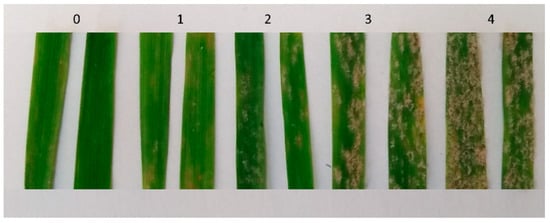
Figure 1.
Photo of leaf fragments showing the different types of plant response to B. graminis f. sp. avenae infection.
Author Contributions
Conceptualization M.C. and S.O.; methodology, M.C. and S.O validation, S.O. formal analysis M.C. and S.O.; data curation, S.O.; writing—original draft preparation, M.C. and S.O.; writing—review and editing, M.C. and S.O. All authors have read and agreed to the published version of the manuscript.
Funding
This research received no external funding.
Data Availability Statement
The data is contained within the manuscript.
Conflicts of Interest
The authors declare no conflict of interest.
References
- Stevens, E.J.; Armstrong, K.W.; Bezar, H.J.; Griffin, W.B.; Hampton, J.G. Fodder Oats: An Overview. In Fodder Oats: A World Overview, 33rd ed.; FAO: Rome, Italy, 2004; pp. 11–18. [Google Scholar]
- Ben Halima, N.; Ben Saad, R.; Khemakhem, B.; Fendri, I.; Abdelkafi, S. Oat (Avena sativa L.): Oil and Nutriment Compounds Valorization for Potential Use in Industrial Applications. J. Oleo Sci. 2015, 64, 915–932. [Google Scholar] [CrossRef] [PubMed]
- Singh, R.; De, S.; Belkheir, A. Avena sativa (Oat), A Potential Neutraceutical and Therapeutic Agent: An Overview. Crit. Rev. Food Sci. Nutr. 2013, 53, 126–144. [Google Scholar] [CrossRef] [PubMed]
- Leszczyńska, D.; Wirkijowska, A.; Gasiński, A.; Średnicka-Tober, D.; Trafiałek, J.; Kazimierczak, R. Oat and Oat Processed Products—Technology, Composition, Nutritional Value, and Health. Appl. Sci. 2023, 13, 11267. [Google Scholar] [CrossRef]
- Liu, B.; Stevens-Green, R.; Johal, D.; Buchanan, R.; Geddes-McAlister, J. Fungal Pathogens of Cereal Crops: Proteomic Insights into Fungal Pathogenesis, Host Defense, and Resistance. J. Plant Physiol. 2022, 269, 153593. [Google Scholar] [CrossRef] [PubMed]
- Różewicz, M.; Wyzińska, M.; Grabiński, J. The Most Important Fungal Diseases of Cereals—Problems and Possible Solutions. Agronomy 2021, 11, 714. [Google Scholar] [CrossRef]
- Dean, R.; Van Kan, J.; Pretorius, Z.; Hammond-Kosack, K.; Di Pietro, A.; Spanu, P.D.; Rudd, J.J.; Dickman, M.; Kahmann, R.; Ellis, J.; et al. The Top 10 Fungal Pathogens in Molecular Plant Pathology. Mol. Plant Pathol. 2012, 13, 414–430. [Google Scholar] [CrossRef]
- Aung, T.; Thomas, H.; Jones, I.T. The Transfer of the Gene for Mildew Resistance from Avena barbata (4x) into the Cultivated Oat A. sativa by an Induced Translocation. Euphytica 1977, 26, 623–632. [Google Scholar] [CrossRef]
- Roderick, H.W.; Jones, E.R.L.; Šebesta, J.; Sebesta, J. Resistance to Oat Powdery Mildew in Britain and Europe: A Review. Ann. Appl. Biol. 2000, 136, 85–91. [Google Scholar] [CrossRef]
- Sebesta, J.; Kummer, M.; Roderick, H.W.W.; Hoppe, H.D.D.; Swierczewski, A.; Mueller, K.; Cervenka, J.; Swierczewski, A.; Muller, K. Breeding Oats for Resistance to Rusts and Powdery Mildew in Central Europe. Ochr. Rostl. 1991, 27, 229–238. [Google Scholar]
- Banyal, D.K.; Sood, V.K.; Singh, A.; Mawar, R. Integrated Management of Oat Diseases in North-Western Himalaya. Range Manag. Agrofor. 2016, 37, 84–87. [Google Scholar]
- Xue, L.H.; Li, C.J.; Zhao, G.Q. First Report of Powdery Mildew Caused by Blumeria graminison Avena sativa in China. Plant Dis. 2017, 101, 1954. [Google Scholar] [CrossRef]
- Lawes, D.A.; Hayes, J.D. The Effect of Mildew (Erysiphe graminis f.Sp. Avenae) on Spring Oats. Plant Pathol. 1965, 14, 125–128. [Google Scholar] [CrossRef]
- Jones, I.T.; Roderick, H.W.; Clifford, B.C. The Integration of Host Resistance with Fungicides in the Control of Oat Powdery Mildew. Ann. Appl. Biol. 1987, 110, 591–602. [Google Scholar] [CrossRef]
- Montilla-Bascón, G.; Rispail, N.; Sánchez-Martín, J.; Rubiales, D.; Mur, L.A.J.; Langdon, T.; Howarth, C.J.; Prats, E. Genome-Wide Association Study for Crown Rust (Puccinia coronata f. Sp. Avenae) and Powdery Mildew (Blumeria graminis f. Sp. Avenae) Resistance in an Oat (Avena sativa) Collection of Commercial Varieties and Landraces. Front. Plant Sci. 2015, 6, 103. [Google Scholar] [CrossRef] [PubMed]
- Zuccaro, A.; Langen, G. Breeding for Resistance: Can We Increase Crop Resistance to Pathogens without Compromising the Ability to Accommodate Beneficial Microbes? New Phytol. 2020, 227, 279–282. [Google Scholar] [CrossRef]
- Flor, H.H. Current Status of the Gene-For-Gene Concept. Annu. Rev. Phytopathol. 1971, 9, 275–296. [Google Scholar] [CrossRef]
- Heath, M.C. Nonhost Resistance and Nonspecific Plant Defenses. Curr. Opin. Plant Biol. 2000, 3, 315–319. [Google Scholar] [CrossRef]
- Ociepa, T.; Okoń, S.; Nucia, A.; Leśniowska-Nowak, J.; Paczos-Grzęda, E.; Bisaga, M. Molecular Identification and Chromosomal Localization of New Powdery Mildew Resistance Gene Pm11 in Oat. Theor. Appl. Genet. 2020, 133, 179–185. [Google Scholar] [CrossRef]
- Ociepa, T.; Okoń, S. Chromosomal Location of Pm12-A Novel Powdery Mildew Resistance Gene from Avena sterilis. Genes 2022, 13, 2409. [Google Scholar] [CrossRef]
- Herrmann, M.H.; Mohler, V. Locating Two Novel Genes for Resistance to Powdery Mildew from Avena byzantina in the Oat Genome. Plant Breed. 2018, 137, 832–838. [Google Scholar] [CrossRef]
- Hsam, S.L.K.; Mohler, V.; Zeller, F.J. The Genetics of Resistance to Powdery Mildew in Cultivated Oats (Avena sativa L.): Current Status of Major Genes. J. Appl. Genet. 2014, 55, 155–162. [Google Scholar] [CrossRef] [PubMed]
- Hsam, S.L.K.; Peters, N.; Paderina, E.V.; Felsenstein, F.; Oppitz, K.; Zeller, F.J. Genetic Studies of Powdery Mildew Resistance in Common Oat (Avena sativa L.) I. Cultivars and Breeding Lines Grown in Western Europe and North America. Euphytica 1997, 96, 421–427. [Google Scholar] [CrossRef]
- Hsam, S.L.K.; Pederina, E.; Gorde, S.; Zeller, F.J. Genetic Studies of Powdery Mildew Resistance in Common Oat (Avena staiva L.). II. Cultivars and Breeding Lines Grown in Northern and Eastern Europe. Hereditas 1998, 129, 227–230. [Google Scholar] [CrossRef]
- Hsam, S.L.K.; Zeller, F.J. Chromosomal Location of Genes for Resistance to Powdery Mildew in Cultivated Oat (Avena sativa L.). 1. Gene Eg-3 in the Cultivar ‘Mostyn’. Plant Breed. 1998, 117, 177–178. [Google Scholar] [CrossRef]
- Okoń, S.; Ociepa, T.; Paczos-Grzęda, E.; Kowalczyk, K. Analysis of the Level of Resistance of Polish Oat Cultivars (Avena sativa L.) to Powdery Mildew (Blumeria graminis DC. f. Sp. Avenae Em. Marchal.). Agron. Sci. 2016, 61, 51–60. [Google Scholar] [CrossRef]
- Okoń, S.M. Identification of Powdery Mildew Resistance Genes in Polish Common Oat (Avena sativa L.) Cultivars Using Host-Pathogen Tests. Acta Agrobot. 2012, 65, 63–68. [Google Scholar] [CrossRef]
- Kowalczyk, K.; Hsam, S.L.K.; Zeller, F.J. Identification of Oat Powdery Mildew Resistance 2 (OMR2) and Polish Common Oat (Avena sativa L.) Cultivars; Workshop “Resistance of Cereals to Biotic Stresses”: Radzików, Poland, 2004. [Google Scholar]
- Pietrusińska, A.; Czembor, J.H. Gene Pyramiding—A Tool Commonly Used in Breeding Programs Breeding Programs. Biul. Inst. Hod. I Aklim. Roślin 2015, 278, 3–16. [Google Scholar]
- Mains, E.B. Inheritance of Resistance to Powdery Mildew, Erysiphe Graminis Tritici, in Wheat. Phytopathology 1934, 24, 1257–1261. [Google Scholar]
- Pietrusińska, A.; Czembor, P.C.; Czembor, J.H. Lr39 + Pm21: A New Effective Combination of Resistance Genes for Leaf Rust and Powdery Mildew in Wheat. Czech J. Genet. Plant Breed. 2013, 49, 109–115. [Google Scholar] [CrossRef]
- Okoń, S.M. Effectiveness of Resistance Genes to Powdery Mildew in Oat. Crop Prot. 2015, 74, 48–50. [Google Scholar] [CrossRef]
- Cieplak, M.; Nucia, A.; Ociepa, T.; Okoń, S. Virulence Structure and Genetic Diversity of Blumeria graminis f. Sp. Avenae from Different Regions of Europe. Plants 2022, 11, 1358. [Google Scholar] [CrossRef]
- Brodführer, S.; Mohler, V.; Stadlmeier, M.; Okoń, S.; Beuch, S.; Mascher, M.; Tinker, N.A.; Bekele, W.A.; Hackauf, B.; Herrmann, M.H. Genetic Mapping of the Powdery Mildew Resistance Gene Pm7 on Oat Chromosome 5D. Theor. Appl. Genet. 2023, 136, 53. [Google Scholar] [CrossRef] [PubMed]
- Okoń, S.; Cieplak, M.; Kuzdraliński, A.; Ociepa, T. New Pathotype Nomenclature for Better Characterisation the Virulence and Diversity of Blumeria graminis f. Sp. Avenae Populations. Agronomy 2021, 11, 1852. [Google Scholar] [CrossRef]
- Pink, D.A.C.; Hand, P. Plant Resistance and Strategies for Breeding Resistant Varieties. Plant Prot. Sci. 2002, 38, S9–S14. [Google Scholar] [CrossRef]
- Pandolfi, V.; Neto, J.; Silva, M.; Amorim, L.; Wanderley-Nogueira, A.; Silva, R.; Kido, E.; Crovella, S.; Iseppon, A. Resistance (R) Genes: Applications and Prospects for Plant Biotechnology and Breeding. Curr. Protein Pept. Sci. 2016, 18, 323–334. [Google Scholar] [CrossRef]
- Newton, A.C.; Torrance, L.; Holden, N.; Toth, I.K.; Cooke, D.E.L.; Blok, V.; Gilroy, E.M. Climate Change and Defense against Pathogens in Plants. Adv. Appl. Microbiol. 2012, 81, 89–132. [Google Scholar]
- Elad, Y.; Pertot, I. Climate Change Impacts on Plant Pathogens and Plant Diseases. J. Crop Improv. 2014, 28, 99–139. [Google Scholar] [CrossRef]
- Stam, R.; McDonald, B.A. When Resistance Gene Pyramids Are Not Durable—The Role of Pathogen Diversity. Mol. Plant Pathol. 2018, 19, 521. [Google Scholar] [CrossRef] [PubMed]
- Sebesta, J.; Roderick, H.W.; Chong, J.; Harder, D.E. The Oat Line Pc54 as a Source of Resistance to Crown Rust, Stem Rust and Powdery Mildew in Europe. Euphytica 1993, 71, 91–97. [Google Scholar] [CrossRef]
- Herrmann, M.; Roderick, H.W. Characterisation of New Oat Germplasm for Resistance to Powdery Mildew. Euphytica 1996, 89, 405–410. [Google Scholar] [CrossRef]
- Saker, M.; Adawy, S.; Smith, C.M. Entomological and Genetic Variation of Cultivated Barley (Hordeum vulgare) from Egypt. Arch. Phytopathol. Plant Prot. 2008, 41, 526–536. [Google Scholar] [CrossRef]
- Li, H.B.; Zhou, M.X.; Liu, C.J. A Major QTL Conferring Crown Rot Resistance in Barley and Its Association with Plant Height. Theor. Appl. Genet. 2009, 118, 903–910. [Google Scholar] [CrossRef] [PubMed]
- Sánchez-Martín, J.; Rubiales, D.; Prats, E. Resistance to Powdery Mildew (Blumeria graminis f. Sp. Avenae) in Oat Seedlings and Adult Plants. Plant Pathol. 2011, 60, 846–856. [Google Scholar] [CrossRef]
- Admassu-Yimer, B.; Gordon, T.; Harrison, S.; Kianian, S.; Bockelman, H.; Bonman, J.M.; Esvelt Klos, K. New Sources of Adult Plant and Seedling Resistance to Puccinia coronata f. Sp. Avenae Identified among Avena sativa Accessions from the National Small Grains Collection. Plant Dis. 2018, 102, 2180–2186. [Google Scholar] [CrossRef] [PubMed]
- Okoń, S.; Kowalczyk, K. Screening Oat Landraces for Resistance to Blumeria graminis f. Sp. Avenae. J. Plant Pathol. 2020, 102, 893–898. [Google Scholar] [CrossRef]
Disclaimer/Publisher’s Note: The statements, opinions and data contained in all publications are solely those of the individual author(s) and contributor(s) and not of MDPI and/or the editor(s). MDPI and/or the editor(s) disclaim responsibility for any injury to people or property resulting from any ideas, methods, instructions or products referred to in the content. |
© 2023 by the authors. Licensee MDPI, Basel, Switzerland. This article is an open access article distributed under the terms and conditions of the Creative Commons Attribution (CC BY) license (https://creativecommons.org/licenses/by/4.0/).