


Abstract
Production of many crops, including onion, under salinity is lagging due to limited information on the physiological, biochemical and molecular mechanisms of salt stress tolerance in plants. Hence, the present study was conducted to identify salt-tolerant onion genotypes based on physiological and biochemical mechanisms associated with their differential responses. Thirty-six accessions were evaluated under control and salt stress conditions, and based on growth and bulb yield. Results revealed that plant height (6.07%), number of leaves per plant (3.07%), bulb diameter (11.38%), bulb yield per plant (31.24%), and total soluble solids (8.34%) were reduced significantly compared to control. Based on percent bulb yield reduction, seven varieties were classified as salt tolerant (with <20% yield reduction), seven as salt-sensitive (with >40% yield reduction) and the remaining as moderately tolerant (with 20 to 40% yield reduction). Finally, seven salt-tolerant and seven salt-sensitive accessions were selected for detailed study of their physiological and biochemical traits and their differential responses under salinity. High relative water content (RWC), membrane stability index (MSI), proline content (PRO), and better antioxidants such as super oxide dismutase (SOD), peroxidase (POX), catalase (CAT), and ascorbate peroxidase (APX) were observed in tolerant accessions, viz. POS35, NHRDF Red (L-28), GWO 1, POS36, NHRDF Red-4 (L-744), POS37, and POS38. Conversely, increased malondialdehyde (MDA) and hydrogen peroxide (H2O2) content, reduced activity of antioxidants, more membrane injury, and high Na+/K+ ratio were observed in sensitive accessions, viz. ALR, GJWO 3, Kalyanpur Red Round, NHRDF Red-3 (L-652), Agrifound White, and NHRDF (L-920). Stepwise regression analysis identified bulb diameter), plant height, APX, stomatal conductance (gS), POX, CAT, MDA, MSI, and bulb Na+/K+ ratio as predictor traits accounting for maximum variation in bulb yield under salinity. The identified seven salt-tolerant varieties can be used in future onion breeding programs for developing tolerant genotypes for salt-prone areas.
1. Introduction
Onion is second most important vegetable crop after tomato with global production of 104.6 million tonnes from 5.48 million hectare area [1]. Asia accounts for the maximum share (66.8%) of total onion production in the world, followed by Africa (13.5%), Europe (9.9%), the Americas (9.6), and Oceania (0.3%) [1]. Maximum bulb onion production (26.74 million tonnes) in India consists of a 1.43 million hectare area with a productivity of 18.64 t/ha, which is less than other countries, viz. Republic of Korea (79.6 t/ha), USA, Australia, Spain, and Japan. In India, onions are grown in a wide range of climatic conditions [2]. Onion is consumed both fresh as well as in the form of processed products, owing to its nutritional and medicinal properties [3]. Onion contains bioactive compounds (quercetin, rutin etc.) and its regular consumption reduces the risk of cancer, heart diseases, diabetes, and production of reactive oxygen species [4]. Most onions in India are produced during the post-monsoon season; owing to shallow roots, onions are highly vulnerable to climatic conditions such as salinity and drought because of inadequate rainfall and low moisture content [5]. Onion is a salt-sensitive crop and because of its threshold level (1.4 dS m−1), the per unit increase in EC reduces 18.52% of the tuber yield [6]. The world’s 950 mha area of land (10%), 300 mha cultivated land (20%), and 230 m ha (50%) irrigated land are distressed by salt stress. Annually, about a USD 12 billion loss is estimated because of salt stress, which adversely affects agriculture production. Salinity changes the morpho-physiological, biochemical, and metabolic processes and affects onion growth and development [7]. Soil salinity increases the Na+ and Cl− concentration in different plant parts, which ultimately influences the ionic activity in plant cells [8]. Salt stress-induced oxidative stress leads to leakage of ions, plasmolysis, membrane damage, disturbed nutrient flux, and ROS detoxification systems. These alterations adversely affect respiration, photosynthesis, hormonal balance, antioxidants activity, water use efficiency, transpiration, and plasma membrane functioning [9]. The adverse effect of salt stress on onion morphology includes reduced bulb weight, bulb diameter, plant height, leaf number per plant, root growth, and crop cycle [6,10]. High salinity decreases the production of large bulbs and maximum decreases were observed at 2.8 dS m−1 [11]. Plants develop different strategies such as avoidance and tissue tolerance to reduce the negative effects of salt stress. Plants also produce various compatible solutes such as glycine betaine, proline, and sugars to regulate osmotic pressure [12]. Likewise, plants produce proteins and antioxidants to counter the negative effect of reactive oxygen species. Tissue tolerance protects the plant cells by executing ion compartmentalization in plant tissues [13]. A low Na+/K+ ratio also plays a significant role in balancing the osmotic pressure and membrane stability [7].
The present study was initiated because there is not much literature on the effect of salinity stress on Indian short-day onions. To develop a breeding strategy for the development of salinity stress-tolerant onions, the basic step is to evaluate the onion accessions and to identify the promising accessions for formulating future strategies.
In view of the scant information on the effect of salinity stress on Indian short-day onions, present study was initiated with the objective to determine the effect of salinity stress on growth and development of onions. Keeping in view this objective, we formulated and tested three research hypothesis, i.e., (i) whether salinity stress negatively affects the bulb yield and yield associated traits in onion, (ii) whether salt tolerant and salt sensitive accessions differ in physicochemical responses?, and (iii) of the most important parameters (morphological, physiological, and biochemical), which ones need to be considered for the screening and development of salt tolerant onion cultivars? To achieve these objectives, thirty-six onion cultivars were considered in the present investigation.
2. Materials and Methods
2.1. Characterization and Evaluation of Onion Accessions
Thirty-six diverse Indian short-day onion accessions including the released cultivars and some of the promising advance lines were collected from the National Horticulture Research and Development Foundation (NHRDF), Karnal; ICAR-Directorate of Onion and Garlic Research, Pune; and ICAR-Indian Agricultural Research Institute (IARI), New Delhi, India (Table 1). Seeds were sown in nursery beds and seedlings were transplanted in three replications using randomized complete block design (RCBD) under control and under saline conditions (ECiw 7 dS m−1) in microplots during the rabi season of 2019–20.

Table 1.
Passport information of onion accessions collected for salinity tolerance evaluation.
In each replication, 20 plants were maintained following a plant geometry of 15 × 10 cm. Soil samples were collected before sowing and after harvesting of the crop of both the treatments and analysed (Table 2). For saline treatment, natural saline ground water (ECiw~18 dS m−1) was used for the preparation of desired saline water salinity (ECiw 7 dS m−1), whereas the normal water of ECiw~1.04 dS m−1 was used for control treatment. Seven days after transplanting, the irrigation was given as per treatment and subsequent irrigation was given as per crop need on the basis of 100% evapotranspiration (ET), and a total of 17 irrigations were applied during the whole crop cycle. After soil analysis, the required dose of NPK was applied and the recommended packages of practices were followed for growing a good crop. As per recommendations, 50% nitrogen and 100% phosphorus and potassium were applied before transplanting, and the remaining nitrogen dose was applied in two split doses, i.e., 30 and 45 days after transplanting. Harvesting of onion bulbs was done when the leaves turned yellow and more than 50 percent neckfall was observed. The bulbs were dug out along with their leaves and the tops were removed, leaving a 2 cm neck portion attached to the bulbs. Harvested bulbs were kept under shade for curing and then sorting before grading was done.
Table 2.
Soil status: Initial and final soil salinity.
2.2. Morphometric and Yield-Related Traits
The data recorded were concerned the plant height (cm), no. of leaves/plant, bulb diameter (cm), bulb yield/plant, and total soluble solids (TSS, °Brix). The replicate-wise data of morphological traits of 10 selected plants were measured after 100 days of transplanting. The bulb yield of 10 plants was harvested separately from control and saline environments. Bulbs were inspected visually for rotting or sprouting damage. Equatorial bulb diameter (cm) of the same 10 plants was measured with the help of the digital Vernier Caliper. The TSS content of the selected bulbs was measured just after bulb harvesting with the help of a portable hand refractometer (Erma Inc., Tokyo, Japan) as °Brix (%) at 20 °C.
2.3. Physio-Biochemical and Ion Estimation
A total of 36 accessions were characterized under a saline environment, and out of these, 14 contrasting accessions were further selected for detailed studies of physiological, biochemical, and antioxidant enzymes, as well as ion contents. Out of the 14 accessions, 7 accessions (POS35, L-28, GJWO-1, POS36, L-744, POS37, POS38) had ≤20% yield reduction under saline conditions and were categorised as salt-tolerant. The other 7 accessions (ALR, GJWO3, KKR, L-652, Agrifound White, L-920, Bhima Dark Red) had ≥40% yield reduction and were categorized as salt-sensitive. These 14 accessions were again transplanted in microplots during the rabi season of 2020–21 for physiological, biochemical, and ionic analysis, and the package of practices and salinity treatments were followed as per the previous year’s (2019–20) experiment.
2.3.1. Physiological Traits
Physiological and biochemical traits were measured at 55 days after transplanting. The method given by Weatheraly [14] was used to estimate the relative water content (RWC). The leaf membrane thermostability index was estimated by using the electrolyte leakage percentage following the procedure of Dionisio-Sese and Tobita [15]. Photosynthesis rate (Pn), transpiration rate (E), and stomatal conductance (gS) of the 3rd fully expanded leaves were estimated using a portable photosynthetic system (Li 6800, Li-Cor Biosciences, Lincoln, NE, USA) following the method of Kumar et al. [16].
2.3.2. Biochemical Traits
The method given by Bates et al. [17] was used to estimate the proline content. H2O2 content was calculated as per the method given by Loreto and Velikova [18]. MDA content was measured at 532 and 600 nm by using same the supernatant which was used for the estimation of H2O2 concentration [19]. A modified approach was followed for the extraction of antioxidant enzymes, superoxide dismutase (SOD), and ascorbate peroxidase (APX) [20]. Peroxidase (POX) was estimated as per the method suggested by Beauchamp and Fridovich [21]. One unit of APX corresponded to a change in O.D. of 1.0 per minute [22]. The POX activity was determined by using 1.0 mol of H2O2 per minute [23]. Based on the breakdown of H2O2 at 240 nm, the catalase (CAT) activity was measured for 1 min [24].
2.3.3. Ion Concentration
Na+ and K+ contents of leaves, roots, and bulbs were determined at the time of harvesting using the flame photometer (Systronics Flame Photometer 128, Olathe, KS, USA) and estimated as mg g−1 of dry weight.
2.4. Statistical Analysis
In the first experiment, five observations, i.e., plant height (cm), number of leaves/plant, equatorial bulb diameter (cm), bulb yield/plant (g), and TSS (°Brix) were recorded for preliminary screening. Onion accessions were categorized on the basis of bulb yield reduction (%) under salinity stress in comparison to the control conditions. Based on percent bulb yield reduction, seven tolerant (≤20%) and seven susceptible (≥40%) accessions were selected for a second experiment to determine the physio-biochemical basis of salinity tolerance.
In experiment 2, all the recorded parameters were put on a Microsoft excel sheet thematically and a test of normality for each parameter was performed through the Shapiro–Wilk test to comply with the assumptions of ANOVA and the appropriate transformation procedure was applied for violated parameters. Further, the approach of two-way analysis of variance (ANOVA) was applied for estimating the effect of genotypes and salinity, and their interaction and group comparison was made between tolerant and sensitive cultivars through contrast analysis using STAR statistical software [25]. The relative contribution of different traits in total genetic divergence of the onion genotypes in control and salinity stress conditions were quantified through the method proposed by Singh [26]. To find out the significant differences in various traits recorded in onion genotypes under salinity stress and control conditions, Duncan’s Multiple Range Test (DMRT) was performed using STAR statistical software [25]. To predict the bulb yield under salinity stress, a response equation was derived through a stepwise regression approach, and significantly associated (p > 0.005) morphological, physiological, and biochemical traits with bulb yield were also prioritized for conducting future studies on salinity stress tolerance in onions.
3. Results
3.1. Effects of Salinity on Selected Onion Accessions
The combined ANOVA of fourteen accessions characterized under normal and salt stress environments showed highly significant differences (p ≤ 0.01) for physiological parameters (SPAD, RWC, MSI, Pn, E and gS), biochemical parameters (Proline, H2O2, MDA, CAT, APX, SOD and POX), growth and bulb parameters (PH, NL, BD, BYP and TSS), and ionic concentrations (root Na+/K+, shoot Na+/K+ and bulb Na+/K+) (Table 3). The results indicated that the amount of variability present among the accessions would be helpful in the selection and utilization of promising salt-tolerant genotypes in onion breeding. Genotypes and environmental interactions were also found to be significant (p ≤ 0.01) for all the studied parameters, except NL, suggesting that most of the genotypes performed differentially in varying environmental conditions. Thus, the significance of variances for both genotypes and the interaction effect indicated that all the studied parameters were highly influenced by genotypes as well as the salt stress condition.
Table 3.
Variance analysis of morpho-physiological and biochemical traits of 14 selected onion accessions over control and saline environment.
3.2. Impact of Salt Stress on Growth and Bulb Parameters
Five growth and bulb parameters were selected for preliminary screening of thirty six onion accessions under normal and saline environments. Salinity stress significantly affects the plant height, bulb diameter, bulb yield per plant, and total soluble solids by 6.07%, 3.07%, 11.38%, 31.24%, and 8.34% compared to control condition, respectively. The percent bulb yield reduction ranged from 14.88% in POS35 to 62.86% in Bhima Dark Red (Table S1). On the basis of bulb yield reduction (%) due to salinity stress, the 36 accessions were classified into three groups. Seven accessions (POS35, L-28, GWO-1, POS36, L-744, POS37, and POS38) had less than 20% bulb yield reduction and were identified as salt-tolerant, whereas seven genotype accessions (ALR, GJWO 3, Kalyanpur Red Round (KKR), L-652, Agrifound White, L-920, Bhima Dark Red) with more than 40% yield reduction were classified as salt-sensitive (Table 4). Finally, we selected fourteen accessions, i.e., seven tolerant and seven sensitive, to observe the differential behavior in their physiological and biochemical traits under control and saline environments. Among the fourteen accessions, the bulb yield per plant under the saline environment was the highest in tolerant accessions with a reduction percentage ranging from 14.88 (POS35) to 19.76% (POS38), whereas a severe decline was recorded in salt sensitive accessions ranging from 42.48 (ALR) to 62.86% (Bhima Dark Red) (Table 5). The parameters such as PH, BD, and BYP were significantly reduced under salinity stress; however, TSS content was significantly increased in onion bulb though salinity treatment. Interestingly, a non-significant difference in numbers of leaves per plant (NOL) was observed under control and salinity conditions (Table 6).
Table 4.
Grouping of onion accessions on % bulb yield reduction in saline environment.
Table 5.
Means comparisons of morphological traits of selected onion accessions under control and salinity stress.
Table 6.
Effects of salinity stress on tolerant and sensitive onion cultivars through group comparison analysis.
3.3. Physiological Responses
Physiological parameters such as SPAD, RWC, MSI, Pn, E, and gS were found higher in tolerant accessions compared to sensitive ones under salt stress. RWC and MSI were related directly to salinity stress and vary significantly among all the onion accessions under salt stress. The tolerant accessions on average maintained higher RWC (>80%) and higher MSI (>70%) under stress conditions (Figure 1). Conversely, sensitive varieties showed lower RWC and more membrane damage. The percent reduction in RWC varied between 1.34 (POS36) to 3.41% (POS37) and 6.54 (ALR) to 13.96% (L-652) in tolerant and sensitive accessions, respectively. Likewise, the reduction percentage in MSI was 10.98 (POS35) to 16.02% (L-28) in tolerant and 19.27 (GJWO 3) to 26.24% (KRR) in sensitive varieties. A similar trend was observed for SPAD index. Tolerant varieties stayed green for a longer time whereas sensitive genotypes showed early leaf senescence in response to salt stress. Moreover, the photosynthetic rate and stomatal conductance were reduced significantly under a saline environment. The photosynthetic rate decreased by 28% in tolerant and by 39% in sensitive accessions. The highest Photosynthetic rate was observed in POS35 (14.17 μmol m−2 s−1) and POS37 (13.67 μmol m−2 s−1), whereas a minimum was found in Bhima Dark Red (8.45 μmol m−2 s−1) and GJWO 3 (8.80 μmol m−2 s−1). Furthermore, sensitive varieties showed a drastic reduction in stomata conductance (Figure 2) compared to tolerant ones. The maximum reduction percentage ranged from 18.52% (GJWO 1) to 29.27% (POS37) in salt-tolerant accessions and 33.19% (KRR) to 50% (L-920) in sensitive varieties, respectively. The tolerant cultivars maintained higher chlorophyll content, RWC, MSI, gS, and Pn compared to sensitive ones, except for the transpiration rate.
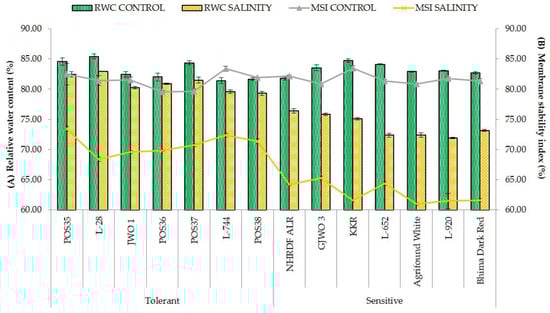
Figure 1.
Changes in relative water content (%) (A); and membrane stability index (%) (B) of onion accessions under control and salinity stress.
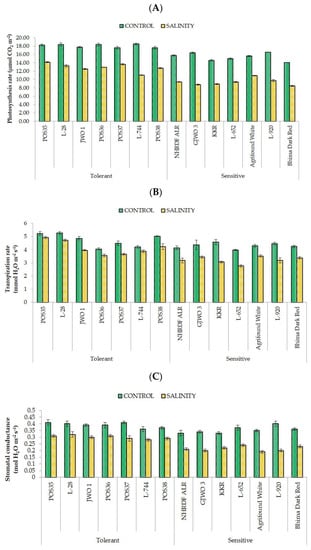
Figure 2.
Alteration in gas exchange traits [Photosynthetic rate, (A); Transpiration rate, (B); and Stomatal conductance (C)] of onion accessions under control and saline environments.
3.4. Biochemical Responses
Salinity stress significantly increased the production of H2O2 and lipid peroxidation via MDA content in all onion accessions (Figure 3). However, differential behaviors of salt tolerant and sensitive accessions were observed for H2O2 and MDA accumulation. The H2O2 content ranged from 2.56 µmoles/g FW (GJWO 3) to 2.80 µmoles/g FW (ALR) in salt-sensitive accessions, and from 2.12 µmoles/g FW (GJWO 1) to 2.54 µmoles/g FW (L-28) in salt-tolerant accessions under a saline environment. Similarly, the accumulation of MDA was higher in sensitive accessions, i.e., 27.33 nmol/g FW(ALR) to 30.60 nmol/g FW (Bhima Dark Red), with lower accumulation in tolerant ones, i.e., 20.74 nmol/g FW (POS38) to 23.50 nmol/g FW (POS36) under stress conditions. The activity of proline and antioxidant defense-related enzymes (CAT, APX, SOD, and POX), which are involved in ROS scavenging during stress conditions, were found to be higher in salt-tolerant and lower in salt-sensitive accessions. The maximum increment in proline content ranged from 109% (GJWO 1) to 196% (L-744) in salt-tolerant and 100% (GJWO 3) to 145% (L-652) in salt-sensitive accessions (Figure 3). Likewise, the percent increment in antioxidants activity of CAT, APX, SOD, and POX varied between 24.76 (GJWO 1) to 41.96% (POS35), 88 (GJWO 1) to 123% (L-744), 57 (POS35) to 72% (L-28), and 92.14 (L-28) to 149.53% (GJWO 1) in salt-tolerant accessions, whereas the range was 15.61 (Agrifound White) to 28.55% (L-652), 49 (GJWO 3) to 83% (L-652), 42 (Bhima Dark Red) to 64% (L-652), and 39.64 (L-652) to 113.52% (KKR) in salt-sensitive accessions, respectively (Figure 4). The tolerant cultivars show a higher activity of antioxidant enzymes and lower production of H2O2 and lipid peroxidation compared to sensitive ones (Table 6).
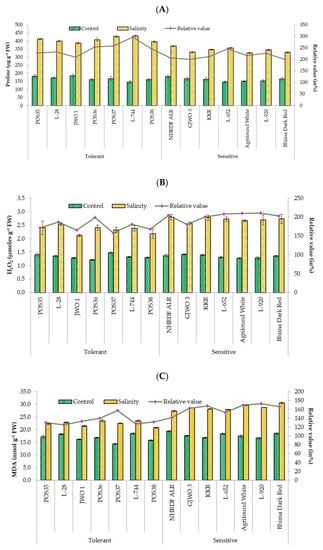
Figure 3.
Alterations in biochemical parameters [Proline, (A); Hydrogen peroxide (H2O2) (B); and Malondialdehyde (MDA) (C)] of selected onion accessions under control and salinity stress.
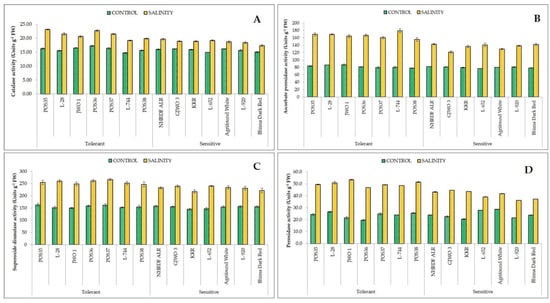
Figure 4.
Antioxidative enzymes activity (CAT, (A); APX, (B); SOD, (C); and POX, (D)) of selected onion accessions under control and salinity.
3.5. Accumulation of Ion Concentrations
Under a saline environment, Na+ accumulation increased significantly in the roots, shoots, and bulbs of all the fourteen onion accessions (Table 6). The Na+/K+ ratio in the roots ranged from 1.05 (L-920) to 2.48 (KRR) under control and from 3.10 (GJWO 1, POS 36) to 3.79 (KRR) under stress conditions. In shoots, the range varied between 0.71 (L-920) to 1.67 (POS 36) under control and 1.44 (POS37) to 3.88 (ALR) under salinity stress. Similarly, the ratio in bulbs was 0.19 (Bhima Dark Red and Agrifound White) to 0.26 (GJWO 1 and ALR) and 0.26 (POS 36) to 0.41 (GJWO1) under control and stress conditions, respectively. The increase in the Na+/K+ ratio was found more in salt-sensitive accessions than in salt-tolerant ones (Table 6). The percent increment in roots, shoots, and bulbs ranged from 53.70 (POS38) to 169.57% (GJWO 1), 35.85 (POS37) to 130.48% (GJWO 1), 13.04 (POS 36) to 57.69% (GJWO 1) in salt-tolerant accessions, and 47.42 (Bhima Dark Red) to 213.33% (L-920), 128.30 (L-652) to 288.73% (L-920), and 19.23 (ALR) to 94.74% (Bhima Dark Red) in salt-sensitive varieties, respectively (Table S2).
3.6. Traits Contributing towards Bulb Yield Divergence
The percentage change in twenty traits in the saline environment and their direction of magnitude are represented in (Table 7). PRO (129.33%), H2O2 (88.38%), MDA (48.27%), CAT (25.90%), APX (86.18%), SOD (57.52%), POX (90.01%), Root Na+/K+ (102.54%), Shoot Na+/K+ (136.61%), and Bulb Na+/K+ (41.54%) showed an increment, whereas SPAD (4.15%), RWC (6.92%), MSI (18.09%), Pn (33.42%), E (18.53%), gS (31.09%), PH (5.45%), NL (1.79%), BD (12.04%), BYP (30.01%), and TSS (8.30 °Brix) showed a decrease in the mean value in the saline environment. Divergence analysis revealed that BYP (73.66%) followed by TSS (6.19 °Brix) and Shoot Na+/K+ (5.79%) were the greatest toward genetic divergence of the fourteen accessions under control conditions, whereas BYP (78.80%), followed by POX (3.83%), MDA (3.27%), RWC (2.58%), and Shoot Na+/K+ (2.54%) contributed maximally under salt stress. (Table 8) Thus, these traits can be exploited for the identification of genetically divergent parents for the genetic improvement program of onions. A stepwise regression analysis was done to identify the component variables contributing significantly to bulb yield under salinity stress. The results indicated that BD, PH, APX, gS, POX, CAT, MDA, MSI, and bulb Na+/K+ ratio accounted for the maximum variation of bulb yield in onions under stress conditions with cumulative R2 = 97.60. A significantly positive regression coefficient of BD, PH, APX, POX, MDA, MSI, and bulb Na+/K+ ratio indicated that an increment in the value of these traits might increase the bulb yield of onions. On the basis of regression coefficients of significant traits, the predicted model equation for bulb yield under salt stress (Table S3) was computed as:
Predicted bulb yield = −409.75 + (21.38 × BD) + (2.28 × PH) + (0.52 × APX) + (−137.77 × gS) + (1.21 × POX) + (−1.47 × CAT) + (3.21 × MDA) + (1.44 × MSI) + (Bulb Na+/K+)
Table 7.
Relative contribution of different physiological, biochemical, and yield-related traits toward genetic divergence in onion accessions.
Table 8.
Traits prioritization for salinity stress tolerance in onions through stepwise regression approach.
4. Discussion
To study the physiological and biochemical responses of thirty six onion accessions, we first evaluated them based on growth and bulb parameters. The results of the primary trial showed a significant reduction in plant height (1.07–12.91%), bulb diameter (0.37–25.85%), bulb yield per plant (14.88–62.86%), and total soluble solids (1.43–20%) under salinity stress in comparison to control (Table S1). However, accessions differences were observed for reduction percentage in studied parameters. Based on percent bulb yield reduction, we selected seven salt-tolerant (less than 20% yield reduction) and seven-salt sensitive (more than 40% yield reduction) accessions to study the various physiological and biochemical changes in onion varieties as adaptive mechanisms. Plant height reduction in onions may be due to a decline in cell division and cell expansion under stress conditions, which ultimately reduces the overall plant growth [27]. Moreover, refs. [28,29] reported that increased salt stress reduces leaf growth, number of leaves, number of branches, and stem diameter. Onions are a salt-sensitive crop and irrigation with saline water reduces the production of large sized bulbs, fresh weight, bulb firmness, water use efficiency, and bulb yield [11]. Furthermore, a differential reduction rate in water dropwort cultivars for plant height, number of branches, number of leaves, and stem length was observed with increasing salt concentrations [30]. Accumulation of excessive salt in leaves might be the probable cause of reduction in the leaf area of onions [31,32,33].
RWC and MSI are the most commonly used adaptive parameters for the selection of tolerant accessions under abiotic stress environments. Maintenance of high RWC and MSI are decisive indicators of high cellular turgidity and less cellular or membrane injuries in plants [33]. Additionally, most of the physiological and biochemical processes such as cell division, cell enlargement, stomatal opening, and transportation in plants are dependent on the water status of the plant cells. Therefore, any reduction in water status adversely affects the plant’s metabolic functioning. Our results demonstrated that tolerant onion varieties showed high RWC and MSI rather than sensitive genotypes showing an agreement with the results of [34,35,36]. Furthermore, the ability of plants to maintain a normal photosynthetic rate, stomatal conductance, and transpiration rate reflects the ability of salt tolerance. The obtained results in the present study showed a negative effect of salt stress on SPAD, Pn, gS, and E in all fourteen accessions. However, tolerant accessions showed a lesser reduction percentage compared to sensitive ones. These results are in agreement with the findings of earlier studies [37,38,39] that reported a significant decrease in photosynthetic rate, transpiration rate, and chlorophyll content under salt stress. The decline in SPAD index under salinity may be due to photo-oxidation, loss of chloroplast membranes, and membrane injury in chloroplasts by ROS [40,41,42]. However, in some studies, higher chlorophyll content was recorded in the saline environment, which may have been caused by the increase in number of chloroplasts [30,43]. Moreover, under excessive salinity, fewer gaseous exchanges occur in leaves because of the high sensitivity of stomata to abiotic stresses, leading to a reduction in transpiration and photosynthetic rates [44,45,46,47]. Lipid peroxidation (MDA) and production of reactive oxygen species (H2O2) are commonly used biochemical indicators for plants exposed to abiotic stresses [48]. The high concentration of MDA and H2O2 under salt stress leads to cell membrane damage and electrolyte leakage [49]. In the present research, the accumulation of MDA and H2O2 was less in tolerant accessions compared to sensitive ones, indicating less oxidative damage to cell membranes of tolerant accessions. These results are also supported by other studies [30,50,51], in which lower ROS production and lipid peroxidation and high membrane stability in salt-tolerant genotypes of rice, wheat, and water dropwort were reported. The compatible solute proline plays a very important role in maintaining the osmotic potential of cytosol with the external environment [52]. The proline activity was observed as high under salt-stressed plants of tolerant accessions, whereas in sensitive accessions, the activity was comparatively lower. The enhanced activity of proline might be the important factor in neutralizing the negative effect of salinity stress via osmotic adjustment [53]. Furthermore, a greater activity of antioxidants (SOD, APX, CAT, and POX) provides salt tolerance by scavenging ROS and reducing membrane damage [54]. In defensive response, the SOD and CAT convert free radical species into H2O2 and oxygen, respectively [55]. Salt tolerance in tomato, potato, cabbage, and amaranth caused by higher antioxidants activity were also reported [48,56,57,58,59]. A positive correlation between enhanced antioxidant activity and reduced oxidative damage has been observed in the present study. The tolerant varieties under salt stress had better activity of these enzymes than those of the sensitive varieties.
Higher salt accumulation in the rhizosphere of plants leads to the accumulation of Na+ and Cl− ions, causing an osmotic effect, ionic imbalance, damage to enzymatic activities, and protein metabolism [60]. Ionic imbalance causes a reduced uptake of essential nutrients such as potassium, manganese, and calcium to plant cells. The increased uptake of external Na+ will enhance the Na+ concentration in different plant organs with a concomitant decrease in K+ [12,48,61]. However, under high salinity stress, tolerant plants have a unique ability to accumulate and compartmentalize Na+ and Cl− in older leaves, but sensitive accessions cannot manage such compartmentalization, which leads to ionic and osmotic effects [61]. This compartmentalization of Na+ into vacuoles is controlled by Na+/H+ antiporters, V-type H+-ATPase, and H+-PPase [62]. In this study, a higher Na+/K+ ratio was found in the roots, shoots, and bulbs, but percentage increase in the ratio was higher in sensitive accessions compared to tolerant accessions. Previous studies in carrot, amaranth, and pistachio also showed an increased uptake of Na+ and decreased uptake of K+ in salt-sensitive genotypes under salinity stress [7,51,63]. Therefore, many authors suggested that maximal uptake of K+ and minimal uptake of Na+ is an indicator of salt tolerance in crop plants [30,51].
Stepwise regression analysis is a statistical method which identifies the most important contributing variable, signifying the amount of variability towards dependent variables such as economic yield. Based on this approach, we identified bulb diameter, plant height, ascorbate peroxidase, stomatal conductance, peroxidase, catalase, malondialdehyde, membrane stability index, and bulb Na+/K+ ratio as significantly contributing traits towards the total variation present in bulb yield per onion plant under salt stress. The significantly positive and negative coefficient of traits indicates that with increase or decrease of their respective value, there will be an increase or decrease in the final bulb yield per plant, respectively. In the previous research, Bojarian et al. [64] also reported that single fruit weight, diameter, pericarp thickness, and titratable acidity are the important traits for successful breeding programs in tomatoes. Similarly, Saed-Moucheshi et al. [65] selected spike weight and chlorophyll content as major traits for wheat breeding programs under different water regime conditions.
5. Conclusions
A wide range of variability was observed in studied onion genotypes for bulb yield and yield associated with morphological, physiological, and biochemical traits. The tolerant accessions selected based on percent yield reduction had strong antioxidant defense systems and lower Na+/K+ ratios in the shoot/leaves and maintained a higher tissue water status and osmoprotectants. Statistical analysis indicated that salinity stress significantly and negatively affects the bulb yield and yield-associated traits in onions, except number of leaves per plant. Interestingly, the salt-tolerant onion-tolerant cultivars showed a higher activity of antioxidant enzymes (APX, SOD, POX, and CAT), higher chlorophyll content (RWC, MSI, gS, and Pn), and lower production of H2O2 and lipid peroxidation compared to sensitive ones. Furthermore, the performance of onion cultivars assessed through traits modeling indicated a total of nine morphological, physiological, and biochemical traits (BD, PH, APX, gS, POX, CAT, MDA, MSI, and bulb Na+/K+ ratio), accounting for maximum variation in bulb yield under salinity stress, and which are the highly weighted variables that can be utilized for onion germplasm screening for salinity stress tolerance. From the experimental findings, we could summarize that the onion cultivars POS35, NHRDF Red (L-28), GWO 1, POS36, NHRDF Red-4 (L-744), POS37, and POS38 may be considered as saline-tolerant. These selected cultivars could be directly recommended for enhancing agricultural resilience in saline agro-ecosystems and can be utilized as potential genetic resources (salt-tolerant donor parents) in onion improvement programs.
Supplementary Materials
The following supporting information can be downloaded at: https://www.mdpi.com/article/10.3390/plants11233325/s1.
Author Contributions
Conceptualization of the experiment, S.K.S. and B.K.D.; execution of research, S.K.S., B.K.D., A.K. (Arvind Kumar) and H.K.; writing of original draft, H.K., S.K.S., A.K. (Arvind Kumar) and A.K. (Anil Khar); review and editing of manuscript, S.K.S., A.K. (Arvind Kumar), A.K. (Anil Khar), P.K. and Y.R. Finalization and validation, S.K.S., A.K. (Arvind Kumar), A.K. (Anil Khar), B.K.D., P.K. and Y.R. All authors have read and agreed to the published version of the manuscript.
Funding
There was no external funding involved in this study.
Institutional Review Board Statement
Not applicable.
Informed Consent Statement
Not applicable.
Data Availability Statement
All the relevant data of the study is provided in the manuscript and Supplementary Files.
Acknowledgments
The authors are highly thankful to the Director of the ICAR-Central Soil Salinity Research Institute, Karnal, for providing all the facilities and the Directors of NHRDF, Karnal, ICAR-Indian Agricultural Research Institute, New Delhi, ICAR-Directorate of Onion and Garlic, Nasik, India, for providing the seed material of the studied onion genotypes.
Conflicts of Interest
The authors declare no conflict of interest.
References
- FAOSTAT. Food and Agriculture Organization of the United Nations; FAO: Rome, Italy, 2020. [Google Scholar]
- Khar, A.; Lawande, K.E.; Negi, K.S. Microsatellite marker based analysis of genetic diversity in short day tropical Indian onion and cross amplification in related Allium spp. Genet. Res. Crop Evol. 2011, 58, 741–752. [Google Scholar] [CrossRef]
- Ricciardi, L.; Mazzeo, R.; Marcotrigiano, A.R.; Rainaldi, G.; Iovieno, P.; Zonno, V.; Pavan, S.; Lotti, C. Assessment of genetic diversity of the “Acquaviva Red Onion” (Allium cepa L.) apulian landrace. Plants 2020, 9, 260. [Google Scholar] [CrossRef] [PubMed]
- Jimenez, L.; Alarcon, E.; Trevithick-Sutton, C.; Gandhi, N.; Scaiano, J.C. Effect of c- radiation on green onion DNA integrity: Role of ascorbic acid and polyphenols against nucleic acid damage. Food Chem. 2011, 128, 735–741. [Google Scholar] [CrossRef]
- El Balla, M.D.; Hamid, A.A.; Abdelmageed, A.H. Effects of time of water stress on flowering, seed yield and seed quality of common onion (Allium cepa L.) under the arid tropical conditions of Sudan. Agric. Water Manag. 2013, 121, 149–157. [Google Scholar] [CrossRef]
- Garcia, G.; Garcia, M.; Ramirez, H. Performance in seven Allium cepa L. cultivars at different salt stress levels. Bioagro 2015, 27, 93–102. [Google Scholar]
- Rahneshan, Z.; Nasibi, F.; Moghadam, A.A. Effects of salinity stress on some growth, physiological, biochemical parameters and nutrients in two pistachio (Pistacia vera L.) rootstocks. J. Plant Interact. 2018, 13, 73–82. [Google Scholar] [CrossRef]
- Singh, M.; Kumar, J.; Singh, V.P.; Prasad, S.M. Plant tolerance mechanism against salt stress: The nutrient management approach. Biochem. Pharmacol. 2014, 3, e165. [Google Scholar] [CrossRef]
- Chourasia, K.N.; Lal, M.K.; Tiwari, R.K.; Dev, D.; Kardile, H.B.; Patil, V.U.; Kumar, A.; Vanishree, G.; Kumar, D.; Bhardwaj, V.; et al. Salinity Stress in Potato: Understanding physiological, biochemical and molecular responses. Life 2021, 11, 545. [Google Scholar] [CrossRef]
- Shannon, M.C.; Grieve, C.M. Tolerance of vegetable crops to salinity. Sci. Hortic. 1998, 78, 5–38. [Google Scholar] [CrossRef]
- Venancio, J.B.; da Silva Dias, N.; de Medeiros, J.F.; de Moraes, P.L.D.; do Nascimento, C.W.A.; de Sousa Neto, O.N.; da Silva Sa, F.V. Yield and morphophysiology of onion grown under salinity and fertilization with silicon. Sci. Hortic. 2022, 301, 111095. [Google Scholar] [CrossRef]
- Silva, E.N.; Silveira, J.A.G.; Rodrigues, C.R.F.; Viegas, R.A. Physiological adjustment to salt stress in Jatropha curcas is associated with accumulation of salt ions, transport and selectivity of K+, osmotic adjustment and K+/Na+ homeostasis. Plant Biol. 2015, 17, 1023–1029. [Google Scholar] [CrossRef]
- Hasanuzzaman, M.; Oku, H.; Nahar, K.; Bhuyan, M.H.M.; Mahmud, J.A.; Baluska, F.; Fujita, M. Nitric oxide-induced salt stress tolerance in plants: ROS metabolism, signaling, and molecular interactions. Plant Biotechnol. Rep. 2018, 12, 77–92. [Google Scholar] [CrossRef]
- Weatherley, P.E. Studies in the water relations of the cotton plant. I. The field measurement of water deficits in leaves. New Phytol. 1950, 49, 81–87. [Google Scholar] [CrossRef]
- Dionisio-Sese, M.L.; Tobita, S. Antioxidant responses of rice seedlings to salinity stress. Plant Sci. 1998, 135, 1–9. [Google Scholar] [CrossRef]
- Kumar, A.; Mishra, A.K.; Singh, K.; Lata, C.; Kumar, A.; Krishnamurthy, S.L.; Kumar, P. Diurnal changes and effect of elevated CO2 on gas exchange under individual and interactive salt and water stress in wheat (Triticum aestivum). Indian J. Agric. Sci. 2019, 89, 763. [Google Scholar]
- Bates, L.S.; Walden, R.P.; Teare, I.D. Rapid determination of proline for water stress studies. Plant Soil. 1973, 39, 205–207. [Google Scholar] [CrossRef]
- Loreto, F.; Velikova, V. Isoprene produced by leaves protects the photosynthetic apparatus against ozone damage, quenches ozone products, and reduces lipid peroxidation of cellular membranes. Plant Physiol. 2001, 127, 1781–1787. [Google Scholar] [CrossRef]
- Heath, R.L.; Packer, L. Photoperoxidation in isolated chloroplasts. I. Kinetics and stoichiometry of fatty acid peroxidation. Arch. Biochem. Biophys. 1968, 125, 189–198. [Google Scholar] [CrossRef]
- Chawla, S.; Jain, S.; Jain, V. Salinity induced oxidative stress and antioxidant system in salt-tolerant and salt-sensitive cultivars of rice (Oryza sativa L.). J. Plant Biochem. Biotechnol. 2013, 22, 27–34. [Google Scholar] [CrossRef]
- Beauchamp, C.; Fridovich, I. Superoxide dismutase: Improved assays and an assay applicable to acrylamide gels. Anal. Biochem. 1971, 44, 276–287. [Google Scholar] [CrossRef]
- Nakano, Y.; Asada, K. Hydrogen peroxide is scavenged by ascorbate-specific peroxidase in spinach chloroplasts. Plant Cell Physiol. 1981, 22, 867–880. [Google Scholar]
- Rao, M.V.; Watkins, C.B.; Brown, S.K.; Weeden, N.F. Active oxygen species metabolism in White Angel x Rome Beauty apple selections resistant and susceptible to superficial scald. J. Am. Soc. Hortic. Sci. 1998, 123, 299–304. [Google Scholar] [CrossRef]
- Aebi, H. Catalase in vitro. Methods Enzymol. 1984, 105, 121–126. [Google Scholar]
- IRRI. Biometrics and Breeding Informatics, STAR version 2.0.1; International Rice Research Institute: Los Baños, PH, USA, 2013. [Google Scholar]
- Singh, D. The relative importance of characters affecting genetic divergence. Indian J. Genet. Plant Breed. 1981, 41, 237–245. [Google Scholar]
- Ghodke, P.H.; Andhale, P.S.; Gijare, U.M.; Thangasamy, A.; Khade, Y.P.; Mahajan, V.; Singh, M. Physiological and biochemical responses in onion crop to drought stress. Int. J. Curr. Microbiol. App. Sci. 2018, 7, 2054–2062. [Google Scholar] [CrossRef]
- Sanwal, S.K.; Mann, A.; Kesh, H.; Kaur, G.; Kumar, R.; Rai, A.K. Genotype environment interaction analysis for fruit yield in okra (Abelmoschus esculentus L.) under alkaline environments. Indian J. Genet. 2021, 81, 101–110. [Google Scholar] [CrossRef]
- Diaz-Lopez, L.; Gimeno, V.; Lidon, V.; Simon, I.; Martinez, V.; García-Sanchez, F. The tolerance of Jatropha curcas seedlings to NaCl: An ecophysiological analysis. Plant Physiol. Biochem. 2012, 54, 34–42. [Google Scholar] [CrossRef]
- Kumar, S.; Li, G.; Yang, J.; Huang, X.; Ji, Q.; Liu, Z.; Ke, W.; Hou, H. Effect of Salt Stress on growth, physiological parameters, and ionic concentration of Water Dropwort (Oenanthe javanica) Cultivars. Front. Plant Sci. 2021, 12, 660409. [Google Scholar] [CrossRef]
- Rauf, S.; Adil, M.S.; Naveed, A.; Munir, H. Response of wheat species to the contrasting saline regimes. Pak. J. Bot. 2010, 42, 3039–3045. [Google Scholar]
- Mwadzingeni, L.; Shimelis, H.; Tesfay, S.; Tsilo, T.J. Screening of bread wheat genotypes for drought tolerance using phenotypic and proline analyses. Front. Plant Sci. 2016, 7, 1276. [Google Scholar] [CrossRef]
- Gedam, P.A.; Thangasamy, A.; Shirsat, D.V.; Ghosh, S.; Bhagat, K.P.; Sogam, O.A.; Gupta, A.J.; Mahajan, V.; Soumia, P.S.; Salunkhe, V.N.; et al. Screening of Onion (Allium cepa L.) Genotypes for drought tolerance using physiological and yield based indices through multivariate analysis. Front. Plant Sci. 2021, 12, 600371. [Google Scholar] [CrossRef] [PubMed]
- Geravandi, M.; Farshadfar, E.; Kahrizi, D. Evaluation of some physiological traits as indicators of drought tolerance in bread wheat genotypes. Russ. J. Plant Physl. 2011, 58, 69–75. [Google Scholar] [CrossRef]
- Sanwal, S.K.; Kaur, G.; Mann, A.; Kumar, R.; Rai, A.K. Response of okra (Abelmoschus esculentus L.) genotypes to salinity stress in relation to seedling stage. J. Soil Salin. Water Qual. 2019, 11, 217–223. [Google Scholar]
- Mahlooji, M.; Seyed Sharifi, R.; Razmjoo, J.; Sabzalian, M.R.; Sedghi, M. Effect of salt stress on photosynthesis and physiological parameters of three contrasting barley genotypes. Photosynthetica. 2018, 56, 549–556. [Google Scholar] [CrossRef]
- Meriem, B.F.; Kaouther, Z.; Cherif, H.; Tijani, M.; Andre, B. Effect of priming on growth, biochemical parameters and mineral composition of different cultivars of coriander (Coriandrum sativum L.) under salt stress. J. Stress Physiol. Biochem. 2014, 10, 84–109. [Google Scholar]
- Sharif, P.; Seyedsalehi, M.; Paladino, O.; Damme, P.; Van Sillanpa, M.; Sharif, A.A. Effect of drought and salinity stresses on morphological and physiological characteristics of canola. Int. J. Environ. Sci. Technol. 2017, 15, 1859–1866. [Google Scholar] [CrossRef]
- Elhakem, A.H. Growth, water relations, and photosynthetic activity are associated with evaluating salinity stress tolerance of wheat cultivars. Int. J. Agron. 2020, 2020, 8882486. [Google Scholar] [CrossRef]
- Gill, S.S.; Tuteja, N. Reactive oxygen species and antioxidant machinery in abiotic stress tolerance in crop plants. Plant Physiol. Bioch. 2010, 48, 909–930. [Google Scholar] [CrossRef]
- Sanwal, S.K.; Kumar, A.; Mann, A.; Kaur, G. Differential response of pea (Pisum sativum) genotypes exposed to salinity in relation to physiological and biochemical attributes. Indian J. Agric. Sci. 2018, 88, 149–156. [Google Scholar]
- Gomes, M.A.C.; Suzuki, M.S.; Cunha, M.D.; Tulli, C.F. Effect of salt stress on nutrient concentration, photosynthetic pigments, proline and foliar morphology of Salvinia auriculata Aubl. Acta Limnol. Bras. 2011, 23, 164–176. [Google Scholar] [CrossRef]
- Jamil, M.; Rehman, S.; Rha, E.S. Salinity effect on plant growth, PSII photochemistry and chlorophyll content in sugar beet (Beta vulgaris L.) and cabbage (Brassica oleracea capitata L.). Pak. J. Bot. 2007, 39, 753–760. [Google Scholar]
- Kanwal, H.; Ashraf, M.; Shahbaz, M. Assessment of salt tolerance of some newly developed and candidate wheat (Triticum aestivum L.) cultivars using gas exchange and chlorophyll fluorescence attributes. Pak. J. Bot. 2011, 43, 2693–2699. [Google Scholar]
- Perveen, S.; Shahbaz, M.; Ashraf, M. Influence of foliar-applied triacontanol on growth, gas exchange characteristics, and chlorophyll fluorescence at different growth stages in wheat under saline conditions. Photosynthetica. 2013, 51, 541–551. [Google Scholar] [CrossRef]
- Pirasteh-Anosheh, H.; Ranjbar, G.; Pakniyat, H.; Emam, Y. Physiological mechanisms of salt stress tolerance in plants: An overview. In Plant Environment Interaction: Responses and Approaches to Mitigate Stress; Chapter 8; Mahgoub Azooz, M., Ahmad, P., Eds.; John Wiley & Sons, Ltd.: Noida, India, 2016; pp. 141–160. [Google Scholar]
- Ali-Dinar, H.M.; Ebert, G.; Ludders, P. Growth, Chlorophyll Content, Photosynthesis and Water Relations in Guava (Psidium guajava L.) under Salinity and Different Nitrogen Supply. Gartenbauwissenschaft 1999, 64, 54–59. [Google Scholar]
- Sarker, U.; Oba, S. The response of salinity stress-induced A. tricolor to growth, anatomy, physiology, non-enzymatic and enzymatic antioxidants. Front. Plant Sci. 2020, 11, 559876. [Google Scholar] [CrossRef] [PubMed]
- Kumar, M.; Hasan, M.; Arora, A.; Gaikwad, K.; Kumar, S.; Rai, R.D.; Singh, A. Sodium chloride-induced spatial and temporal manifestation in membrane stability index and protein profiles of contrasting wheat (Triticum aestivum L.) genotypes under salt stress. Ind. J. Plant Physiol. 2015, 20, 271–275. [Google Scholar] [CrossRef]
- Rao, S.P.; Mishra, B.; Gupta, S.R.; Rathore, A. Physiological response to salinity and alkalinity of rice genotypes of varying salt tolerance grown in field Lysimeters. J. Stress Physiol. Biochem. 2013, 9, 54–65. [Google Scholar]
- Yassin, M.; El Sabagh, A.; Mekawy, A.M.; Islam, M.; Hossain, A.; Barutcular, C.; Alharby, H.; Bamagoos, A.; Liu, L.; Ueda, A.; et al. Comparative performance of two bread wheat (Triticum aestivum L.) genotypes under salinity stress. Appl. Ecol. Environ. Res. 2019, 17, 5029–5041. [Google Scholar] [CrossRef]
- Alzahrani, S.M.; Alaraidh, I.A.; Migdadi, H.; Alghamdi, S.; Altaf Khan, M.; Ahmad, P. Physiological, biochemical, and antioxidant properties of two genotypes of Vicia faba grown under salinity stress. Pak. J. Bot. 2019, 51, 786–798. [Google Scholar] [CrossRef]
- Kumar, S.; Beena, A.S.; Awana, M.; Singh, A. Physiological, biochemical, epigenetic and molecular analyses of wheat (Triticum aestivum) genotypes with contrasting salt tolerance. Front. Plant Sci. 2017, 8, 1151. [Google Scholar] [CrossRef]
- Ali, Q.; Daud, M.K.; Zulqurnain, M.; Ali, S. Seed priming by sodium nitroprusside improves salt tolerance in wheat (Triticum aestivum L.) by enhancing physiological and biochemical parameters. Plant Physiol. Biochem. 2017, 119, 50–58. [Google Scholar] [CrossRef] [PubMed]
- Polash, M.A.S.; Sakil, M.A.; Hossain, M.A. Plants responses and their physiological and biochemical defense mechanisms against salinity: A review. Trop. Plant Res. 2019, 6, 250–274. [Google Scholar] [CrossRef]
- Li, Y. Physiological responses of tomato seedlings (Lycopersicon esculentum) to salt stress. Mod. Appl. Sci. 2009, 3, 171–176. [Google Scholar] [CrossRef]
- Sahin, U.; Ekinci, M.; Ors, S.; Turan, M.; Yildiz, S.; Yildirim, E. Effects of individual and combined effects of salinity and drought on physiological, nutritional and biochemical properties of cabbage (Brassica oleracea var. capitata). Sci. Hortic. 2018, 240, 196–204. [Google Scholar] [CrossRef]
- Sanwal, S.K.; Kumar, P.; Kesh, H.; Gupta, V.K.; Kumar, A.; Kumar, A.; Meena, B.L.; Colla, G.; Cardarelli, M.; Kumar, P. Salinity Stress Tolerance in Potato Cultivars: Evidence from Physiological and Biochemical Traits. Plants 2022, 11, 1842. [Google Scholar] [CrossRef]
- Sanwal, S.K.; Mann, A.; Kumar, A.; Kesh, H.; Kaur, G.; Rai, A.K.; Kumar, R.; Sharma, P.C.; Kumar, A.; Bahadur, A.; et al. Salt Tolerant Eggplant Rootstocks Modulate Sodium Partitioning in Tomato Scion and Improve Performance under Saline Conditions. Agriculture. 2022, 12, 183. [Google Scholar] [CrossRef]
- Tester, M.; Davenport, R. Na+ tolerance and Na+ transport in higher plants. Ann. Bot. 2003, 91, 503–527. [Google Scholar] [CrossRef]
- Behera, T.K.; Krishna, R.; Ansari, W.A.; Aamir, M.; Kumar, P.; Kashyap, S.P.; Pandey, S.; Kole, C. Approaches Involved in the Vegetable Crops Salt Stress Tolerance Improvement: Present Status and Way Ahead. Front. Plant Sci. 2022, 12, 787292. [Google Scholar] [CrossRef]
- Tsujii, M.; Kera, K.; Hamamoto, S.; Kuromori, T.; Shikanai, T.; Uozumi, N. Evidence for potassium transport activity of Arabidopsis KEA1-KEA6. Sci. Rep. 2019, 9, 10040. [Google Scholar] [CrossRef]
- Menezes, R.V.; Azevedo Neto, A.D.D.; Ribeiro, M.D.O.; Cova, A.M.W. Growth and contents of organic and inorganic solutes in amaranth under salt stress. Pesqui. Agropecuária Trop. 2017, 47, 22–30. [Google Scholar] [CrossRef]
- Bojarian, M.; Asadi-Gharneh, H.A.; Golabadi, M. Factor analysis, stepwise regression and path coefficient analyses of yield, yield-associated traits, and fruit quality in tomato. Int. J. Veg. Sci. 2019, 25, 542–553. [Google Scholar] [CrossRef]
- Saed-Moucheshi, A.; Pessarakli, M.; Heidari, B. Comparing relationships among yield and its related traits in mycorrhizal and nonmycorrhizal inoculated wheat cultivars under different water regimes using multivariate statistics. Int. J. Agron. 2013, 2013, 682781. [Google Scholar] [CrossRef]
Publisher’s Note: MDPI stays neutral with regard to jurisdictional claims in published maps and institutional affiliations. |
© 2022 by the authors. Licensee MDPI, Basel, Switzerland. This article is an open access article distributed under the terms and conditions of the Creative Commons Attribution (CC BY) license (https://creativecommons.org/licenses/by/4.0/).