1. Introduction
Property valuation represents a fundamental component of economic systems worldwide, directly influencing monetary policy decisions, urban development strategies, and household wealth dynamics. Housing markets play a major role in shaping economic activity. Rising property values can boost household wealth and encourage consumer spending, while sharp fluctuations in prices may worsen affordability problems and widen social inequality. For governments, financial institutions, and individual stakeholders, accurate house price prediction serves as a critical tool for informing investment decisions, taxation frameworks, and urban planning initiatives.
Accurate property valuation is a central challenge in urban analytics, real-estate economics, and spatial decision support. Estimating land and housing prices requires understanding how geographic proximity, functional amenities, and boundary-induced segmentation jointly influence market dynamics. Traditional hedonic and spatial econometric models such as spatial autoregressive (SAR) or geographically weighted regression (GWR) have long provided interpretable spatial insights through distance-based dependence structures [
1,
2]. However, these methods rely on predefined spatial weight matrices, limiting their ability to capture complex spatial heterogeneity or sharp discontinuities caused by segmentation effects. As cities become more fragmented by zoning regulations, school district boundaries, and developer-defined communities, these rigid assumptions can no longer capture the complex spatial logic that shapes modern property markets.
In parallel, machine learning (ML) approaches including support-vector machines, tree-based ensembles, and deep neural networks have achieved higher predictive accuracy through data-driven learning [
3,
4,
5]. However, these methods typically treat properties as independent observations and therefore overlook spatial interactions altogether.
Graph Neural Networks (GNNs) have recently emerged as powerful alternatives that learn spatial relationships directly from graph structure rather than from fixed kernels [
6,
7,
8]. Their message-passing mechanisms allow flexible aggregation of neighborhood information and have advanced spatial modeling by enabling complex, data-driven relationships between nodes to be learned directly from observed interactions. Recent graph-based valuation models [
9,
10,
11,
12] and scalable extensions incorporating transformer layers [
13] show that GNNs can match or even surpass traditional spatial models in predictive performance.
Despite their promise, classical GNNs assume homophily—that spatially or topologically connected nodes share similar attributes and outcomes. In housing markets, spatial heterogeneity and heterophily are common rather than exceptional. Boundary-induced segmentation, such as zoning regimes or neighborhood communities, can produce sharp price discontinuities between adjacent parcels. When the homophily assumption fails, message passing across such boundaries propagates misleading signals, thereby degrading predictive performance and obscuring the underlying spatial structure.
To overcome this limitation, a growing body of research on heterophily-aware GNNs has sought to relax the homophily constraint through enhanced message passing, multi-hop aggregation, adaptive filtering, and attention-based mechanisms [
14,
15,
16,
17,
18,
19,
20,
21,
22]. Although these approaches improve learning in weak-homophily contexts, they tend to treat all heterophilous relationships uniformly, overlooking the distinction between structured boundary effects and random variation. Moreover, most existing heterophily-aware GNNs address node-classification problems, whereas property valuation is a continuous regression task that demands finer sensitivity to both spatial smoothness and boundary contrast.
The critical gap in current research lies in the treatment of boundary-induced segmentation. Existing graph-based valuation models [
9,
10,
11,
12] typically build graphs using only geographic distance or simple spatial adjacency. As a result, segmentation created by administrative or functional boundaries remains outside the learning process. This is problematic because decades of urban economics research have shown that such boundaries consistently produce clear and persistent price differences [
23,
24,
25,
26,
27,
28].
The key limitation is twofold: First, traditional spatial models and recent GNN approaches fail to explicitly differentiate between intra-boundary similarity (properties within the same administrative unit subject to similar regulations) and inter-boundary discontinuity (neighboring properties belonging to different administrative units with distinct market regimes). Second, while heterophily-aware GNNs address node heterogeneity, they treat all heterophilous relationships uniformly without distinguishing structured boundary effects from random variation. They cannot differentiate between systematic price discontinuities caused by administrative boundaries and random price variations within the same administrative context.
This leads to a fundamental question: How can spatial learning models incorporate boundary-induced segmentation directly into the learning process, while maintaining the flexibility of data-driven representation learning?
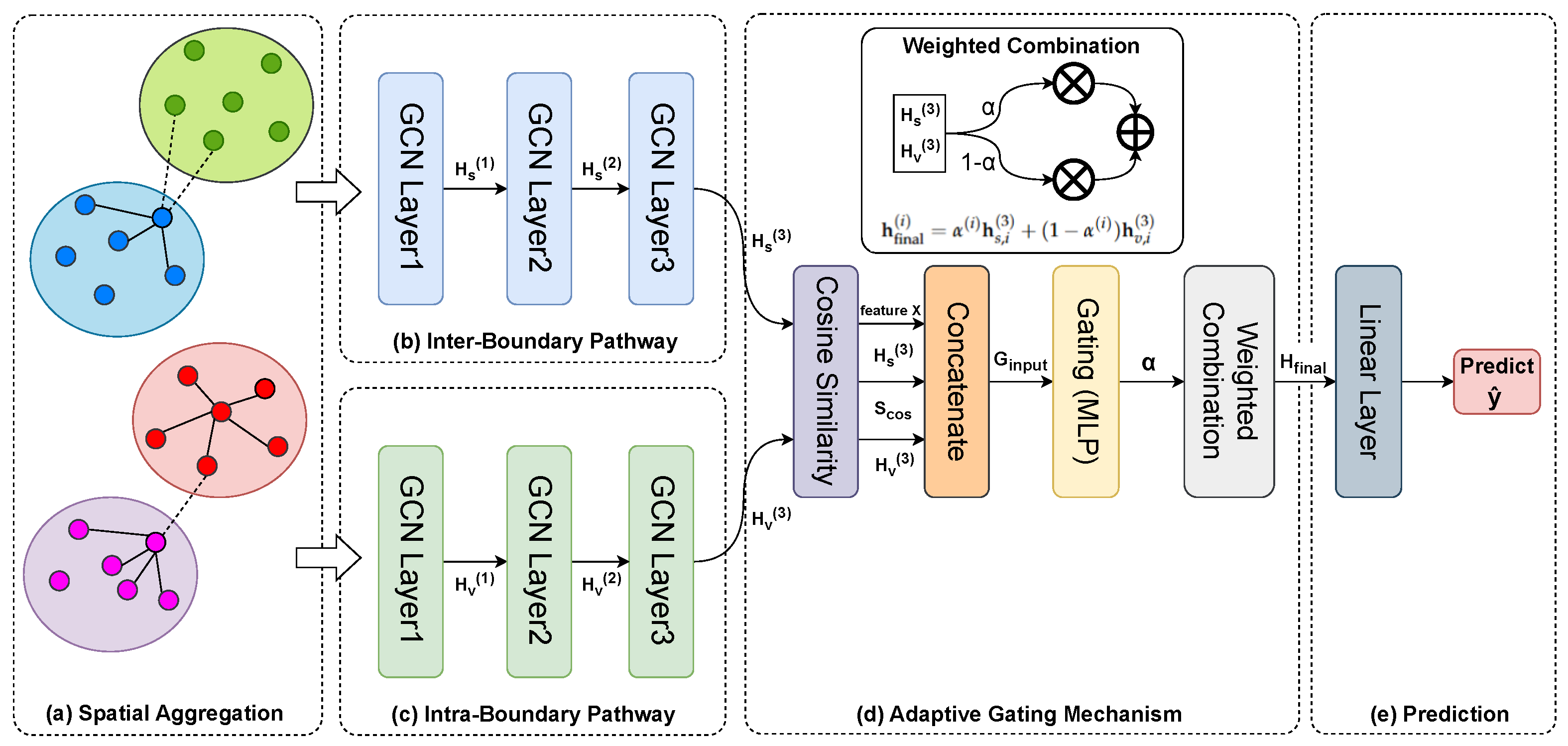
To address this gap, this study proposes the Boundary-Aware Dual-Path Graph Neural Network (BD-GNN). The key innovation is the use of two separate learning paths: one for capturing spatial proximity relationships among geographically nearby properties, and another for modeling administrative boundary effects. BD-GNN learns when to emphasize spatial similarity within administrative units and when to capture price discontinuities across boundaries, enabling more accurate and interpretable property valuation in heterogeneous urban markets.
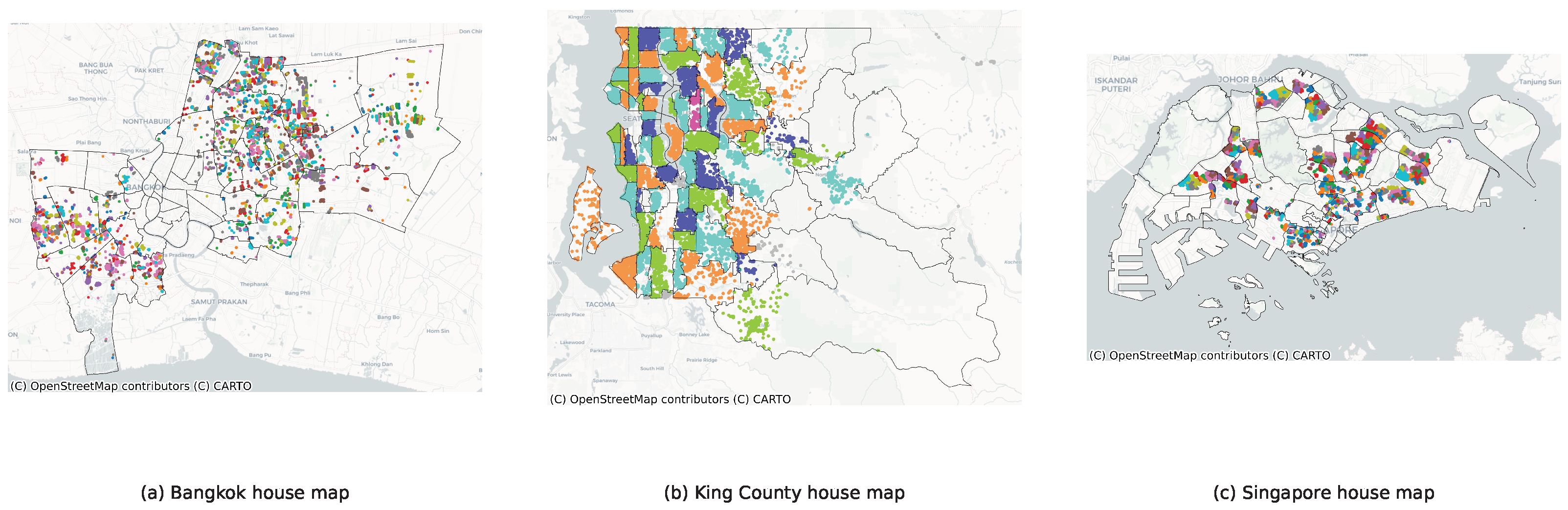
To comprehensively evaluate the proposed framework, we conduct experiments on three datasets representing diverse developmental contexts and spatial configurations across Bangkok (Thailand), King County (USA), and Singapore. These settings differ markedly in urban morphology, data richness, and segmentation structures, providing a rigorous basis for assessing both predictive generalizability and interpretability robustness. The results show that BD-GNN not only improves predictive accuracy but also reveals interpretable spatial–administrative trade-offs consistent with established urban-economic theory.
The main contributions of this paper are threefold:
- 1.
Conceptual integration: We formalize boundary-induced segmentation as structured sources of geospatial heterophily and embed them directly into a learnable dual-path graph representation, explicitly distinguishing intra-boundary and inter-boundary relationships.
- 2.
Methodological advancement: We integrate an adaptive gating mechanism that seamlessly fuses spatial and boundary pathways within a unified dual-path framework, enabling the model to dynamically balance information flow between proximity-based and segmentation-based relationships during message passing.
- 3.
Empirical validation and interpretability: We evaluate the proposed BD-GNN across three cities—Bangkok, King County, and Singapore—demonstrating consistent performance gains and interpretable boundary effects aligned with urban-economic theory.
Together, these contributions advance boundary-aware spatial learning and offer a new direction for interpretable, policy-relevant property valuation in complex urban environments.
The remainder of this paper is organized as follows.
Section 2 reviews related work in traditional approaches, ML, GNNs, heterophily-aware GNNs, and real estate-specific GNNs, including explainability.
Section 3 describes the experimental setups, datasets, and the proposed architecture, including evaluation metrics.
Section 4 presents results and analysis across different urban contexts.
Section 5 discusses the findings and their practical implications.
Section 6 concludes with future research directions.
2. Related Work
Research on property valuation has progressed through several methodological phases, from traditional econometric models to modern machine learning and graph-based deep learning approaches. Each stage provides a different perspective on how spatial, structural, and institutional factors influence property prices. The hedonic pricing model [
29] established the theoretical foundation for linking property values to structural and locational attributes. Spatial econometric models such as the Spatial Autoregressive (SAR) Model and the Spatial Error Model (SEM) extended this framework by explicitly modeling spatial dependence among nearby properties [
1,
30,
31]. Geographically Weighted Regression (GWR) [
2] and its multiscale extension, MGWR [
32], further enhanced this approach by allowing model parameters to vary locally across space. Although these models remain interpretable and widely used, they rely on predefined spatial weight matrices that impose rigid neighborhood structures. Such assumptions limit their ability to capture complex spatial heterogeneity or sharp price contrasts at neighborhood and administrative boundaries, motivating a shift toward more flexible, data-driven frameworks that can learn spatial relationships directly from data.
Machine learning (ML) approaches address this need for flexibility by prioritizing predictive performance over structural constraints. Ensemble methods such as Random Forests, Gradient Boosting, and XGBoost have demonstrated strong predictive power in property valuation and mass appraisal tasks [
33,
34], while deep learning techniques have enabled the integration of multiple data modalities, including imagery and tabular information [
35,
36]. However, most ML models treat each property as an independent observation, overlooking spatial dependence among nearby locations. Although these approaches capture complex nonlinear relationships among features, they fail to model neighborhood interactions that strongly influence price formation in real markets. This limitation has motivated growing interest in frameworks capable of learning spatial relationships directly from observed data rather than relying on fixed distance-based kernels.
Graph Neural Networks (GNNs) provide a flexible way to model spatial dependencies by learning directly from graph structures instead of fixed spatial kernels. Core architectures such as GCN [
6], GraphSAGE [
7], and GAT [
8] employ message passing mechanisms that aggregate neighborhood information adaptively to learn spatial relationships. However, these models rely on the homophily assumption, which suggests that connected nodes tend to share similar features or outcomes. In housing markets, this assumption is often violated, as zoning policies, administrative boundaries, or developer-defined communities create sharp discontinuities between adjacent properties. When message passing occurs across such dissimilar regions, it propagates noisy signals that reduce predictive performance and obscure meaningful spatial patterns.
To address this issue, heterophily-aware GNNs have been proposed to improve representation learning under weak-homophily conditions. MixHop [
14] and GPR-GNN [
15] extend information aggregation through multi-hop or weighted propagation, while H2GCN [
16] separates ego and neighbor embeddings to mitigate noisy neighbor effects. Geom-GCN [
17] redefines neighborhoods based on geometric or structural similarity, and FAGCN [
18] applies adaptive filtering to balance low- and high-frequency signals. PNA [
19] enhances model expressiveness through multiple aggregation functions with degree scaling, whereas ACM [
20] and LinkX [
21] decouple structural and feature representations, improving generalization to non-homophilous and large-scale graphs. SHGNN [
22] explicitly targets spatial heterophily in urban graphs by introducing a Spatial Diversity Score and heterophily-sensitive aggregation modules. Despite these advances, most models treat heterophilous relationships in a uniform way and do not distinguish between structured spatial heterogeneity, such as boundary-induced segmentation, and random local variation. A recent study indicates that the reported progress of heterophily-aware GNNs may be overstated, as many evaluations rely on biased benchmarks and inconsistent experimental setups [
37]. This highlights the need for models that can explicitly represent structured spatial heterogeneity. Furthermore, they are primarily developed for node classification tasks rather than continuous regression, which requires finer sensitivity to spatial smoothness and boundary contrast.
Several studies have applied GNNs directly to property valuation, demonstrating their ability to integrate spatial and nonlinear relationships. Spatial Regression GCNs (SRGCNN and A–SRGCNN) [
9,
10], geo-spatial network embeddings (GSNEs) [
11], lifelong valuation over heterogeneous information networks (LUCE) [
12], and scalable architectures for large urban markets [
13] show that GNNs can outperform traditional spatial econometric models. Nevertheless, these approaches often rely on homophily-based message passing and construct graphs solely from Euclidean proximity, without incorporating administrative or functional boundaries into graph design. Extensive evidence from urban economics shows that institutional boundaries, such as school districts, zoning areas, and developer-defined communities, lead to persistent and measurable price discontinuities [
23,
24,
25,
26,
27,
28]. When boundary effects are used only as additional features instead of being modeled as part of the graph structure, the model becomes less interpretable and its ability to represent local neighborhood patterns is reduced. Explicitly embedding boundary structures into spatial learning can better align model behavior with real-world market segmentation.
Interpretability has long been a core consideration in property valuation, given that valuation models directly inform taxation, investment, and urban planning decisions. Traditional econometric models provide transparent, coefficient-based explanations linking property characteristics to price outcomes [
29]. Machine learning models, while offering higher predictive accuracy, rely on post hoc tools such as feature importance [
3] and SHAP values [
38,
39] to interpret predictions. However, these methods largely focus on individual feature effects and do not explain how spatial dependencies shape property prices. Although GNNs are effective at capturing relational structures, they often function as black boxes because their learned spatial embeddings are difficult to interpret. Explainable AI (XAI) techniques such as GNNExplainer [
40], PGExplainer [
41], and SubgraphX [
42] attempt to reveal the most influential nodes, edges, or subgraphs. Recent work by Karamanou et al. [
43] applied explainable GNNs to housing markets, illustrating the potential of graph-based interpretation in real estate analysis. Yet, these explanation techniques remain largely data-driven and detached from economic reasoning. Incorporating domain-relevant structures, such as market or administrative boundaries, directly into GNN learning could enhance both predictive performance and interpretability by aligning spatial representations with economic and institutional realities.
In summary, studies across econometric, machine learning, and graph-based approaches reveal several unresolved challenges in modeling spatial dynamics of property markets. The main research gaps that emerge from this body of work are outlined as follows:
Econometric models emphasize interpretability through explicit coefficient estimates but impose rigid spatial assumptions.
Machine learning models improve predictive accuracy but ignore spatial dependence.
GNN-based models learn spatial relationships but often overlook structured heterophily caused by administrative or functional boundaries.
Heterophily-aware GNNs represent progress toward handling spatial complexity but still fail to differentiate systematic boundary effects from random noise.
Existing property valuation GNNs similarly omit boundary segmentation from their learning architecture.
This gap motivates the present study by embedding structured spatial heterogeneity directly into the graph representation. The proposed framework enhances both predictive performance and interpretability for property valuation in complex, heterophilic urban environments.
4. Results
Across all datasets, BD-GNN consistently achieved the best predictive performance, improving MAPE by up to 7.92% and increasing by up to 6.05% compared with the best baselines. The model demonstrates particularly strong gains in highly fragmented administrative settings, such as Singapore and Bangkok, while maintaining stable improvements in King County. These results confirm that explicitly modeling boundary effects not only enhances prediction accuracy but also improves robustness under high inter-boundary connectivity.
We note that SAR could not be estimated on the Singapore dataset due to prohibitive memory requirements associated with constructing large spatial weight matrices, even under a high-RAM environment. This reflects a known scalability limitation of classical spatial econometric models in large-scale urban settings.
Table 7 summarizes the MAPE results across all datasets and connectivity levels. BD-GNN achieves the lowest MAPE in every configuration: Bangkok (14.95% at
, 11.80% at
), King County (17.89% at
, 12.64% at
), and Singapore (14.32% at
, 11.59% at
). Relative to the best baselines in case of
, the reductions in MAPE range from 4.42% to 7.92%, with the largest improvement observed in Bangkok (7.92%), while King County and Singapore exhibit comparable gains of 4.42% and 4.54% respectively. Pairwise t-tests at the 95% confidence level (
p-value < 0.05) confirm that these improvements are statistically significant across all datasets and connectivity settings. These results indicate that BD-GNN effectively captures structured discontinuities in property values that conventional and heterophily-aware GNNs often fail to model.
Table 8 presents the
results across all datasets and connectivity levels. BD-GNN consistently outperforms all baseline methods, with performance gains particularly evident at higher connectivity (
) where inter-boundary heterophily is strongest. For
, the model achieves
in Bangkok,
in King County, and
in Singapore. Relative to the best-performing baselines, these correspond to improvements of 3.26%, 0.67%, and 5.01% respectively. Pairwise t-tests at the 95% confidence level (
p-value < 0.05) confirm significance across all dataset–connectivity combinations, underscoring the model’s ability to explain more variance in fragmented administrative environments.
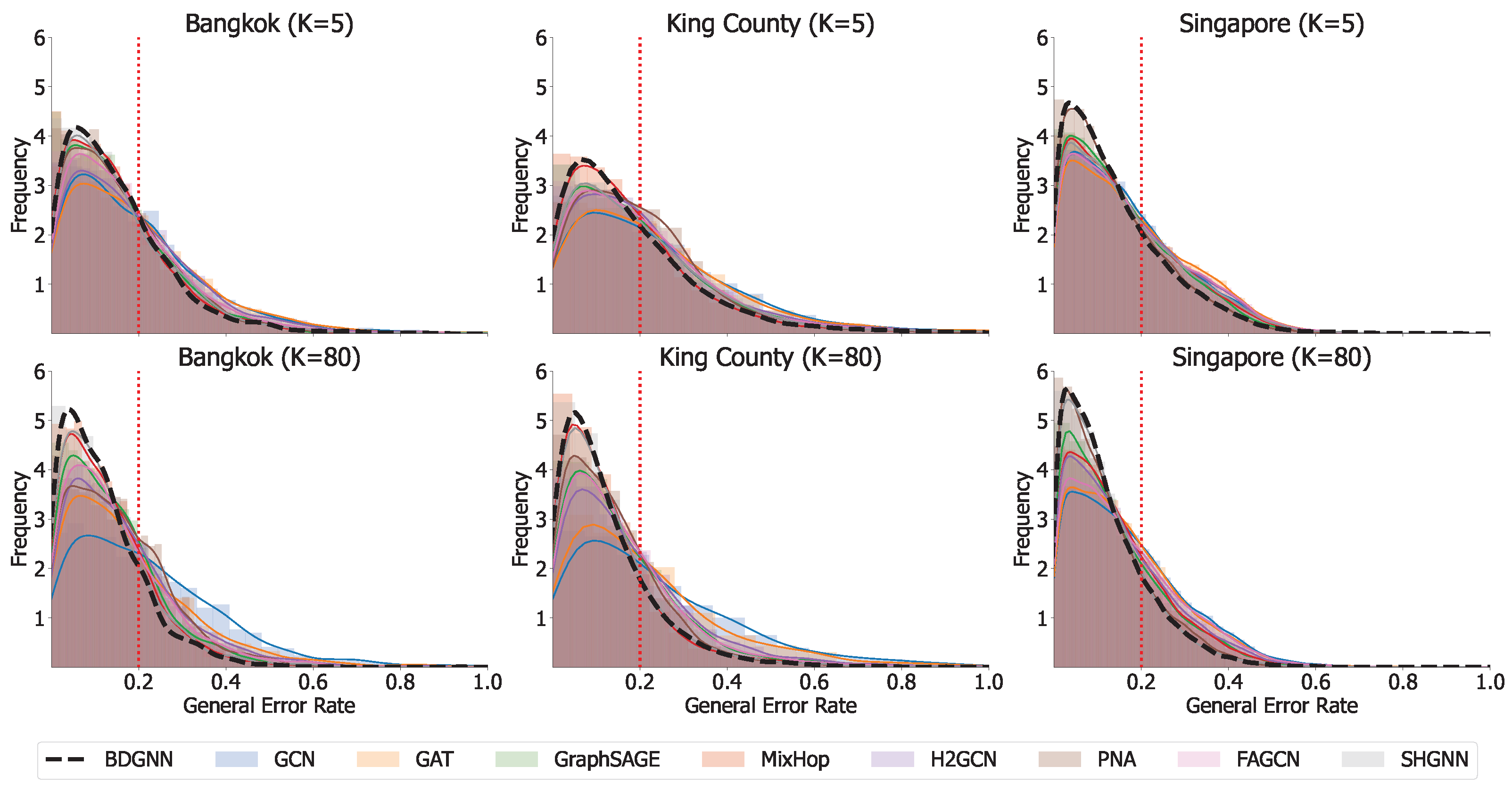
For GER, the cumulative distributions in
Figure 6 and the tabulated values in
Table 9 paint a consistent picture. BD-GNN places a larger share of predictions within low error ranges across all datasets and thresholds. At
and a 10% tolerance, it reaches 51.70% in Bangkok, 53.78% in King County, and 53.61% in Singapore, corresponding to improvements of 3.31, 3.28, and 2.33 percentage points over the best baselines. The comparison between
and
shows that BD-GNN maintains stable performance even when neighborhood size increases and cross-boundary connections become more prevalent. This effect is especially evident in Bangkok and Singapore, where larger neighborhoods introduce substantial boundary-induced heterogeneity, yet the model continues to deliver robust predictive accuracy.
Across all three datasets and both neighborhood sizes, BD-GNN consistently achieves the lowest MAPE, outperforming all baseline methods in Bangkok, King County, and Singapore. This advantage holds under both localized neighborhoods () and extended spatial interactions (), indicating robustness to neighborhood scale.
The strongest baseline differs by dataset and neighborhood size. In Bangkok, the most competitive baselines are SHGNN and MixHop, while in Singapore, PNA is strongest at and SHGNN becomes strongest at . In King County, SAR provides the best baseline performance at , whereas at the best baseline shifts to MixHop, suggesting that global linear spatial dependence is already informative at small neighborhoods, while multi-hop mixing becomes more effective as spatial connectivity expands.
Despite these strong baselines—including cases where a classical spatial model (SAR) is most competitive—BD-GNN remains best in every dataset–connectivity setting. These results indicate that explicitly distinguishing spatial proximity from boundary-related effects, and adaptively weighting their contributions, improves predictive performance relative to both classical spatial models and existing GNN approaches.
5. Discussion: Boundary Dynamics, Adaptation, Boundary Robustness, Interpretability, Practical Trade-Off, and Potential Extension to Spatiotemporal
5.1. Interpreting : Spatial–Boundary Dynamics Across Cities
The adaptive gating parameter measures how the model balances spatial and boundary information, serving as an interpretable signal of each city’s underlying structural regime. Its distribution provides insight into how different urban morphologies mediate the interaction between spatial proximity and administrative segmentation.
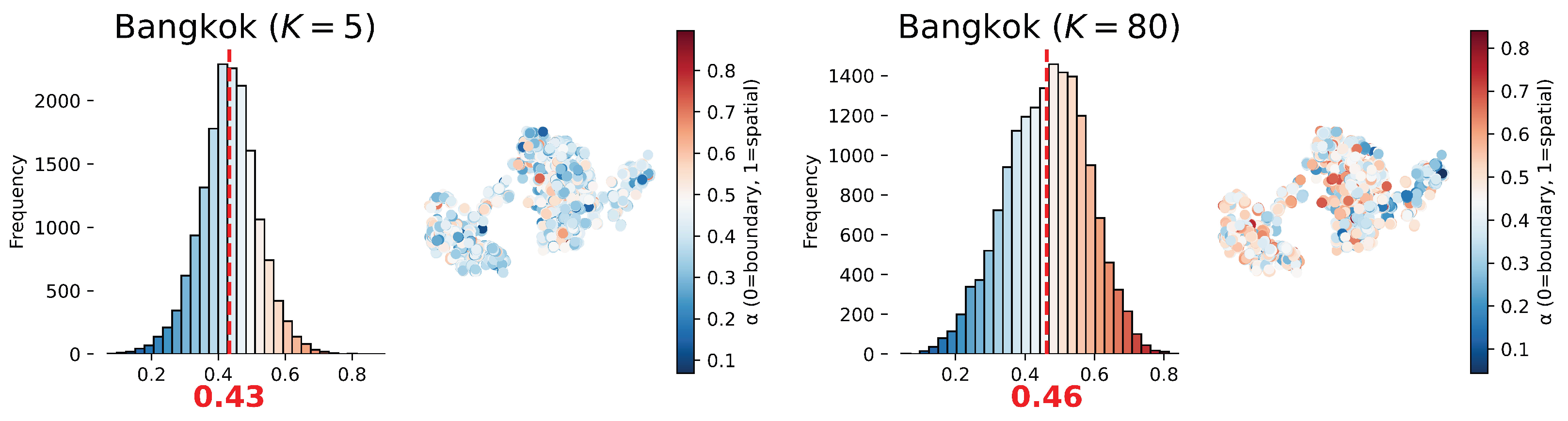
As shown in
Figure 7 for Bangkok,
values remain below 0.5, increasing slightly from 0.43 to 0.46 as the neighborhood size (
K) expands. This pattern indicates that boundary effects continue to dominate even at broader spatial scales. The trend reflects Bangkok’s village-based urban structure, where private housing developments are internally uniform but separated by distinct price gaps along their boundaries. Bangkok therefore represents a boundary-aligned regime, where spatial continuity exists but remains secondary to administrative or community segmentation.
As shown in
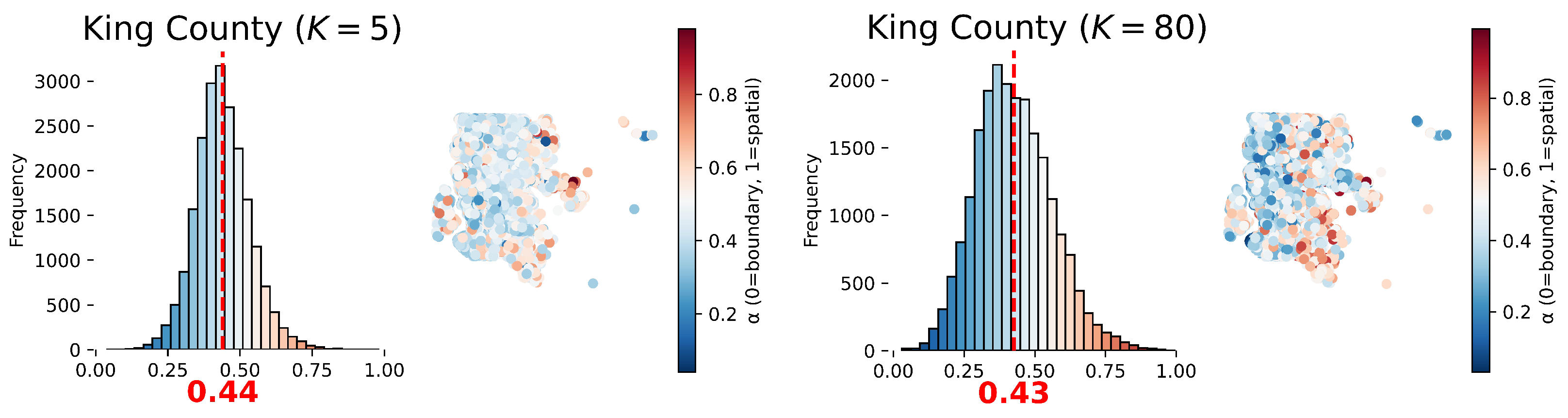
Figure 8 for King Country,
averages around 0.44 across scales but shows greater dispersion as
K increases, suggesting diverse local dynamics. Suburban areas depend more strongly on spatial proximity, while central zones are shaped by zoning and regulatory boundaries. The coexistence of these conditions produces a hybrid regime, in which spatial and administrative influences interact differently depending on the local context.
As shown in
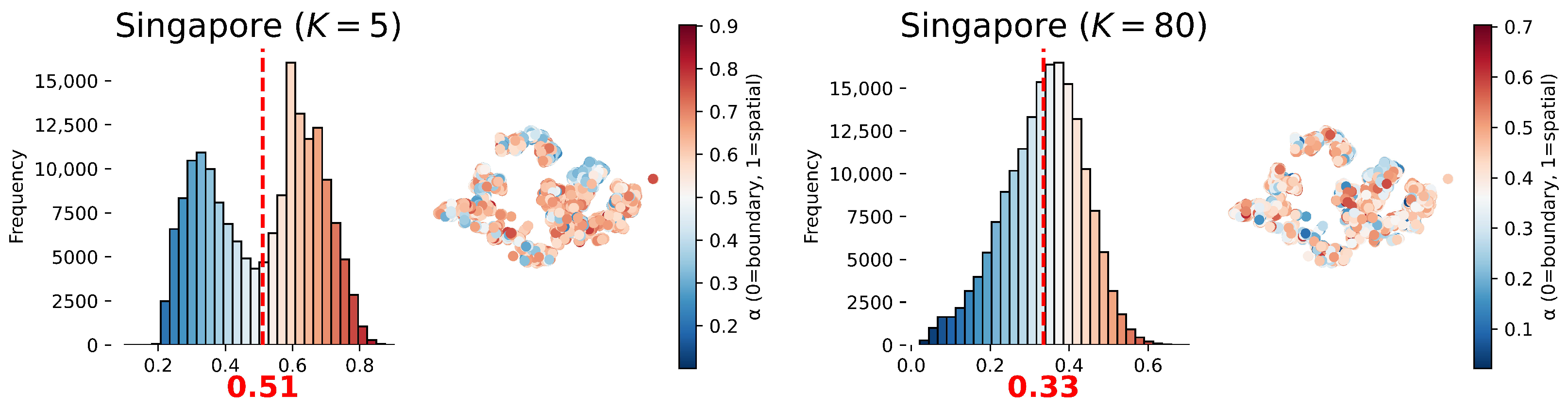
Figure 9 for Singapore,
decreases markedly from 0.51 to 0.33 as
K grows, showing that boundary effects intensify with neighborhood expansion. The narrow distribution indicates structural uniformity across the city, consistent with Singapore’s centrally planned housing environment dominated by Housing and Development Board (HDB) estates. These estates exhibit strong internal homogeneity, with prices organized primarily by block-level boundaries. Singapore thus represents a boundary-dominant regime.
Across the three regimes, represented by boundary-aligned Bangkok, hybrid King County, and boundary-dominant Singapore, the results show that effectively reflects key variations in urban structure. It operates not merely as a model parameter but as a diagnostic indicator of spatial–administrative balance, offering a more interpretable understanding of how governance and morphology shape property markets.
5.2. Boundary Robustness Under Weak and Artificial Segmentation
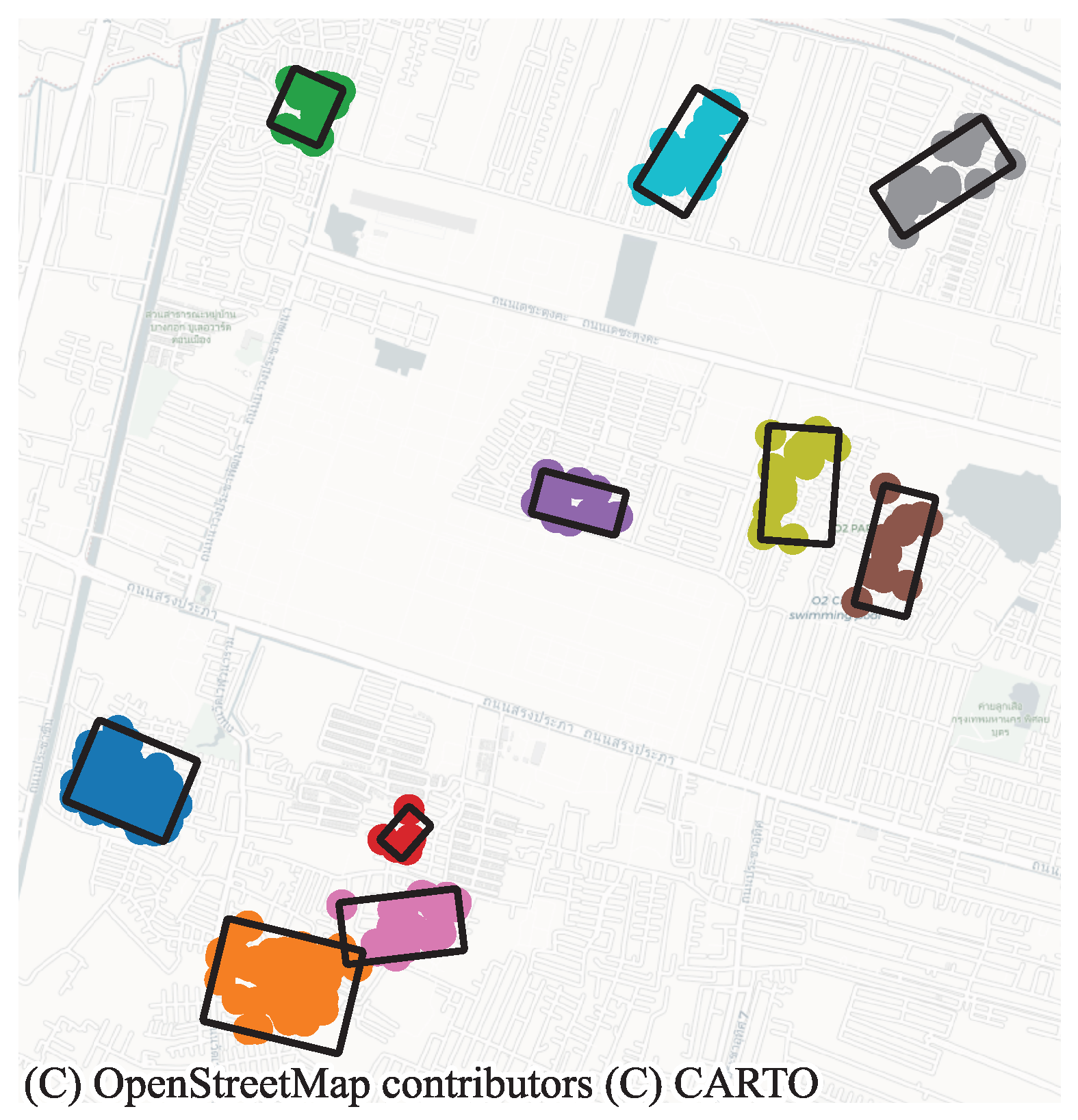
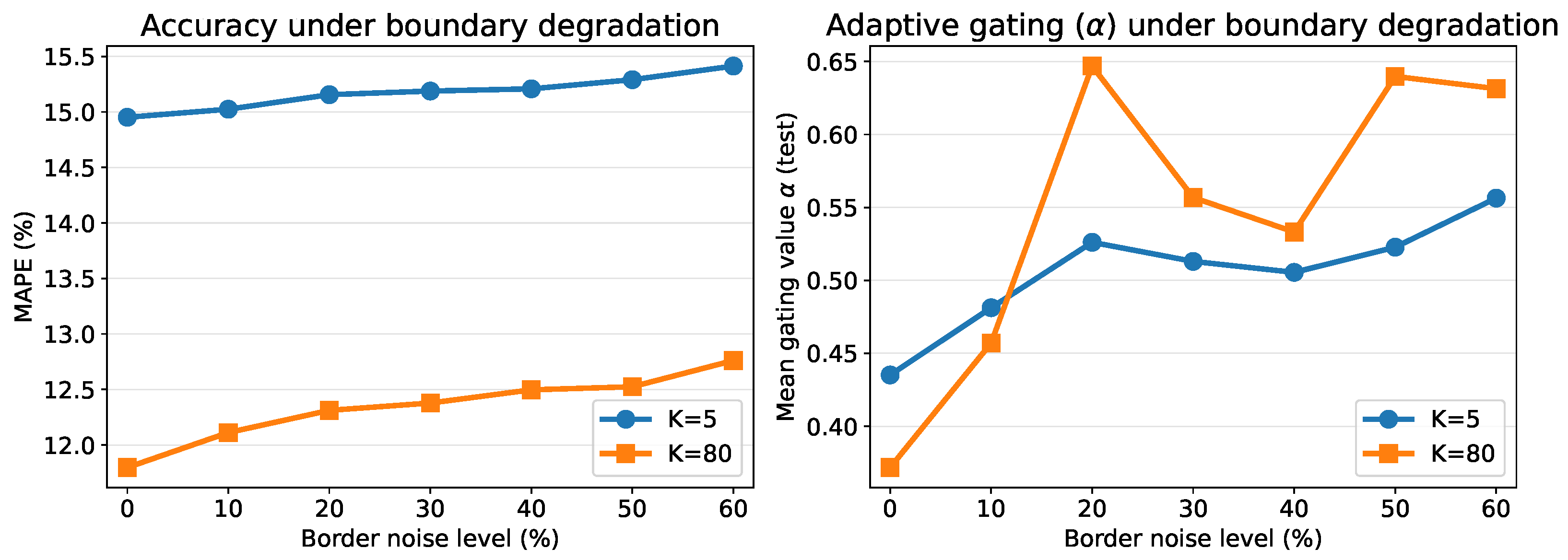
To assess the robustness of BD-GNN under imperfect boundary definitions, we conduct a controlled boundary-perturbation experiment on the Bangkok dataset, where villages act as explicit boundaries. We evaluate boundary robustness by selectively perturbing village labels for houses located near village borders, while keeping the underlying kNN graph topology unchanged. The perturbation level is increased from 0% to 60% to emulate progressively weaker or partially misaligned segmentation specifically in the most ambiguous boundary regions. Noise levels are limited to 60% because perturbations beyond this threshold no longer represent plausible boundary uncertainty in real-world valuation settings and instead correspond to near-random segmentation, which falls outside the intended scope of this robustness analysis.
Figure 10 (left) shows that prediction error increases gradually as border noise rises for both neighborhood sizes. This pattern indicates that BD-GNN is sensitive to boundary degradation in the expected direction, yet does not exhibit abrupt failure under moderate boundary perturbations. The degradation is smooth and limited in magnitude, suggesting that the model retains useful predictive structure even when boundary labels are partially corrupted at border areas.
Figure 10 (right) reports the behavior of the adaptive gating parameter
. Overall,
tends to move upward under higher noise levels, indicating a shift toward relying more on spatial continuity when boundary information becomes less reliable. At the same time, the response is not strictly monotonic, particularly for larger neighborhoods (
), where broader connectivity increases interactions across villages and introduces more heterogeneous signals. This non-monotonic pattern reflects the fact that the gating mechanism is learned from data and adaptively balances spatial and boundary information under uncertainty, rather than following a fixed or deterministic rule.
Taken together, these results address the concern of weak or imperfect boundaries. BD-GNN does not assume boundary labels to be error-free; instead, it treats segmentation as a soft structural signal whose contribution is adaptively regulated. When border-level boundary information is degraded, the model maintains stable behavior: prediction error increases smoothly, while adjusts to re-balance boundary-based and spatial aggregation. This supports the robustness of BD-GNN to boundary uncertainty in realistic settings where boundary regions are most prone to ambiguity or misclassification.
5.3. Model Adaptability and Transferability
The variations in across cities highlight the importance of adaptive modeling. Conventional GNNs typically apply a single message-passing strategy regardless of spatial or administrative context, which can lead to systematic bias when these influences vary widely. In contrast, BD-GNN dynamically adjusts its balance between spatial and boundary pathways through the adaptive gating mechanism.
When approaches 1, inter-boundary connections dominate the message-passing process, whereas when approaches 0, intra-boundary relationships prevail. This flexibility allows BD-GNN to respond automatically to local urban morphology without requiring manual tuning or prior zoning assumptions. The model therefore learns the appropriate structural emphasis directly from data, aligning its internal representation with the city’s actual spatial organization.
From a practical perspective, also functions as a diagnostic tool for model transferability. Before applying BD-GNN to a new context, analyzing on a validation subset can reveal the city’s dominant regime:
Hybrid regimes (for example, King County) may require stronger spatial aggregation to capture inter-boundary diffusion.
Boundary-dominant regimes (for example, Singapore) benefit from a higher weighting on boundary pathways to reflect institutional segmentation.
Boundary-aligned regimes (for example, Bangkok) represent intermediate conditions in which both spatial and boundary signals exert comparable influence.
This flexibility allows BD-GNN to adapt effectively across cities with different spatial and administrative configurations. Rather than training a separate model for each area, the same architecture can adjust its -based balance between spatial continuity and boundary segmentation. As a result, BD-GNN functions not only as a predictive tool but also as an adaptive framework for multi-city property valuation.
5.4. Policy and Planning Relevance
Understanding how boundaries influence property values is crucial for designing equitable and efficient urban policies. The -based regimes identified above offer practical guidance for aligning planning instruments with the structural organization of each area.
Boundary-dominant regimes, such as in Singapore, indicate that property values are largely determined within administrative units. In such cases, block-level taxation, estate-specific development controls, or targeted subsidy programs are likely to be most effective. Hybrid regimes, such as in King County, exhibit mixed spatial interactions, suggesting the need for inter-boundary coordination, including regional infrastructure planning, inter-municipal zoning, or coordinated service delivery. Boundary-aligned regimes, such as in Bangkok, emphasize the internal coherence of residential clusters, where neighborhood-scale interventions, such as localized land-use regulations or community-level infrastructure investments, can yield significant impacts.
Rather than applying uniform, city-wide valuation rules, policy design should align with the dominant spatial–administrative regime. BD-GNN supports this regime-aware formulation by revealing how spatial and boundary signals interact across scales. This integration of analytical insight and governance logic bridges predictive modeling with practical decision-making, enabling data-driven interventions that reflect the spatial realities of urban morphology. In this way, BD-GNN transforms boundary effects, traditionally seen as constraints, into measurable and actionable spatial processes.
5.5. Explainability and Local Insights
While provides a global perspective on spatial–boundary dynamics, understanding individual predictions requires local interpretability. BD-GNN integrates the GNN Explainer to identify the most influential neighbors and structural attributes that contribute to each property’s estimated value.
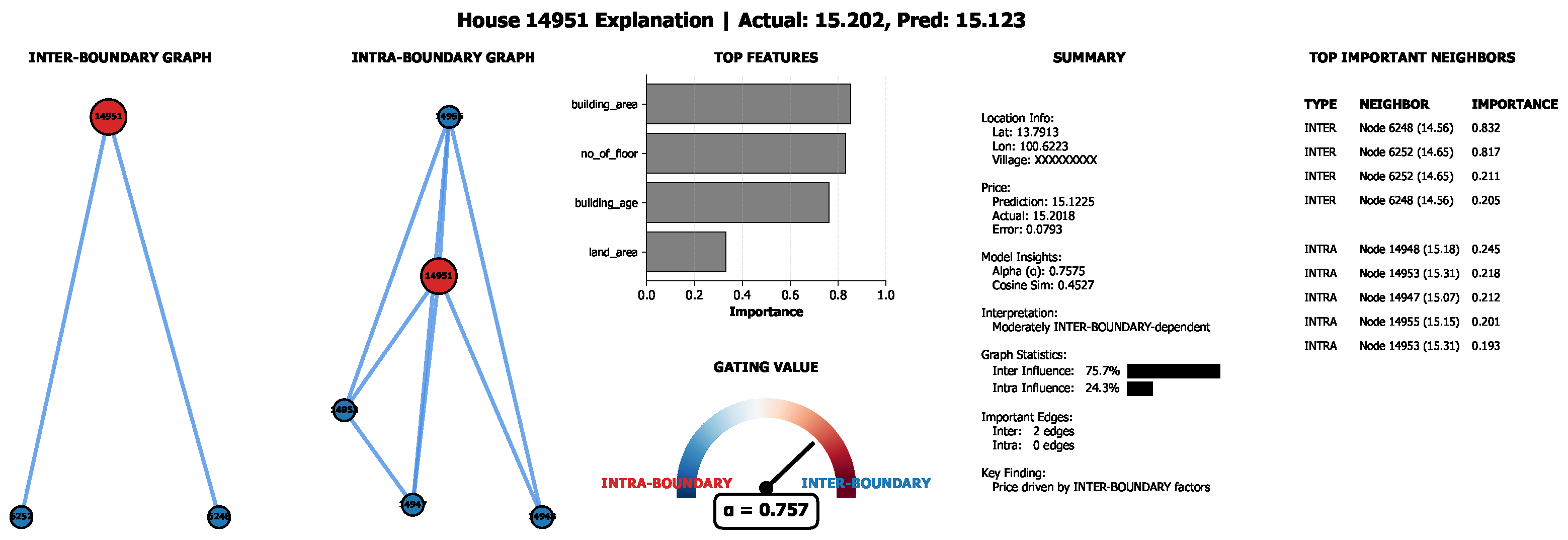
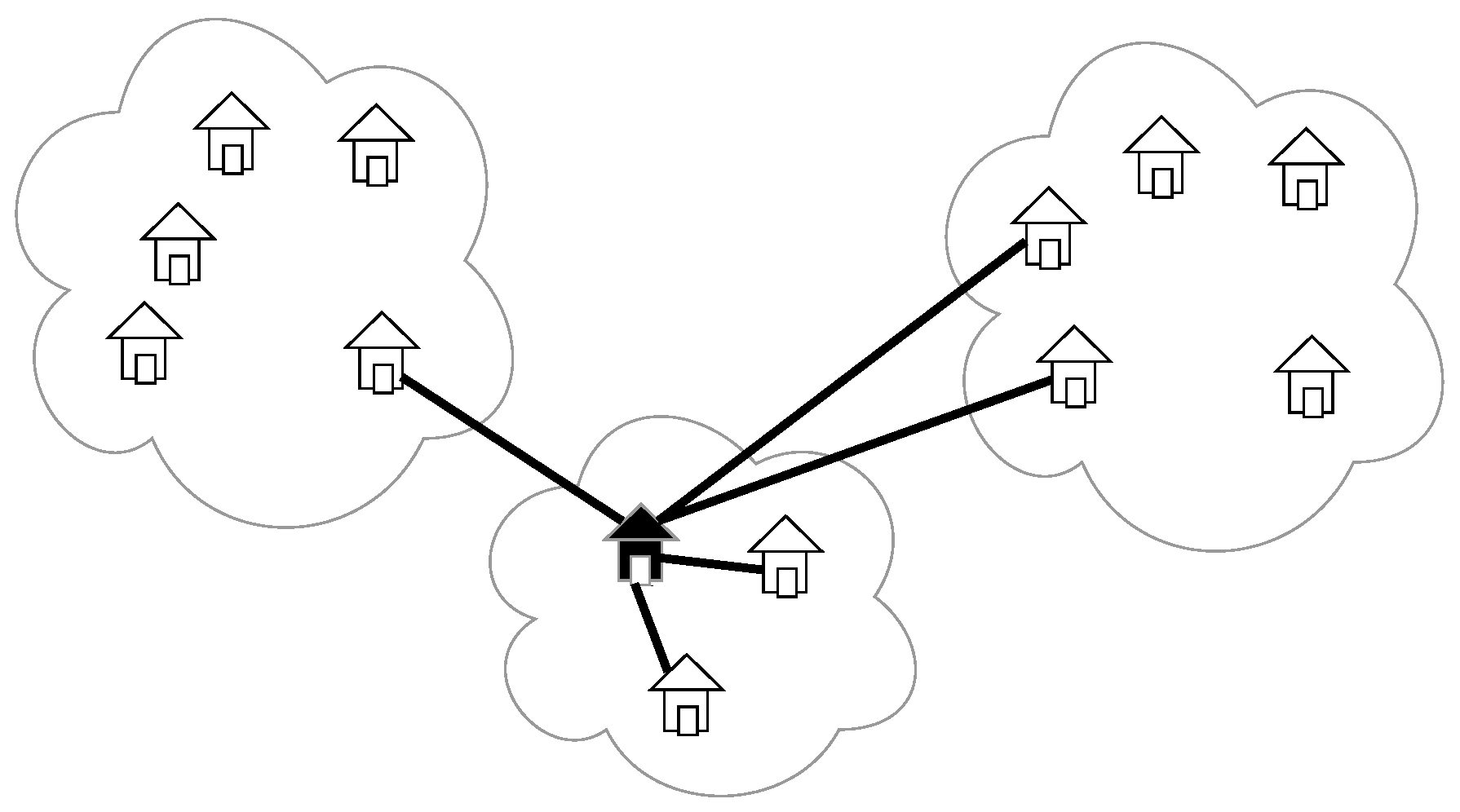
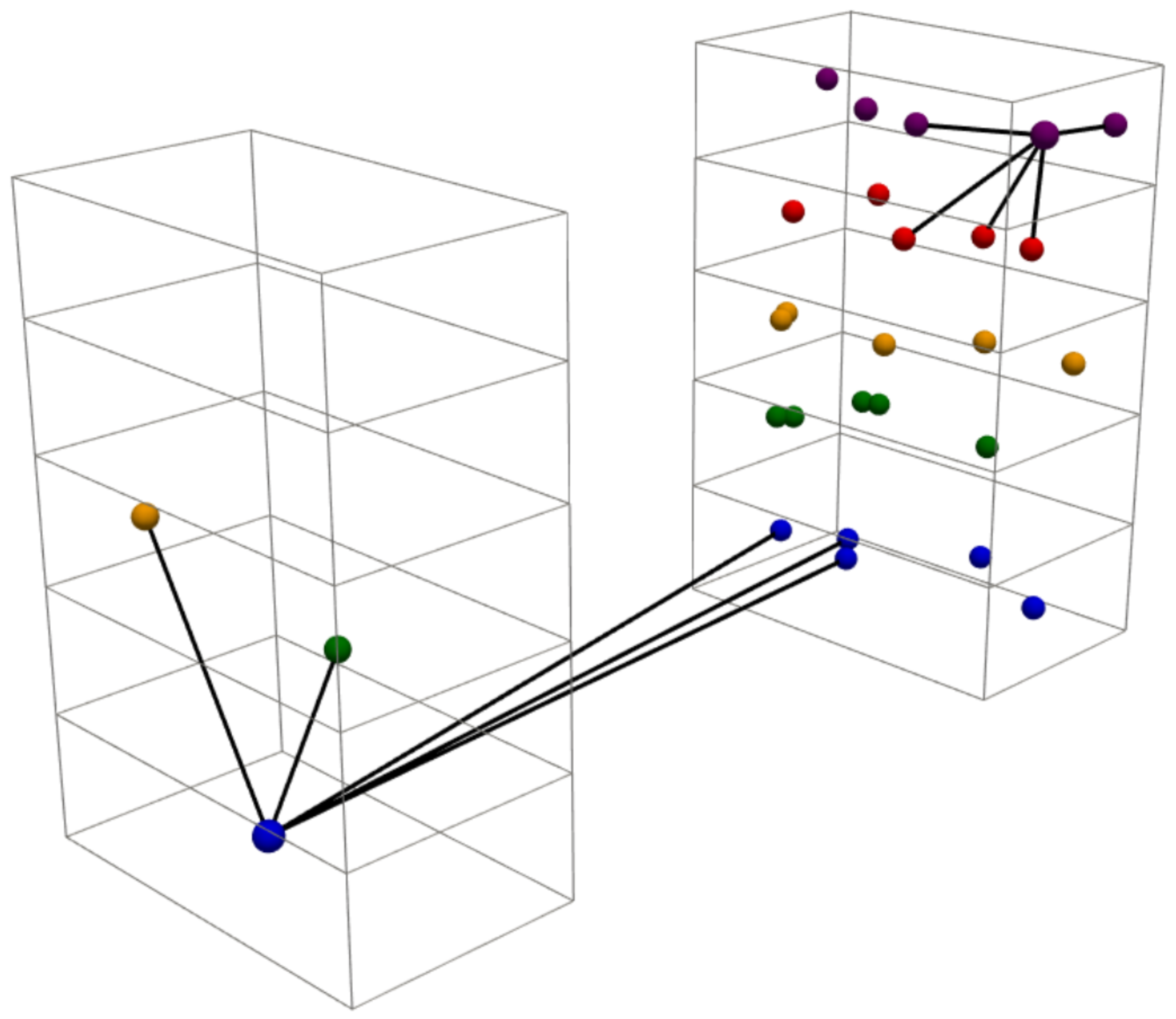
Figure 11 shows a representative example from Bangkok. For a selected property, the model identifies key neighbors, two of which lie across administrative boundaries, with a gating value of
. It also ranks the most influential structural features, including building area, number of floors, age, and land size. This node-level interpretation clarifies how spatial and physical attributes interact in determining the predicted price.
The combination of global interpretability (via ) and local transparency (via GNN Explainer) allows BD-GNN to move beyond black-box prediction. The global signal captures citywide structural regimes, while the local explanation exposes the reasoning behind individual predictions. Together, they enhance transparency, user trust, and the interpretive value of spatial AI in real-world valuation practice.
5.6. Practical Trade-Off: Accuracy and Computational Cost
The computational cost of BD-GNN should be understood in relation to its modeling objective rather than as a direct efficiency comparison with classical spatial econometric models. Spatial regression models such as SAR are designed primarily for explanatory analysis under fixed linear specifications and are estimated through a single model-fitting procedure. However, their computational cost increases rapidly with sample size due to the construction and manipulation of large spatial weight matrices.
As shown in
Table A2, SAR exhibits high computational and memory demands, especially under large and dense spatial graphs. In practice, this limitation becomes critical for large-scale datasets. In our experiments, SAR could not be estimated for the Singapore dataset (
) at either
or
, even when using a high-RAM environment (51 GB) on Google Colab, highlighting its limited scalability in nationwide or city-scale mass appraisal settings.
For graph-based valuation models, neighborhood size (K) plays a central role in determining predictive performance. While small neighborhoods preserve local homogeneity, larger neighborhoods increasingly mix information across administrative boundaries. Standard GNNs aggregate neighbor information uniformly, which often leads to signal dilution when boundary-induced heterogeneity is strong.
BD-GNN addresses this issue by explicitly separating spatial proximity and boundary-based neighborhood structure, and by learning how to balance them through the adaptive gating parameter . This allows the model to maintain stable and improved accuracy at larger neighborhood sizes, particularly in cities where administrative segmentation strongly shapes property values.
In practice, the trade-off is therefore between modeling simplicity and structural fidelity. SAR remains suitable for moderate-sized datasets where fast estimation and global interpretability are prioritized. BD-GNN is most appropriate when accurate valuation under boundary-driven heterogeneity is required, and where a moderate and predictable computational overhead is acceptable.
5.7. Potential Extension to Spatiotemporal Property Valuation
This study focuses on a static property valuation setting in order to isolate the structural effects of administrative boundaries on spatial price formation. This design choice allows the boundary-induced heterogeneity to be examined without interference from temporal market fluctuations, thereby enabling a clearer interpretation of the proposed boundary-aware learning mechanism.
Nevertheless, temporal dynamics are undeniably important in real estate markets, where property values evolve over time in response to macroeconomic conditions, policy changes, and local development processes. Extending BD-GNN to a spatiotemporal setting therefore represents a natural and meaningful direction for future research. Such an extension would require additional modeling considerations, including constructing graphs that evolve over time, ensuring consistent boundary definitions across periods, and using transaction data with adequate temporal coverage.
Importantly, the dual-path architecture of BD-GNN provides a flexible foundation for incorporating temporal information. The explicit separation between spatial proximity and boundary-based relations could be combined with temporal graph neural networks or sequence-based learning frameworks, allowing spatial boundary effects and temporal price dynamics to be modeled jointly rather than conflated. For example, temporal encoders could be applied to node representations while preserving the boundary-aware aggregation mechanism at each time step.
While such spatiotemporal integration lies beyond the scope of the current study, the results presented here demonstrate that explicitly modeling administrative boundaries yields clear benefits even in a static setting. This suggests that boundary-aware spatial learning is a complementary component, rather than a substitute, to temporal modeling, and highlights the potential of BD-GNN as a building block for future spatiotemporal property valuation frameworks.
5.8. Summary of Discussion
This study shows that property values in urban areas are shaped not only by spatial proximity but also by administrative boundaries that organize markets into distinct segments. These boundaries function as socio-economic separators. This means that locations that are geographically close may still differ substantially in value if they lie within different governance or development contexts.
BD-GNN incorporates this segmentation directly by separating intra- and inter-boundary message passing and learning the relative importance of each through the adaptive gating parameter (). The learned values indicate stable spatial–administrative regimes that reveal where price continuity holds and where boundary-driven differentiation is structurally reinforced. This provides a transparent mechanism for understanding how local market identities form.
Explainable GNN analysis shows that neighborhood features, access to amenities, and local development history work together with boundary segmentation to shape price patterns. In contrast, conventional GNNs tend to diffuse information uniformly and therefore overlook these distinctions.
Although BD-GNN is formulated under a static valuation setting in this study, extending the model to incorporate temporal dynamics is a promising direction for future work. Real estate markets are inherently time-dependent, with major macroeconomic events and policy interventions unfolding over time and influencing price formation. The dual-path, boundary-aware architecture of BD-GNN provides a natural foundation for integration with temporal graph or sequence-based models, enabling future research to jointly model spatial segmentation and temporal market dynamics.
All in all, the findings highlight that structured heterophily arising from governance, zoning, and administrative boundaries is a critical yet underrepresented factor in property valuation. Explicitly modeling this structure improves predictive accuracy and clarifies how urban morphology shapes price identities. In practice, this positions BD-GNN as a suitable choice when valuation accuracy and structural insight are prioritized, rather than as a replacement for faster but more rigid modeling approaches. This establishes a stronger foundation for decision support in urban planning, real estate governance, and valuation practice.
6. Conclusions
This study proposed BD-GNN, a boundary-aware dual-path graph neural network for property valuation in complex urban environments. By explicitly separating intra-boundary and inter-boundary message passing and adaptively balancing spatial proximity and administrative segmentation, BD-GNN addresses a key limitation of existing valuation models that uniformly aggregate neighborhood information and overlook boundary-induced price discontinuities.
Empirical evaluations across three heterogeneous urban datasets demonstrate that BD-GNN consistently improves predictive accuracy and stability in boundary-driven markets, reducing MAPE by up to 7.9% and increasing by up to 5.0% compared to strong baselines, particularly at larger neighborhood scales where standard GNNs tend to oversmooth local price signals. Additional robustness and scalability analyses further show that BD-GNN maintains linear scalability with respect to graph size and adapts gracefully to uncertainty or misalignment in administrative boundaries.
Beyond predictive performance, BD-GNN contributes a form of structural interpretability through its adaptive gating mechanism, enabling insight into the relative importance of spatial continuity versus boundary-induced segmentation in different urban contexts. This makes the framework particularly relevant for applied valuation tasks where transparency, boundary effects, and regulatory compliance play a central role, including mass appraisal, property taxation, and urban planning.
While this study examines static valuation settings to isolate boundary effects, the dual-path architecture provides a natural foundation for incorporating temporal dynamics. Extending BD-GNN to spatiotemporal valuation represents the most immediate direction for future research, while incorporating alternative or learned boundary definitions and integrating transformer-based architectures offer longer-term extensions. We believe that boundary-aware graph modeling provides a useful foundation for more realistic, interpretable, and policy-relevant property valuation in complex urban systems.