


Comparative Framework for Multi-Modal Accessibility Assessment Within the 15-Minute City Concept: Application to Parks and Playgrounds in an Indian Urban Neighborhood


Abstract
1. Introduction
1.1. Literature Review
1.1.1. The 15-Minute City (15 MC) Concept and Accessibility Assessment
1.1.2. Modelling Accessibility with Open-Source Tools: QGIS, OSMnx, and Space Syntax
1.1.3. Accessibility and Indian Urban Development Policies
1.1.4. Intermediate Public Transportation (Autorickshaw) as a Sustainable Transportation Mode
1.2. Research Question
2. Materials and Methods
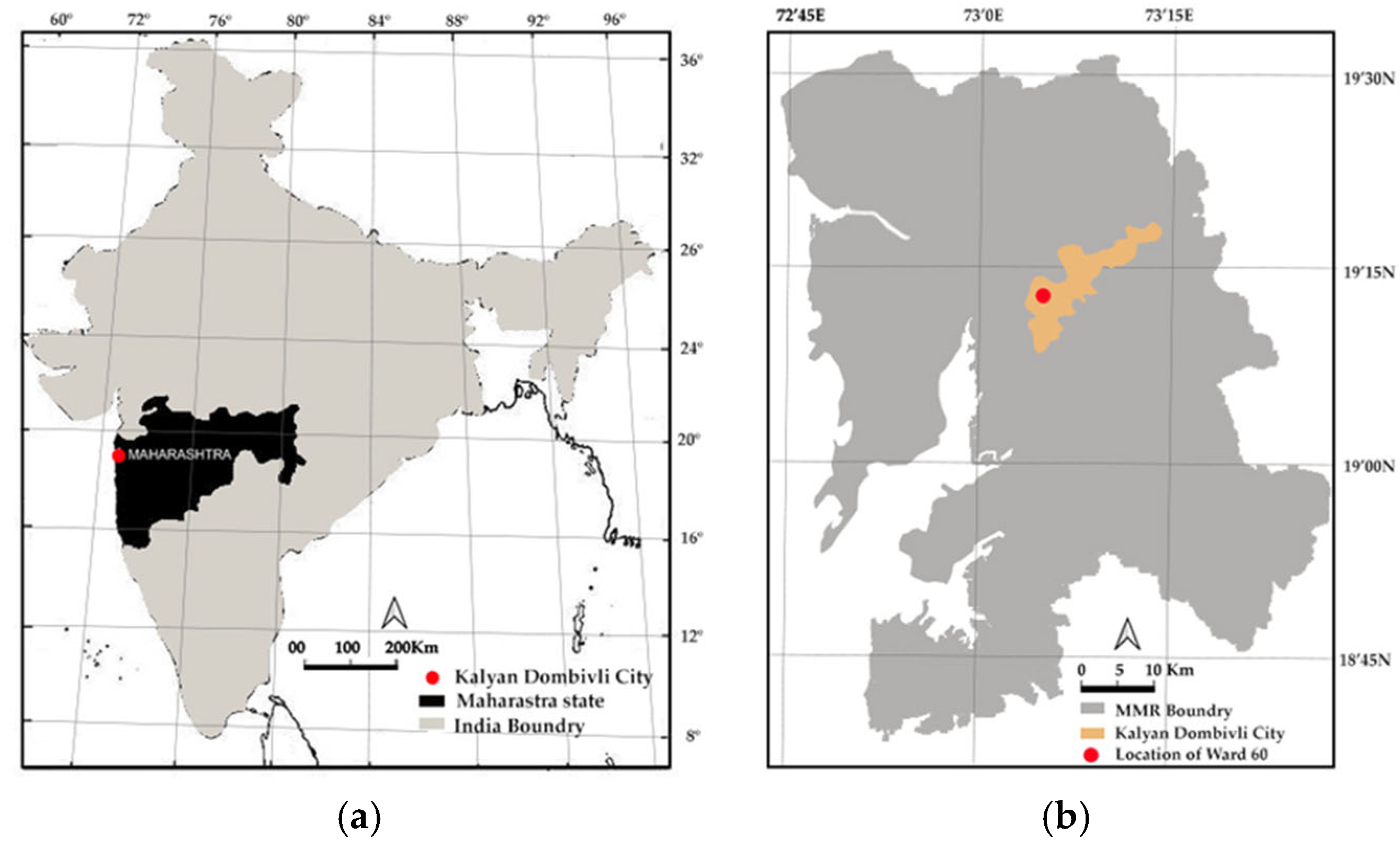
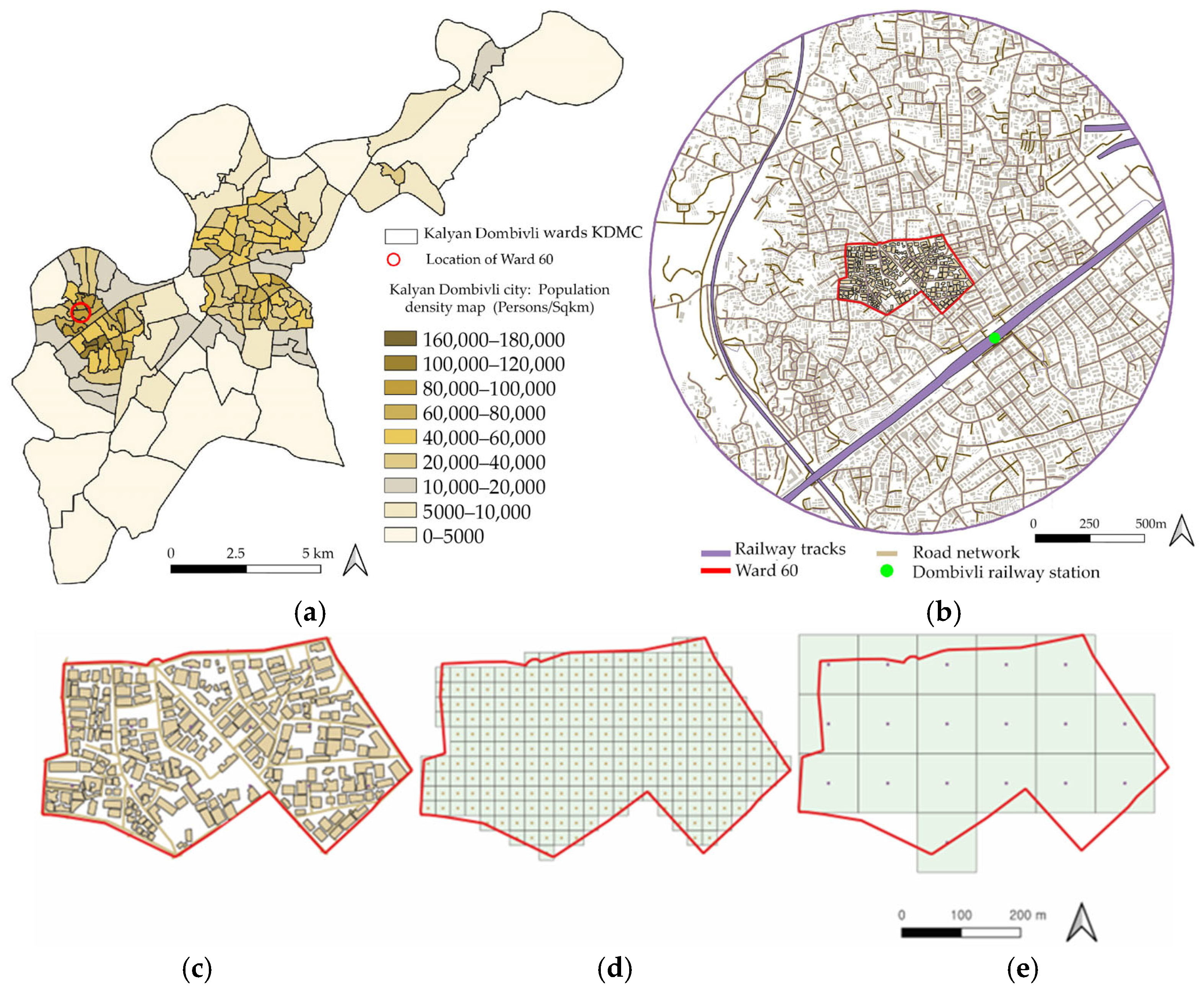
2.1. Selection of the Study Area: A Mixed-Use Neighborhood in Kalyan Dombivli City
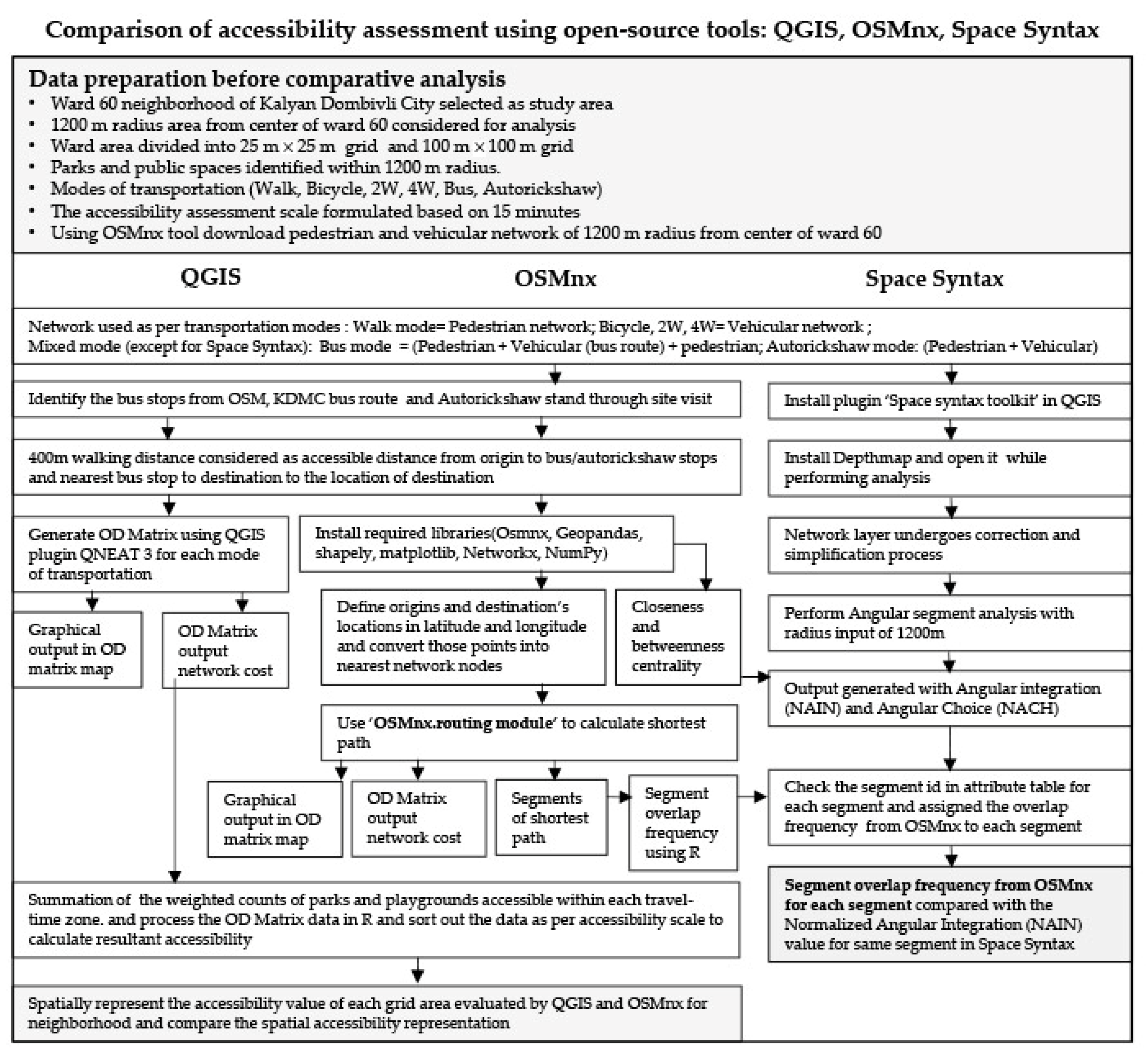
2.2. Methodological Approach of Comparative Analysis
2.3. Parameters of Accessibility Assessment
2.3.1. Neighborhood Destinations Such as Parks and Playgrounds
2.3.2. Transportation Modes
2.3.3. Networks or Routes
2.3.4. Distance to PT and IPT Stops
2.3.5. Accessibility Scale
2.3.6. Peak and Non-Peak Hours of the Day
2.3.7. Distribution of 25 m and 100 m Grid
2.3.8. Selection of 1200 m Catchment Area for Analysis
2.4. Accessibility Assessment by QGIS, OSMnx, and Space Syntax
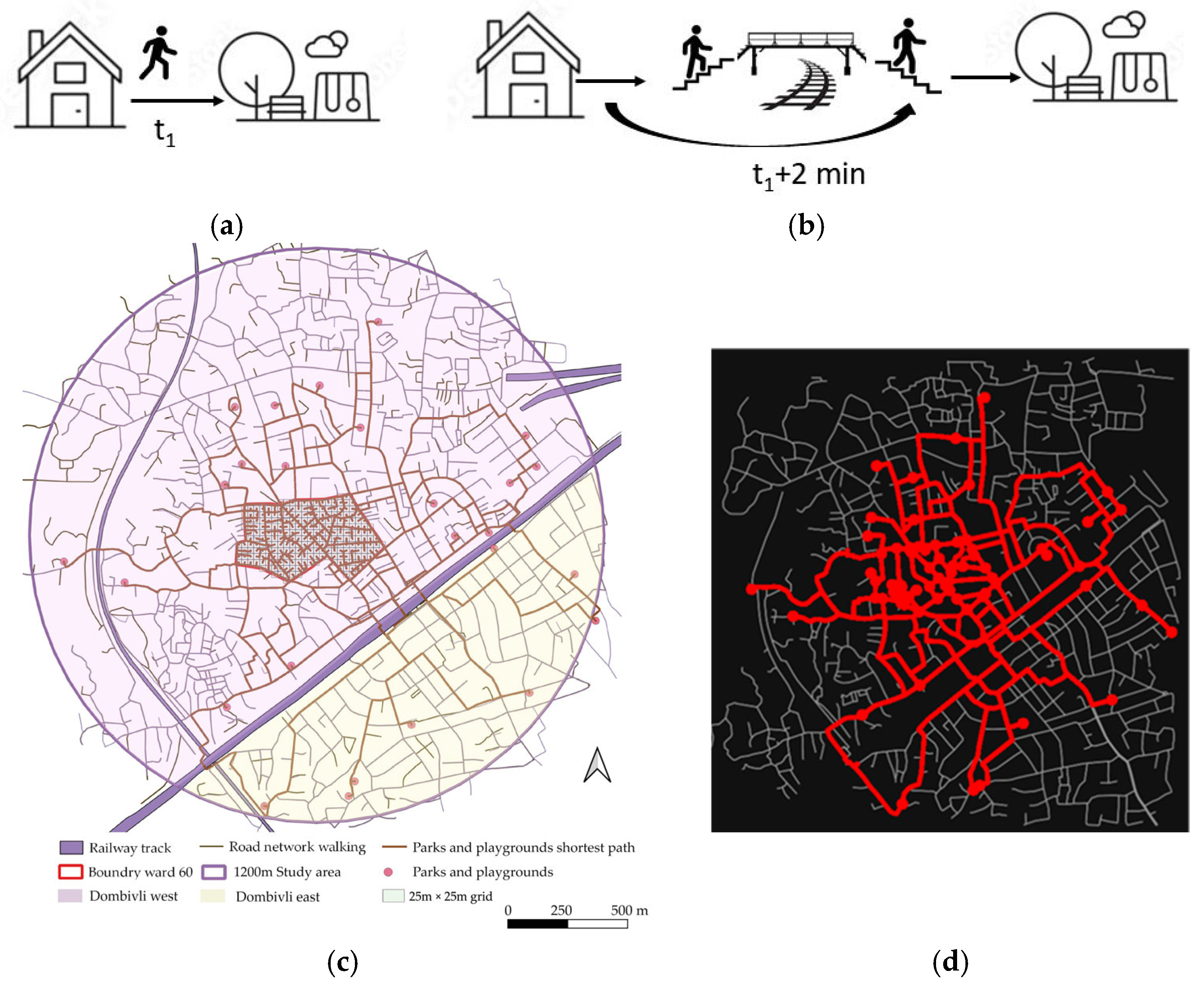
2.4.1. Computation of OD Matrix Shortest Path to Parks and Playgrounds by QGIS
2.4.2. Computation of OD Matrix Shortest Path to Parks and Playgrounds by OSMnx
2.4.3. Accessibility Assessment Using Various Mode of Transport
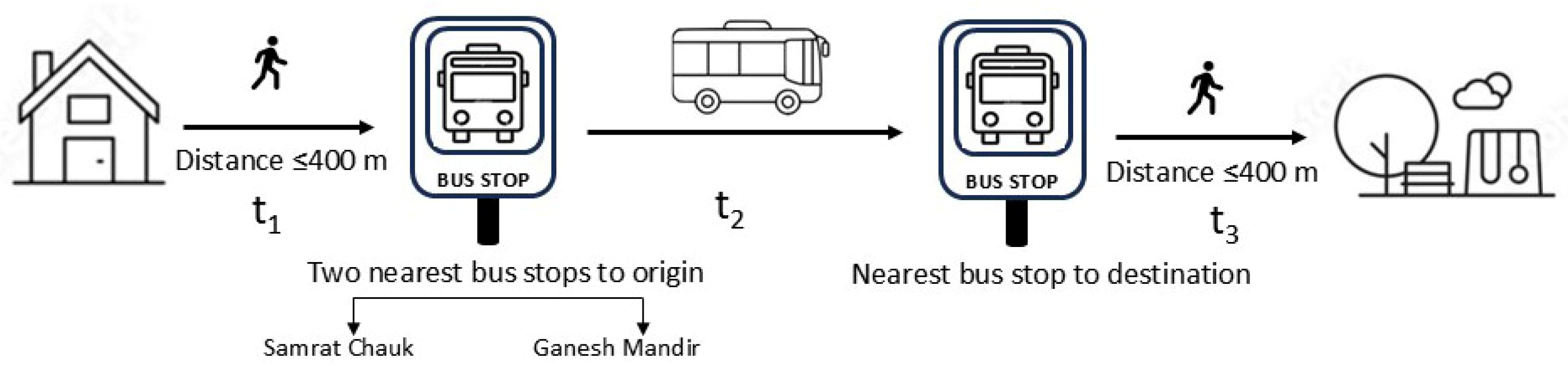
Accessibility Assessment Using a Bus as the Mode of Transport
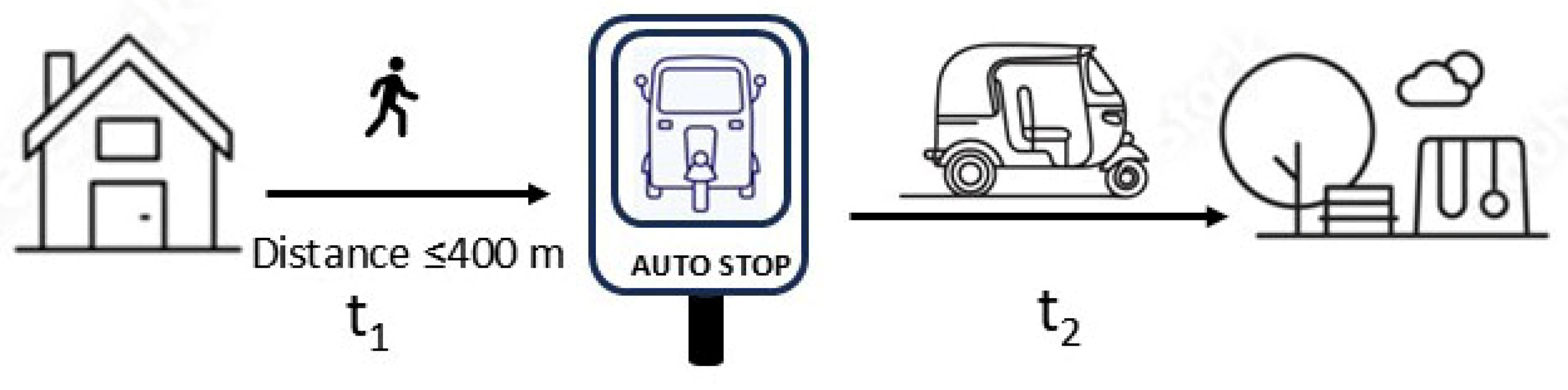
Accessibility Assessment Using Autorickshaws as the Mode of Transport
Accessibility Assessment Using a Bicycle, 2W, and 4W as the Mode of Transport
2.4.4. Data Analysis Using R
2.4.5. Accessibility of a Grid and Average Accessibility of Ward 60 (GIS and OSMnx Method)
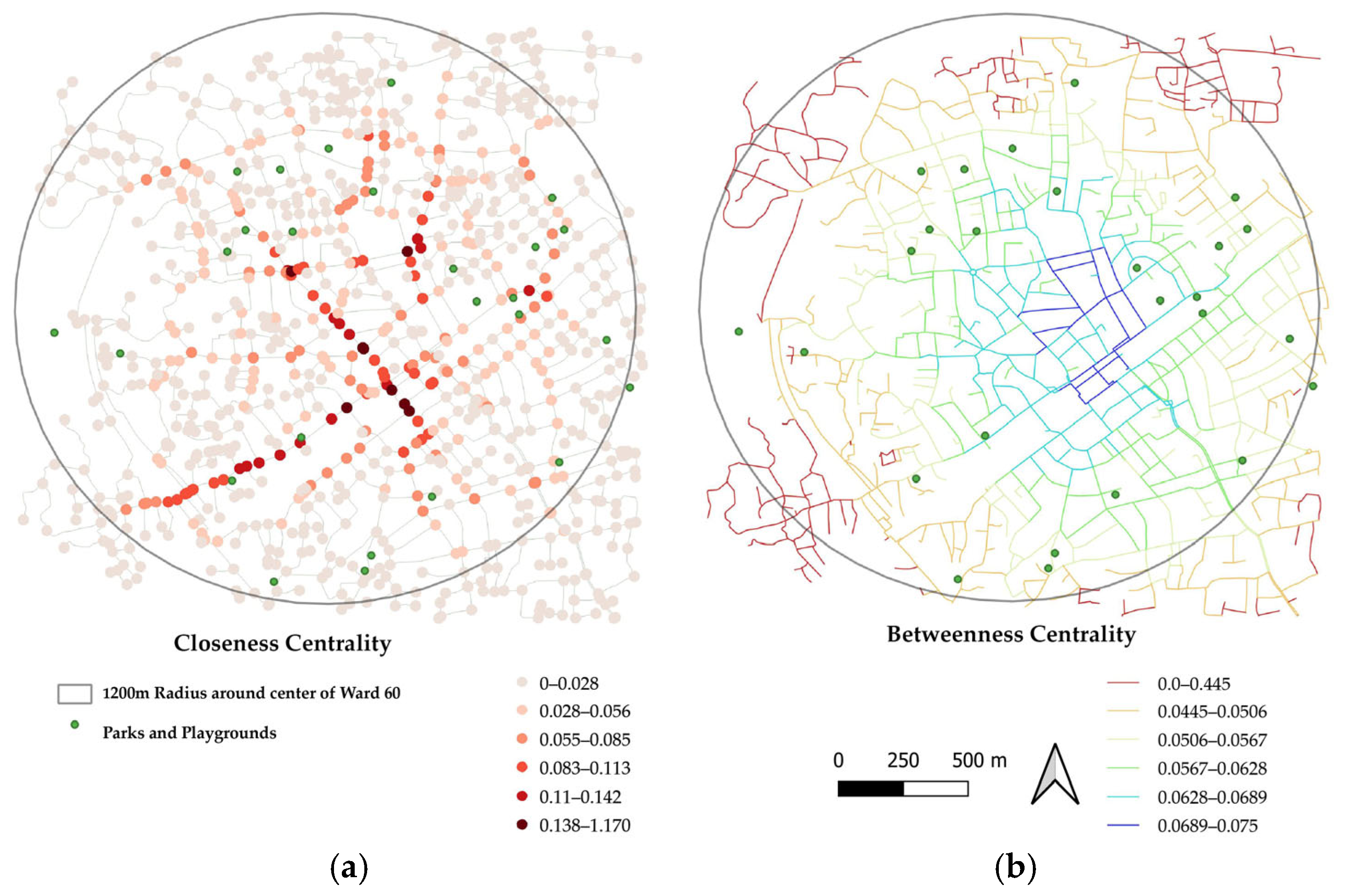
2.5. Betweenness Centrality and Closeness Centrality by OSMnx
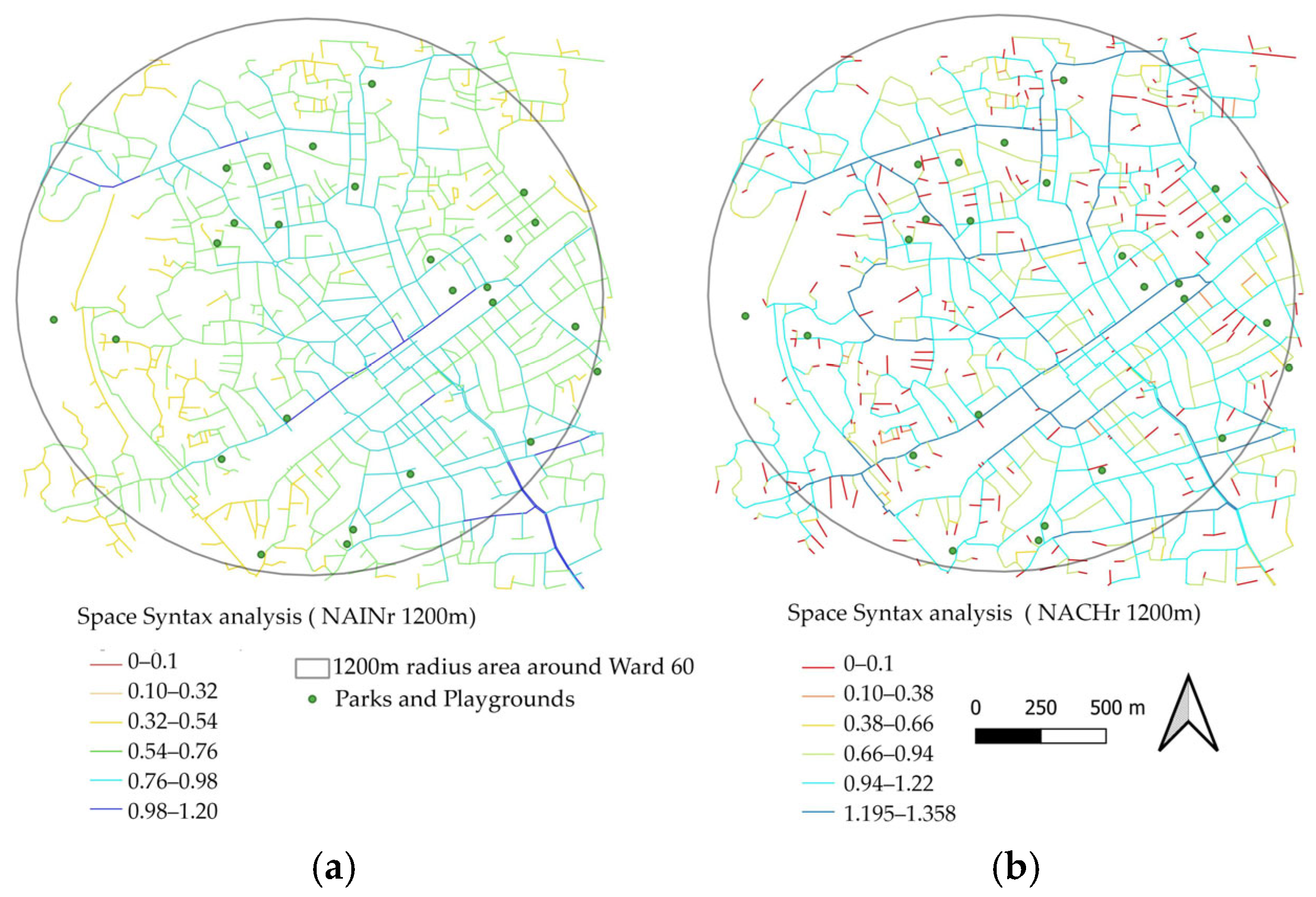
2.6. Normalized Angular Integration (NAIN) and Normalized Angular Choice (NACH) in Space Syntax
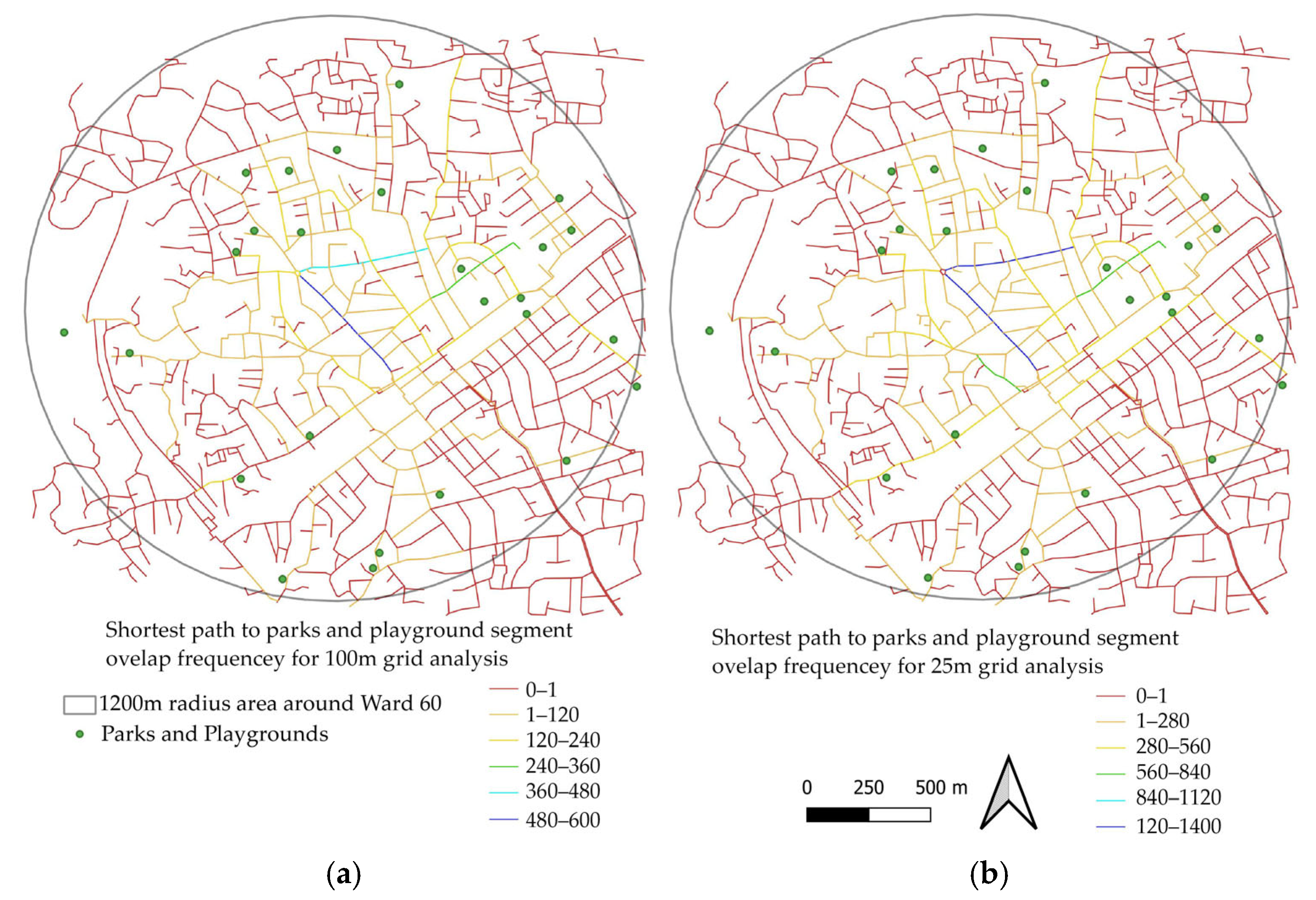
2.7. OD Matrix Shortest Path to Park and Playground Segments Overlap Frequency
3. Results and Discussion
3.1. Method-Wise Comparison of Accessibility Assessments by QGIS and OSMnx
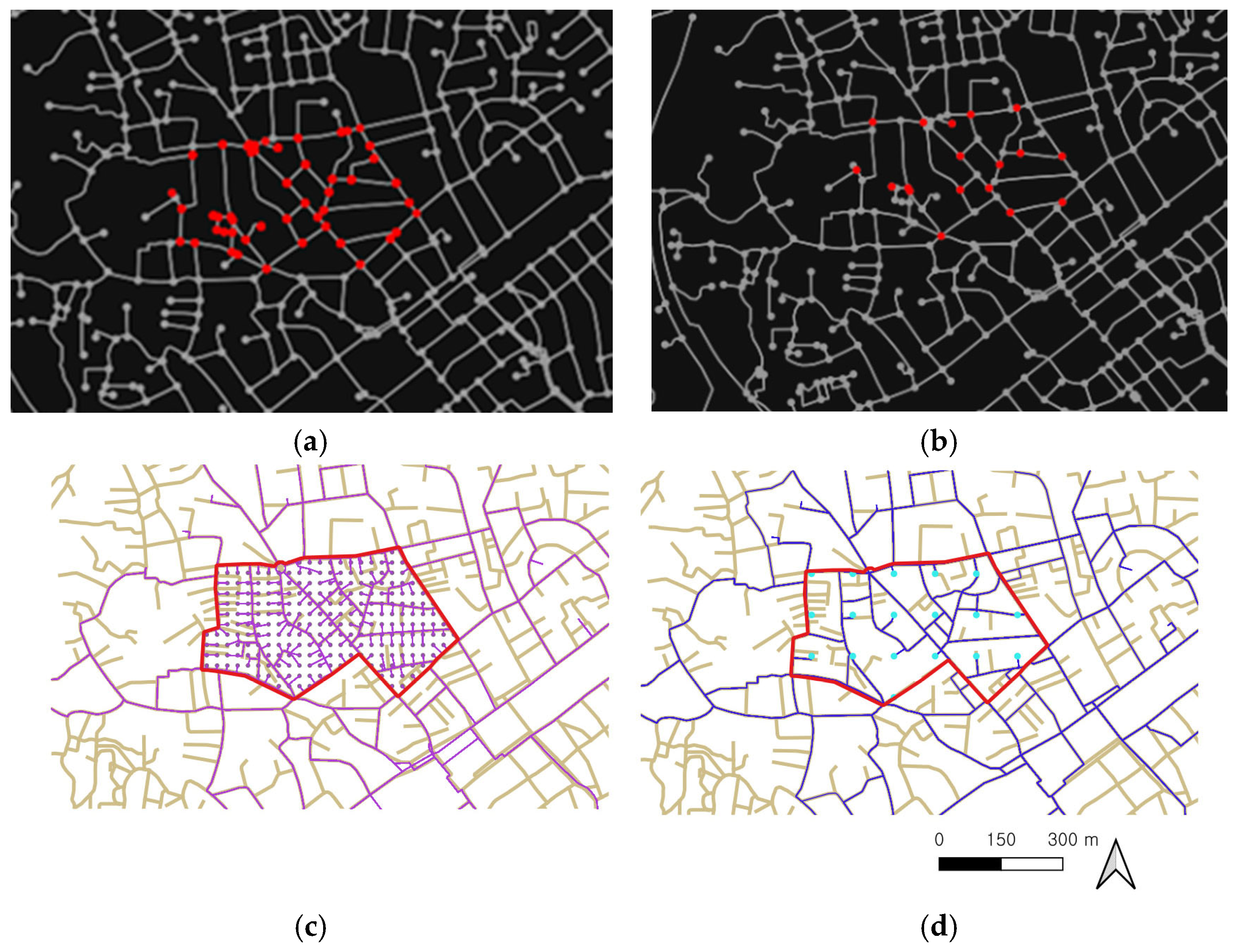
3.1.1. The Role of the Nearest Node in Shortest Path Calculation
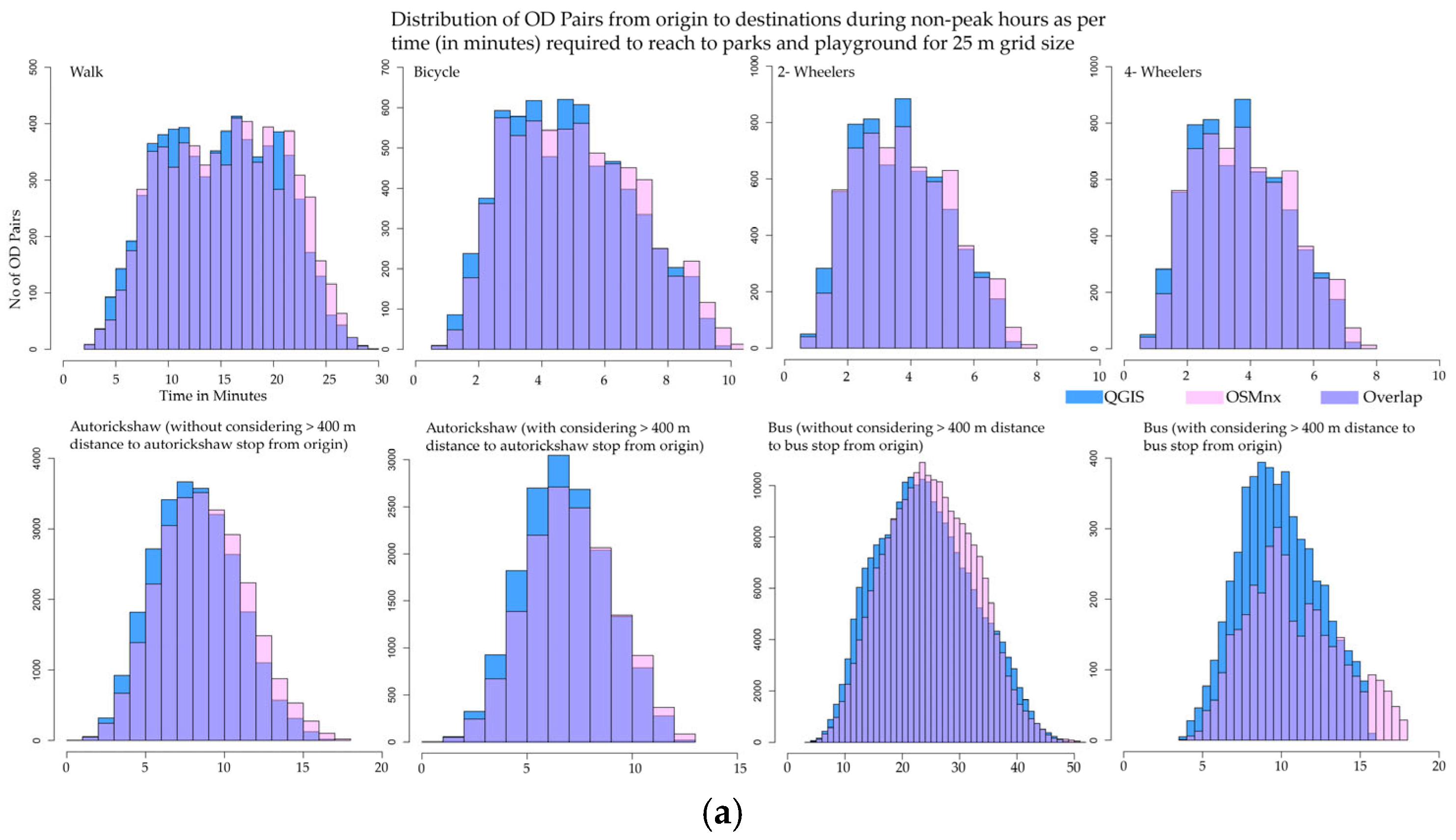
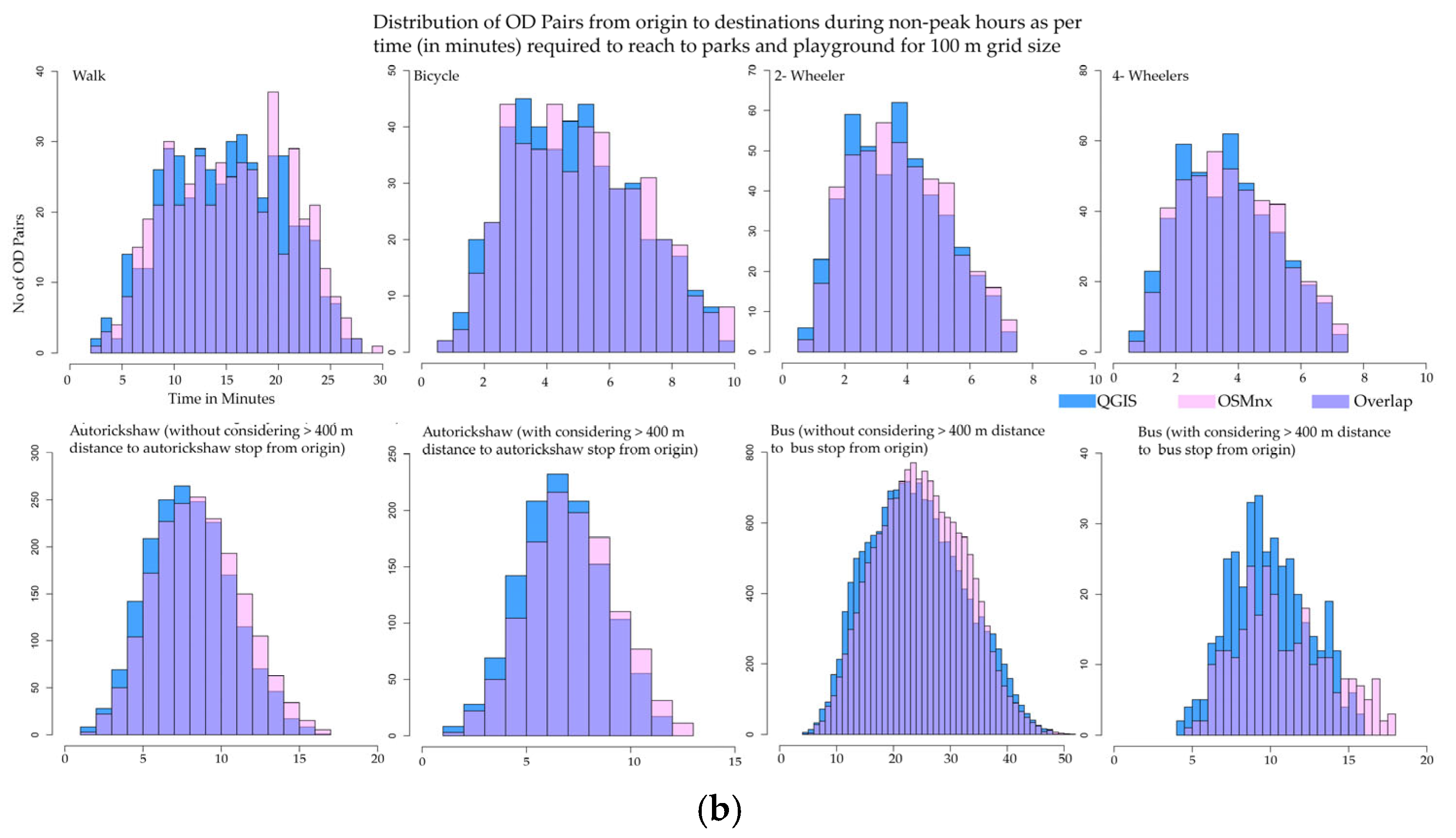
3.1.2. Distribution of Number of OD Pairs from Origin to Destination Accessible Within Time
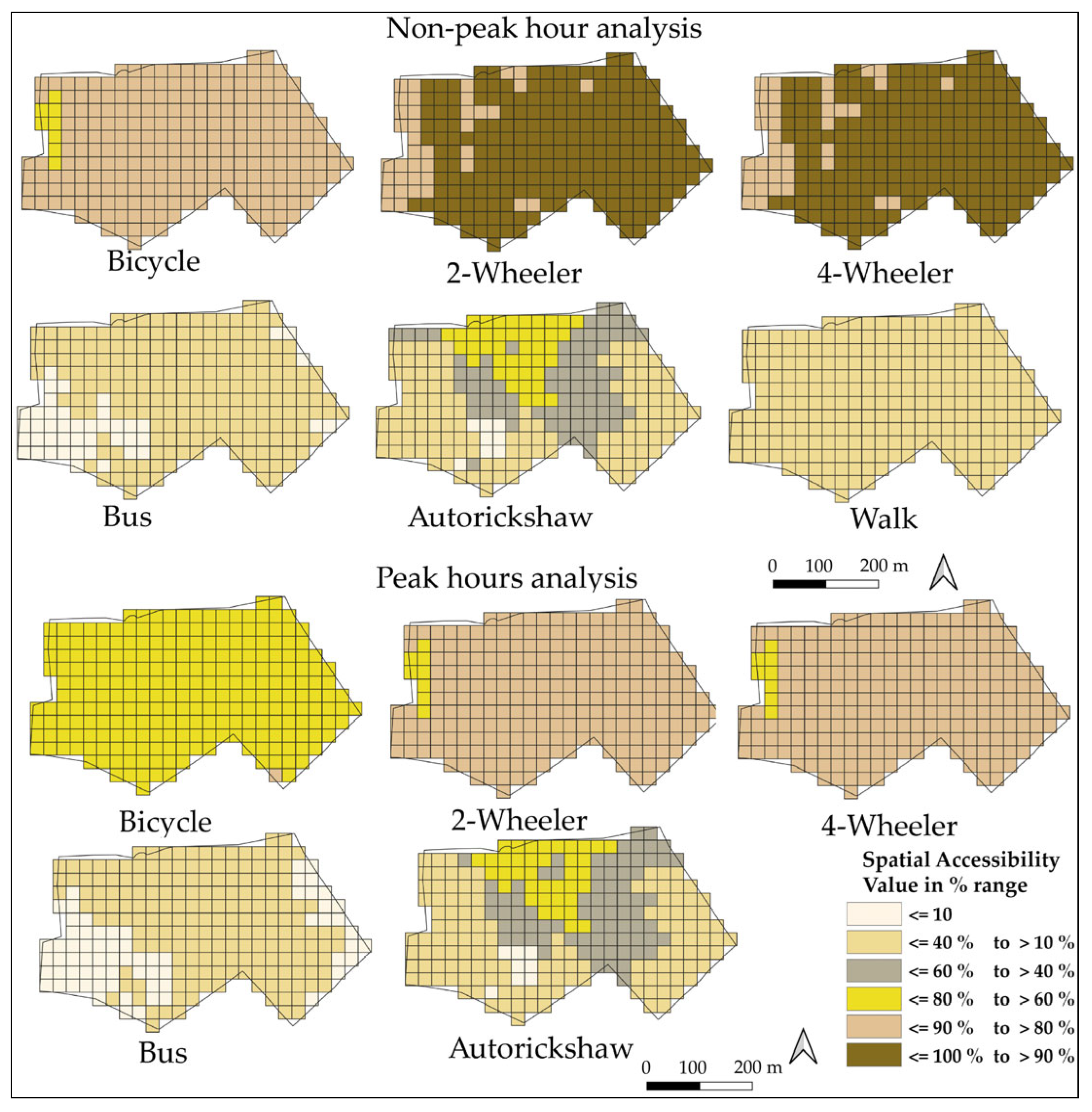
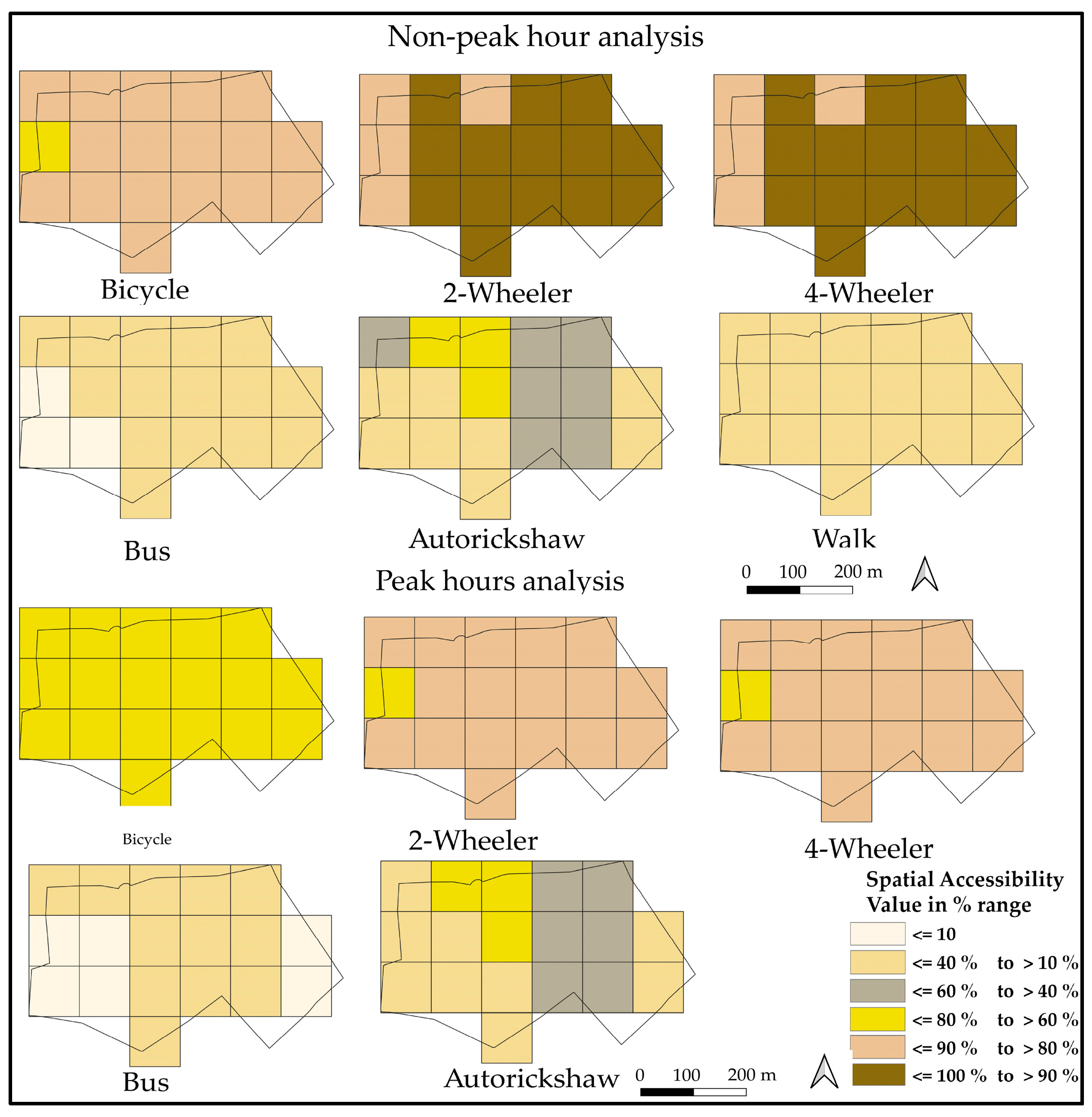
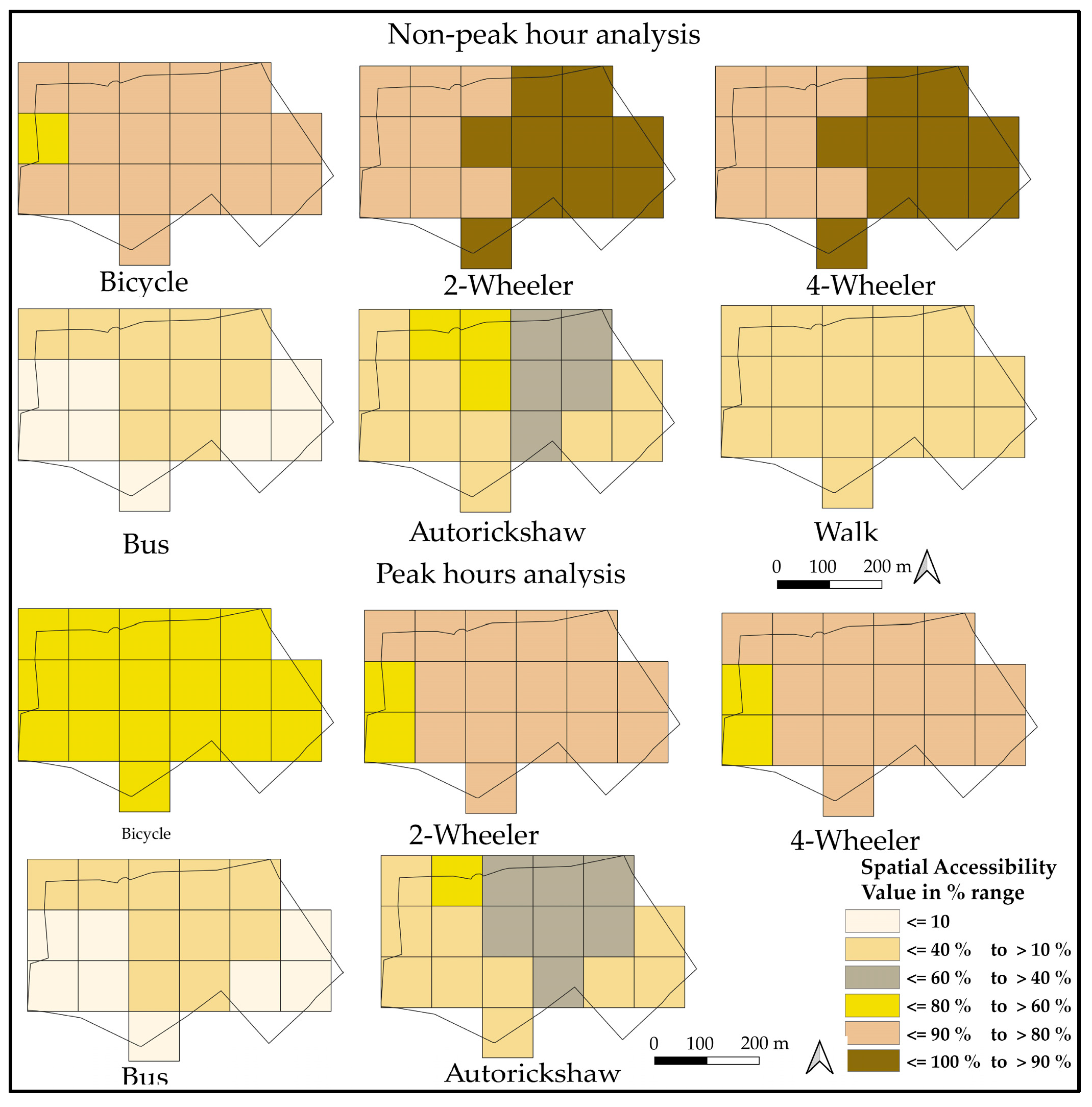
3.2. Systematic Comparison of Accessibility Assessment of Parks and Playgrounds for 25 m and 100 m Grid Sizes Using Each Mode of Transportation (Mode-Wise Spatially Represented) Through QGIS
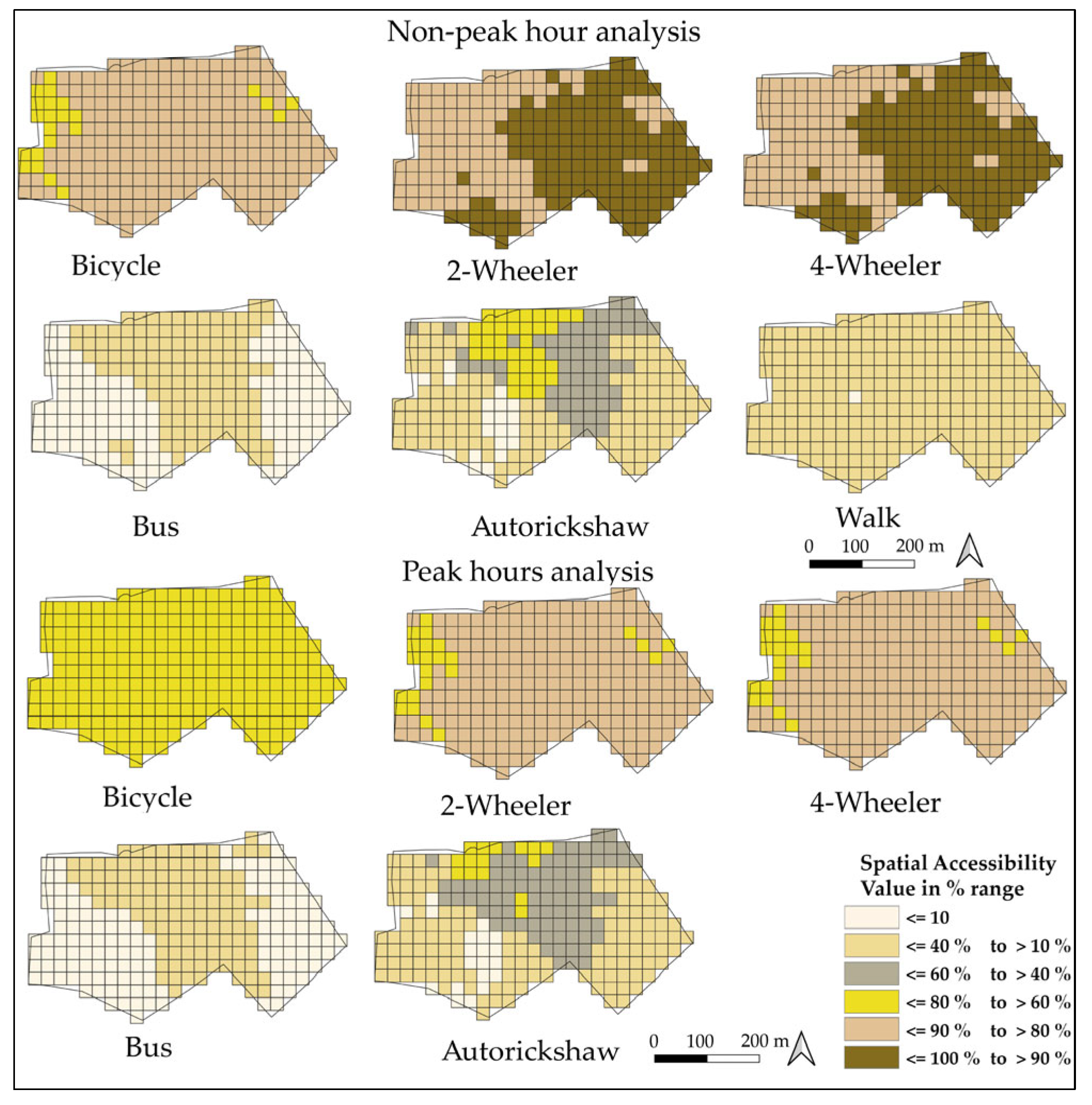
3.3. Systematic Comparison of Accessibility Assessment of Parks and Playgrounds for 25 m and 100 m Grid Sizes Using Each Mode of Transportation (Mode-Wise Spatially Represented) Through OSMnx
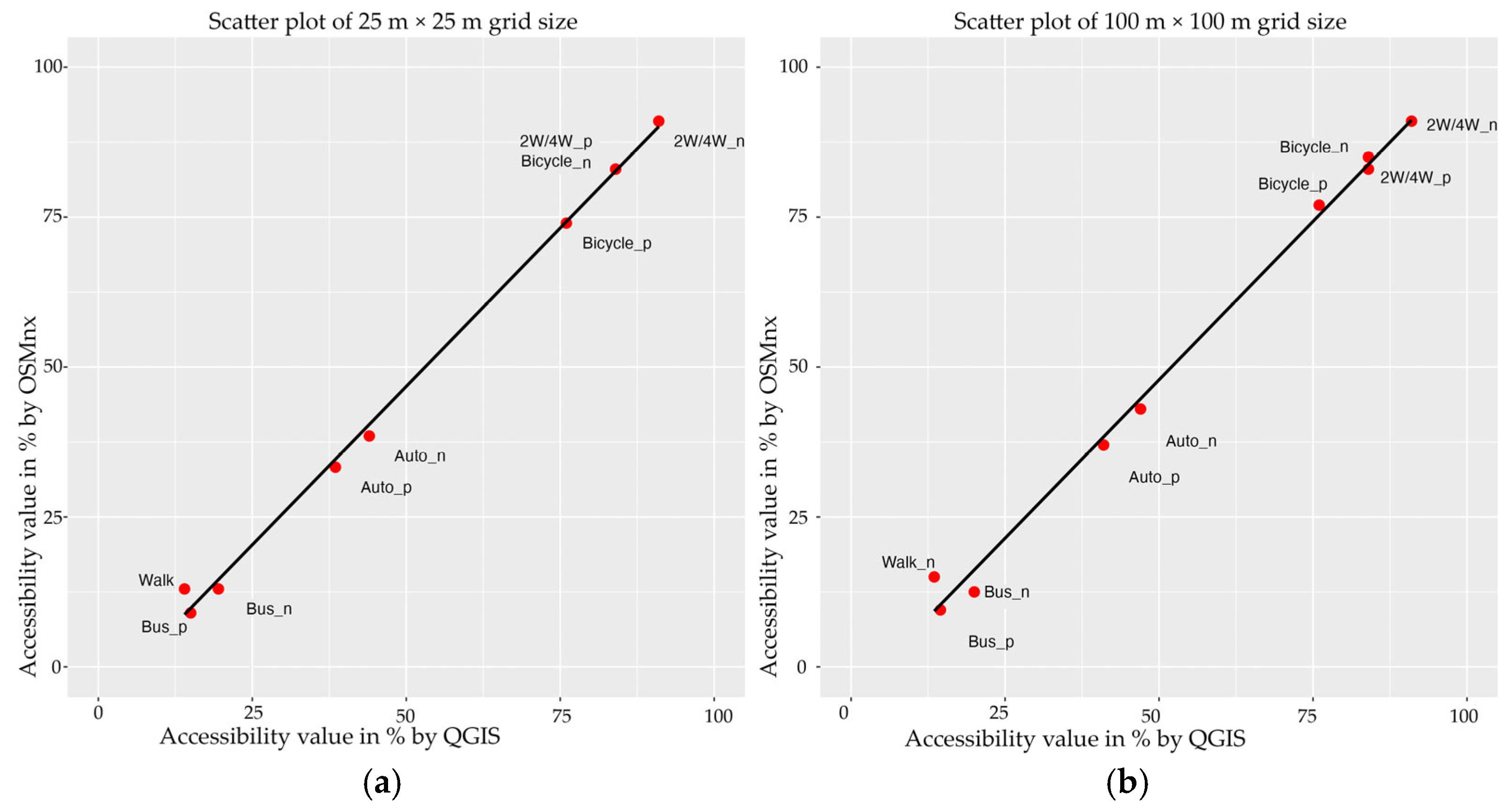
3.4. Transportation Mode-Wise Comparison of Accessibility Assessment Values for All Six Modes
3.5. The Average Accessibility of Ward 60 Using Both QGIS and OSMnx Methods
3.6. Closeness Centrality and Between Centrality Results by OSMnx
3.7. Angular Segment Analysis Method of Space Syntax (Integration and Choice)
3.8. Results of Segment Ovelap Frequency: Comparison of OSMnx and Space Syntax
4. Implication of Urban Planning Policies for Accessibility Assessments
5. Conclusions
Limitations of Research and Future Research Areas
Supplementary Materials
Author Contributions
Funding
Data Availability Statement
Conflicts of Interest
Correction Statement
Abbreviations
| SusTAIN | Sustainable Transportation Assessment Index |
| NSA | Neighborhood Sustainability Assessment |
| GIS | Geographic Information System |
| QGIS | Quantum Geographic Information System |
| GI | Green Infrastructure |
| SDGs | Sustainable Development Goals |
| SS | Space Syntax |
| 15 MC | 15-Minute City |
| UrMoAC | The Urban Mobility Accessibility Computer |
| 2SFCA | Two-Step Floating Catchment Area |
| AI | Artificial Intelligence |
| URDPFI | Urban and Regional Development Plans Formulation and Implementation Guidelines |
| TOD | Transit-Oriented Development |
| PT | Public Transport |
| IPT | Intermediate Public Transportation |
| NAIN | Normalized Angular Integration |
| NACH | Normalized Angular Choice |
| MMR | Mumbai Metropolitan Region |
| ODw1 | Origin to destinations in Dombivli west matrix |
| ODw2 | Origin to destinations in Dombivli east matrix |
| BS1 | Bus stops closest to homes |
| BS2 | Bus stops closest to destinations |
| ODb1 | Origin to bus stops closest to homes matrix |
| ODb2 | Bus stops closest to homes (BS1) to bus stop closest to destinations (BS2) Matrix |
| ODb3 | The bus stops near to destinations (BS2) to actual location of destination Matrix |
| ODa1 | Origin to autorickshaw stops (1,2,3,4) |
| ODa2 | Autorickshaw stop 1 to destinations matrix |
| ODa3 | Autorickshaw stop 2 to destinations matrix |
| ODa4 | Autorickshaw stop 3 to destinations matrix |
| ODa5 | Autorickshaw stop 4 to destinations matrix |
| ODx | Origin to destination matrix for Bicycles |
| ODy | Origin to destination matrix for 2-Wheelers |
| ODz | Origin to destination matrix for 4-Wheelers |
| Bi | Bicycle |
| 2W | 2-Wheeler |
| 4W | 4-Wheeler |
| Auto | Autorickshaw |
| DP | Douglas Peucker |
| OSM | Open Street Map |
| RCL | Road Centre Line |
| ASA | Angular Segment Analysis |
| UNGI | Urban Neighborhood Green Index |
| NDVI | Normalized Difference Vegetation Index |
| UGA | Urban Green Accessibility |
| FSI | Floor Space Index |
| EV | Electric Vehicle |
References
- Bahale, S.; Schuetze, T. Sustainable Transportation Assessment Index (SusTAIN) Framework for Mixed-Use Neighborhoods in India. Land 2024, 13, 1325. [Google Scholar] [CrossRef]
- Bahadure, S.; Kotharkar, R. Framework for measuring sustainability of neighbourhoods in Nagpur, India. Build. Environ. 2018, 127, 86–97. [Google Scholar] [CrossRef]
- Gouda, A.A.; Masoumi, H.E. Sustainable Transportation According to Certification Systems: A viability analysis based on neighborhood size and context relevance. Environ. Impact Assess. Rev. 2017, 63, 147–159. [Google Scholar] [CrossRef]
- Bahadure, S.; Kamble, T. Measuring Urban Accessibility using Complete Spatial Randomness. In Proceedings of the 7th Annual Internation Conference on Architecture and Civil Engineering (ACE 2019), Singapore, 27–28 May 2019. [Google Scholar]
- Gu, X.; Tao, S.; Dai, B. Spatial accessibility of country parks in Shanghai, China. Urban For. Urban Green. 2017, 27, 373–382. [Google Scholar] [CrossRef]
- Swain, M.; Bahadure, S. Urban Green Space for a Sustainable Urban Environment. In Proceedings of the 2nd International Conference on Sustainability: Developments and Innovations (ICSDI 2024), Riyadh, Saudi Arabia, 18–22 February 2024; pp. 278–285. [Google Scholar]
- Turaga, R.M.R.; Jha-Thakur, U.; Chakrabarti, S.; Hossain, D. Exploring the role of Urban Green Spaces in ‘smartening’ cities in India. Impact Assess. Proj. Apprais. 2019, 38, 479–490. [Google Scholar] [CrossRef]
- Czesak, B.; Różycka-Czas, R. Assessing accessibility and crowding in urban green spaces: A comparative study of approaches. Landsc. Urban Plan. 2025, 257, 105301. [Google Scholar] [CrossRef]
- La Rosa, D. Accessibility to greenspaces: GIS based indicators for sustainable planning in a dense urban context. Ecol. Indic. 2014, 42, 122–134. [Google Scholar] [CrossRef]
- Gupta, K.; Roy, A.; Luthra, K.; Maithani, S.; Mahavir. GIS based analysis for assessing the accessibility at hierarchical levels of urban green spaces. Urban For. Urban Green. 2016, 18, 198–211. [Google Scholar] [CrossRef]
- Chen, Q.; Wang, C.; Lou, G.; Zhang, M.; Wu, S. Measurement of Urban Park Accessibility from the Quasi-Public Goods Perspective. Sustainability 2019, 11, 4573. [Google Scholar] [CrossRef]
- Jang, K.M.; Kim, J.; Lee, H.-Y.; Cho, H.; Kim, Y. Urban Green Accessibility Index: A Measure of Pedestrian-Centered Accessibility to Every Green Point in an Urban Area. ISPRS Int. J. Geo-Inf. 2020, 9, 586. [Google Scholar] [CrossRef]
- Kamble, T.; Bahadure, S.; Punglia, S. Availability and Accessibility of Urban Green Spaces in a High-Density City: The Case of Raipur, India. Prof. Geogr. 2022, 74, 290–303. [Google Scholar] [CrossRef]
- Imam, A.U.K.; Banerjee, U.K. Urbanisation and greening of Indian cities: Problems, practices, and policies. Ambio 2016, 45, 442–457. [Google Scholar] [CrossRef]
- Moreno, C.; Allam, Z.; Chabaud, D.; Gall, C.; Pratlong, F. Introducing the “15-Minute City”: Sustainability, Resilience and Place Identity in Future Post-Pandemic Cities. Smart Cities 2021, 4, 93–111. [Google Scholar] [CrossRef]
- Jeong, I.; Choi, M.; Kwak, J.; Ku, D.; Lee, S. A comprehensive walkability evaluation system for promoting environmental benefits. Sci. Rep. 2023, 13, 16183. [Google Scholar] [CrossRef]
- Soukhov, A.; Tarriño-Ortiz, J.; Soria-Lara, J.A.; Páez, A. Multimodal spatial availability: A singly-constrained measure of accessibility considering multiple modes. PLoS ONE 2024, 19, e0299077. [Google Scholar] [CrossRef]
- Villanueva-Durbán, N.; Lorenzo-Sáez, E.; Lerma-Arce, V.; Coll-Aliaga, E. Evaluation of Urban Accessibility Through Geomarketing Techniques: Case Study in Valencia (Spain). ISPRS Int. J. Geo-Inf. 2025, 14, 60. [Google Scholar] [CrossRef]
- Rahman, F.; Oliver, R.; Buehler, R.; Lee, J.; Crawford, T.; Kim, J. Impacts of point of interest (POI) data selection on 15-Minute City (15-MC) accessibility scores and inequality assessments. Transp. Res. Part A Policy Pract. 2025, 195, 104429. [Google Scholar] [CrossRef]
- Pozoukidou, G.; Chatziyiannaki, Z. 15-Minute City: Decomposing the New Urban Planning Eutopia. Sustainability 2021, 13, 928. [Google Scholar] [CrossRef]
- Abd El Karim, A.; Awawdeh, M.M. Integrating GIS Accessibility and Location-Allocation Models with Multicriteria Decision Analysis for Evaluating Quality of Life in Buraidah City, KSA. Sustainability 2020, 12, 1412. [Google Scholar] [CrossRef]
- Plastara, D.; Pozoukidou, G. 15-minute cities: A literature overview exploring international planning strategies. In Proceedings of the 18th International Conference on Environmental Science and Technology, Athens, Greece, 30 August–2 September 2023. [Google Scholar]
- Grădinaru, A.P.; Badea, A.-C.; Ene, A.; Badea, G. The integration of geospatial analyses based on AI in GIS in the context of the “15-minute city” concept. In Proceedings of the 9th Conference of the Sustainable Solutions for Energy and Environment (EENVIRO 2024), Bucharest, Romania, 28 October–1 November 2024; Volume 608, p. 05008. [Google Scholar] [CrossRef]
- Abdelfattaha, L.; Depontea, D.; Fossab, G. The 15-minute city: Interpreting the model to bring out urban resiliencies. In Proceedings of the XXV International Conference Living and Walking in Cities—New Scenarios for Safe Mobility in Urban Areas (LWC 2021), Brescia, Italy, 9–10 September 2021; pp. 330–337. [Google Scholar]
- Gaglioneb, F.; Gargiulob, C.; Zucarob, F.; Cottrilla, C. Urban accessibility in a 15-minute city: A measure in the city of Naples, Italy. In Proceedings of the XXV International Conference Living and Walking in Cities—New Scenarios for Safe Mobility in Urban Areas (LWC 2021), Brescia, Italy, 9–10 September 2021; pp. 378–385. [Google Scholar]
- Murgante, B.; Patimisco, L.; Annunziata, A. Developing a 15-minute city: A comparative study of four Italian Cities-Cagliari, Perugia, Pisa, and Trieste. Cities 2024, 146, 104765. [Google Scholar] [CrossRef]
- Merlo, L.; Chapman, D.; Nilson, F.; Johansson, C.; Larsson, A. Healthy ageing and the 15-minute walking environment in the Swedish Arctic communities. J. Transp. Health 2025, 42, 102019. [Google Scholar] [CrossRef]
- Biraghi, C.A.; Ogut, O.; Dong, T.; Tadi, M. CityTime: A Novel Model to Redefine the 15-Minute City Globally Through Urban Diversity and Proximity. Urban Sci. 2025, 9, 36. [Google Scholar] [CrossRef]
- Gaxiola-Beltrán, A.L.; Narezo-Balzaretti, J.; Ramírez-Moreno, M.A.; Pérez-Henríquez, B.L.; Ramírez-Mendoza, R.A.; Krajzewicz, D.; Lozoya-Santos, J.d.-J. Assessing Urban Accessibility in Monterrey, Mexico: A Transferable Approach to Evaluate Access to Main Destinations at the Metropolitan and Local Levels. Appl. Sci. 2021, 11, 7519. [Google Scholar] [CrossRef]
- Yang, Y.; Qian, Y.; Zeng, J.; Wei, X.; Yang, M. Walkability Measurement of 15-Minute Community Life Circle in Shanghai. Land 2023, 12, 153. [Google Scholar] [CrossRef]
- Liu, D.; Kan, Z.; Lee, J. The proposal of a 15-minute city composite index through integrating GPS trajectory data-inferred urban function attraction based on the Bayesian framework. Appl. Geogr. 2024, 173, 103451. [Google Scholar] [CrossRef]
- Yenisetty, P.T.; Bahadure, P. Measuring Accessibility to Various ASFs from Public Transit using Spatial Distance Measures in Indian Cities. ISPRS Int. J. Geo-Inf. 2020, 9, 446. [Google Scholar] [CrossRef]
- Liu, D.; Kwan, M.-P.; Wang, J. Developing the 15-Minute City: A comprehensive assessment of the status in Hong Kong. Travel Behav. Soc. 2024, 34, 100666. [Google Scholar] [CrossRef]
- Fenghour, Z.A.E.; Raham, D.; Sadouni, S. Dynamic spatial approach using GIS and AI for enhanced accessibility of public transportation system: Case of study Ali Mendjeli, Algeria. Euro-Mediterr. J. Environ. Integr. 2025, 10, 4265–4285. [Google Scholar] [CrossRef]
- Observer Research Foundation. Revisiting India’s Own ‘15 minutes City’mixed-Use Planning Concepts, Town Planning Scheme. Available online: https://www.orfonline.org/expert-speak/revisiting-india-own-15-minute-city-mixed-use-planning-concepts-town-planning-schemes (accessed on 11 April 2025).
- Lovelace, R. Open source tools for geographic analysis in transport planning. J. Geogr. Syst. 2021, 23, 547–578. [Google Scholar] [CrossRef]
- Rey, S.J. Show me the code: Spatial analysis and open source. J. Geogr. Syst. 2009, 11, 191–207. [Google Scholar] [CrossRef]
- Boeing, G. OSMnx: New methods for acquiring, constructing, analyzing, and visualizing complex street networks. Comput. Environ. Urban Syst. 2017, 65, 126–139. [Google Scholar] [CrossRef]
- Fu, X.; Kakkar, D.; Chen, J.; Moynihan, K.M.; Hegland, T.A.; Blossom, J. A Comparative Study of Methods for Drive Time Estimation on Geospatial Big Data: A Case Study in USA. In Proceedings of the International Archives of the Photogrammetry Remote Sensing and Spatial Information Sciences, Padua, Italy, 24–26 May 2023; Volume XLVIII-4/W7-2023, pp. 53–60. [Google Scholar] [CrossRef]
- Boeing, G. Modeling and Analyzing Urban Networks and Amenities with OSMnx. Geogr. Anal. 2025, 57, 567–577. [Google Scholar] [CrossRef]
- Batty, M. Integrating space syntax with spatial interaction. Urban Inform. 2022, 1, 4. [Google Scholar] [CrossRef]
- Nes, A.V.; Yamu, C. Introduction to Space Syntax in Urban Studies; Springer Nature: Cham, Switzerland, 2021. [Google Scholar]
- Hillier, B.; Leaman, A.; Stansall, P.; Bedford, M. Space Syntax. Environ. Plan. B Plan. Des. 1976, 3, 147–185. [Google Scholar] [CrossRef]
- Boeing, G. Street Network Models and Indicators for Every Urban Area in the World. Geogr. Anal. 2021, 54, 519–535. [Google Scholar] [CrossRef]
- Yen, Y.; Zhao, P.; Sohail, M.T. The morphology and circuity of walkable, bikeable, and drivable street networks in Phnom Penh, Cambodia. Environ. Plan. B Urban Anal. City Sci. 2019, 48, 169–185. [Google Scholar] [CrossRef]
- Poppinga, M. Large-Scale Accessibility Analysis Using Open Street Map Data. Master’s Thesis, University of Hamburg, Hamburg, Germany, 2018. [Google Scholar]
- Ministry of Urban Development, Government of India. Urban and Regional Development Plans Formulation and Implementation (URDPFI) Guidelines; Ministry of Urban Development: New Dehli, India, 2015; Volume I. [Google Scholar]
- Town and Country Planning Organisation, Ministry of Urban Development, Government of India. Urban Green Guidelines 2014; Ministry of Urban Development: New Dehli, India, 2014. [Google Scholar]
- Ministry of Urban Development, Government of India; UNDP. Development of Toolkit Under Sustainable Urban Transport Project: Public Transport Accessibility Toolkit; Ministry of Urban Development: New Delhi, India, 2013; Available online: https://iutindia.org/CapacityBuilding/Toolkits.aspx (accessed on 12 March 2025).
- Ministry of Urban Development, Government of India. Transit Oriented Development Policy 2017; Ministry of Urban Development: New Dehli, India, 2017. [Google Scholar]
- Ministry of Housing and Urban Affairs. National Transit Oriented Development (TOD) Policy; Ministry of Housing and Urban Affairs, Government of India: New Dehli, India, 2017. [Google Scholar]
- Mani, A.; Pai, M.; Aggarwal, R. Sustainable Urban Transport in India: Role of the Auto-Rickshaw Sector; World Resources Institute and EMBARQ: Washington, DC, USA, 2012. [Google Scholar]
- Tiwari, G. The Role of Cycle Rickshaws in Urban Transport. Transfers 2014, 4, 83–96. [Google Scholar] [CrossRef]
- Kumar, A.; Thomas, J.; Wadhwa, S.S.; Mishra, A.; Dasgupta, S. The last mile connectivity: Experience of passengers and drivers of E-rickshaws and cycle rickshaws in an Indian city. Case Stud. Transp. Policy 2022, 10, 948–953. [Google Scholar] [CrossRef]
- Garg, S.; Gayen, A.S.; Jena, P.; Jose, G.S.; Ramamurthy, L.; Jiyad, K.M.; Dhanuraj, D. Study on the Autorickshaw Sector in Chennai; Civitas Consultancies Pvt Ltd. for City Connect Foundation Chennai (CCCF): Chennai, India, 2010. [Google Scholar]
- Ashwathy, A.; Sreevatsan, A.; Taraporevala, P. An Overview of the Smart Cities Mission in India; Center for Policy Research India: New Delhi, India, 2018. [Google Scholar]
- Building Inclusive Urban Communities (BINUCOM); KRVIA. KRVIA Local Dissemination Workkshop, September 2017: Local Area Planning Kalyan Dombivli. Available online: https://mdl.donau-uni.ac.at/binucom/pluginfile.php/766/mod_page/content/6/170916_parmar.pdf (accessed on 22 June 2024).
- Murtagh, E.M.; Mair, J.L.; Aguiar, E.; Tudor-Locke, C.; Murphy, M.H. Outdoor Walking Speeds of Apparently Healthy Adults: A Systematic Review and Meta-analysis. Sports Med. 2021, 51, 125–141. [Google Scholar] [CrossRef]
- Perry, C.A. The Neighborhood Unit, a Scheme of Arrangement for the Family-Life Community; Committee on Regional Plan of New York and Its Environs: New York, NY, USA, 1929. [Google Scholar]
- Litman, T. Evaluating Accessibility for Transport Planning Measuring People’s Ability to Reach Desired Services and Activities; Victoria Transport Policy Institute: Victoria, BC, Canada, 2023. [Google Scholar]
- Khavarian-Garmsir, A.R.; Sharifi, A.; Hajian Hossein Abadi, M.; Moradi, Z. From Garden City to 15-Minute City: A Historical Perspective and Critical Assessment. Land 2023, 12, 512. [Google Scholar] [CrossRef]
- Curtis, C.; Jan, S. Planning for Public Transport Accessibility: An International Sourcebook, 1st ed.; Routledge: London, UK, 2016; p. 328. [Google Scholar]
- Neutens, T.; Schwanen, T.; Witlox, F.; De Maeyer, P. Equity of urban service delivery: A comparison of different accessibility measures. Environ. Plan. A Econ. Space 2010, 42, 1613–1635. [Google Scholar] [CrossRef]
- Khavarian-Garmsir, A.R.; Sharifi, A.; Sadeghi, A. The 15-minute city: Urban planning and design efforts toward creating sustainable neighborhoods. Cities 2023, 132, 104101. [Google Scholar] [CrossRef]
- Chen, P.N.; Karimi, K. Multilevel Multimodal Network Modelling:The Spatial Impacts of the Public Transport on Urban Systems. In Proceedings of the 13th Space Syntax Symposium (13SSS), Bergen, Norway, 20–24 June 2022. [Google Scholar]
- Pourramazani, H.; Miralles-Garcia, J.L. Evaluating Urban Transportation Accessibility: A Systematic Review of Access Dimensions and Indicators. Int. J. Transp. Dev. Integr. 2023, 7, 331–339. [Google Scholar] [CrossRef]
- QGIS Pythons Plugins Repository. Available online: https://plugins.qgis.org/plugins/QNEAT3/ (accessed on 28 November 2024).
- Boeing, G. OSMnx Documentation 2.0.7: Osmnx. Routing Module. Shortest_Path. Available online: https://osmnx.readthedocs.io/en/stable/user-reference.html#osmnx.routing.shortest_path (accessed on 7 August 2024).
- The R Foundation. R Project for Statistical Computing. Available online: https://www.r-project.org (accessed on 10 October 2024).
- Wickham, H.; Averick, M.; Bryan, J.; Chang, W.; McGowan, L.D.A.; François, R.; Grolemund, G.; Hayes, A.; Henry, L.; Hester, J.; et al. Welcome to the tidyverse. J. Open Source Softw. 2019, 4, 1686. [Google Scholar] [CrossRef]
- Wickham, H.; François, R.; Henry, L.; Müller, K.; Vaughan, D. dplyr: A Grammar of Data Manipulation. Available online: https://cran.r-project.org/web/packages/dplyr/index.html (accessed on 10 October 2024).
- Wickham, H. ggplot2: Elegant Graphics for Data Analysis; Springer: New York, NY, USA, 2016. [Google Scholar]
- Hillier, B.; Yang, T.; Turner, A. Normalising least angle choice in Depthmap and how it opens up new perspectives on the global and local analysis of city space. J. Space Syntax 2012, 3, 155–193. [Google Scholar]
- Körmeçli, P.Ş. Analysis of Walkable Street Networks by Using the Space Syntax and GIS Techniques: A Case Study of Çankırı City. ISPRS Int. J. Geo-Inf. 2023, 12, 216. [Google Scholar] [CrossRef]
- Donegan, L.; Tavares, F. Tuning in: Investigating OSMnx RCL model preparation methods for Angular Segment Analysis. In Proceedings of the 13th Space Syntax Symposium, Bergen, Norway, 20–24 June 2022; pp. 1–17. [Google Scholar]
- Long, Y.; Qin, J.; Wu, Y.; Wang, K. Analysis of Urban Park Accessibility Based on Space Syntax: Take the Urban Area of Changsha City as an Example. Land 2023, 12, 1061. [Google Scholar] [CrossRef]
- Kanyou, C.; Kouokam, E.; Emvudu, Y. Structural network analysis: Correlation between centrality measures. CARI 2022, 2022, 1–8. [Google Scholar]
- He, B.; Wang, Y.; Cheshmehzangi, A. Urban Climate and Urban Design, Urban Sustainability; Springer: Berlin/Heidelberg, Germany, 2025. [Google Scholar]
- Hidalgo, D.; Pai, M.; Carrigan, A.; Bhatt, A. Toward People’s Cities through Land use and Transport Integration. Transp. Res. Rec. J. Transp. Res. Board 2013, 2394, 10–18. [Google Scholar] [CrossRef]
- Mahajan, M. Master Planned Mixed-Use: Lessons from Delhi. Tekton 2018, 5, 8–19. [Google Scholar]
- Allam, Z.; Bibri, S.E.; Chabaud, D.; Moreno, C. The ‘15-Minute City’ concept can shape a net-zero urban future. Humanit. Soc. Sci. Commun. 2022, 9, 126. [Google Scholar] [CrossRef]



| Accessibility | Highest | Very High | High | High | Medium–High | Medium–High | Medium | Medium | Medium | Low |
|---|---|---|---|---|---|---|---|---|---|---|
| Duration (minutes) | (≤3) | (>3–≤5) | (>5–≤6.5) | (>6.5–≤8) | (>8–≤9) | (>9–≤10) | (>10–≤11.5) | (>11.5–≤13) | (>13–≤15) | (>15) |
| Weight | 1 | 0.9 | 0.8 | 0.7 | 0.6 | 0.5 | 0.4 | 0.3 | 0.2 | 0.1 |
| Accessibility (%) | (>90–100) | (>80–≤90) | (>70–≤80) | (>60–≤70) | (>50–≤60) | (>40–≤50) | (>30–≤40) | (>20–≤30) | (>10–≤20) | ≤10 |
| Transport Mode | Average Speed (km/h) | Network Type | Origin-Destination Matrix Identifier | Origin-Destination Matrix (Origin → Destination) | OD Matrix Time (min) | Delay Time (min) | Total Time (min) |
|---|---|---|---|---|---|---|---|
| Walk | 4.7 | Pedestrian | ODw1 | Origin → destination in Dombivli west | t1 | – | t1 |
| 4.7 | ODw2 | Origin → destination in Dombivli east | t1 | 2 | t1 + 2 | ||
| Bus | 4.7 | Pedestrian | ODb1 | Origin → bus stop closest to homes (BS1) | t1 | – | t1 + t2 + t3 |
| Peak hour 20, non-peak hour 24 | Bus route | ODb2 | BS1 → Travel time required to access the bus stop near to destinations (BS2) | t1 | – | ||
| 4.7 | Pedestrian | ODb3 | BS2 → destinations | t3 | – | ||
| Auto- rickshaw | 4.7 | Pedestrian | ODa1 | Origin → Autorickshaw stop | t1 | – | t1 + t2 |
| Peak hour 15, non-peak hour 20 | Vehicular | ODa2, ODa3, ODa4, ODa5 | Autorickshaw → destinations | t2 | – | ||
| Bicycle | Peak hour 12, non-peak hour 15 | Vehicular | ODx | Origin → destinations | t1 | – | t1 |
| 2W | Peak hour 15, non-peak hour 20 | Vehicular | ODy | Origin → destinations | t1 | – | t1 |
| 4W | Peak hour 15, non-peak hour 20 | Vehicular | ODz | Origin → destinations | t1 | – | t1 |
Disclaimer/Publisher’s Note: The statements, opinions and data contained in all publications are solely those of the individual author(s) and contributor(s) and not of MDPI and/or the editor(s). MDPI and/or the editor(s) disclaim responsibility for any injury to people or property resulting from any ideas, methods, instructions or products referred to in the content. |
© 2025 by the authors. Published by MDPI on behalf of the International Society for Photogrammetry and Remote Sensing. Licensee MDPI, Basel, Switzerland. This article is an open access article distributed under the terms and conditions of the Creative Commons Attribution (CC BY) license (https://creativecommons.org/licenses/by/4.0/).
Share and Cite
Bahale, S.; Arora, A.S.; Schuetze, T. Comparative Framework for Multi-Modal Accessibility Assessment Within the 15-Minute City Concept: Application to Parks and Playgrounds in an Indian Urban Neighborhood. ISPRS Int. J. Geo-Inf. 2025, 14, 479. https://doi.org/10.3390/ijgi14120479
Bahale S, Arora AS, Schuetze T. Comparative Framework for Multi-Modal Accessibility Assessment Within the 15-Minute City Concept: Application to Parks and Playgrounds in an Indian Urban Neighborhood. ISPRS International Journal of Geo-Information. 2025; 14(12):479. https://doi.org/10.3390/ijgi14120479
Chicago/Turabian StyleBahale, Swati, Amarpreet Singh Arora, and Thorsten Schuetze. 2025. "Comparative Framework for Multi-Modal Accessibility Assessment Within the 15-Minute City Concept: Application to Parks and Playgrounds in an Indian Urban Neighborhood" ISPRS International Journal of Geo-Information 14, no. 12: 479. https://doi.org/10.3390/ijgi14120479
APA StyleBahale, S., Arora, A. S., & Schuetze, T. (2025). Comparative Framework for Multi-Modal Accessibility Assessment Within the 15-Minute City Concept: Application to Parks and Playgrounds in an Indian Urban Neighborhood. ISPRS International Journal of Geo-Information, 14(12), 479. https://doi.org/10.3390/ijgi14120479