


Abstract
Grand unified theories (GUTs) may result in the -inspired composite Higgs model (ECHM) at low energies, almost stabilizing the electroweak scale. We consider an orbifold GUT in 6 dimensions in which the -gauge group is broken to the gauge symmetry of the standard model (SM) while different multiplets of the SM fermions come from different 27-plets. The strongly coupled sector of the ECHM is confined on the brane where is broken down to its subgroup. Near the scale of , this approximate symmetry is expected to be further broken down to its subgroup, which contains the SM-gauge group. Such a breakdown leads to a set of pseudo-Nambu–Goldstone bosons (pNGBs) that includes an SM-like Higgs doublet. The approximate gauge coupling unification in the ECHM takes place at high energies when the right-handed top quark is a composite fermion. To ensure anomaly cancellation, the weakly coupled sector of this model contains extra exotic matter beyond the SM. We discuss the mechanism of the generation of matter–antimatter asymmetry within the variant of the ECHM in which the baryon number and CP invariance are violated.
1. Introduction
It is well known that the standard model (SM) of elementary particles, which involves all known fundamental bosons and fermions, describes rather precisely the major part of all experimental data. At very high energies, the SM can be embedded into grand unified theories (GUTs) [1]. In the simplest GUTs based on the -gauge group, each SM family of fermions is composed of one antifundamental and one antisymmetric second-rank tensor representation of , i.e., . In the case of the GUTs, each family of quarks and leptons fills in a complete single 16-dimensional spinor representation of . This representation also contains the right-handed neutrino, which may be used for the see-saw mechanism [2,3].
Supersymmetry (SUSY) implies that each supermultiplet includes the same number of bosonic and fermionic degrees of freedom. In SUSY GUTs with the -gauge group, the fundamental 27 representation of decomposes under the subgroup as
where the first and second quantities in brackets are the representation and its charge. As before, the supermultiplet can include one family of quarks and leptons. The doublet of the Higgs bosons may form components of the supermultiplet . The SM-gauge bosons are assigned to the adjoint representation of , i.e., a 78-plet. In SUSY GUTs based on the -gauge symmetry, all SM bosons and SM fermions may belong to a single 248 representation of which decomposes under the subgroup of , as follows:
In Equation (2), 3 generations of the SM fermions can be associated with 3 27-plets which may also contain the doublet of the Higgs bosons, while some components of the 78-plet may form the multiplets of the SM-gauge bosons.
The breakdown of gauge symmetry within the SUSY GUTs near some high energy scale – GeV can result in the gauge group and field content of the SM. In this case, below the scale of , the Higgs scalar potential takes the form
In order to ensure that, at low energies, the doublet of the Higgs fields acquires vacuum expectation value (VEV) breaking the electroweak (EW) symmetry, is required to be of the order of . On the other hand, most commonly, is about , and an enormous amount of fine tuning is needed to keep .
Such enormous fine tuning can be avoided if the breakdown of gauge symmetry in SUSY GUTs leads to the extension of the SM with softly broken supersymmetry. The cancellation of quadratic divergences [4,5,6,7] within the minimal supersymmetric standard model (MSSM) stabilises the EW scale, solving the hierarchy problem [8,9] (for a review see [10]). SUSY also facilitates the high-energy convergence of the SM-gauge couplings [11,12,13,14] which allows the SM-gauge group, i.e., , to be embedded into SUSY GUTs. Theories with flat [15,16] and warped [17,18] extra spatial dimensions provide new insight into gauge coupling unification [19,20] and also permit the hierarchy between the EW and Planck scales to be explained.
Alternatively, the Higgs boson can be a composite state. Composite Higgs models include two sectors (for a review, see ref. [21]). One of them involves weakly-coupled elementary particles with the quantum numbers of all SM-gauge bosons and SM fermions. The second strongly coupled sector gives rise to a set of bound states that, in particular, contains Higgs doublet. The corresponding idea was proposed in the 1970s [22,23] and 1980s [24,25,26,27,28,29,30,31]. This implies that the EW scale is generated dynamically in a strongly interacting sector, in analogy with the origin of the QCD scale. In general, these models lead to a relatively large quartic coupling at the EW scale, and the composite Higgs state tends to be quite heavy. The rather small values of the parameters and in Equation (3), which are associated with the measured Higgs mass 125–126 , indicate that the Higgs doublet may emerge as a set of pseudo-Nambu–Goldstone bosons (pNGB). The appearance of such pNGB states can be caused by the spontaneous breakdown of an approximate global symmetry of the strongly coupled sector.
In SUSY GUTs with the (or )-gauge group, the breakdown of gauge symmetry at high energies down to the subgroup may lead to the global symmetry in the strongly interacting sector [32,33,34,35,36,37]. Hereafter, it is assumed that fields, which compose the strongly coupled sector, can be charged under both the ()- and (G)-gauge symmetries, whereas the elementary states belonging to the weakly coupled sector participate in the () interactions only. The scenario mentioned above is realised if, for instance, in the strongly interacting sector, is broken to , with sequential breakdown of to its subgroup near the GUT scale . The spontaneous symmetry, breaking at much lower energies to , which contains the SM-gauge group, gives rise to the 11 pNGBs in this -inspired composite Higgs model (ECHM) [32,33,34,35,36,37]. The corresponding set of the pNGBs involves the Higgs doublet. It is worth noting that the ECHM can not appear as a low energy limit of the heterotic superstring theory with -gauge symmetry. Some phenomenological consequences of the heterotic string model were discussed in [38,39].
This review paper is organised as follows. In the next Section, we briefly review the composite Higgs models and specify the ECHM. To suppress the proton decay rate and the Majorana masses of the left-handed neutrino within the ECHM, the elementary fermions with different baryon and lepton numbers should stem from different fundamental representations of , whereas all other components of the corresponding 27-plets are expected to gain masses of the order of . In this context, in Section 3, we present a six-dimensional () orbifold GUT model based on the -gauge group in which the appropriate splitting of the fundamental representations of can be achieved. The observed baryon asymmetry in the universe stimulates the exploration of different extensions of the SM. This asymmetry can be created dynamically within the scenarios satisfying Sakharov conditions [40]. A number of such new physics scenarios were proposed, including GUT baryogenesis [41,42,43,44,45,46,47], baryogenesis via leptogenesis [48], the Affleck–Dine mechanism [49,50], electroweak baryogenesis [51], etc. In Section 4 we consider the process of the baryon asymmetry generation in the framework of the ECHM with explicitly broken baryon symmetry. The sizeable baryon number asymmetry can be induced in this model if CP is violated. Section 5 concludes the paper.
2. Composite Higgs Models and ECHM
2.1. Composite Higgs Models—A Brief Review
The strongly interacting sector of the minimal composite Higgs model (MCHM) possesses a global symmetry [52]. It is expected that, near the scale 1–10, this global symmetry is broken down to , which includes the -gauge group as a subgroup. Such a breakdown gives rise to a set of pNGBs which form the Higgs doublet. Via the AdS/CFT correspondence, such composite Higgs scenarios are dual to the Randall–Sundrum (RS) extra-dimensional scenarios, with the SM fields in the bulk [52,53]. In the RS scenarios, Kaluza–Klein excitations of the SM fields are associated with the bound states at the compositeness scale, f [52,53,54,55].
Thus, the strongly coupled sector in the composite Higgs models should result in a set of massive fields with quantum numbers of all SM particles, which are the so-called composite partners of the SM states. The elementary states from the weakly coupled sector mix with their composite partners. Therefore, at low energies, those states identified with SM fermions (bosons) are superpositions of the elementary fermionic (bosonic) states and their fermionic (bosonic) composite partners. Such partial compositeness [55,56] implies that the SM states couple to the composite Higgs with a strength which is determined by the fraction of the compositeness of this state. As consequence, the effective up- and down-quark Yukawa couplings ( and ) are given by
where , and are the fractions of compositeness of the left-handed SM quarks as well as the right-handed SM quarks of up- and down-types, whereas . In Equation (4), and are the effective Yukawa couplings of the composite Higgs field to the composite partners of the up- and down-quarks. The couplings of the elementary states to the operators of the strongly interacting sector explicitly break its global symmetry. In these models, the Higgs potential arises from loops containing elementary states. This results in the suppression of the effective quartic Higgs coupling. The contributions of the composite partners of the SM states to the EW observables, including the and parameters, were examined in [57,58,59,60,61,62,63,64,65,66,67,68,69,70,71,72,73,74,75,76,77,78,79,80,81,82,83,84]. Within the MCHM, the custodial symmetry [85] protects the Peskin–Takeuchi parameter [86] against the contributions of new composite states.
In the phenomenologically viable composite Higgs models, the fractions of compositeness of the first and second generation fermions should be rather small. If this is the case, the corresponding states have small couplings to the Higgs doublet and therefore tend to be light. In other words, the observed mass hierarchy in the quark and lepton sectors can be reproduced if the couplings of the elementary fermions associated with the first and second generations to the states from the strongly interacting sector are very weak. Such weak couplings result in some suppression of flavour-changing processes and modifications of the W and Z couplings [55,87], playing the role of the generalization of the Glashow–Iliopoulos–Maiani (GIM) mechanism of the SM [88]. Although this generalization of the GIM mechanism reduces the contributions of new composite states to the off-diagonal flavour transitions in the quark and lepton sectors, this suppression is not sufficient. To avoid dangerous flavour-changing processes, the composite Higgs models have to satisfy a set of constraints which were examined in [81,82,83,84,89,90,91,92,93,94,95,96,97]. If the matrices of effective Yukawa couplings in the strongly interacting sector, such as and , are structureless, then the adequate suppression of the non-diagonal flavour transitions can be achieved only if f is larger than [81,82,83,89,90,91,94,95]. At the same time, in the composite Higgs models with flavour symmetries [79,80,81,89,92,93,98,99,100], under which the third-generation elementary fermions transform as singlets while the first two generations of elementary fermions form different doublets, the corresponding constraints can be fulfilled even if [92,93].
When , approximate and symmetries, which ensure the conservation of the baryon and lepton numbers, should be imposed in the strongly interacting sector of the composite Higgs models. These symmetries are needed to suppress the operators that give rise to the Majorana masses of the left-handed neutrinos and the baryon number violation. The implications of the composite Higgs models were considered for Higgs physics [73,74,75,76,77,78,101,102,103,104,105,106,107,108,109,110,111,112,113,114,115,116,117,118,119,120,121,122,123,124], gauge coupling unification [125,126], dark matter [57,107,127,128] and collider phenomenology [70,71,72,73,79,80,89,93,123,124,129,130,131,132,133,134,135,136,137,138,139,140,141,142,143,144,145,146,147,148,149,150,151,152,153]. Non-minimal composite Higgs models were explored in [57,101,102,103,104,105,106,107,127,128,154,155,156,157,158,159,160,161,162,163].
Since the top quark is rather heavy, the left-handed and right-handed top quarks (t and ) should have substantial fractions of compositeness. In the case when is in an entirely composite state, the approximate unification of the SM-gauge couplings in the composite Higgs models may take place if all multiplets in the strongly coupled sector form complete representations of , while the weakly coupled sector includes the following set of matter multiplets [32,164]:
where runs over all 3 generations and runs over the first 2 generations. Here, we have denoted the right-handed charged leptons and the right-handed down- and up-type quarks by , and , whereas and are associated with the left-handed lepton and quark doublets. In Equation (5), , , and correspond to the exotic fermions which have opposite quantum numbers compared to the right-handed charged leptons, right-handed down-type quarks, as well as left-handed quark and left-handed lepton doublets, respectively. The set of elementary states (5) contains all SM fermions except . The particle content of the weakly coupled sector is chosen so that anomaly cancellation takes place.
The phenomenological viability of such composite Higgs models implies that the strongly coupled sector leads to a set of composite fermions that form multiplets of . All of them, except the components of the 10-plet associated with the composite , get combined with and , composing vector-like states. The composite triplet identified with survives to the EW scale.
The presence of exotic vector-like fermions facilitates the convergence of the SM-gauge couplings at high energies. In the one-loop approximation, the renormalisation group (RG) flow of the SM-gauge couplings is described by a system of RG equations (RGEs), which can be written in the following form:
where are one-loop beta functions with the index i running from 1 to 3, corresponding to , and interactions, and is a renormalisation scale. Then, using the solutions of the RGEs (6), one can find , for which the exact gauge coupling unification takes place
If all bound states in the strongly interacting sector compose complete multiplets, they contribute equally to . Because of this, the inclusion of the composite sector fields does not change the differential running. In other words, in the one-loop approximation, are determined by the particle content of the weakly coupled sector (5). Then, from Equation (7), it follows that for , and the values of corresponding to the elementary particle spectrum (5), the exact gauge coupling unification may be obtained if . Such unification of the SM-gauge couplings takes place near the scale –. Despite the fact that is considerably lower than the central measured value of this coupling, this estimation indicates that, in the composite Higgs model with a composite , an approximate unification of the SM-gauge couplings can be attained.
2.2. ECHM
Hereafter, we assume that the weakly coupled sector of the ECHM involves all elementary states specified in Equation (5). Since the strongly coupled sector of the ECHM possesses an approximate global symmetry, which is expected to be broken down to its subgroup near some scale so that the -gauge symmetry remains intact, all composite states must come in complete multiplets. Therefore, an approximate gauge coupling unification may be achieved. Because the Lagrangian of the strongly interacting sector of the ECHM does not possess any custodial symmetry that may protect the Peskin–Takeuchi parameter against contributions of extra composite states, should be of the order [57]. In this case, the electroweak precision measurements, which constrain , result in the lower bound
In the model under consideration, more stringent restrictions on the scale f can be avoided. Indeed, the non-diagonal flavour transitions can be suppressed by imposing approximate flavour symmetry. Due to the mixing between the elementary states and their composite partners, the interactions in the strongly coupled sector may also induce the dimension-5 operators of the form , which give rise to overly large Majorana neutrino masses, as well as a set of baryon number-violating operators. All these operators are suppressed by the small fractions of compositeness of the SM fermions and by the relatively large scale f. Nevertheless such suppression is not sufficient if . The baryon- and lepton number-violating operators can be forbidden by postulating the conservation of baryon and lepton numbers in the ECHM. In principle, the corresponding and symmetries can be part of the symmetries of the composite sector. The -gauge symmetry associated with the strongly coupled sector might be broken down to its subgroup G so that the and symmetries are preserved to very good approximations. As a consequence, at low energies, the Lagrangian of the strongly interacting sector of the ECHM respects the approximate global symmetry.
The global symmetry has to be broken down to
where L is a lepton number. This breakdown allows the left-handed neutrinos to gain non-zero Majorana masses. When remains in almost exact discrete symmetry, it forbids all operators that lead to rapid proton decay.
Near the scale f, the approximate global symmetry of the strongly coupled sector is broken down to in the ECHM. The and groups have 35 and 24 generators, , respectively, which are normalised so that . Here, we denote the 11 broken generators from the coset by . The generators of the unbroken subgroup of are denoted by . The 11 pNGB states can be parameterised in terms of a 6-component unit vector [32]
where
In Equation (10), is a real field, whereas and are complex fields. Taking into account that and are invariant under the symmetry transformations, vector can be decomposed into under the unbroken symmetry. Thus, it is convenient to introduce a 5-component multiplet and , which is a SM singlet field. The first two components of compose an doublet. Therefore these components can be associated with the SM-like Higgs doublet H. A total of 3 other components, , form an triplet. Since in the SM the Higgs doublet does not carry any baryon and/or lepton numbers (B and L), all components of the vector have . The Lagrangian that describes the interactions of these pNGBs is given by
Integrating out composite partners of the SM states and exotic fermions, one can obtain the pNGB effective potential . This potential is induced by the interactions of the SM states with their composite partners that break symmetry. In the exact symmetry limit, it vanishes. The investigation of the pNGB potentials within similar models revealed that there exists a large part of the parameter space where the EW symmetry is broken, while is preserved [57,127]. Nevertheless, a significant tuning, ∼0.01%, is required in order to get a Higgs state in ECHM because . It was shown that the appropriate quadratic term in the pNGB effective potential can be induced [127]. The analysis performed in the models, which are similar to the ECHM, indicated that, in the corresponding part of the parameter space, the triplet scalar T is considerably heavier than the SM-like Higgs boson.
As mentioned before, the weakly coupled sector of the ECHM includes a set of elementary states (5), whereas the right-handed top quark is a composite state. Such a scenario implies that the dynamics of the strongly interacting sector results in the formation of the composite multiplets of . These multiplets get combined with , , and , leading to a set of massive vector-like fermions as well as composite . The composite multiplets of may originate from two -plets ( and ) and one -plet of . The -plet and -plet have the following decomposition in terms of representations:
The components of , and decompose under as follows:
In Equation (12), the first and second quantities in brackets are the and representations, while the third, fourth and fifth quantities are the , and charges, respectively. Since the right-handed top quark belongs to the -plet, all components of this multiplet should carry the same baryon and lepton numbers as , i.e., and . After the symmetry breaking, a -plet from the and -plet from the -plet should compose vector-like states. This can be possible only if and . Although the baryon and lepton numbers of the components of the multiplet are not fixed in the ECHM, the singlet components of and may gain mass through the interaction if and .
As pointed out before, in the composite Higgs models, the elementary fermions acquire masses through mixing with their composite partners. From the conservation of baryon and lepton numbers, it follows that in the ECHM, different multiplets of elementary fermions should come from different representations of the GUT-gauge group. All other components of the corresponding GUT multiplets have to be extremely heavy. Therefore, elementary fermions appear at low energies as incomplete GUT multiplets. In the case of the simplest GUT, the elementary fermions constitute the following set of incomplete multiplets:
where the first, second and third quantities in brackets are the representation and the and charges. In Equation (13), and . The Higgs doublet h is normally embedded into the fundamental representation of , i.e., . In this scenario, the Yukawa interactions of the SM, which induce the masses of the up-type quarks at low energies, have the following structure:
In the simplest models, the masses of the charged leptons and down-type quarks are generated through the Yukawa interactions
The composite partners of the elementary quarks and leptons must be embedded into the representations of the group so that the Yukawa interactions (14) and (15) are allowed. In this case, the Higgs multiplet has to be replaced by the unit vector . Moreover, instead of and of , one needs to include two multiplets which involve an decuplet. The simplest multiplet of this type is an antisymmetric second-rank tensor field . The next-simplest representation that contains an decuplet is a totally antisymmetric third-rank tensor that has the following decomposition in terms of representations: . The generalisation of the Yukawa interaction (14) to the case of symmetry can be written as
In Equation (16), the -plet has to be identified with the unit vector . Thus, there are two different scenarios. In scenario A, the composite partners of and ( and ) are components of and representations of , while in scenario B, the composite partners of and belong to and , respectively. Below scale f, the mixing between incomplete representations ( and ) and their composite partners is induced, and the Yukawa interactions (14) are reproduced.
In scenario A, the generalisation of the Yukawa interactions (15) is given by
where . In Equation (17), the -plet is associated with the representations involving the composite partners of , i.e., , while the -plet involves the multiplet of the group that should include the composite partners of , i.e., .
In scenario B, the generalisation of the structure of the Yukawa interactions (15) takes the form:
In this case, again, the in Equation (18) must be identified with . The -plet corresponds to , which contains the composite partners of , whereas the -plet has to involve the composite partners of (), i.e., . After the breakdown of the global symmetry near the scale f, Equation (18) should lead to the Yukawa interactions (15).
The interactions (18) can also be used to generate the masses of charged leptons in both scenarios A and B. In this case, and should contain the composite partners of and , respectively. In the simplest GUT, the masses of the left-handed neutrinos can be induced through the interactions
The generalisation of the interactions (19) takes the form:
where should be associated with , and . The inclusion of interactions (20) implies that global symmetry is broken down to . Since, in the ECHM, the lepton number is preserved to a very good approximation, are expected to be very small, giving rise to tiny masses of the left-handed neutrinos.
3. From Orbifold GUT to the ECHM
As previously noted, the nearly exact conservation of the baryon and lepton numbers at low energies requires different multiplets of elementary quarks and leptons to stem from different representations of the GUT group. In this sense, the and charges of the corresponding GUT multiplets are determined by the baryon and lepton numbers of the fermion components of these representations that survive to low energies. All other components of these GUT multiplets must gain huge masses. In this section, we focus on the SUSY GUTs with the -gauge group and assume that elementary fermions originate from different -plets and -plets of . The complete set of the and representations associated with the multiplets of elementary fermions is given by
In Equation (21), the first quantity in brackets is either the or representation, whereas the second and third quantities are the and charges. It is rather problematic to get the desirable splitting of the -plets and -plets within four-dimensional GUTs. Nevertheless, the appropriate splitting of these representations can occur in the orbifold GUTs with extra dimensions.
Orbifolding in higher-dimensional theories offers new possibilities for gauge symmetry breaking which have been explored within the SUSY GUT models in five dimensions [165,166,167,168,169,170,171,172,173,174,175,176,177,178,179,180,181,182,183,184,185,186,187,188,189,190,191,192,193] and six dimensions [188,189,190,191,192,193,194,195,196,197,198,199,200,201,202,203,204,205,206,207,208]. Initially, in the string-motivated work [209,210,211,212,213,214,215], it was pointed out that the breakdown of the gauge symmetry can be caused by identifications imposed on the gauge fields under the spacetime symmetries of an orbifold. More recently, it was argued that the orbifold compactifications of the heterotic string may lead to five-dimensional or six-dimensional GUT structures which are similar to orbifold GUT models [216,217,218,219,220,221,222]. The unification of gauge couplings in the and orbifold GUTs was examined in [179,180,181,182,183,184,185,186,187,206,207]. The models of composite fermions were studied in the context of Sherk–Schwarz compactification in [223].
In this section, an SUSY GUT in , which results in a set of elementary fermions given by Equation (5), is considered. This SUSY GUT is based on the -gauge group. Near some high energy scale , the and groups are broken down to and G, respectively. The elementary bosons and fermions participate in the interactions only. Fields from the composite sector are charged under both the (G) and -gauge symmetries. The phenomenological viability of such a model requires the adequate suppression of operators which give rise to proton decay. In the context of orbifold GUTs, the proton stability was discussed in [176,177,178,180,181,182,183,184,185,208]. It was shown that the experimental lower limit on the proton lifetime can be satisfied if [208].
All elementary fermions in the model under consideration are components of the bulk 27-plets. In the four-dimensional SUSY GUT, the fundamental 27-dimensional representation of contains components () associated with the supermultiplets of one generation of ordinary matter, including the right-handed neutrino (), i.e., q, ℓ, , , and . In addition, it also involves the supermultiplets that correspond to the charged exotic quarks (h and ), 2 doublets ( and ) as well as a SM singlet s. Each fermion state is formed by 2 Weyl fermions, and . The minimal SUSY in implies that each superfield involves one fermion field and two complex scalars, and . These fields compose a hypermultiplet that contains 2 chiral superfields, and , with opposite quantum numbers. Therefore, each 27-plet includes two supermultiplets, (27-plet) and (-plet). In other words, the SUSY in corresponds to supersymmetry in .
The -gauge supermultiplet which should exist in the bulk must include vector bosons () as well as Weyl fermions (gauginos). Each gaugino is formed by 2 Weyl fermions, and . The components of vector bosons and gauginos can be grouped into chiral and vector supermultiplets of the SUSY in , i.e.,
In Equation (22), , whereas , , , V and are matrices in the adjoint representation. The supermultiplets (22) compose an vector supermultiplet in .
We assume that 2 extra dimensions and are compact with and that corresponds to the compactification of extra dimensions on a torus with fixed radii and , where and are defined by the scale . Using symmetry, the orbifold can be obtained. The transformation acts on according to and . The components of the bulk supermultiplets also transform under symmetry, while the Lagrangian of the model under consideration has to be invariant under this transformation. The symmetry allows the physical region to be reduced to a pillow with the 4 fixed points as corners: , , and .
3.1. The Symmetry Breaking to
In this section, we consider a SUSY GUT compactified on the orbifold , where , and are reflections. In particular, a transformation is defined as before, i.e., and . The reflection acts as and , where . The reflection is defined by and , where . The reflection symmetries and introduce additional fixed points, resulting in the physical region in which and . The irreducible space is a pillow limited by fixed points with 4 branes (walls) which are located at its corners.
The Lagrangian of this SUSY GUT must be invariant under the transformations of , and symmetries. Each reflection has its own orbifold parity, i.e., P, and . The components and of 27-plets transform under , and reflections as follows:
In Equation (23), P, and are diagonal matrices which have eigenvalues . The diagonal elements of these matrices can be written as
where are parities of the 27-plets and are weights which are well-known [193]. The gauge shifts , and associated with , and reflections are chosen so that
The corresponding orbifold parity assignments are shown in Table 1.

Table 1.
Orbifold parity assignments in the bulk 27 supermultiplet with .
The components of the -gauge supermultiplet (V and ) transform under reflections , and as follows:
where and , while are the generators. In the orbifold GUT under consideration, the SUSY is broken down to supersymmetry because components and as well as V and transform differently under the reflections. Since P, and are not unit matrices, they do not commute with all generators of . As a consequence, the -gauge symmetry is broken as well.
From the P parity assignment, it follows that near the fixed point (brane O) associated with the reflection, the -gauge group is broken down to . Indeed, the fundamental representation of decomposes under as follows:
In Equation (27), the first and second quantities in brackets are the and representations. From Table 1, one can see that is formed by two doublets ℓ and , two SM singlets and s as well as two triplets and . Indeed, these components of the 27-plet transform differently under the reflection as compared with the other components of the fundamental representation of which compose the supermultiplet of . The unbroken group contains a subgroup. It is assumed that all fields of the strongly interacting sector are localised on the O brane.
At the fixed point , (brane ) of the reflection the group is broken to its subgroup. According to the parity assignment, all doublets from the 27-plet transform differently as compared with the other components of the fundamental representation of . These doublets compose the representation of . All other components of the 27-plet form of . In this case, the unbroken includes a subgroup. It is assumed that 2 pairs of and of are localised on the brane . They are needed to ensure the appropriate breakdown of the -gauge group to its subgroup.
Near the fixed point , (brane ) associated with the reflection the -gauge group is also broken to . Indeed, the parity assignment indicates that the 16 components of the fundamental representation of , i.e., q, , , , and s, are odd, composing a 16-dimensional spinor representation of . All other components of the 27-plet are even. Because, in the orbifold GUTs, the mechanism of gauge symmetry breaking preserves the ranks of the group, the unbroken subgroup of the group has to be . The unbroken contains a subgroup. The 10 components of the 27-plet, i.e., , ℓ, and h, constitute a 10-dimensional vector representation of while the component of the 27-plet is an singlet. It is worth noting that the spinor representation of the ordinary and are composed by different components of the 27-plets. This means that and are different subgroups of . We assume that, on the brane , a 45-dimensional representation of as well as 3 pairs of and superfields are confined.
At the corner of the physical region, i.e., , , a fourth fixed point (brane ) is located. It is associated with the symmetry, which is obtained by combining reflections , and . The corresponding parity assignment is just an identity matrix. Therefore, near this fixed point, the -gauge group remains intact, whereas SUSY is broken to supersymmetry. We assume that two 27-plets reside on the brane .
The intersection of the subgroups, which remain intact near the branes O, , and , represents the unbroken gauge group of the effective theory. The intersection of the subgroups , and is , where the group includes a subgroup. The group is also a subgroup of and . In Table 2, the charges associated with the symmetry are specified.
Table 2.
The charges (, , and ) of the components of the 27-plet associated with the , , and symmetries.
3.2. The Breakdown of to
According to Table 1, the bulk 27-plets contain components which have even and odd parities with respect to the transformations of the , and symmetries. At the same time, only components that have all even parities are allowed to have zero modes which may survive below the scale . In particular, the elementary fermions, , and , can stem from the bulk 27-plets , , and . Hereafter, index runs over three generations. These bulk 27-plets decompose as follows:
In Equation (28), the quantities in brackets are the parities of the bulk 27-plets , , and as well as the representations of these supermultiplets. The parities of are such that only the components , and of have zero modes. Since the parities of the components of and are opposite, the supermultiplet does not lead to zero modes. On the other hand, the Kaluza–Klein (KK) expansion of involves only the zero modes of components , and . The bulk 27-plets and result in a similar set of zero modes.
The 45-dimensional representation of that resides on the brane involves one component, , corresponding to the generator of the subgroup of , the charges of which are specified in Table 2. It is assumed that acquires a non-zero vacuum expectation value (VEV), , and couples to and . This VEV, which is smaller than the scale , breaks the -gauge symmetry to , generating masses of the the zero modes , , and of supermultiplets and . In this case, only zero modes associated with the components and remain massless. The couplings of other supermultiplets to are expected to be forbidden. Because supermultiplet is confined on the brane , the VEV does not directly break the global symmetry of the strongly interacting sector which is localised on the brane O.
At the same time, the superfield , which resides on brane , can be combined with the corresponding zero modes of , giving rise to vector-like states with masses of order of . In the same way, and the appropriate zero modes of can form vector-like states that gain masses set by the scale . As a result, only zero modes of the components of and with the quantum numbers of , , and remain massless.
The zero modes with the quantum numbers of , , and can originate from the bulk supermultiplets
Using the parity assignments given in Table 1, it is easy to check that all parities of , , and components of , , , and components of , and components of as well as and and components of are positive. Therefore, the corresponding KK expansions include zero modes.
In order to obtain the zero modes associated with the and components of the 27-plets and -plet, the set of the supermultiplets has to be supplemented by
Again, one can check that all parities of and components of as well as and components of are positive, resulting in the corresponding set of zero modes. The full set of the bulk supermultiplets, as well as their zero modes, which remain massless below , are given in Table 3. We assume here that the mass terms associated with the zero modes with opposite quantum numbers are forbidden.
Table 3.
The bulk supermultiplets and their zero modes that remain massless below the scales , and .
Below the scale , the supermultiplets result in the set of zero modes which involves 3 pairs of chiral 27 and -plets. The model under consideration implies that 2 -plets associated with and 2 27 supermultiplets which are confined on the brane compose vector-like states with masses . It is also expected that 2 pairs of and 15 of that reside on the brane acquire VEVs of the order of . The VEVs of the and components of one pair of 15 and break the -gauge group to . Different phenomenological aspects of the SUSY extensions of the SM based on the -gauge symmetry were explored in [224,225,226,227,228,229,230,231,232,233,234,235,236,237,238,239,240,241,242,243,244,245,246,247,248,249,250]. The VEVs of the and s components of another pair of 15 and break the -gauge group to . The VEVs of , , and s also induce the set of the mass terms in the superpotential as follows:
where and . The pairs of 15 and of compose vector-like states with masses which are close to . These states reside on the brane and do not interact directly with the supermultiplets which are localised on the brane O. Therefore, the global symmetry of the strongly interacting sector may remain unbroken.
In the six-dimensional orbifold GUTs, there are two types of anomalies: bulk anomalies [251,252,253,254,255] and anomalies at orbifold fixed points [256,257,258]. Bulk anomalies are induced by box diagrams, the contributions of which are proportional to the trace of four generators. This trace includes a part which may be reduced to the product involving traces of two generators. It corresponds to the reducible anomaly that can be canceled by the Green–Schwarz mechanism [259]. Another nonfactorizable part is associated with the irreducible gauge anomaly. The orbifold GUT model in six dimensions does not have irreducible anomaly [254,255]. The anomalies at the fixed points reduces to the anomalies associated with the unbroken subgroup of the -gauge group in the vicinity of such points. These anomalies are determined by the sum of the contributions that come from the zero modes confined on the brane [251,252,253,260,261,262]. In the orbifold GUT under consideration, the corresponding brane anomalies are cancelled automatically.
Finally, near the scale , which is somewhat lower than , SUSY gets broken. As a consequence, the scalar components of all superfields gain masses of the order of . At the scale of , the SM singlet superfield S develops a non-zero VEV. This superfield interacts only with the components of and . The interactions of the superfield S with the components of other bulk supermultiplets can be forbidden by the discrete symmetry, under which only and S are odd, whereas all other bulk 27-plets are even. The VEV of S gives rise to the masses of zero modes and . Thus, below scale , the weakly coupled elementary sector includes a set of the fermion states given by Equation (5). Since different fermion multiplets are the zero modes of different bulk supermultiplets, they are allowed to have different baryon and lepton numbers in this case.
4. Generation of Matter–Antimatter Asymmetry in the ECHM
In this section, we restrict our consideration to the scenarios with . The symmetry can be explicitly broken in the strongly coupled sector in this case, since can be nearly exact, forbidding all operators which lead to the proton decay. When scale f is so high, all other operators that violate baryon number are sufficiently strongly suppressed. This suppression is caused by the small mixing between elementary fermions and their composite partners as well as by the large value of f. For instance, the effective operators in the SM, which give rise to the processes with and , are given by
where are the generation indices. The mixing mass and oscillation time can be estimated as
In Equation (33), and . The oscillation time becomes close to the experimental limit . Refs. [263,264] for . The operators (32) also induce the process of the annihilation of the two nucleons , resulting in rare nuclear decays. The searches for such decays set a lower bound on of around 200–300 TeV. At the same time, in the ECHM with , the value of .
Here we assume that the effective Lagrangian of the ECHM possesses an approximate symmetry. This discrete symmetry is a subgroup of , i.e.,
In Equation (34), B is the baryon number of the multiplet. The discrete symmetry forbids proton decay, but it does not suppress the baryon-number-violating operators (32) Thus, in this case, the Lagrangian of the strongly interacting sector of the ECHM respects the approximate symmetry.
In the scenario under consideration, after the breakdown of the global symmetry to its subgroup, all composite states and exotic fermions, including the components of the multiplets , , as well as and , gain masses which are several times larger than f. The only exceptions are the components of the 15-plet which are identified with . These components survive to the EW scale. As follows from Equation (12), all components of the -plet and multiplet as well as and are odd under the symmetry. The components of the multiplet, and can be either odd or even under the symmetry. Hereafter, it is assumed that these fermions are -even.
The and components of and multiplets acquire Majorana masses through the interactions and , respectively. These operators are allowed by the approximate symmetry. Nevertheless, this symmetry suppresses the mixing between and . We further assume that is substantially lighter than other composite and exotic fermions and has a mass of order of f.
The pNGB states have masses which are considerably lower than . Therefore these resonances are the lightest composite particles in the ECHM spectrum. All pNGB states are even under the symmetry because the Higgs boson manifests itself in interactions with SM particles as a -even state. The and gauge symmetries permit the decays of the triplet of scalar fields T into up and down antiquarks. On the other hand, almost exact symmetry forbids the decays of T into either a neutrino and a down quark or a charged lepton and an up quark. The decay mode should be the dominant one because the first and second generation quarks have quite small fractions of compositeness. For , all operators that violate baryon number are suppressed, and T manifests itself in the interactions with other particles as a diquark with . At the LHC, the triplet can be pair produced, resulting in four heavy quarks in the final state, i.e., . A somewhat similar signature arises in the R-parity-violating SUSY models. It is associated with the lightest squark in these models. Nowadays, scenarios with the mass of the triplet T below are disfavored by the LHC constraints on the masses of such squarks [265].
Although at low energies the baryon number violating processes are suppressed within the ECHM, a sizeable baryon number asymmetry may still be generated via the out-of-equilibrium decays of if has a mass which is substantially lower than the masses of all other composite and exotic fermions. This can happen if CP is violated and the mass of the triplet T () is in the multi TeV range, provided and the decays and are allowed. The Lagrangian that describes the decays of and into down-type quarks and the pNGB state T is given by
When symmetry is exact, the coupling vanishes. Therefore, one can expect that, in the case of the approximate symmetry, . Because the pNGB state T decays mostly into , the decays of the Majorana fermion lead to the final states with . The baryon asymmetry generation via the neutral fermion decays into scalar diquark and quark was considered in [266,267,268,269,270,271,272,273,274,275,276,277,278,279,280,281].
The generation of the baryon asymmetry is determined by the flavour CP asymmetries
where , whereas and are partial decay widths of and . There are three CP (decay) asymmetries that correspond to three quark flavours, i.e., and b. At the tree level,
and the decay asymmetries (36) vanish in this approximation. In Equation (37), is the mass of . The interference of the tree-level decay amplitudes of with the one-loop corrections to them yields the non-zero values of the CP asymmetries (36) if CP invariance is violated. The corresponding tree-level and one-loop diagrams can be found in [250]. Assuming that , and using the results obtained in the case of thermal leptogenesis [48,282,283,284,285,286], the direct calculation of all these diagrams gives
where is the mass of and .
To compute the baryon asymmetries generated by the decays of , one needs to solve the system of Boltzmann equations that determine the evolution of baryon number densities. Since the corresponding solution has to be similar to the solutions in the case of thermal leptogenesis, the induced baryon asymmetry relative to the entropy density can be approximately estimated as (see [286])
where are efficiency factors that vary from 0 to 1, and s is the entropy density. In the limit, when washout processes can be neglected, . Here we ignore sphaleron processes that partially convert baryon asymmetry into lepton asymmetry.
It is expected that and because s- and d-quarks are almost elementary fermions which couple very weakly to the operators of the strongly interacting sector. Such hierarchical structure of the Yukawa couplings ensures that and are negligibly small. To simplify our analysis, we set . In the limit for , one finds
where the phases and are defined as and . When CP invariance is preserved, i.e., all Yukawa couplings are real, the decay asymmetry (40) goes to zero. The maximum absolute value of is attained for .
The efficiency factor can be of the order of unity in the ECHM. Indeed, in the strong washout scenario may be estimated as follows (see, for example [286])
where is the number of relativistic degrees of freedom in the thermal bath and H is the Hubble expansion rate. In the SM, , while in the ECHM, for . From Equation (41), one can see that the efficiency factor increases with diminishing of , and for sufficiently small values of , it may become close to unity. For instance, in the case when and , this factor is around .
When , the generated baryon asymmetry is defined by the CP asymmetry which does not depend on . From Equation (40), it follows that for a given ratio and negligibly small absolute values of the Yukawa couplings , , and , the decay asymmetry is set by the combination of phases and . Because is not suppressed by the discrete symmetry, it is expected that . In Figure 1, the dependence of on is shown for two different values of , i.e., and . Figure 1 illustrates that increases when grows and attains its maximal possible value for . Near its maximum, the value of is so large that a phenomenologically acceptable baryon density is induced only for . If and , then the appropriate matter–antimatter asymmetry, corresponding to , can be obtained only in the limit when . This demonstrates that, in the ECHM, the observed baryon density can be induced even if CP is approximately preserved. For and , phenomenologically acceptable matter–antimatter asymmetry can be also generated when varies from to .
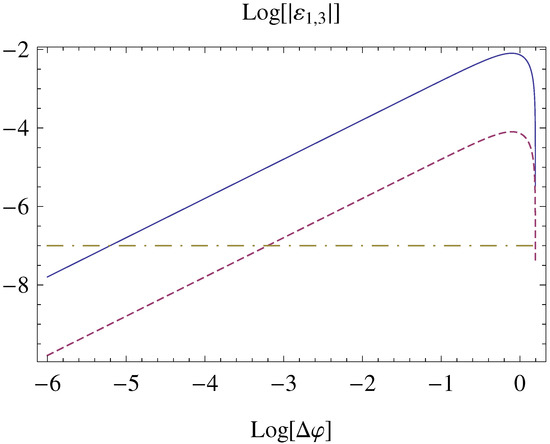
Figure 1.
Logarithm (base 10) of the absolute value of the decay asymmetry as a function of logarithm (base 10) of for (solid line) and (dashed line) in the case when and .
5. Conclusions
The breakdown of gauge symmetry within GUTs can lead, at low energies, to the -inspired composite Higgs model (ECHM), which almost allows the mass hierarchy to be stabilized. In particular, the ECHM can originate from the SUSY GUT based on the -gauge symmetry. In the vicinity of some high energy scale , the group can be broken down to the subgroup, where G and are associated with the strongly interacting sector. We consider a six-dimensional orbifold SUSY GUT in which all fields of the strongly coupled sector reside on the brane where is broken down to . It is expected that, in the ECHM , there still remains an approximate symmetry of the strongly interacting sector even at low energies, and this gets spontaneously broken around the scale to , which contains the -gauge group as a subgroup. The orbifold GUTs in six dimensions do not have irreducible bulk anomaly. In the orbifold SUSY GUT under consideration, brane anomalies are cancelled. Within this model, different multiplets of the elementary quarks and leptons stem from different bulk 27-plets. All other components of these 27-plets gain huge masses which are somewhat close to . As a consequence, the low energy Lagrangian of the ECHM can be invariant with respect to the global and symmetries, which guarantee the conservation of the lepton and baryon charges to a very good approximation. To ensure that the left-handed neutrinos acquire non-zero Majorana masses, the symmetry should be broken down to its discrete subgroup, which forbids all operators giving rise to rapid proton decay.
The symmetry breaking to in the ECHM results in eleven pNGB states. Four of these states form the SM-like Higgs doublet H. One of these pNGBs is a SM singlet boson A. Six others are associated with the triplet of scalar field T. The pNGB states mentioned above do not carry any lepton and/or baryon numbers. A significant fine-tuning, ∼0.01%, is required to obtain a Higgs boson with mass around in this model because .
The masses of the SM fermions in the ECHM are induced through the mixing between elementary states and their composite partners. There are two different scenarios of quark mass generation. In scenario A, the composite partners of the right-handed down-type quarks, left-handed quarks and right-handed up-type quarks are components of , and representations of . Scenario B implies that the composite partners of the right-handed down-type quarks, left-handed quarks and right-handed up-type quarks belong to , and representations of the group. In the case of the lepton sector, the corresponding masses can be generated if the composite partners of the right-handed charged leptons and left-handed leptons are components of the and representations of .
The embedding of the ECHM into an orbifold GUT with the -gauge group implies that, at some high energy scale, the SM-gauge couplings are approximately equal. This can be achieved when the dynamics of the strongly coupled sector lead to the composite right-handed top quark . In addition to the SM fields (without ), the weakly coupled sector in this case must involve a set of exotic fermions that also permits anomalies to be canceled. In particular, this set of exotic particles contains two SM singlet Majorana fermions and . In general, all exotic fermions and all composite resonances except the pNGB states gain masses which are a few times larger than f. The pNGB states have masses which tend to be considerably lower than f. Therefore, they are the lightest composite resonances in the ECHM spectrum. In our analysis, is assumed to be the lightest exotic fermion; it has a mass around . The discrete symmetry, which is a subgroup of , forbids all couplings that allow to decay. When is an approximate symmetry, can be a long-lived composite state.
When the symmetry-breaking scale and symmetry are almost exact, all operators that violate baryon number are sufficiently strongly suppressed even if is explicitly broken. In this variant of the ECHM, the out-of-equilibrium decays and can induce the observed baryon asymmetry if CP is violated. This scenario implies that the lifetime of is less than . Phenomenologically acceptable matter–antimatter asymmetry can be obtained, even in the limit when all CP-violating phases are small (≲0.01). The electric dipole moments (EDMs) of atoms, neutrons and elementary states, which have not been observed in different experiments, are suppressed if CP invariance is approximately preserved. These EDMs, as well as baryon-number-violating processes, such as neutron-antineutron oscillations, are going to be searched for in the near future [263,264].
The lightest exotic fermion becomes absolutely stable if and are exact symmetries. In this limit, can account for all or some of the observed cold dark matter density if it has a mass which is much smaller than the scale f. In particular, when is close to half the mass of the SM singlet boson A, the annihilation cross section for can be relatively large, resulting in the cold dark matter density which is smaller than its measured value.
For a large symmetry-breaking scale, i.e., 5–10 , all exotic fermions and almost all composite resonances are too heavy to be observed at the LHC. Because the deviations of the couplings of the SM-like Higgs boson to the SM particles within the ECHM are determined by , the modifications of the appropriate Higgs branching fractions are negligibly small in this case. Therefore, it is going to be rather problematic to probe such small deviations at the LHC and future collider. Too large a value of f also implies that the interactions of the top quark with the SM particles are very similar to the ones which are predicted by the SM. This makes the top quark with its significant admixture of composite components basically indistinguishable from the corresponding SM state. Nonetheless, the spectrum of the ECHM must contain the triplet of scalar fields T () with an electric charge () and a mass which is significantly lower than f. This state predominantly decays into . If this triplet T has a mass in the few TeV range, then it can be pair produced at the LHC, resulting in some enhancement of the cross section of . The discovery of such a colour state will provide a smoking gun signal of the composite Higgs model under consideration.
Funding
This research received no external funding.
Institutional Review Board Statement
Not applicable.
Informed Consent Statement
Not applicable.
Data Availability Statement
Data sharing is not applicable to this article.
Acknowledgments
R.N. thanks A.W. Thomas for sharing his valuable ideas in connection with composite Higgs models. R.N. acknowledges fruitful discussions with E. Akhmedov, E. Boos, M. Dubinin, S. Duplij, D. Gorbunov, D. Kazakov, V. Novikov, V. Rubakov, M. Vasiliev, M. Vysotsky and E. Zhemchugov.
Conflicts of Interest
The author declares no conflict of interest.
References
- Georgi, H.; Glashow, S.L. Unity Of All Elementary Particle Forces. Phys. Rev. Lett. 1974, 32, 438. [Google Scholar] [CrossRef]
- Minkowski, P. μ→eγ at a Rate of One Out of 109 Muon Decays? Phys. Lett. B 1977, 67, 421. [Google Scholar] [CrossRef]
- Mohapatra, R.N.; Senjanovic, G. Neutrino Mass and Spontaneous Parity Nonconservation. Phys. Rev. Lett. 1980, 44, 912. [Google Scholar] [CrossRef]
- Witten, E. Dynamical Breaking of Supersymmetry. Nucl. Phys. B 1981, 188, 513. [Google Scholar] [CrossRef]
- Sakai, N. Naturalness in Supersymmetric GUTs. Z. Phys. C 1981, 11, 153. [Google Scholar] [CrossRef]
- Dimopoulos, S.; Georgi, H. Softly Broken Supersymmetry and SU(5). Nucl. Phys. B 1981, 193, 150. [Google Scholar] [CrossRef]
- Kaul, R.K.; Majumdar, P. Cancellation of Quadratically Divergent Mass Corrections in Globally Supersymmetric Spontaneously Broken Gauge Theories. Nucl. Phys. B 1982, 199, 36. [Google Scholar] [CrossRef]
- Gildener, E.; Weinberg, S. Symmetry Breaking and Scalar Bosons. Phys. Rev. D 1976, 13, 3333. [Google Scholar] [CrossRef]
- Gildener, E. Gauge Symmetry Hierarchies. Phys. Rev. D 1976, 14, 1667. [Google Scholar] [CrossRef]
- Chung, D.J.H.; Everett, L.L.; Kane, G.L.; King, S.F.; Lykken, J.; Wang, L.T. The soft supersymmetry-breaking Lagrangian: Theory and applications. Phys. Rept. 2005, 407, 1. [Google Scholar] [CrossRef]
- Ellis, J.R.; Kelley, S.; Nanopoulos, D.V. Probing the desert using gauge coupling unification. Phys. Lett. B 1991, 260, 131. [Google Scholar] [CrossRef]
- Langacker, P.; Luo, M.X. Implications of precision electroweak experiments for Mt, ρ0, sin2θW and grand unification. Phys. Rev. D 1991, 44, 817. [Google Scholar] [CrossRef] [PubMed]
- Amaldi, U.; de Boer, W.; Furstenau, H. Comparison of grand unified theories with electroweak and strong coupling constants measured at LEP. Phys. Lett. B 1991, 260, 447. [Google Scholar] [CrossRef]
- Anselmo, F.; Cifarelli, L.; Peterman, A.; Zichichi, A. The Effective experimental constraints on M(susy) and M(gut). Nuovo Cim. A 1991, 104, 1817. [Google Scholar] [CrossRef]
- Arkani-Hamed, N.; Dimopoulos, S.; Dvali, G.R. The Hierarchy problem and new dimensions at a millimeter. Phys. Lett. B 1998, 429, 263. [Google Scholar] [CrossRef]
- Antoniadis, I.; Arkani-Hamed, N.; Dimopoulos, S.; Dvali, G.R. New dimensions at a millimeter to a Fermi and superstrings at a TeV. Phys. Lett. B 1998, 436, 257. [Google Scholar] [CrossRef]
- Randall, L.; Sundrum, R. A Large mass hierarchy from a small extra dimension. Phys. Rev. Lett. 1999, 83, 3370. [Google Scholar] [CrossRef]
- Randall, L.; Sundrum, R. An Alternative to compactification. Phys. Rev. Lett. 1999, 83, 4690. [Google Scholar] [CrossRef]
- Dienes, K.R.; Dudas, E.; Gherghetta, T. Extra space-time dimensions and unification. Phys. Lett. B 1998, 436, 55. [Google Scholar] [CrossRef]
- Dienes, K.R.; Dudas, E.; Gherghetta, T. Grand unification at intermediate mass scales through extra dimensions. Nucl. Phys. B 1999, 537, 47. [Google Scholar] [CrossRef]
- Bellazzini, B.; Csáki, C.; Serra, J. Composite Higgses. Eur. Phys. J. C 2014, 74, 2766. [Google Scholar] [CrossRef]
- Terazawa, H.; Akama, K.; Chikashige, Y. Unified Model of the Nambu-Jona-Lasinio Type for All Elementary Particle Forces. Phys. Rev. D 1977, 15, 480. [Google Scholar] [CrossRef]
- Terazawa, H. Subquark Model of Leptons and Quarks. Phys. Rev. D 1980, 22, 184. [Google Scholar] [CrossRef]
- Dimopoulos, S.; Preskill, J. Massless Composites With Massive Constituents. Nucl. Phys. B 1982, 199, 206. [Google Scholar] [CrossRef]
- Kaplan, D.B.; Georgi, H. SU(2) × U(1) Breaking by Vacuum Misalignment. Phys. Lett. B 1984, 136, 183. [Google Scholar] [CrossRef]
- Kaplan, D.B.; Georgi, H.; Dimopoulos, S. Composite Higgs Scalars. Phys. Lett. B 1984, 136, 187. [Google Scholar] [CrossRef]
- Georgi, H.; Kaplan, D.B.; Galison, P. Calculation of the Composite Higgs Mass. Phys. Lett. B 1984, 143, 152. [Google Scholar] [CrossRef]
- Banks, T. Constraints on SU(2) × U(1) Breaking by Vacuum Misalignment. Nucl. Phys. B 1984, 243, 125. [Google Scholar] [CrossRef]
- Georgi, H.; Kaplan, D.B. Composite Higgs and Custodial SU(2). Phys. Lett. B 1984, 145, 216. [Google Scholar] [CrossRef]
- Dugan, M.J.; Georgi, H.; Kaplan, D.B. Anatomy of a Composite Higgs Model. Nucl. Phys. B 1985, 254, 299. [Google Scholar] [CrossRef]
- Georgi, H. A Tool Kit for Builders of Composite Models. Nucl. Phys. B 1986, 266, 274. [Google Scholar] [CrossRef]
- Nevzorov, R.; Thomas, A.W. E6 inspired composite Higgs model. Phys. Rev. D 2015, 92, 075007. [Google Scholar] [CrossRef]
- Nevzorov, R.; Thomas, A.W. LHC signatures of neutral pseudo-Goldstone boson in the E6CHM. J. Phys. G 2017, 44, 075003. [Google Scholar] [CrossRef]
- Nevzorov, R.; Thomas, A.W. E6 inspired composite Higgs model and 750 GeV diphoton excess. EPJ Web Conf. 2016, 125, 02021. [Google Scholar] [CrossRef]
- Nevzorov, R.; Thomas, A.W. Baryon asymmetry generation in the E6CHM. Phys. Lett. B 2017, 774, 123. [Google Scholar] [CrossRef]
- Nevzorov, R.; Thomas, A.W. Generation of baryon asymmetry in the E6CHM. EPJ Web Conf. 2018, 191, 02004. [Google Scholar] [CrossRef][Green Version]
- Nevzorov, R.; Thomas, A.W. E6 Inspired Composite Higgs Model and Baryon Asymmetry Generation. Phys. Part. Nucl. 2020, 51, 709. [Google Scholar] [CrossRef]
- Khlopov, M.Y.; Shibaev, K.I. New physics from superstring phenomenology. Grav. Cosmol. Suppl. 2002, 8, 45. [Google Scholar]
- Khlopov, M.Y. What comes after the Standard model? Prog. Part. Nucl. Phys. 2021, 116, 103824. [Google Scholar] [CrossRef]
- Sakharov, A.D. Violation of CP invariance, C asymmetry, and baryon asymmetry of the universe. JETP Lett. 1967, 5, 24. [Google Scholar]
- Ignatiev, A.Y.; Krasnikov, N.V.; Kuzmin, V.A.; Tavkhelidze, A.N. Universal CP Noninvariant Superweak Interaction and Baryon Asymmetry of the Universe. Phys. Lett. B 1978, 76, 436. [Google Scholar] [CrossRef]
- Yoshimura, M. Unified Gauge Theories and the Baryon Number of the Universe. Phys. Rev. Lett. 1978, 41, 281. [Google Scholar] [CrossRef]
- Toussaint, D.; Treiman, S.B.; Wilczek, F.; Zee, A. Matter - Antimatter Accounting, Thermodynamics, and Black Hole Radiation. Phys. Rev. D 1979, 19, 1036. [Google Scholar] [CrossRef]
- Weinberg, S. Cosmological production of baryons. Phys. Rev. Lett. 1979, 42, 850. [Google Scholar] [CrossRef]
- Yoshimura, M. Origin of Cosmological Baryon Asymmetry. Phys. Lett. B 1979, 88, 294. [Google Scholar] [CrossRef]
- Barr, S.M.; Segre, G.; Weldon, H.A. The Magnitude of the Cosmological Baryon Asymmetry. Phys. Rev. D 1979, 20, 2494. [Google Scholar] [CrossRef]
- Nanopoulos, D.V.; Weinberg, S. Mechanisms for Cosmological Baryon Production. Phys. Rev. D 1979, 20, 2484. [Google Scholar] [CrossRef]
- Fukugita, M.; Yanagida, T. Baryogenesis Without Grand Unification. Phys. Lett. B 1986, 174, 45. [Google Scholar] [CrossRef]
- Affleck, I.; Dine, M. A New Mechanism for Baryogenesis. Nucl. Phys. B 1985, 249, 361. [Google Scholar] [CrossRef]
- Dine, M.; Randall, L.; Thomas, S.D. Baryogenesis from flat directions of the supersymmetric standard model. Nucl. Phys. B 1996, 458, 291. [Google Scholar] [CrossRef]
- Riotto, A.; Trodden, M. Recent progress in baryogenesis. Ann. Rev. Nucl. Part. Sci. 1999, 49, 35. [Google Scholar] [CrossRef]
- Agashe, K.; Contino, R.; Pomarol, A. The Minimal composite Higgs model. Nucl. Phys. B 2005, 719, 165. [Google Scholar] [CrossRef]
- Contino, R.; Nomura, Y.; Pomarol, A. Higgs as a holographic pseudoGoldstone boson. Nucl. Phys. B 2003, 671, 148. [Google Scholar] [CrossRef]
- Agashe, K.; Delgado, A.; May, M.J.; Sundrum, R. RS1, custodial isospin and precision tests. J. High Energy Phys. 2003, 308, 50. [Google Scholar] [CrossRef][Green Version]
- Contino, R.; Kramer, T.; Son, M.; Sundrum, R. Warped/composite phenomenology simplified. J. High Energy Phys. 2007, 705, 74. [Google Scholar] [CrossRef]
- Kaplan, D.B. Flavor at SSC energies: A New mechanism for dynamically generated fermion masses. Nucl. Phys. B 1991, 365, 259. [Google Scholar] [CrossRef]
- Frigerio, M.; Serra, J.; Varagnolo, A. Composite GUTs: Models and expectations at the LHC. J. High Energy Phys. 2011, 1106, 29. [Google Scholar] [CrossRef]
- Agashe, K.; Contino, R. The Minimal composite Higgs model and electroweak precision tests. Nucl. Phys. B 2006, 742, 59. [Google Scholar] [CrossRef]
- Agashe, K.; Contino, R.; Da Rold, L.; Pomarol, A. A Custodial symmetry for Zb. Phys. Lett. B 2006, 641, 62. [Google Scholar] [CrossRef]
- Giudice, G.F.; Grojean, C.; Pomarol, A.; Rattazzi, R. The Strongly-Interacting Light Higgs. J. High Energy Phys. 2007, 706, 45. [Google Scholar] [CrossRef]
- Barbieri, R.; Bellazzini, B.; Rychkov, V.S.; Varagnolo, A. The Higgs boson from an extended symmetry. Phys. Rev. D 2007, 76, 115008. [Google Scholar] [CrossRef]
- Lodone, P. Vector-like quarks in a ‘composite’ Higgs model. J. High Energy Phys. 2008, 0812, 029. [Google Scholar] [CrossRef]
- Gillioz, M. A Light composite Higgs boson facing electroweak precision tests. Phys. Rev. D 2009, 80, 055003. [Google Scholar] [CrossRef]
- Anastasiou, C.; Furlan, E.; Santiago, J. Realistic Composite Higgs Models. Phys. Rev. D 2009, 79, 075003. [Google Scholar] [CrossRef]
- Panico, G.; Wulzer, A. The Discrete Composite Higgs Model. J. High Energy Phys. 2011, 1109, 135. [Google Scholar] [CrossRef]
- De Curtis, S.; Redi, M.; Tesi, A. The 4D Composite Higgs. J. High Energy Phys. 2012, 1204, 42. [Google Scholar] [CrossRef]
- Marzocca, D.; Serone, M.; Shu, J. General Composite Higgs Models. J. High Energy Phys. 2012, 1208, 013. [Google Scholar] [CrossRef]
- Orgogozo, A.; Rychkov, S. The S parameter for a Light Composite Higgs: A Dispersion Relation Approach. J. High Energy Phys. 2013, 1306, 14. [Google Scholar] [CrossRef]
- Grojean, C.; Matsedonskyi, O.; Giuliano, P. Light top partners and precision physics. J. High Energy Phys. 2013, 1310, 160. [Google Scholar] [CrossRef]
- Carena, M.; Ponton, E.; Santiago, J.; Wagner, C.E.M. Light Kaluza Klein States in Randall-Sundrum Models with Custodial SU(2). Nucl. Phys. B 2006, 759, 202. [Google Scholar] [CrossRef]
- Pomarol, A.; Serra, J. Top Quark Compositeness: Feasibility and Implications. Phys. Rev. D 2008, 78, 074026. [Google Scholar] [CrossRef]
- Pappadopulo, D.; Thamm, A.; Torre, R. A minimally tuned composite Higgs model from an extra dimension. J. High Energy Phys. 2013, 1307, 58. [Google Scholar] [CrossRef]
- Bellazzini, B.; Csaki, C.; Hubisz, J.; Serra, J.; Terning, J. Composite Higgs Sketch. J. High Energy Phys. 2012, 1211, 3. [Google Scholar] [CrossRef]
- Gillioz, M.; Grober, R.; Grojean, C.; Muhlleitner, M.; Salvioni, E. Higgs Low-Energy Theorem (and its corrections) in Composite Models. J. High Energy Phys. 2012, 1210, 4. [Google Scholar] [CrossRef]
- Azatov, A.; Galloway, J. Electroweak Symmetry Breaking and the Higgs Boson: Confronting Theories at Colliders. Int. J. Mod. Phys. A 2013, 28, 1330004. [Google Scholar] [CrossRef]
- Falkowski, A.; Riva, F.; Urbano, A. Higgs at last. J. High Energy Phys. 2013, 1311, 111. [Google Scholar] [CrossRef]
- Azatov, A.; Contino, R.; Di Iura, A.; Galloway, J. New Prospects for Higgs Compositeness in h→Zγ. Phys. Rev. D 2013, 88, 075019. [Google Scholar] [CrossRef]
- Gillioz, M.; Gröber, R.; Kapuvari, A.; Mühlleitner, M. Vector-like Bottom Quarks in Composite Higgs Models. J. High Energy Phys. 2014, 1403, 37. [Google Scholar] [CrossRef]
- Barbieri, R.; Isidori, G.; Pappadopulo, D. Composite fermions in Electroweak Symmetry Breaking. J. High Energy Phys. 2009, 902, 29. [Google Scholar] [CrossRef][Green Version]
- Matsedonskyi, O. On Flavour and Naturalness of Composite Higgs Models. J. High Energy Phys. 2015, 1502, 154. [Google Scholar] [CrossRef]
- Barbieri, R.; Buttazzo, D.; Sala, F.; Straub, D.M.; Tesi, A. A 125 GeV composite Higgs boson versus flavour and electroweak precision tests. J. High Energy Phys. 2013, 1305, 69. [Google Scholar] [CrossRef]
- Csaki, C.; Falkowski, A.; Weiler, A. The Flavor of the Composite Pseudo-Goldstone Higgs. J. High Energy Phys. 2008, 809, 8. [Google Scholar] [CrossRef][Green Version]
- Agashe, K.; Azatov, A.; Zhu, L. Flavor Violation Tests of Warped/Composite SM in the Two-Site Approach. Phys. Rev. D 2009, 79, 056006. [Google Scholar] [CrossRef]
- Vignaroli, N. Δ F=1 constraints on composite Higgs models with LR parity. Phys. Rev. D 2012, 86, 115011. [Google Scholar] [CrossRef]
- Sikivie, P.; Susskind, L.; Voloshin, M.B.; Zakharov, V.I. Isospin Breaking in Technicolor Models. Nucl. Phys. B 1980, 173, 189. [Google Scholar] [CrossRef]
- Peskin, M.E.; Takeuchi, T. Estimation of oblique electroweak corrections. Phys. Rev. D 1992, 46, 381. [Google Scholar] [CrossRef]
- Agashe, K.; Perez, G.; Soni, A. Flavor structure of warped extra dimension models. Phys. Rev. D 2005, 71, 016002. [Google Scholar] [CrossRef]
- Glashow, S.L.; Iliopoulos, J.; Maiani, L. Weak Interactions with Lepton-Hadron Symmetry. Phys. Rev. D 1970, 2, 1285. [Google Scholar] [CrossRef]
- Redi, M.; Weiler, A. Flavor and CP Invariant Composite Higgs Models. J. High Energy Phys. 2011, 1111, 108. [Google Scholar] [CrossRef]
- Blanke, M.; Buras, A.J.; Duling, B.; Gori, S.; Weiler, A. Δ F = 2 Observables and Fine-Tuning in a Warped Extra Dimension with Custodial Protection. J. High Energy Phys. 2009, 903, 1. [Google Scholar] [CrossRef][Green Version]
- Gedalia, O.; Isidori, G.; Perez, G. Combining Direct & Indirect Kaon CP Violation to Constrain the Warped KK Scale. Phys. Lett. B 2009, 682, 200. [Google Scholar]
- Barbieri, R.; Buttazzo, D.; Sala, F.; Straub, D.M. Flavour physics from an approximate U(2)3 symmetry. J. High Energy Phys. 2012, 1207, 181. [Google Scholar] [CrossRef]
- Redi, M. Leptons in Composite MFV. J. High Energy Phys. 2013, 1309, 60. [Google Scholar] [CrossRef]
- Agashe, K.; Blechman, A.E.; Petriello, F. Probing the Randall-Sundrum geometric origin of flavor with lepton flavor violation. Phys. Rev. D 2006, 74, 053011. [Google Scholar] [CrossRef]
- Csaki, C.; Grossman, Y.; Tanedo, P.; Tsai, Y. Warped penguin diagrams. Phys. Rev. D 2011, 83, 073002. [Google Scholar] [CrossRef]
- Csaki, C.; Delaunay, C.; Grojean, C.; Grossman, Y. A Model of Lepton Masses from a Warped Extra Dimension. J. High Energy Phys. 2008, 0810, 055. [Google Scholar] [CrossRef]
- del Aguila, F.; Carmona, A.; Santiago, J. Neutrino Masses from an A4 Symmetry in Holographic Composite Higgs Models. J. High Energy Phys. 2010, 1008, 127. [Google Scholar] [CrossRef]
- Cacciapaglia, G.; Csaki, C.; Galloway, J.; Marandella, G.; Terning, J.; Weiler, A. A GIM Mechanism from Extra Dimensions. J. High Energy Phys. 2008, 804, 6. [Google Scholar] [CrossRef]
- Redi, M. Composite MFV and Beyond. Eur. Phys. J. C 2012, 72, 2030. [Google Scholar] [CrossRef]
- König, M.; Neubert, M.; Straub, D.M. Dipole operator constraints on composite Higgs models. Eur. Phys. J. C 2014, 74, 2945. [Google Scholar] [CrossRef]
- Gripaios, B.; Pomarol, A.; Riva, F.; Serra, J. Beyond the Minimal Composite Higgs Model. J. High Energy Phys. 2009, 904, 70. [Google Scholar] [CrossRef]
- Mrazek, J.; Pomarol, A.; Rattazzi, R.; Redi, M.; Serra, J.; Wulzer, A. The Other Natural Two Higgs Doublet Model. Nucl. Phys. B 2011, 853, 1. [Google Scholar] [CrossRef]
- Redi, M.; Tesi, A. Implications of a Light Higgs in Composite Models. J. High Energy Phys. 2012, 1210, 166. [Google Scholar] [CrossRef]
- Bertuzzo, E.; Ray, T.S.; de Sandes, H.; Savoy, C.A. On Composite Two Higgs Doublet Models. J. High Energy Phys. 2013, 1305, 153. [Google Scholar] [CrossRef]
- Montull, M.; Riva, F. Higgs discovery: The beginning or the end of natural EWSB? J. High Energy Phys. 2012, 1211, 18. [Google Scholar] [CrossRef]
- Chala, M. h→γγ excess and Dark Matter from Composite Higgs Models. J. High Energy Phys. 2013, 1301, 122. [Google Scholar] [CrossRef]
- Frigerio, M.; Pomarol, A.; Riva, F.; Urbano, A. Composite Scalar Dark Matter. J. High Energy Phys. 2012, 1207, 15. [Google Scholar] [CrossRef]
- Contino, R.; Grojean, C.; Moretti, M.; Piccinini, F.; Rattazzi, R. Strong Double Higgs Production at the LHC. J. High Energy Phys. 2010, 1005, 89. [Google Scholar] [CrossRef]
- Low, I.; Vichi, A. On the production of a composite Higgs boson. Phys. Rev. D 2011, 84, 045019. [Google Scholar] [CrossRef]
- Contino, R.; Marzocca, D.; Pappadopulo, D.; Rattazzi, R. On the effect of resonances in composite Higgs phenomenology. J. High Energy Phys. 2011, 1110, 81. [Google Scholar] [CrossRef]
- Azatov, A.; Galloway, J. Light Custodians and Higgs Physics in Composite Models. Phys. Rev. D 2012, 85, 055013. [Google Scholar] [CrossRef]
- Contino, R.; Ghezzi, M.; Moretti, M.; Panico, G.; Piccinini, F.; Wulzer, A. Anomalous Couplings in Double Higgs Production. J. High Energy Phys. 2012, 1208, 154. [Google Scholar] [CrossRef]
- Contino, R.; Ghezzi, M.; Grojean, C.; Muhlleitner, M.; Spira, M. Effective Lagrangian for a light Higgs-like scalar. J. High Energy Phys. 2013, 1307, 35. [Google Scholar] [CrossRef]
- Delaunay, C.; Grojean, C.; Perez, G. Modified Higgs Physics from Composite Light Flavors. J. High Energy Phys. 2013, 1309, 90. [Google Scholar] [CrossRef]
- Banfi, A.; Martin, A.; Sanz, V. Probing top-partners in Higgs+jets. J. High Energy Phys. 2014, 1408, 53. [Google Scholar] [CrossRef]
- Montull, M.; Riva, F.; Salvioni, E.; Torre, R. Higgs Couplings in Composite Models. Phys. Rev. D 2013, 88, 095006. [Google Scholar] [CrossRef]
- Contino, R.; Grojean, C.; Pappadopulo, D.; Rattazzi, R.; Thamm, A. Strong Higgs Interactions at a Linear Collider. J. High Energy Phys. 2014, 1402, 6. [Google Scholar] [CrossRef]
- Flacke, T.; Kim, J.H.; Lee, S.J.; Lim, S.H. Constraints on composite quark partners from Higgs searches. J. High Energy Phys. 2014, 1405, 123. [Google Scholar] [CrossRef]
- Grojean, C.; Salvioni, E.; Schlaffer, M.; Weiler, A. Very boosted Higgs in gluon fusion. J. High Energy Phys. 2014, 1405, 22. [Google Scholar] [CrossRef]
- Carena, M.; Da Rold, L.; Pontón, E. Minimal Composite Higgs Models at the LHC. J. High Energy Phys. 2014, 1406, 159. [Google Scholar] [CrossRef]
- Carmona, A.; Goertz, F. A naturally light Higgs without light Top Partners. J. High Energy Phys. 2015, 1505, 2. [Google Scholar] [CrossRef]
- Buchalla, G.; Cata, O.; Krause, C. A Systematic Approach to the SILH Lagrangian. Nucl. Phys. B 2015, 894, 602. [Google Scholar] [CrossRef]
- Pomarol, A.; Riva, F. The Composite Higgs and Light Resonance Connection. J. High Energy Phys. 2012, 1208, 135. [Google Scholar] [CrossRef]
- Matsedonskyi, O.; Panico, G.; Wulzer, A. Light Top Partners for a Light Composite Higgs. J. High Energy Phys. 2013, 1301, 164. [Google Scholar] [CrossRef]
- Agashe, K.; Delgado, A.; Sundrum, R. Grand unification in RS1. Ann. Phys. 2003, 304, 145. [Google Scholar] [CrossRef]
- Gherghetta, T. Partly supersymmetric grand unification. Phys. Rev. D 2005, 71, 065001. [Google Scholar] [CrossRef]
- Barnard, J.; Gherghetta, T.; Ray, T.S.; Spray, A. The Unnatural Composite Higgs. J. High Energy Phys. 2015, 1501, 67. [Google Scholar] [CrossRef]
- Asano, M.; Kitano, R. Partially Composite Dark Matter. J. High Energy Phys. 2014, 1409, 171. [Google Scholar] [CrossRef]
- Agashe, K.; Belyaev, A.; Krupovnickas, T.; Perez, G.; Virzi, J. LHC Signals from Warped Extra Dimensions. Phys. Rev. D 2008, 77, 015003. [Google Scholar] [CrossRef]
- Lillie, B.; Randall, L.; Wang, L.T. The Bulk RS KK-gluon at the LHC. J. High Energy Phys. 2007, 0709, 074. [Google Scholar] [CrossRef]
- Agashe, K.; Davoudiasl, H.; Gopalakrishna, S.; Han, T.; Huang, G.Y.; Perez, G.; Si, Z.G.; Soni, A. LHC Signals for Warped Electroweak Neutral Gauge Bosons. Phys. Rev. D 2007, 76, 115015. [Google Scholar] [CrossRef]
- Carena, M.; Medina, A.D.; Panes, B.; Shah, N.R.; Wagner, C.E.M. Collider phenomenology of gauge-Higgs unification scenarios in warped extra dimensions. Phys. Rev. D 2008, 77, 076003. [Google Scholar] [CrossRef]
- Contino, R.; Servant, G. Discovering the top partners at the LHC using same-sign dilepton final states. J. High Energy Phys. 2008, 0806, 026. [Google Scholar] [CrossRef]
- Agashe, K.; Gopalakrishna, S.; Han, T.; Huang, G.Y.; Soni, A. LHC Signals for Warped Electroweak Charged Gauge Bosons. Phys. Rev. D 2009, 80, 075007. [Google Scholar] [CrossRef]
- Aguilar-Saavedra, J.A. Identifying top partners at LHC. J. High Energy Phys. 2009, 0911, 030. [Google Scholar] [CrossRef]
- Mrazek, J.; Wulzer, A. A Strong Sector at the LHC: Top Partners in Same-Sign Dileptons. Phys. Rev. D 2010, 81, 075006. [Google Scholar] [CrossRef]
- Agashe, K.; Azatov, A.; Han, T.; Li, Y.; Si, Z.G.; Zhu, L. LHC Signals for Coset Electroweak Gauge Bosons in Warped/Composite PGB Higgs Models. Phys. Rev. D 2010, 81, 096002. [Google Scholar] [CrossRef]
- Dissertori, G.; Furlan, E.; Moortgat, F.; Nef, P. Discovery potential of top-partners in a realistic composite Higgs model with early LHC data. J. High Energy Phys. 2010, 1009, 19. [Google Scholar] [CrossRef]
- Vignaroli, N. Early discovery of top partners and test of the Higgs nature. Phys. Rev. D 2012, 86, 075017. [Google Scholar] [CrossRef]
- Cacciapaglia, G.; Deandrea, A.; Panizzi, L.; Perries, S.; Sordini, V. Heavy Vector-like quark with charge 5/3 at the LHC. J. High Energy Phys. 2013, 1303, 4. [Google Scholar] [CrossRef]
- De Simone, A.; Matsedonskyi, O.; Rattazzi, R.; Wulzer, A. A First Top Partner Hunter’s Guide. J. High Energy Phys. 2013, 1304, 4. [Google Scholar] [CrossRef]
- Li, J.; Liu, D.; Shu, J. Towards the fate of natural composite Higgs model through single t′ search at the 8 TeV LHC. J. High Energy Phys. 2013, 1311, 47. [Google Scholar] [CrossRef]
- Redi, M.; Sanz, V.; de Vries, M.; Weiler, A. Strong Signatures of Right-Handed Compositeness. J. High Energy Phys. 2013, 1308, 8. [Google Scholar] [CrossRef]
- Delaunay, C.; Flacke, T.; Gonzalez-Fraile, J.; Lee, S.J.; Panico, G.; Perez, G. Light Non-degenerate Composite Partners at the LHC. J. High Energy Phys. 2014, 1402, 55. [Google Scholar] [CrossRef]
- Matsedonskyi, O.; Riva, F.; Vantalon, T. Composite Charge 8/3 Resonances at the LHC. J. High Energy Phys. 2014, 1404, 59. [Google Scholar] [CrossRef]
- Cheng, H.C.; Gu, J. Top seesaw with a custodial symmetry, and the 126 GeV Higgs. J. High Energy Phys. 2014, 1410, 2. [Google Scholar] [CrossRef]
- Gripaios, B.; Müller, T.; Parker, M.A.; Sutherland, D. Search Strategies for Top Partners in Composite Higgs models. J. High Energy Phys. 2014, 1408, 171. [Google Scholar] [CrossRef]
- Azatov, A.; Panico, G.; Perez, G.; Soreq, Y. On the Flavor Structure of Natural Composite Higgs Models & Top Flavor Violation. J. High Energy Phys. 2014, 1412, 82. [Google Scholar]
- Backović, M.; Flacke, T.; Kim, J.H.; Lee, S.J. Boosted Event Topologies from TeV Scale Light Quark Composite Partners. J. High Energy Phys. 2015, 1504, 82. [Google Scholar] [CrossRef]
- Kanemura, S.; Kaneta, K.; Machida, N.; Shindou, T. New resonance scale and fingerprint identification in minimal composite Higgs models. Phys. Rev. D 2015, 91, 115016. [Google Scholar] [CrossRef]
- Thamm, A.; Torre, R.; Wulzer, A. Future tests of Higgs compositeness: Direct vs indirect. J. High Energy Phys. 2015, 1507, 100. [Google Scholar] [CrossRef]
- Azatov, A.; Chowdhury, D.; Ghosh, D.; Ray, T.S. Same sign di-lepton candles of the composite gluons. J. High Energy Phys. 2015, 1508, 140. [Google Scholar] [CrossRef]
- Serra, J. Beyond the Minimal Top Partner Decay. J. High Energy Phys. 2015, 1509, 176. [Google Scholar] [CrossRef]
- Barnard, J.; Gherghetta, T.; Ray, T.S. UV descriptions of composite Higgs models without elementary scalars. J. High Energy Phys. 2014, 1402, 2, [arXiv:1311.6562 [hep-ph]]. [Google Scholar] [CrossRef]
- Ferretti, G.; Karateev, D. Fermionic UV completions of Composite Higgs models. J. High Energy Phys. 2014, 1403, 077. [Google Scholar] [CrossRef]
- Cacciapaglia, G.; Sannino, F. Fundamental Composite (Goldstone) Higgs Dynamics. J. High Energy Phys. 2014, 1404, 111. [Google Scholar] [CrossRef]
- Hietanen, A.; Lewis, R.; Pica, C.; Sannino, F. Fundamental Composite Higgs Dynamics on the Lattice: SU(2) with Two Flavors. J. High Energy Phys. 2014, 1407, 116. [Google Scholar] [CrossRef]
- Ferretti, G. UV Completions of Partial Compositeness: The Case for a SU(4) Gauge Group. J. High Energy Phys. 2014, 1406, 142. [Google Scholar] [CrossRef]
- Parolini, A. Phenomenological aspects of supersymmetric composite Higgs models. Phys. Rev. D 2014, 90, 115026. [Google Scholar] [CrossRef]
- Geller, M.; Telem, O. Holographic Twin Higgs Model. Phys. Rev. Lett. 2015, 114, 191801. [Google Scholar] [CrossRef]
- Gripaios, B.; Nardecchia, M.; Renner, S.A. Composite leptoquarks and anomalies in B-meson decays. J. High Energy Phys. 2015, 1505, 6. [Google Scholar] [CrossRef]
- Low, M.; Tesi, A.; Wang, L.T. Twin Higgs mechanism and a composite Higgs boson. Phys. Rev. D 2015, 91, 095012. [Google Scholar] [CrossRef]
- Golterman, M.; Shamir, Y. Top quark induced effective potential in a composite Higgs model. Phys. Rev. D 2015, 91, 094506. [Google Scholar] [CrossRef]
- Agashe, K.; Contino, R.; Sundrum, R. Top compositeness and precision unification. Phys. Rev. Lett. 2005, 95, 171804. [Google Scholar] [CrossRef]
- Kawamura, Y. Triplet doublet splitting, proton stability and extra dimension. Prog. Theor. Phys. 2001, 105, 999. [Google Scholar] [CrossRef]
- Altarelli, G.; Feruglio, F. SU(5) grand unification in extra dimensions and proton decay. Phys. Lett. B 2001, 511, 257. [Google Scholar] [CrossRef]
- Hebecker, A.; March-Russell, J. A Minimal S1/(Z2 × ) orbifold GUT. Nucl. Phys. B 2001, 613, 3. [Google Scholar] [CrossRef]
- Barbieri, R.; Hall, L.J.; Nomura, Y. Softly broken supersymmetric desert from orbifold compactification. Phys. Rev. D 2002, 66, 045025. [Google Scholar] [CrossRef]
- Haba, N.; Shimizu, Y.; Suzuki, T.; Ukai, K. Fermion mass hierarchy in the grand unified theory on S1/(Z2 × ) orbifold. Prog. Theor. Phys. 2002, 107, 151. [Google Scholar] [CrossRef][Green Version]
- Barr, S.M.; Dorsner, I. Unifying flipped SU(5) in five-dimensions. Phys. Rev. D 2002, 66, 065013. [Google Scholar] [CrossRef]
- Hebecker, A.; March-Russell, J. The Flavor hierarchy and seesaw neutrinos from bulk masses in 5-d orbifold GUTs. Phys. Lett. B 2002, 541, 338. [Google Scholar] [CrossRef]
- Paccetti Correia, F.; Schmidt, M.G.; Tavartkiladze, Z. 5-D SUSY orbifold SU(6) GUT and pseudoGoldstone Higgs doublets. Phys. Lett. B 2002, 545, 153. [Google Scholar] [CrossRef]
- Hebecker, A.; March-Russell, J.; Yanagida, T. Higher dimensional origin of heavy sneutrino domination and low scale leptogenesis. Phys. Lett. B 2003, 552, 229. [Google Scholar] [CrossRef]
- Kim, H.D.; Raby, S. Neutrinos in 5-D SO(10) unification. J. High Energy Phys. 2003, 0307, 14. [Google Scholar] [CrossRef][Green Version]
- Bhattacharyya, G.; Branco, G.C.; Silva-Marcos, J.I. CP Violation and Flavour Mixings in Orbifold GUTs. Phys. Rev. D 2008, 77, 011901. [Google Scholar] [CrossRef]
- Kobakhidze, A.B. Proton stability in TeV scale GUTs. Phys. Lett. B 2001, 514, 131. [Google Scholar] [CrossRef]
- Hebecker, A.; March-Russell, J. Proton decay signatures of orbifold GUTs. Phys. Lett. B 2002, 539, 119. [Google Scholar] [CrossRef]
- Shafi, Q.; Tavartkiladze, Z. Neutrino democracy and other phenomenology from 5-D SO(10). Nucl. Phys. B 2003, 665, 469. [Google Scholar] [CrossRef]
- Hall, L.J.; Nomura, Y. Gauge unification in higher dimensions. Phys. Rev. D 2001, 64, 055003. [Google Scholar] [CrossRef]
- Nomura, Y. Strongly coupled grand unification in higher dimensions. Phys. Rev. D 2002, 65, 085036. [Google Scholar] [CrossRef]
- Hall, L.J.; Nomura, Y. Gauge coupling unification from unified theories in higher dimensions. Phys. Rev. D 2002, 65, 125012. [Google Scholar] [CrossRef]
- Dermisek, R.; Mafi, A. SO(10) grand unification in five-dimensions: Proton decay and the mu problem. Phys. Rev. D 2002, 65, 055002. [Google Scholar] [CrossRef]
- Hall, L.J.; Nomura, Y. A Complete theory of grand unification in five-dimensions. Phys. Rev. D 2002, 66, 075004. [Google Scholar] [CrossRef]
- Kim, H.D.; Raby, S. Unification in 5-D SO(10). J. High Energy Phys. 2003, 0301, 56. [Google Scholar] [CrossRef]
- Dorsner, I. Flipping SU(5) towards five-dimensional unification. Phys. Rev. D 2004, 69, 056003. [Google Scholar] [CrossRef]
- Kim, H.-D.; Kim, J.E.; Lee, H.M. Top - bottom mass hierarchy, s - mu puzzle and gauge coupling unification with split multiplets. Eur. Phys. J. C 2002, 24, 159. [Google Scholar] [CrossRef][Green Version]
- Correia, F.P.; Schmidt, M.G.; Tavartkiladze, Z. Gauge coupling unification and phenomenology of selected orbifold 5-D N=1 SUSY models. Nucl. Phys. B 2003, 649, 39. [Google Scholar] [CrossRef]
- Hall, L.J.; Nomura, Y.; Tucker-Smith, D. Gauge Higgs unification in higher dimensions. Nucl. Phys. B 2002, 639, 307. [Google Scholar] [CrossRef]
- Hall, L.J.; March-Russell, J.; Okui, T.; Tucker-Smith, D. Towards a theory of flavor from orbifold GUTs. J. High Energy Phys. 2004, 0409, 26. [Google Scholar] [CrossRef]
- Babu, K.S.; Barr, S.M.; Kyae, B.-S. Family unification in five-dimensions and six-dimensions. Phys. Rev. D 2002, 65, 115008. [Google Scholar] [CrossRef]
- Kim, H.D.; Raby, S.; Schradin, L. Quark and lepton masses in 5-D SO(10). J. High Energy Phys. 2005, 0505, 36. [Google Scholar] [CrossRef]
- Forste, S.; Nilles, H.P.; Wingerter, A. Geometry of rank reduction. Phys. Rev. D 2005, 72, 026001. [Google Scholar] [CrossRef]
- Braam, F.; Knochel, A.; Reuter, J. An Exceptional SSM from E6 Orbifold GUTs with intermediate LR symmetry. J. High Energy Phys. 2010, 1006, 13. [Google Scholar] [CrossRef]
- Li, T.-J. GUT breaking on M4 × T2/(Z2 × Z2′). Phys. Lett. B 2001, 520, 377. [Google Scholar] [CrossRef]
- Asaka, T.; Buchmuller, W.; Covi, L. Gauge unification in six-dimensions. Phys. Lett. B 2001, 523, 199. [Google Scholar] [CrossRef]
- Li, T.-J. N=2 supersymmetric GUT breaking on T2 orbifolds. Nucl. Phys. B 2001, 619, 75. [Google Scholar] [CrossRef]
- Haba, N.; Kondo, T.; Shimizu, Y. Fermion mass hierarchy in six-dimensional SO(10) grand unified theory on a T2/Z2 orbifold. Phys. Lett. B 2002, 531, 245. [Google Scholar] [CrossRef]
- Watari, T.; Yanagida, T. Higher dimensional supersymmetry as an origin of the three families for quarks and leptons. Phys. Lett. B 2002, 532, 252. [Google Scholar] [CrossRef]
- Haba, N.; Kondo, T.; Shimizu, Y. Fermion mass hierarchy in six- dimensional SO(10) SUSY GUT. Phys. Lett. B 2002, 535, 271. [Google Scholar] [CrossRef]
- Watari, T.; Yanagida, T. Geometric origin of large lepton mixing in a higher dimensional space-time. Phys. Lett. B 2002, 544, 167. [Google Scholar] [CrossRef]
- Asaka, T.; Buchmuller, W.; Covi, L. Exceptional coset spaces and unification in six-dimensions. Phys. Lett. B 2002, 540, 295. [Google Scholar] [CrossRef]
- Hebecker, A.; Ratz, M. Group theoretical aspects of orbifold and conifold GUTs. Nucl. Phys. B 2003, 670, 3. [Google Scholar] [CrossRef][Green Version]
- Asaka, T.; Buchmuller, W.; Covi, L. Quarks and leptons between branes and bulk. Phys. Lett. B 2003, 563, 209. [Google Scholar] [CrossRef]
- Buchmuller, W.; Kersten, J.; Schmidt-Hoberg, K. Squarks and sleptons between branes and bulk. J. High Energy Phys. 2006, 0602, 69. [Google Scholar] [CrossRef][Green Version]
- Buchmuller, W.; Covi, L.; Emmanuel-Costa, D.; Wiesenfeldt, S. CP Violation and Neutrino Masses and Mixings from Quark Mass Hierarchies. J. High Energy Phys. 2007, 0712, 30. [Google Scholar] [CrossRef][Green Version]
- Hall, L.J.; Nomura, Y.; Okui, T.; Tucker-Smith, D. SO(10) unified theories in six-dimensions. Phys. Rev. D 2002, 65, 035008. [Google Scholar] [CrossRef]
- Lee, H.M. Gauge coupling unification in six dimensions. Phys. Rev. D 2007, 75, 065009. [Google Scholar] [CrossRef]
- Buchmuller, W.; Covi, L.; Emmanuel-Costa, D.; Wiesenfeldt, S. Flavour structure and proton decay in 6D orbifold GUTs. J. High Energy Phys. 2004, 0409, 4. [Google Scholar] [CrossRef]
- Candelas, P.; Horowitz, G.T.; Strominger, A.; Witten, E. Vacuum Configurations for Superstrings. Nucl. Phys. B 1985, 258, 46. [Google Scholar] [CrossRef]
- Witten, E. Symmetry Breaking Patterns in Superstring Models. Nucl. Phys. B 1985, 258, 75. [Google Scholar] [CrossRef]
- Dixon, L.J.; Harvey, J.A.; Vafa, C.; Witten, E. Strings on Orbifolds. Nucl. Phys. B 1985, 261, 678. [Google Scholar] [CrossRef]
- Breit, J.D.; Ovrut, B.A.; Segre, G.C. E6 Symmetry Breaking in the Superstring Theory. Phys. Lett. B 1985, 158, 33. [Google Scholar] [CrossRef]
- Dixon, L.J.; Harvey, J.A.; Vafa, C.; Witten, E. Strings on Orbifolds 2. Nucl. Phys. B 1986, 274, 285. [Google Scholar] [CrossRef]
- Sen, A. Naturally Light Higgs Doublet in Supersymmetric E6 Grand Unified Theory. Phys. Rev. Lett. 1985, 55, 33. [Google Scholar] [CrossRef] [PubMed]
- Ibanez, L.E.; Kim, J.E.; Nilles, H.P.; Quevedo, F. Orbifold Compactifications with Three Families of SU(3) × SU(2) × U(1)n. Phys. Lett. B 1987, 191, 282. [Google Scholar] [CrossRef]
- Kobayashi, T.; Raby, S.; Zhang, R.-J. Constructing 5-D orbifold grand unified theories from heterotic strings. Phys. Lett. B 2004, 593, 262. [Google Scholar] [CrossRef]
- Kobayashi, T.; Raby, S.; Zhang, R.-J. Searching for realistic 4d string models with a Pati-Salam symmetry: Orbifold grand unified theories from heterotic string compactification on a Z(6) orbifold. Nucl. Phys. B 2005, 704, 3. [Google Scholar] [CrossRef]
- Buchmuller, W.; Hamaguchi, K.; Lebedev, O.; Ratz, M. Supersymmetric standard model from the heterotic string. Phys. Rev. Lett. 2006, 96, 121602. [Google Scholar] [CrossRef] [PubMed]
- Lebedev, O.; Nilles, H.P.; Raby, S.; Ramos-Sanchez, S.; Ratz, M.; Vaudrevange, P.K.S.; Wingerter, A. A Mini-landscape of exact MSSM spectra in heterotic orbifolds. Phys. Lett. B 2007, 645, 88. [Google Scholar] [CrossRef]
- Buchmuller, W.; Hamaguchi, K.; Lebedev, O.; Ratz, M. Supersymmetric Standard Model from the Heterotic String (II). Nucl. Phys. B 2007, 785, 149. [Google Scholar] [CrossRef]
- Buchmuller, W.; Ludeling, C.; Schmidt, J. Local SU(5) Unification from the Heterotic String. J. High Energy Phys. 2007, 0709, 113. [Google Scholar] [CrossRef]
- Lebedev, O.; Nilles, H.P.; Raby, S.; Ramos-Sanchez, S.; Ratz, M.; Vaudrevange, P.K.S.; Wingerter, A. The Heterotic Road to the MSSM with R parity. Phys. Rev. D 2008, 77, 046013. [Google Scholar] [CrossRef]
- Chaichian, M.; Chkareuli, J.L.; Kobakhidze, A. Composite quarks and leptons in higher space-time dimensions. Phys. Rev. D 2002, 66, 095013. [Google Scholar] [CrossRef]
- Ma, E. Neutrino masses in an extended gauge model with E6 particle content. Phys. Lett. B 1996, 380, 286. [Google Scholar] [CrossRef]
- Keith, E.; Ma, E. Generic consequences of a supersymmetric U(1) gauge factor at the TeV scale. Phys. Rev. D 1997, 56, 7155. [Google Scholar] [CrossRef]
- Suematsu, D. Neutralino decay in the μ problem solvable extra U(1) models. Phys. Rev. D 1998, 57, 1738. [Google Scholar] [CrossRef]
- Daikoku, Y.; Suematsu, D. Mass bound of the lightest neutral Higgs scalar in the extra U(1) models. Phys. Rev. D 2000, 62, 095006. [Google Scholar] [CrossRef]
- King, S.F.; Moretti, S.; Nevzorov, R. Theory and phenomenology of an exceptional supersymmetric standard model. Phys. Rev. D 2006, 73, 035009. [Google Scholar] [CrossRef]
- King, S.F.; Moretti, S.; Nevzorov, R. Exceptional supersymmetric standard model. Phys. Lett. B 2006, 634, 278. [Google Scholar] [CrossRef][Green Version]
- King, S.F.; Moretti, S.; Nevzorov, R. Gauge coupling unification in the exceptional supersymmetric standard model. Phys. Lett. B 2007, 650, 57. [Google Scholar] [CrossRef][Green Version]
- King, S.F.; Moretti, S.; Nevzorov, R. E6SSM. AIP Conf. Proc. 2007, 881, 138. [Google Scholar]
- Athron, P.; King, S.F.; Miller, D.J.; Moretti, S.; Nevzorov, R. Predictions of the Constrained Exceptional Supersymmetric Standard Model. Phys. Lett. B 2009, 681, 448. [Google Scholar] [CrossRef]
- Athron, P.; King, S.F.; Miller, D.J.; Moretti, S.; Nevzorov, R. The Constrained Exceptional Supersymmetric Standard Model. Phys. Rev. D 2009, 80, 035009. [Google Scholar] [CrossRef]
- Athron, P.; Hall, J.P.; Howl, R.; King, S.F.; Miller, D.J.; Moretti, S.; Nevzorov, R. Aspects of the exceptional supersymmetric standard model. Nucl. Phys. Proc. Suppl. 2010, 200–202, 120. [Google Scholar] [CrossRef]
- Hall, J.P.; King, S.F.; Nevzorov, R.; Pakvasa, S.; Sher, M. Novel Higgs Decays and Dark Matter in the E6SSM. Phys. Rev. D 2011, 83, 075013. [Google Scholar] [CrossRef]
- Athron, P.; King, S.F.; Miller, D.J.; Moretti, S.; Nevzorov, R. LHC Signatures of the Constrained Exceptional Supersymmetric Standard Model. Phys. Rev. D 2011, 84, 055006. [Google Scholar] [CrossRef]
- Athron, P.; King, S.F.; Miller, D.J.; Moretti, S.; Nevzorov, R. Constrained Exceptional Supersymmetric Standard Model with a Higgs Near 125 GeV. Phys. Rev. D 2012, 86, 095003. [Google Scholar] [CrossRef]
- Nevzorov, R. E6 inspired supersymmetric models with exact custodial symmetry. Phys. Rev. D 2013, 87, 015029. [Google Scholar] [CrossRef]
- Nevzorov, R. Quasifixed point scenarios and the Higgs mass in the E6 inspired supersymmetric models. Phys. Rev. D 2014, 89, 055010. [Google Scholar] [CrossRef]
- Nevzorov, R.; Pakvasa, S. Exotic Higgs decays in the E6 inspired SUSY models. Phys. Lett. B 2014, 728, 210. [Google Scholar] [CrossRef]
- Athron, P.; Mühlleitner, M.; Nevzorov, R.; Williams, A.G. Non-Standard Higgs Decays in U(1) Extensions of the MSSM. J. High Energy Phys. 2015, 1501, 153. [Google Scholar] [CrossRef]
- Athron, P.; Harries, D.; Nevzorov, R.; Williams, A.G. E6 Inspired SUSY benchmarks, dark matter relic density and a 125 GeV Higgs. Phys. Lett. B 2016, 760, 19. [Google Scholar] [CrossRef]
- Nevzorov, R.; Pakvasa, S. Nonstandard Higgs decays in the E6 inspired SUSY models. Nucl. Part. Phys. Proc. 2016, 273-275, 690. [Google Scholar] [CrossRef]
- King, S.F.; Nevzorov, R. 750 GeV Diphoton Resonance from Singlets in an Exceptional Supersymmetric Standard Model. J. High Energy Phys. 2016, 1603, 139. [Google Scholar] [CrossRef]
- Athron, P.; Harries, D.; Nevzorov, R.; Williams, A.G. Dark matter in a constrained E6 inspired SUSY model. J. High Energy Phys. 2016, 1612, 128. [Google Scholar] [CrossRef]
- Nevzorov, R. Leptogenesis as an origin of hot dark matter and baryon asymmetry in the E6 inspired SUSY models. Phys. Lett. B 2018, 779, 223. [Google Scholar] [CrossRef]
- Nevzorov, R. E6 inspired SUSY models with custodial symmetry. Int. J. Mod. Phys. A 2018, 33, 1844007. [Google Scholar] [CrossRef]
- King, S.F.; Moretti, S.; Nevzorov, R. A Review of the Exceptional Supersymmetric Standard Model. Symmetry 2020, 12, 557. [Google Scholar] [CrossRef]
- Nevzorov, R. Higgs Boson with Mass around 125 GeV in SUSY Extensions of the SM. Phys. Atom. Nucl. 2020, 83, 338. [Google Scholar] [CrossRef]
- King, S.F.; Luo, R.; Miller, D.J.; Nevzorov, R. Leptogenesis in the Exceptional Supersymmetric Standard Model: Flavour dependent lepton asymmetries. J. High Energy Phys. 2008, 0812, 042. [Google Scholar] [CrossRef]
- Asaka, T.; Buchmuller, W.; Covi, L. Bulk and brane anomalies in six-dimensions. Nucl. Phys. B 2003, 648, 231. [Google Scholar] [CrossRef]
- von Gersdorff, G.; Quiros, M. Localized anomalies in orbifold gauge theories. Phys. Rev. D 2003, 68, 105002. [Google Scholar] [CrossRef]
- Scrucca, C.A.; Serone, M. Anomalies in field theories with extra dimensions. Int. J. Mod. Phys. A 2004, 19, 2579. [Google Scholar] [CrossRef]
- Borghini, N.; Gouverneur, Y.; Tytgat, M.H.G. Anomalies and fermion content of grand unified theories in extra dimensions. Phys. Rev. D 2002, 65, 025017. [Google Scholar] [CrossRef]
- von Gersdorff, G. Anomalies on Six Dimensional Orbifolds. J. High Energy Phys. 2007, 703, 83. [Google Scholar] [CrossRef]
- Adler, S.L. Axial vector vertex in spinor electrodynamics. Phys. Rev. 1969, 177, 2426. [Google Scholar] [CrossRef]
- Adler, S.L.; Bardeen, W.A. Absence of higher order corrections in the anomalous axial vector divergence equation. Phys. Rev. 1969, 182, 1517. [Google Scholar] [CrossRef]
- Bell, J.S.; Jackiw, R. A PCAC puzzle: Pi0 –> gamma gamma in the sigma model. Nuovo Cim. A 1969, 60, 47. [Google Scholar] [CrossRef]
- Green, M.B.; Schwarz, J.H. Anomaly Cancellation in Supersymmetric D=10 Gauge Theory and Superstring Theory. Phys. Lett. B 1984, 149, 117. [Google Scholar] [CrossRef]
- Arkani-Hamed, N.; Cohen, A.G.; Georgi, H. Anomalies on orbifolds. Phys. Lett. B 2001, 516, 395. [Google Scholar] [CrossRef][Green Version]
- Scrucca, C.A.; Serone, M.; Silvestrini, L.; Zwirner, F. Anomalies in orbifold field theories. Phys. Lett. B 2002, 525, 169. [Google Scholar] [CrossRef]
- Barbieri, R.; Contino, R.; Creminelli, P.; Rattazzi, R.; Scrucca, C.A. Anomalies, Fayet-Iliopoulos terms and the consistency of orbifold field theories. Phys. Rev. D 2002, 66, 024025. [Google Scholar] [CrossRef]
- Phillips, D.G., II; Snow, W.M.; Babu, K.; Banerjee, S.; Baxter, D.V.; Berezhiani, Z.; Bergevin, M.; Bhattacharya, S.; Brooijmans, G.; Castellanos, L. Neutron-Antineutron Oscillations: Theoretical Status and Experimental Prospects. Phys. Rept. 2016, 612, 1. [Google Scholar] [CrossRef]
- Kronfeld, A.S.; Tschirhart, R.S.; Al-Binni, U.; Altmannshofer, W.; Ankenbrandt, C.; Babu, K.; Banerjee, S.; Bass, M.; Batell, B.; Baxter, D.V. Project X: Physics Opportunities. arXiv 2013, arXiv:1306.5009. [Google Scholar]
- The ATLAS collaboration. A search for pair-produced resonances in four-jet final states at = 13 TeV with the ATLAS detector. Eur. Phys. J. C 2018, 78, 250. [Google Scholar]
- Cline, J.M.; Raby, S. Gravitino induced baryogenesis: A Problem made a virtue. Phys. Rev. D 1991, 43, 1781. [Google Scholar] [CrossRef]
- Scherrer, R.J.; Cline, J.M.; Raby, S.; Seckel, D. Gravitino induced baryogenesis, primordial nucleosynthesis, and the Tremaine-Gunn limit. Phys. Rev. D 1991, 44, 3760. [Google Scholar] [CrossRef] [PubMed]
- Ma, E.; Raidal, M. Three active and two sterile neutrinos in an E6 model of diquark baryogenesis. J. Phys. G 2002, 28, 95. [Google Scholar] [CrossRef][Green Version]
- Ma, E. Multiplicative conservation of baryon number and baryogenesis. Phys. Lett. B 2008, 661, 273. [Google Scholar] [CrossRef][Green Version]
- Ma, E. Common Origin of (−)L, (−)3B, and Strong CP Conservation. Phys. Rev. D 2008, 78, 047701. [Google Scholar] [CrossRef]
- Ma, E. Axionic Extensions of the Supersymmetric Standard Model. Mod. Phys. Lett. A 2009, 24, 1335. [Google Scholar] [CrossRef]
- Kohri, K.; Mazumdar, A.; Sahu, N. Inflation, baryogenesis and gravitino dark matter at ultra low reheat temperatures. Phys. Rev. D 2009, 80, 103504. [Google Scholar] [CrossRef]
- Cui, Y.; Sundrum, R. Baryogenesis for weakly interacting massive particles. Phys. Rev. D 2013, 87, 116013. [Google Scholar] [CrossRef]
- Krauss, L.M.; Long, A.J.; Sabharwal, S. Gravitino Leptogenesis. Phys. Rev. D 2014, 89, 043503. [Google Scholar] [CrossRef]
- Rompineve, F. Weak Scale Baryogenesis in a Supersymmetric Scenario with R-parity violation. J. High Energy Phys. 2014, 1408, 014. [Google Scholar] [CrossRef]
- Boucenna, S.M.; Morisi, S. Theories relating baryon asymmetry and dark matter: A mini review. Front. Phys. 2014, 1, 33. [Google Scholar] [CrossRef]
- Ishiwata, K.; Jeong, K.S.; Takahashi, F. Moduli-induced Baryogenesis. J. High Energy Phys. 2014, 1402, 62. [Google Scholar] [CrossRef]
- Dhuria, M.; Hati, C.; Sarkar, U. Explaining the CMS excesses, baryogenesis and neutrino masses in E6 motivated U(1)N model. Phys. Rev. D 2016, 93, 015001. [Google Scholar] [CrossRef]
- Cui, Y. A Review of WIMP Baryogenesis Mechanisms. Mod. Phys. Lett. A 2015, 30, 1530028. [Google Scholar] [CrossRef]
- Farina, M.; Monteux, A.; Shin, C.S. Twin mechanism for baryon and dark matter asymmetries. Phys. Rev. D 2016, 94, 035017. [Google Scholar] [CrossRef]
- Cui, Y.; Okui, T.; Yunesi, A. LHC Signatures of WIMP-triggered Baryogenesis. Phys. Rev. D 2016, 94, 115022. [Google Scholar] [CrossRef]
- Luty, M.A. Baryogenesis Via Leptogenesis. Phys. Rev. D 1992, 45, 455. [Google Scholar] [CrossRef] [PubMed]
- Flanz, M.; Paschos, E.A.; Sarkar, U. Baryogenesis from a lepton asymmetric universe. Phys. Lett. B 1995, 345, 248. [Google Scholar] [CrossRef]
- Plumacher, M. Baryogenesis and lepton number violation. Z. Phys. C 1997, 74, 549. [Google Scholar] [CrossRef]
- Buchmuller, W.; Plumacher, M. CP asymmetry in Majorana neutrino decays. Phys. Lett. B 1998, 431, 354. [Google Scholar] [CrossRef]
- Davidson, S.; Nardi, E.; Nir, Y. Leptogenesis. Phys. Rept. 2008, 466, 105. [Google Scholar] [CrossRef]
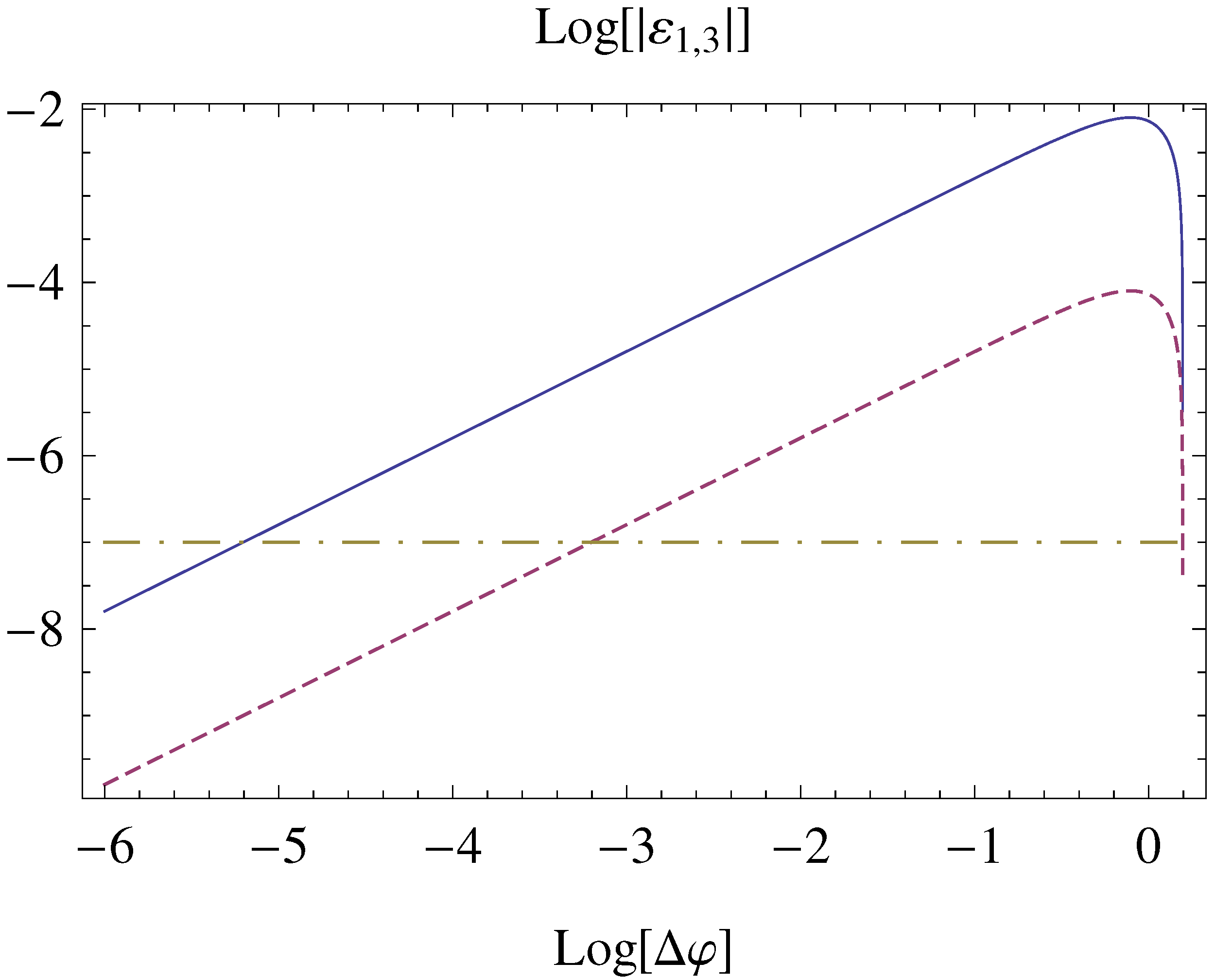
Publisher’s Note: MDPI stays neutral with regard to jurisdictional claims in published maps and institutional affiliations. |
© 2022 by the author. Licensee MDPI, Basel, Switzerland. This article is an open access article distributed under the terms and conditions of the Creative Commons Attribution (CC BY) license (https://creativecommons.org/licenses/by/4.0/).