
Abstract
We review recent works on the possibility for eternal existence of thin-shell wormholes on Einstein and Einstein–Gauss–Bonnet gravity. We introduce thin-shell wormholes that are categorized into a class of traversable wormhole solutions. After that, we discuss stable thin-shell wormholes with negative-tension branes in Reissner–Nordström–(anti) de Sitter spacetimes in d-dimensional Einstein gravity. Imposing symmetry, we construct and classify traversable static thin-shell wormholes in spherical, planar and hyperbolic symmetries. It is found that the spherical wormholes are stable against spherically symmetric perturbations. It is also found that some classes of wormholes in planar and hyperbolic symmetries with a negative cosmological constant are stable against perturbations preserving symmetries. In most cases, stable wormholes are found with the appropriate combination of an electric charge and a negative cosmological constant. However, as special cases, there are stable wormholes even with a vanishing cosmological constant in spherical symmetry and with a vanishing electric charge in hyperbolic symmetry. Subsequently, the existence and dynamical stability of traversable thin-shell wormholes with electrically neutral negative-tension branes is discussed in Einstein–Gauss–Bonnet theory of gravitation. We consider radial perturbations against the shell for the solutions, which have the symmetry. The effect of the Gauss–Bonnet term on the stability depends on the spacetime symmetry.
1. Introduction
Wormholes are spacetime structures which connect two different universes or even two points of one universe. Wormholes have fascinated people for a long time and many sci-fi movies and novels are based on them. One may be surprised to know that wormholes are indeed a subject of theoretical physics. Unlike black holes, wormholes are hypothetical objects in a real world. However, theoretical physicists have pursued such peculiar objects and revealed many properties of them because the consequences of wormhole physics are appealing: they enable instant travels between two distinct points and even the realization of time travel [1].
To understand what a wormhole is, it is better to follow the history of wormholes first. Interestingly, an insight into a wormhole shares the same year of discovery as the first black hole. In 1916, Schwarzschild found his famous black hole solution of the Einstein equations, the Schwarzschild black hole. In 1916, Flamm found that the Schwarzschild metric has a hidden tunnel structure which connects two asymptotically flat spaces; he developed what is now called the embedding diagram [2]. Almost twenty years after Flamm’s work, Einstein and Rosen published their famous paper about the “Einstein–Rosen bridge” which is the Schwarzschild spacetime that can be interpreted as a solution joining the two same Schwarzschild geometries at their horizons [3]. The bridge acts as a spacetime tunnel since it connects two asymptotically flat regions.
The outline of this article is following: Section 1 is the introduction, where wormhole properties are reviewed. In Section 2, we show the construction and linear stability against perturbations preserving symmetries of thin-shell wormholes. In Section 3, we mention that there are many generalizations of the thin-shell wormhole by Poisson and Visser. In this section, we review some of its generalizations. In Section 4, we concentrate on pure tension wormholes in Einstein gravity. This part is based on the work of [4]. We introduce wormholes with a negative-tension brane and we analyze the existence of static solutions, stability and horizon avoidance in spherical, planar and hyperbolic symmetries. In Section 5, we treat pure tension wormholes in Einstein–Gauss–Bonnet gravity. This part is on the work of [5]. At first, assuming that the shell is made of tension together with a perfect fluid, we derive the equation of motion for the shell and review the basic properties of the static shell After that, we show that the shell has a negative energy density and hence the weak energy condition is violated. (However, the negative-tension brane still satisfies the null energy condition.) Next, we study the existence and instability of static spherically symmetric thin-shell wormholes. The signature of the metric is taken as diag, and Greek indices run over all spacetime indices. In this section, the d-dimensional gravitational constant is retained. Section 6 is dedicated to the conclusion.
1.1. Einstein–Rosen Bridge
The Einstein–Rosen bridge is unstable since the throat pinches off quickly. To understand this mechanism, let us see the dynamics of the bridge to understand the reason of the pinch off.
We show here how this tunnel structure is recognized. The Schwarzschild metric is written in the spherical coordinates as
where M is a constant mass parameter. Suppose we take a constant time slice, const. Since the spacetime is spherically symmetric, we can take the equator slice, , without loss of generality. Then, the metric reduces to
Equation (2) has an axial symmetry: const. The metric or the line element can be expressed as a two-dimensional surface in a three-dimensional flat space; at const and is embedded into the three dimensional Euclidean space . In , the infinitesimal distance with the cylindrical coordinates () (: distance from the z axis, : angle around the z axis) is given by
A surface in a flat space can be described as in the cylindrical coordinates. Since the coordinates r and are functions of and , we must have relation between () and () to identify the equation of the surface, i.e., . Since the metric (2) is axially symmetric, which suggests and , the surface function becomes the function of r, . Summarizing the above, we find
The simultaneous equations reduces to a single differential equation and is easy to integrate;
A plot for (6) is shown in Figure 1 below, in the assumption . One finds that two asymptotically flat regions ( as ) are connected by the neck . Due to the shape of a neck, we call it a throat.
Figure 1.
(Left) The plot of (6). (Right) The surface is obtained by rotating the function around z axis in the direction. The narrowest surface corresponds to .
At this stage, one may ask a question such as “if we live in an asymptotically flat region, namely, in the upper space of Figure 1, what does the other region correspond to? Can we pass through the throat and go to this other region?”. A clear answer to this question, is produced in the paper by Fuller and Wheeler [6]. They revealed the dynamical properties of the throat and also showed that no traveller can safely pass through the throat to go to the other region. We will show the dynamics of the throat by the following this argument.
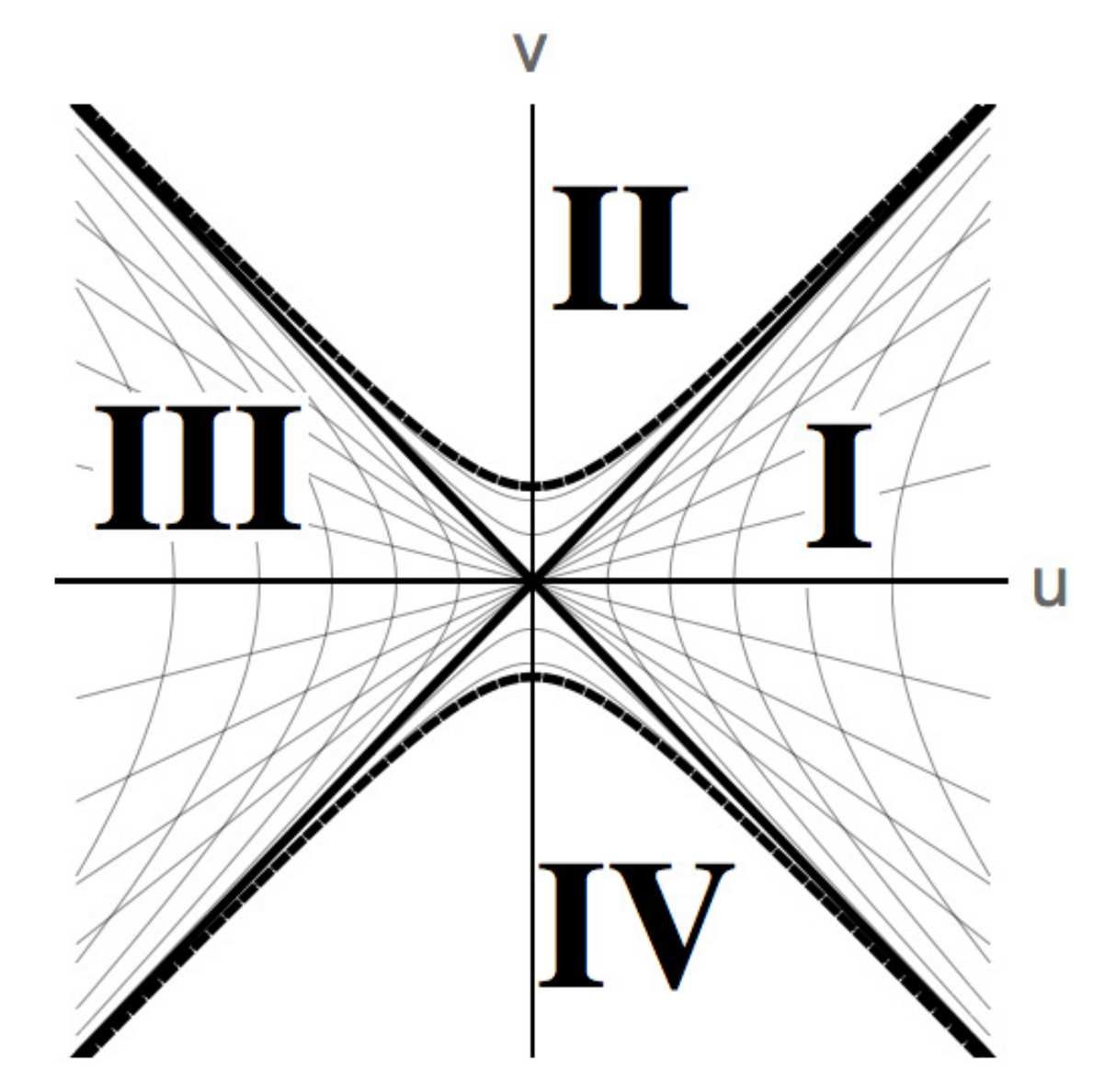
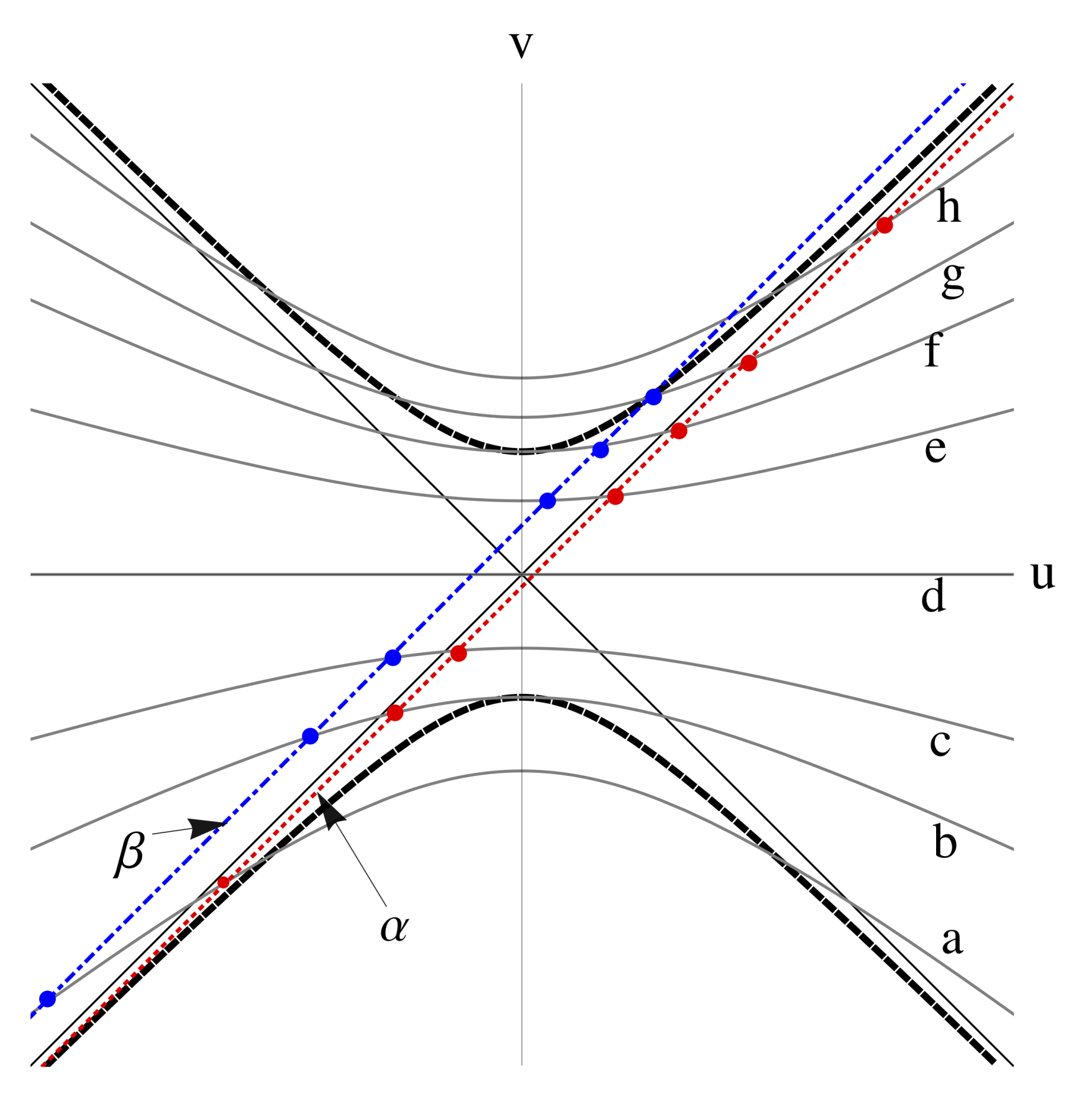
The Kruskal diagram of the Schwarzschild spacetime is given by Figure 2. Here, v is a timelike coordinate while u is a spacelike coordinate. Regions I and III represent the outside of the black hole which corresponds to the region of in the Schwarzschild coordinates. Region II is the inside of the black hole, , while Region IV is the white hole, that is considered as a time-reversal of the black hole. The straight lines correspond to , the event horizon of the spacetime. The dashed bold lines are the curvature singularity . Straight lines between and are const., while hyperbolas are const. surfaces.
Figure 2.
Kruskal diagram.
Here, we take a particular spacelike slice for the diagram as
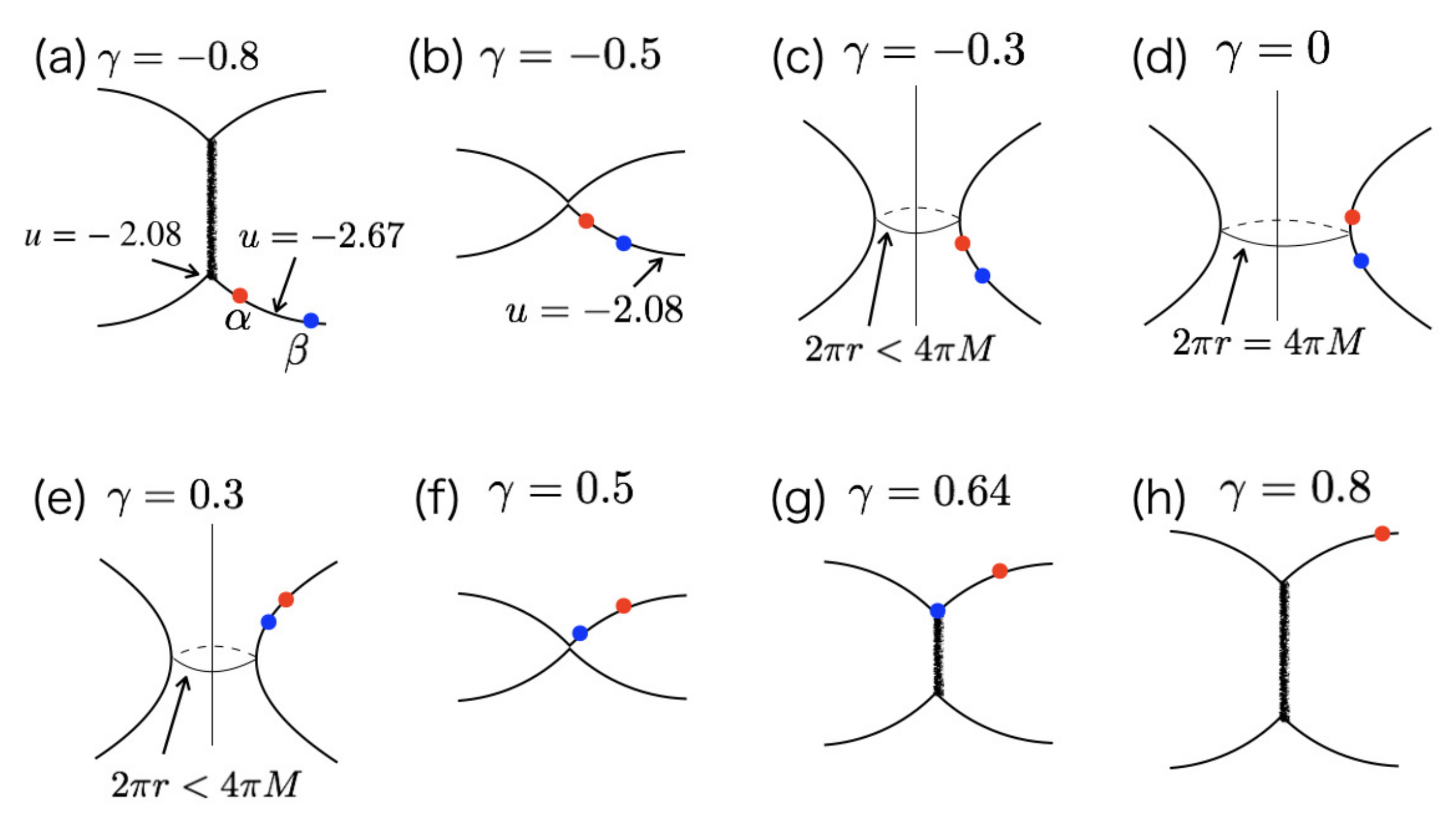
which becomes , as . We draw const. surfaces of (7) in Figure 3 as gray curves ((a) to (h)). As one can see, plays the role of time here; when increases, the surface (7) moves in the direction of increasing v. Since the surface (7) is spacelike, it moves in the time direction. In this figure, the red dotted straight line describes a null geodesic released from Region IV, while the blue one is a null geodesic released from Region III. The throat cannot stay static and its dynamics is as described in Figure 4. The process occurs in the order of (a) to (h):
Figure 3.
The red dotted line is the geodesic of photon from Region IV, while the blue one is that of photon from Region III. After passing through the anti horizon , photon goes to Region I and never across the event horizon . The geodesic of photon must terminate at the singularity in a finite time in Region II.
Figure 4.
The dynamics of the throat and the motion of photons. A throat emerges instantaneously and connects two asymptotically flat space-sheets. After that, it expands and then starts to contract. Finally, it pinches off the connection between the two space-sheets.
- (a)
- Photons and initially are in the lower sheet. They go to the center . The values and correspond to and , respectively. The vertical bold line is the curvature singularity . At this moment, the singularity is in between two quasi-Euclidean spaces.
- (b)
- Both photons go to the center. A throat is going to appear.
- (c)
- The throat just opened. The circumference of the throat is smaller than .
- (d)
- The maximal throat, . The photon has passed though the throat.
- (e)
- The throat is shrinking. Both photons have passed though the throat.
- (f)
- The moment of the throat closing. In this stage, both photons are still in the upper sheet, while the photon approaches the central singularity.
- (g)
- Photon is just caught. Then, disappears in the singularity and stops existing.
- (h)
- Photon keeps escaping to the null infinity of the upper sheet.
Although we have used a specific spacelike slice (7) to show the dynamical feature of the bridge, this dynamics does not change as long as the slice is spacelike.
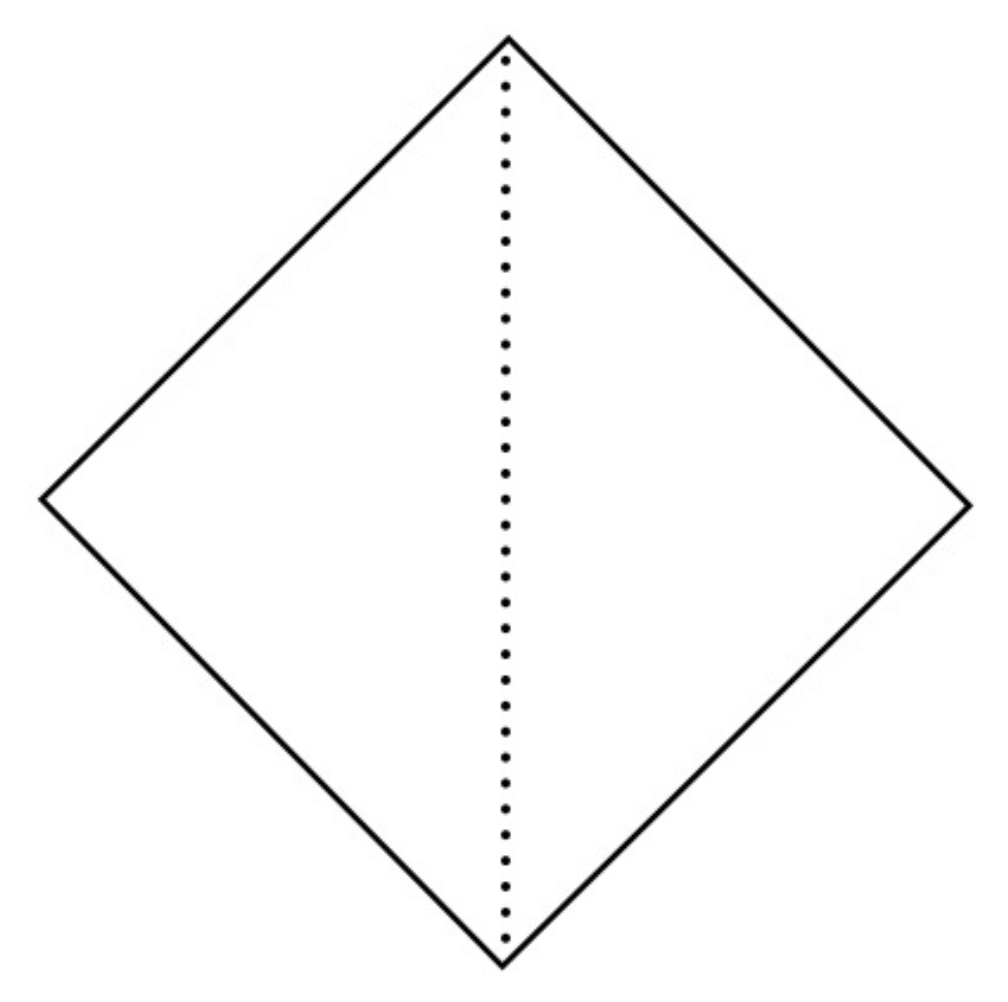
From the above, we conclude that, although a timelike traveller might go to the upper space in just a finite time, it cannot come back to the lower space. Hence, the Schwarzschild solution provides one-way travel. One can speculate that a two-way travel needs a Penrose diagram such as Figure 5. Apparently, this diagram shows that a timelike worldline can cross the throat again and again without hitting any singularities. The introduction of such a two-way tunnel spacetime is explained in the next subsection.
Figure 5.
A Penrose diagram for a two-way traversable spacetime. The center vertical line describes a wormhole throat which connects the left and the right regions. From the above picture, a timelike traveller clearly can pass through the throat to go to the other region and also come back to the original region.
1.2. Wormhole Properties in Brief
It was Morris and Thorne who established modern wormhole physics. In this subsection, we follow their approach to understand what properties wormholes should have. They pioneered qualitative study for static and spherically symmetric spacetimes which have “two-way“ traversable wormholes [7]. Since they knew what kinds of geometries describe tunnel structures, they deduced the metric which has such a geometry. Then, substituting the metric into the Einstein equation, they recovered the matter properties and its distribution. Here, we begin with a brief overview of their discussion.
A convenient choice of coordinates to describe static and spherically symmetric wormhole spacetimes is
where and b are both functions of r. To simplify calculations, we introduce an orthonormal basis of reference frame of the static observers:
In this basis, the metric takes the Minkowskian form: . Then, the non-zero components of the Einstein tensor yield
where . Since the geometry is both static and spherically symmetric, the vacuum equation must be the Schwarzschild black hole (Birkhoff’s theorem), a non-traversable wormhole. Thus, if we want to build a wormhole spacetime, we must handle spacetimes with a specific form of stress–energy tensors. As the Einstein tensor takes a diagonal form, the corresponding non-zero stress–energy tensor must also be diagonal. In the orthonormal basis, we can then give each component of the stress–energy tensor the physical interpretation as , where is the energy density, that static observers measure, is the radial tension that they measure in the radial direction (negative of the radial pressure) and p is the pressure that they measure in the lateral direction.
The Einstein equations give the following non-trivial equations for and p:
One may solve the above equations to get the form of b and by imposing a specific component choice for , i.e., a specific form of and p. An alternative way to solve them is that one imposes an equation of state as and , and then one solves for (12).
1.2.1. Embedding Wormholes and Asymptotic Flatness
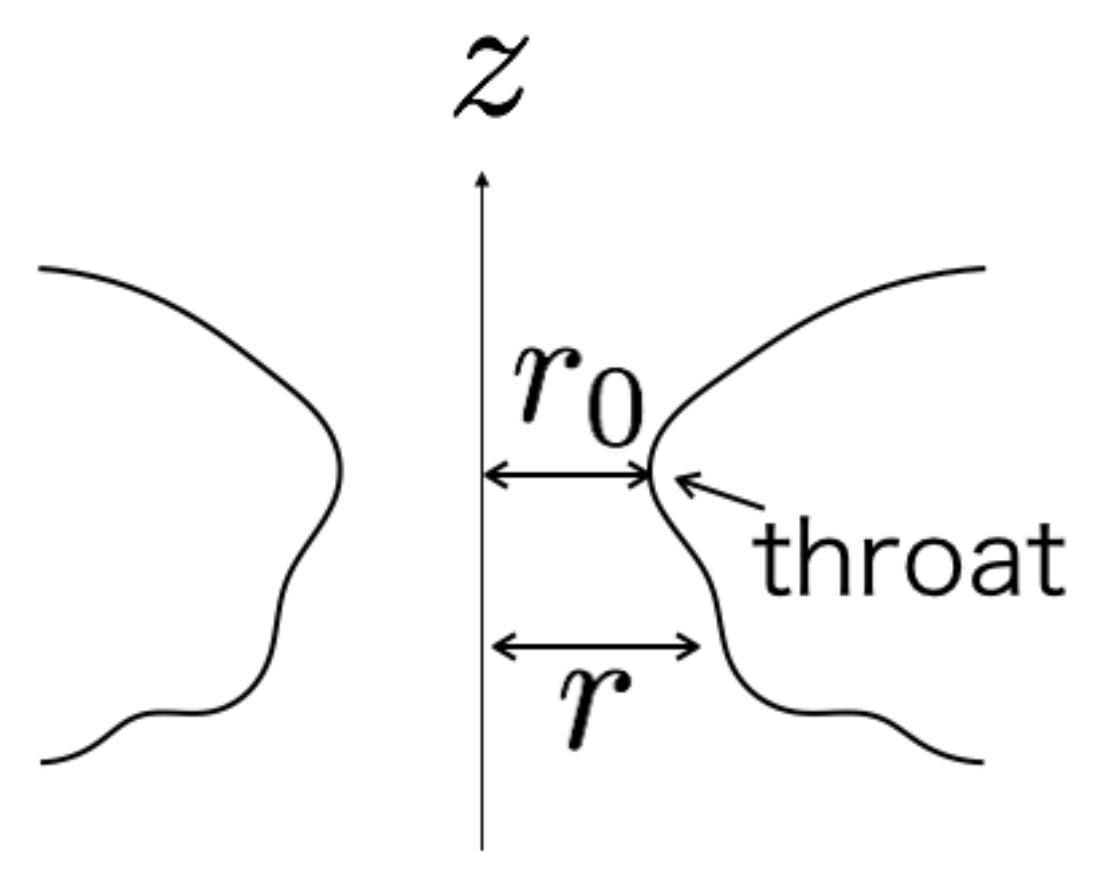
The surface actually describes the throat. The reason for this is obvious from the embedding operation. We can play the same game in Section 1.1 to get the embedding of the metric (8). Going through the same process in Section 1.1, we obtain a differential equation for z;
This differential equation can now be integrated if is determined. Thus, b is called the shape function. Obviously, (13) diverges when . Since the schematic picture of (13) is similar to Figure 1, one finds that the sphere with radius of describes the throat (Figure 6). We denote the throat, , as the minimum surface. As mentioned, at the throat, . Morris and Thorne further imposed the asymptotically flatness condition which means as .
Figure 6.
The embedding of the Morris–Thorne type metric. In general, wormholes do not have a mirror symmetry (such as the Einstein–Rosen bridge) as long as the flaring out condition is satisfied.
1.2.2. Flaring-Out Condition
In Section 1.2.1, we show that (13) diverges at the throat. In other words, the inverse function of , i.e., satisfies
For a spacetime to be a wormhole, there must be a throat that flares out. The flaring-out condition states
at and near the throat.
1.2.3. Absence of the Horizon
For the wormhole to be traversable, there must be no horizons in a spacetime. By using the function in the metric (8), it states
1.2.4. Magnitude of the Tension at the Throat
The shape function b gives restrictions on and p through Equation (12). A critical restriction is at the throat, . Then, . Reviving c and G, this yields the huge tension;
if is not too large.
1.2.5. Exotic Matter
Besides some of the peculiar features about wormholes noted above, the most difficult thing to digest in wormhole physics is the necessity of exotic matters that can violate energy conditions. In general relativity, Morris–Thorne’s static spherically symmetric traversable wormholes need stress–energy tensors that violate energy conditions at and near the throat. To see what happens to the relation between the tension and energy density near the throat, we introduce a dimensionless function as
Since (15) and is satisfied around the throat, reduces to
at and near the throat. We call the matter which has property as an exotic matter because the conventional matter satisfies the null energy condition, .
1.2.6. Other Properties
Morris and Thorne required some additional conditions on traversable wormholes, tidal forces and a time to pass through wormholes. We do not explain these conditions here since we think that the conditions mentioned above (Section 1.2.2, Section 1.2.3, Section 1.2.4 and Section 1.2.5) are the primary problems for wormholes. We refer the reader to the work of [7] for the details of tidal forces and time to pass through wormholes.
1.3. Simple Exact Solutions and Their Stability
If we somehow solved all of the difficulties about wormhole properties discussed above, there is still an important problem, i.e., the stability of wormhole spacetimes. Given a spacetime, its stability analysis against gravitational/matter perturbations is a problem with critical importance in the sense that only stable spacetimes may exist in the “real world”.
During few decades, after the paper by Einstein and Rosen, several exact solutions to the Einstein equations have been found and they have tunnel structures as described above [8,9,10]. These types of spacetimes are assumed to have a massless scalar field with the opposite sign of its kinetic term to the sign of the Einstein-Hilbert term in the Lagrangian. We often call such a scalar field a ghost or phantom scalar field. We refer to the simplest exact wormhole solution as the Ellis solution (or the Ellis–Bronnikov solution).
Although wormhole solutions have been known for decades, their stability analysis had not been conducted until quite recently. The first stability analysis was by [11]. In this paper, it is shown that the Ellis wormhole is stable against gravitational perturbations in a restricted class which do not change the throat radius. Subsequently, Shinkai and Hayward showed that the Ellis wormhole is unstable against either a normal and a phantom gaussian pulse of massless scalar field [12]. When a normal (ghost) pulse is injected into the throat, the throat must shrink (inflate). Gonzalez et al. also proved that the Ellis wormhole is unstable against linear and non-linear spherically symmetric perturbations in which the throat is not fixed [13,14]. They showed that a charged generalization of the wormhole is also unstable [15]. This unstable feature is invariant in the higher dimensional generalization of the Ellis spacetime [16].
2. Thin-Shell Wormholes
As mentioned in Section 1.2, Morris and Thorne pioneered qualitative study for static spherically symmetric wormholes.
Another class of traversable wormholes was found by Visser. This class of wormholes can be obtained by a “cut-and-paste” procedure [17,18,19] and such structures are called thin-shell wormholes. Poisson and Visser first presented stability analysis for spherical perturbations around such thin-shell wormholes and found that there are stable configurations according to the equation of state of an exotic matter residing on the throat [20]. The work of Poisson and Visser has been extended in different directions: charged thin-shell wormholes [21,22], thin-shell wormholes constructed by a couple of Schwarzschild spacetimes of different masses [23] and thin-shell wormhole with a cosmological constant [24]. Thin-shell wormholes in cylindrically symmetric spacetimes have also been studied [25,26,27,28,29,30]. Garcia et al. published a paper about stability for generic static and spherically symmetric thin-shell wormholes [31]. Dias and Lemos studied stability in higher dimensional Einstein gravity [32]. Thin-shell wormholes can also be constructed in extended gravity models [33,34,35] (see [36,37,38,39,40,41,42,43,44,45,46] for recent progress on thin-shell wormhole and its applications).
These wormhole models are easy to construct, which certainly have a wormhole structure. Thin-shell spacetimes have no differentiability for its metric at their throat, i.e., they are only , contrary to smooth wormhole models such as the Ellis wormhole, which are smooth () at their throat. Although thin-shell wormholes are not smooth, they indeed have qualitatively common features with smooth wormholes. Hence, investigating the properties of thin-shell wormholes may prompt deeper understanding for the properties of generic wormholes.
In this section, we show the construction and linear stability against perturbations preserving symmetries of thin-shell wormholes.
2.1. Junction Conditions
To construct thin-shell wormholes, we first review junction conditions. Let us consider a hypersurface in a spacetime. divides the spacetime into two parts, the one side is with coordinates and the metric while the other side is with coordinates and the metric . Junction conditions are capable of joining and at , so that respect the Einstein equations.
We define the extrinsic curvatures as
We also define as a metric of the line element on . Then, for the smooth joint of spacetimes at their boundaries,
are required. We define the deviation of an arbitrary tensorial function on the both sides of the hypersurface as , where and are functions in and , respectively.
On the other hand, if , in addition to , there is a stress–energy tensor, , which satisfies
The matter with non-zero is confined to the infinitesimally thin surface , so we call the surface a thin-shell. Equation (22) describes the motion for the thin-shell. The corresponding constraints are given by
and
where . See the works by Poisson [47] and Barrabes and Bressange [48] for the details of derivation.
2.2. Construction
To investigate wormhole stability, one must construct thin-shell wormholes. Here, we show how to build them.
First, we note that the construction is operated in spherically, planar and hyperbolically symmetric spacetimes in d-dimensional () Einstein gravity with an electromagnetic field and a cosmological constant in bulk spacetimes. Such a rich setup is required for later analysis.
The formalism for maximally symmetric d-dimensional thin-shell wormholes was first developed by Dias and Lemos [32]. We extend their formalism to more general situations. We obtain wormholes by operating three steps invoking junction conditions [47].
First, consider a couple of d-dimensional manifolds, . We assume . The d-dimensional Einstein equations are given by
where , and are Einstein tensors, stress–energy tensors and cosmological constants in the manifolds , respectively. The metrics on are given by . The metrics for static and spherically, planar and hyperbolically symmetric spacetimes with symmetry on are written as
respectively. and correspond to the mass and charge parameters in , respectively. k is a constant that determines the geometry of the -dimensional space and takes or 0. , 0 and correspond to a sphere, plane and a hyperboloid, respectively. is given by
We should note that, by generalized Birkhoff’s theorem [49,50,51,52,53], the metric (26) is the unique solution of Einstein equations of electrovacuum for and .
Secondly, we construct a manifold by gluing at their boundaries. We choose the boundary hypersurfaces as follows: , where a is called a thin-shell radius. Then, by gluing the two regions which are defined as with matching their boundaries, , we can construct a new manifold which has a wormhole throat at . should be a timelike hypersurface, on which the line element is given by
The surface function for is given by . stands for proper time on the junction surface whose position is described by the coordinates , where Greek indices run over and Latin indices run over . are the intrinsic coordinates on .
Thirdly, by using the junction conditions, we derive the Einstein equations for the submanifold . To achieve this, we define unit normals to hypersurfaces . The unit normals are defined by
To construct thin-shell wormholes, we make the unit normals on take different signs, while to construct normal thin shell models, the unit normals are chosen to be of same signs. Tangent vectors are defined by . We also define the four-velocity of the boundary as
where and is satisfied. The explicit form of (30) is
and the unit normal satisfies and .
2.3. Equation of Motion for the Shell
The equations for the shell are given by (22). The non-zero components of the extrinsic curvature are the following:
where . Since our metrics Equation (26) are diagonal, is also diagonal and written as
where p is the surface pressure (of opposite sign to the surface tension) and is the surface energy density living on the thin-shell. Hence, we obtain the explicit form of (22):
where
Note that we deduced a critical property of wormholes that σ must be negative.
The conservation law for the surface stress–energy tensor is given by (23). Since the stress–energy tensor in the bulk spacetime only contains the electromagnetic field, , one can find . Hence, (23) yields that is
Equation (38) corresponds to the conservation law. For later convenience for calculations, we recast Equation (38) to
We can get the master equation for the thin-shell throat by recasting Equation (35) as follows:
where
From Equation (40), the range of a which satisfies is the movable range for the shell. Since we obtained Equation (40) by twice squaring Equation (35), there is the possibility that we take wrong solutions which satisfy Equation (40) but do not satisfy Equation (35). However, we can show that this is not the case (see [4] for the proof). By differentiating Equation (40) with respect to , we get the equation of motion for the shell as
Suppose a thin-shell throat is static at and its throat radius must satisfy the relation
This condition is called the horizon-avoidance condition in [54].
We analyze stability against small perturbations preserving symmetries. To determine whether the shell is stable or not against the perturbation, we use Taylor expansion of the potential around the static radius as
The leading term is quadratic as to a and has the co-efficient . The sign of the co-efficient makes the form of the potential near static solutions. Therefore, the stability condition against radial perturbations for the static shell is given by
2.4. Simplest Thin-Shell Wormhole
As mentioned above, due to (35), wormholes must have a negative surface energy density, namely an exotic matter. Hence, the stability of such wormholes depends not only on their geometries but also on exotic matters on . In the following, we see the simplest thin-shell wormhole made from gluing two Schwarzschild spacetimes and its stability.
The simplest wormhole was first proposed by Visser. As mentioned above, the simplest thin-shell wormhole is constructed from cutting and pasting the couple of identical Schwarzschild spacetimes in the four dimensions, that is, in (27) we take , , , and and hence . Then, (41) reduces to
where is not specified yet.
2.5. Stability
In the simplest setup of thin-shell wormholes, the potential takes the form of (47). In this setup, we study a stability analysis with barotropic fluid and a pure tension matter field.
2.5.1. Global Stability
First, we learn a global stability analysis with general fluid, i.e., we do not specify an equation of state for the exotic matter residing on the shell. We see how the wormhole can be prevented from collapsing to a black hole or expanding infinity. This case is in the book by Visser [17,18,19]. To begin with, we investigate the asymptotic form of the potential (47). The explicit form of (47) is
If we have , the wormhole is prevented from an eternal throat expansion. This condition is explicitly written as
Hence, we can say that . Let us assume Taylor’s expansion of p around :
For , this can be integrated to with a constant C. Actually, must vanish because of the asymptotic behavior of . Hence, one obtains
We emphasize that this linear equation of state is valid only for large a. As a throat moves inwardly from infinity, term in (50) gradually becomes significant.
Although we have just shown that (54) is no-explosion condition, we also want to have a no-collapse condition. As mentioned above, we see the contribution of is dominant for . Since there is no hope for , we assume for getting no-collapse condition. We also assume that we can use (53) also for small a. This assumption allows us to write the potential as
If
is satisfied (and parameters M and C are chosen appropriately), this condition prevents the wormhole throat from collapsing. Therefore, the overlap of (54) and (56) is fully stable condition:
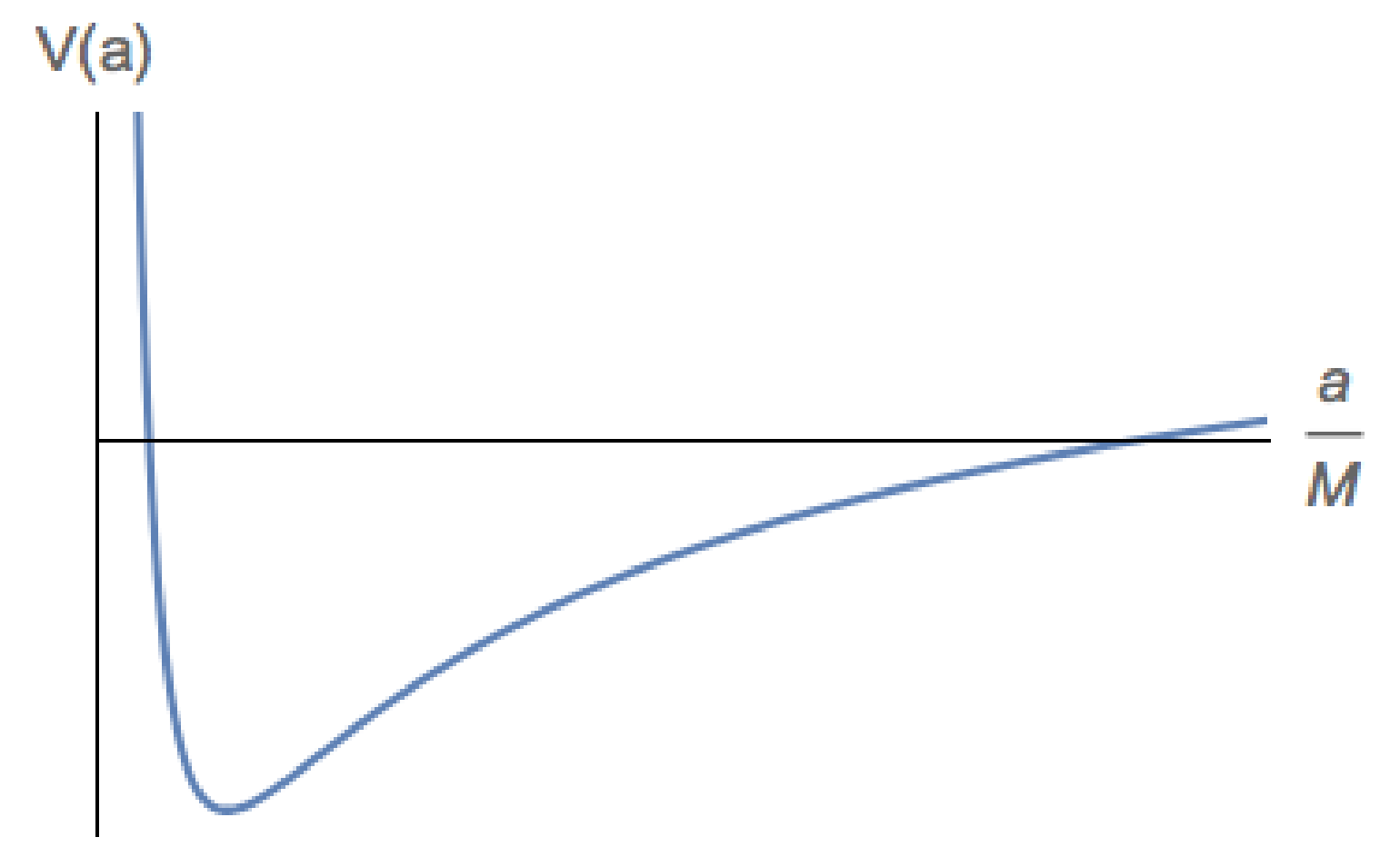
Such a globally stable wormhole is plotted in Figure 7.
Figure 7.
Schematic potential of a globally stable wormhole.
2.5.2. Local Stability
Local stability was studied by Poisson and Visser [20]. They assumed barotropic equation of state, . Then, (39) can be integrated as
Since (58) is an equation for , the solution is given by . Substituting into the master Equation (47) reads
Static solutions satisfy
Hence, the stability condition is
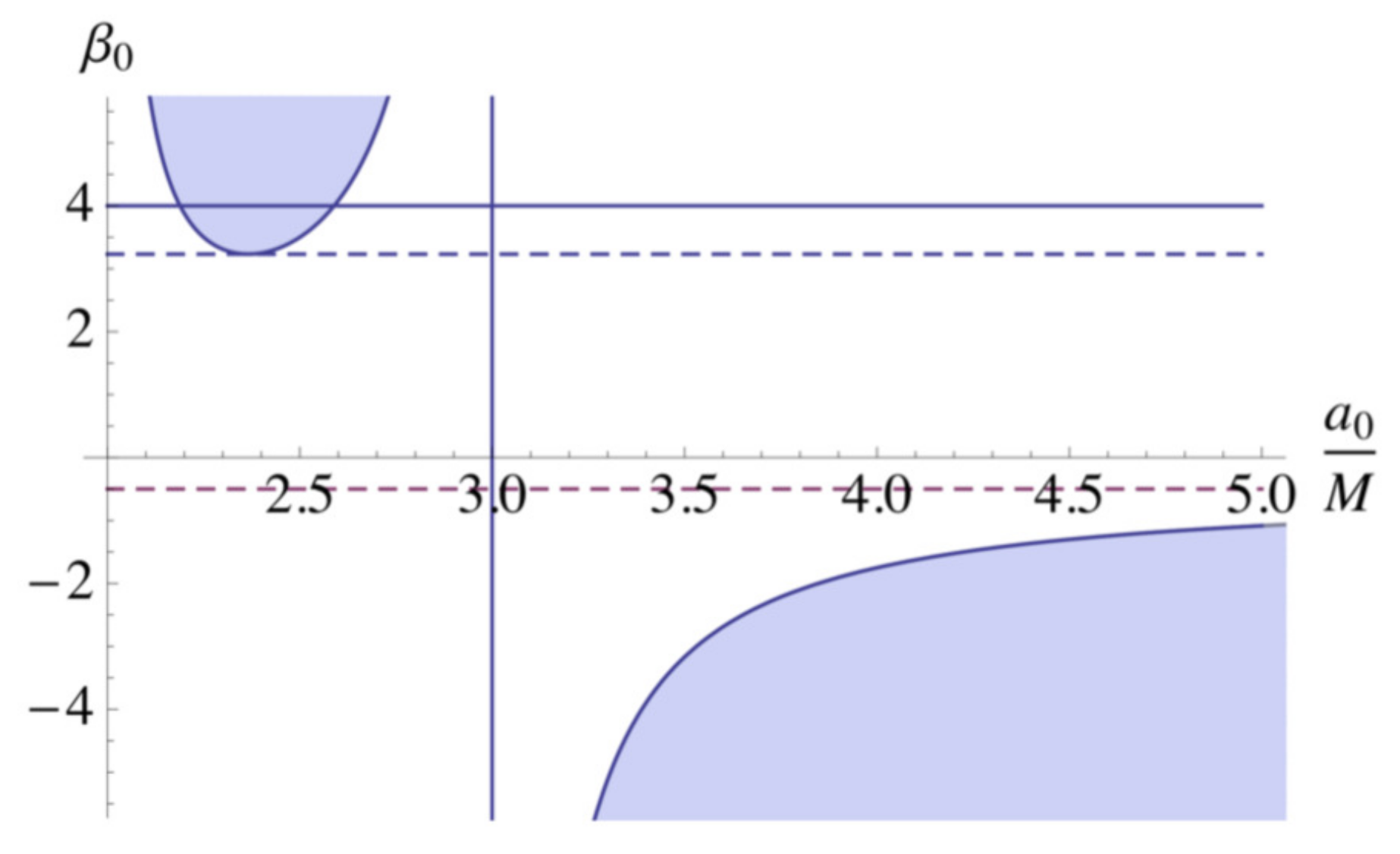
When , it is unstable regardless of the value because . Due to (63), one can identify the stable range of if is given. Stable regions are depicted as shaded regions in Figure 8. Although there are two values that stand for two extremums of , namely, , the smaller solution is an unphysical value because we consider the range .
Figure 8.
If is given, one knows the range of for the stable static throat solution. Region is unphysical since such region does not exist in the wormhole. The upper broken line is while lower is . Shaded regions correspond to stable regions. We draw the horizontal line with for an example. In this case, wormhole can be stable if .
From the above analysis, we can state that, if we take a particular value of , the stability range of is determined. Since relates to the equation of state of exotic matters, this statement is equivalent to that the types of exotic matter determine the range of which is the radius of a stable static throat radius.
We summarize the stability analysis in the assumption of barotropic equation of state:
- (1)
- There are stable solutions in or .
- (2)
- No solution in is stable.
- (3)
- The solution at is unstable regardless of the value of .
In the work of Poisson and Visser, they took the barotropic equation of state and the stability analysis does not need to specify the form of the equation of state. As one can see in Figure 8, there is no stable wormhole between . can be interpreted as the square of the magnitude of the speed of sound for the exotic matter. Poisson and Visser pointed out that, since we do not know microphysics for exotic matter, there is no guarantee that actually is the speed of sound. Therefore, the region with or is not a priori ruled out.
2.5.3. Pure Tension
We show what happens if we adopt a pure tension as the exotic matter. The pure tension is an equation of state that is written by
3. Generalized Thin-Shell Wormholes
In Section 2, we mention that there are many generalizations of the thin-shell wormhole introduced by Visser. In this section, we review some of its generalizations implemented by several authors.
3.1. Charged Generalization
A charged generalization is a theoretically natural extension of the simplest thin-shell wormhole. This was done by Eiroa and Romero [21,22]. A charged wormhole is constructed from cutting and pasting the couple of identical Reissner–Nordström spacetimes in four dimensions. This situation is reproduced in our formula by putting
into (27). In this case, stability condition reduces to
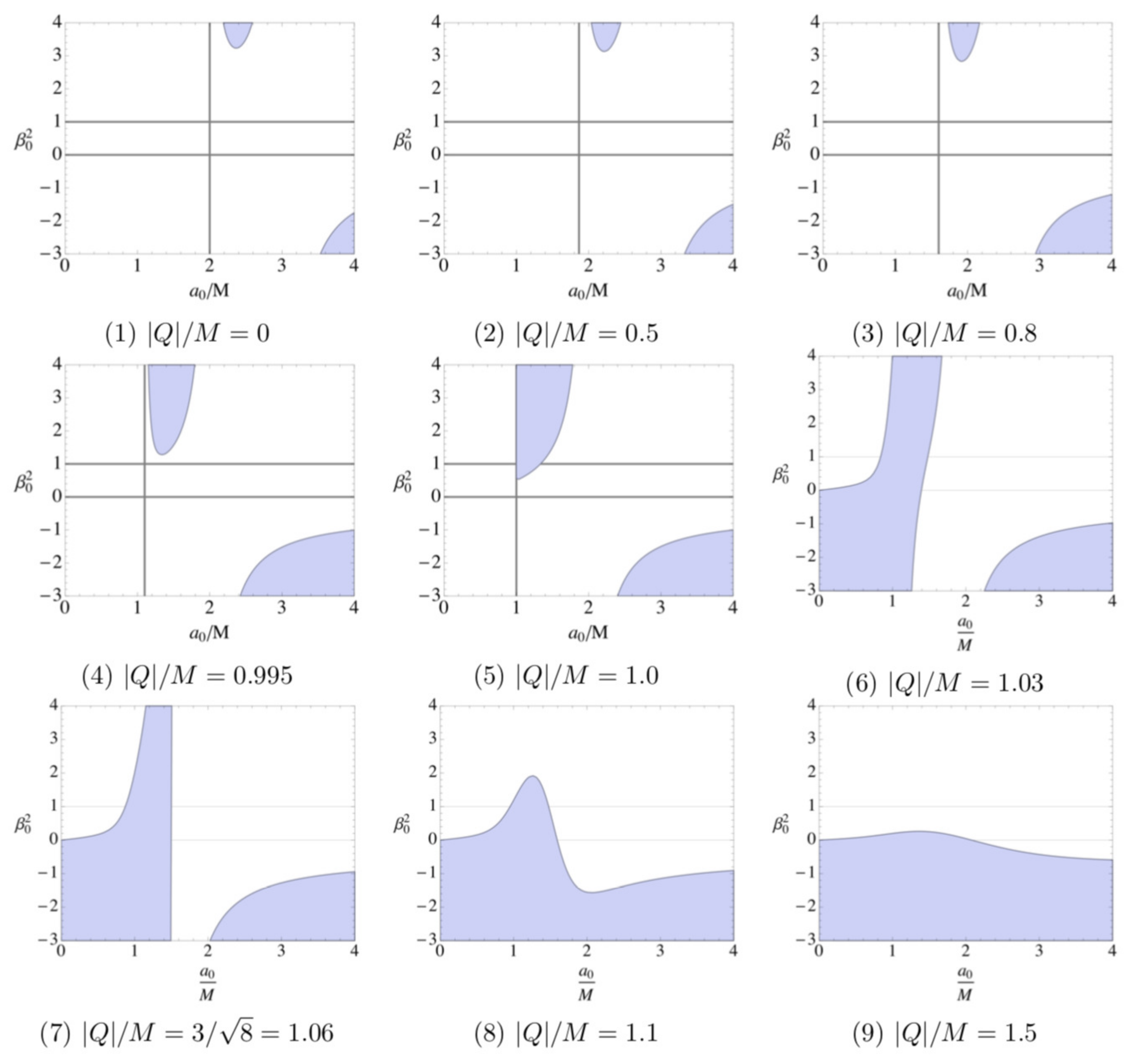
Stable regions are presented with each value of charge in Figure 9. The outer horizon corresponds to
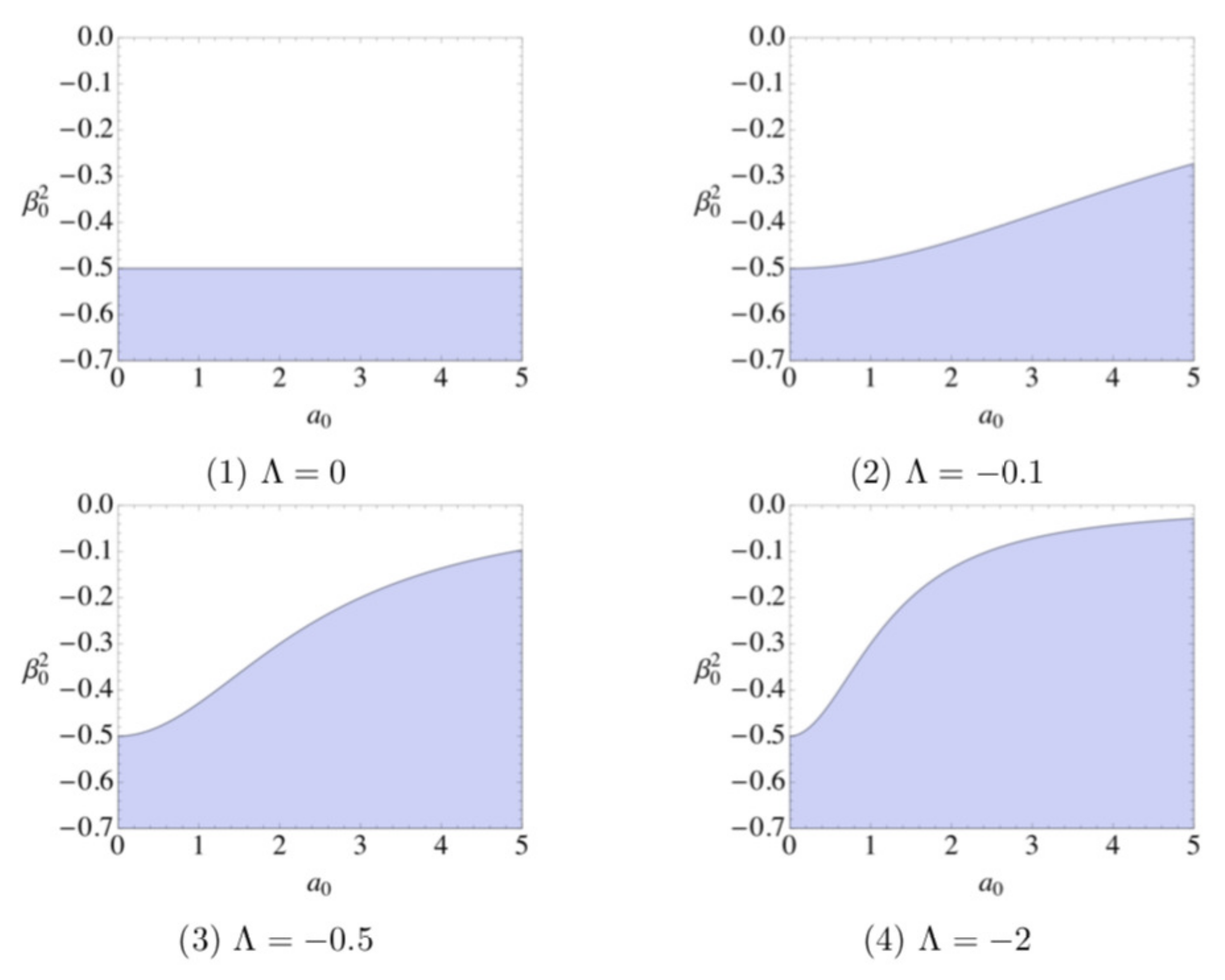
Figure 9.
Charged thin-shell wormholes. Shaded regions correspond to stable regions. The outer horizon corresponds to ; therefore, the regions inside of the outer horizons (vertical lines) have no physical meaning in these figures when .
Therefore, the regions inside of the outer horizons (vertical lines in the figure) have no physical meaning. One finds that stable region appears in , the sound-speed condition that is supposed to be satisfied for conventional matters. After the charge reaches the extremal value, , there is no longer horizon. Thus, any static solution can be stable for corresponding . We should emphasize that there are always stable solutions when regardless of values of .
3.2. Presence of a Cosmological Constant
Another generalization is implemented in a cosmological sense. Lobo and Crawford developed the construction by introducing a cosmological constant to the simplest wormhole [24]. In our notation, such situation is recovered by taking
in (27). Stability condition reduces to
Since the ingredient spacetimes are Schwarzschild–(anti) de Sitter, for any the event horizon (and also the cosmological horizon for ) exists where the equation
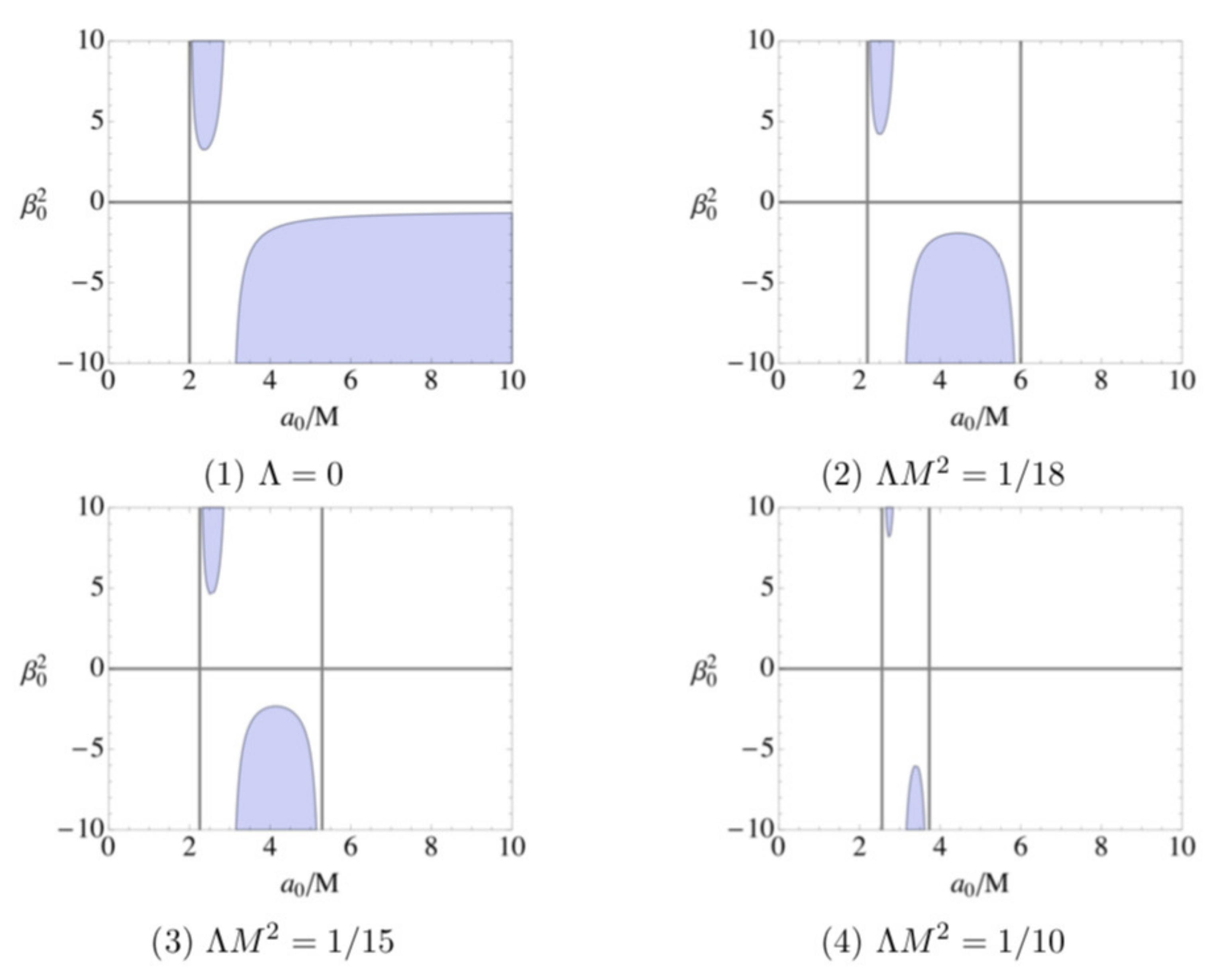
holds. Evidently, corresponds to the Schwarzschild shell wormhole. Figure 10 and Figure 11 show Schwarzschild–de Sitter and Schwarzschild–anti de Sitter thin-shell wormhole, respectively.
Figure 11.
Schwarzschild–anti de Sitter thin-shell wormhole. The shaded regions indicate the stability.
3.2.1. Schwarzschild–de Sitter Thin-Shell Wormhole:
For each value of , there are two vertical lines where the denominator diverges in (67). These lines correspond to the event horizon and the cosmological horizon, respectively. Hence, the left (right) side of the event (cosmological) horizon is the unphysical region. For any curves, “the region above curves lying in ” and “the region below curves lying in ” are stable regions. One finds that, in the case of the Schwarzschild–de Sitter thin-shell wormhole, stability region decreases with increasing relative to the Schwarzschild thin-shell wormhole ().
3.2.2. Schwarzschild–Anti de Sitter Thin-Shell Wormhole:
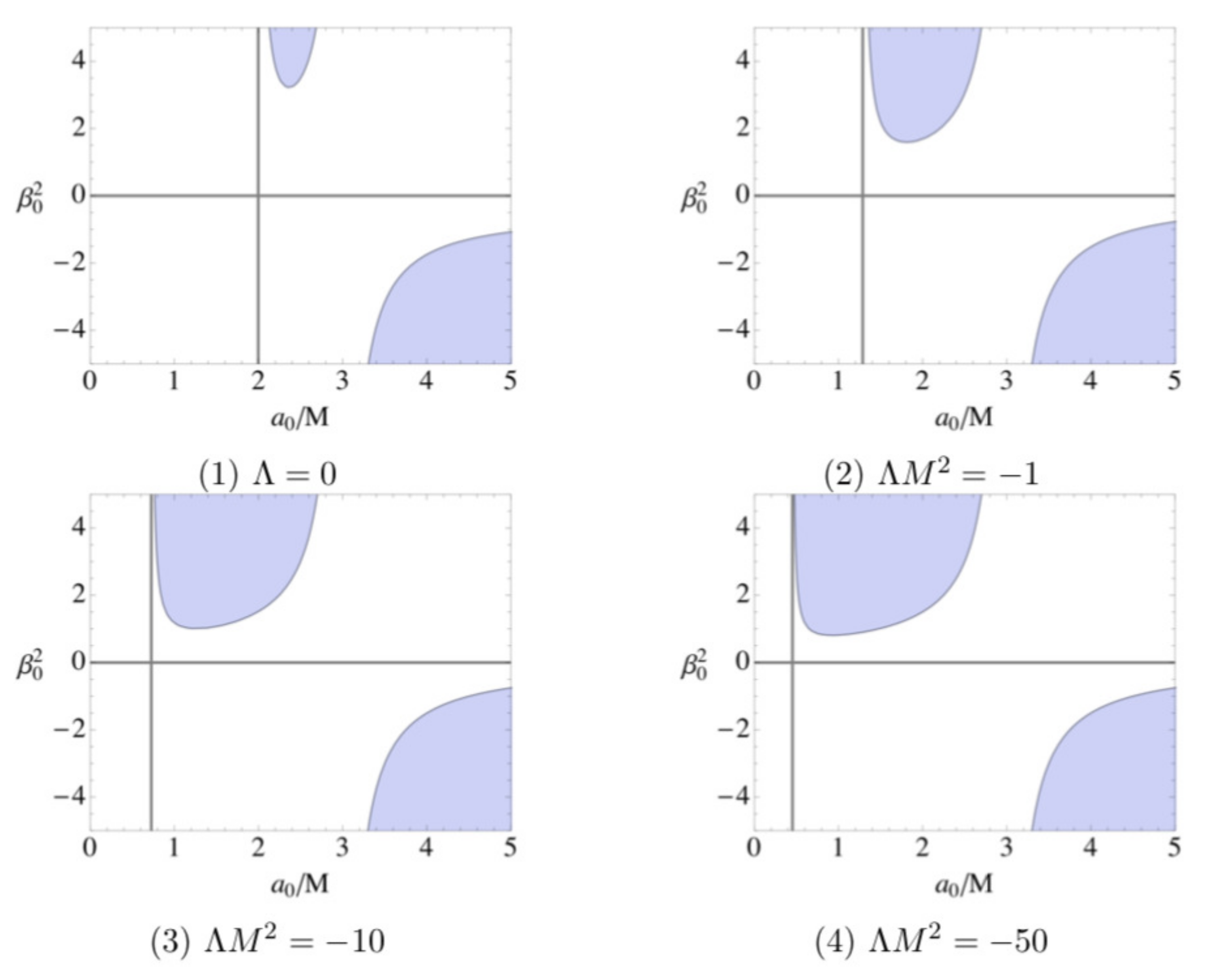
For each value of , there is a vertical line where the denominator diverges in (67). This vertical line corresponds to the event horizon. Hence, the left side of the event horizon is an unphysical region. Stable regions are similar to those in the case of the Schwarzschild–de Sitter thin-shell wormhole. One finds that in the case of the Schwarzschild–anti de Sitter thin-shell wormhole, the stability region increases with decreasing relative to the Schwarzschild thin-shell wormhole ().
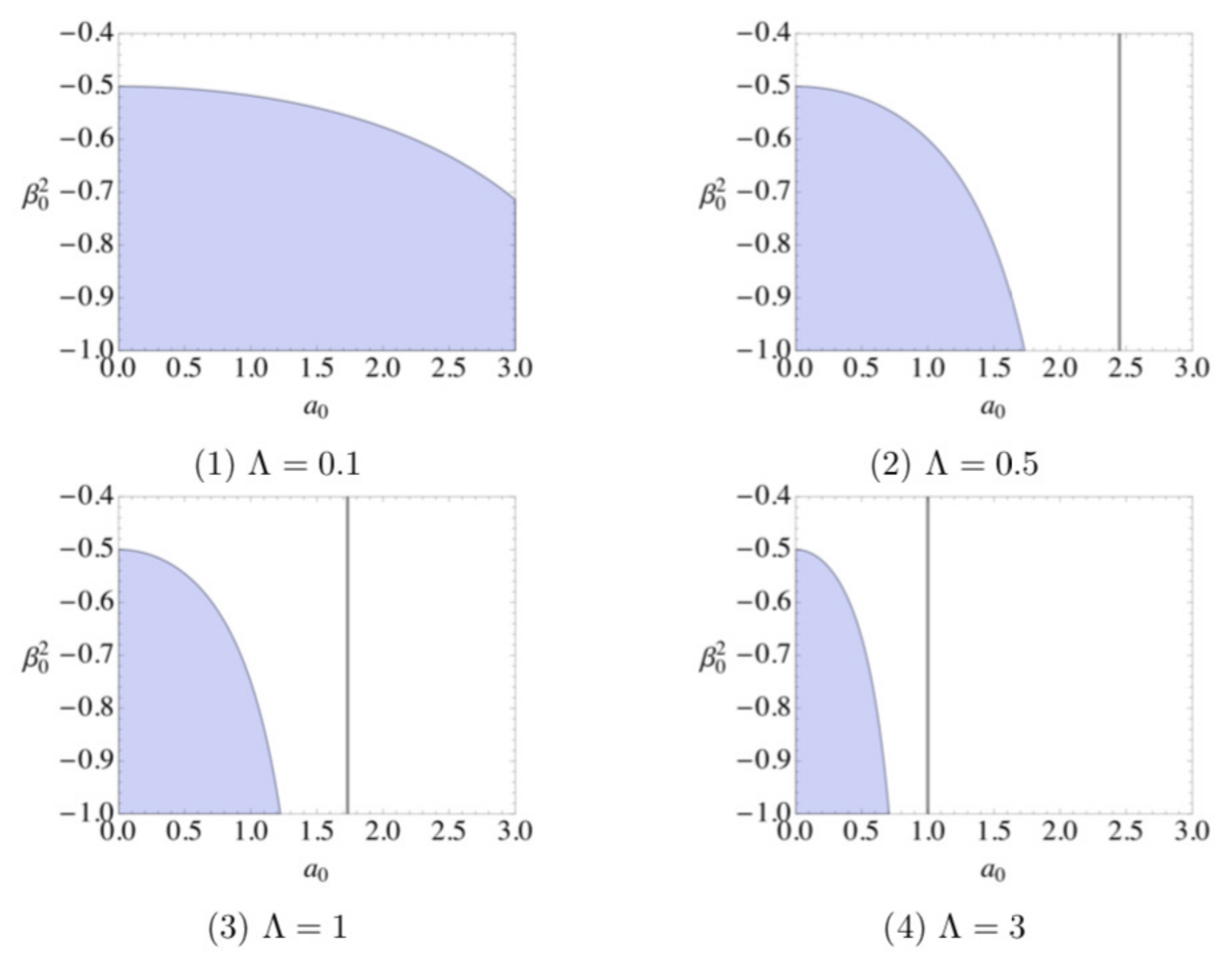
3.2.3. (Anti) de Sitter Thin-Shell Wormhole
We can also construct (anti) de Sitter wormhole just by putting in (67):
Figure 12.
De-Sitter wormholes. A stable region is below the curve. Each vertical line represents the cosmological horizon. Hence, the right side of the vertical line is an unphysical region.
Figure 13.
Anti de Sitter wormholes. Stable region is below the curve. Figure (1) describes a wormhole in the Minkowski spacetime.
3.3. Non- Symmetric Case
The simplest thin-shell wormhole is made by gluing a couple of Schwarzschild spacetimes with . Ishak and Lake expanded this analysis into the different-mass case, i.e., M is not continuous at . See [23] for detail. This situation corresponds to
in (27). In four dimensions, if we transform as in (27), then is interpreted as the ADM mass. In this situation, reduce to the following form:
where
We define and as
is also defined through the equations:
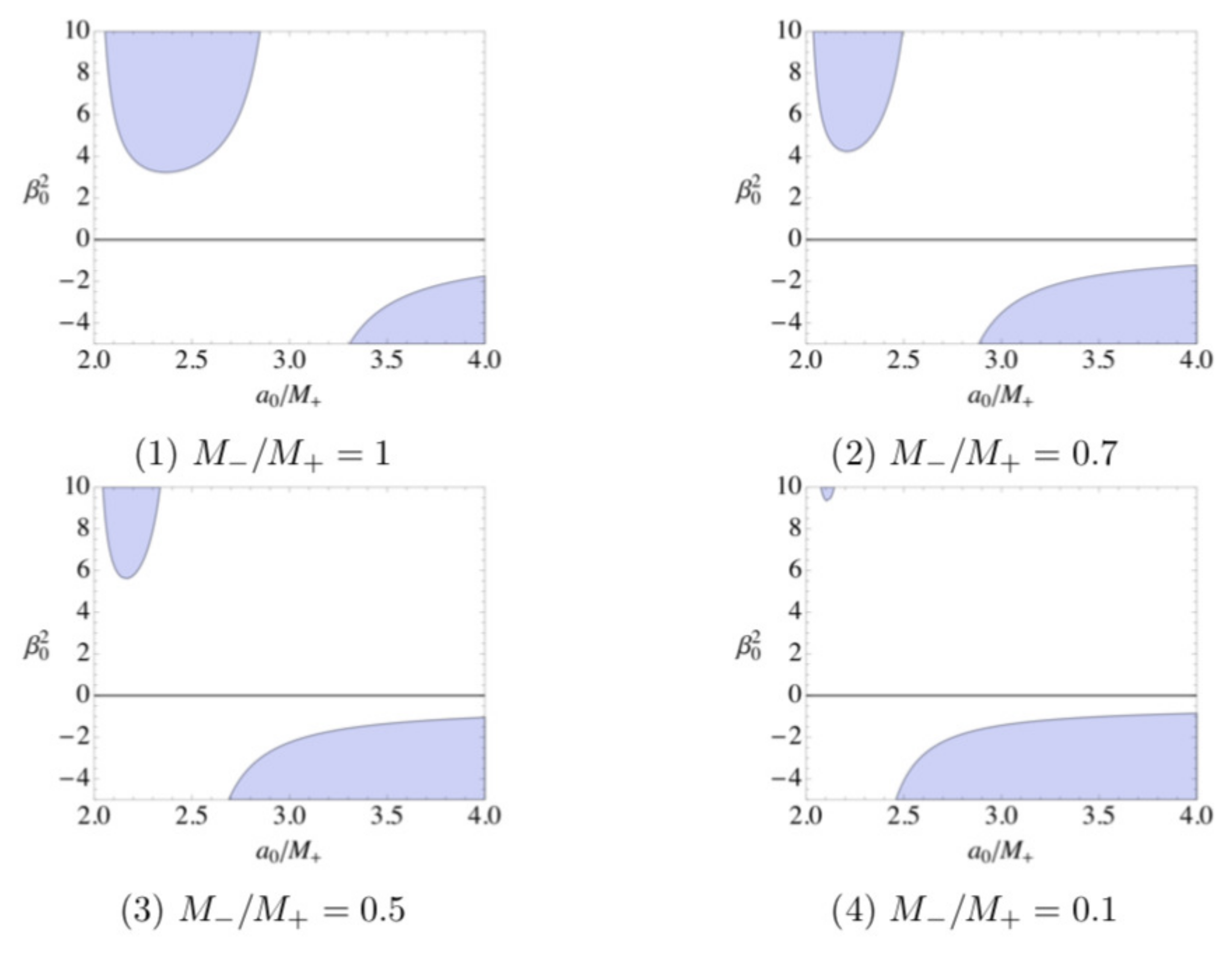
Putting into (71) recovers the condition by Ishak and Lake. Stable equilibrium is depicted in Figure 14. We find that the area of stable regions decreases with increasing the difference between and .
Figure 14.
Non- symmetry. The shaded regions represent stability. The area of stable regions decreases with increasing the difference between and . The horizontal axis is normalized by .
3.4. In Higher Dimensions
A higher dimensional generalization was introduced by Dias and Lemos [32]. We show a spherically symmetric shell wormhole in arbitrary dimensions, say, a Tangherlini shell wormhole. In (27), this situation corresponds to
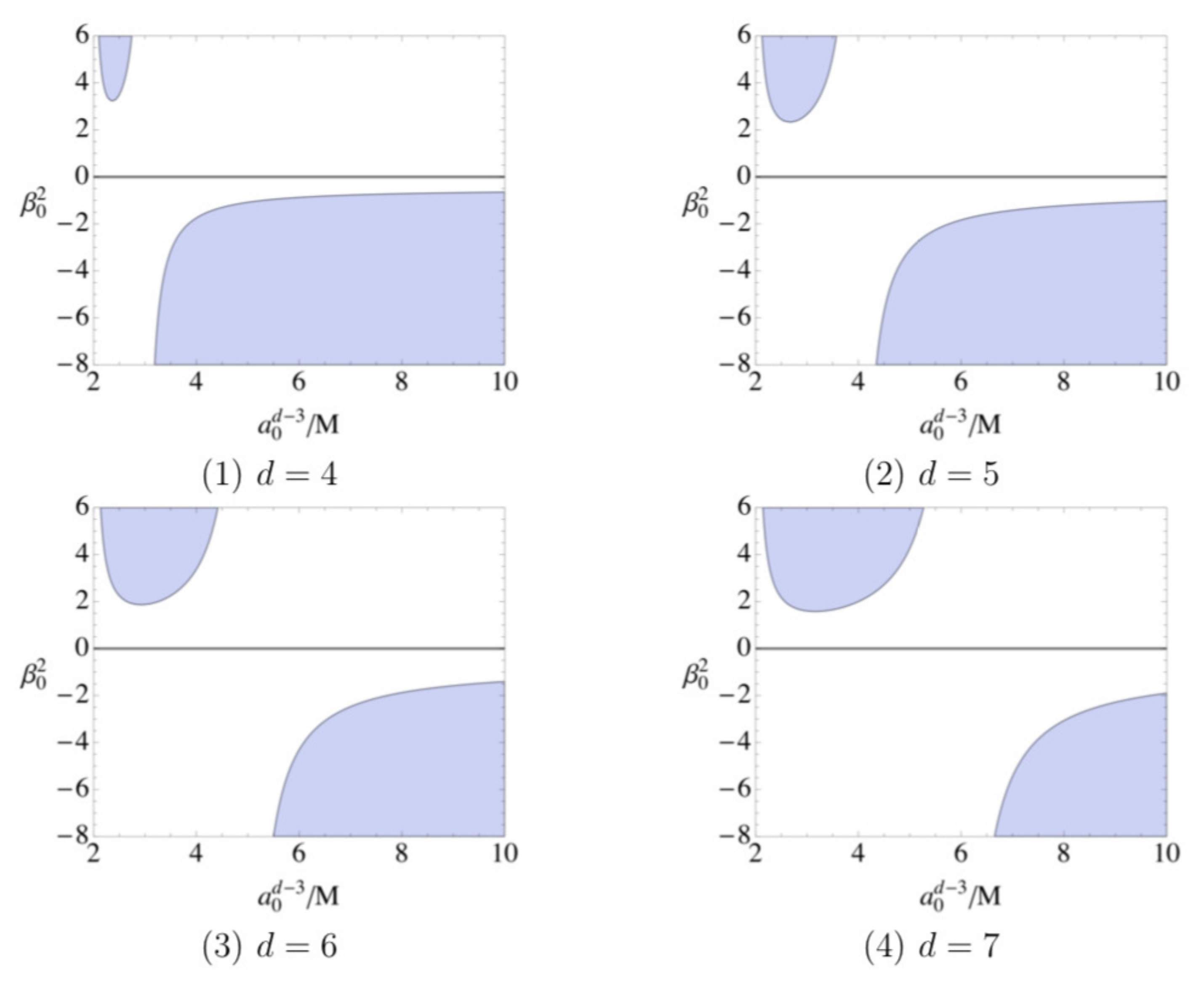
Putting these values into (71)–(75), we have the stable condition. Figure 15 shows the stable equilibrium. We find that the area of the stable regions increases with d.
Figure 15.
A higher dimensional generalization. The shaded regions represent the stability.
4. Pure Tension Wormholes in Einstein Gravity
4.1. Einstein Gravity
Although general relativity is the most successful simple gravitational theory, many alternative theories have also been theoretically investigated. Particularly, gravity models in four or higher dimensions have been investigated in many aspects:
The notion of higher dimensional spacetimes was first introduced by Kaluza and Klein [55,56]. They found that the gravitational field and the electromagnetic field can be unified in five-dimensional spacetimes. In their work, the length of the fifth dimension is confined to a very small scale.
The gauge/gravity correspondence conjectured by Maldacena [57] generally sheds light on structures in the anti de Sitter spacetime in higher dimensions.
At the end of the twentieth century, Randall and Sundrum proposed an idea that we perhaps live in a (3+1)-dimensional brane in the (4+1)-dimensional spacetime whose extra dimension spreads widely with a negative cosmological constant, which is called a brane-world model [58]. In this model, the bulk five-dimensional spacetime is the anti de Sitter spacetime.
In a broader context, candidate theories for quantum gravity, such as superstring theory and M-theory, entail higher dimensional spacetimes.
The most natural and the simplest generalization into higher dimension is the higher dimensional generalization of general relativity. This generalization is taken by writing the gravitational action in vacuum as
where and is a d-dimensional gravitational constant. The Ricci scalar R is associated with the d-dimensional metric. Variation of the action with respect to the metric gives the same form of general relativity, .
4.2. Advantage of Use of Pure Tension
Pure tension branes, whether the tension is positive or negative, have particular interest because they have Lorentz invariance and have no intrinsic dynamical degrees of freedom. In the context of stability, pure negative-tension branes have no intrinsic instability by their own, although they violate the weak energy condition. This is in contrast with the Ellis wormholes, for which a phantom scalar field is assumed as a matter content and it suffers the so-called ghost instability because of the kinetic term of a wrong sign [12,13,14].
The construction of traversable wormholes by using negative tension branes were first proposed by Barceló and Visser [54]. We prove that a wormhole with a pure tension brane analyzed in Section 2.5.3 is unstable. Barceló and Visser investigated pure tension wormholes in more general construction: They analyzed the dynamics of spherically symmetric traversable wormholes obtained by operating the cut-and-paste procedure for negative tension 2-branes (three-dimensional timelike singular hypersurface) in four-dimensional spacetimes. They found stable brane wormholes constructed by pasting a couple of Reissner–Nordström–(anti) de Sitter spacetimes. In their work [54], both the charge and negative cosmological constant are important to sustain such stable wormholes. In most cases, a negative cosmological constant tends to make the black hole horizons smaller. However, in exceptional cases, one can obtain wormholes with a vanishing cosmological constant, if the absolute value of the charge satisfies a certain condition.
4.3. Pure Tension Wormholes in Einstein Gravity
Here, we concentrate on stability of thin-shell wormholes against radial perturbations. The radial perturbation is important in the context of stability analysis in the following reasons: (i) Since the stability analysis against radial perturbations is much simpler than nonradial perturbations which entail gravitational radiation, it is a natural first step to investigate radial stability of wormhole models. For thin-shell models, the stability analysis against radial perturbations is particularly simple. (ii) The previous study suggests that the radial perturbation of wormhole spacetimes is most dangerous: [11] showed that the Ellis wormhole is stable against metric perturbations including nonradial perturbations which do not change the throat radius. Subsequently, the Ellis wormhole turned out to be unstable against radial perturbation which changes the radius of the throat. The throat must shrink or inflate [12]. From the above, we might say that, for the Ellis wormhole, the radial perturbation which changes the radius of the throat is the most “dangerous” perturbation, as mentioned in Bronnikov’s book [59]. One can expect that this property applies to not only the Ellis wormhole but also other wormhole solutions.
The effects caused by the electromagnetic field on the stability of a thin-shell wormhole are not well known. One may wonder whether the existence of the electric charge of wormholes can stabilize the wormholes. Therefore, it is worth studying electrically charged thin-shell wormholes.
In recent several years, the possibility of stable wormholes in various theories of modified gravity has gathered attention and has been extensively investigated by many authors [29,30,60,61,62,63,64,65,66,67,68,69,70]. However, the possibility of wormholes whose exotic matter is a pure tension brane has not yet fully been checked in those theories. To study such possibility, it is important and necessary to fully understand the existence and stability of all kinds of symmetric Reissner–Nordström–(anti) de Sitter thin-shell wormholes in higher dimensional pure Einstein–Maxwell theory.
In this section, we investigate negative-tension branes as thin-shell wormholes in spherical, planar and hyperbolic symmetries in d-dimensional Einstein gravity with an electromagnetic field and a cosmological constant in bulk spacetimes. In spherical geometry, we find the higher dimensional counterpart of Barceló and Visser’s wormholes which are stable against spherically symmetric perturbations. As the number of dimensions increases, larger charge is allowed to construct such stable wormholes without a cosmological constant. Not only in spherical geometry, but also in planar and hyperbolic geometries, we find static wormholes which are stable against perturbations preserving symmetries.
4.4. Effective Potential
From now on, for simplicity, we assume symmetry, that is, we assume , and and, hence, . We denote , , and . We investigate wormholes which consist of a negative-tension brane. From Equations (35) and (36), the surface energy density and surface pressure for the negative-tension brane are represented as
where is a constant with a negative value. The effective potential reduces to
4.5. Static Solutions and Stability Criterion
The present system may have static solutions . The equation for the static solutions is given by
The stability condition for wormholes was shown before as . The corresponding stability condition is
As one can see, since the static solutions Equation (84) and stability condition Equation (85) do not contain , the cosmological constant only affects the horizon-avoidance condition of Equation (43). By studying both the existence of static solutions and stability condition, we can search static and stable wormholes.
Combining Equations (85) and (86), we can see that for , the positive and negative sign solutions coincide and their stability depends on higher order terms.
As a specific example of stability analysis, we review the and case below. For and , the negative sign solution is stable, while the positive sign solution is unstable. When , there are two static solutions determined by Equation (86). The stability condition is satisfied if we take the negative sign solution of Equation (86). The positive sign solution is unstable. Since the radius of the static wormhole must be positive, we must have . In this stable case, one can achieve this situation if and only if
is satisfied. Therefore, we can construct a stable thin-shell wormhole without when the condition Equation (88) is satisfied. Thus, the extremal or subextremal charge of the Reissner–Nordström spacetime cannot satisfy Equation (88). We can reconfirm the previous result by taking and for Equation (88) as
This coincides with the previous result by Barceló and Visser [54]. From Equation (88), as d increases, a larger charge is allowed to construct a stable wormhole without . This class of wormholes are constructed by pasting a couple of over-charged higher dimensional Reissner– Nordström spacetimes.
The following transformation helps us to understand the potentials:
so that
where is a constant defined by
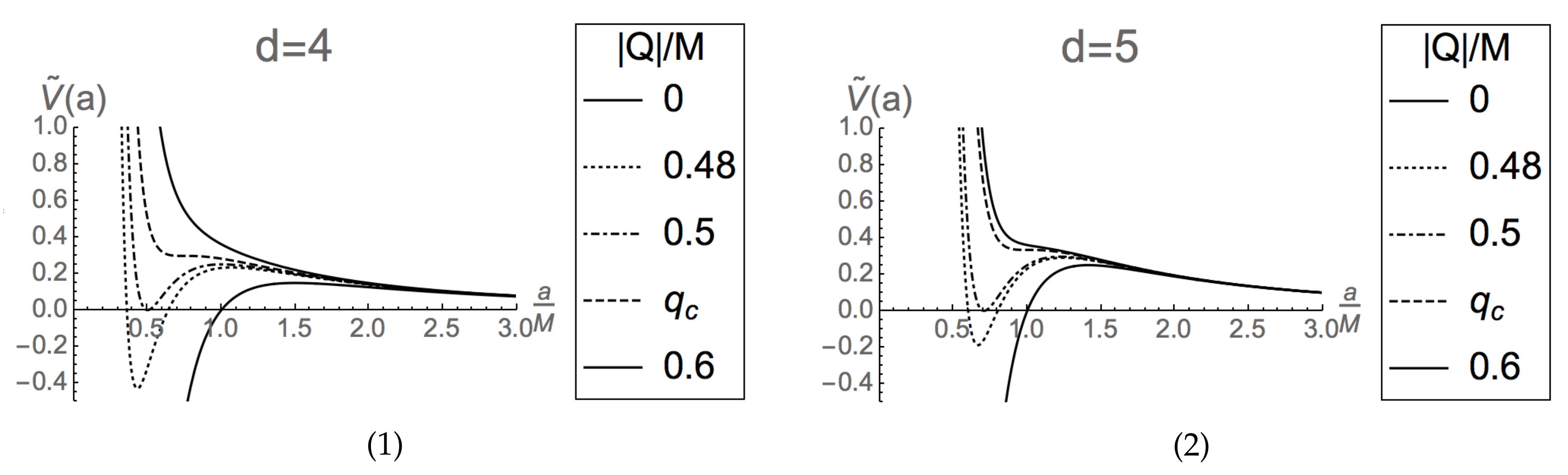
The potentials are plotted in Figure 16 for and , respectively.
Figure 16.
(1) The potential for , and . The dashed line is the potential for the critical value defined in Equation (87). (2) The potential for , and .
In the above, we discuss the stability analysis for . The analysis for and has also been completed (see [4] for the detail of the analysis). We summarize the stability analysis of the wormholes for all combinations of and q in Table 1, Table 2, Table 3 and Table 4 (see [4] for the definitions of , and are given in [4]).
Table 1.
The existence and stability of static wormholes in three dimensions.
Table 2.
The existence and stability of static wormholes in spherical symmetry in four and higher dimensions.
Table 3.
The existence and stability of static wormholes in planar symmetry in four and higher dimensions.
Table 4.
The existence and stability of static wormholes in hyperbolic symmetry in four and higher dimensions.
5. Pure Tension Wormholes in Einstein–Gauss–Bonnet Gravity
5.1. Einstein–Gauss–Bonnet Gravity
The action of the -dimensional Einstein–Gauss–Bonnet gravity in vacuum is given by
where is the cosmological constant. The Gauss–Bonnet term is defined by the following special combination of the Ricci scalar R, the Ricci tensor and the Riemann tensor :
The Gauss–Bonnet term appears in the action as the ghost-free quadratic curvature correction term in the low-energy limit of heterotic superstring theory in ten dimensions (together with a dilaton) [71,72,73,74,75]. In this context, the coupling constant is regarded as the inverse string tension and positive definite.
For this reason, we assume throughout this article. In addition, we put another conservative assumption , where
so that the theory admits maximally symmetric vacua, namely Minkowski, de Sitter (dS) or anti de Sitter (AdS) vacuum solutions. Although there exists a maximally symmetric vacuum for , we do not consider this case for simplicity.
The variation of the action (93) with respect to the metric gives the following vacuum Einstein–Gauss–Bonnet equations:
where
The tensor obtained from the Gauss–Bonnet term does not give any higher-derivative term and holds for . As a result, Einstein–Gauss–Bonnet gravity is a second-order quasi-linear theory as Einstein gravity is.
5.2. Pure Tension Wormholes in Einstein–Gauss–Bonnet Gravity
In 2011, Kanti, Kleihaus and Kunz numerically constructed four-dimensional spherically symmetric wormhole solutions in Einstein–Gauss–Bonnet-dilaton gravity and showed that they are dynamically stable against spherical perturbations [69,70] 1. The Gauss–Bonnet term non-minimally coupled to a dilaton scalar field appears in the Lagrangian as the ghost-free quadratic correction in the low-energy limit of heterotic string theories [71]. Although this Einstein–Gauss–Bonnet–dilaton theory is realized only in ten dimensions, their result gives courage and hope toward the construction of wormholes in our universe described by a well-motivated effective theory of gravity. Then, a natural question arises: Which is the main ingredient stabilizing the wormhole, the Gauss–Bonnet term or its dilaton coupling?
The main purpose of the article is to clarify the effect of the Gauss–Bonnet term on the dynamical stability. For this purpose, we study the simplest thin-shell wormhole which is made of its tension. While dynamical stability of thin-shell wormholes have been intensively investigated both in general relativity (Einstein gravity) [17,18,19,20,21,22,23,24,25,26,27,28,31,32] and in various models of modified gravity [60,62,63,64,65,66,67,68], pure tension brane is the best set-up to analyze stability as a pure gravitational effect because such a thin-shell does not suffer from the matter instability.
In Einstein gravity, such thin-shell wormholes have been fully investigated in the previous section. In the vacuum case, such thin-shell wormholes are stable against radial perturbations only in the hyperbolically symmetric case with negative mass in the bulk spacetime [4].
In this section, we study the same system with the Gauss–Bonnet term but without a dilaton in the Lagrangian. Since the Gauss–Bonnet term becomes total derivative and does not affect the field equations in four or lower dimensions in the absence of the non-minimal coupling to a dilaton, we consider five or higher dimensional spacetimes. In comparison with the general relativistic case, the equation of motion for the shell is much more complicated. For this reason, although thin-shell wormholes have been investigated in Einstein–Gauss–Bonnet gravity by many authors [67,77,78,79,80,81,82,83], the stability analysis has not been completed yet even against radial perturbations.
In Section 5.8, for investigating stability of shell wormholes, we develop a systematic method that is applied to any gravitational theories. This method makes stability analysis simpler.
5.3. Bulk Solution
We study the properties of thin-shell wormholes in Einstein–Gauss–Bonnet gravity. Such wormhole solutions are constructed by gluing two bulk solutions at a timelike hypersurface.
In this article, we consider the d-dimensional vacuum solution with a maximally symmetric base manifold [84,85,86,87,88] as the bulk solution, of which metric is given by
where and are the coordinates and the unit metric on the base manifold and
Here, is the curvature of the maximally symmetric base manifold corresponding to the spherical, planar and hyperbolically symmetric spacetime, respectively. m is called the mass parameter.
The expression of the metric function (100) shows that there are two branches of solutions corresponding to the different signs in front of the square root. The branch with the minus sign, called the GR branch, allows the general relativistic limit as
On the other hand, the metric in the branch with the plus sign, called the non-GR branch, diverges in this limit. In the following section, we consider the bulk solution only in the GR branch as a conservative choice.
The global structure of the spacetime (99) depending on the parameters has been completely classified [89]. There are two classes of curvature singularities in spacetime. One is the central curvature singularity at . Since we assume and , the interior of the square root becomes zero at some for negative m. This corresponds to another curvature singularity called the branch singularity and the metric becomes complex at . In this case, the domain of the coordinate r is .
The spacetime has a Killing horizon at satisfying depending on the parameters. To construct static thin-shell wormholes, the bulk spacetime needs to be static. For this reason, we consider the bulk solution (99) in the domain if there is no branch singularity and if there is a branch singularity. We define the future (past) direction with increasing (decreasing) t. We stress that since there is a generalized Birkhoff’s theorem in Einstein–Gauss–Bonnet gravity [90], the bulk spacetime is static as long as a shell moves with preserving symmetries.
5.4. Equation of Motion for a Thin-Shell
A thin-shell wormhole spacetime is constructed by gluing two bulk spacetimes (99) at a timelike hypersurface . Here, the bulk spacetimes are defined in the domain and may have different parameters. Then, the junction conditions, which are the field equations (96) in the distributional sense, tell us the matter content on the thin-shell at . Finally, the equation of motion for the shell is obtained as a closed system when the equation of state for the matter is assumed.
The junction condition in Einstein–Gauss–Bonnet gravity is given by
are indices for the coordinates on the timelike shell [91,92,93]. In the junction conditions (102), is the extrinsic curvature of the shell and , where is the induced metric on the shell. Other geometrical quantities are defined by
where , , and are the Riemann tensor, Ricci tensor, and Ricci scalar on the shell, respectively. is the divergence-free part of the Riemann tensor satisfying , where is the covariant derivative on the shell. Lastly, is the energy-momentum tensor on the shell, which satisfies the conservation equations .
A static thin-shell wormhole is realized as a static solution for the equation of motion. However, in general, a is not constant but changes in time, representing a moving shell. In such a case, a may be written as a function of the proper time on the shell as .
Now, let us derive the equation of motion for the shell. We describe the position of the thin-shell as and in the spacetime (99) and assume the form of as
This assumption means that the matter on the shell consists of a perfect fluid and the constant tension of the shell, where and p are the energy density and pressure of the perfect fluid. Assuming the Z symmetry for the bulk spacetime, we write down the junction conditions (102) as
where . A dot and a prime denote the derivative with respect to and a, respectively. (see [5] for the details of derivation). The above equations give the equation of motion for a thin-shell in Einstein–Gauss–Bonnet gravity.
To obtain the equation of motion in a closed system, the equation of state for the perfect fluid is required. One possibility is the following linear equation of state with a constant :
With this equation state, the energy-conservation equation on the shell , written as
is integrated to give
where is a constant.
5.5. Effective Potential for the Shell
The dynamics of the shell governed by Equations (106) and (107) with the equation of state (108) can be discussed as a one-dimensional potential problem. Then, the shape of the effective potential for the shell determines the stability of static configurations, namely the static wormholes.
This is a cubic function for . The position of the throat for a static wormhole is obtained by solving the following algebraic equation for :
where and .
is required for the real metric and the absence of branch singularity. In the GR branch, because of the existence of the square root in Equation (115), the following inequality holds:
which is used below.
Actually, Equation (111) admits only a single real solution for :
which has the form of the one-dimensional potential problem. The effective potential is defined by
where is defined by
One can see . can be expressed in terms of A and B as
5.6. Negative Energy Density of the Shell
We show that the energy density on the shell must be negative for static wormholes. The condition and Equation (106) with yields , where . Clearly, this is not satisfied for under the assumption . For , Equation (106) gives and this is not satisfied because there is a constraint for the throat radius in the GR branch, which can be shown from the combination of Equations (116) and . Now, we have shown that the energy density on the shell is negative in the physical set up considered in this article. Hence, the weak energy condition is violated in the GR-branch with . However, the negative-tension brane still satisfies the null energy condition.
Hereafter, we consider the case without a perfect fluid on the shell () and assume . The resulting static thin-shell wormholes are made of the pure (negative) tension and satisfy the null energy condition. This simplest set up is preferred by the minimal violation of the energy conditions. The energy-momentum tensor for the negative tension is equivalent to a negative cosmological constant. Such a matter corresponds to an inverted harmonic oscillator in classical mechanics. A technical advantage in this set up is the constancy of .
5.7. Static Solutions
Here, we summarize the existence conditions for a static shell located at . Equation (117) is interpreted as the conservation law of mechanical energy for the shell. By differentiating Equation (117) with respect to , we obtain the equation of motion for the shell as
From Equations (117) and (122), is determined algebraically by and . In addition, must satisfy and . The latter condition is called the horizon-avoidance condition in the previous section and Reference [54], which simply means that the position of the throat is located in the static region of the spacetime. Actually, this condition is always satisfied because we have and Equation (118) implies .
5.8. Stability Criterion
As explained at the beginning of this section, the sign of determines stability of a static thin-shell wormhole. In this subsection, we derive in a convenient form to prove the (in)stability.
5.8.1. Einstein Gravity
First, let us consider Einstein gravity as a simple lesson. In the general relativistic limit , Equation (111) reduces to
By solving Equation (125) for , we define a potential of the conservation law of the one-dimensional potential problem. Then, we directly calculate the second derivative of . However, without such direct calculations, in principle, we can derive the form of by operating a systematic method below, which can be applied also in more general theories of gravity.
Suppose we get a master equation as . By this master equation, in Equation (125) is replaced by to give
Differentiating this equation twice, we obtain
where for the pure tension brane.
In Einstein gravity, the metric function is
which satisfies
Combining this with Equation (129), we obtain the algebraic equation to determine :
For , Equation (133) requires and is totally undetermined. For , Equation (133) requires and the throat radius is given by
As seen in Equation (134), does not contribute to the size of the wormhole throat. However, it appears in the horizon-avoidance condition . Equation (132) shows that requires in the case of . In the case of , is satisfied only for . In the case of and , gives a constraint on the size of the wormhole throat, where
On the other hand, in the case of and , gives . Combining this inequality with Equation (134), we obtain the range of the mass parameter admitting static wormhole solutions; for with and for with , where
In Einstein gravity, a simple criterion for the stability of static solutions is available. Substituting Equations (130) and (131) into Equation (128) and evaluating them at , we obtain
where we use Equations (129) and (133).
This simple expression clearly shows that the wormhole is stable only for with [4]. Existence and stability of static thin-shell wormholes in Einstein gravity are summarized in Table 5.
5.8.2. Einstein–Gauss–Bonnet Gravity
Although it is more complicated, we can play this game in Einstein–Gauss–Bonnet gravity in a similar manner. Replacing by in the master Equation (111), we obtain
In Einstein–Gauss–Bonnet gravity, the metric function is
which satisfies
where
Equation (139) gives
Differentiating (138) and evaluating it at , we obtain
where we use Equation (140). This equation reduces to Equation (132) for . Equation (144) is used to express in terms of .
Differentiating Equation (138) twice and using Equations (140) and (141), we finally obtain in a rather compact form:
where we have eliminated by using Equation (144). This expression reduces to Equation (137) for . Because of Equation (116), the denominator in the expression of is positive and, therefore, the sign of the function determines the stability of the shell.
5.9. Effect of the Gauss–Bonnet Term on the Stability
Before moving onto the full-order analysis, let us clarify how the Gauss–Bonnet term affects the stability of thin-shell wormholes in the situation where is small.
In the general relativistic limit with , Equation (124) gives
This is the static solution in Einstein gravity which requires [4]. Now, we obtain the static solution for in a perturbative method. We expand in a power series of :
Substituting this expression into Equation (124) and expanding it in a series of , we obtain
This allows us to derive the expansion of Equation (145):
The first term of Equation (150) coincides with Equation (137) and the second term is negative because of Equation (132). Hence, we arrive at a simple conclusion about the effect of the Gauss–Bonnet term for small : it destabilizes wormholes in the spherically symmetric case (), while it stabilizes in the hyperbolically symmetric case ().
5.10. Stability Analysis
Here, we prove (in)stability of the static thin-shell wormhole in the framework of Einstein–Gauss– Bonnet gravity. We focus on stability analysis for as an educational example.
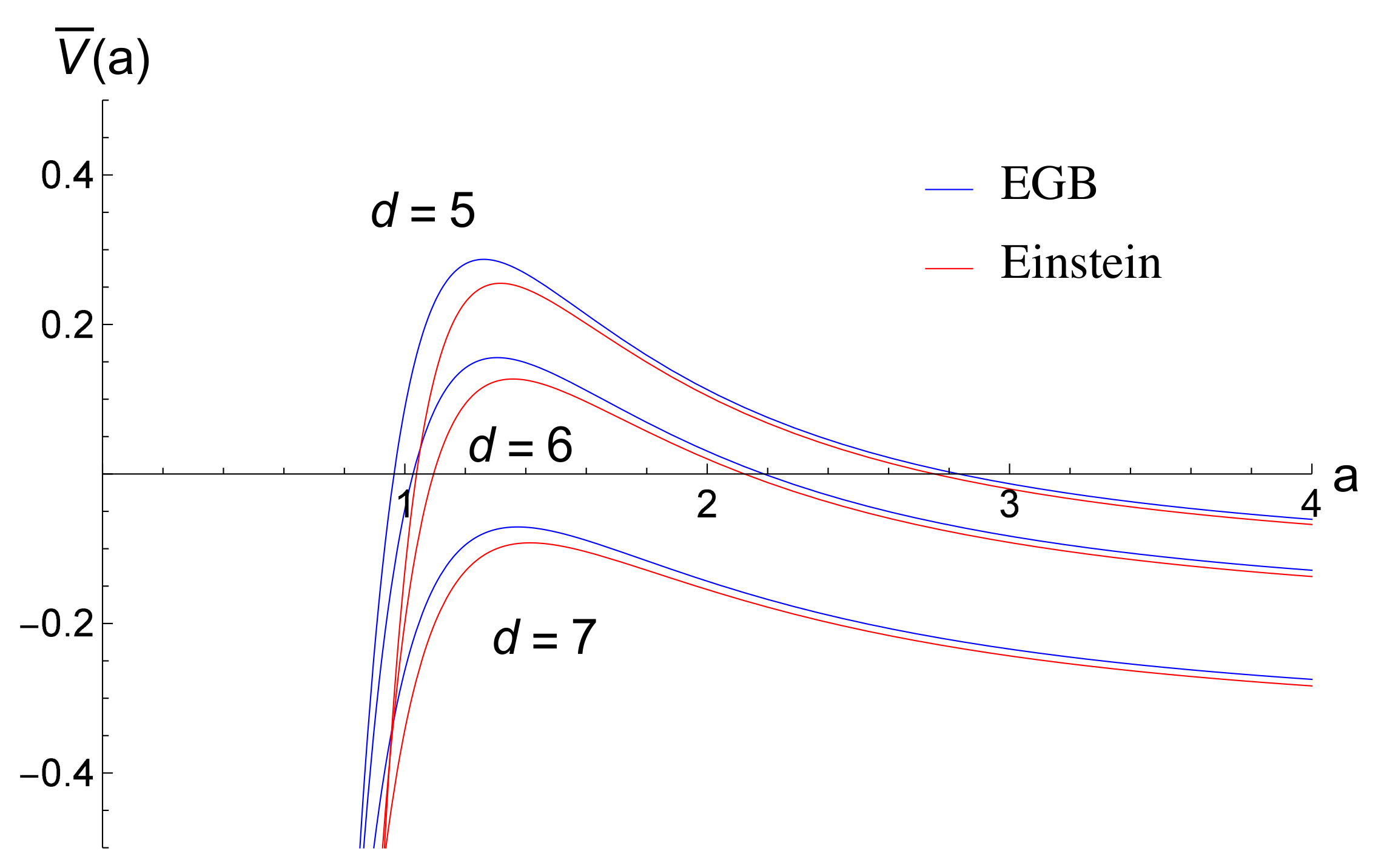
In this article, we do not clarify the parameter region with positive m admitting static wormhole solutions because they are all dynamically unstable in any case. In Figure 17, we plot the profile of with and , in which there is a local maximum. This implies that the corresponding static solution is unstable. Indeed, we can prove that this case is unstable.
Figure 17.
The potential for in Einstein and Einstein–Gauss–Bonnet (EGB) gravity with , , , and .
For , the positivity of in Equation (145) means instability of the static wormhole. Using the inequality (116), we evaluate the lower bound of as
Therefore, the wormhole is dynamically unstable. We note that a similar analysis for can reveal the instability of thin-shell wormholes which are made of a dust fluid (see [5]).
We focus on the analysis with and . The remaining combinations of k and m have also been completely analyzed (see [5] for the details). All the results obtained in Reference [5] for all combinations of k and M are summarized in Table 6.
Table 6.
The existence and stability of Z symmetric static thin-shell wormholes made of pure negative tension in the GR branch with and . “S“, “M” and “U” stand for “Stable”, “Marginally stable” and “Unstable”, respectively.
6. Conclusions
6.1. In Einstein Gravity
We developed the thin-shell formalism for d-dimensional spacetimes, which is more general than Dias and Lemos formalism [32]. We investigated spherically, planar and hyperbolically symmetric wormholes with a pure negative-tension brane and found and classified Z symmetric static solutions which are stable against radial perturbations. We summarize the results in Table 1, Table 2, Table 3 and Table 4. We found that, in most cases, charge is needed to keep the static throat radius positive and that a negative cosmological constant tends to decrease the radius of the black hole horizon and then to achieve the horizon avoidance. Thus, the combination of an electric charge and a negative cosmological constant makes it easier to construct stable wormholes. However, a negative cosmological constant is unnecessary in the certain situation of and and charge is unnecessary in the certain situation of and .
We note that the existence and stability of negative-tension branes as thin-shell wormholes crucially depend on the curvature of the maximally symmetric -dimensional manifolds. On the other hand, they do not qualitatively but only quantitatively depend on the number of spacetime dimensions.
We considered only radial stability for thin-shell wormholes here. In a realistic situation, a wormhole in the universe would be suffered by gravitational waves that are produced by a particle falling into the wormhole, incidental waves produced from gravitational collapses of nearby stars, etc. In such situations, we must consider non-radial gravitational perturbations for wormholes. Thus far, there is no stability analysis for gravitational perturbations of thin-shell wormholes. A linear stability analysis on a specific-perturbation mode (so-called axial perturbations) for a wormhole that corresponds to Morris–Thorne type has been investigated [94]. In [94], the matter distribution is continuous not as a shell. Since matters of thin-shell wormholes are localized on their throat as a shell, the perturbation analysis for thin-shell wormholes is not like that of Morris–Thorne type. To treat the non-spherically perturbed shell, we can employ the perturbed junction condition developed by Gerlach and Sengupta [95,96,97,98]. By using the perturbed junction condition, Kodama et al. investigated whether a domain wall emits gravitational waves or not. In their work, a domain wall is constructed by pasting a couple of Minkowski spacetimes with a negative-tension brane localized at their boundary [99]. Since their situation is similar to that of a thin-shell wormhole, we expect their study can be extended to the case of shell wormholes.
6.2. In Einstein–Gauss–Bonnet Gravity
-dimensional static thin-shell wormholes with the Z symmetry have been investigated in the spherically (), planar () or hyperbolically () symmetric spacetime in Einstein–Gauss–Bonnet gravity. For our primary motivation to reveal the effect of the Gauss–Bonnet term on the static configuration and dynamical stability of a wormhole, we have studied the stability against linear perturbations preserving symmetries in the simplest set up where the thin-shell is made of pure negative tension, which satisfies the null energy condition.
In this system, the dynamics of the shell can be treated as a one-dimensional potential problem characterized by a mass parameter m in the vacuum bulk spacetime for a given value of d, k, the cosmological constant and the Gauss–Bonnet coupling constant . We have studied solutions which admit the general relativistic limit and considered a very conservative region in the parameter space. The shape of the effective potential for the shell dynamics clarifies possible static configurations of a wormhole and their dynamical stability.
As shown in Table 5 and Table 6, the results with and without the Gauss–Bonnet term are similar in many cases. For , static wormholes require and they are dynamically unstable. For , static wormholes require and and they are marginally stable. For , and are required for static wormholes.
We have clarified the effect of the Gauss–Bonnet term on the stability in a perturbative method by expanding the equation in a power series of . We have shown that, for , the Gauss–Bonnet term tends to destabilize spherically symmetric thin-shell wormholes (), while it stabilizes hyperbolically symmetric wormholes (). For planar symmetric wormholes (), the Gauss–Bonnet term does not affect their stability and they are marginally stable, same as in Einstein gravity. However, we have observed that the non-perturbative effect is quite non-trivial.
As the effect of the Gauss–Bonnet term on the existence and stability of static wormholes is revealed in this article, the effect of its dilaton coupling is now of great interest. Unfortunately, in the presence of a dilaton, exact bulk solutions are not available to construct thin-shell wormholes. Moreover, Birkhoff’s theorem does not apply to the dilatonic system because of the additional dynamical degree of freedom in the dilaton. Nevertheless, this is a promising direction of research leading to understand the result in [69,70].
Author Contributions
Conceptualization, T.K. and T.H.; methodology, T.K. and T.H.; validation, T.K. and T.H.; formal analysis, T.K. and T.H.; investigation, T.K. and T.H.; writing—original draft preparation, T.K.; writing—review and editing, T.K. and T.H.; and supervision, T.H. All authors have read and agreed to the published version of the manuscript.
Funding
This work was partially supported by JSPS KAKENHI Grant No. JP19K03876 (T.H.) and the National Natural Science Foundation of China under Grant No. 11690034 (T.K.).
Acknowledgments
We would like to thank Hideki Maeda for fruitful discussion.
Conflicts of Interest
The authors declare no conflict of interest.
References
- Morris, M.S.; Thorne, K.S.; Yurtsever, U. Wormholes, Time Machines, and the Weak Energy Condition. Phys. Rev. Lett. 1988, 61, 1446. [Google Scholar] [CrossRef]
- Flamm, L. Beiträge zur Einsteinschen Gravitationstheorie. Phys. Z. 1916, 17, 448. [Google Scholar]
- Einstein, A.; Rosen, N. The Particle Problem in the General Theory of Relativity. Phys. Rev. 1935, 48, 73. [Google Scholar] [CrossRef]
- Kokubu, T.; Harada, T. Negative tension branes as stable thin-shell wormholes. Class. Quantum Grav. 2015, 32, 205001. [Google Scholar] [CrossRef]
- Kokubu, T.; Maeda, H.; Harada, T. Does the Gauss–Bonnet term stabilize wormholes? Class. Quantum Grav. 2015, 32, 235021. [Google Scholar] [CrossRef]
- Fuller, R.; Wheeler, J. Causality and Multiply Connected Space-Time. Phys. Rev. 1962, 128, 919. [Google Scholar] [CrossRef]
- Morris, M.S.; Thorne, K.S. Wormholes in space-time and their use for interstellar travel: A tool for teaching general relativity. Am. J. Phys. 1988, 56, 395. [Google Scholar] [CrossRef]
- Ellis, H.G. Ether flow through a drainhole—A particle model in general relativity. J. Math. Phys. 1973, 14, 104. [Google Scholar] [CrossRef]
- Bronnikov, K.A. Scalar-tensor theory and scalar charge. Acta Phys. Polon. B 1973, 4, 251. [Google Scholar]
- Kodama, T. General Relativistic Nonlinear Field: A Kink Solution in a Generalized Geometry. Phys. Rev. D 1978, 18, 3529. [Google Scholar] [CrossRef]
- Armendariz-Picon, C. On a class of stable, traversable Lorentzian wormholes in classical general relativity. Phys. Rev. D 2002, 65, 104010. [Google Scholar] [CrossRef]
- Shinkai, H.; Hayward, S.A. Fate of the first traversible wormhole: Black hole collapse or inflationary expansion. Phys. Rev. D 2002, 66, 044005. [Google Scholar] [CrossRef]
- González, J.A.; Guzman, F.S.; Sarbach, O. Instability of wormholes supported by a ghost scalar field. I. Linear stability analysis. Class. Quantum Grav. 2009, 26, 015010. [Google Scholar] [CrossRef]
- González, J.A.; Guzman, F.S.; Sarbach, O. Instability of wormholes supported by a ghost scalar field. II. Nonlinear evolution. Class. Quantum Grav. 2009, 26, 015011. [Google Scholar] [CrossRef]
- González, J.A.; Guzman, F.S.; Sarbach, O. On the instability of charged wormholes supported by a ghost scalar field. Phys. Rev. D 2009, 80, 024023. [Google Scholar] [CrossRef]
- Torii, T.; Shinkai, H. Wormholes in higher dimensional space-time: Exact solutions and their linear stability analysis. Phys. Rev. D 2013, 88, 064027. [Google Scholar] [CrossRef]
- Visser, M. Traversable wormholes from surgically modified Schwarzschild space-times. Nucl. Phys. B 1989, 328, 203. [Google Scholar] [CrossRef]
- Visser, M. Lorentzian Wormholes; AIP Press: New York, NY, USA, 1996. [Google Scholar]
- Visser, M. Traversable wormholes: Some simple examples. Phys. Rev. D 1989, 39, 3182. [Google Scholar] [CrossRef]
- Poisson, E.; Visser, M. Thin shell wormholes: Linearization stability. Phys. Rev. D 1995, 52, 7318. [Google Scholar] [CrossRef]
- Eiroa, E.F.; Romero, G.E. Linearized stability of charged thin shell wormholes. Gen. Rel. Grav. 2004, 36, 651. [Google Scholar] [CrossRef]
- Eiroa, E.F. Stability of thin-shell wormholes with spherical symmetry. Phys. Rev. D 2008, 78, 024018. [Google Scholar] [CrossRef]
- Ishak, M.; Lake, K. Stability of transparent spherically symmetric thin shells and wormholes. Phys. Rev. D 2002, 65, 044011. [Google Scholar] [CrossRef]
- Lobo, F.S.N.; Crawford, P. Linearized stability analysis of thin shell wormholes with a cosmological constant. Class. Quantum Grav. 2004, 21, 391–404. [Google Scholar] [CrossRef]
- Eiroa, E.F.; Simeone, C. Cylindrical thin shell wormholes. Phys. Rev. D 2004, 70, 044008. [Google Scholar] [CrossRef]
- Bejarano, C.; Eiroa, E.F.; Simeone, C. Thin-shell wormholes associated with global cosmic strings. Phys. Rev. D 2007, 75, 027501. [Google Scholar] [CrossRef]
- Eiroa, E.F.; Simeone, C. Some general aspects of thin-shell wormholes with cylindrical symmetry. Phys. Rev. D 2010, 81, 084022. [Google Scholar] [CrossRef]
- Mazharimousavi, S.H.; Halilsoy, M.; Amirabi, Z. Stability of generic cylindrical thin shell wormholes. Phys. Rev. D 2014, 89, 084003. [Google Scholar] [CrossRef]
- Eiroa, E.F.; Simeone, C. Brans-Dicke cylindrical wormholes. Phys. Rev. D 2010, 82, 084039. [Google Scholar] [CrossRef]
- Richarte, M.G. Cylindrical wormholes in DGP gravity. Phys. Rev. D 2013, 87, 067503. [Google Scholar] [CrossRef]
- Garcia, N.M.; Lobo, F.S.N.; Visser, M. Generic spherically symmetric dynamic thin-shell traversable wormholes in standard general relativity. Phys. Rev. D 2012, 86, 044026. [Google Scholar] [CrossRef]
- Dias, G.A.S.; Lemos, J.P.S. Thin-shell wormholes in dd-dimensional general relativity: Solutions, properties, and stability. Phys. Rev. D 2010, 82, 084023. [Google Scholar] [CrossRef]
- Mustafa, G.; Hussain, I.; Farasat Shamir, M. Stable Wormholes in the Background of an Exponential f(R) Gravity. Universe 2020, 6, 48. [Google Scholar] [CrossRef]
- Mustafa, G.; Abbas, G.; Xia, T. Wormhole solutions in F(T, TG) gravity under Gaussian and Lorentzian non-commutative distributions with conformal motions. Chin. J. Phys. 2019, 60, 362–378. [Google Scholar] [CrossRef]
- Mustafa, G.; Waheed, S.; Zubair, M.; Xia, T. Non-commutative Wormholes Exhibiting Conformal Motion in Rastall Gravity. Chin. J. Phys. 2020, 33, 2050035. [Google Scholar] [CrossRef]
- Konoplya, R.; Zhidenko, A. Wormholes versus black holes: Quasinormal ringing at early and late times. J. Cosmol. Astropart. Phys. 2016, 2016, 43. [Google Scholar] [CrossRef]
- Cardoso, V.; Hopper, S.; Macedo, C.F.B.; Palenzuela, C.; Pani, P. Gravitational-wave signatures of exotic compact objects and of quantum corrections at the horizon scale. Phys. Rev. D 2016, 94, 084031. [Google Scholar] [CrossRef]
- Deng, H.; Garriga, J.; Vilenkin, A. Primordial black hole and wormhole formation by domain walls. J. Cosmol. Astropart. Phys. 2017, 2017, 50. [Google Scholar] [CrossRef]
- Smirnov, A.L. Traversable intra-Universe wormholes and timeholes in General Relativity: Two new solutions. Class. Quantum Grav. 2016, 33, 225005. [Google Scholar] [CrossRef]
- Cardoso, V.; Franzin, E.; Maselli, A.; Pani, P.; Raposo, G. Testing strong-field gravity with tidal Love numbers. Phys. Rev. D 2017, 95, 084014. [Google Scholar] [CrossRef]
- Akai, Y.; Nakao, K.I. Nonlinear stability of a brane wormhole. Phys. Rev. D 2017, 96, 024033. [Google Scholar] [CrossRef]
- Tsukamoto, N.; Kokubu, T. Linear stability analysis of a rotating thin-shell wormhole. Phys. Rev. D 2018, 98, 044026. [Google Scholar] [CrossRef]
- Konoplya, R.A.; Stuchlík, Z.; Zhidenko, A. Echoes of compact objects: New physics near the surface and matter at a distance. Phys. Rev. D 2019, 99, 024007. [Google Scholar] [CrossRef]
- Li, A.C.; Xu, W.L.; Zeng, D.F. Linear Stability Analysis of Evolving Thin Shell Wormholes. J. Cosmol. Astropart. Phys. 2019, 2019, 16. [Google Scholar] [CrossRef]
- Lobo, F.S.N.; Simpson, A.; Visser, M. Dynamic thin-shell black-bounce traversable wormholes. Phys. Rev. D 2020, 101, 124035. [Google Scholar] [CrossRef]
- Koga, Y. Photon surfaces as pure tension shells: Uniqueness of thin shell wormholes. Phys. Rev. D 2020, 101, 104022. [Google Scholar] [CrossRef]
- Poisson, E. A Relativist’s Toolkit; Cambridge University Press: Cambridge, UK, 2007. [Google Scholar]
- Barrabés, C.; Bressange, G.F. Singular hypersurfaces in scalar - tensor theories of gravity. Class. Quantum Grav. 1997, 14, 805. [Google Scholar] [CrossRef]
- Ruban, V. Generalized Birkhoff’s theorem (GBT) for Einstein-Maxwell fields (Λ ≠ 0). In Proceedings of the 8th International Conference on General Relativity and Gravitation, Waterloo, ON, Canada, 7–12 August 1977; p. 303. [Google Scholar]
- Bronnikov, K.; Kovalchuk, M. On a generalisation of Birkhoff’s theorem. J. Phys. A. Math. Gen. 1980, 13, 187. [Google Scholar] [CrossRef]
- Bronnikov, K.; Melnikov, V. The Birkhoff theorem in multidimensional gravity. Gen. Rel. Grav. 1995, 27, 465. [Google Scholar] [CrossRef]
- Goenner, H. Lorentz-invariant gravitational perturbations and the evaluation of generalized green’s functions. Commun. Math. Phys. 1970, 16, 34–47. [Google Scholar] [CrossRef]
- Sato, H.; Kodama, H. Ippan Sotaisei Riron; Iwanami Shoten: Tokyo, Japan, 1992. [Google Scholar]
- Barceló, C.; Visser, M. Brane surgery: Energy conditions, traversable wormholes, and voids. Nucl. Phys. B 2000, 584, 415–435. [Google Scholar] [CrossRef]
- Kaluza, T. Zum Unitätsproblem der Physik. Sitzungsber. Preuss. Akad. Wiss. 1921, 96, 69. [Google Scholar]
- Klein, O. Quantum Theory and Five-Dimensional Theory of Relativity. Eur. Phys. J. A 1926, 37, 895. [Google Scholar]
- Maldacena, J. The Large N Limit of Superconformal Field Theories and Supergravity. Adv. Theor. Math. Phys. 1998, 2, 231. [Google Scholar] [CrossRef]
- Randall, L.; Sundrum, R. A Large mass hierarchy from a small extra dimension. Phys. Rev. Lett. 1999, 83, 3370. [Google Scholar] [CrossRef]
- Bronnikov, K.; Rubin, S.G. Black Holes, Cosmology and Extra Dimensions; World Scientific: Singapore, 2013; p. 184. [Google Scholar]
- Eiroa, E.F.; Simeone, C. Thin-shell wormholes in dilaton gravity. Phys. Rev. D 2005, 71, 127501. [Google Scholar] [CrossRef]
- Rahaman, F.; Kalam, M.; Chakraborti, S. Thin shell wormhole in heterotic string theory. Int. J. Mod. Phys. D 2007, 16, 1669. [Google Scholar] [CrossRef]
- Richarte, M.G.; Simeone, C. Wormholes in Einstein-Born-Infeld theory. Phys. Rev. D 2009, 80, 104033. [Google Scholar] [CrossRef]
- Richarte, M.G. Wormholes and solitonic shells in five-dimensional DGP theory. Phys. Rev. D 2010, 82, 044021. [Google Scholar] [CrossRef]
- Usmani, A.A.; Hasan, Z.; Rahaman, F.; Rakib, S.A.; Ray, S.; Kuhfittig, P.K.F. Thin-shell wormholes from charged black holes in generalized dilaton-axion gravity. Gen. Rel. Grav. 2010, 42, 2901. [Google Scholar] [CrossRef]
- Rahaman, F.; Kuhfittig, P.K.F.; Kalam, M.; Usmani, A.A.; Ray, S. A comparison of Horava-Lifshitz gravity and Einstein gravity through thin-shell wormhole construction. Class. Quantum Grav. 2011, 28, 155021. [Google Scholar] [CrossRef]
- Mazharimousavi, S. Habib; Halilsoy, M.; Amirabi, Z. d-dimensional non-asymptotically flat thin-shell wormholes in Einstein-Yang-Mills-Dilaton gravity. Phys. Lett. A 2011, 375, 231–236. [Google Scholar] [CrossRef]
- Dehghani, M.H.; Mehdizadeh, M.R. Lovelock thin-shell wormholes. Phys. Rev. D 2012, 85, 024024. [Google Scholar] [CrossRef]
- Kozyrev, S.M. Stability of composite vacuum Heckmann wormholes in Brans-Dicke theory. arXiv 2014, arXiv:1401.6662. [Google Scholar]
- Kanti, P.; Kleihaus, B.; Kunz, J. Wormholes in Dilatonic Einstein-Gauss-Bonnet Theory. Phys. Rev. Lett. 2011, 107, 271101. [Google Scholar] [CrossRef] [PubMed]
- Kanti, P.; Kleihaus, B.; Kunz, J. Stable Lorentzian Wormholes in Dilatonic Einstein-Gauss-Bonnet Theory. Phys. Rev. D 2012, 85, 044007. [Google Scholar] [CrossRef]
- Gross, D.J.; Witten, E. Superstring Modifications Of Einstein’s Equations. Nucl. Phys. 1986, B277, 1. [Google Scholar] [CrossRef]
- Gross, D.J.; Sloan, J.H. The Quartic Effective Action For The Heterotic String. Nucl. Phys. 1987, B291, 41. [Google Scholar] [CrossRef]
- Metsaev, R.R.; Tseytlin, A.A. Two Loop Beta Function For The Generalized Bosonic Sigma Model. Phys. Lett. B 1987, 191, 354. [Google Scholar] [CrossRef]
- Zwiebach, B. Curvature Squared Terms And String Theories. Phys. Lett. B 1985, 156, 315. [Google Scholar] [CrossRef]
- Metsaev, R.R.; Tseytlin, A.A. Order Alpha-Prime (Two Loop) Equivalence Of The String Equations Of Motion And The Sigma Model Weyl Invariance Conditions: Dependence On The Dilaton And The Antisymmetric Tensor. Nucl. Phys. 1987, B293, 385. [Google Scholar] [CrossRef]
- Cuyubamba, M.A.; Konoplya, R.A.; Zhidenko, A. No stable wormholes in Einstein-dilaton-Gauss-Bonnet theory. Phys. Rev. D 2018, 98, 044040. [Google Scholar] [CrossRef]
- Thibeault, M.; Simeone, C.; Eiroa, E.F. Thin-shell wormholes in Einstein-Maxwell theory with a Gauss-Bonnet term. Gen. Rel. Grav. 2006, 38, 1593. [Google Scholar] [CrossRef]
- Richarte, M.G.; Simeone, C. Thin-shell wormholes supported by ordinary matter in Einstein-Gauss-Bonnet gravity. Phys. Rev. D 2007, 76, 087502, Erratum in 2008, 77, 089903. [Google Scholar] [CrossRef]
- Garraffo, C.; Giribet, G.; Gravanis, E.; Willison, S. Gravitational solitons and C0 vacuum metrics in five-dimensional Lovelock gravity. J. Math. Phys. 2008, 49, 042502. [Google Scholar] [CrossRef]
- Bandyopadhyay, T.; Chakraborty, S. Thin-shell wormholes in Einstein-Yang-Mills-Gauss-Bonnet theory. Class. Quantum Grav. 2009, 26, 085005. [Google Scholar] [CrossRef]
- Mazharimousavi, S.H.; Halilsoy, M.; Amirabi, Z. Stability of thin-shell wormholes supported by ordinary matter in Einstein-Maxwell-Gauss-Bonnet gravity. Phys. Rev. D 2010, 81, 104002. [Google Scholar] [CrossRef]
- Simeone, C. Addendum to Thin-shell wormholes supported by ordinary matter in Einstein-Gauss-Bonnet gravity. Phys. Rev. D 2011, 83, 087503. [Google Scholar] [CrossRef]
- Amirabi, Z.; Halilsoy, M.; Mazharimousavi, S.H. Effect of the Gauss-Bonnet parameter in the stability of thin-shell wormholes. Phys. Rev. D 2013, 8, 124023. [Google Scholar] [CrossRef]
- Boulware, D.G.; Deser, S. String Generated Gravity Models. Phys. Rev. Lett. 1985, 55, 2656. [Google Scholar] [CrossRef]
- Wheeler, J.T. Symmetric solutions to the Gauss-Bonnet extended Einstein equations. Nucl. Phys. 1986, B268, 737. [Google Scholar] [CrossRef]
- Lorenz-Petzold, D. Higher Dimensional Gauss-Bonnet Cosmologies. Mod. Phys. Lett. 1988, A3, 827. [Google Scholar] [CrossRef]
- Cai, R.-G. Gauss-Bonnet black holes in AdS spaces. Phys. Rev. D 2002, 65, 084014. [Google Scholar] [CrossRef]
- Cai, R.-G.; Guo, Q. Gauss-Bonnet black holes in dS spaces. Phys. Rev. D 2004, 69, 104025. [Google Scholar] [CrossRef]
- Torii, T.; Maeda, H. Spacetime structure of static solutions in Gauss-Bonnet gravity: Neutral case. Phys. Rev. D 2005, 71, 124002. [Google Scholar] [CrossRef]
- Wiltshire, D.L. Spherically Symmetric Solutions of Einstein-Maxwell Theory With a Gauss-Bonnet Term. Phys. Lett. 1986, 169B, 36. [Google Scholar] [CrossRef]
- Myers, R.C. Higher Derivative Gravity, Surface Terms and String Theory. Phys. Rev. D 1987, 36, 392. [Google Scholar] [CrossRef] [PubMed]
- Davis, S.C. Israel conditions for the Gauss-Bonnet theory and the Friedmann equation on the brane universe. Phys. Rev. D 2003, 67, 024030. [Google Scholar] [CrossRef]
- Gravanis, E.; Willison, S. Israel conditions for the Gauss-Bonnet theory and the Friedmann equation on the brane universe. Phys. Lett. 2013, B562, 118. [Google Scholar] [CrossRef]
- Bronnikov, K.; Lipatova, L.N.; Novikov, I.D.; Shatskiy, A.A. Example of a Stable Wormhole in General Relativity. Gravit. Cosmol. 2013, 19, 269. [Google Scholar] [CrossRef]
- Gerlach, U.H.; Sengupta, U.K. Gauge invariant perturbations on most general spherically symmetric space-times. Phys. Rev. D 1979, 19, 2268. [Google Scholar] [CrossRef]
- Gerlach, U.H.; Sengupta, U.K. Junction conditions for odd parity perturbations on most general spherically symmetric space-times. Phys. Rev. D 1979, 20, 3009. [Google Scholar] [CrossRef]
- Gerlach, U.H.; Sengupta, U.K. Even parity junction conditions for perturbations on most general spherically symmetric space-times. J. Math. Phys. 1979, 20, 2540. [Google Scholar] [CrossRef]
- Gerlach, U.H.; Sengupta, U.K. Gauge invariant coupled gravitational, acoustical, and electromagnetic modes on most general spherical space-times. Phys. Rev. D 1980, 22, 1300. [Google Scholar] [CrossRef]
- Kodama, H.; Ishihara, H.; Fujiwata, Y. Does a domain wall emit gravitational waves? General-relativistic perturbative analysis of a simple case. Phys. Rev. D 1994, 50, 7292. [Google Scholar] [CrossRef] [PubMed]
| 1. | Recently, the instability of the present wormhole was reported by [76]. |
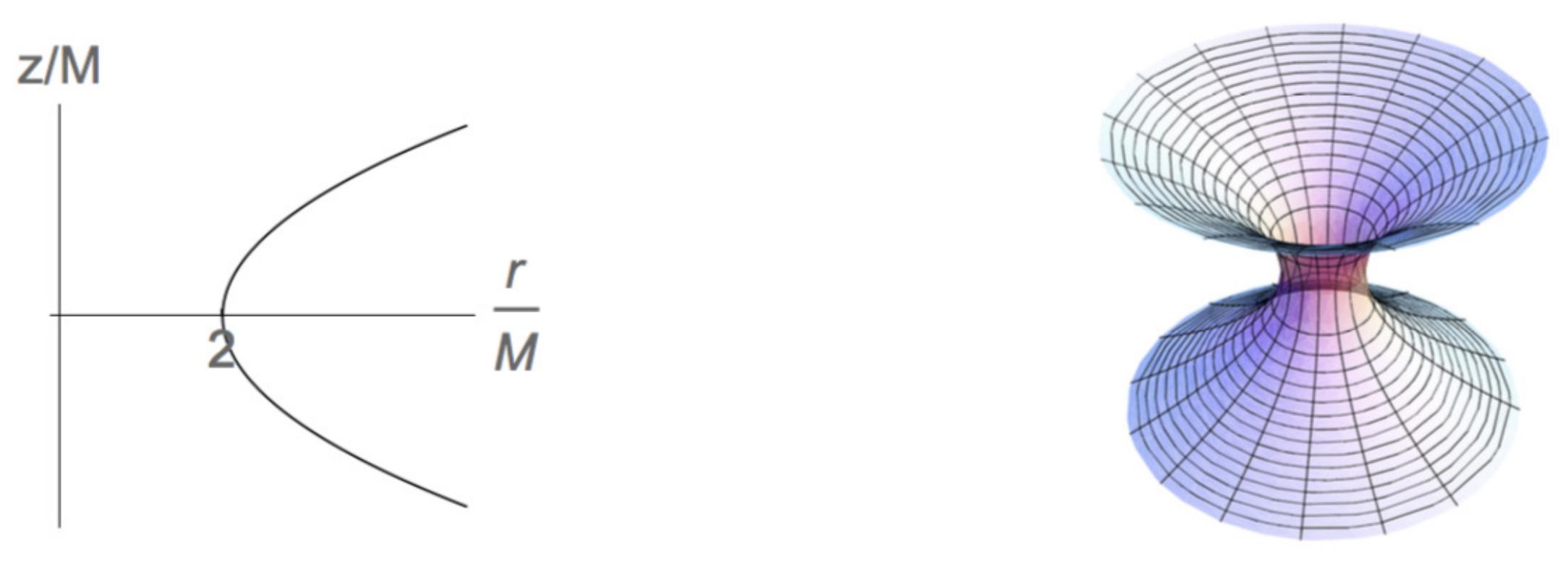
Publisher’s Note: MDPI stays neutral with regard to jurisdictional claims in published maps and institutional affiliations. |
© 2020 by the authors. Licensee MDPI, Basel, Switzerland. This article is an open access article distributed under the terms and conditions of the Creative Commons Attribution (CC BY) license (http://creativecommons.org/licenses/by/4.0/).