


Abstract
The high-precision and long-duration photometry provided by the mission has greatly advanced frequency analyses of a large number of pulsating stars, a fundamental step in asteroseismology. For Scuti stars, analyses are typically confined to frequencies below the Nyquist frequency. However, signals above this limit can be reflected into the sub-Nyquist range, especially in long-cadence data, where they may overlap with genuine pulsation modes and lead to misinterpretation. To address this issue, a recently proposed method—the sliding Lomb–Scargle periodogram (sLSP)—can effectively distinguish real frequencies from aliased ones. In this study, we compiled a sample of 68 Scuti stars whose frequency analyses were based on the photometry. Using the sLSP method, we systematically examined the 1406 reported frequencies in the literature. As a result, we identified six previously unrecognized reflected super-Nyquist frequencies in four stars: KIC 3440495, KIC 5709664, KIC 7368103, and KIC 9204718. We have once again demonstrated the ability of the sLSP method to detect and correct such artifacts. This technique improves the reliability of frequency selection, thereby enhancing the accuracy of asteroseismic interpretation and stellar modeling for pulsating stars.
1. Introduction
Asteroseismology investigates stellar evolution and internal structure by analyzing the pulsation frequencies of stars and constructing models based on these observations. Oscillations occur at various evolutionary stages and produce characteristic features in light curves, offering insights into internal processes such as rotation, diffusion, and convection [1].
Scuti ( Sct) stars are a representative class of A- and F-type pulsating variables, positioned on or above the main sequence and concentrated toward the hotter end of the instability strip. They are classified as p-mode pulsators, characterized by oscillations with frequencies ≳ 4 (approximately 46 Hz), mainly driven by turbulent pressure and the -mechanism in the He II ionization zone of the stellar envelope [1,2]. High-precision, long-duration survey data show that most Sct stars also exhibit g-mode pulsations observed in Doradus stars [3,4,5,6]. Therefore, the complex pulsation behavior of Sct stars is influenced not only by the mechanism but also by convective mechanisms that excite g-mode pulsations, such as convective blocking [2,6,7]. Modeling these oscillations offers an effective means to gain deeper insights into the Sct stars.
In recent years, space missions such as MOST [8], CoRoT [9], the [10], and TESS [11] have achieved photometric precisions ranging from milli- to micro-magnitude levels. The high-precision data significantly enhance the detection of low-amplitude oscillation frequencies, allowing for the identification of subtle signals that ground-based observations cannot capture, and enabling the construction of more complete frequency spectra. This capability has directly contributed to recent advances in mode identification and the detection of complex oscillation patterns in various types of pulsating stars. For instance, Lares-Martiz [12] proposed a method for diagnosing the nonlinear pulsation characteristics of low-amplitude Sct stars, which may assist in identifying radial modes and determining their radial order n. Yang et al. [13] revealed the decline in the amplitude of the first-overtone mode in KIC 2857323, suggesting a possible loss of pulsation energy. Niu and Xue [14] discovered significant variations in the amplitudes and frequencies of three independent pulsation modes, along with their harmonics and combinations, in KIC 6382916, challenging the reliability of independent modes as indicators of stellar interior structure.
To accurately map the internal sound-speed profile of pulsators through asteroseismology requires detecting a sufficient number of reliable oscillation frequencies. The frequencies used in pulsation analysis are typically below the Nyquist frequency (), derived from Fourier transforms of photometric data. Frequencies exceeding are termed super-Nyquist frequencies (SNFs), and their reflected counterparts, , can alias with the real frequencies. Based on the and TESS photometric observations, Murphy et al. [15] and Murphy [16] outlined methods for identifying through their spectral profiles. Besides aliasing, SNFs can cause false-alarm amplitude modulations in genuine pulsation modes, detectable by examining their characteristic modulation periods [17,18]. These spurious modulations resemble real pulsation features and must be properly interpreted to avoid mischaracterizing stellar behavior.
During the four-year mission, SNFs are expected to undergo four full cycles of frequency modulation, providing a key signature to identify [19]. Thus, Wang et al. [19] introduced a sliding Lomb–Scargle periodogram (sLSP) method, which enables a more intuitive visualization of the sinusoidal-like modulation patterns of . The mission provides photometric data with two distinct sampling intervals: long-cadence (LC) data with a sampling interval of 29.43 min, and short-cadence (SC) data that are sampled approximately every 58.85 s, corresponding to of 283.16 and 8496.18 Hz, respectively. Limited by onboard storage and downlink constraints, observed no more than 512 SC targets at a time, selected based on scientific priority [20,21]. Therefore, only a small fraction of the SC data is suitable for asteroseismic analysis. However, SC data are essentially unaffected by SNFs, and thus can be used to verify the authenticity of SNFs detected in LC data [22,23,24]. Additionally, in contrast to the limited SC observations, the longer continuous coverage of LC data effectively reduces the noise level [19]. Moreover, the larger number of targets observed in LC mode offers significant support for frequency analysis. In the study of Wang et al. [19], which analyzed Doradus stars using the LC data, was found to have only a minor impact on their g-mode pulsations, in contrast to its more significant influence on Sct stars. This difference arises because the pulsation frequencies of Sct stars span the of the LC data. SNFs map into the low-frequency domain, overlapping with the genuine pulsation frequencies [15,19], which complicates the identification of intrinsic modes and can result in misclassifications during asteroseismic analysis [13,25,26,27].
As the method proposed by Wang et al. [19] can effectively remove from the data, we aim to re-examine the frequencies extracted from recent studies of Sct stars using the data, with the goal of identifying any overlooked frequencies that may have slipped through the cracks. Section 2 presents the selection of the research targets. Section 3 describes the data preprocessing procedures and the subsequent frequency analysis. Section 4 provides a detailed discussion, and Section 5 summarizes the results and conclusion.
2. Target Selection
The mission data, with their excellent frequency resolution and high duty cycle, have enabled the identification of over 2000 Sct stars from their high-quality light curves [5,17,28,29,30]. We conducted a statistical review of research published over the past decades, which focus on the pulsation of the Sct stars based on observations, and identified a total of 74 publications in which pulsation frequencies were extracted and analyzed, covering 68 Sct stars. A detailed summary is provided in Table 1.

Table 1.
List of Sct stars whose pulsation frequency analysis was made with the observations. The ‘Cad.’ column indicates the cadence type used, with ‘LSC’ representing the use of both LC and SC data. The “Info” column is labeled ‘Inde.’ if harmonics and combination frequencies were excluded, or ‘Sign.’ if all significant frequencies were included. The ‘Num’ column lists the corresponding number of frequencies identified in each study within the 46 Hz– range. ‘-’ is used when no frequencies within this range were reported.
There are studies from the literature which have recognized the aliasing effects caused by SNFs and mitigated the impact of by identifying multiplet structures or incorporating the SC data. The ‘Cad.’ column in Table 1 indicates the type of the cadence used for frequency extraction in each study. Since SNF primarily affects p-mode pulsations, we limit our analysis to significant frequencies above 46 Hz. The ‘Num’ column lists the number of frequencies identified in each referenced study and used in our analysis. If harmonics and combination frequencies were excluded in the study, the “Info” column is labeled as ‘Inde.’, indicating that only independent frequencies are counted in the ‘Num’ column. Otherwise, it is labeled as ‘Sign.’, meaning that all significant frequencies are included in the count.
3. Data Preparation and Frequency Verification
Given that the of the SC data (8496.18 Hz) is well above the pulsation range of Sct stars (typically confined below 800–900 Hz [1,2]), and that even ground-based observations with very short exposure times [100,101] have not detected frequencies beyond this range, we can be confident that aliasing with does not occur in these cases. Therefore, in the following work, we focus primarily on the LC data.
3.1. Preprocessing and Frequency Check
We downloaded the LC light curve data of the 68 Sct stars from the Mikulski Archive for Space Telescopes (MAST) server. To ensure high data quality, we utilized the Pre-search Data Conditioning Simple Aperture Photometry (PDCSAP) fluxes, which have been processed through the NASA Data Processing Pipeline. This pipeline has effectively eliminated most discontinuities, outliers, systematic trends, and other instrumental signatures [102]. To further refine the data, we employed the Python package lightkurve (v2.4.2) [103], which allowed us to remove the discrete points from the PDCSAP flux, ensuring that only reliable data remained for analysis [104]. Next, we applied the wotan (v1.10) package [105] to remove any remaining overall trends in the data. This method effectively removes long-term variations such as stellar activity or instrumental effects, thus ensuring that only the intrinsic pulsation signals are preserved for subsequent frequency analysis. The operations were performed independently for each quarter of data, which were subsequently concatenated for further analysis.
Then, we applied the sLSP method to systematically examine 1406 reported frequencies from 68 stars listed in Table 1. To achieve a balance between frequency resolution and smoothing effect, we adopted a sliding window of 300 days with a step size of 5 days, as proposed by Wang et al. [19]. Within each window, we computed the Lomb–Scargle periodogram (LSP) of the light curve to extract the corresponding frequency and amplitude information, thereby constructing the sLSP diagram. Next, we selected data within a ±0.1 Hz range around each target frequency to generate the LSP and sLSP plots, which reveal the amplitude distribution near the frequency and its temporal evolution, respectively. Both the data processing and frequency extraction procedures may introduce slight deviations in the frequency values. If amplitude modulation is detected within ±0.1 Hz of the target frequency, we consider it as a candidate.
Ultimately, we found that the frequencies of four Sct stars exhibited SNF modulation, namely, KIC 3440495 [57], KIC 5709664 [32], KIC 7368103 [99] and KIC 9204718 [97]. The SNFs modulation is illustrated in Figure 1.
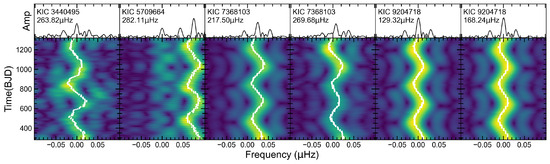
Figure 1.
The modulation of SNF that has not been discovered in the literature. The color intensity represents the amplitude of the corresponding frequency, with brighter colors indicating higher amplitudes.
3.2. Detailed Analysis of the Light Curves of the Four Stars
To ensure the reliability of subsequent frequency extraction, we thoroughly examined the preprocessed light curves of the four target stars. For the eclipsing binary KIC 7368103, we removed the binary signal. Using the phase widths of the primary and secondary eclipses from the Eclipsing Binary Catalog (KEBC [106,107,108]), we retained only the out-of-eclipse data for further analysis.
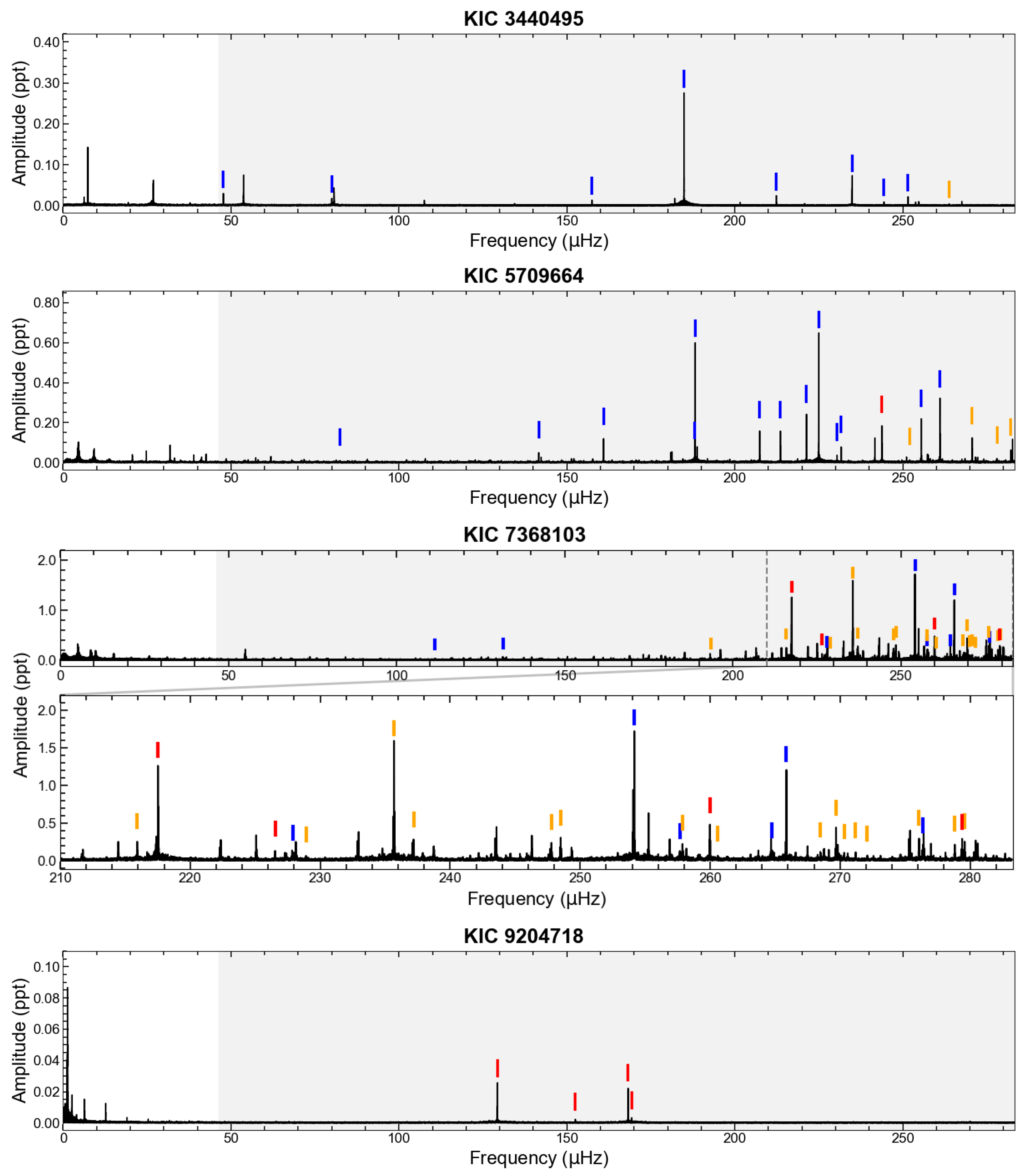
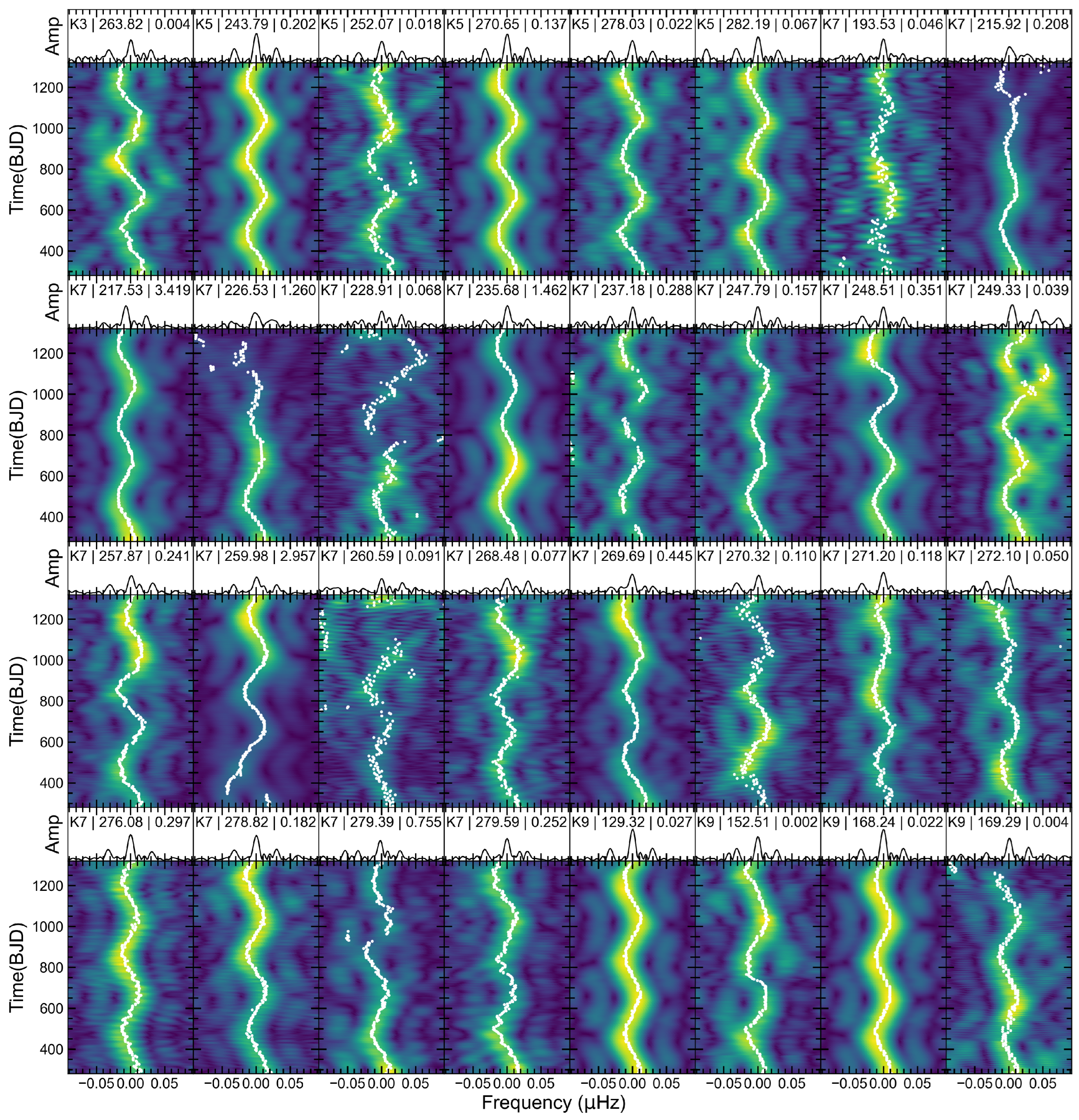
Then, we performed separate frequency analyses for the four stars that show previously unidentified . We employed the Felix method [109,110] to extract significant frequencies with a signal-to-noise ratio (S/N) greater than 5.6 from the preprocessed light curve data. S/N is calculated by dividing the frequency amplitude by the median background noise in its surrounding Fourier spectrum [111]. We obtained 76, 253, 326, and 51 frequencies for KIC 3440495, KIC 5709664, KIC 7368103, and KIC 9204718, respectively. Due to the dense frequency spectra of the Sct stars shown in Figure 2, we performed a detailed examination and analysis of the extracted frequencies: (1) Frequencies that are separated by less than the frequency resolution , where T is the time span of the data, are treated as a single frequency to avoid frequency aliasing and ensure the accuracy of the analysis. (2) We then used the sLSP method (window = 300 d, step = 5 d) to check all frequencies and find all candidates. There are a total of 32 candidates, and all modulation patterns are shown in Figure 3. (3) Using the method outlined in Pápics [112], we examined and identified harmonic frequencies and combination frequencies . These frequencies are typically artifacts arising from nonlinear mode interactions and should be removed to obtain a clean set of intrinsic pulsation frequencies. The pulsation frequencies of the four Sct stars are listed in Table 2, which includes only independent frequencies and all candidates. The frequency IDs are sorted in descending order of amplitude as , , etc.
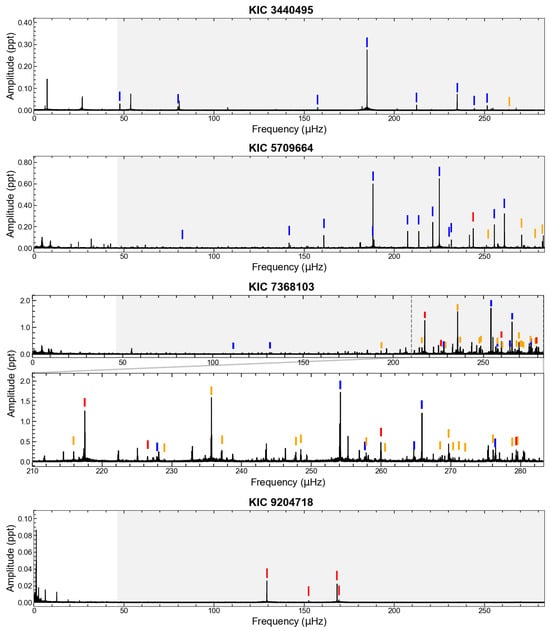
Figure 2.
Amplitude spectra of the light curves of the four stars. The gray region indicates the p-mode domain above 46 Hz. The genuine independent frequencies (blue), the (red), and the combination frequencies with the SNF modulation (orange) are marked within this region. We add an enlarged view for the dense mode distribution of KIC 7368103.
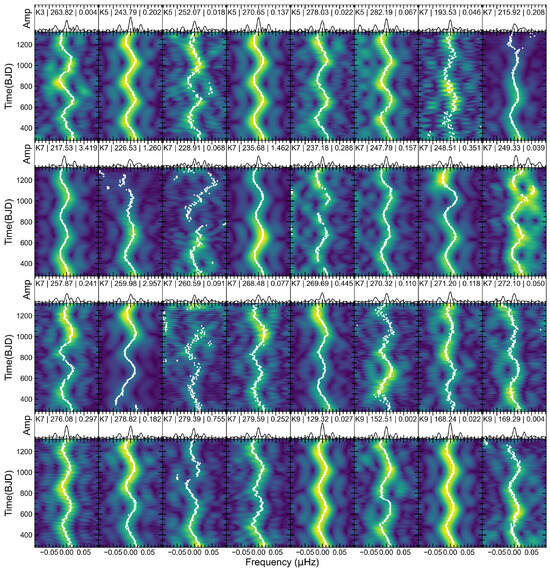
Figure 3.
A total of 32 SNF modulations of the four stars are shown here. The figure sequentially labels the KIC ID, frequency (Hz), and amplitude (ppt) for each panel, separated by ‘|’. ‘K3’, ‘K5’, ‘K7’, and ‘K9’ represent KIC 3440495, KIC 5709664, KIC 7368103, and KIC 9204718, respectively. Color scale is the same as in Figure 1.
Table 2.
Pulsation frequencies of the four stars extracted from the LC light curves. The ‘S/N’ column represents the signal-to-noise ratio.
may result from either a single or multiple reflections of a SNF. Although there is no theoretical limit to the number of reflections, practical detectability is constrained by noise and frequency resolution [15]. Considering the pulsation frequency range of Sct stars, as shown in Figure 2 of Wang et al. [19], can be obtained by reflecting an SNF (within the range of to ) once, or by reflecting an SNF (greater than ) twice. Therefore, we checked whether the two SNFs corresponding to each independent are combination frequencies. In the ‘Label’ column of Table 2, we categorize the types of frequencies: (1) Independent frequencies that are not candidates for are labeled as ‘Base’. (2) If both the candidate and its corresponding SNFs are independent frequencies, they are considered as real and labeled as ‘’. (3) If the candidate is a combination frequency, it is not considered as a real and is labeled as ‘Combination’. (4) If the candidate is an independent frequency but at least one of its corresponding SNFs is a combination frequency, it is not considered as a real and is labeled as ‘ Mirror’, with the corresponding SNF value noted in the ‘Remark’ column. In Figure 2, frequencies above 46 Hz are highlighted with a gray background and color-coded by category. An enlarged view is provided for KIC 7368103 due to its relatively dense frequency distribution.
4. Discussion
Since the frequency datasets from previous studies were processed by the original authors, it is not possible to determine whether any were present in the raw data, or to quantify their number. However, we extracted a total of 706 frequencies from four stars, among which 32 were identified as candidates using the sLSP method, corresponding to 4.53%—significantly higher than the 0.67% reported by Wang et al. [19] for Doradus stars. The modulation patterns of these candidates are shown in Figure 3, and none of them fall within the typical g-mode pulsation range. A total of 17 of these candidates fall within the range of 250 Hz to the (283.16 Hz), accounting for 8.7%—slightly higher than the 7% reported by Wang et al. [19]. These findings further support the conclusion that aliasing between and real frequencies is more likely to occur within the p-mode pulsation domain of Sct stars.
As shown in the ‘Remark’ column of Table 2, we identified additional frequencies that were not reported in the corresponding studies. This discrepancy may result from subtle differences in data preprocessing, variations in the adopted S/N thresholds, or minor deviations affecting the identification of combination frequencies. These differences are typical in frequency extraction and combination analysis and do not affect the reliability of the main conclusions.
In the study of KIC 3440495, Ma et al. [57] removed candidate using the SC photometric data. However, they retained the frequency of 263.82 Hz. This frequency shows SNF modulation but corresponds to a combination frequency in our analyses. In Figure 1, the panel for KIC 5709664 shows 282.11 Hz as the central frequency, while the SNF modulation we identified appears at a different location within the same figure. The slight offset suggests they may represent different frequencies, with our candidate lying near 282.19 Hz, which we classify as a combination frequency. It is likely that this candidate was recognized and removed by Derekas et al. [32] during their analysis. A frequency of 282.11 Hz is also extracted in our analysis but corresponds to a combination frequency. Among the frequencies reported for KIC 7368103 by Wang et al. [99], two frequencies—217.50 Hz and 269.68 Hz—show signs of SNF modulation. Our analysis identified 217.50 Hz as a real , while 269.68 Hz corresponds to a combination frequency. In the study of KIC 9204718 by Ulusoy et al. [97], the reported frequencies 129.32 Hz and 168.24 Hz are classified in this work as real . Additionally, we identified one real in the data from KIC 5709664, three in KIC 7368103 and two in KIC 9204718, which may have been discarded in previous studies. A complete list of these frequencies is given in Table 3.
Table 3.
Real and reference .
For asteroseismic modeling, only the filtered and validated independent frequencies (see Table 2) would be used. Among the four stars, KIC 3440495 had 12 independent frequencies that were all confirmed as genuine. For the other three stars, the fractions of among the independent frequencies were 1/17 for KIC 5709664, 4/16 for KIC 7368103, and 4/8 for KIC 9204718.
The aliasing of with the real frequencies has long been recognized as a potential source of misleading results in frequency analysis and frequency-based studies. The charts clearly demonstrate that exhibit multi-peak structures, which makes the spectral profile filtering an effective, yet incomplete, method for their removal. In cases of poor data quality, may not be fully detectable through profile identification. The new sLSP method, however, offers the capability for batch searching, enabling the identification of with less obvious multi-peak structures.
5. Summary
We conducted a review of 74 published studies during the past ten years that investigated the pulsation behavior of Sct stars using the data, encompassing 68 individual stars. For each publication, we recorded the number of reported significant frequencies falling within the range of 46 Hz to of the LC data, corresponding to the p-mode frequency domain where is most likely to undergo aliasing. We then downloaded the light curves, performed preprocessing, and re-examined the 1406 reported frequencies using the sLSP method [19].
As a result, we identified four stars—KIC 3440495, KIC 5709664, KIC 7368103, and KIC 9204718—whose published frequencies exhibit clear signs of SNF modulation (Figure 1), which had not been recognized in the original studies. We subsequently extracted all significant frequencies from the light curves of these four stars and applied the sLSP method, yielding 32 candidates, each of which was carefully examined and classified. Table 2 summarizes the independent frequencies and candidates for the four stars. The corresponding amplitude spectra are presented in Figure 2.
Accurately identifying pulsation frequencies is a fundamental and crucial step in asteroseismic studies. Matching a moderate number of well-validated, independent frequencies with asteroseismic model frequencies can better constrain the models, leading to more precise stellar parameters [13,113]. Using incorrect frequencies, however, may lead to substantial errors in the resulting models. of the LC data is 283.16 Hz. Real p-mode frequencies above this limit are aliased below , overlapping with low-frequency signals and complicating mode identification. In principle, SNF artifacts exhibit uniformly spaced multiplet structures. However, when their frequency spacing mimics that of rotational splitting, misclassification may occur [15]. Removing harmonic and combination frequencies, combining SC and LC data, and integrating techniques such as mode identification and frequency spacing analysis constitute the most effective approach currently available for more accurately identifying real frequencies.
Our results further demonstrate that using SC data or identifying multiple structures in the power spectra to mitigate SNF contamination still has limitations. The sLSP method proves to be a robust tool for verifying the presence of . When treated as an independent phenomenon, SNF modulation serves as a valuable tool for improving the accuracy of asteroseismic analysis. Identifying a sufficiently complete set of not only facilitates removal of spurious frequencies, but also enables the recovery of the corresponding true SNFs. This process leads to a more reliable and complete frequency list, thereby improving the constraints on asteroseismic models. Its significance is more evident when account for a substantial portion of the independent frequency set—for example, in KIC 9204718, half of the independent frequencies are identified as . The influence of on asteroseismic modeling will be further evaluated in our subsequent modeling efforts.
In future work, we aim to apply the sLSP method to a broader range of Sct stars and extend our analysis to other types of pulsating variables, such as B-type pulsators [114,115]. This expanded effort will contribute to advancing nonlinear stellar oscillation theory and inform stellar modeling approaches that can interpret the pulsation behavior of variable stars. Meanwhile, we look forward to higher-quality data from missions such as PLATO [116], offering 2.5-s exposure observations, to better study pulsating stars.
Author Contributions
Conceptualization, W.Z.; data curation, X.W. and Y.M.; methodology, X.W. and Y.M.; writing—original draft preparation, Z.Y.; writing—review and editing, J.F. and W.Z. All authors have read and agreed to the published version of the manuscript.
Funding
This work is supported by the China Manned Space Program with grant no. CMS-CSST-2025-A013, the Central Guidance for Local Science and Technology Development Fund under No. ZYYD2025QY27, the National Natural Science Foundation of China (NSFC) through the grants 12090040, 12090042, and 12427804.
Data Availability Statement
The data underlying this article will be shared on reasonable request to the corresponding author.
Conflicts of Interest
The authors declare no conflicts of interest.
References
- Aerts, C.; Christensen-Dalsgaard, J.; Kurtz, D.W. Asteroseismology; Springer: Dordrecht, The Netherlands, 2010. [Google Scholar] [CrossRef]
- Kurtz, D.W. Asteroseismology Across the Hertzsprung-Russell Diagram. Annu. Rev. Astron. Astrophys. 2022, 60, 31–71. [Google Scholar] [CrossRef]
- Uytterhoeven, K.; Moya, A.; Grigahcène, A.; Guzik, J.A.; Gutiérrez-Soto, J.; Smalley, B.; Handler, G.; Balona, L.A.; Niemczura, E.; Fox Machado, L.; et al. The Kepler characterization of the variability among A- and F-type stars. I. General overview. Astron. Astrophys. 2011, 534, A125. [Google Scholar] [CrossRef]
- Balona, L.A.; Guzik, J.A.; Uytterhoeven, K.; Smith, J.C.; Tenenbaum, P.; Twicken, J.D. The Kepler view of γ Doradus stars. Mon. Not. R. Astron. Soc. 2011, 415, 3531–3538. [Google Scholar] [CrossRef]
- Balona, L.A. Low frequencies in Kepler δ Scuti stars. Mon. Not. R. Astron. Soc. 2014, 437, 1476–1484. [Google Scholar] [CrossRef]
- Balona, L.A.; Daszyńska-Daszkiewicz, J.; Pamyatnykh, A.A. Pulsation frequency distribution in δ Scuti stars. Mon. Not. R. Astron. Soc. 2015, 452, 3073–3084. [Google Scholar] [CrossRef]
- Dupret, M.A.; Grigahcène, A.; Garrido, R.; Gabriel, M.; Scuflaire, R. Convection-pulsation coupling. II. Excitation and stabilization mechanisms in δ Sct and γ Dor stars. Astron. Astrophys. 2005, 435, 927–939. [Google Scholar] [CrossRef]
- Walker, G.; Matthews, J.; Kuschnig, R.; Johnson, R.; Rucinski, S.; Pazder, J.; Burley, G.; Walker, A.; Skaret, K.; Zee, R.; et al. The MOST Asteroseismology Mission: Ultraprecise Photometry from Space. Publ. Astron. Soc. Pac. 2003, 115, 1023–1035. [Google Scholar] [CrossRef]
- Auvergne, M.; Bodin, P.; Boisnard, L.; Buey, J.T.; Chaintreuil, S.; Epstein, G.; Jouret, M.; Lam-Trong, T.; Levacher, P.; Magnan, A.; et al. The CoRoT satellite in flight: Description and performance. Astron. Astrophys. 2009, 506, 411–424. [Google Scholar] [CrossRef]
- Borucki, W.J.; Koch, D.; Basri, G.; Batalha, N.; Brown, T.; Caldwell, D.; Caldwell, J.; Christensen-Dalsgaard, J.; Cochran, W.D.; DeVore, E.; et al. Kepler Planet-Detection Mission: Introduction and First Results. Science 2010, 327, 977–980. [Google Scholar] [CrossRef]
- Ricker, G.R.; Winn, J.N.; Vanderspek, R.; Latham, D.W.; Bakos, G.Á.; Bean, J.L.; Berta-Thompson, Z.K.; Brown, T.M.; Buchhave, L.; Butler, N.R.; et al. Transiting Exoplanet Survey Satellite (TESS). J. Astron. Telesc. Instrum. Syst. 2015, 1, 014003. [Google Scholar] [CrossRef]
- Lares-Martiz, M. Asteroseismic inferences from the study of non-linearities in Delta Sct stars. Front. Astron. Space Sci. 2022, 9, 301. [Google Scholar] [CrossRef]
- Yang, T.Z.; Zuo, Z.Y.; Sun, X.Y.; Tang, R.X.; Esamdin, A. KIC 2857323: A Double-mode High-amplitude δ Scuti Star with Amplitude Decline of the First Overtone Mode. Astrophys. J. 2022, 936, 48. [Google Scholar] [CrossRef]
- Niu, J.S.; Xue, H.F. Unveiling the intricate symphony of nonlinear pulsation mode interactions in high-amplitude δ Scuti stars. Astron. Astrophys. 2024, 682, L8. [Google Scholar] [CrossRef]
- Murphy, S.J.; Shibahashi, H.; Kurtz, D.W. Super-Nyquist asteroseismology with the Kepler Space Telescope. Mon. Not. R. Astron. Soc. 2013, 430, 2986–2998. [Google Scholar] [CrossRef]
- Murphy, S.J. The potential for super-Nyquist asteroseismology with TESS. Mon. Not. R. Astron. Soc. 2015, 453, 2569–2575. [Google Scholar] [CrossRef]
- Bowman, D.M.; Kurtz, D.W.; Breger, M.; Murphy, S.J.; Holdsworth, D.L. Amplitude modulation in δ Sct stars: Statistics from an ensemble study of Kepler targets. Mon. Not. R. Astron. Soc. 2016, 460, 1970–1989. [Google Scholar] [CrossRef]
- Zong, W.; Charpinet, S. Amplitude and Frequency Modulation of Super-Nyquist Frequency from Kepler Photometric Sampling. Res. Notes Am. Astron. Soc. 2021, 5, 41. [Google Scholar] [CrossRef]
- Wang, X.; Zong, W.; Ma, X.Y.; Charpinet, S.; Wu, T.; Wang, H. Distinguishing super-Nyquist frequencies via their temporal variation in γ Doradus stars from continuous photometry. Astron. Astrophys. 2025, 693, A63. [Google Scholar] [CrossRef]
- Van Cleve, J.E.; Caldwell, D.A. Kepler Instrument Handbook; Kepler Science Document KSCI-19033-002, id.1; Haas, M.R., Howell, S.B., Eds.; NASA Ames Research Center: Moffett Field, CA, USA, April 2016. [Google Scholar]
- Gilliland, R.L.; Jenkins, J.M.; Borucki, W.J.; Bryson, S.T.; Caldwell, D.A.; Clarke, B.D.; Dotson, J.L.; Haas, M.R.; Hall, J.; Klaus, T.; et al. Initial Characteristics of Kepler Short Cadence Data. Astrophys. J. Lett. 2010, 713, L160–L163. [Google Scholar] [CrossRef]
- Yang, T.Z.; Sun, X.Y.; Zuo, Z.Y.; Liu, H.W. KIC 10975348: A Double-mode or Triple-mode High-amplitude δ Scuti Star? Astron. J. 2021, 161, 27. [Google Scholar] [CrossRef]
- Feng, G.J.; Esamdin, A.; Fu, J.N.; Niu, H.B.; Zong, P.; Yang, T.Z.; Ma, S.G.; Xu, J.; Bai, C.H.; Wang, Y.; et al. KIC 10417986: Spectroscopic Confirmation of the Nature of the Binary System with a δ Scuti Component. Res. Astron. Astrophys. 2022, 22, 105005. [Google Scholar] [CrossRef]
- Daszyńska-Daszkiewicz, J.; Szewczuk, W.; Walczak, P. Asteroseismology of the fast-rotating high-amplitude δ Scuti star V2367 Cygni. Mon. Not. R. Astron. Soc. 2024, 532, 1140–1184. [Google Scholar] [CrossRef]
- Manzoori, D. Linear and non-linear tidal oscillations and mode identification in the eccentric binary system KIC 3858884. Mon. Not. R. Astron. Soc. 2020, 498, 1871–1890. [Google Scholar] [CrossRef]
- Jennings, Z.; Southworth, J.; Rappaport, S.A.; Borkovits, T.; Handler, G.; Kurtz, D.W. Characterization of the δ Scuti eclipsing binary KIC 4851217 and its tertiary companion as well as detection of tidally tilted pulsations. Mon. Not. R. Astron. Soc. 2024, 533, 2705–2726. [Google Scholar] [CrossRef]
- Gajdoš, P.; Parimucha, Š.; Skarka, M.; Kamenec, M.; Lipták, J.; Karjalainen, R. Analysis of KIC 7023917: Spotted Low-mass Ratio Eclipsing Binary with δ Scuti Pulsations. Astron. J. 2024, 168, 171. [Google Scholar] [CrossRef]
- Balona, L.A.; Dziembowski, W.A. Kepler observations of δ Scuti stars. Mon. Not. R. Astron. Soc. 2011, 417, 591–601. [Google Scholar] [CrossRef]
- Gaulme, P.; Guzik, J.A. Systematic search for stellar pulsators in the eclipsing binaries observed by Kepler. Astron. Astrophys. 2019, 630, A106. [Google Scholar] [CrossRef]
- Liakos, A. A catalogue of δ Sct pulsators in binary systems in 2024. Contrib. Astron. Obs. Skaln. Pleso 2025, 55, 172–181. [Google Scholar] [CrossRef]
- Li, M.Y.; Qian, S.B.; Zhu, L.Y.; Liu, L.; Liao, W.P.; Zhao, E.G.; Shi, X.D.; Li, F.X.; Sun, Q.B. KIC 7914906: An eclipsing heartbeat star with tidally excited oscillations and gamma Doradus/delta Scuti hybrid pulsations. Publ. Astron. Soc. Jpn. 2025, 77, 118–126. [Google Scholar] [CrossRef]
- Derekas, A.; Murphy, S.J.; Dálya, G.; Szabó, R.; Borkovits, T.; Bókon, A.; Lehmann, H.; Kinemuchi, K.; Southworth, J.; Bloemen, S.; et al. Spectroscopic confirmation of the binary nature of the hybrid pulsator KIC 5709664 found with the frequency modulation method. Mon. Not. R. Astron. Soc. 2019, 486, 2129–2136. [Google Scholar] [CrossRef]
- Shafaeiyeh Hiagh, A.; Riazi, N. Pulsation modes of three Delta Scuti stars using Kepler project data: KIC3429637, KIC10451090, KIC2987660. New Astron. 2024, 113, 102294. [Google Scholar] [CrossRef]
- Guo, Z.; Fuller, J.; Shporer, A.; Li, G.; Hambleton, K.; Manuel, J.; Murphy, S.; Isaacson, H. KIC 4142768: An Evolved Gamma Doradus/Delta Scuti Hybrid Pulsating Eclipsing Binary with Tidally Excited Oscillations. Astrophys. J. 2019, 885, 46. [Google Scholar] [CrossRef]
- Balona, L.A. The effect of tides on self-driven stellar pulsations. Mon. Not. R. Astron. Soc. 2018, 476, 4840–4847. [Google Scholar] [CrossRef]
- Murphy, S.J.; Grigahcène, A.; Niemczura, E.; Kurtz, D.W.; Uytterhoeven, K. Pulsational amplitude growth of the star KIC 3429637 (HD 178875) in the context of Am and ρ Pup stars. Mon. Not. R. Astron. Soc. 2012, 427, 1418–1428. [Google Scholar] [CrossRef]
- Zhang, X.B.; Wang, K.; Chen, X.H.; Luo, C.Q.; Zhang, C.G. Discovery and Seismic Analysis of an EL CVn-type Binary with Hybrid δ Sct-γ Dor Pulsations. Astrophys. J. 2019, 884, 165. [Google Scholar] [CrossRef]
- Yang, T.Z.; Esamdin, A. A Double-modulation Effect Detected in a Double-mode High-amplitude δ Scuti Star: KIC 10284901. Astrophys. J. 2019, 879, 59. [Google Scholar] [CrossRef]
- Liakos, A. Asteroseismology of two Kepler detached eclipsing binaries. Astron. Astrophys. 2020, 642, A91. [Google Scholar] [CrossRef]
- Ahlers, J.P.; Barnes, J.W.; Myers, S.A. Dealing with δ-Scuti Variables: Transit Light Curve Analysis of Planets Orbiting Rapidly Rotating, Seismically Active A/F Stars. Astron. J. 2019, 158, 88. [Google Scholar] [CrossRef]
- Balona, L.A. Equally spaced periods in the δ Scuti star KIC 5123889. Mon. Not. R. Astron. Soc. 2018, 475, 359–367. [Google Scholar] [CrossRef]
- Balona, L.A.; Lenz, P.; Antoci, V.; Bernabei, S.; Catanzaro, G.; Daszyńska-Daszkiewicz, J.; di Criscienzo, M.; Grigahcène, A.; Handler, G.; Kurtz, D.W.; et al. Kepler observations of the high-amplitude δ Scuti star V2367 Cyg. Mon. Not. R. Astron. Soc. 2012, 419, 3028–3038. [Google Scholar] [CrossRef]
- Samadi Ghadim, A.; Lampens, P.; Jassur, D.M. Hybrid Pulsations and Tidal Splitting detected in the Kepler Eclipsing and Spotted Binary System KIC 6048106. Acta Astron. 2018, 68, 425–447. [Google Scholar] [CrossRef]
- Jennings, Z.; Southworth, J.; Pavlovski, K.; Van Reeth, T. Physical properties of the eclipsing binary KIC 9851944 and analysis of its tidally perturbed p- and g-mode pulsations. Mon. Not. R. Astron. Soc. 2024, 527, 4052–4075. [Google Scholar] [CrossRef]
- Liakos, A. KIC 8553788: A pulsating Algol with an extreme mass ratio. Astron. Astrophys. 2018, 616, A130. [Google Scholar] [CrossRef]
- Guo, Z.; Gies, D.R.; Matson, R.A.; García Hernández, A. Kepler Eclipsing Binaries with Delta Scuti/Gamma Doradus Pulsating Components I: KIC 9851944. Astrophys. J. 2016, 826, 69. [Google Scholar] [CrossRef]
- Sowicka, P.; Handler, G.; Dębski, B.; Jones, D.; Van de Sande, M.; Pápics, P.I. Search for exoplanets around pulsating stars of A-F type in Kepler short-cadence data and the case of KIC 8197761. Mon. Not. R. Astron. Soc. 2017, 467, 4663–4673. [Google Scholar] [CrossRef]
- Wang, H.; Esamdin, A.; Lv, C.; Shen, L.; Karimov, R.; Ehgamberdiev, S.A. Hilbert Transform Reveals Unusual Modulation in Delta Scuti Star KIC 10407873. Astrophys. J. 2024, 977, 241. [Google Scholar] [CrossRef]
- Guo, Z.; Gies, D.R.; Matson, R.A. Gravity Modes Reveal the Internal Rotation of a Post-mass-transfer Gamma Doradus/Delta Scuti Hybrid Pulsator in Kepler Eclipsing Binary KIC 9592855. Astrophys. J. 2017, 851, 39. [Google Scholar] [CrossRef]
- Shen, L.x.; Esamdin, A.; Lv, C.l.; Wang, H.z.; Yang, T.z.; Karimov, R.; Ehgamberdiev, S.A.; Niu, H.b.; Liu, J.z. KIC 10855535: An Elegant δ Scuti Pulsator with Amplitude and Phase Modulation. Astrophys. J. 2024, 977, 47. [Google Scholar] [CrossRef]
- Zhang, X.B.; Fu, J.N.; Liu, N.; Luo, C.Q.; Ren, A.B. Low-mass Pre-He White Dwarf Stars in Kepler Eclipsing Binaries with Multi-periodic Pulsations. Astrophys. J. 2017, 850, 125. [Google Scholar] [CrossRef]
- Yang, T.Z.; Zuo, Z.Y.; Liu, J.H.; Jiang, D.K.; Zhang, Z.X.; Tang, Q.j.; García Hernández, A. KIC 8840638: A Newly Discovered Eclipsing Binary with δ Scuti–Type Oscillations. Astrophys. J. 2024, 975, 171. [Google Scholar] [CrossRef]
- Sun, X.Y.; Zuo, Z.Y.; Yang, T.Z.; García Hernández, A. KIC 9845907: A δ Scuti Star with the First Overtone as the Dominant Frequency and with Many Equidistant Structures in Its Spectrum. Astrophys. J. 2023, 955, 80. [Google Scholar] [CrossRef]
- Guo, Z.; Gies, D.R.; Matson, R.A.; García Hernández, A.; Han, Z.; Chen, X. KIC 8262223: A Post-mass Transfer Eclipsing Binary Consisting of a Delta Scuti Pulsator and a Helium White Dwarf Precursor. Astrophys. J. 2017, 837, 114. [Google Scholar] [CrossRef]
- Lyu, X.; Yang, M. Hidden Companions Detected by Asteroseismology. II. A Long-period Noneclipsing Binary System Revealed by Kepler and TESS. Astrophys. J. Lett. 2023, 943, L7. [Google Scholar] [CrossRef]
- Lee, J.W.; Hong, K.; Kim, S.L.; Koo, J.R. KIC 11401845: An Eclipsing Binary with Multiperiodic Pulsations and Light-travel Time. Astrophys. J. 2017, 835, 189. [Google Scholar] [CrossRef]
- Ma, S.; Esamdin, A.; Hernández, A.G.; Murphy, S.J.; Lv, C.; Wei, P.; Rieutord, M.; Pascual-Granado, J.; Dang, F.; Niu, H.; et al. KIC 3440495: A Rapidly Rotating δ Scuti-γ Doradus Hybrid Pulsator in a Binary System. Astrophys. J. 2022, 937, 80. [Google Scholar] [CrossRef]
- Lee, J.W.; Hong, K.; Kim, S.L.; Koo, J.R. KIC 6220497: A new Algol-type eclipsing binary with multiperiodic pulsations. Mon. Not. R. Astron. Soc. 2016, 460, 4220–4229. [Google Scholar] [CrossRef]
- Lee, J.W.; Kim, S.L.; Hong, K.; Koo, J.R.; Lee, C.U.; Youn, J.H. KIC 4739791: A New R CMa-type Eclipsing Binary with a Pulsating Component. Astron. J. 2016, 151, 25. [Google Scholar] [CrossRef]
- Niu, J.S.; Xue, H.F. A Rapidly Evolving High-amplitude δ Scuti Star Crossing the Hertzsprung Gap. Astrophys. J. Lett. 2022, 938, L20. [Google Scholar] [CrossRef]
- Saio, H.; Kurtz, D.W.; Takata, M.; Shibahashi, H.; Murphy, S.J.; Sekii, T.; Bedding, T.R. Asteroseismic measurement of slow, nearly uniform surface-to-core rotation in the main-sequence F star KIC 9244992. Mon. Not. R. Astron. Soc. 2015, 447, 3264–3277. [Google Scholar] [CrossRef]
- Ulusoy, C.; Ulaş, B.; Gülmez, T.; Balona, L.A.; Stateva, I.; Iliev, I.K.; Dimitrov, D.; Kobulnicky, H.A.; Pickering, T.E.; Fox Machado, L.; et al. Multisite photometric campaign on the high-amplitude δ Scuti star KIC 6382916. Mon. Not. R. Astron. Soc. 2013, 433, 394–401. [Google Scholar] [CrossRef]
- Kurtz, D.W.; Hambleton, K.M.; Shibahashi, H.; Murphy, S.J.; Prša, A. Validation of the frequency modulation technique applied to the pulsating δ Sct-γ Dor eclipsing binary star KIC 8569819. Mon. Not. R. Astron. Soc. 2015, 446, 1223–1233. [Google Scholar] [CrossRef]
- Bowman, D.M.; Kurtz, D.W. Amplitude Modulation in the δ Sct star KIC 7106205. EPJ Web Conf. 2015, 101, 06013. [Google Scholar] [CrossRef]
- Lv, C.; Esamdin, A.; Pascual-Granado, J.; Yang, T.; Shen, D. Frequency Analysis of KIC 1573174: Shedding Light on the Nature of HADS Stars. Astrophys. J. 2022, 932, 42. [Google Scholar] [CrossRef]
- Bowman, D.M.; Kurtz, D.W. Pulsational frequency and amplitude modulation in the δ Sct star KIC 7106205. Mon. Not. R. Astron. Soc. 2014, 444, 1909–1918. [Google Scholar] [CrossRef]
- Ma, S.; Ali, E.; Lv, C.; Wei, P.; Yang, T.; Niu, H.; Nie, J.; Liu, J.; Zong, P.; Feng, G.; et al. KIC 5768203: A δ Sct Pulsator Modulated by Rotation and Spots. Astron. J. 2022, 164, 22. [Google Scholar] [CrossRef]
- Schmid, V.S.; Tkachenko, A.; Aerts, C.; Degroote, P.; Bloemen, S.; Murphy, S.J.; Van Reeth, T.; Pápics, P.I.; Bedding, T.R.; Keen, M.A.; et al. KIC 10080943: An eccentric binary system containing two pressure- and gravity-mode hybrid pulsators. Astron. Astrophys. 2015, 584, A35. [Google Scholar] [CrossRef]
- Samadi-Ghadim, A.; Lampens, P.; Gizon, L. KIC 6951642: A confirmed Kepler γ Doradus - δ Scuti star with intermediate to fast rotation in a possible single-lined binary system. Astron. Astrophys. 2022, 667, A60. [Google Scholar] [CrossRef]
- Bognár, Z.; Lampens, P.; Frémat, Y.; Southworth, J.; Sódor, Á.; De Cat, P.; Isaacson, H.T.; Marcy, G.W.; Ciardi, D.R.; Gilliland, R.L.; et al. KIC 9533489: A genuine γ Doradus - δ Scuti Kepler hybrid pulsator with transit events. Astron. Astrophys. 2015, 581, A77. [Google Scholar] [CrossRef]
- Lv, C.L.; Esamdin, A.; Liu, J.H.; Zeng, X.Y.; Yang, T.Z. KIC 5197256: An eclipsing binary containing a δ Scuti variable star. Res. Astron. Astrophys. 2021, 21, 224. [Google Scholar] [CrossRef]
- Barceló Forteza, S.; Michel, E.; Roca Cortés, T.; García, R.A. Evidence of amplitude modulation due to resonant mode coupling in the δ Scuti star KIC 5892969. A particular or a general case? Astron. Astrophys. 2015, 579, A133. [Google Scholar] [CrossRef]
- Turner, G.; Holaday, J. The δ Scuti Pulsation Periods in KIC 5197256. J. Am. Assoc. Var. Star Obs. 2015, 43, 40. [Google Scholar]
- Kurtz, D.W.; Saio, H.; Takata, M.; Shibahashi, H.; Murphy, S.J.; Sekii, T. Asteroseismic measurement of surface-to-core rotation in a main-sequence A star, KIC 11145123. Mon. Not. R. Astron. Soc. 2014, 444, 102–116. [Google Scholar] [CrossRef]
- Murphy, S.J.; Li, T.; Sekaran, S.; Bedding, T.R.; Yu, J.; Tkachenko, A.; Colman, I.; Huber, D.; Hey, D.; Baratashvili, T.; et al. A binary with a δ Scuti star and an oscillating red giant: Orbit and asteroseismology of KIC 9773821. Mon. Not. R. Astron. Soc. 2021, 505, 2336–2348. [Google Scholar] [CrossRef]
- Breger, M.; Montgomery, M.H. Evidence of Resonant Mode Coupling and the Relationship between Low and High Frequencies in a Rapidly Rotating a Star. Astrophys. J. 2014, 783, 89. [Google Scholar] [CrossRef]
- Bowman, D.M.; Hermans, J.; Daszyńska-Daszkiewicz, J.; Holdsworth, D.L.; Tkachenko, A.; Murphy, S.J.; Smalley, B.; Kurtz, D.W. KIC 5950759: A high-amplitude δ Sct star with amplitude and frequency modulation near the terminal age main sequence. Mon. Not. R. Astron. Soc. 2021, 504, 4039–4053. [Google Scholar] [CrossRef]
- Breger, M.; Fossati, L.; Balona, L.; Kurtz, D.W.; Robertson, P.; Bohlender, D.; Lenz, P.; Müller, I.; Lüftinger, T.; Clarke, B.D.; et al. Relationship between Low and High Frequencies in δ Scuti Stars: Photometric Kepler and Spectroscopic Analyses of the Rapid Rotator KIC 8054146. Astrophys. J. 2012, 759, 62. [Google Scholar] [CrossRef]
- Yang, T.; Esamdin, A.; Song, F.; Niu, H.; Feng, G.; Zong, P.; Zeng, X.; Liu, J.; Liu, J.; Ma, L.; et al. A Weak Modulation Effect Detected in the Light Curves of KIC 5950759: Intrinsic or Instrumental Effect? Astrophys. J. 2018, 863, 195. [Google Scholar] [CrossRef]
- Rostopchina, A.; Breger, M. Relationship between low and high frequencies in the δ Scuti star KIC 9764965. Astron. Nachrichten 2014, 335, 812–816. [Google Scholar] [CrossRef]
- Lv, C.; Esamdin, A.; Zeng, X.; Pascual-Granado, J.; Yang, T.; Liu, J. KIC 12602250: A Low-amplitude Double-mode Delta Scuti Star with Amplitude Modulation. Astron. J. 2021, 162, 48. [Google Scholar] [CrossRef]
- Smalley, B.; Kurtz, D.W.; Smith, A.M.S.; Fossati, L.; Anderson, D.R.; Barros, S.C.C.; Butters, O.W.; Collier Cameron, A.; Christian, D.J.; Enoch, B.; et al. SuperWASP observations of pulsating Am stars. Astron. Astrophys. 2011, 535, A3. [Google Scholar] [CrossRef]
- Maceroni, C.; Lehmann, H.; da Silva, R.; Montalbán, J.; Lee, C.U.; Ak, H.; Deshpande, R.; Yakut, K.; Debosscher, J.; Guo, Z.; et al. KIC 3858884: A hybrid δ Scuti pulsator in a highly eccentric eclipsing binary. Astron. Astrophys. 2014, 563, A59. [Google Scholar] [CrossRef]
- Liakos, A.; Niarchos, P. Asteroseismic Analysis of δ Scuti Components of Binary Systems: The Case of KIC 8504570. Galaxies 2020, 8, 75. [Google Scholar] [CrossRef]
- Hambleton, K.M.; Kurtz, D.W.; Prša, A.; Guzik, J.A.; Pavlovski, K.; Bloemen, S.; Southworth, J.; Conroy, K.; Littlefair, S.P.; Fuller, J. KIC 4544587: An eccentric, short-period binary system with δ Sct pulsations and tidally excited modes. Mon. Not. R. Astron. Soc. 2013, 434, 925–940. [Google Scholar] [CrossRef]
- Cui, K.; Guo, Z.; Gao, Q.; Ren, J.; Zhang, J.; Zhou, Y.; Liu, J. KIC 12268220: A δ Scuti Pulsating Star and an Active Protohelium White Dwarf in an Eclipsing Binary System. Astrophys. J. 2020, 898, 136. [Google Scholar] [CrossRef]
- Murphy, S.J.; Pigulski, A.; Kurtz, D.W.; Suárez, J.C.; Handler, G.; Balona, L.A.; Smalley, B.; Uytterhoeven, K.; Szabó, R.; Thygesen, A.O.; et al. Asteroseismology of KIC 11754974: A high-amplitude SX Phe pulsator in a 343-d binary system. Mon. Not. R. Astron. Soc. 2013, 432, 2284–2297. [Google Scholar] [CrossRef]
- Chen, X.; Zhang, X.; Li, Y.; Chen, H.; Luo, C.; Su, J.; Chen, X.; Han, Z. KIC 10736223: An Algol-type Eclipsing Binary That Has Just Undergone the Rapid Mass-transfer Stage. Astrophys. J. 2020, 895, 136. [Google Scholar] [CrossRef]
- Lampens, P.; Tkachenko, A.; Lehmann, H.; Debosscher, J.; Aerts, C.; Beck, P.G.; Bloemen, S.; Kochiashvili, N.; Derekas, A.; Smith, J.C.; et al. Low-frequency variations of unknown origin in the Kepler δ Scuti star KIC 5988140 = HD 188774. Astron. Astrophys. 2013, 549, A104. [Google Scholar] [CrossRef]
- Zhang, X.; Chen, X.; Zhang, H.; Fu, J.; Li, Y. A Pre-main-sequence γ Dor-δ Sct Hybrid with Extremely Slow Internal Rotation in a Short-period Eclipsing Binary KIC 9850387 Revealed by Asteroseismology. Astrophys. J. 2020, 895, 124. [Google Scholar] [CrossRef]
- Balona, L.A.; Breger, M.; Catanzaro, G.; Cunha, M.S.; Handler, G.; Kołaczkowski, Z.; Kurtz, D.W.; Murphy, S.; Niemczura, E.; Paparó, M.; et al. Unusual high-frequency oscillations in the Kepler δ Scuti star KIC 4840675. Mon. Not. R. Astron. Soc. 2012, 424, 1187–1196. [Google Scholar] [CrossRef]
- Liakos, A. On the Pulsations of the δ Scuti Star of the Binary System KIC 6629588. Acta Astron. 2020, 70, 265–289. [Google Scholar] [CrossRef]
- Shibahashi, H.; Kurtz, D.W. FM stars: A Fourier view of pulsating binary stars, a new technique for measuring radial velocities photometrically. Mon. Not. R. Astron. Soc. 2012, 422, 738–752. [Google Scholar] [CrossRef]
- Southworth, J.; Zima, W.; Aerts, C.; Bruntt, H.; Lehmann, H.; Kim, S.L.; Kurtz, D.W.; Pavlovski, K.; Prša, A.; Smalley, B.; et al. Kepler photometry of KIC 10661783: A binary star with total eclipses and δ Scuti pulsations. Mon. Not. R. Astron. Soc. 2011, 414, 2413–2423. [Google Scholar] [CrossRef]
- Samadi-Ghadim, A.; Lampens, P.; Jassur, D.M.; Jofré, P. KIC 8975515: A fast-rotating (γ Dor - δ Sct) hybrid star with Rossby modes and a slower δ Sct companion in a long-period orbit. Astron. Astrophys. 2020, 638, A57. [Google Scholar] [CrossRef]
- Breger, M.; Balona, L.; Lenz, P.; Hollek, J.K.; Kurtz, D.W.; Catanzaro, G.; Marconi, M.; Pamyatnykh, A.A.; Smalley, B.; Suárez, J.C.; et al. Regularities in frequency spacings of δ Scuti stars: The Kepler star KIC 9700322. Mon. Not. R. Astron. Soc. 2011, 414, 1721–1731. [Google Scholar] [CrossRef]
- Ulusoy, C.; Stateva, I.; Ulaş, B.; Aliçavuş, F.; Iliev, I.K.; Napetova, M.; Kaygan, E. A study of variability of the marginal Am star HD 176843 observed in the Kepler field. New Astron. 2019, 71, 33–38. [Google Scholar] [CrossRef]
- Turner, G. Modeling KIC 10684673 as a delta Scuti-type variable. New Astron. 2019, 67, 40–44. [Google Scholar] [CrossRef]
- Wang, K.; Zhang, X.; Luo, Y.; Luo, C. Two new R CMa-type eclipsing binaries containing a possible low-mass Helium white dwarf precursor: KIC 7368103 and KIC 8823397. Mon. Not. R. Astron. Soc. 2019, 486, 2462–2470. [Google Scholar] [CrossRef]
- Handler, G.; Breger, M.; Sullivan, D.J.; van der Peet, A.J.; Clemens, J.C.; O’Donoghue, D.; Chen, A.L.; Kanaan, A.; Sterken, C.; Claver, C.F.; et al. Nonradial pulsation of the unevolved hot δ Scuti star CD-24 7599 discovered with the Whole Earth Telescope. Astron. Astrophys. 1996, 307, 529–538. [Google Scholar]
- Koen, C. δ Scuti pulsations in β Pictoris. Mon. Not. R. Astron. Soc. 2003, 341, 1385–1387. [Google Scholar] [CrossRef]
- Smith, J.C.; Stumpe, M.C.; Van Cleve, J.E.; Jenkins, J.M.; Barclay, T.S.; Fanelli, M.N.; Girouard, F.R.; Kolodziejczak, J.J.; McCauliff, S.D.; Morris, R.L.; et al. Kepler Presearch Data Conditioning II—A Bayesian Approach to Systematic Error Correction. Publ. Astron. Soc. Pac. 2012, 124, 1000. [Google Scholar] [CrossRef]
- Lightkurve Collaboration; Cardoso, J.V.D.M.; Hedges, C.; Gully-Santiago, M.; Saunders, N.; Cody, A.M.; Barclay, T.; Hall, O.; Sagear, S.; Turtelboom, E.; et al. Lightkurve: Kepler and TESS Time Series Analysis in Python; record ascl:1812.013; Astrophysics Source Code Library: Houghton, MI, USA, 2018. [Google Scholar]
- Xing, K.; Zong, W.; Silvotti, R.; Fu, J.N.; Charpinet, S.; Cang, T.; Hermes, J.J.; Ma, X.Y.; Wang, H.; Wang, X.; et al. Flare Hunting in Hot Subdwarf and White Dwarf Stars from Cycles 1–5 of TESS Photometry. Astrophys. J. Suppl. Ser. 2024, 271, 57. [Google Scholar] [CrossRef]
- Hippke, M.; David, T.J.; Mulders, G.D.; Heller, R. Wōtan: Comprehensive Time-series Detrending in Python. Astron. J. 2019, 158, 143. [Google Scholar] [CrossRef]
- Prša, A.; Batalha, N.; Slawson, R.W.; Doyle, L.R.; Welsh, W.F.; Orosz, J.A.; Seager, S.; Rucker, M.; Mjaseth, K.; Engle, S.G.; et al. Kepler Eclipsing Binary Stars. I. Catalog and Principal Characterization of 1879 Eclipsing Binaries in the First Data Release. Astron. J. 2011, 141, 83. [Google Scholar] [CrossRef]
- Conroy, K.E.; Prša, A.; Stassun, K.G.; Orosz, J.A.; Fabrycky, D.C.; Welsh, W.F. Kepler Eclipsing Binary Stars. IV. Precise Eclipse Times for Close Binaries and Identification of Candidate Three-body Systems. Astron. J. 2014, 147, 45. [Google Scholar] [CrossRef]
- Kirk, B.; Conroy, K.; Prša, A.; Abdul-Masih, M.; Kochoska, A.; Matijevič, G.; Hambleton, K.; Barclay, T.; Bloemen, S.; Boyajian, T.; et al. Kepler Eclipsing Binary Stars. VII. The Catalog of Eclipsing Binaries Found in the Entire Kepler Data Set. Astron. J. 2016, 151, 68. [Google Scholar] [CrossRef]
- Charpinet, S.; Green, E.M.; Baglin, A.; Van Grootel, V.; Fontaine, G.; Vauclair, G.; Chaintreuil, S.; Weiss, W.W.; Michel, E.; Auvergne, M.; et al. CoRoT opens a new era in hot B subdwarf asteroseismology. Detection of multiple g-mode oscillations in KPD 0629-0016. Astron. Astrophys. 2010, 516, L6. [Google Scholar] [CrossRef]
- Zong, W.; Charpinet, S.; Vauclair, G.; Giammichele, N.; Van Grootel, V. Amplitude and frequency variations of oscillation modes in the pulsating DB white dwarf star KIC 08626021. The likely signature of nonlinear resonant mode coupling. Astron. Astrophys. 2016, 585, A22. [Google Scholar] [CrossRef]
- Zong, W.; Charpinet, S.; Vauclair, G. Oscillation Mode Variability in Evolved Compact Pulsators from Kepler Photometry. II. Comparison of Modulation Patterns between Raw and Corrected Flux. Astrophys. J. 2021, 921, 37. [Google Scholar] [CrossRef]
- Pápics, P.I. The puzzle of combination frequencies found in heat-driven pulsators. Astron. Nachrichten 2012, 333, 1053–1056. [Google Scholar] [CrossRef]
- Chen, X.; Zhang, X.; Li, Y.; Luo, C.; Li, X.; Su, J.; Chen, X. OO Dra: An Algol-type Binary Formed through an Extremely Helium-poor Mass Accretion Revealed by Asteroseismology. Astrophys. J. 2021, 920, 76. [Google Scholar] [CrossRef]
- Zhang, Q.S.; Li, Y.; Wu, T.; Jiang, C. Asteroseismic Investigation on KIC 10526294 to Probe Convective Core Overshoot Mixing. Astrophys. J. 2023, 953, 9. [Google Scholar] [CrossRef]
- Michielsen, M.; Van Reeth, T.; Tkachenko, A.; Aerts, C. Probing the physics in the core boundary layers of the double-lined B-type binary KIC 4930889 from its gravito-inertial modes. Astron. Astrophys. 2023, 679, A6. [Google Scholar] [CrossRef]
- Rauer, H.; Aerts, C.; Cabrera, J.; Deleuil, M.; Erikson, A.; Gizon, L.; Goupil, M.; Heras, A.; Walloschek, T.; Lorenzo-Alvarez, J.; et al. The PLATO mission. Exp. Astron. 2025, 59, 26. [Google Scholar] [CrossRef]
Disclaimer/Publisher’s Note: The statements, opinions and data contained in all publications are solely those of the individual author(s) and contributor(s) and not of MDPI and/or the editor(s). MDPI and/or the editor(s) disclaim responsibility for any injury to people or property resulting from any ideas, methods, instructions or products referred to in the content. |
© 2025 by the authors. Licensee MDPI, Basel, Switzerland. This article is an open access article distributed under the terms and conditions of the Creative Commons Attribution (CC BY) license (https://creativecommons.org/licenses/by/4.0/).