


Abstract
Industry 4.0 emphasizes developing an innovative approach to eliminating the problems caused by environmental and shop floor waste, which is accomplished by a suitable process optimization approach. The process optimization approach is used to maximize productivity within limited constraints by observing end-to-end management systems. The present research work developed an innovative agile model using the lean, smart, and green approach to improve operational performance within limited constraints in Industry 4.0. The proposed model was developed by thoroughly reviewing research articles conducted over the past decades on process optimization approaches that include lean manufacturing, smart manufacturing, kaizen, and lean six sigma. The model was validated through two real production case studies in the mining machinery and automobile industries. The present article concluded that overall operational performance was enhanced in both case studies by improvement in different factors, including working environment, worker efficiency, environmental evolution, logistics management, and resources utilization. The authors of the present article strongly believe that the proposed innovative agile model would help people in industry make aesthetic and smart sustainable production systems in Industry 4.0 within limited constraints.
1. Introduction
In Industry 4.0, the process optimization approach has provided positive results in shop floor management due to production management team members’ emphasis on implementing the approach. The process optimization approach is used to maximize productivity within limited constraints by observing end-to-end management systems. Nowadays, various approaches have been used, including lean manufacturing, smart manufacturing, green manufacturing, kaizen, and lean six sigma [1,2]. These approaches are used to maximize productivity by eliminating the wasted effort, energy, and materials that are generated from non-value-added activities occurring in the production processes in different shop floor areas [2,3]. Such wastefulness is a curse on any production system because it always results in financial losses [4,5]. To rectify the problem, it is necessary to eliminate all types of wastefulness that are present in the industry by adopting suitable alternative approaches. Lean manufacturing is a prevalent approach in the present scenario, and it is used to eliminate several types of wastefulness [6]. The green manufacturing approach aims to reduce the negative impact of environmental issues, such as wasted energy and materials, in every area of the shop floor [7]. The green approach allows industries to achieve higher productivity for long-term performance within available resources [8,9]. The main objective of the green concept is to eliminate problems that affect the efficacy of the management system [10]. These problems mainly arise due to deterioration in working conditions and environmental degradation, mainly including workers’ inefficiency, resource depletion, increasing inventory, unhealthy working conditions, and disorganized machinery conditions [11,12,13,14,15].
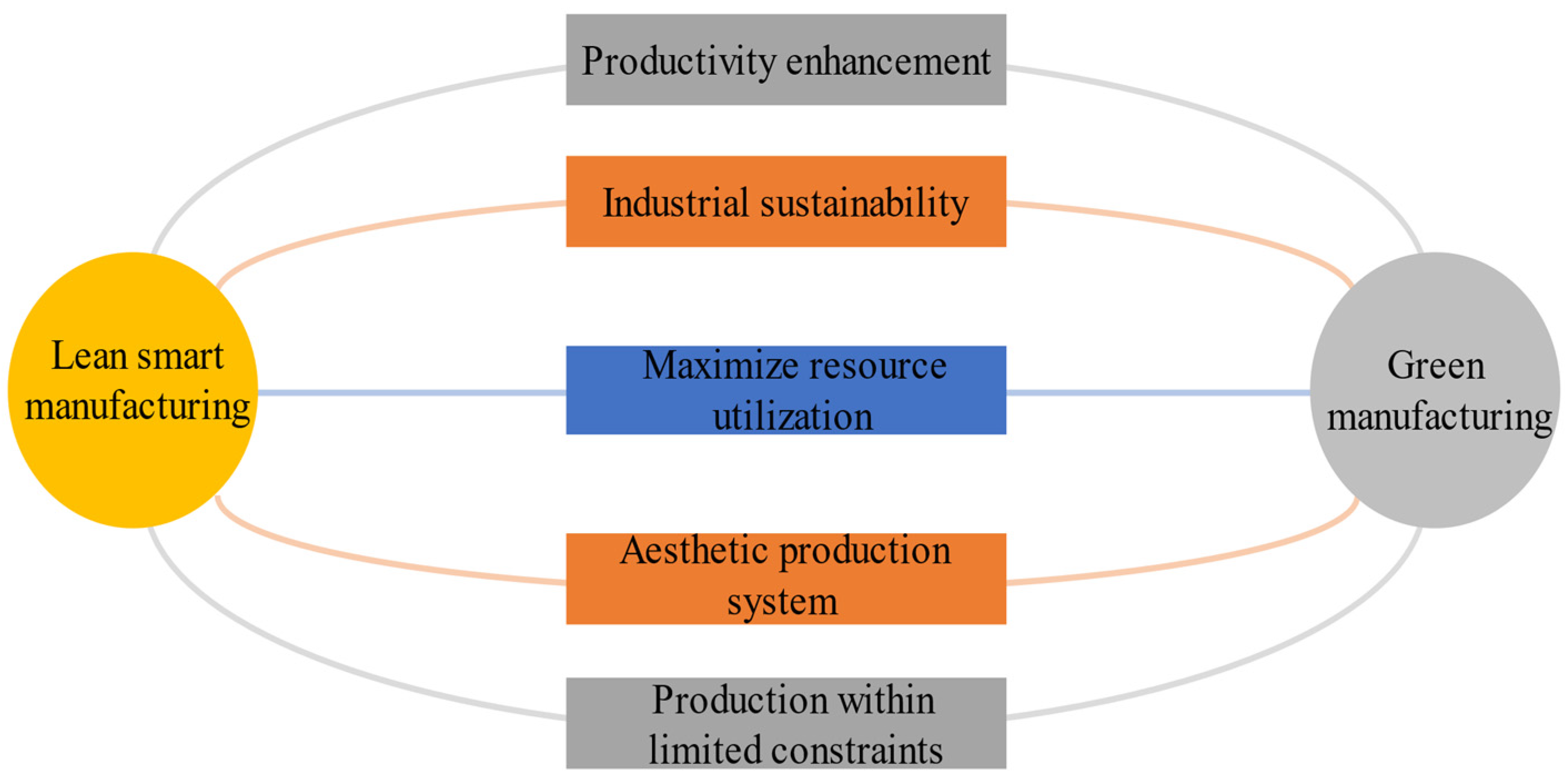
Smart lean–green is an open innovative approach in the present scenario of Industry 4.0 and it is key to the improvement in productivity problems on the shop floor. This approach assists in eliminating different inefficiencies on the production shop floor [16]. Lean–green is an integration of two approaches, and it is used to eliminate the wastefulness present in production processes and working environments [17]. Figure 1 demonstrates that the objective of the lean–green approach works in the present scenario of Industry 4.0.
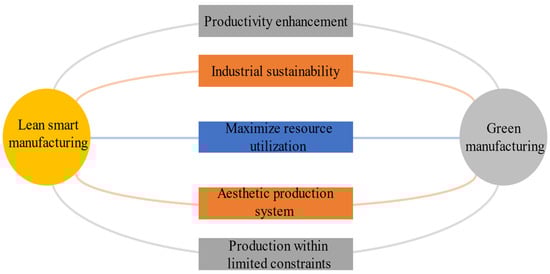
Figure 1.
Objectives of smart lean–green approach.
Nowadays, people in industry are facing problems in production control. These problems result in lengthy production times as well as financial losses. To address such issues, the members of production teams have been curious to identify the main sources of the problems and have sought to eliminate the problems with an appropriate method. Accomplishing that end requires the help of effective approaches. Some previous researchers have attempted to resolve such problems and have suggested ways to improve production control [7,11,14,18,19,20,21,22,23,24,25,26,27,28,29,30,31,32,33,34,35,36,37,38,39,40,41,42,43,44,45]. The identified problems and suggestions provided in previous research are described in Table 1.

Table 1.
A review of previous research in terms of problems and suggestions.
Previous researchers have appreciated the implementation of the lean approach in production management [21,23,26,30,31,32,33,34], because it is an approach that was proven to be able to solve almost all kinds of production problems. It has been observed in reviewed research work that management team members were facing various problems in the control of operational performance in Industry 4.0 using the lean concept. To eliminate these problems, the authors supported integrating approaches that included lean manufacturing, smart manufacturing, the internet of things, and green manufacturing [1,12,14,38]. The results of the studies show that higher operational excellence was achieved in production management systems where integration of approaches was implemented, and the results also show that integration of approaches was able to deliver operational excellence even in Industry 4.0. In the last few years, it has been observed that environmental waste has emerged as a challenge for industry individuals [42]. Green manufacturing is used to eliminate these challenges by eliminating environmental waste. The green concept helps to understand the sources of non-value-added activities on the production shop floor [43]. Although applying the green concept in industries has yielded effective improvements, the industry does not fully support the green concept as its constraints are too high, and it can provide only limited improvement in production. On the other hand, implementing the green concept in operation management works as a booster for industry individuals and enhances industrial sustainability and competitiveness in management systems [46].
In recent years, production management has emphasized the development of new technology to eliminate all types of waste, which could be capable of eliminating all the waste related to the shop floor and the environment in Industry 4.0 [47]. The integration of lean and green has proved successful in eliminating these wastes [44]. The authors of the present study reviewed previous research on process optimization approach implementation for production shop floor management at an extensive level [48,49,50,51]. From the literature review, it is concluded:
- i.
- Previous researchers have developed several approaches for the elimination of waste and concluded that the elimination of wastes could improve overall operational performance. Still, no generalized approach has been provided that can identify non-value-added activities at the beginning of production processes.
- ii.
- Previous researchers have proposed several tools, strategies, and methodologies, but have not proved that they can be applied in all types of operating conditions.
The objective of the present research work is to develop an innovative agile model using the lean, green, and smart approach for improvement in operational performance within limited constraints in Industry 4.0. The authors of the present work strongly believe that the proposed model will prove an open innovative decision-making key in Industry 4.0 to industry individuals.
2. Literature Review
The process optimization approach has been popular in recent decades, even though its goal and methodology are not new. The process optimization approach was initially developed in Japan and called the Toyota Production System [52]. The process optimization approach included lean manufacturing, lean six sigma, kaizen, and total quality management. Lean is one of the prevalent approaches in the present scenario because it uses several strategies to focus on the elimination of non-value-added activities along with resource utilization [53,54].
In the process optimization context, non-value-added activity is defined as waste that occurs on the shop floor and never adds value to a product [55]. Several techniques include Gemba walk, total productive maintenance, single-minute exchange of dies, just-in-time, 5S, and value stream mapping to identify these non-value-added activities. These techniques were developed as tools of the lean approach. The literature review proves that the lean manufacturing approach has positively impacted production performance by eliminating sources of non-value-added activity, and it also reduces inventories and lead time [56,57].
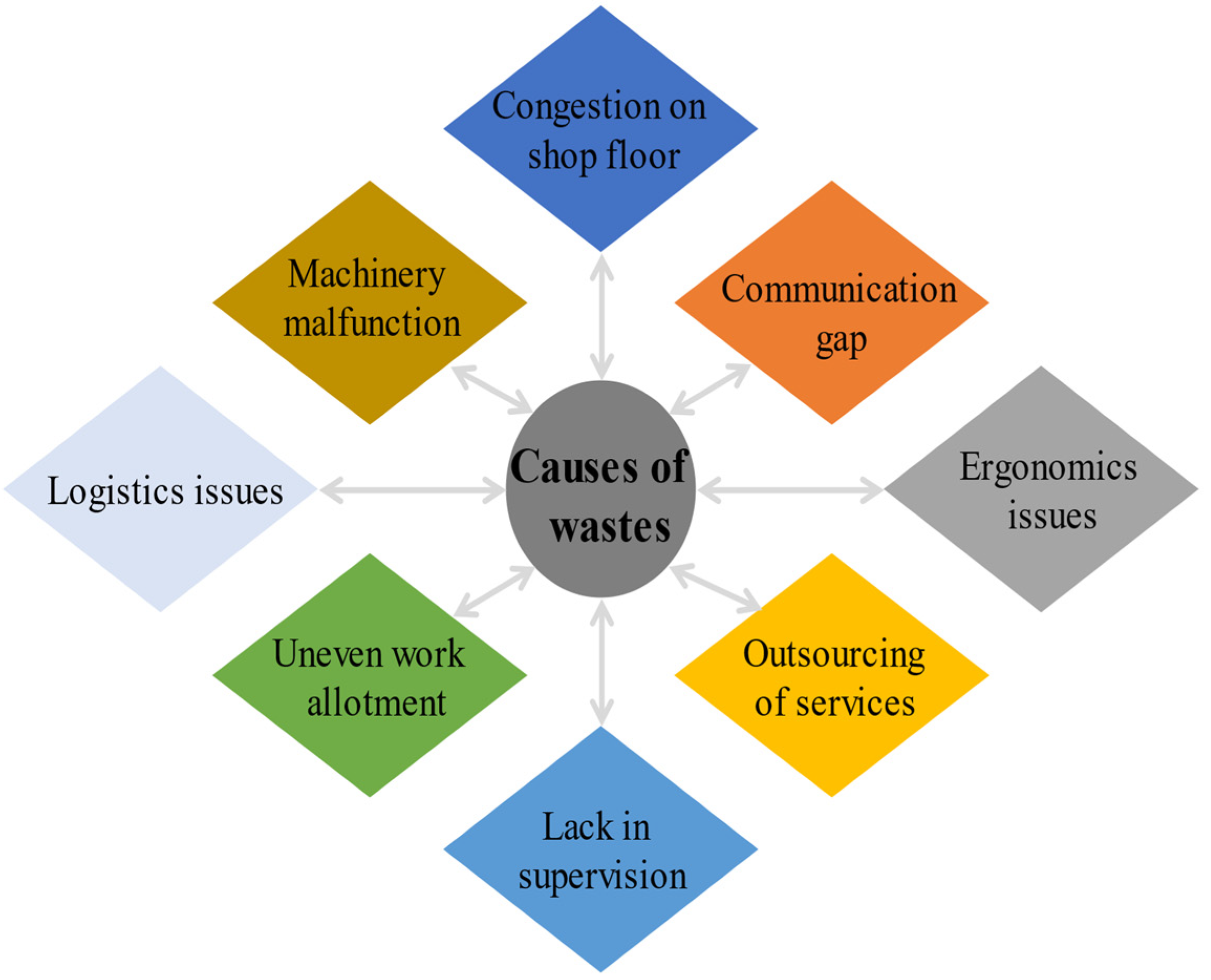
On the other hand, green manufacturing improves environmental performance in industries within limited financial conditions. The green manufacturing philosophy intends to enhance operational performance efficiency by eliminating environmental wastes [45]. Environmental waste is described as unethical uses of natural resources that could be hazardous for human beings and the environment [58]. Researchers have been focused on eliminating activities responsible for environmental waste because this waste directly affects operational performance, economical condition, safety, health, and readiness of workers. Figure 2 shows the possible causes of waste, including shop floor waste and environmental waste, found in a comprehensive literature review.
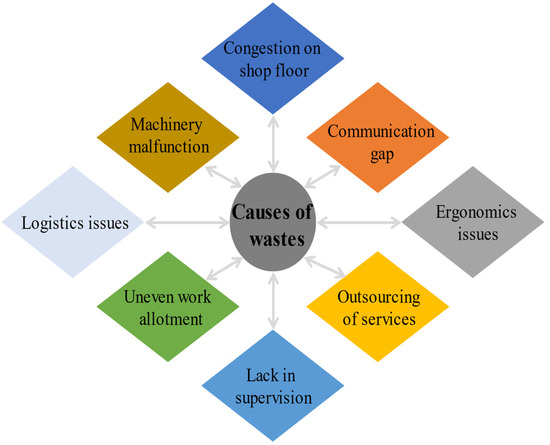
Figure 2.
Probable causes of waste.
The previous researchers argued that waste directly impacts worker performances, whether it is related to the environment or the shop floor [59,60]. Furthermore, they demonstrated that environmental waste results in inconvenient operational conditions and shop floor waste results in higher lead time. Lean manufacturing has been implemented with the green manufacturing concept to eliminate this problematic condition in previous research. In the present study, the authors identified probable reasons for both types of waste and developed an agile methodology using a lean–green approach. A smart lean–green approach is an emerging approach in Industry 4.0, and it is helpful to develop a sustainable and aesthetic shop floor management system [61]. The objective of the present article is to develop an innovative agile model using the smart lean–green approach for improvement in operational performance within limited constraints. The proposed model is validated by production enhancement, achieved in a case study carried out at an earth-moving machinery assembly plant. The case study results prove that the proposed smart lean–green model would help industry individuals to create an aesthetic and sustainable production system in Industry 4.0.
Integration of Lean, Smart, and Green Approaches in Industry 4.0
The competitive environment of the globalized industry places emphasis on industry individuals to develop an open innovative approach for production management that could be applied in all types of production system in Industry 4.0. To achieve this, several process optimization approaches were integrated and called hybrid approaches. Lean–kaizen, lean–green, lean–smart, and lean–six sigma were included in these approaches. Among all these approaches, the lean–green approach was found to be optimal, as it proved successful in eliminating environmental waste, including shop floor waste. The lean–green approach also enhanced employee morale and quality.
The smart lean–green approach can provide a new opportunity to industry individuals to improve their operational performance; particularly, working strategy and environmental conditions.
Caiado et al. [62] proposed a fuzzy-logic-based maturity model for supply chain management in Industry 4.0. The proposed model was tested in a real manufacturing organization. The results demonstrate that the proposed model could provide a robust diagnostic tool for digital readiness in industries. Abubakr et al. [63] addressed challenges faced in the manufacturing industry to integrate sustainable smart manufacturing performance. The results of the study reveal that the concept of smart manufacturing improved the environmental quality. Saxby et al. [64] supported continuous improvement in Industry 4.0 by the lean manufacturing principle. The analysis of the lean concept was achieved by interviews of five quality specialists of industries. The results of the study show that the adaptability of lean could be improved by integrating it with some other new techniques. Saqlain et al. [65] proposed the internet of things framework to support industrial control data, online monitoring, and smart manufacturing. The study results show that the framework can control the productivity and prognosis of production lines by converting collected data into useful data information. Gaspar et al. [66] investigated the internet of thing’s technological capabilities by surveying small, micro, and agro-food industries. The results of the study demonstrate that several opportunities for internet of things solutions include mainly monitoring and measuring variables of production, which can help managers make precise decisions.
Smart, lean, and green are three commensurate approaches because of the similar waste reduction goals with efficient utilization of resources. Various studies have discussed the relationship between smart, lean, and green by highlighting their integration in different contexts and their benefits on operational performance. A comprehensive literature review was carried out on recent research on the implementation of the lean–green approach. From all these studies, it was concluded that:
- I.
- Researchers and industry individuals found the lean concept to be efficient for sustainable production systems because the barriers of the lean theory are minimal, making it easy to apply across industries.
- II.
- It was found that the adaptability of smart–lean can be improved by integrating it with green manufacturing, because the green concept aims to eliminate the waste present in the production.
- III.
- The researchers found that the lean and green concepts are implemented for similar objectives because lean and green concepts are considered synergetic strategies for production enhancement.
- IV.
- The researchers concluded that integrating smart, lean, and green concepts improved workers’ performance by providing an aesthetically pleasing work environment on the production shop floor.
- V.
- The researchers believed that a lean concept would be efficient when implemented with the smart and green concept on production shop floors because lean could eliminate shop floor waste and green could eliminate environmental waste.
3. An Agile Model for Process Optimization Using Smart Lean–Green
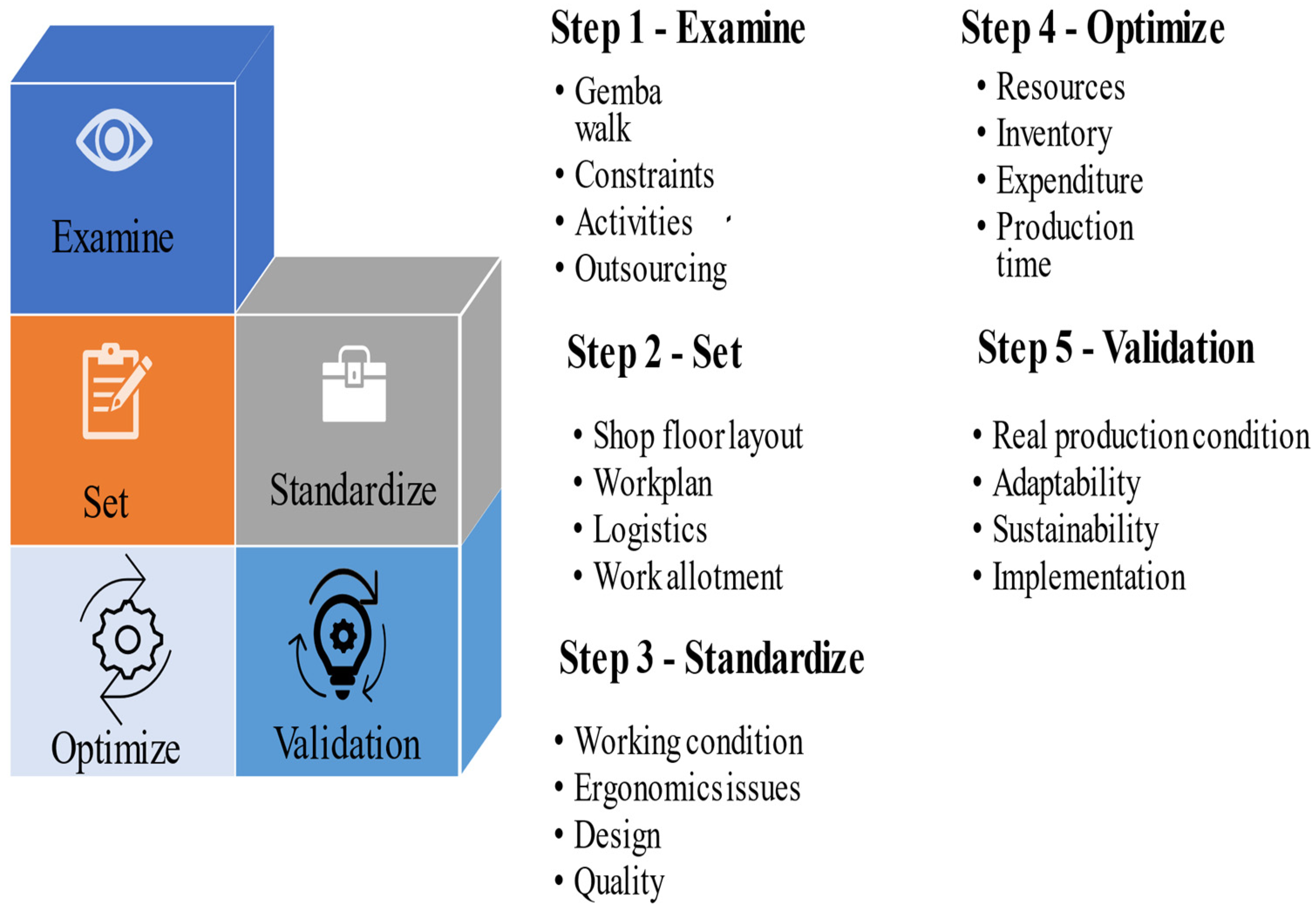
Due to rapid changes in production conditions and the focus on new ways to control production, production management systems lose their stability and fail to improve production effectively [67,68,69,70]. For this, a new model needs to be created which can handle any change in the production condition. The present research work objective is to develop an innovative agile model using the smart lean–green approach to improve operational performance within limited constraints. The model will also help to make an agile and sustainable production system in Industry 4.0. The basic objective of developing the smart, lean, and green model is to improve production system strategy within limited constraints. It helps to strengthen the production management system and maintain industrial sustainability in Industry 4.0 [71]. The model provides an aesthetic, operational environment to enhance bottom-line and top management performance during production processes on the shop floor. The literature review on previous research was used to develop the proposed model, as mentioned in the present research article. The previous research work shows that the management system failed to control operational performance in uncertain conditions [1,2,7,8,11,12,23,24,36,42,71]. It was observed that the developed models in previous research works had several limitations and could not provide efficient management systems in uncertain conditions [22,26,27,33,34,40,42,49,53]. The uncertain conditions include variation in product specification, limitations of constraints, resource unavailability, continuous changes in guidelines, and unspecified profitability [30,32,34,48,51,52,72]. To overcome these problems, the authors of the present research article proposed a model to control operational performance in each production condition faced in industrial scenarios. The developed model was developed by keeping in mind that it should be understandable to all types of industries and production management team members and could be implemented within limited constraints in Industry 4.0. Figure 3 shows the proposed model for the implementation of smart, lean, and green concepts.
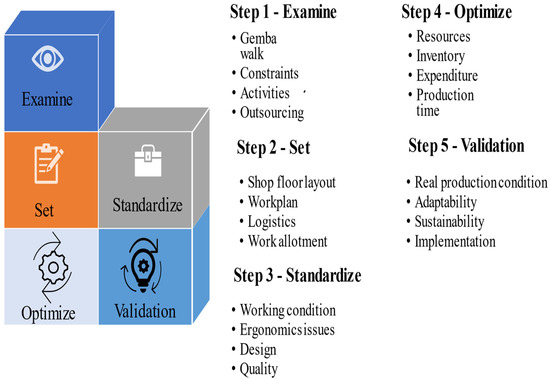
Figure 3.
Proposed model.
The proposed model consists of five steps as shown in Figure 3. In step 1, Gemba walk was used to observe the shop floor operational performance and production processes. Step 2 demonstrates that planning of production management system includes layout, work plan, logistics, and workload allotment. Step 3 determines the standards of different factors active in the production management system. In step 4, improvement was carried out to optimize resources, time, work in progress, and cost. Step 5 describes the proposed model’s applicability by evaluating production enhancement achieved in an actual production condition.
3.1. Criteria for the Developed Model
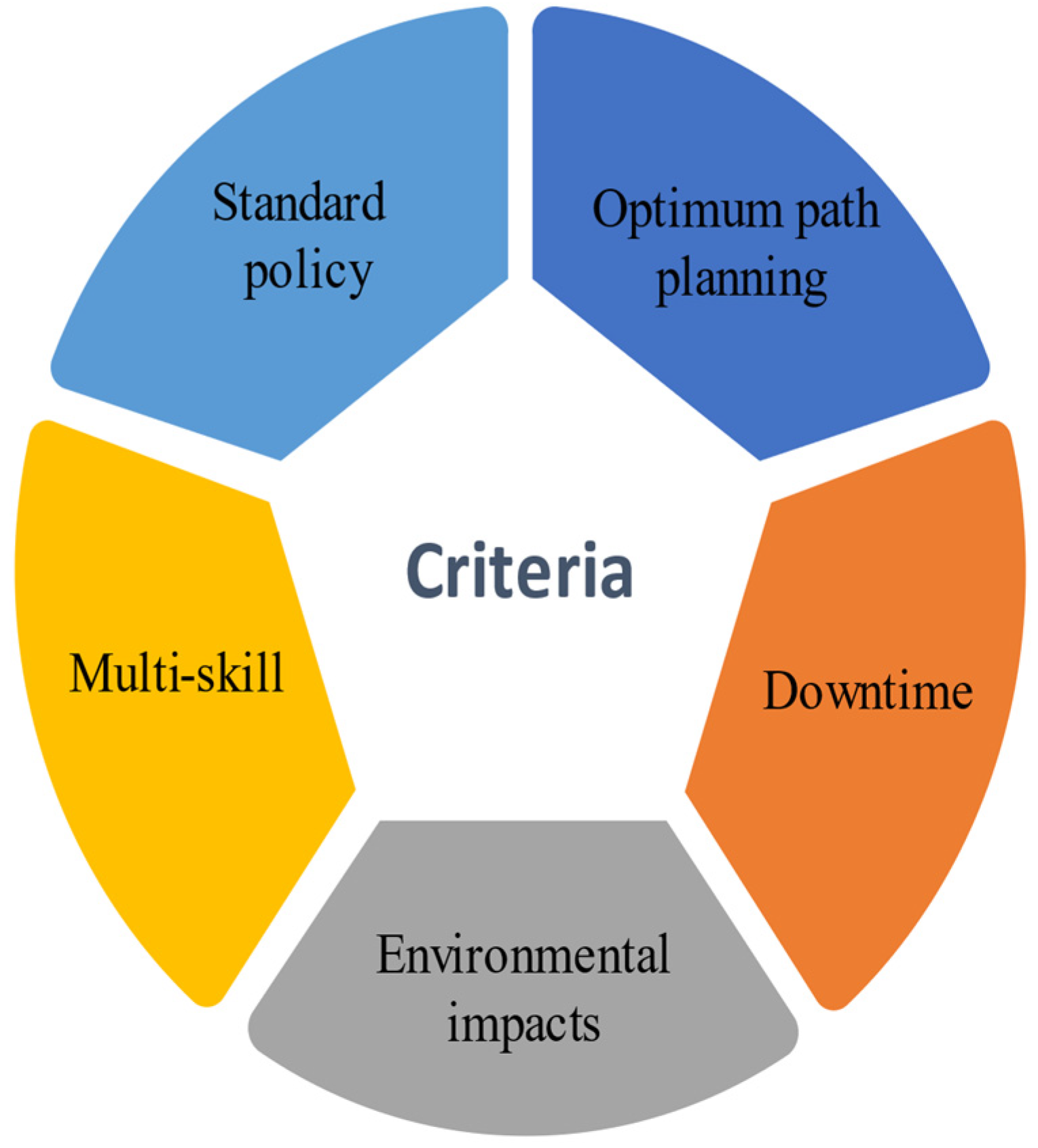
The proposed model for smart lean–green implementation and management key was based on the accumulated experience of previous research and adopted the essence of various methodologies implemented in all research that wanted to simultaneously improve environmental management and production shop floor management [6,7,8,10,11,12,13,20,44,46]. The criteria of the proposed model are described in Figure 4.
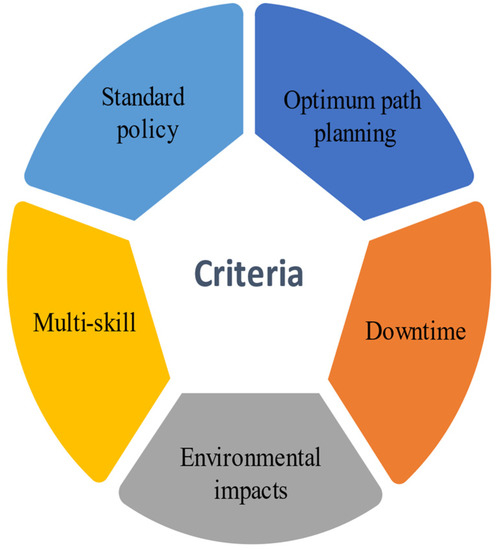
Figure 4.
Criteria of the proposed model.
The proposed model was developed mainly on four keys including (i) innovative brainstorming sessions, (ii) shop floor synthesis, (iii) control points, and (iv) production enhancement. The brainstorming criteria consist of thoroughly analysed previous research and models developed. In the analysis of the shop floor synthesis, elements, factors, and production terms are identified. The control points describe the solutions and modifications derived for proposed production management systems. In the final stage, the proposed model is applied to actual production situations and validated by increasing production. The model has been implemented in two actual conditions, the assembly shop floor of mining equipment and the automobile shop floor.
3.2. Guidelines for Developed Model
The challenge for the production management team is how to use lean and green concepts to implement the developed model systematically to sustain productivity improvements in Industry 4.0. To achieve this, the concerned industry should consider important key elements to ensure the effective implementation of the lean green concept. The suggested keys for the effective implementation of the developed model are shown in Figures 5 and 6 respectively. In addition, the main guidelines for implementation of the proposed model are discussed below:
- I.
- The commitment of management team members is critical for long-term success. The top management must develop an open innovative strategy and method for the positive working culture that considers intrinsic and extrinsic production environment to improve the sustainability of operational performance.
- II.
- Lean uses several tools to identify and eliminate challenges and problems in obtaining sustainability. The lean effectiveness can be enhanced by integrating other tools and approaches, including kaizen, smart, six sigma, green, and total quality management. The application of the lean and green concepts was found to be most efficient because both concepts have the same objectives, to eliminate wastes. They work simultaneously and synergistically in industries to achieve production enhancement.
- III.
- Strategic planning and comprehensive production information are essential to determine the proposed model’s objective and success. Efficient strategic planning helps industry individuals make decisions for the allocation of workers, machinery, and financial orders to maintain industrial sustainability by the proposed model.
- IV.
- The proposed model is used to enhance production within limited constraints by obtaining sustainable operational performance in production processes. In addition, the authors develop a strategy and problem-solving keys to manage production planning by optimizing resources. The keys support industry persons in implementing continuous improvement and obtain sustainability in the production management system in Industry 4.0.
The present research shows that the proposed model of smart, lean, and green helps to overcome problems and challenges in the production management systems. The authors of the present article proved the proposed model applicability to be efficient by two case studies carried out on different shop floors. The proposed model helps to enhance production within limited constraints.
4. Validation of Developed Model
The validation of the developed model was achieved by implementing it in two case studies of Industry 4.0. The proposed model was evaluated to test its adaptability and effectiveness in real production conditions by improving operational and environmental performance. In the present industrial scenario, the need for the developed model can be proved superior by achieving improvement in production. Thus, the proposed model will prove to be a good option in future research work in operational and environmental performance enhancement within resources options in Industry 4.0 through its application in times to come.
4.1. Case Study 1
Management team members of a small enterprise of the automobile industry located in India were interested in using lean and green concepts to increase resources, and the expenditure involved in the concepts was according to their budget. The management members paid special attention to the use of resources because there was a wide gap between the position information about the resources given by the shop floor supervisor and the industry’s basic information. Therefore, the production was reviewed in the present work, and the developed model was implemented.
4.1.1. Examine
The main problems of the present automobile manufacturer were found by Gemba walk and brainstorming sessions organized with supervisors, managers, and workers. The investigation team found several issues on the production shop floor and concluded that some activities were responsible for higher production time. The current production condition, and the activities responsible for the low productivity, are detailed in Table 2.
Table 2.
Experimental production conditions on the shop floor.
4.1.2. Set
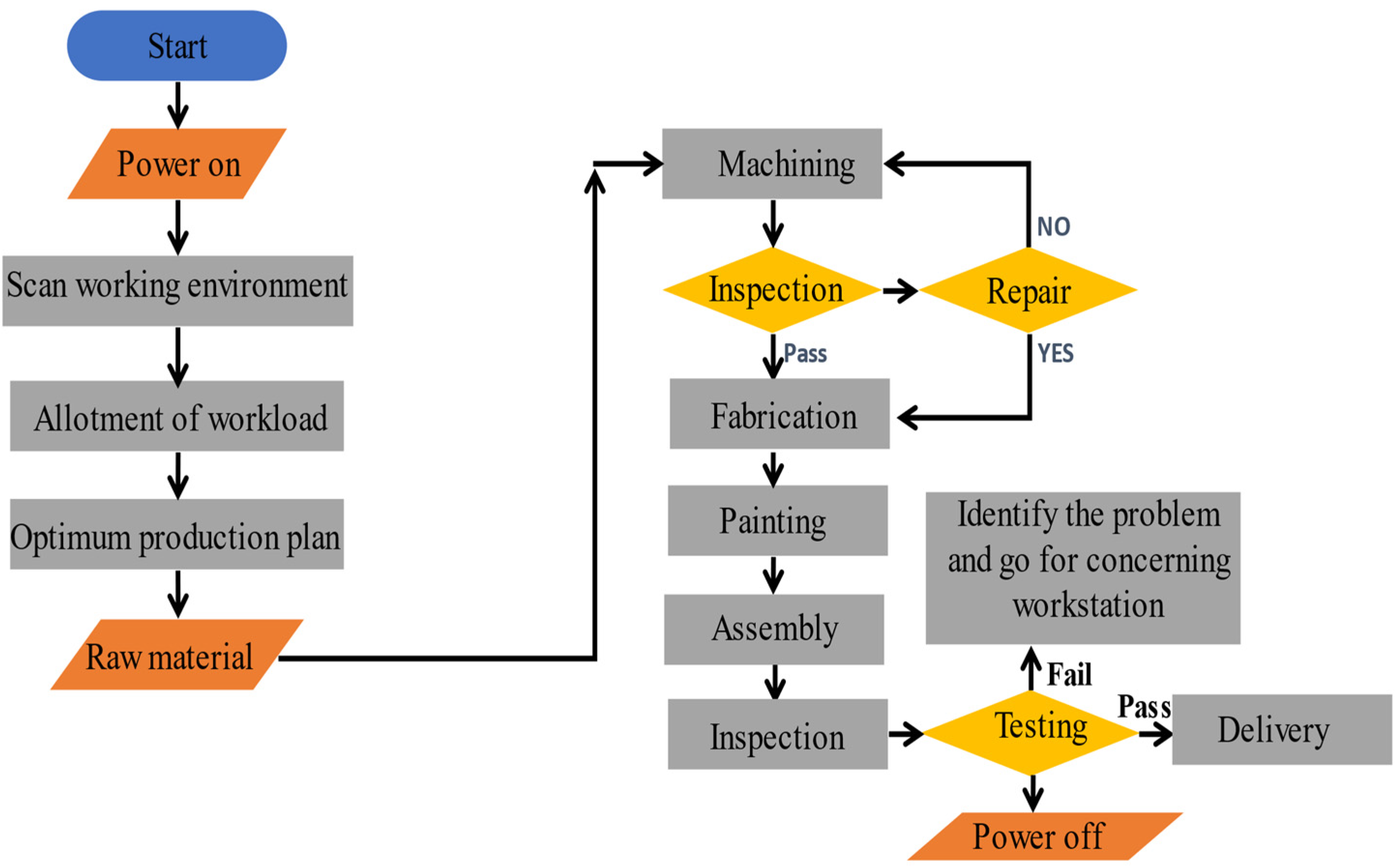
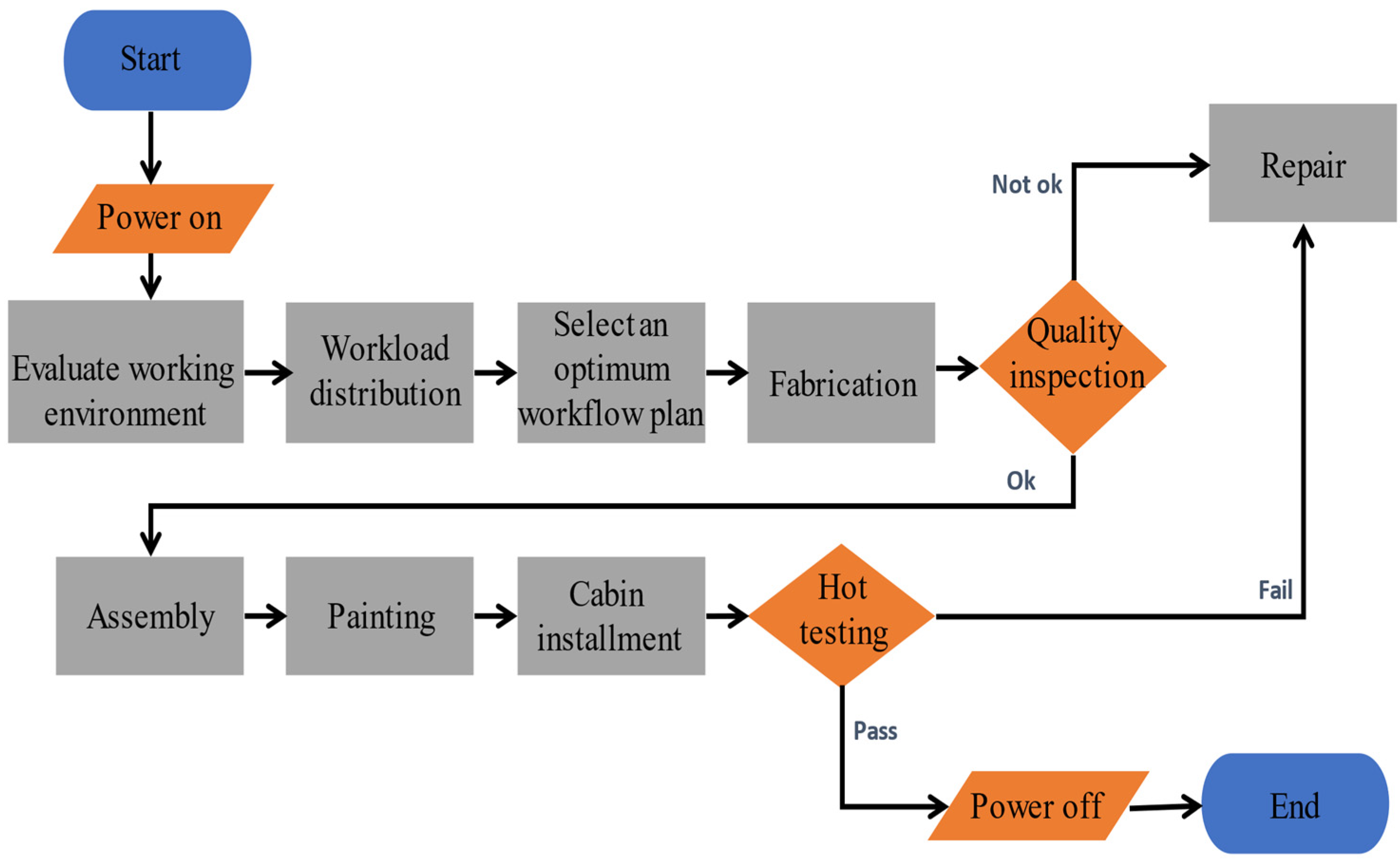
The present automobile industry receives large quantities of orders, so production management favours a push system. Production management produces regularly. The authors analysed all production processes and activities on the shop floor and developed a systematic planning modified production workflow. The process flow of the production operations involved in manufacturing the vehicle according to shops is shown in Figure 5.
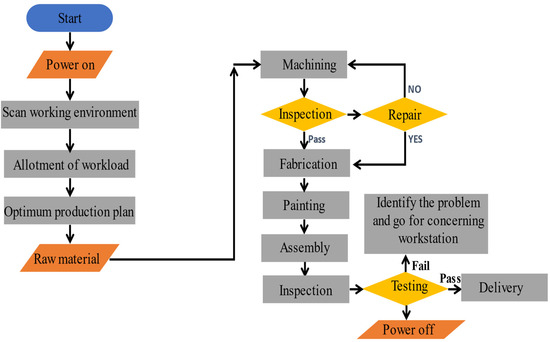
Figure 5.
Modified workflow.
The developed production workflow was decided by different discussions, interviews, and meetings conducted with present employers’ staff. As a result, the developed workflow shows the optimum path between each workstation. Furthermore, it was prepared by eliminating different wastes identified on the production shop floor, including environmental and shop floor wastes.
4.1.3. Standardize
The authors and industry persons brainstormed additional ideas about industrial sustainability and found some conclusions after reviewing overall production processes and activities. The findings suggested some actions to be taken for production enhancement. The steps are discussed as follows:
- Add environmental temperature sensors;
- Condition-based maintenance system;
- Intelligent sensors to stop the machine when not in use;
- Design software to decide optimum path planning;
- Sensors and non-destructive testing system;
- Organize training programs;
- Resolve ergonomics issues.
The authors found from the production analysis that production can improve within limited constraints by applying the above actions. These actions would be proved beneficial for industry persons to control the production management in the future in Industry 4.0.
4.1.4. Optimize
After reviewing the performance of all factors, control points, and overall production activities on the production shop floor, an optimal production plan is developed to minimize production lead times and environmental impacts. Several production plans were proposed to determine the developed production plan. The most optimal production plan was selected that was necessary to maximize the operational performance from start to finish of the production processes. The following parameters are to be analysed to decide the optimum production plan:
- Minimum movement between workstations;
- Proper arrangement for water and electricity;
- Sufficient workspace;
- Systematic planning for machinery positions;
- Connectivity between similar types of workstations.
4.1.5. Validation
In the modified production work plan, it was proposed that the manufacturing would be operated in two shifts with 50 min/shift breaktime. In the proposed plan, all production activities are systematically with the optimum plan with minimum utilization of resources, minimum work-in-progress inventory, and minimum waiting time by elimination of waste as decided in the previous section. The validation of the proposed model was carried out by production enhancement achieved in the present automobile industry. The result analysis was carried out by comparing the observed condition and the proposed condition, and Table 3 shows the improvements achieved in the result.
Table 3.
Analysis of observed condition and proposed condition.
4.2. Case Study 2
The second study was carried out in a mining machinery equipment assembly unit in India. The industry is a leading world-class mining machinery equipment manufacturer using cutting-edge technology. This mining machinery is built to provide reliability, safety, low cost, and easy maintenance. Moreover, it can survive in rough conditions and proves its applicability over any surface conditions. However, it was found that the present industry is facing problems in obtaining production enhancement within the industry’s financial conditions.
4.2.1. Examine
The main problem in the present study was identified as a delay in delivery time. A brainstorming analysis was conducted with the employees of the current employer, and Gemba walk was used to identify the root cause of the problem. As a result, the industry persons found different production problems. The present production condition, and the activities responsible for the lower productivity, are detailed in Table 4.
Table 4.
Experimental production conditions on the shop floor.
4.2.2. Set
The present industry follows a job shop production system and receives product orders regularly. As a result, the industry makes a variety of products at the demand of customers. The authors reviewed production information obtained by Gemba walk and proposed a production work plan to enhance production within limited constraints. Figure 6 shows the proposed work planning for the production shop floor.
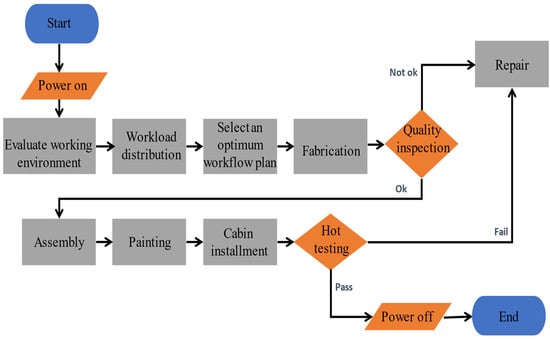
Figure 6.
Modified workflow plan.
The modified workflow plan has been selected by analysing all possible routes from the beginning to the end of production processes. The production plan has been prepared by eliminating all types of shop floor and environmental wastes identified in the present production condition.
4.2.3. Standardize
After reviewing overall production activities and operational performance through multiple brainstorming sessions, industry individuals and authors found the causes of the production problems. The authors suggested some actions implemented for obtaining industrial sustainability and production enhancement within limited constraints. The actions are discussed as follows:
- Set alert for shop floor working temperature;
- Condition monitoring system;
- Intelligent sensors to stop the machine when not in use;
- Design a model to decide optimum path planning;
- Proper workload distribution;
- Organize training programs;
- Conduct meeting of workers with top-level management;
- Resolve ergonomics issues.
The production throughput was improved by implementing the above action on the production shop floor. The authors believed that the proposed actions would benefit industry persons in future production management in Industry 4.0.
4.2.4. Optimize
Several actions were suggested by the industry individuals, based on how suggested actions can be implemented to improve operational performance. The industry individuals use some parameters to optimize operational paths within available resources. The following parameters are to be analysed to decide the optimum production plan:
- A shorter distance between workstations;
- Proper arrangement for power supply;
- Sufficient workspace at each workstation;
- The fixed position of machinery;
- The suitable communication channel between workstations;
- Space to easily connect similar workstations.
4.2.5. Validation
The proposed model was verified by increasing production and minimizing environmental issues in the current industry. The results obtained by analysis on the production parameters between the proposed position and the observed position show that the proposed workflow will increase production. Staff members and workers verified each case to reduce environmental issues and a comparison between the two production conditions proved that the proposed actions effectively reduce environmental damages. Table 5 shows the comparison between observed and proposed production conditions.
Table 5.
Analysis of observed and proposed production conditions.
5. Result and Discussion
To enhance productivity with minimal environmental issues, an agile innovative model was developed and validated by implementing it in the real production conditions of Industry 4.0. The developed model used smart, lean, and green manufacturing philosophy to improve operational performance on the production shop floor. The developed model used a team of industry persons of different departments and observed and scanned overall production activities by Gemba walk and open innovative brainstorming sessions. The goal of the developed model was to reduce each type of waste present on the production shop floor.
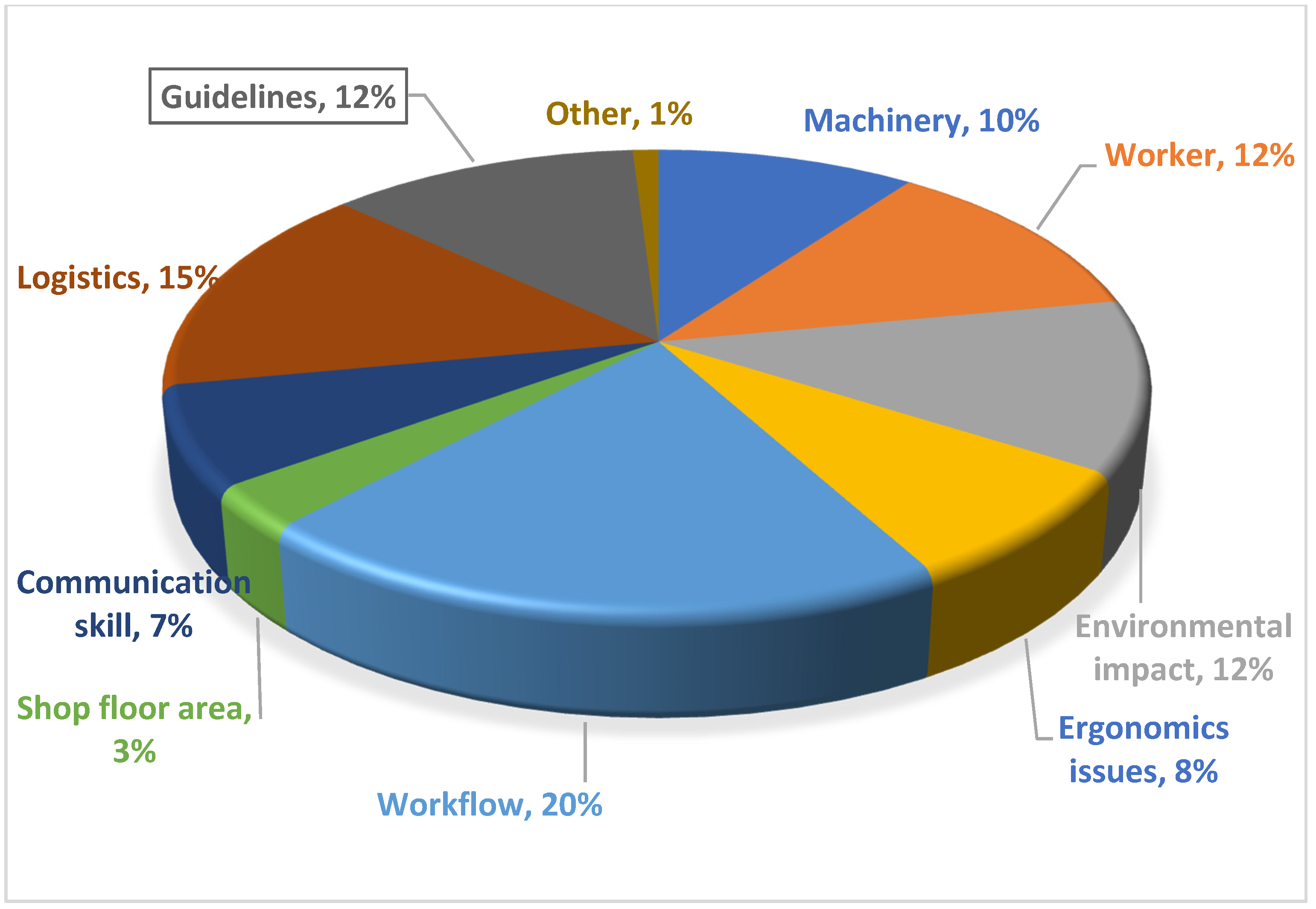
The examples on the real production shop floor have been described in the previous sections and provide guidelines to industry persons to understand the main problems and issues through the proposed methodology. The guidelines help to eliminate types of waste and improve production shop floor conditions and environmental issues. The results of case studies show that productivity enhancement was achieved by the elimination of both types of waste, including shop floor waste and environmental waste. Figure 7 shows the effect of different factors on operational performance on the shop floor. The impacts were analysed from the feedback system conducted with the employees of different departments.
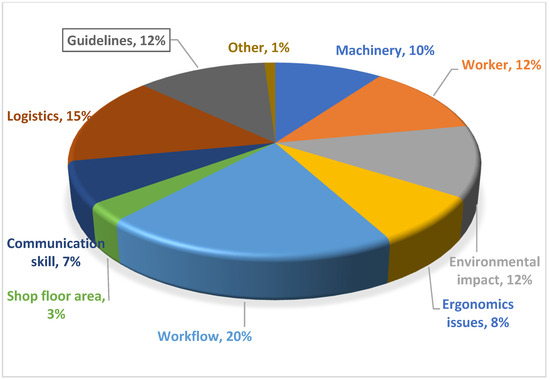
Figure 7.
Effects of different factors on operational performance.
6. Conclusions
The present research proposes an agile innovative model that integrates smart, lean, and green concepts for improving operational performance on the production shop floor in Industry 4.0. The proposed model describes the logical steps to achieve industrial sustainability, and is easily understandable, simple in structure, open innovative, and can be implemented within limited constraints across all types of industries. The model was validated by improving operational and environmental performance in two case studies performed at automobile and mining machinery units. It was found that overall operational performance was enhanced in both case studies by improvement in different factors, including working environment, worker efficiency, logistics management, and resources utilization. The results show that the developed model is an open innovation strategy and is sustainable for production enhancement and environmental performance improvement in Industry 4.0. In the future, the efficacy of the proposed model can be improved by in-depth case studies on the implementation of lean, green, smart manufacturing models for industrial profitability through the establishment of industrial sustainability in Industry 4.0.
7. Future Scope
Production management team members in worldwide industries are focused on responsibly controlling their shop floor activities to improve operational and environmental performance [1,18,23,40,47,62]. A suitable model and approach are needed to accomplish this, which has been attempted in the present research. The present research article develops an innovative agile model using the lean, green, and smart approach to improve operational and environmental performance within limited constraints in Industry 4.0. The results show that the developed model proved suitable to enhance production by improving operational and environmental conditions within limited constraints in Industry 4.0. Thus, it can be implemented in industries that emphasize operational control by a suitable approach, looking to achieve sustainability in shop floor management. The lean and green concept is found to be efficient in shop floor management [6,9,44,45,46], and confirms that industry individuals could enhance production within limited constraints by integration with smart concepts [61,68]. In the future, the developed model can be extended by improving other industrial environments of Industry 4.0. Industry individuals need to face problems in controlling operational and environmental performance for production enhancement within limited constraints. The proposed model can also be modified by extending shop-floor applicability by integrating lean, green, and other smart techniques.
Author Contributions
Conceptualization, V.T., S.C., A.K.M., S.S. and J.S.; methodology, V.T., S.C., A.K.M. and S.S.; formal analysis, V.T. and S.S.; investigation, V.T., S.C., A.K.M. and S.S.; resources, V.T., S.S., D.Y.P. and K.G.; writing—original draft preparation, V.T. and S.S.; writing—review and editing, V.T., S.C., A.K.M., S.S., J.S., D.Y.P. and K.G.; supervision, S.C. and S.S.; funding acquisition, S.S., D.Y.P. and K.G. All authors have read and agreed to the published version of the manuscript.
Funding
This work receives no external funding.
Institutional Review Board Statement
Not applicable.
Informed Consent Statement
Not applicable.
Data Availability Statement
The data presented in this study are available on request from the corresponding author.
Conflicts of Interest
The authors declare no conflict of interest.
References
- Li, L.-R. Lean Smart Manufacturing in Taiwan—Focusing on the Bicycle Industry. J. Open Innov. Technol. Mark. Complex. 2019, 5, 79. [Google Scholar] [CrossRef]
- Tripathi, V.; Saraswat, S.; Gautam, G.D. A Study on Implementation of Various Approaches for Shop Floor Management; Springer: Singapore, 2021; pp. 371–387. [Google Scholar] [CrossRef]
- Costa, R.; Resende, T.; Dias, A.; Pereira, L.; Santos, J. Public Sector Shared Services and the Lean Methodology: Implications on Military Organizations. J. Open Innov. Technol. Mark. Complex. 2020, 6, 78. [Google Scholar] [CrossRef]
- Ali, A.A.; Mahmood, A.; Ikram, A.; Ahmad, A. Configuring the Drivers and Carriers of Process Innovation in Manufacturing Organizations. J. Open Innov. Technol. Mark. Complex. 2020, 6, 154. [Google Scholar] [CrossRef]
- Tjahjadi, B.; Soewarno, N.; Hariyati, H.; Nafidah, L.N.; Kustiningsih, N.; Nadyaningrum, V. The Role of Green Innovation between Green Market Orientation and Business Performance: Its Implication for Open Innovation. J. Open Innov. Technol. Mark. Complex. 2020, 6, 173. [Google Scholar] [CrossRef]
- Siegel, R.; Antony, J.; Garza-Reyes, J.A.; Cherrafi, A.; Lameijer, B. Integrated green lean approach and sustainability for SMEs: From literature review to a conceptual framework. J. Clean. Prod. 2019, 240, 118205. [Google Scholar] [CrossRef]
- Shokri, A.; Li, G. Green implementation of Lean Six Sigma projects in the manufacturing sector. Int. J. Lean Six Sigma 2020, 11, 711–729. [Google Scholar] [CrossRef]
- Sagnak, M.; Kazancoglu, Y. Integration of green lean approach with six sigma: An application for flue gas emissions. J. Clean. Prod. 2016, 127, 112–118. [Google Scholar] [CrossRef]
- Prasad, S.; Khanduja, D.; Sharma, S.K. An empirical study on applicability of lean and green practices in the foundry industry. J. Manuf. Technol. Manag. 2016, 27, 408–426. [Google Scholar] [CrossRef]
- Oliveira, G.A.; Tan, K.H.; Guedes, B.T. Lean and green approach: An evaluation tool for new product development focused on small and medium enterprises. Int. J. Prod. Econ. 2018, 205, 62–73. [Google Scholar] [CrossRef]
- Cherrafi, A.; Elfezazi, S.; Hurley, B.; Garza-Reyes, J.A.; Kumar, V.; Anosike, A.A.; Batista, L. Green and lean: A Gemba–Kaizen model for sustainability enhancement. Prod. Plan. Control 2019, 30, 385–399. [Google Scholar] [CrossRef]
- Choudhary, S.; Nayak, R.; Dora, M.; Mishra, N.; Ghadge, A. An integrated lean and green approach for improving sustainability performance: A case study of a packaging manufacturing SME in the U.K. Prod. Plan. Control 2019, 30, 353–368. [Google Scholar] [CrossRef]
- Inman, R.A.; Green, K.W. Green. Lean and green combine to impact environmental and operational performance. Int. J. Prod. Res. 2018, 56, 4802–4818. [Google Scholar] [CrossRef]
- Zhu, X.Y.; Zhang, H.; Jiang, Z.G. Application of green-modified value stream mapping to integrate and implement lean and green practices: A case study. Int. J. Comput. Integr. Manuf. 2019, 33, 716–731. [Google Scholar] [CrossRef]
- Kurdve, M.; Zackrisson, M.; Wiktorsson, M.; Harlin, U. Lean and green integration into production system models-Experiences from Swedish industry. J. Clean. Prod. 2014, 85, 180–190. [Google Scholar] [CrossRef]
- Belhadi, A.; Kamble, S.S.; Zkik, K.; Cherrafi, A.; Touriki, F.E. The integrated effect of Big Data Analytics, Lean Six Sigma and Green Manufacturing on the environmental performance of manufacturing companies: The case of North Africa. J. Clean. Prod. 2019, 252, 119903. [Google Scholar] [CrossRef]
- Duarte, S.; Cruz Machado, V. Green and lean implementation: An assessment in the automotive industry. Int. J. Lean Six Sigma 2017, 8, 65–88. [Google Scholar] [CrossRef]
- Shahin, M.; Chen, F.F.; Bouzary, H.; Krishnaiyer, K. Integration of Lean practices and Industry 4.0 technologies: Smart manufacturing for next-generation enterprises. Int. J. Adv. Manuf. Technol. 2020, 107, 2927–2936. [Google Scholar] [CrossRef]
- Tortorella, G.L.; Narayanamurthy, G.; Thurer, M. Identifying pathways to a high-performing lean automation implementation: An empirical study in the manufacturing industry. Int. J. Prod. Econ. 2020, 231, 107918. [Google Scholar] [CrossRef]
- Thanki, S.J.; Thakkar, J. Interdependence analysis of lean-green implementation challenges: A case of Indian SMEs. J. Manuf. Technol. Manag. 2018, 29, 295–328. [Google Scholar] [CrossRef]
- Rahani, A.R.; Al-Ashraf, M. Production flow analysis through Value Stream Mapping: A lean manufacturing process case study. Procedia Eng. 2012, 41, 1727–1734. [Google Scholar] [CrossRef]
- Naqvi, S.A.A.; Fahad, M.; Atir, M.; Zubair, M.; Shehzad, M.M. Productivity improvement of a manufacturing facility using systematic layout planning. Cogent Eng. 2016, 3, 13. [Google Scholar] [CrossRef]
- Barbosa, G.F.; Carvalho, J.; Filho, E.V.G. A proper framework for design of aircraft production system based on lean manufacturing principles focusing to automated processes. Int. J. Adv. Manuf. Technol. 2014, 72, 1257–1273. [Google Scholar] [CrossRef]
- Amrani, A.; Ducq, Y. Lean practices implementation in aerospace based on sector characteristics: Methodology and case study. Prod. Plan. Control 2020, 31, 1–23. [Google Scholar] [CrossRef]
- Rahman, N.A.A.; Sharif, S.M.; Esa, M.M. Lean Manufacturing Case Study with Kanban System Implementation. Procedia Econ. Financ. 2013, 7, 174–180. [Google Scholar] [CrossRef]
- Pattanaik, L.N.; Sharma, B.P. Implementing lean manufacturing with cellular layout: A case study. Int. J. Adv. Manuf. Technol. 2008, 42, 772–779. [Google Scholar] [CrossRef]
- Sahoo, A.K.; Singh, N.K.; Shankar, R.; Tiwari, M.K. Lean philosophy: Implementation in a forging company. Int. J. Adv. Manuf. Technol. 2007, 36, 451–462. [Google Scholar] [CrossRef]
- Kumar, S.; Dhingra, A.K.; Singh, B. Process improvement through Lean Kaizen using value stream map: A case study in India. Int. J. Adv. Manuf. Technol. 2018, 96, 2687–2698. [Google Scholar] [CrossRef]
- Suhardi, B.; Anisa, N.; Laksono, P.W. Minimizing waste using lean manufacturing and ECRS principle in Indonesian furniture industry. Cogent Eng. 2019, 6, 1567019. [Google Scholar] [CrossRef]
- Chen, J.C.; Cheng, C.H.; Huang, P.B.; Wang, K.J.; Huang, C.J.; Ting, T.C. Warehouse management with lean and RFID application: A case study. Int. J. Adv. Manuf. Technol. 2013, 69, 531–542. [Google Scholar] [CrossRef]
- Santos, Z.G.D.; Vieira, L.; Balbinotti, G. Lean Manufacturing and Ergonomic Working Conditions in the Automotive Industry. Procedia Manuf. 2015, 3, 5947–5954. [Google Scholar] [CrossRef]
- Rohani, J.M.; Zahraee, S.M. Production Line Analysis via Value Stream Mapping: A Lean Manufacturing Process of Color Industry. Procedia Manuf. 2015, 2, 6–10. [Google Scholar] [CrossRef]
- Mwanza, B.G.; Mbohwa, C. Design of a Total Productive Maintenance Model for Effective Implementation: Case Study of a Chemical Manufacturing Company. Procedia Manuf. 2015, 4, 461–470. [Google Scholar] [CrossRef]
- Lu, J.C.; Yang, T. Implementing lean standard work to solve a low-work in-process buffer problem in a highly automated manufacturing environment. Int. J. Prod. Res. 2015, 53, 2285–2305. [Google Scholar] [CrossRef]
- Shet, S.V.; Pereira, V. Proposed managerial competencies for Industry 4.0—Implications for social sustainability. Technol. Forecast. Soc. Chang. 2021, 173, 121080. [Google Scholar] [CrossRef]
- Ghobakhloo, M.; Ching, N.T. Adoption of digital technologies of smart manufacturing in SMEs. J. Ind. Inf. Integr. 2019, 16, 100107. [Google Scholar] [CrossRef]
- Dey, B.K.; Bhuniya, S.; Sarkar, B. Involvement of controllable lead time and variable demand for a smart manufacturing system under a supply chain management. Expert Syst. Appl. 2021, 184, 115464. [Google Scholar] [CrossRef]
- Buer, S.V.; Semini, M.; Strandhagen, J.O.; Sgarbossa, F. The complementary effect of lean manufacturing and digitalisation on operational performance. Int. J. Prod. Res. 2021, 59, 1976–1992. [Google Scholar] [CrossRef]
- Ramadan, M.; Salah, B.; Othman, M.; Ayubali, A.A. Industry 4.0-Based Real-Time Scheduling and Dispatching in Lean Manufacturing Systems. Sustainability 2020, 12, 2272. [Google Scholar] [CrossRef]
- Dey, B.K.; Pareek, S.; Tayyab, M.; Sarkar, B. Autonomation policy to control work-in-process inventory in a smart production system. Int. J. Prod. Res. 2021, 59, 1258–1280. [Google Scholar] [CrossRef]
- Nakagawa, E.Y.; Antonino, P.O.; Schnicke, F.; Capilla, R.; Kuhn, T.; Liggesmeyer, P. Industry 4.0 reference architectures: State of the art and future trends. Comput. Ind. Eng. 2021, 156, 107241. [Google Scholar] [CrossRef]
- Thanki, S.; Govindan, K.; Thakkar, J. An investigation on lean-green implementation practices in Indian SMEs using analytical hierarchy process (AHP) approach. J. Clean. Prod. 2016, 135, 284–298. [Google Scholar] [CrossRef]
- Mishra, M.N. Identify critical success factors to implement integrated green and Lean Six Sigma. Int. J. Lean Six Sigma 2018. [Google Scholar] [CrossRef]
- Kumar, S.; Luthra, S.; Govindan, K.; Kumar, N.; Haleem, A. Barriers in green lean six sigma product development process: An ISM approach. Prod. Plan. Control 2016, 27, 604–620. [Google Scholar] [CrossRef]
- Leong, W.D.; Teng, S.Y.; How, B.S.; Ngan, S.L.; Rahman, A.A.; Tan, C.P.; Ponnambalam, S.G.; Lam, H.L. Enhancing the adaptability: Lean and green strategy towards the Industry Revolution 4.0. J. Clean. Prod. 2020, 273, 122870. [Google Scholar] [CrossRef]
- Bhattacharya, A.; Nand, A.; Castka, P. Lean-green integration and its impact on sustainability performance: A critical review. J. Clean. Prod. 2019, 236, 117697. [Google Scholar] [CrossRef]
- Kamble, S.; Gunasekaran, A.; Dhone, N.C. Industry 4.0 and lean manufacturing practices for sustainable organisational performance in Indian manufacturing companies. Int. J. Prod. Res. 2020, 58, 1319–1337. [Google Scholar] [CrossRef]
- Tripathi, V.; Saraswat, S.; Gautam, G.; Singh, D. Shop Floor Productivity Enhancement Using a Modified Lean Manufacturing Approach. In Recent Trends in Industrial and Production Engineering; Springer: Singapore, 2021. [Google Scholar] [CrossRef]
- Tyagi, S.; Choudhary, A.; Cai, X.; Yang, K. Value stream mapping to reduce the lead-time of a product development process. Int. J. Prod. Econ. 2015, 160, 202–212. [Google Scholar] [CrossRef]
- Freitas, J.G.D.; Costa, H.G.; Ferraz, F.T. Impacts of Lean Six Sigma over organizational sustainability: A survey study. J. Clean. Prod. 2017, 156, 262–275. [Google Scholar] [CrossRef]
- Ruben, R.B.; Vinodh, S.; Asokan, P. Implementation of Lean Six Sigma framework with environmental considerations in an Indian automotive component manufacturing firm: A case study. Prod. Plan. Control 2017, 28, 1193–1211. [Google Scholar] [CrossRef]
- Tripathi, V.; Saraswat, S.; Gautam, G.D. Development of a Systematic Framework to Optimize the Production Process in Shop Floor Management. In Recent Trends in Industrial and Production Engineering; Springer: Singapore, 2021. [Google Scholar] [CrossRef]
- Vinodh, S.; Arvind, K.R.; Somanaathan, M. Application of value stream mapping in an Indian camshaft manufacturing organisation. J. Manuf. Technol. Manag. 2010, 21, 888–900. [Google Scholar] [CrossRef]
- Syreyshchikova, N.V.; Pimenov, D.Y.; Markopoulos, A.P.; Moldovan, L. Value Stream Maps in Clock Production. Russ. Engin. Res. 2021, 41, 378–381. [Google Scholar] [CrossRef]
- Morales Méndez, J.D.; Rodriguez, R.S. Total productive maintenance (TPM) as a tool for improving productivity: A case study of application in the bottleneck of an auto-parts machining line. Int. J. Adv. Manuf. Technol. 2017, 92, 1013–1026. [Google Scholar] [CrossRef]
- Yadav, G.; Luthra, S.; Huisingh, D.; Mangla, S.K.; Narkhede, B.E.; Liu, Y. Development of a lean manufacturing framework to enhance its adoption within manufacturing companies in developing economies. J. Clean. Prod. 2020, 245, 118726. [Google Scholar] [CrossRef]
- Tayal, A.; Kalsi, N.S.; Gupta, M.K.; Pimenov, D.Y.; Sarikaya, M.; Pruncu, C.I. Effectiveness Improvement in Manufacturing Industry; Trilogy Study and Open Innovation Dynamics. J. Open Innov. Technol. Mark. Complex. 2021, 7, 7. [Google Scholar] [CrossRef]
- Cherrafi, A.; Elfezazi, S.; Govindan, K.; Garza-Reyes, J.A.; Benhida, K.; Mokhlis, A. A framework for the integration of Green and Lean Six Sigma for superior sustainability performance. Int. J. Prod. Res. 2017, 55, 4481–4515. [Google Scholar] [CrossRef]
- Syreyshchikova, N.V.; Pimenov, D.Y.; Yaroslavova, E.N.; Gupta, M.K.; Aamir, M.; Giasin, K. Managing Risks in the Improved Model of Rolling Mill Loading: A Case Study. J. Risk Financ. Manag. 2021, 14, 359. [Google Scholar] [CrossRef]
- Syreyshchikova, N.V.; Pimenov, D.Y.; Mikolajczyk, T.; Moldovan, L. Automation of Production Activities of an Industrial Enterprise based on the ERP System. Procedia Manuf. 2020, 46, 525–532. [Google Scholar] [CrossRef]
- Touriki, F.E.; Benkhati, I.; Kamble, S.S.; Belhadi, A.; Ffezazi, S.E. An integrated smart, green, resilient, and lean manufacturing framework: A literature review and future research directions. J. Clean Prod. 2021, 319, 128691. [Google Scholar] [CrossRef]
- Caiado, R.G.G.; Scavarda, L.F.; Gavião, L.O.; Ivson, P.; de Nascimento, D.L.M.; Garza-Reyes, J.A. A fuzzy rule-based industry 4.0 maturity model for operations and supply chain management. Int. J. Prod. Econ. 2020, 231, 107883. [Google Scholar] [CrossRef]
- Abubakr, M.; Abbas, A.T.; Tomaz, I.; Soliman, M.S.; Luqman, M.; Hegab, H. Sustainable and smart manufacturing: An integrated approach. Sustainability 2020, 12, 2280. [Google Scholar] [CrossRef]
- Saxby, R.; Cano-Kourouklis, M.; Viza, E. An initial assessment of Lean Management methods for Industry 4.0. TQM J. 2020, 32, 587–601. [Google Scholar] [CrossRef]
- Saqlain, M.; Piao, M.; Shim, Y.; Lee, J.Y. Framework of an IoT-based Industrial Data Management for Smart Manufacturing. J. Sens. Actuator Netw. 2019, 8, 25. [Google Scholar] [CrossRef]
- Gaspar, P.D.; Fernandez, C.M.; Soares, V.N.G.J.; Caldeira, J.M.L.P.; Silva, H. Development of technological capabilities through the internet of things (Iot): Survey of opportunities and barriers for iot implementation in Portugal’s agro-industry. Appl. Sci. 2021, 11, 3454. [Google Scholar] [CrossRef]
- Seth, D.; Gupta, V. Application of value stream mapping for lean operations and cycle time reduction: An Indian case study. Prod. Plan. Control 2005, 16, 44–59. [Google Scholar] [CrossRef]
- Pampanelli, A.B.; Found, P.; Bernardes, A.M. A Lean & Green Model for a production cell. J. Clean. Prod. 2013, 85, 19–30. [Google Scholar] [CrossRef]
- Dieste, M.; Panizzolo, R.; Garza-Reyes, J.A.; Anosike, A. The relationship between lean and environmental performance: Practices and measures. J. Clean. Prod. 2019, 224, 120–131. [Google Scholar] [CrossRef]
- Zhang, K.; Qu, T.; Zhou DThürer, M.; Liu, Y.; Nie, D.; Haung, G.Q. IoT-enabled dynamic lean control mechanism for typical production systems. J. Ambient. Intell. Humaniz. Comput. 2018, 10, 1009–1023. [Google Scholar] [CrossRef]
- Tortorella, G.L.; Saurin, T.A.; Gaiardelli, P.; Jurburg, D. Relationships between competences and lean automation practices: An exploratory study. Prod. Plan. Control. 2021, 1–16. [Google Scholar] [CrossRef]
- Schoeman, Y.; Oberholster, P.; Somerset, V. Value stream mapping as a supporting management tool to identify the flow of industrial waste: A case study. Sustainability 2020, 13, 91. [Google Scholar] [CrossRef]
Publisher’s Note: MDPI stays neutral with regard to jurisdictional claims in published maps and institutional affiliations. |
© 2021 by the authors. Licensee MDPI, Basel, Switzerland. This article is an open access article distributed under the terms and conditions of the Creative Commons Attribution (CC BY) license (https://creativecommons.org/licenses/by/4.0/).