
Patient with Secondary Amyloidosis Due to Crohn’s Disease on Hemodialysis Effectively Treated with Ferric Carboxymaltose Injections: A Case Report and Literature Review

 ,
,
Abstract
1. Background
2. Case Presentation
2.1. Patient
2.2. Clinical Course
3. Discussion
4. Conclusions
Author Contributions
Funding
Institutional Review Board Statement
Informed Consent Statement
Data Availability Statement
Acknowledgments
Conflicts of Interest
Abbreviations
| Hb | hemoglobin |
| SFO | saccharated ferric oxide |
| FCM | ferric carboxymaltose |
| TSAT | transferrin saturation |
| COVID-19 | coronavirus disease 2019 |
| ESA | erythropoiesis stimulating agent |
| HIF-PHI | hypoxia-inducible factor prolyl hydroxylase inhibitor |
| CKD | chronic kidney disease |
| ACD | anemia of chronic disease |
References
- Lachmann, H.J.; Goodman, H.J.B.; Gilbertson, J.A.; Gallimore, J.R.; Sabin, C.A.; Gillmore, J.D.; Hawkins, P.N. Natural history and outcome in systemic AA amyloidosis. N. Engl. J. Med. 2007, 356, 2361–2371. [Google Scholar] [CrossRef] [Scilit] [PubMed]
- Yilmaz, M.; Unsal, A.; Sokmen, M.; Kaptanogullari, O.H.; Alkim, C.; Kabukcuoglu, F.; Ozagari, A.; Bor, E. Renal involvement in AA amyloidosis: Clinical outcomes and survival. Kidney Blood Press Res. 2013, 37, 33–42. [Google Scholar] [CrossRef] [Scilit] [PubMed]
- Barahona-Correa, J.E.; Morales, S.D.; Andrade-Pérez, R.; Hani, A. Renal amyloidosis and Crohn disease. Ochsner. J. 2021, 21, 291–295. [Google Scholar] [CrossRef] [Scilit] [PubMed]
- Bunker, D.; Gorevic, P. AA amyloidosis: Mount Sinai experience, 1997–2012. Mt. Sinai J. Med. 2012, 79, 749–756. [Google Scholar] [CrossRef] [Scilit]
- Corica, D.; Romano, C. Renal involvement in inflammatory bowel diseases. J. Crohns. Colitis. 2016, 10, 226–235. [Google Scholar] [CrossRef] [Scilit]
- Avni, T.; Bieber, A.; Steinmetz, T.; Leibovici, L.; Gafter-Gvili, A. Treatment of anemia in inflammatory bowel disease- Systematic review and meta-analysis. PLoS ONE 2013, 8, e75540. [Google Scholar] [CrossRef] [Scilit]
- Pelliccia, F.; Alfieri, O.; Calabrò, P.; Cecchi, F.; Ferrazzi, P.; Gragnano, F.; Kaski, J.P.; Limongelli, G.; Maron, M.; Rapezzi, C.; et al. Multidisciplinary evaluation and management of obstructive hypertrophic cardiomyopathy in 2020: Towards the HCM Heart Team. Int. J. Cardiol. 2020, 304, 86–92. [Google Scholar] [CrossRef] [Scilit]
- Wang, J.; Marzolf, A.; Zhang, J.C.L.; Owens, A.; Han, Y. Cardiac amyloidosis masked as hypertrophic cardiomyopathy: A case report. Cardiol. Res. 2016, 7, 178–180. [Google Scholar] [CrossRef] [Scilit]
- Gallo-Fernández, I.; López-Aguilera, J.; González-Manzanares, R.; Pericet-Rodriguez, C.; Carmona-Rico, M.J.; Perea-Armijo, J.; Castillo-Domínguez, J.C.; Anguita-Sánchez, M. Clinical differences between transthyretin cardiac amyloidosis and hypertensive heart disease. Med. Clin. 2024, 162, 205–212. [Google Scholar] [CrossRef] [Scilit]
- Nakanishi, T.; Kuragano, T.; Kaibe, S.; Nagasawa, Y.; Hasuike, Y. Should we reconsider iron administration based on prevailing ferritin and hepcidin concentrations? Clin. Exp. Nephrol. 2012, 16, 819–826. [Google Scholar] [CrossRef] [Scilit]
- Eschbach, W.; Cook, J.D.; Scribner, B.H.; Finch, C.A. Iron balance in hemodialysis patients. Ann. Intern Med. 1977, 87, 710–713. [Google Scholar] [CrossRef] [Scilit] [PubMed]
- Koch, T.A.; Myers, J.; Goodnough, L.T. Intravenous iron therapy in patients with iron deficiency anemia: Dosingng considerations. Anemia 2015, 2015, 763576. [Google Scholar] [CrossRef] [Scilit] [PubMed]
- Yamamoto, H.; Nishi, S.; Tomo, T.; Masakane, I.; Saito, K.; Nangaku, M.; Hattori, M.; Suzuki, T.; Morita, S.; Ashida, A.; et al. Japanese society for dialysis therapy: Guidelines for renal anemia in chronic kidney disease. Ren. Replace Ther. 2017, 3, 36. [Google Scholar] [CrossRef] [Scilit]
- Tanhehco, Y.C.; Berns, J.S. Red blood cell transfusion risks in patients with end-stage renal disease. Semin. Dial. 2012, 25, 539–544. [Google Scholar] [CrossRef] [Scilit]
- Schlarmann, J.; Schurek, H.J.; Neumann, K.H.; Neumann Eckert, G. Chloride-induced increase of plasma potassium after transfusion of erythrocytes in dialysis patients. Nephron 1984, 37, 240–245. [Google Scholar] [CrossRef] [Scilit]
- Geisser, P.; Banké-Bochita, J. Pharmacokinetics, safety and tolerability of intravenous ferric carboxymaltose: A dose-escalation study in volunteers with mild iron-deficiency anaemia. Arzneim. Forsch. 2010, 60, 362–372. [Google Scholar] [CrossRef] [Scilit]
- Babitt, J.L.; Eisenga, M.F.; Haase, V.H.; Kshirsagar, V.; Levin, A.; Locatelli, F.; Małyszko, J.; Swinkels, D.W.; Tarng, D.C.; Cheung, M.; et al. Controversies in optimal anemia management: Conclusions from a Kidney Disease: Improving Global Outcomes (KDIGO) Conference. Kidney Int. 2021, 99, 1280–1295. [Google Scholar] [CrossRef] [Scilit]
- Covic, A.; Mircescu, G. The safety and efficacy of intravenous ferric carboxymaltose in anaemic patients undergoing haemodialysis: A multi-centre, open-label, clinical study. Nephrol. Dial. Transplant. 2010, 25, 2722–2730. [Google Scholar] [CrossRef] [Scilit]
- Hofman, J.M.G.; Eisenga, M.F.; Diepenbroek, A.; Nolte, I.M.; van Dam, B.; Westerhuis, R.; Bakker, S.J.L.; Franssen, C.F.M.; Gaillard, C.A.J.M. Switching iron sucrose to ferric carboxymaltose associates to better control of iron status in hemodialysis patients. BMC Nephrol. 2018, 19, 242. [Google Scholar] [CrossRef] [Scilit]
- Lacquaniti, A.; Pasqualetti, P.; Tocco, T.C.D.; Campo, S.; Rovito, S.; Bucca, M.; Ragusa, A.; Monardo, P. Ferric carboxymaltose versus ferric gluconate in hemodialysis patients: Reduction of erythropoietin dose in 4 years of follow-up. Kidney Res. Clin. Pract. 2020, 39, 334–343. [Google Scholar] [CrossRef] [Scilit]
- Gobbi, L.; Scaparrotta, G.; Rigato, M.; Cattarin, L.; Qassim, L.; Carraro, G.; Rossi, B.; Calò, L.A. Intravenous ferric carboxymaltose for iron deficiency anemia in dialysis patients: Effect of a new protocol adopted for a hemodialysis limited assistance center. Ther. Apher. Dial. 2020, 24, 642–647. [Google Scholar] [CrossRef] [Scilit] [PubMed]
- Rosati, A.; Conti, P.; Berto, P.; Molinaro, S.; Baldini, F.; Egan, C.G.; Panichi, V. Efficacy, safety and pharmacoeconomic analysis of intravenous ferric carboxymaltose in anemic hemodialysis patients unresponsive to ferric gluconate treatment: A multicenter retrospective study. J. Clin. Med. 2022, 11, 5284. [Google Scholar] [CrossRef] [Scilit] [PubMed]
- Portolés-Pérez, J.; Durá-Gúrpide, B.; Merino-Rivas, J.L.; Martín-Rodriguez, L.; Hevia-Ojanguren, C.; Burguera-Vion, V.; Yuste-Lozano, C.; Sánchez-García, L.; Rodriguez-Palomares, J.R.; Paraiso, V.; et al. Effectiveness and safety of ferric carboxymaltose therapy in peritoneal dialysis patients: An observational study. Clin. Kidney J. 2021, 14, 174–180. [Google Scholar] [CrossRef] [Scilit] [PubMed]
- Diebold, M.; Kistler, A.D. Evaluation of iron stores in hemodialysis patients on maintenance ferric carboxymaltose dosing. BMC Nephrol. 2019, 20, 76. [Google Scholar] [CrossRef] [Scilit]
- Nemeth, E.; Rivera, S.; Gabayan, V.; Keller, C.; Taudorf, S.; Pedersen, B.K.; Ganz, T. IL-6 mediates hypoferremia of inflammation by inducing the synthesis of the iron regulatory hormone hepcidin. J. Clin. Investig. 2004, 113, 1271–1276. [Google Scholar] [CrossRef]
- Andrews, N.C. Anemia of inflammation: The cytokine-hepcidin link. J. Clin. Investig. 2004, 113, 1251–1253. [Google Scholar] [CrossRef]
- Fang, W.; Kenny, R.; Rizvi, Q.U.A.; McMahon, L.P.; Garg, M. Hypophosphataemia after ferric carboxymaltose in unrelated to symptoms, intestinal inflammation or vitamin D status. BMC Gastroenterol. 2020, 20, 183. [Google Scholar] [CrossRef] [Scilit]

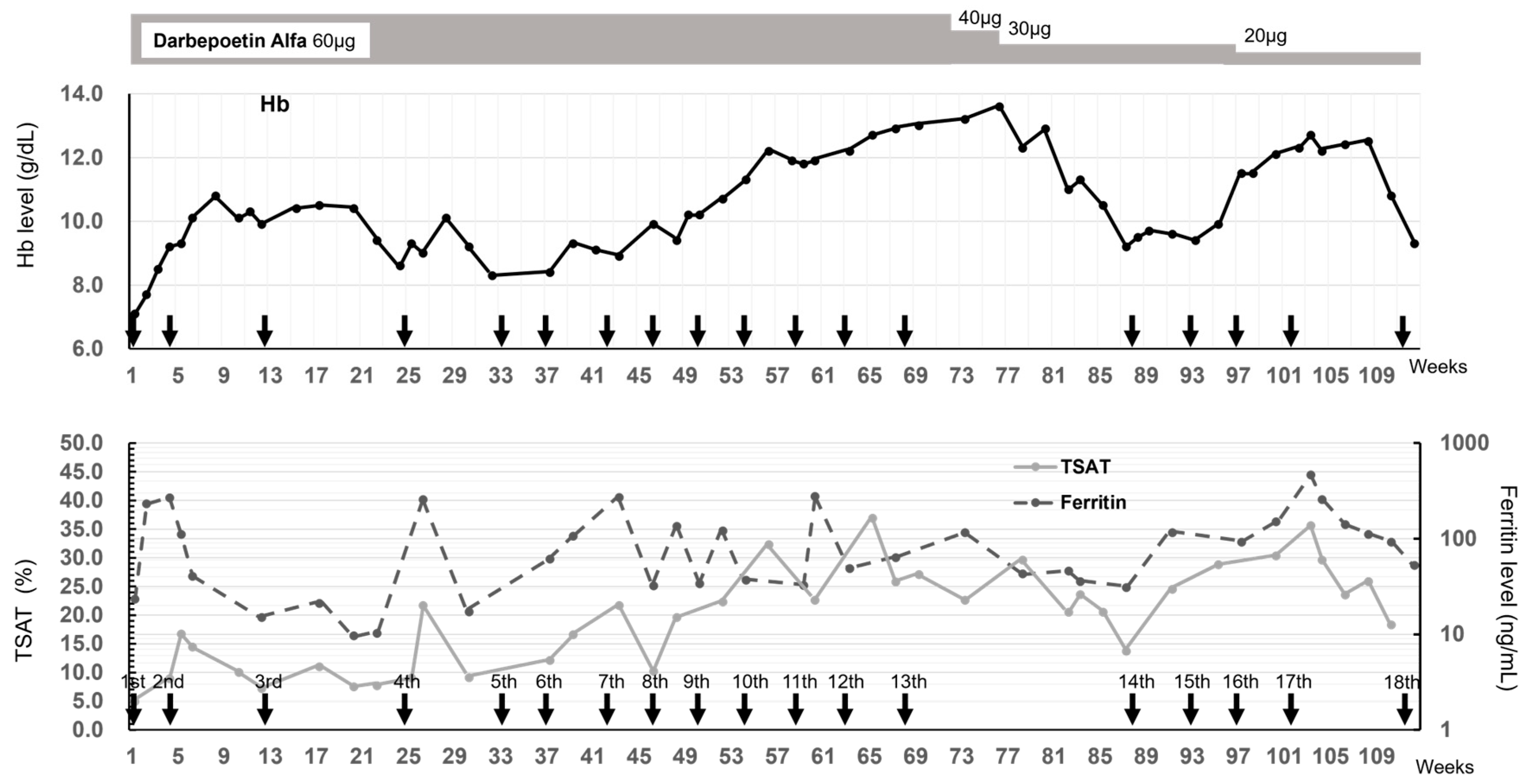
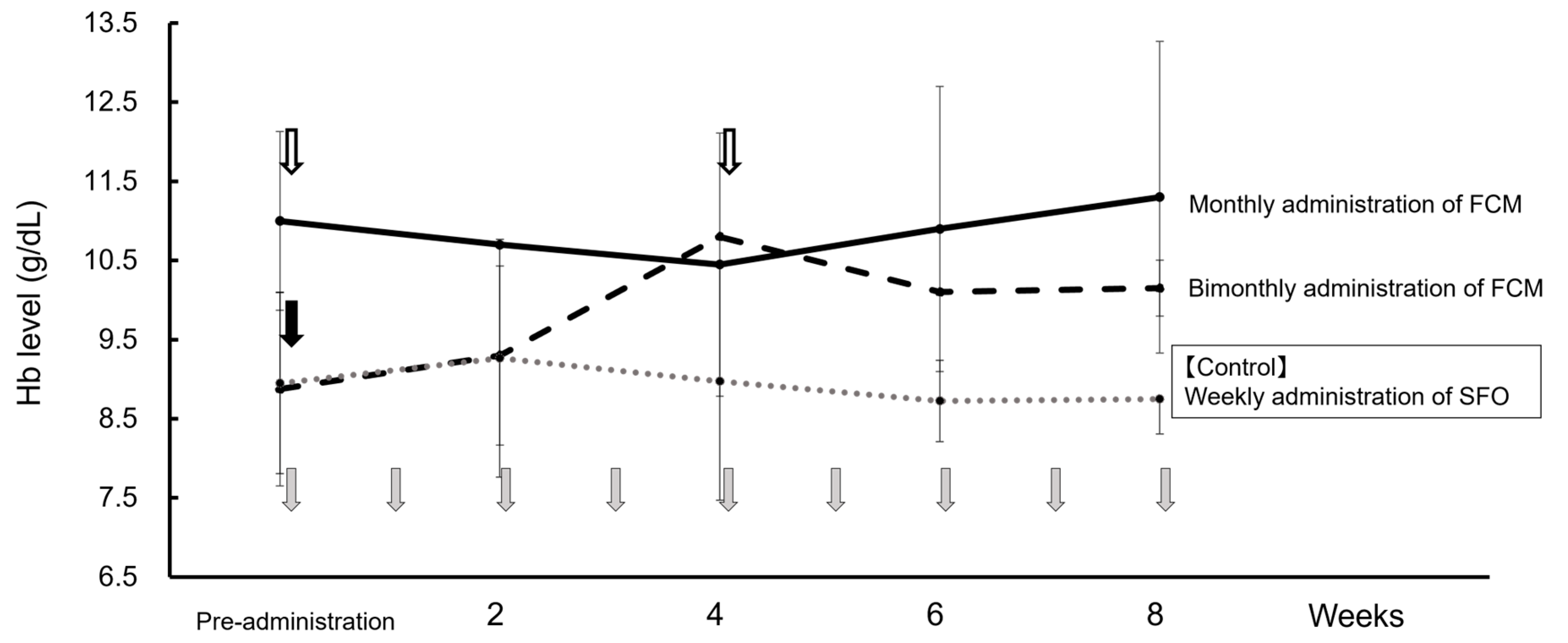
 dashed line), fifth–twelfth: monthly administration of FCM (
 solid line), and weekly administration of SFO as a control drug before FCM administration (
 dotted line). Data are shown as mean ± standard.
dashed line), fifth–twelfth: monthly administration of FCM ( solid line), and weekly administration of SFO as a control drug before FCM administration ( dotted line). Data are shown as mean ± standard.
dotted line). Data are shown as mean ± standard.
dashed line), fifth–twelfth: monthly administration of FCM ( solid line), and weekly administration of SFO as a control drug before FCM administration ( dotted line). Data are shown as mean ± standard.

| Blood Counts | Biochemistry | |||||||||
|---|---|---|---|---|---|---|---|---|---|---|
| WBC | 9100 | /μL | TP | 5.7 | g/dL | Na | 141 | mmol/L | ||
| RBC | 261 × 104 | /μL | Alb | 3.1 | g/dL | K | 5.2 | mmol/L | ||
| Hb | 7.1 | g/dL | BUN | 78.3 | mg/dL | Cl | 106 | mmol/L | ||
| Ht | 24.2 | % | Cr | 14.22 | mg/dL | Ca | 8.6 | mg/dL | ||
| MCV | 92.7 | fL | UA | 10.6 | mg/dL | IP | 5.8 | mg/dL | ||
| MCH | 27.2 | pg | AST | 24 | U/L | Mg | 2.4 | mg/dL | ||
| MCHC | 29.3 | g/dL | ALT | 25 | U/L | CRP | 0.115 | mg/dL | ||
| Reticulocytes | 30 | ‰ | ALP | 59 | U/L | Fe | 18 | μg/dL | ||
| Plt | 26.6 × 10⁴ | /μL | LDH | 190 | U/L | TIBC | 364 | μg/dL | ||
| γGTP | 14 | U/L | TSAT | 4.9 | % | |||||
| TC | 134 | mg/dL | Ferritin | 23.2 | ng/mL | |||||
| Authors /Country (a) | Design | Patients (Number) | Treatment | FCM AP | Results |
|---|---|---|---|---|---|
| Covic et al., [18]/Romania | Multicenter, open-label, single-arm, Phase II study | HD (163) | FCM 100 or 200 mg, two to three sessions per week for a maximum of 6 W Hb ≤ 11.0 g/dL and either ferritin ≤200 µg/L or TSAT < 20% | Maximum 6 W | Mean Hb levels increased at 2 W after the first administration and continued to increase through the observation period at follow-up. Within the 2 W following the first administration FCM, ferritin levels and TSAT had increased until the final follow-up visit. 3.1% patients discontinued study medication due to an AE. |
| Hofman et al., [19] /Netherlands | Retrospective study | HD (221) | Treated with IS 100 mg for 6 M and after washout period with FCM 100 mg for 9 M according to the following criteria. The shift IS to FCM, IS 100 mg or FCM 100 mg TSAT < 20% or Ferritin < 200 µg/L, every week TSAT 20–30% and/or Ferritin 200–500 µg/L, every 2 W TSAT 30–50% and/or Ferritin 500–800 µg/L, every 4 W TSAT > 50% and/or Ferritin > 800 µg/L, no administration | 9 M | The dosage of iron medication decreased significantly after switch from IS to FCM (p = 0.04), Hb (p < 0.001) and hematocrit (p < 0.001) increased significantly. After the switch from IS to FCM, ferritin increased significantly (p < 0.001) as well as TSAT (p < 0.001). |
| Lacquaniti et al., [20]/Italy | Retrospective study | HD (b) (25) | Treated with FG 125 mg for 2Y and after washout period with FCM 100 mg for 2 Y according to the following criteria. TSAT < 20% and/or Ferritin < 200 µg, every week TSAT 20–30% and/or Ferritin 200–500 µg, every 2 W TSAT 30–50% and/or Ferritin 500–800 µg, every month | 2 Y | FCM increased TSAT levels by 11.9% (p < 0.001) with respect to FG. Events of TSAT less than 20% were reduced during FCM. The monthly dose of EPO was reduced in the FCM period (p = 0.004). During the period with FCM, ferritin levels were higher than during FG (p < 0.001), while transferrin was reduced (p = 0.001). |
| Gobbi et al., [21]/Italy | Single-center, open-label, uncontrolled, prospective study | HD (b) (24) | FG 125 mg once a week was switched to FCM administration protocol as follows. Ferritin < 100 µg/L, once a week 200 mg Ferritin 100–250 µg/L, once a week 100 mg Ferritin 250–500 µg/L, every 2 W 100 mg Ferritin > 500 µg/L, no administration | 12 M | At FCM protocol, ferritin, TSAT, and Hb levels significantly increased (p = 0.001). Mean EPO consumption significantly decreased (p = 0.001). No patient needed RBC transfusions during the follow-up. No gastrointestinal or other AEs were reported. |
| Rosati et al., [22]/Italy | Retrospective multicenter observational study | HD (b) (77) | FG treatment was switched to FCM treatment, when anemic HD patients were unresponsive to FG treatment. The mean dose for the entire period of FG treatment was 394 ± 203 mg compared to 412 ± 243 mg in the period under FCM treatment with no statistical difference between them. | 6 M | ERI decreased from 24.2 ± 14.6 at pre-switch to 20.4 ± 14.6 after FCM and Hb levels ≥10.5 g/dL improved from 61% to 75.3% patients (p = 0.042). A 1 g/dL increase in Hb levels was seen in 26% of patients as well as a 37.7% increase in patients achieving >20% increase in TSAT after FCM. Levels of Hb, TSAT and ferritin increased during FCM treatment with a concomitant decrease in ESAs. No hypersensitivity reaction was recorded and only one patient reported an AE after FCM. FCM treatment was associated with a cost saving. |
| Portolés-Pérezi et al., [23]/Spain | Multicenter, retrospective study | PD (91) | FCM 500 or 1000 mg, TSAT < 20% or Ferritin < 100 µg/L TSAT > 20% and Ferritin 200–800 µg/L Ferritin > 800 µg/L, no administration | 12 M | 68.6% of patients achieved ferritin levels of 200–800 ng/mL, 78.4% achieved TSAT > 20%, and 62.8% achieved TSAT > 20% and ferritin > 200 ng/mL after 12 M of FCM initiation (p < 0.01). Hb levels were maintained at >11 g/dL with a lower dose of darbepoetin throughout the follow-up. No hypersensitivity reaction, FCM discontinuation or dose adjustment due to a serious AE was registered. |
| Diebold and Kistler [24] /Switzerland | Prospective observational study | HD (b) (39) | FCM 100 or 200 mg, every 4 W Defined by ESAs dose adjustments of <25% within the last 2 M. Hb values between 95 g/L and 125 g/L within the last 12 W with a difference between the lowest and the highest value of <15 g/L | 2 M or more | Ferritin values increased by 113 ± 72.2 µg/L (p < 0.001) from baseline to the peak value and remained significantly elevated until 2 W after the administration of 100 mg FCM. After the administration of 200 mg FCM, ferritin values increased by 188.5 ± 67.56 µg/L (p < 0.001) and remained significantly elevated by the end of week 3. TSAT values increased by 12.0 ± 9.7% (p < 0.001) and 23.1 ± 20.4% (p = 0.002) in patients receiving FCM, respectively, and returned to baseline within 4 D. |
Disclaimer/Publisher’s Note: The statements, opinions and data contained in all publications are solely those of the individual author(s) and contributor(s) and not of MDPI and/or the editor(s). MDPI and/or the editor(s) disclaim responsibility for any injury to people or property resulting from any ideas, methods, instructions or products referred to in the content. |
© 2025 by the authors. Licensee MDPI, Basel, Switzerland. This article is an open access article distributed under the terms and conditions of the Creative Commons Attribution (CC BY) license (https://creativecommons.org/licenses/by/4.0/).
Share and Cite
Ueno, M.; Hirai, F.; Fuji, A.; Shimomura, Y.; Uemoto, K.; Masutani, K.; Saito, T. Patient with Secondary Amyloidosis Due to Crohn’s Disease on Hemodialysis Effectively Treated with Ferric Carboxymaltose Injections: A Case Report and Literature Review. Diseases 2025, 13, 125. https://doi.org/10.3390/diseases13040125
Ueno M, Hirai F, Fuji A, Shimomura Y, Uemoto K, Masutani K, Saito T. Patient with Secondary Amyloidosis Due to Crohn’s Disease on Hemodialysis Effectively Treated with Ferric Carboxymaltose Injections: A Case Report and Literature Review. Diseases. 2025; 13(4):125. https://doi.org/10.3390/diseases13040125
Chicago/Turabian StyleUeno, Masayo, Fumihito Hirai, Asami Fuji, Yuko Shimomura, Keiko Uemoto, Kosuke Masutani, and Takao Saito. 2025. "Patient with Secondary Amyloidosis Due to Crohn’s Disease on Hemodialysis Effectively Treated with Ferric Carboxymaltose Injections: A Case Report and Literature Review" Diseases 13, no. 4: 125. https://doi.org/10.3390/diseases13040125
APA StyleUeno, M., Hirai, F., Fuji, A., Shimomura, Y., Uemoto, K., Masutani, K., & Saito, T. (2025). Patient with Secondary Amyloidosis Due to Crohn’s Disease on Hemodialysis Effectively Treated with Ferric Carboxymaltose Injections: A Case Report and Literature Review. Diseases, 13(4), 125. https://doi.org/10.3390/diseases13040125