


Orbital Radiotherapy for Graves’ Ophthalmopathy: Single Institutional Experience of Efficacy and Safety

 ,
,  , , and
Abstract
1. Introduction
2. Materials and Methods
3. Results
4. Discussion
5. Conclusions
Author Contributions
Funding
Institutional Review Board Statement
Informed Consent Statement
Data Availability Statement
Acknowledgments
Conflicts of Interest
Correction Statement
References
- Bello, O.M.; Druce, M.; Ansari, E. Graves’ Ophthalmopathy: The Clinical and Psychosocial Outcomes of Different Medical Interventions—A Systematic Review. BMJ Open Ophthalmol. 2024, 9, e001515. [Google Scholar] [CrossRef] [Scilit] [PubMed]
- Liardo, R.L.E.; Borzì, A.M.; Spatola, C.; Martino, B.; Privitera, G.; Basile, F.; Biondi, A.; Vacante, M. Effects of Infections on the Pathogenesis of Cancer. Indian J. Med. Res. 2021, 153, 431–445. [Google Scholar] [CrossRef] [Scilit] [PubMed]
- Wémeau, J.-L.; Klein, M.; Sadoul, J.-L.; Briet, C.; Vélayoudom-Céphise, F.-L. Graves’ Disease: Introduction, Epidemiology, Endogenous and Environmental Pathogenic Factors. Ann. Endocrinol. 2018, 79, 599–607. [Google Scholar] [CrossRef] [Scilit] [PubMed]
- Ohtsuka, K.; Sato, A.; Kawaguchi, S.; Hashimoto, M.; Suzuki, Y. Effect of Steroid Pulse Therapy with and without Orbital Radiotherapy on Graves’ Ophthalmopathy. Am. J. Ophthalmol. 2003, 135, 285–290. [Google Scholar] [CrossRef] [Scilit]
- Matthiesen, C.; Thompson, J.S.; Thompson, D.; Farris, B.; Wilkes, B.; Ahmad, S.; Herman, T.; Bogardus, C. The Efficacy of Radiation Therapy in the Treatment of Graves’ Orbitopathy. Int. J. Radiat. Oncol. Biol. Phys. 2012, 82, 117–123. [Google Scholar] [CrossRef] [Scilit]
- Bahn, R.S. Thyrotropin Receptor Expression in Orbital Adipose/Connective Tissues from Patients with Thyroid-Associated Ophthalmopathy. Thyroid. 2002, 12, 193–195. [Google Scholar] [CrossRef] [Scilit]
- Perros, P.; Žarković, M.P.; Panagiotou, G.C.; Azzolini, C.; Ayvaz, G.; Baldeschi, L.; Bartalena, L.; Boschi, A.M.; Nardi, M.; Brix, T.H.; et al. Asymmetry Indicates More Severe and Active Disease in Graves’ Orbitopathy: Results from a Prospective Cross-Sectional Multicentre Study. J. Endocrinol. Investig. 2020, 43, 1717–1722. [Google Scholar] [CrossRef] [Scilit]
- Viani, G.A.; Boin, A.C.; De Fendi, L.I.; Fonseca, E.C.; Stefano, E.J.; de Paula, J.S. Radiation Therapy for Graves’ Ophthalmopathy: A Systematic Review and Meta-Analysis of Randomized Controlled Trials. Arq. Bras. Oftalmol. 2012, 75, 324–332. [Google Scholar] [CrossRef] [Scilit]
- Rundle, F.F.; Wilson, C.W. Development and Course of Exophthalmos and Ophthalmoplegia in Graves’ Disease with Special Reference to the Effect of Thyroidectomy. Clin. Sci. 1945, 5, 177–194. [Google Scholar]
- Bartley, G.B. Rundle and His Curve. Arch. Ophthalmol. 2011, 129, 356–358. [Google Scholar] [CrossRef] [Scilit]
- Le Moli, R.; Muscia, V.; Tumminia, A.; Frittitta, L.; Buscema, M.; Palermo, F.; Sciacca, L.; Squatrito, S.; Vigneri, R. Type 2 Diabetic Patients with Graves’ Disease Have More Frequent and Severe Graves’ Orbitopathy. Nutr. Metab. Cardiovasc. Dis. 2015, 25, 452–457. [Google Scholar] [CrossRef] [Scilit] [PubMed]
- Viebahn, M.; Barricks, M.E.; Osterloh, M.D. Synergism between Diabetic and Radiation Retinopathy: Case Report and Review. Br. J. Ophthalmol. 1991, 75, 629–632. [Google Scholar] [CrossRef] [Scilit] [PubMed]
- Lanzolla, G.; Vannucchi, G.; Ionni, I.; Campi, I.; Sileo, F.; Lazzaroni, E.; Marinò, M. Cholesterol Serum Levels and Use of Statins in Graves’ Orbitopathy: A New Starting Point for the Therapy. Front. Endocrinol. 2019, 10, 933. [Google Scholar] [CrossRef] [Scilit] [PubMed]
- Bartalena, L.; Kahaly, G.J.; Baldeschi, L.; Dayan, C.M.; Eckstein, A.; Marcocci, C.; Marinò, M.; Vaidya, B.; Wiersinga, W.M.; Ayvaz, G.; et al. The 2021 European Group on Graves’ Orbitopathy (EUGOGO) Clinical Practice Guidelines for the Medical Management of Graves’ Orbitopathy. Eur. J. Endocrinol. 2021, 185, G43–G67. [Google Scholar] [CrossRef] [Scilit]
- Choi, J.H.; Lee, J.K. Efficacy of Orbital Radiotherapy in Moderate-to-Severe Active Graves’ Orbitopathy Including Long-Lasting Disease: A Retrospective Analysis. Radiat. Oncol. 2020, 15, 220. [Google Scholar] [CrossRef] [Scilit]
- Bartalena, L.; Marcocci, C.; Tanda, M.L.; Rocchi, R.; Mazzi, B.; Barbesino, G.; Pinchera, A. Orbital Radiotherapy for Graves’ Ophthalmopathy. Thyroid 2002, 12, 245–250. [Google Scholar] [CrossRef] [Scilit]
- Donaldson, S.S.; Bagshaw, M.A.; Kriss, J.P. Supervoltage Orbital Radiotherapy for Graves’ Ophthalmopathy. J. Clin. Endocrinol. Metab. 1973, 37, 276–285. [Google Scholar] [CrossRef] [Scilit]
- La Rocca, M.; Leonardi, B.F.; Lo Greco, M.C.; Marano, G.; Finocchiaro, I.; Iudica, A.; Milazzotto, R.; Liardo, R.L.E.; La Monaca, V.A.; Salamone, V.; et al. Radiotherapy of Orbital and Ocular Adnexa Lymphoma: Literature Review and University of Catania Experience. Cancers 2023, 15, 5782. [Google Scholar] [CrossRef] [Scilit]
- Spatola, C.; Liardo, R.L.E.; Milazzotto, R.; Raffaele, L.; Salamone, V.; Basile, A.; Foti, P.V.; Palmucci, S.; Cirrone, G.A.P.; Cuttone, G.; et al. Radiotherapy of Conjunctival Melanoma: Role and Challenges of Brachytherapy, Photon-Beam and Protontherapy. Appl. Sci. 2020, 10, 9071. [Google Scholar] [CrossRef] [Scilit]
- Common Terminology Criteria for Adverse Events (CTCAE).
- Baldeschi, L.; Macandie, K.; Koetsier, E.; Blank, L.E.C.M.; Wiersinga, W.M. The Influence of Previous Orbital Irradiation on the Outcome of Rehabilitative Decompression Surgery in Graves Orbitopathy. Am. J. Ophthalmol. 2008, 145, 534–540.e1. [Google Scholar] [CrossRef] [Scilit]
- Schaue, D.; Jahns, J.; Hildebrandt, G.; Trott, K.-R. Radiation Treatment of Acute Inflammation in Mice. Int. J. Radiat. Biol. 2005, 81, 657–667. [Google Scholar] [CrossRef] [Scilit] [PubMed]
- Douglas, R.S.; Kahaly, G.J.; Patel, A.; Sile, S.; Thompson, E.H.Z.; Perdok, R.; Fleming, J.C.; Fowler, B.T.; Marcocci, C.; Marinò, M.; et al. Teprotumumab for the Treatment of Active Thyroid Eye Disease. N. Engl. J. Med. 2020, 382, 341–352. [Google Scholar] [CrossRef] [Scilit] [PubMed]
- Rödel, F.; Kamprad, F.; Sauer, R.; Hildebrandt, G. Functional and molecular aspects of anti-inflammatory effects of low-dose radiotherapy. Strahlenther. Onkol. 2002, 178, 1–9. [Google Scholar] [CrossRef] [Scilit] [PubMed]
- Beige, A.; Boustani, J.; Bouillet, B.; Truc, G. Management of Graves’ Ophthalmopathy by Radiotherapy: A Literature Review. Cancer Radiother. 2024, 28, 282–289. [Google Scholar] [CrossRef] [Scilit]
- Verrienti, M.; Gagliardi, I.; Valente, L.; Stefanelli, A.; Borgatti, L.; Franco, E.; Galiè, M.; Bondanelli, M.; Zatelli, M.C.; Ambrosio, M.R. Late Orbital Radiotherapy Combined with Intravenous Methylprednisolone in the Management of Long-Lasting Active Graves’ Orbitopathy: A Case Report and Literature Review. Endocrine 2024, 85, 576–583. [Google Scholar] [CrossRef] [Scilit]
- North, V.S.; Dolman, P.J.; Garrity, J.A.; Kazim, M. Disease Modulation Versus Modification: A Call for Revised Outcome Metrics in the Treatment of Thyroid Eye Disease. Ophthalmic Plast. Reconstr. Surg. 2024, 40, 156–160. [Google Scholar] [CrossRef] [Scilit]
- Han, Q.; Mao, X.; Tian, S. A Retrospective Study on the Effectiveness of Intensity Modulated Radiation Therapy for Thyroid Associated Ophthalmopathy at a Single Institute. Sci. Rep. 2024, 14, 17834. [Google Scholar] [CrossRef] [Scilit]
- Wakelkamp, I.M.M.J.; Tan, H.; Saeed, P.; Schlingemann, R.O.; Verbraak, F.D.; Blank, L.E.C.M.; Prummel, M.F.; Wiersinga, W.M. Orbital Irradiation for Graves’ Ophthalmopathy: Is It Safe? A Long-Term Follow-up Study. Ophthalmology 2004, 111, 1557–1562. [Google Scholar] [CrossRef] [Scilit]
- Kim, J.W.; Han, S.H.; Son, B.J.; Rim, T.H.; Keum, K.C.; Yoon, J.S. Efficacy of Combined Orbital Radiation and Systemic Steroids in the Management of Graves’ Orbitopathy. Graefes Arch. Clin. Exp. Ophthalmol. 2016, 254, 991–998. [Google Scholar] [CrossRef] [Scilit]
- Bartalena, L.; Marcocci, C.; Chiovato, L.; Laddaga, M.; Lepri, G.; Andreani, D.; Cavallacci, G.; Baschieri, L.; Pinchera, A. Orbital Cobalt Irradiation Combined with Systemic Corticosteroids for Graves’ Ophthalmopathy: Comparison with Systemic Corticosteroids Alone. J. Clin. Endocrinol. Metab. 1983, 56, 1139–1144. [Google Scholar] [CrossRef] [Scilit]
- Marcocci, C.; Bartalena, L.; Panicucci, M.; Marconcini, C.; Cartei, F.; Cavallacci, G.; Laddaga, M.; Campobasso, G.; Baschieri, L.; Pinchera, A. Orbital Cobalt Irradiation Combined with Retrobulbar or Systemic Corticosteroids for Graves’ Ophthalmopathy: A Comparative Study. Clin. Endocrinol. 1987, 27, 33–42. [Google Scholar] [CrossRef] [Scilit] [PubMed]
- Wang, S.-C.; Wu, J.; Xie, X.-Q.; Liu, X.-L.; Luo, Y.; Wang, F.; Li, Z.-P.; Qu, B.-L.; Kang, J.-B.; Wu, D.-B.; et al. Comparison of IMRT and VMAT Radiotherapy Planning for Graves’ Ophthalmopathy Based on Dosimetric Parameters Analysis. Eur. Rev. Med. Pharmacol. Sci. 2020, 24, 3898–3906. [Google Scholar] [CrossRef] [Scilit] [PubMed]
- Gorman, C.A.; Garrity, J.A.; Fatourechi, V.; Bahn, R.S.; Petersen, I.A.; Stafford, S.L.; Earle, J.D.; Forbes, G.S.; Kline, R.W.; Bergstralh, E.J.; et al. A Prospective, Randomized, Double-Blind, Placebo-Controlled Study of Orbital Radiotherapy for Graves’ Ophthalmopathy. Ophthalmology 2001, 108, 1523–1534. [Google Scholar] [CrossRef] [Scilit] [PubMed]
- Kahaly, G.J.; Rösler, H.P.; Pitz, S.; Hommel, G. Low- versus High-Dose Radiotherapy for Graves’ Ophthalmopathy: A Randomized, Single Blind Trial. J. Clin. Endocrinol. Metab. 2000, 85, 102–108. [Google Scholar] [CrossRef] [Scilit]
- Mourits, M.P.; van Kempen-Harteveld, M.L.; García, M.B.; Koppeschaar, H.P.; Tick, L.; Terwee, C.B. Radiotherapy for Graves’ Orbitopathy: Randomised Placebo-Controlled Study. Lancet 2000, 355, 1505–1509. [Google Scholar] [CrossRef] [Scilit]
- Kahaly, G.J.; Subramanian, P.S.; Conrad, E.; Holt, R.J.; Smith, T.J. Long-Term Efficacy of Teprotumumab in Thyroid Eye Disease: Follow-Up Outcomes in Three Clinical Trials. Thyroid 2024, 34, 880–889. [Google Scholar] [CrossRef] [Scilit]
- Stiebel-Kalish, H.; Robenshtok, E.; Hasanreisoglu, M.; Ezrachi, D.; Shimon, I.; Leibovici, L. Treatment Modalities for Graves’ Ophthalmopathy: Systematic Review and Metaanalysis. J. Clin. Endocrinol. Metab. 2009, 94, 2708–2716. [Google Scholar] [CrossRef] [Scilit]
- X-Ray Treatment of Malignant Exophthalmos: A Report on 28 Patients—PubMed. Available online: https://pubmed.ncbi.nlm.nih.gov/13084727/ (accessed on 10 November 2024).
- The Efficacy of Intensity Modulated Radiation Therapy in Treating Thyroid-Associated Ophthalmopathy and Predictive Factors for Treatment Response|Scientific Reports. Available online: https://www.nature.com/articles/s41598-017-17893-y (accessed on 10 November 2024).
- Petersen, I.A.; Kriss, J.P.; McDougall, I.R.; Donaldson, S.S. Prognostic Factors in the Radiotherapy of Graves’ Ophthalmopathy. Int. J. Radiat. Oncol. Biol. Phys. 1990, 19, 259–264. [Google Scholar] [CrossRef] [Scilit]
- A Randomized Controlled Trial of Orbital Radiotherapy Versus Sham Irradiation in Patients with Mild Graves’ Ophthalmopathy—PubMed. Available online: https://pubmed.ncbi.nlm.nih.gov/14715820/ (accessed on 10 November 2024).
- Lee, V.H.F.; Ng, S.C.Y.; Choi, C.W.; Luk, M.Y.; Leung, T.W.; Au, G.K.H.; Kwong, D.L.W. Comparative Analysis of Dosimetric Parameters of Three Different Radiation Techniques for Patients with Graves’ Ophthalmopathy Treated with Retro-Orbital Irradiation. Radiat. Oncol. 2012, 7, 199. [Google Scholar] [CrossRef] [Scilit]
- Spatola, C.; Militello, C.; Tocco, A.; Salamone, V.; Raffaele, L.; Migliore, M.; Pagana, A.; Milazzotto, R.; Chillura, I.; Pergolizzi, S.; et al. Intensity-Modulated Radiotherapy for Relapsed Malignant Pleural Mesothelioma. Future Oncol. 2016, 12, 67–71. [Google Scholar] [CrossRef] [Scilit]
- Zygulska, A. Radiotherapy in the Treatment of Graves Ophthalmopathy-to Do It or Not? J. Ocul. Biol. Dis. Inform. 2009, 3, 1–11. [Google Scholar] [CrossRef] [Scilit] [PubMed]
- Nakahara, H.; Noguchi, S.; Murakami, N.; Morita, M.; Tamaru, M.; Ohnishi, T.; Hoshi, H.; Jinnouchi, S.; Nagamachi, S.; Futami, S. Graves Ophthalmopathy: MR Evaluation of 10-Gy versus 24-Gy Irradiation Combined with Systemic Corticosteroids. Radiology 1995, 196, 857–862. [Google Scholar] [CrossRef] [Scilit] [PubMed]
- Johnson, K.T.M.; Wittig, A.; Loesch, C.; Esser, J.; Sauerwein, W.; Eckstein, A.K. A Retrospective Study on the Efficacy of Total Absorbed Orbital Doses of 12, 16 and 20 Gy Combined with Systemic Steroid Treatment in Patients with Graves’ Orbitopathy. Graefes Arch. Clin. Exp. Ophthalmol. 2010, 248, 103–109. [Google Scholar] [CrossRef] [Scilit]
- Weissmann, T.; Lettmaier, S.; Donaubauer, A.-J.; Bert, C.; Schmidt, M.; Kruse, F.; Ott, O.; Hecht, M.; Fietkau, R.; Frey, B.; et al. Low- vs. High-Dose Radiotherapy in Graves’ Ophthalmopathy: A Retrospective Comparison of Long-Term Results. Strahlenther. Onkol. 2021, 197, 885–894. [Google Scholar] [CrossRef] [Scilit]
- Gerling, J.; Kommerell, G.; Henne, K.; Laubenberger, J.; Schulte-Mönting, J.; Fells, P. Retrobulbar Irradiation for Thyroid-Associated Orbitopathy: Double-Blind Comparison between 2.4 and 16 Gy. Int. J. Radiat. Oncol. Biol. Phys. 2003, 55, 182–189. [Google Scholar] [CrossRef] [Scilit]
- Efficacy of B-Cell Targeted Therapy with Rituximab in Patients with Active Moderate to Severe Graves’ Orbitopathy: A Randomized Controlled Study—PubMed. Available online: https://pubmed.ncbi.nlm.nih.gov/25494967/ (accessed on 10 November 2024).
- Wiersinga, W.M. Advances in Treatment of Active, Moderate-to-Severe Graves’ Ophthalmopathy. Lancet Diabetes Endocrinol. 2017, 5, 134–142. [Google Scholar] [CrossRef] [Scilit]
- Stan, M.N.; Garrity, J.A.; Carranza Leon, B.G.; Prabin, T.; Bradley, E.A.; Bahn, R.S. Randomized Controlled Trial of Rituximab in Patients with Graves’ Orbitopathy. J. Clin. Endocrinol. Metab. 2015, 100, 432–441. [Google Scholar] [CrossRef] [Scilit]
- Perez-Moreiras, J.V.; Gomez-Reino, J.J.; Maneiro, J.R.; Perez-Pampin, E.; Romo Lopez, A.; Rodríguez Alvarez, F.M.; Castillo Laguarta, J.M.; Del Estad Cabello, A.; Gessa Sorroche, M.; España Gregori, E.; et al. Efficacy of Tocilizumab in Patients With Moderate-to-Severe Corticosteroid-Resistant Graves Orbitopathy: A Randomized Clinical Trial. Am. J. Ophthalmol. 2018, 195, 181–190. [Google Scholar] [CrossRef] [Scilit]
- Marcocci, C.; Bartalena, L.; Bogazzi, F.; Bruno-Bossio, G.; Lepri, A.; Pinchera, A. Orbital Radiotherapy Combined with High Dose Systemic Glucocorticoids for Graves’ Ophthalmopathy Is More Effective than Radiotherapy Alone: Results of a Prospective Randomized Study. J. Endocrinol. Investig. 1991, 14, 853–860. [Google Scholar] [CrossRef] [Scilit]
- Douglas, R.S.; Dailey, R.; Subramanian, P.S.; Barbesino, G.; Ugradar, S.; Batten, R.; Qadeer, R.A.; Cameron, C. Proptosis and Diplopia Response With Teprotumumab and Placebo vs the Recommended Treatment Regimen With Intravenous Methylprednisolone in Moderate to Severe Thyroid Eye Disease: A Meta-Analysis and Matching-Adjusted Indirect Comparison. JAMA Ophthalmol. 2022, 140, 328–335. [Google Scholar] [CrossRef] [Scilit]
- Teprotumumab Efficacy, Safety, and Durability in Longer-Duration Thyroid Eye Disease and Re-Treatment: OPTIC-X Study—PubMed. Available online: https://pubmed.ncbi.nlm.nih.gov/34688699/ (accessed on 10 November 2024).

| Inclusion Criteria: | Exclusion Criteria: |
|---|---|
| Age > 18 years. Active GO with CAS > 3 or CAS = 3 with severely progressive dysmotility. CT of the orbits shows characteristic features of GO (thickening of straight muscles in both orbits, increased fat tissue, damaged optic nerve, enlargement of the lacrimal gland). Administration of glucocorticoids i.v. Duration of onset symptoms (≤12 months). Start of combined treatment within the first year after initial diagnosis of GO. Bilateral disease. Follow-up of at least 6 months following irradiation. | Inactive disease. More than 1 year after the initial diagnosis. Optic nerve compression orbital decompression surgery before RT. Lack of steroid treatment within the past 3 months. More than one course of systemic steroids. Unilateral disease. Previous RT of the eye region. History of other eye diseases (i.e., glaucoma, diabetic retinopathy, maculopathy). |
| Clinical Activity Score (CAS) |
|---|
|
| Grade | Characteristics |
|---|---|
| Mild | Minor impact on daily QoL (immunomodulation or surgical treatment are not necessary). One or more of the following:
|
| Moderate to severe | Not sight-threatening but a sufficient impact on QoL if immunosuppression (if active GO) or surgical intervention (if inactive GO) is needed. Two or more of the following:
|
| Very severe (sight-threatening) | Presence of dysthyroid optic neuropathy and/or corneal breakdown |
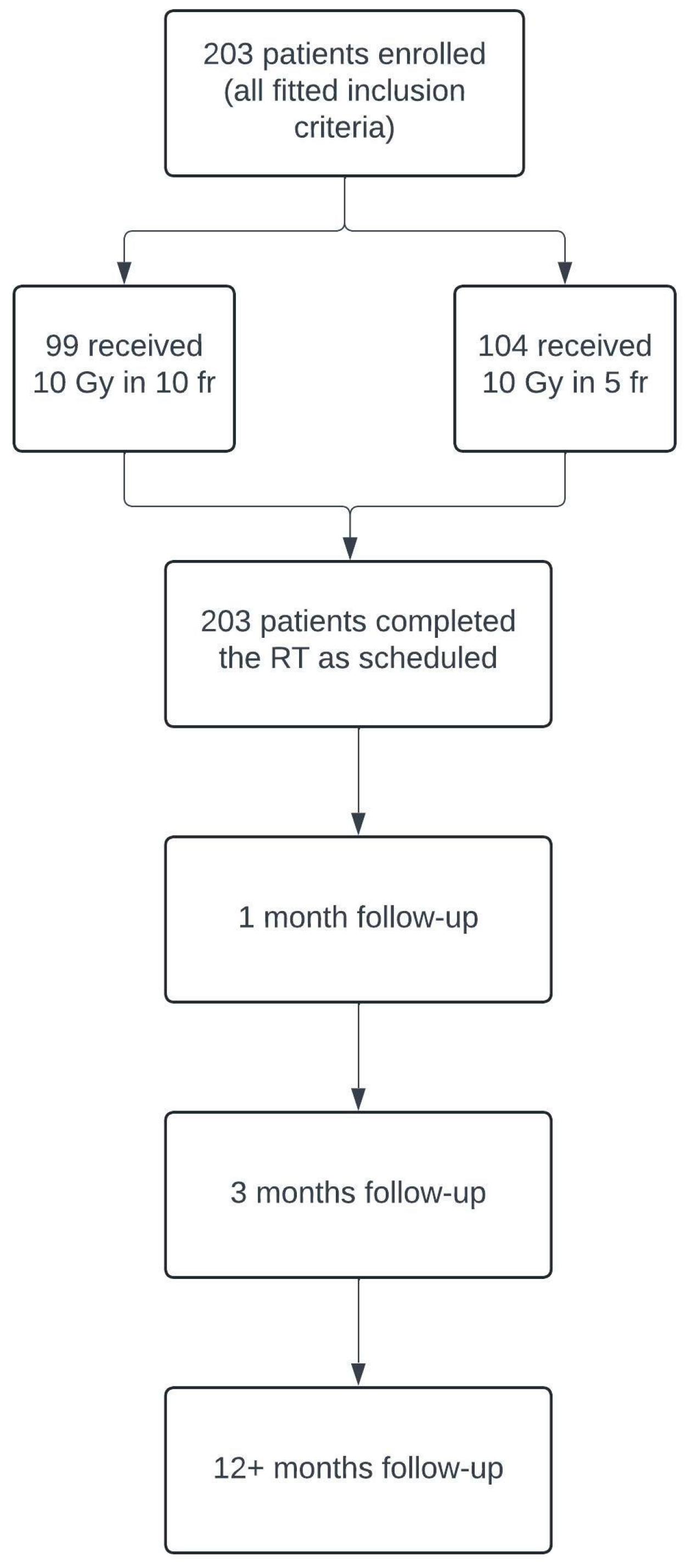
| Total (n = 203) | 10 Gy/10 fr (n = 99) | 10 Gy/5 fr (n = 104) |
|---|---|---|
| Median Age | 56.4 (range: 36–78) | |
| Sex | ||
| Male | 33 (33.3%) | 36 (34.6%) |
| Female | 66 (66.6%) | 68 (65.38%) |
| Smoking | ||
| Yes | 31 (31.3%) | 28 (26.9%) |
| No | 68 (68.7%) | 76 (73.1%) |
| Diabetes | ||
| Yes | 12 (12.1%) | 18 (17.3%) |
| No | 87 (87.9%) | 86 (82.7%) |
| Thyroid status at diagnosis | ||
| Normal | 64 (64.6%) | 72 (30.8%) |
| Hyperthyreosis | 35 (35.4%) | 32 (69.2%) |
| Active treatment of hyperthyreosis | ||
| Yes | 17 (17.2%) | 26 (25%) |
| No | 82 (82.8%) | 78 (75%) |
| Pre-treatment TSH, T3, T4, FT4 levels | ||
| Normal | 90 (91%) | 92 (88.5%) |
| Elevated | 9 (9%) | 12 (11.5%) |
| Interval from onset of ocular symptoms to RT, months 8.2 (6–11.5) | ||
| CAS at baseline | ||
| 4 | 37 (18.2%) | |
| 5 | 82 (40.3%) | |
| 6 | 69 (33.9%) | |
| 7 | 15 (7.4%) | |
| Proptosis at diagnosis | ||
| 3 mm | 28 (13.79%) | |
| 4 mm | 115 (56.65%) | |
| 5 mm | 60 (29.56%) | |
| Symptoms at diagnosis | ||
| Proptosis | 120 (63.8%) | |
| Edema | 180 (95.7%) | |
| Diplopia | 125 (66.5%) | |
| Tearing/eye burning | 86 (44.7%) | |
| Pain | 74 (39.4%) | |
| Visual acuity | 103 (54.8%) | |
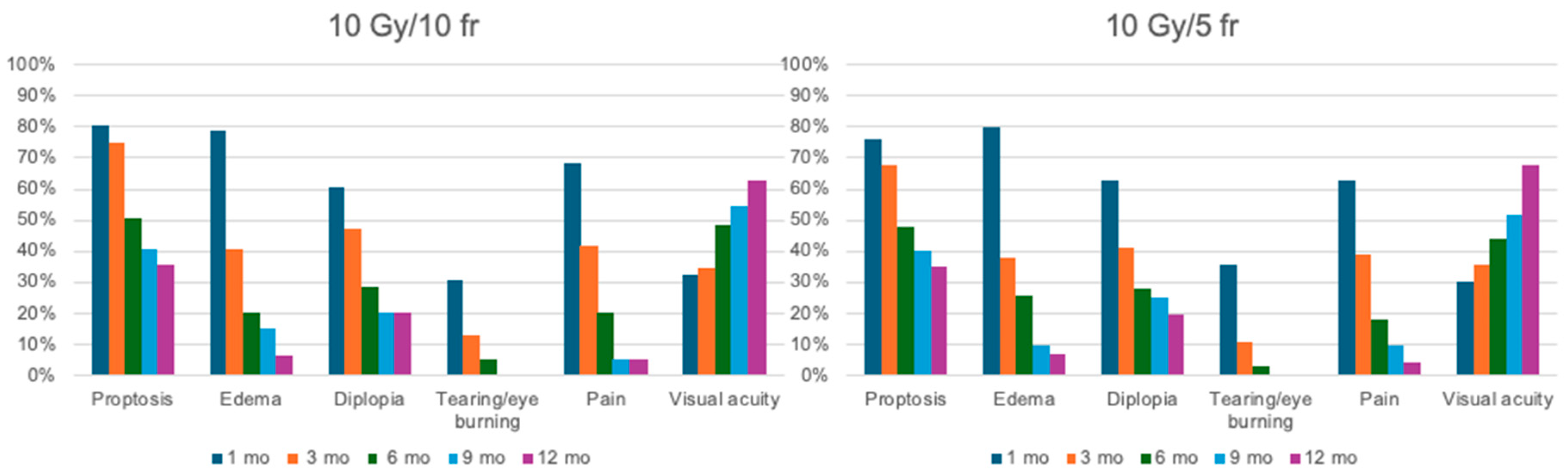
| 10 Gy/10 Fractions | 1 Month | 3 Months | 6 Months | 9 Months | 12 Months |
|---|---|---|---|---|---|
| Proptosis | 80% | 74.6% | 50% | 40% | 35% |
| Edema | 78% | 40% | 20% | 15% | 6% |
| Diplopia | 60% | 47% | 28% | 20% | 20% |
| Tearing/Eye Burning | 30% | 12.5% | 5% | 0% | 0% |
| Pain | 68% | 41% | 20% | 5% | 5% |
| Visual acuity | 32% | 34% | 48% | 54% | 62% |
| 10 Gy/5 Fractions | 1 Month | 3 Months | 6 Months | 9 Months | 12 Months |
|---|---|---|---|---|---|
| Proptosis | 76% | 68% | 48% | 40% | 35% |
| Edema | 80% | 38% | 26% | 10% | 7% |
| Diplopia | 63% | 41% | 28% | 25% | 20% |
| Tearing/Eye Burning | 36% | 11% | 3% | 0% | 0% |
| Pain | 63% | 39% | 18% | 10% | 4% |
| Visual acuity | 30% | 36% | 44% | 52% | 68% |
| Study | N of pts | Dose/Fraction | Technique | Energy | Corticosteroid | Complete Response | Partial Response | Stabilization | Progression/ Recurrence |
|---|---|---|---|---|---|---|---|---|---|
| Nakahara et al., [46] 1995 | 31 | 15 pts 10 Gy 16 pts 24 Gy | LOF | 4 MeV | 3 days iv of 500 mg methylprednisolone. 1 week of os 80 mg prednisolone; tapered until 10 mg/day | 24 Gy 9 pts 10 Gy 0 | 24 Gy 5 10 Gy 10 | 24 Gy 2 10 Gy 5 | 24 Gy 4 10 Gy 5 |
| Kahaly et al., [35] 2000 | 62 | A: (18 pts) 20 Gy in 1 Gy/w for 20 weeks B: (22 pts) 10 Gy/10 fr C: (22) 20 Gy/10 fr | LOF | 4 MeV | / | A 12 (67%) B 13 (59%) C 12 (55%) | / | / | A 6 (33%) B 9 (41%) C 10 (45%) |
| Zygulska et al., [45] 2009 | 121 | 20 Gy/10 fr | LOF | 6 MV | Solu Medrol 2 g/week for 4 weeks. | 97 patients (80.2%) | / | 21 pts (17.3%) | 3 pts (2.5%) |
| Johnson et al., [47] 2009 | 129 | 44 12 Gy 712 fr, 47 16 Gy/8 fr 38 20 Gy/10 fr | LOF | 6 MeV | 1.5 g 6 weeks (3 weeks 250 mg of prednisolone once/week i.v, | 12 Gy 85%, 16 Gy 70% 20 Gy 79% | 1 pts with 16 Gy | ||
| Matthiesen et al., [5] 2012 | 209 | 20 Gy/10 fr | LOF | 6 MV | 43 pts (20.6%) | 93 pts (44.5%) | 114 pts (54.5%) | 1 pts | 1 pts |
| Weissmann et al., [48] 2020 | 127 | 61 4.8 Gy/6 fr 60 20.0 Gy/10 fr | 3DCRT | 6-MV photon fields. | / | 7.9% | 55.9% | 36.2% |
Disclaimer/Publisher’s Note: The statements, opinions and data contained in all publications are solely those of the individual author(s) and contributor(s) and not of MDPI and/or the editor(s). MDPI and/or the editor(s) disclaim responsibility for any injury to people or property resulting from any ideas, methods, instructions or products referred to in the content. |
© 2025 by the authors. Licensee MDPI, Basel, Switzerland. This article is an open access article distributed under the terms and conditions of the Creative Commons Attribution (CC BY) license (https://creativecommons.org/licenses/by/4.0/).
Share and Cite
La Rocca, M.; Leonardi, B.F.; Lo Greco, M.C.; Marano, G.; Milazzotto, R.; Liardo, R.L.E.; Acquaviva, G.; La Monaca, V.A.; Salamone, V.; Basile, A.; et al. Orbital Radiotherapy for Graves’ Ophthalmopathy: Single Institutional Experience of Efficacy and Safety. Diseases 2025, 13, 61. https://doi.org/10.3390/diseases13020061
La Rocca M, Leonardi BF, Lo Greco MC, Marano G, Milazzotto R, Liardo RLE, Acquaviva G, La Monaca VA, Salamone V, Basile A, et al. Orbital Radiotherapy for Graves’ Ophthalmopathy: Single Institutional Experience of Efficacy and Safety. Diseases. 2025; 13(2):61. https://doi.org/10.3390/diseases13020061
Chicago/Turabian StyleLa Rocca, Madalina, Barbara Francesca Leonardi, Maria Chiara Lo Greco, Giorgia Marano, Roberto Milazzotto, Rocco Luca Emanuele Liardo, Grazia Acquaviva, Viviana Anna La Monaca, Vincenzo Salamone, Antonio Basile, and et al. 2025. "Orbital Radiotherapy for Graves’ Ophthalmopathy: Single Institutional Experience of Efficacy and Safety" Diseases 13, no. 2: 61. https://doi.org/10.3390/diseases13020061
APA StyleLa Rocca, M., Leonardi, B. F., Lo Greco, M. C., Marano, G., Milazzotto, R., Liardo, R. L. E., Acquaviva, G., La Monaca, V. A., Salamone, V., Basile, A., Foti, P. V., Palmucci, S., David, E., Parisi, S., Pontoriero, A., Pergolizzi, S., & Spatola, C. (2025). Orbital Radiotherapy for Graves’ Ophthalmopathy: Single Institutional Experience of Efficacy and Safety. Diseases, 13(2), 61. https://doi.org/10.3390/diseases13020061

