1. Introduction
Metaphor, as a way of thinking and expression, makes language expression more vivid and plays an important role in daily communication. Metaphors arise when words are used to express another concept by mapping from their original concept [
1,
2]. Metaphors are frequently used in daily language, almost one in every three natural language sentences, which is evidenced by existing research on metaphor [
1,
3]. Therefore,
metaphor detection, which targets identifying all
metaphorical words in given texts, is considered as a significant task in Natural Language Processing (NLP). Additionally, to better understand metaphor, it is also necessary to study
metaphor interpretation which aims at capturing meanings of metaphorical words, that is, using straightforward language that preserve the original meanings of provided texts to explain the metaphorical expressions [
4].
Metaphor detection has attracted growing interest in recent years, prompting the development of various models for metaphor detection [
5,
6,
7,
8,
9,
10]. Among them, a considerable amount of work is based on Selectional Preference Violation (SPV) theory and Metaphor Identification Procedure (MIP) theory.
Both SPV theory [
11] and MIP theory [
3,
12] are linguistic theories related to metaphor. SPV theory decides the metaphor of the target word by judging whether there is a semantic disparity between its literal meaning and its contextual semantic. While MIP theory is based on the contrast between the literal meaning of the target word and its practical meaning in context. Capturing contextual semantics more accurately can help identify metaphors better. However, existing works simply use the hidden layer encoding vector output by the encoder (Transformer, etc.) as the context semantic representation of the target word [
6,
13], but it is not enough to obtain the semantics only from the encoding vector. Therefore, it is necessary to obtain more semantic information and the metaphor interpretation may be an appropriate choice. This article simultaneously focuses on learning metaphor detection and interpretation to enhance the efficacy of identifying metaphors.
Present techniques in metaphor interpretation mainly concentrate on transferred attribute extraction, the production of literal substitute paraphrases, or underlying conceptual correlations detection [
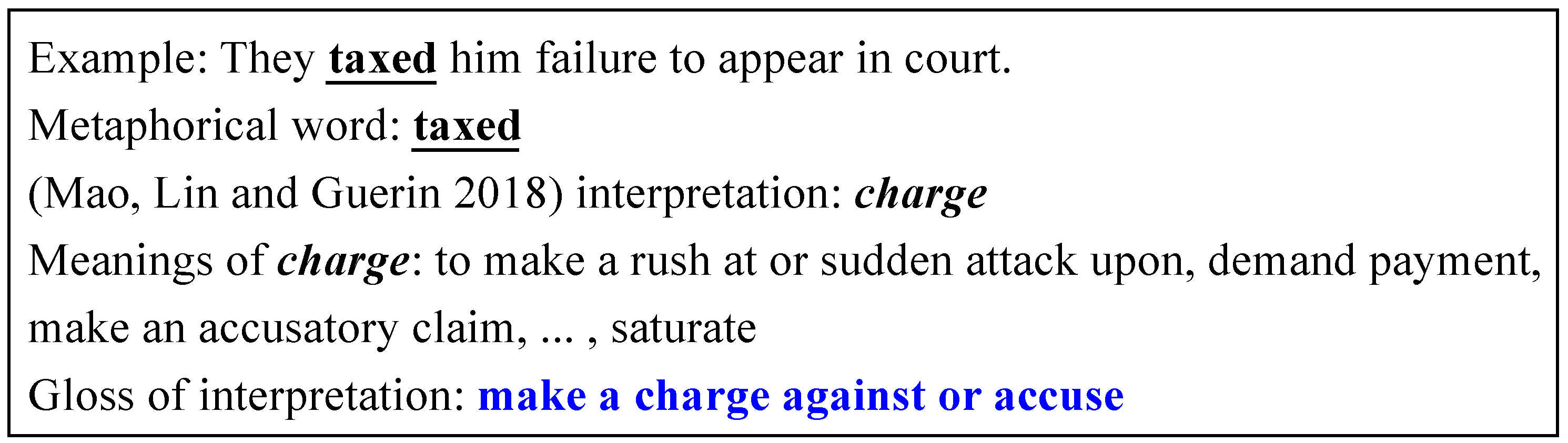
14]. However, these approaches remain constrained by the coarse-grained nature of metaphorical properties or the ambiguous connotations of the metaphorical substitute terms. As illustrated in
Figure 1,
taxed is a metaphorical term. While prior work [
4] interprets
taxed as
charge, WordNet [
15] assigns 25 distinct meanings to the latter. This semantic multiplicity makes it difficult to pinpoint the precise intended sense of
taxed. As noted by [
12], there is a critical distinction between the basic meaning of a word and its meaning in context. Specifically, the gloss-based interpretation of
taxed shown in
Figure 1—
make a charge against or accuse—contrasts sharply with its basic meaning,
levy a tax on. Unlike direct substitution, which can be ambiguous, the dictionary gloss provides a clearer interpretation that effectively distinguishes the contextual sense from the basic one. Consequently, the task of metaphor detection can be augmented by employing the technique of gloss-based metaphor interpretation.
In light of the above insights, we propose to explain metaphorical words by means of gloss-based interpretations. Specifically, we formulate the metaphor interpretation to select the optimal gloss from candidates. We utilize modern
Word Sense Disambiguation (WSD) [
16] methods for the metaphor interpretation, where WSD is a widely used technique to detect the right meaning of a target word. In addition to utilizing gloss interpretation, this article also introduces the part-of-speech (POS) tagging and external knowledge like ConceptNet to improve metaphor detection.
The work [
5] formally divides the problem of metaphor detection into two types of tasks, classification and sequence labeling. Classification aims to determine if a particular word is metaphorical within a specific context, whereas sequence labeling aims to identify the metaphorical nature of each word in the provided sentence. Viewing metaphor detection as a classification task amplifies the characteristic of the target word. However, it is difficult to detect the continuous metaphorical expression, while it is more accurate for models with sequence labeling. Therefore, in order to explore the impact of gloss-based metaphor interpretation on metaphor detection, we design two different types of joint learning models for metaphor detection and interpretation, classification and sequence labeling.
The joint classification models focus on the given word, converting metaphor interpretation into a binary classification task, and carry out metaphor detection and interpretation simultaneously in the same context. Metaphor detection and interpretation tasks share semantic representation through the encoder. In practice, we design Pair-MIP and Pair-SPV based on the theories MIP and SPV, respectively. Additionally, there is also a model named Pair-MIP-SPV, which applies both theories. Unlike joint classification models, the joint sequence labeling models perceive metaphor detection as a sequence labeling problem and metaphor interpretation as a task that selects the most fitting gloss from candidates. Metaphor interpretation directly provides an interpretation semantic vector for metaphor detection and enhances the contextual semantics of words, which is quite consistent with MIP theory. Therefore, SEQ-MIP proposed in this article is a sequence-labeling model based on MIP theory. On account of the structure of SEQ-MIP, a two-stage joint model, SEQ-MIP-TSD, is proposed.
This work involves both metaphor detection and metaphor interpretation but there is a lack of datasets annotated for both tasks. To investigate whether gloss-based interpretation aids in metaphor detection, we improve three bench datasets: TroFi, VUA, and PSUCMC. We build a collection of candidate words for each dataset, and utilize glosses extracted from the dictionary to annotate these words. Experimental results on the aforementioned three improved dataset indicate that the metaphor detection is facilitated by gloss-based metaphor interpretation. On the VUA dataset and PSUCMC dataset, the joint sequence labeling models achieve the best experimental results, and on the TroFi dataset, the joint classification models achieve the best performance.
We summarize the main contributions in the following points.
We propose a different interpretation mechanism that explains metaphorical words by means of gloss-based interpretations.
We develop two types of joint learning models for metaphor detection and gloss-based interpretation: classification and sequence labeling, which empirically show that the joint learning of metaphor detection and gloss-based metaphor interpretation can improve the performance of metaphor detection.
Three metaphor detection datasets are supplemented with additional annotations that include glosses for metaphorical words.
In contrast to our previous conference version [
17], which only proposed a single sequence labeling model, this article extensively explores both classification and sequence labeling paradigms for the joint task. We go beyond simply changing the task formulation; we also investigate diverse model architectures and component designs based on MIP and SPV theories to capture metaphorical mechanisms from different perspectives. Furthermore, we incorporate Part-of-Speech tags and external knowledge to enhance the feature representation. Our experiments demonstrate that the gloss-based interpretation module effectively assists in improving the performance of metaphor detection.
The remainder of this paper is organized as follows.
Section 2 provides an overview of relevant theories and existing approaches. In
Section 3, we detail the architecture and working principles of the proposed joint learning models.
Section 4 describes the experimental setup, including the enhanced datasets and evaluation metrics, followed by a discussion of the results, an ablation study, and case studies. Finally,
Section 5 summarizes the paper and outlines directions for future work.
3. The Proposed Joint Models
This section details the two main model classes we propose for metaphor detection and interpretation.
Section 3.1 presents the joint classification models, while
Section 3.2 describes the joint sequence labeling models.
3.1. The Joint Classification Models
Given a sentence s consisting of n words , , …, and a corresponding sequence of all candidate glosses for , the purpose of metaphor detection is to judge whether the word is metaphorical or literal in s. Additionally, we focus on identifying whether each gloss in can interpret the intended meaning of correctly for metaphor interpretation. The joint classification models convert both metaphor detection and interpretation into classification tasks. Therefore, we modify each example as sextuples . Clearly, s represents the given sentence, is the given word in s and is the part-of-speech of , and is the metaphor label of . Additionally, represents the j-th gloss in and if explains the contextual meaning of correctly, , and otherwise. The reason why POS tagging is introduced is that metaphor phenomenon appears more frequently in keywords of the text, and the part of speech of these keywords are verbs, nouns and adjectives in many existing cases.
Taking into account the established effectiveness of the pre-trained language model BERT [
53] in various natural language processing tasks, we have chosen to employ the BERT model as our encoder. For each
, we generate the input sequence as the following combination template:
where “[CLS]” and “[SEP]” are special tokens introduced in BERT. The sequence begins with the sentence context ss followed by the
and the target word
, providing the model with the syntactic and semantic environment of the metaphor candidate. The trigger word “means” acts as a bridge to prompt the model to predict the definition. The candidate gloss
is placed after the “[SEP]” token, which allows the model to compute the attention score between the context and the gloss, thereby determining if the gloss is the correct interpretation of
in the given context. An example is composed of the input sequence and the metaphor label
, and the interpretation label
. If a target word
is metaphorical, then the metaphor label
is metaphorical for all samples for
.
3.1.1. Pair-MIP
As shown in
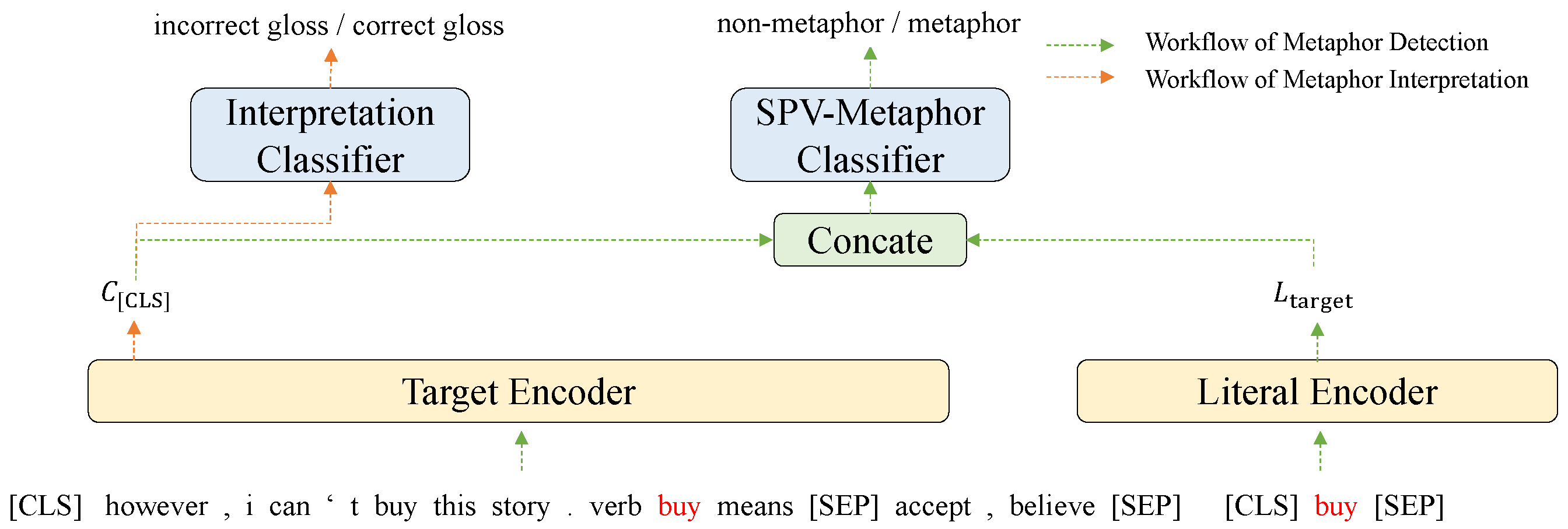
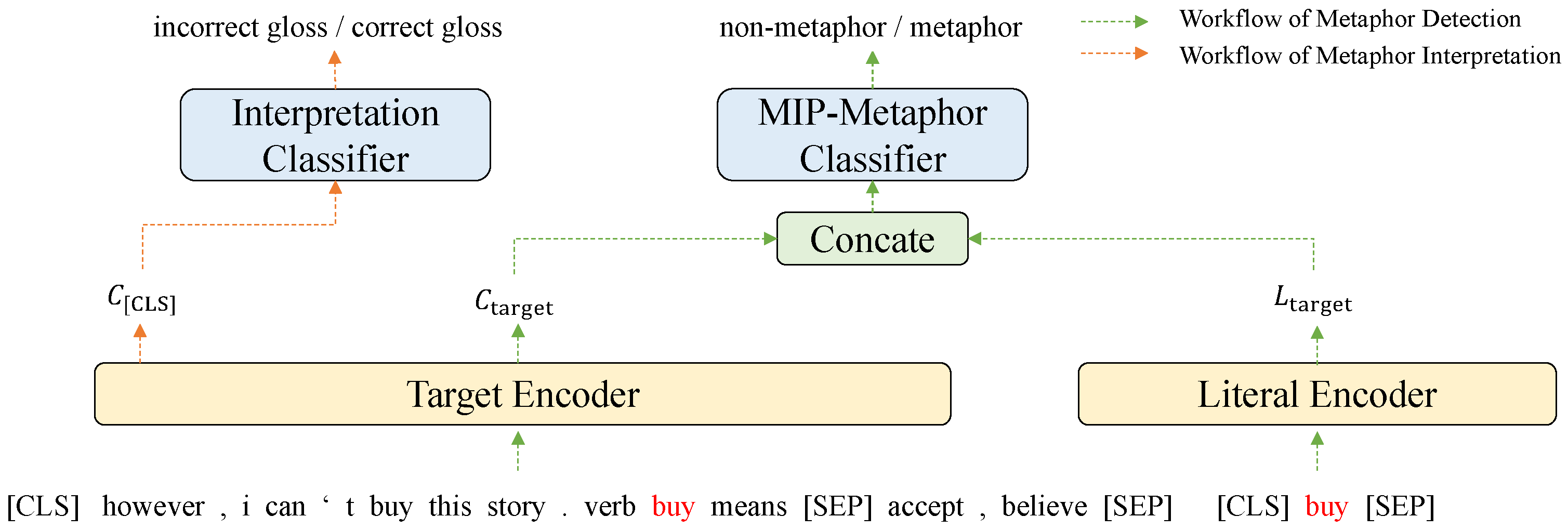
Figure 2, Pair-MIP is a joint metaphor detection and interpretation classification model based on the MIP theory. It is composed of two encoders and two classifiers. Both encoders are based on the pre-trained BERT. Additionally, both classifiers include a fully connected layer and a normalized exponential function decoder.
The target encoder serves both metaphor detection and metaphor interpretation. Taking the example in
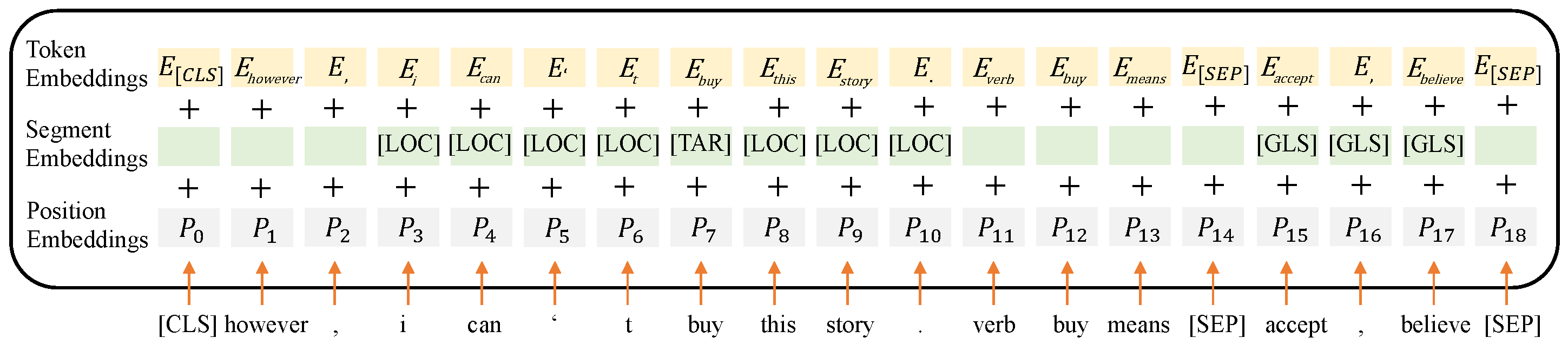
Figure 2, “buy” is the given target word. The input sequence of the target encoder is represented by the sum of three embeddings, including token embeddings, segment embeddings and position embeddings, as shown in
Figure 3. Token embeddings and position embeddings are kept the same as BERT. Different from the setting of BERT, new tags are introduced in segment embeddings. To emphasize the target word, the tag for target words “[TAR]” is inserted into the embeddings [
24]. The local context is a comma-separated clause containing the target word which is utilized in existing work [
8,
24]. In this paper, we also add the tag of local context “[LOC]” to enhance the semantic characteristics of the context. Additionally, the “[GLS]” tag is added to indicate the gloss corresponding to the word.
is the hidden vector of the token “[CLS]” from the last layer of the target encoder and
, which corresponds to the hidden size of the encoder model used in this article. For metaphor interpretation, Pair-MIP utilizes
to judge whether the gloss given in the input sequence is the correct contextual meaning of the target word.
is passed through a fully connected layer, which is then followed by a softmax classifier. Then, the probability distribution
of the interpretation classifier is obtained, and is formally defined as follows.
where
and
are learnable parameters.
, where the predicted probability that the provided gloss is incorrect is denoted by
, while
represents the probability that the given gloss is correct.
The Pair-MIP model is designed based on MIP theory which involves two relevant meanings, contextual semantics and literal semantics. The literal encoder in
Figure 2 is mainly used to produce a literal semantic representation. The input of the literal encoder is the target word. The target word
T may be split into multiple tokens
and we obtain a sequence of vector
, where
, through the literal encoder. By the mean-pooling method, the literal semantic vector
is defined as follows:
The target encoder produces the context semantic representation
of the target word in the same way with
. Then, we concatenate
and
and put them into the MIP-metaphor classifier. The probability distribution
is calculated as follows.
where
and
are learnable parameters.
can be written as
, where
represents the probability that the target word is literal and
represents the metaphorical probability.
3.1.2. Pair-SPV
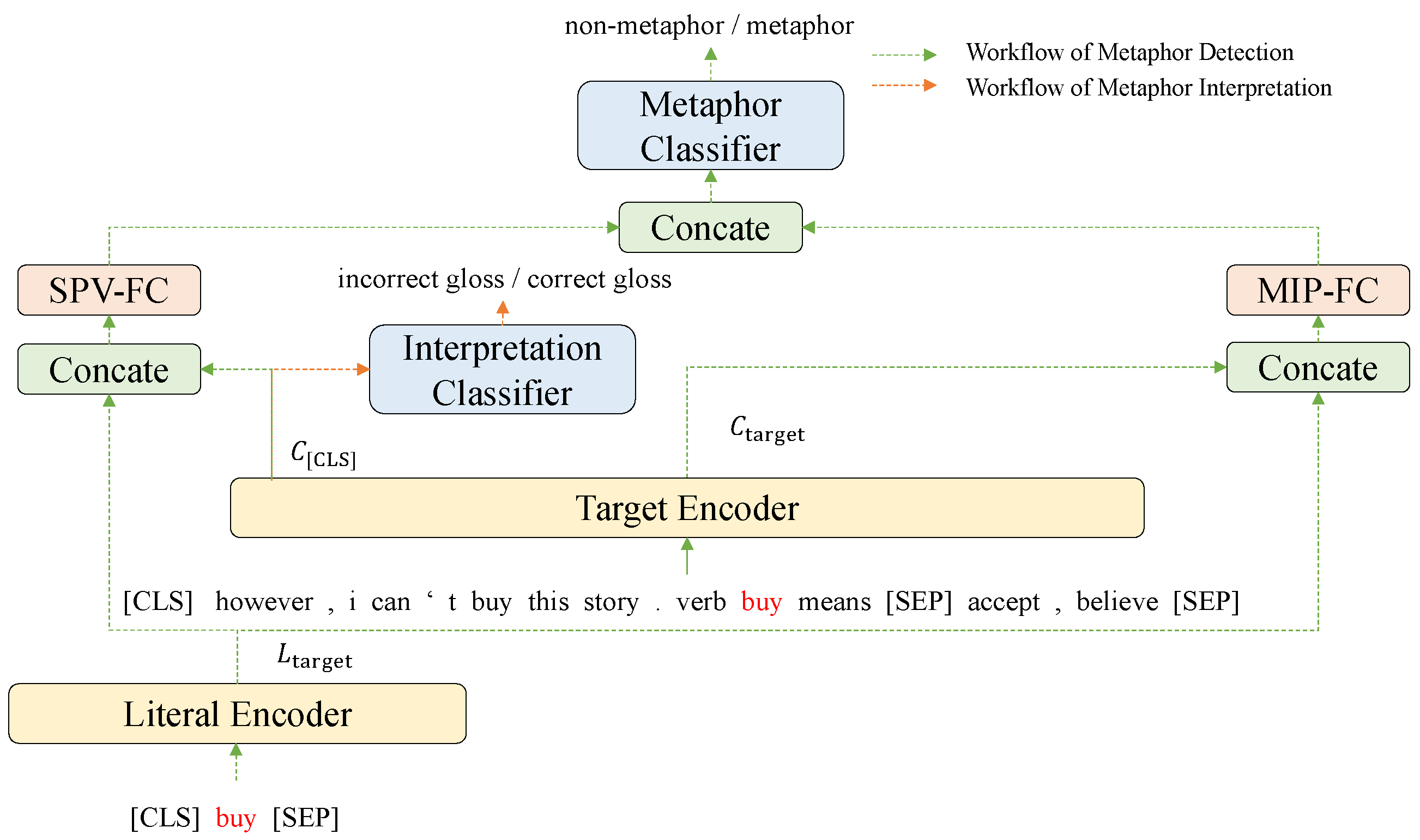
Pair-SPV based on the SPV theory has the same input and output as Pair-MIP. The core point of SPV theory is that there is a clear semantic contrast between the context and the literalness of the metaphorical word. As shown in
Figure 4, instead of using
, Pair-SPV directly uses
to represent the concextual meaning. The difference between the framework of Pair-MIP and Pair-SPV is the input of metaphor classifier which is the basis of metaphor identification. Therefore, the metaphor probability distribution
is defined as follows.
where
and
are learnable parameters. The processing of pair-SPV on metaphor interpretation is consistent with that of pair-MIP.
3.1.3. Pair-MIP-SPV
Figure 5 shows the basic structure of Pair-MIP-SPV. The interpretation classification of Pair-MIP-SPV is consistent with the two models mentioned above, while the metaphor detection task integrates information from both MIP theory and SPV theory. Both MIP-FC and SPV-FC are made up of a fully connected layer, defined as follows, respectively.
where
,
,
, and
are trainable parameters,
,
, and
,
.
Thus we utilize the vector
and
calculated from SPV-FC and MIP-FC to classify the metaphor. Similarly, we concatenate the two vectors, and then input them into metaphor classifier. We obtain the probability distribution
.
where
and
are learnable parameters.
is also composed of two dimensions.
3.1.4. Loss Function
The three joint classification models introduced in this section all accomplish two tasks simultaneously. Thus the optimization objective of the joint models also includes these two tasks. Due to both tasks are binary classification tasks, the design of the loss function is based on binary cross-entropy. Pair-MIP, Pair-SPV, and Pair-MIP-SPV differ only in model details, and their output remains exactly the same.
For
i-th sample
, the metaphor classification loss
, where PMD refers to the metaphor detection task in the proposed Pair-MIP, Pair-SPV, and Pair-MIP-SPV models, is defined as follows:
where
is the correct label,
if the target word in
i-th sample is literal or
if the target word is metaphorical.
, corresponding to the first dimension in
,
and
, denotes the probability that the target word is literal. Additionally,
is the second dimension in
,
and
, is the probability that the target word is metaphorical.
The metaphor interpretation loss
—where
refers to the metaphor interpretation task in the proposed Pair-MIP, Pair-SPV, and Pair-MIP-SPV models—is defined as follows:
where
is the correct label,
if the gloss in
i-th sample is incorrect for the target word or
if the gloss is correct. Additionally, in the three joint classification models, each
represents the probability that the gloss is wrong and
, respectively represents the probability that the gloss is correct.
The total loss functionis defined as follows:
where
q represents the number of samples. The models are trained on the candidate set
built according to the glosses. Only samples belonging to the candidate set will be calculated for the loss value of metaphor interpretation. Indicator function
if
X is true and
otherwise.
3.2. The Joint Sequence Labeling Models
Given a sentence s consisting of n words and a corresponding sequence of all candidate glosses , for any word and a gloss list with the length of for , for metaphor detection, we target on judging whether the word is metaphorical or literal in s, whereas metaphor interpretation focuses on acquiring the intended meaning of thorough choosing a gloss from .
Detecting metaphor generates a sequence of metaphor labels with the length of n, and each metaphor label represents the metaphorical prediction result of the corresponding word. Similarly, the output of metaphor interpretation is a sequence of glosses with the length of n, each of which corresponds to a predicted gloss of a word. This article proposes to jointly learn the metaphor interpretation task and metaphor detection task, which is actually to enhance the model’s capability to capture the semantics of words in specific contexts. The core idea of MIP theory is that there exists a huge difference between the semantic of words in context and their basic literal semantics. Therefore, the models proposed in this section are mainly designed based on MIP theory.
3.2.1. SEQ-MIP
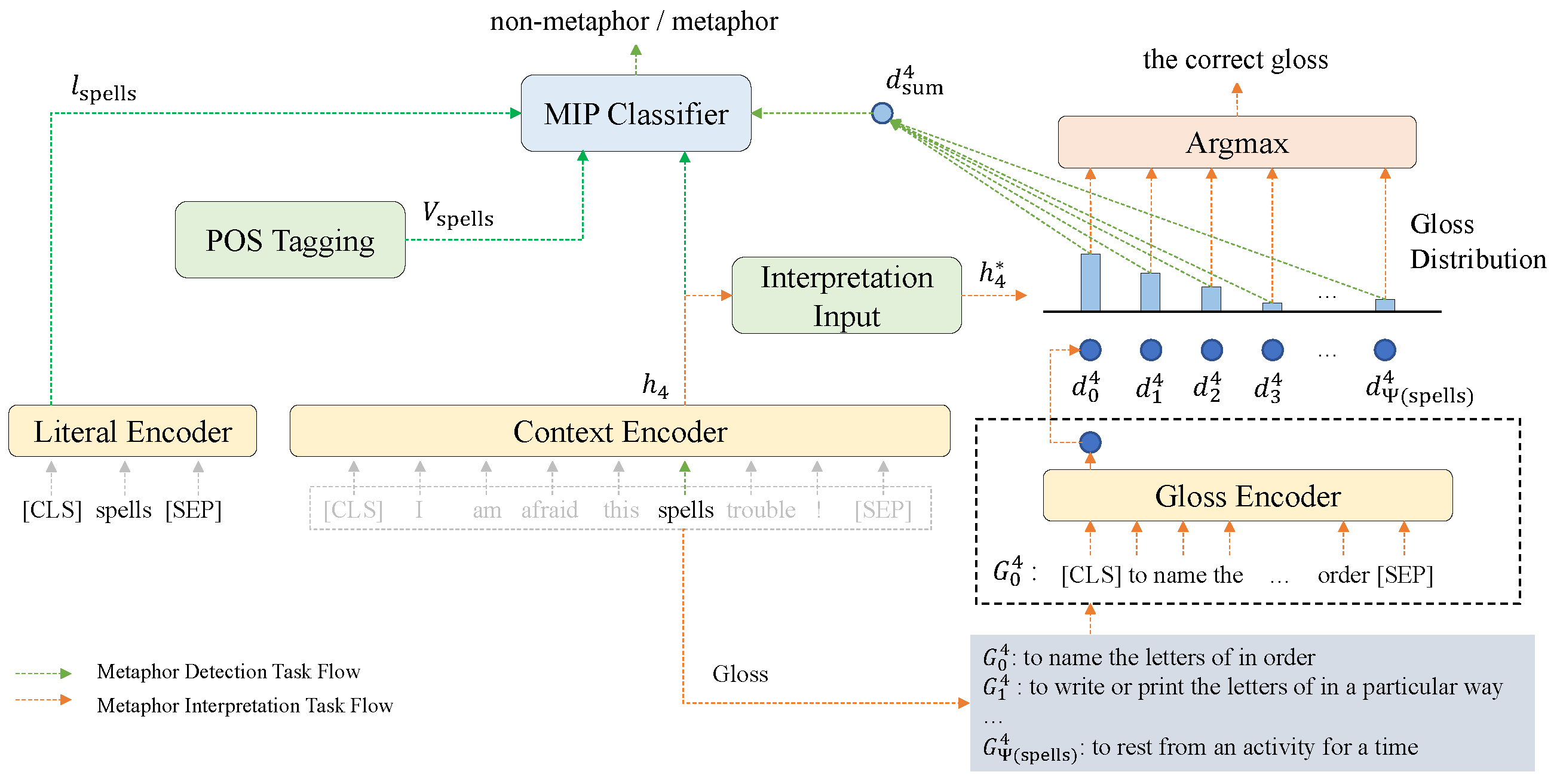
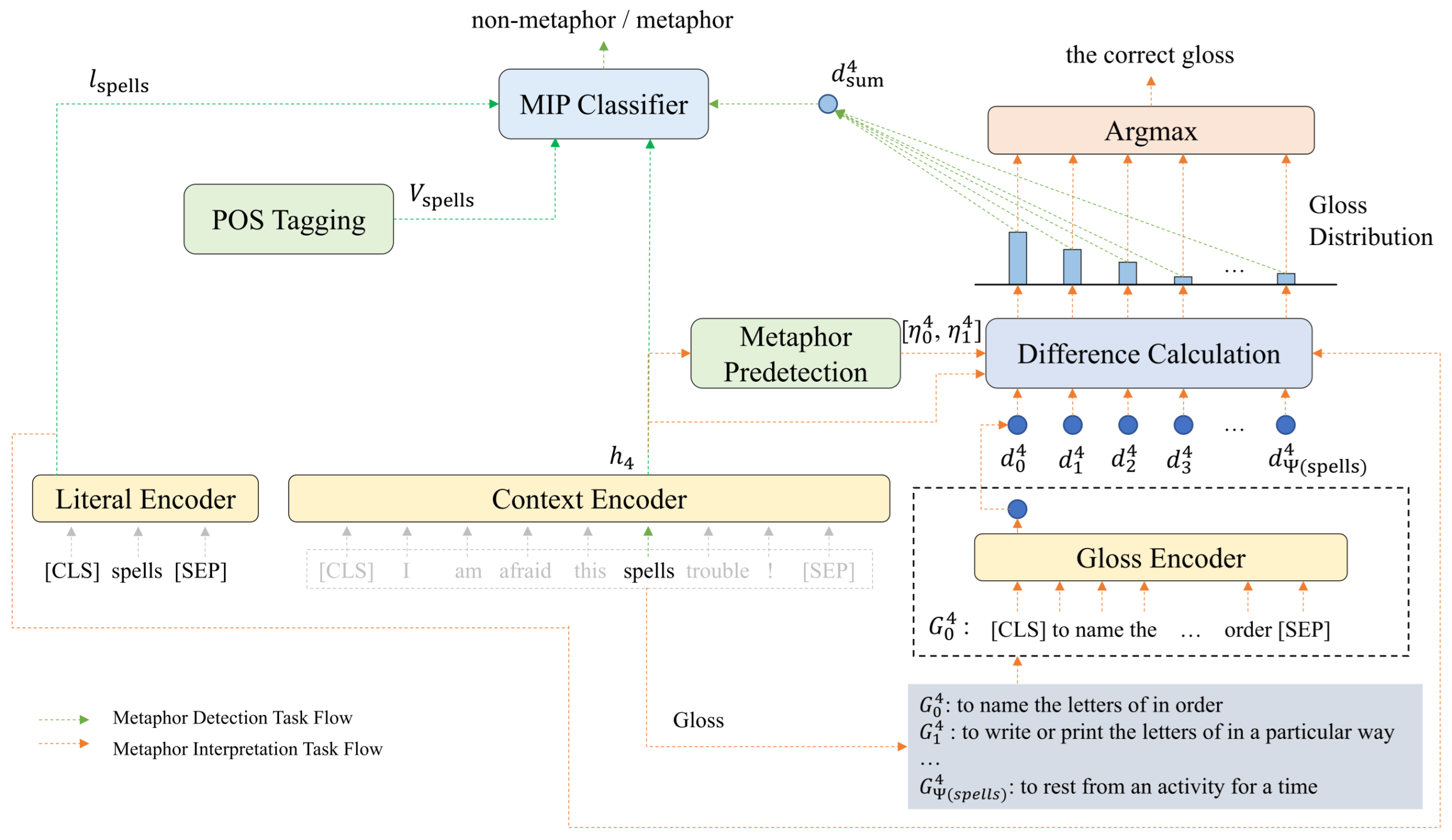
SEQ-MIP based on the MIP theory is a sequence labeling model shown in
Figure 6. The underlying structure consists of three encoders, which encode context, gloss and word literal semantic, respectively.
According to the direction of the data flow, the results of metaphor detection are affected by the context, gloss, literal semantic, and part-of-speech tagging of the word, while metaphor interpretation is only affected by the context and gloss. In addition to the context semantic representation vector and literal semantic representation vector for metaphor detection based on the MIP theory, the interpretation semantic vector based on glosses,
in
Figure 6, is introduced to enhance context semantics. Additionally, metaphor interpretation and metaphor detection share a context encoder, which makes the semantics affected by the metaphor interpretation task also affect the metaphor detection task. Meanwhile, the correct gloss depends on context semantic representation vector of the word and gloss encoding vectors of the word. For each word in the input sentence, both metaphor detection and metaphor interpretation tasks should be carried out simultaneously.
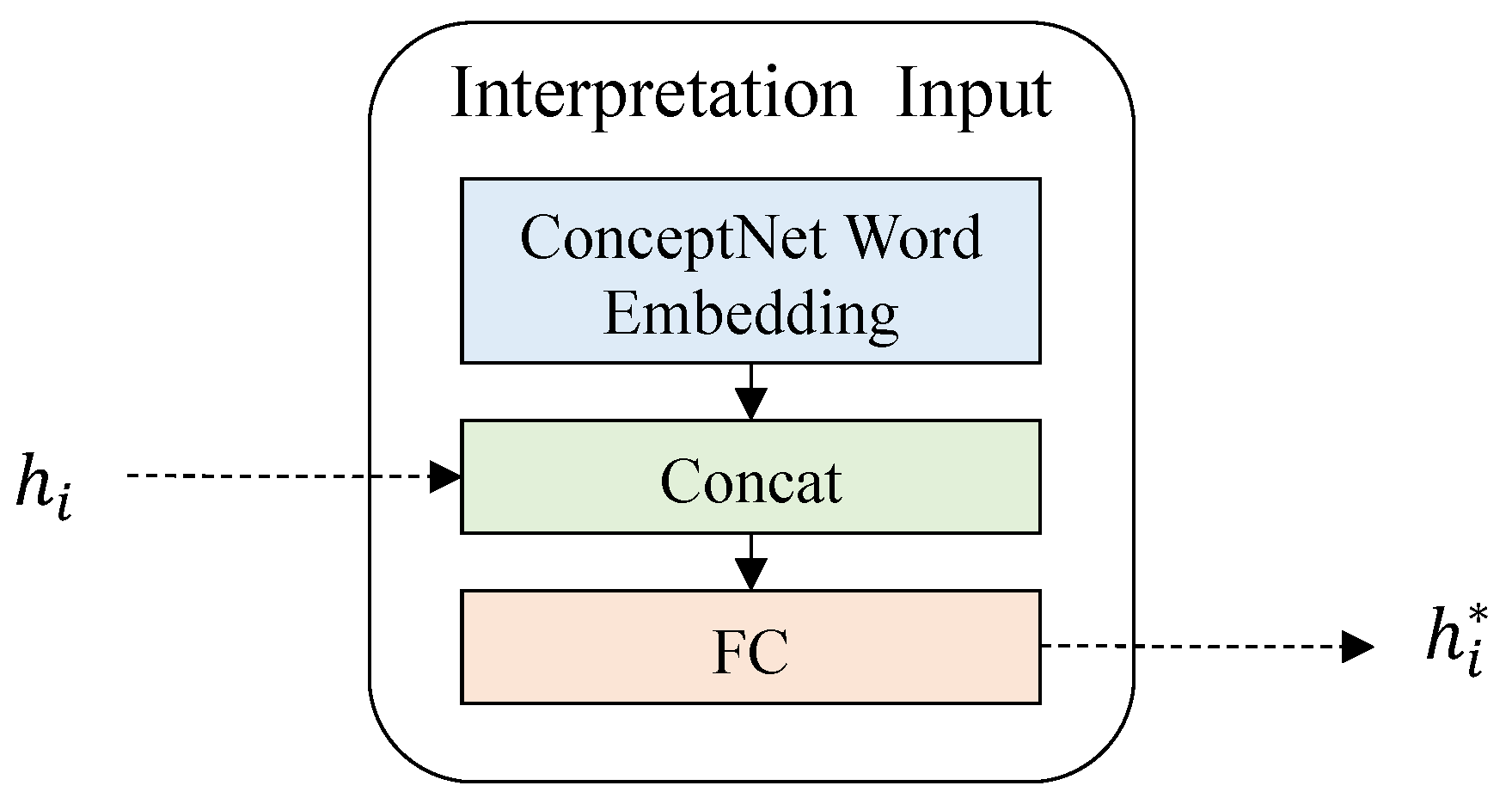
If we suppose in sentence s, then we denote the hidden vector of in the last layer as the context semantic representation vector of . There may be a few tokens for a word after tokenizing, the context semantic representation vector of can be obtained through mean-pooling processing, here as . The interpretation input module processes to produce the contextual semantic representation vector . There are two ways about the interpretation input module:
The second approach integrates the external knowledge. In order to better understand the relationships between the target word and other words, we consider to utilize ConceptNet to build a more comprehensive and richer semantic representation. It calculates
through combining
with the ConceptNet word embeddings learnt from knowledge graph and distributed word representation vectors, which is defined as follows:
where
represents the ConceptNet word embedding of
,
, and
are learnable parameters and
and
.
In addition to , we utilize the gloss encoder to encode each gloss in and denote the vector of “[CLS]” as the semantic representation vector of the gloss . Thus, the set of gloss representation vectors are calculated. For different words, the size of their gloss set and the selection of glosses are different. Attention mechanism is a viable solution to such problem.Thus, we choose a gloss with the highest semantic relevance with the given context semantic of in metaphor interpretation. We define as the query and both keys and values correspond to the set of the gloss representation vectors.
According to the contextual semantic vector
, we calculate the attention distribution of the gloss representation vectors, and denote it as the probability distribution of the correct gloss. Additionally, the probability that the gloss corresponding to
is correct, is defined as follows.
The sum of all the correct probability of
is 1. The gloss with the highest probability is considered as the correct gloss in metaphor interpretation module. Then, we obtain the interpretation semantic vector
as follows.
denotes the implicit semantic representation of interpretation, which can enhance the semantic information of the context. Thus, the proposed model can discriminate metaphor according to MIP theory. In
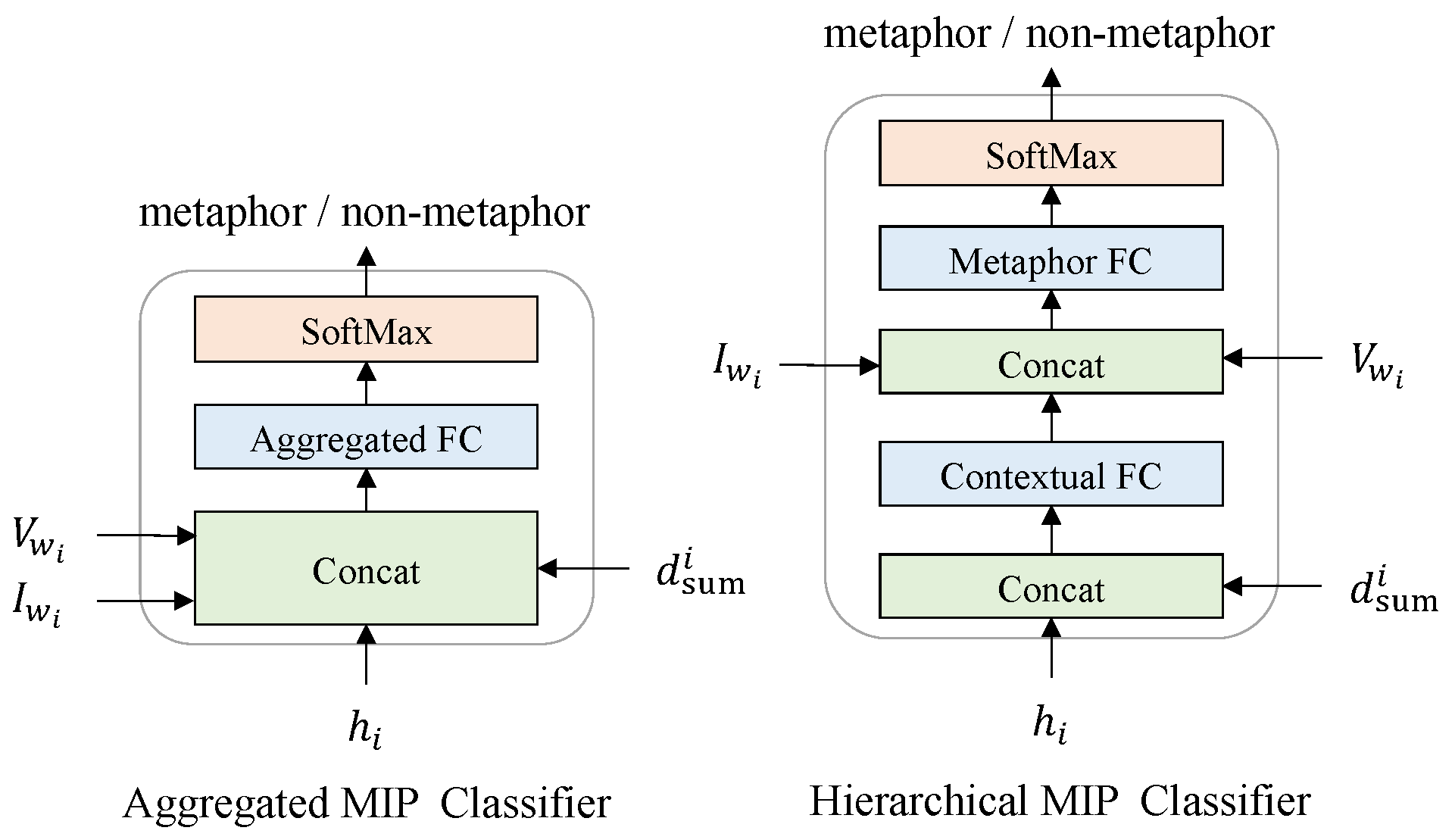
Figure 6, the proposed SEQ-MIP introduces the part-of-speech tagging (POS tagging). POS tagging vectors are randomly initialized and each specific POS corresponds to a specific vector. Furthermore, all POS tagging vectors remain unchanged during model training. In this article, two simple implementations of MIP classifier are proposed, as
Figure 8 shows.
The first is an aggregated MIP classifier. We concatenate all inputs into a single, unified vector, which is subsequently fed through an aggregated fully connected layer for processing. The implementation process of aggregated MIP classifier can be summarized as follows.
where
and
where
represents the length of the POS tagging vector.
and
are trainable parameters.
As shown in
Figure 8, hierarchical MIP classifier first processes
and
to get an enhanced vector
. Then
is input into a full connection layer together with
and
. The process is defined as follows.
where
,
,
, and
are trainable parameters.
The metaphor probability distribution and are both two-dimensional. The first dimension represents the probability that is not metaphorical, while the second dimension represents the probability that is metaphorical.
The loss function of SEQ-MIP consists of two parts, metaphor detection and metaphor interpretation. For a word
in
s, its loss of metaphor detection is defined as follows.
where
denotes the metaphor detection task of SEQ-MIP and the
is the real label. Additionally,
is corresponding to the first dimension of
and
, and
is on behalf of the second dimension.
For the task of metaphor interpretation, the loss of
is formulated as follows.
where
signifies the metaphor interpretation task of SEQ-MIP and
denotes the correct gloss of
in
s. SEQ-MIP is trained by minimizing the loss function of two tasks. Thus, the total loss of SEQ-MIP can be expressed as follows.
where
n represents the number of words, and
is the candidate set constructed for the interpretation task. Only words in
need to be considered in the interpretation task training.
3.2.2. SEQ-MIP-TSD
Based on SEQ-MIP, we propose a two-stage joint model which is called SEQ-MIP-TSD. As
Figure 9 shows, the part of metaphor detection basically remains unchanged compared with SEQ-MIP. The main difference exists in the interpretation task. In SEQ-MIP-TSD, the metaphor interpretation module is also directly affected by the metaphor pre-detection results, which makes two tasks closer.
There are two stages of metaphor detection, respectively, from metaphor pre-detection and MIP classifier in SEQ-MIP-TSD. Identification in the first metaphor detection stage only depends on the word and its given context.In SEQ-MIP-TSD, the interpretation task is directly affected by the results of metaphor pre-detection which is different from the traditional WSD. To refer to MIP theory that the meaning of a metaphor in a specific context is quite different from its literal meaning, this article proposes the following hypotheses:
The representation vector corresponding to the correct gloss of a metaphor word diverges significantly from its literal semantic representation vector.
The representation vector corresponding to the correct gloss of a non-metaphorical word exhibits a lesser degree of difference when compared to its literal semantic representation vector.
However, differences between vectors are difficult to describe numerically. Therefore, SEQ-MIP-TSD projects gloss representation vectors and literal semantic representation vectors into a specific vector space, such that the following is true:
There exists the biggest difference between the representation vectors corresponding to a metaphor word’s correct gloss and its literal semantic representation vector.
There exists the least difference between the representation vectors corresponding to a non-metaphorical word’s correct gloss and its literal semantic representation vector.
We can see that the biggest and least are related to the results of metaphor detection, which introduces a metaphor pre-detection module defined as follows.
where
is of the form
where
represents the predicted probability that
is to be interpreted literally, and
denotes the probability that
is metaphorical.
and
are learnable parameters.
represents
is metaphorical while
represents
is literal.
Because there are two situations corresponding to the biggest difference and the least difference, respectively, this article unifies the problems into the form of finding the biggest difference. The unification is realized by the difference calculation module which is composed of a coefficient function
and a difference function
through utilizing
. The definition of
is as follows.
where
and
are two hyper-parameters which used for scaling the value of the coefficient function and
is a tiny constant.
x equals
. Due to
, whether
is positive or not is consistent with
x.
In the hypothesis proposed in this article, the gloss and literal vectors need to be projected into a specific vector space. Metaphor is context-specific, and we utilize the vector from context encoder to project, which is formulated as follows.
where
is the projection matrix,
is the independent variable, and ∘ represents element-wise multiplication. Thus we can apply projection function to each gloss encoding vector
and literal vector
. After obtaining the projection vectors, the difference calculation module calculates the difference through the coefficient of function
as Formula (
24) shows. Formula (
25) then normalizes the difference scores for all candidate glosses into the range [0, 1], representing the probability of each being the correct interpretation. Consequently, regardless of whether the target word is metaphorical or non-metaphorical, the gloss with the highest difference score is considered the most likely correct interpretation.
During training, the objective is to maximize the normalized difference score for the correct gloss. In the prediction stage, the correct gloss is with the highest normalized difference value. Taking the normalized difference value as the weight, the interpretation semantic vector
is defined as follows.
The other parts of SEQ-MIP-TSD keep the same as SEQ-MIP and the MIP classifier produces the final results of metaphor detection, which is denoted as .
For
in
s, the loss function of SEQ-MIP-TSD consists of three parts: the loss function of metaphor detection
, the loss function of metaphor interpretation
and the loss function of consistency between two metaphor detection
. The calculation of
, where
denotes the metaphor detection task of SEQ-MIP-TSD, defined as follow, is similar to
.
where
and
are the output of MIP classifier.
Compared to
in SEQ-MIP,
,where
denotes the metaphor interpretation task of SEQ-MIP-TSD, maximizes the difference value between the projection vector of the correct gloss and the literal semantic
, which is calculated as follows.
The SEQ-MIP-TSD model has two stages of metaphor detection. To ensure the consistency of the two stages of metaphor detection results, we compute
as follows.
It is important to note that only when the results of the two stages of metaphor detection is not consistent, namely
, will
be considered. The SEQ-MIP-TSD model is trained by minimizing three loss function values, and the total loss function is shown in Formula (
30) and
denotes the two-stage joint model SEQ-MIP-TSD.
4. Experiments
In this section, we first introduce the datasets for evaluation and describe the process for enhancing them to support the gloss-based metaphor interpretation. By carrying out experiments on three augmented datasets, our proposed models outperform the existing model in metaphor detection on all datasets, proving that gloss-based interpretation can indeed help improve metaphor detection. Additionally, experimental results can also achieve considerable performance on the task of metaphor interpretation. In addition, we compare and analyze the influence of different types of models and different components on metaphor detection and metaphor interpretation.
4.1. Three Enhanced Datasets
The metaphor detection datasets TroFi and VUA, both in English, and PSUCMC, in Chinese, have been enhanced.
Verb metaphors are labeled in TroFi [
55]. Going along with the study [
6], we consider unmarked words as literal words when training.
The VU Amsterdam Metaphor Corpus (VUA) [
3] is composed of fragments drawn from the British National Corpus. It annotates every word within the corpus in accordance with MIP theory. Our evaluation of models encompasses both the VUA ALL POS track and the VUA-Verb track.
The PSU Chinese Metaphor Corpus (PSUCMC) [
56,
57] is composed of text samples from the Lancaster Mandarin Chinese Corpus that have been annotated for words related to metaphor based on MIPVU [
3]. Every word within the PSUCMC is labeled, and we conduct our model assessments on the PSUCMC ALL POS track.
These datasets have been refined to aid in the task of metaphor interpretation with glosses. We utilize candidate set to term the words that require interpretation. In the TroFi dataset, all verbs that have been labeled are included in the candidate set. For the VUA dataset, the candidate set is compiled by randomly selecting verbs. In the PSUCMC dataset, a candidate set is constructed by randomly selecting words and then removing those that lack meaning. Human annotators have annotated the words in the candidate set.
For TroFi and VUA, annotators are directed to consult the Merriam–Webster dictionary
https://www.merriam-webster.com/dictionary/ (accessed on 7 January 2026) to acquire the glosses for words in the candidate For PSUCMC, word glosses are obtained from the Baidu Dictionary
https://dict.baidu.com (accessed on 7 January 2026). To ensure the quality of the annotations, we enlisted four annotators for each dataset. The annotators consist of linguistics experts, ensuring a solid understanding of semantic nuances. The annotation task involved selecting the most suitable gloss that reflects the contextual meaning of the target word. Each expert was required to annotate all instances across the three datasets. The entire annotation process was completed over a period of three weeks. The annotation process followed a strict quality-control procedure. First, the annotators independently annotated the assigned data. Following their individual annotations, they convened to discuss any discrepancies and finalized the annotations through consensus. To quantitatively assess the consistency of the annotations, we computed the kappa-score, a well-established metric in computational linguistics for evaluating inter-annotator agreement [
58]. As shown in
Table 2, the kappa-scores for each dataset indicate a high level of annotation reliability, confirming the dependability of our data. The samples are randomly allocated into training, validation, and test sets in a proportion of 8:1:1 for PSUCMC and TroFi. In the case of VUA, we still utilize data partitions provided by [
6].
Table 3 provides an overview of the statistical information for all the datasets used in the experimental setup.
4.2. Experimental Setup
4.2.1. Model Architectures and Pre-Trained Backbones
The models proposed in this article are built upon pre-trained language models. Specifically The Pair-MIP, Pair-SPV and Pair-MIP-SPV models proposed in this article all have a target encoder and a literal encoder, while SEQ-MIP and SEQ-MIP-TSD have three encoders: context encoder, annotation encoder and literal encoder. The above listed encoders are all based on the pre-trained language model. In practice, this article uses three basic pretrained language models: bert-base-uncased [
53] and roberta-base [
59] on the English datasets, and bert-base-chinese is used on PSUCMC dataset. In the same model, all the encoders adopt the same pretrained language model to ensure that different encoders are in the same semantic space before fine-tuning.
4.2.2. Model Variants
There are many different variants of the model proposed in this article. There are six variants of the joint classification model: Pair-MIP-R, Pair-MIP-B, Pair-SPV-R, Pair-SPV-B, Pair-MIP-SPV-R, and Pair-MIP-SPV-B, where R and B represent that encoders utilize roberta-base and bert-base-uncased, respectively. As for the joint sequence labeling model, there exist twelve variants according to different pre-trained models and different structures of interpretation input modules and MIP classifiers: SEQ-MIP-EQ(CNet)-Hie(Agg)-R(B) and SEQ-MIP-TSD-Hie(Agg)-R(B) where EQ and CNet represent the type of interpretation input module, Hie and Agg represent the type of MIP classifier.
4.2.3. Dataset Sampling Strategy for the Joint Classification Models
The dataset of the joint classification models is constructed according to the gloss set, which causes a large amount of data in the training set and the unbalanced distribution of labels. We randomly sample in all samples of each target word and select at most seven samples. If the target word is metaphorical, the sample that correctly interprets the target word must be included. The validation set and test set are not randomly selected. In the testing phase, each target word corresponds to multiple samples, and the strategy to decide whether a target word is metaphorical is: as long as the prediction result is metaphorical in one of the sample sets corresponding to the target word, the target word is metaphorical.
4.2.4. Training Settings
The POS tagging vectors in Equations (
14) and (
16) were randomly generated, and their dimension size is 100. The values of
,
and
in Equation (
21) were 1, 2, and
, respectively. For training, we configured the learning rate at
for PSUCMC and TroFi, and
for VUA. We trained the models using a maximum of 5 epochs. A dropout probability of 0.2 was applied to the fully connected layer. Additionally, the maximum sequence length was established at 256 tokens. For the classification models, the batch size is for glosses, which was set to 512 in all three datasets. For the sequence models, the batch size refers to the number of samples, which was 32. Specifically, the model checkpoint that achieves the highest F1 score for metaphor detection on the validation set is preserved. This optimal model is subsequently used to evaluate performance on the test set.
4.2.5. Evaluation Metric
For the metaphor detection task, we utilize precison (P), recall (R), F1 score (F1), and accuracy (Acc) as our evaluation metrics. Additionally, we use Acc as the sole evaluation metric for metaphor interpretation. The sequence labeling model uses the accuracy I-Acc to evaluate the effect of metaphor interpretation. I-ACC represents the proportion of the number of samples that are correctly predicted to the number of samples that need to be explained. Since the metaphor interpretation of joint classification model is a binary classification mode, the evaluation metrics are consistent with that metaphor detection adopts. All reported numbers are expressed in percentages. We evaluate each word in the test set for metaphor detection. Though we can generate each word with glosses, metaphor interpretation is only evaluated for the words that are marked in the test dataset.
4.3. Compared Methods
For the purpose of comparative analysis, our proposed method is evaluated against the following previous approaches.
CNN + RNN
ens [
13] is a CNN-BiLSTM model. It uses Word2Vec to encode the text and CNN to encode the part-of-speech tag, word clustering and the word vector.
SEQ [
5] concatenates ELMo embeddings and GloVe embeddings into a Bi-LSTM network to to obtain contextual representations for each word.
RNN_HG [
6] is a sequence labeling model based on BiLSTM, designed according to the MIP theory. The model utilize ELMo and GloVe embeddings as input as well.
RNN_MHCA [
6] designs the model according to the SPV theory. It concatenates the vectors obtained from the multi-head attention mechanism with the contextual representation vectors.
MUL_GCN [
7], a graph convolutional neural network based on sentence dependency trees, constructs a multi-task learning framework for metaphor detection and WSD tasks.
DeepMet [
8] incorporates features such as POS tags and surrounding text into its input through utilizing RoBERTa [
59]. For a fair comparison, we only match our models against DeepMet’s single model.
ExampleBERT [
22] is a model based on SPV theory. It first learns the general context information of the target word to fine-tune the metaphor detection.
DefinitionBERT [
22] is a classification model based on MIP theory, which introduces all glosses of target words to represent the literal meaning, and fuses the literal meaning with context representation vector.
MrBERT [
23] transforms the problem of metaphor detection into a problem of relation extraction. It models the target verb and its context, and resolves the relationship through Standford Dependency Parser [
60].
MelBERT [
24] combines sentences and the POS tags as input samples and utilizes different position tags. The metaphor classification results of target words are obtained by combining MIP theory and SPV theory.
BEM [
48] is a WSD model that comprises two independent encoders. Both encoders are initialized from BERT based on the Transformer architecture.
MDGI-Joint and MDGI-Joint-S [
17] are models proposed in our previous conference version.
MisNet [
9] proposes a linguistics enhanced network inspired by MIP and SPV.
WPDM [
10] concentrates on the detection of metaphorical expressions at the token level and introduces an innovative explainable method called Word Pair based Domain Mining, which is influenced by conceptual metaphor theory.
For the VUA dataset, we present the results as reported in the published papers of the methods being compared. In the case of evaluating on the TroFi and PSUCMC, we utilize the publicly available code for certain compared methods. It is important to highlight that all the compared methods are designed exclusively for the English language domain. To facilitate the evaluation on PSUCMC, we employ ELMo embeddings that have been trained on the Xinhua portion of the Chinese Gigawords corpus
https://github.com/HIT-SCIR/ELMoForManyLangs, (accessed on 7 January 2026) a resource released by Che et al. [
61] and Fares et al. [
62]. Additionally, we leverageword embeddings trained on the Chinese Wikipedia (zh-wiki) corpus
https://dumps.wikimedia.org/zhwiki/latest/ (accessed on 7 January 2026) to replace the GloVe embeddings.
4.4. Experimental Results
4.4.1. Results for Metaphor Detection
Comparison with previous approaches. Table 4 shows the result for metaphor detection. F1 score comprehensively reflects the false detection and missed detection of metaphor detection. Our proposed model achieves the highest F1 on all the datasets except for VUA ALL POS, which demonstrates the introduction of glosses improves the performance of metaphor detection. Although the integration of relational semantic features in MrBERT decreases the number of false detections, it simultaneously undermines the association of the target word with its surrounding context, resulting in a lower F1 score.
Analysis of Model Variants. The results of different variants proposed in this article are shown in
Table 4. In our proposed different variants, the best F1 of the sequence labeling models is higher than that of the classification models on most datasets, which indicates sequence labeling models can better capture the connection between the target word and the context. The classification models carry out metaphor detection with each word as the center, thus obtaining a high recall rate. Additionally, for the classification models, RoBERTa performs better, while for the sequence labeling model, BERT performs better. For the sequence labeling models, the metric F1 of SEQ-MIP is superior to SEQ-MIP-TSD. Although the two-stage metaphor detection models can enhance the connection between metaphor detection and metaphor interpretation tasks, they will also cause error accumulation. What’s more, models without processing the input of metaphor interpretation don’t perform as well as models that incorporate ConceptNet embeddings in most cases, suggesting that models that incorporated ConceptNet knowledge perform better on the metaphor detection task. In addition, different structures of MIP classifiers have little effect on the overall performance.
4.4.2. Results for Metaphor Interpretation
Comparison with previous approaches. Table 5 exhibits the experimental results of the joint sequence labeling models. We can conclude that the more complex the metaphor interpretation part of the model is, the worse the performance becomes. The worst performance is the two-stage joint model which introduces too many assumptions related to metaphor. However, the performance of the model with a relatively simple structure, such as the SEQ-MIP-EQ-AGG-B, is similar to that of the word sense disambiguation model BEM. The reason why models proposed in this article are worse than MDGI-Joint-S is that we pay more attention to using metaphor interpretation to improve metaphor detection, which reduces the performance of metaphor interpretation to some extent.
Analysis of Model Variants. Table 6 shows the results of the metaphor interpretation task in the joint classification models. From the results in the three data sets, the recall is much higher than the precision, which indicates that incorrect glosses are selected slightly more often than correct glosses are missed. According to the empirical results, the difficulty of the metaphor interpretation task in the VUA dataset is greater than that in the other two datasets. Pair-MIP-R achieves an F1 value of 37.8 on VUA, and Pair-MIP-SPV-B was the best model on PSUCMC dataset with the highest performance of all evaluation indicators. The pair-SPV-R is the best metaphor interpretation model on TroFi dataset. On both the VUA and PSUCMC datasets, the models with the best performance on the metaphor interpretation task are also the models with the best performance on the metaphor detection task in the joint classification models. As can be seen from
Table 5, in the joint sequence labeling models, the performance of the models based on RoBERTa is significantly lower than those of BERT. Additionally, the models using hierarchical classifiers perform better than the models using aggregate classifiers on the interpretation task, which indicates that initial fusion processing of the contextual representation and the enhanced contextual semantic representation can reduce the impact on metaphor interpretation.
4.5. Ablation Study
To explore whether the different semantic features or model structures have a significant impact, we perform an ablation study on the PSUCMC dataset.
Table 7 shows the experimental results of the ablation on two semantic features, part-of-speech tags and [LOC] tags, of the joint classification models. The metaphor interpretation performance of Pair-MIP-B and Pair-SPV-B slightly has been improved after the POS tags are removed, while Pair-MIP-SPV-B significantly decreased. The Pair-MIP-SPV-B model decreases more on metaphor detection after removing the POS tags input than the other two models, which means that POS tags play a greater role in models that apply both theories simultaneously. As for the [LOC] tag, the performance of metaphor detection and metaphor interpretation of Pair-MIP-B and Pair-MIP-SPV-B models are significantly decreased after removing it. However, the performance of metaphor detection of Pair-SPV-B is slightly improved because the SPV theory pays more attention to the semantics of the global context. Emphasizing the local context weakens the semantic information of the global context. The last row gives the results of MelBERT. MelBERT, which applies MIP and SPV theories but excludes the metaphor interpretation task, can serve as a contrast to the classification joint models. Except that Pair-SPV-B is equal to MelBERT, the Pair-MIP-B and Pair-MIP-SPV-B models are better than MelBERT in metaphor detection, which implies that the metaphor interpretation does assist metaphor detection.
Table 8 shows the necessity of POS tags and the interpretation vectors in the joint sequence labeling models. After reducing the POS tags, the performance of metaphor detection of all models decreased significantly and the performance of metaphor interpretation task for all models improved slightly, except for SEQ-MIP-TSD-Hie-B. The coarse-grained POS tagging will bring some bias, which may bring errors to the more elaborate metaphor interpretation task. As observed from
Table 8, the performance on metaphor detection decreases significantly after
is discarded, which illustrates the importance of interpretation fusion representation vectors. As for the metaphor interpretation, except for the two-stage model SEQ-MIP-TSD-Hie-B, the performance of the other models does not increase or decrease significantly. What’s more, the last row of
Table 8 presents the metaphor detection results of the SEQ-MIP-B model. SEQ-MIP-B is a model that completely removes the metaphor interpretation task; it concatenates the context representation vector obtained from the context decoder, the literal semantic representation vector obtained from the literal encoder, and the part-of-speech tagging vector. These are then input into a fully connected layer, where the classification results for metaphor detection are finally decoded via the Softmax function. As shown in
Table 8, incorporating the metaphor interpretation task into the sequence labeling model for joint learning significantly improves the performance of metaphor detection, thereby verifying the necessity of the motivation proposed in this article.
4.6. Case Study
The effectiveness and shortcomings of the two models proposed in this article are analyzed using three cases from the VUA dataset, as detailed in
Table 9. There are no metaphorical words in the texts of case#2 and case#3, while there are three metaphorical words in the text of case #1, which are “stand”, “outside” and “this”. For comparison, we selected three cases that all contain the word “stand”. To provide a comprehensive view, we analyze and report the results of all the model variants in
Table 10 for each case.
According to the results of the case#1 in
Table 10, under that the metaphor interpretation of all joint classification models are correct, the other five models can correctly predict all the metaphor words except Pair-MIP-R. Among the sequence labeling models that successfully predicted the metaphoricity of “stand”, most predicted the interpretation as “to take up or maintain a specified position or posture”. Since the interpretation differs significantly from the literal meaning of “stand”, these models were able to identify its metaphoricity. In contrast, the models that failed to predict “stand” as metaphorical all predicted the interpretation as “to support oneself on the feet in an erect position”, which is a literal interpretation. This indicates that the accuracy of interpretation prediction has a significant impact on metaphor detection. Additionally, both SEQ-MIP-CNet-Agg-B and SEQ-MIP-CNet-Hie-B incorrectly identified “with” as a metaphor. Observations from previous experimental results show that these two models have relatively high recall rates; therefore, the abundance of metaphorical words in the surrounding context may have influenced them, leading to the misclassification of “with” as metaphorical.
In case#2 and case#3, “stand” is used literally. However, the sentence length of case#2 is short, so there are certain challenges to detection. Four RoBERTa-based models Pair-MIP-R, SEQ-MIP-CNet-Hie-R, SEQ-MIP-CNet-Agg-R and SEQ-MIP-TSD-Agg-R all incorrectly detect “stand” as a metaphor. However, SEQ-MIP-CNet-Hie-R and SEQ-MIP-CNet-Hie-B models with the same model structure both detect “up” as a metaphor, indicating that in the case of short texts, the RoBERTa model-based models and the hierarchical model SEQ-MIP-CNet-Hie-R and SEQ-MIP-CNet-Hie-B that absorb ConceptNet word embeddings are more likely to misdetect metaphorical words.
In case#3, only two sequence labeling models, SEQ-MIP-EQ-Hie-R and SEQ-MIP-EQ-Hie-B, incorrectly identified ‘stand’ as a metaphorical word, whereas the other sequence labeling models accurately classified “stand” as literal. The reason why the classification-based joint models and the remaining sequence labeling joint models misidentified “at” as metaphorical is that “at” rarely appears in similar contextual contexts. Consequently, these models mistakenly classified it as metaphorical. This also demonstrates the effectiveness of the other sequence labeling models in this scenario.
The above three cases confirm the effectiveness of the proposed models in metaphor detection, and analyze the false detection situation of the models in short texts and that the performance of the detection task is affected by the imprecision of the interpretation task.