Enhancing IoT Common Service Functions with Blockchain: From Analysis to Standards-Based Prototype Implementation



Abstract
1. Introduction
- An analysis that maps blockchain functionalities to oneM2M CSFs, synthesizing representative prior work and identifying use cases that enhance trust, security, and automation across diverse IoT scenarios. Compared with many prior studies that focus on a single function or a specific vertical, this provides a CSF-wide, standards-grounded view.
- A standards-compliant IoT-blockchain framework featuring BlockIPE for transparent interworking, supporting selective data handling for traceability-critical applications. In contrast to fragmented ad hoc integrations, BlockIPE preserves the standard oneM2M request flow and enables optional on-chain anchoring (e.g., hashes/events) for auditability.
- A Dockerized prototype (tinyIoT + BlockIPE + Ethereum-compatible smart contracts) targeting a permissioned ledger deployment (implemented with Hyperledger Besu), with performance evaluation on Ganache to isolate proxy-level overhead and scalability. This provides implementation evidence in a standards-based setting, complementing prior work that is often evaluated outside a CSF-aligned interworking architecture.
2. IoT Service Layer Standards and Blockchain Fundamentals
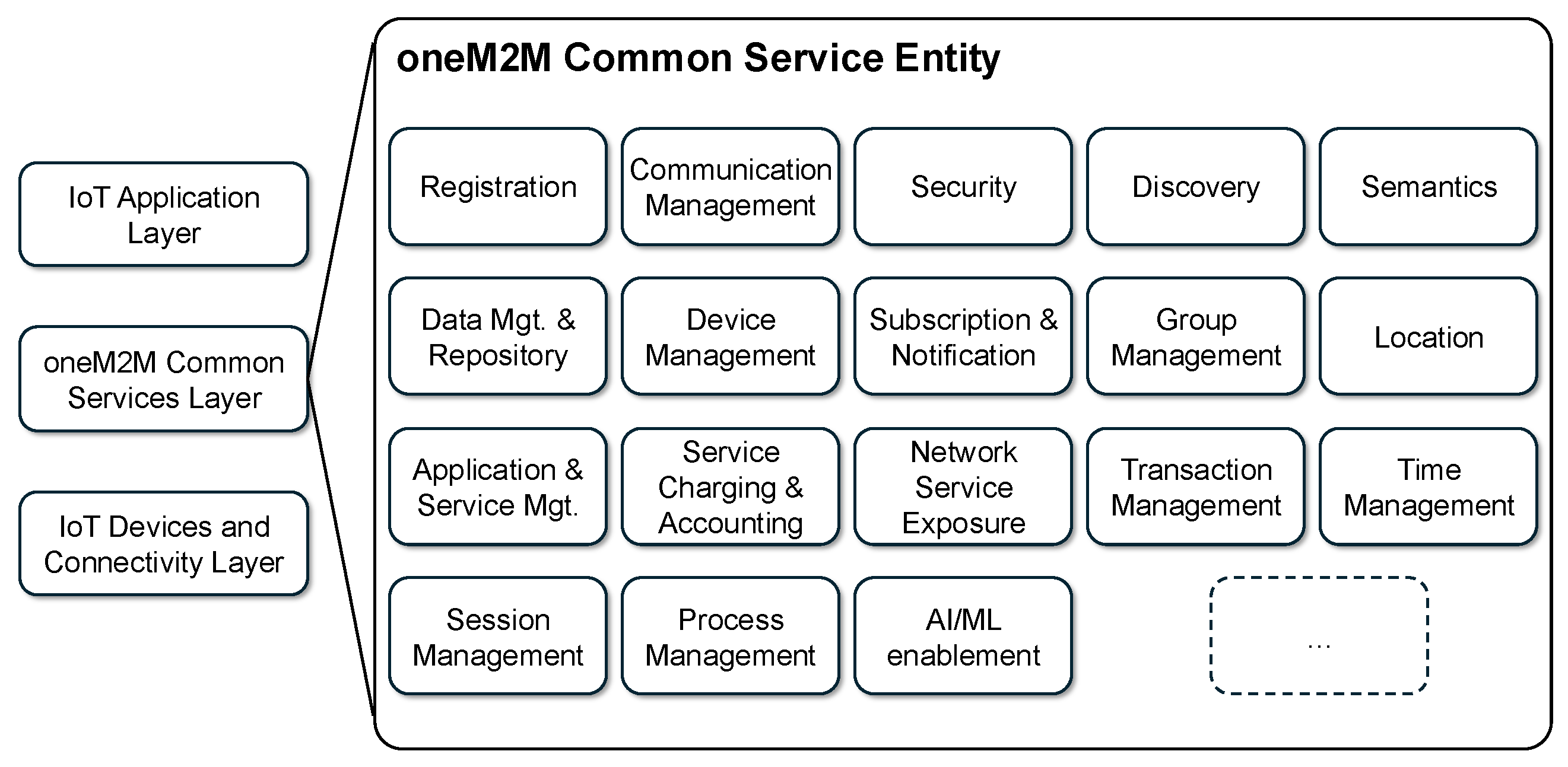
2.1. IoT Service Layer Standards and oneM2M
- Data Management and Semantics: Manages the storage, retrieval, and semantic annotation of IoT data, ensuring efficient processing and meaningful interpretation across devices.
- Security: Provides authentication, authorization, and encryption mechanisms, such as access control policies (ACPs), to safeguard data and interactions.
- Device Management and Registration: Handles device onboarding, configuration, and lifecycle tracking, ensuring reliable operation and updates.
- Discovery: Enables the identification of devices and services, supporting dynamic interactions within IoT ecosystems.
- Group Management: Facilitates coordinated operations among device groups, such as synchronized control in smart homes or industrial systems.
- Location Services: Supports geospatial data management and location-based triggers for applications like logistics and smart cities.
- Subscription and Notification: Manages event-driven subscriptions and real-time alerts for timely responses to IoT conditions.
- Application and Service Management: Oversees the deployment, execution, and monitoring of IoT applications and services.
- Service Charging and Accounting: Tracks resource usage and enables billing, supporting monetization of IoT services.
2.2. Blockchain and Permissioned Distributed Ledger
- Access Control: Only authorized entities join, ensuring transparency and manageability.
- High Security: Verified identities reinforce system integrity.
- Efficient Consensus Mechanisms: Limited nodes enable rapid processing and energy efficiency.
2.3. Advantages of the Proposed Method Compared to Related Works
3. Analysis of Blockchain Applications for oneM2M Common Service Functions
3.1. Data Management & Semantics
- Consensus-Driven Data StorageBlockchain’s consensus mechanisms, such as PoA or Practical Byzantine Fault Tolerance (PBFT), validate data before storage, ensuring integrity and preventing unauthorized modifications [39]. This is critical for IoT applications requiring high reliability, such as healthcare monitoring, where falsified data could lead to misdiagnoses [14].
- Distributed Ledger Storage By storing data across multiple nodes, blockchain eliminates single points of failure and enhances data availability. Tampering is deterred, as altering data requires compromising a majority of nodes, a principle demonstrated by Bitcoin’s resistance to 51% attacks [39]. Studies like [40] highlight blockchain’s role in ensuring data redundancy in IoT networks.
- Semantic Integrity Blockchain records ontology changes immutably, ensuring consistent semantic annotations across IoT devices. This supports interoperable data interpretation, critical for cross-domain applications [14]. For instance, smart contracts can enforce semantic consistency in supply chain data.
- Use Case: Blockchain facilitates trusted data management across diverse domains. In agri-food supply chains and smart agriculture, systems immutably record IoT sensor data to ensure traceability and food safety from farm to consumer [14,41]. Similarly, in industrial IoT, blockchain creates secure, auditable logs for manufacturing data, ensuring provenance and reliable sharing [42]. Furthermore, in the energy sector, smart meters utilize distributed ledgers to enable secure, decentralized peer-to-peer energy trading while protecting against fraud [43].
- Challenge: The primary challenge in integrating blockchain with IoT data management is the inherent conflict between high-frequency IoT data generation and the storage-intensive, slower consensus processes of blockchain. Simply recording all raw sensor data on-chain is impractical. Therefore, hybrid architectures are necessary. Only critical data (e.g., integrity proofs, access events, or aggregated state hashes) are stored on the blockchain. Bulk data is stored in off-chain solutions like the InterPlanetary File System (IPFS) or traditional databases, with their hashes anchored on-chain for verification [40].
- Resolution: This paper applies a hybrid pipeline that keeps raw data streams off-chain and stores on-chain only integrity hashes, access/policy events, or transactions bundled in batches, thereby mitigating storage and consensus overhead.
3.2. Security
3.2.1. Decentralized and Immutable Access Control Policies
3.2.2. RBAC via Smart Contracts
3.2.3. Encryption and Data Privacy
- Use Case: The practical application of blockchain for enhancing IoT security is evidenced in several research initiatives. For example, Novo designed a scalable access control system for IoT where blockchain-based smart contracts manage the distribution of access keys to devices, successfully overcoming the limitations of a centralized manager in a wireless sensor network scenario [46]. In a more complex industrial setting, Di Francesco Maesa et al. demonstrated the use of blockchain to automatically manage access rights in an IoT ecosystem, providing a decentralized and auditable access control mechanism that dynamically adapts to changes in the system [47]. These implementations highlight blockchain’s capacity to create more resilient and transparent security architectures for IoT.
- Challenge: A significant challenge in deploying blockchain for IoT security is the performance overhead associated with consensus mechanisms and smart contract execution, which can introduce latency incompatible with real-time access control requirements. Optimizing consensus algorithms like PBFT for resource-constrained environments or employing hybrid layered architectures are necessary to achieve a viable balance between security assurance and system performance [15].
- Resolution: To address the security/privacy/access-control concerns raised in the literature, we clarify the intended on-chain enforcement pattern and threat assumptions rather than claiming a full formal proof. Specifically, the proposed architecture supports a two-layer access-control design. First, a permissioned membership/allowlist at the PDL boundary to reject non-authorized nodes/accounts. Second, smart-contract RBAC/ACP checks that authorize the caller before any policy update or state transition occurs. For privacy, deployments may choose a hybrid path in which only integrity anchors and policy/audit events are recorded on the chain, whereas sensitive payloads are kept off-chain (optionally encrypted), or payloads are selectively stored on-chain using the oneM2M BC attribute (see Section 4.5).
3.3. Device Management & Registration
- Device Registration and Authentication: Blockchain ensures that each IoT device is securely registered with a unique identifier (e.g., MAC address, digital certificate), stored on the blockchain. This creates a tamper-resistant and verifiable record of device identities, ensuring that only trusted devices can join the network.
- Firmware Update Integrity: Blockchain ensures the integrity of firmware updates. By storing the hash of the firmware on the blockchain, devices can verify that the updates have not been altered. Furthermore, the blockchain enables devices to securely download firmware and configurations directly from the blockchain [17].
- Device Lifecycle Management: Blockchain tracks the entire lifecycle of IoT devices, from manufacturing to deployment, maintenance, and retirement. Every event in the lifecycle is recorded on the blockchain, creating a transparent and auditable history.
- Use Case: Blockchain implementation enhances device management across diverse sectors. The filament blocklet chip secures device authentication and firmware verification, thereby ensuring regulatory compliance in the medical IoT [17]. Dorri et al. proposed a lightweight distributed ledger to manage access rights in smart homes without a central authority [48]. Furthermore, for industrial environments, Samaniego and Deters demonstrated blockchain as an immutable storage layer for transparently tracking the lifecycle and state changes in virtualized IoT resources [49].
- Challenge: A primary challenge in applying blockchain to device management is the scalability limitation posed by the high volume of frequent, small transactions generated by lifecycle events and status updates from millions of devices. This can strain the blockchain throughput and storage. Potential solutions include employing efficient transaction-batching techniques, utilizing hybrid on-chain/off-chain architectures in which only critical attestations are recorded on the blockchain, and leveraging lightweight consensus algorithms designed for IoT resource constraints. The high-frequency lifecycle updates the strain-blockchain throughput, requiring efficient transaction batching or hybrid storage solutions [50].
- Resolution: This study alleviates the throughput and storage constraints by batching high-frequency lifecycle updates into single transactions and adopting a hybrid on/off-chain design that anchors only critical on-chain attestations.
3.4. Discovery
- Decentralized and Tamper-Proof Resource Directories: Blockchain acts as a decentralized, immutable registry for IoT resources. By recording device capabilities and services on a distributed ledger, it creates a tamper-proof catalog immune to malicious alteration. Smart contracts further automate registration and deregistration, ensuring the directory remains current without a central authority.
- Confidential and Privacy-Preserving Discovery: To balance findability with privacy, blockchain utilizes cryptographic techniques such as zero-knowledge proofs. These allow smart contracts to validate resource availability and metadata without revealing sensitive underlying data, enabling entities to prove capabilities while preserving confidentiality [18].
- Role-Based Access Control for Discovery: Smart contracts can enforce RBAC on the discovery process, ensuring only authorized roles can query specific resources. For instance, maintenance personnel might access diagnostic sensors while tenants are restricted to user services. This granular control prevents unauthorized network reconnaissance and secures the network topology.
- Use Case: Research has demonstrated various approaches to blockchain-based discovery in IoT. Novo addressed the scalability challenges in IoT access management using a blockchain, which inherently requires a robust discovery mechanism to locate and verify devices within a network [46]. In a more focused study, Dorri et al. proposed a lightweight blockchain framework for smart homes that included a secure and private method for device discovery, ensuring that only authorized users could locate and interact with specific IoT devices while maintaining their privacy [48]. These implementations demonstrate that blockchain can create more secure, private, and decentralized discovery mechanisms than traditional centralized approaches. In the industrial IoT, blockchain ensures the confidential discovery of factory sensors, restricting access to authorized operators, as implemented in [18].
- Challenge: The primary challenge in employing blockchain for discovery is the computational overhead associated with performing cryptographic operations and executing smart contracts for every query, which can affect scalability and response latency. The storage cost of maintaining the resource metadata on-chain for many IoT devices is also nontrivial. Utilizing lightweight cryptographic algorithms, such as Elliptic Curve Cryptography (ECC) and implementing hybrid architectures, where only critical discovery metadata are stored on-chain, are potential solutions for mitigating these performance concerns [18].
- Resolution: This paper mitigates computational and storage overheads by adopting a hybrid discovery architecture that records only critical discovery metadata on-chain while keeping bulk indices off-chain, thereby improving scalability and response latency.
3.5. Group Management
- Decentralized Group Coordination through Smart Contracts: Group tasks, such as device synchronization, are executed as blockchain transactions. This creates an immutable record of task completion that is shared across the network, enabling transparent and real-time monitoring of group status.
- Use Case: Blockchain technology has demonstrated significant potential in enhancing secure group management across diverse IoT applications. In medical IoT environments, it enables the management of group access while supporting robust device authentication and authorization through public-private key mechanisms [23,24]. Extending this paradigm, blockchain-based group key agreement protocols have been employed in energy-constrained IoT networks to establish decentralized and resilient key management for group communications, effectively addressing the vulnerabilities associated with centralized architectures [52]. Moreover, in dynamic IoT settings characterized by large-scale groups, distributed blockchain solutions provide scalable and trustworthy mechanisms for group key management by incorporating intelligent authentication and lightweight data updates [53].
- Challenge: The primary challenge for blockchain in group management, particularly in large groups, is scalability. The large transaction volume and data size generated by massive IoT devices can lead to significant processing delays (latencies) when traditional consensus mechanisms are used. To mitigate this, sharding techniques have been actively researched to partition networks into smaller segments (shards) that can process group transactions in parallel, thereby improving throughput [24,54,55]. In addition, resource-constrained IoT devices face challenges when directly participating in resource-intensive blockchain consensus processes. This necessitates the use of lightweight consensus algorithms such as PoA variations, which are tailored to minimize computation and energy consumption, or the deployment of dedicated management hub nodes that interface with the blockchain on their behalf to manage group activities [56,57].
- Resolution: This study demonstrates a feasible path using a lightweight blockchain interworking proxy solely as a ledger interface—without centralizing group management—and by adopting a hybrid on/off-chain design with batched submissions to explicitly reduce the on-chain transaction rate and data footprint for large groups. In addition to improving scalability, this decentralized group-management model can naturally support federated learning scenarios that rely on secure group aggregation across multiple organizations: blockchain-based membership, key-management, and contribution records allow participating clients, aggregators, and auditors to verify group composition and updates without sharing raw training data.
3.6. Location
- Location Data Integrity and Verification: Blockchain ensures location data (e.g., GPS) is stored immutably, guaranteeing integrity against tampering [25]. This provides a verifiable foundation for applications like logistics, where the authenticity of location history is critical.
- Location Data Sharing: Blockchain facilitates secure, consistent location data sharing among multiple stakeholders while preserving privacy [58]. It enforces strict access controls, ensuring that only authorized parties in ecosystems like smart cities can view or update sensitive location information.
- Use Case: The integration of Blockchain and IoT for location management enhances trust and transparency in critical sectors. In logistics, IoT sensors record shipment locations and conditions in a distributed ledger, creating an immutable audit trail that allows smart contracts to automate payments or insurance claims based on verifiable delivery data [13,59,60]. Similarly, in Smart Cities and Intelligent Transportation Systems (ITS), blockchain secures decentralized vehicle location data. This enables real-time sharing with authorized entities (e.g., traffic management) while preserving driver privacy through pseudonymity, ensuring data authenticity without compromising security [61,62].
- Challenge: The primary challenge in utilizing the blockchain for real-time location management is its scalability. The high frequency and sheer volume of location updates generated by a massive number of mobile IoT devices can significantly increase the transaction latency and blockchain storage demands, requiring solutions such as off-chain data storage (e.g., the InterPlanetary File System or IPFS) with on-chain verification mechanisms [58].
- Resolution: This study adopts a hybrid on/off-chain design for real-time location data—keeping high-frequency off-chain updates while anchoring concise on-chain proofs—and uses batched submissions to alleviate processing latency and on-chain storage demand.
3.7. Network Service Exposure
- Use Case: In 5G and beyond, consortium blockchains facilitate decentralized trading and management of network slices. These frameworks allow Infrastructure Providers (InPs) and Mobile Virtual Network Operators (MVNOs) to securely trade spectrum resources by utilizing smart contracts and game-theoretic incentives to automate slice adjustments and ensure a fair distribution [64,65]. Furthermore, for 6G networks, blockchain enhances service-level agreement (SLA) management by immutably recording slice configurations and performance indicators. This enables automated, auditable SLA monitoring and penalty enforcement, thereby securing trust between consumers and providers in multidomain environments [66,67].
- Challenge: A primary challenge is the requirement of low-latency consensus mechanisms to support real-time instantaneous decisions for network selection and resource allocation. The computational overhead of traditional blockchain consensus protocols can introduce significant delays, imposing constraints on resource-constrained IoT devices and time-sensitive network functions.
- Resolution: This study confines blockchain use for network service exposure to asynchronous, batched audit/attestation writes via an interworking proxy—devices do not participate in consensus or execute contracts—while real-time network selection/resource allocation remains off-chain, reducing per-device on-chain interaction without modifying consensus.
3.8. Subscription and Notification
- Event-Based Subscription and Notification: Smart contracts automate event-driven subscriptions by triggering alerts when predefined conditions (e.g., temperature thresholds) are met [28]. This ensures timely, verifiable notifications, while the ledger’s immutability creates an unalterable audit trail of all triggered events.
- Secure and Tamper-Proof Notifications: Blockchain creates a secure, validation-based history for critical IoT alerts. In sectors like smart agriculture, recording environmental anomalies on-chain ensures a transparent audit trail for stakeholders [29]. This mechanism mitigates the risk of fraudulent or erroneous notifications by enforcing data integrity.
- Access Control and Role-Based Notification Delivery: Smart contracts enforce RBAC to ensure notifications reach only authorized recipients [30]. For instance, in smart grids, operational alerts can be routed exclusively to utility managers while billing data is sent to consumers [31]. This granular control enhances privacy by preventing unauthorized information exposure.
- Use Case: Blockchain facilitates trusted, automated dissemination of critical event data across various ecosystems. Commercial platforms, such as IBM Watson’s IoT and WiMi, leverage this to securely transmit real-time alerts between business partners, thereby ensuring data immutability for supply chain updates [31]. In Intelligent Transportation Systems (ITS), blockchain frameworks verify traffic anomalies by using consensus mechanisms before broadcasting authenticated warnings to vehicles, thereby preventing accidents caused by false information [68]. Similarly, in Industrial IoT (IIoT), smart contracts trigger secure maintenance notifications upon detecting anomalies logged on a private blockchain and are dispatched exclusively to authorized technicians, creating a verified audit trail for regulatory compliance [28].
- Challenge: The primary technical constraint is the potential of high-frequency notifications to generate a large volume of transactions, which can lead to network congestion and high latency within a blockchain network. This challenge necessitates the development of efficient transaction aggregation and optimized off-chain processing solutions to maintain real-time responsiveness required by many IoT applications [29].
- Resolution: This study mitigates congestion by adopting a hybrid on/off-chain design that records only critical subscription/notification attestations on-chain, while keeping bulk event data off-chain and employing batched, asynchronous submissions to reduce transaction volume and preserve real-time responsiveness.
3.9. Application & Service Management
- Use Case: In commercial scenarios, platforms such as IBM Watson IoT leverage the blockchain to automate smart grid provisioning and ensure an immutable financial settlement [32]. Beyond billing, research focuses on Quality of Service (QoS) assurance, and frameworks such as SmartSLA utilize smart contracts to automatically enforce service-level agreements (SLAs) by verifying metrics such as latency and executing penalty clauses [69]. Similarly, in Edge-Cloud environments, systems such as EdgeChain employ smart contracts for decentralized resource orchestration. These contracts govern the computing resource allocation based on policies and credit systems, thereby ensuring fair and auditable usage of IoT devices [70].
- Challenge: The primary challenge is the complexity of encoding the intricate application management logic in smart contracts, which can lead to increased gas costs (in public blockchains) and potential vulnerabilities. Furthermore, the performance overheads of consensus mechanisms and contract execution may affect the responsiveness of management operations, particularly for latency-sensitive applications. Designing lightweight smart contracts and utilizing permissioned blockchain configurations with optimized consensus algorithms are essential strategies for mitigating these challenges.
- Resolution: This study does not directly address the intrinsic performance limits of consensus or smart contract execution. Instead, it minimizes the on-chain application management logic (favoring lightweight contracts) and employs a BlockIPE that abstracts the ledger, enabling replacement/reconfiguration (e.g., permissioned chains with optimized consensus) without redesigning the services. These choices constrain on-chain exposure and the associated costs, and the remaining limitations are discussed in Section 6.
3.10. Service Charging & Accounting
- Use Case: Blockchain facilitates trustless automation in verticals such as decentralized smart grids, enabling real-time peer-to-peer micropayments between prosumers and consumers without intermediaries [37,38]. This is particularly evident in the Electric Vehicle (EV) charging infrastructure. Consortium blockchains and smart contracts manage the entire transaction lifecycle, from bidding and authentication to final settlement, based on smart meter data. This approach not only fosters an efficient decentralized energy market [72] but also secures charging sessions against cyberattacks by enforcing strict identity verification and data integrity during the payment process [73].
- Challenge: The primary challenge in implementing blockchain for service charging is the scalability requirement for handling the high volume of microtransactions characteristic of massive IoT deployments. The latency and transaction throughput limitations of some blockchain consensus mechanisms can constrain the real-time billing capabilities. Potential solutions include employing DAG-based structures for a higher transaction throughput, implementing payment channel networks for off-chain transaction aggregation, and developing optimized consensus algorithms specifically designed for high-frequency accounting scenarios [36].
- Resolution: This study did not directly address optimizing the consensus or performance overheads associated with high-volume microtransactions for service charging. Instead, the architecture abstracts the ledger via a BlockIPE, enabling the replacement or reconfiguration of the underlying blockchain (e.g., DAG-based or payment-channel-enabled networks) without redesigning services; the evaluation of such alternatives and their limitations is deferred to future work.
3.11. Discussion
3.11.1. Key Lessons Learned
3.11.2. Synthesis of CSF Enhancements
3.11.3. Bridging to Implementation
4. Blockchain-Enabled IoT Platform
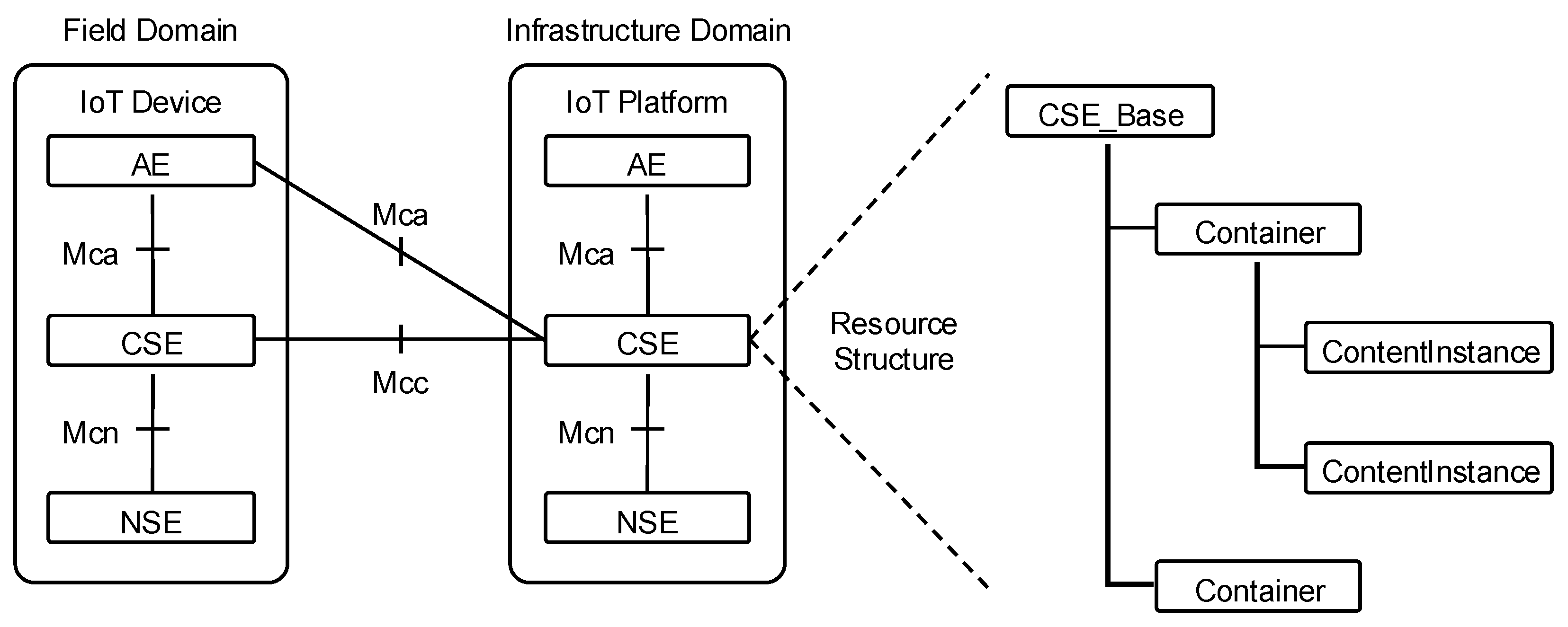
4.1. oneM2M Architecture Principle
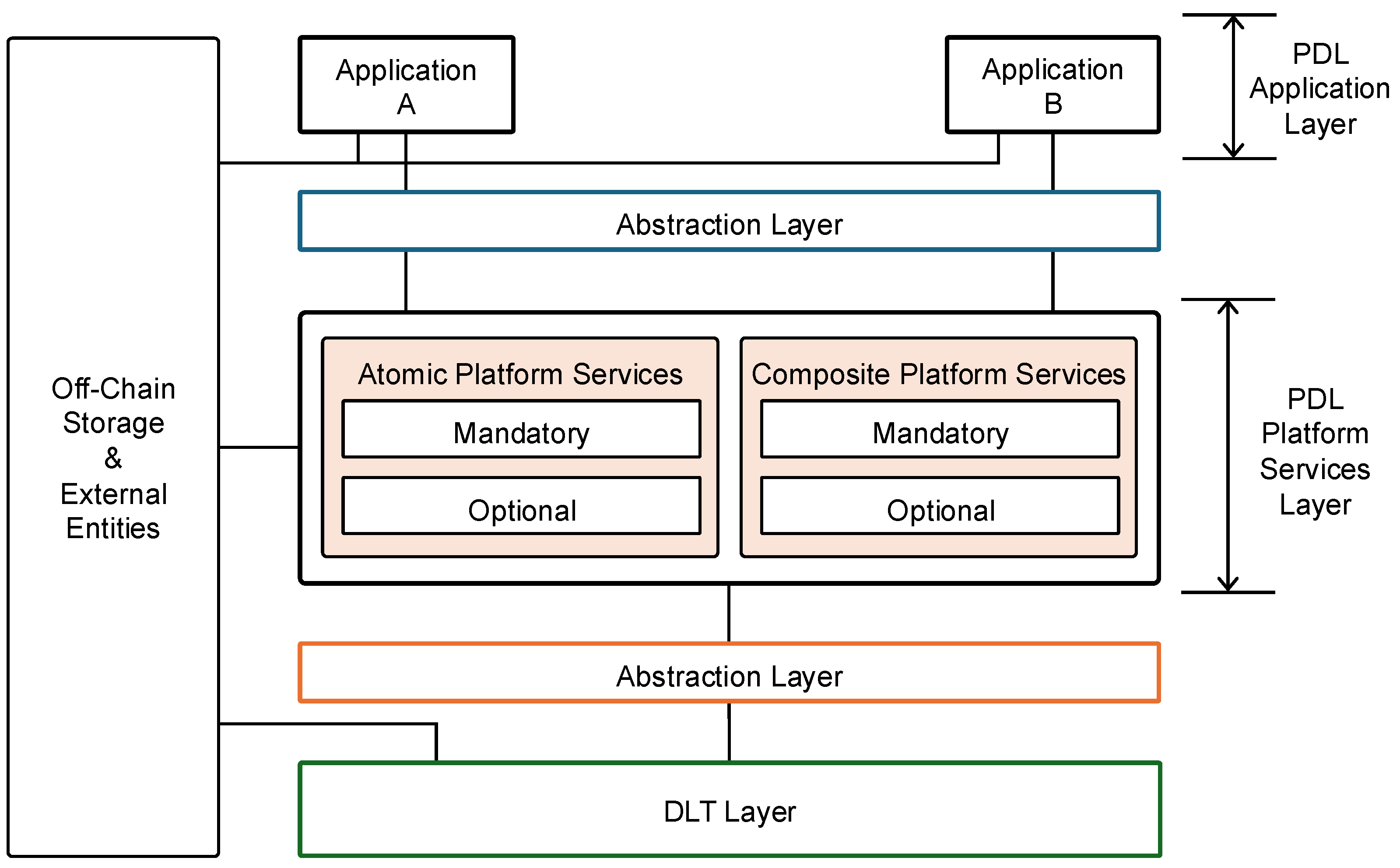
4.2. High-Level Architecture of Blockchain-Enabled IoT Platform
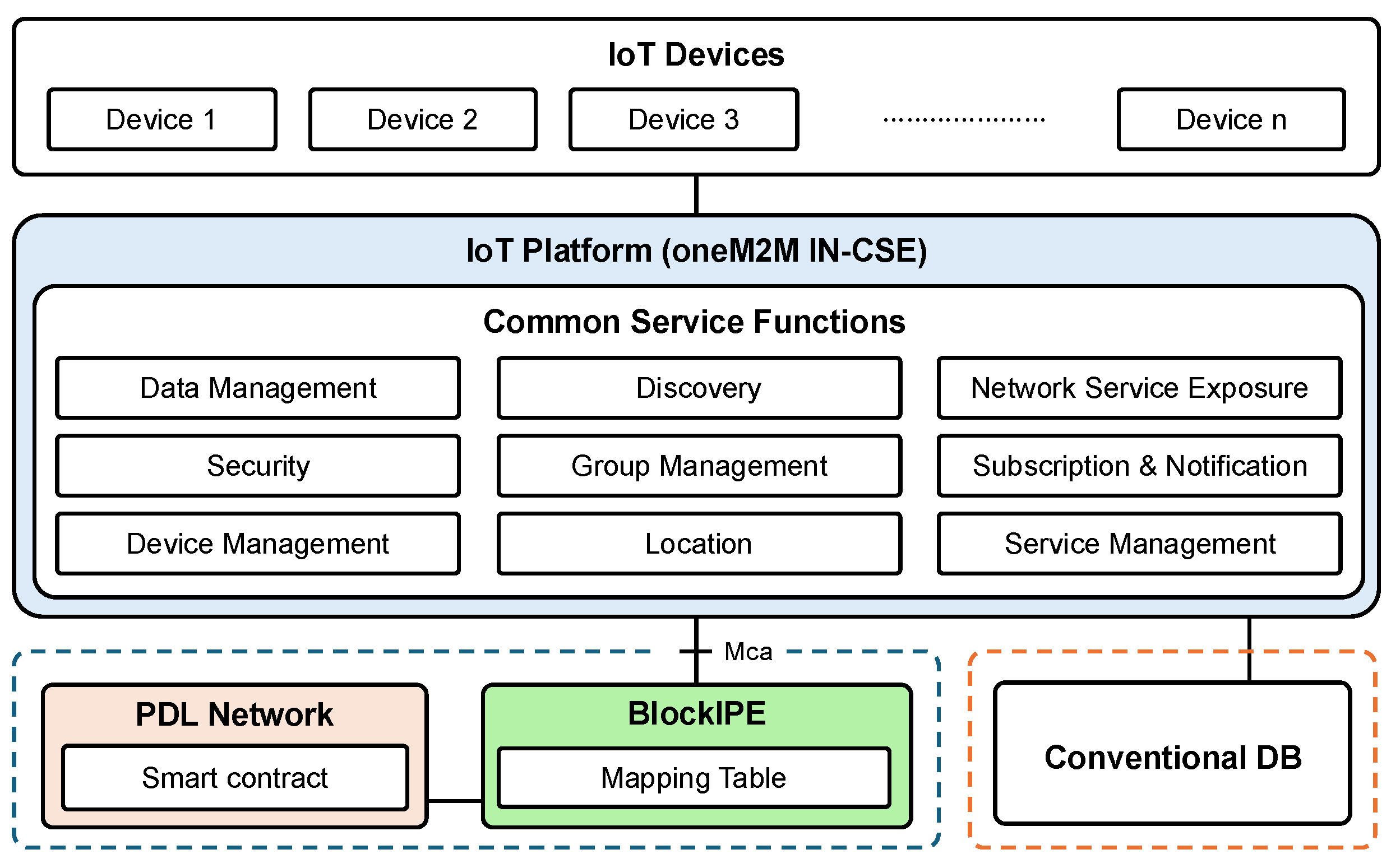
- Conventional data processing. If the data does not have a significant impact on the service, it does not need to be stored in the blockchain network. In that case, the IoT platform will manage the data in the conventional way, using common functions to store data in a connected conventional database.
- Blockchain data processing. If the data needs to be traced, they should not be changed under any circumstances. Such data should be stored in the blockchain network when it Is uploaded to the IoT platform.
4.3. Connected Blockchain
4.4. Detailed IoT and Blockchain Interworking Mechanism
| Algorithm 1: BlockIPE Interworking Pseudocode that shows detailed interworking mechanism enabling blockchain function to IoT platforms |
 |
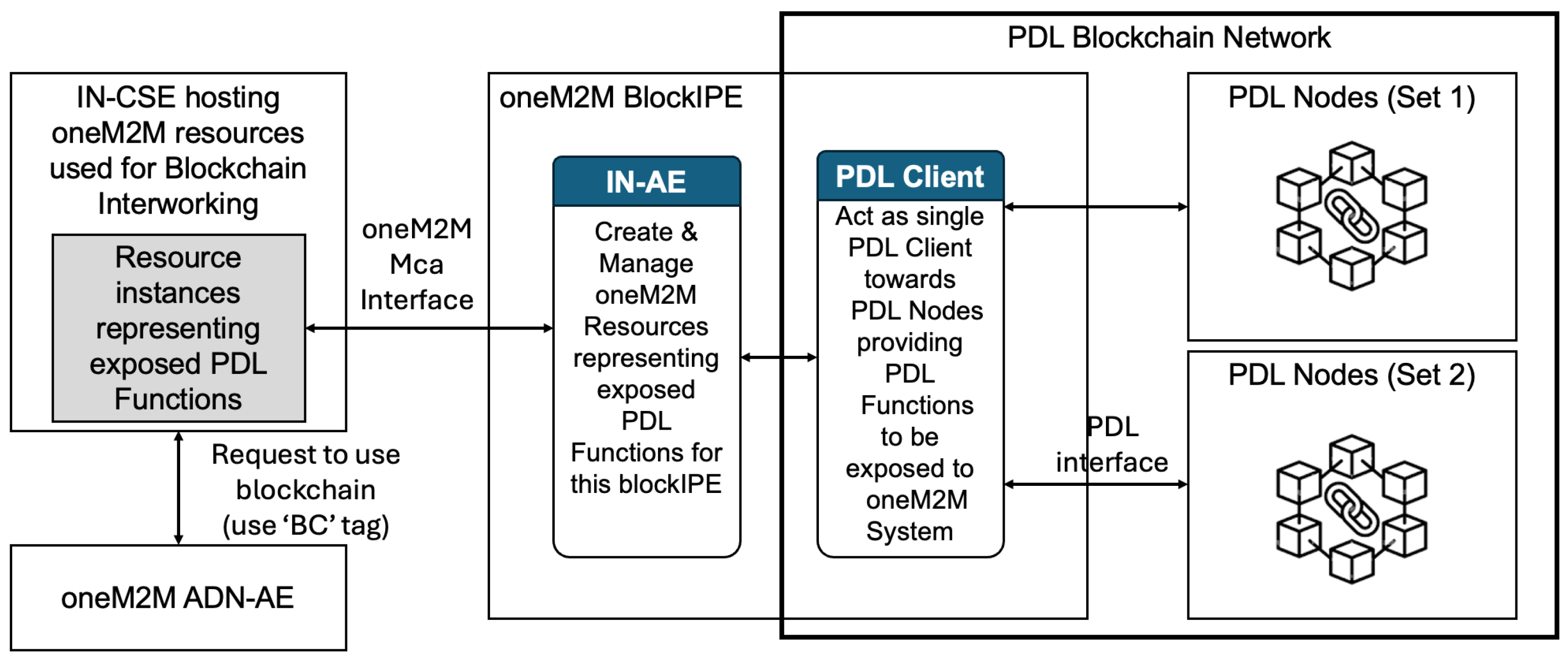
- Notification and Processing: The oneM2M platform detects the BC attribute and sends a notification containing the <cin> details to the BlockIPE (Step 3-2). The IPE internally processes this data, consulting the CSF-contract mapping and encoding the payload.
- Submission: The IPE creates and submits a transaction to the PDL platform (Step 3-3). The PDL platform validates the transaction and anchors it to the ledger.
- Finalization: Once validated, the PDL platform returns the transaction hash to the BlockIPE (Step 3-4). Finally, the IPE creates a history <cin> in the oneM2M platform (Step 3-5). This resource contains the transaction hash, effectively linking the off-chain IoT data with its immutable on-chain record.
4.5. Security, Privacy, and Access-Control Clarifications
- Threat Model: We assume adversaries may (i) impersonate AEs, (ii) attempt unauthorized CRUD operations, or (iii) submit replayed transactions. We do not assume default on-chain confidentiality; thus, sensitive payloads represent off-chain data.
- Privacy Groups: A privacy group aggregates authorized principals (e.g., AEs) under a common scope. On-chain, this maps a groupId to member addresses and binds to oneM2M <acp> policies to strictly control resource access.
- Key Handling: Principals sign requests using cryptographic keys, optionally linked to DIDs. In the event of a compromise, access is revoked by updating the on-chain role assignments, effectively blocking future authorization.
- On-Chain RBAC Enforcement: Smart contracts enforce authorization by validating the caller’s role against stored policies before any state transition. Unauthorized calls revert, preventing invalid state changes. The enforcement flow is as follows:
- 1.
- Admission: The BlockIPE is allow-listed on the PDL to reject unauthorized senders.
- 2.
- Trigger: An AE creates a BC-anchored <cin>, notifying the IPE.
- 3.
- Validation: The IPE submits a transaction; the contract verifies the role/policy and reverts if unauthorized.
- 4.
- Linkage: Validated transaction hashes are recorded on-chain and linked back to a history <cin> for auditability.
- Mitigation: Our design employs a dual-layer defense: network-level allow-listing and contract-level role checks. Replay attacks are mitigated using nonces/timestamps, whereas key compromises are handled through immediate on-chain role revocation.
5. System Implementation and Evaluation
5.1. Scope of Evaluation and System-Level Considerations
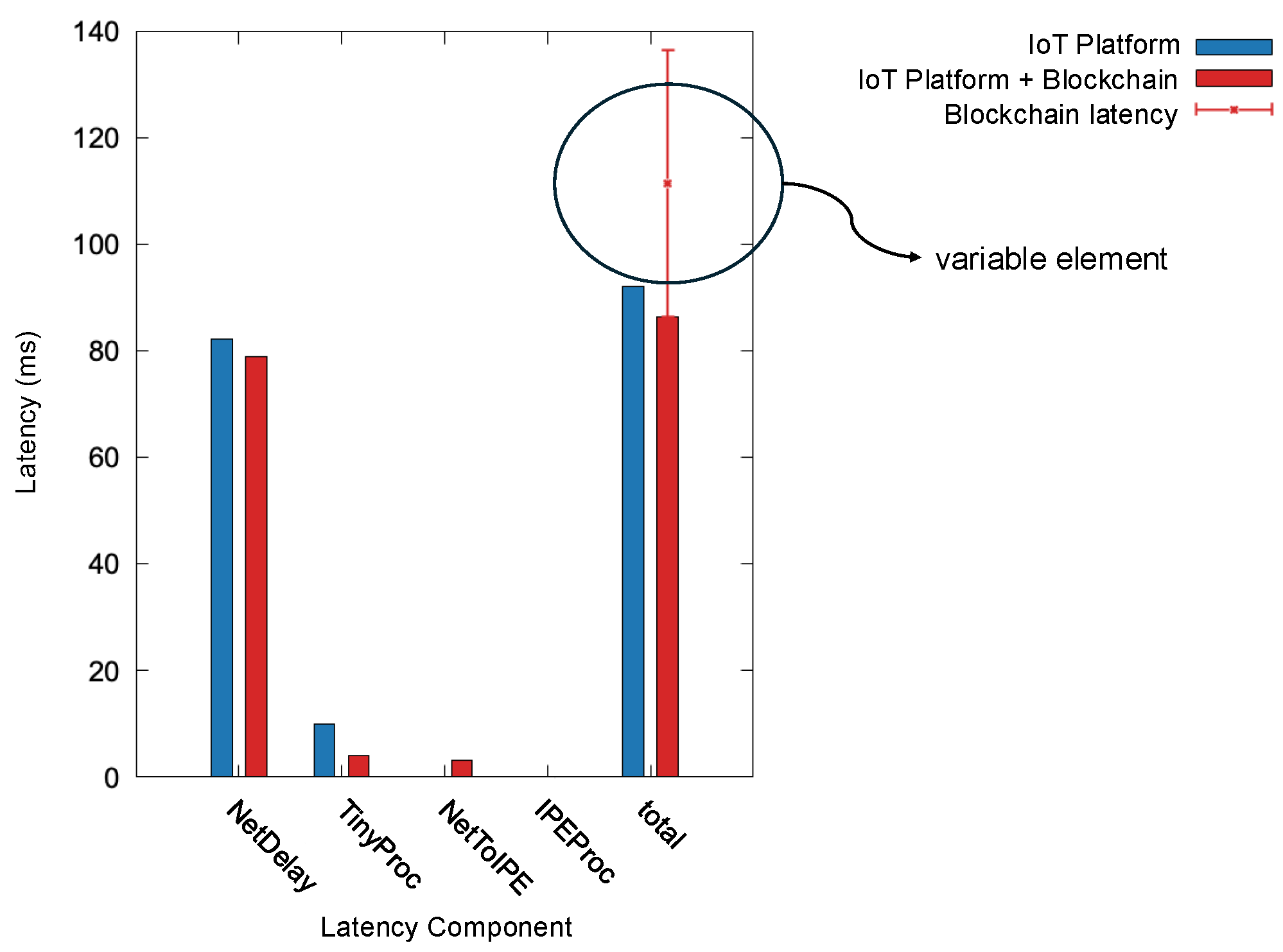
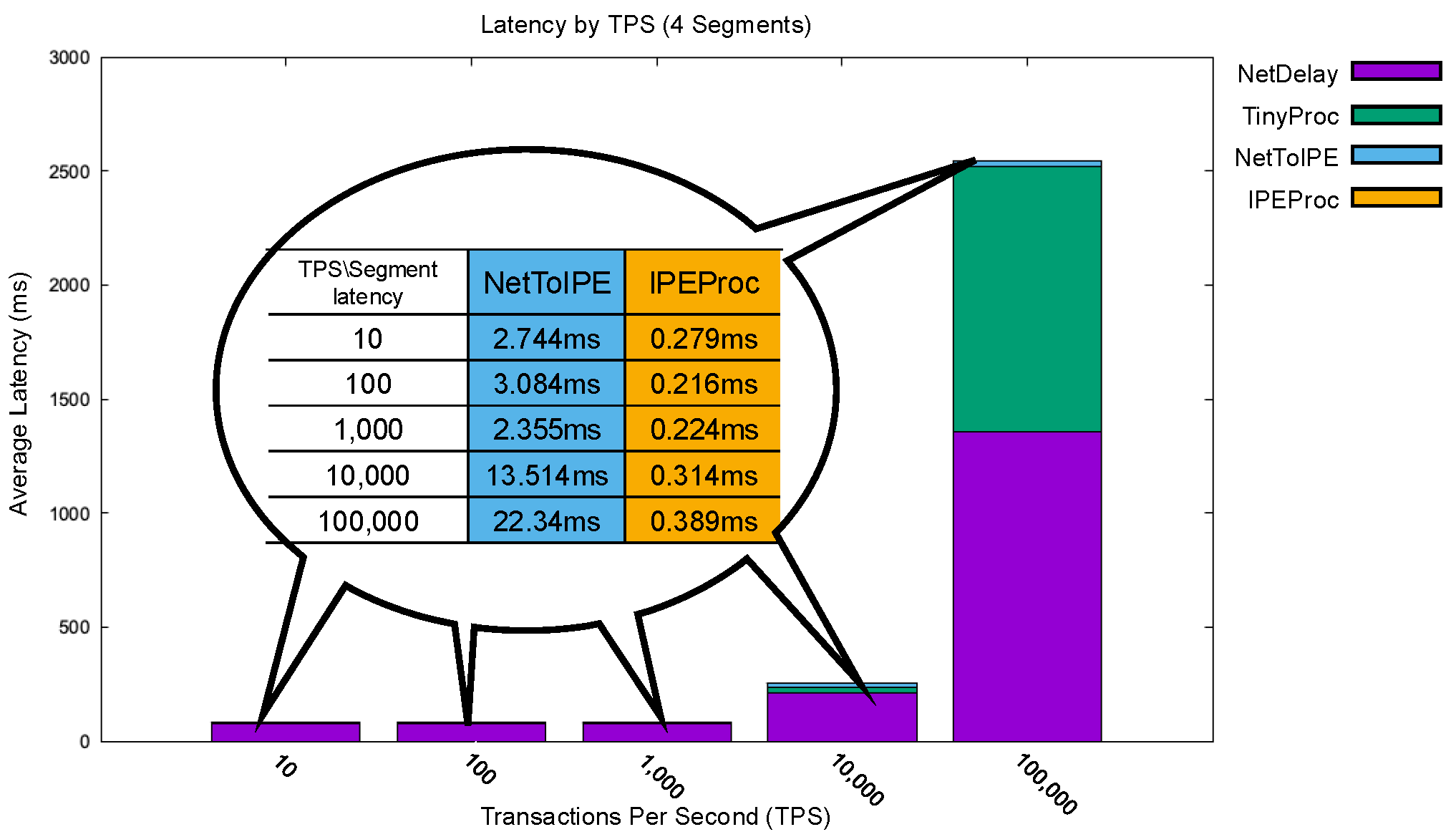
- Scope of evaluation: Our evaluation is intentionally scoped to demonstrate the feasibility of a standards-compliant oneM2M-PDL interworking architecture with acceptable proxy-leveloverhead, rather than claiming end-to-end optimization of all system-level metrics. Accordingly, the latency and throughput results shown in Figure 8 and Figure 9 measure the path up to transaction submission at the BlockIPE (i.e., without waiting for on-chain finality/confirmation). They are used to isolate the incremental overhead introduced by the BlockIPE and the selective on-/off-chain routing.
- Reliability under node failures/partitions: Reliability under node failures and network partitioning is primarily governed by the underlying permissioned ledger’s membership and consensus configuration (e.g., crash/fault tolerance thresholds and reconfiguration policies), which is orthogonal to the oneM2M interface logic. Within our architecture, the BlockIPE is a replaceable gateway component; thus, availability can be improved by deploying redundant IPE instances behind a load balancer and treating transaction submission failures as recoverable errors (retry/queue policies are deployment-dependent and will be discussed in future work).
- Storage overhead and long-term ledger growth: Ledger growth is linear in the number of anchored operations: , where N is the number of on-chain anchoring events and s is the average size of the on-chain record (transaction + logs). The hybrid model reduces s by recording only integrity anchors and policy/audit events for high-volume data, while maintaining privacy-sensitive payloads off-chain, and batching can reduce N under bursty workloads. Long-term sustainability can be supported by operational techniques (e.g., pruning/archival nodes, periodic checkpointing, and off-chain data-retention policies), which we leave to deployment-specific engineering.
- Computational cost and resource utilization: Our measurements decompose proxy-level latency into network and processing segments (e.g., NetToIPE and IPEProc), where IPEProc remains sub-millisecond across increasing virtual loads, indicating low processing overhead at the BlockIPE. However, the validator-side CPU/RAM costs from consensus and smart contract execution are not directly measured in this work and are explicitly stated as limitations and future benchmarking targets.
- Sustainability of the hybrid on-/off-chain model: The hybrid design improves scalability by minimizing on-chain storage and avoiding confidentiality assumptions for ledger state, while preserving auditability through immutable anchors and events. This shifts part of the system’s responsibility to off-chain storage availability and retention, which can be addressed through replication and regular integrity audits (hash verification) and is discussed as an operational consideration rather than a protocol guarantee.
5.2. Security Analysis of the Prototype Implementation
6. Conclusions and Future Work
- Security: We did not optimize or evaluate the intrinsic overheads of consensus mechanisms and smart-contract execution. Data encryption, key lifecycle management, and private channel operational guidelines remain at the design-only stage. Future work: Quantify p95/p99 latency and throughput under permissioned consensus (e.g., PBFT/PoA/IBFT), implement encryption with KMS-backed key lifecycle, and define private-channel operational policies.
- Group Management: The proxy was used only as a ledger interface; optimization of consensus and contract performance was out of scope. The evaluation of sharding and other distributed techniques for large-scale groups—without centralized control—remains a topic for future work. Future work: Prototype sharding and hierarchical group operations, and measure cross-shard consistency, membership churn costs, and end-to-end latency while preserving decentralization.
- Application & Service Management: We used lightweight smart contracts, and no quantitative analysis of consensus performance or contract-execution overhead was conducted. The effectiveness of IoT-tailored consensus and network alternatives is unverified. Future work: Apply formal verification to contracts and assess upgrade safety (proxy/modular patterns); benchmark IoT-suitable consensus/networks (e.g., Fabric, Besu/IBFT) for contract-execution latency and resource cost.
- Service Charging & Accounting: Mechanisms tailored to high-frequency microtransactions (e.g., DAG-based ledgers, payment channels, rollups) were neither integrated nor evaluated. Future work: Integrate payment channels/rollups/DAG-based ledgers and benchmark settlement latency, double-spend resilience, fee volatility, and recovery under bursty microtransaction loads.
Author Contributions
Funding
Informed Consent Statement
Data Availability Statement
Acknowledgments
Conflicts of Interest
References
- Pinno, O.J.A.; Gregio, A.R.A.; De Bona, L.C. Controlchain: Blockchain as a central enabler for access control authorizations in the iot. In Proceedings of the GLOBECOM 2017–2017 IEEE Global Communications Conference, Singapore, 4–8 December 2017; IEEE: New York, NY, USA, 2017; pp. 1–6. [Google Scholar]
- Casado-Vara, R.; Chamoso, P.; De la Prieta, F.; Prieto, J.; Corchado, J.M. Non-linear adaptive closed-loop control system for improved efficiency in IoT-blockchain management. Inf. Fusion 2019, 49, 227–239. [Google Scholar] [CrossRef]
- Hassan, M.U.; Rehmani, M.H.; Chen, J. Privacy preservation in blockchain based IoT systems: Integration issues, prospects, challenges, and future research directions. Future Gener. Comput. Syst. 2019, 97, 512–529. [Google Scholar] [CrossRef]
- Huang, J.; Kong, L.; Chen, G.; Wu, M.Y.; Liu, X.; Zeng, P. Towards secure industrial IoT: Blockchain system with credit-based consensus mechanism. IEEE Trans. Ind. Inform. 2019, 15, 3680–3689. [Google Scholar] [CrossRef]
- Alladi, T.; Chamola, V.; Parizi, R.M.; Choo, K.K.R. Blockchain applications for industry 4.0 and industrial IoT: A review. IEEE Access 2019, 7, 176935–176951. [Google Scholar] [CrossRef]
- Swetina, J.; Lu, G.; Jacobs, P.; Ennesser, F.; Song, J. Toward a standardized common M2M service layer platform: Introduction to oneM2M. IEEE Wirel. Commun. 2014, 21, 20–26. [Google Scholar] [CrossRef]
- Martigne, P. Overview of ETSI machine-to-machine and oneM2M architectures. In Machine-to-Machine (M2M) Communications; Elsevier: Amsterdam, The Netherlands, 2015; pp. 27–46. [Google Scholar]
- Roth, F.M.; Becker, C.; Vega, G.; Lalanda, P. XWARE—A customizable interoperability framework for pervasive computing systems. Pervasive Mob. Comput. 2018, 47, 13–30. [Google Scholar] [CrossRef]
- Gyrard, A.; Datta, S.K.; Bonnet, C.; Boudaoud, K. Integrating machine-to-machine measurement framework into oneM2M architecture. In Proceedings of the Network Operations and Management Symposium (APNOMS), 2015 17th Asia-Pacific, Busan, Republic of Korea, 19–21 August 2015; IEEE: New York, NY, USA, 2015; pp. 364–367. [Google Scholar]
- Condos, J.; Sorrell, W.H.; Donegan, S.L. Blockchain Technology: Opportunities and Risks; Vermont Office of the Attorney General: Montpelier, VT, USA, 2016. [Google Scholar]
- Thwin, T.T.; Vasupongayya, S. Blockchain-based access control model to preserve privacy for personal health record systems. Secur. Commun. Netw. 2019, 2019, 8315614. [Google Scholar] [CrossRef]
- Al Neyadi, D.; Puthal, D.; Dutta, J.; Damiani, E. Role-based access control in private blockchain for iot integrated smart contract. In Proceedings of the IFIP International Internet of Things Conference, Denton, TX, USA, 2–3 November 2023; Springer: Berlin/Heidelberg, Germany, 2023; pp. 227–245. [Google Scholar]
- George, B. Blockchain in Global Trade: Insights from the TradeLens Experiment; Technical Report; Center for Open Science: Charlottesville, VA, USA, 2025. [Google Scholar]
- Bhuvana, R.; Aithal, P. Blockchain based service: A case study on IBM blockchain services & hyperledger fabric. Int. J. Case Stud. Bus. IT Educ. (IJCSBE) 2020, 4, 94–102. [Google Scholar]
- Honar Pajooh, H.; Rashid, M.; Alam, F.; Demidenko, S. Hyperledger fabric blockchain for securing the edge internet of things. Sensors 2021, 21, 359. [Google Scholar] [CrossRef] [PubMed]
- Androulaki, E.; Barger, A.; Bortnikov, V.; Cachin, C.; Christidis, K.; De Caro, A.; Enyeart, D.; Ferris, C.; Laventman, G.; Manevich, Y.; et al. Hyperledger fabric: A distributed operating system for permissioned blockchains. In Proceedings of the Thirteenth EuroSys Conference, Porto, Portugal, 23–26 April 2018; pp. 1–15. [Google Scholar]
- Košt’ál, K.; Helebrandt, P.; Belluš, M.; Ries, M.; Kotuliak, I. Management and monitoring of IoT devices using blockchain. Sensors 2019, 19, 856. [Google Scholar] [CrossRef]
- Rondanini, C.; Carminati, B.; Ferrari, E. Confidential discovery of iot devices through blockchain. In Proceedings of the 2019 IEEE International Congress on Internet of Things (ICIOT), Milan, Italy, 8–13 July 2019; IEEE: New York, NY, USA, 2019; pp. 1–8. [Google Scholar]
- Anjum, M.; Kraiem, N.; Min, H.; Dutta, A.K.; Daradkeh, Y.I.; Shahab, S. Opportunistic access control scheme for enhancing IoT-enabled healthcare security using blockchain and machine learning. Sci. Rep. 2025, 15, 7589. [Google Scholar] [CrossRef]
- Ayoade, G.; Karande, V.; Khan, L.; Hamlen, K. Decentralized IoT data management using blockchain and trusted execution environment. In Proceedings of the 2018 IEEE International Conference on Information Reuse and Integration (IRI), Salt Lake City, UT, USA, 6–9 July 2018; IEEE: New York, NY, USA, 2018; pp. 15–22. [Google Scholar]
- Nakamura, Y.; Zhang, Y.; Sasabe, M.; Kasahara, S. Exploiting smart contracts for capability-based access control in the internet of things. Sensors 2020, 20, 1793. [Google Scholar] [CrossRef]
- Haque, E.U.; Shah, A.; Iqbal, J.; Ullah, S.S.; Alroobaea, R.; Hussain, S. A scalable blockchain based framework for efficient IoT data management using lightweight consensus. Sci. Rep. 2024, 14, 7841. [Google Scholar] [CrossRef]
- Cao, Z.; Wen, X.; Ai, S.; Shang, W.; Huan, S. A decentralized authentication scheme for smart factory based on blockchain. Sci. Rep. 2024, 14, 24640. [Google Scholar] [CrossRef]
- Khashan, O.A.; Alamri, S.; Alomoush, W.; Alsmadi, M.K.; Atawneh, S.; Mir, U. Blockchain-Based Decentralized Authentication Model for IoT-Based E-Learning and Educational Environments. Comput. Mater. Contin. 2023, 75, 3133–3158. [Google Scholar] [CrossRef]
- Qiu, Y.; Liu, Y.; Li, X.; Chen, J. A novel location privacy-preserving approach based on blockchain. Sensors 2020, 20, 3519. [Google Scholar] [CrossRef]
- Chen, Y.; Wang, X.; Yang, Y.; Li, H. Location-aware Wi-Fi authentication scheme using smart contract. Sensors 2020, 20, 1062. [Google Scholar] [CrossRef] [PubMed]
- Victor, F.; Zickau, S. Geofences on the blockchain: Enabling decentralized location-based services. In Proceedings of the 2018 IEEE International Conference on Data Mining Workshops (ICDMW), Singapore, 17–20 November 2018; IEEE: New York, NY, USA, 2018; pp. 97–104. [Google Scholar]
- Albulayhi, A.S.; Alsukayti, I.S. A blockchain-centric IoT architecture for effective smart contract-based management of IoT data communications. Electronics 2023, 12, 2564. [Google Scholar] [CrossRef]
- Rifi, N.; Agoulmine, N.; Chendeb Taher, N.; Rachkidi, E. Blockchain technology: Is it a good candidate for securing iot sensitive medical data? Wirel. Commun. Mob. Comput. 2018, 2018, 9763937. [Google Scholar] [CrossRef]
- Algarni, S.; Eassa, F.; Almarhabi, K.; Almalaise, A.; Albassam, E.; Alsubhi, K.; Yamin, M. Blockchain-based secured access control in an IoT system. Appl. Sci. 2021, 11, 1772. [Google Scholar] [CrossRef]
- Zhang, Y.; Kasahara, S.; Shen, Y.; Jiang, X.; Wan, J. Smart contract-based access control for the internet of things. IEEE Internet Things J. 2018, 6, 1594–1605. [Google Scholar] [CrossRef]
- Rahman, Z.; Yi, X.; Khalil, I.; Kelarev, A. Blockchain for iot: A critical analysis concerning performance and scalability. In Quality, Reliability, Security and Robustness in Heterogeneous Systems, Proceedings of the 17th EAI International Conference, QShine 2021, Virtual Event, 29–30 November 2021; Proceedings 17; Springer: Berlin/Heidelberg, Germany, 2021; pp. 57–74. [Google Scholar]
- Krishnan, P.; Jain, K.; Poojara, S.R.; Srirama, S.N.; Pandey, T.; Buyya, R. eSIM and blockchain integrated secure zero-touch provisioning for autonomous cellular-IoTs in 5G networks. Comput. Commun. 2024, 216, 324–345. [Google Scholar] [CrossRef]
- Mollah, M.B.; Zhao, J.; Niyato, D.; Lam, K.Y.; Zhang, X.; Ghias, A.M.; Koh, L.H.; Yang, L. Blockchain for future smart grid: A comprehensive survey. IEEE Internet Things J. 2020, 8, 18–43. [Google Scholar] [CrossRef]
- Suliman, A.; Husain, Z.; Abououf, M.; Alblooshi, M.; Salah, K. Monetization of IoT data using smart contracts. IET Netw. 2019, 8, 32–37. [Google Scholar] [CrossRef]
- Mercan, S.; Kurt, A.; Akkaya, K.; Erdin, E. Cryptocurrency solutions to enable micropayments in consumer IoT. IEEE Consum. Electron. Mag. 2021, 11, 97–103. [Google Scholar] [CrossRef]
- Martins, J.P.; Ferreira, J.C.; Monteiro, V.; Afonso, J.A.; Afonso, J.L. IoT and blockchain paradigms for EV charging system. Energies 2019, 12, 2987. [Google Scholar] [CrossRef]
- Liu, H.; Lv, Z.; Song, Z.; Zhou, S.; Liu, W.; Fang, M. Application of blockchain technology in electric vehicle charging piles based on electricity Internet of Things. Wirel. Commun. Mob. Comput. 2022, 2022, 8533219. [Google Scholar] [CrossRef]
- Nawab, F.; Sadoghi, M. Consensus in data management: From distributed commit to blockchain. Found. Trends® Databases 2023, 12, 221–364. [Google Scholar] [CrossRef]
- Zhao, G.; Liu, S.; Lopez, C.; Lu, H.; Elgueta, S.; Chen, H.; Boshkoska, B.M. Blockchain technology in agri-food value chain management: A synthesis of applications, challenges and future research directions. Comput. Ind. 2019, 109, 83–99. [Google Scholar] [CrossRef]
- Tian, F. An agri-food supply chain traceability system for China based on RFID & blockchain technology. In Proceedings of the 2016 13th International Conference on Service Systems and Service Management (ICSSSM), Kunming, China, 24–26 June 2016; IEEE: New York, NY, USA, 2016; pp. 1–6. [Google Scholar]
- Christidis, K.; Devetsikiotis, M. Blockchains and smart contracts for the internet of things. IEEE Access 2016, 4, 2292–2303. [Google Scholar] [CrossRef]
- Aitzhan, N.Z.; Svetinovic, D. Security and privacy in decentralized energy trading through multi-signatures, blockchain and anonymous messaging streams. IEEE Trans. Dependable Secur. Comput. 2016, 15, 840–852. [Google Scholar] [CrossRef]
- Alam, T. Blockchain and its Role in the Internet of Things (IoT). arXiv 2019, arXiv:1902.09779. [Google Scholar]
- Addula, S.R.; Meesala, M.K.; Ravipati, P.; Sajja, G.S. A hybrid autoencoder and gated recurrent unit model optimized by honey badger algorithm for enhanced cyber threat detection in iot networks. Secur. Priv. 2025, 8, e70086. [Google Scholar] [CrossRef]
- Novo, O. Scalable access management in IoT using blockchain: A performance evaluation. IEEE Internet Things J. 2018, 6, 4694–4701. [Google Scholar] [CrossRef]
- Maesa, D.D.F.; Mori, P.; Ricci, L. Blockchain based access control services. In Proceedings of the 2018 IEEE International Conference on Internet of Things (iThings) and IEEE Green Computing and Communications (Greencom) and IEEE Cyber, Physical and Social Computing (Cpscom) and IEEE Smart Data (Smartdata), Halifax, NS, Canada, 30 July–3 August 2018; IEEE: New York, NY, USA, 2018; pp. 1379–1386. [Google Scholar]
- Dorri, A.; Kanhere, S.S.; Jurdak, R.; Gauravaram, P. Blockchain for IoT security and privacy: The case study of a smart home. In Proceedings of the 2017 IEEE International Conference on Pervasive Computing and Communications Workshops (PerCom Workshops), Kona, HI, USA, 13–17 March 2017; pp. 618–623. [Google Scholar]
- Samaniego, M.; Jamsrandorj, U.; Deters, R. Blockchain as a Service for IoT. In Proceedings of the 2016 IEEE International Conference on Internet of Things (iThings) and IEEE Green Computing and Communications (GreenCom) and IEEE Cyber, Physical and Social Computing (CPSCom) and IEEE Smart Data (SmartData), Chengdu, China, 15–18 December 2016; pp. 433–436. [Google Scholar]
- Li, M.; Zhu, J.; Zhang, T.; Tan, C.; Xia, Y.; Angel, S.; Chen, H. Bringing decentralized search to decentralized services. In Proceedings of the 15th {USENIX} Symposium on Operating Systems Design and Implementation ({OSDI} 21), Virtual Event, 14–16 July 2021; pp. 331–347. [Google Scholar]
- Pesanhane, H.S.; Koch, F.L.; Westphall, C.B. Access control of IoT devices based on smart contracts and double-layer channels. In Proceedings of the 2024 International Conference on Information Networking (ICOIN), Ho Chi Minh City, Vietnam, 17–19 January 2024; IEEE: New York, NY, USA, 2024; pp. 537–542. [Google Scholar]
- Chen, C.M.; Deng, X.; Gan, W.; Chen, J.; Islam, S. A secure blockchain-based group key agreement protocol for IoT. J. Supercomput. 2021, 77, 9046–9068. [Google Scholar] [CrossRef]
- Ni, J.; Fang, G.; Zhao, Y.; Ren, J.; Chen, L.; Ren, Y. Distributed Group Key Management Based on Blockchain. Electronics 2024, 13, 2216. [Google Scholar] [CrossRef]
- Rouzbahani, A.; Taghiyareh, F. A Sharding Blockchain Model for Scalable Trust Management in Social IoT. Int. J. Web Res. 2024, 7, 29–39. [Google Scholar]
- Quan, B.L.Y.; Wahab, N.H.A.; Al-Dhaqm, A.; Alshammari, A.; Aqarni, A.; Razak, S.A.; Wei, K.T. Recent Advances in Sharding Techniques for Scalable Blockchain Networks: A Review. IEEE Access 2025, 13, 21335–21366. [Google Scholar] [CrossRef]
- Vavilis, S.; Niavis, H.; Loupos, K. A Fair and Lightweight Consensus Algorithm for IoT. arXiv 2025, arXiv:2503.08607. [Google Scholar] [CrossRef]
- Dorri, A.; Jurdak, R. Tree-Chain: A Fast Lightweight Consensus Algorithm for IoT Applications. In Proceedings of the 2020 IEEE 45th Conference on Local Computer Networks (LCN), Sydney, Australia, 16–19 November 2020; pp. 369–372. [Google Scholar]
- Zheng, W. A Blockchain-based Data Sharing Platform for Smart Cities. In Proceedings of the 2022 International Conference on Computer Science, Information Engineering and Digital Economy (CSIEDE 2022), Guangzhou, China, 28–30 October 2022; Atlantis Press: Paris, France, 2022; pp. 75–85. [Google Scholar]
- Balfaqih, M.; Balfagih, Z.; Lytras, M.D.; Alfawaz, K.M.; Alshdadi, A.A.; Alsolami, E. A Blockchain-Enabled IoT Logistics System for Efficient Tracking and Management of High-Price Shipments: A Resilient, Scalable and Sustainable Approach to Smart Cities. Sustainability 2023, 15, 13971. [Google Scholar] [CrossRef]
- Aleksieva, V.; Valchanov, H.; Maleshkov, V.; Haka, A. Blockchain Solutions for Logistic Management. Blockchains 2024, 2, 445–457. [Google Scholar] [CrossRef]
- Rejeb, A.; Rejeb, K.; Zaher, H.F.; Simske, S. Blockchain and Smart Cities: Co-Word Analysis and BERTopic Modeling. Smart Cities 2025, 8, 111. [Google Scholar] [CrossRef]
- Kakkar, R.; Gupta, R.; Agrawal, S.; Tanwar, S.; Sharma, R. Blockchain-based secure and trusted data sharing scheme for autonomous vehicle underlying 5G. J. Inf. Secur. Appl. 2022, 67, 103179. [Google Scholar] [CrossRef]
- Ben Saad, S.; Ksentini, A.; Brik, B. An end-to-end trusted architecture for network slicing in 5G and beyond networks. Secur. Priv. 2022, 5, e186. [Google Scholar] [CrossRef]
- Singh, S.; Babu, C.R.; Ramana, K.; Ra, I.H.; Yoon, B. BENS-B5G: Blockchain-enabled network slicing in 5G and beyond-5G (B5G) networks. Sensors 2022, 22, 6068. [Google Scholar] [CrossRef] [PubMed]
- Boateng, G.O.; Sun, G.; Mensah, D.A.; Doe, D.M.; Ou, R.; Liu, G. Consortium Blockchain-Based Spectrum Trading for Network Slicing in 5G RAN: A Multi-Agent Deep Reinforcement Learning Approach. IEEE Trans. Mob. Comput. 2023, 22, 5801–5815. [Google Scholar] [CrossRef]
- Luo, X.; Xue, K.; Li, J.; Li, R.; Wei, D.S.L. Make Rental Reliable: Blockchain-Based Network Slice Management Framework with SLA Guarantee. IEEE Commun. Mag. 2023, 61, 142–148. [Google Scholar] [CrossRef]
- Javed, F.; Mangues-Bafalluy, J. Blockchain-based SLA Management for Inter-Provider Agreements. In Proceedings of the 2022 IEEE Conference on Network Function Virtualization and Software Defined Networks (NFV-SDN), Phoenix, AZ, USA, 14–16 November 2022; pp. 155–161. [Google Scholar]
- Pujol, F.A.; Mora, H.; Ramírez, T.; Rocamora, C.; Bedón, A. Blockchain-Based Framework for Traffic Event Verification in Smart Vehicles. IEEE Access 2024, 12, 9251–9266. [Google Scholar] [CrossRef]
- Whitlatch, K.M.; Malik, A.W.; Madria, S. SmartSLA: Enabling Quality of Service in Blockchain-Enabled IoT Networks. In Proceedings of the 2025 26th IEEE International Conference on Mobile Data Management (MDM), Irvine, CA, USA, 2–5 June 2025; IEEE: New York, NY, USA, 2025; pp. 1–7. [Google Scholar]
- Pan, J.; Wang, J.; Hester, A.; Alqerm, I.; Liu, Y.; Zhao, Y. EdgeChain: An Edge-IoT Framework and Prototype Based on Blockchain and Smart Contracts. IEEE Internet Things J. 2019, 6, 4719–4732. [Google Scholar] [CrossRef]
- Saputhanthri, A.; De Alwis, C.; Liyanage, M. Survey on Blockchain-Based IoT Payment and Marketplaces. IEEE Access 2022, 10, 103411–103437. [Google Scholar] [CrossRef]
- Lasla, N.; Al-Ammari, M.; Abdallah, M.; Younis, M. Blockchain Based Trading Platform for Electric Vehicle Charging in Smart Cities. IEEE Open J. Intell. Transp. Syst. 2020, 1, 80–92. [Google Scholar] [CrossRef]
- Chowdhury, A.; Shafin, S.S.; Masum, S.; Kamruzzaman, J.; Dong, S. Secure Electric Vehicle Charging Infrastructure in Smart Cities: A Blockchain-Based Smart Contract Approach. Smart Cities 2025, 8, 33. [Google Scholar] [CrossRef]
- Husain, S.; Prasad, A.; Kunz, A.; Papageorgiou, A.; Song, J. Recent trends in standards related to the internet of things and machine-to-machine communications. J. Inf. Commun. Converg. Eng. 2014, 12, 228–236. [Google Scholar] [CrossRef]
- Kuzlu, M.; Pipattanasomporn, M.; Gurses, L.; Rahman, S. Performance analysis of a hyperledger fabric blockchain framework: Throughput, latency and scalability. In Proceedings of the 2019 IEEE International Conference on Blockchain (Blockchain), Atlanta, GA, USA, 14–17 July 2019; IEEE: New York, NY, USA, 2019; pp. 536–540. [Google Scholar]
- Fan, C.; Lin, C.; Khazaei, H.; Musilek, P. Performance analysis of hyperledger besu in private blockchain. In Proceedings of the 2022 IEEE International Conference on Decentralized Applications and Infrastructures (DAPPS), Newark, CA, USA, 15–18 August 2022; IEEE: New York, NY, USA, 2022; pp. 64–73. [Google Scholar]
- Madhwal, Y.; Yanovich, Y.; Zhintiy, G. Portable Blockchain for System Testing of Solana Smart Contracts. In Proceedings of the 2024 7th International Conference on Blockchain Technology and Applications, Xi’an, China, 6–8 December 2024; pp. 49–54. [Google Scholar]



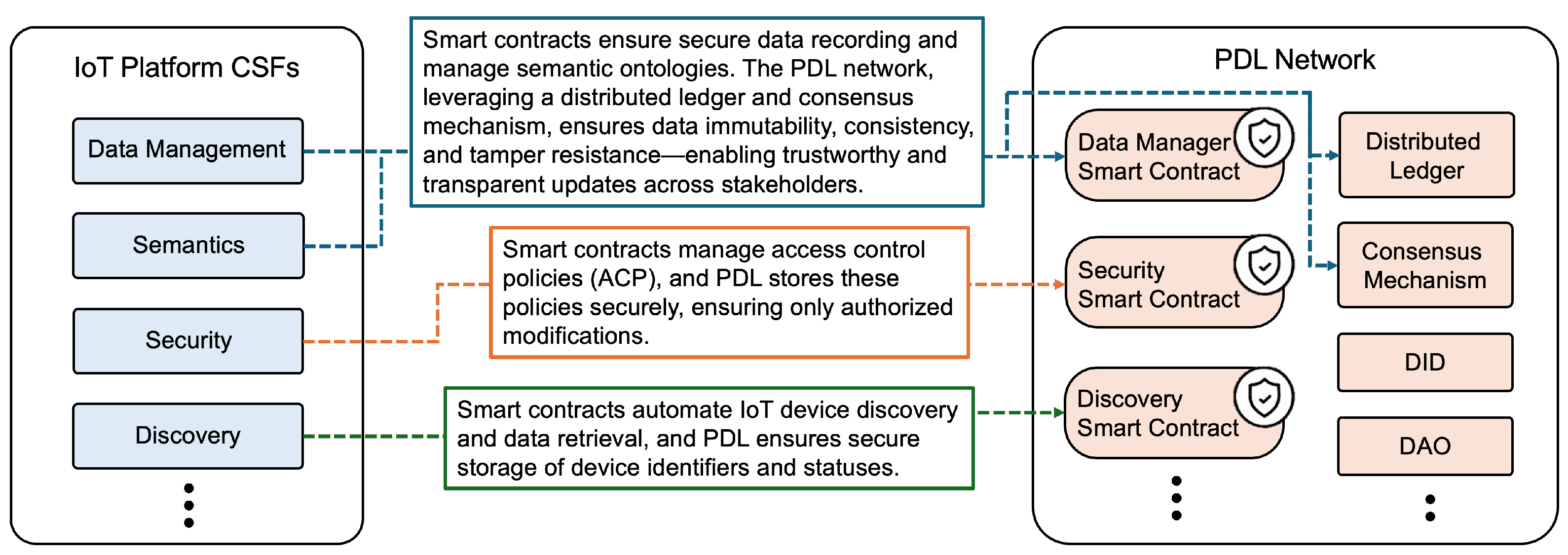
| IoT Platform CSF | Blockchain-Enabled IoT Platform Common Feature |
|---|---|
| Data Management | Blockchain enhances data integrity and reliability via consensus mechanisms and distributed ledgers. IBM Blockchain IoT provides a tamper-proof record-sharing platform [14]. |
| Security | ACP and Role-based access control (RBAC) are enforced via smart contracts. Hyperledger Fabric supports fine-grained access control and privacy via channels and identity-based permissions [12,15,16]. |
| Device Management | Blockchain ensures device authentication and firmware integrity using hashed records. Filament’s Blocklet and DoE’s smart grid trials exemplify secure device lifecycle tracking [17]. |
| Discovery | Confidential discovery and role-based access are enabled through encrypted smart contracts. RBAC improves security and privacy during device discovery [12,18,19]. |
| Group Management | Blockchain manage decentralized group formation, access policy enforcement, and group task synchronization. Examples include LWM2M interworking and medical IoT authentication [20,21,22,23,24]. |
| Location | Tamper-resistant location logs and geofence-triggered smart contract events enhance traceability and automation. TradeLens and SK C&C logistics exemplify its use in cargo tracking [25,26,27]. |
| Subscription & Notification | Smart contracts enable real-time, tamper-proof event alerts and subscription logs with RBAC. Used in IBM Watson IoT and WiMi for timely anomaly notifications [28,29,30,31]. |
| Application & Service Management | Lifecycle automation of applications, usage metering, and service billing are implemented via smart contracts. IBM Watson IoT applies this in smart grid billing [32,33]. |
| Service Charging & Accounting | Smart contracts support real-time micropayments based on IoT data usage. Proven in decentralized energy platforms and logistics billing [34,35,36,37,38]. |
Disclaimer/Publisher’s Note: The statements, opinions and data contained in all publications are solely those of the individual author(s) and contributor(s) and not of MDPI and/or the editor(s). MDPI and/or the editor(s) disclaim responsibility for any injury to people or property resulting from any ideas, methods, instructions or products referred to in the content. |
© 2025 by the authors. Licensee MDPI, Basel, Switzerland. This article is an open access article distributed under the terms and conditions of the Creative Commons Attribution (CC BY) license.
Share and Cite
Lee, J.; Lee, J.; Wang, Z.; Song, J. Enhancing IoT Common Service Functions with Blockchain: From Analysis to Standards-Based Prototype Implementation. Electronics 2026, 15, 123. https://doi.org/10.3390/electronics15010123
Lee J, Lee J, Wang Z, Song J. Enhancing IoT Common Service Functions with Blockchain: From Analysis to Standards-Based Prototype Implementation. Electronics. 2026; 15(1):123. https://doi.org/10.3390/electronics15010123
Chicago/Turabian StyleLee, Jiho, Jieun Lee, Zehua Wang, and JaeSeung Song. 2026. "Enhancing IoT Common Service Functions with Blockchain: From Analysis to Standards-Based Prototype Implementation" Electronics 15, no. 1: 123. https://doi.org/10.3390/electronics15010123
APA StyleLee, J., Lee, J., Wang, Z., & Song, J. (2026). Enhancing IoT Common Service Functions with Blockchain: From Analysis to Standards-Based Prototype Implementation. Electronics, 15(1), 123. https://doi.org/10.3390/electronics15010123