FloorTag: A Hybrid Indoor Localization System Based on Floor-Deployed Visual Markers and Pedometer Integration

 ,
, 
 , and
, and 
Abstract
1. Introduction
- Low cost: The system should avoid expensive or complex hardware infrastructures, thereby reducing barriers to adoption.
- Low invasiveness: Environmental modifications should be minimal, preserving visual integrity of spaces and ensuring compatibility with existing systems.
- Simple deployment: Installation should be feasible by non-specialized personnel without requiring extensive technical expertise, directly impacting scalability and adoption potential.
- User-friendly: The system must provide intuitive interfaces with passive localization and clear navigation guidance, minimizing cognitive workload for end users.
- Accuracy: Positioning performance should remain reliable across varying environmental conditions, meeting application-specific requirements.
- Scalability: The architecture must integrate seamlessly into commercial solutions and adapt to different building types and sizes with minimal customization effort.
- A novel indoor localization methodology based on floor-deployed markers (combined with pedometer-based dead reckoning) which, unlike solutions requiring wall or ceiling scans, leverages the natural downward orientation of a user’s smartphone camera during navigation. This makes the marker detection process nearly transparent and unobtrusive to the user while walking and minimizes infrastructure needs, requiring only printed markers. The system achieves near-real-time performance (see Section 4 for details) on older smartphones and does not require internet connectivity for its core localization functions.
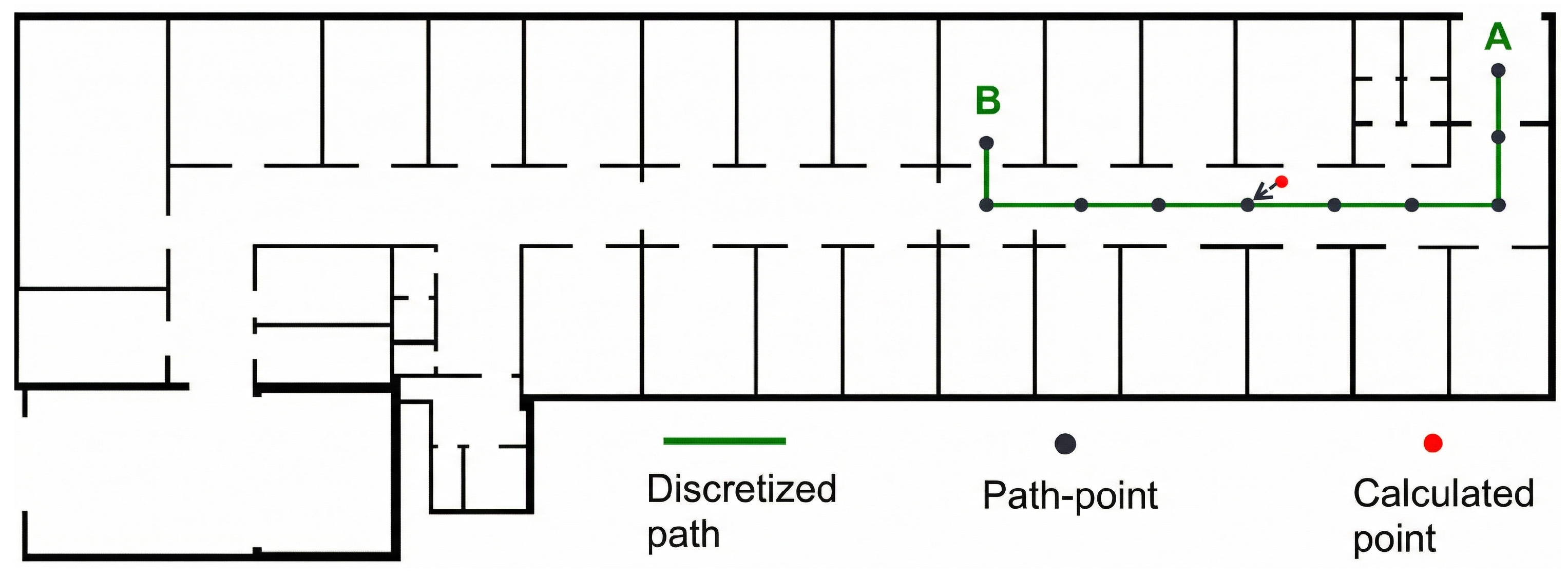
- The introduction of Path-Points, a concept for discretizing the walkable space into predefined locations. This serves to stabilize position estimates and mitigate sensor drift.
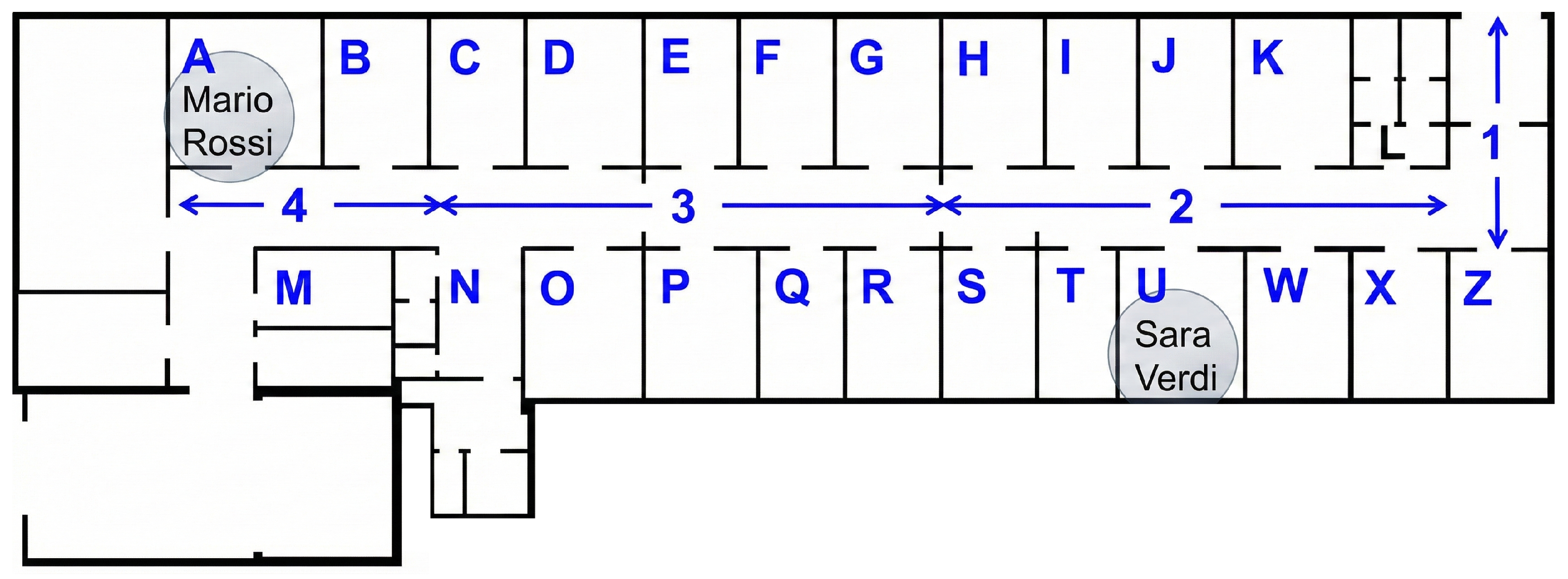
- The introduction of Informative Layers, which overlay semantic information (such as room labels and points of interest) onto the base coordinate map of the indoor environment, enhancing the user experience by enabling goal-oriented navigation beyond coordinate-based navigation.
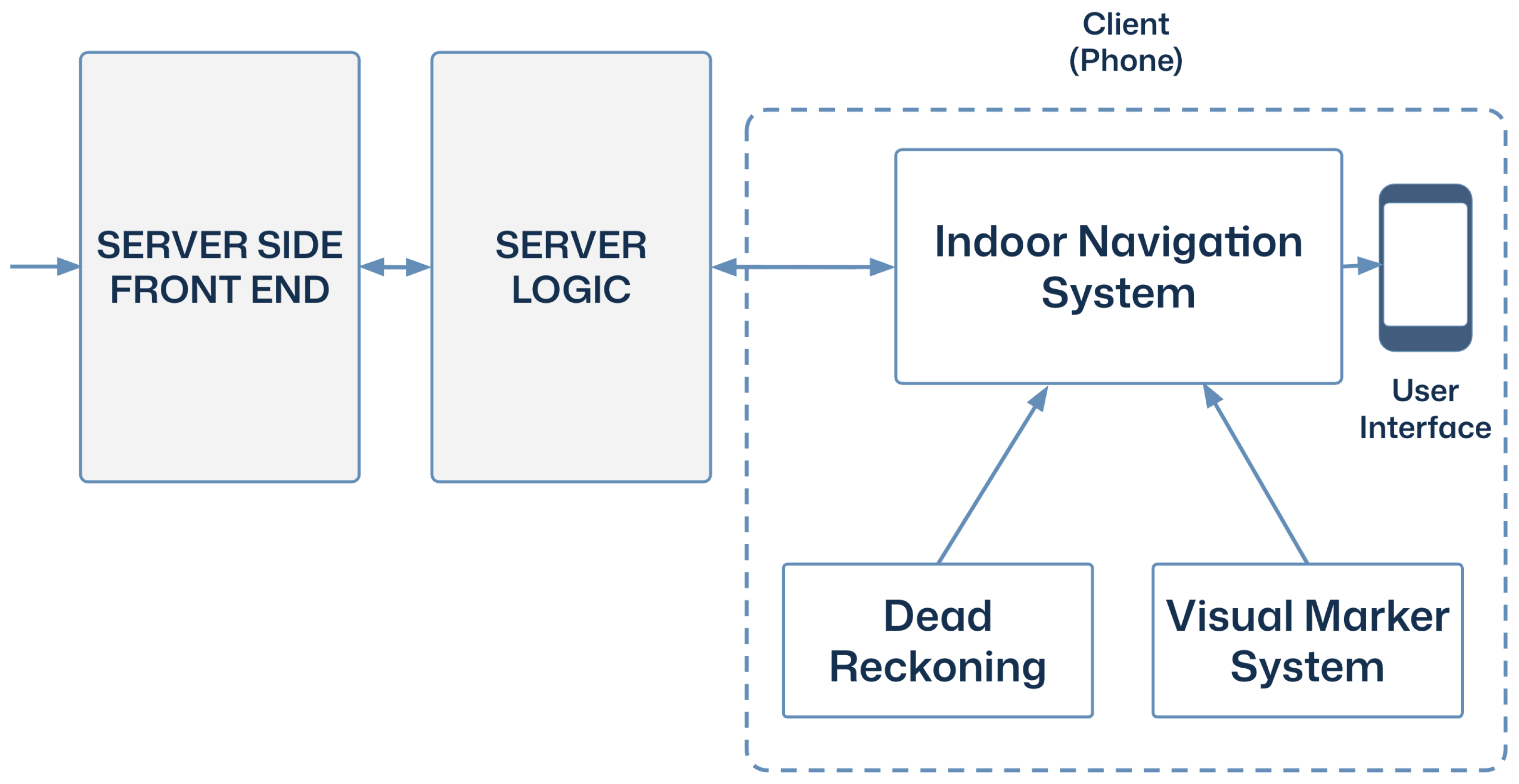
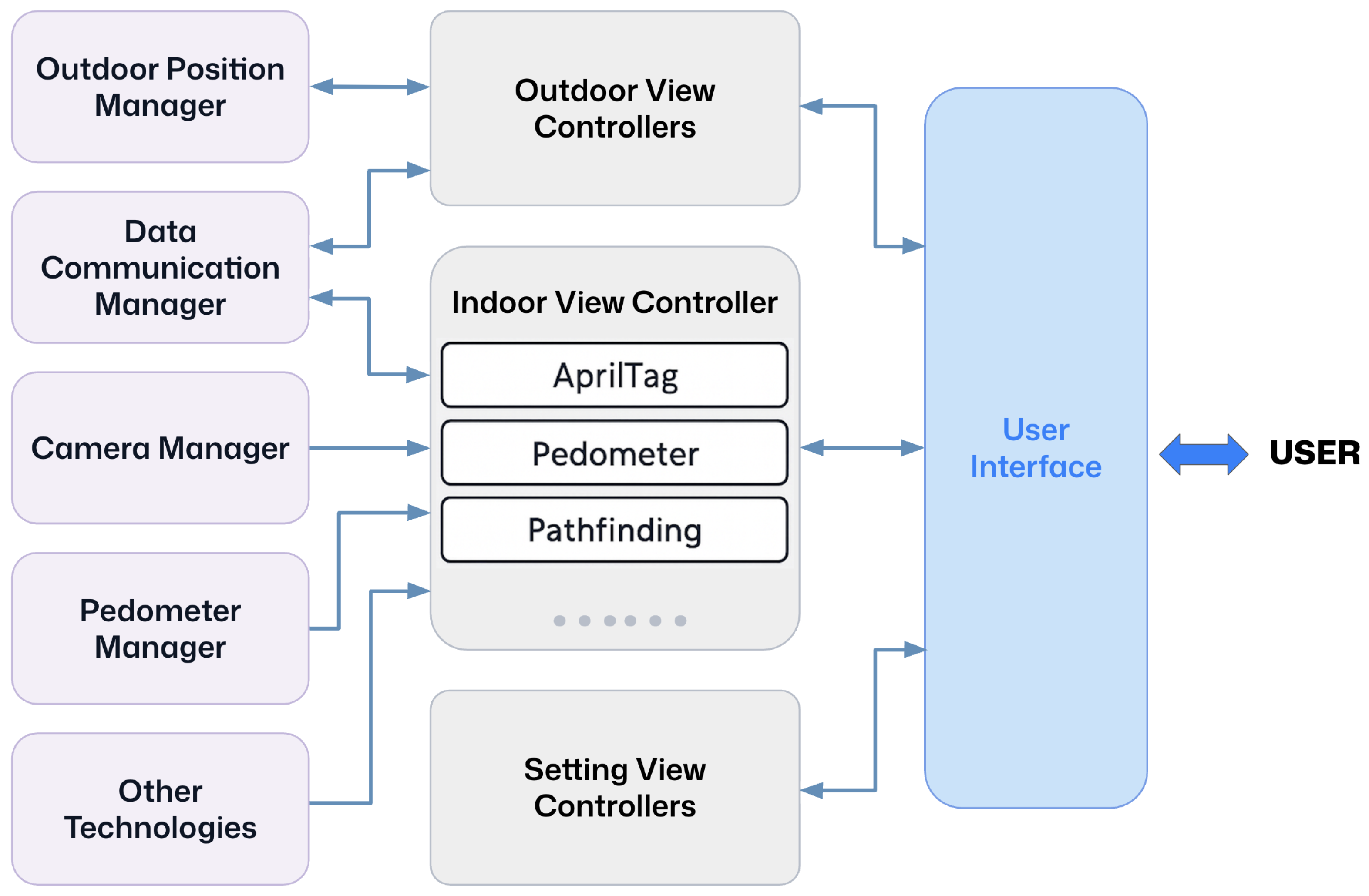
- A Client–server architecture that ensures system scalability by centralizing building data management on the server while delegating real-time processing tasks to the client devices.
2. Related Work
3. System Overview and Architecture
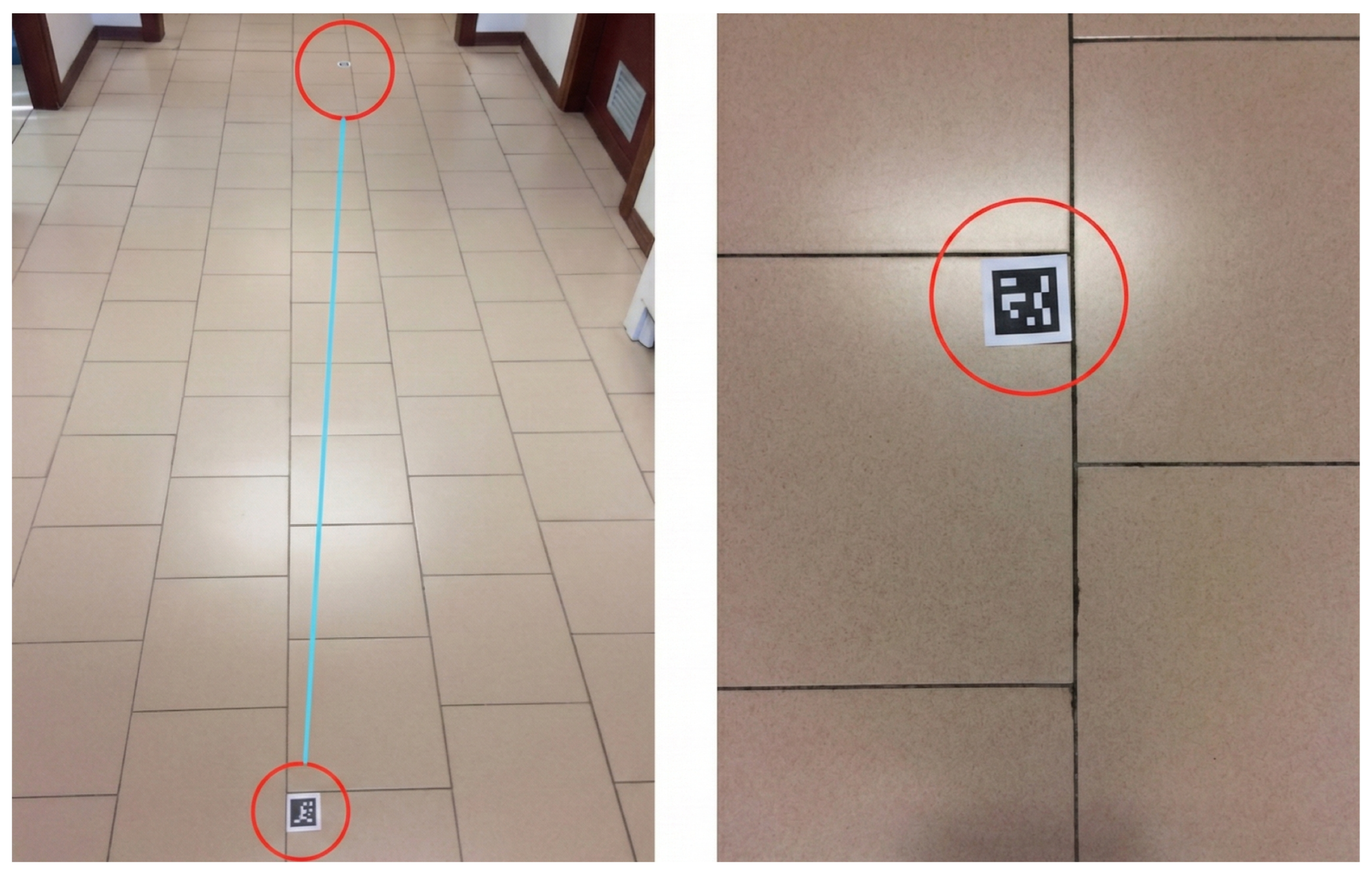
- The floor typically presents a consistent and predictable background pattern, as shown in Figure 1. This characteristic can be exploited to improve decoding algorithm speed and allows reduction of physical marker sizes.
- The marker appears with a relatively fixed and known size within the camera frame due to the stable distance between the smartphone camera and the floor during typical usage. This characteristic enables faster marker detection within the frame.
- The predetermined positions and spatial relationships of markers in the building layout enable sequence validation: given a detected marker, subsequent detections are constrained to spatially adjacent positions, allowing the system to reject spurious detections caused by decoding errors, improving overall reliability.
3.1. Path-Points
| Listing 1. Excerpt of the JSON structure encoding Base Layer (Path-Points, edges, and markers). |
| { |
| .... |
| "baseLayer": { |
| "metadata": { |
| "version": "2025-09-18", |
| "buildingId": "B13", |
| .... |
| }, |
| "pathPoints": [ |
| { "id": "pp-001", "x": 30.0, "y": 30.0 }, |
| { "id": "pp-002", "x": 30.0, "y": 40.0 }, |
| { "id": "pp-003", "x": 40.0, "y": 40.0, "type": "door" }, |
| .... |
| ], |
| "edges": [ |
| { "from": "pp-001", "to": "pp-002", "bidirectional": true }, |
| { "from": "pp-002", "to": "pp-003", "bidirectional": true }, |
| .... |
| ], |
| "markers": [ |
| { "markerId": 0, "pathPointId": "pp-003" }, |
| { "markerId": 1, "pathPointId": "pp-010" }, |
| .... |
| ] |
| ... |
| } |
3.2. Informative Layers
| Listing 2. Sample JSON structure for the professorsOffices Informative Layer. |
| { |
| .... |
| "informativeLayers": { |
| "professorsOffices": [ |
| { "id": "prof-rossi", |
| "name": "Mario Rossi", |
| "phone": "+39-095-112233", |
| "subjects": ["Computer Science"], |
| .... |
| }, |
| { "id": "prof-verdi", |
| "name": "Sara Verdi", |
| "phone": "+39-095-445566", |
| "subjects": ["Electronics"], |
| .... |
| } |
| ] |
| .... |
| } |
| } |
| Listing 3. Excerpt of the JSON structure linking Path-Points to Informative Layers. |
| { |
| "version": "2025-09-18", |
| "buildingId": "B13", |
| .... |
| "associations": [ |
| { "pathPointId": "pp-003", |
| "refs": [ |
| { "layerId": "professorsOffices", "entityId": "prof-rossi", |
| "role": "door", ....}, |
| .... |
| ] |
| }, |
| { "pathPointId": "pp-021", |
| "refs": [ |
| { "layerId": "professorsOffices", "entityId": "prof-verdi", ....}, |
| ... |
| ] |
| } |
| ] |
| .... |
| } |
3.3. Server-Side Architecture
- Map ingestion and calibration: The administrator uploads a high-resolution image of the building’s floor plan and defines a Cartesian coordinate system on top of the plan. A scale is established by selecting two reference points on the image (e.g., endpoints of a corridor segment with known length) and entering their physical distance, so that all coordinates are stored in meters in the resulting reference frame.
- Coordinate system definition: An arbitrary origin point is defined on the map (typically the bottom-left corner). All subsequent spatial elements are stored as 2D Cartesian coordinates relative to this origin.
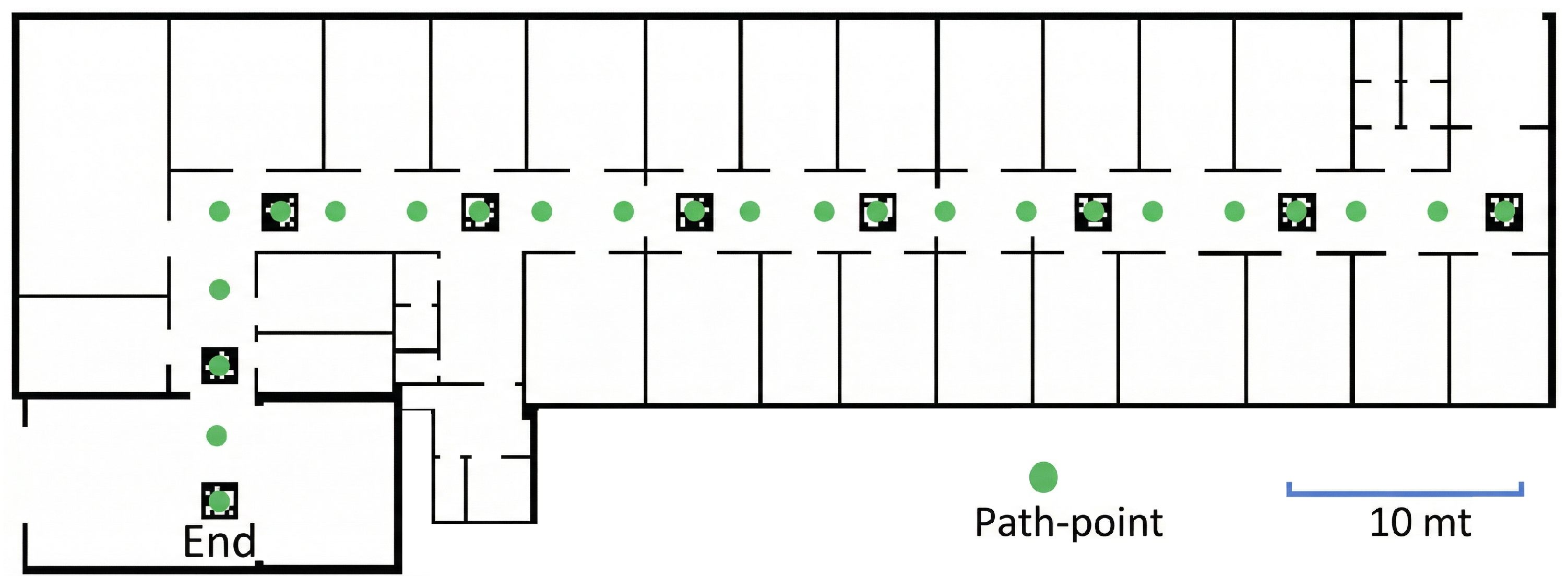
- Path-Point and marker registration: Once the map is calibrated, the walkable space is discretized into Path-Points by the administrator, who interactively places points along corridor centerlines and other accessible routes in the floor reference frame, at the desired spacing (≈2 m in the prototype deployment). AprilTag markers are then associated with the Path-Points by specifying for each marker a correspondent marker identifier and selecting an existing Path-Point.
- Informative Layer Definition: To enable the goal-oriented navigation, using the calibrated map interface, specific Path-Points or spatial regions are visually selected and associated with semantic metadata by the administrator.
3.4. Client-Side Architecture
4. Discussion and Results
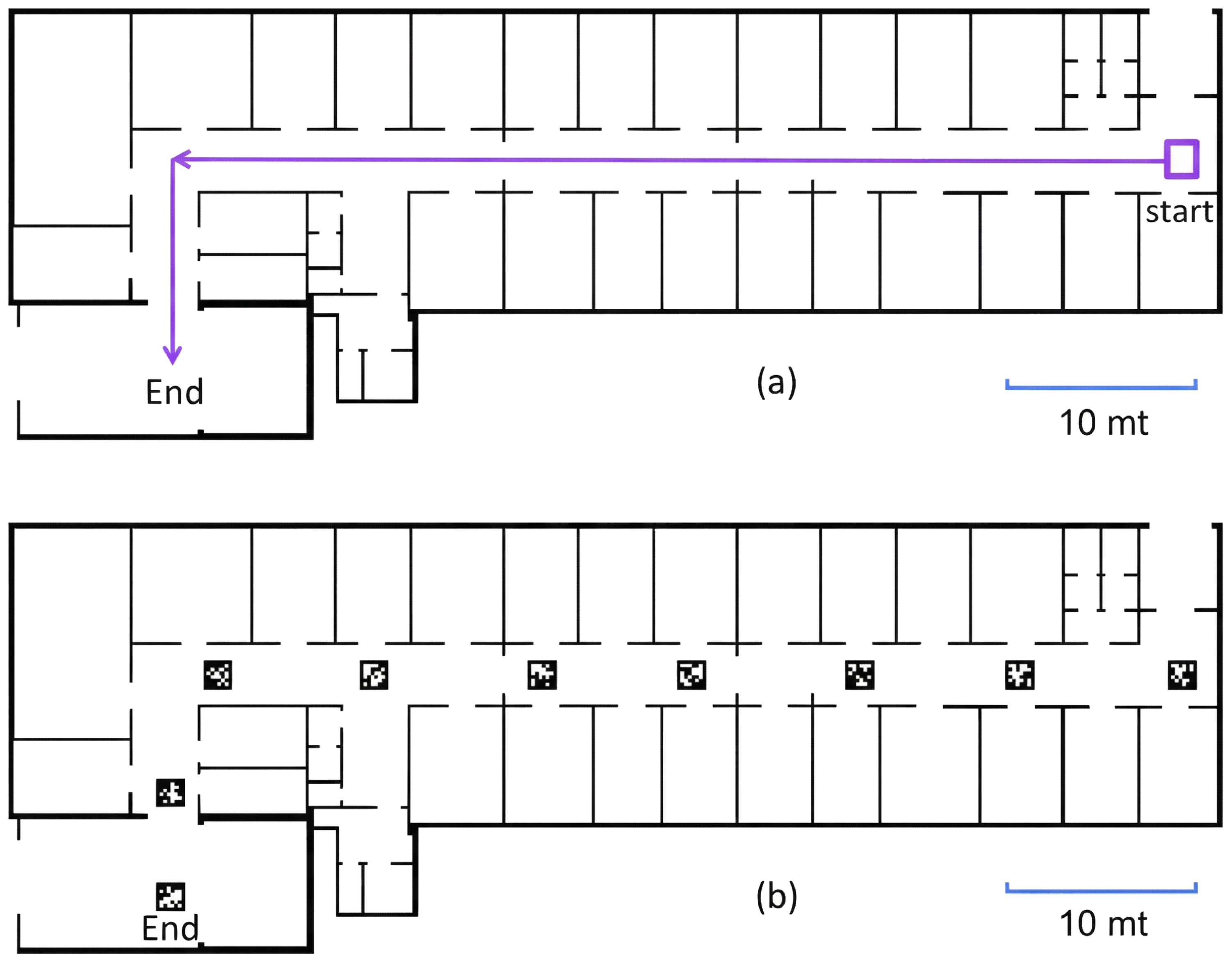
4.1. Evaluation of FloorTag with AprilTags Only (Pedometer Disabled)
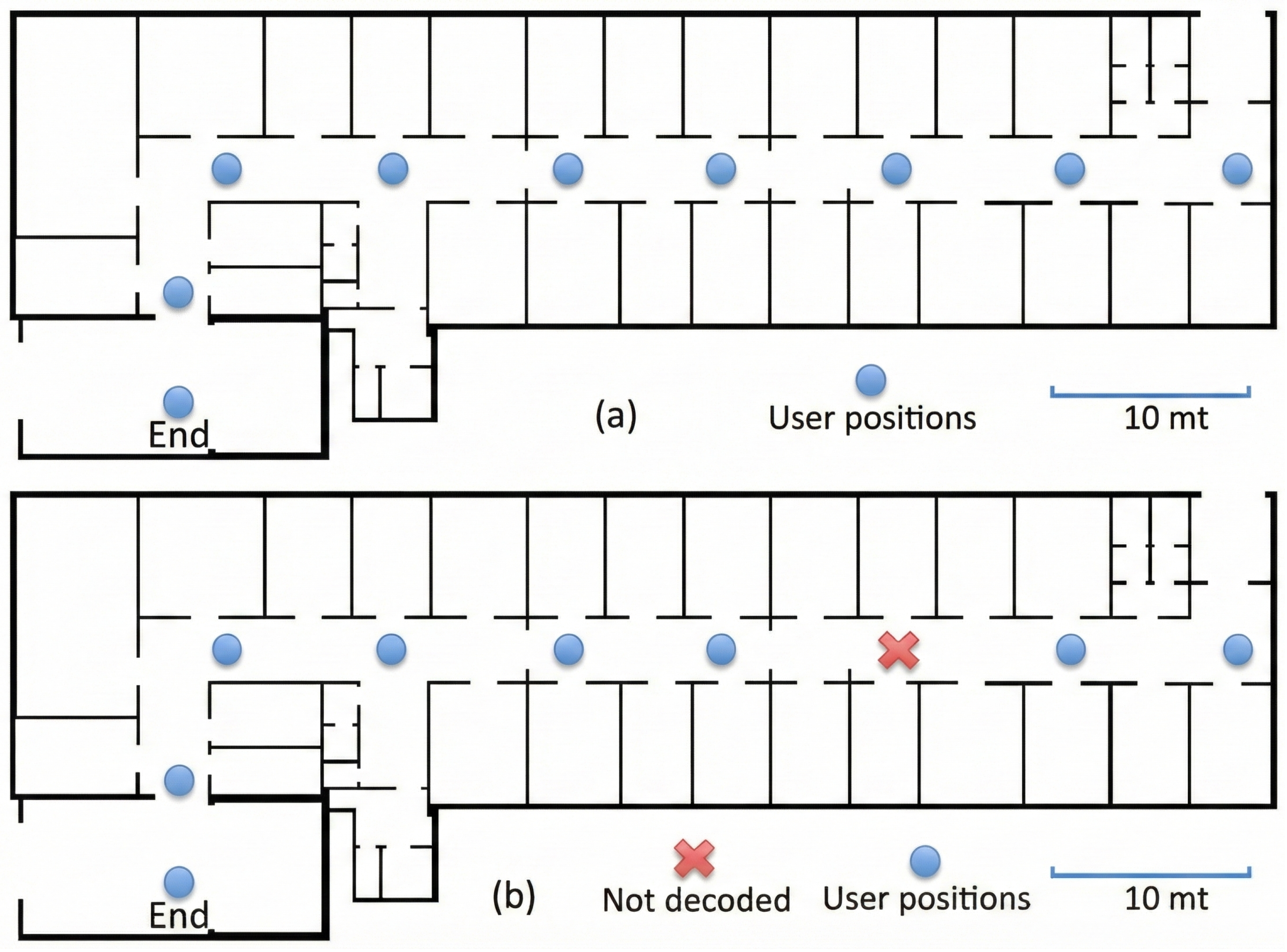
- Optimal lighting represents a best-case scenario during daytime, simulating conditions with maximum visibility. All artificial ceiling lights in the corridor were switched on, and all window curtains were fully raised to allow maximum natural light, resulting in bright and uniform illumination without significant shadows or reflections on the markers.
- Moderate lighting describes typical daytime indoor scenarios where approximately only 50% of the artificial ceiling corridor lights were activated (in an alternating pattern), and only half of the window curtains were raised. In this configuration, some visual markers were partially mildly shadowed by nearby objects, such as electronic devices (e.g., photocopiers) or recycling bins, and occasionally experienced reflections.
- Low lighting simulates a challenging, poorly lit daytime scenario, with all the corridor lights switched off and window curtains partially lowered to restrict natural light, with visual markers poorly illuminated, as they received only diffuse natural light, and partially shadowed by corridor objects.
4.2. Evaluation of FloorTag with AprilTags and Pedometer Integration
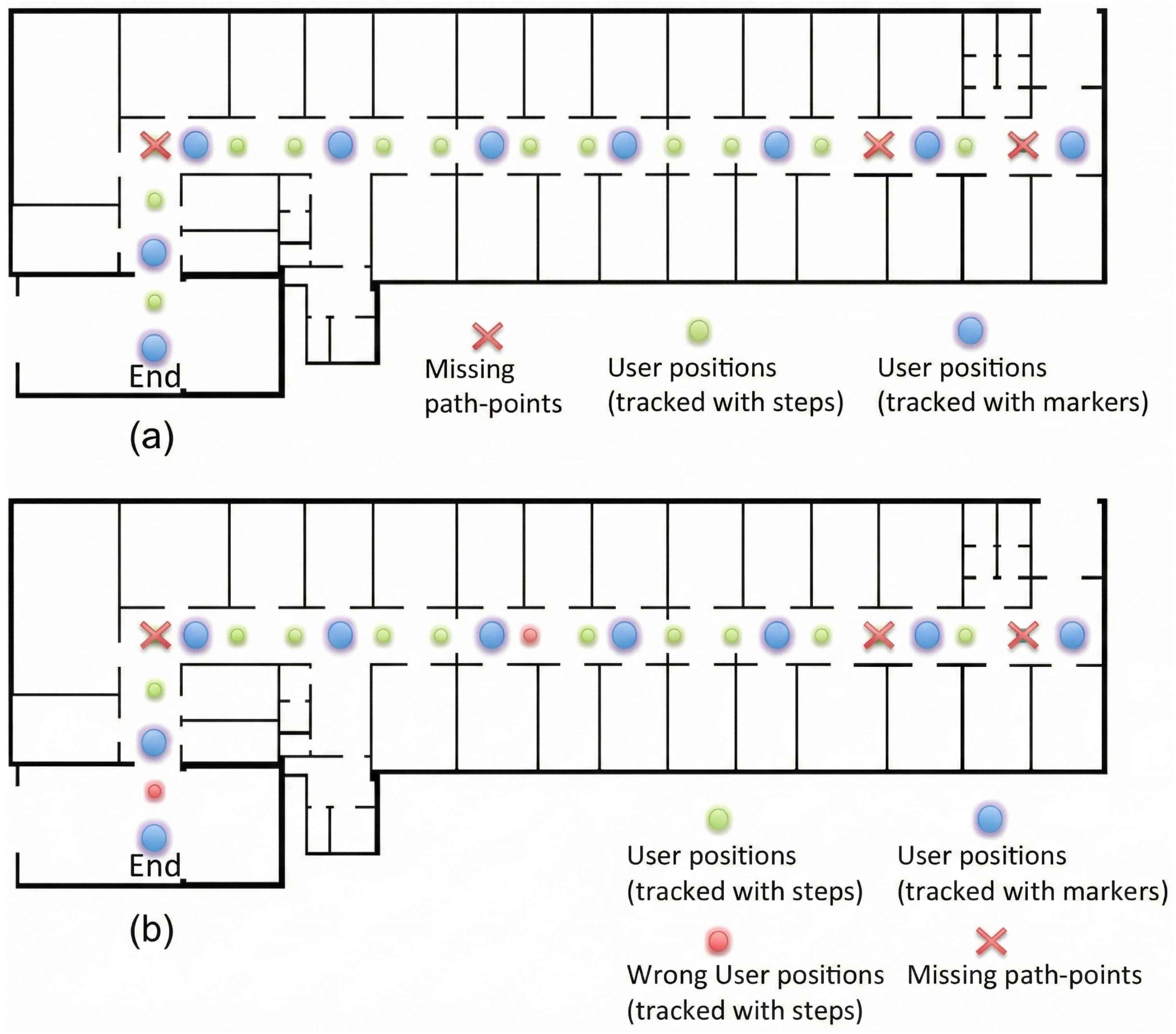
- The iOS pedometer APIs introduce an intrinsic delay of a few seconds in providing step-count updates. Depending on the density of Path-Points, walking speed, and step length, the algorithm may advance past one or more intermediate Path-Points between consecutive marker detections, causing the user’s estimated position to “jump” forward along the path.
- Between two AprilTag detections, accumulated step count errors may cause the snapping algorithm to place the user at a wrong Path-Point, resulting in position estimation errors.
5. Conclusions and Future Work
Author Contributions
Funding
Data Availability Statement
Conflicts of Interest
References
- Catania, V.; Delfa, G.C.L.; Monteleone, S.; Patti, D.; Ventura, D.; Torre, G.L. GOOSE: Goal oriented orchestration for smart environments. Int. J. Ad Hoc Ubiquitous Comput. 2019, 32, 159–170. [Google Scholar] [CrossRef] [Scilit]
- Ventura, D.; Monteleone, S.; La Torre, G.; La Delfa, G.C.; Catania, V. Smart EDIFICE—Smart EveryDay interoperating future devICEs. In Proceedings of the 2015 International Conference on Collaboration Technologies and Systems (CTS), Atlanta, GA, USA, 1–5 June 2015; pp. 19–26. [Google Scholar] [CrossRef] [Scilit]
- Huang, H. Location Based Services. In Springer Handbook of Geographic Information; Kresse, W., Danko, D., Eds.; Springer International Publishing: Cham, Switzerland, 2022; pp. 629–637. [Google Scholar] [CrossRef] [Scilit]
- Aziz, T.; Koo, I. A Comprehensive Review of Indoor Localization Techniques and Applications in Various Sectors. Appl. Sci. 2025, 15, 1544. [Google Scholar] [CrossRef] [Scilit]
- Boysen, N.; Fedtke, S.; Schwerdfeger, S. Last-mile delivery concepts: A survey from an operational research perspective. OR Spectrum 2021, 43, 1–58. [Google Scholar] [CrossRef] [Scilit]
- Wang, W.; Zhao, W.; Wang, X.; Jin, Z.; Li, Y.; Runge, T. A Low-cost Simultaneous Localization And Mapping Algorithm For Last-mile Indoor Delivery. In Proceedings of the 2019 5th International Conference on Transportation Information and Safety (ICTIS), Liverpool, UK, 14–17 July 2019; pp. 329–336. [Google Scholar] [CrossRef] [Scilit]
- Kim Geok, T.; Zar Aung, K.; Sandar Aung, M.; Thu Soe, M.; Abdaziz, A.; Pao Liew, C.; Hossain, F.; Tso, C.P.; Yong, W.H. Review of Indoor Positioning: Radio Wave Technology. Appl. Sci. 2021, 11, 279. [Google Scholar] [CrossRef] [Scilit]
- Ouyang, G.; Abed-Meraim, K. A Survey of Magnetic-Field-Based Indoor Localization. Electronics 2022, 11, 864. [Google Scholar] [CrossRef] [Scilit]
- Zhu, Z.; Yang, Y.; Chen, M.; Guo, C.; Cheng, J.; Cui, S. A Survey on Indoor Visible Light Positioning Systems: Fundamentals, Applications, and Challenges. IEEE Commun. Surv. Tutorials 2025, 27, 1656–1686. [Google Scholar] [CrossRef] [Scilit]
- Basiri, A.; Lohan, E.S.; Moore, T.; Winstanley, A.; Peltola, P.; Hill, C.; Amirian, P.; Figueiredo e Silva, P. Indoor location based services challenges, requirements and usability of current solutions. Comput. Sci. Rev. 2017, 24, 1–12. [Google Scholar] [CrossRef] [Scilit]
- Hailu, T.G.; Guo, X.; Si, H.; Li, L.; Zhang, Y. Theories and Methods for Indoor Positioning Systems: A Comparative Analysis, Challenges, and Prospective Measures. Sensors 2024, 24, 6876. [Google Scholar] [CrossRef] [Scilit] [PubMed]
- La Delfa, G.C.; Prieto, J.; Monteleone, S.; Rafique, H.; Palesi, M.; Patti, D. Survey of smartphone-based datasets for indoor localization: A machine learning perspective. Internet Things 2025, 34, 101753. [Google Scholar] [CrossRef] [Scilit]
- Rafique, H.; Patti, D.; Palesi, M.; La Delfa, G.C.; Catania, V. Optimization Technique for Indoor Localization: A Multi-Objective Approach to Sampling Time and Error Rate Trade-off. In Proceedings of the 2023 IEEE Third International Conference on Signal, Control and Communication (SCC), Hammamet, Tunisia, 1–3 December 2023; pp. 1–6. [Google Scholar] [CrossRef] [Scilit]
- J, N.S.C.; Wahab, N.H.A.; Sunar, N.; Ariffin, S.H.S.; Wong, K.Y.; Aun, Y. Indoor Positioning System: A Review. Int. J. Adv. Comput. Sci. Appl. 2022, 13, 477–490. [Google Scholar] [CrossRef] [Scilit]
- Simelane, T.; Mathaba, T.N.; Otunniyi, T.O. A Review Paper: Indoor Positioning Systems Using Radio Frequency Technology. In Proceedings of the 2023 International Conference on Electrical, Computer and Energy Technologies (ICECET), Cape Town, South Africa, 16–17 November 2023; pp. 1–7. [Google Scholar] [CrossRef] [Scilit]
- Subedi, S.; Pyun, J.Y. A Survey of Smartphone-Based Indoor Positioning System Using RF-Based Wireless Technologies. Sensors 2020, 20, 7230. [Google Scholar] [CrossRef] [Scilit]
- Liu, F.; Liu, J.; Yin, Y.; Wang, W.; Hu, D.; Chen, P.; Niu, Q. Survey on WiFi-based indoor positioning techniques. IET Commun. 2020, 14, 1372–1383. [Google Scholar] [CrossRef] [Scilit]
- Shang, S.; Wang, L. Overview of WiFi fingerprinting-based indoor positioning. IET Commun. 2022, 16, 725–733. [Google Scholar] [CrossRef] [Scilit]
- Yi, G.H.; bin Djaswadi, G.W.; bin Md Khir, M.H.; Ramli, N. An Adaptive Wi-Fi Trilateration-Based Indoor Localization. In Proceedings of the 2018 International Conference on Intelligent and Advanced System (ICIAS), Kuala Lumpur, Malaysia, 13–14 August 2018; pp. 1–6. [Google Scholar] [CrossRef] [Scilit]
- Korogodin, I.V.; Dneprov, V.V.; Mikhaylova, O.K. Triangulation Positioning by Means of Wi-Fi Signals in Indoor Conditions. In Proceedings of the 2019 PhotonIcs & Electromagnetics Research Symposium—Spring (PIERS-Spring), Rome, Italy, 17–20 June 2019; pp. 2339–2345. [Google Scholar] [CrossRef] [Scilit]
- Chan, S.; Sohn, G. Indoor localization using wi-fi based fingerprinting and trilateration techiques for lbs applications. Int. Arch. Photogramm. Remote Sens. Spat. Inf. Sci. 2012, XXXVIII-4/C26, 1–5. [Google Scholar] [CrossRef] [Scilit]
- Bembenik, R.; Falcmann, K. BLE Indoor Positioning System Using RSSI-based Trilateration. J. Wirel. Mob. Netw. Ubiquitous Comput. Dependable Appl. 2020, 11, 50–69. [Google Scholar] [CrossRef]
- Zafari, F.; Papapanagiotou, I.; Devetsikiotis, M.; Hacker, T. An iBeacon based Proximity and Indoor Localization System. arXiv 2017, arXiv:1703.07876. [Google Scholar] [CrossRef] [Scilit]
- Ji, T.; Li, W.; Zhu, X.; Liu, M. Survey on indoor fingerprint localization for BLE. In Proceedings of the 2022 IEEE 6th Information Technology and Mechatronics Engineering Conference (ITOEC), Chongqing, China, 4–6 March 2022; Volume 6, pp. 129–134. [Google Scholar] [CrossRef] [Scilit]
- Motroni, A.; Buffi, A.; Nepa, P. A Survey on Indoor Vehicle Localization Through RFID Technology. IEEE Access 2021, 9, 17921–17942. [Google Scholar] [CrossRef] [Scilit]
- Jiangbo, W.; Wenjun, L.; Hong, L. Research on RFID Indoor Localization Algorithm Based on Virtual Tags and Fusion of LANDMARC and Kalman Filter. In Proceedings of the 6GN for Future Wireless Networks, Shangai, China, 7–8 October 2023; Li, J., Zhang, B., Ying, Y., Eds.; Springer: Cham, Switzerland, 2024; pp. 224–235. [Google Scholar]
- Huiting, J. Indoor Localization of UHF RFID Tags. Ph.D. Thesis, University of Twente, Enschede, The Netherlands, 2017. [Google Scholar] [CrossRef] [Scilit]
- Elsanhoury, M.; Mäkelä, P.; Koljonen, J.; Välisuo, P.; Shamsuzzoha, A.; Mantere, T.; Elmusrati, M.; Kuusniemi, H. Precision Positioning for Smart Logistics Using Ultra-Wideband Technology-Based Indoor Navigation: A Review. IEEE Access 2022, 10, 44413–44445. [Google Scholar] [CrossRef] [Scilit]
- Denis, B.; Keignart, J.; Daniele, N. Impact of NLOS propagation upon ranging precision in UWB systems. In Proceedings of the IEEE Conference on Ultra Wideband Systems and Technologies, Reston, VA, USA, 16–19 November 2003; pp. 379–383. [Google Scholar] [CrossRef] [Scilit]
- Schjørring, A.; Cretu-Sircu, A.L.; Rodriguez, I.; Cederholm, P.; Berardinelli, G.; Mogensen, P. Performance Evaluation of a UWB Positioning System Applied to Static and Mobile Use Cases in Industrial Scenarios. Electronics 2022, 11, 3294. [Google Scholar] [CrossRef] [Scilit]
- Ouyang, G.; Abed-Meraim, K. Analysis of Magnetic Field Measurements for Indoor Positioning. Sensors 2022, 22, 4014. [Google Scholar] [CrossRef] [Scilit]
- Subbu, K.P.; Gozick, B.; Dantu, R. LocateMe: Magnetic-fields-based indoor localization using smartphones. ACM Trans. Intell. Syst. Technol. 2013, 4, 1–27. [Google Scholar] [CrossRef] [Scilit]
- Lee, N.; Ahn, S.; Han, D. AMID: Accurate Magnetic Indoor Localization Using Deep Learning. Sensors 2018, 18, 1598. [Google Scholar] [CrossRef] [Scilit]
- Rafique, H.; Patti, D.; Palesi, M.; La Delfa, G.C. A Characteristics-Based Least Common Multiple Algorithm to Optimize Magnetic-Field-Based Indoor Localization. IEEE Internet Things J. 2025, 12, 10463–10478. [Google Scholar] [CrossRef] [Scilit]
- Rafique, H.; Patti, D.; Palesi, M.; Delfa, G.C.L. Characteristics-Based Least Common Multiple: A Novel Clustering Algorithm to Optimize Indoor Positioning. In Proceedings of the 21st International Conference on Informatics in Control, Automation and Robotics—Volume 1: ICINCO, Porto, Portugal, 18–20 November 2024; SciTePress: Setúbal, Portugal, 2024; pp. 301–308. [Google Scholar] [CrossRef] [Scilit]
- Rafique, H.; Patti, D.; Palesi, M.; La Delfa, G.C. Indoor localization by projecting magnetic field signals onto images with vision transformer. Comput. Electr. Eng. 2025, 123, 110074. [Google Scholar] [CrossRef] [Scilit]
- Chew, M.T.; Alam, F.; Legg, M.; Sen Gupta, G. Accurate Ultrasound Indoor Localization Using Spring-Relaxation Technique. Electronics 2021, 10, 1290. [Google Scholar] [CrossRef] [Scilit]
- Cheng, B.; Wu, J. Acoustic TDOA Measurement and Accurate Indoor Positioning for Smartphone. Future Internet 2023, 15, 240. [Google Scholar] [CrossRef] [Scilit]
- Moutinho, J.N.; Araũjo, R.E.; Freitas, D. Indoor localization with audible sound—Towards practical implementation. Pervasive Mob. Comput. 2016, 29, 1–16. [Google Scholar] [CrossRef] [Scilit]
- Rishabh, I.; Kimber, D.; Adcock, J. Indoor localization using controlled ambient sounds. In Proceedings of the 2012 International Conference on Indoor Positioning and Indoor Navigation (IPIN), Sydney, Australia, 13–15 November 2012; pp. 1–10. [Google Scholar] [CrossRef] [Scilit]
- Jia, R.; Jin, M.; Chen, Z.; Spanos, C.J. SoundLoc: Accurate room-level indoor localization using acoustic signatures. In Proceedings of the 2015 IEEE International Conference on Automation Science and Engineering (CASE), Gothenburg, Sweden, 24–28 August 2015; pp. 186–193. [Google Scholar] [CrossRef] [Scilit]
- Yang, H.; Zhang, R.; Bordoy, J.; Höflinger, F.; Li, W.; Schindelhauer, C.; Reindl, L. Smartphone-Based Indoor Localization System Using Inertial Sensor and Acoustic Transmitter/Receiver. IEEE Sensors J. 2016, 16, 8051–8061. [Google Scholar] [CrossRef] [Scilit]
- Luo, W.; Song, Q.; Yan, Z.; Tan, R.; Lin, G. Indoor Smartphone SLAM with Learned Echoic Location Features. In Proceedings of the 20th ACM Conference on Embedded Networked Sensor Systems, New York, NY, USA, 6–9 November 2022; SenSys ’22. pp. 489–503. [Google Scholar] [CrossRef] [Scilit]
- Lan, K.C.; Shih, W.Y. On Calibrating the Sensor Errors of a PDR-Based Indoor Localization System. Sensors 2013, 13, 4781–4810. [Google Scholar] [CrossRef] [Scilit] [PubMed]
- Poulose, A.; Eyobu, O.S.; Han, D.S. An Indoor Position-Estimation Algorithm Using Smartphone IMU Sensor Data. IEEE Access 2019, 7, 11165–11177. [Google Scholar] [CrossRef] [Scilit]
- Wang, X.; Chen, G.; Cao, X.; Zhang, Z.; Yang, M.; Jin, S. Robust and Accurate Step Counting Based on Motion Mode Recognition for Pedestrian Indoor Positioning Using a Smartphone. IEEE Sensors J. 2022, 22, 4893–4907. [Google Scholar] [CrossRef] [Scilit]
- Fernando, G.C.; Qi, T.; Ndimbo, E.V.; Abraha, A.T.; Wang, B. On Fusing Wireless Fingerprints with Pedestrian Dead Reckoning to Improve Indoor Localization Accuracy. Sensors 2025, 25, 1294. [Google Scholar] [CrossRef] [Scilit]
- Jiang, F.; Caruso, D.; Dhekne, A.; Qu, Q.; Engel, J.J.; Dong, J. Robust Indoor Localization with Ranging-IMU Fusion. In Proceedings of the 2024 IEEE International Conference on Robotics and Automation (ICRA), Yokohama, Japan, 13–17 May 2024; pp. 11963–11969. [Google Scholar] [CrossRef] [Scilit]
- Panja, A.K.; Chowdhury, C.; Neogy, S. Survey on inertial sensor-based ILS for smartphone users. CCF Trans. Pervasive Comput. Interact. 2022, 4, 319–337. [Google Scholar] [CrossRef] [Scilit]
- Wang, Q.; Fu, M.; Wang, J.; Luo, H.; Sun, L.; Ma, Z.; Li, W.; Zhang, C.; Huang, R.; Li, X.; et al. Recent Advances in Pedestrian Inertial Navigation Based on Smartphone: A Review. IEEE Sensors J. 2022, 22, 22319–22343. [Google Scholar] [CrossRef] [Scilit]
- Shao, Y. Survey on Indoor Positioning and Navigation Technologies Based on Sensors Fusion. Highlights in Science, Engineering and Technology 2024, 94, 62–69. [Google Scholar] [CrossRef] [Scilit]
- Rafique, H.; Patti, D.; Palesi, M.; Delfa, G.C.L. Fusing Visuals with Magnetic Signals to Improve Indoor Localization Using Vision Transformer. In Proceedings of the 2024 14th International Conference on Indoor Positioning and Indoor Navigation (IPIN), Hong Kong, China, 14–17 October 2024; pp. 1–6. [Google Scholar] [CrossRef] [Scilit]
- Yan, J.; Huang, Z.; Wu, X. Smartphone-Based Indoor Localization Using Machine Learning and Multisource Information Fusion. IEEE Trans. Aerosp. Electron. Syst. 2024, 60, 2722–2734. [Google Scholar] [CrossRef] [Scilit]
- Guo, X.; Ansari, N.; Hu, F.; Shao, Y.; Elikplim, N.R.; Li, L. A Survey on Fusion-Based Indoor Positioning. IEEE Commun. Surv. Tutorials 2020, 22, 566–594. [Google Scholar] [CrossRef] [Scilit]
- Liu, J.; Yang, Z.; Zlatanova, S.; Li, S.; Yu, B. Indoor Localization Methods for Smartphones with Multi-Source Sensors Fusion: Tasks, Challenges, Strategies, and Perspectives. Sensors 2025, 25, 1806. [Google Scholar] [CrossRef] [Scilit] [PubMed]
- Khan, D.; Cheng, Z.; Uchiyama, H.; Ali, S.; Asshad, M.; Kiyokawa, K. Recent advances in vision-based indoor navigation: A systematic literature review. Comput. Graph. 2022, 104, 24–45. [Google Scholar] [CrossRef] [Scilit]
- Morar, A.; Moldoveanu, A.; Mocanu, I.; Moldoveanu, F.; Radoi, I.E.; Asavei, V.; Gradinaru, A.; Butean, A. A Comprehensive Survey of Indoor Localization Methods Based on Computer Vision. Sensors 2020, 20, 2641. [Google Scholar] [CrossRef] [Scilit]
- Sato, T.; Shimada, S.; Murakami, H.; Watanabe, H.; Hashizume, H.; Sugimoto, M. ALiSA: A Visible-Light Positioning System Using the Ambient Light Sensor Assembly in a Smartphone. IEEE Sensors J. 2022, 22, 4989–5000. [Google Scholar] [CrossRef] [Scilit]
- Abe, K.; Sato, T.; Watanabe, H.; Hashizume, H.; Sugimoto, M. Smartphone Positioning Using an Ambient Light Sensor and Reflected Visible Light. In Proceedings of the 2021 International Conference on Indoor Positioning and Indoor Navigation (IPIN), Lloret de Mar, Spain, 29 November–2 December 2021; pp. 1–8. [Google Scholar] [CrossRef] [Scilit]
- Torres, J.C.; Montes, A.; Mendoza, S.L.; Fernández, P.R.; Betancourt, J.S.; Escandell, L.; del Valle, C.I.; Sánchez-Pena, J.M. A Low-Cost Visible Light Positioning System for Indoor Positioning. Sensors 2020, 20, 5145. [Google Scholar] [CrossRef] [Scilit]
- Nguyen, Q.D.; Nguyen, N.H. Mobile Application for Visible Light Communication Systems: An Approach for Indoor Positioning. Photonics 2024, 11, 293. [Google Scholar] [CrossRef] [Scilit]
- Rahman, M.H.; Sejan, M.A.S.; Chung, W.Y. Multilateration Approach for Wide Range Visible Light Indoor Positioning System Using Mobile CMOS Image Sensor. Appl. Sci. 2021, 11, 7308. [Google Scholar] [CrossRef] [Scilit]
- Li, M.; Chen, R.; Liao, X.; Guo, B.; Zhang, W.; Guo, G. A Precise Indoor Visual Positioning Approach Using a Built Image Feature Database and Single User Image from Smartphone Cameras. Remote Sens. 2020, 12, 869. [Google Scholar] [CrossRef] [Scilit]
- Karkar, A.G.; Al-Maadeed, S.; Kunhoth, J.; Bouridane, A. CamNav: A computer-vision indoor navigation system. J. Supercomput. 2021, 77, 7737–7756. [Google Scholar] [CrossRef] [Scilit]
- Zeller, A.J.; Wu, H. GSplatLoc: Ultra-Precise Camera Localization via 3D Gaussian Splatting. arXiv 2025, arXiv:2412.20056. [Google Scholar]
- Mpeis, P.; Hadjichristodoulou, A.; Ioannides, I.; Zeinalipour-Yazti, D. AnyplaceCV: Infrastructure-less Localization in Anyplace with Computer Vision. In Proceedings of the 2022 23rd IEEE International Conference on Mobile Data Management (MDM), Paphos, Cyprus, 6–9 June 2022; pp. 290–291. [Google Scholar] [CrossRef] [Scilit]
- Labinghisa, B.A.; Lee, D.M. Indoor localization system using deep learning based scene recognition. Multimed. Tools Appl. 2022, 81, 28405–28429. [Google Scholar] [CrossRef] [Scilit]
- Fusco, G.; Coughlan, J.M. Indoor localization for visually impaired travelers using computer vision on a smartphone. In Proceedings of the 17th International Web for All Conference, New York, NY, USA, 20–21 April 2020. W4A ’20. [Google Scholar] [CrossRef] [Scilit]
- Idrees, A.; Iqbal, Z.; Ishfaq, M. An efficient indoor navigation technique to find optimal route for blinds using QR codes. In Proceedings of the 2015 IEEE 10th Conference on Industrial Electronics and Applications (ICIEA), Auckland, New Zealand, 15–17 June 2015; pp. 690–695. [Google Scholar] [CrossRef] [Scilit]
- Khan, D.; Ullah, S.; Nabi, S. A Generic Approach toward Indoor Navigation and Pathfinding with Robust Marker Tracking. Remote Sens. 2019, 11, 3052. [Google Scholar] [CrossRef] [Scilit]
- Ruvolo, P.; Chakraborty, A.; Dave, R.; Li, R.; Mazza, D.; Shen, X.; Siddique, R.; Suresh, K. The Invisible Map: Visual-Inertial SLAM with Fiducial Markers for Smartphone-based Indoor Navigation. arXiv 2023, arXiv:2310.10862. [Google Scholar]
- Neto, B.S.R.; Araújo, T.D.O.; Meiguins, B.S.; Santos, C.G.R. Tape-Shaped, Multiscale, and Continuous-Readable Fiducial Marker for Indoor Navigation and Localization Systems. Sensors 2024, 24, 4605. [Google Scholar] [CrossRef] [Scilit] [PubMed]
- Olson, E. AprilTag: A robust and flexible visual fiducial system. In Proceedings of the 2011 IEEE International Conference on Robotics and Automation, Shanghai, China, 9–13 May 2011; pp. 3400–3407. [Google Scholar] [CrossRef] [Scilit]
- Wang, J.; Olson, E. AprilTag 2: Efficient and robust fiducial detection. In Proceedings of the 2016 IEEE/RSJ International Conference on Intelligent Robots and Systems (IROS), Daejeon, Republic of Korea, 9–14 October 2016; pp. 4193–4198. [Google Scholar] [CrossRef] [Scilit]
- La Delfa, G.C.; Monteleone, S.; Catania, V.; De Paz, J.F.; Bajo, J. Performance analysis of visual markers for indoor navigation systems. Front. Inf. Technol. Electron. Eng. 2016, 17, 730–740. [Google Scholar] [CrossRef] [Scilit]
- Pratama, A.R.; Widyawan; Hidayat, R. Smartphone-based Pedestrian Dead Reckoning as an indoor positioning system. In Proceedings of the 2012 International Conference on System Engineering and Technology (ICSET), Bandung, Indonesia, 11–12 September 2012; pp. 1–6. [Google Scholar] [CrossRef] [Scilit]
- Bai, S.; Wen, W.; Li, Y.; Shi, C.; Hsu, L.T. Toward Persistent Spatial Awareness: A Review of Pedestrian Dead Reckoning-Centric Indoor Positioning With Smartphones. IEEE Trans. Instrum. Meas. 2024, 73, 1–28. [Google Scholar] [CrossRef] [Scilit]
- Miller, R.B. Response time in man-computer conversational transactions. In Proceedings of the Fall Joint Computer Conference, Part I, New York, NY, USA, 9–11 December 1968; AFIPS ’68 (Fall, part I). pp. 267–277. [Google Scholar] [CrossRef] [Scilit]



| Light Conditions | Less than 250 ms | More than 250 ms | Not Decoded |
|---|---|---|---|
| Optimal Light | 100% | 0% | 0% |
| Moderate Light | 100% | 0% | 0% |
| Low Light | 73% | 13% | 14% |
| Metric | Controlled Walks | Uncontrolled Walks |
|---|---|---|
| Missed Path-Points (%) | 21% | 19.3% |
| Wrong positions (%) | 2.2% | 14.2% |
Disclaimer/Publisher’s Note: The statements, opinions and data contained in all publications are solely those of the individual author(s) and contributor(s) and not of MDPI and/or the editor(s). MDPI and/or the editor(s) disclaim responsibility for any injury to people or property resulting from any ideas, methods, instructions or products referred to in the content. |
© 2025 by the authors. Licensee MDPI, Basel, Switzerland. This article is an open access article distributed under the terms and conditions of the Creative Commons Attribution (CC BY) license (https://creativecommons.org/licenses/by/4.0/).
Share and Cite
La Delfa, G.C.; Plaza-Hernandez, M.; Prieto, J.; Carrera, A.; Monteleone, S. FloorTag: A Hybrid Indoor Localization System Based on Floor-Deployed Visual Markers and Pedometer Integration. Electronics 2025, 14, 4819. https://doi.org/10.3390/electronics14244819
La Delfa GC, Plaza-Hernandez M, Prieto J, Carrera A, Monteleone S. FloorTag: A Hybrid Indoor Localization System Based on Floor-Deployed Visual Markers and Pedometer Integration. Electronics. 2025; 14(24):4819. https://doi.org/10.3390/electronics14244819
Chicago/Turabian StyleLa Delfa, Gaetano Carmelo, Marta Plaza-Hernandez, Javier Prieto, Albano Carrera, and Salvatore Monteleone. 2025. "FloorTag: A Hybrid Indoor Localization System Based on Floor-Deployed Visual Markers and Pedometer Integration" Electronics 14, no. 24: 4819. https://doi.org/10.3390/electronics14244819
APA StyleLa Delfa, G. C., Plaza-Hernandez, M., Prieto, J., Carrera, A., & Monteleone, S. (2025). FloorTag: A Hybrid Indoor Localization System Based on Floor-Deployed Visual Markers and Pedometer Integration. Electronics, 14(24), 4819. https://doi.org/10.3390/electronics14244819