Abstract
This paper delves into the problem of moving-target detection in partially homogeneous environments (PHE) with unknown Gaussian disturbance using a frequency diverse array multiple-input multiple-output (FDA-MIMO) radar. Using training data, we have derived expressions for four adaptive detectors, including the one-step and two-step generalized likelihood ratio test (GLRT), two-step Rao (TRao) test, and two-step Wald (TWald) test criteria, respectively. All the proposed detectors are characterized by the constant false-alarm rate (CFAR). The theoretical analysis and simulation results validate the effectiveness of the proposed detectors.
1. Introduction
The frequency diverse array (FDA) was first introduced by Antonik at the 2006 IEEE Radar Conference [1]. Since then, it has gained significant attention from the radar community [2,3,4,5,6] due to its various advantages over traditional phased arrays (PAs). The FDA radar uses a small frequency increment across its array elements to produce a range-angle-time dependent beampattern. This range and time dependency allows for more degrees of freedom (DOFs) in operating the beampattern for improved performance. However, the time dependency and range-angle coupled beampattern can sometimes pose challenges for accurate target detection and estimation. To address these issues, a frequency diverse array multiple-input multiple-output (FDA-MIMO) radar has been developed by combining an FDA with a MIMO system, which is presented in the literature [7]. This innovative technology effectively eliminates time-variance and coupling effects while preserving target information [8,9,10]. The FDA-MIMO radar has a wide range of applications, including secure physical layer communications [11], high-resolution and wide-swath synthetic aperture radar (HRWS-SAR) imaging [12,13], SAR deceptive jamming rejection [14,15,16], and more. By discriminating echoes at different distances, the mainlobe interferences [17], mainlobe clutter [18], main-beam deceptive jamming [9,10,17,19,20,21], etc., can be effectively suppressed using the FDA-MIMO-based range information.
Accurate target detection is a critical aspect of radar performance, and FDA-MIMO radars are no different. However, target detection in diverse environments using FDA-MIMO radars [18,22,23,24] has yet to be thoroughly investigated. For instance, Gui et al. [23] developed a low complexity unstructured generalized likelihood ratio test (UGLRT) approach for an FDA-MIMO radar in the case of an unknown interference covariance matrix (ICM), including deceptive and suppressive jamming. Huang et al. [25] investigated the target detection problem in an interference background using the Rao and Wald principles. Please note that these approaches did not use any training data to estimate the interference covariance due to the range dependency of the deceptive jamming covariance matrix for an FDA-MIMO radar. Therefore, the covariance matrix of the training data sampled from near-range cells does not apply to the current cell under test (CUT). However, techniques such as secondary range dependence compensation [26] can help overcome the range dependency and acquire independent and identically distributed (IID) training data, which allows the estimation of the unknown covariance matrix and improves detection performance. Therefore, Lan et al. [22] analyzed the FDA-MIMO-based target detection problem with training data in the case of an unknown interference-plus-noise covariance matrix according to the traditional generalized likelihood ratio test (GLRT) criterion. Chen et al. [27] proposed a space-range-doppler focus-based moving-target detection approach that utilized training data for an FDA-MIMO radar in clutter and noise environments. Li et al. [28] adopted the GLRT criterion and used training data to design adaptive detectors for an FDA-MIMO radar in the cases of known and unknown target velocity with unknown Gaussian noise. Please note that the training and test data observe a common covariance matrix in the aforementioned detectors, i.e., homogeneous environments (HE). Nevertheless, in practice, it is rare to find completely homogeneous environments due to various environmental and instrumental factors. When the terrain is undulating, there may be power variations between the training and test data. This leads to partially homogeneous environments, which is a commonly held assumption when dealing with nonhomogeneous environments. In partially homogeneous environments, it is assumed that the training and test data observe the same covariance matrix up to an unknown scaling factor [29,30,31], which helps to improve the robustness against noise power level variations between the training and test data [32]. If the scaling factor equals 1, then the radar operates in a homogeneous environment; otherwise, it operates in a partially homogeneous environment. The partial homogeneity assumption is critical for airborne and ground-based radars [30,33] as it provides an accurate scenario description. Consequently, it is necessary to thoroughly investigate target detection methods in partially homogeneous environments for an FDA-MIMO radar.
In this paper, we thoroughly investigate adaptive detectors with training data for an FDA-MIMO radar in partially homogeneous Gaussian disturbance environments where thermal noise, mainlobe deceptive jamming, and range-compensated clutter exist. It should be noted that finding a uniformly optimal detector for this detection problem is nearly impossible, but we can still explore suboptimal detectors. As common detector design guidelines, it has been found that the one-step GLRT (OGLRT) offers superior detection performance [30], while the two-step GLRT (TGLRT) performs similarly to OGLRT but with less computation. Additionally, the two-step Rao (TRao) test and two-step Wald (TWald) test exhibit greater selectivity or robustness to signal mismatch while also reducing computational complexity [34,35]. Therefore, these four criteria will be utilized to design adaptive detectors for the FDA-MIMO radar-based target detection problem. We evaluate the detection performance in partially homogeneous environments and prove that the detectors demonstrate a constant false-alarm rate (CFAR) property against the covariance matrix and the scaling factor. The experimental outcomes demonstrate that the proposed OGLRT detector outperforms the other proposed detectors when steering vectors match. In contrast, the other proposed detectors exhibit superior detection performance when steering vectors mismatch. The main contributions of this paper are summarized as follows:
- (1)
- This study is the first to explore the target detection problem for an FDA-MIMO radar in partially homogeneous environments and illustrates that the proposed methods are general since they can also be applied in homogeneous environments.
- (2)
- With training data, four adaptive detectors are designed for FDA-MIMO radar based on the OGLRT, TGLRT, TRao, and TWald methods, and it is proven that they have a CFAR property for the covariance matrix and the scaling factor.
The remaining sections of this paper are structured as follows: the next section introduces the problem of moving-target detection for FDA-MIMO radar. Section 3 derives the detectors with training data. Section 4 investigates the CFAR property of the proposed detectors. Section 5 assesses the performance of proposed detectors by Monte Carlo (MC) simulations. Section 6 draws conclusions.
2. Problem Formulation
Consider an FDA-MIMO radar with an M-element FDA transmitter and an N-element PA receiver for a far-field scenario. The inter-element spacings of transmit and receive arrays are set to be and , respectively. Suppose a point-like moving target is located at , where is the slant range and represents the azimuth angle. The target is moving at a constant radial velocity v towards the radar. After mixed and matched filtered, the kth snapshot of an FDA-MIMO signal (using frequency-shifted orthogonal waveforms with large frequency increments leads the waveform correlation matrix to an identity matrix [23]) can be mathematically modeled as [36]
where is the unknown complex amplitude depending on both the radar cross section (RCS) and the propagation coefficient. The moving-target Doppler has the form , with K and being the total number of transmit pulses and the relative Doppler frequency caused by the moving-target, respectively. Additionally, c, , and represent the speed of light, reference carrier frequency, and pulse repetition interval (PRI), respectively. Moreover, is the joint transmit-receive steering vector, defined as
where ⊗ is the Kronecker product, and stands for the transmit steering vector, given by
where ⊙ is the Hadamard product, with
and
representing the transmit array vector and the carrier vector, respectively. The notation stands for the matrix (vector) transpose, is the wavelength corresponding to , stands for the inter-element frequency increment in the transmit array, and is the two-way time delay. The receive steering vector is given by,
Finally, the additive term represents the Gaussian noise (thermal noise, mainlobe deceptive jamming and range-compensated clutter) in the receiver array.
Furthermore, jointly processing over K snapshots (For the sake of mathematical convenience, assume that the target motion does not cross the range cell or undergo a Doppler shift during the K snapshots.), we can obtain the received data in a matrix form, expressed as [23]:
where
and
In addition, a set of available training data , is sampled from the neighboring range cells, which only contain noise, with representing the kth column of lth training data matrix . The noise terms and , , are modeled as zero-mean circularly complex Gaussian independent random vectors with unknown positive definite covariance matrices and , i.e., and , respectively. The assumption of a partially homogeneous environment implies that the covariance matrix of the training data is related to that of the test data with a constant scaling factor, so we have:
where is a positive value representing the power mismatch between the two matrices. In particular, when , the covariance matrices are identical, indicating that the current detection environments are under the homogeneity assumption.
Hence, the FDA-MIMO radar-based detection problem can be formulated as a binary hypotheses test:
where the null hypothesis represents target absence, whereas the alternative hypothesis indicates target presence. Please note that in (12), and are both known, while , and remain unknown. It is important to point out that this paper takes a different approach compared to the literature [28], as we address the target detection problem for the FDA-MIMO radar in partially homogeneous environments, whereas the literature [28] concentrated solely on designing OGLRT-based detectors in homogeneous environments. Additionally, we will demonstrate that our proposed detectors are effective in solving the detection problem for the FDA-MIMO radar in both homogeneous and partially homogeneous environments. Subsequently, for notational brevity, we replace and with and , respectively.
For future reference, we define , then the joint probability density function (PDF) of and under hypothesis is
where is times sample covariance matrix (SCM). Please note that to obtain a nonsingular covariance matrix estimate, it is necessary to ensure . The symbols and represent the trace and the determinant of a matrix, respectively. Meanwhile, the notations and denote the conjugate transpose and inverse of the nonsingular matrix argument, respectively.
Similarly, the joint PDF of and under hypothesis is
where .
3. Detector Design
In this section, we use the training data and apply the OGLRT, TGLRT, TRao test, and TWald test to design detectors for an FDA-MIMO radar.
3.1. OGLRT
According to the OGLRT criterion, the decision statistics are given by [37]
where is the detection threshold.
To derive OGLRT, we need to maximize both the numerator and denominator of (15), respectively. We accomplish this by taking the logarithm of (14) and then taking its derivative with respect to , resulting in
where the symbols and denote partial derivative and natural logarithm, respectively. Equation (16) to zero gives the maximum likelihood estimate (MLE) of under hypothesis as
Plugging above expression into (14) and applying for any applicable matrices, lead to
where , with and , and denotes the identity matrix of . It is apparent that maximizing (18) over is tantamount to minimizing (19), as following
In accordance with the theorem presented in [38], we can obtain the MLE of and the minimum of as
and
respectively, where is the projection matrix onto the column space of . Appendix A provides a detailed derivation of these results. Substituting (21) into (18) yields
Likewise (17), we also have the MLE of under hypothesis as
Substituting (23) into (13) leads to
where the determinant lemma is used once again. We can then insert (22) and (24) into (15) and take its th root to obtain
where denotes a modification of the threshold in (15).
Assuming that and are the MLEs of under hypotheses and respectively. The technique used in [39] is adopted to find the solution for , which is the unique positive solution to the following equation
where , x denotes the unknown, and represent the rth non-zero eigenvalues of the matrices and , respectively. The detailed derivations of the above results are provided in Appendix B. Once we have found , it is inserted into (25), and we obtain the final OGLRT detector as
3.2. TGLRT
In this subsection, we investigate the TGLRT criterion to address the detection problem proposed earlier. First, we derive the GLRT using a deterministic and known matrix . Then, we replace in the GLRT derived above with the training data SCM .
The GLRT for the known is given by [37]
where is the detection threshold. Deriving the derivative of the logarithm of (14) regarding leads to
Setting , we obtain the MLE of under as
Inserting (30) into (14) yields
where denotes a parameter without unknown variables and . Furthermore, we define
which appears in (30) and (31) simultaneously. The derivative of (32) regarding leads to
Equation (33) to zero gives the MLE of as
where the fact is applied. Plugging (34) into (32), we obtain
where symbol denotes modulus of a complex number. It is worth noting that (35) can also be interpreted as an estimate of , which neglects constants and has no unknown variables.
Similar to (30), the MLE of under can be obtained as
After substituting (31), (35) and (37) into (28) and taking the th root and performing algebraic operations, we can obtain
where denotes a modification of the threshold in (28).
As a matter of fact, in practice, (38) is not feasible due to the presence of an unknown noise covariance matrix (NCM). Hence, we use SCM to replace to obtain the final TGLRT detector independent of as
3.3. TRao Test
Let be a parameter vector, expressed as
where contains a useful argument, and contains redundant arguments with symbol denoting vectorization. The Fisher information matrix (FIM) can be partitioned as
or equivalently expressed as
where
with symbol denoting the statistical expectation. Next, the Rao test with known is expressed as [40]
with being the MLE of under hypothesis . is the detection threshold. Moreover, according to Schur complement theorem, can be written as
As for the partial derivative parts in (44), derivatizing the logarithm of (14) regarding and , respectively, produces
and
3.4. TWald Test
The Wald test with known is expressed is [40]
where and are the MLEs of and under hypothesis , respectively. is the value of under hypothesis . , the Schur complement of , is expressed in the form of the inversion of (45). is the detection threshold.
Furthermore, we have
4. Analysis of CFAR Property
As one of the crucial features of the adaptive detectors, the CFAR property has become a vital requirement. In this section, we refer to the analysis presented in the literature [30,39,41] to demonstrate that the detectors proposed in (27), (39), (52) and (57) possess the CFAR property due to their irrelevance to the noise covariance matrix and the scaling factor .
We first analyze the CFAR property of the OGLRT-PHE detector in (27). Please note that the term in the denominator can be rewritten as
where with being the projection matrix onto the column space of .
The first term in (58) is equivalent to
where , and . At this point, we can observe that under hypothesis , each column of follows a zero-mean complex circular Gaussian distribution with covariance matrix , i.e., . At the same time, follows an -degree-of-freedom complex central Wishart distribution with associated covariance matrix [42], i.e., . As a result, and are independent of and .
The last two terms in (58) both contain , which can be recast as
where . Please note that is a full-column-rank matrix, and after orthogonal triangular decomposition, it can be expressed as
where is a non-zero scalar, and sub-unitary matrix is equivalent to the first column of an unitary matrix , with . In this way, (60) can be further transformed to
where and . Please note that under hypothesis , and in (62) are statistically equivalent to and in (59), respectively. Hence, they are also uncorrelated with and . To proceed with the proof, we partition the matrices and as needed. Let
and
with and according to the partitioned matrix inversion formula [43]. Since and both are Hermitian matrices, i.e., and , we have . Then, (62) can be further reformulated as
where . Since and are independent on and , is also independent on and .
In the same way, the term in the numerator of (27) is also equivalent to (59). On the other hand, following the approach in [39], and in (27) can be recast as
and
respectively, where and are independent of and . Plugging (58), (59), (66), (67) and (68) into (27) results in
Under hypothesis , it can be inferred that , , , and are not related to and . Therefore, the OGLRT-PHE detector exhibits the CFAR property against and .
Clearly from the derivation above, we conclude that the TGLRT-PHE, the TRao-PHE, and the TWald-PHE detectors posses the property of CFAR.
5. Simulation Results
In this section, we conduct extensive numerical simulations to evaluate the performance of the proposed detectors based on the FDA-MIMO radar. For all simulations, we assume the radar operates at GHz, mounted with 3 transmit antennas and 4 receive antennas. The inter-element spacings are , and the bandwidth is MHz. Unless stated otherwise, , , MHz, and . Due to the presence of thermal noise, mainlobe deceptive jamming, and range-compensated clutter in the scenario, the covariance matrix can be modeled as
where is noise (including clutter) power, generated deterministically according to the signal-to-noise ratio (SNR) defined as . is the jamming-to-noise ratio (JNR) of the jth deceptive jamming, defined as with is the power of the jth deceptive jamming. Moreover, the covariances of noise and deceptive jamming can be modeled as
and
respectively. In the simulation environment, we set , dB, and .
In addition, the detection thresholds and probabilities of detection (PDs) are obtained through the MC techniques, based on and trials, respectively. PFA represents the probability of a false alarm, which is set to .
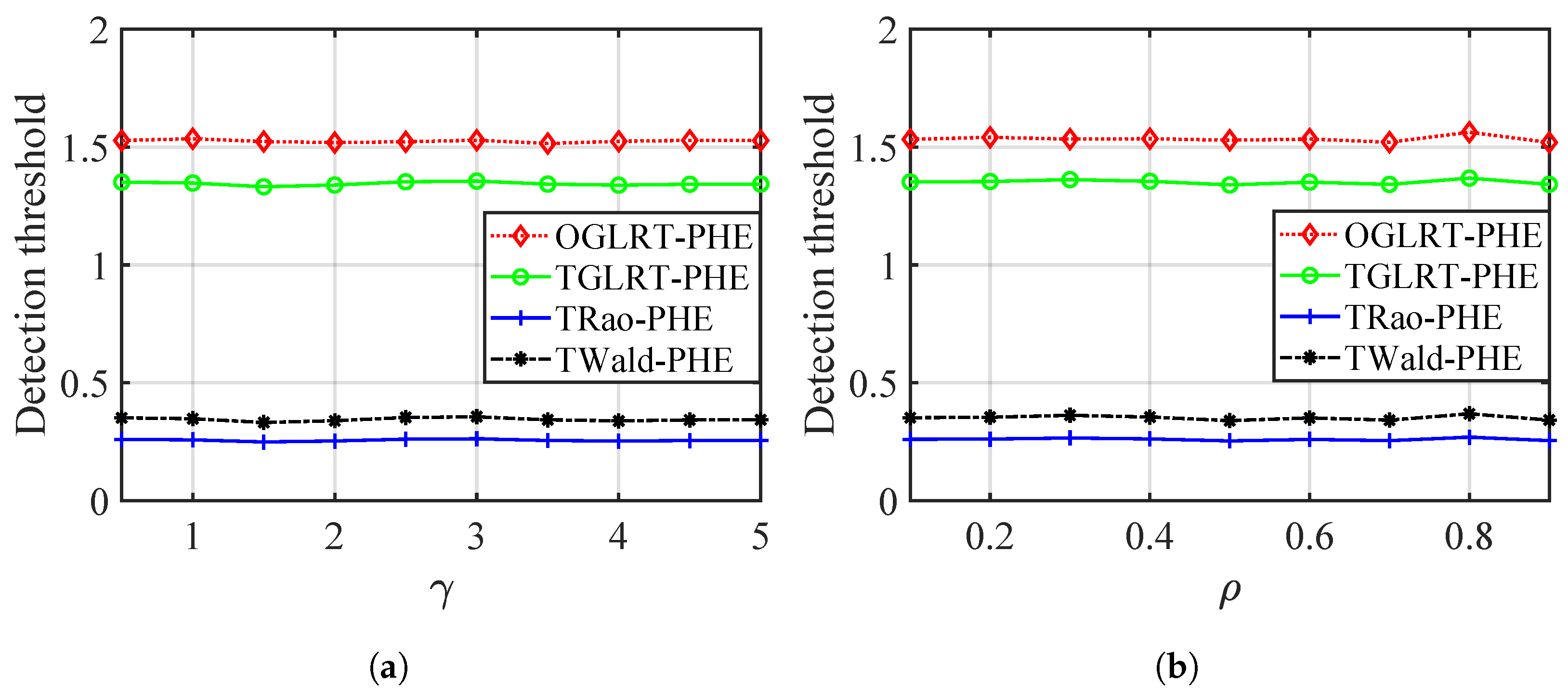
Figure 1 illustrates the detection thresholds of proposed detectors in various cases of power mismatch and , respectively. We can find that the detection thresholds of proposed detectors are less affected by the changes in and , which confirms that the four detectors have CFAR property against and in turn.
Figure 1.
Detection threshold versus (a) and (b) , respectively.
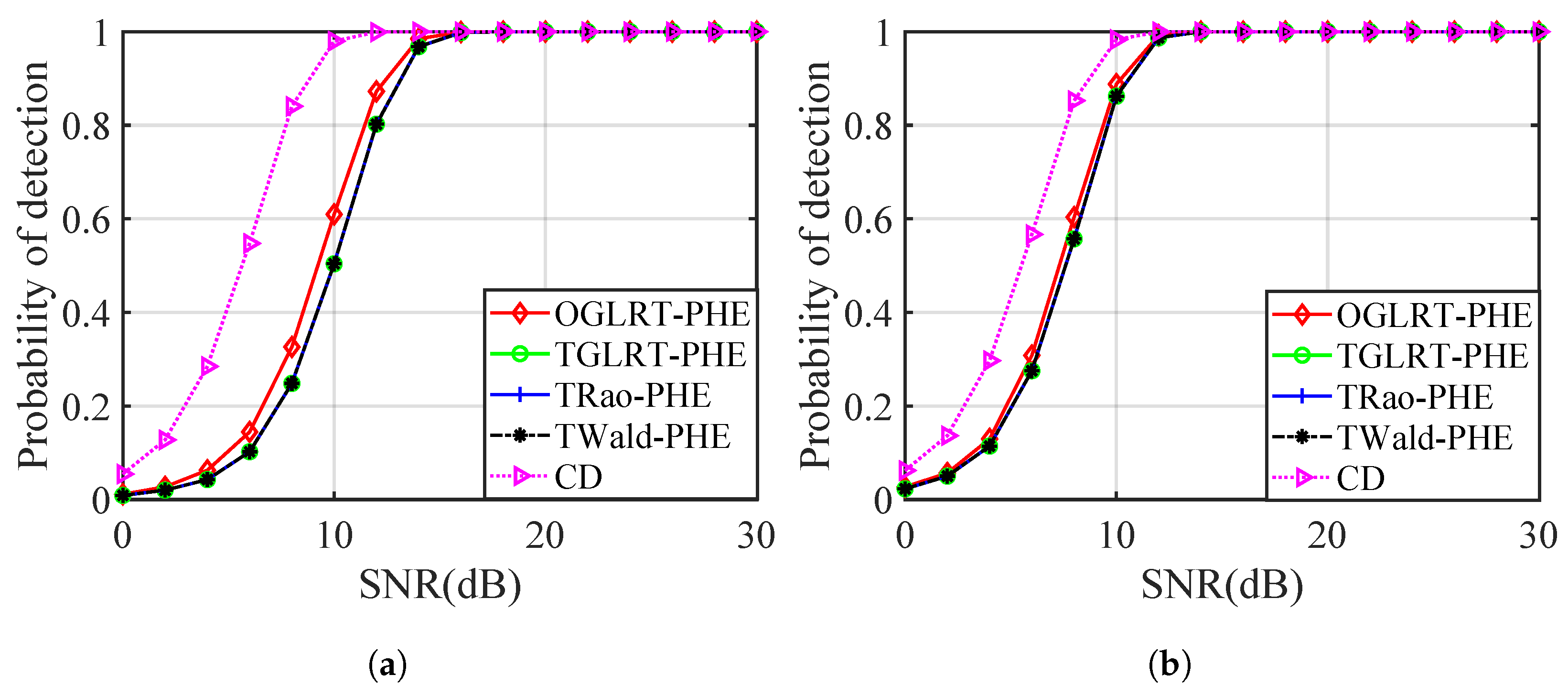
Figure 2 displays the detection performance of proposed detectors with different snapshots. In the legend, CD denotes the detector in (38) with a known covariance matrix . Please note that this detector is impractical since it requires knowledge of the covariance matrix in advance. However, this ideal detector provides a useful performance constraint for any suboptimal method. Hence, it can be used to measure the performance of the proposed detectors. From Figure 2, it is evident that the OGLRT-PHE detector achieves a superior detection performance compared to the other three proposed detectors. This is because the OGLRT-PHE detector uses both the training and test data to estimate the covariance matrix , which results in a more accurate estimation. The remaining three proposed detectors perform similarly as their detection statistics expressions are equivalent. Additionally, the larger the number of snapshots K, the better the performance of the proposed detectors, and the smaller the performance gaps between the proposed detectors and CD. Therefore, it can be predicted that when the number of snapshots K is large enough, the performance of all proposed detectors will be almost the same. This is because a larger number of snapshots leads to an increase in training data, which in turn provides a more reliable estimate of the covariance matrix .
Figure 2.
PD versus SNR for different cases of K. (a) , (b) .
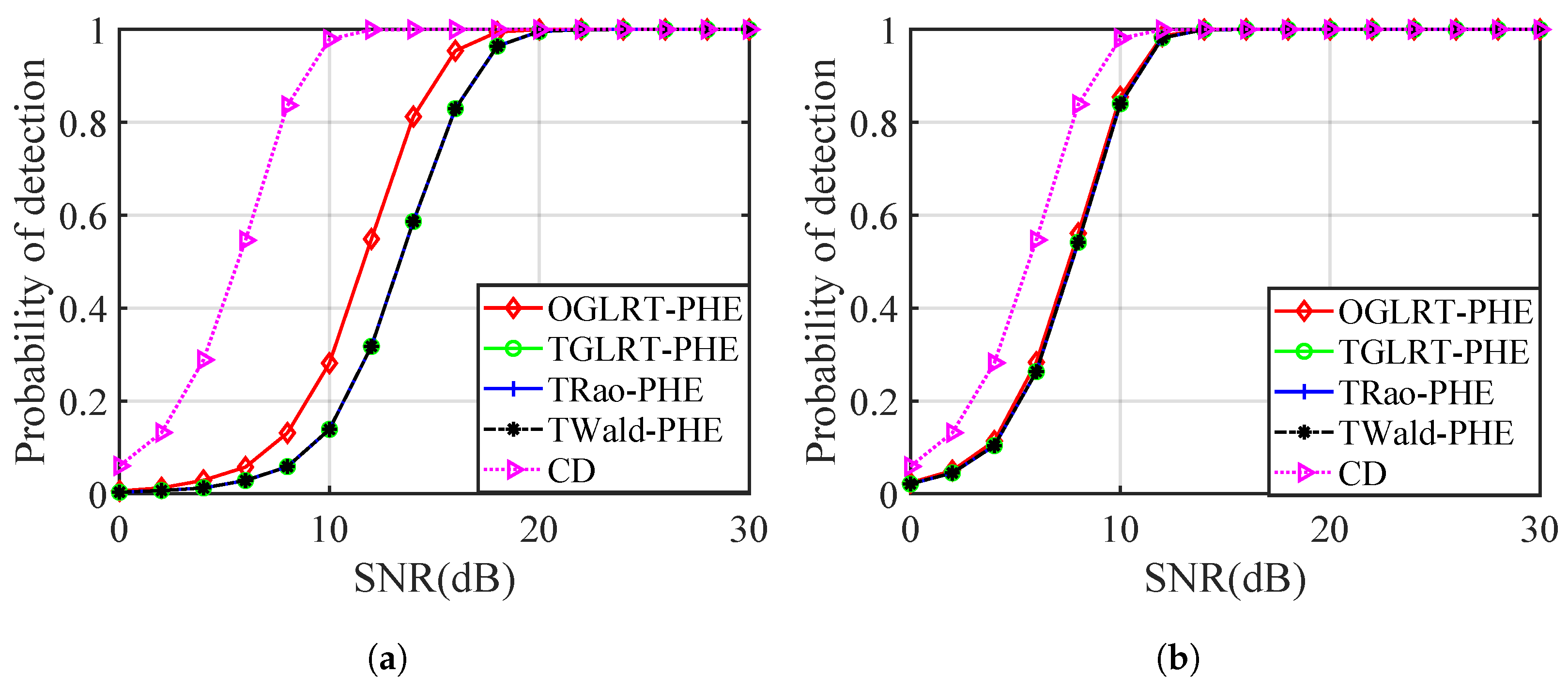
Figure 3 shows the detection performance of the proposed detectors with different sample covariance snapshots. It is observed that as we take more sample covariance snapshots L, the detectors’ performance improves. This is consistent with the results obtained by increasing the number of snapshots K, as shown in Figure 2. The improvement is because increasing L and K provides more training data, which enhances the estimation precision of the covariance matrix . However, there is a notable difference between Figure 2b and Figure 3b. With the same amount of training data (the product of K and L is equal), increasing the number of snapshots K leads to significant improvement in detection performance. Moreover, Figure 3a illustrates that the proposed OGLRT-PHE detector outperforms other proposed detectors with less training data.
Figure 3.
PD versus SNR for different cases of L. (a) , (b) .
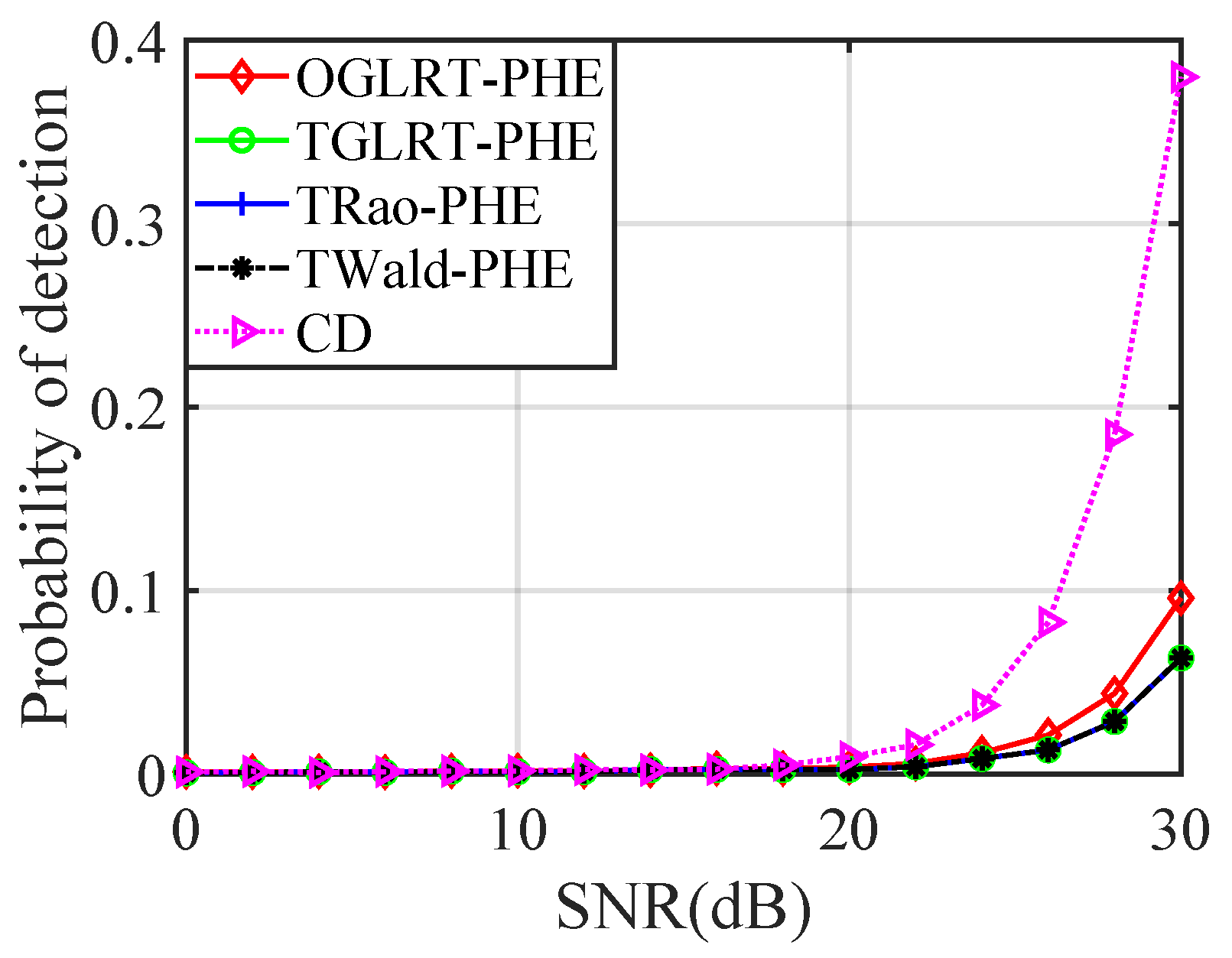
Figure 4 demonstrates the detection performance of the proposed detectors where the frequency increment is set as MHz. Together with Figure 2a, it can be found that the performance of all these detectors degrades significantly with the increase of the frequency increment .
Figure 4.
PD versus SNR with MHz.
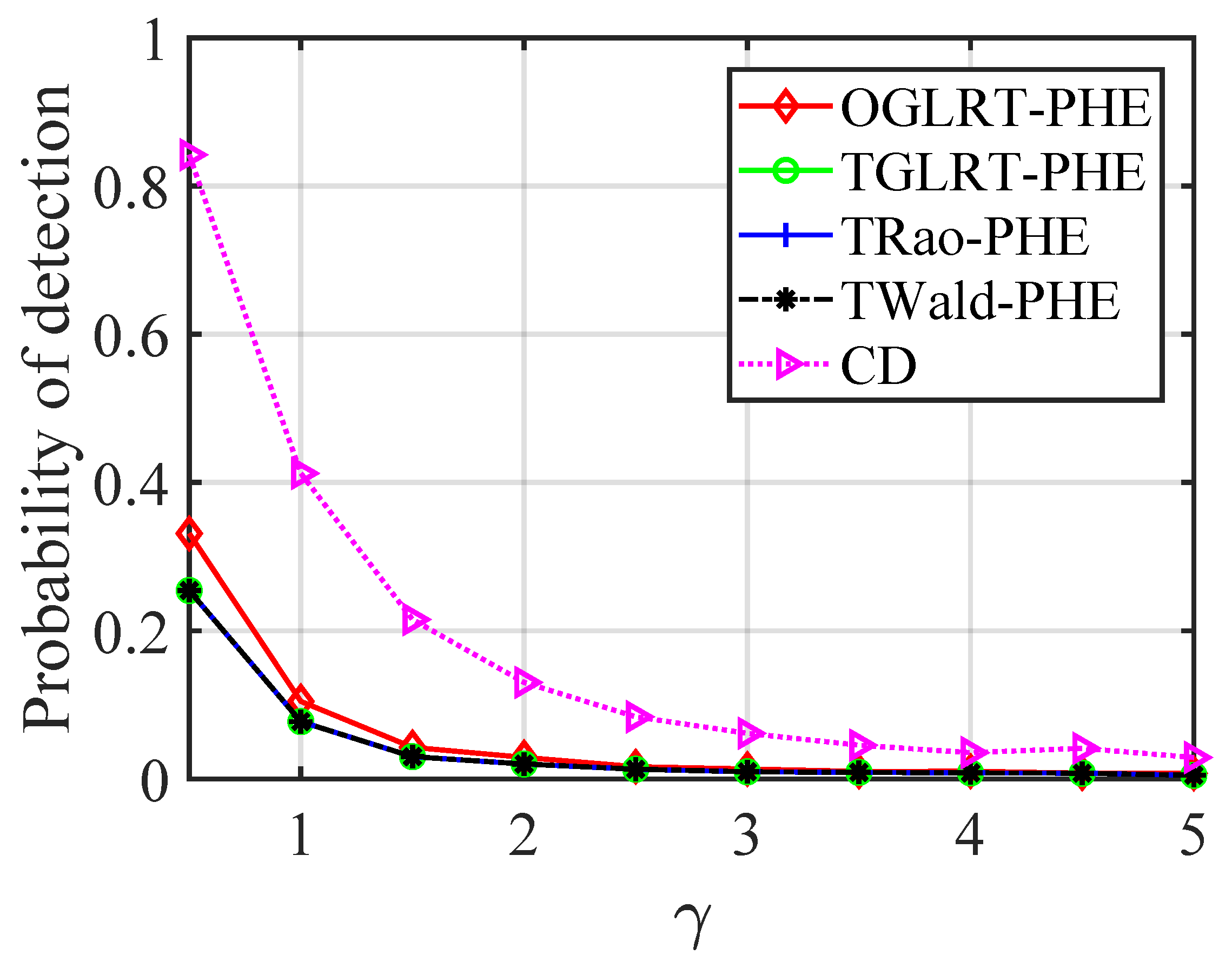
Figure 5 plots the detection performance of the proposed detectors against various power mismatch where SNR is set as dB. The results indicate that the detection performance of the proposed detector worsens as the power mismatch increases. The reason for this is that a larger power mismatch causes more disturbance, leading to poorer estimation precision of the covariance matrix . Furthermore, the OGLRT-PHE detector still gains the highest PD among all the proposed detectors.
Figure 5.
PD versus with dB.
In practice, there can be inaccuracies in the array calibration and waveform matching, which can cause the actual steering vectors to deviate from the presumed ones. To measure the degree of these discrepancies, we employ two parameters— and —which are defined as
and
respectively. Here, and representing the actual transmit-receive steering vector and the actual Doppler steering vector, respectively. Smaller values of and indicate a more severe mismatch.
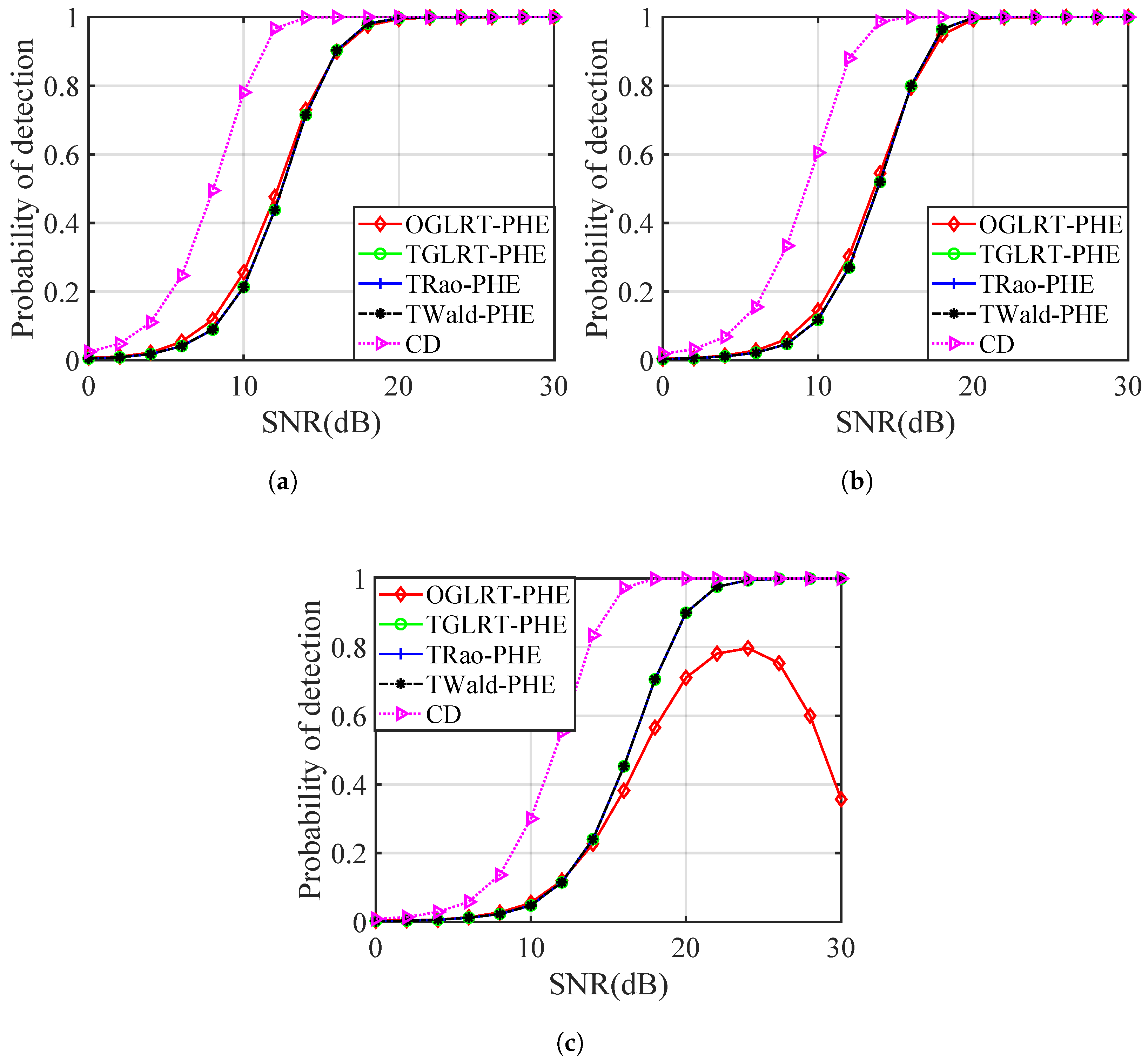
Figure 6 depicts the detection performance of the proposed detectors in the presence of steering vector mismatches. The figure shows three scenarios: Figure 6a only the transmit-receive steering vector mismatch exists (), Figure 6b only the Doppler steering vector mismatch exists (), and Figure 6c both transmit-receive and Doppler steering vector mismatches exist ( and ). When compared to Figure 2a, it is clear that all the proposed detectors’ performances decline in the presence of steering vector mismatches, with the OGLRT-PHE detector having the fastest decline in PD. The effect of the Doppler steering vector mismatch on the PDs is more significant when there is a single steering vector mismatch. On the other hand, when both steering vector mismatches exist, the TGLRT-PHE, TRao-PHE, and TWald-PHE detectors have higher PDs, indicating that these three detectors are more robust.
Figure 6.
PD versus SNR for different cases of steering vector mismatch. (a) , (b) . (c) and .
For comparison, we introduce detectors based on OGLRT, TGLRT, TRao, and TWald criteria in a homogeneous environment. Their statistical expressions are [28,41]:
and
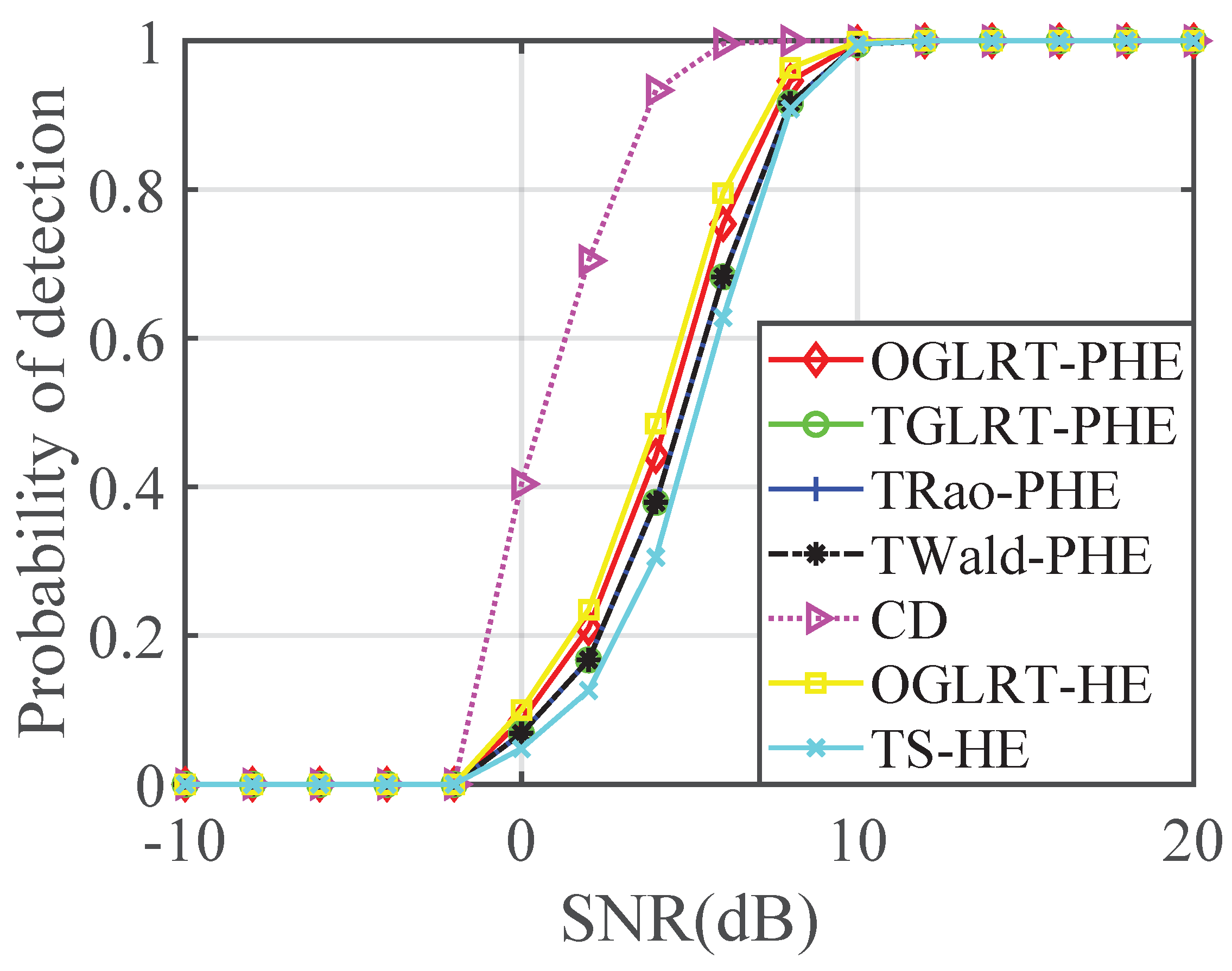
respectively, with and being defined in Appendix A. Here, the expressions for the TGLRT, TRao, and TWald detectors in homogeneous environments are all equivalently uniform to the TS-HE detector.
Figure 7 displays the detection performance of all detectors in homogeneous environments. Notably, the proposed detectors demonstrate comparable performance to those derived from homogeneous environments and even exhibit a slight advantage. This outcome serves as a validation of the effectiveness of the proposed detectors.
Figure 7.
PD versus SNR in HE ( = 1).
6. Conclusions
In this paper, we comprehensively explored the problem of adaptive moving-target detection in partially homogeneous environments for an FDA-MIMO radar platform. Based on different criteria, OGLRT-PHE, TGLRT-PHE, TRao-PHE, and TWald-PHE detectors with CFAR properties were derived using training data. Numerical experiments show that the OGLRT-PHE detector performs optimally, while the rest of the proposed detectors are more robust to signal mismatch. Moreover, these proposed detectors perform comparably to detectors designed for homogeneous environments, even in such environments. For future work, the detection problem for FDA-MIMO radar in compound Gaussian disturbance and other nonhomogeneous environments deserves further investigation. Moreover, Durbin and gradient tests can also provide new methods for FDA-MIMO radar target detection.
Author Contributions
Conceptualization, C.H. and B.H.; methodology, C.H., B.H. and Y.J.; validation, R.Z. and Z.W.; data analysis M.X. and L.L.; writing—original draft preparation, C.H., B.H. and M.X.; writing—review and editing, C.H., R.Z., Z.W., Z.L. and Y.J.; funding acquisition, Z.L. and Y.J. All authors have read and agreed to the published version of the manuscript.
Funding
This research was funded by the Beijing Nova Program OF FUNDER grant number Z201100006820103.
Data Availability Statement
Data are contained within the article.
Acknowledgments
The authors would like to thank Abdul Basit for help with language editing.
Conflicts of Interest
The authors declare no conflict of interest.
Abbreviations
The following abbreviations are used in this manuscript:
| FDA | frequency diverse array |
| MIMO | multiple-input multiple-output |
| FDA-MIMO | frequency diverse array multiple-input multiple-output |
| PA | phased array |
| DOF | degree of freedom |
| GLRT | generalized maximum likelihood ratio test |
| UGLRT | unstructured generalized likelihood ratio test |
| OGLRT | one-step GLRT |
| TGLRT | two-step GLRT |
| TRao | two-step Rao |
| TWald | two-step Wald |
| HE | homogeneous environments |
| PHE | partially homogeneous environments |
| CFAR | constant false-alarm rate |
| HRWS-SAR | high-resolution and wide-swath synthetic aperture radar |
| ICM | interference covariance matrix |
| CUT | cell under test |
| RCS | radar cross section |
| IID | independent and identically distributed |
| probability density function | |
| SCM | sample covariance matrix |
| MLE | maximum likelihood estimate |
| w.r.t | with respect to |
| NCM | noise covariance matrix |
| FIM | Fisher information matrix |
| PD | probability of detection |
| PFA | probability of false alarm |
| SNR | signal-to-noise ratio |
| JNR | jamming-to-noise ratio |
| MC | Monte Carlo |
Appendix A. Deviation of (20) and (21)
Please note that in (19) can be decomposed into
where and , with and being the projection matrix and the orthogonal projection matrix onto the column space of , respectively. Using the inequality [43], where is positive define matrix and is positive semi-define matrix, we have,
When the minimum is obtained, , i.e., , that leads to
Pre-multiplying both sides of (A3) by yields
Post-multiplying both sides of (A4) by , after sorting, it leads to
where the fact is used again.
Appendix B. Deviation of (26)
The numerator and denominator of (25) share the same expression form as
where is positive semi-define matrix with rank R and non-zero eigenvalues . Taking the derivative of (A7) regarding , we have
Define
Clearly, is continuous and monotonically decreasing over , thus we have
and
Therefore, if , there is a unique positive value of satisfying by solving the equation . Otherwise, namely , it follows that , , hence, the minimum of occurs at . The latter case should be excluded because corresponding to the minimum of is out of the range. In summary, attains its minimum regarding as the solution of .
Now, we go back to (25). For the numerator, there is and its non-zero eigenvalues s, . For the denominator, there is and its non-zero eigenvalues s, . Herein, .
References
- Antonik, P.; Wicks, M.; Griffiths, H.; Baker, C. Frequency diverse array radars. In Proceedings of the 2006 IEEE Conference on Radar, Verona, NY, USA, 24–27 April 2006; p. 3. [Google Scholar] [CrossRef]
- Gao, K.; Wang, W.Q.; Cai, J.; Xiong, J. Decoupled frequency diverse array range- angle-dependent beampattern synthesis using non-linearly increasing frequency offsets. IET Microwaves Antennas Propag. 2016, 10, 880–884. [Google Scholar] [CrossRef]
- Xu, J.; Liao, G.; Zhang, Y.; Ji, H.; Huang, L. An Adaptive Range-Angle-Doppler Processing Approach for FDA-MIMO Radar Using Three-Dimensional Localization. IEEE J. Sel. Top. Signal Process. 2017, 11, 309–320. [Google Scholar] [CrossRef]
- Basit, A.; Wang, W.Q.; Nusenu, S.Y.; Wali, S. FDA Based QSM for mmWave Wireless Communications: Frequency Diverse Transmitter and Reduced Complexity Receiver. IEEE Trans. Wirel. Commun. 2021, 20, 4571–4584. [Google Scholar] [CrossRef]
- Gui, R.; Huang, B.; Wang, W.Q.; Sun, Y. Generalized Ambiguity Function for FDA Radar Joint Range, Angle and Doppler Resolution Evaluation. IEEE Geosci. Remote Sens. Lett. 2020, 19, 3502305. [Google Scholar] [CrossRef]
- Bang, H.; Yan, Y.; Basit, A.; Wang, W.Q.; Cheng, J. Radar Cross Section Characterization of Frequency Diverse Array Radar. IEEE Trans. Aerosp. Electron. Syst. 2023, 59, 460–471. [Google Scholar] [CrossRef]
- Li, J.; Stoica, P. MIMO Radar Signal Processing; John Wiley & Sons, Inc.: Hoboken, NJ, USA, 2008. [Google Scholar]
- Tan, M.; Wang, C.; Li, Z. Correction Analysis of Frequency Diverse Array Radar About Time. IEEE Trans. Antennas Propag. 2021, 69, 834–847. [Google Scholar] [CrossRef]
- Lan, L.; Xu, J.; Liao, G.; Zhang, Y.; So, H.C. Suppression of Mainbeam Deceptive Jammer with FDA-MIMO Radar. IEEE Trans. Veh. Technol. 2020, 69, 11584–11598. [Google Scholar] [CrossRef]
- Xu, J.; Liao, G.; Zhu, S.; Huang, L.; So, H.C. Joint Range and Angle Estimation Using MIMO Radar with Frequency Diverse Array. IEEE Trans. Signal Process. 2015, 63, 3396–3410. [Google Scholar] [CrossRef]
- Ji, S.; Wang, W.Q.; Chen, H.; Zhang, S. On Physical-Layer Security of FDA Communications Over Rayleigh Fading Channels. IEEE Trans. Cogn. Commun. Netw. 2019, 5, 476–490. [Google Scholar] [CrossRef]
- Zhou, Y.; Wang, W.; Chen, Z.; Zhao, Q.; Deng, Y.; Wang, R. A Novel High-Resolution and Wide-Swath SAR Imaging Mode Using Frequency Diverse Planar Array. In Proceedings of the EUSAR 2021, 13th European Conference on Synthetic Aperture Radar, Virtal Event, 29 March–1 April 2021; pp. 1–5. [Google Scholar]
- Zhou, Y.; Wang, W.; Chen, Z.; Zhao, Q.; Zhang, H.; Deng, Y.; Wang, R. High-Resolution and Wide-Swath SAR Imaging Mode Using Frequency Diverse Planar Array. IEEE Geosci. Remote Sens. Lett. 2021, 18, 321–325. [Google Scholar] [CrossRef]
- Huang, B.; Wang, W.Q.; Zhang, S.; Wang, H.; Gui, R.; Lu, Z. A Novel Approach for Spaceborne SAR Scattered-Wave Deception Jamming Using Frequency Diverse Array. IEEE Geosci. Remote Sens. Lett. 2020, 17, 1568–1572. [Google Scholar] [CrossRef]
- Bang, H.; Wang, W.Q.; Zhang, S.; Liao, Y. FDA-Based Space–Time–Frequency Deceptive Jamming Against SAR Imaging. IEEE Trans. Aerosp. Electron. Syst. 2022, 58, 2127–2140. [Google Scholar] [CrossRef]
- Huang, L.; Zong, Z.; Zhang, S.; Wang, W.Q. 2-D Moving Target Deception Against Multichannel SAR-GMTI Using Frequency Diverse Array. IEEE Geosci. Remote Sens. Lett. 2022, 19, 4006705. [Google Scholar] [CrossRef]
- Cheng, J.; Wang, W.Q.; Zhang, S. Joint MIMO and Frequency Diverse Array for Suppressing Mainlobe Interferences. In Proceedings of the International Symposium on Antennas and Propagation, Osaka, Japan, 25–28 January 2021. [Google Scholar]
- Gui, R.; Wang, W.Q.; Farina, A.; So, H.C. FDA radar with doppler-spreading consideration: Mainlobe clutter suppression for blind-doppler target detection. Signal Process. 2021, 179, 107773. [Google Scholar] [CrossRef]
- Lan, L.; Liao, G.; Xu, J.; Zhang, Y.; Fioranelli, F. Suppression Approach to Main-Beam Deceptive Jamming in FDA-MIMO Radar Using Nonhomogeneous Sample Detection. IEEE Access 2018, 6, 34582–34597. [Google Scholar] [CrossRef]
- Zhang, Y.; Liao, G.; Xu, J.; Lan, L. Mainlobe Deceptive Jammer Suppression Based on Quadratic Phase Coding in FDA-MIMO Radar. Remote Sens. 2022, 14, 5831. [Google Scholar] [CrossRef]
- Wan, P.; Weng, Y.; Xu, J.; Liao, G. Range Gate Pull-Off Mainlobe Jamming Suppression Approach with FDA-MIMO Radar: Theoretical Formalism and Numerical Study. Remote Sens. 2022, 14, 1499. [Google Scholar] [CrossRef]
- Lan, L.; Marino, A.; Aubry, A.; Maio, A.D.; Zhang, Y. GLRT-based Adaptive Target Detection in FDA-MIMO Radar. IEEE Trans. Aerosp. Electron. Syst. 2020, 57, 597–613. [Google Scholar] [CrossRef]
- Gui, R.; Wang, W.Q.; Zheng, Z. Low-complexity GLRT for FDA radar without training data. Digit. Signal Process. 2020, 107, 102861. [Google Scholar] [CrossRef]
- Zhu, Y.; Liu, L.; Lu, Z.; Zhang, S. Target Detection Performance Analysis of FDA-MIMO Radar. IEEE Access 2019, 7, 164276–164285. [Google Scholar] [CrossRef]
- Huang, B.; Basit, A.; Gui, R.; Wang, W.Q. Adaptive Moving Target Detection Without Training Data for FDA-MIMO Radar. IEEE Trans. Veh. Technol. 2022, 71, 220–232. [Google Scholar] [CrossRef]
- Xu, J.; Zhu, S.; Liao, G. Range Ambiguous Clutter Suppression for Airborne FDA-STAP Radar. IEEE J. Sel. Top. Signal Process. 2015, 9, 1620–1631. [Google Scholar] [CrossRef]
- Chen, X.; Chen, B.; Guan, J.; Huang, Y.; He, Y. Space-Range-Doppler Focus-Based Low-observable Moving Target Detection Using Frequency Diverse Array MIMO Radar. IEEE Access 2018, 6, 43892–43904. [Google Scholar] [CrossRef]
- Zeng, L.; Wang, Y.L.; Liu, W.; Liu, J.; Lan, L. GLRT-based detectors for FDA-MIMO radar with training data. Digit. Signal Process. 2022, 130, 103729. [Google Scholar] [CrossRef]
- Kraut, S.; Scharf, L.L. The CFAR Adaptive Subspace Detector is a Scale-Invariant GLRT. IEEE Trans. Signal Process. 1999, 47, 2538. [Google Scholar] [CrossRef]
- Liu, W.; Xie, W.; Liu, J.; Wang, Y. Adaptive Double Subspace Signal Detection in Gaussian Background—Part II: Partially Homogeneous Environments. IEEE Trans. Signal Process. 2014, 62, 2358–2369. [Google Scholar] [CrossRef]
- Dong, Y.; Ming, L.; Kai, L.; Tang, Z.; Liu, W. Adaptive Direction Detection in Deterministic Interference and Partially Homogeneous Noise. IEEE Signal Process. Lett. 2017, 24, 599–603. [Google Scholar] [CrossRef]
- Liu, J.; Liu, W.; Hao, C.; Orlando, D.; Farina, A. Robust GLRT Detection Exploiting Persymmetry in Partially Homogeneous Environments. In Proceedings of the 2019 International Conference on Control, Automation and Information Sciences (ICCAIS), Chengdu, China, 23–26 October 2019; pp. 1–6. [Google Scholar] [CrossRef]
- Huang, C.; Wang, Y.; Liu, W.; Liu, J.; Du, Q. Adaptive Detection with Training Data in Partially Homogeneous Environments for Colocated MIMO Radar. Signal Process. 2023, 217, 109353. [Google Scholar] [CrossRef]

- Pulsone, N.; Rader, C. Adaptive beamformer orthogonal rejection test. IEEE Trans. Signal Process. 2001, 49, 521–529. [Google Scholar] [CrossRef]
- Bandiera, F.; Orlando, D.; Ricci, G. Advanced Radar Detection Schemes Under Mismatched Signal Models; Synthesis Lectures on Signal Processing Series; Springer: Cham, Switzerland, 2009; Volume 4, pp. 1–105. [Google Scholar] [CrossRef]
- Gui, R.; Wang, W.Q.; Shao, H. General receiver design for FDA radar. In Proceedings of the 2018 IEEE Radar Conference (RadarConf18), Oklahoma City, OK, USA, 23–27 April 2018. [Google Scholar]
- Kelly, E. An Adaptive Detection Algorithm. IEEE Trans. Aerosp. Electron. Syst. 1986, AES-22, 115–127. [Google Scholar] [CrossRef]
- Kelly, E.J.; Forsythe, K.M. Adaptive Detection and Parameter Estimation for Multidimensional Signal Models; NASA STI/Recon Technical Report N; MIT Lincoln Laboratory: Lexington, MA, USA, 1989. [Google Scholar]
- Conte, E.; Maio, A.D.; Ricci, G. GLRT-based adaptive detection algorithms for range-spread targets. IEEE Trans. Signal Process. 2002, 49, 1336–1348. [Google Scholar] [CrossRef]
- Liu, W.; Wang, Y.; Xie, W. Fisher information matrix, Rao test, and Wald test for complex-valued signals and their applications. Signal Process. 2014, 94, 1–5. [Google Scholar] [CrossRef]
- Liu, W.; Xie, W.; Liu, J.; Wang, Y. Adaptive Double Subspace Signal Detection in Gaussian Background—Part I: Homogeneous Environments. IEEE Trans. Signal Process. 2014, 62, 2345–2357. [Google Scholar] [CrossRef]
- Tague, J.A.; Caldwell, C.I. Expectations of useful complex Wishart forms. Multidimens. Syst. Signal Process. 1994, 5, 263–279. [Google Scholar] [CrossRef]
- Zhang, X. Matrix Analysis and Applications; Cambridge University Press: Cambridge, UK, 2007; Volume 309, Part I; pp. 3–94. [Google Scholar]
Disclaimer/Publisher’s Note: The statements, opinions and data contained in all publications are solely those of the individual author(s) and contributor(s) and not of MDPI and/or the editor(s). MDPI and/or the editor(s) disclaim responsibility for any injury to people or property resulting from any ideas, methods, instructions or products referred to in the content. |
© 2024 by the authors. Licensee MDPI, Basel, Switzerland. This article is an open access article distributed under the terms and conditions of the Creative Commons Attribution (CC BY) license (https://creativecommons.org/licenses/by/4.0/).