



Comparative Analysis of Traffic-Reduction Techniques for Seamless CAN-Based In-Vehicle Network Systems

Abstract
1. Introduction
- By carefully studying the recently proposed seamless CAN protocol as a potential prospective candidate for modern IVN solutions in terms of its working principles and limitations, we proposed an architecture for effective network traffic usage where unnecessary infotainment data frames are not made fault-tolerant to make room for more critical traffic.
- Through an in-depth comparative analysis among several well-known traffic-reduction techniques for the original HSR protocol, we were able to further minimize the network traffic in our proposed architecture by choosing the suitable methods applicable to seamless CAN protocol. The compatible techniques are versatile and can be applied to any type of traffic while still being easy for implementation.
- We implemented the proposed architecture and its traffic-reduction techniques using the OMNeT++ simulation framework [8]. Next, we conducted a comparative assessment to evaluate the performance of different traffic-reduction techniques for the conventional and the proposed traffic-effective network architectures. Through in-depth discussions and analyses, we further demonstrated the feasibility of seamless CAN for various IVN system designs.
2. Related Work
2.1. HSR Fundamental Concepts
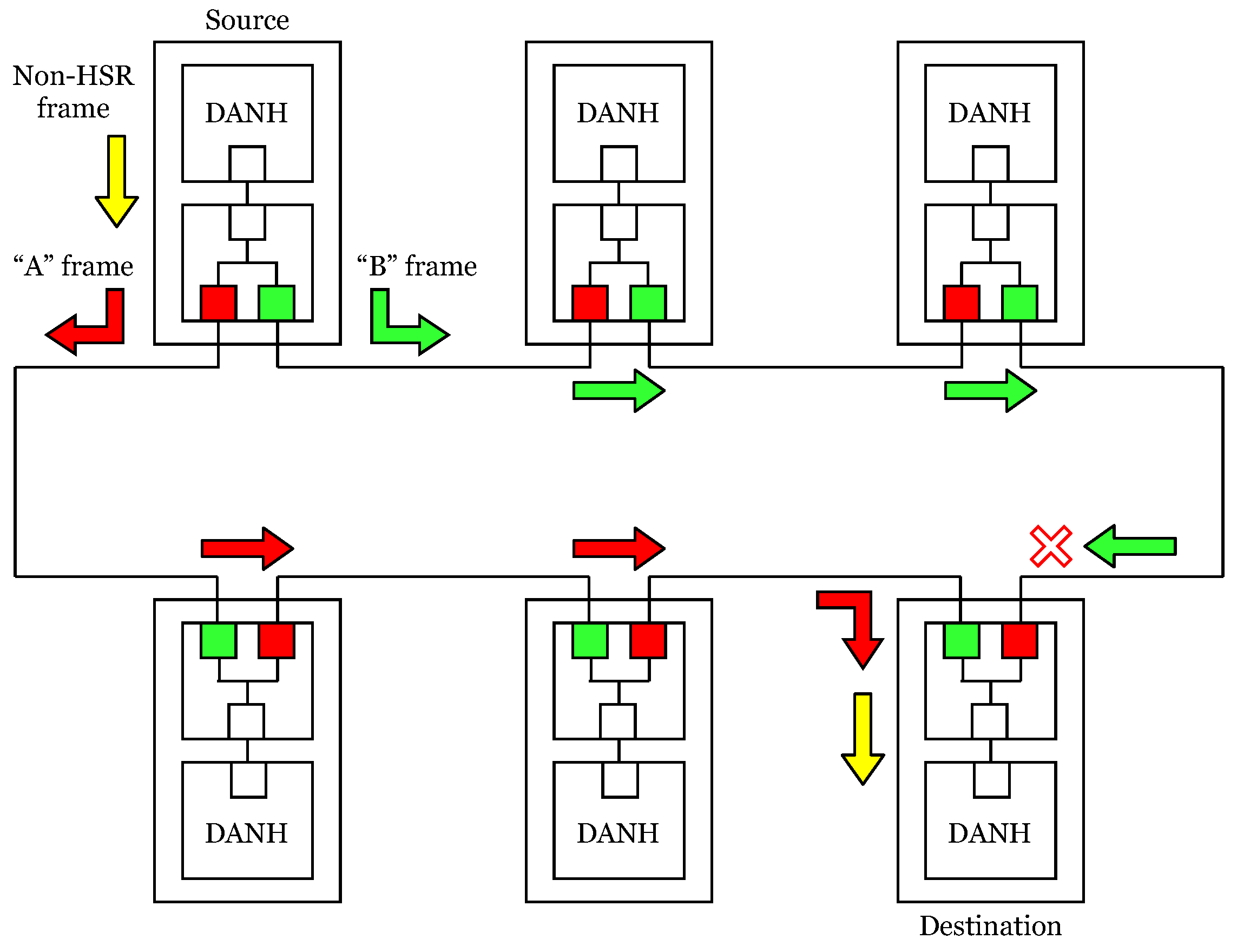
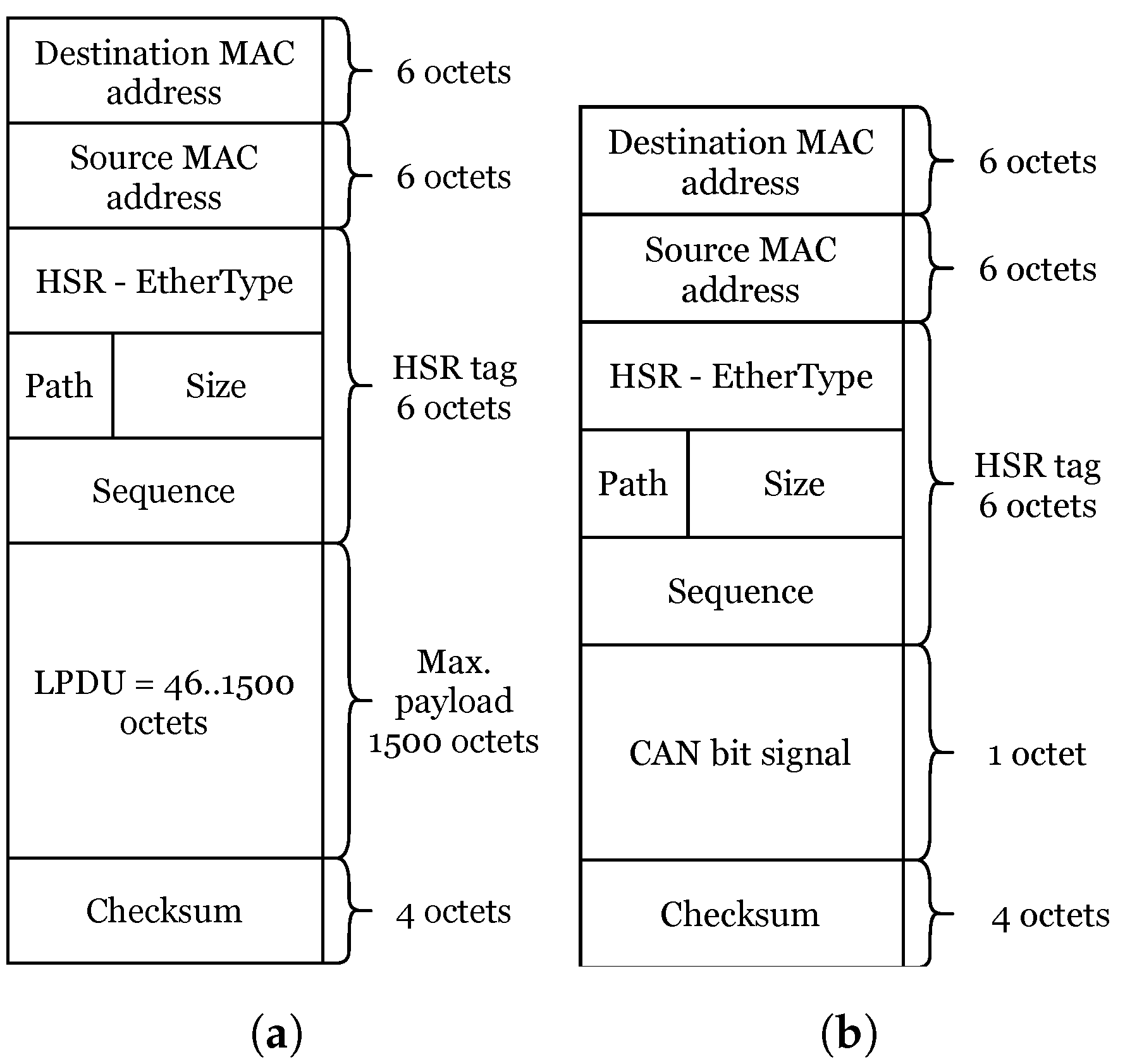
- “PT” is the EtherType and is used to identify a frame of HSR type;
- “Path” is reserved for experimental purposes;
- “LSDU size” is the size of LSDU;
- “Sequence number” is used to enumerate the frames.

- Doubly attached node for HSR (DANH). An HSR-capable switching end node with two HSR ports sharing the same media access control is known as a DANH node (MAC). A single interface is formed by these two ports. The source DANH replicates the frame received from the upper layers into two frame copies, adds the HSR tag to each copy, and sends them over both ports. In the event of a failure-free transmission, the destination DANH receives two copies of the identical frame, one from each port;
- Redundancy box (RedBox). Single-attached nodes (SANs) cannot be directly linked to an HSR ring because they lack the HSR tag support and HSR-forwarding functionality. To join SANs to the HSR ring, a RedBox is utilized. Like DANH nodes, RedBoxes operate as proxies for any SANs that access them and forward the frames over the ring;
- Quadruple port device (QuadBox). HSR rings are linked together using QuadBox nodes. Each pair of the four HSR ports on a QuadBox, which are separated into two groups of two and connected by an interlink, uses the same MAC. QuadBoxes function simultaneously as HSR nodes for both rings.
2.2. HSR Traffic-Reducing Techniques
- Quick removing (QR) [10]. When every node in a ring has received one copy of a frame and is about to receive a second copy, QR is used to remove circulated and duplicated frames from the ring. QR may be used for any traffic, including unicast, multicast, and broadcast, in any network architecture; therefore, it is appropriate for ring or connected ring topologies. The most straightforward method for reducing duplicate traffic in HSR networks is QR. This method is simple to use. However, QR’s biggest drawback is that it does not reduce traffic for unused rings. Network unicast frames are forwarded into all rings of HSR networks using the QR method, including QuadBox rings and DANH rings that do not include the frames’ destinations and do not carry unicast traffic from the source to the destination.
- Traffic control (TC) [11]. Similar to QR, TC is a straightforward technique to eliminate duplicated and circulated frames from a ring. In the case of terminal rings, the TC method is used. One of the ring’s nodes is chosen by TC to serve as the traffic control node. Duplicated frames will be discarded based on decisions made by the traffic control node. TC is a straightforward method, like QR, for reducing duplicate traffic in HSR networks. TC is applicable for all types of traffic, including broadcast, multicast, and unicast, in ring topologies. TC strategy does, however, have significant drawbacks. TC cannot reduce traffic for unused rings as QR can. Network traffic may be redirected into any network ring thanks to TC. In contrast with QR, which applies to both DANH and QuadBox rings, the TC technique only applies to DANH rings.
- Port locking (PL) [12]. By filtering and removing traffic for idle DANH rings, PL lowers redundant unicast traffic in HSR connected-ring networks. Without using network control messages, the PL technique allows for the network to progressively learn the position of the target node. It then locks the entry ports of the relevant DANH rings to prune those that do not include the destination node. By filtering unicast traffic for unused DANH rings, the PL method lowers redundant unicast traffic in HSR networks. The PL technique avoids increasing control overhead in HSR networks because it does not employ control messages to filter traffic. The PL technique does, however, have significant drawbacks. The PL method does not eliminate unneeded QuadBox rings from unicast traffic. Additionally, all QuadBox rings continue to replicate and transmit unicast packets.
- Enhanced port locking (EPL) [13]. The PL methodology has been improved with the EPL method. In contrast with the PL, which only prunes unicast traffic for DANH rings, the EPL technique filters unicast traffic for both QuadBox rings and DANH rings. In comparison to the PL technique, the EPL strategy enhances traffic performance in HSR networks. The EPL method prunes unicast traffic for both underutilized QuadBox rings and unused DANH rings. As a result, it reduces unicast traffic more effectively than the PL technique. Furthermore, the EPL technique, like the PL approach, does not prune unicast traffic using control messages; as a result, there is no additional control cost in the networks.
- Filtering HSR traffic (FHT) [14]. In comparison to the PL technique, the EPL strategy enhances traffic performance in HSR networks. The EPL method prunes unicast traffic for both underutilized QuadBox rings and unused DANH rings. As a result, it reduces unicast traffic more effectively than the PL technique. Furthermore, the EPL technique, like the PL approach, does not prune unicast traffic using control messages; as a result, there is no additional control cost in the networks. The FHT method prunes unicast traffic for unused QuadBox rings in addition to underutilized DANH rings. It also takes circulating and repeated traffic out of the active rings. These characteristics elevate the FHT method to the top of the list of HSR traffic-reduction strategies.
- Optimal Dual Paths (ODP) [15]. In HSR networks, ODP creates dual pathways for each connection pair of terminal nodes, such as DANH nodes and RedBox nodes. The following criteria are used to identify the dual paths: ideal connection metrics and an absence of shared nodes. Dual pathways are automatically established between all the terminal nodes in a network. Each terminal node must be aware of the measurements for all of the network links in order to identify the dual pathways with the best metrics. As a result, the ODP technique creates a table that includes metrics for every network link. The ODP technique finds all possible pathways for each connection pair based on that table, arranges them according to ascending path metrics, and identifies dual paths that meet the aforementioned requirements. By sending the redundant unicast data over two predetermined pathways rather than duplicating and flooding the entire network, ODP dramatically decreases redundant unicast traffic when compared to the normal HSR protocol. Additionally, dual pathways offer the best connection metrics, enhancing the network quality of service. The fundamental disadvantage of ODP is that it must create and maintain the link information table, adding to the network’s management cost.
- Dual Virtual Paths (DVPs) [16]. For every connecting pair of terminal nodes in a network, DVP creates two specified pathways. The DVP technique, in contrast with ODP, finds the dual pathways by sending and receiving control messages, including path selection and path confirmation messages. ODP finds the dual paths based on the network’s connection information. In the DVP setup procedure, these dual pathways will be automatically constructed. After a learning task, such a procedure merely renders all of the intermediate QuadBox nodes as “smart”. The QuadBox nodes are, therefore, able to forward a unicast frame to the intended recipient over just one of their ports, as opposed to flooding and duplicating the message through all of their ports (apart from the port on which it was received), as in the case of the traditional HSR protocol.
- Ring-Based Dual Paths (RDP) [17]. In contrast with the typical HSR protocol, which duplicates and floods data, RDP sets two predetermined paths for each connection pair and uses them for point-to-point communications. RDP, however, creates dual routes for each connection pair of terminal rings, in contrast with ODP and DVP, which do so for each connection pair of terminal nodes (DANH rings). Dual pathways used in the RDP technique are ring-based dual paths. The RDP method uses the dual pathways that have already been created between the source DANH ring and the destination DANH ring to transfer unicast frames from a source node to a destination node.
3. Background
3.1. Seamless CAN
3.2. Traffic-Reduction Techniques for Seamless CAN
- Quick removing (QR);
- Traffic control (TC).
3.3. The Proposed Traffic-Effective Architecture
- Frames are sent into all DANH rings in addition to the one containing its destination;
- Frames are sent to all QuadBox rings;
- Frames are duplicated and circulated across all rings.
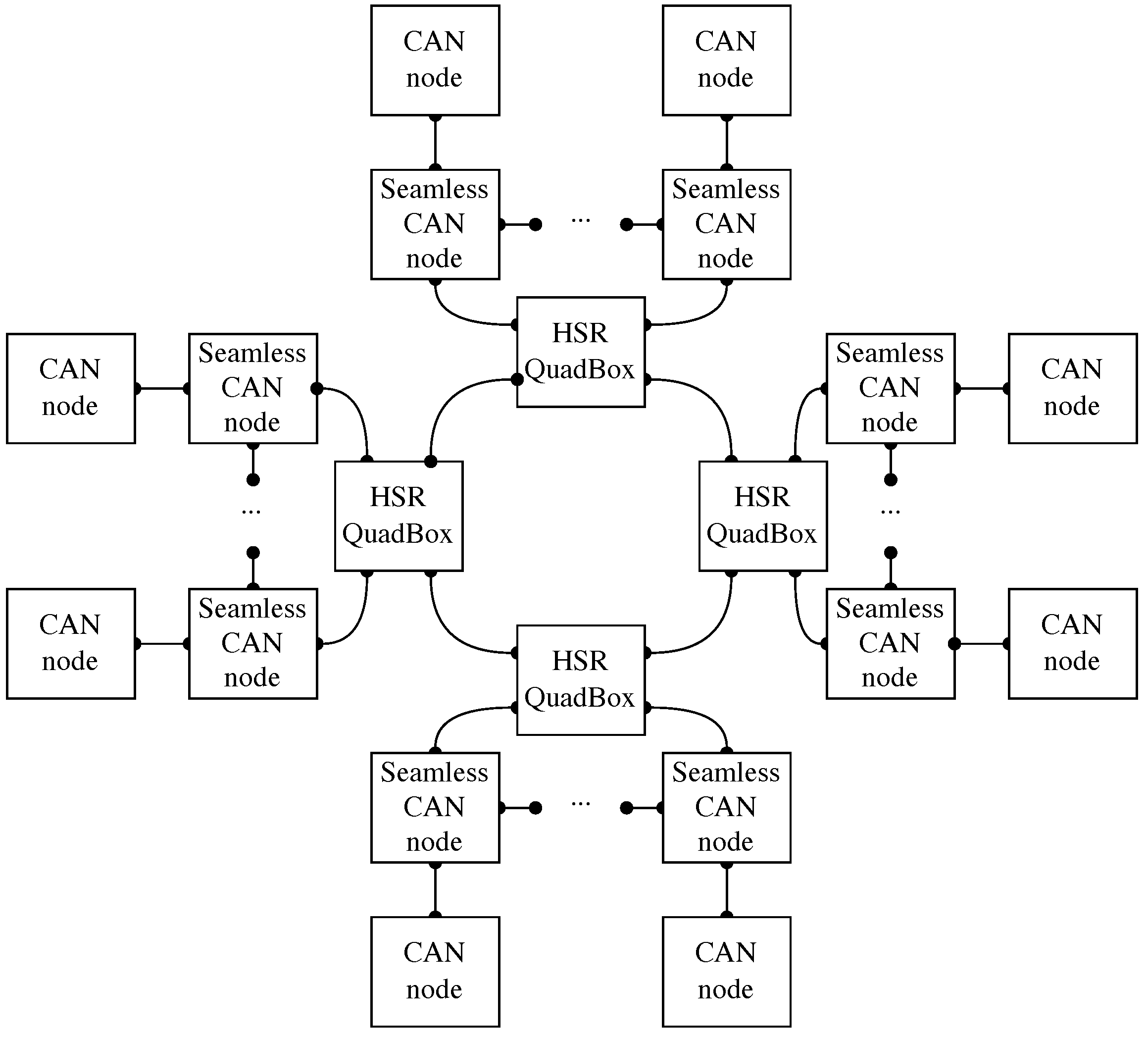
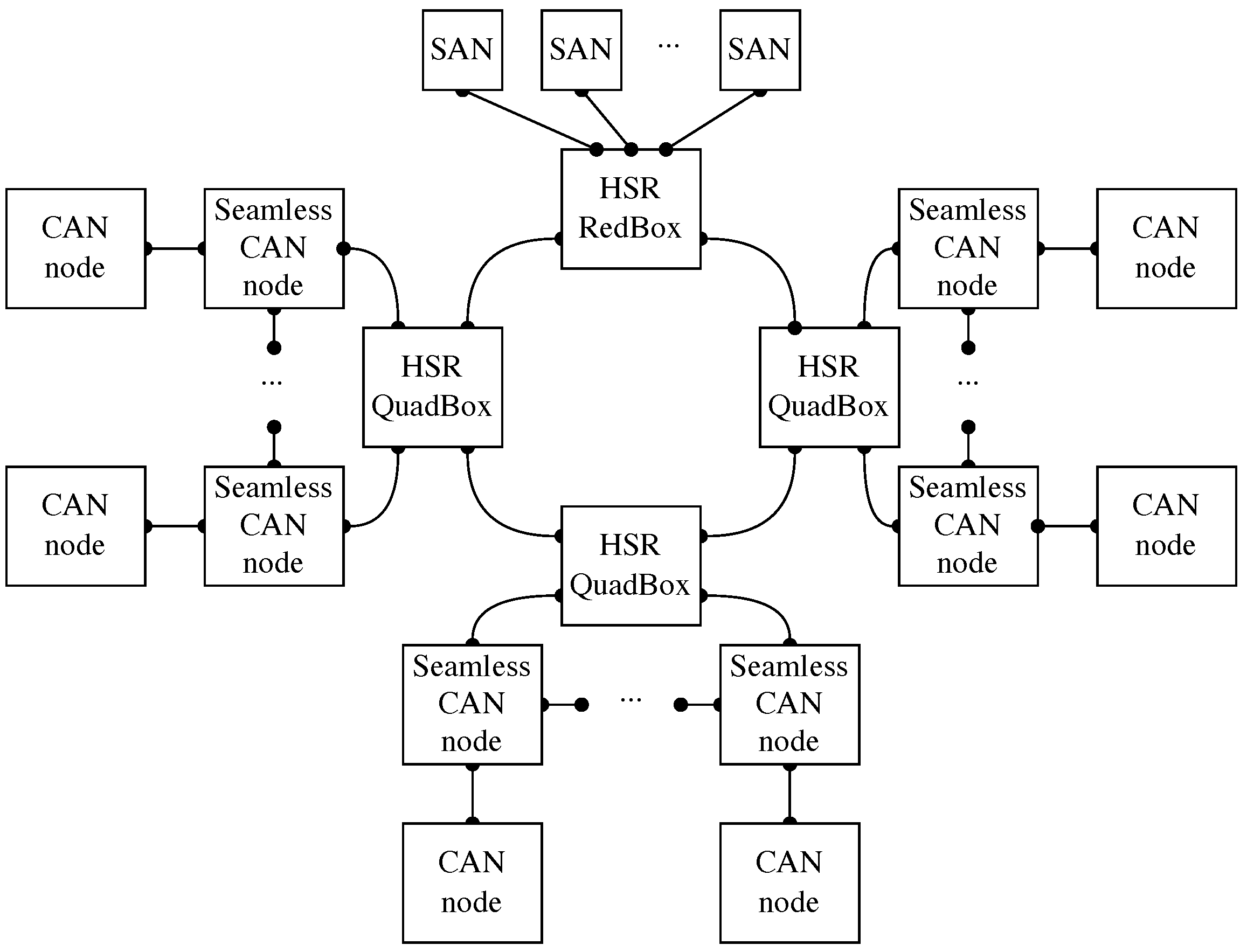
- First, we noticed that in addition to parts of an IVN system that are in charge of transmitting time-critical information, such as sensor data and a brake controlling signal, there are also network components that communicate non-critical information (e.g., radio and media playing services). Obviously, they do not play an important role in ensuring the safety of car users because their exchanging information is not crucial. In addition, it is noted that these infotainment parts of the network consume a large amount of data traffic as they are bandwidth-demanding for high-quality audio and video transmission;
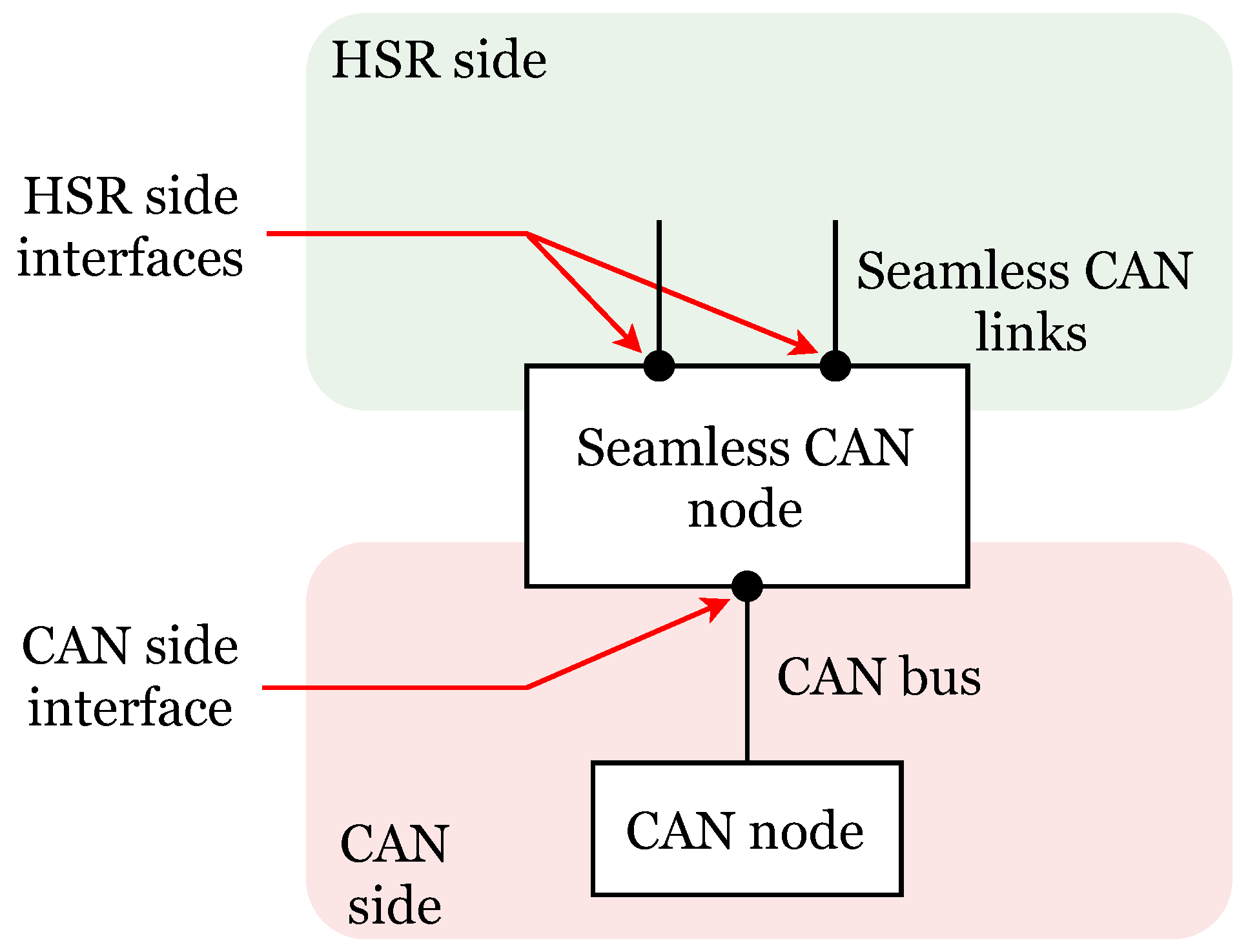
- Therefore, in the proposed traffic-efficient network architecture, we decided not to implement fault tolerance for non-crucial parts of the network. Specifically, because entertainment units can be collectively modeled as any one of the four QuadBox rings (as depicted in Figure 5), we can replace the seamless CAN nodes with SAN nodes. In addition, the SAN nodes are connected using an HSR RedBox, which is a device that enables non-HSR devices to join the ring-type HSR network. In this manner, SAN nodes (e.g., media players and camcorders) are still able to communicate with the rest of the network while there is no need to provide seamless redundancy for them. Ultimately, the other parts of the entire network remain the same.
- First, by making use of the novel fault-tolerant seamless CAN method, we ensure that mission-critical network frames always have two redundant paths between the source and destination nodes in the error-free scenario. In the case of faulty network links, there would still be no delay in the delivery process of the data frames as long as one path is still available;
- Second, the proposed architecture removes the fault tolerance capability for the infotainment components to reduce unnecessary traffic generated by them as they are the parts that may greatly consume bandwidth in the network;
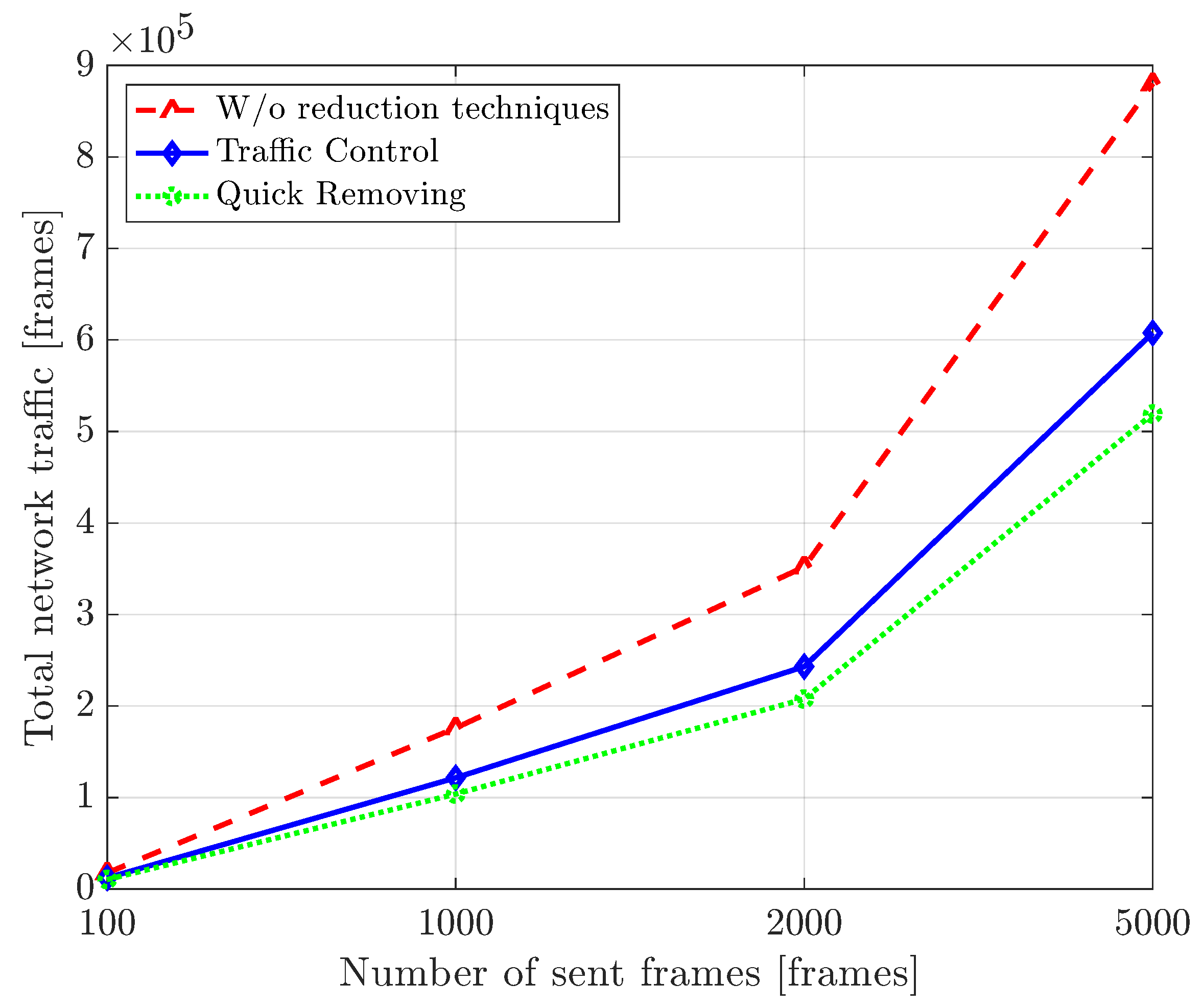
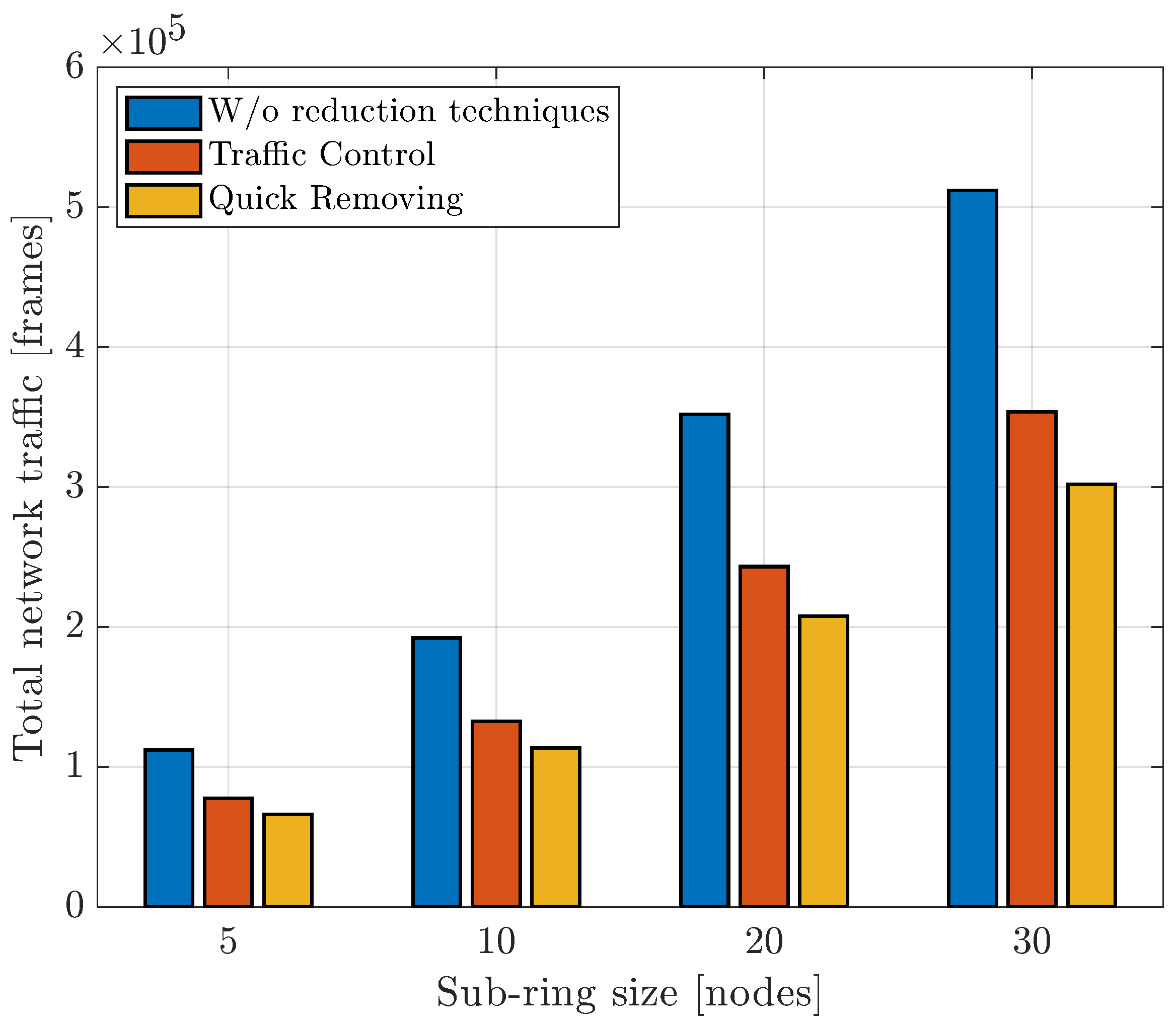
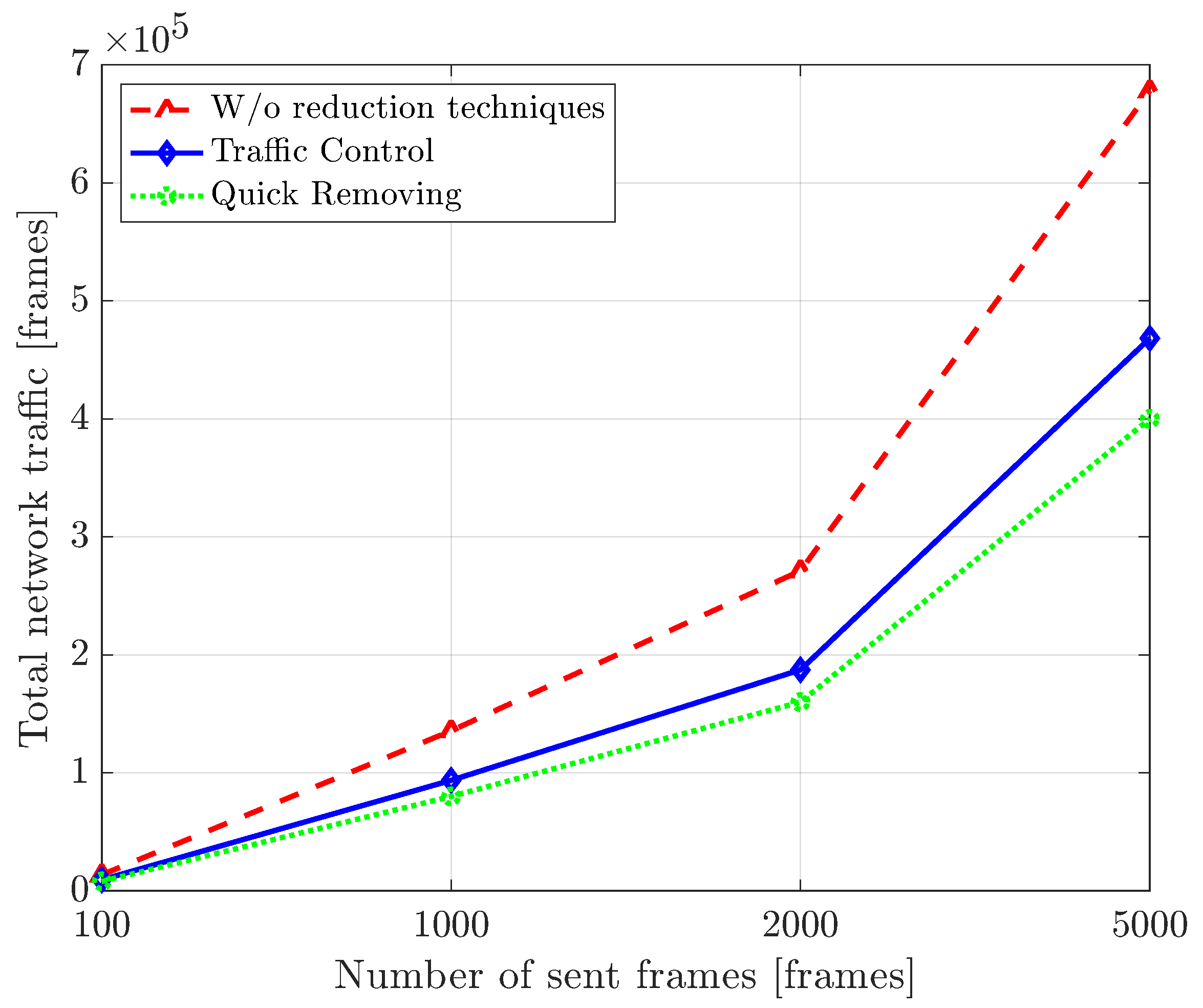
- Finally, by using either the QR or TC traffic-reduction technique, we are able to further decrease a substantial amount of redundant traffic in the other parts of the network without compromising their seamless redundancy function.
4. Comparative Evaluation of Traffic-Reduction Techniques
4.1. For Conventional Architecture
4.2. For the Proposed Architecture
4.3. Evaluation
5. Conclusions
Author Contributions
Funding
Data Availability Statement
Acknowledgments
Conflicts of Interest
Abbreviations
| CAN | Controller area network |
| DANH | Doubly attached node for HSR |
| DVP | Dual virtual paths |
| ECU | Electronic control unit |
| EPL | Enhanced port locking |
| FHT | Filtering HSR traffic |
| HSR | High-availability seamless redundancy |
| IVN | In-vehicle network |
| MOST | Media-oriented systems transport |
| ODP | Optimal dual paths |
| PL | Port locking |
| QR | Quick removing |
| QuadBox | Quadruple port device |
| RDP | Ring-based dual paths |
| RedBox | Redundancy Box |
| SAN | Single-attached node |
| SUA | Sudden unexpected acceleration |
| TC | Traffic control |
| TSN | Time sensitive networking |
References
- D’Orazio, L.; Visintainer, F.; Darin, M. Sensor networks on the car: State of the art and future challenges. In Proceedings of the 2011 Design, Automation Test in Europe, Grenoble, France, 14–18 March 2011; pp. 1–6. [Google Scholar]
- Kang, S.; Han, S.; Cho, S.; Jang, D.; Choi, H.; Choi, J.W. High speed CAN transmission scheme supporting data rate of over 100 Mb/s. IEEE Commun. Mag. 2016, 54, 128–135. [Google Scholar] [CrossRef]
- Lee, Y. Analysis of unintended acceleration through physical interference of accelerator. Forensic Sci. Int. Rep. 2020, 2, 100079. [Google Scholar] [CrossRef]
- Hoang, D.N.M.; Rhee, J.M. Comparative Analysis of IEC 62439–3 (HSR) and IEEE 802.1CB (FRER) Standards. In Proceedings of the 2021 Twelfth International Conference on Ubiquitous and Future Networks (ICUFN), Jeju Island, Republic of Korea, 17–20 August 2021; pp. 231–235. [Google Scholar]
- EN IEC 62439-3:2022; Industrial Communication Networks—High Availability Automation Networks—Part 3: Parallel Redundancy Protocol (PRP) and High-Availability Seamless Redundancy (HSR). IEC: Geneva, Switzerland, 2016.
- Kim, D.H.; Young Lee, N.; Rhee, J.M.; Park, S.Y. Performance Analysis for HSR Based In-Vehicular Network (IVN) under End-to-End Latency (EEL) Constraint with Store-and-Forward Mode. In Proceedings of the 2020 International Conference on Information and Communication Technology Convergence (ICTC), Jeju Island, Republic of Korea, 21–23 October 2020; pp. 1001–1003. [Google Scholar]
- Rhee, J.M.; Altaha, I.R.A.; Hoang, D.N.M.; Kim, D.H.; Yang, J.S.; Park, S.Y. Seamless CAN: CAN Bus Plus High-Availability Seamless Redundancy. In Proceedings of the 2021 International Conference on Information and Communication Technology Convergence (ICTC), Jeju Island, Republic of Korea, 20–22 October 2021; pp. 1284–1286. [Google Scholar]
- OMNeT++ Discrete Event Simulator. Available online: https://omnetpp.org/ (accessed on 2 January 2023).
- Tien, N.X.; Nsaif, S.A.; Rhee, J.M. A Comparison of Techniques for Reducing Unicast Traffic in HSR Networks. Energies 2015, 8, 12029–12060. [Google Scholar] [CrossRef]
- Nsaif, S.A.; Rhee, J.M. Improvement of High-Availability Seamless Redundancy (HSR) Traffic Performance for Smart Grid Communications. J. Commun. Netw. 2012, 14, 653–661. [Google Scholar] [CrossRef]
- Shin, M.; Joe, I. Performance Improvement for the HSR Ring Protocol with Traffic Control in Smart Grid. In Computer Applications for Graphics, Grid Computing, and Industrial Environment; Communications in Computer and Information Science; Springer: Berlin/Heidelberg, Germany, 2012; pp. 48–55. [Google Scholar]
- Abdulsalam, I.R.; Rhee, J.M. Improvement of High-Availability Seamless Redundancy (HSR) Unicast Traffic Performance Using Port Locking. In Proceedings of the 2013 Fourth World Congress on Software Engineering, Hong Kong, China, 3–4 December 2013; pp. 246–250. [Google Scholar]
- Altaha, I.R.; Rhee, J.M.; Pham, H.A. Improvement of High-Availability Seamless Redundancy (HSR) Unicast Traffic Performance Using Enhanced Port Locking (EPL) Approach. IEICE Trans. Inf. Syst. 2015, E98.D, 1646–1656. [Google Scholar] [CrossRef]
- Tien, N.X.; Rhee, J.M. FHT: A Novel Approach for Filtering High-Availability Seamless Redundancy (HSR) Traffic. Energies 2015, 8, 6249–6274. [Google Scholar] [CrossRef]
- Tien, N.; Nsaif, S.; Rhee, J.M. High-availability Seamless Redundancy (HSR) Traffic Reduction Using Optimal Dual Paths (ODP). In Proceedings of the 2015 International Conference on Green and Human Information Technology (ICGHIT), Hanoi, Vietnam, 5–7 February 2015. [Google Scholar]
- Nsaif, S.; Rhee, J.M. DVP: A Novel High-Availability Seamless Redundancy (HSR) Protocol Traffic-Reduction Algorithm for a Substation Automation System Network. Energies 2014, 7, 1792–1810. [Google Scholar] [CrossRef]
- Tien, N.X.; Kim, S.; Rhee, J.M. A novel ring-based dual paths approach for reducing redundant traffic in HSR networks. Comput. Netw. 2016, 110, 338–350. [Google Scholar] [CrossRef]
- Park, J.P.; Nsaif, S.A.; Rhee, J.M. High-Availability Seamless Redundancy (HSR) Protocol for Automobile Networks. J. Satell. Inf. Commun. 2014, 9, 33–40. [Google Scholar]
- Hoang, D.N.M.; Rhee, J.M.; Park, S.Y. Traffic-Effective Architecture for Seamless CAN-based In-Vehicle Network Systems. In Proceedings of the 2022 International Conference on Information and Communication Technology Convergence (ICTC), Jeju Island, Republic of Korea, 19–21 October 2022. [Google Scholar]

| Characteristics | Traffic-Filtering-Based | Predefined Path-Based | ||||||
|---|---|---|---|---|---|---|---|---|
| QR | TC | PL | EPL | FHT | ODP | DVP | RDP | |
| Traffic filtering for DANH rings | N | N | Y | Y | Y | - | - | - |
| Traffic filtering for QuadBox rings | N | N | N | Y | Y | - | - | - |
| Removing duplicate traffic | Y | Y | N | N | Y | Y | Y | Y |
| Learning MAC addresses | N | N | Y | Y | Y | - | - | - |
| Using control messages | N | N | N | N | Y | N | Y | Y |
| Configuration to setup dual paths | - | - | - | - | - | Node | Node | Ring |
| Using network topology information | - | - | - | - | - | Y | N | N |
| Type of filtered traffic | Any | Any | Unicast | Unicast | Unicast | Unicast | Unicast | Unicast |
| Applicability to Seamless CAN | Y | Y | N | N | N | N | N | N |
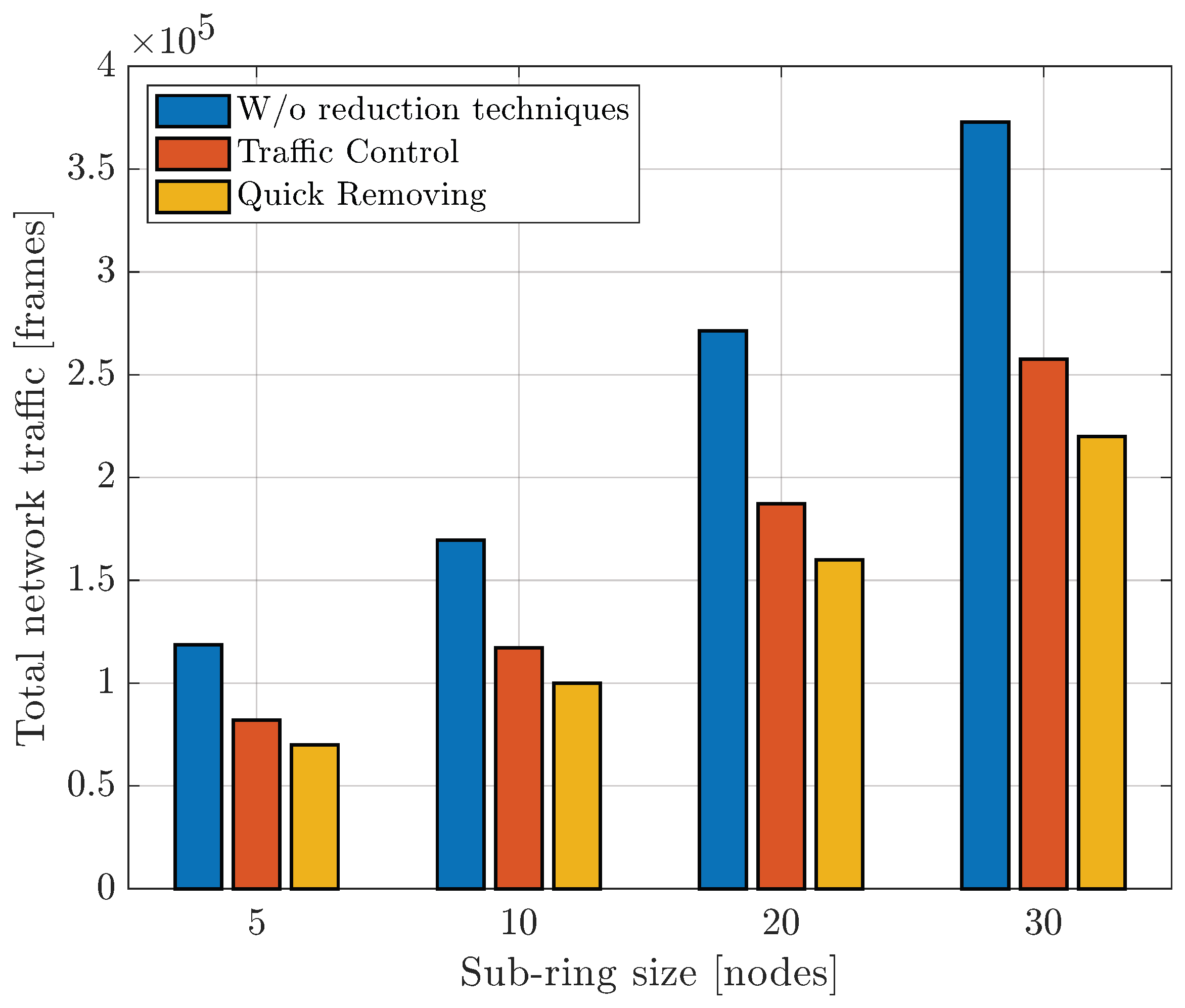
| Parameters | Value | |
|---|---|---|
| Scenario 1 | Number of sent frames | |
| Sub-ring size | 20 | |
| Scenario 2 | Number of sent frames | 2000 |
| Sub-ring size |
| No. of Sent Frames | Conventional | Proposed | ||||
|---|---|---|---|---|---|---|
| - | TC | QR | - | TC | QR | |
| 100 | 17,600 | 12,150 | 10,382 | 13,562 | 9366 | 8000 |
| 1000 | 176,000 | 121,550 | 103,822 | 135,616 | 93,656 | 80,000 |
| 2000 | 352,000 | 243,090 | 207,645 | 271,232 | 187,312 | 160,000 |
| 5000 | 880,000 | 607,730 | 519,112 | 678,080 | 468,280 | 400,000 |
| No. of Sent Frames | Conventional | Proposed | ||
|---|---|---|---|---|
| TC | QR | TC | QR | |
| 100 | 30.97% | 41.01% | 46.78% | 54.55% |
| 1000 | 30.94% | 41.01% | 46.79% | 54.55% |
| 2000 | 30.95% | 41.00% | 46.79% | 54.54% |
| 5000 | 30.94% | 41.01% | 46.78% | 54.55% |
Disclaimer/Publisher’s Note: The statements, opinions and data contained in all publications are solely those of the individual author(s) and contributor(s) and not of MDPI and/or the editor(s). MDPI and/or the editor(s) disclaim responsibility for any injury to people or property resulting from any ideas, methods, instructions or products referred to in the content. |
© 2023 by the authors. Licensee MDPI, Basel, Switzerland. This article is an open access article distributed under the terms and conditions of the Creative Commons Attribution (CC BY) license (https://creativecommons.org/licenses/by/4.0/).
Share and Cite
Hoang, D.N.M.; Park, S.Y.; Rhee, J.M. Comparative Analysis of Traffic-Reduction Techniques for Seamless CAN-Based In-Vehicle Network Systems. Electronics 2023, 12, 998. https://doi.org/10.3390/electronics12040998
Hoang DNM, Park SY, Rhee JM. Comparative Analysis of Traffic-Reduction Techniques for Seamless CAN-Based In-Vehicle Network Systems. Electronics. 2023; 12(4):998. https://doi.org/10.3390/electronics12040998
Chicago/Turabian StyleHoang, Duc N. M., Sang Yoon Park, and Jong Myung Rhee. 2023. "Comparative Analysis of Traffic-Reduction Techniques for Seamless CAN-Based In-Vehicle Network Systems" Electronics 12, no. 4: 998. https://doi.org/10.3390/electronics12040998
APA StyleHoang, D. N. M., Park, S. Y., & Rhee, J. M. (2023). Comparative Analysis of Traffic-Reduction Techniques for Seamless CAN-Based In-Vehicle Network Systems. Electronics, 12(4), 998. https://doi.org/10.3390/electronics12040998

