You are currently viewing a new version of our website. To view the old version click .
Electronics
  • Article
  • Open Access

1 January 2023

Blockchain-Based Anonymous Authentication in Edge Computing Environment

,
,
and
School of Computer Science and Technology, Xi’an Jiaotong University, Xi’an 710049, China
*
Author to whom correspondence should be addressed.
This article belongs to the Section Artificial Intelligence

Abstract

Authentication is an important requirement for the security of edge computing applications. The existing authentication schemes either frequently rely on third-party trusted authorities, leading to the security risk of user information disclosure, or have high authentication overhead, causing certain pressure on the computation and communication of lightweight terminal equipment in the edge environment. In this paper, we proposed a blockchain-based anonymous authentication scheme for edge computing environments. We first designed a blockchain-based authentication architecture to store a small number of authentication elements in the blockchain network, and provide a decentralized and trusted authentication environment to ensure device anonymity and improve the security of authentication processes. Then, an elliptic cryptographic curve-based authentication scheme is proposed. It uses the chameleon hash function to dynamically generate the authentication data according to the elements stored in the blockchain and negotiate the session key, which effectively reduces the computational overhead in the authentication process. The experimental results show that the proposed scheme achieves a secure authentication process and effectively reduces the authentication overhead by up to 43.16% compared to three state-of-the-art schemes.

1. Introduction

Edge computing is a new computing model resulting from the cross-development and integration of technologies such as cloud computing, IoT, and high-speed mobile communication [1]. Edge computing development has boosted a large number of emerging areas. With the popularity of smart terminal equipment and their widespread use, it not only generates huge application data, but also brings massive amounts of data access requests [2,3]. Despite the advantages of on-demand resources, dynamic scaling and cost reduction [4], cloud platforms have difficulty in efficiently handling massive data requests from various end devices, not to mention the high responsiveness requirements of these applications [5,6]. In the edge computing environment, computing, storage, and other resources are deployed near terminal equipment, which can respond to various requests from the devices in a timely manner and provide elastic services to users, thus reducing response latency and alleviating the pressure on data transmission and computation in the cloud [7]. As a result, edge computing vigorously promotes the rapid development of emerging applications such as autonomous driving [8], smart cities [9], and smart homes [10].
At the same time, edge computing is facing many new challenges. For example, security is one of the most fundamental and important challenges [11]. Without a complete solution to application security issues, any application could suffer huge losses and serious consequences [12,13]. Authentication, as the entry point to information access and external services, provides the foundation for the security of many applications. Secure authentication is the basis for users to acquire application services and is a prerequisite for authorized user access [14]. However, the traditional centralized unilateral authentication approach is fragile and suffers from a single point of failure, internal attacks or internal spoofing, which can lead to authentication failures or even system crashes [15].
Existing authentication schemes either have security risks or are costly to ensure security. Due to the decentralized and complex characteristics of lightweight terminal equipment, the complete, mature, and centralized authentication schemes deployed in cloud computing environments [16,17] find it difficult to meet the highly trusted and efficient authentication requirements of edge computing environments. Meanwhile, existing authentication schemes in edge environments usually use digital certificates to achieve decentralized and distributed authentication [18,19], but as the authentication process often relies on third-parties, this brings about complex certificate management problems and there is still a certain risk of security leakage. Meanwhile, many studies have improved the security of the authentication process by designing more sophisticated and complex authentication mechanisms [20,21], but increased the authentication overhead and caused pressure on the request response delay, data access and computational efficiency on resource-constrained terminal equipment. In short, existing authentication schemes do not achieve a good balance between secure authentication process and high authentication efficiency.
In this paper, we propose a blockchain-based anonymous authentication; a secure and efficient distributed authentication method for the specificity of the edge computing environment, which will improve the security of authentication data and reduce the authentication overhead for edge computing applications. The main contributions of this paper are as follows.
  • We propose a blockchain-based identity authentication architecture. It stores the authentication data in the blockchain network and provides a distributed and trusted authentication environment for edge computing, reducing the risk of data loss and data misuse associated with centralized storage of authentication information.
  • We design an elliptic cryptographic curve-based authentication scheme. Based on the elliptic curve discrete logarithm problem, we construct a chameleon hash function and use its trapdoor feature to dynamically generate a small number of authentication elements so that terminal equipment can reduce computational overhead in the process of mutual authentication.
  • We analyze the security of the proposed scheme, and evaluate the computational overhead and the communication overhead of our scheme by comparing with three state-of-the-art authentication schemes. The results show that the proposed scheme outperforms the previous schemes.
The rest of this paper is organized as follows. Section 2 discusses related work. Section 3 describes our authentication model scheme in detail. Section 4 presents the evaluation results. Section 5 concludes this paper.

3. Methodology

This section describes the proposed authentication architecture and the process of our authentication scheme, including system initialization, registration, and mutual authentication.

3.1. Authentication Architecture

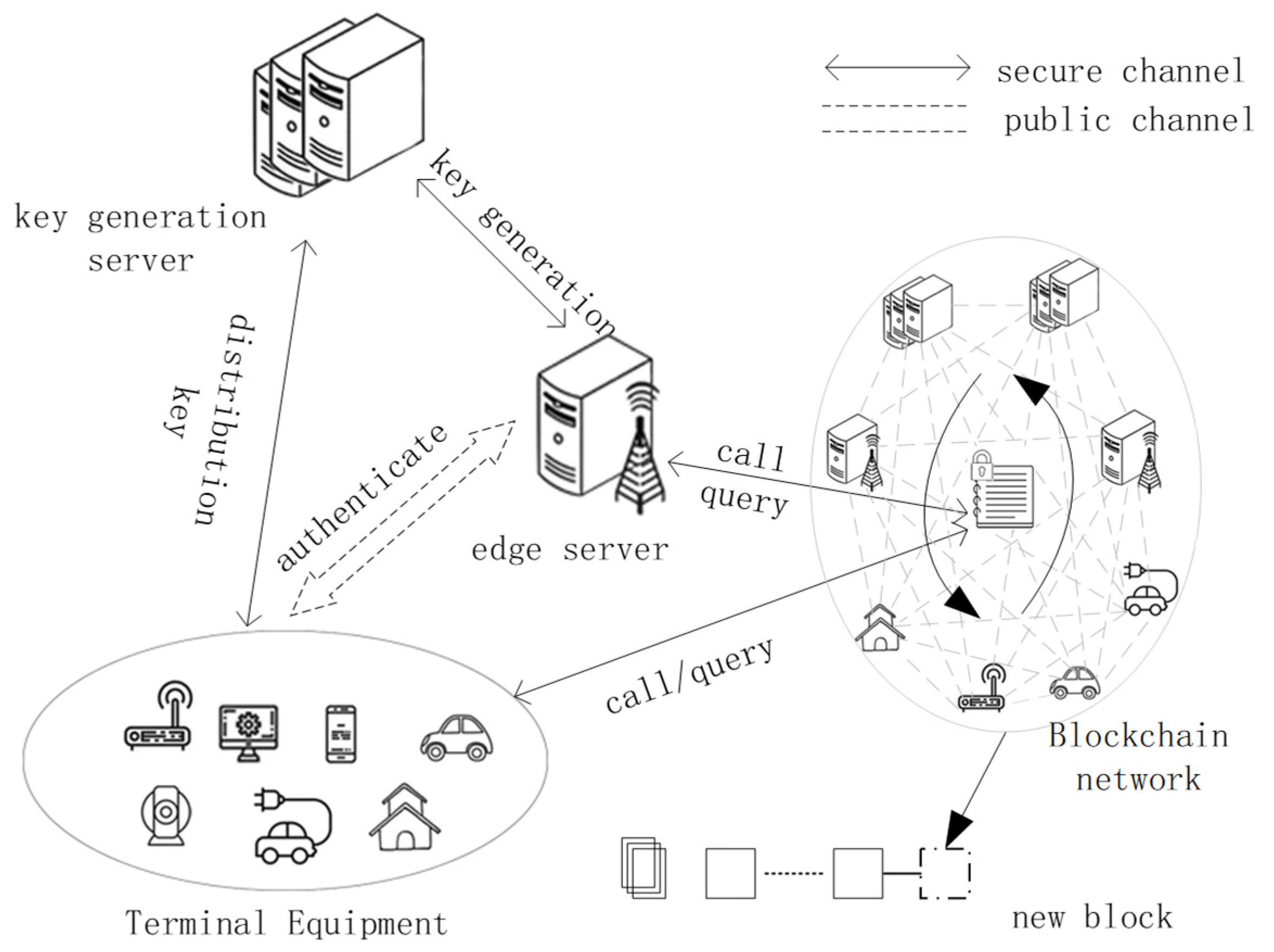
Figure 1 shows the infrastructure architecture for authentication. The main entities include the terminal equipment (U), the key generation server/center (KGC), the edge server (ES), and the blockchain network.
Figure 1. Authentication architecture diagram.
The blockchain network plays an important role in the proposed authentication architecture. The blockchain serves as a distributed, trusted and shared ledger, and it can securely store some of the authentication elements to enable distributed and trusted sharing of authentication data, and also provides trust help for identity authentication. The blockchain execution engine calls smart contracts and other functions, and the blockchain network makes consensus on the generated registration and other data and saves them in the blockchain.
Terminal equipment can be any device that needs to request edge-side services, such as smartphones, intelligent vehicles, smart cameras, smart meters, and other smart devices. The terminal equipment users send information content such as registration and authentication requests to the blockchain network. The requests are sent through the call interface.
The edge server can provide efficient data processing and analysis to serve terminal equipment. Each ES joined to the blockchain network can ensure the normal operation of the blockchain distributed ledger, and also communicates with the cloud to guarantee the high efficiency and low cost of application services with the help of richer computing, storage and other resources in the cloud. Terminal equipment and edge servers must register on the blockchain before obtaining or providing services.
ESs and U register on the blockchain by invoking smart contracts, and invoke smart contracts to query the authentication information and other elements of the device. The information of U is not saved in the blockchain in plaintext, but only the relevant information elements are stored to avoid revealing the identity information of the terminal equipment. In order to take advantage of the proximity of the ES to the data source to provide convenient services, there is no need to provide anonymous services for the ES. Therefore, the ES’s information is stored in the blockchain in plaintext. Although the devices communicate in the blockchain in an anonymous way, the transaction information occurring at the anonymous public key address can be analyzed and, thus, there is a risk of device information leakage. Therefore, the anonymous feature of the blockchain is not used in the identity authentication scheme, but we use discrete logarithmic puzzles to achieve the anonymity of the device information.
The KGC is deployed in the cloud service. The cloud is a secure and trusted existence relative to the edge. The secure and reliable KGC can generate a large amount of random and secure key information, and is responsible for distributing key information for terminal equipment and edge servers. It is worth noting that in the proposed architecture, KGC does not save the registration information of terminal equipment and edge servers, to reduce the risk of device information leakage due to centralized storage.
The device requests key information through a secure channel during the registration and authentication process. The terminal equipment and the edge server complete the mutual authentication process through a public channel, and negotiate a secure session key to protect the transmitted data to a certain extent.
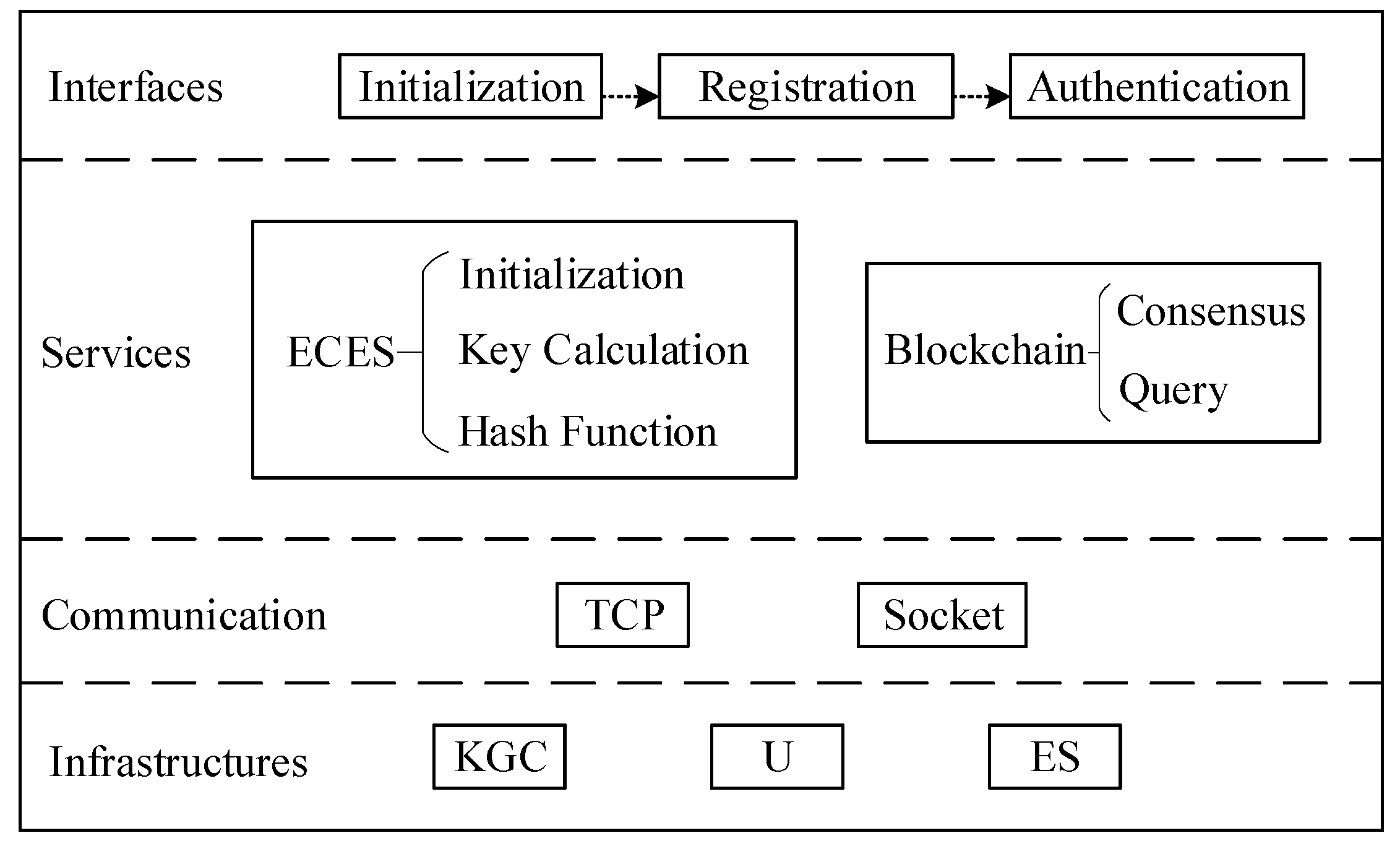
Figure 2 shows the hierarchical structure of the proposed authentication scheme. The elliptic curve encryption system (ECES) is employed to generate the authentication information. The interfaces in Figure 2 correspond to the three main phases of the authentication scheme. The edge computing applications invoke the three interfaces in turn to establish the secure connection between U and ES if it is feasible. The initialization phase initializes the ECES parameters and the public and private key parameters for the KGS. In the registration phase, U and ES separately apply for keys from KGC and are registered to the blockchain network constructed by the development tool Ganache [28]. In the mutual authentication phase, U and ES communicate with each other according to TCP protocol and socket, and access part authentication elements by querying the smart contract of the constructed blockchain network. We will describe in detail the implementation process of these three phases for the whole scheme in the next subsections.
Figure 2. Hierarchical structure of the proposed authentication scheme.

3.2. Initialization Phase

The initialization phase is mainly to initialize the parameters of the elliptic curve cryptosystem and construct the public and private key information. Section 3.2.1 describes the initialization phase in detail. Section 3.2.2 describes the construction of the chameleon hash function used in the elliptic curve cryptosystem in detail.

3.2.1. System Initialization

(1)
KGC first generates elliptic curves E of order q, element P, the cyclic additive group G, and the large integer group Z q of order r.
(2)
KGC generates random number S K k g c from Z q as the private key, then calculates P K k g c = S K k g c P , and constitutes its public and private key information ( P K k g c , S K k g c ) , where S K k g c Z q .
(3)
Select a chameleon hash function H 2 : C H ( g , h , r , t ) , three one-way secure hash functions that H 1 : { 0 , 1 } Z q , H 4 : { 0 , 1 } × G Z q , H 3 : G × { 0 , 1 } × G × { 0 , 1 } Z q .
(4)
E , G , P , q , H 1 , H 2 , H 3 , H 4 , P K k g c are disclosed as a public parameter. S K k g c is confidential and not disclosed.
Table 1 describes the symbolic parameters used in this paper.
Table 1. Descriptions of symbolic parameters.

3.2.2. Construction of the Chameleon Hash Function

In the authentication scheme, the elliptic curve discrete logarithm difficulty problem is used to construct the chameleon hash function. First, the terminal equipment generates a random value S K u from the group of integers as the private trapdoor key, S K u Z q , and the group G generates a trapdoor to create the public key g . The public trapdoor key h is obtained by computing h = g S K u .
A random value r is generated at time T u , where r Z q . The value of the chameleon hash function T u is obtained by calculating H 2 . The construction and calculation of H 2 is given by Equation (1).
H 2 : C H ( g , h , r , T u ) = ( g T u ) h r = g T u + ( S K u ) r
Since changing the random value r will definitely lead to a change in the chameleon hash function value, the hash value of the current time T n is calculated by Equation (2) when T u becomes T n . In order to make the hash function value of time T n and that of time T u the same, i.e., Equation (3) holds, a new random value r ' can be calculated by Equation (4). So far, the terminal equipment can fake different time according to the corresponding random value, and thus generate the same hash value.
C H ( T n ) = ( g T n ) h ( r ' ) = g T n + ( S K u ) ( r ' )
C H ( T u ) = C H ( T n ) g T u + ( S K u ) ( r ) = g T n + ( S K u ) ( r ' )
r ' = f o r g e ( S K u , r , T n , T u ) = T u T n S K u + r

3.3. Registration Phase

In the registration phase of the proposed scheme, the terminal equipment and the edge server first submit the key application request to the KGC separately. Second, the KGC generates key information for the device after verifying the correctness of the request information, and does not save the key information. Finally, the device invokes a smart contract to register on the blockchain network.
The terminal equipment and the edge server are registered on the blockchain network before they start authenticating with each other, which in part improves the security of the authentication process.

3.3.1. Terminal Equipment Registration

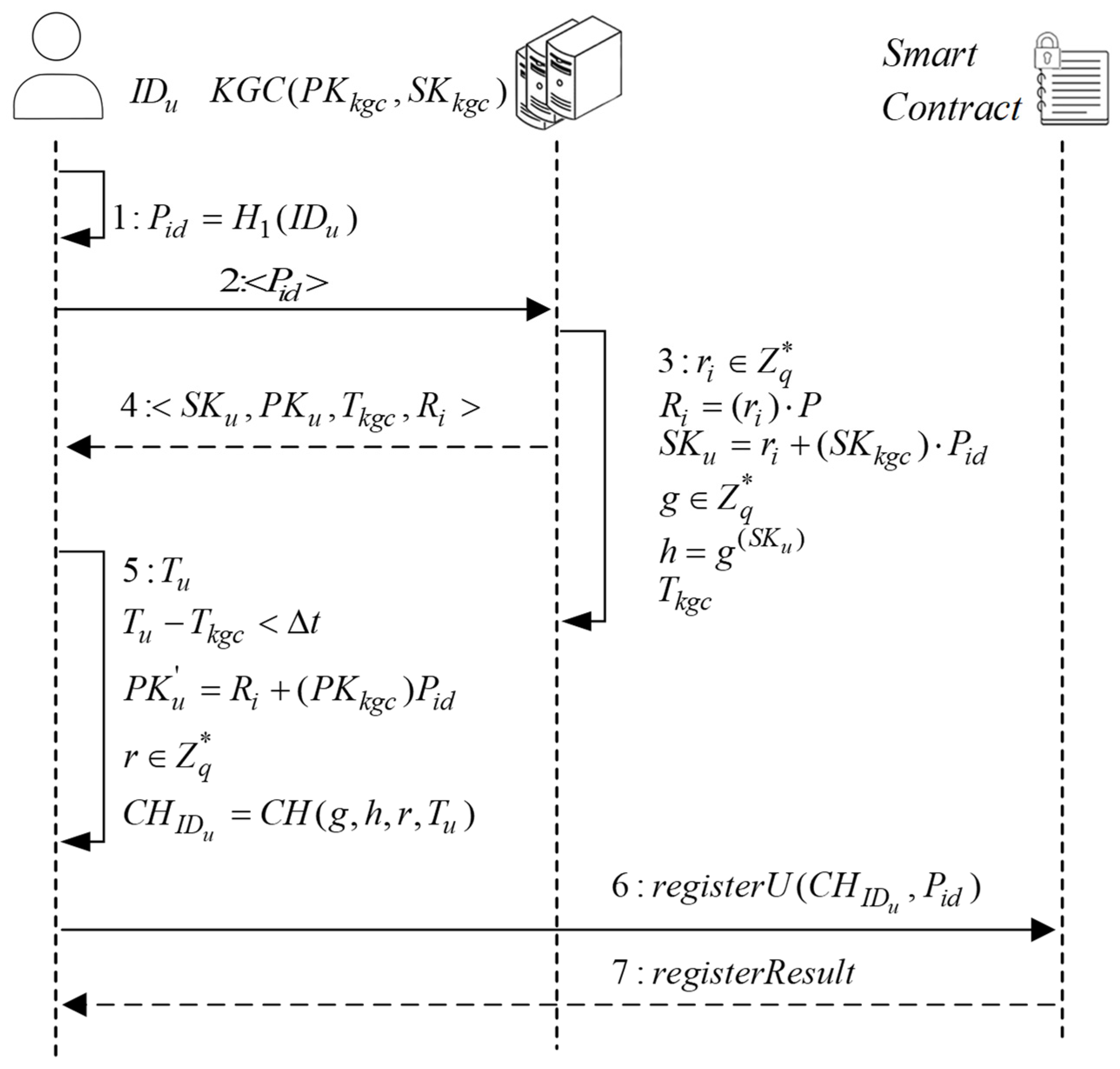
The sequence diagram of registration process on the terminal equipment is shown in Figure 3. The specific processing steps are described as follows.
Figure 3. Sequence diagram of terminal equipment registration.
(1)
The terminal equipment U hashes the unique identity I D u through P i d = H 1 ( I D u ) to generate a pseudo-identity P i d and sends the pseudo-identity P i d to the KGC through a secure channel. After receiving the key request message P i d from the terminal equipment, KGC generates a random number r i as the temporary private key, where r i Z q , and gets the temporary public key R i by computing ( r i ) P . It gets S K u and uses it as the private key of the device by computing r i + ( S K k g c ) P i d . It gets the public key P K u of the terminal equipment by computing ( S K u ) P and generates the public and private key information of the device. KGC generates a random number g from G as the generated public key of the chameleon hash function, gets the public key of the terminal equipment by calculating h = g S K u as the public key of the trapdoor of the terminal equipment, and generates the current timestamp T k g c . KGC sends the information S K u , P K u , h , T k g c , R i to the terminal equipment.
(2)
After receiving the message, the terminal equipment verifies the timestamp and public key information. First, device checks if the timestamp is within the acceptable range, if not, it rejects the response message. By calculating R i + ( P K k g c ) P i d and comparing it with P K u , the response message is rejected if they are not equal.
(3)
The terminal equipment generates the current timestamp T u , along with a random number r , where r Z q , and generates the chameleon hash value by C H ( g , h , r , T u ) , and invokes smart contract r e g i s t e r U ( C H I D u , P i d ) to register the information C H I D u , P i d into the blockchain.

3.3.2. Server Registration

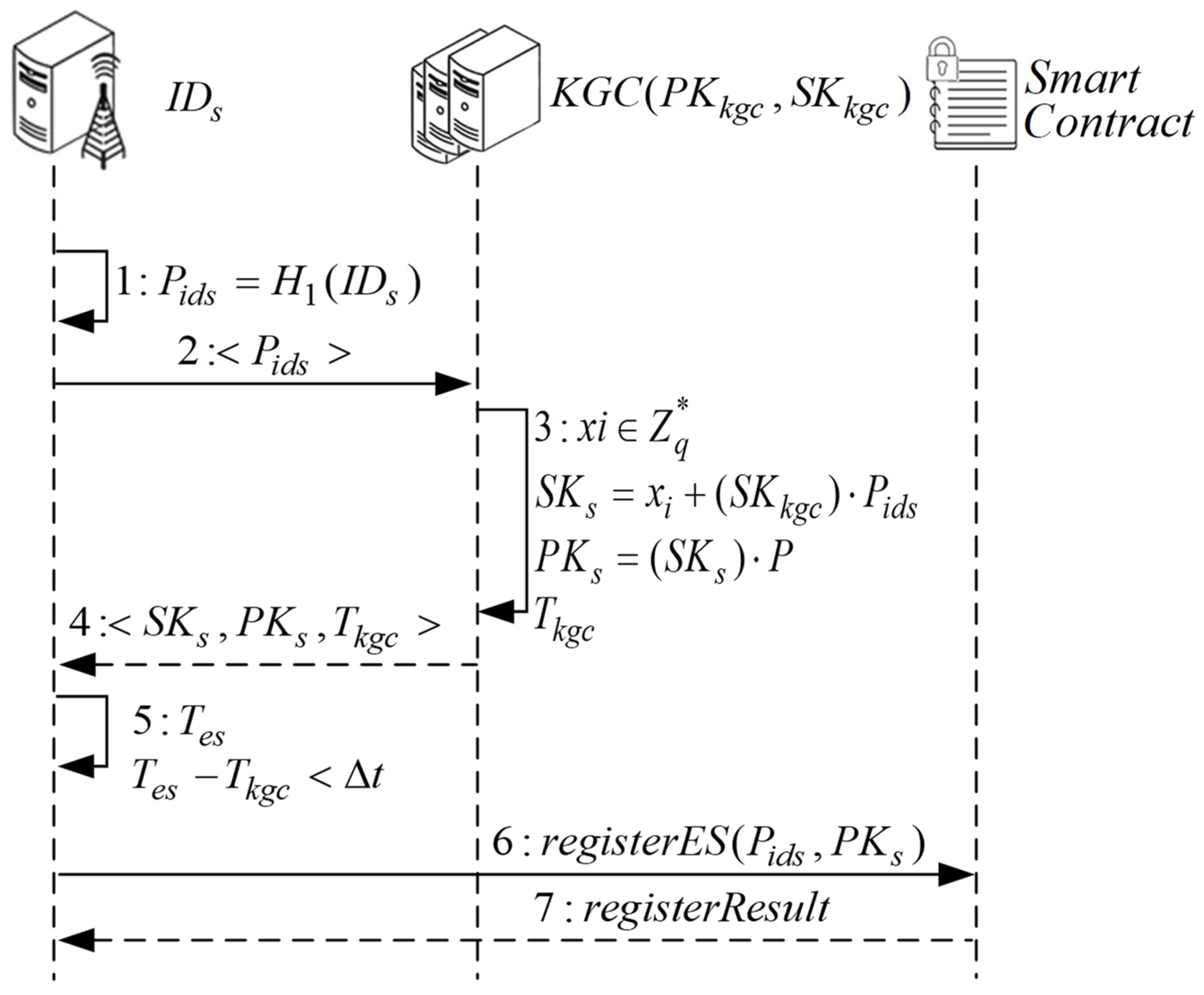
The sequence diagram of registration process on the edge server is shown in Figure 4. The specific processing steps are described as follows.
Figure 4. Sequence diagram of edge server registration.
(1)
The edge server ES hashes the identity I D s , and then sends it to the KGC via a secure channel.
(2)
After receiving the request, KGC generates a random value x i , where x i Z q . The private key S K s of the edge server is obtained by calculating x i + ( S K k g c ) P i d s . The public key P K s is obtained by calculating ( S K s ) P . The current timestamp T k g c can be obtained, and the information S K s , P K s , T k g c is sent to the edge server.
(3)
After receiving the response information, the edge server first determines whether the difference between the current timestamp T e s and the received timestamp T k g c is within the valid range. The edge server rejects the response if the difference is not within the valid range. Then, the smart contract r e g i s t e r S ( P i d s , P K s ) is invoked to register the public key information of the edge server into the blockchain.

3.4. Authentication Phase

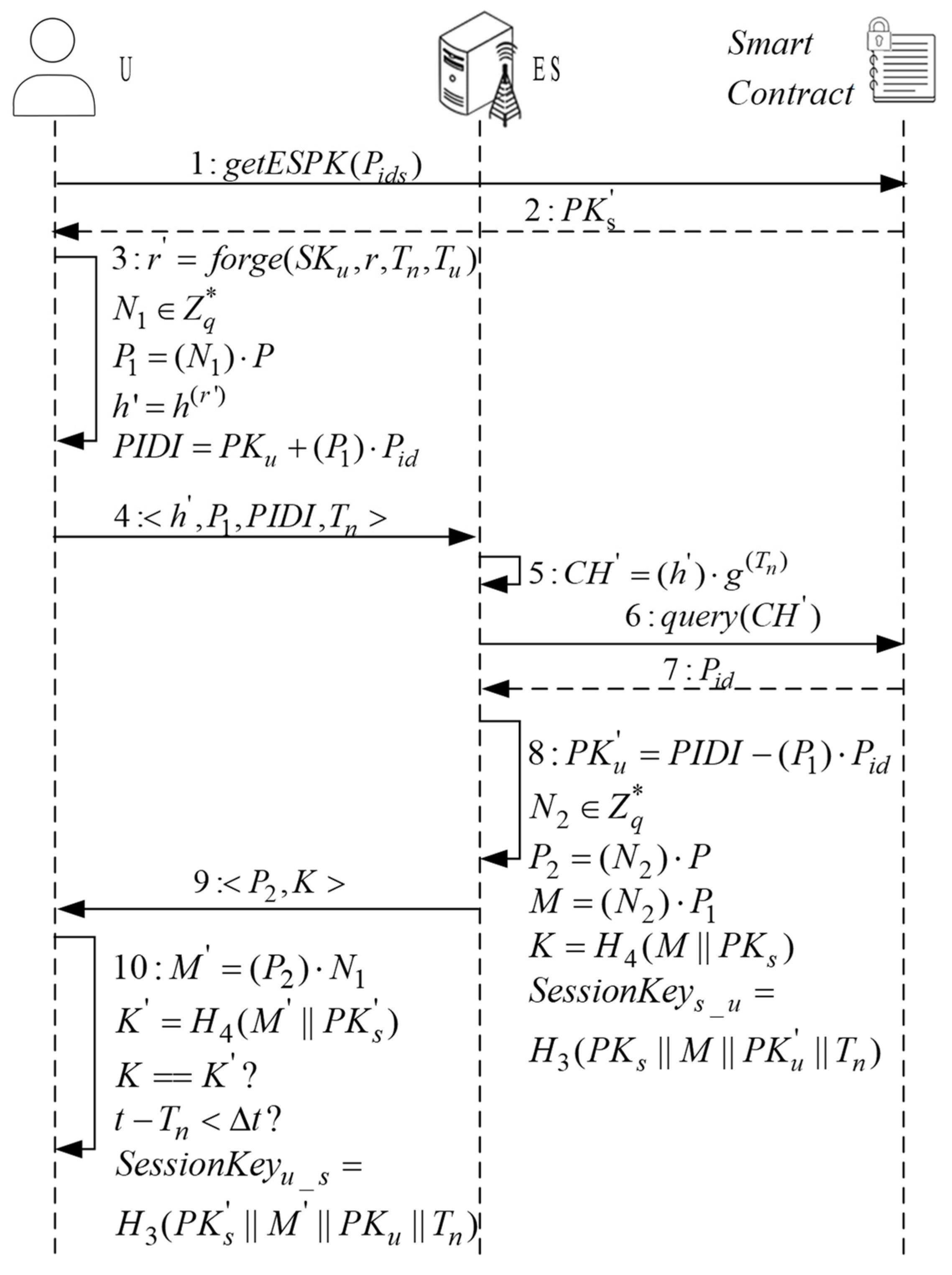
In the mutual authentication phase, the terminal equipment makes an authentication request to the edge server, the terminal equipment and the edge server query the relevant authentication elements by invoking the smart contract. The authentication phase invokes smart contracts to obtain authentication elements to dynamically construct authentication data. It completes the negotiation of session keys, through one round of communication, that are known only to the communicating parties.
The terminal equipment and the edge server complete the authentication by querying a part of the authentication elements stored on the blockchain network instead of KGC. The use of blockchain technology simplifies communication in the authentication process and avoids the risk of device information leakage due to centralized storage.
The sequence diagram of mutual authentication process is shown in Figure 5. The specific processing steps are described as follows.
Figure 5. Sequence diagram of mutual authentication.
(1)
First, the terminal equipment requests access to the edge server by invoking the smart contract to obtain the public key information of ES P K s ' . Then, the terminal equipment generates a random number r ' that can form the same hash value by taking the trapdoor private key S K u , the previous random number r , the timestamp T u , and the present timestamp T n to calculate h ' = h ( r ' ) .
(2)
The terminal equipment generates the temporary private key N 1 , where N 1 Z q , and calculates ( N 1 ) P to obtain the temporary public key P 1 . By calculating P K u + ( P 1 ) P i d , the pseudo-identifier ( P I D I ) is obtained, and h ' , P 1 , P I D I , T n is sent to the edge server ES through the public channel.
(3)
ES obtains the value of the chameleon hash function of the terminal equipment by computing ( h ' ) g T n , and invokes the smart contract to query whether the value exists. It obtains the corresponding pseudo-identity P i d . The public key information of U is obtained by computing P K u ' = P I D I ( P 1 ) P i d .
(4)
ES generates a random number N 2 as the temporary private key, where N 2 Z q , and calculates ( N 2 ) P to obtain the temporary public key P 2 . Then, it calculates M = ( N 2 ) P 1 , K = H 4 ( M | | P K s ) , S e s s i o n K e y s _ u = H 3 ( P K s | | M | | P K u ' | | T n ) , and sends the message P 2 , K to U.
(5)
After receiving the information from ES, the device calculates M ' = ( P 2 ) N 1 , generates K ' = H 4 ( M ' | | P K s ' ) , and confirms the relationship between K and K ' . In a case of dissimilarity, it needs to stop the authentication. After successful authentication, the session key between the terminal equipment and the edge server is calculated to obtain S e s s i o n K e y u _ s = H 3 ( P K s ' | | M ' | | P K u | | T n ) .

4. Performance Evaluation

We evaluate the proposed authentication scheme in terms of both security and authentication overhead.

4.1. Security Analysis

Scyther [29] is an automated tool for security validation, which verifies the protocol through an unlimited number of sessions and random numbers. An attacker verifies that the protocol satisfies the stated security properties without knowing the communicating parties’ keys. The security properties of the protocol include Secret, Alive, Weakagree, Niagree (Non-injective agreement) and Nisynch (Non-injective Synchronization). After making a security declaration for a protocol, Scyther checks whether the protocol meets the security declaration.
We use the Scyther tool to verify the security of the mutual authentication process, assuming that the information obtained from the blockchain is secure. The results of Scyther verification show that there are no potential attack paths in the mutual authentication phase. The protocol can satisfy the session key security, and both communicating parties satisfy the declared security properties, and the protocol is resistant to man-in-the-middle attacks and replay attacks.
We also analyze the proposed authentication scheme in detail to prove that it meets the necessary security requirements [30], which include forward security, untraceable, anonymity, etc.
(1)
Mutual authentication. Mutual authentication is based on K and K , both of which are dependent on M and M’, that depend not only on the temporary public key P 1 and P 2 during the message transmission conversation, but also on the public key P K s of the edge server and the temporary private key information N 1 and N 2 . Since N 1 and N 2 are not transmitted on the public channel, attackers cannot eavesdrop, steal, or analyze them. Due to the elliptic curve discrete logarithm problem (ECDLP) puzzle, attackers cannot extract the private key information from the public key information, and therefore cannot forge the authentication message.
(2)
Distributed trustworthiness of the authentication process. The KGC key generation server only participates in the issuance of key information and does not store the information. The authentication process of the device does not rely on a centralized trusted third party, and thus it meets the distributed trustworthiness requirements.
(3)
Forward security. Through one round of communication between the terminal equipment and the edge server, negotiating session keys S e s s i o n K e y s _ u = H 3 ( P K s | | M | | P K u ' | | T n ) and S e s s i o n K e y u _ s = H 3 ( P K s ' | | M ' | | P K u | | T n ) are both obtained in real-time, depending on M , M ' and T n . There is no connection with the session keys to which the previous communication established a connection. The leakage of the master keys P K s and P K u cannot access the session keys established between devices in the past. Therefore, there is no threat to the completed communication, since no third party can access each session of the device to generate of temporary private N 1 and N 2 . In addition to that, an attacker needs to know ( N 2 ) P 1 and ( N 1 ) P 2 . Even if P 1 and P 2 are obtained by snooping the channel transmission information, the information of N 1 and N 2 cannot be cracked because ECDLP cannot parse out M and M ' .
(4)
Replay attacks. The establishment of session keys relies not only on the information transmitted over the communication channel, but also on temporary public and private keys and timestamps. Using multi-party information to prevent replay attacks, devices cannot negotiate a common session key through the communication information used to establish previous connection.
(5)
Man-in-the-middle attack. In the authentication phase, the authentication information K and K ' are related to the temporary public and private keys generated by establishing the session. The session key is also related to them. Suppose an attacker wants to act as a man-in-the-middle to forward messages and tamper with them. In that case, it must know the temporary key information and the private key information of the device to complete the authentication and key exchange process. Assuming that the private key of the device is safely stored, then the man-in-the-middle attack is impossible to achieve.
(6)
Untraceable. During the authentication process, the data h ' , P 1 , P I D I , T n and P 2 , K transmitted by the public channel are unrelated in each authentication process, and the key negotiated for each authentication is different. The attacker cannot analyze the similarity of communication from the data transmitted by the public channel to obtain the device information, so the session process between devices cannot be traced, which ensures the identity security of terminal equipment.
(7)
Session key. The generation of session keys S e s s i o n K e y u _ s and S e s s i o n K e y s _ u depends not only on the public key information of both parties, but also on M , M ' and the timestamp T n . In the process of mutual authentication, even though the public key information P K u of the terminal equipment and the public key P K s of the edge server are known, and the timestamp T n is stolen through the public channel, third parties and attackers cannot obtain them because M and M ' are secure and the session keys are known only to the communicating parties.
(8)
Anonymity of user identity. In the process of authentication between the terminal equipment and the edge server, the unique identification information I D u of the terminal equipment is not transmitted, and the pseudo-identity P I D I is also changed during each session. The attacker cannot obtain I D u . In addition, due to the one-way nature of the hash function, I D u cannot be obtained from the analysis of P I D I . The scheme can guarantee the anonymity of the device identity.
(9)
Single sign-on. In the process of connecting the terminal equipment to the edge server, the edge server obtains the connection information of the device from the blockchain network and decrypts the login information. The edge server does not need to save the information of the terminal equipment in the whole process. Due to the trapdoor feature of the chameleon hash function, the terminal equipment only needs to apply for the key information once, and the random value of the chameleon hash function is changed according to the time of each request for authentication. Therefore, the terminal equipment can conveniently connect to any edge server by only registering once on the blockchain network.

4.2. Performance Analysis

The performance of the authentication scheme is evaluated by computational overhead and communication overhead. We compared the proposed authentication schemes with the other three schemes, SAI [23], LPA [24], and SEI [20]. These schemes used for comparison are state-of-the-art for anonymous protection authentication in edge computing environments, and they are all certificate-free schemes. Although we have made a detailed analysis of these schemes in the related work, we summarized the features of the comparison schemes in order to more intuitively compare the differences between our scheme and them. Table 2 shows the feature differences of these schemes.
Table 2. Features of comparison schemes.
Since the terminal equipment and edge servers have different performance overheads for the same cryptographic operations, we used two different platforms for simulation. The cloud server is used as the edge computing node (server) with Intel(R) Xeon(R) CPU of E5-2630 0 @ 2.30 GHz (Intel Corporation, Santa Clara, USA) and Google Nexus One cell phone with armeabi-v7a CPU (Google Inc, Santa Clara, USA) is used as the terminal (user).
Table 3 shows the overhead of performing cryptographic operations under different platforms, which fully characterizes the performance differences between the two sides of authentication in the edge computing environment.
Table 3. Time consumption of cryptographic operations (ms).

4.2.1. Computational Overhead Analysis

Table 4 shows the time consumption of operations related to the chameleon hash function, where the time consumption for forging random values and generating hash values are indicated, respectively.
Table 4. Time consumption of operations related to the chameleon hash function (ms).
In the authentication process, only the computational cost of the authentication phase is estimated in [20,23,24]. The initialization and registration are generally performed only once. And the other computational overhead consumption is very small and can be ignored. In addition, the call request latency for queries and other calls to smart contracts in the blockchain does not involve the performance consumption of lightweight devices. Therefore, we do not account for the time consumption of initialization and registration into the computational overhead. We analyzed the numbers of different cryptographic operations used in the authentication process of the schemes, and Table 5 shows the numbers.
Table 5. Operations required to calculate the overhead.
The computational overheads of the terminal and server side are compared as a whole. We used the values from Table 3 and Table 4 to compute the computational overheads of different schemes according to Table 5.
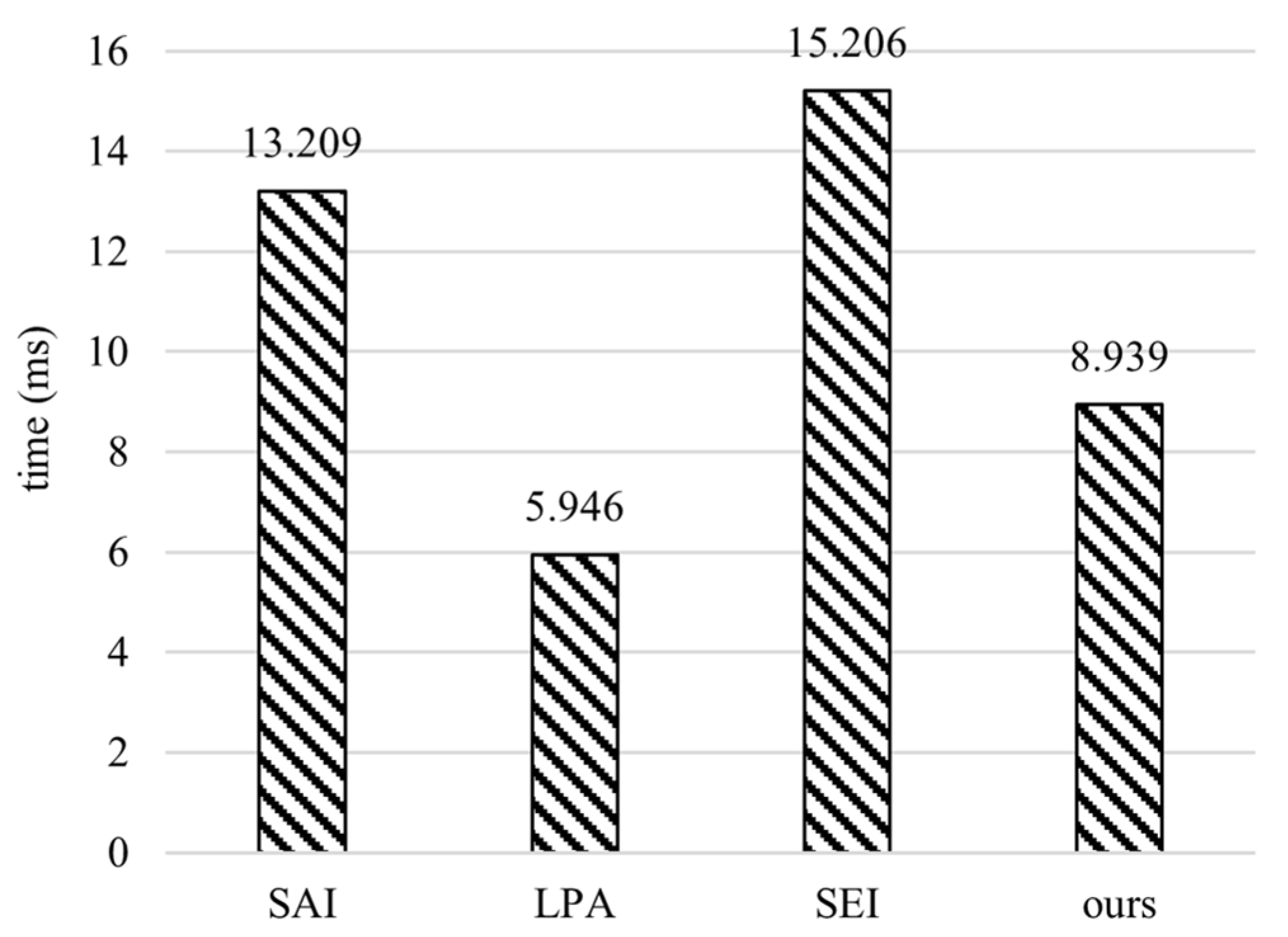
Figure 6 shows the comparison of the authentication calculation overhead on the terminal side. It is clear that the proposed scheme has the minimum calculation time on the terminal side. According to Table 5, the proposed scheme has the least number of scalar point multiplication and point addition. The proposed authentication scheme reduces the computational cost in the terminal by 44.51%, 16.50%, and 19.92%, respectively, compared to SAI, LPA, and SEI.
Figure 6. Computational overhead of SAI [23], LPA [24], SEI [20], and ours on the terminal side.
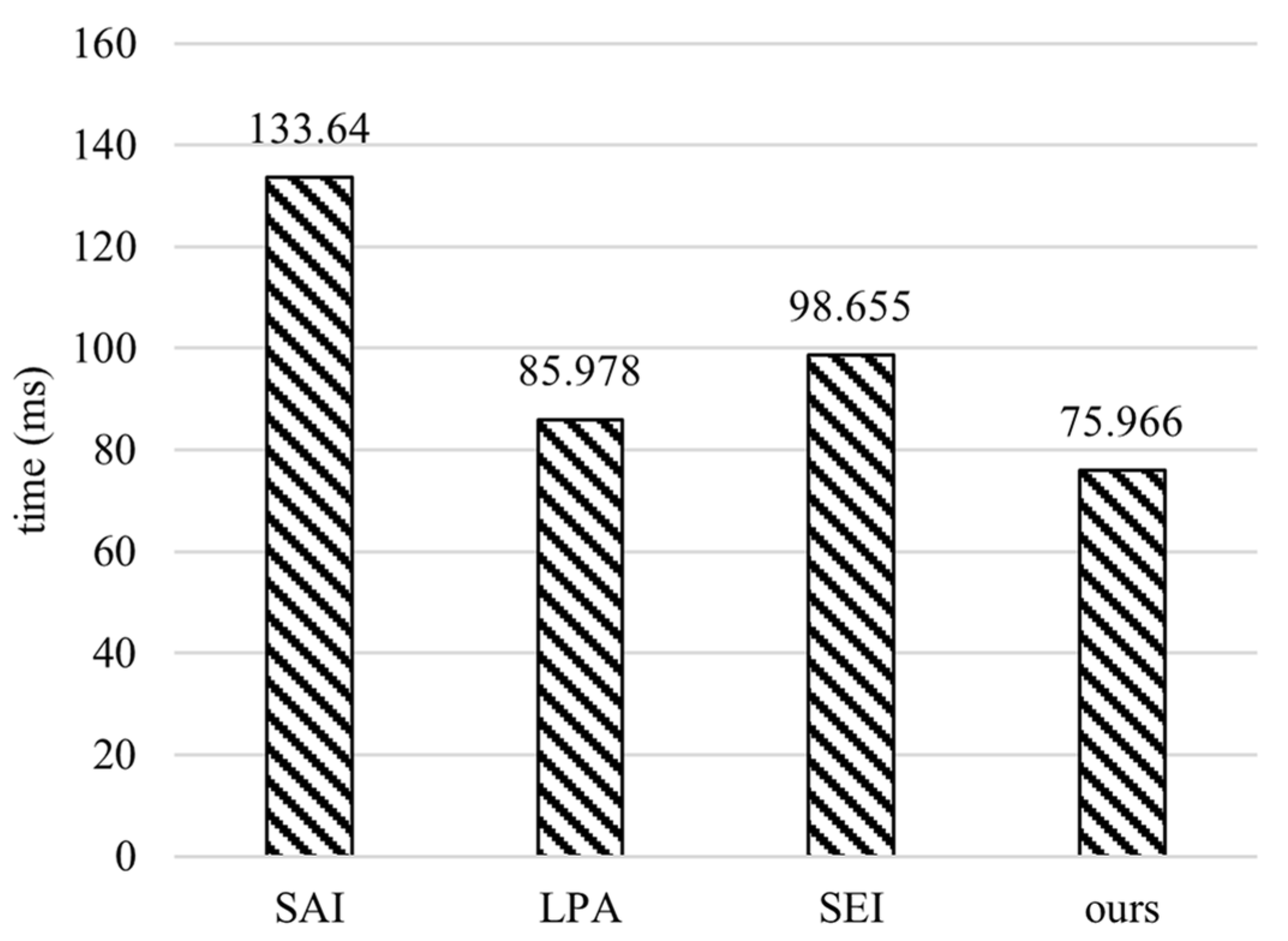
The comparison of the computational overhead on the edge server side is shown in Figure 7. The computational overhead of our scheme is lower than that of SAI and SEI, both of which use the most time-consuming bilinear mapping pairing operation at the server side and, thus, they have higher time consumption. Our scheme achieves 32.33% and 41.21% lower overhead on the edge server side than SAI and SEI, respectively. However, LPA performs better than the proposed scheme. This is because LPA has less computation operations and computational overhead in the authentication process at the edge server side, according to Table 5. Although our scheme has a 33.48% higher computational overhead on the edge side than LPA, it still outperforms LPA in term of the overall overhead.
Figure 7. Computational overhead of SAI [23], LPA [24], SEI [20], and ours on the edge server.
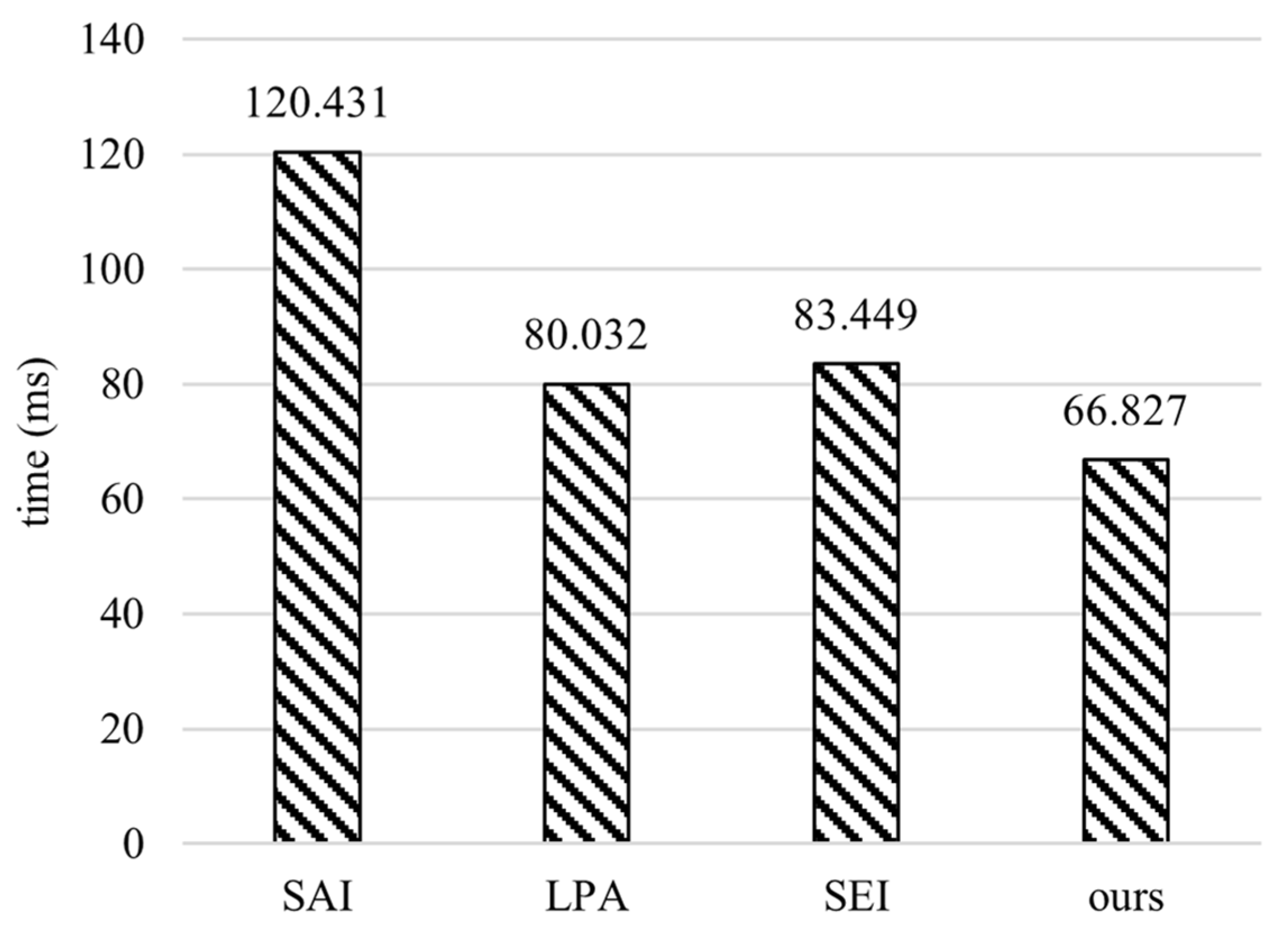
Figure 8 shows the overall computational overheads of both terminal and server side during the authentication process. The result shows that the proposed scheme has the least overall computational overhead. In summary, its computational overhead is 43.16%, 11.64%, and 22.30% lower than that of SAI, LPA, and SEI, respectively, indicating that the proposed scheme is lightweight and requires relatively low computational overhead.
Figure 8. Overall authentication overhead of SAI [23], LPA [24], SEI [20], and ours.

4.2.2. Communication Overhead Analysis

To compare the communication overhead of the proposed scheme with other schemes, the number of messages transmitted between the participants is evaluated. These transmitted messages are represented by different symbols with different sizes, such as large integer groups Z q , logos I D , hashes H , timestamps T , and cyclic addition groups G . And in the proposed authentication scheme, the sizes of these messages are set as follows: | Z q * | = 160 b ,   | T | = 32 b ,   | H | = 256 b ,   | G | = 1024 b ,   | I D | = 256 b . Based on these values, the communication costs of the schemes are calculated and summarized in Table 6.
Table 6. Communication overhead calculation.
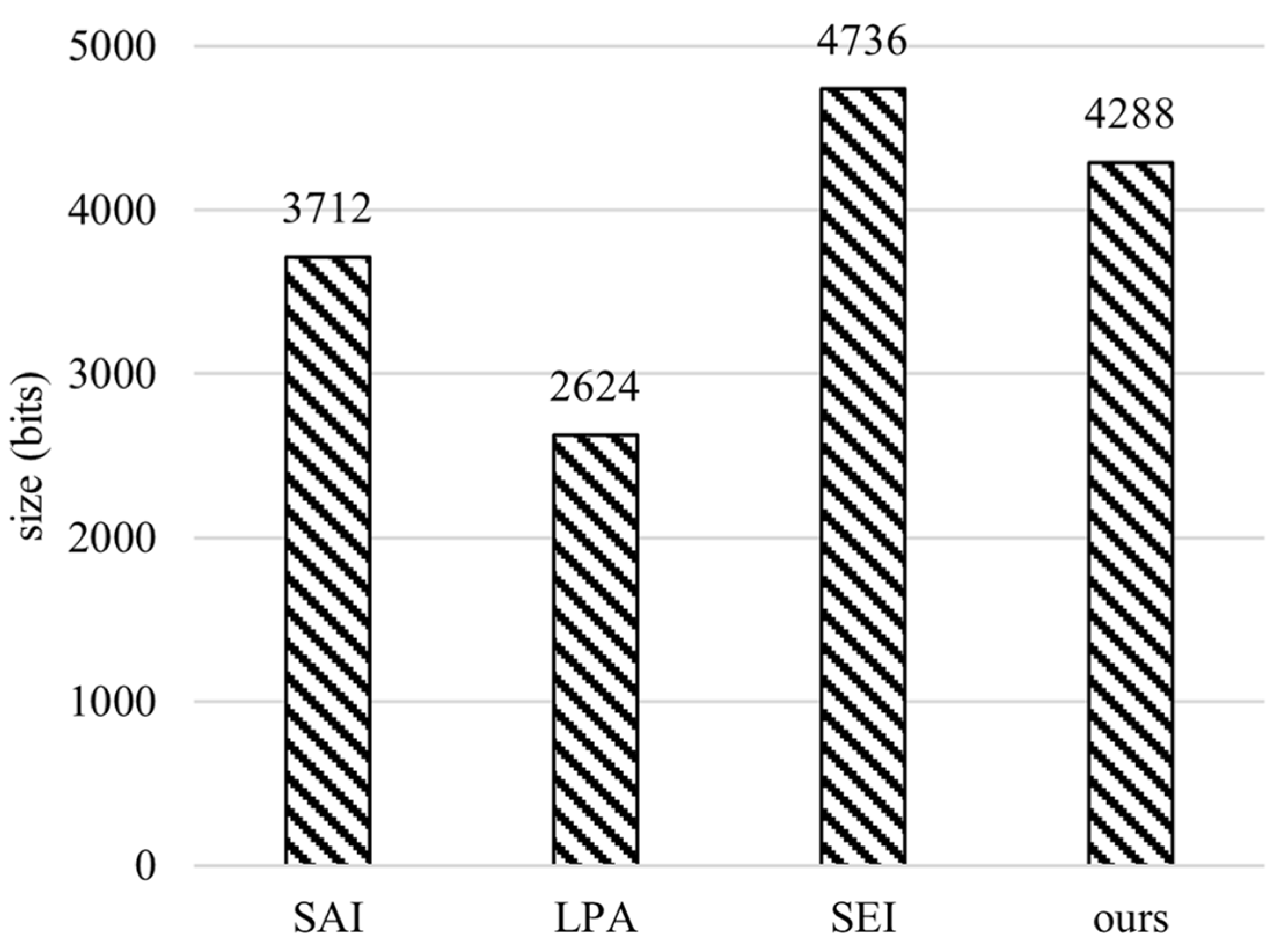
Since the communication overhead is much smaller in time than the calculation overhead, we used the data size to present the communication overhead. Figure 9 shows the amount of data transmitted for authentication under different schemes. The communication overhead of our scheme is 4288 bits, which is lower than that of SEI by reducing 9.46%, but higher compared to SAI and LPA. This is because more data needs to be transmitted when forging the random values of the chameleon hash function in exchange for the security of anonymity. Based on the security analysis, our scheme can provide good security under different scenarios in edge computing environments. Our scheme makes a good balance between security and authentication efficiency.
Figure 9. Communication overhead of SAI [23], LPA [24], SEI [20], and ours.

5. Conclusions

In this paper, we propose a blockchain-based authentication architecture and an effective authentication scheme for the edge computing environment. The proposed scheme provides a secure and efficient anonymous authentication for lightweight devices and edge servers. It uses the characteristics of the chameleon hash function to achieve distributed and trusted sharing of authentication data with the blockchain. We analyze the security properties and evaluate the computational and communication costs of the authentication scheme. The experimental results show that our scheme reduces the computational overhead and communication overhead to a certain extent compared with existing authentication schemes, while providing good security for authentication.
In our future work, we will try to apply the proposed authentication scheme to specific application domains, such as intelligent transportation, intelligent retail, industrial internet, intelligent medical, security monitoring, etc. For the scenarios with intensive terminal equipment, combining the aggregated authentication scheme with the proposed blockchain-based scheme to reduce the number of consensus coalescences in the blockchain would be a feasible research direction for further improving the authentication efficiency. At the same time, some methods [31,32] of providing differentiated services based on different resource allocation devices in wireless sensor networks also provide an interesting research direction for us to improve communication security and efficiency. In addition, powerful machine learning and deep learning techniques have been widely used in wireless sensor networks [33,34]. We will also explore the possibility of using AI methods in both identity authentication and blockchain consensus mechanisms for edge computing environments.

Author Contributions

Conceptualization, S.L.; methodology, S.L.; software, L.H.; validation, L.H. and Y.C.; formal analysis, S.L.; investigation, L.H.; resources, S.L.; data curation, L.H.; writing—original draft preparation, L.H.; writing—review and editing, Y.C.; visualization, Y.C.; supervision, W.W.; project administration, W.W.; funding acquisition, S.L. All authors have read and agreed to the published version of the manuscript.

Funding

This work was partially funded by the National Natural Science Foundation of China (No. 62002279), and Natural Science Basic Research Program of Shaanxi (Program No. 2020JQ-077).

Data Availability Statement

The data presented in this study are available in Table 3 and Table 4, and Figure 6, Figure 7, Figure 8 and Figure 9.

Conflicts of Interest

The authors declare no conflict of interest.

References

  1. Zhou, C.; Yu, Y.; Yang, S.; Xu, H. Intelligent Immunity based Security Defense System for Multi-access Edge Computing Network. China Commun. 2021, 18, 100–107. [Google Scholar] [CrossRef]
  2. Hegde, M.; Rao, R.R.; Nikhil, B.M. DDMIA: Distributed Dynamic Mutual Identity Authentication for Referrals in Blockchain-Based Health Care Networks. IEEE Access 2022, 10, 78557–78575. [Google Scholar] [CrossRef]
  3. Li, X.; Zhang, K.; Zhang, L.; Zhao, X. A New Quantum Multiparty Simultaneous Identity Authentication Protocol with the Classical Third-Party. Entropy 2022, 24, 483. [Google Scholar] [CrossRef] [PubMed]
  4. Muniswamaiah, M.; Agerwala, T.; Tappert, C. A Survey on Cloudlets, Mobile Edge, and Fog Computing. In Proceedings of the 2021 8th IEEE International Conference on Cyber Security and Cloud Computing (CSCloud)/2021 7th IEEE International Conference on Edge Computing and Scalable Cloud (EdgeCom), Washington, DC, USA, 26–28 June 2021; pp. 139–142. [Google Scholar]
  5. Zhong, H.; Zhang, C.; Xu, Y.; Liu, L. Authentication and Key Agreement based on Anonymous Identity for Peer-to-Peer Cloud. IEEE Trans. Cloud Comput. 2020, 10, 1592–1603. [Google Scholar] [CrossRef]
  6. Zhou, J.; Wu, N.; Wang, Y.; Gu, S.; Cao, Z.; Dong, X.; Choo, K. A Differentially Private Federated Learning Model against Poisoning Attacks in Edge Computing. IEEE Trans. Dependable Secur. Comput. 2022, accepted. [Google Scholar] [CrossRef]
  7. Wum, J.; Tseng, Y.; Huang, S. An Identity-based Authenticated Key Exchange Protocol Resilient to Continuous Key Leakage. IEEE Syst. J. 2019, 13, 3968–3979. [Google Scholar]
  8. Liu, S.; Liu, L.; Tang, J.; Yu, B.; Wang, Y.; Shi, W. Edge Computing for Autonomous Driving: Opportunities and Challenges. Proc. IEEE 2019, 107, 1697–1716. [Google Scholar] [CrossRef]
  9. Khan, L.; Yaqoob, I.; Tran, N.; Kazmi, S.; Dang, T.; Hong, C. Edge-Computing-enabled Smart Cities: A Comprehensive Survey. IEEE Internet Things 2020, 7, 10200–10232. [Google Scholar] [CrossRef]
  10. Albataineh, H.; Nijim, M.; Bollampall, D. The Design of a Novel Smart Home Control System using Smart Grid based on Edge and Coud Computing. In Proceedings of the 2020 IEEE 8th International Conference on Smart Energy Grid Engineering (SEGE), Oshawa, ON, Canada, 12–14 August 2020; pp. 88–91. [Google Scholar]
  11. Yao, A.; Jiang, F.; Li, X.; Dong, C.; Xu, J.; Xu, Y.; Li, G.; Liu, X. A Novel Security Framework for Edge Computing based UAV Delivery System. In Proceedings of the 2021 IEEE 20th International Conference on Trust, Security and Privacy in Computing and Communications (TrustCom), Shenyang, China, 20–22 October 2021; pp. 1031–1038. [Google Scholar]
  12. Cao, L.; Liu, Y.; Cao, S. An Authentication Protocol in LTE-WLAN Heterogeneous Converged Network Based on Certificateless Signcryption Scheme With Identity Privacy Protection. IEEE Access 2019, 7, 139001–139012. [Google Scholar] [CrossRef]
  13. Jia, X.; Luo, M.; Choo, K.; Li, L.; He, D. A Redesigned Identity-Based Anonymous Authentication Scheme for Mobile Edge Computing. IoT-J. 2021, 9, 10108–10120. [Google Scholar] [CrossRef]
  14. Ayotte, B.; Banavar, M.; Hou, D.; Schuckers, S. Fast Free-Text Authentication via Instance-based Keystroke Dynamics. IEEE Trans. Biom. Behav. Identity Sci. 2020, 2, 377–387. [Google Scholar] [CrossRef]
  15. Gupta, D.; Ray, S.; Singh, T.; Kumari, M. Post-Quantum Lightweight Identity-based Two-Party Authenticated Key Exchange Protocol for Internet of Vehicles with Probable Security. Comput. Commun. 2022, 181, 69–79. [Google Scholar] [CrossRef]
  16. Shen, S.; Wang, H.; Zhao, Y. Identity-based Authenticated Encryption with Identity Confidentiality. Theor. Comput. Sci. 2022, 901, 1–18. [Google Scholar] [CrossRef]
  17. Takieldeen, A.; Abd Elkhalik, S.; Samra, A.; Mohamed, M.; Khalifa, F. A Robust and Hybrid Cryptosystem for Identity Authentication. Information 2021, 12, 104. [Google Scholar] [CrossRef]
  18. Ma, Z.; Meng, J.; Wang, J.; Shan, Z. Blockchain-based Decentralized Authentication Modeling Scheme in Edge and IoT Environment. IoT-J. 2020, 8, 2116–2123. [Google Scholar]
  19. El-Hajj, M.; Fadlallah, A.; Chamoun, M.; Serhrouchni, A. Ethereum for Secure Authentication of IoT using Pre-Shared Keys (PSKs). In Proceedings of the 2019 International Conference on Wireless Networks and Mobile Communications (WINCOM), Fez, Morocco, 29 October–1 November 2019; pp. 1–7. [Google Scholar]
  20. Jia, X.; He, D.; Kumar, N.; Choo, K. A Provably Secure and Efficient Identity-based Anonymous Authentication Scheme for Mobile Edge Computing. IEEE Syst. J. 2019, 14, 560–571. [Google Scholar] [CrossRef]
  21. Karthikeyan, S.; El-Razouk, H. Horizontal Correlation Analysis of Elliptic Curve Diffie Hellman. In Proceedings of the 2020 3rd International Conference on Information and Computer Technologies (ICICT), San Jose, CA, USA, 9–12 March 2020; pp. 511–519. [Google Scholar]
  22. Zhang, P.; Jiang, C.; Pang, X.; Qian, Y. STEC-IoT: A Security Tactic by Virtualizing Edge Computing on IoT. IoT-J. 2020, 8, 2459–2467. [Google Scholar] [CrossRef]
  23. Li, Y.; Cheng, Q.; Liu, X.; Li, X. A Secure Anonymous Identity-based Scheme in New Authentication Architecture for Mobile Edge Computing. IEEE Syst. J. 2020, 15, 935–946. [Google Scholar] [CrossRef]
  24. Kaur, K.; Garg, S.; Kaddoum, G.; Guizani, M.; Jayakody, D. A Lightweight and Privacy-Preserving Authentication Protocol for Mobile Edge Computing. In Proceedings of the 2019 IEEE Global Communications Conference (GLOBECOM), Waikoloa, HI, USA, 9–13 December 2019; pp. 1–6. [Google Scholar]
  25. Gao, S.; Su, Q.; Zhang, R.; Zhu, J.; Sui, Z.; Wang, J. A Privacy-Preserving Identity Authentication Scheme based on the Blockchain. Secur. Commun. Netw. 2021, 2021, 9992353. [Google Scholar] [CrossRef]
  26. Zhang, J.; Cui, J.; Zhong, H.; Chen, Z.; Liu, L. PA-CRT: Chinese Remainder Theorem based Conditional Privacy Preserving Authentication Scheme in Vehicular Ad-Hoc Networks. IEEE Trans. Dependable Secur. Comput. 2019, 18, 722–735. [Google Scholar] [CrossRef]
  27. Tan, H.; Zheng, W.; Vijayakumar, P.; Sakurai, K.; Kumar, N. An Efficient Vehicle-Assisted Aggregate Authentication Scheme for Infrastructure-Less Vehicular Networks. IEEE Trans. Intell. Transp. Syst. 2022, accepted. [Google Scholar] [CrossRef]
  28. Ganache—Truffle Suite. Available online: https://www.trufflesuite.com/ganache/ (accessed on 11 December 2022).
  29. Scyther Tool (cispa.io). Available online: https://people.cispa.io/cas.cremers/scyther/ (accessed on 11 December 2022).
  30. Chen, Y.; Chen, J. CPP-CLAS: Efficient and Conditional Privacy-Preserving Certificateless Aggregate Signature Scheme for VANETs. IoT-J. 2021, 9, 10354–10365. [Google Scholar] [CrossRef]
  31. Xia, F.; Hao, R.; Li, J.; Xiong, N.; Yang, L.T.; Zhang, Y. Adaptive GTS Allocation in IEEE 802.15.4 for Real-Time Wireless Sensor Networks. J. Syst. Archit. 2013, 59, 1231–1242. [Google Scholar] [CrossRef]
  32. Yao, Y.; Xiong, N.; Park, J.; Ma, L.; Liu, J. Privacy-Preserving Max/Min Query in Two-Tiered Wireless Sensor Networks. Comput. Math. Appl. 2013, 65, 1318–1325. [Google Scholar] [CrossRef]
  33. Cheng, H.; Xie, Z.; Shi, Y.; Xiong, N. Multi-step Data Prediction in Wireless Sensor Networks based on One-Dimensional CNN and Bidirectional LSTM. IEEE Access 2019, 7, 117883–117896. [Google Scholar] [CrossRef]
  34. Gao, Y.; Xiang, X.; Xiong, N.; Huang, B.; Lee, H.; Alrifai, R.; Jiang, X.; Fang, Z. Human Action Monitoring for Healthcare Based on Deep Learning. IEEE Access 2018, 6, 52277–52285. [Google Scholar] [CrossRef]
Disclaimer/Publisher’s Note: The statements, opinions and data contained in all publications are solely those of the individual author(s) and contributor(s) and not of MDPI and/or the editor(s). MDPI and/or the editor(s) disclaim responsibility for any injury to people or property resulting from any ideas, methods, instructions or products referred to in the content.

Article Metrics

Citations

Article Access Statistics

Multiple requests from the same IP address are counted as one view.