You are currently viewing a new version of our website. To view the old version click .
Electronics
  • Article
  • Open Access

26 March 2022

Efficient Generation of Cancelable Face Templates Based on Quantum Image Hilbert Permutation

,
,
,
and
1
Department of Computer Engineering, College of Computers and Information Technology, Taif University, P.O. Box 11099, Taif 21944, Saudi Arabia
2
Department of Industrial Electronics and Control Engineering, Faculty of Electronic Engineering, Menoufia University, Menouf 32952, Egypt
3
Department of Electrical Engineering, Faculty of Engineering, Menoufia University, Shebin El-Kom 32511, Egypt
4
Department of Electronics and Electrical Communication Engineering, Faculty of Electronic Engineering, Menoufia University, Menouf 32952, Egypt
This article belongs to the Special Issue Human Face and Motion Recognition in Video

Abstract

The pivotal need to identify people requires efficient and robust schemes to guarantee high levels of personal information security. This paper introduces an encryption algorithm to generate cancelable face templates based on quantum image Hilbert permutation. The objective is to provide sufficient distortion of human facial biometrics to be stored in a database for authentication requirements through encryption. The strength of the proposed Cancelable Biometric (CB) scheme is guaranteed through the ability to generate cancelable face templates by performing the scrambling operation of the face biometrics after addition of a noise mask with a pre-specified variance and an initial seed. Generating the cancelable templates depends on a strategy with three basic steps: Initialization, Odd module, and Even module. Notably, the proposed scheme achieves high recognition rates based on the Area under the Receiver Operating Characteristic (AROC) curve, with a value up to 99.51%. Furthermore, comparisons with the state-of-the-art schemes for cancelable face recognition are performed to validate the proposed scheme.

1. Introduction

Document fraud, identity theft, terrorism, and cybercrime are serious issues that need to be considered and studied carefully. Therefore, security solutions have been extended widely to face unauthorized access to modern systems with abundant data communication. Biometric solutions are reliable security solutions that depend on physical or behavioral analysis for authentication of persons [1,2,3]. Biometric technologies are classified according to the required application as follows: physiological against behavioral, mono-modal against multimodal, cooperative against non-cooperative, contact against touchless, near against remote, server-based against mobile-based, and human against automated.
Universally, biometric systems are adopted for security in several applications such as forensics, surveillance, logical and physical access control, attendance management, etc. However, biometric systems are recommended wherever identification and authentication are critical. Recently, biometric technology has flourished greatly, particularly in identity documents based on individual specific characteristics in a short time. For distinguishing individuals, biometric identifiers involve statistical analysis for physiological and behavioral measurements [4,5,6,7,8,9,10,11,12,13,14,15].
Physiological patterns may be morphological, such as the iris, retina, face, hand shape, fingerprint, and vein pattern, or non-morphological such as the DNA, blood, saliva, urine, and police forensics. The most common behavioral measurements involve gesture, gait, voice, keystroke, signature dynamics, etc. Masek provided a well-known algorithm with its open-source code for iris recognition [16]. It depends on the circular Hough transform with some sort of pre-processing for initial iris localization. The science of biometric recognition is rapidly evolving in several applications using different modalities such as fingerprint, face, iris, hand geometry, ear, and gait, which are discussed and covered in detail in [17].
The main objective of this research is to present a CB recognition scheme based on quantum image Hilbert permutation. Flexible Quantum Image Representation (FRQI) is proposed to allow image representation on quantum computers in the form of a natural model. The FRQI captures and transforms image information into normalized quantum states based on colors and positions in order to allow better management of image information. The strategy adopted in this scheme is used to save the original biometrics from being stored in databases, and use their encrypted versions instead. The verification or identification task is implemented on the encrypted versions through correlation estimation and thresholding. Each user has the ability to change his templates through a user-specific operation. That is why the proposed CB scheme improves both biometrics security and users privacy. The proposed scheme also maintains high accuracy of operation.
The remainder of this paper is sectioned as follows. The state-of-the-art work is explored in Section 1. Preliminaries of the FRQI, in addition to Hilbert image scrambling and quantum gates, are presented in Section 3. The design of the proposed CB recognition scheme based on quantum encryption is introduced in Section 4. Tests with quantitative and qualitative evaluation are given in Section 5. Conclusions are finally discussed in Section 6.

3. Preliminaries: Quantum Image Processing (QIP)

Quantum Image Processing (QIP) is a research area that depends on the image representation using quantum information and quantum operators. Unlike classical theory, quantum theory concepts depend on qubits [53]. The FRQI model involves information about the color and the corresponding pixel position in an image. The general quantum representation of an image of size 2 n × 2 n is given by the following mathematical relation:
I ( θ = 1 2 n i = 0 2 2 n 1 | c i | i
| c i = cos θ i | 0 + sin θ i | 1 ,   θ i [ 0 ,   π 2 ] ,   i = 0 ,   1 ,   , 2 2 n 1
where the following relation gives the vertical and horizontal coordinates for | c i , which encodes color information with their corresponding pixel positions | i :
| i = | y | x = | y n 1   y n 2 y 0 | x n 1   x n 2 x 0
For n = 1, the 2 × 2 FRQI template image will be described by the following equation:
| I = 1 2 [ ( cos θ 0 | 0 + sin θ 0 | 1 ) | 00 +      ( cos θ 1 | 0 + sin θ 1 | 1 ) | 01 +      ( cos θ 2 | 0 + sin θ 2 | 1 ) | 10 +      ( cos θ 3 | 0 + sin θ 3 | 1 ) | 11 ]
The Hilbert scanning matrix is vital to allow image scrambling by performing permutation on each pixel to a new position to transform a meaningful image into a distorted non-meaningful encrypted image. Therefore, the Hilbert scanning matrix is given by the following relations [54]:
H n + 1 = { ( H n 4 n E n + H n T ( 4 n + 1 + 1 ) E n H n u d ( 3 × 4 n + 1 ) E n ( H n l r ) T ) ,    n   is   even . ( H n ( 4 n + 1 + 1 ) E n H n l r 4 n E n + H n T     ( 3 × 4 n + 1 ) E n ( H n T ) l r ) ,    n   is   odd .
where n represents a positive integer. The initial matrix is
H 1 = ( 1 2 4 3 )
and
E n = ( 1 1 1 1 1 1 . . . . . . . . 1 1 1 )
The geometric transformation of the matrix image A in the form 2 m × 2 m is given as follows:
A = ( a 1 , 1 a 1 , 2 a 1 , m a 2 , 1 a 2 , 2 a 2 , m . . . . . . . . a m , 1 a m , 2 a m , m ) ,
Then,
A T = ( a 1 , 1 a 2 , 1 a m , 1 a 1 , 2 a 2 , 2 a m , 2 . . . . . . . . a 1 , m a 2 , m a m , m ) A l r = ( α 1 , μ α 1 , 2 α 1 , 1 α 2 , μ α 2 , 2 α 2 , 1 . . . . . . . . α μ , μ α μ , 2 α μ , 1 ) A u d = ( a m , 1 a m , 2 a m , m . . . . . . . . a 2 , 1 a 2 , 2 a 2 , m a 1 , 1 a 1 , 2 a 1 , m ) A p p = ( a m , m a m , 2 a m , 1 . . . . . . . . a 2 , m a 2 , 2 a 2 , 1 a 1 , m a 1 , 2 a 1 , 1 )
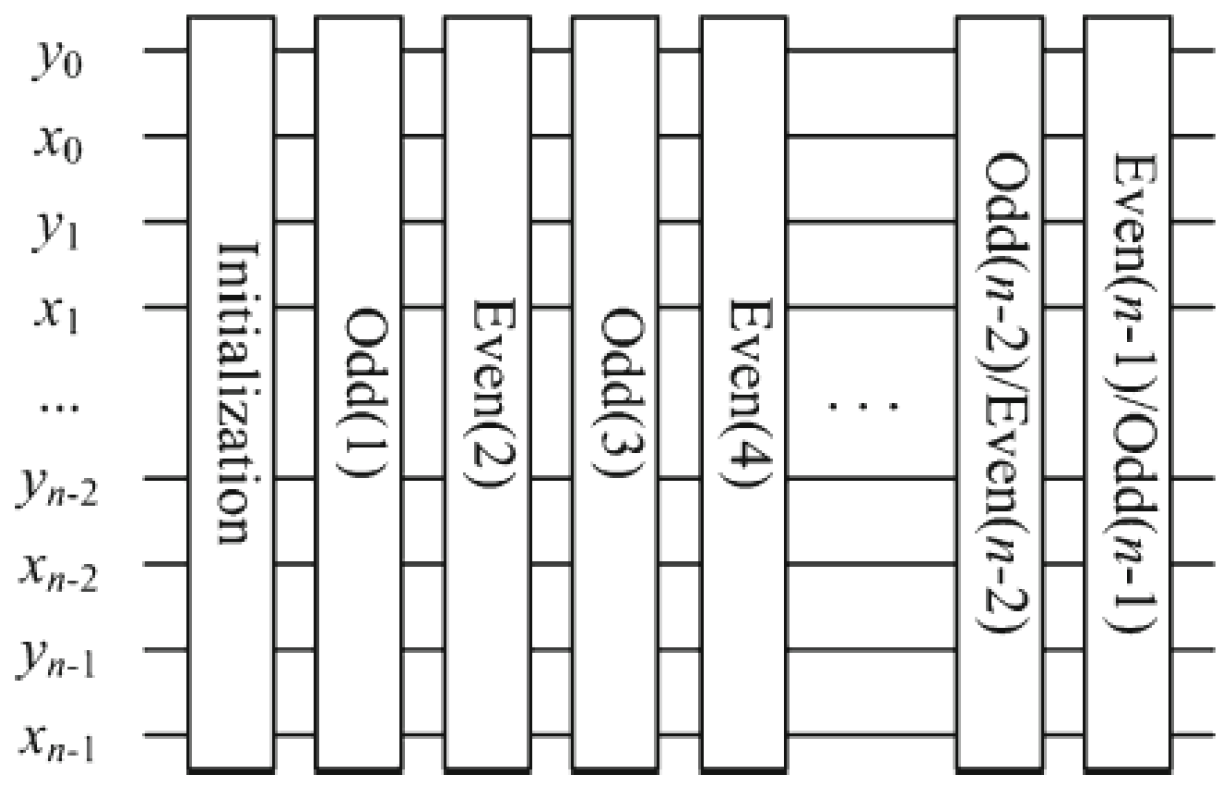
The scrambling process of the original image is composed of the three basic operations as illustrated in Figure 1, including initialization, Even and Odd modules. The size of the Hilbert scanning matrix begins with 2 × 2 and increases gradually with each operation step. The scrambling starts with partitioning of the image into blocks and working on each block according to Equation (1). PARTITION (0) is performed in the initialization step to divide the 2 n × 2 n input image into 2 n 1 × 2 n 1 sub-images with size 2 × 2. Then, each block is denoted by ( a b c d ) . Next, swapping operation is performed on the last two pixels of every sub-image to be ( a b d c ) . Then, PARTITION (1) divides the output image into 4 × 4 sub-images. This is followed by an Odd module that changes every block into ( a d p p b T c T ) . Then, the Even module is performed to generate ( a b T d p p c T ) . The Odd and Even modules are performed, alternatively, until Even(n−1)/Odd(n−1) that is if (n−1) is an even value, the final operation is Even(n−1); otherwise, the final operation will be Odd (n−1).
Figure 1. The general Hilbert scrambling quantum scheme.

4. Cancelable Face Recognition Based on Quantum Image Distortion

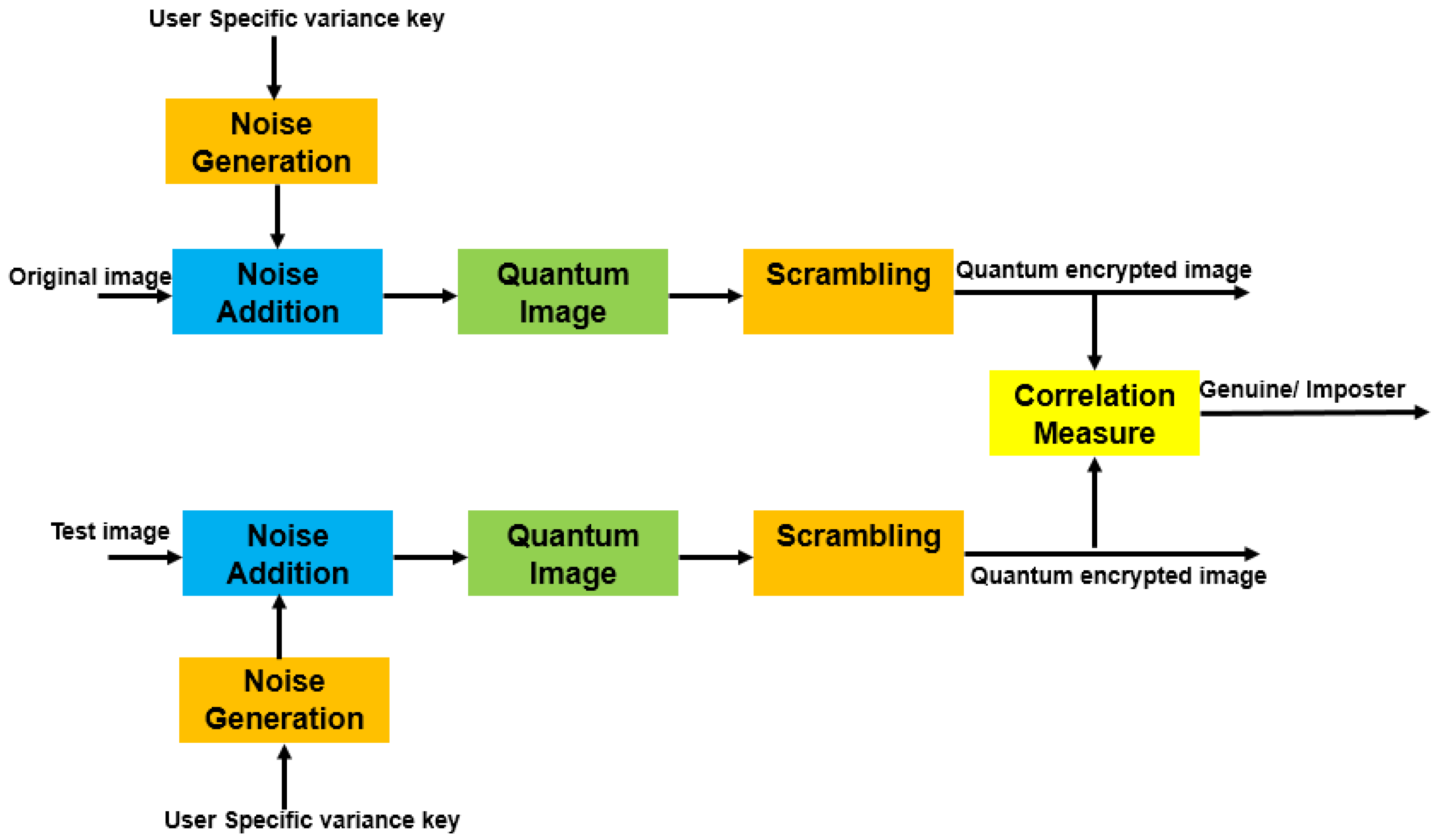
This section introduces the methodology to accomplish our proposed scheme to generate robust cancelable templates to achieve a high security level for the original biometric templates against thefts and attacks. The proposed scheme is illustrated in Figure 2, where the scrambling approach is performed on the raw images in the enrollment stage. The generated encrypted templates are stored in the database for further matching processes in the authentication phase. The generated cancelable templates are obtained through the Hilbert scrambling strategy with three basic steps: Initialization, Odd and Even modules. The cancelable templates are produced as follows:
Figure 2. The proposed QIP-based CB recognition scheme.
Step 1: The procedure starts with PARTITION (0) to generate 2 × 2 sub-images in the form ( i i + 1 i + 2 i + 3 ) .
Step 2: Swapping operation is performed for the last two pixels of every sub-image by the C-Not gate.
Step 3: 4 × 4 sub-images are generated through PARTITION (1). Odd and Even modules are used to complete the scrambling process.
If a generated distorted template is compromised, the proposed CB recognition scheme can generate a new different distorted template that completely differs from the compromised one by adding a noise mask to the original biometric image according to an initial seed and a certain variance. The newly generated template will be totally different from the other stored templates in the database.

5. Performance Evaluation and Test Results
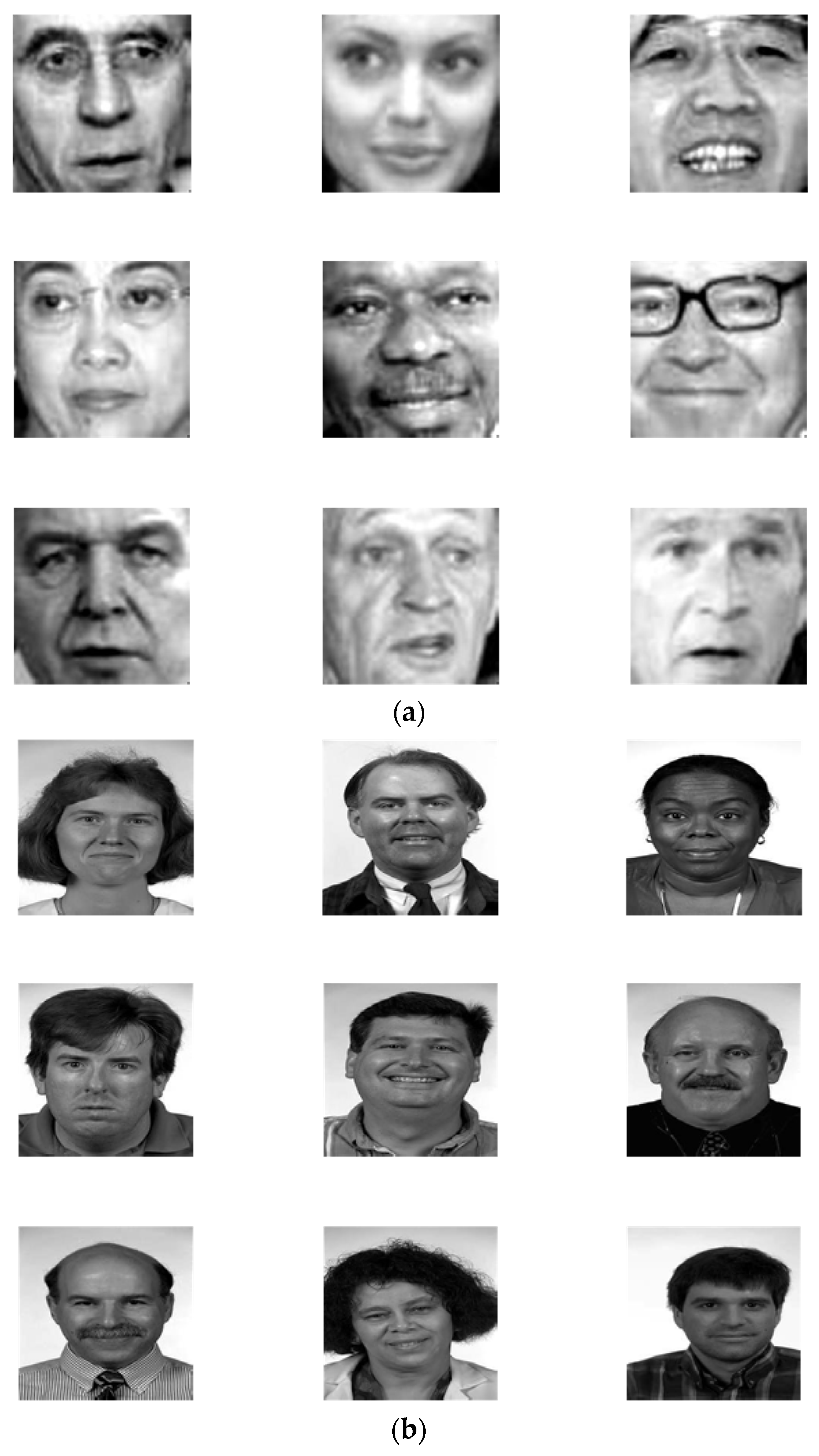
Quantitative and qualitative analysis are introduced in this work. The proposed facial recognition scheme is implemented using MATLAB running on Intel Core™ i5-4210U with 1.7 GHz CPU. The goal is to overcome illegal access and attacks. Therefore, we propose an efficient scheme based on QIP to be resistant to intrusion attacks. Samples of biometric face images used in this study are selected from the Mass Labeled Faces in the Wild (LFW) dataset [55], Olivetti and Oracle (ORL) dataset [56], and NiST Face Recognition Technology (FERET) dataset [57]. Different evaluation metrics are used for investigating the proposed scheme robustness. Furthermore, a comparison is introduced between the proposed scheme and other existing ones based on fuzzy domain and homomorphic domain to demonstrate and ensure the effectiveness of the proposed scheme.
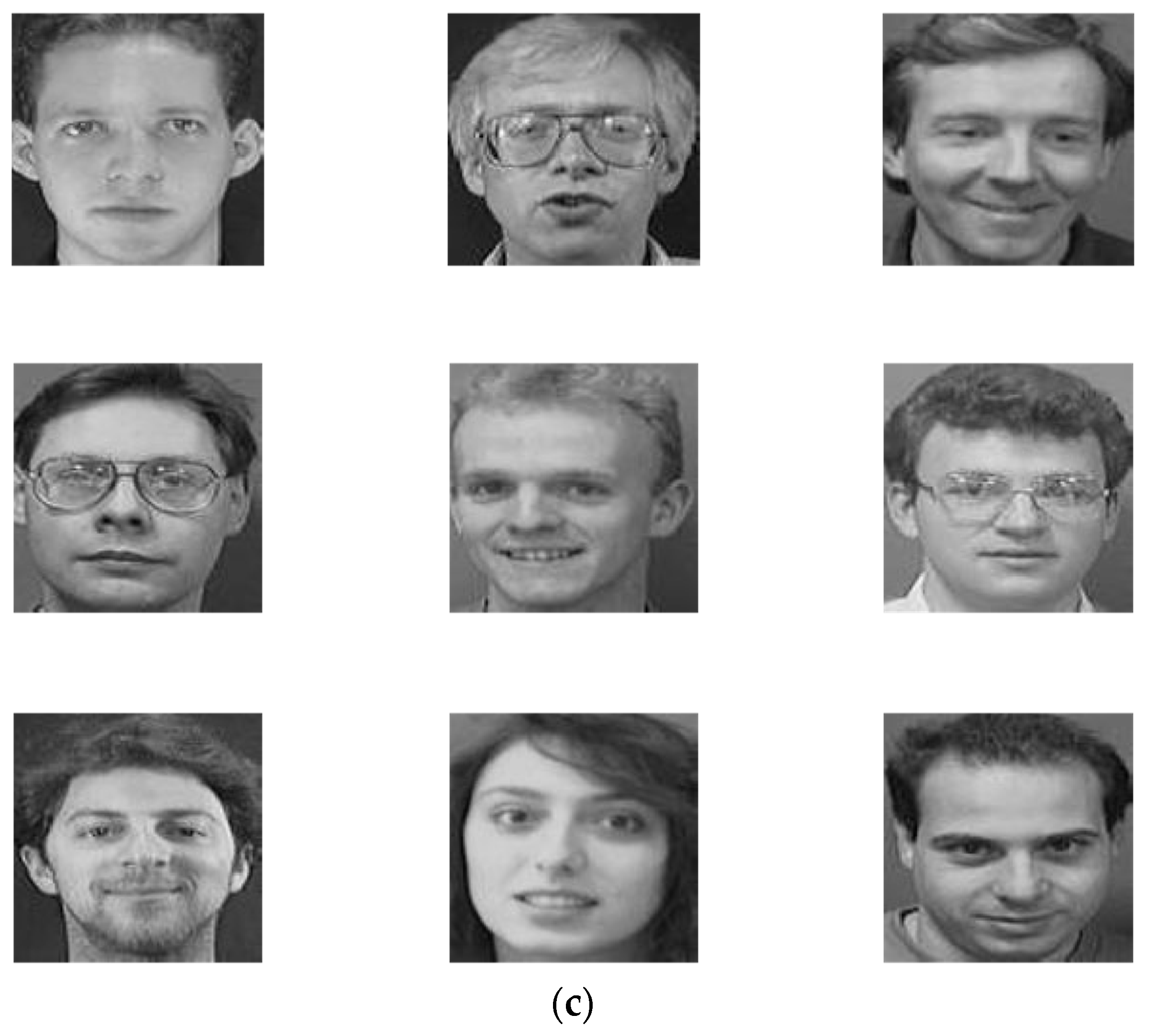
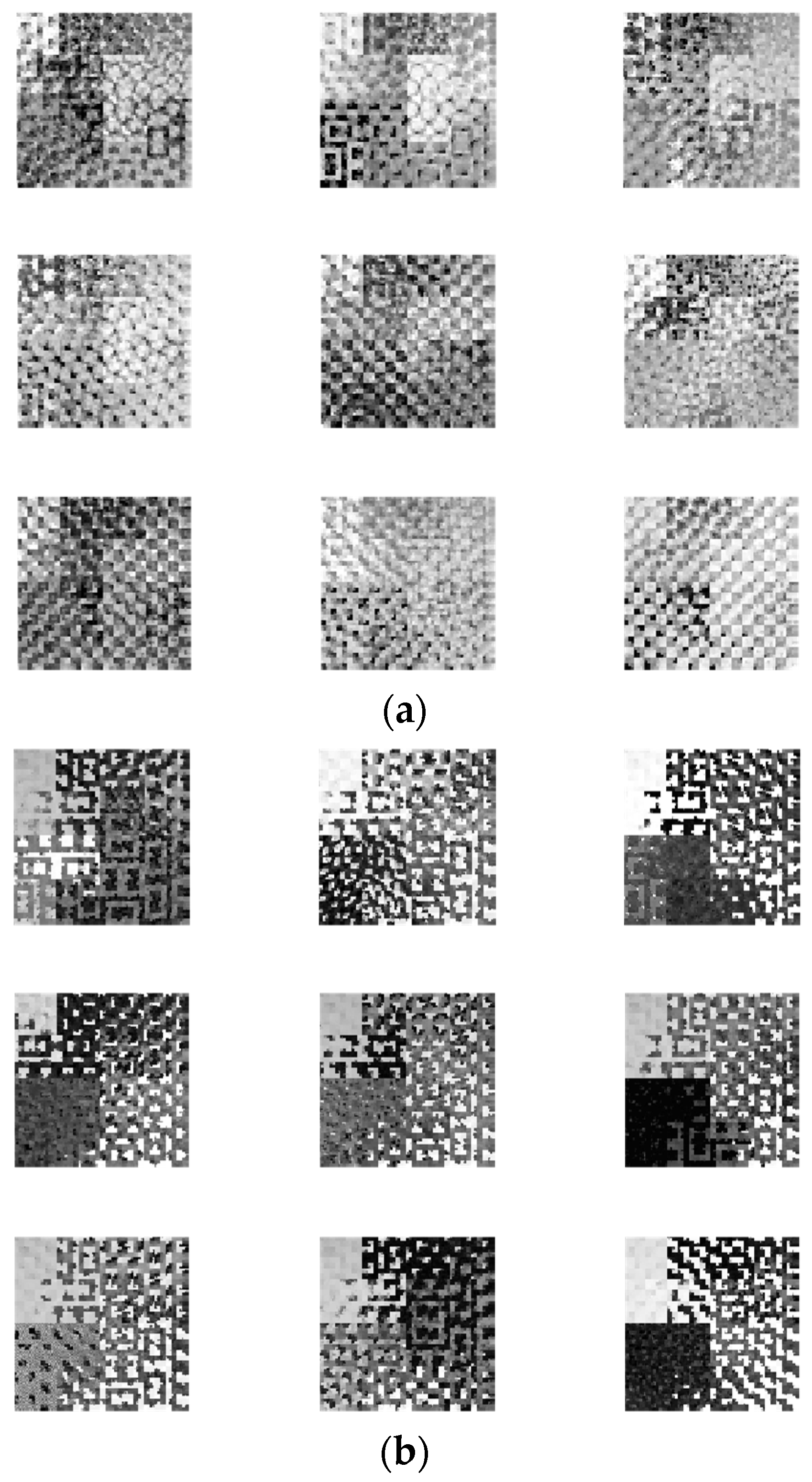
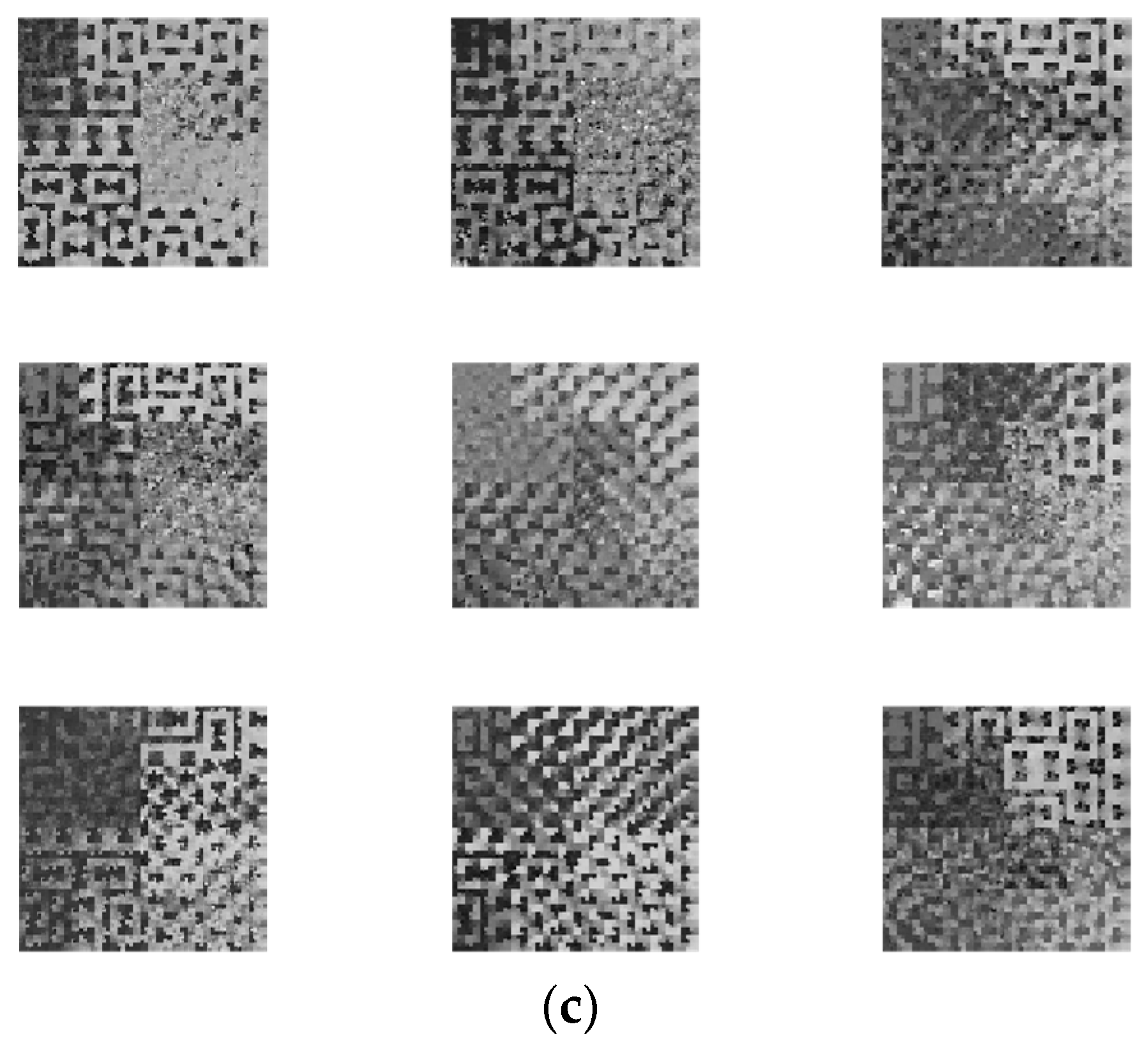
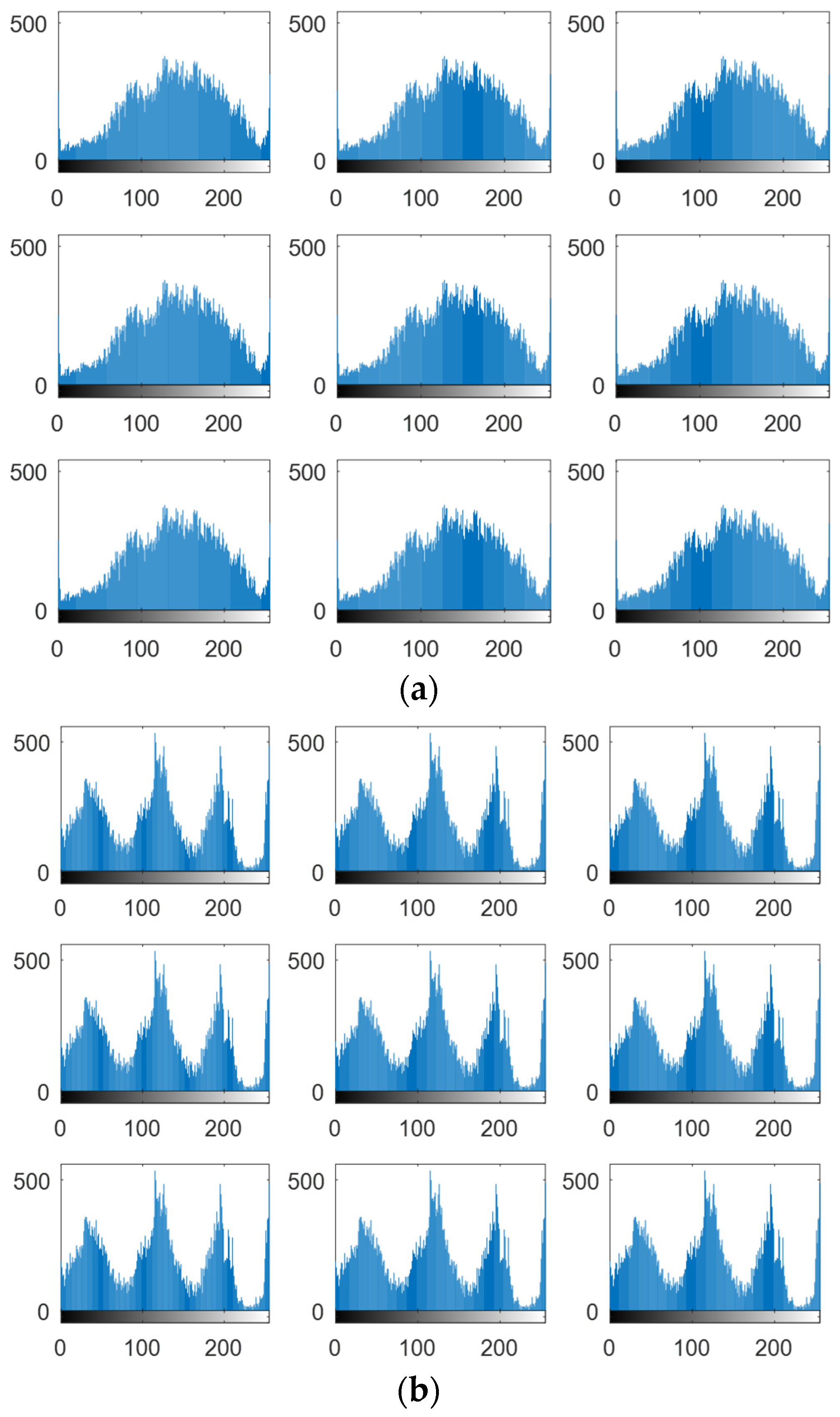
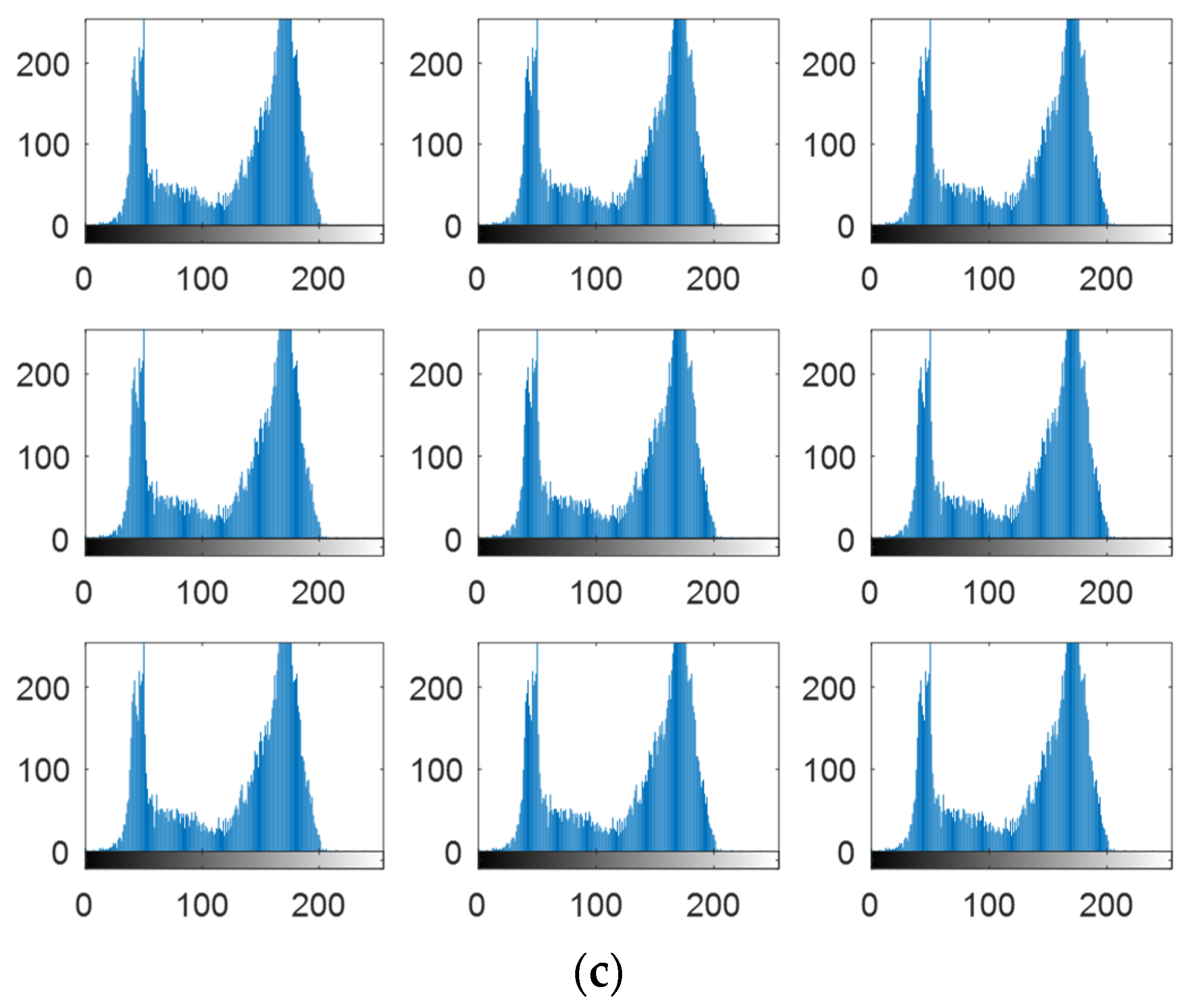
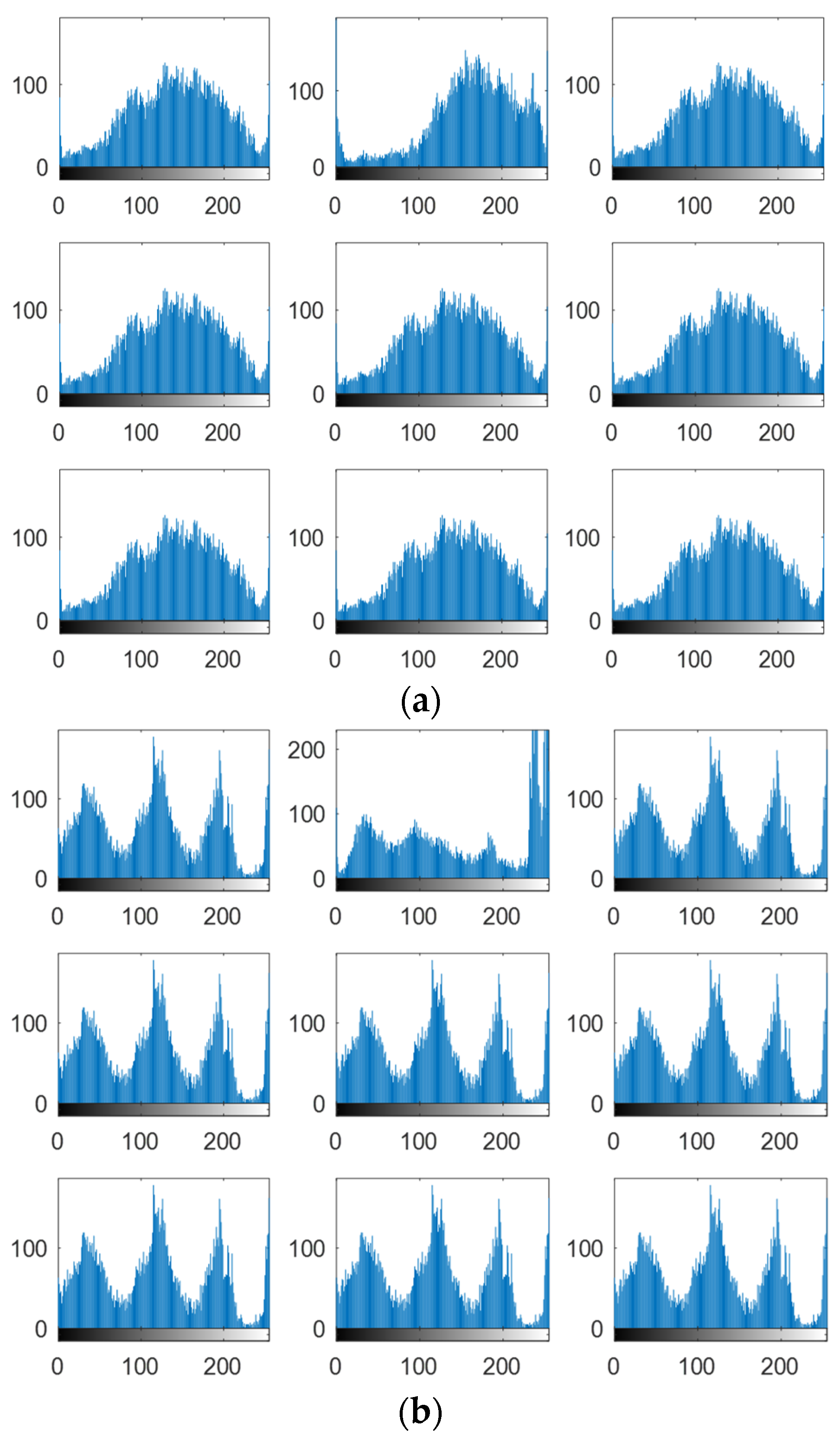
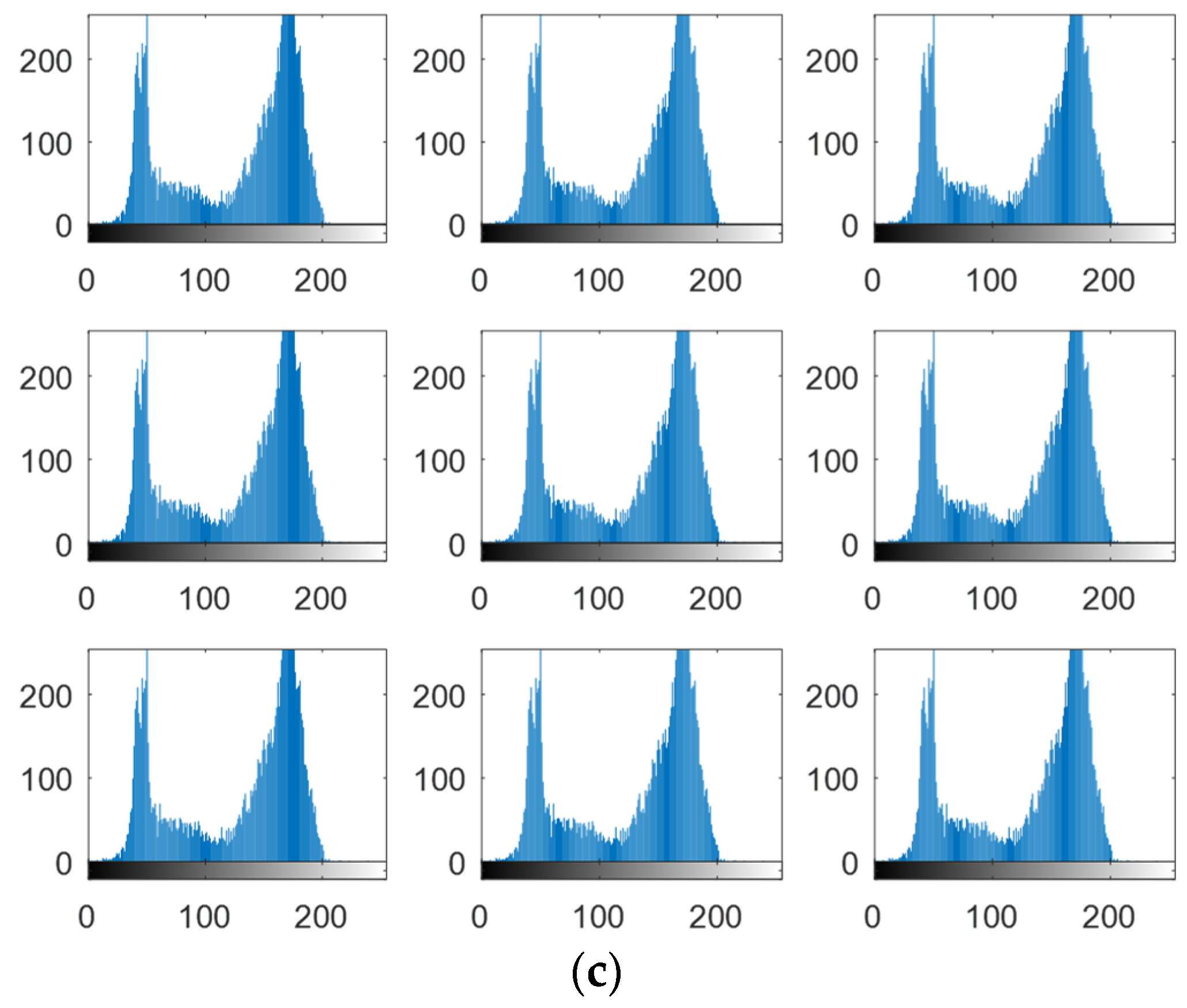
We consider three different datasets to examine the encryption algorithm performance and enrich the validation scheme. The size of all templates is 128 × 128. The original samples of the three datasets are presented in Figure 3, with distorted versions shown in Figure 4. The distributions of histograms for the original samples and the encrypted samples illustrated in Figure 5 and Figure 6 prove that the scrambling process based on Swapping operation, Odd module and Even module permutes and shuffles sufficiently each pixel position to perform effectual distortion without changing pixel gray levels.
Another important metric used to evaluate the performance of the encryption algorithm is the correlation coefficient, which is used for measuring the correlation between distorted output templates in the enrollment phase and the new distorted facial images. The correlation coefficient can be evaluated as follows:
R x y = 1 N i = 1 N ( x i x ¯ ) ( y i y ¯ ) σ x σ y
where N, x and y are the number of pixels, the current stored distorted encrypted version, and the newly distorted template.
Figure 3. Samples of face images used as original biometrics [55,56,57]. (a) LFW dataset [55]. (b) FERET dataset [57]. (c) ORL dataset [56].
Figure 4. Encrypted versions of biometric faces in Figure 3 based on QIP. (a) Samples of LFW encrypted templates. (b) Samples of FERET encrypted templates. (c) Samples of ORL encrypted templates.
Figure 5. Histograms of facial image samples for (a) LFW dataset, (b) FERET dataset, (c) ORL dataset.
Figure 6. Histograms of encrypted facial image samples based on QIP for (a) LFW dataset, (b) FERET dataset, (c) ORL dataset.
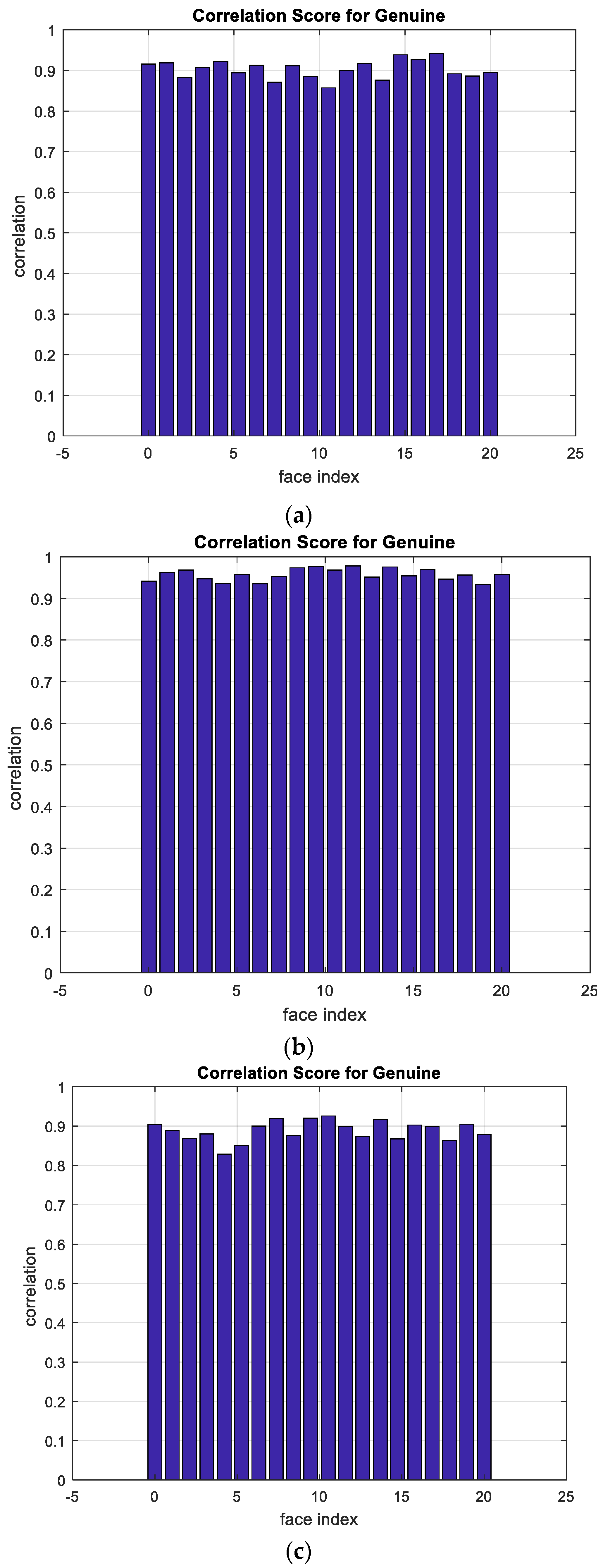
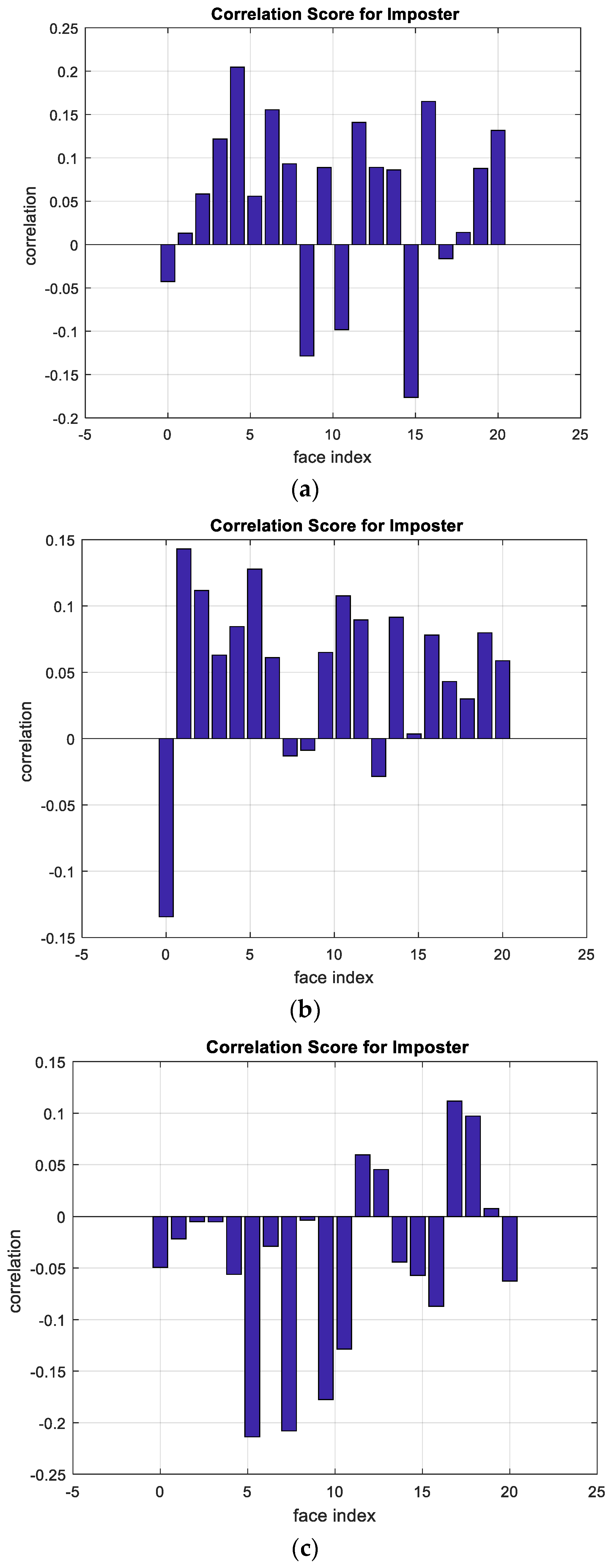
Figure 7 illustrates the correlation coefficient values evaluated among the authorized biometrics and their corresponding counterparts stored in the enrollment phase with noise for all encrypted templates. In addition, Figure 8 illustrates the calculated correlation coefficient scores for all impostor and unauthorized records. The output scores in both Figure 7 and Figure 8 demonstrate that all correlation values for authorized patterns are greater than 0.7, while those correlation values for unauthorized patterns are lower than 0.25. Hence, a threshold score may be adopted ranging from 0.25 to 0.7 to distinguish between authorized and unauthorized patterns. Using such a wide range for setting the threshold, the proposed scheme achieves a high security level.
Figure 7. Correlation scores for authorized patterns based on QIP for (a) LFW dataset, (b) FERET dataset, (c) ORL dataset.
Figure 8. Correlation scores for unauthorized impostor patterns based on QIP for (a) LFW dataset, (b) FERET dataset, (c) ORL dataset.
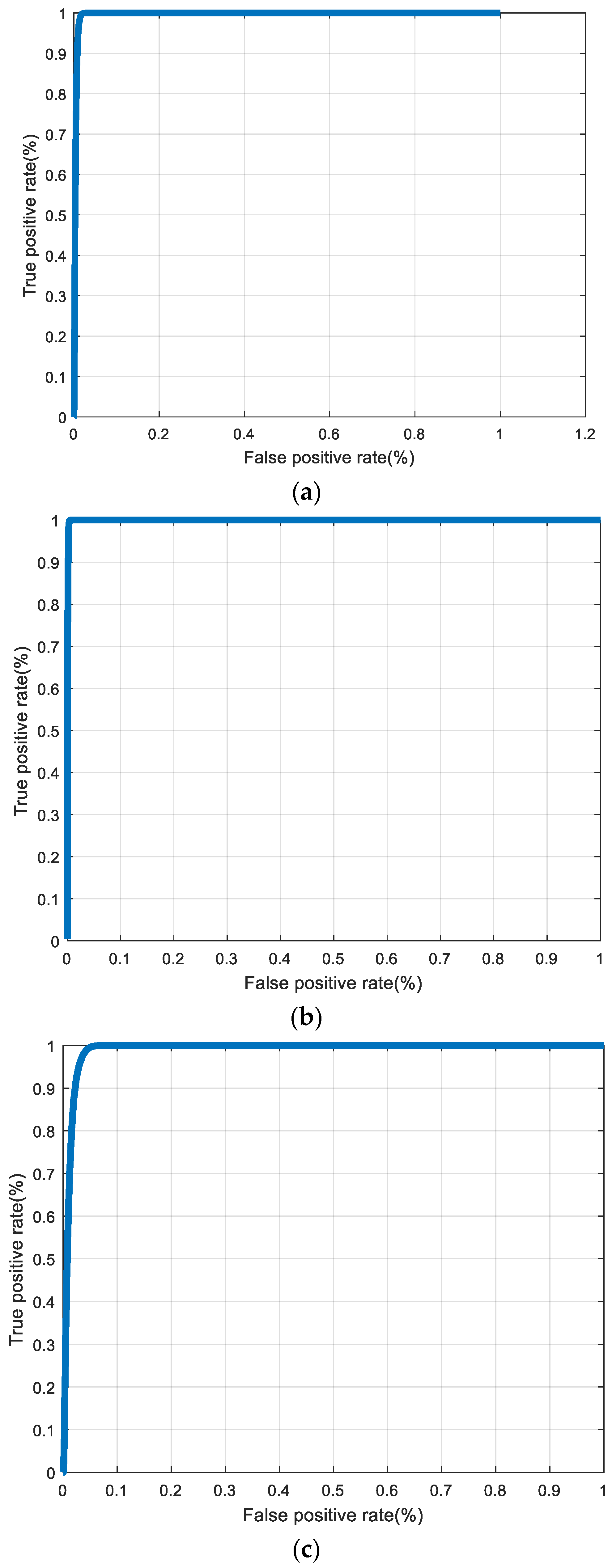
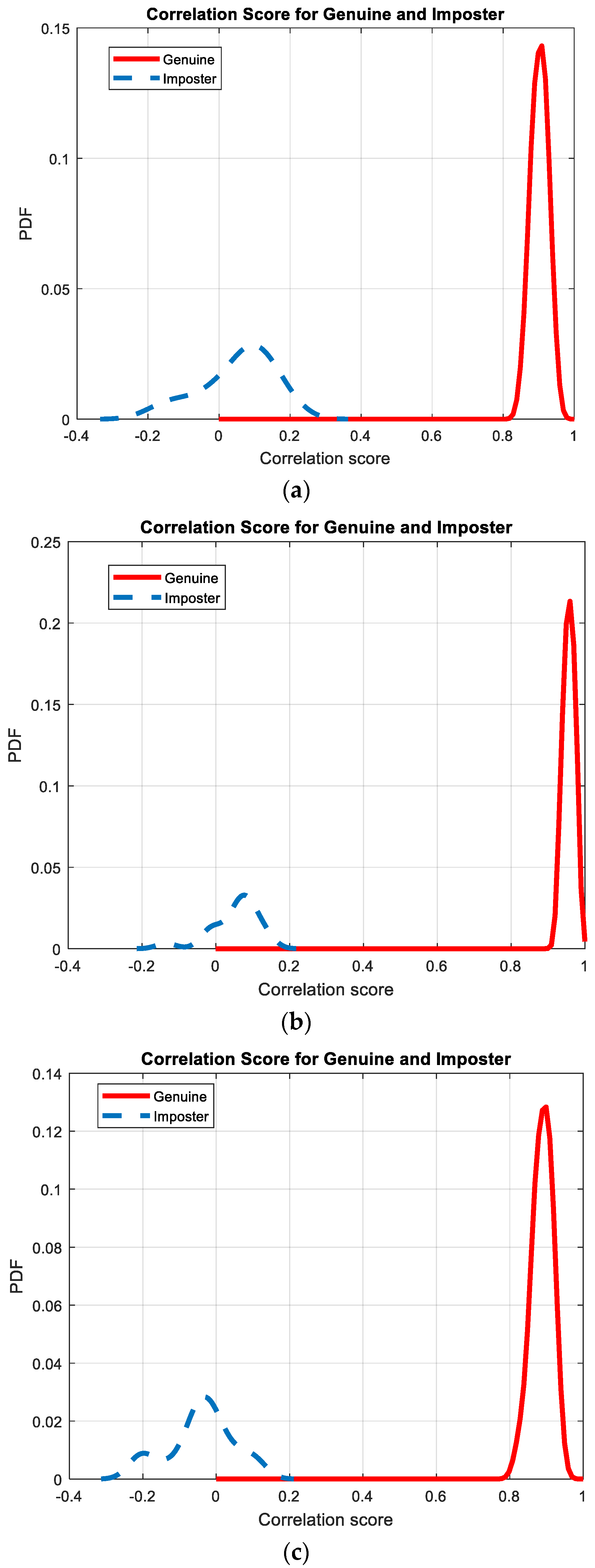
The ROC curves are shown in Figure 9 for better grasping and understanding of the results. The True Positive Rate (TPR) versus the False Positive Rate (FPR) was studied in [58,59,60,61]. The TPR and the FPR are used to assess the authentication performance. The AROC is as high as possible, revealing more robustness and strength of the proposed scheme. The probability distributions of the correlation scores for both authorized and unauthorized tests are given in Figure 10.
Figure 9. ROC curves for the proposed CB recognition scheme based on QIP for (a) LFW dataset, (b) FERET dataset, (c) ORL dataset.
Figure 10. Probability distributions for the proposed CB recognition scheme based on QIP for (a) LFW dataset, (b) FERET dataset, (c) ORL dataset.
The congruity evaluation metrics, such as Structural Similarity Index Metric (SSIM), are employed to measure the similarity between two templates. For example, an acceptable SSIM value to test the encryption quality between original and encrypted images should be close to zero. Mathematically, SSIM can be computed as in Equation (7) [62] to evaluate the distortion strength.
SSIM = ( 2 μ x μ y + S 1 ) ( 2 δ x y   + S 2 ) ( μ x   2 + μ y   2 + S 1 ) + ( δ x   2 + δ y   2 + S 2 )
where μ x and μ y are the means of the images x and y, respectively, δ x   2 , and δ y   2 denote the two images variances, δ x y is the cross-covariance between them, S 1 and S 2 are selected as small as possible according to [63].
Table 1 ensures the high performance and the robustness of the proposed CB recognition scheme by displaying the scores of evaluation metrics. These metrics include the AROC and SSIM scores among the stored and impostor patterns, and the correlation score distribution for authorized and unauthorized patterns. These presented metrics are used to demonstrate and prove the superiority of the proposed CB recognition scheme. The obtained results of high AROC values of 0.9951 on average for the three different datasets in addition to the low values of SSIM indicate the strength of the proposed scheme to be applied for authentication applications. Finally, Table 2 presents a comparison with state-of-the-art CB recognition schemes from the AROC perspective. The suggested CB recognition scheme is superior compared to the others.
Table 1. Evaluation metrics of the QIP-based cancelable face recognition scheme on three different datasets.
Table 2. Comparison with state-of-the-art CB recognition schemes from the AROC perspective.

6. Conclusions

This paper presented a cancelable biometric recognition scheme that depends on QIP concepts. A scrambling and permutation algorithm was proposed to generate the cancelable encrypted templates to be stored in the database for authentication. The proposed scheme allows securing of biometric templates from unauthorized access. In addition, it allows changing the biometric templates if compromised through the addition of a user-specific noise mask. The proposed scheme was evaluated and tested on three distinct datasets to take into consideration the anticipated variations in lighting conditions, and background. Simulation and comparison results revealed an average AROC of 0.9951 and an average SSIM of 0.051 for the proposed scheme. These findings reveal that the proposed scheme is a good candidate for biometric security in remote access systems. In future work, our research plan is to work on multiple biometrics to generate robust cancelable templates. In addition, deep learning will be considered for robust feature extraction in CB recognition systems.

Author Contributions

Conceptualization, H.A. and O.S.F.; methodology, G.M.E.-B.; software, G.M.E.-B.; validation, H.S.E.-S., H.A. and G.M.E.-B.; formal analysis, O.S.F.; investigation, F.E.A.E.-S.; resources, G.M.E.-B.; data curation, H.A.; writing—original draft preparation, H.S.E.-S.; writing—review and editing, O.S.F.; visualization, H.A.; supervision, F.E.A.E.-S.; project administration, O.S.F.; funding acquisition, H.A. All authors have read and agreed to the published version of the manuscript.

Funding

This study was funded by the Deanship of Scientific Research, Taif University Researchers Supporting Project number (TURSP-2020/216), Taif University, Taif, Saudi Arabia.

Data Availability Statement

The data presented in this study are openly available as follows: [LFW Database 2020] at http://vis-www.cs.umass.edu/lfw/ (accessed on 1 January 2022), [55], [ORL Database 2020] at https://www.cl.cam.ac.uk/research/dtg/attarchive/facedatabase.html (accessed on 1 January 2022), [56], and [FERET Database 2020] at https://www.nist.gov/itl/products-and-services/color-feret-database (accessed on 1 January 2022), [57].

Acknowledgments

The authors would like to thank the Deanship of Scientific Research, Taif University Researchers Supporting Project number (TURSP-2020/216), Taif University, Taif, Saudi Arabia for supporting this research work.

Conflicts of Interest

The authors declare no conflict of interest.

References

  1. Ashbourn, J. Biometrics: Advanced Identity Verification, the Complete Guide; Springer: London, UK, 2000. [Google Scholar]
  2. Smith, R. Authentication: From Passwords to Public Keys; Addison and Wesley: Boston, MA, USA, 2002. [Google Scholar]
  3. Jain, A.; Ross, A.; Prabhakar, S. An introduction to biometric recognition. IEEE Trans. Circuits Syst. Video Technol. 2004, 14, 4–20. [Google Scholar] [CrossRef] [Green Version]
  4. Chen, X.; Flynn, P.J.; Bowyer, K.W. IR and visible light face recognition. Comput. Image Vis. Underst. 2005, 99, 332–358. [Google Scholar] [CrossRef]
  5. Zhou, S.K.; Chellappa, R.; Zhao, W. Unconstrained Face Recognition; Springer: Berlin/Heidelberg, Germany, 2006. [Google Scholar]
  6. Jain, A.; Bolle, R.; Pankanti, S. Biometrics: Personal Identification in Networked Society; Springer Science & Business Media: New York, NY, USA, 2006; p. 479. [Google Scholar]
  7. Delac, K.; Grgic, M. Face Recognition; I-Tech Education and Publishing: Vienna, Austria, 2007. [Google Scholar]
  8. Kim, Y.; Toh, K. A method to enhance face biometric security. In Proceedings of the IEEE International Conference on Biometrics: Theory, Applications, and Systems, Crystal City, VA, USA, 27–29 September 2007; pp. 1–6. [Google Scholar]
  9. Khan, M.; Zhang, J.; Wang, X. Chaotic hash-based fingerprint biometric remote user authentication scheme on mobile devices. Chaos Solitons Fractals 2008, 35, 519–524. [Google Scholar] [CrossRef]
  10. Delac, K.; Grgic, M.; Bartlett, M.S. Recent Advances in Face Recognition; IN-TECH: Vienna, Austria, 2008. [Google Scholar]
  11. Tistarelli, M.; Li, S.Z.; Chellappa, R. Handbook of Remote Biometrics for Surveillance and Security; Springer: Berlin/Heidelberg, Germany, 2009. [Google Scholar]
  12. Khan, M.; Xie, L.; Zhang, J. Chaos and NDFT-based spread spectrum concealing of fingerprint biometric data into audio signals. Digit. Signal Processing 2010, 20, 179–190. [Google Scholar] [CrossRef]
  13. Li, S.Z.; Jain, A.K. Handbook of Face Recognition; Springer: Berlin/Heidelberg, Germany, 2011. [Google Scholar]
  14. Marsico, M.D.; Nappi, M.; Tistarelli, M. Face Recognition in Adverse Conditions; IGI-Global: Hershey, PA, USA, 2014. [Google Scholar]
  15. Das, R. Biometric Technology: Authentication, Biocryptography, and Cloud-Based Architecture; CRC Press: Boca Raton, FL, USA, 2014. [Google Scholar]
  16. Masek, L. Recognition of Human Iris Patterns for Biometric Identification; The University of Western: Perth, Australia, 2003. [Google Scholar]
  17. Jain, A.K.; Ross, A.A.; Nandakumar, K. Introduction to Biometrics; Springer: Berlin/Heidelberg, Germany, 2017. [Google Scholar]
  18. Bhartiya, N.; Jangid, N.; Jannu, S. Biometric Authentication systems: Security concerns and solutions. In Proceedings of the 3rd International Conference for Convergence in Technology (I2CT), Pune, India, 6–8 April 2018; pp. 4–11. [Google Scholar]
  19. Jagadiswarya, D.; Saraswadya, D. Biometric authentication using fused multimodal biometric. In Proceedings of the 2016 International Conference on Computational Modeling and Security (CMS 2016), Bengaluru, India, 11–13 February 2016; pp. 109–116. [Google Scholar]
  20. Patil, S.; Lokhande, S.; Dhumal, P.; Kamble, T. Design and implementation of secure biometric based authentication system using RFID and secret sharing. In Proceedings of the 2017 2nd International Conference for Convergence in Technology (I2CT), Mumbai, India, 7–9 April 2017; pp. 2–13. [Google Scholar]
  21. Huangac, Z.H.; Lia, W.J.; Shangab, J.; Wangb, J.; Zhangac, T. Non-uniform patch based face recognition via 2D-DWT. Image Vis. Comput. 2015, 37, 12–19. [Google Scholar] [CrossRef]
  22. Devi, D.V.R.; Rao, K.N. A multimodal biometric system using partition based DWT and rank level fusion. In Proceedings of the 2016 IEEE International Conference on Computational Intelligence and Computing Research (ICCIC), Chennai, India, 15–17 December 2016; pp. 10–17. [Google Scholar]
  23. Amritha, G.; Meethu, V. Biometric steganographic technique using DWT and encryption. Int. J. Adv. Res. Comput. Sci. Softw. Eng. 2013, 3, 566–572. [Google Scholar]
  24. Rathageb, C.; Hammerle-Uhl, A. A Survey on biometric cryptosystem and cancelable biometrics. EURASIP J. Inf. Secur. 2011, 18, 3. [Google Scholar]
  25. Choudhury, B.; Then, P.; Issac, B.; Raman, V.; Haldar, M.K. A Survey on biometrics and cancelable biometrics systems. Int. J. Image Graph. 2018, 18, 1850006. [Google Scholar] [CrossRef] [Green Version]
  26. Wang, S.; Hu, J. A blind system identification approach to cancelable fingerprint templates. Pattern Recognit. 2016, 54, 14–22. [Google Scholar] [CrossRef]
  27. Chaudhary, S.; Nath, R.; Kant, C.; Kant, S. Approach for protection of iris template using cancelable biometrics. Int. J. Sens. Wirel. Commun. Control 2019, 9, 12–22. [Google Scholar] [CrossRef]
  28. Choudhury, B.; Then, P.; Raman, V.; Issac, B.; Haldar, M.K. Cancelable iris biometrics based on data hiding schemes. In Proceedings of the IEEE Student Conference on Research and Developmen, Kuala Lumpur, Malaysia, 13–14 December 2016; pp. 26–34. [Google Scholar]
  29. Sandhya, M.; Prasad, M.V.N.K. Securing fingerprint templates using fused structures. IET Biom. 2017, 6, 173–182. [Google Scholar] [CrossRef]
  30. Kaur, H.; Khanna, P. Random distance method for generating unimodal and multimodal cancelable biometric features. IEEE Trans. Inf. Forensics Secur. 2019, 14, 709–719. [Google Scholar] [CrossRef]
  31. Soliman, N.F.; Algarni, A.D.; El-Shafai, W.; Ismail, S.; Abd El-Samie, F.E.; Elbanby, G. Discrete transforms and matrix rotation based cancelable face and fingerprint recognition for biometric security applications. Entropy 2020, 22, 1361. [Google Scholar]
  32. Abouelazm, L.A.; Ibrahim, S.; Egila, M.G.; Shawky, H.; Elsaid, M.K.H.; El-Shafai, W.; El-Samie, F.E.A. Cancelable face and fingerprint recognition based on the 3D jigsaw transform and optical encryption. Multimed. Tools Appl. 2020, 79, 14053–14078. [Google Scholar] [CrossRef]
  33. Laia, Y.; Jina, Z.; Teohb, A.B.J.; Goia, B.; Yapa, W.; Chaia, T.; Rathgebc, C. Cancellable iris template generation based on indexing-first-one hashing. Pattern Recogn. 2017, 64, 105–117. [Google Scholar] [CrossRef]
  34. Akdogan, D.; Alto, D.K.; Eskandarian, L.; Levi, A. Secure key agreement protocols: Pure biometrics and cancelable biometrics. Comput. Netw. 2018, 142, 33–48. [Google Scholar] [CrossRef]
  35. Fijany, A.; Williams, C.P. Quantum wavelet transform: Fast algorithm and complete circuits. arXiv 1998, arXiv:quant-ph/9809004. [Google Scholar]
  36. Tseng, C.C.; Hwang, T.M. Quantum circuit design of 8 × 8 discrete cosine transforms using its fast computation flow graph. In Proceedings of the 2005 IEEE International Symposium on Circuits and Systems (ISCAS), Kobe, Japan, 23–26 May 2005; Volume l, pp. 828–831. [Google Scholar]
  37. Nielsen, M.; Chuang, I. Quantum Computation and Quantum Information; Cambridge University Press: New York, NY, USA, 2000. [Google Scholar]
  38. Venegas-Andraca, S.B.S. Storing, processing, and retrieving an image using quantum mechanics. In Proceedings of the SPIE Conference of Quantum Information and Computation 2003, Orlando, FL, USA, 21–25 April 2003; pp. 134–147. [Google Scholar]
  39. Venegas-Andraca, S.E.; Ball, J.L. Processing images in entangled quantum systems. Quantum Inf. Processing 2010, 9, 1–11. [Google Scholar] [CrossRef]
  40. Le, P.Q.; Dong, F.; Hirota, K. A flexible representation of quantum images for polynomial preparation, image compression, and processing operations. Quantum Inf. Processing 2011, 10, 63–84. [Google Scholar] [CrossRef]
  41. Sun, B.; Iliyasu, A.; Yan, F.; Dong, F.; Hirota, K. An RGB multi-channel representation for images on quantum computers. J. Adv. Comput. Intell. Intell. Inform. 2013, 17, 404–407. [Google Scholar] [CrossRef]
  42. Li, H.S.; Qingxin, Z.; Lan, S.; Shen, C.Y.; Zhou, R.; Mo, J. Image storage, retrieval, compression and segmentation in a quantum system. Quantum Inf. Processing 2013, 12, 2269–2290. [Google Scholar] [CrossRef]
  43. Zhang, Y.; Lu, K.; Gao, Y.; Wang, M. NEQR: A novel enhanced quantum representation of digital images. Quantum Inf. Processing 2013, 12, 2833–2860. [Google Scholar] [CrossRef]
  44. Yan, F.; Venegas-Andraca, S.E.; Hirota, K. Toward implementing efficient image processing algorithms on quantum computers. Soft Comput. 2022. [Google Scholar] [CrossRef]
  45. Hu, W.W.; Zhou, R.G.; Luo, J.; Jiang, S.X.; Luo, G.F. Quantum image encryption algorithm based on Arnold scrambling and wavelet transforms. Quantum Inf. Processing 2020, 19, 82. [Google Scholar] [CrossRef]
  46. Ye, H.; Zhou, N.; Gong, L. Multi-image compression-encryption scheme based on quaternion discrete fractional Hartley transform and improved pixel adaptive diffusion. Signal Processing 2020, 175, 107652. [Google Scholar] [CrossRef]
  47. Zhou, N.R.; Hua, T.X.; Gong, L.H.; Pei, D.J.; Liao, Q.H. Quantum image encryption based on generalized Arnold transform and double random-phase encoding. Quantum Inf. Processing 2015, 14, 1193–1213. [Google Scholar] [CrossRef]
  48. Zhou, N.-R.; Huang, L.-X.; Gong, L.-H.; Zeng, Q.-W. Novel quantum image compression and encryption algorithm based on DQWT and 3D hyper-chaotic Henon map. Quantum Inf. Processing 2020, 19, 284. [Google Scholar] [CrossRef]
  49. Badr, I.S.; Radwan, A.G.; EL-Rabaie, E.S.M.; Said, L.A.; El Banby, G.M.; El-Shafai, W.; Abd El-Samie, F.E. Cancellable face recognition based on fractional-order Lorenz chaotic system and Haar wavelet fusion. Digit. Signal Processing 2021, 116, 103103. [Google Scholar] [CrossRef]
  50. Dong, X.; Wong, K.; Jin, Z.; Dugelay, J.L. A cancellable face template scheme based on nonlinear multi-dimension spectral hashing. In Proceedings of the 2019 7th International Workshop on Biometrics and Forensics (IWBF), Cancun, Mexico, 2–3 May 2019; pp. 1–6. [Google Scholar]
  51. Alwan, H.B.; Ku-Mahamud, K.R. Cancellable face template algorithm based on speeded-up robust features and winner-takes-all. Multimed. Tools Appl. 2020, 79, 28675–28693. [Google Scholar] [CrossRef]
  52. Ashiba, H.I. Proposed framework for cancelable face recognition system. Multimed. Tools Appl. 2021, 80, 13677–13705. [Google Scholar] [CrossRef]
  53. Li, H.; Chen, X.; Song, S.; Liao, Z.; Fang, J. A block-based quantum image scrambling for GNEQR. IEEE Access 2019, 7, 138233–138243. [Google Scholar] [CrossRef]
  54. Abd El-Latif, A.; Abd-El-Atty, B.; Talha, M. Robust encryption of quantum medical images. IEEE Access 2017, 6, 1073–1081. [Google Scholar] [CrossRef]
  55. LFW Database. 2020. Available online: http://vis-www.cs.umass.edu/lfw/ (accessed on 1 June 2020).
  56. ORL Database. 2020. Available online: https://www.cl.cam.ac.uk/research/dtg/attarchive/facedatabase.html (accessed on 1 June 2020).
  57. FERET Database. 2020. Available online: https://www.nist.gov/itl/products-and-services/color-feret-database (accessed on 1 June 2020).
  58. Benrhouma, O.; Hermassi, H.; El-Latif, A.A.; Belghith, S. Chaotic watermark for blind forgery detection in images. Multimed. Tools Appl. 2015, 75, 8695–8718. [Google Scholar] [CrossRef]
  59. Wang, N.; Li, Q.; El-Latif, A.A.; Peng, J.; Niu, X. An enhanced thermal face recognition method based on multiscale complex fusion for Gabor coefficients. Multimed. Tools Appl. 2013, 72, 2339–2358. [Google Scholar] [CrossRef]
  60. Soliman, R.F.; El Banby, G.M.; Algarni, A.D.; Elsheikh, M.; Soliman, N.F.; Amin, M.; El-Samie, F.E.A. Double random phase encoding for cancelable face and iris recognition. Appled Opt. 2018, 57, 10305–10316. [Google Scholar] [CrossRef]
  61. Wang, Z.; Bovik, A.C.; Sheikh, H.R.; Simoncelli, E.P. Image quality assessment: From error visibility to structural similarity. IEEE Trans. Image Processing 2004, 13, 600–612. [Google Scholar] [CrossRef] [PubMed] [Green Version]
  62. Wang, Z.; Simoncelli, E.P.; Bovik, A.C. Multiscale structural similarity for image quality assessment. In Proceedings of the Thirty-Seventh Asilomar Conference on Signals, Systems & Computers, Pacific Grove, CA, USA, 9–12 November 2003; pp. 1398–1402. [Google Scholar] [CrossRef] [Green Version]
  63. Algarni, A.D.; El Banby, G.M.; Soliman, N.F.; El-Samie, F.E.A.; Iliyasu, A.M. Efficient implementation of homomorphic and fuzzy transforms in random-projection encryption frameworks for cancellable face recognition. Electronics 2020, 9, 1046. [Google Scholar] [CrossRef]
  64. Réfrégier, P.; Javidi, B. Optical image encryption based on input plane and Fourier plane random encoding. Opt. Lett. 1995, 20, 767. [Google Scholar] [CrossRef]
  65. Sinha, A.; Singh, K. Image encryption by using fractional Fourier transform and jigsaw transform in image bit planes. Opt. Eng. 2005, 44, 057001. [Google Scholar] [CrossRef]
  66. Kumar, P.; Joseph, J.; Singh, K. Optical image encryption using a jigsaw transform for silhouette removal in interference-based methods and decryption with a single spatial light modulator. Appl. Opt. 2011, 50, 1805–1811. [Google Scholar] [CrossRef]
Publisher’s Note: MDPI stays neutral with regard to jurisdictional claims in published maps and institutional affiliations.

Article Metrics

Citations

Article Access Statistics

Multiple requests from the same IP address are counted as one view.