1. Introduction
Robot manipulators play an important role in human–robot interaction (HRI). So far, they have been widely applied in the manufacturing industry, medical treatment, cargo handling, space exploration and so on to improve automation and efficiency. In the dynamics of robot manipulators, there exist complicated inherent characteristics, such as load variation, hysteresis, friction and coupling, which make the control issues challenging and nontrivial. In order to achieve the accurate control objective of positioning tracking, some feedback control strategies have been proposed in the past decades, such as decentralized control [
1], feedback linearization [
2], PID control [
3], iterative learning control [
4],
control [
5], robust control [
6], neural network control [
7] and sliding mode control (SMC) [
8].
SMC has many advantages, e.g., fast response and strong robustness to the variety of system parameters and external disturbances. Additionally, SMC is convenient in physical implementation for free of online system identification. Based on the above merits, SMC algorithms for robot manipulator have been reported in many works in the literature [
8,
9,
10,
11,
12]. Specifically, Zhang et al. investigated the trajectory tracking control based on smooth second-order sliding mode for robot manipulators [
8]. Zhao et al. studied the sliding mode control for a two-joint coupling nonlinear system based on extended state observer [
9]. In [
10], Baek et al. presented a new adaptive SMC scheme that uses the time-delay estimation technique and applied the scheme to robot manipulators. In [
11], Van et al. developed an adaptive fuzzy fault tolerant SMC strategy for robot manipulators. In [
12], Tran et al. investigated the backstepping adaptive sliding mode control for an electrohydraulic elastic manipulator in the presence of the matched and unmatched uncertainties. The SMC algorithms given in literature [
8,
9,
10,
11,
12] can ensure that the tracking error asymptotically converges to zero or its neighborhood.
Unlike these traditional SMC schemes, terminal SMC aims at converging to zero within a finite time, which motivates people to research and develop terminal SMC schemes for practical applications [
13]. The potential singularity is an obstacle for applying terminal SMC theoretical algorithms into industrial applications because the singularity means that the value of the control input is infinite. In order to overcome the singularity problem, some nonsingular terminal SMC strategies have been proposed in the literature [
14,
15,
16,
17]. In [
14], a robust nonsingular terminal SMC method was proposed for rigid manipulator systems with unmodeled dynamics and external disturbances. The further investigation of [
14] was reported in [
15], where a novel terminal SMC approach was developed to improve the convergence speed and tracking accuracy. In [
16], an integral nonsingular terminal sliding mode surface was constructed for the SMC design of manipulators with unmodeled dynamics and unknown external disturbances. In [
17], a second-order fast nonsingular terminal SMC approach was proposed for robotic systems with external disturbances and inertial uncertainties, which can make the tracking error quickly converge to zero, with the chattering phenomena of control signal avoided. So far, the most popular strategy to deal with singularity problems is to construct piecewise continuous sliding mode surfaces [
14,
15,
16,
17]. However, this solution have two flaws. First, it is not an easy job to construct a piecewise continuous sliding mode surface. Second, the online computation load is very large while such a control system runs.
Based on the above analysis, we obtain the following consequent conclusions: (1) It is worthwhile to investigate the terminal SMC scheme free of constructing piecewise continuous sliding mode surface. (2) It is necessary to study how to lighten the online calculation burden of closed-loop systems and reduce the analysis difficulty of finite-time stability during controller design.
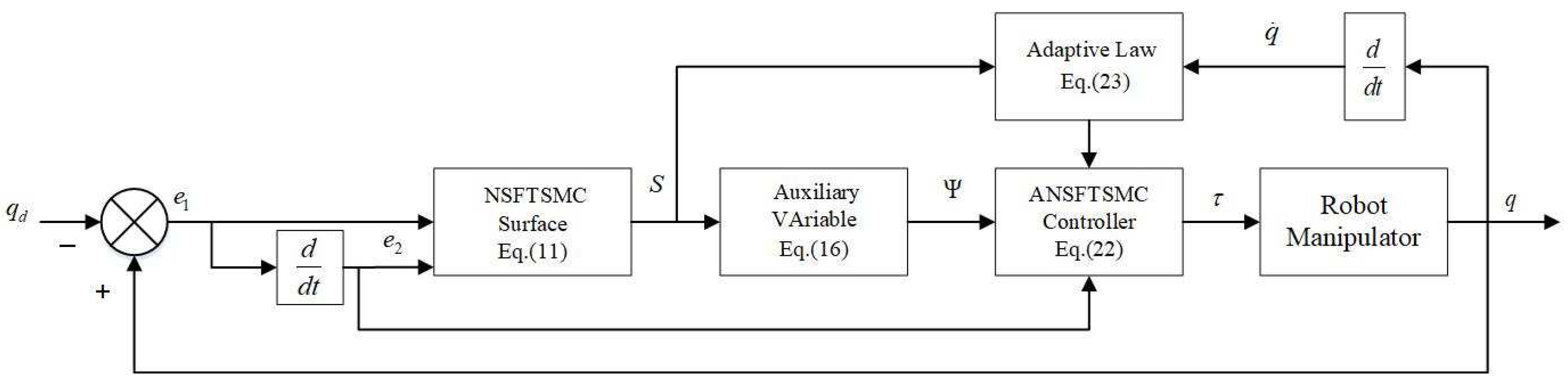
In this paper, an adaptive nonsingular fast terminal SMC (ANSFTSMC) approach is proposed for a class of robot manipulators with internal uncertainties and external disturbances such that the tracking error can converge to the neighborhood of the origin during a finite time. The main contributions are as follows. First, a new terminal sliding surface is designed to avoid the occurrence of singularity problem. Second, during control law design, an auxiliary function method is developed to overcome the singular problem caused by matrix inversion. Compared with the traditional piecewise continuous function methods, the auxiliary function method can reduce the design difficulty and the burden computation. Third, robust adaptive method is used to design feedback term to compensate for the sum of uncertainties, whose upper bound need not be prior known.
The remainder of this paper is organized as follows. The problem formulation is presented in
Section 2. The construction of a nonsingular fast terminal sliding mode surface, the detailed design process of controller and stability analysis are introduced in
Section 3. The simulation results are shown in
Section 4. Finally,
Section 5 concludes this work.
2. Problem Formulation
Consider an
n degrees-of-freedom rigid manipulator, whose dynamic equation is expressed by [
17]
where
is the vector of joint angular position,
is a symmetric positive definite inertia matrix,
represents the vector of centripetal and Coriolis torques,
is the gravitational force,
is the input torque, and
represents the sum of external disturbances and unmodeled dynamics.
Due to modeling errors, physical parameter perturbations and other factors, there exist some unmodeled dynamics in robot manipulator systems as follows:
where
,
and
are the nominal components of robot manipulator systems;
are uncertainties.
Combining (
2) with (
1) leads to
where
. Let
. Then, (
3) may be rewritten as
Let us define
and
as follows:
where
is the reference trajectory. From (
4) and (
5), we can obtain the error dynamic equation as
where
,
.
Based on the above system descriptions, the following lemmas and assumptions are given in this article.
Lemma 1 ([
18])
. For a given system , if there exists a continuous non-negative function and scalars and such that holds, then the system is finite-time stable, that is, x converges to a small residual set in a finite time, where ,Here, indicates the initial time of control system operation.
Lemma 2 ([
19])
. For , and any constants , the following inequality holds: Lemma 3 ([
20])
. For any positive number , , there exists a constant r, which satisfies Assumption 1 ([
14])
. The sum of uncertainties meets the following inequality:where , . Here, is a positive constant for i = 1, 2, 3; the operator means taking the Euclidean norm for ·. The control objective of this paper is to design an adaptive nonsingular fast terminal sliding mode controller
for the system (
4) to make the joint position of the manipulator
track the reference trajectory
in a finite time. In addition, by constructing a nonsingular terminal sliding surface and auxiliary function, the singularity problem is avoided during the controller design.
4. Simulation
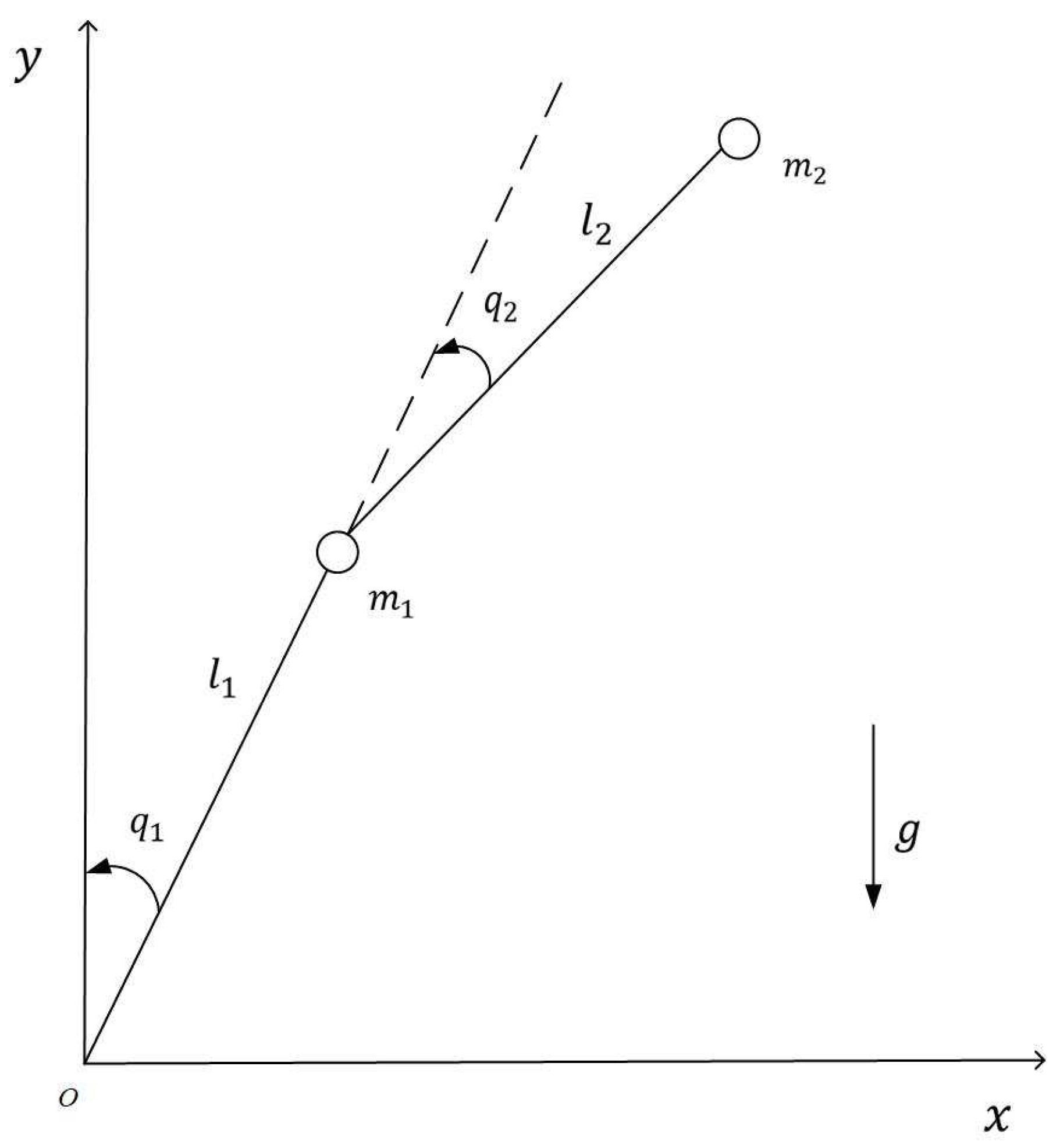
Consider a two-joint rigid robot manipulator [
17] shown in
Figure 2.
The dynamic of robot manipulator in (1) and (2) by Lagrangian equation is represented as
where
,
,
,
,
and
.
Table 1 shows the physical attributes of the manipulator used for the simulation analysis.
The reference position trajectories are rad and rad. , . The initial states of the robot manipulator are set as follows: , , and .
The ANSFTSMC approach proposed in this paper (including nonsingular fast terminal sliding surface (
11), control law (
22) and adaptive law (
23)) is applied for simulation, where the parameters are set as
,
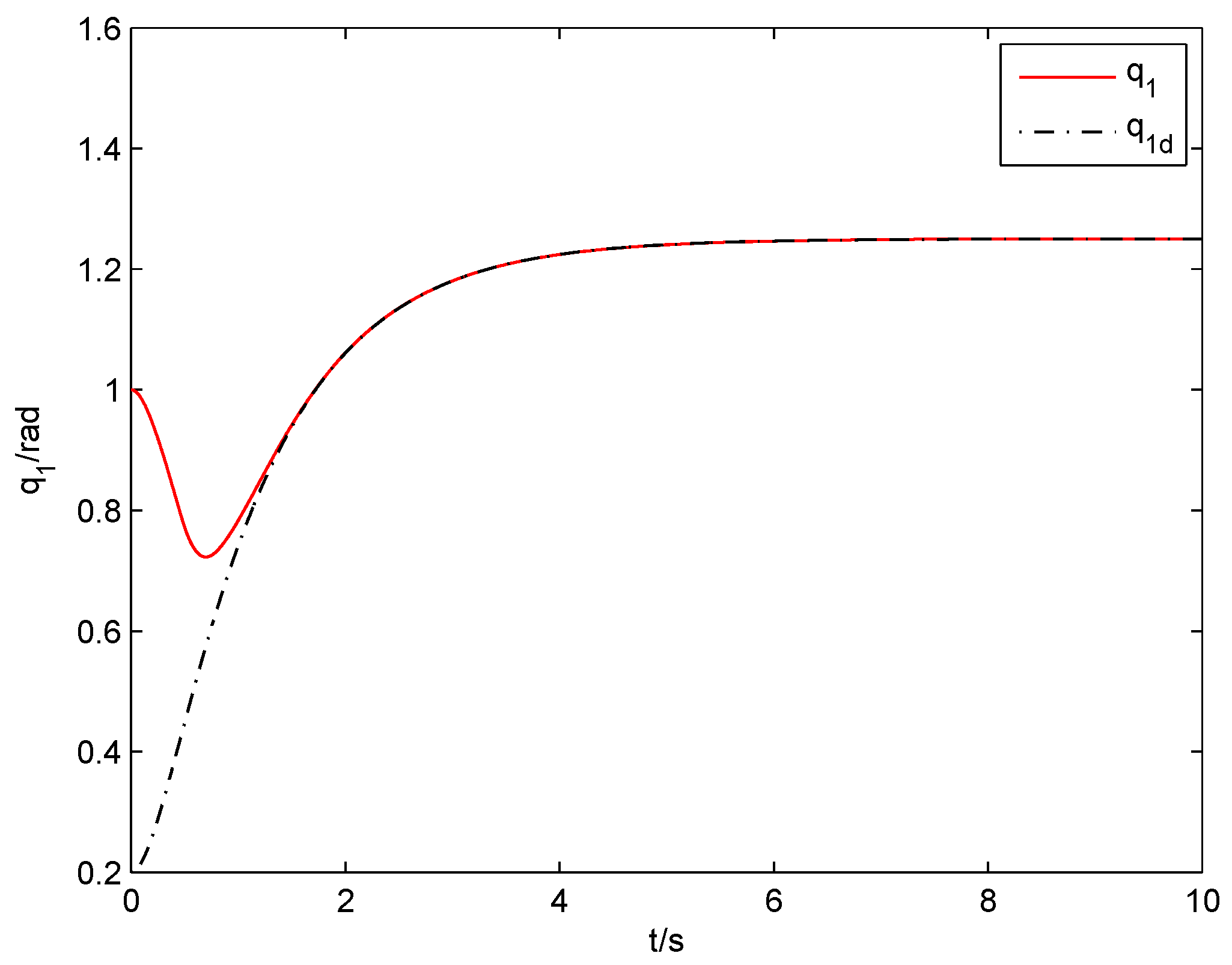
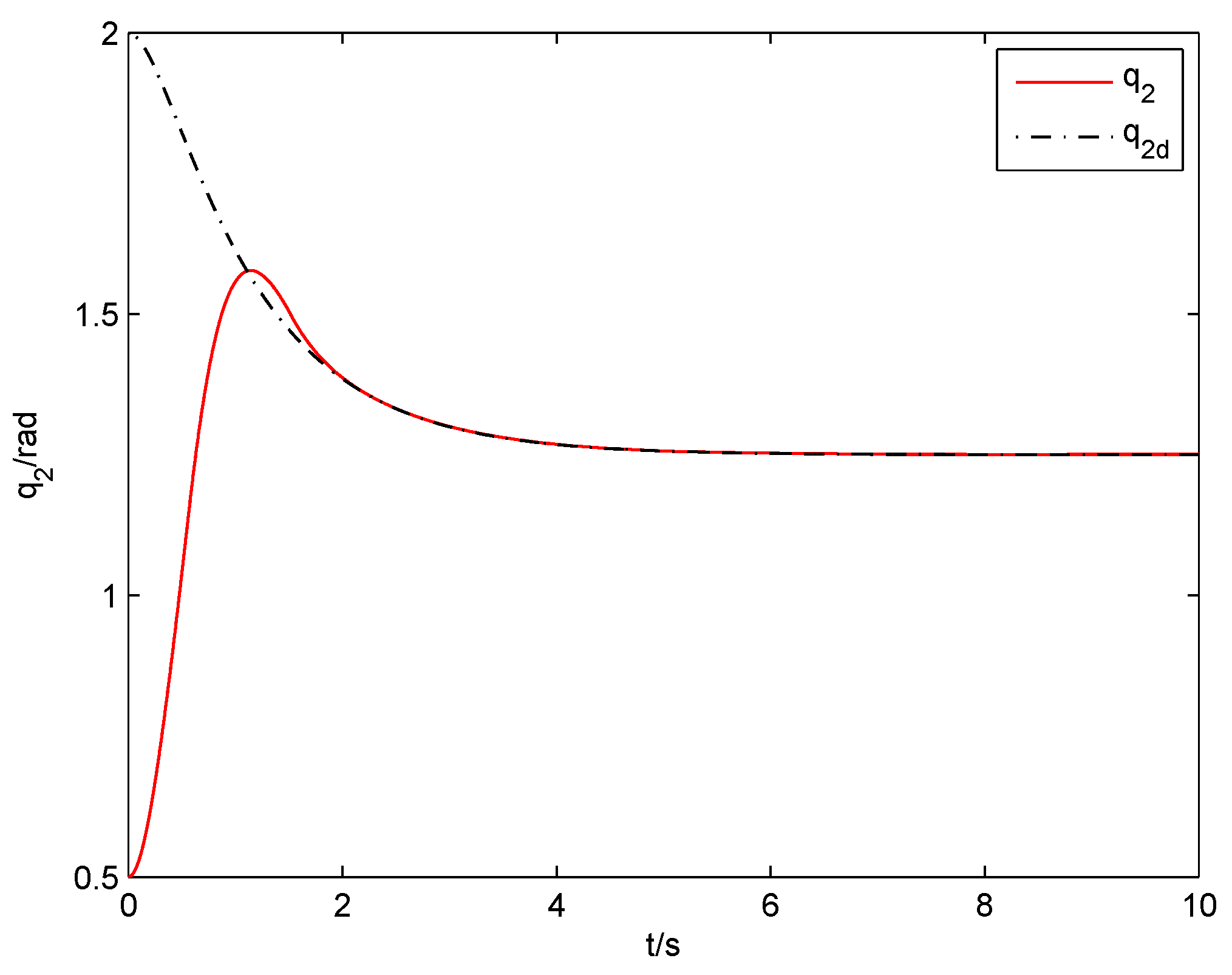
. The angular positions of joints 1 and 2 in are illustrated in
Figure 3 and
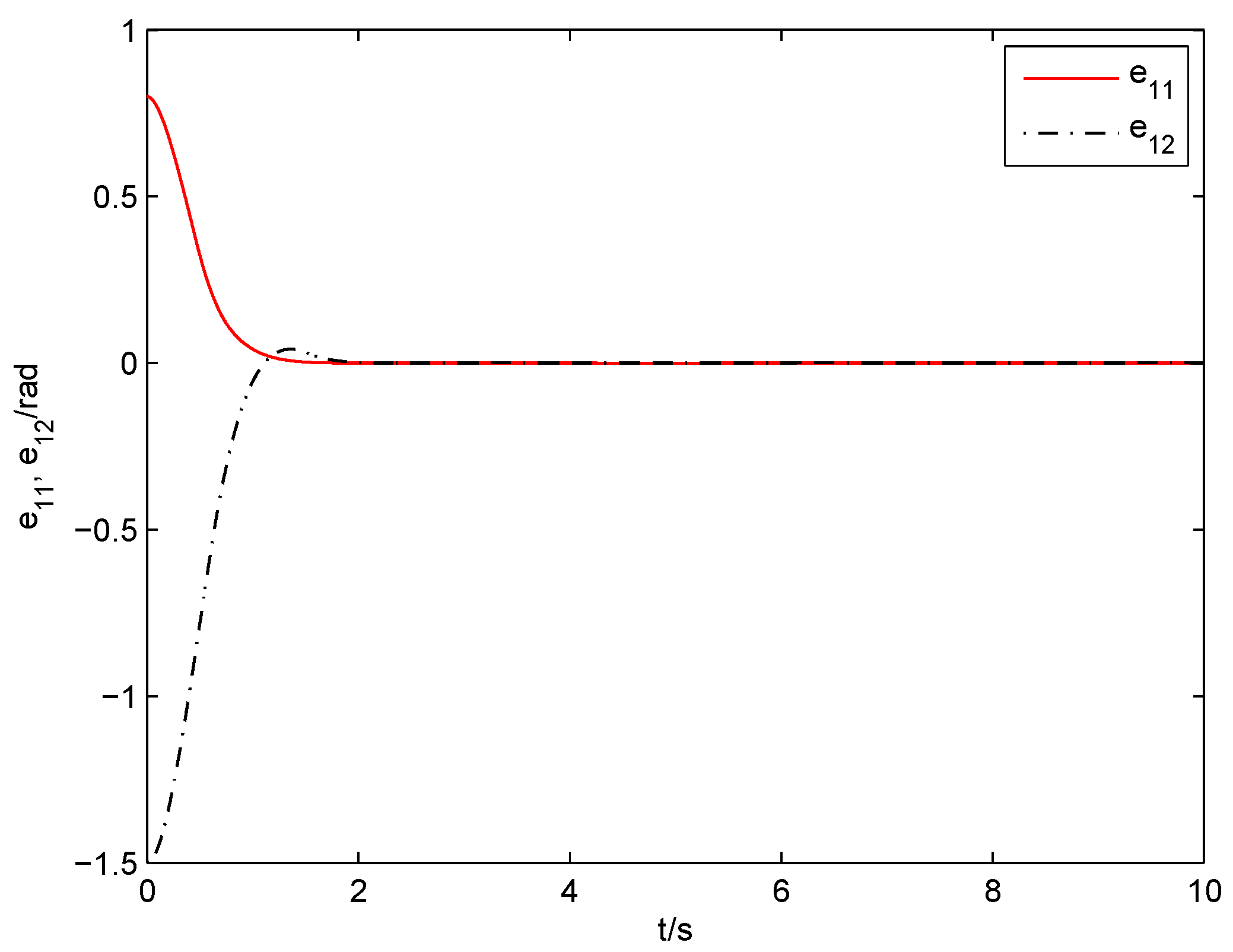
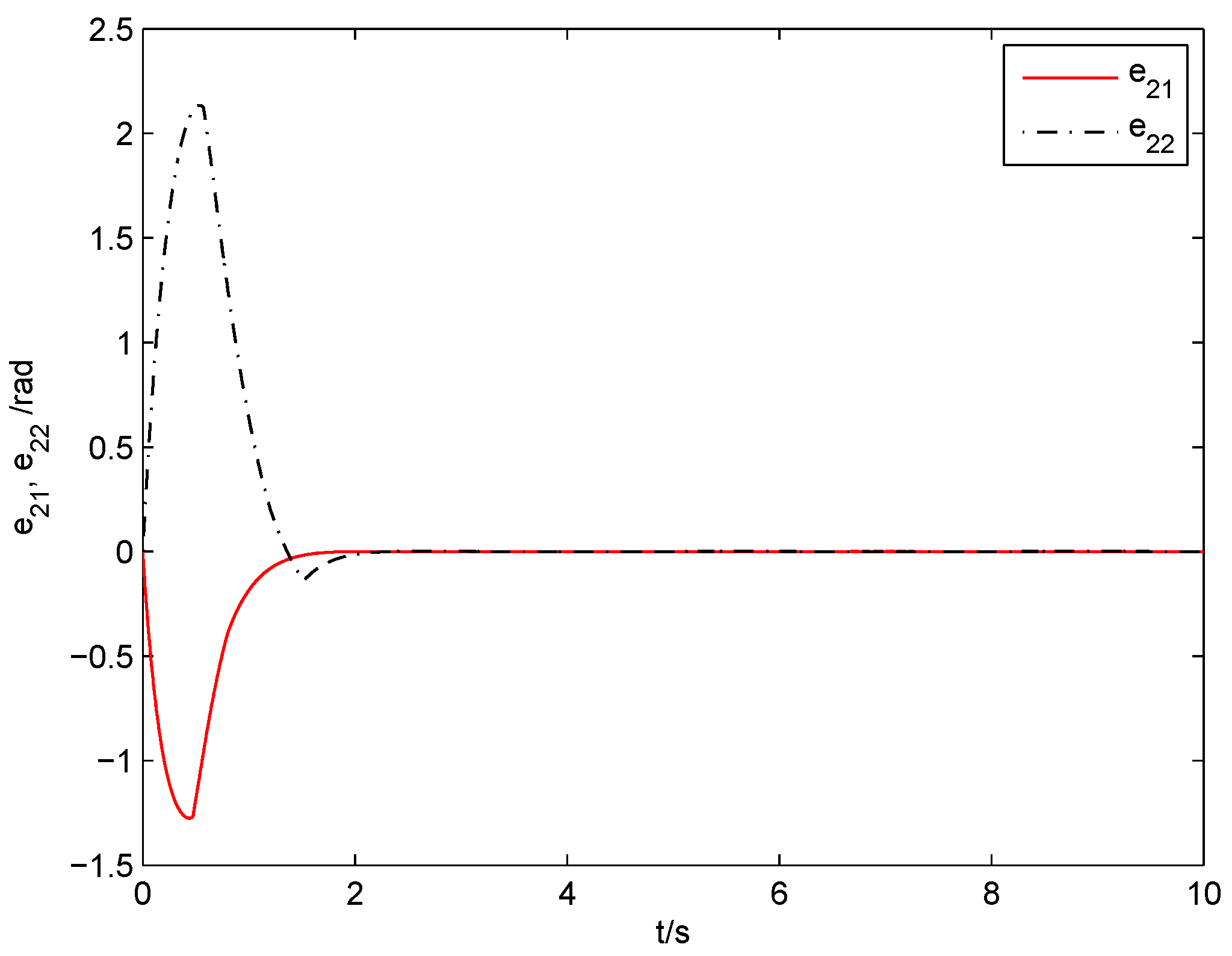
Figure 4, respectively. The angular position error signals and angular velocity error signals of two joints are shown in
Figure 5 and
Figure 6, respectively. It is observed from
Figure 3,
Figure 4,
Figure 5 and
Figure 6 that favorable trajectory tracking responses are obtained by using the proposed control law.
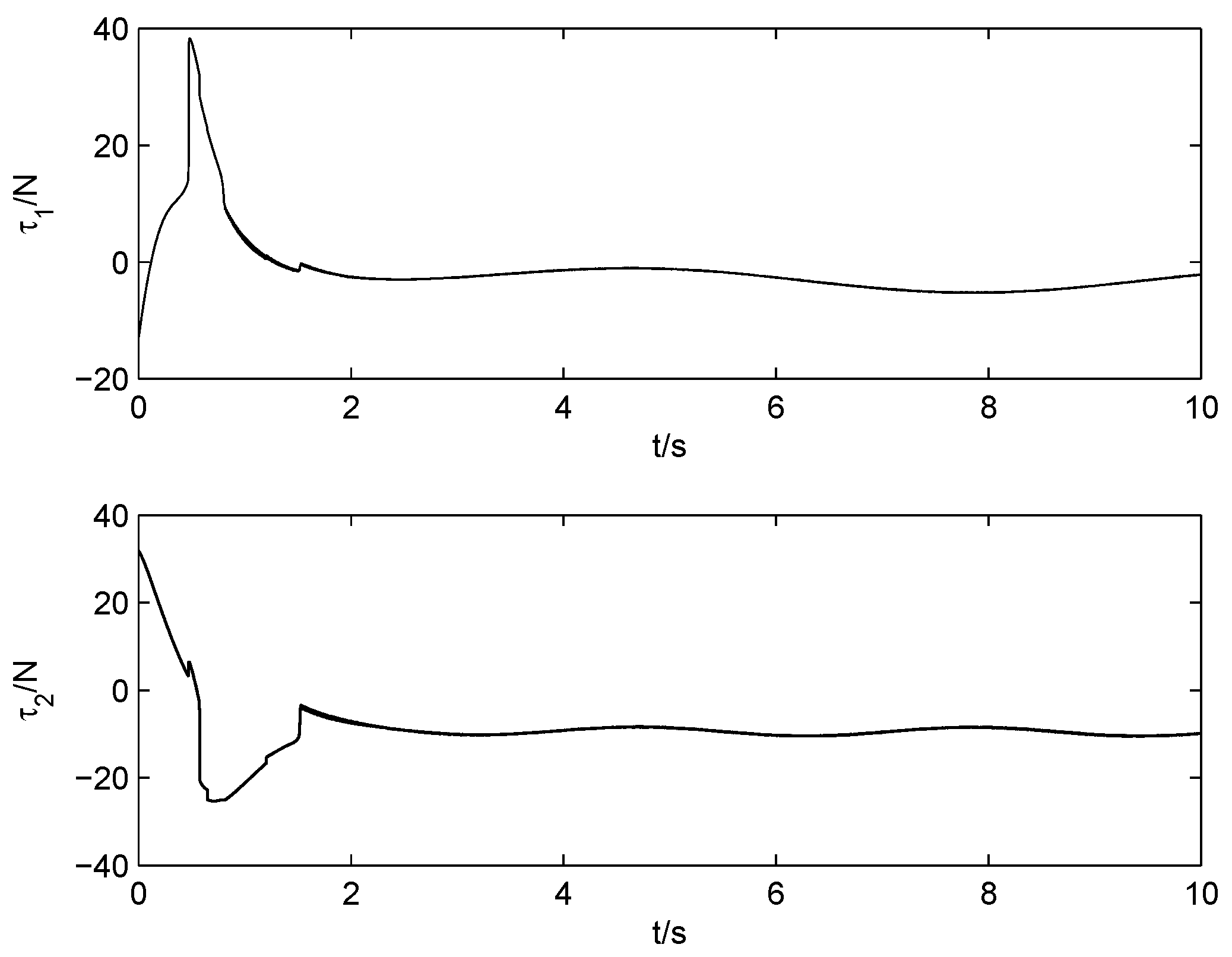
Figure 7 exhibits the control torques, which shows that the input signals are continuous and chattering-free.
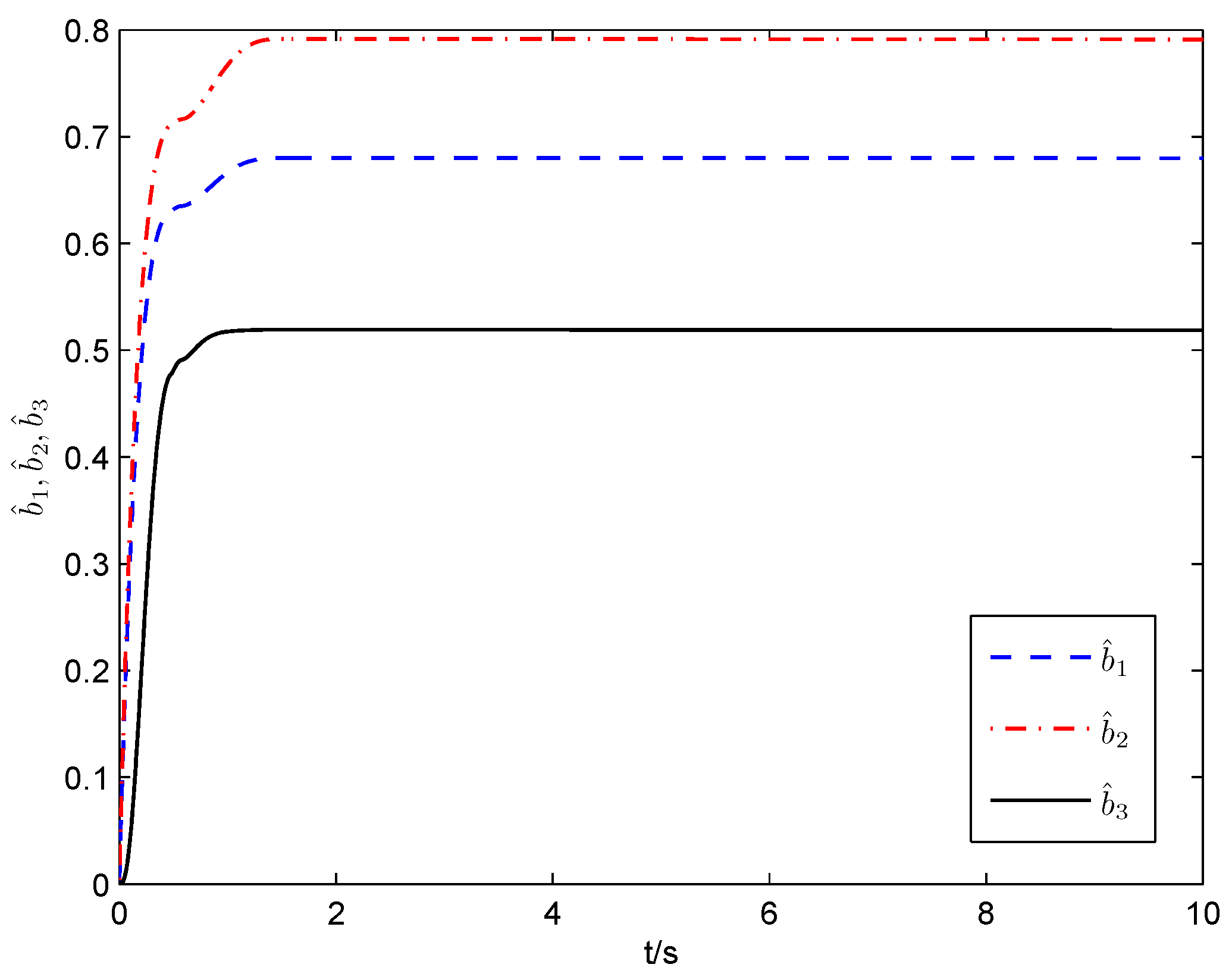
Figure 8 displays the parameter estimation. We can see that
and
can converge to corresponding constants over time, respectively, which indicates good compensation for the uncertainties in robot manipulators.
Remark 5. In Section 3, the design parameters are theoretically required to meet , , , , . In the practical application, we recommend to set their values as follows: , , , , , , , . In order to verify the effectiveness of the proposed control approach, two comparisons will be carried out.
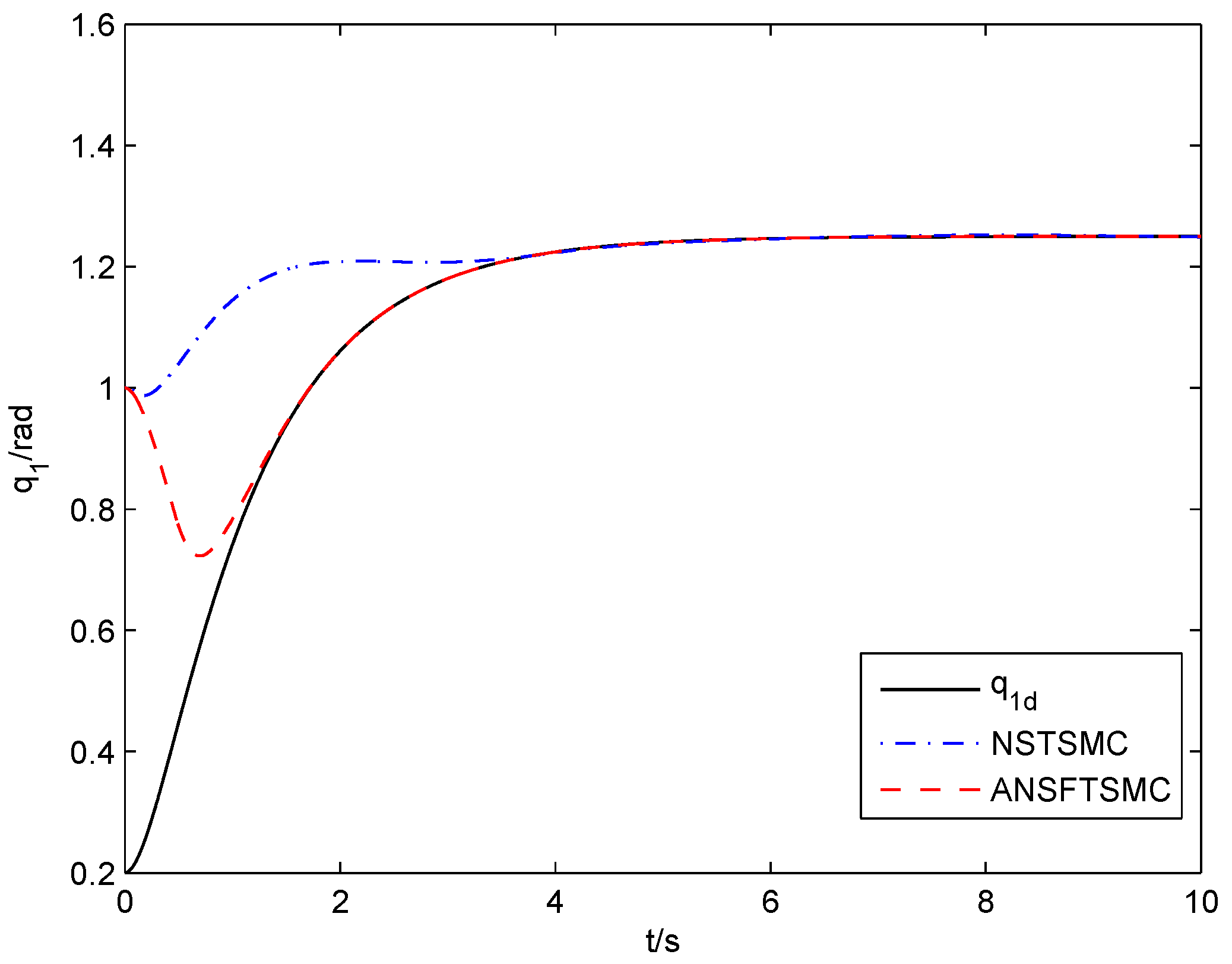
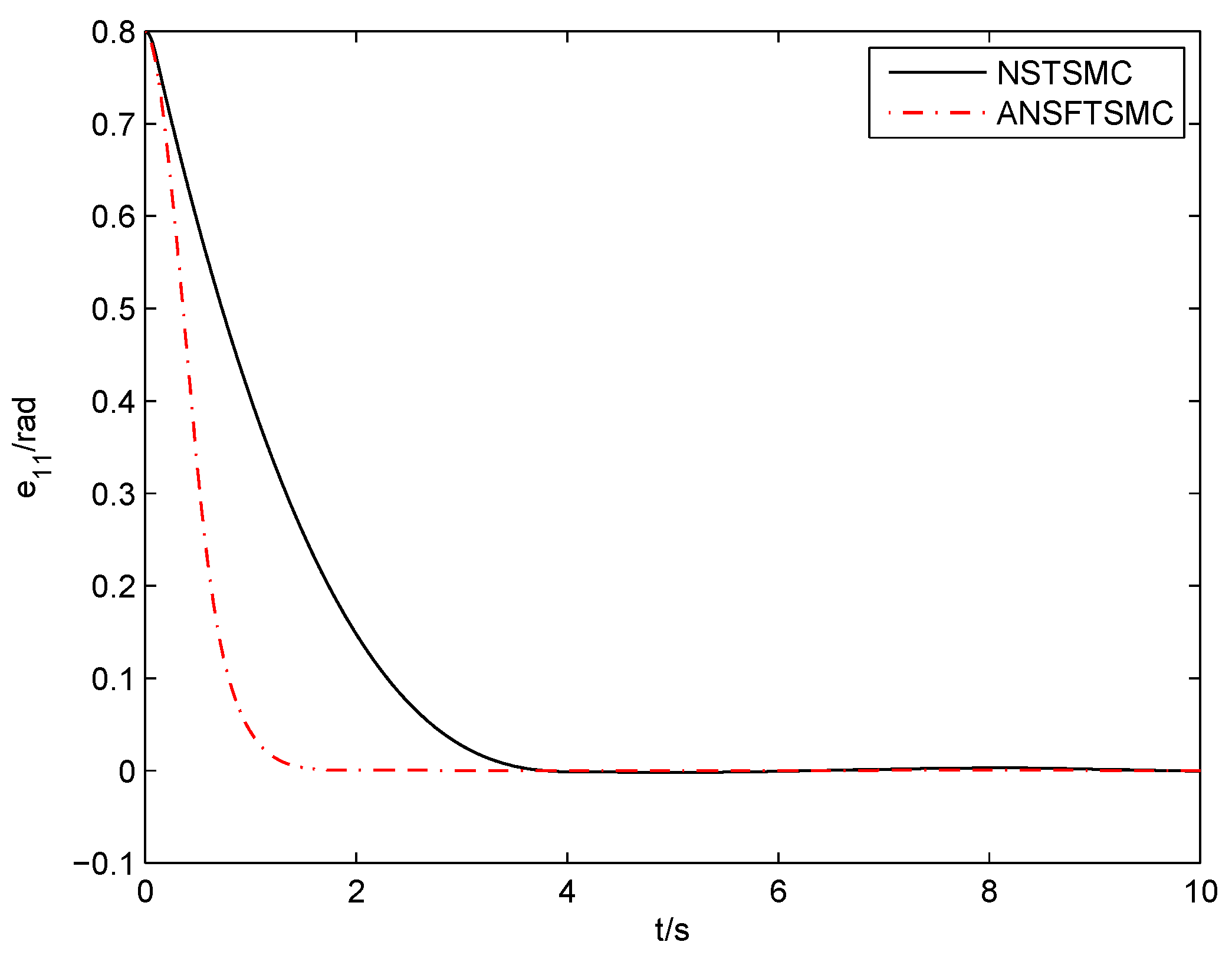
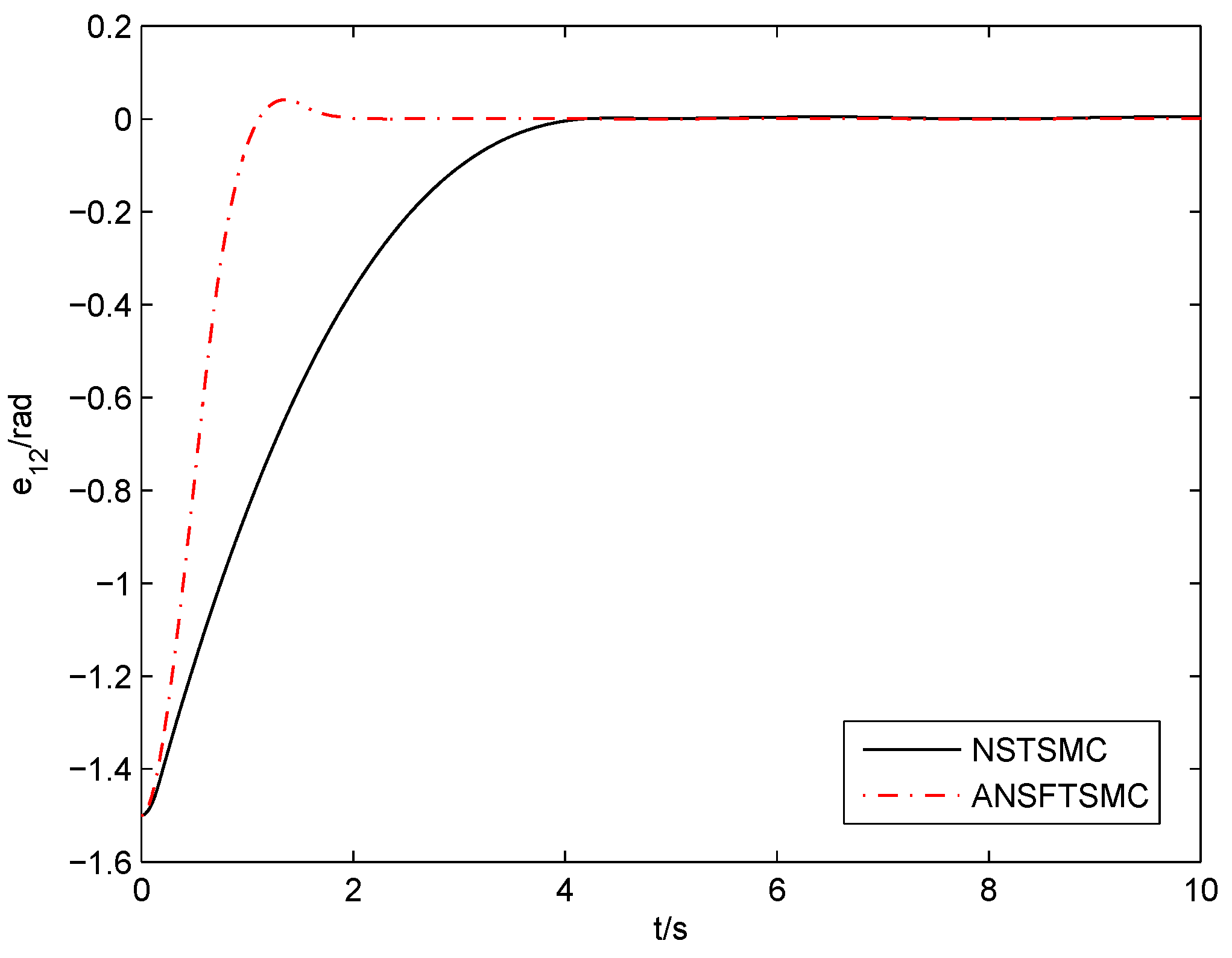
Comparison A: The following sliding surface and the nonsingular terminal SMC (NSTSMC) law proposed in [
14] are introduced for comparison as follows:
where
The design parameters of (41) and (42) are chosen as
and
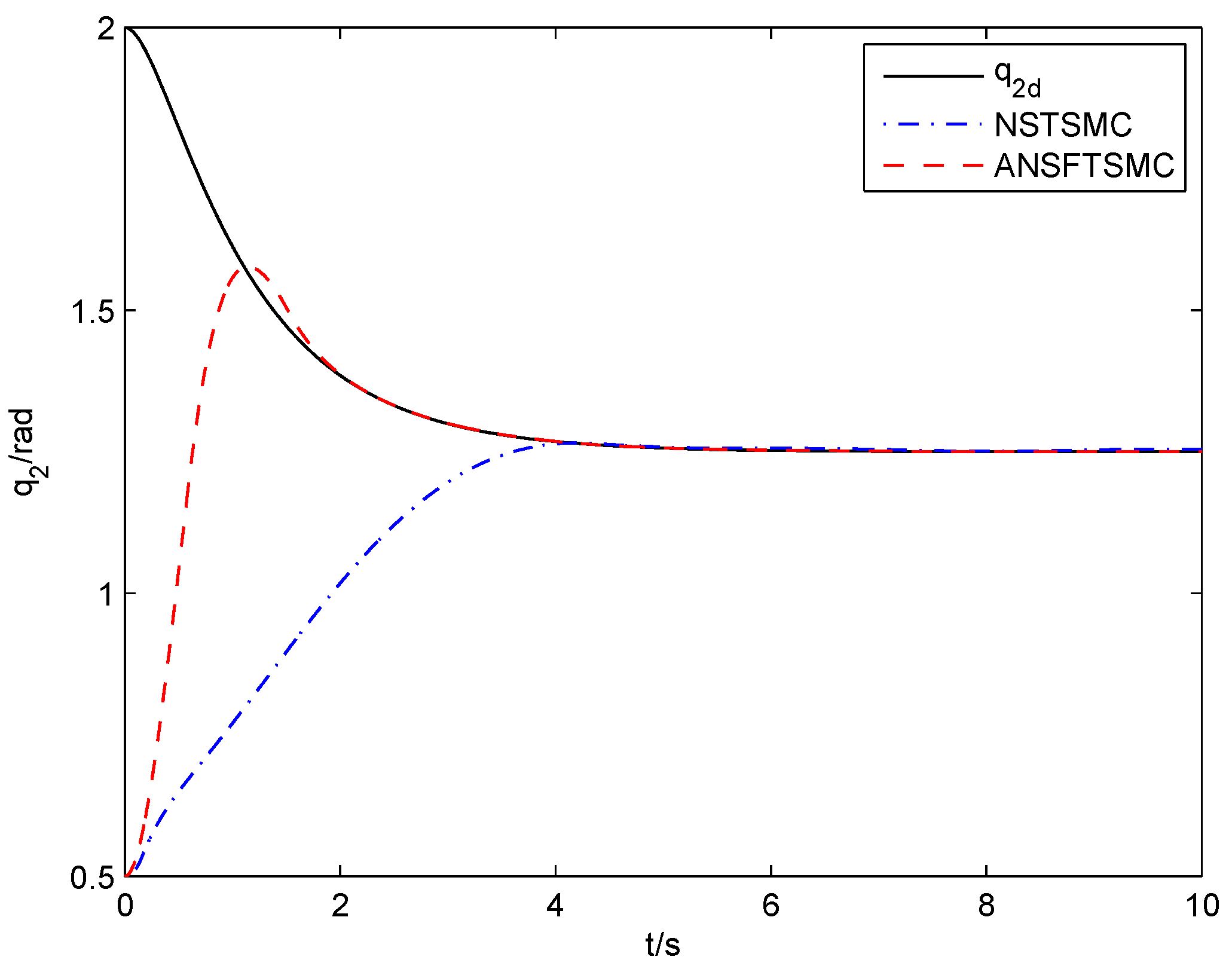
, respectively. The simulation results are shown in
Figure 9,
Figure 10,
Figure 11 and
Figure 12. From them, we can see that the convergence speed of the proposed ANSFTSMC approach is faster than that of the NSTSMC algorithm.
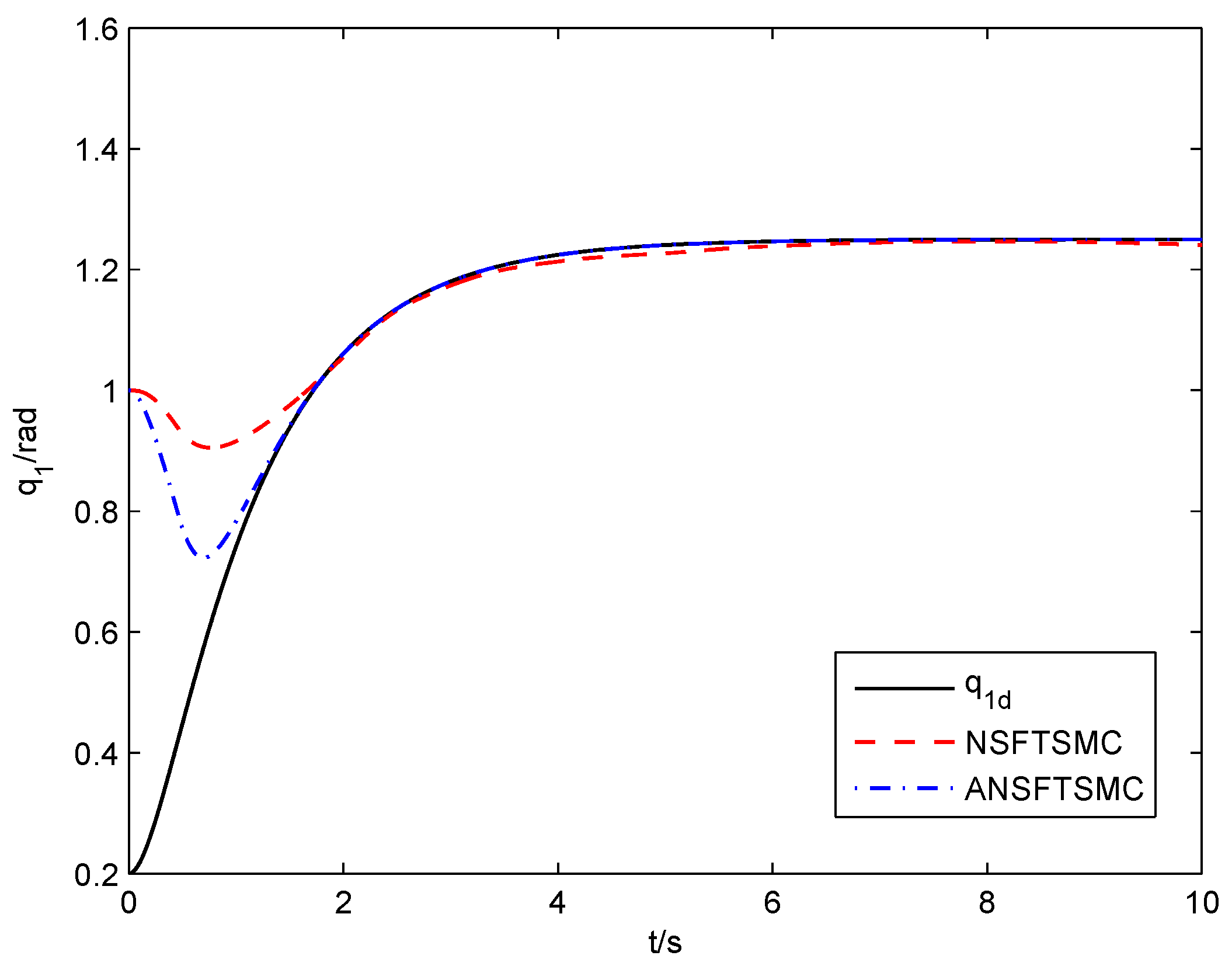
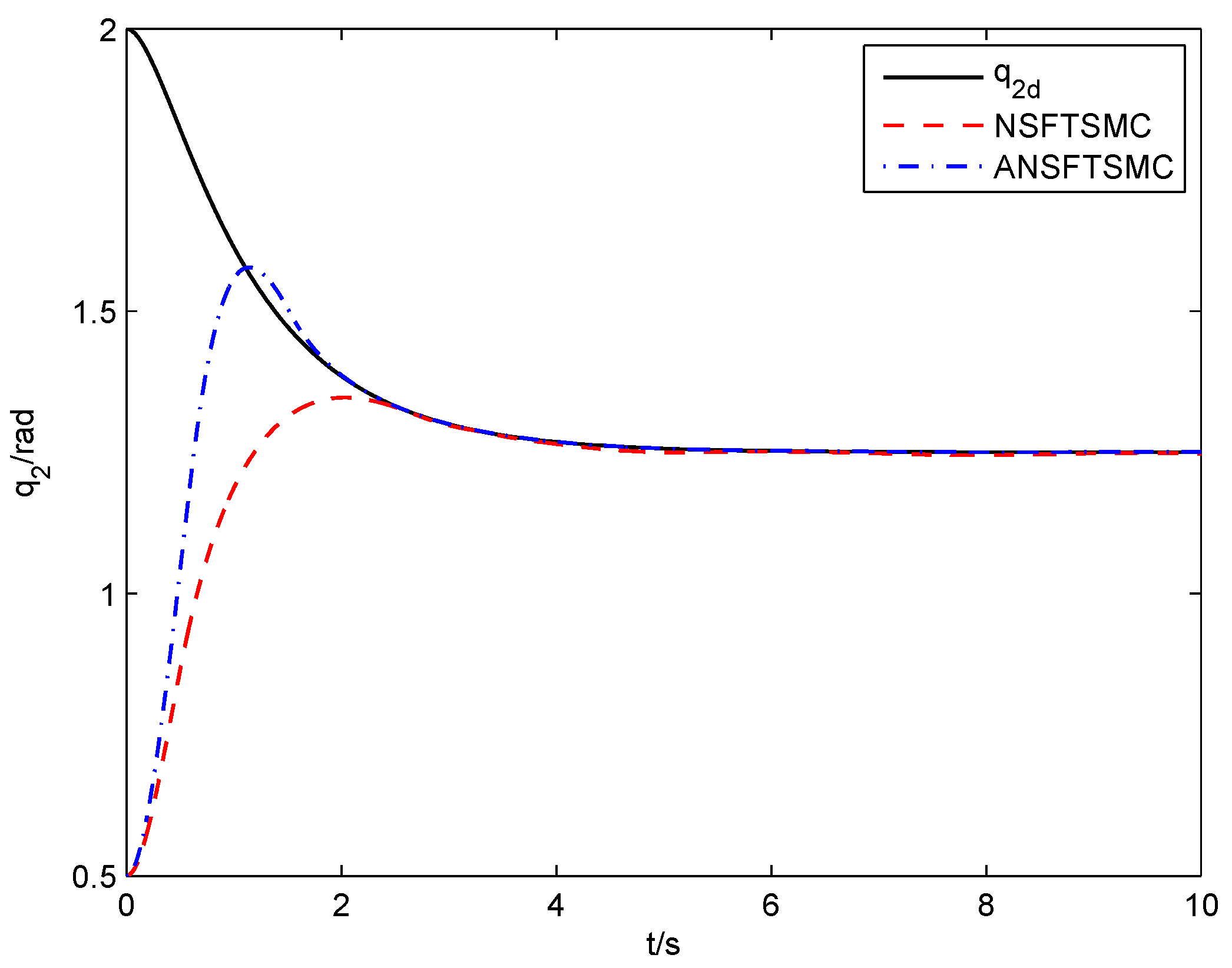
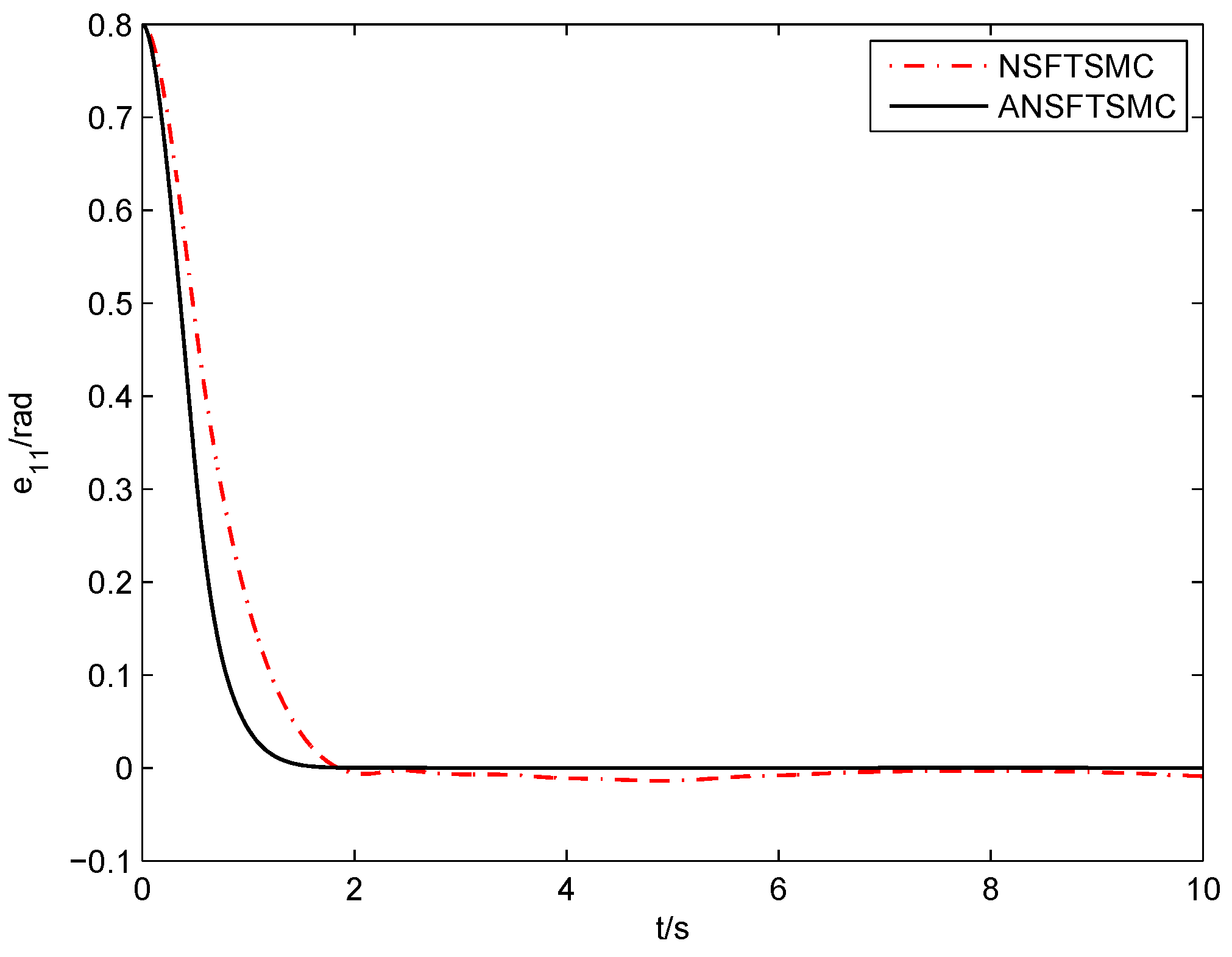
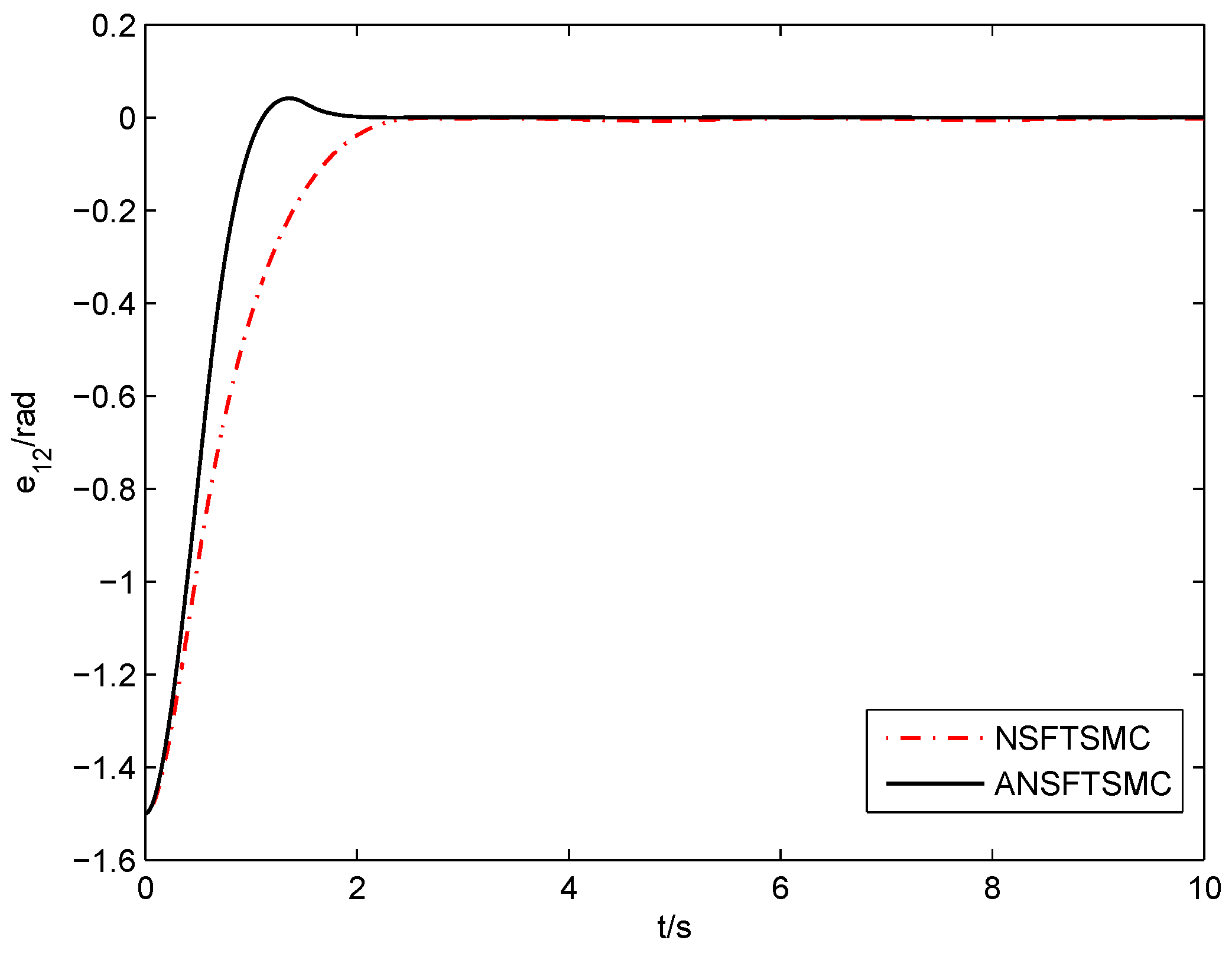
Comparison B: The following sliding surface and nonsingular fast terminal SMC (NSFTSMC) algorithm are designed in light of the literature [
22] as
where
,
,
As shown in
Figure 13 and
Figure 14, the system angular position states track the desired reference signals quickly in the cases of NSFTSMC and ANSFTSMC, respectively. However, the ANSFTSMC system is better than NSFTSMC in convergence speed and stable precision, which can also be verified by
Figure 15 and
Figure 16. In the controller deign of NSFTSMC,
and
are assumed to be known (see (
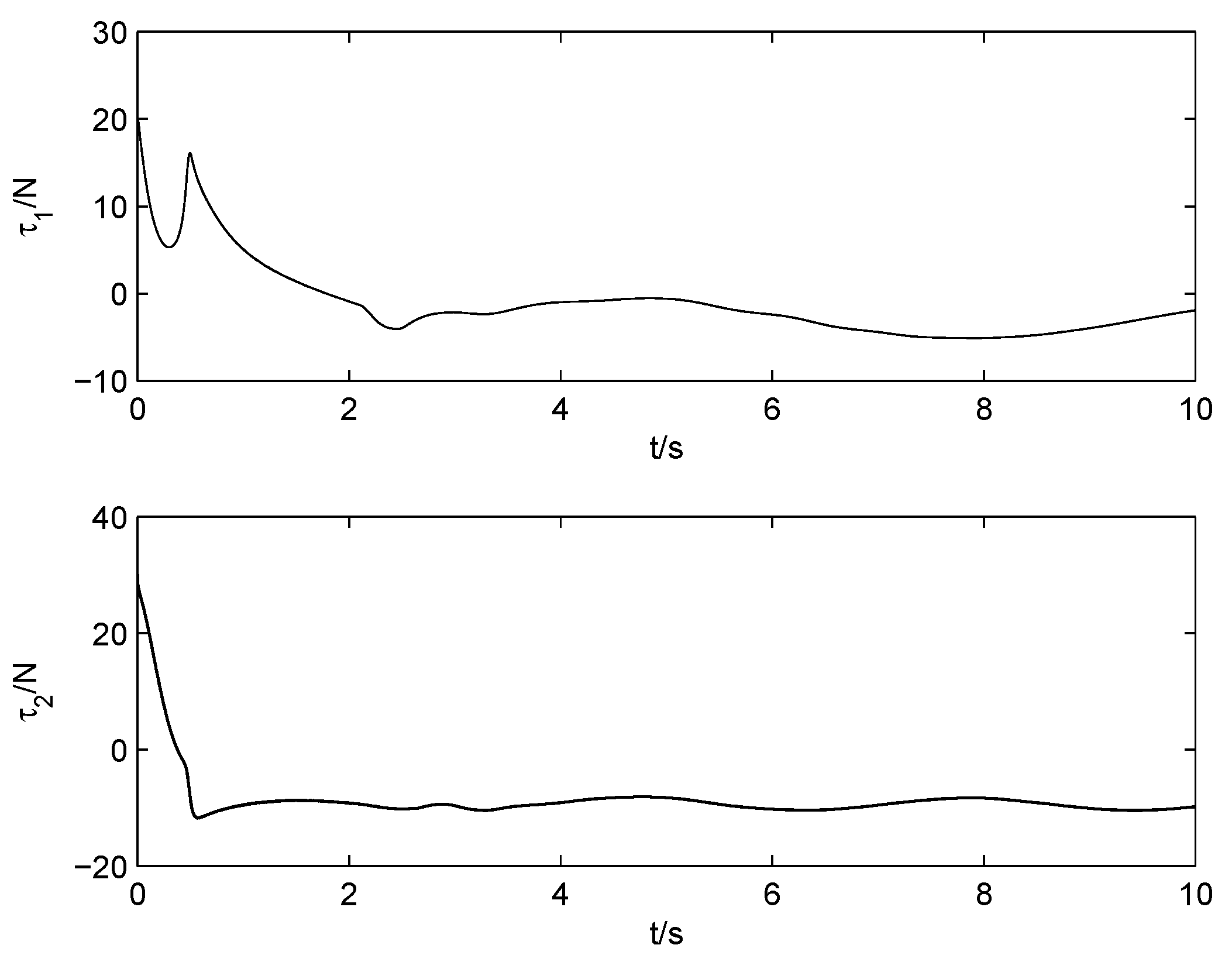
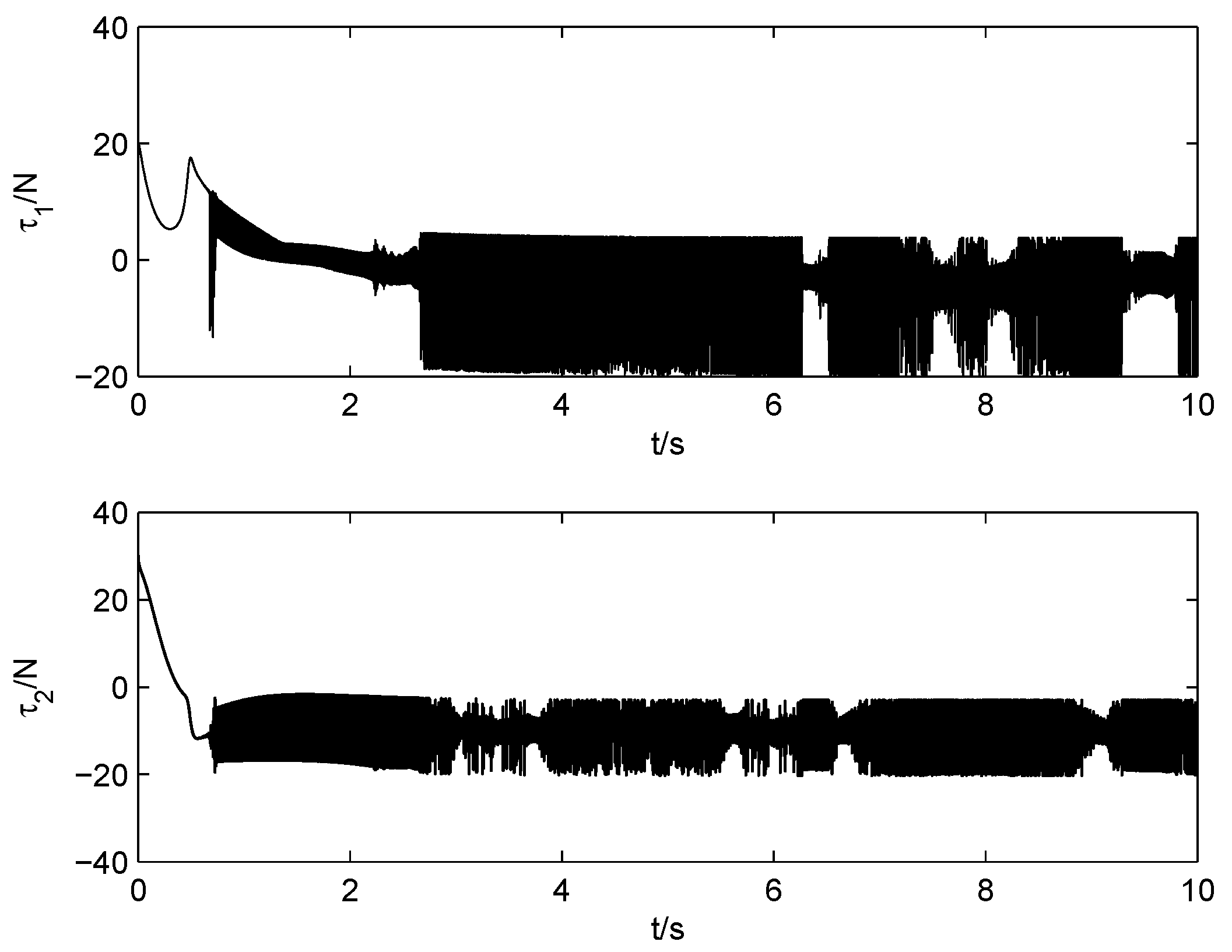
44)), which is required in the controller design of ANSFTSMC. Note that if the design parameter
is set close to zero, then the chattering phenomenon will happen.
Figure 17 and
Figure 18 show the control input for the case of
and
, respectively.