A Survey on Moving Target Defense for Networks: A Practical View



Abstract
:1. Introduction
1.1. Motivations behind Moving Target Defense
1.2. Our Contribution
1.3. Paper Structure
2. Materials and Methods
2.1. Methods
- “moving target defense” and “network”.
2.2. Background
2.2.1. Attack Surface
2.2.2. MTD Techniques Taxonomy
- What to move refers to the choice of moving parameters in the system. Each of them can be dynamically changed within a domain of allowed values. Such changes lead to a change in the system’s attack surface, resulting in increased attack complexity. For this reason, each of the moving parameters must have a large enough parameter space to reduce the chance of being guessed by the attacker. Some examples of this category can be:
- -
- Network level
- *
- Internet Protocol (IP) address
- *
- Port
- *
- Network topology
- *
- Servers
- -
- Address space
- -
- Virtual machine (VM)
- -
- Operating system (OS)
- -
- Software version.
- How to move specifies the means by which to choose a new value and use it to replace a previous parameter. It is meant to increase the unpredictability of the system and confuse the attacker. Such techniques can include the use of:
- -
- Randomness
- -
- Game-theoretic approach
- -
- Approach based on real-life observations.
- When to move defines the optimal time to change the moving parameters. It is crucial to choose the right schedule for that operation, such that performing it too rarely results in not enough security, whereas doing it too often might result in the loss of system performance.
- -
- Timer-based—a moving parameter is changed in fixed or varying time intervals
- -
- Event-based (reactive approach)—a change is done after a certain occurrence, such as after an intrusion-detection system (IDS) detects an intruder.
- Shuffling rearranges system components in various layers, like IPs, address spaces, or network topology.
- Diversity is about providing the same functionality by using different means. For example, different OS, compilers, or even programming languages.
- Redundancy ensures the existence of multiple replicas of the same component, for example, redundant nodes or paths.
- Dynamic Data are techniques that change the format or representation of data dynamically.
- Dynamic Software are techniques that change the application’s code on the fly.
- Dynamic Runtime Environment are techniques that change the application environment. This group can be further subdivided into address space and instruction set randomization.
- Dynamic Platform are techniques that change the platform properties, like hardware components or OS version.
- Dynamic Networks are techniques that change network characteristics of the system, like topology or protocols used.
2.2.3. Attacks
- Reconnaissance. Also called a scanning attack, reconnaisance is used by an attacker to obtain information about the target. These might include IP addresses, open ports, running services, OS version, and network topologies. Gathered data might then be used by the attacker to prepare before a real attack is launched, for example after discovering that target runs an unpatched application with a known vulnerability. Reconnaissance attacks can be divided into two types—passive and active. During a passive attack, an attacker does not interact with the target, which might include using public resources. This type of information gathering is also called open source intelligence (OSINT); for a more detailed description, refer to [34]. As for the active reconnaissance, the attacker is allowed to interact with the target, for example by directly scanning it. This might lead to gathering more data faster, but carries a significant risk of detection. There exists a huge number of dedicated tools to perform a target scan, some of the most popular examples of which are Nmap [35] for the network scan, Aircrack-ng [36] focused on WiFi network security, and Nessus [37] for vulnerability assessment. It is important to note here that these tools might be used not only with malicious intent, but can also be run by the defender in order to provide important information in order to harden the network.
- Denial of Service (DoS). DoS is a type of attack that disrupts the normal functions of a device. A variant of DoS attacks called distributed denial of service (DDoS) is often used to bring down networks or servers. It involves using a large number of hosts, often a part of botnet, all working together to bring the target network down. In networks, this might involve sending a large amount of requests to a server, that overwhelms it and makes it unable to process them in real time. This so called ‘flooding’ might involve ICMP or ACK packets. A type of DDoS attack is crossfire attack that targets only few, selected links in the network masking itself very well, thus making it particularly hard to detect. More on that attack can be found in [38], and [39] talks about how various network topologies impact the detectability of crossfire attacks. Currently DDoS protection can be offered by vendors like Cloudflare [40] that provide solutions to detect the attack, then drop malicious traffic or reroute it, detect and block offending IPs etc.
- Zero-day. Sometimes also called 0-day, zero-day is a name for vulnerabilities before they are patched. In worst case scenarios, it can take months or even years before they are even detected, allowing the attacker to exploit a system, which is otherwise considered secure, in an unbothered manner. Report [41] indicates a huge rise in the number of exploited zero-days in 2012 compared to previous years. They were mostly used by state actors, targeted to spy on huge companies, but financially motivated attacks are also on a rise. The article [42] attempts to assess the security impact of unknown vulnerabilities on computer systems.
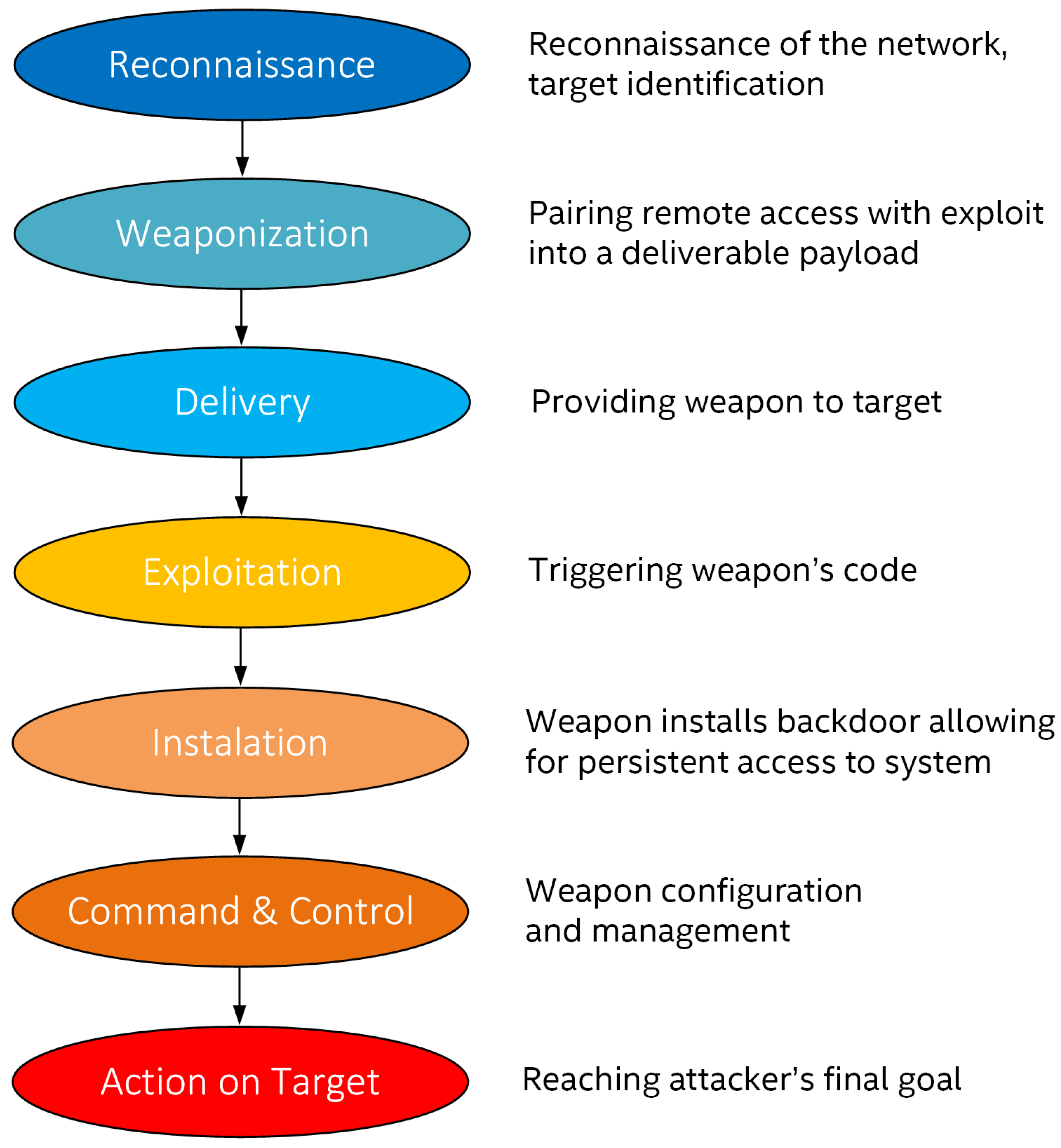
- Advanced persistent threat (APT) as described in [43] refers to an attack strategy by a bad actor with access to significant resources, both technical and financial, and high levels of expertise, allowing him to use multiple attack vectors to achieve his goal, which might be to extract information or to impede critical infrastructure or processes. Proposals for a multistage approach that such attacker must use to fulfill its objectives were introduced in [44,45]. The first stage of an APT is always reconnaissance; the attacker wants to understand as much about the target as possible. This could consist of technical information-gathering techniques, like port or service scanning, as well as the use of social engineering on the company employees to obtain necessary information. When this is finished, the attacker then attempts to gain a foothold in the attacked system, which can be done by means of using malware or zero-day vulnerabilities, as well as spear-phishing and a watering-hole attack. More data on APT campaigns is presented in [46], along with the entry methods used. After gaining access to the system, the attacker begins to slowly spread throughout it, which can take a long time, if one is to avoid detection. Finally, the attacker attempts to exfiltrate the data or impede the system. MTD might be perfect to protect against this type of attack, as shown in [4]. Multiple MTD techniques can be applied at each step of APT. However, from the defender’s point of view, the best scenario would be to prevent the malicious actions early to stop it from ever gaining entry into the system, for example by significantly increasing the complexity of the reconnaissance stage. In [47], the authors talk in detail about the targeted nature of APTs, their characteristics and the motives behind them.
2.2.4. Potential MTD Implementation Techniques
3. Trends in MTD
3.1. What to Move
3.1.1. Address and Port Mutation
3.1.2. Route Mutation
3.1.3. Host Mutation
3.1.4. Dynamic Resource Allocation via MTD
3.1.5. Architectures Utilizing Multiple MTD Methods
3.1.6. Other
3.2. How to Move
3.3. When to Move
3.4. Testbeds
3.5. Threat Model
3.6. Metrics
- Network based performance metrics:
- -
- Packet overhead [118]: Measures the increase of packet size after applying MTD techniques.
- -
- -
- -
- Routing overhead [17,95,99,101,109]: This metric describes the overhead introduced by changes to network routing rules introduced by the applied MTD technique. In [109], the authors measure routing table size and convergence time. The number of flow rules in switches generated by the MTD technique is used as a metric in [17,95,101]. The solving time for route selection is measured in [99].
- -
- -
- -
- DNS [109]: Measures the change in number of queries to DNS.
- -
- Traffic dispersion [83]: Measures per-flow and per-node traffic dispersion.
- -
- Hop count [73]: This metric shows the change in hop count between two hosts due to changed paths.
- Computational overhead [73,77,90,100,109]: Measures the amount of additional calculations required by the MTD technique. In [73,77,100], it is tracked as a CPU utilization. The authors of [90] calculate the number of signatures that have to be precomputed in their proposal. The paper [109] measures the time required to find a solution by a satisfiability module theories solver required to plan the MTD mutations.
- Proxy count [103]: This metric calculates the number of proxies required to isolate 90% of innocent users from attackers.
- Deterrence—Quantifies the cost incurred by the attacker expressed as a time required to complete an attack compared with legacy network.
- Deception—Quantifies the ratio of missed targets, or the percentage of resources saved, due to applied deception techniques.
- Detectability—Measures the ratio of illegitimate actions committed during an attack, like probing nonexisting destinations in an MTD network compared with a legacy network.
- Unpredictability—Requires that defended assets must be moved in a manner that seems random to clients without proper authorization.
- Vastness—Guarantees that the destination space must be large enough so that it is infeasible by an attacker to find its target by means of an exhaustive search.
- Periodicity—Ensures that the defended assets are moved frequently enough so that any data gathered by an attacker is quickly expired.
- Uniqueness—Guarantees that the system can authorize each client, in a way that cannot be shared with any other client, after it meets preconditions set by that system.
- Revocability—Provides a way for the system to revoke or expire once granted authorization without causing disruption to other clients.
- Availability—Guarantees that once a client is authorized, it can successfully reach its target. This also requires the MTD technique to not introduce any new denial-of-service vulnerabilities.
- Distinguishability—Allows the system to separate trustworthy clients from untrustworthy ones.
- Diversification—Requires the system to support multiple configuration choices.
- Adaptations—Ensures that the system supports both the the movement within the system that does not change the network graph’s shape and size as well as the movement that does change it.
- Randomization—This metric covers the unpredictability of both movement and network configuration transformations.
- MTD Entropy—Measures the effectiveness of MTD defense solution.
- Ease of Deployment—Measures whether the system supports platform independence as well as protects against a large set of cyberattacks.
- Timelines—Ensures the system is capable of performing MTD movement within a given time period.
- Scalability—Measures the capability of the system to handle huge amounts of clients, IP prefixes, and matching rules.
- Wide-area load balancing—This metric describes the system’s ability to disperse attack traffic over available resources.
- Cost consciousness—Measures the cost to deploy and run proposed MTD defense.
4. Discussion
4.1. Application to Existing Networks
4.2. Hardware-Accelerated MTD
- Improved introduction to established networks. With the help of specialized devices, MTD could be introduced simply and without major disruption to existing networks. Such hardware should require little configuration to work properly to reduce the chance of human error during installation and provide expected security levels out of the box.
- Enhancing MTD in networks already defended by MTD. In this scenario, the addition of hardware accelerators to offload MTD-related computations can improve both network performance and MTD defense. Such devices could take away additional operations needed to operate MTD from existing infrastructure, thus increasing throughput, latency, or other parameters of the network. Additionally, they might be added to improve defensive parameters of MTD, like more frequent parameter change, with no negative impact to network user experience.
- Address and port mutation
- SDN-based MTD
- Route mutation
- Host migration
- Algorithms
4.3. Security of MTD Techniques
- Lack of clearly defined and realistic threat model: In Section 3.5, we have presented our findings on threat models defined in surveyed papers. We found that in many cases, it might be too simplistic, and thus not realistic enough. These models often boil down to assuming that an attacker is located outside the network and launches some specific kind of attack. A common pitfall we’ve noticed across the literature was assuming the attacker actively engages with the network, most commonly by probing IP addresses. In real networks, this kind of behaviour would likely be quickly picked up by existing sensors and such an incident would alert defender’s security team.
- Protection against insider threats: Although closely tied to the previous point, insider threats deserve a mention on their own. Cybersecurity and infrastructure security agency defines insider threats as potential for people with elevated access and knowledge in the organization to harm it [143]. According to a report by IBM, malicious insiders were responsible for 5 to 29% of the attacks, depending on the industry [144]. Although this is a serious threat to computer systems, most MTD papers never consider their impact on the security of the scheme. It is unclear how damage can be caused by a malicious employee who leaks the real IP of a machine protected by constant address mutation or MTD algorithm details.
- Lack of realistic testing scenarios: In Section 3.4, we have presented test methods that were used throughout surveyed papers. As further stated in Section 4.1, not many of those proposals were actually tested on real hardware. Because of that, it is almost impossible to assess the impact that proposed MTD techniques might have on the availability of network resources to users. Particularly vulnerable might be protocols that require establishing a session, as they might be negatively affected if mutations occur mid-session. Another issue might be the potentially detrimental impact of MTD on overall performance of the network, which might not be noticeable in a simplified, simulation-based environment.
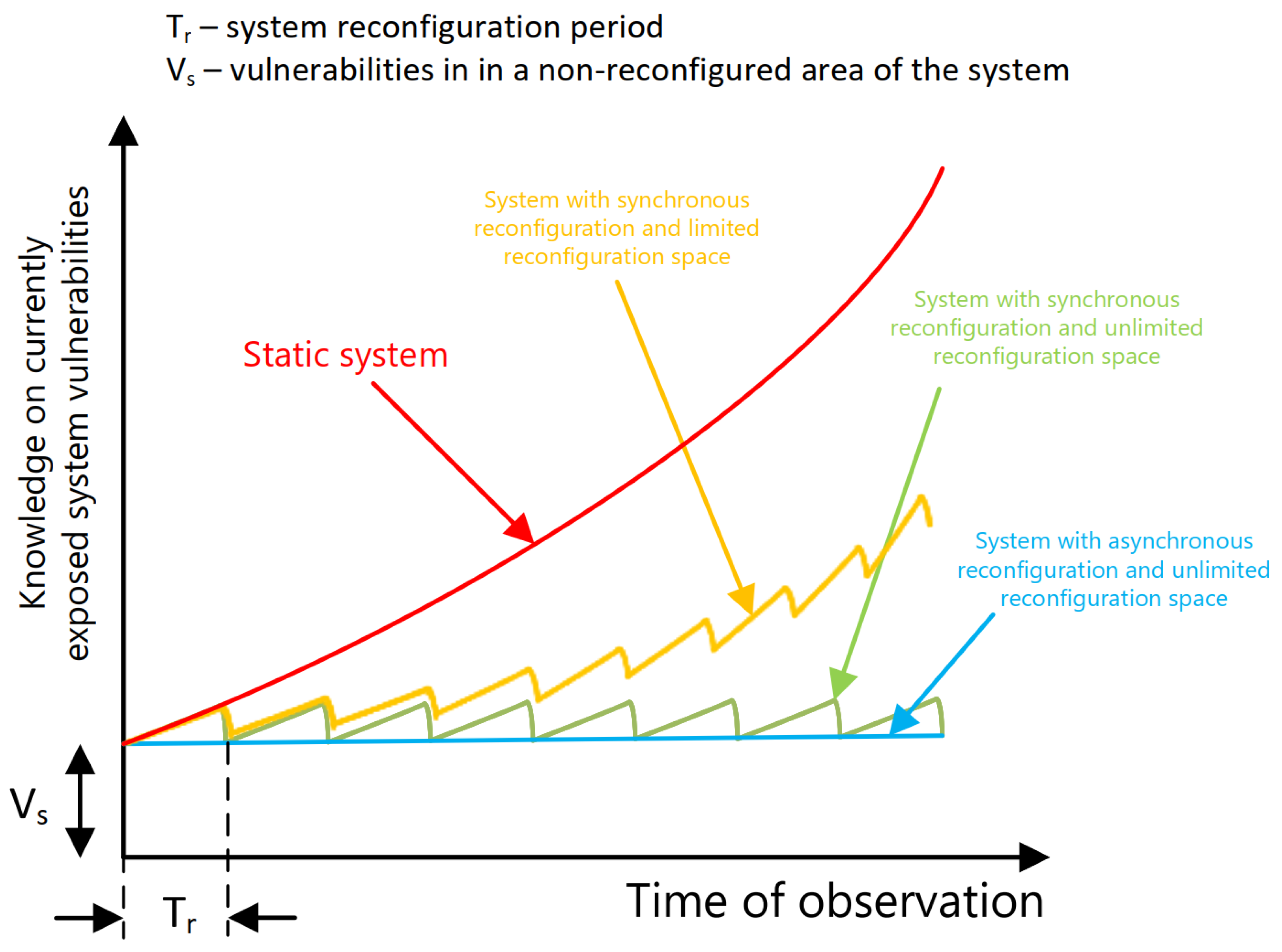
- Lack of understanding how security levels behave after MTD have been enabled for a long periods of time: Figure 2 shows how attackers’ knowledge of a system, which periodically mutates in a limited reconfiguration space, slowly increases over time. Analyzing the surveyed articles, it is not clear enough to conclude for how long these systems would actually work against a determined attacker. State actors might have the funding necessary to observe the system for months or years, slowly gathering intelligence about the network. More research is required to help understand if proposed techniques have a large enough mutation space to effectively protect against this kind of threat over prolonged periods of time.
- Lack of consideration of alternative attack vectors: The next security gap we have identified is the lack of flexibility of surveyed MTD techniques. This proposal often protects against one particular type of attack, but because the aim of MTD is to overcome the attackers’ asymmetric advantage over the defender, these proposals are just not enough. In the case of address mutation MTD schemes, if the attackers purely operate on IP addresses, these techniques might indeed protect the network. However, if the attacker tries to implement more sophisticated attack vectors, like packet analysis, it might overcome this defense completely. We propose that more research time needs to be spent on flexible MTD schemes, which are able to protect against a wide range of threats.
4.4. Metrics
4.5. Research Directions
- Better metrics need to be developed—As shown in Section 3.6, many of the reviewed papers use some performance-based metrics which provide a solid ground on which the proposed technique can be evaluated. However, there is an apparent lack of metrics that provide good understanding of the security level those proposals provide to the network. Although many of the articles use the attack success probability metric, there is a huge variance in both the attacker and how this metric is calculated. Moreover, the proposed attacker may often not be a good representation of a threat to the network in real-world applications. As such, more work needs to be done to provide a set of common and universal metrics that can be applied to any proposed MTD techniques so that they can be easily compared against each other.
- Application of MTD to existing networks—As discussed in Section 4.1, currently there is little work done to assess the applicability of MTD to existing networks. Of the surveyed papers, the majority were tested on a simulator or on small-scale implementations in local networks. There needs to be more research of applications of these MTD techniques in large-scale corporate networks, especially in aspects like the initial costs required in terms of both money and time spent reconfiguring the network, the decrease of general network performance, or the impact to network stability.
- Hardware-accelerated MTD—Closely tied to the previous point, we see great potential in the use of hardware-accelerated MTD to protect the network. Although such solutions don’t necessarily increase security on their own, they provide significant performance improvement over typical computational devices, while being often more powerfully effective and requiring less management. One example of such an accelerator is SmartNIC, which is a type of a programmable device, based on an ASIC or FPGA [145]. These are already utilized in data centers for accelerating SDNs [146] or security-related tasks like DDoS protection [147,148].
- Realistic testbeds—During our research, we identified the need for better testbeds that allow one to simulate MTD in conditions that are as close to real as is feasible. This is especially important when it comes to simulating realistic attackers to measure the effectiveness of a given MTD technique. Although there is a significant amount of testbeds that allow one to simulate even large networks (especially for SDNs) and that offer a great deal of configuration possibilities, replicating realistic traffic on them is much harder. A trivial solution for this problem is to replay the saved packet traffic from files, but this comes with issues of its own. Perhaps the best source of them might be the save the packets from the network that we are going to implement the MTD in, but this might not always be possible. Otherwise one could use many of the traffic files shared for free on the Internet. No matter the source of the file, they often require a lot of storage space that further needs to be multiplied by the number of hosts on the network if one wants different traffic from each of the machines. On top of that, extra work is required to replay packets from protocols that establish a session, like transmission control protocol (TCP). This shows the need to create an easy way to configure a testbed for MTD validation with capabilities of a packet generator that is able to produce different types of traffic.
- Economics of MTD—Another poorly researched aspect of MTD is the overall economics of this technique. More work needs to be done to understand the cost of running the MTD technique across its lifetime, in terms of initial implementation costs, the work and hardware required, and the running costs of this solution. On top of that, closely tied to the previous two research directions, more work is necessary to help define the long-term financial benefits offered by enhanced protection by MTD compared with unprotected network.
- Application of MTD to kill-chain phases other than reconnaissance—Almost all of the surveyed papers were focused on disrupting an attacker’s reconnaissance actions. An interesting research direction might be to assess viability of applying MTD to later phases of the Intrusion Kill Chain Model presented in Figure 1. The potential application of MTD might be an “Action on Objective” step, which would aim to prevent attackers from exfiltrating the stolen data.
- Hybrid MTD—The last research direction that we identified is MTD utilizing multiple strategies to protect against a wide range of attackers. During our survey, we identified only individual papers utilizing this technique, but we believe it has great potential against real-life threats. However, more work needs to be done to identify when and how certain strategies need to be applied to optimize the protection and minimize the impact to the network.
5. Conclusions
Author Contributions
Funding
Conflicts of Interest
Abbreviations
| MTD | Moving Target Defense |
| NFV | Network Functions Virtualization |
| SDN | Software-Defined Networking |
| DOS | Denial of Service |
| DDoS | Distributed Denial of Service |
| OSINT | Open Source Intelligence |
| ACM | Association for Computing Machinery |
| IoT | Internet of Things |
| NAT | Network Address Translation |
| DNS | Domain Name System |
| MAC | Medium Access Control |
| IP | Internet Protocol |
| TTL | Time to Live |
| TCB | Trusted Computing Base |
| UDP | User Datagram Protocol |
| BGP | Border Gateway Protocol |
| CVSS | Common Vulnerability Scoring System |
| IDS | Intrusion Detection System |
| VM | Virtual Machine |
| OS | Operating System |
| ISP | Internet Service Provider |
| HMAC | Keyed-Hash Message Authentication Code |
| QoE | Quality of experience |
| NTM | Network Topology Management |
| VN | Virtualized Network |
| NM | Network Monitoring |
| TMC | Topology Mutation Control |
| APT | Advanced Persistent Threat |
| TCP | Transmission Control Protocol |
| HRNG | Hardware Random Number Generator |
| ASIC | Application Specific Integration Circuits |
| FPGA | Field-Programmable Gate Arrays |
| HDL | Hardware Design Languages |
| SoC | System-on-a-Chip |
| NIC | Network Interface Card |
| IPU | Infrastructure Processing Unit |
References
- Okhravi, H.; Streilein, W.W.; Bauer, K.S. Moving Target Techniques: Leveraging Uncertainty for Cyber Defense. Linc. Lab. J. Spec. Issue Cyber Secur. 2016, 22, 100–109. [Google Scholar]
- How Long Does It Take to Detect a Cyber Attack? Available online: https://www.itgovernanceusa.com/blog/how-long-does-it-take-to-detect-a-cyber-attack (accessed on 4 January 2022).
- 98 Must-Know Data Breach Statistics for 2021. Available online: https://www.varonis.com/blog/data-breach-statistics (accessed on 4 January 2022).
- Khosravi-Farmad, M.; Ahmadian Ramaki, A.; Bafghi, A. Moving Target Defense Against Advanced Persistent Threats for Cybersecurity Enhancement. In Proceedings of the 2018 8th International Conference on Computer and Knowledge Engineering (ICCKE), Mashhad, Iran, 25–26 October 2018; pp. 280–285. [Google Scholar] [CrossRef]
- Zerodium. Available online: https://zerodium.com/ (accessed on 14 August 2021).
- Perlroth, N. The Untold History of America’s Zero-Day Market. Available online: https://www.wired.com/story/untold-history-americas-zero-day-market/ (accessed on 14 August 2021).
- Greenberg, A. The Untold Story of NotPetya, the Most Devastating Cyberattack in History. Available online: https://www.wired.com/story/notpetya-cyberattack-ukraine-russia-code-crashed-the-world/ (accessed on 14 August 2021).
- Hutchins, E.; Cloppert, M.; Amin, R. Intelligence-Driven Computer Network Defense Informed by Analysis of Adversary Campaigns and Intrusion Kill Chains. Lead. Issues Inf. Warf. Secur. Res. 2011, 1, 80. [Google Scholar]
- Pal, P.; Schantz, R.; Paulos, A.; Benyo, B. Managed Execution Environment as a Moving-Target Defense Infrastructure. IEEE Secur. Priv. 2014, 12, 51–59. [Google Scholar] [CrossRef]
- National Cyber Leap Year Summit 2009 Co-Chairs’ Report; Networking and Information Technology Research and Development: Please add more information 2009. Available online: https://www.nitrd.gov/nitrdgroups/images/b/bd/National_Cyber_Leap_Year_Summit_2009_CoChairs_Report.pdf (accessed on 1 September 2022).
- Jajodia, S.; Ghosh, A.; Swarup, V.; Wang, C.; Wang, X. Moving Target Defense: Creating Asymmetric Uncertainty for Cyber Threats; Springer: New York, NY, USA, 2011; Volume 54. [Google Scholar] [CrossRef]
- Jajodia, S.; Ghosh, A.; Subrahmanian, V.; Swarup, V.; Wang, C.; Wang, X. Moving Target Defense II: Application of Game Theory and Adversarial Modeling; Springer: New York, NY, USA, 2013. [Google Scholar] [CrossRef]
- Zhuang, R.; Deloach, S.; Ou, X. Towards a Theory of Moving Target Defense. Proc. ACM Conf. Comput. Commun. Secur. 2014, 2014, 31–40. [Google Scholar] [CrossRef]
- Crosby, S.; Carvalho, M.; Kidwell, D. A layered approach to understanding network dependencies on moving target defense mechanisms. In Proceedings of the Eighth Annual Cyber Security and Information Intelligence Research Workshop, Oak Ridge, TN, USA, 8–10 January 2013. [Google Scholar] [CrossRef]
- Carroll, T.; Crouse, M.; Fulp, E.; Berenhaut, K. Analysis of network address shuffling as a moving target defense. In Proceedings of the 2014 IEEE International Conference on Communications (ICC), Sydney, NSW, Australia, 10–14 June 2014; pp. 701–706. [Google Scholar] [CrossRef]
- Zhuang, R.; Deloach, S.; Ou, X. A model for analyzing the effect of moving target defenses on enterprise networks. In Proceedings of the 9th Annual Cyber and Information Security Research Conference, Oak Ridge, TN, USA, 8–10 April 2014. [Google Scholar] [CrossRef]
- Jafarian, J.; Al-Shaer, E.; Duan, Q. OpenFlow random host mutation: Transparent moving target defense using software defined networking. In Proceedings of the HotSDN’12—Proceedings of the 1st ACM International Workshop on Hot Topics in Software Defined Networks, Helsinki, Finland, 13 August 2012. [Google Scholar] [CrossRef]
- Ward, B.; Gomez, S.; Skowyra, R.; Bigelow, D.; Martin, J.; Landry, J.; Okhravi, H. Survey of Cyber Moving Targets Second Edition; Technical Report; Lincoln Laboratory, Massachusetts Institute of Technology: Lexington, MA, USA, 2018. [Google Scholar]
- Team, P. PaX Address Space Layout Randomization (ASLR). 2003. Available online: https://pax.grsecurity.net/docs/aslr.txt (accessed on 14 August 2021).
- Lei, C.; Zhang, H.Q.; Jinglei, T.; Zhang, Y.C.; Liu, X.H. Moving Target Defense Techniques: A Survey. Secur. Commun. Netw. 2018, 2018, 3759626. [Google Scholar] [CrossRef] [Green Version]
- Cho, J.H.; Sharma, D.; Alavizadeh, H.; Yoon, S.; Ben-Asher, N.; Moore, T.; Kim, D.; Lim, H.; Nelson, F. Toward Proactive, Adaptive Defense: A Survey on Moving Target Defense. IEEE Commun. Surv. Tutor. 2020, 22, 709–745. [Google Scholar] [CrossRef]
- Cai, G.L.; Wang, B.S.; Hu, W.; Wang, T.Z. Moving target defense: State of the art and characteristics. Front. Inf. Technol. Electron. Eng. 2016, 17, 1122–1153. [Google Scholar] [CrossRef]
- Zheng, J.; Siami Namin, A. A Survey on the Moving Target Defense Strategies: An Architectural Perspective. J. Comput. Sci. Technol. 2019, 34, 207–233. [Google Scholar] [CrossRef]
- Sengupta, S.; Chowdhary, A.; Sabur, A.; Alshamrani, A.; Huang, D.; Kambhampati, S. A Survey of Moving Target Defenses for Network Security. IEEE Commun. Surv. Tutor. 2020, 22, 1909–1941. [Google Scholar] [CrossRef]
- Manadhata, P.; Wing, J. An Attack Surface Metric. Softw. Eng. IEEE Trans. 2011, 37, 371–386. [Google Scholar] [CrossRef]
- Manadhata, P.; Wing, J. Measuring a System’s Attack Surface; Technical Report cmu- cs-04-102; School of Computer Science, Carnegie Mellon University: Pittsburgh, PA, USA, 2004. [Google Scholar]
- Howard, M.; Pincus, J.; Wing, J. Measuring Relative Attack Surfaces. In Computer Security in the 21st Century; Springer: Boston, MA, USA, 2005; pp. 109–137. [Google Scholar] [CrossRef]
- Albanese, M.; Battista, E.; Jajodia, S.; Casola, V. Manipulating the attacker’s view of a system’s attack surface. In Proceedings of the 2014 IEEE Conference on Communications and Network Security, San Francisco, CA, USA, 29–31 October 2014; pp. 472–480. [Google Scholar] [CrossRef]
- Albanese, M.; Battista, E.; Jajodia, S. Deceiving Attackers by Creating a Virtual Attack Surface. In Cyber Deception; Springer: Cham, Switzerland, 2016; pp. 169–201. [Google Scholar] [CrossRef]
- Manadhata, P. Game Theoretic Approaches to Attack Surface Shifting. In Moving Target Defense II; Springer: New York, NY, USA, 2013; pp. 1–13. [Google Scholar] [CrossRef]
- Hobson, T.; Okhravi, H.; Bigelow, D.; Rudd, R.; Streilein, W. On the Challenges of Effective Movement. Proc. ACM Conf. Comput. Commun. Secur. 2014, 2014, 41–50. [Google Scholar] [CrossRef]
- Hong, J.; Kim, D.S. Assessing the Effectiveness of Moving Target Defenses Using Security Models. IEEE Trans. Dependable Secur. Comput. 2015, 13, 163–177. [Google Scholar] [CrossRef]
- Okhravi, H.; Rabe, M.; Mayberry, T.; Leonard, W.; Hobson, T.; Bigelow, D.; Streilein, W. Survey of Cyber Moving Targets; Technical Report; Lincoln Laboratory, Massachusetts Institute of Technology: Lexington, MA, USA, 2013. [Google Scholar]
- Pastor-Galindo, J.; Nespoli, P.; Gomez Marmol, F.; Martinez Perez, G. The Not Yet Exploited Goldmine of OSINT: Opportunities, Open Challenges and Future Trends. IEEE Access 2020, 8, 10282–10304. [Google Scholar] [CrossRef]
- Nmap: The Network Mapper. Available online: https://nmap.org/ (accessed on 20 March 2022).
- Aircrack-ng. Available online: https://www.aircrack-ng.org/ (accessed on 20 March 2022).
- Nessus: Vulnerability Assessment. Available online: https://www.tenable.com/products/nessus (accessed on 20 March 2022).
- Kang, M.; Lee, S.B.; Gligor, V. The Crossfire Attack. In Proceedings of the 2013 IEEE Symposium on Security and Privacy, Berkeley, CA, USA, 19–22 May 2013; pp. 127–141. [Google Scholar] [CrossRef]
- Liaskos, C.; Ioannidis, S. Network Topology Effects on the Detectability of Crossfire Attacks. IEEE Trans. Inf. Forensics Secur. 2018, 13, 1682–1695. [Google Scholar] [CrossRef]
- Cloudflare: Comprehensive DDoS Protection. Available online: https://www.cloudflare.com/ddos/ (accessed on 20 March 2022).
- Zero Tolerance: More Zero-Days Exploited in 2021 Than Ever Before. Available online: https://www.mandiant.com/resources/zero-days-exploited-2021 (accessed on 29 May 2022).
- Wang, L.; Jajodia, S.; Singhal, A.; Cheng, P.; Noel, S. k-Zero Day Safety: A Network Security Metric for Measuring the Risk of Unknown Vulnerabilities. Dependable Secur. Comput. IEEE Trans. 2014, 11, 30–44. [Google Scholar] [CrossRef]
- Ross, R. Managing Information Security Risk: Organization, Mission, and Information System View. 2011. Available online: https://tsapps.nist.gov/publication/get_pdf.cfm?pub_id=908030 (accessed on 1 September 2022).
- Chen, P.; Desmet, L.; Huygens, C. A Study on Advanced Persistent Threats. In IFIP International Conference on Communications and Multimedia Security; Springer: Berlin/Heidelberg, Germany, 2014; pp. 63–72. [Google Scholar] [CrossRef]
- Alshamrani, A.; Myneni, S.; Chowdhary, A.; Huang, D. A Survey on Advanced Persistent Threats: Techniques, Solutions, Challenges, and Research Opportunities. IEEE Commun. Surv. Tutor. 2019, 21, 1851–1877. [Google Scholar] [CrossRef]
- Ussath, M.; Jaeger, D.; Cheng, F.; Meinel, C. Advanced persistent threats: Behind the scenes. In Proceedings of the 2016 Annual Conference on Information Science and Systems (CISS), Princeton, NJ, USA, 16–18 March 2016; pp. 181–186. [Google Scholar] [CrossRef]
- Sood, A.; Enbody, R. Targeted Cyber Attacks—A Superset of Advanced Persistent Threats. IEEE Secur. Priv. 2013, 11, 54–61. [Google Scholar] [CrossRef]
- Network Functions Virtualisation: An Introduction, Benefits, Enablers, Challenges & Call for Action. Issue 1. October 22–24, 2012 at the “SDN and OpenFlow World Congress”, Darmstadt-Germany. Available online: https://portal.etsi.org/nfv/nfv_white_paper.pdf (accessed on 1 September 2022).
- Han, B.; Gopalakrishnan, V.; Ji, L.; Lee, S. Network Function Virtualization: Challenges and Opportunities for Innovations. Commun. Mag. IEEE 2015, 53, 90–97. [Google Scholar] [CrossRef]
- Network Functions Virtualisation ETSI Industry Specification Group ETSI GR NFV 001 V1.3.1 Network Functions Virtualisation (NFV); Use Cases. 2021. Available online: https://www.etsi.org/deliver/etsi_gr/NFV/001_099/001/01.03.01_60/gr_NFV001v010301p.pdf (accessed on 7 October 2021).
- Yi, B.; Wang, X.; Li, K.; Das, S.; Huang, M. A Comprehensive Survey of Network Function Virtualization. Comput. Netw. 2018, 133, 212–262. [Google Scholar] [CrossRef]
- Alwakeel, A.; Alnaim, A.; Fernández, E. A Survey of Network Function Virtualization Security. In Proceedings of the SoutheastCon 2018, St. Petersburg, FL, USA, 19–22 April 2018. [Google Scholar] [CrossRef]
- Kreutz, D.; Ramos, F.; Veríssimo, P.; Esteve Rothenberg, C.; Azodolmolky, S.; Uhlig, S. Software-Defined Networking: A Comprehensive Survey. Proc. IEEE 2014, 103, 14–76. [Google Scholar] [CrossRef]
- McKeown, N.; Anderson, T.; Balakrishnan, H.; Parulkar, G.; Peterson, L.; Rexford, J.; Shenker, S.; Turner, J. OpenFlow: Enabling innovation in campus networks. Comput. Commun. Rev. 2008, 38, 69–74. [Google Scholar] [CrossRef]
- Berde, P.; Gerola, M.; Hart, J.; Higuchi, Y.; Kobayashi, M.; Koide, T.; Lantz, B.; O’Connor, B.; Radoslavov, P.; Snow, W.; et al. ONOS: Towards an open, distributed SDN OS. In Proceedings of the HotSDN 2014—Proceedings of the ACM SIGCOMM 2014 Workshop on Hot Topics in Software Defined Networking, Chicago, IL, USA, 22 August 2014. [Google Scholar] [CrossRef]
- Medved, J.; Varga, R.; Tkacik, A.; Gray, K. OpenDaylight: Towards a Model-Driven SDN Controller architecture. In Proceedings of the IEEE International Symposium on a World of Wireless, Mobile and Multimedia Networks 2014 Sydney, NSW, Australia, 19 June 2014; pp. 1–6. [Google Scholar] [CrossRef]
- Tootoonchian, A.; Gorbunov, S.; Ganjali, Y.; Casado, M.; Sherwood, R. On Controller Performance in Software-defined Networks. In Proceedings of the 2nd USENIX conference on Hot Topics in Management of Internet, Cloud, and Enterprise Networks and Services, San Jose, CA, USA, 24 April 2012; p. 10. [Google Scholar]
- Erickson, D. The Beacon OpenFlow Controller. In Proceedings of the Second ACM SIGCOMM Workshop on Hot Topics in Software Defined Networking, Hong Kong, China, 16 August 2013; pp. 13–18. [Google Scholar] [CrossRef]
- Ryu, a Component-Based Software Defined Networking Framework. Available online: https://ryu-sdn.org/ (accessed on 14 October 2021).
- Zhang, Y.; Cui, L.; Wang, W.; Zhang, Y. A Survey on Software Defined Networking with Multiple Controllers. J. Netw. Comput. Appl. 2017, 103, 101–118. [Google Scholar] [CrossRef]
- Kumari, A.; Sairam, A. A Survey of Controller Placement Problem in Software Defined Networks. arXiv 2019, arXiv:1905.04649. [Google Scholar]
- Wang, G.; Zhao, Y.; Huang, J.; Wang, W. The Controller Placement Problem in Software Defined Networking: A Survey. IEEE Netw. 2017, 31, 21–27. [Google Scholar] [CrossRef]
- Yinbo, Y.; Li, X.; Leng, X.; Song, L.; Bu, K.; Chen, Y.; Yang, J.; Zhang, L.; Cheng, K.; Xiao, X. Fault Management in Software-Defined Networking: A Survey. IEEE Commun. Surv. Tutor. 2018, 21, 349–392. [Google Scholar] [CrossRef]
- Farhady, H.; Lee, H.; Nakao, A. Software-Defined Networking: A survey. Comput. Netw. 2015, 81, 79–95. [Google Scholar] [CrossRef]
- Benzekki, K.; El Fergougui, A.; El Belrhiti El Alaoui, A. Software-defined networking (SDN): A survey. Secur. Commun. Netw. 2017, 9, 5803–5833. [Google Scholar] [CrossRef]
- Nisar, K.; Welch, I.; Hassan, R.; Sodhro, A.; Pirbhulal, S. A Survey on the Architecture, Application, and Security of Software Defined Networking. Internet Things 2020, 12, 100289. [Google Scholar] [CrossRef]
- Sahay, R.; Meng, W.; Jensen, C.D. The application of Software Defined Networking on securing computer networks: A survey. J. Netw. Comput. Appl. 2019, 131, 89–108. [Google Scholar] [CrossRef]
- Pfaff, B.; Pettit, J.; Koponen, T.; Jackson, E.; Zhou, A.; Rajahalme, J.; Gross, J.; Wang, A.; Stringer, J.; Shelar, P.; et al. The Design and Implementation of Open vSwitch. In Proceedings of the 12th USENIX Symposium on Networked Systems Design and Implementation (NSDI 15), Oakland, CA, USA, 4–6 May 2015; USENIX Association: Oakland, CA, USA, 2015; pp. 117–130. [Google Scholar]
- Duan, Q.; Ansari, N.; Toy, M. Software-defined network virtualization: An architectural framework for integrating SDN and NFV for service provisioning in future networks. IEEE Netw. 2016, 30, 10–16. [Google Scholar] [CrossRef]
- Li, Y.; Chen, M. Software-Defined Network Function Virtualization: A Survey. IEEE Access 2015, 3, 2542–2553. [Google Scholar] [CrossRef]
- Saputro, N.; Aydeger, A.; Akkaya, K. A Moving Target Defense and Network Forensics Framework for ISP Networks using SDN and NFV. Future Gener. Comput. Syst. 2019, 94, 496–509. [Google Scholar] [CrossRef]
- Xu, X.; Hu, H.; Liu, Y.; Zhang, H.; Chang, D. An Adaptive IP Hopping Approach for Moving Target Defense Using a Light-Weight CNN Detector. Secur. Commun. Netw. 2021, 2021, 8848473. [Google Scholar] [CrossRef]
- Hyder, M.F.; Fatima, T. Towards Crossfire Distributed Denial of Service Attack Protection Using Intent-Based Moving Target Defense Over Software-Defined Networking. IEEE Access 2021, 9, 112792–112804. [Google Scholar] [CrossRef]
- Wang, L. Shoal: A Network Level Moving Target Defense Engine with Software Defined Networking. ICST Trans. Secur. Saf. 2021, 7, 170011. [Google Scholar] [CrossRef]
- Bandi, N.; Tajbakhsh, H.; Analoui, M. FastMove: Fast IP switching Moving Target Defense to mitigate DDOS Attacks. In Proceedings of the 2021 IEEE Conference on Dependable and Secure Computing (DSC), Aizuwakamatsu, Japan, 30 January–2 February 2021; pp. 1–7. [Google Scholar] [CrossRef]
- Chowdhary, A.; Huang, D.; Sabur, A.; Vadnere, N.; Kang, M.; Montrose, B. SDN-based Moving Target Defense using Multi-agent Reinforcement Learning. In Proceedings of the first International Conference on Autonomous Intelligent Cyber defense Agents (AICA 2021), Paris, France, 15–16 March 2021. [Google Scholar]
- Debroy, S.; Calyam, P.; Nguyen, M.; Neupane, R.; Mukherjee, B.; Eeralla, A.K.; Salah, K. Frequency-Minimal Utility-Maximal Moving Target Defense against DDoS in SDN-based Systems. IEEE Trans. Netw. Serv. Manag. 2020, 17, 890–903. [Google Scholar] [CrossRef]
- Chai, X.; Wang, Y.; Yan, C.; Zhao, Y.; Chen, W.; Wang, X. DQ-MOTAG: Deep Reinforcement Learning-based Moving Target Defense Against DDoS Attacks. In Proceedings of the 2020 IEEE Fifth International Conference on Data Science in Cyberspace (DSC), Hong Kong, China, 27–30 July 2020; pp. 375–379. [Google Scholar] [CrossRef]
- Gudla, C.; Sung, A. Moving Target Defense Discrete Host Address Mutation and Analysis in SDN. In Proceedings of the 2020 International Conference on Computational Science and Computational Intelligence (CSCI), Las Vegas, NV, USA, 16–18 December 2020; pp. 55–61. [Google Scholar] [CrossRef]
- Sengupta, S.; Chowdhary, A.; Huang, D.; Kambhampati, S. General Sum Markov Games for Strategic Detection of Advanced Persistent Threats Using Moving Target Defense in Cloud Networks. In Proceedings of the International Conference on Decision and Game Theory for Security, Stockholm, Sweden, 30 October–1 November 2019; pp. 492–512. [Google Scholar] [CrossRef]
- Zhang, H.; Zheng, K.; Wang, X.; Luo, S.; Wu, B. Efficient Strategy Selection for Moving Target Defense Under Multiple Attacks. IEEE Access 2019, 7, 65982–65995. [Google Scholar] [CrossRef]
- Rawski, M. Network Topology Mutation as Moving Target Defense for Corporate Networks. Int. J. Electron. Telecommun. 2019, 65, 571–577. [Google Scholar] [CrossRef]
- Zhou, Z.; Xu, C.; Kuang, X.; Zhang, T.; Sun, L. An Efficient and Agile Spatio-Temporal Route Mutation Moving Target Defense Mechanism. In Proceedings of the ICC 2019—2019 IEEE International Conference on Communications (ICC), Shanghai, China, 20–24 May 2019; pp. 1–6. [Google Scholar] [CrossRef]
- Macwan, S.; Lung, C.H. Investigation of Moving Target Defense Technique to Prevent Poisoning Attacks in SDN. In Proceedings of the 2019 IEEE World Congress on Services (SERVICES), Milan, Italy, 8–13 July 2019; pp. 178–183. [Google Scholar] [CrossRef]
- Sharma, D.; Kim, D.; Yoon, S.; Lim, H.; Cho, J.H.; Moore, T. FRVM: Flexible Random Virtual IP Multiplexing in Software-Defined Networks. In Proceedings of the 2018 17th IEEE International Conference on Trust, Security and Privacy in Computing and Communications/12th IEEE International Conference on Big Data Science and Engineering (TrustCom/BigDataSE), New York, NY, USA, 1–3 August 2018; pp. 579–587. [Google Scholar] [CrossRef] [Green Version]
- Steinberger, J.; Kuhnert, B.; Dietz, C.; Ball, L.; Sperotto, A.; Baier, H.; Pras, A.; Dreo, G. DDoS defense using MTD and SDN. In Proceedings of the NOMS 2018—2018 IEEE/IFIP Network Operations and Management Symposium, Taipei, Taiwan, 23–27 April 2018; pp. 1–9. [Google Scholar] [CrossRef]
- Chowdhary, A.; Sengupta, S.; Alshamrani, A.; Huang, D.; Sabur, A. Adaptive MTD Security using Markov Game Modeling. In Proceedings of the 2019 International Conference on Computing, Networking and Communications (ICNC), Honolulu, HI, USA, 18–21 February 2019. [Google Scholar] [CrossRef]
- Chowdhary, A.; Alshamrani, A.; Huang, D.; Liang, H. MTD Analysis and evaluation framework in Software Defined Network (MASON). In Proceedings of the 2018 ACM International Workshop on Security in Software Defined Networks & Network Function Virtualization, Tempe, AZ, USA, 21 March 2018; pp. 43–48. [Google Scholar] [CrossRef]
- Sengupta, S.; Chowdhary, A.; Huang, D.; Kambhampati, S. Moving Target Defense for the Placement of Intrusion Detection Systems in the Cloud. In Proceedings of the 9th International Conference, GameSec 2018, Seattle, WA, USA, 29–31 October 2018. [Google Scholar]
- Chang, S.Y.; Park, Y.; Babu, B. Fast IP Hopping Randomization to Secure Hop-by-Hop Access in SDN. IEEE Trans. Netw. Serv. Manag. 2018, 16, 308–320. [Google Scholar] [CrossRef]
- Hong, J.; Yoon, S.; Lim, H.; Kim, D.S. Optimal Network Reconfiguration for Software Defined Networks Using Shuffle-Based Online MTD. In Proceedings of the 2017 IEEE 36th Symposium on Reliable Distributed Systems (SRDS), Hong Kong, China, 26–29 September 2017; pp. 234–243. [Google Scholar] [CrossRef]
- Wang, J.; Xiao, F.; Huang, J.; Zha, D.; Hu, H.; Zhan, H. CHAOS: An SDN-based Moving Target Defense System. Secur. Commun. Netw. 2017, 2017, 3659167. [Google Scholar] [CrossRef]
- Luo, Y.b.; Wang, B.s.; Wang, X.F.; Zhang, B.f. A keyed-hashing based self-synchronization mechanism for port address hopping communication. Front. Inf. Technol. Electron. Eng. 2017, 18, 719–728. [Google Scholar] [CrossRef]
- Zhao, Z.; Liu, F.; Gong, D. An SDN-Based Fingerprint Hopping Method to Prevent Fingerprinting Attacks. Secur. Commun. Netw. 2017, 2017, 1560594. [Google Scholar] [CrossRef]
- Wang, K.; Chen, X.; Zhu, Y. Random domain name and address mutation (RDAM) for thwarting reconnaissance attacks. PLoS ONE 2017, 12, e0177111. [Google Scholar] [CrossRef]
- Chowdhary, A.; Pisharody, S.; Alshamrani, A.; Huang, D. Dynamic Game based Security framework in SDN-enabled Cloud Networking Environments. In Proceedings of the ACM International Workshop on Security in Software Defined Networks & Network Function Virtualization, Scottsdale, AZ, USA, 24 March 2017; pp. 53–58. [Google Scholar] [CrossRef]
- Wang, L.; Wu, D. Moving Target Defense Against Network Reconnaissance with Software Defined Networking. In Proceedings of the 19th International Conference, ISC 2016, Honolulu, HI, USA, 3–6 September 2016; Volume 9866, pp. 203–217. [Google Scholar] [CrossRef]
- Sun, J.; Sun, K. DESIR: Decoy-enhanced seamless IP randomization. In Proceedings of the IEEE INFOCOM 2016—The 35th Annual IEEE International Conference on Computer Communications, San Francisco, CA, USA, 10–14 April 2016; pp. 1–9. [Google Scholar] [CrossRef]
- Zhang, L.; Wei, Q.; Gu, K.; Yuwen, H. Path hopping based SDN network defense technology. In Proceedings of the 2016 12th International Conference on Natural Computation, Fuzzy Systems and Knowledge Discovery (ICNC-FSKD), Changsha, China, 13–15 August 2016; pp. 2058–2063. [Google Scholar] [CrossRef]
- Zhao, Z.; Gong, D.; Lu, B.; Liu, F.; Zhang, C. SDN-Based Double Hopping Communication against Sniffer Attack. Math. Probl. Eng. 2016, 2016, 8927169. [Google Scholar] [CrossRef]
- Achleitner, S.; Porta, T.; McDaniel, P.; Sugrim, S.; Krishnamurthy, S.; Chadha, R. Cyber Deception: Virtual Networks to Defend Insider Reconnaissance. In Proceedings of the 8th ACM CCS International Workshop on Managing Insider Security Threats, Vienna, Austria, 28 October 2016; pp. 57–68. [Google Scholar] [CrossRef]
- Debroy, S.; Calyam, P.; Nguyen, M.; Stage, A.; Georgiev, V. Frequency-Minimal Moving Target Defense using Software-Defined Networking. In Proceedings of the 2016 International Conference on Computing, Networking and Communications (ICNC), Kauai, HI, USA, 15–18 February 2016. [Google Scholar] [CrossRef]
- Venkatesan, S.; Albanese, M.; Amin, K.; Jajodia, S.; Wright, M. A moving target defense approach to mitigate DDoS attacks against proxy-based architectures. In Proceedings of the 2016 IEEE Conference on Communications and Network Security (CNS), Philadelphia, PA, USA, 17–19 October 2016; pp. 198–206. [Google Scholar] [CrossRef]
- Aydeger, A.; Saputro, N.; Akkaya, K.; Rahman, M. Mitigating Crossfire Attacks Using SDN-based Moving Target Defense. In Proceedings of the 2016 IEEE 41st Conference on Local Computer Networks (LCN), Dubai, United Arab Emirates, 7–10 November 2016. [Google Scholar] [CrossRef]
- Maleki, H.; Valizadeh, S.; Koch, W.; Bestavros, A.; van Dijk, M. Markov Modeling of Moving Target Defense Games. In Proceedings of the 2016 ACM Workshop on Moving Target Defense, Vienna, Austria, 24 October 2016; pp. 81–92. [Google Scholar] [CrossRef]
- Ahmed, N.; Bhargava, B. Mayflies: A Moving Target Defense Framework for Distributed Systems. In Proceedings of the 2016 ACM Workshop on Moving Target Defense, Vienna, Austria, 24 October 2016; pp. 59–64. [Google Scholar] [CrossRef]
- Venkatesan, S.; Albanese, M.; Cybenko, G.; Jajodia, S. A Moving Target Defense Approach to Disrupting Stealthy Botnets. In Proceedings of the 2016 ACM Workshop on Moving Target Defense, Vienna, Austria, 24 October 2016; pp. 37–46. [Google Scholar] [CrossRef]
- MacFarland, D.; Shue, C. The SDN Shuffle: Creating a Moving-Target Defense using Host-based Software-Defined Networking. In Proceedings of the Second ACM Workshop on Moving Target Defense, Denver, CO, USA, 12 October 2015; pp. 37–41. [Google Scholar] [CrossRef]
- Jafarian, J.; Al-Shaer, E.; Duan, Q. An Effective Address Mutation Approach for Disrupting Reconnaissance Attacks. Inf. Forensics Secur. IEEE Trans. 2015, 10, 2562–2577. [Google Scholar] [CrossRef]
- Luo, Y.B.; Wang, B.S.; Wang, X.F.; Hu, X.F.; Cai, G.L.; Sun, H. RPAH: Random Port and Address Hopping for Thwarting Internal and External Adversaries. In Proceedings of the 2015 IEEE Trustcom/BigDataSE/ISPA, Helsinki, Finland, 20–22 August 2015; pp. 263–270. [Google Scholar] [CrossRef]
- Clark, A.; Sun, K.; Bushnell, L.; Poovendran, R. A Game-Theoretic Approach to IP Address Randomization in Decoy-Based Cyber Defense. In Proceedings of the 6th International Conference, GameSec 2015, London, UK, 4–5 November 2015; pp. 3–21. [Google Scholar] [CrossRef]
- Jafarian, J.; Al-Shaer, E.; Duan, Q. Spatio-temporal Address Mutation for Proactive Cyber Agility against Sophisticated Attackers. In Proceedings of the First ACM Workshop on Moving Target Defense, Scottsdale, AZ, USA, 7 November 2014; Volume 2014, pp. 69–78. [Google Scholar] [CrossRef]
- Jia, Q.; Wang, H.; Fleck, D.; Li, F.; Stavrou, A.; Powell, W. Catch me if you can: A cloud-enabled DDoS defense. In Proceedings of the 2014 44th Annual IEEE/IFIP International Conference on Dependable Systems and Networks, Atlanta, GA, USA, 23–26 June 2014; pp. 264–275. [Google Scholar] [CrossRef]
- Peng, W.; Li, F.; Huang, C.T.; Zou, X. A moving-target defense strategy for Cloud-based services with heterogeneous and dynamic attack surfaces. In Proceedings of the 2014 IEEE International Conference on Communications (ICC), Sydney, NSW, Australia, 10–14 June 2014; pp. 804–809. [Google Scholar] [CrossRef]
- Jia, Q.; Sun, K.; Stavrou, A. MOTAG: Moving Target Defense against Internet Denial of Service Attacks. In Proceedings of the 2013 22nd International Conference on Computer Communication and Networks (ICCCN), Nassau, Bahamas, 30 July–2 August 2013; pp. 1–9. [Google Scholar] [CrossRef]
- Clark, A.; Sun, K.; Poovendran, R. Effectiveness of IP address randomization in decoy-based moving target defense. In Proceedings of the 52nd IEEE Conference on Decision and Control, Firenze, Italy, 10–13 December 2013; pp. 678–685. [Google Scholar] [CrossRef]
- Huang, Y.; Ghosh, A. Introducing Diversity and Uncertainty to Create Moving Attack Surfaces for Web Services. In Moving Target Defense; Springer: New York, NY, USA, 2011; pp. 131–151. [Google Scholar] [CrossRef]
- Dunlop, M.; Groat, S.; Urbanski, W.; Marchany, R.; Tront, J. MT6D: A moving target IPv6 defense. In Proceedings of the MILCOM 2011 Military Communications Conference, Baltimore, MD, USA, 7–10 November 2011; pp. 1321–1326. [Google Scholar] [CrossRef]
- Azab, M.; Hassan, R.; Eltoweissy, M. ChameleonSoft: A Moving Target Defense System. In Proceedings of the 7th International Conference on Collaborative Computing: Networking, Applications and Worksharing (CollaborateCom), Orlando, FL, USA, 15–18 October 2011; pp. 241–250. [Google Scholar] [CrossRef]
- Narantuya, J.; Yoon, S.; Lim, H.; Cho, J.H.; Kim, D.; Moore, T.; Nelson, F. SDN-Based IP Shuffling Moving Target Defense with Multiple SDN Controllers. In Proceedings of the 2019 49th Annual IEEE/IFIP International Conference on Dependable Systems and Networks—Supplemental Volume (DSN-S), Portland, OR, USA, 24–27 June 2019; pp. 15–16. [Google Scholar] [CrossRef]
- MATLAB. 9.11 (R2021b); The MathWorks Inc.: Natick, MA, USA, 2021. [Google Scholar]
- Van Rossum, G.; Drake, F.L. Python 3 Reference Manual; CreateSpace: Scotts Valley, CA, USA, 2009. [Google Scholar]
- Spring, N.; Mahajan, R.; Wetherall, D.; Anderson, T. Measuring ISP Topologies with Rocketfuel. Netw. IEEE/ACM Trans. 2004, 12, 2–16. [Google Scholar] [CrossRef]
- Mininet: An Instant Virtual Network on Your Laptop (or other PC). Available online: http://mininet.org/ (accessed on 14 October 2021).
- POX, a Networking Software Platform Written in Python. Available online: https://github.com/noxrepo/pox (accessed on 14 October 2021).
- Gude, N.; Koponen, T.; Pettit, J.; Pfaff, B.; Casado, M.; McKeown, N.; Shenker, S. NOX: Towards an operating system for networks. Comput. Commun. Rev. 2008, 38, 105–110. [Google Scholar] [CrossRef]
- Floodlight, a Community-Developed, Open Source, Java OpenFlow Controller. Available online: https://floodlight.atlassian.net/wiki/spaces/floodlightcontroller/overview (accessed on 14 October 2021).
- Jikecloud Cloud Services. Available online: https://www.jikecloud.net/ (accessed on 14 October 2021).
- Chun, B.; Culler, D.; Roscoe, T.; Bavier, A.; Peterson, L.; Wawrzoniak, M.; Bowman, M. Planetlab: An overlay testbed for broad-coverage services. ACM SIGCOMM Comput Commun Rev. Comput. Commun. Rev. 2003, 33, 3–12. [Google Scholar] [CrossRef]
- Berman, M.; Chase, J.; Landweber, L.; Nakao, A.; Ott, M.; Raychaudhuri, D.; Ricci, R.; Seskar, I. GENI: A Federated Testbed for Innovative Network Experiments. Comput. Netw. 2014, 61, 5–23. [Google Scholar] [CrossRef]
- Chowdhary, A.; Dixit, V.H.; Tiwari, N.; Kyung, S.; Huang, D.; Ahn, G.J. Science DMZ: SDN based secured cloud testbed. In Proceedings of the 2017 IEEE Conference on Network Function Virtualization and Software Defined Networks (NFV-SDN), Berlin, Germany, 6–8 November 2017; pp. 1–2. [Google Scholar] [CrossRef]
- Ricci, R.; Eide, E.; Team, C. Introducing CloudLab: Scientific Infrastructure for Advancing Cloud Architectures and Applications. Login Usenix Mag. 2014, 39, 36–38. [Google Scholar]
- NS3, a Discrete-Event Network Simulator for Internet Systems. Available online: https://www.nsnam.org/ (accessed on 14 October 2021).
- Green, M.; MacFarland, D.; Smestad, D.; Shue, C. Characterizing Network-Based Moving Target Defenses. In Proceedings of the Second ACM Workshop on Moving Target Defense, Denver, CO, USA, 12 October 2015; pp. 31–35. [Google Scholar] [CrossRef]
- Dunlop, M.; Groat, S.; Marchany, R.C.; Tront, J.G. Implementing an IPv6 Moving Target Defense on a Live Network. 2012. Available online: https://vtechworks.lib.vt.edu/bitstream/handle/10919/84190/DunlopIPV62012.pdf (accessed on 1 September 2022).
- Rathee, S.; Sinha, Y.; Haribabu, K. A survey: Hybrid SDN. J. Netw. Comput. Appl. 2017, 100, 35–55. [Google Scholar] [CrossRef]
- Amin, R.; Reisslein, M.; Shah, N. Hybrid SDN Networks: A Survey of Existing Approaches. IEEE Commun. Surv. Tutor. 2018, 20, 3259–3306. [Google Scholar] [CrossRef]
- Krishnan, V.; Serres, O.; Blocksome, M. COnfigurable Network Protocol Accelerator (COPA): An Integrated Networking/Accelerator Hardware/Software Framework. In Proceedings of the 2020 IEEE Symposium on High-Performance Interconnects (HOTI), Piscataway, NJ, USA, 19–21 August 2020; pp. 17–24. [Google Scholar] [CrossRef]
- Tajbakhsh, H.; Parizotto, R.; Neves, M.; Schaeffer-Filho, A.; Haque, I. Accelerator-Aware In-Network Load Balancing for Improved Application Performance. In Proceedings of the 2022 IFIP Networking Conference (IFIP Networking), Catania, Italy, 13–16 June 2022; pp. 1–9. [Google Scholar] [CrossRef]
- Burres, B.; Daly, D.; Debbage, M.; Louzoun, E.; Severns-Williams, C.; Sundar, N.; Turbovich, N.; Wolford, B.; Li, Y. Intel’s Hyperscale-Ready Infrastructure Processing Unit (IPU). In Proceedings of the 2021 IEEE Hot Chips 33 Symposium (HCS), Palo Alto, CA, USA, 22–24 August 2021; pp. 1–16. [Google Scholar] [CrossRef]
- Intel, Explore the Power of Intel® Programmable Ethernet Switch Products, Intel. Available online: https://www.intel.com/content/www/us/en/products/network-io/programmable-ethernet-switch.html (accessed on 31 July 2022).
- Rossi Mafioletti, D.; Mello, R.; Ruffini, M.; Frascolla, V.; Martinello, M.; Ribeiro, M. Programmable Data Planes as the Next Frontier for Networked Robotics Security: A ROS Use Case. In Proceedings of the 2021 17th International Conference on Network and Service Management (CNSM), Izmir, Turkey, 25–29 October 2021; pp. 160–165. [Google Scholar] [CrossRef]
- Defining Insider Threats. Available online: https://www.cisa.gov/defining-insider-threats (accessed on 23 July 2022).
- IBM Security X-Force Threat Intelligence Index 2022. Available online: https://www.ibm.com/downloads/cas/ADLMYLAZ (accessed on 23 July 2022).
- Data Centre Networking: SmartNICs. Available online: https://ubuntu.com/blog/data-centre-networking-smartnics (accessed on 2 July 2022).
- Azure Accelerated Networking: SmartNICs in the Public Cloud. Available online: https://www.usenix.org/sites/default/files/conference/protected-files/nsdi18_slides_firestone.pdf (accessed on 2 July 2022).
- Miano, S.; Doriguzzi Corin, R.; Risso, F.; Siracusa, D.; Sommese, R. Introducing SmartNICs in Server-based Data Plane Processing: The DDoS Mitigation Use Case. IEEE Access 2019, 7, 107161–107170. [Google Scholar] [CrossRef]
- Dimolianis, M.; Pavlidis, A.; Maglaris, V. A Multi-Feature DDoS Detection Schema on P4 Network Hardware. In Proceedings of the 2020 23rd Conference on Innovation in Clouds, Internet and Networks and Workshops (ICIN), Paris, France, 24–27 February 2020; pp. 1–6. [Google Scholar] [CrossRef]


| Article | MTD Type | Defense Against | SDN | ||
|---|---|---|---|---|---|
| What | How | When | |||
| [72], 2021 | IP | Randomness | Event | Recon | ✓ |
| [73], 2021 | Route | Randomness | Event | Crossfire | ✓ |
| [74], 2021 | All | Randomness | Timer, Event | Recon | ✓ |
| [75], 2021 | Proxy | Randomness | Timer | DDoS | |
| [76], 2021 | Strategy | Game-theory | Event | Recon | ✓ |
| [77], 2020 | VM | State | Event | DDoS | ✓ |
| [78], 2020 | Proxies | Deep Q-learning | Event | DDoS | |
| [79], 2020 | IP | Randomness | Timer, Event | Recon | ✓ |
| [80], 2019 | IDS | Markov game | Event | APT | |
| [81], 2019 | Various | Genetic algorithm | Event | Various threats | |
| [82], 2019 | Topology | Randomness | Timer, Event | Recon | ✓ |
| [83], 2019 | Route | State | Timer | Recon, APT | |
| [84], 2019 | IP | Randomness | Event | Recon | ✓ |
| [85], 2018 | IP | Randomness | Timer | Recon | ✓ |
| [86], 2018 | Path, Host, IP | Not defined | Event | DoS | ✓ |
| [87], 2018 | Countermeasure | Markov game | Event | APT | |
| [88], 2018 | Port | Randomness | Event | DoS | ✓ |
| [89], 2018 | IDS | Game theory | Event | Recon, DoS | |
| [90], 2018 | IP | Randomness | Timer | Recon | ✓ |
| [91], 2017 | Topology | Finding optimal shuffle | Timer, Event | Recon, DDoS | ✓ |
| [92], 2017 | Hosts, ports | Randomness | Event | Recon | ✓ |
| [93], 2017 | Path | Pre-shared key | Event | Recon | |
| [94], 2017 | Fingerprint | Signaling game | Event | Recon | ✓ |
| [95], 2017 | Domain name, IP | Randomness | Event | Recon | ✓ |
| [96], 2017 | Network bandwidth | Game theory | Event | DoS | ✓ |
| [97], 2016 | Topology | Randomness | Event | Recon | ✓ |
| [98], 2016 | IP, decoy | Randomness | Timer | Recon | |
| [99], 2016 | Path | Randomness | Event | Recon | ✓ |
| [100], 2016 | IP, Path | Randomness | Event | Recon | ✓ |
| [101], 2016 | IP, path, hosts | Randomness | Event | Recon | ✓ |
| [102], 2016 | VM | State | Event | DoS | ✓ |
| [103], 2016 | Proxies | Randomness | Event | Recon, DoS | |
| [104], 2016 | Path | State | Event | Crossfire | ✓ |
| [105], 2016 | IP | Markov game | Event | Recon | |
| [106], 2016 | VM, IP | Randomness | Timer, Event | Recon | |
| [107], 2016 | IDS | Defined strategies | Event | Recon | |
| [108], 2015 | IP, MAC | Randomness | Timer | Recon | ✓ |
| [109], 2015 | IP | Randomness | Timer | Recon | |
| [110], 2015 | Port, Address | Pre-shared key | Timer | Recon | |
| [111], 2015 | IP | Game theory | Event | Recon | |
| [112], 2014 | IP | Randomness | Event | Recon | |
| [113], 2014 | VM | Randomness | Event | DDoS | |
| [114], 2014 | VM | State | Timer | Recon | |
| [115], 2013 | Proxies | Randomness | Event | DDoS | |
| [116], 2013 | IP, Decoy | Randomness | Event | Recon | |
| [17], 2012 | IP | Randomness | Timer | Recon | ✓ |
| [117], 2011 | VM | Randomness | Event | Recon, DDoS | |
| [118], 2011 | IP | Randomness | Timer | Recon | |
| [119], 2011 | Software | Randomness | Timer, Event | Recon | |
Publisher’s Note: MDPI stays neutral with regard to jurisdictional claims in published maps and institutional affiliations. |
© 2022 by the authors. Licensee MDPI, Basel, Switzerland. This article is an open access article distributed under the terms and conditions of the Creative Commons Attribution (CC BY) license (https://creativecommons.org/licenses/by/4.0/).
Share and Cite
Jalowski, Ł.; Zmuda, M.; Rawski, M. A Survey on Moving Target Defense for Networks: A Practical View. Electronics 2022, 11, 2886. https://doi.org/10.3390/electronics11182886
Jalowski Ł, Zmuda M, Rawski M. A Survey on Moving Target Defense for Networks: A Practical View. Electronics. 2022; 11(18):2886. https://doi.org/10.3390/electronics11182886
Chicago/Turabian StyleJalowski, Łukasz, Marek Zmuda, and Mariusz Rawski. 2022. "A Survey on Moving Target Defense for Networks: A Practical View" Electronics 11, no. 18: 2886. https://doi.org/10.3390/electronics11182886
APA StyleJalowski, Ł., Zmuda, M., & Rawski, M. (2022). A Survey on Moving Target Defense for Networks: A Practical View. Electronics, 11(18), 2886. https://doi.org/10.3390/electronics11182886