


Abstract
Despite numerous studies offering some evidence about the significance of quality measurements in enhancing the success of m-learning applications, there are still limited studies about the role of quality measurements in promoting the usability of mobile learning systems. Therefore, our study explores the role of quality measurements in promoting the usability of m-learning systems during COVID-19. The results revealed that the service quality, information quality and system quality are the most important factors affecting mobile learning usability among learners during COVID-19. Moreover, these findings are valuable for classifying the significance of these quality elements, which provide guidance on assigning quality aspects to improve this mobile learning usage during COVID-19 in higher education institutions.
1. Introduction
The rapid spread of smartphones has increased the usage of mobile learning applications among learners [1,2,3]. Mobile learning is defined as ubiquitous learning opportunities that take place through the use of mobile devices such as smartphones, tablets, or tablet computers [4]. Based on that, these devices allow students to learn anytime and anywhere by connecting to and interacting with content on mobile devices [5,6,7,8]. Due to the features of mobile learning applications, such as availability, flexibility, portability and affordability, adopting mobile learning in learning and teaching processes has become one of the recent trends that have motivated many researchers to conduct more research on mobile learning usage and adoption specifically after COVID-19 [9,10,11,12].
Several studies have been conducted on mobile learning to realize the use of mobile learning applications in educational settings. According to [13], undeniably, mobile learning applications are becoming universal. The study suggests that mobile learning applications would benefit teachers and students. Mobile learning indicates learning related to applications of the mobile device anytime and anywhere [14,15,16,17]. Mobile learning applications have numerous benefits. First, learning processes via mobile learning can happen anywhere and anytime, and the learning procedure is not limited to a specific place [18,19,20,21,22,23]. Second, it can help learners to enhance their dialogue/technical skills and competence sets to find answers to questions and agree to information sharing [24,25,26,27,28]. Third, it can enhance a sense of cooperation and use learning outcomes for the future [29,30,31]. Finally, these applications let students use self-regulated learning and let teachers use personalized instruction [32]. Based on the above, the rapid transition to mobile learning has started. In addition, COVID-19 has forced many universities to use new technologies to support learning such as mobile learning applications and e-learning systems. For example, many universities throughout the world, e.g., in USA, Jordan, Spain and Taiwan, started teaching many courses using mobile learning applications during the COVID-19 period [33,34,35].
Recently, with the spread of COVID-19, one of the important aspects globally is how to adopt educational technologies in order to continue the learning and teaching process [33]. Therefore, many universities introduced distance learning technologies such as e-learning systems, blackboard, mobile learning apps and others [34,35,36,37]. However, these educational technologies are still in the early stages of usage among students, and the research on the adoption of mobile applications in educational settings is limited and needs more investigation [38,39,40,41]. Based on the literature, despite numerous studies offering some evidence about the importance of quality factors of educational technologies, such as learning management systems and e-learning systems [42], there are still limited studies about the role of quality measurements in promoting the usability of mobile learning applications. Therefore, identifying the most important and suitable quality measurements for designers and developers is an important factor in ensuring the successful development of mobile learning applications in universities, and this will reflect the effectiveness of learning via mobile applications in a positive way. Therefore, this work aims to answer this question:
Which quality measurements contribute to the success of m-learning applications in supporting students learning effectiveness?
2. Literature Review and Research Background
With the current significant improvements in the features of mobile devices and applications, the usage of these applications among students for learning purposes has also increased. These new applications have become a primary tool for teaching and learning during COVID-19 [42]. Thus, the research interest in how to develop, adopt and use mobile learning applications has also increased. Several researchers have started to investigate the main factors that promote and enhance the quality of mobile learning applications [43,44,45,46,47]. According to several studies in the information system context, identifying quality factors is a critical step for guaranteeing the successful implementation of any new system [48,49,50,51,52]. Other studies confirmed the positive and significant role of quality factors in enhancing the usage of many types of information systems among users [53,54,55]. Based on that, the main quality measurements for mobile learning applications should be properly identified [56], and quality requirements should be correctly understood by mobile learning application developers and designers from the beginning stage of the development. Based on the literature, despite numerous studies offering some evidence about the importance of quality factors in enhancing the success of mobile learning applications [57], there are still limited studies about the role of quality measurements in promoting the usability of mobile learning systems [58]. Some studies have started to investigate the effect of quality measurements on the usability of mobile learning, specifically during COVID-19. These studies confirmed that quality measurements might support the discovery of quality aspects important to ensuring the actual usage of mobile learning applications [59,60,61,62,63]. As a result, these studies have recommended that quality measurements play a critical role in improving the quality of numerous kinds of educational applications, such as learning management systems, e-learning systems and mobile learning applications [59,60,61,62,63].
Several studies have started to address this issue. For example, [64] proposed a quality model for a mobile learning system by examining the impact of quality factors on students’ actual use of mobile learning. The study found that quality measurements such as content design quality, interface design quality and functionality had a significant on enhancing the usage of mobile learning among students. In the same way, a study was conducted by [65] to investigate the role of quality measurements on the usage of mobile learning. The results indicated that system quality, service quality and information quality played an important role in enhancing the success of mobile learning applications. Sarrab et al. [66] found three essential quality factors for the efficiency of mobile learning: service quality, content, and functionality. From the perspective of learners’ motivation and literature, this study offers which factors of mobile learning quality can be improved from the following four perspectives: system, service, functionality, and information quality. On the other hand, Al-Emran et al. [6] recommended that perceived enjoyment, ease of use, and perceived usefulness are significant precedents for a learner’s intention to apply mobile learning.
Despite numerous studies in the literature offering some evidence about the importance of quality factors in enhancing the success of mobile learning applications [57], there are still limited studies about the role of quality measurements in promoting the usability of mobile learning systems [58]. Therefore, identifying the most important and suitable quality measurements for designers and developers is considered one of the critical steps for ensuring the successful development of mobile learning applications in universities, and this will reflect the effectiveness of learning via mobile applications in a positive way.
2.1. The Relationship between Quality Factors and Usability Factors
2.1.1. The Relationship between Quality Factors and Behavioral Intention to Use Mobile Learning
This section details the related studies on the relationship between quality factors and usability of information systems. DeLone and Mclean confirmed that the three types of quality factors, system quality, information quality and service quality, can predict behavioral intention to use. In addition, these quality factors have a strong and positive relationship with behavioral intention to use. Furthermore, in different information system contexts, several studies showed that system quality, information quality and service quality are important factors for predicting behavioral intention to use educational technologies [9,10,11,12]. The findings of the studies indicated that these quality factors are influencing behavioral intention significantly and positively, as shown in Table 1. For instance, Almarashdeh et al. [63] conducted a study to examine the influence of quality factors on the acceptance of learning management systems in Malaysia. The findings supported that system quality, information quality and service quality had a significant and direct influence on intention to use learning management systems.

Table 1.
Previous studies on the relationship between quality factors and behavioral intention (BI).
In addition, Fathema, Shannon, and Ross [64] confirmed in a study involving 300 individuals in the USA that system quality was indeed significantly related to behavioral intention. Mohammadi [66] confirmed in the study using TAM that system quality, information quality and service quality were significantly and directly impacting behavioral intention to use an e-learning system in Iran.
2.1.2. The Relationship between Quality Factors and Perceived Usefulness and Perceived Ease of Use
This work will focus on the effect of quality factors on two constructs of usability factors (i) the relationship between quality factors and perceived usefulness and (ii) the relationship between quality factors and perceived ease of use.
Several empirical studies support the relationship between quality factors and per-ceived usefulness, and perceived ease of use has been studied in several information system contexts [66]. The results from previous studies indicated that quality factors are an antecedent of perceived usefulness and perceived ease of use and are influencing them significantly and positively, as shown in Table 2. For instance, Wang and Wang [66] conducted a study to explore the influence of quality measurements on perceived ease of use and usefulness in order to enhance the usage of e-learning systems among students. The study found that quality measurements had positive effects on both usability factors of ease of use and usefulness in the e-learning system context. In the same way, Ahn [60] found that the impact of three types of quality measurements also had a strong effect on perceived ease of use and perceived usefulness for the adoption of a web retailing site in South Korea. Sarrab et al. [28] found three essential quality factors for the efficiency of mobile learning: service quality, content, and functionality. From the views of learner motivation and literature, this study offers which factors of mobile learning quality can be improved from the following four perspectives: system, service, functionality, and information quality. On the other hand, Al-Emran et al. [17] recommended that perceived enjoyment, ease of use, and perceived usefulness are significant precedents of a learner’s intention to apply mobile learning.
Table 2.
Previous studies of the relationship between quality factors and perceived ease of use (PEU) and perceived usefulness (PU).
Another study performed by Lwoga [60] claimed that quality measurements, including quality of content and quality of system, had a positive impact on the perceived usefulness of a website. In the same way, Al-Debei [61] investigated the impact of the quality of content on e-learning systems among students. He found that this factor has a significant effect on perceived usefulness. Cho, Cheng, and Lai [62] recommended that the relationship between quality measurements and usability factors, including ease of use and usefulness, is significant. The authors of [64] proposed a quality model for a mobile learning system by examining the impact of quality factors on students’ actual use of mobile learning. The study found that quality measurements such as content design quality, interface design quality and functionality significantly enhanced the usage of mobile learning among students. In the same way, [65] investigated the role of quality measurements on the usage of mobile learning. The results indicated that system quality, service quality and information quality played an important role in enhancing the success of mobile learning applications. Based on the previous studies, there is limited research work on investigating the impact of quality measurements to enhance the usability of mobile learning applications. Therefore, the main objective of our work is to address this gap by examining the impact of quality measurements to enhance the usability of mobile learning applications.
In this research, it can be concluded from the literature review that the relationship significantly and positively influences perceived ease of use and perceived usefulness in different contexts of information systems. However, quality factors have not been receiving much attention from researchers regarding the influence of quality factors on perceived ease of use and perceived usefulness in the mobile learning field, although the quality factors are important in the acceptance process.
3. Developing the Proposed Model Using Quality Factors from the Updated Delone and Mclean Information System Success Model
Actual usage of new educational technologies among students during COVID-19 remains one of the challenges to the successful implementation of mobile learning systems [1]. Several researchers proposed models and frameworks to capture the success factors for mobile learning usage, acceptance and adoption. Part of them used theoretical models, such as UTAUT, TAM and DeLone and McLean IS success model, in order to identify the most important determinates of mobile learning usage. However, one of the most powerful models used in previous studies is the DeLone and McLean IS success model, which was developed by DeLone and McLean [2].
According to the literature, prior studies in e-learning and learning management systems used the DeLone and McLean model and recommended that this model is among the strong models for measuring the effect of quality measurements on the successful usage of educational technologies [3]. Other studies [4] employed this model in the context of mobile learning, and they confirmed that the DeLone and McLean model is a suitable model for examining the effect of quality measurements on the success of mobile learning as compared with other models such as TAM and UTAUT.
The key role of the DeLone and McLean model in our study is to offer a general theoretical model to help us determine the most important quality measurements for enhancing the usability of mobile learning applications. This model includes three main quality measurements, namely: information quality, service quality and system quality. According to prior studies, these quality measurements could play a key role in promoting users to use mobile learning systems. Several prior studies indicated that quality measurements have a primary role in improving the usage of several types of educational technologies such as e-learning, learning management systems and mobile learning [1]. Another essential point is that mobile learning systems with a high-quality characteristics will lead to more use, more user satisfaction, and more user acceptance [2]. Furthermore, fundamentally, the success of a new information system largely depends on users’ usage. Thus, the three quality factors have a vital role in users’ usage of information systems, as mentioned by many scholars [3].
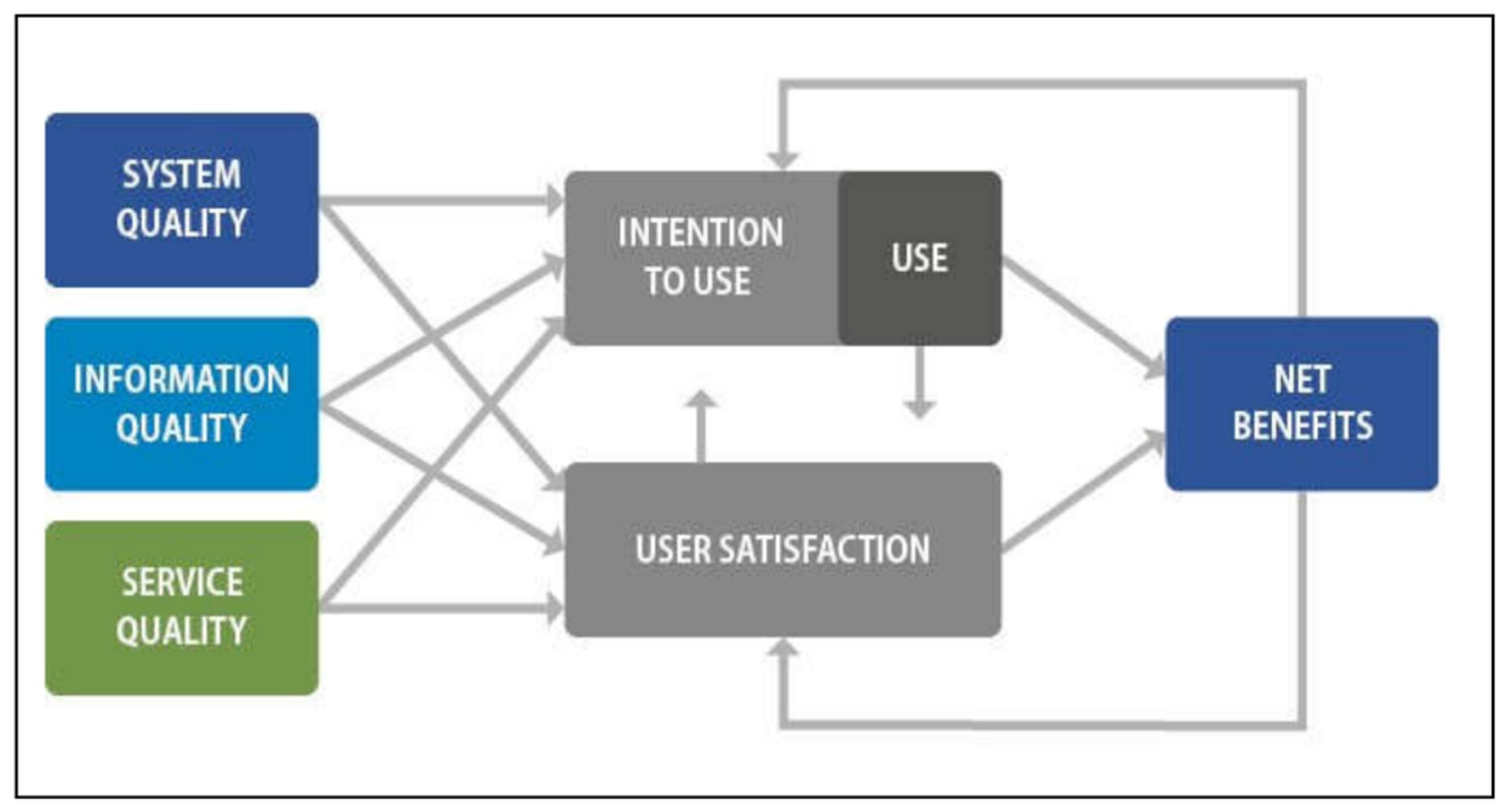
Based on the above discussion, we concluded that these three quality measurements of the DeLone and McLean model will be employed as a foundation for developing our proposed research model. In the sections below, we will present details about the quality constructs of the DeLone and McLean model as shown in Figure 1.
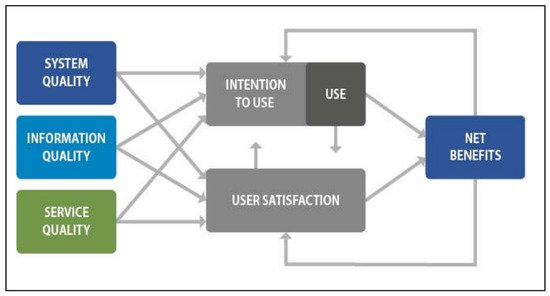
Figure 1.
The Delone and Mclean model.
- (i)
- System Quality
System quality measurement is one of the major constructs of the DeLone and McLean model, which is defined as the high-quality features that should be included in any system, such as navigability, functionality, and availability, etc. [4]. According to quality models, system quality includes groups of sub-measurements such as navigability, functionality, availability and flexibility [5]. According to DeLone and McLean [6], applying and selecting the system quality measurements should be based on the context of the study. Based on this recommendation, the most common system quality measurements that have been used in educational systems are functionality, availability, accessibility and flexibility [7].
In the context of educational technologies studies, prior studies found that system quality is considered one of the key measurements that played a primary role in encouraging the usage of educational platforms among students. For example, Almaiah et al. [2] found that the quality of a system is a significant metric for promoting the actual usage of mobile learning through usability factors such as ease of use and usefulness. Based on the above discussion, we used the system quality measurement as a foundation for developing our proposed research model; thus, we developed the following hypotheses:
H1.
System quality would have a significant impact on perceived ease of use of m-learning.
H2.
System quality would have a significant impact on perceived usefulness of m-learning.
- (ii)
- Information Quality
The second quality measurement in the DeLone and McLean model is the information or content quality. This factor refers to the quality of content in terms of design, format and accuracy that should be available in the system [2]. According to quality models, information quality consists of several sub-measurements, namely: accuracy, relevance, efficiency and completeness of content, etc. [3]. In the context of educational technologies studies, prior studies found that information quality is considered one of the key predictors that played a primary role in encouraging the usage of educational platforms among students. For example, Almaiah et al. [2] found that quality of information is a significant measurement in promoting the actual usage of mobile learning through usability factors ease of use and usefulness. Al-Debei [4] found that quality of information is the primary predictor of perceived usefulness and perceived ease of use. Based on the above discussion, we used the information quality measurement as a foundation for developing our proposed research model; thus, we proposed the following:
H3.
Information quality would have a significant positive impact on perceived ease of use of m-learning.
H4.
Information quality would have a significant positive impact on the usefulness of m-learning.
- (iii)
- Service Quality
The third quality measurement in the DeLone and McLean model is the service quality. The common sub-measurements of service quality in the context of educational technologies are trust, responsiveness and personalization [1]. Several prior studies reported that service quality is one of the key predictors that played a primary role in encouraging the usage of educational platforms among students. For example, Almaiah et al. [2] found that quality of service is a significant measurement in promoting the actual usage of mobile learning through usability factors ease of use and usefulness. Al-Debei [27] found that quality of service is the primary predictor of perceived usefulness and perceived ease of use. Practically, service quality is based on determining students’ requirements and how to achieve them [7]. Based on the above discussion, we employed the service quality measurement as a foundation for developing our proposed research model; thus, we proposed the following:
H5.
Service quality would have a significant positive effect on perceived ease of use of m-learning.
H6.
Service quality would have a significant positive impact on the usefulness of m-learning.
Justification of Applying the Quality Factors in Our Proposed Model
According to the literature, the above three quality factors from the DeLone and McLean model are considered the key elements for ensuring the success of several types of information systems such as e-learning [1], e-commerce [4], learning management systems [8], e-Government [12], and web-based systems [16]. Several prior studies have employed quality measurements from the DeLone and McLean model for examining the role of system, service and information quality on the student’s usage of educational technologies. They found that the DeLone and McLean model is the theory of evaluating the effect of quality measurements on the success of mobile learning as compared with other models such as TAM and UTAUT.
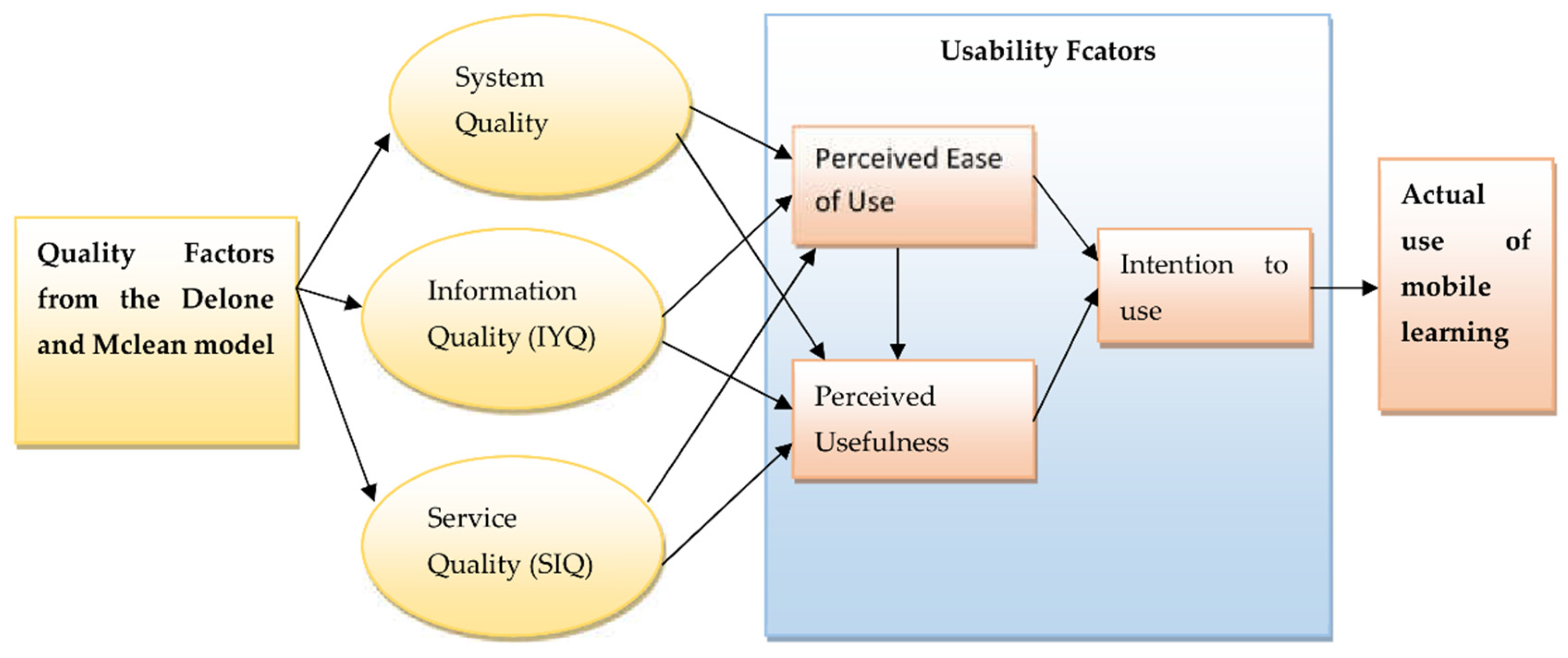
Necessity, quality assurance, improvement, and enhancement of educational technologies during COVID-19 in universities have increasingly become a central concern for researchers and service providers [19]. Obviously, applying quality measurements in these new technologies has become an essential requirement for enhancing the usability of these educational platforms [40]. However, the success of any IS/IT can be represented by the quality characteristics of the IS itself [1]. In addition, DeLone and Mclean [25] recommended that any system with high-quality measurements will result in higher usage and greater user satisfaction. Therefore, the above three quality factors from the DeLone and McLean model could be used as the main drivers for enhancing the usability of mobile learning applications among students. Figure 2 presents the proposed model of our study.
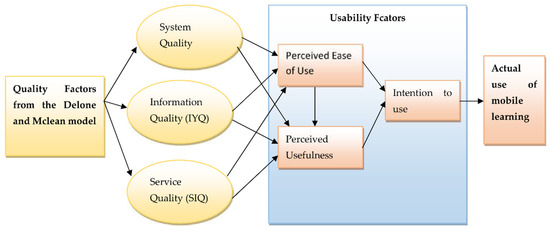
Figure 2.
The proposed model.
H7.
Perceived ease of use would have a significant positive effect on perceived usefulness of m-learning.
H8.
Perceived ease of use would have a significant positive effect on intention to use m-learning.
H9.
Perceived usefulness would have a significant positive effect on intention to use m-learning.
H10.
Intention to use would have a significant positive effect on actual use of m-learning.
4. Methodology
4.1. Data Collection and Participants
The data collection for this study was implemented in the top five universities in Saudi Arabia, namely: King Khalid University, King Saud University, King Faisal University, King Fahad University and Tabouk University, in the second semester of 2022. Because of the COVID-19 pandemic, these universities started using distance-learning technologies, such as mobile learning applications. In addition, all lectures were held digitally or via the Blackboard system. Complementing the lectures, students could participate in synchronous, live tutorials and submit exercise sheets.
For this study, we invited 500 students from the above five universities who used any type of distance learning tools during COVID-19 to participate in the online survey conducted during the first five weeks of the second semester of 2022. Through the data collection, we informed the students of the research purpose and their voluntary participation in the study. Even if they took part in the survey, they had the possibility to refuse to answer any question.
The students were asked to answer the online survey according to their experience with different types of distance learning tools during COVID-19. Our study sample consists of 500 students distributed among the five universities in Saudi Arabia. In the initial evaluation, we excluded 45 answers due to missing values in their survey responses and five without any variation in the responses. Thus, the total usable responses are 450, which means the usable response rate is 90%. The final sample comprises 320 female and 130 male students, with the overwhelming majority (87%) being 24 years old and younger. Table 3 presents the summarized descriptive statistics for the final sample of 450 students.
Table 3.
Analysis of participants.
4.2. Research Measurements
To test the hypotheses in our proposed model, we developed the measurements in the questionnaire from the validated scales from previous studies and modified them to be suitable in the context of mobile learning. For instance, measurements of system quality, information quality and service quality factors were adopted from the study conducted by Sarrab et al. [62]. Perceived ease of use and perceived usefulness were adapted from Davis [63]. Finally, intention to use and actual use items were adapted from a study conducted by Al-Emran et al. [7]. The items were unanimously measured with four or five items each, as previously described. All items were assessed on a five-point Likert scale (from 1 = “strongly disagree” to 5 = “strongly agree”). Appendix A presents the final online survey consisting of the mentioned items used in our research model. We developed the survey in English, in accordance with prior studies, and then converted it to the Arabic language through a professional translator. In order to avoid any issues, we also requested a professional translation service to translate it back into English to ensure conversion correspondence and the validity of the items.
In order to check the validity of the questionnaire items, we emailed five experts in the mobile learning domain and sent them a draft of the questionnaire items to check them in terms of clarity and appropriateness of each item for each construct. All experts confirmed that all items are understandable, correct and suitable within the context of mobile learning.
5. Data Analysis and Results
5.1. Reliability Analysis
The reliability analysis for all items in the proposed model was performed by using Cronbach’s alpha. As shown in Table 4, the findings of the reliability analysis indicated that all Cronbach’s alpha values were larger than 0.7. The calculated Cronbach’s coefficient alpha values were acceptable: system quality (89.0), information quality (84.0), and service quality (87.0), perceived ease of use (88.0), perceived usefulness (91.0), intention to use (80.0) and actual use (93.0).
Table 4.
Reliability and convergent validity analyses.
5.2. Convergent and Discriminant Validity Analysis
All items in the proposed models also were validated by using both convergent and discriminant validity analysis. Based on the findings in Table 4, the values of average variance extracted (AVE) were greater than 0.5, which indicates that the convergent validity of all items was accepted for further analysis in the next step according to [64].
For discriminant validity analysis, we calculated the square root of AVE values for all items in Table 5. The findings indicated that all values of the square root of AVE values were greater than 0.5, which indicates that the discriminant validity of all items were ac-accepted for further analysis in the next step according to [64].
Table 5.
Discriminant validity analysis.
5.3. Correlation Analysis
In our study, the correlation analysis was employed to test the relationship between the constructs in the proposed model. We used the Pearson correlation coefficient to test the relationship between two constructs based on the proposed hypotheses. This type of testing is used to measure the linear correlation between constructs. According to Compeau and Higgins [41], the minimum value of the Pearson correlation coefficient is (0.05), and the values of the Pearson correlation coefficient should be ranged between −1 and +1 if the hypothesis is supported.
In our study, ten hypotheses were evaluated using the correlation analysis. The Pearson correlation coefficient method was used to test the relationship between three types of quality measurements (system quality, service quality and information quality) with two usability factors (perceived ease of use and perceived usefulness). In addition, it has been used to evaluate the correlation between perceived ease of use with perceived usefulness and intention to use, as well as between perceived usefulness and intention to use. Finally, we tested the relationship between intention to use and actual usage.
The first hypothesis (H1) stated that system quality would have a significant impact on perceived ease of use of m-learning. The findings in Table 6 indicate that the value of the correlation coefficient is 0.781. This indicated that there is a significant relationship between the two constructs. Therefore, this hypothesis is supported.
Table 6.
Results of the correlation analysis for hypothesis 1 (H1).
The second hypothesis (H2) stated that system quality would have a significant impact on perceived usefulness of m-learning. The results in Table 7 indicate that the value of the correlation coefficient is 0.752. This indicated that there is a significant relationship between the two constructs. Therefore, this hypothesis is supported.
Table 7.
Results of the correlation analysis for hypothesis 2 (H2).
The third hypothesis (H3) stated that information quality would have a significant positive impact on perceived ease of use of m-learning. Our results from the Pearson correlation coefficient analysis in Table 8 indicate that the value of the correlation coefficient is 0.697. This means that there is a significant correlation between the two constructs. Therefore, hypothesis 3 is supported.
Table 8.
Results of the correlation analysis for hypothesis 3 (H3).
The fourth hypothesis (H4) stated that information quality would have a significant positive impact on the usefulness of m-learning. Our results from the Pearson correlation coefficient analysis in Table 9 indicate that the value of the correlation coefficient is 0.710. This means that there is a significant correlation between the two constructs. Therefore, hypothesis 4 is supported.
Table 9.
Results of correlation analysis for hypothesis 4 (H4).
The fifth hypothesis (H5) stated that service quality would have a significant positive effect on perceived ease of use of m-learning. The results in Table 10 indicate that the value of the correlation coefficient is 0.657. This indicates that there is a significant relationship between the two constructs. Therefore, there is support for this hypothesis.
Table 10.
Results of the correlation analysis for hypothesis 5 (H5).
The sixth hypothesis (H6) proposed that service quality would have a significant positive impact on the usefulness of m-learning. Our results from the Pearson correlation coefficient analysis in Table 11 indicate that the value of the correlation coefficient is 0.725. This means that there is a significant correlation between the two constructs. Therefore, hypothesis 6 is supported.
Table 11.
Results of the correlation analysis for hypothesis 6 (H6).
The seventh hypothesis (H7) stated that perceived ease of use would have a significant positive effect on perceived usefulness of m-learning. Table 12 shows that the value of the correlation coefficient is 0.626. Based on this result, this indicates that there is a significant positive relationship between the two variables. Therefore, there is support for this hypothesis.
Table 12.
Results of the correlation analysis for hypothesis 7 (H7).
The eighth hypothesis (H8) proposed that perceived ease of use would have a significant positive effect on intention to use m-learning. Table 13 shows that the value of the correlation coefficient is 0.617. Based on this result, this indicates that there is a significant relationship between the two constructs. Therefore, there is support for this hypothesis.
Table 13.
Results of the correlation analysis for hypothesis 8 (H8).
The ninth hypothesis (H9) proposed that perceived usefulness would have a significant positive effect on intention to use m-learning. Table 14 shows that the value of the correlation coefficient is 0.766. Based on this result, this indicates that there is a significant relationship between the two constructs. Therefore, there is support for this hypothesis.
Table 14.
Results of the correlation analysis for hypothesis 9 (H9).
The tenth hypothesis (H10) proposed that intention to use would have a significant positive effect on actual use of m-learning. Table 15 shows that the value of the correlation coefficient is 0.785. Based on this result, this indicates that there is a significant relationship between the two constructs. Therefore, there is a support for this hypothesis.
Table 15.
Results of the correlation analysis for hypothesis 10 (H10).
5.4. Structural Model Analysis
Our research model was tested using PLS-SEM as the most favorable method to validate multistage models with complex relationships, interdependencies, constructs, and indicators [66]. Based on the findings of the PLS-SEM test in Table 16, we found that system quality influenced the two usability factors: perceived ease of use and usefulness significantly (H1: β-value = 0.321, p < 0.001), (H2: β-value = 0.366, p < 0.001). This indicates that H1 and H2 are supported. The results also revealed that information quality also impacted the perceived ease of use and usefulness significantly (H3: β-value = 0.330, p < 0.001), (H4: β-value = 0.354, p < 0.001). This indicates that H3 and H4 are supported. Furthermore, H5 and H6 were supported, which means that service quality had a significant effect on both two usability factors: perceived ease of use and usefulness (H5: β-value = 0.371, p < 0.001), (H6: β-value = 0.366, p < 0.001). Our findings also indicate that perceived ease of use had a significant effect on both perceived usefulness and intention to use (H7: β-value = 0.315, p < 0.001), (H8: β-value = 0.309, p < 0.001). This indicates that H7 and H8 are supported. Perceived usefulness also had a significant effect on intention to use (H9: β-value = 0.361, p < 0.001). Finally, the results indicated that intention to use had a significant influence on actual use (H10: β-value = 0.388, p < 0.001). Based on the above results, H9 and H10 were supported.
Table 16.
Results of the structural equation modeling analysis.
6. Discussion
Mobile learning applications have been considered one of the important solutions for higher education during COVID-19. However, the actual usage of mobile learning still requires more planning and investigation as to how quality measurements could play a key role in enhancing the usability of mobile learning during COVID-19. According to the Delone and Mclean model, we used three main quality factors with 12 items that could fulfill the mobile learning quality. Then, we examined the effect of these quality measurements on enhancing the usability of mobile learning applications.
Through our proposed model, we determined and evaluated the relationships between quality factors and usability factors using the DeLone and McLean model (as demonstrated in Figure 2). Based on the findings, system quality is the most significant perspective affecting on perceived ease of use and perceived usefulness of mobile learning, with β = 0.321 and β = 0.366. These findings showed that system quality notably affected usability factors of mobile learning. This means that when the mobile learning system is easy to access, user-friendly, easy to navigate, easy to use, and possesses learning abilities, it will improve the usability of mobile learning among students. Therefore, measurements of system quality had an important effect on mobile learning usability. These results were confirmed by previous studies conducted by Al-Emran et al. and Almaiah et al.
According to the results, information quality played an important part and has the most significant impact on perceived ease of use and perceived usefulness of mobile learning with β = 0.330 and β = 0.354. This means that quality of information is the primary predictor of mobile learning usability. In addition, when the mobile learning content is clear, accuracy, relevance, efficiency and completeness of content will improve the usability of mobile learning among students. Based on that, measurements of information quality had a significant effect on mobile learning usability. These results were consistent with previous studies conducted by Sarrab et al.
Furthermore, service quality also had a significant influence on both perceived ease of use and perceived usefulness of mobile learning with β = 0.371 and β = 0.366. This indicates that service quality notably affected the usability of mobile learning. This means that when the mobile learning system is trustworthy, responsive and customizable, it will improve the usability of mobile learning among students. Therefore, measurements of service quality had an important effect on mobile learning usability. These results were confirmed by previous studies conducted by Al-Emran et al. and Almaiah et al.
Based on our findings, perceived ease of use had a significant impact on perceived usefulness and intention to use of mobile learning with β = 0.315 and β = 0.309. This means that perceived ease of use is the primary predictor of actual usage of mobile learning through perceived usefulness and intention to use. In addition, when the mobile learning application is user-friendly and easy to use, it will improve the actual use of mobile learning among students. These results were consistent with previous studies conducted by Sarrab et al.
The findings also indicated that there is strong relationship between perceived usefulness and intention to use mobile learning with β = 0.361. This means that perceived usefulness is the primary predictor of actual usage of mobile learning through intention to use. Finally, the results indicated that actual use of mobile learning was influenced by intention to use significantly with β = 0.388. These results were consistent with previous studies conducted by Sarrab et al.
7. Conclusions
The emergence of COVID-19 has caused a high adoption of mobile learning applications for learning and teaching processes. The usability of mobile learning applications still needs more investigation. Therefore, this study tried to cover this gap by examining the impact of quality measurements from the DeLone and McLean model on the usability of mobile learning applications during COVID-19. Hence, we proposed a research model combining three types of quality measurements, system quality, service quality and information quality, with four usability factors, namely perceived ease of use, perceived usefulness, intention to use and actual use. Based on the findings, system quality is the most significant perspective affecting perceived ease of use and perceived usefulness of mobile learning. According to the results, information quality played an important part and had the most significant impact on perceived ease of use and perceived usefulness of mobile learning. Furthermore, service quality also had a significant influence on both perceived ease of use and perceived usefulness of mobile learning. On the other hand, perceived ease of use had a significant impact on perceived usefulness of and intention to use mobile learning, and perceived ease of use is the primary predictor of actual usage of mobile learning through perceived usefulness and intention to use. The findings also indicated that there is strong relationship between perceived usefulness of and intention to use mobile learning. Finally, the results indicated that actual use of mobile learning was significantly influenced by intention to use.
Author Contributions
Conceptualisation, M.A.A., F.H. and R.S.; methodology, A.L.; software, A.A.; validation, A.B.A., M.A.A. and M.A.A.; formal analysis, M.A.A.; investigation, M.A.A.; resources, F.H.; writing—original draft preparation, R.S.; writing—review and editing, A.A.; visualisation, M.A.A.; supervision, M.A.A.; project administration, M.A.A.; funding acquisition, M.A.A. All authors have read and agreed to the published version of the manuscript.
Funding
This work was funded by King Faisal University and Princess Nourah bint Abdulrahman University.
Institutional Review Board Statement
Not applicable.
Informed Consent Statement
Not applicable.
Data Availability Statement
Not applicable.
Acknowledgments
This work was supported through the Annual Funding track by the Deanship of Scientific Research, Vice Presidency for Graduate Studies and Scientific Research, King Faisal University, Saudi Arabia (Project No. GRANT 24); and Princess Nourah bint Abdulrahman University Researchers Supporting Project Number (PNURSP2022R236), Princess Nourah bint Abdulrahman University, Riyadh, Saudi Arabia.
Conflicts of Interest
All authors declare no conflict of interest.
Appendix A
| Construct | Items | |
| System Quality | SQ1 | The mobile app is easy to navigate. |
| SQ2 | The mobile app allows me to find easily the information I am looking for. | |
| SQ3 | The mobile app is well structured. | |
| SQ4 | The mobile app is easy to use. | |
| Information Quality | IQ1 | The information provided by the mobile app is useful. |
| IQ2 | The information provided by the mobile app is understandable. | |
| IQ3 | The information provided by the mobile app is interesting. | |
| IQ4 | The information provided by the mobile app is reliable. | |
| Service Quality | SEQ1 | The responsible service personnel is always highly willing to help |
| SEQ2 | whenever I need support with the mobile app. | |
| SEQ3 | The responsible service personnel provides personal attention when I experience problems with the mobile app. | |
| SEQ4 | The responsible service personnel provides services related to the mobile app at the promised time. | |
| Perceived Ease of Use | PEU1 | The mobile app is easy to use. |
| PEU2 | The mobile app is friendly. | |
| Perceived Usefulness | PU1 | I believe the mobile app can assist learning efficiency. |
| PU2 | I believe the mobile app can assist learning performance. | |
| Intention to Use | INU1 | I will reuse the mobile app in the future. |
| INU2 | I will frequently use the mobile app in the future. | |
| INU3 | I will recommend that fellow students use the mobile app. | |
References
- Almaiah, M.A. Acceptance and usage of a mobile information system services in University of Jordan. Educ. Inf. Technol. 2018, 23, 1873–1895. [Google Scholar] [CrossRef]
- Almaiah, M.A.; Jalil, M.M.A.; Man, M. Empirical investigation to explore factors that achieve high quality of mobile learning system based on students’ perspectives. Eng. Sci. Technol. Int. J. 2016, 19, 1314–1320. [Google Scholar] [CrossRef] [Green Version]
- Aburub, F.; Alnawas, I. A new integrated model to explore factors that influence adoption of mobile learning in higher education: An empirical investigation. Educ. Inf. Technol. 2019, 24, 2145–2158. [Google Scholar] [CrossRef]
- Al-Adwan, A.S.; Albelbisi, N.A.; Hujran, O.; Al-Rahmi, W.M.; Alkhalifah, A. Developing a Holistic Success Model for Sustainable E-Learning: A Structural Equation Modeling Approach. Sustainability 2021, 13, 9453. [Google Scholar] [CrossRef]
- Pimmer, C.; Mateescu, M.; Gröhbiel, U. Mobile and ubiquitous learning in higher education settings. A systematic review of empirical studies. Comput. Hum. Behav. 2016, 63, 490–501. [Google Scholar] [CrossRef]
- Al-Emran, M.; Mezhuyev, V.; Kamaludin, A. Technology Acceptance Model in M-learning context: A systematic review. Comput. Educ. 2018, 125, 389–412. [Google Scholar] [CrossRef]
- Davis, F.D. Perceived usefulness, perceived ease of use, and user acceptance of information technology. MIS Q. 1989, 13, 319–340. [Google Scholar] [CrossRef] [Green Version]
- Aldossry, B. Evaluating the madrasati platform for the virtual classroom in Saudi arabian education during the time of COVID-19 Pandemic. Eur. J. Open Educ. E-Learn. Stud. 2021, 6, 42–66. [Google Scholar] [CrossRef]
- Ministry of Education, Kingdom of Saudi Arabia. 2021. Available online: https://backtoschool.sa/ (accessed on 13 June 2021).
- Khalife, W. The effectiveness of using active learning based on distance learning on improving academic achievement and developing the trend towards distance learning for the learning technologies course for mathematics education students. Sci. J. Phys. Educ. Sports Sci. 2019, 87, 321–334. [Google Scholar]
- Khanfar, A.R. Distance-learning entrepreneurship education in the time of corona virus—COVID-19 challenges & solution. J. Entrep. Educ. 2020, 23, 1–17. [Google Scholar]
- MOE. Ministry of Education, Kingdom of Saudi Arabia. 2020. Available online: https://www.moe.gov.sa/ar/mediacenter/MOEnews/Pages/MR2-2020-453.aspx (accessed on 13 June 2021).
- Almaiah, M.A.; Alamri, M.M. Proposing a new technical quality requirements for mobile learning applications. J. Theor. Appl. Inf. Technol. 2018, 96, 6955–6968. [Google Scholar]
- Almaiah, M.A. Thematic analysis for classifying the main challenges and factors influencing the successful implementation of e-learning system using Nvivo. Int. J. Adv. Trends Comput. Sci. Eng. 2020, 9, 142–152. [Google Scholar] [CrossRef]
- Lutfi, A.; Alsyouf, A.; Almaiah, M.A.; Alrawad, M.; Abdo, A.A.; Al-Khasawneh, A.L.; Ibrahim, N.; Saad, M. Factors Influencing the Adoption of Big Data Analytics in the Digital Transformation Era: Case Study of Jordanian SMEs. Sustainability 2022, 14, 1802. [Google Scholar] [CrossRef]
- Althunibat, A.; Almaiah, M.A.; Altarawneh, F. Examining the Factors Influencing the Mobile Learning Applications Usage in Higher Education during the COVID-19 Pandemic. Electronics 2021, 10, 2676. [Google Scholar] [CrossRef]
- Al-Emran, M.; Arpaci, I.; Salloum, S.A. An empirical examination of continuous intention to use m-learning: An integrated model. Educ. Inf. Technol. 2020, 25, 2899–2918. [Google Scholar] [CrossRef]
- Hoi, V.N. Understanding higher education learners’ acceptance and use of mobile devices for language learning: A Rasch-based path modeling approach. Comput. Educ. 2020, 146, 103761. [Google Scholar] [CrossRef]
- Gharaibeh, M.K.; Gharaibeh, N.K. An empirical study on factors influencing the intention to use mobile learning. Adv. Sci. Technol. Eng. Syst. J. 2020, 5, 1261–1265. [Google Scholar] [CrossRef]
- Al-Nawayseh, M.K.; Baarah, A.H.; Al-Masaeed, S.A.; Alnabhan, M.M. Mobile learning adoption in Jordan: Technology influencing factors. Int. J. Netw. Virtual Organ. 2019, 20, 400–417. [Google Scholar] [CrossRef]
- Badwelan, A.; Bahaddad, A.A. Functional Requirements to Increase Acceptance of M-Learning Applications among University Students in the Kingdom of Saudi Arabia (KSA). Int. J. Comput. Sci. Netw. Secur. 2021, 21, 21–39. [Google Scholar]
- Fauziati, C. Faktor-Faktor Yang Memengaruhi Penerimaan Mobile Learning Applications (Apps) (Acceptance Factors of Mobile Learning Applications (Apps)). J. Iptekkom J. Ilmu Pengetah. Teknol. Inf. 2020, 22, 45–57. [Google Scholar]
- Lutfi, A. Factors Influencing the Continuance Intention to Use Accounting Information System in Jordanian SMEs from the Perspectives of UTAUT: Top Management Support and Self-Efficacy as Predictor Factors. Economies 2022, 10, 75. [Google Scholar] [CrossRef]
- Wahab, R.A. Student’s acceptance of digital educational tools: A case study. In Proceedings of the 2020 Sixth International Conference on E-Learning, Sakheer, Bahrain, 6–7 December 2020; IEEE: Piscataway, NJ, USA, 2020; pp. 81–86. [Google Scholar]
- Badwelan, A.; Bahaddad, A.A. Towards the Acceptance of Functional Requirements in M-Learning Application for KSA University Students. Int. J. Comput. Sci. Netw. Secur. 2021, 21, 145–166. [Google Scholar]
- Wei, N.; Li, Z. Telepresence and Interactivity in Mobile Learning System: Its Relation with Open Innovation. J. Open Innov. Technol. Mark. Complex. 2021, 7, 78. [Google Scholar] [CrossRef]
- Al-Emran, M.; Mezhuyev, V.; Kamaludin, A. An innovative approach of applying knowledge management in M-learning application development: A pilot study. Int. J. Inf. Commun. Technol. Educ. 2019, 15, 94–112. [Google Scholar] [CrossRef]
- Zhang, M.; Chen, Y.; Zhang, S.; Zhang, W.; Li, Y.; Yang, S. Understanding mobile learning continuance from an online-cum-offline learning perspective: A SEM-neural network method. Int. J. Mob. Commun. 2022, 20, 105–127. [Google Scholar] [CrossRef]
- Kumar, J.A.; Osman, S.; Sanmugam, M.; Rasappan, R. Mobile Learning Acceptance Post Pandemic: A Behavioural Shift among Engineering Undergraduates. Sustainability 2022, 14, 3197. [Google Scholar] [CrossRef]
- Alturki, U.; Aldraiweesh, A. Students’ Perceptions of the Actual Use of Mobile Learning during COVID-19 Pandemic in Higher Education. Sustainability 2022, 14, 1125. [Google Scholar] [CrossRef]
- Mingyue, F.; Ndavi, J.W.; Qalati, S.A.; Huang, L.; Zhengjia, P. Applying the time continuum model of motivation to explain how major factors affect mobile learning motivation: A comparison of SEM and fsQCA. Online Inf. Rev. 2022, 20, 45–59. [Google Scholar]
- Chibisa, A.; Mutambara, D. Determinants of High School Learners’ Continuous Use of Mobile Learning during the COVID-19 Pandemic. Int. J. Learn. Teach. Educ. Res. 2022, 21, 21–33. [Google Scholar] [CrossRef]
- Bacolod, D.B. Mobile Learning as a Solution for Restricted Learning during the COVID-19 Pandemic. J. Digit. Educ. Technol. 2022, 2, ep2203. [Google Scholar] [CrossRef]
- Lin, H.C.; Ho, C.F.; Yang, H. Understanding adoption of artificial intelligence-enabled language e-learning system: An empirical study of UTAUT model. Int. J. Mob. Learn. Organ. 2022, 16, 74–94. [Google Scholar] [CrossRef]
- Pishtari, G.; Rodríguez-Triana, M.J. An Analysis of Mobile Learning Tools in Terms of Pedagogical Affordances and Support to the Learning Activity Life Cycle. In Hybrid Learning Spaces; Springer: Cham, Switzerland, 2022; pp. 167–183. [Google Scholar]
- Hartley, K.; Andújar, A. Smartphones and Learning: An Extension of M-Learning or a Distinct Area of Inquiry. Educ. Sci. 2022, 12, 50. [Google Scholar] [CrossRef]
- Bai, H. Students’ Use of Learning Management System in Hybrid Learning: Mobile or Not. Int. J. E-Learn. 2022, 21, 5–23. [Google Scholar]
- Okuonghae, O.; Igbinovia, M.O.; Adebayo, J.O. Technological readiness and computer self-efficacy as predictors of E-learning adoption by LIS students in Nigeria. Libri 2022, 72, 13–25. [Google Scholar] [CrossRef]
- Sayaf, A.M.; Alamri, M.M.; Alqahtani, M.A.; Alrahmi, W.M. Factors Influencing University Students’ Adoption of Digital Learning Technology in Teaching and Learning. Sustainability 2022, 14, 493. [Google Scholar] [CrossRef]
- Hsu, H.T.; Lin, C.C. Extending the technology acceptance model of college learners’ mobile-assisted language learning by incorporating psychological constructs. Br. J. Educ. Technol. 2022, 53, 286–306. [Google Scholar] [CrossRef]
- Mehra, A.; Rajput, S.; Paul, J. Determinants of adoption of latest version smartphones: Theory and evidence. Technol. Forecast. Soc. Chang. 2022, 175, 121410. [Google Scholar] [CrossRef]
- Ismail, S.N.; Omar, M.N.; Don, Y.; Purnomo, Y.W.; Dzahir, M. Teachers’ acceptance of mobile technology use towards innovative teaching in Malaysian secondary schools. Int. J. Eval. Res. Educ. 2022, 11, 120–127. [Google Scholar] [CrossRef]
- Khlaif, Z.N.; Sanmugam, M.; Ayyoub, A. Impact of Technostress on Continuance Intentions to Use Mobile Technology. In The Asia-Pacific Education Researcher; Springer: Cham, Switzerland, 2022; pp. 1–2. [Google Scholar]
- Alsharida, R.; Hammood, M.; Al-Emran, M. Mobile Learning Adoption: A Systematic Review of the Technology Acceptance Model from 2017 to 2020. Int. J. Emerg. Technol. Learn. 2021, 16, 147–162. [Google Scholar] [CrossRef]
- Moya, S.; Camacho, M. Identifying the key success factors for the adoption of mobile learning. Educ. Inf. Technol. 2021, 26, 3917–3945. [Google Scholar] [CrossRef]
- Gupta, Y.; Khan, F.M.; Agarwal, S. Exploring Factors Influencing Mobile Learning in Higher Education-A Systematic Review. Int. J. Interact. Mob. Technol. 2021, 15, 15–30. [Google Scholar] [CrossRef]
- Alowayr, A.; Al-Azawei, A. Predicting mobile learning acceptance: An integrated model and empirical study based on higher education students’ perceptions. Australas. J. Educ. Technol. 2021, 37, 38–55. [Google Scholar] [CrossRef]
- Criollo-C, S.; Guerrero-Arias, A.; Jaramillo-Alcázar, Á.; Luján-Mora, S. Mobile learning technologies for education: Benefits and pending issues. Appl. Sci. 2021, 11, 4111. [Google Scholar] [CrossRef]
- Alhumaid, K.; Habes, M.; Salloum, S.A. Examining the factors influencing the mobile learning usage during COVID-19 Pandemic: An Integrated SEM-ANN Method. IEEE Access 2021, 9, 102567–102578. [Google Scholar] [CrossRef]
- Sungur-Gül, K.; Ateş, H. Understanding pre-service teachers’ mobile learning readiness using theory of planned behavior. Educ. Technol. Soc. 2021, 24, 44–57. [Google Scholar]
- Buabeng-Andoh, C. Exploring University students’ intention to use mobile learning: A research model approach. Educ. Inf. Technol. 2021, 26, 241–256. [Google Scholar] [CrossRef]
- Al-Hamad, M.; Mbaidin, H.; AlHamad, A.; Alshurideh, M.; Kurdi, B.; Al-Hamad, N. Investigating students’ behavioral intention to use mobile learning in higher education in UAE during Coronavirus-19 pandemic. Int. J. Data Netw. Sci. 2021, 5, 321–330. [Google Scholar] [CrossRef]
- Ibrahim, M.; Khairudin, N.; Salleh, D. Unwinding Environment in the Lecture Room Using Mobile Learning (M-Learning) Adoption among the Millennial Generation. J. Phys. Conf. Ser. 2021, 1874, 012033. [Google Scholar] [CrossRef]
- Saikat, S.; Dhillon, J.S.; Wan Ahmad, W.F.; Jamaluddin, R. A systematic review of the benefits and challenges of mobile learning during the COVID-19 pandemic. Educ. Sci. 2021, 11, 459. [Google Scholar] [CrossRef]
- Antee, A. Student perceptions and mobile technology adoption: Implications for lower-income students shifting to digital. Educ. Technol. Res. Dev. 2021, 69, 191–194. [Google Scholar] [CrossRef]
- Loh, X.K.; Lee, V.H.; Loh, X.M.; Tan, G.W.; Ooi, K.B.; Dwivedi, Y.K. The dark side of mobile learning via social media: How bad can it get? Inf. Syst. Front. 2021, 15, 1–8. [Google Scholar] [CrossRef] [PubMed]
- Yuan, Y.P.; Tan, G.W.; Ooi, K.B.; Lim, W.L. Can COVID-19 pandemic influence experience response in mobile learning? Telemat. Inform. 2021, 64, 101676. [Google Scholar] [CrossRef] [PubMed]
- Vallejo-Correa, P.; Monsalve-Pulido, J.; Tabares-Betancur, M. A systematic mapping review of context-aware analysis and its approach to mobile learning and ubiquitous learning processes. Comput. Sci. Rev. 2021, 39, 100335. [Google Scholar] [CrossRef]
- Okai-Ugbaje, S. Towards a pedagogical and sociotechnical framework for the strategic integration of mobile learning in higher education in low and middle income countries. High. Educ. Res. Dev. 2021, 40, 581–598. [Google Scholar] [CrossRef]
- Criollo-C, S.; Lema, M.; Gonzalez, M.S.; Jaramillo-Alcázar, A.; Guerrero-Arias, A.; Luján-Mora, S. Exploring the technological acceptance of a mobile learning tool used in the teaching of an indigenous language. PeerJ Comput. Sci. 2021, 7, e550. [Google Scholar] [CrossRef] [PubMed]
- Qashou, A. Influencing factors in M-learning adoption in higher education. Educ. Inf. Technol. 2021, 26, 1755–1785. [Google Scholar] [CrossRef]
- Zhang, X.; Lo, P.; So, S.; Chiu, D.K.; Leung, T.N.; Ho, K.K.; Stark, A. Medical students’ attitudes and perceptions towards the effectiveness of mobile learning: A comparative information-need perspective. J. Librariansh. Inf. Sci. 2021, 53, 116–129. [Google Scholar] [CrossRef]
- Sophonhiranrak, S. Features, barriers, and influencing factors of mobile learning in higher education: A systematic review. Heliyon 2021, 7, e06696. [Google Scholar] [CrossRef]
- Dorouka, P.; Papadakis, S.; Kalogiannakis, M. Nanotechnology and mobile learning: Perspectives and opportunities in young children’s education. Int. J. Technol. Enhanc. Learn. 2021, 13, 237–252. [Google Scholar] [CrossRef]
- Shodipe, T.O.; Ohanu, I.B. Electrical/electronics technology education teachers attitude, engagement, and disposition towards actual usage of Mobile learning in higher institutions. Educ. Inf. Technol. 2021, 26, 1023–1042. [Google Scholar] [CrossRef]
- Hoi, V.N.; Mu, G.M. Perceived teacher support and students’ acceptance of mobile-assisted language learning: Evidence from Vietnamese higher education context. Br. J. Educ. Technol. 2021, 52, 879–898. [Google Scholar] [CrossRef]
Publisher’s Note: MDPI stays neutral with regard to jurisdictional claims in published maps and institutional affiliations. |
© 2022 by the authors. Licensee MDPI, Basel, Switzerland. This article is an open access article distributed under the terms and conditions of the Creative Commons Attribution (CC BY) license (https://creativecommons.org/licenses/by/4.0/).