1. Introduction
Led by the search of low-cost inputs by businesses [
1] with the increase in poverty levels, the informal economy is expanding at a fast pace in developing countries. Female home-based workers (FHBWs) are categorized as informal workers who carry out remunerative work at home or in adjacent premises, rather than at employers’ premises. They are usually engaged in manufacturing and post-manufacturing tasks such as embroidery/stitching, carpet weaving, paper products, handicrafts, football making, and others. These workers are often confronted with unhealthy living and working conditions. Thus, the home-cum-workplace environment puts them at higher risk of suffering from occupational diseases.
Falling sick results in below-par performance, low-quality output, and significant delays in product delivery. Eventually, a dreadful impact is witnessed on the earnings of FHBWs, which further reduces their ability to seek appropriate medical treatment. The irony is that, due to their invisibility, policymakers and health practitioners cannot understand the occupational safety and health problems faced by FHBWs.
According to the UN-Women report [
2], home-based workers contributed almost 400 billion PKR (nearly 3.8% of the total GDP) through their wages to the economy of Pakistan in 2013–2014. However, they are excluded from the mainstream market economy, health protection, occupational safety, and social insurance. In Punjab, 44.29% of the population is engaged with an informal economy in which female and male labor force participation rates are 6.77% and 37.52%, respectively. The majority of the female labor force is home-based workers [
3].
According to the Punjab Home-based Workers Survey (2016) [
4], FHBWs face the following challenges while working.
Poor lighting situation in the workplace.
Lack of ventilation and protective equipment.
Workplaces are congested, hot, and suffocated.
Workplaces contain dust and fumes.
Subject to chemical hazards.
Working with sharp machines/tools.
Bad posture.
Long working hours.
These challenges pose massive health risks; thus, FHBWs are often confronted with numerous occupational diseases. A healthy FHBW not only generates household income but also plays a pivotal role in enhancing productivity that leads towards sustainable economic growth. Despite their undeniable importance, pertinent government organizations and health practitioners are ignorant of the occupational health issues of FHBWs. Undoubtedly, the ignorance is due to the disguised and isolated way of working of home-based workers. To the best of our knowledge, no comprehensive scientific study exists that has identified the frequent occupational diseases faced by FHBWs. The discovery of frequent occupational diseases could help in identifying and eradicating the inadequacies faced by the FHBWs. Furthermore, robust medical surveillance is required for the early detection of occupational diseases and injuries [
5].
This study is an attempt to analyze FHBWs occupational disease data from a data science perspective. Data science is defined as a set of principles to extract knowledge from data. Techniques based on data science principles are increasingly being applied in medical diagnostics and informatics [
6,
7]. Today’s sophisticated tools based on data science principles are capable of discovering significant underlying associations or co-occurring groups in the data. Thus, a data science insight can help in exploring the frequent co-occurring diseases faced by FHBWs. Frequent itemset mining (FIM) is an indispensable data science technique for exploring frequent co-occurring items in voluminous databases [
8]. The co-occurrence reveals strong associations among the items.
The role of FIM has become even more important in the era of big data, where abundant co-occurrence grouping exists. FIM has been applied primarily to perform market basket analysis, in which it explores the items frequently bought together by customers [
8]. FIM techniques are also used to perform classification [
9], clustering [
10], and mining association rules [
11]. At present, along with other applications, FIM is also being applied in medical applications.
In this study, FIM is applied to discover the frequent co-occurring diseases faced by FHBWs. The FHBW data were obtained from the Punjab Home-based Workers Survey (2016), conducted by the Bureau of Statistics Punjab, Pakistan [
4]. The far-reaching objectives of identifying frequent co-occurring occupational diseases in this study are the following.
Promoting occupational safety and health.
Making public health authorities well aware of the co-occurring occupational diseases faced by the FHBWs. Ample awareness can help the authorities to adopt the correct policies, so that appropriate medical treatment and compensation can be provided to FHBWs.
Providing awareness to the FHBWs of the health and safety risks they are exposed to every day while working.
To efficiently mine frequent co-occurring occupational diseases, the recently proposed FIM algorithm, Deferring the Generation of Power sets for Discovering Frequent Itemsets from Sparse Big data (D-GENE) is used in this study. D-GENE was chosen due to its superior runtime efficiency as well as having the least memory consumption, especially for sparse data. D-GENE has shown its superiority over other state-of-the-art methods like Apriori and FP-growth [
12]. Considering the sparse nature of the data used in this study, D-GENE was believed to be the optimal choice to discover frequent co-occurring diseases from them.
The organization of this paper is as follows. A review of related work is introduced in
Section 2.
Section 3 describes the problem of FIM. Experimental details followed by a complete example are given in
Section 4. Detailed results are given in
Section 5. A detailed discussion is given in
Section 6.
Section 7 concludes this study.
2. Related Work
Medical data were analyzed by using the Apriori algorithm [
8] to discover frequent diseases in diverse geographical areas at a given time [
13]. Another technique was proposed for predicting the risk level of patients suffering from heart disease [
14]. Disease symptoms were identified and used as input. Frequent itemsets were generated based on a pre-defined minimum support threshold. It was envisaged that the resultant frequent itemsets would help in making better diagnostics as well as determining the disease risks at the early stages.
A modified version of the K-means algorithm was proposed to analyze medical datasets to discover early on and monthly periodic frequent patterns [
15]. Periodical frequent patterns between the years 2012 and 2013 and month-wise frequent patterns were discovered. An idea of temporal view was used to adapt K-means for this purpose. A prototype was made on the proposed methodology that yielded useful results in finding diseases.
To aid in effectively diagnosing polycystic ovarian syndrome (PCOS), FIM was applied to discover recurring patterns among the symptoms of PCOS patients [
16]. The Apriori algorithm was incorporated for predicting susceptible cases as well. A software system was built to produce well-timed forecasting of diabetes as well as cardiovascular diseases [
17]. The system aims to predict whether the patient is at risk of suffering from a non-communicable disease or not. Most frequent disease patterns were identified for prediction.
Furthermore, innovative techniques were proposed to mine associations of infrequent diseases from electronic patient datasets [
18]. A novel measure of special casual leverage and a model of the fuzzy recognition-primed decision was developed. These models mined the casual associations between drug and their reactions. A study on the data mining process in health care recommended association rule-based Apriori for generating a frequency of diseases [
19]. EMR data belonging to hospitals located in different geographical areas with various time periods were used for the study. The research output identified four different diseases that occurred frequently in a different geographical area in a particular year.
Techniques based on associative classification including CBA and CMAR were applied to predict tuberculosis in a database containing twelve preliminary symptoms and one class attribute [
20]. The class label of an unidentified sample was predicted as tuberculosis (TB) associated with HIV based on a higher confidence rule. Most of the resulting classifier rules might assist doctors in making better disease diagnoses.
A framework for the early assessment of rheumatoid arthritis (RA) was proposed by integrating efficient associative classifiers [
21]. RA risk patterns from a large clinical database were identified. Frequently occurring risk patterns classifying the disease status were extracted. A weighted approach was incorporated for the integration of correlation and popularity information into the measure to prevent the objectivity of the results.
A technique based on association rule learning was developed to automatically detect ECG beats during myocardial ischemia [
22]. Furthermore, a novel technique was proposed to identify common symptoms of patients suffering from depression [
23]. FIM and association rules were used on a depression database containing 5954 records. The Apriori predictive approach was used to generate the rules for patients suffering from heart disease [
24]. Based on the rules, factors were discovered that caused heart problems in both males and females. The study revealed that females are less prone to coronary heart disease as compared to males.
Recently, a new FIM algorithm, Deferring the Generation of Power sets for Mining Frequent Itemsets in Sparse Big data (D-GENE), was proposed [
12]. D-GENE uses the concept of power set from set theory to generate an Iterative Trimmed Transaction Lattice (ITTL) of each transaction. However, before generating the ITTL, D-GENE cuts off the infrequent part of each transaction. Thus, the generated ITTLs consume the least memory. Moreover, D-GENE generates the ITTL of similar trimmed transactions once by introducing a deferred ITTL generation and compression strategy. These mechanisms help D-GENE enormously in getting maximal efficiency both in terms of runtime and consumption of memory, particularly for sparse data. Therefore, the D-GENE algorithm was chosen in this study to find frequent co-occurring occupational diseases among FHBWs.
5. Results
The D-GENE algorithm was run for each dataset to discover frequent itemsets at different
minsup values.
Table 7 shows the state of
dictionary ADT,
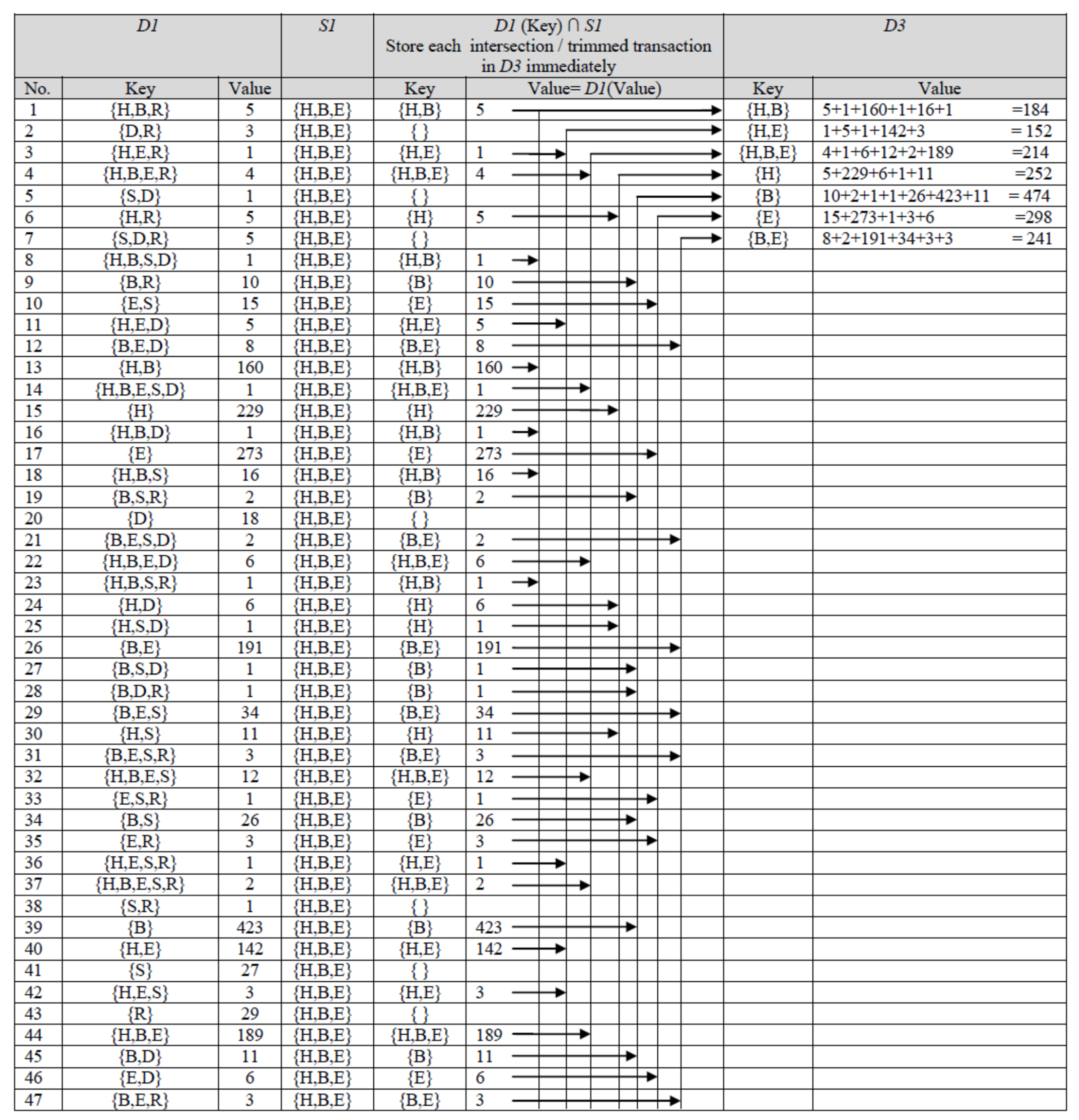
D1, for each dataset during the first phase of D-GENE execution. The state of
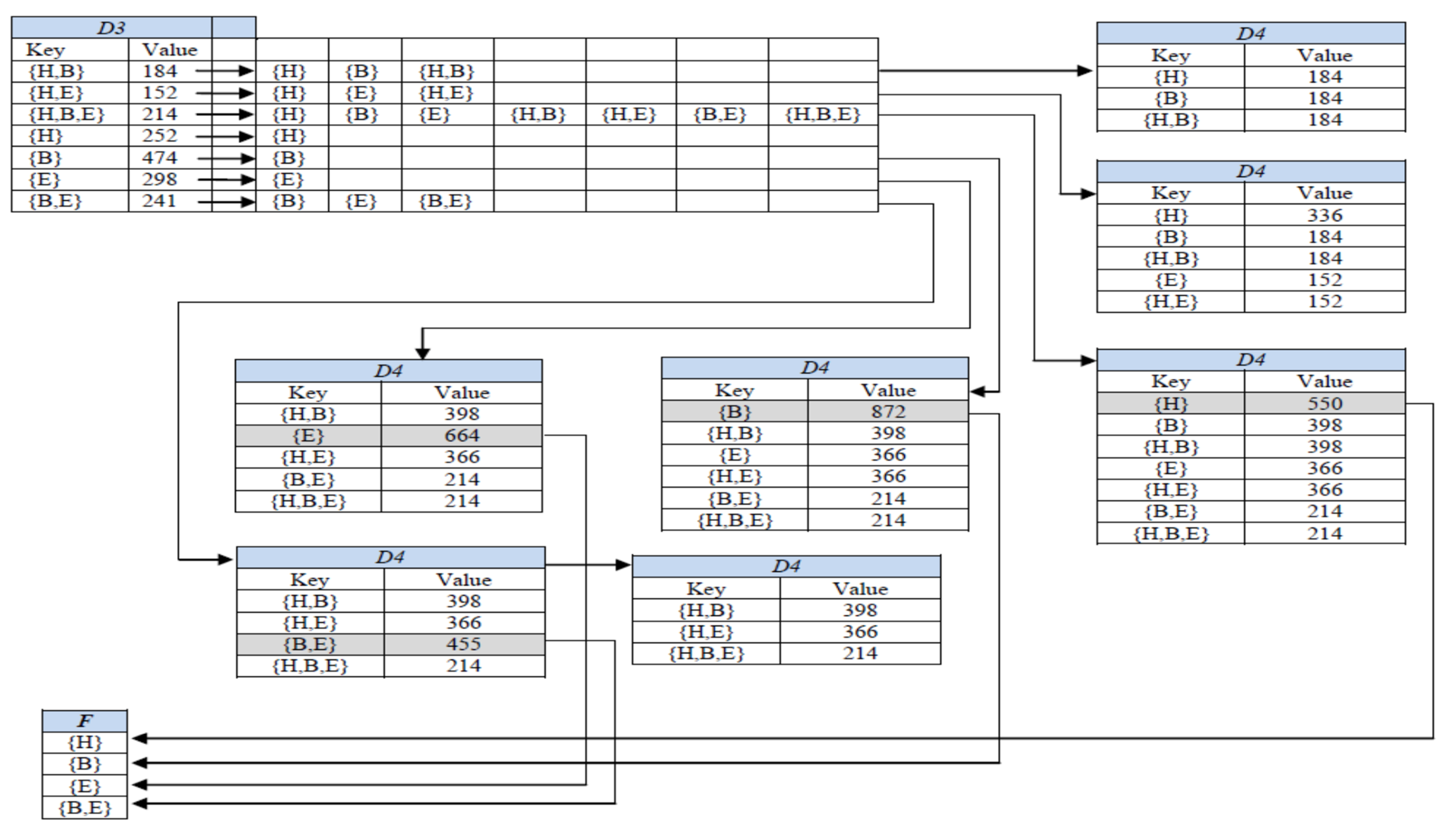
D1 depicts that distinct transactions were far less in number compared to the total transactions in each dataset. Instead of generating ITTLs of all transactions, D-GENE generates ITTLs of distinct transactions in the last step; thus, it gets better runtime efficiency and consumes the least memory. An illustration of ITTL generation is shown in
Figure 2.
Table 8,
Table 9,
Table 10,
Table 11 and
Table 12 contain the frequent co-occurring diseases for each age group at different
minsup thresholds.
Table 8 represents frequent co-occurring diseases for the age group 15–24. It shows that itemset {B, E} was frequent when
minsup was 21%, which means that 21% of participants belonging to the age group 15–24 were suffering from backache and affected eyesight diseases jointly. At
minsup 9%, itemsets, {B,E}, {H,B}, {H,E}, and {H,B,E} were frequent, which means that 9% of participants were suffering from the following co-occurring diseases:
Backache and affected eyesight.
Headache and backache.
Headache and affected eyesight.
Headache, backache, and affected eyesight.
The rest of the records in
Table 8 can be inferred accordingly.
Table 9 represents frequent co-occurring diseases for the age group 25–34. It shows that itemset {B, E} was frequent when
minsup was 23%, which means that 23% of participants belonging to the age group 25–34 were suffering from both backache and affected eyesight diseases. At
minsup 11%, itemsets {B,E}, {H,B}, {H,E}, and {H,B,E} were frequent, which means that 11% of participants were facing the following co-occurring diseases:
Backache and affected eyesight.
Headache and backache.
Headache and affected eyesight.
Headache, backache, and affected eyesight.
The rest of the records in
Table 9 can be analyzed in the same fashion.
Table 10 represents frequent co-occurring diseases for the age group 35–44. It shows that itemset {B, E} was frequent when
minsup was 26%, which means that 26% of participants belonging to the age group 35–44 were confronting backache and affected eyesight diseases jointly. At
minsup 12%, itemsets {B,E}, {H,B}, {H,E}, and {H,B,E} were frequent, which means that 12% of participants were suffering from the following co-occurring diseases:
Backache and affected eyesight.
Headache and backache.
Headache and affected eyesight.
Headache, backache, and affected eyesight.
Similarly, interpretation of the rest of the records in
Table 10 can be done.
Table 11 represents frequent co-occurring diseases for the age group 45–54. It shows that itemset {B,E} was frequent when
minsup was 31%, which means that 31% of participants belonging to age group 45–54 were facing backache and affected eyesight diseases jointly. At
minsup 23%, itemset {B,E} and {H,E} were frequent, which means that 23% of participants of age group 45–54 were facing backache and affected eyesight jointly and headache and affected eyesight jointly. Itemsets {B,E}, {H,B}, {H,E}, and {H,B,E} were frequent at
minsup 14%, which means that 14% of the participants were facing the following co-occurring diseases:
Backache and affected eyesight.
Headache and backache.
Headache and affected eyesight.
Headache, backache, and affected eyesight.
The rest of the records in
Table 11 can be inferred accordingly.
Table 12 represents frequent co-occurring diseases for the age group (>54). It shows that itemset {B,E} was frequent when
minsup was 33%, which means that 33% of participants belonging to age group (>54) were suffering from backache and affected eyesight diseases jointly. At
minsup 27%, itemset {B, E} and {H, E} were frequent, which means that 27% of participants of the age group >54 were facing backache and affected eyesight and headache and affected eyesight jointly. Itemsets {B,E}, {H,B}, {H,E}, and {H,B,E} were frequent at
minsup 16%, which means that 16% of the participants were facing the following co-occurring diseases:
Backache and affected eyesight.
Headache and backache.
Headache and affected eyesight.
Headache, backache, and affected eyesight.
Other records in
Table 12 can be interpreted likewise.
6. Discussion
Therefore, it can be observed that:
The most devastating co-occurring diseases faced by FHBWs are backache and affected eyesight.
Headache and backache are the second most common co-occurring diseases.
Headache and affected eyesight together are the third most frequent.
Headache, backache, and affected eyesight together are the fourth most frequent.
Furthermore, the intensity increased with the increase in the age of workers. It can be inferred that the working conditions of numerous FHBWs are not per their job specifications. Ironically, they are unaware of this fact, thus, compromising their health. It is imperative to educate FHBWs, the complete requirements of their work, and relevant health and safety risks. This is essential because FHBWs are unregistered; thus, the state does not treat them as registered workers with benefits like health care and others.
The resulting disease patterns suggest that FHBWs should take essential precautionary measures while at work. FHBWs could never know the pertinent occupational diseases ahead of time due to the absence of any scientific study highlighting such risk factors. Thus, this study is novel and the foremost attempt to identify the leading co-occurring occupational diseases. By applying frequent itemset mining, a fundamental data science technique, this study has revealed insights that would not be possible with conventional statistical techniques. It is envisioned that the discovered disease patterns, if adequately communicated by relevant NGOs and health practitioners, would make FHBWs aware of the diseases that they are susceptible to in future. Eventually, they would take essential precautionary measures, such as the installation of proper lighting in the working area and the adoption appropriate working postures along with others.
To spread awareness, relevant organizations [
25,
26] and competent health authorities might adopt the following strategies:
7. Conclusions
The majority of female workers in Pakistan are categorized as Female Home-Based Workers (FHBWs). They usually work in unhealthy conditions and are unaware of pertinent health and safety risks. Therefore, FHBWs often suffer from numerous occupational diseases. The biggest downside is the informal nature of their job due to which FHBWs cannot get adequate health care, safety, and other fringe benefits from the government. Additionally, their work-related health issues are usually overlooked by the relevant health authorities. Therefore, there is a dire need to identify the most common diseases faced by FHBWs.
In this study, D-GENE, a recent FIM algorithm, was applied to data obtained from the Punjab Home-based Workers Survey (2016) to find co-occurring frequent diseases faced by FHBWs. Discovered frequent disease patterns (affected eyesight and backache) clearly signify that inadequate lighting and incorrect working postures are the dominant factors affecting FHBWs’ health. It is envisioned that the results of the study will be useful for both the relevant health authorities and FHBWs. Health authorities will be able to make more favorable health policies after getting a clear insight. Eventually, FHBWs would take essential precautionary measures, such as the installation of proper lighting in the working area and the adoption of appropriate working postures along with others. A healthy and well aware FHBW will become more productive and a useful contributor to the sustainable economic growth of the country.



 ,
,