Abstract
Skin hydration is a key indicator of skin health and stratum corneum (SC) integrity, yet its relationship with multi-dimensional physiological parameters remains incompletely understood. This study aimed to investigate the association between facial skin hydration and key physiological parameters and explored the lipidomic differences between individuals with high and low hydration levels. We enrolled 60 healthy Chinese women (aged 30–55), divided into a low-hydration (LH, n = 11) group and a high-hydration (HH, n = 19) group based on Corneometer measurements. An integrated methodology was employed, including confocal Raman spectroscopy, multiphoton laser tomography, biophysical instruments, and untargeted lipidomics. Our results demonstrated a positive correlation between skin hydration and SC thickness, ceramides, and lactate levels. However, no significant correlation was identified in relation to wrinkles, color, or elasticity. The lipidomic analysis revealed eighty-three significantly upregulated lipids (VIP > 1.0, p < 0.05) in LH skin, among which ten lipids, including nine ceramides, exhibited strong negative correlations with hydration (|r| > 0.8, p < 0.05). These lipids were predominantly associated with sphingolipid and triacylglycerol metabolic pathways. Together, our findings suggest that low-hydration skin is characterized by systemic lipidomic dysregulation, rather than a deficiency of individual lipids. These findings represent novel insights into the mechanisms underlying skin hydration and identify potential therapeutic targets for addressing skin dryness and aging.
1. Introduction
The skin is the largest organ of the human body. Its outermost layer, the stratum corneum (SC), is responsible for maintaining barrier function and preventing excessive transepidermal water loss (TEWL). Skin hydration is a core indicator of cutaneous health and functional status and is regulated by various intrinsic and extrinsic factors [1]. Notably, skin dryness not only compromises the epidermal barrier but is also closely associated with the dermal aging process. Research indicates that dry skin promotes substance release by epidermal keratinocytes. These can diffuse into the dermis, inducing the overexpression of matrix metalloproteinase-1 and initiating collagen degradation. This finding provides crucial mechanistic insight into the mechanism underlying the effects of skin dryness on the dermal matrix [2]. Clinical studies further revealed that oily skin exhibits greater dermal thickness and echogenicity compared to dry skin, suggesting superior dermal conditions [3]. Collectively, these findings highlight an intrinsic link between skin hydration status and dermal structural integrity.
Conventionally, biophysical techniques, such as SC hydration content and TEWL measurements, have been employed to evaluate skin barrier integrity and hydration. However, these macroscopic parameters reflect the integrated contributions of diverse physiological and biochemical components at the microscopic level, including intercellular lipids (e.g., ceramides and cholesterol), natural moisturizing factors (NMFs), and skin metabolites (e.g., urea) [1]. Therefore, exploring the relationship between these key physiological parameters and skin hydration is essential for a deeper understanding of the mechanisms underlying skin moisturization and anti-aging.
Recent advances in non-invasive in vivo detection technologies have revolutionized the analysis of the skin’s microstructure and chemical composition. Confocal Raman spectroscopy (CRS) enables the non-invasive, quantitative acquisition of molecular information on various chemical constituents at specific skin depths. This approach provides a powerful tool for the in vivo investigation of SC thickness, NMFs, ceramides, and other components [4,5]. Studies utilizing CRS have established that SC thickness exhibits significant anatomical variation in healthy subjects [6]. More importantly, CRS has been instrumental in quantitatively demonstrating the depletion of key NMF components in various dry skin conditions [7,8], highlighting the technology’s crucial role in quantifying clinically relevant compositional changes. Additionally, multiphoton laser tomography (MPT) can non-invasively assess dermal structural alterations by detecting autofluorescence and second harmonic generation signals. Specifically, the derived Skin Aging Index (SAAID) serves as a reliable indicator for the quantification of photoaging [9]. However, no studies have conducted an integrated analysis correlating SC biochemistry, dermal structural aging, and macroscopic physiological functions. Such a multi-dimensional and systematic research framework could provide a comprehensive understanding of the regulatory mechanisms governing skin hydration.
In addition to the aforementioned parameters, the lipid metabolism plays a pivotal role in maintaining skin barrier function and water homeostasis. Deficiencies in key lipids, such as ceramides, are closely linked to xerotic skin conditions, including atopic dermatitis (AD) [10] and Dorfman–Chanarin syndrome [11]. Nevertheless, most studies have only investigated a limited number of known lipid classes. The advent of omics technologies, particularly untargeted lipidomics, enables the systematic profiling of the complete lipidome of biological samples, thereby facilitating the discovery of potential lipid biomarkers associated with specific physiological or pathological states [12]. Untargeted lipidomics has already demonstrated its utility in skin research. For instance, it has been employed to reveal the distinct lipid profiles of sensitive–dry, sensitive–oily, and healthy skin, highlighting the role of lipids in skin homeostasis [13]. Researchers have further utilized this approach to observe alterations in the lipid composition induced by erlotinib treatments [14]. Moreover, in therapeutic studies involving topical plant oil application, lipidomics has been used to characterize improvements in epidermal lipid profiles [15]. However, current untargeted lipidomics applications in dermatology have predominantly focused on pathological skin states [16]. To our knowledge, research employing untargeted lipidomics to directly compare the global lipid profiles of individuals with high versus low skin hydration levels, and to investigate the association between lipid metabolic networks and skin hydration status, remains scarce.
Consequently, this study employs an integrated technological strategy to systematically investigate the relationship between skin hydration and multi-dimensional physiological parameters, as well as the underlying lipidomic basis. The present study combines CRS, MPT, and various biophysical measurement techniques to non-invasively assess SC thickness, key biochemical components (NMFs, ceramides, cholesterol, urea, and lactate), the SAAID, and macroscopic parameters (hydration, TEWL, elasticity, and color). A correlation analysis is utilized to determine the associations between these factors and the skin hydration. Furthermore, this study pioneers the application of untargeted lipidomics to identify differential lipids between high- and low-hydration groups. Moreover, an enrichment analysis was performed to identify key lipid metabolic pathways associated with the skin’s hydration status. This research provides a multi-dimensional and systematic perspective on the regulatory mechanisms of skin hydration and deepens our understanding of the molecular basis linking dry skin to dermal aging. The findings offer a theoretical foundation for developing innovative interventions targeting skin dryness and aging.
2. Materials and Methods
2.1. Participants
Sixty healthy female participants (mean ± SD age of 41.75 ± 6.81 years, range of 30–55) were enrolled in this study after providing written informed consent. Group assignments were based on modified Corneometer® cut-off values from the literature [13,17]. Participants with a Corneometer value of less than 40 a.u. were assigned to the low-hydration (LH) group (n = 11), and those with a value exceeding 70 a.u. were allocated to the high-hydration (HH) group (n = 19). Consequently, 30 participants with intermediate hydration values (40–70 a.u.) were excluded from the comparative analysis. The inclusion criteria were as follows: (1) female participants aged 30–55 years and (2) participants in good health at the time of assessment. The exclusion criteria were as follows: (1) participants who were pregnant, breastfeeding, or planning to become pregnant; (2) participants suffering from severe systemic diseases; and (3) participants with dermatological diseases in the test area or those receiving pharmacological treatment. This project adhered to the guidelines outlined in the Declaration of Helsinki, and the study protocol was approved by the Ethics Committee of the Cosmetic Technology Center of the Chinese Academy of Inspection and Quarantine. All collected data were strictly protected using the following measures: (i) participant identifiers were removed during data recording (anonymization); (ii) electronic data were stored on password-encrypted servers with regular backup protocols; (iii) physical records were kept in locked cabinets with restricted access; and (iv) data access was limited to principal investigators directly involved in this study. This research was conducted in Beijing between October 2024 and November 2024. Before conducting the skin assessments, participants were acclimatized for at least 30 min in a controlled environment, with a temperature of 22 ± 1 °C and a humidity of 50 ± 5%.
2.2. Measurement of Physiological Skin Parameters
Each participant underwent a series of tests, including assessments of skin complexion, elasticity, and moisture content on one randomized cheek alongside rapid optical imaging of the skin conducted on a randomized corner of the eye.
Skin color metrics were recorded using a CM2500d chromameter (CR-400, Konica Minolta, Tokyo, Japan) and a Mexameter (MX18, Courage and Khazaka, Köln, Germany), providing indices such as L* (indicating color brightness), a* (represents red and green shades), b* (represents blue and yellow shades), the individual typology angle (ITA°), the melanin index (MI), and the erythema index (EI). Three consecutive measurements were performed at each test site using the chromameter, while five replicates were obtained with the Mexameter; the mean values were calculated for statistical analysis.
Skin elasticity was evaluated using a Cutometer (Cutometer MPA 580; Courage and Khazaka, Köln, Germany), including Q0 (maximum recovery area), Q1 (gross elasticity), Q2 (net elasticity), and Q3 (biological elasticity) parameters. Three repetitions were performed at each test area, and average values were used for the analysis.
The hydration level of the skin was measured with a Corneometer (Corneometer CM 825; Courage and Khazaka, Köln, Germany). This capacitance-based assessment, reported in arbitrary units (a.u.), was performed in quintuplicate at each measurement site, with the mean value representing the “skin hydration” level referenced throughout the manuscript.
Skin roughness was assessed using a rapid optical imaging system (FOITS, DermaTOP V3, Courage and Khazaka, Köln, Germany), including Rz (average maximum roughness) and Ra as analytical parameters (arithmetic mean roughness). Five replicate images were captured per site, with an automated analysis providing mean values for surface roughness parameters.
2.3. Assessment of Skin Composition and the Dermal Aging Index
The assessment of the skin composition, including the specific measurement of SC hydration, was performed using CRS (gen2-SCA, RiverD, Rotterdam, The Netherlands). For CRS, we employed a 671 nm laser to acquire spectra in the 2500–4000 cm−1 range, from which the skin moisture content–depth profile was derived, and the SC thickness was calculated. This allows for the quantification of the hydration level specifically within the SC. Simultaneously, a 785 nm laser was used to obtain spectra in the 400–1850 cm−1 range, generating fingerprint spectra of cutaneous endogenous substances, including NMFs, cholesterol, ceramides, urea, lactic acid, etc. These results were analyzed to quantify these endogenous substances at different skin depths.
A near-infrared (710–920 nm) femtosecond laser was utilized for MPT (MPTflex 10, Jenlab, Berlin, Germany), generating two-photon excited autofluorescence (AF) signals from endogenous fluorophores (e.g., NAD(P)H, flavins, porphyrins, elastin, and melanin) and second harmonic generation (SHG) signals from collagen. These signals were used to calculate the dermal aging index (SAAID).
2.4. The Lipidomic Analysis of the SC
2.4.1. Lipid Collection and Preparation
Lipids were collected and adjusted for the conditions described by Sadowski et al. [18]. Briefly, the facial skin was cleansed and disinfected with 75% alcohol. Sampling was conducted using D-Squame® tape disks (D100, 22 mm diameter, CuDerm Corporation, Dallas, TX, USA) and a D500 D-Squame Pressure instrument (CuDerm Corporation, Dallas, TX, USA) to apply a standardized pressure of 225 g/cm2 for 10 s at specific cheek sites. To obtain sufficient SC material, sampling was repeated sequentially at the same site for a total of five layers. Each tape strip was individually placed in a cryogenic tube to avoid adhesion, clearly labeled with the layer number, and immediately stored at −80 °C until lipid extraction.
The lipid extraction was performed following the protocol described by Fan et al. [12]. Briefly, SC samples were subjected to repeated freeze–thaw cycles in water, followed by lipid extraction with a methyl tert-butyl ether/methanol (5:1, v/v) solution containing internal standards. After centrifugation, the supernatant was collected, dried under a vacuum, and reconstituted in dichloromethane/methanol (1:1, v/v) for UPLC-MS/MS analysis.
2.4.2. UPLC-MS/MS Analysis
The lipidomic analysis was conducted based on the method developed by Xiahou et al. [19]. Chromatographic separation was achieved on a Waters ACQUITY UPLC HSST3 column (2.1 × 100 mm, 1.8 μm, Waters Corp., Milford, MA, USA) using a Thermo Vanquish UPLC system. Subsequently, a Thermo Q Exactive HFX mass spectrometer (Thermo Fisher Scientific, Bremen, Germany) was operated in both positive and negative ionization modes to acquire full MS and MS/MS data.
2.4.3. Data Processing
The raw mass spectrometry data were converted into mzXML format using ProteoWizard. Thereafter, eXtensible Computational Mass Spectrometry (XCMS, version 3.2) software was utilized for retention time correction, peak detection, extraction, integration, and data alignment. Lipid identification was performed using XCMS, a custom R program, and the Lipidblast database. Subsequently, the data were normalized using internal standards. Processed peak area data were imported into SIMCA-P14.1 software (Sartorius Stedim Data Analytics AB, Umea, Sweden) for multivariate statistical analysis, including Orthogonal projections to latent structures–discriminant analysis (OPLS-DA). Lipids with a Student’s t-test p-value < 0.05, as well as variable importance in the projection (VIP) score > 1 from the first component of the OPLS-DA model, were considered statistically significant differential biomarkers for group discrimination. A lipid ontology enrichment analysis (LION/web) [20,21] was used to identify the major lipid metabolism pathways enriched among the different groups.
2.5. Statistical Analysis
All statistical analyses were conducted using R (version 3.6.2). The normality of the data distribution was assessed using the Shapiro–Wilk test. Data conforming to a normal distribution were analyzed by Pearson’s correlation test, whereas Spearman’s correlation test was used for non-normally distributed data. A p-value less than 0.05 was considered statistically significant.
2.6. Declaration of Generative AI Use
During the draft preparation of this work, the authors used Yuanbao AI (version 2.47.0) for initial language translation assistance from Chinese to English. All translated content was subsequently thoroughly reviewed, revised, and finalized by the authors, who take full responsibility for the final version.
3. Results
3.1. Correlation Analysis of Skin Hydration and Physiological Parameters
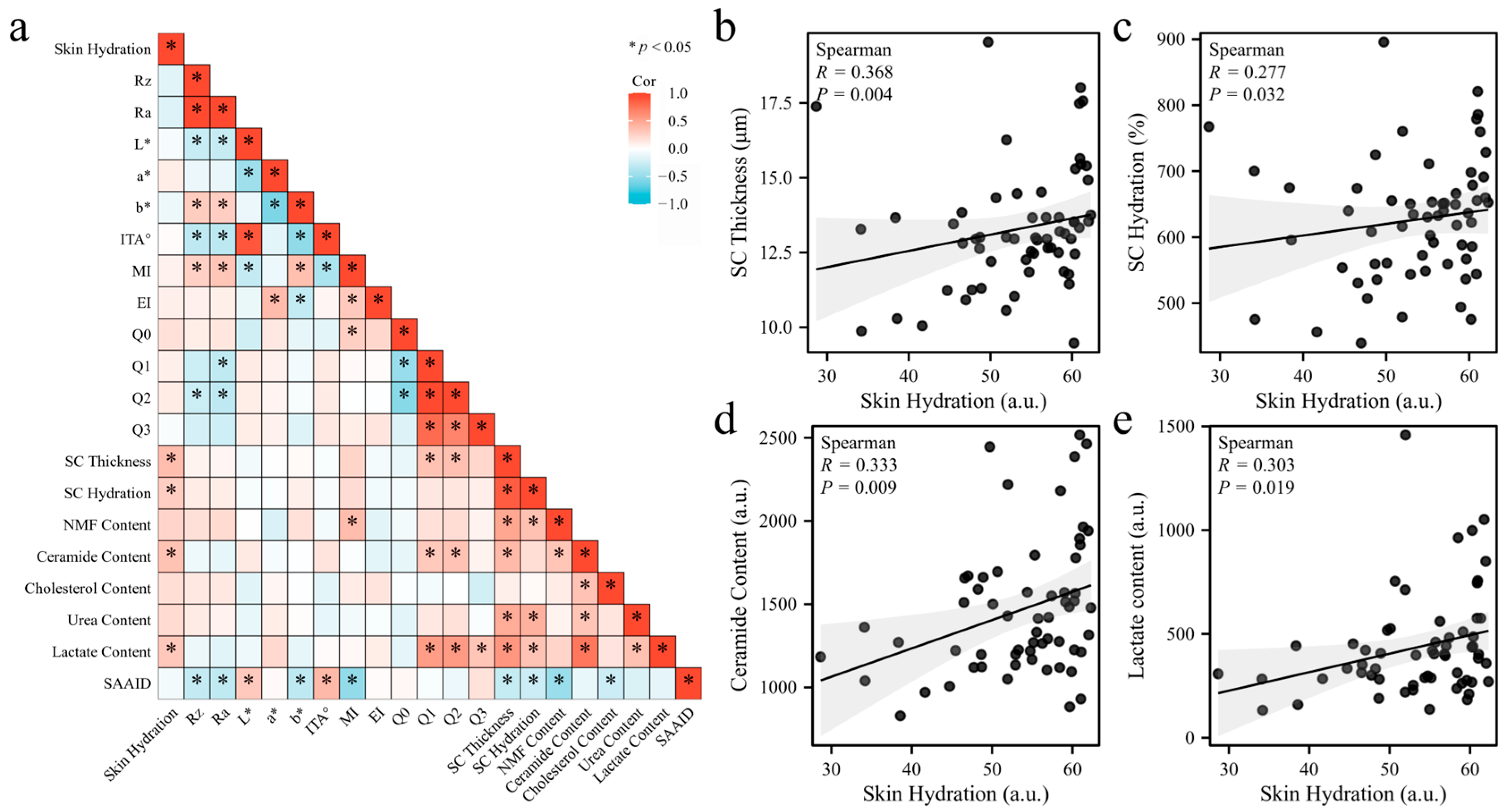
This study evaluated 21 biophysical skin parameters related to wrinkles, melanin, elasticity, color, the SC composition, and dermal aging on the cheeks and crow’s feet of 60 female subjects. To identify parameters associated with skin hydration, Spearman’s correlation coefficients were calculated. Of the twenty-one parameters, four demonstrated significant correlations with skin hydration, including the SC thickness, SC hydration, ceramide content, and lactate content (Figure 1). Specifically, SC thickness and ceramide and lactate levels exhibited moderate correlations, whereas SC hydration demonstrated a weak correlation with overall skin hydration.
Figure 1.
Correlations between various facial skin parameters and skin hydration. (a) Heatmap illustrating the correlation matrix of different skin parameters. Data with p < 0.05 are marked with an asterisk (*). On the heat map, red indicates a strong positive correlation, blue represents a strong negative correlation, and white indicates no correlation. (b–e) Scatter plots depicting the correlation between skin hydration and SC thickness (b), SC hydration (c), ceramide content (d), and lactate content (e). EI (erythema index), MI (melanin index), a* (represents red and green shades), b* (represents blue and yellow shades), ITA° (individual typology angle), L* (indicates color brightness), Q0 (maximum recovery area), Q1 (gross elasticity), Q2 (net elasticity), Q3 (biological elasticity), Rz (average maximum roughness), and Ra (arithmetic mean roughness).
3.2. Differences in Skin Physiological Indicators of LH and HH Groups
The Mann–Whitney U test revealed no significant difference in age between the LH and HH groups (Table 1). The comparative analysis of the 21 skin physiological parameters indicated that significant differences between the LH and HH groups were specific to skin hydration and key SC properties (Table 1). Specifically, the HH group exhibited significantly higher values than the LH group for skin hydration (73.861 ± 3.9725 vs. 32.911 ± 4.4613), SC thickness (14.629 ± 2.2134 vs. 12.434 ± 2.2479), ceramide contents (1632.7 ± 485.88 vs. 1247.1 ± 280.33), and lactate contents (514.52 ± 258.25 vs. 316.4 ± 103.9) (all p < 0.05). In contrast, no significant difference was identified in the SC hydration content between the groups, despite a trend toward a higher value in the HH group.
Table 1.
Differences in physiological indicators of LH and HH.
3.3. Comparison of LH and HH Groups in SC Lipids
3.3.1. The Identification of Differential Lipids in the LH and HH Groups
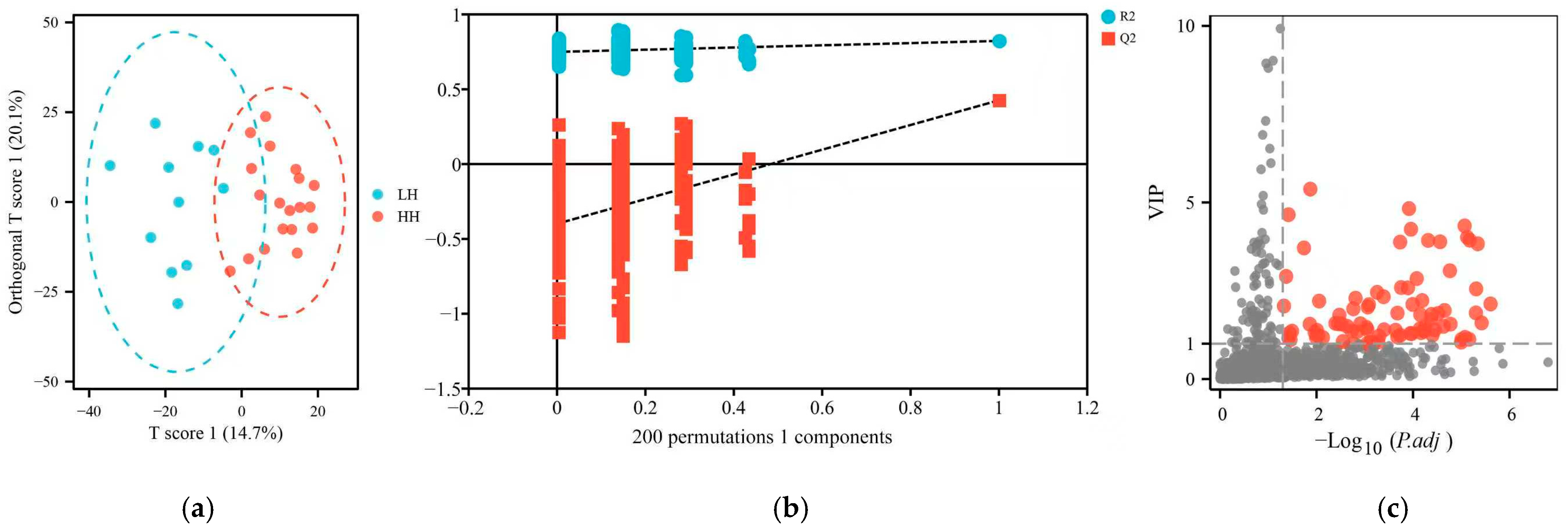
Untargeted lipidomics was employed to conduct a comprehensive lipidomic analysis of the facial SC of Chinese women in the LH and HH groups. OPLS-DA, a multivariate statistical method with supervised pattern recognition, effectively eliminates variations unrelated to the study groups, thereby facilitating the screening of differential lipids. Lipidomics data are characterized by high dimensionality (a large number of detected lipids) and a small sample size. These variables include both differential lipids related to the group classification and a substantial number of non-differential variables that may be intercorrelated. Therefore, applying the OPLS-DA statistical method enables the filtration of orthogonal variations unrelated to the grouping variable. Notably, the non-orthogonal and orthogonal components are analyzed separately, thereby yielding more reliable information on inter-group differences in lipids and their correlation with the experimental groups. As shown in Figure 2a, the OPLS-DA score plot indicated a clear separation between the lipid profiles of the two groups (R2Y = 0.781, Q2 = 0.617). Subsequently, a 200-response permutation test was performed to assess potential overfitting of the OPLS-DA model. As displayed in Figure 2b, the intercept of the Q2 regression line with the Y-axis was below zero, and all permuted Q2 values on the left were lower than the original Q2 value on the right, indicating that the constructed model was valid. Differential lipids between the LH and HH groups were identified using a VIP score > 1 from the first principal component of the OPLS-DA model and a p-value < 0.05 as the screening criteria. A total of 83 differential lipids met these criteria, as detailed in Supplementary Table S1. The results were visualized using a volcano plot, presented in Figure 2c.
Figure 2.
Differential SC lipids between the LH and HH groups. (a) OPLS-DA score plot. The abscissa represents the predictive principal component score values, indicating the differences between the groups. The ordinate represents the orthogonal component score values, indicating the variation within the groups. Each scatter point represents an individual sample, with its shape and color denoting the different experimental groups. A greater horizontal distance between samples indicates a larger inter-group difference, while a closer vertical distance suggests better intra-group reproducibility. (b) The permutation test plot. The abscissa represents the permutation retention (the correlation of the permuted Y-variable with the original Y-variable). The ordinate represents the values of R2Y and Q2. The blue dots indicate the R2Y values obtained from the permutation test, and the red squares indicate the Q2 values. The two dashed lines represent the regression lines for R2Y and Q2, respectively. The original model is considered valid as all permuted Q2 values (red squares) on the left are lower than the original Q2 value on the right, and the intercept of the Q2 regression line with the Y-axis is below zero. (c) A volcano plot of the differential lipids. Each point represents a lipid. Lipids satisfying the criteria of a VIP score > 1 and a p-value < 0.05 were considered statistically significant differential lipids between the two groups.
3.3.2. Analysis of Differential Lipids
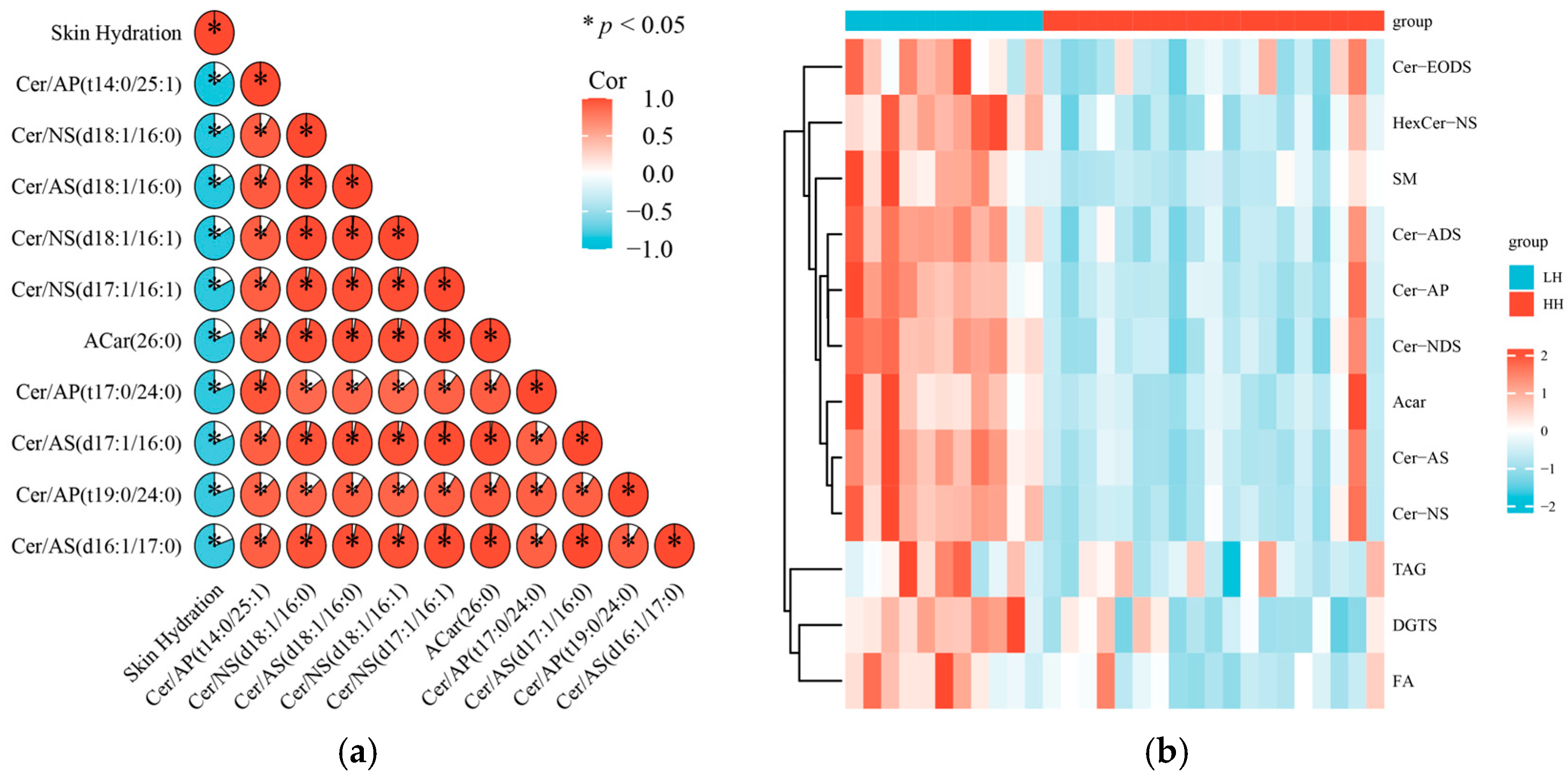
To investigate the potential association between the skin lipidome and skin hydration, a Spearman correlation analysis was conducted on the 83 differential lipids. The results revealed that all 83 lipids exhibited a negative correlation with the skin hydration level. Notably, ten lipids demonstrated a strong negative correlation (|r| > 0.8, p < 1.0 × 10⁻⁷) (Figure 3a), suggesting that these lipids may play a critical role in regulating skin hydration. These ten strongly correlated lipids comprised Cer/AP(t14:0/25:1), Cer/NS(d18:1/16:0), Cer/AS(d18:1/16:0), Cer/NS(d18:1/16:1), Cer/NS(d17:1/16:1), ACar(26:0), Cer/AP(t17:0/24:0), Cer/AS(d17:1/16:0), Cer/AP(t19:0/24:0), and Cer/AS(d16:1/17:0). Nine of the top ten lipids were ceramides, including various subtypes such as ceramide alpha-hydroxy fatty acid–phytospingosine (Cer-AP), ceramide alpha-hydroxy fatty acid–sphingosine (Cer-AS), and ceramide non-hydroxy fatty acid–sphingosine (Cer-NS). In addition, Acar (26:0) was also identified. These findings suggest that the dysregulation of ceramide metabolism may represent a core molecular feature underlying skin water loss and impaired barrier function. In addition to these ten lipids, the majority of the remaining lipids also exhibited moderate negative correlations, further supporting a broad association between the overall dynamics of the skin lipidome and the skin hydration status.
Figure 3.
Correlation and expression patterns of differential lipids associated with skin hydration status. (a) Pie chart illustrating the proportion of lipids exhibiting a significant and highly negative correlation with skin hydration status. The midline annotation indicates the p-value from the correlation test, while both the color and the filled proportion of each segment represent the correlation coefficient (r). (b) A heatmap displaying the relative abundance of different lipid classes in the LH and HH groups. The x-axis represents the sample groups, and the y-axis lists the differential lipids associated with each group. The color intensity within each tile reflects the relative expression level of the corresponding lipid. Cer-ADS (ceramide alpha-hydroxy fatty acid–dihydrosphingosine), Cer-EODS (ceramide esterified omega-hydroxy fatty acid–dihydrosphingosine), Cer-NDS (ceramide non-hydroxyfatty acid–dihydrosphingosine), DGTS (diacylglyceryl trimethylhomoserine), FA (free fatty acid), HexCer-NS (hexosylceramide non-hydroxyfatty acid–sphingosine), SM (sphingomyelin), and TAG (Triacylglycerol).
Based on the LipidBlast database (https://fiehnlab.ucdavis.edu/projects/LipidBlast, accessed on 24 November 2025), the 83 differential lipids were categorized into 12 distinct lipid classes (Supplementary Table S2). The difference in the distribution of these lipid classes between the LH and HH groups was analyzed by integrating their relative mean abundances. All 12 classes were found to be significantly more abundant in the LH group compared to the HH group (Figure 3b). These elevated lipid classes included various ceramide subclasses (e.g., Cer-NS, Cer-AS, Cer-ADS), as well as HexCer-NS, SM, acyl carnitines (Acar), TAG, diacylglyceryltrimethylhomoserines (DGTS), and free fatty acids (FA).
3.3.3. Enrichment Analysis of Differential Lipids
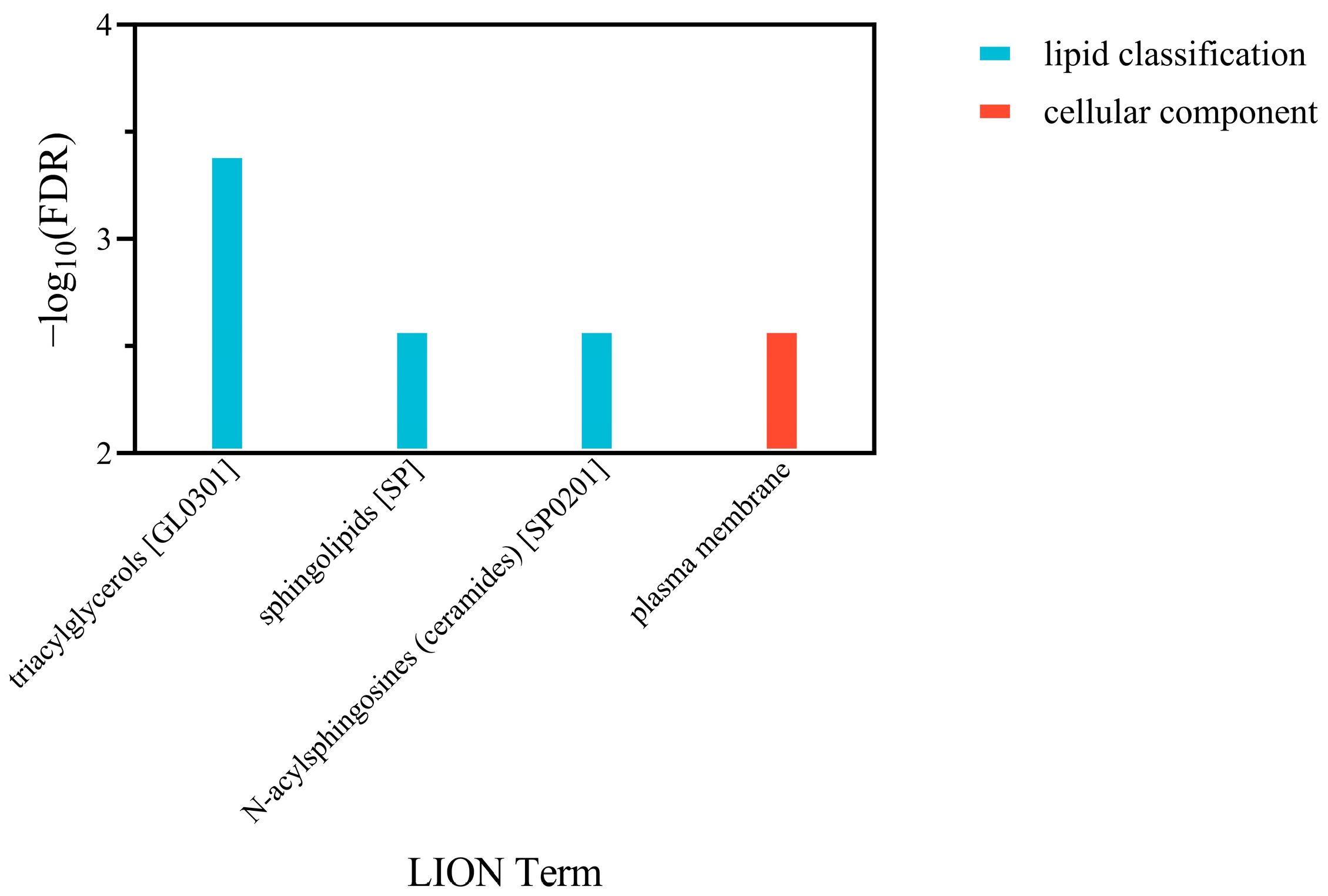
The enrichment analysis was performed using the LION/web ontology tool to investigate the functional implications of the differential lipids. A high matching rate of 98.79% was achieved between the input lipids and the ontology database. The analysis revealed statistically significant enrichment in three lipid categories and one cellular component (Figure 4). The significantly enriched lipid terms comprised triacylglycerols [GL0301], sphingolipids [SP], and N-acylsphingosines (ceramides) [SP0201]. Additionally, the plasma membrane was identified as a significantly enriched cellular component. These results indicate that the lipidomic alterations between the LH and HH groups are primarily associated with the sphingolipid metabolism and plasma membrane structure and function.
Figure 4.
Enrichment analysis of significantly differential lipids using LION/web.
4. Discussion
The present study systematically investigated the core relationships between facial skin hydration status and skin physiological parameters, the SC biochemical composition, and lipid metabolism in healthy women. This work specifically addresses a critical knowledge gap in the field. Previous research on dry skin has largely focused on analyzing individual components, such as NMFs, cholesterol, or ceramide classes, often lacking a holistic and unbiased analysis of the entire lipid metabolic network to identify systemic drivers. Our lipidomics analysis revealed that low-hydration skin is not merely attributed to lipid deficiency, such as ceramides, but rather a significant dysregulation of the overall lipid metabolic profile, including various sphingolipids (SPs), glycerolipids (GLs), and FAs. This finding challenges the common misconception of dry skin as a state of a simple lipid shortage and redefines it as a state of systemic lipid metabolic imbalance. These findings provide a new perspective for understanding the molecular mechanisms of skin dryness and for developing targeted, metabolism-based therapies.
4.1. Multi-Dimensional Physiological Correlations of Skin Hydration
The results of this study indicate a moderate positive correlation between facial skin hydration status and SC thickness, ceramides, and lactate contents, which is consistent with the theory of skin barrier function. A thicker SC, as a crucial structural component of the physical skin barrier, is often associated with better barrier function and a higher hydration capacity [6]. Ceramides are key components of the intercellular lipids in the SC, effectively preventing TEWL by forming dense lamellar structures [22]. Sufficient ceramide content can reduce TEWL and improve skin hydration [23]. For instance, in patients with AD, a significantly reduced ceramide content is observed in both lesional and non-lesional skin, accompanied by increased TEWL and decreased hydration [24]. Furthermore, an interventional study in adults demonstrated that the application of an emollient containing specific moisturizing components significantly enhanced skin hydration and increased the levels of the ceramides NS and AS, further supporting their positive correlation [25]. Additionally, as a vital element of NMFs, lactate supports hydration by attracting moisture and replacing water molecules in dehydrated conditions, helping to preserve the fluidity of SC lipids and proteins [26]. Decreased lactate levels in mild AD are associated with exacerbated skin dryness [27], underscoring their role in hydration. Notably, the SC hydration status measured via CRS exhibited only a weak correlation with the skin hydration measured using the capacitance method (Corneometer®) (r = 0.277, p < 0.05). Further analysis revealed a significant positive correlation between SC hydration and NMFs (r = 0.342, p < 0.01), whereas the correlation between skin hydration and NMFs did not reach statistical significance (r = 0.238, p = 0.068). This discrepancy may be attributed to differences in measurement principles. CRS non-invasively and specifically detects the distribution of water and the NMFs content within the SC, directly reflecting the hydration mechanisms of NMFs at their primary site of action. This result is consistent with existing research that indicates that NMFs components (e.g., urea and urocanic acid) maintain SC hydration via hydrogen-bonding networks and lipid regulation [28]. Although studies suggest that lower NMFs levels are directly associated with a dry skin state [29] and that the topical application of NMFs components can significantly increase skin hydration [30], the lack of a significant correlation between the capacitance-measured hydration and NMFs in this study might be because the measurement based on the skin surface dielectric constant is susceptible to various interfering factors. This method may lack the specificity to accurately capture NMFs-related hydration changes, potentially leading to an attenuated correlation. Therefore, future studies should expand the sample size and cautiously interpret hydration data from different sources within an integrated multi-technical framework.
Additionally, this study found no significant correlation between the hydration status and the crow’s feet parameters (Ra, Rz), skin color indicators (L*, a*, b*, ITA°), MI, EI, or elasticity in facial skin. This finding is highly consistent with the study by Mayrovitz et al. [31], which also reported no significant association between skin firmness (mechanical properties) and hydration status, as measured by tissue dielectric constants in the mandibular angle region. Notably, Mayrovitz et al. [32] reported a significant negative correlation between the skin water content and the melanin index on the volar forearms of women. However, this study demonstrated no similar association on the face, suggesting that this water–pigment relationship may be dependent on age, site, and ethnicity. A previous study conducted in Puerto Rico and the United States investigated the skin characteristics of women of different ethnicities. Regueira et al. provided key evidence supporting a negative correlation between skin color (L* value) and stratum corneum water contents and revealed significant ethnic differences in this relationship [33]. The discrepancies between the results of the present study and those reported in the literature further emphasize that the relationship between skin hydration status and physiological parameters is influenced by multiple factors. Hence, this analysis requires a comprehensive approach considering specific populations and sites.
4.2. The Dysregulation of the Lipid Metabolic Network: The Core Molecular Feature of Low-Hydration Skin
This study systematically elucidated the characteristics of the SC lipid composition on the facial skin of Chinese women with high and low hydration levels using untargeted lipidomics technology. The results revealed 83 differentially abundant lipids between the two groups. All these lipids exhibited an upregulated trend in the LH group and were widely distributed across 12 functional categories, including various ceramide subtypes (Cer-EODS, Cer-AP, Cer-NS, Cer-AS, Cer-ADS), SM, Acar, TAG, DGTS, and FA. These findings are consistent with the report by Xie et al. [13], which indicated that levels of GL, SP, and FA in the SC of sensitive dry skin were actually higher than in healthy skin. This suggests that impaired skin barrier function or poor hydration status may be accompanied by compensatory upregulation or abnormal accumulation of specific lipid species.
From a mechanistic perspective, the observed overall upregulation of lipids in low-hydration conditions may originate from two biological processes. On one hand, it could represent a compensatory response of the skin to impaired barrier function. When the skin barrier is damaged due to dry environments or pathological factors, keratinocytes upregulate lipid synthesis pathways to increase the synthesis and delivery of the intercellular lipid matrix, attempting to repair the damaged barrier and reduce TEWL [34]. Schreiner et al. [35] found that a deficiency of Cer-EOS and Cer-EOH in young, dry skin was often accompanied by a compensatory increase in Cer-NS and Cer-AS. A similar pattern of specific lipid changes has been observed in patients with senile pruritus (where skin dryness is a common clinical feature) [36]. Patients with AD exhibit characteristic changes, including decreased levels of long-chain ceramides accompanied by increased levels of short-chain ceramides [37,38]. On the other hand, abnormal accumulation due to impaired lipid processing or secretion is also a plausible explanation. This mechanism has been reported in various diseases and may be related to dysfunctions in key steps of the lipid metabolism. In conditions associated with skin barrier impairment, such as in atopic dermatitis or psoriasis patients, and in surfactant-treated skin, the content of ω-esterified ceramides and phytosphingosine-based ceramides decreases, while the content of sphingosine-based ceramides (namely CER-NS and CER-AS) increases [34].
Among the lipids demonstrating a strong negative correlation with skin hydration, Cer-AP, Cer-AS, and Cer-NS predominated. Cer -NS contains a sphingosine long-chain base and a fatty acid chain with a trans double bond, which tends to form a “bent conformation.” This reduces hydrogen bonding with water molecules and promotes lipid–lipid hydrogen bond formation, leading to looser lipid packing and the significantly increased water permeability of the membrane [39]. The specific structure of Cer-AP is crucial for the formation of the short periodicity phase and the maintenance of the overall integrity of the SC barrier [40]. A decrease in Cer-AP contents directly weakens the hydrogen bonding strength within the lipid matrix, causing a shift in lipid packing from the tight orthorhombic phase to the loose hexagonal phase, ultimately exacerbating an increase in TEWL [41]. Multiple studies have reported increases in CER-NS and CER-AS in atopic skin [42], indirectly supporting the negative correlation between CER-NS, CER-AS, and skin hydration.
ω-O-acylceramides (such as Cer-EOS and Cer-EOH) are indispensable for the proper function of the skin barrier. These ceramides contain ultra-long-chain ω-hydroxylated acyl chains esterified with linoleic acid and are core components for maintaining the structural stability of the intercellular lipid matrix in the SC [43]. Schreiner et al. [35] found that a deficiency of EOS and EOH ceramide types in dry skin was often accompanied by a lack of intercellular lipid lamellar structures in the SC, directly leading to abnormalities in the lamellar architecture. In this study, we observed that EODS ceramides (esterified ω-hydroxy ceramides) exhibited a moderate negative correlation with skin hydration status. Its increased level may indicate underlying lipid metabolic disturbances or compensatory barrier dysfunction, a phenomenon highly consistent with the barrier regulatory mechanism of ω-O-acylceramides: under normal physiological conditions, these ceramides need to act synergistically in specific proportions to promote the formation of the long periodicity phase and tight orthorhombic chain packing [43]. Any imbalance in the proportions of these subtypes can affect the formation of normal lamellar structures in the intercellular lipids, leading to decreased lipid order and increased barrier permeability and ultimately triggering skin dryness [44].
It is important to note that lipid changes in dry skin exhibit significant heterogeneity [45], which may stem from the interplay of multiple factors, primarily including the anatomical site, the etiology of dryness, and detection methodologies. First, the anatomical site is a critical determinant of lipid variations. The pattern of comprehensive ceramide upregulation in facial skin observed in this study contrasts sharply with the trend of decreased ceramide contents in leg skin reported by Ishikawa et al. [46]. Conversely, other studies have reported a decrease in total ceramide levels in dry forearm skin, accompanied by a reduction in subtypes such as CER-NH, CER-NP, CER-EOS, CER-EOH, and CER-EOP, alongside an observed increase in CER-AS [47]. Research indicates that the total ceramide content in the leg and arm region is significantly higher than in the cheek [46], and such physiological differences may lead to distinct lipid response patterns to dryness stimuli across different skin sites. Second, the etiology of dryness directly influences the characteristics of lipid alterations. Surfactant-induced dry leg skin demonstrates increased levels of Cer-NS, Cer-EOP, and Cer-EOH, while Cer-NP levels decrease [48]. In contrast, erlotinib-induced dry skin exhibits a declining trend only in Cer-AP and AH [14]. This etiology-specific lipid response pattern suggests that dryness triggered by different mechanisms may impact lipid metabolism through distinct pathways. Additionally, detection methodologies cannot be overlooked. Notably, age, gender, race, and season further contribute to the complexity of the lipid composition [18]. In summary, dry skin does not manifest as a simple reduction in lipids but rather exhibits highly specific lipid remodeling. This remodeling pattern is jointly regulated by multi-dimensional factors such as the anatomical site, the etiology of dryness, and ethnic influences. Future research must establish a more refined classification system that comprehensively considers these factors to accurately interpret the lipid metabolic characteristics of dry skin.
The enrichment analysis of the 83 differential lipids using the LION/web tool suggested that these lipids were primarily enriched in lipid categories such as triacylglycerol [GL0301], sphingolipids [SP], and N-acylsphingosine (ceramide) [SP0201], as well as the plasma membrane cellular component. Hence, the lipidomic differences between the LH and HH groups are mainly reflected in the imbalance of the sphingolipid metabolism and TAG, as well as alterations in the plasma membrane structure and function. From a functional perspective, these enriched categories collectively point to the homeostatic maintenance mechanisms of the SC barrier. During terminal differentiation, TAG secreted by lamellar bodies can be hydrolyzed by local lipases, releasing free FA that serve as direct precursors for synthesizing key barrier lipids such as ceramides and cholesterol [37]. Ceramides, as the most abundant lipids in the SC intercellular lipid matrix, must combine with cholesterol and free FA in precise proportions to form densely packed bilayer structures, thereby effectively restricting TEWL. This study demonstrates that multiple ceramide subtypes (e.g., Cer-NS, Cer-AP, and Cer-AS) are broadly upregulated in the LH group, but imbalances in their subtype ratios may disrupt the optimal lipid composition, potentially driving a transition in the lamellar structure from a tightly packed orthorhombic to a looser hexagonal lattice, thereby increasing membrane permeability. Furthermore, sphingolipids and their metabolites (e.g., sphingosine-1-phosphate and S1P) are not only structural membrane components but are also key signaling molecules that regulate keratinocyte proliferation, differentiation, and apoptosis [49]. The plasma membrane, as a critical interface for lipid metabolism and signal transduction, undergoes compositional lipid changes that may affect the terminal differentiation process of keratinocytes and the orderly secretion of barrier lipids [50]. In summary, the global perturbation of the lipid metabolic network under LH conditions—particularly the dysregulation of ceramide subtype ratios and alterations in plasma membrane function—likely synergistically disrupts the normal organization of the SC lipid bilayers, leading to increased water loss and thereby contributing to the pathophysiological process of low skin hydration. From a comprehensive lipidomics perspective, this study further reveals that sphingolipid metabolic disturbances and the consequent changes in the plasma membrane lipid composition may constitute an important molecular basis for the decline in skin’s water-holding capacity. These findings reveal new clues for a deeper understanding of skin dryness mechanisms. More critically, they directly reveal the greatest opportunity for future intervention. Our results demonstrate that the most significant intervention opportunity is not the broad “supplementation of lipids” but the precise “modulation of the imbalanced lipid metabolic network”—specifically, restoring the specific proportions among key ceramide subtypes (e.g., Cer-EOS, Cer-NS, and Cer-AP) and rectifying the overall disruption of lipid metabolism. This provides definitive molecular targets and a theoretical basis for developing novel therapies that can fundamentally restore skin barrier homeostasis. Such metabolism-targeted therapies (e.g., bioactive agents that regulate key enzymatic activities), as opposed to mere supplemental moisturizers, represent the forward path.
4.3. Study Limitations
This study aimed to explore the stratum corneum components associated with skin hydration in a healthy population and to identify lipid molecules linked to low hydration levels. While our lipidomic profiling provides novel insights into the systemic metabolic imbalance underlying dry skin, several limitations should be acknowledged. First, the relatively small sample size (LH group n = 11, HH group n = 19) may affect the power of statistical tests and limit the generalizability of the findings. Second, the absence of TEWL measurements, a gold-standard functional assessment of the skin barrier, represents a significant limitation. Although our study focused on the association between hydration status and lipidomic profiles, the lack of TEWL data prevents us from directly linking the observed lipid dysregulation to functional barrier impairment. This omission hinders a comprehensive understanding of the functional consequences of the lipidomic alterations in LH skin. Furthermore, although our lipidomics analysis revealed correlations between the skin hydration status and lipid metabolism, these findings have not been confirmed by in vitro functional experiments. Thus, the specific roles of the differential lipids in skin water retention remain obscure, limiting our ability to establish a causal relationship between the lipidomic features and skin hydration status. Finally, the use of multiple detection techniques may introduce potential batch effects; although standardized procedures were implemented, this could still affect the stability of the results. Therefore, future research should expand the sample size, incorporate key functional measurements like TEWL to correlate lipidomic changes with barrier function, and incorporate various experimental methods, such as cell/tissue models or targeted interventions, for functional validation to enhance the robustness, generalizability, and causal inference of the conclusions.
5. Conclusions
In conclusion, this study provides multi-dimensional evidence supporting the close association between skin hydration and the SC thickness, ceramide content, and lactate levels. We employed untargeted lipidomics, revealing a global dysregulation of lipid metabolism centered on ceramide metabolism in low-hydration skin. These findings offer a novel systems biology perspective on skin barrier function and hydration mechanisms. Our work not only deepens the understanding of the physiological basis of skin dryness but also provides a critical theoretical foundation and potential biomarkers for developing innovative skincare strategies that target the lipid metabolic network to alleviate skin dryness and delay aging.
Supplementary Materials
The following supporting information can be downloaded at https://www.mdpi.com/article/10.3390/cosmetics13010004/s1, Table S1: The relative contents of differentially expressed lipids among the five groups; Table S2: The lipid classification table.
Author Contributions
Z.W. and P.L.: conceptualization, methodology, supervision. Y.F., Z.W. and P.L.: investigation. Y.F. and Z.W.: formal analysis, data curation. Y.F.: writing—original draft. Z.W. and P.L.: writing—review and editing. Z.W.: project administration. All authors have read and agreed to the published version of the manuscript.
Funding
This research received no external funding.
Institutional Review Board Statement
This study was conducted in accordance with the Declaration of Helsinki and was approved by the Ethics Committee of the Cosmetic Technology Center of the Chinese Academy of Inspection and Quarantine (protocol code: S2024-09-017; date of approval: 25 September 2024).
Informed Consent Statement
Informed consent was obtained from all subjects involved in this study.
Data Availability Statement
The datasets generated and analyzed during the current study are available in the article and its Supplementary Materials (Tables S1 and S2). The raw datasets (including individual physiological data) are not publicly available due to privacy restrictions but are available from the corresponding author on reasonable request.
Acknowledgments
The authors would like to express their sincere gratitude to the China Inspection and Quarantine Science Research Institute for providing the experimental platform and related detection equipment, which was crucial for the successful execution of this study and the precise acquisition of data. We also extend our heartfelt thanks to the staff of the institute for their technical assistance and support throughout the experimental process. Additionally, we appreciate the collaboration of Shanghai Biotree Biotech Co., Ltd. for their assistance in the lipidomics analysis.
Conflicts of Interest
Authors Yumei Fan and Zheng Wang are employed at Meyer Bio-medicine Co., Ltd., while Peixue Ling is a professor at the National Glycoengineering Research Center of Shandong University and the founder of Meyer Bio-medicine. The authors declare that the research was conducted in the absence of any commercial or financial relationships that could be construed as a potential conflict of interest. The funders had no role in the design of the study; in the collection, analyses or interpretation of data; in the writing of the manuscript; or in the decision to publish the results.
Abbreviations
The following abbreviations are used in this manuscript:
| SC | Stratum corneum |
| TEWL | Transepidermal water loss |
| NMFs | Natural moisturizing factors |
| CRS | Confocal Raman spectroscopy |
| MPT | Multiphoton laser tomography |
| SAAID | Skin Aging Index |
| ITA° | Individual typology angle |
| MI | Melanin index |
| EI | Erythema index |
| OPLS-DA | Orthogonal projections to latent structures–discriminant analysis |
| VIP | Variable importance in the projection |
| Acar | Acylcarnitine |
| Cer-ADS | Ceramide alpha-hydroxy fatty acid–dihydrosphingosine |
| Cer-AP | Ceramide alpha-hydroxy fatty acid–phytospingosine |
| Cer-AS | Ceramide alpha-hydroxy fatty acid–sphingosine |
| Cer-EODS | Ceramide Esterified omega-hydroxy fatty acid–dihydrosphingosine |
| Cer-NDS | Ceramide non-hydroxyfatty acid–dihydrosphingosine |
| Cer-NS | Ceramide non-hydroxyfatty acid–sphingosine |
| DGTS | Diacylglyceryl trimethylhomoserine |
| FA | Free fatty acid |
| HexCer-NS | Hexosylceramide non-hydroxyfatty acid–sphingosine |
| SM | Sphingomyelin |
| TAG | Triacylglycerol |
References
- Camilion, J.V.; Khanna, S.; Anasseri, S.; Laney, C.; Mayrovitz, H.N. Physiological, Pathological, and Circadian Factors Impacting Skin Hydration. Cureus 2022, 14, e27666. [Google Scholar] [CrossRef] [PubMed]
- Yokota, M.; Shimizu, K.; Kyotani, D.; Yahagi, S.; Hashimoto, S.; Masaki, H. The Possible Involvement of Skin Dryness on Alterations of the Dermal Matrix. Exp. Dermatol. 2014, 23, 27–31. [Google Scholar] [CrossRef]
- De Melo, M.O.; Maia Campos, P.M.B.G. Characterization of Oily Mature Skin by Biophysical and Skin Imaging Techniques. Ski. Res. Technol. 2018, 24, 386–395. [Google Scholar] [CrossRef] [PubMed]
- Kourbaj, G.; Bielfeldt, S.; Kruse, I.; Wilhelm, K. Confocal Raman Spectroscopy Is Suitable to Assess Hair Cleansing-derived Skin Dryness on Human Scalp. Ski. Res. Technol. 2022, 28, 577–581. [Google Scholar] [CrossRef]
- Koppes, S.A.; Kemperman, P.; Van Tilburg, I.; Calkoen-Kwa, F.; Engebretsen, K.A.; Puppels, G.J.; Caspers, P.J.; Kezic, S. Determination of Natural Moisturizing Factors in the Skin: Raman Microspectroscopy versus HPLC. Biomarkers 2017, 22, 502–507. [Google Scholar] [CrossRef] [PubMed]
- Crowther, J.M.; Sieg, A.; Blenkiron, P.; Marcott, C.; Matts, P.J.; Kaczvinsky, J.R.; Rawlings, A.V. Measuring the effects of topical moisturizers on changes in stratum corneum thickness, water gradients and hydration in vivo. Br. J. Dermatol. 2008, 159, 567–577. [Google Scholar] [CrossRef]
- Dinish, U.S.; Yew, Y.W.; Vinod Ram, K.; Bi, R.; Attia, A.B.E.; Teo Xinhui, V.; Rajarahm, P.; Oon, H.H.; Thng, S.T.G.; Olivo, M. Non-invasive biochemical analysis and comparison of atopic dermatitis and psoriasis skin using handheld confocal Raman spectroscopy. J. Biophotonics 2023, 16, e202300191. [Google Scholar] [CrossRef]
- Zolotas, M.; Schleusener, J.; Lademann, J.; Meinke, M.C.; Kokolakis, G.; Darvin, M.E. Atopic Dermatitis: Molecular Alterations between Lesional and Non-Lesional Skin Determined Noninvasively by In Vivo Confocal Raman Microspectroscopy. Int. J. Mol. Sci. 2023, 24, 14636. [Google Scholar] [CrossRef]
- König, K.; König, A. Multiphoton Tomography in Cosmetic Research. Cosmetics 2025, 12, 44. [Google Scholar] [CrossRef]
- Toncic, R.J.; Jakasa, I.; Hadzavdic, S.L.; Goorden, S.M.; der Vlugt, K.J.G.; Stet, F.S.; Balic, A.; Petkovic, M.; Pavicic, B.; Zuzul, K.; et al. Altered Levels of Sphingosine, Sphinganine and Their Ceramides in Atopic Dermatitis Are Related to Skin Barrier Function, Disease Severity and Local Cytokine Milieu. Int. J. Mol. Sci. 2020, 21, 1958. [Google Scholar] [CrossRef]
- Goto-Inoue, N.; Hayasaka, T.; Zaima, N.; Nakajima, K.; Holleran, W.M.; Sano, S.; Uchida, Y.; Setou, M. Imaging Mass Spectrometry Visualizes Ceramides and the Pathogenesis of Dorfman-Chanarin Syndrome Due to Ceramide Metabolic Abnormality in the Skin. PLoS One 2012, 7, e49519. [Google Scholar] [CrossRef] [PubMed]
- Fan, Y.; Wei, C.; Su, N.; Ma, Y.; Liu, W.; Sun, P.; Shan, S. Correlation Study of Facial Lipid Profile Differences and Skin Physiological Characteristics in Chinese Women Aged 19–33 Years. Intern. J. Cosmet. Sci. 2025, 47, 752–767. [Google Scholar] [CrossRef] [PubMed]
- Xie, A.; Zhang, X.; Huang, Q.; Wu, J. Utilizing Untargeted Lipidomics Technology to Elucidate Differences in Lipid Compositions Among Sensitive Dry, Sensitive Oily and Healthy Skin Types. Metabolites 2025, 15, 292. [Google Scholar] [CrossRef] [PubMed]
- Uchino, T.; Fujino, H.; Kamiya, D.; Suzuki, T.; Miyazaki, Y.; Asada, K.; Shirai, T.; Yagi, H.; Sano, Y.; Moriki, M.; et al. Association of dry skin with intercellular lipid composition of stratum corneum after erlotinib administration. Cancer Chemother. Pharmacol. 2020, 86, 233–243. [Google Scholar] [CrossRef]
- Blaak, J.; Dähnhardt, D.; Bielfeldt, S.; Theiss, C.; Simon, I.; Wilhelm, K.-P.; Dähnhardt-Pfeiffer, S.; Staib, P. Improvement of Human Epidermal Barrier Structure and Lipid Profile in Xerotic- and Atopic-Prone Skin via Application of a Plant-Oil and Urea Containing pH 4.5 Emulsion. Cosmetics 2023, 10, 95. [Google Scholar] [CrossRef]
- Su, Q.; Hu, X.; Yang, M.; He, H.; Jia, Y. Lipidomic Analysis of Facial Skin Surface Lipids in Acne in Young Women. Int. J. Cosmet. Sci. 2024, 46, 424–436. [Google Scholar] [CrossRef]
- Choi, M.R.; Shin, J.M.; Shin, Y.A.; Chang, Y.H.; Chang, M.Y.; Lim, C.A.; Sohn, K.C.; Seo, Y.J.; Kim, C.D.; Lee, J.H.; et al. Possible Role of Single Stranded DNA Binding Protein 3 on Skin Hydration by Regulating Epidermal Differentiation. Ann. Dermatol. 2018, 30, 432–440. [Google Scholar] [CrossRef]
- Sadowski, T.; Klose, C.; Gerl, M.J.; Wójcik-Maciejewicz, A.; Herzog, R.; Simons, K.; Reich, A.; Surma, M.A. Large-Scale Human Skin Lipidomics by Quantitative, High-Throughput Shotgun Mass Spectrometry. Sci. Rep. 2017, 7, 43761. [Google Scholar] [CrossRef]
- Xiahou, Z.; Han, J. Effects of Dehydroabietic Acid on Nontarget Lipidomics and Proteomics of HepG2. Front. Pharmacol. 2022, 13, 1015240. [Google Scholar] [CrossRef]
- Molenaar, M.R.; Jeucken, A.; Wassenaar, T.A.; Van De Lest, C.H.A.; Brouwers, J.F.; Helms, J.B. LION/Web: A Web-Based Ontology Enrichment Tool for Lipidomic Data Analysis. GigaScience 2019, 8, giz061. [Google Scholar] [CrossRef]
- Molenaar, M.R.; Haaker, M.W.; Vaandrager, A.B.; Houweling, M.; Helms, J.B. Lipidomic Profiling of Rat Hepatic Stellate Cells during Activation Reveals a Two-Stage Process Accompanied by Increased Levels of Lysosomal Lipids. J. Biol. Chem. 2023, 299, 103042. [Google Scholar] [CrossRef] [PubMed]
- Akiyama, F.; Takahashi, N.; Ueda, Y.; Tada, S.; Takeuchi, N.; Ohno, Y.; Kihara, A. Correlations between Skin Condition Parameters and Ceramide Profiles in the Stratum Corneum of Healthy Individuals. Int. J. Mol. Sci. 2024, 25, 8291. [Google Scholar] [CrossRef] [PubMed]
- Murphy, B.; Grimshaw, S.; Hoptroff, M.; Paterson, S.; Arnold, D.; Cawley, A.; Adams, S.E.; Falciani, F.; Dadd, T.; Eccles, R.; et al. Alteration of Barrier Properties, Stratum Corneum Ceramides and Microbiome Composition in Response to Lotion Application on Cosmetic Dry Skin. Sci. Rep. 2022, 12, 5223. [Google Scholar] [CrossRef] [PubMed]
- Shimada, K.; Yoon, J.S.; Yoshihara, T.; Iwasaki, T.; Nishifuji, K. Increased transepidermal water loss and decreased ceramide content in lesional and non-lesional skin of dogs with atopic dermatitis. Vet. Dermatol. 2009, 20, 541–546. [Google Scholar] [CrossRef]
- Nguyen, H.; Nguyen, T.; Mantilla, A.; Emesiani, C.; Meckfessel, M. Individual Article: Over-the-Counter Moisturizers Significantly Improve Skin Hydration in Adults With Eczema/Atopy-Prone Skin. J. Drugs Dermatol. 2023, 22, SF388641s16-SF388641s20. [Google Scholar] [CrossRef]
- Gunnarsson, M.; Mojumdar, E.H.; Topgaard, D.; Sparr, E. Extraction of Natural Moisturizing Factor from the Stratum Corneum and Its Implication on Skin Molecular Mobility. J. Colloid Interface Sci. 2021, 604, 480–491. [Google Scholar] [CrossRef]
- Sugawara, T.; Kikuchi, K.; Tagami, H.; Aiba, S.; Sakai, S. Decreased lactate and potassium levels in natural moisturizing factor from the stratum corneum of mild atopic dermatitis patients are involved with the reduced hydration state. J. Dermatol. Sci. 2012, 66, 154–159. [Google Scholar] [CrossRef]
- Martin, M.; Chantemargue, B.; Trouillas, P. Skin Hydration by Natural Moisturizing Factors, a Story of H-Bond Networking. J. Phys. Chem. B 2025, 129, 844–852. [Google Scholar] [CrossRef]
- Feng, L.; Chandar, P.; Lu, N.; Vincent, C.; Bajor, J.; McGuiness, H. Characteristic differences in barrier and hygroscopic properties between normal and cosmetic dry skin. II. Depth profile of natural moisturizing factor and cohesivity. Int. J. Cosmet. Sci. 2014, 36, 231–238. [Google Scholar] [CrossRef]
- Gallinger, J.; Kuhn, A.; Wessel, S.; Behm, P.; Heinecke, S.; Filbry, A.; Hillemann, L.; Rippke, F. Depth-dependent hydration dynamics in human skin: Vehicle-controlled efficacy assessment of a functional 10% urea plus NMF moisturizer by near-infrared confocal spectroscopic imaging (KOSIM IR) and capacitance method complemented by volunteer perception. Skin Res. Technol. 2022, 28, 342–349. [Google Scholar] [CrossRef]
- Mayrovitz, H.N.; Wong, J.; Fasen, M. Age and Hydration Dependence of Jowl and Forearm Skin Firmness in Young and Mature Women. J. Cosmet. Dermatol. 2018, 17, 1262–1270. [Google Scholar] [CrossRef] [PubMed]
- Mayrovitz, H.N.; Aoki, K.; Deehan, E.; Ruppe, M. Epidermal and Dermal Hydration in Relation to Skin Color Parameters. Skin Res. Technol. 2024, 30, e70028. [Google Scholar] [CrossRef] [PubMed]
- Regueira, Y.; Fargo, J.D.; Tiller, D.; Brown, K.; Clements, C.; Beacham, B.; Brignone, E.; Sommers, M.S. Comparison of Skin Biomechanics and Skin Color in Puerto Rican and Non-Puerto Rican Women. P. R. Health Sci. J. 2019, 38, 170–175. [Google Scholar]
- Mijaljica, D.; Townley, J.P.; Spada, F.; Harrison, I.P. The heterogeneity and complexity of skin surface lipids in human skin health and disease. Prog. Lipid Res. 2024, 93, 101264. [Google Scholar] [CrossRef] [PubMed]
- Schreiner, V.; Gooris, G.S.; Pfeiffer, S.; Lanzendörfer, G.; Wenck, H.; Diembeck, W.; Proksch, E.; Bouwstra, J. Barrier characteristics of different human skin types investigated with X-ray diffraction, lipid analysis, and electron microscopy imaging. J. Investig. Dermatol. 2000, 114, 654–660. [Google Scholar] [CrossRef] [PubMed]
- Ma, X.; Lu, L.; Zhao, Z.; Cai, M.; Gao, N.; Han, G. Lipidomics profiling of skin surface lipids in senile pruritus. Lipids Health Dis. 2020, 19, 171. [Google Scholar] [CrossRef]
- Fujii, M. The Pathogenic and Therapeutic Implications of Ceramide Abnormalities in Atopic Dermatitis. Cells 2021, 10, 2386. [Google Scholar] [CrossRef]
- Emmert, H.; Baurecht, H.; Thielking, F.; Stölzl, D.; Rodriguez, E.; Harder, I.; Proksch, E.; Weidinger, S. Stratum corneum lipidomics analysis reveals altered ceramide profile in atopic dermatitis patients across body sites with correlated changes in skin microbiome. Exp. Dermatol. 2021, 30, 1398–1408. [Google Scholar] [CrossRef]
- Reuter, M.; Joseph, E.; Lian, G.; Lunter, D.J. Presence of Different Ceramide Species Modulates Barrier Function and Structure of Stratum Corneum Lipid Membranes: Insights from Molecular Dynamics Simulations. Mol. Pharm. 2025, 22, 4280–4292. [Google Scholar] [CrossRef]
- Engelbrecht, T.N.; Schroeter, A.; Hauß, T.; Demé, B.; Scheidt, H.A.; Huster, D.; Neubert, R.H.H. The impact of ceramides NP and AP on the nanostructure of stratum corneum lipid bilayer. Part I: Neutron diffraction and 2H NMR studies on multilamellar models based on ceramides with symmetric alkyl chain length distribution. Soft Matter 2012, 8, 2599–2607. [Google Scholar] [CrossRef]
- Uche, L.E.; Gooris, G.S.; Beddoes, C.M.; Bouwstra, J.A. New insight into phase behavior and permeability of skin lipid models based on sphingosine and phytosphingosine ceramides. Biochim. Biophys. Acta Biomembr. 2019, 1861, 1317–1328. [Google Scholar] [CrossRef] [PubMed]
- Mijaljica, D.; Townley, J.P.; Hondros, A.; Hewson, C.; Harrison, I.P.; Spada, F. Considering Phytosphingosine-Based Ceramide Formulations for Atopic Skin Care. Dermato 2024, 4, 5–22. [Google Scholar] [CrossRef]
- Opálka, L.; Kováčik, A.; Pullmannová, P.; Maixner, J.; Vávrová, K. Effects of omega-O-acylceramide structures and concentrations in healthy and diseased skin barrier lipid membrane models. J. Lipid Res. 2020, 61, 219–228. [Google Scholar] [CrossRef]
- Frame, C.O.; Shamaprasad, P.; Deshpande, S.; Quach, C.D.; Gui, L.; Iacovella, C.R.; Bunge, A.L.; McCabe, C. New Coarse-Grained Models for Stratum Corneum Ceramides Reveal Headgroup-Dependent Structural Organization. J. Phys. Chem. B 2025, 129, 12167–12178. [Google Scholar] [CrossRef] [PubMed]
- Amin, R.; Lechner, A.; Vogt, A.; Blume-Peytavi, U.; Kottner, J. Molecular characterization of xerosis cutis: A systematic review. PLoS ONE 2021, 16, e0261253. [Google Scholar] [CrossRef]
- Ishikawa, J.; Shimotoyodome, Y.; Ito, S.; Miyauchi, Y.; Fujimura, T.; Kitahara, T.; Hase, T. Variations in the Ceramide Profile in Different Seasons and Regions of the Body Contribute to Stratum Corneum Functions. Arch. Dermatol. Res. 2013, 305, 151–162. [Google Scholar] [CrossRef]
- Ishikawa, J.; Narita, H.; Kondo, N.; Hotta, M.; Takagi, Y.; Masukawa, Y.; Kitahara, T.; Takema, Y.; Koyano, S.; Yamazaki, S.; et al. Changes in the ceramide profile of atopic dermatitis patients. J. Investig. Dermatol. 2010, 130, 2511–2544. [Google Scholar] [CrossRef]
- Fulmer, A.W.; Kramer, G.J. Stratum corneum lipid abnormalities in surfactant-induced dry scaly skin. J. Investig. Dermatol. 1986, 86, 598–602. [Google Scholar] [CrossRef]
- Borodzicz, S.; Rudnicka, L.; Mirowska-Guzel, D.; Cudnoch-Jedrzejewska, A. The role of epidermal sphingolipids in dermatologic diseases. Lipids Health Dis. 2016, 15, 13. [Google Scholar] [CrossRef]
- Li, C.; Quintana Perez, Y.; Lamaze, C.; Blouin, C.M. Lipid Nanodomains and Receptor Signaling: From Actin-Based Organization to Membrane Mechanics. Curr. Opin. Cell Biol. 2024, 86, 102308. [Google Scholar] [CrossRef]
Disclaimer/Publisher’s Note: The statements, opinions and data contained in all publications are solely those of the individual author(s) and contributor(s) and not of MDPI and/or the editor(s). MDPI and/or the editor(s) disclaim responsibility for any injury to people or property resulting from any ideas, methods, instructions or products referred to in the content. |
© 2025 by the authors. Licensee MDPI, Basel, Switzerland. This article is an open access article distributed under the terms and conditions of the Creative Commons Attribution (CC BY) license.