

Transformation of the Personnel Training System for Oil and Gas Projects in the Russian Arctic

 ,
,
Abstract
1. Introduction
2. Materials and Methods
3. Results of the Expert Survey
- Oil and gas complex—27%;
- Science—27%;
- Education—19%;
- Business (Economics and consulting)—27%.
- drilling engineers, including specialists in offshore drilling (14.3% of the total number of responses);
- specialists in the sphere of marine transport—pilots, captains, security specialists in marine transport (14.3%);
- database specialists—programmers (11.9%);
- mining engineers (9.5%);
- geologists (7.1%);
- environmentalists (7.1%);
- construction workers (7.1%).
4. Discussion: New Trends in Training Specialists for the Arctic
4.1. Increased Competition, Development of New Standards
4.2. Life Long Learning
4.3. Digitalization
4.4. Internationalization of Arctic Education
5. Conclusions
Author Contributions
Funding
Conflicts of Interest
References
- Savard, C.; Nikulina, A.Y.; Mécemmène, C.; Mokhova, E. The Electrification of Ships Using the Northern Sea Route: An Approach. J. Open Innov. Technol. Mark. Complex. 2020, 6, 13. [Google Scholar] [CrossRef]
- Litvinenko, V. The Role of Hydrocarbons in the Global Energy Agenda: The Focus on Liquefied Natural Gas. Resources 2020, 9, 59. [Google Scholar] [CrossRef]
- Rosen, M.; Thuringer, C. Unconstrained Foreign Direct Investment: An Emerging Challenge to Arctic Security; CNA Corp.: Washington, DC, USA, 2017. [Google Scholar]
- Zagorskii, A.V. China accepts conditions in the Arctic. Mirovaya Ekon. I Mezhdunarodnye Otnos. 2019, 7, 76–83. (In Russian) [Google Scholar]
- Väätänen, V.; Zimmerbauer, K. Territory–network interplay in the co-constitution of the Arctic and ‘to-be’ Arctic states. Territ. Politi- Gov. 2019, 8, 372–389. [Google Scholar] [CrossRef]
- Sokolova, I.; Smorchkova, V.; Yusov, A. Human resources of the Russian Arctic regions. Public Adm. 2017, 19, 86–93. (In Russian) [Google Scholar] [CrossRef]
- Fadeev, A.M.; Larichkin, F.D.; Cherepovitsyn, A.E. Features of Training of Personnel for the Arctic Marine Hydrocarbon Fields Development. J. Min. Inst. 2011, 194, 332–338. [Google Scholar]
- Fadeev, A.M.; Cherepovitsyn, A.E.; Larichkin, F.D.; Tsvetkova, A.Y. Personnel Support for the Implementation of Offshore Projects in the Arctic as an Effective Tool for Strategic Management of the Oil and Gas Complex. The North and the market: Shaping the economic order 2018, 2, 16–25. Available online: http://www.iep.kolasc.net.ru/journal/files/2018-2.pdf (accessed on 30 August 2020). (In Russian).
- Fadeev, A.M.; Cherepovitsyn, A.E.; Larichkin, F.D. Strategic Management of the Oil And Gas Complex in the Arctic; KSC RAS: Apatity, Russia, 2019; pp. 217–225. [Google Scholar]
- Keskitalo, P.; Määttä, K.; Uusiautti, S. Sámi education in Finland. Early Child Dev. Care 2012, 182, 329–343. [Google Scholar] [CrossRef]
- Uusiautti, S.; Happo, I.; Määttä, K. Challenges and Strengths of Early Childhood Education in Sparsely Populated Small Provinces the Case of Lapland, Finland. Br. J. Educ. Soc. Behav. Sci. 2014, 4, 562–572. [Google Scholar] [CrossRef]
- Määttä, K.; Uusiautti, S. Arctic Education in the Future. In Human Migration in the Arctic; Uusiautti, S., Yeasmin, N., Eds.; Palgrave Macmillan: Singapore, 2019; pp. 213–238. [Google Scholar]
- Vasilyeva, O.E.; Dmitrieva, A.A.; Gdalin, D.A.; Ilyinsky, S.V.; Popov, M.I. High education and human resources in the Russian Arctic region: Problems and particular qualities of development. IOP Conf. Series Earth Environ. Sci. 2020, 539. [Google Scholar] [CrossRef]
- Veretennikov, N.P.; Agarkov, S.A.; Kozmenko, S.Y.; Ulchenko, M.V. Features of Marine Education in the Arctic Region. In Proceedings of the 2018 XVII Russian Scientific and Practical Conference on Planning and Teaching Engineering Staff for the Industrial and Economic Complex of the Region (PTES), St. Petersburg, Russia, 14–15 November 2018; Saint Petersburg Electrotechnica University: Saint Petersburg, Russia, 2018; pp. 175–177. [Google Scholar]
- Kudryavtseva, R.-E.A.; Guseva, N.A.; Koroleva, J. Arctic education in the field of polar research. IOP Conf. Series Earth Environ. Sci. 2020, 539. [Google Scholar] [CrossRef]
- Nikolaeva, A.D.; Neustroev, N.D.; Neustroeva, A.N.; Bugaeva, A.P.; Shergina, T.A.; Kozhurova, A.A. Regional model of indigenous education: The case of the Sakha republic (Yakutia). Int. Trans. J. Eng. Manag. Appl. Sci. Technol. 2019, 10, 10A19M. [Google Scholar]
- Pitukhina, M.; Tolstoguzov, O.; Privara, A.; Volokh, V. Transarctic cooperation potential evaluation of northern universities: Research performance of arctic universities’ education indicators. In Proceedings of the 12th International Technology, Education and Development Conference, Valencia, Spain, 5–7 March 2018; IATED: Valencia, Spain, 2018; pp. 4103–4113. [Google Scholar]
- Gaski, M.; Halvorsen, P.A.; Aaraas, I.J.; Aasland, O.G. Does the University of Tromso- The Arctic University of Norway educate doctors to work in rural communities? Tidsskr. Den Nor. Legeforening 2017, 137, 1026–1031. [Google Scholar] [CrossRef]
- Arruda, G.M. Sustainable Energy Education in the Arctic: The Role of Higher Education; Routledge: London, UK, 2020; p. 278. [Google Scholar]
- Kudryashova, E.V.; Nenasheva, M.V.; Saburov, A.A. Network Interaction of Universities in the Context of the Russian Arctic Development. Vysshee Obraz. v Ross. 2020, 29, 105–113. (In Russian) [Google Scholar] [CrossRef]
- Djamilia, S.; Kuzaeva, A.; Glushkova, A. Formation of a database of indicators and analysis of the environmental and socio-economic vital activity spheres of Russian Federation Arctic zone municipalities. Int. J. Syst. Assur. Eng. Manag. 2019, 11, 1–25. [Google Scholar] [CrossRef]
- Skripnuk, D.F.; Kikkas, K.N.; Safonova, A.S.; Volodarskaya, E.B. Comparison of international transport corridors in the Arctic based on the autoregressive distributed lag model. IOP Conf. Series Earth Environ. Sci. 2019, 302. [Google Scholar] [CrossRef]
- Kruk, M.; Semenov, A.; Cherepovitsyn, A.; Nikulina, A. Environmental and economic damage from the development of oil and gas fields in the Arctic shelf of the Russian Federation. Eur. Res. Stud. J. 2018, 2, 423–433. (In Russian) [Google Scholar] [CrossRef]
- Didenko, N.I.; Skripnuk, D.F.; Mirolyubova, O.V. Urbanization and Greenhouse Gas Emissions from Industry. IOP Conf. Series Earth Environ. Sci. 2017, 72, 012014. [Google Scholar] [CrossRef]
- Sharok, V.; Iakovleva, I.; Vakhnin, N. Social and psychological aspects of individual adaptation in Arctic conditions. IOP Conf. Series Earth Environ. Sci. 2019, 302, 1. [Google Scholar] [CrossRef]
- Tatianina, L.; Vakhnina, E. Personal determinants of trust in Arctic ships’ crews. IOP Conf. Ser. Earth Environ. Sci. 2020, 554, 012007. [Google Scholar] [CrossRef]
- Berge, S.T. Pedagogical Pathways for Indigenous Business Education: Learning from Current Indigenous Business Practices. Int. Indig. Policy J. 2020, 11, 1–20. [Google Scholar] [CrossRef]
- Vizina, Y.; Williamson, K.J. Indigenous Peoples and Education in The Arctic Region; United Nations Department of Economic and Social Affairs: New York, NY, USA, 2017; pp. 41–64. [Google Scholar]
- Määttä, K.; Hyvärinen, S.; Äärelä, T.; Uusiautti, S. Five Basic Cornerstones of Sustainability Education in the Arctic. Sustainability 2020, 12, 1431. [Google Scholar] [CrossRef]
- Arctic National Scientific-Educational Consortium. Available online: http://arctic-union.ru (accessed on 30 August 2020). (In Russian).
- Center of Competence in the Sphere of Engineering and Technology of Field Development in the Arctic. Available online: https://spmi.ru/rezultaty-nauchnoy-deyatelnosti (accessed on 30 August 2020). (In Russian).
- ‘Gazpromneft-Polytech’ Research and Education Center. Available online: https://gpn.spbstu.ru/projects/ (accessed on 30 August 2020). (In Russian).
- Arctic Floating University. Available online: https://narfu.ru/science/expeditions/floating_university/2020/ (accessed on 30 August 2020). (In Russian).
- Areas of MSTU Training. Available online: http://abit.mstu.edu.ru/ (accessed on 30 August 2020). (In Russian).
- Comprehensive Research of the Arctic Shelf. Available online: https://tpu.ru/research/fields/arctic (accessed on 30 August 2020). (In Russian).
- Master’s Program “Study of Siberia and the Arctic”. Available online: http://tssw.ru/page/magisterskaya-programma-izuchenie-sibiri-i-arktiki/ (accessed on 5 November 2020). (In Russian).
- Arctic Field Study Semester. Available online: https://www.mcgill.ca/arctic/academic (accessed on 13 September 2020).
- Northern Studies. Available online: https://www.unbc.ca/northern-studies (accessed on 13 September 2020).
- Arctic and Northern Studies Program. Available online: https://www.uaf.edu/arctic/ (accessed on 13 September 2020).
- Programs and Courses of University of Northern British Columbia. Available online: https://www.unbc.ca/programs (accessed on 13 September 2020).
- Adapting To Change UK Policy towards the Arctic. Available online: https://assets.publishing.service.gov.uk/government/uploads/system/uploads/attachment_data/file/251216/Adapting_To_Change_UK_policy_towards_the_Arctic.pdf (accessed on 13 September 2020).
- Science and Innovation Network (SIN). Available online: https://www.gov.uk/world/organisations/uk-science-and-innovation-network (accessed on 13 September 2020).
- QS Top. Universities. Available online: https://www.topuniversities.com/ (accessed on 13 September 2020).
- Youth Policy of “Rosneft” Company. Available online: https://www.rosneft.ru/Development/personnel/young_specialists/ (accessed on 30 August 2020). (In Russian).
- Kudryashova, E.V.; Sorokin, S.E.; Bugaenko, O.D. University-Industry Interaction as an Element of the University’s «Third Mission». Vysshee Obraz. v Ross. 2020, 29, 9–21. (In Russian) [Google Scholar] [CrossRef]
- Professional Retraining Program “Procurement and Logistics of Offshore Projects in the Oil and Gas Industry”. Available online: http://www.mstu.edu.ru/press/ads/16-07-2019/zakupkiilogistikashelf.shtml (accessed on 30 August 2020). (In Russian).
- Additional Educational Program “At the Start!”. Available online: https://gpn-nastart.ru/ (accessed on 30 August 2020). (In Russian).
- Makhovikov, A.B.; Katuntsov, E.V.; Kosarev, O.V.; Tsvetkov, P.S. Digital transformation in oil and gas extraction. In Innovation-Based Development of the Mineral Resources Sector: Challenges and Prospects; CRC Press: Boca Raton, FL, USA, 2018; pp. 531–538. [Google Scholar]
- Dmitrievsky, A.N.; Eremin, N.A. Big geodata in the digital oil and gas ecosystem. Energy Strategy 2018, 2, 31–39. [Google Scholar]
- Abukova, L.A.; Borisenko, N.Y.; Martynov, V.G.; Dmitrievsky, A.N.; Eremin, N.A. Digital modernization of the gas complex: Scientific research and personnel support. Sci. J. Russ. Gas Soc. 2017, 4, 3–12. [Google Scholar]
- Kosarev, O.V.; Tcvetkov, P.S.; Makhovikov, A.B.; Vodkaylo, E.G.; Zulin, V.A.; Bykasov, D.A. Modeling of industrial iot complex for underground space scanning on the base of arduino platform. In Topical Issues of Rational Use of Natural Resources 2018; CRC Press: Boca Raton, FL, USA, 2019; pp. 407–412. (In Russian) [Google Scholar]
- Gafurov, A.R.; Skotarenko, O.V.; Nikitin, Y.A.; Plotnikov, V.A. Digital transformation prospects for the offshore project supply chain in the Russian Arctic. IOP Conf. Series Earth Environ. Sci. 2020, 554, 012009. [Google Scholar] [CrossRef]
- Litvinenko, B.C.; Dvoinikov, M. Methodology for determining the parameters of drilling mode for directional straight sections of well using screw downhole motors. J. Min. Inst. 2020, 241, 105. [Google Scholar] [CrossRef]
- Chudinova, I.; Nikolaev, N.; Petrov, A. Design of domestic compositions of drilling fluids for drilling wells in shales. In Youth Technical Sessions Proceedings; CRC Press: Boca Raton, FL, USA, 2019; Volume 1, pp. 371–375. [Google Scholar]
- “Gazprom Neft” on the Path of Comprehensive Digital Transformation. Available online: https://news.myseldon.com/ru/news/index/203832229 (accessed on 30 August 2020). (In Russian).
- Tkacheva, V.L.; Grinyaev, S.N.; Pravikov, D.I.; Fatyanov, A.A.; Shushkevich, Y.A. Fuel and Energy Complex in the Era of Digital Economy Formation: Application of Digital Economy Technologies in Power Engineering; Gubkin Russian State University of Oil and Gas (SRI): Moscow, Russia, 2019; p. 234. (In Russian) [Google Scholar]
- Gubkin University Has Created A Training Laboratory for Studying The Means of Detecting Computer Attacks. Available online: https://gubkin.ru/news/detail.php?ID=39680&sphrase_id=9160622 (accessed on 30 August 2020). (In Russian).
- Study in Russia. UArctic. Available online: https://education.uarctic.org/universities/russia/ (accessed on 30 August 2020).

| The Institution Activity Specifics | Name of the Institution | Number of Participating Respondents | Number of those Who Refused |
|---|---|---|---|
| Scientific (directors of institutes/centers, heads of departments) | Kola Science Centre RAS | 3 | 1 |
| E.M. Primakov National Research Institute of World Economy and International Relations RAS | 1 | - | |
| European Institute RAS | 1 | - | |
| Arctic and Antarctic Research Institute | 1 | - | |
| Institute of oil and gas RAS | 1 | - | |
| Karelia Science Centre RAS | - | 1 | |
| Komi Scientific Centre at the Ural branch of the Russian Academy of Sciences | - | 1 | |
| “Arctic” Research Centre of the Far Eastern branch RAS | - | 1 | |
| Universities (deans and heads of departments of specialties) | Murmansk State Technical University | 2 | - |
| Northern (Arctic) Federal University | 2 | - | |
| Gubkin Russian State University of oil and gas (2 respondents) | 2 | - | |
| Saint Petersburg Mining University | 2 | - | |
| Murmansk Arctic State University | 2 | 1 | |
| Petrozavodsk State University | - | 1 | |
| North-Eastern Federal University named after M. K. Ammosov | - | 1 | |
| Far-Eastern Federal University | - | 1 | |
| Companies that specialize in oil and gas production (department heads and shift managers) | ‘Gazprom Neft’ PJSC | 3 | - |
| ‘Gazprom Neft shelf’ LLC | 2 | - | |
| ‘Rosneft NK’ PJSC | 2 | - | |
| ‘NOVATEK’ PJSC | - | 2 | |
| Institutions involved in the development and implementation of oil and gas projects (heads of departments) | ‘SPG’ group of companies | 3 | - |
| ‘Iceberg’ Central Design Bureau | - | 2 | |
| Expert center (head of the expert center and experts) | Expert center of the Arctic development project office | 3 | - |
| Qualitative Characteristics | Respondents’ Answers |
|---|---|
| The importance of using digital technologies to solve professional tasks is growing | Fully agree—73%: oil and gas complex—27% science—9% education—10% business—27% |
| Quite agree—27%: oil and gas complex—0% science—18% education—9% business—0% | |
| There is a growing need to develop international cooperation in the sphere of training “Arctic personnel” | Fully agree—47%: oil and gas complex—12% science—11% education—12% business—12% |
| Quite agree—53% oil and gas complex—15% science—16% education—7% business—15% | |
| The importance of a practice-oriented approach to training specialists for Arctic projects is growing | Fully agree—60% oil and gas complex—18% science—12% education—14% business—16% |
| Quite agree—40% oil and gas complex—9% science—15% education—5% business—11% | |
| There is a growing importance of mastering basic knowledge in meteorology, physics, biology, and ecology, regardless of the sphere of study | Fully agree—60%: oil and gas complex—24% science—24% education—12% business—0% |
| Quite agree—27%: oil and gas complex—3% science—3% education—4% business—17% | |
| Rather disagree—13%: oil and gas complex—0% science—0% education—3% business—10% | |
| Participation of universities from non-Arctic countries in training specialists for the Arctic contributes to increasing the effectiveness of Arctic projects | Quite agree—73%: oil and gas complex—27% science—27% education—16% business—3% |
| Rather disagree—27%: oil and gas complex—0% science—0% education—3% business—24% |
| Higher Educational Institution | Number of Responses (%) |
|---|---|
| I. M. Gubkin Russian State University of oil and gas | 28.2 |
| Saint Petersburg Mining University | 25.6 |
| Saint Petersburg Polytechnic University | 12.8 |
| Northern (Arctic) Federal University named after M. V. Lomonosov | 10.2 |
| Murmansk State Technical University | 5.1 |
| Ufa State Oil Technical University | 5.1 |
| Ukhta State Technical University | 2.6 |
| Northeast Federal University named after M. K. Ammosov | 2.6 |
| National Research Institute of Technology “MISiS” | 2.6 |
| Tomsk Polytechnic University | 2.6 |
| Saint Petersburg State University of Economics | 2.6 |
| Universities Located in the Arctic Zone of the Russian Federation | Universities out of the Arctic Zone of the Russian Federation |
|---|---|
| 1. Northern (Arctic) Federal University named after M. V. Lomonosov 2. North-Eastern Federal University named after M. K. Ammosov 3. Murmansk Arctic State University 4. Murmansk State Technical University 5. Petrozavodsk State University 6. Northern State Medical University 7. Syktyvkar State University named after Pitirim Sorokin 8. Ukhta State Technical University 9. Ugra State University |
|
| Universities | QS WUR | EECA UR | QS WUR by Subject | |||||
|---|---|---|---|---|---|---|---|---|
| Engineering—Mineral and Mining | Engineering—Petroleum | Engineering and Technology | Computer Science and Information Systems | Earth and Marine Science | Environmental Studies | |||
| Russian universities (in the order specified by experts) | ||||||||
| Gubkin Russian State University of Oil and Gas | - | 182 | - | - | - | - | - | - |
| St. Petersburg Mining University | - | 173 | 18 | - | - | - | - | - |
| Peter the Great Saint Petersburg Polytechnic University | 401 | 47 | - | - | 191 | 301–350 | - | - |
| Northern (Arctic) State University named after M. V. Lomonosov | - | 231–240 | - | - | - | - | - | - |
| Murmansk State Technical University | - | - | - | - | - | - | - | - |
| Ufa State Oil Technical University | - | 301–350 | - | - | - | - | - | - |
| Ukhta State Technical University | - | - | - | - | - | - | - | - |
| North-Eastern Federal University named after M. K. Ammosov | - | 231–240 | - | - | - | - | - | - |
| National Research Technology University ‘MISiS’ | 428 | 45 | 46 | - | 247 | - | - | - |
| Tomsk Polytechnical University | 401 | 30 | - | 26 | 282 | 501–550 | - | - |
| Saint Petersburg State University of Economics | - | 241–250 | - | - | - | - | - | - |
| Universities—world leaders (in order of appearance in the paper text) | ||||||||
| UiT The Arctic University of Norway | 416 | - | - | - | - | - | - | 301–350 |
| University of Copenhagen | 76 | - | 51–57 | 101–150 | 51–100 | 42 | ||
| University of Lapland | - | - | - | - | - | - | - | - |
| University of Iceland | - | - | - | - | - | - | - | - |
| Luleå University of Technology | - | - | - | - | - | - | 301–350 | |
| McGill University | 31 | - | 6 | - | 47 | 51–100 | 27 | 29 |
| University of Northern British Columbia | 45 | - | 9 | - | - | - | - | - |
| University of Alaska-Fairbanks | - | - | - | - | - | - | 151–200 | 351–400 |
| Colorado School of Mines | - | - | 1 | 18 | 227 | 36 | 201–250 | |
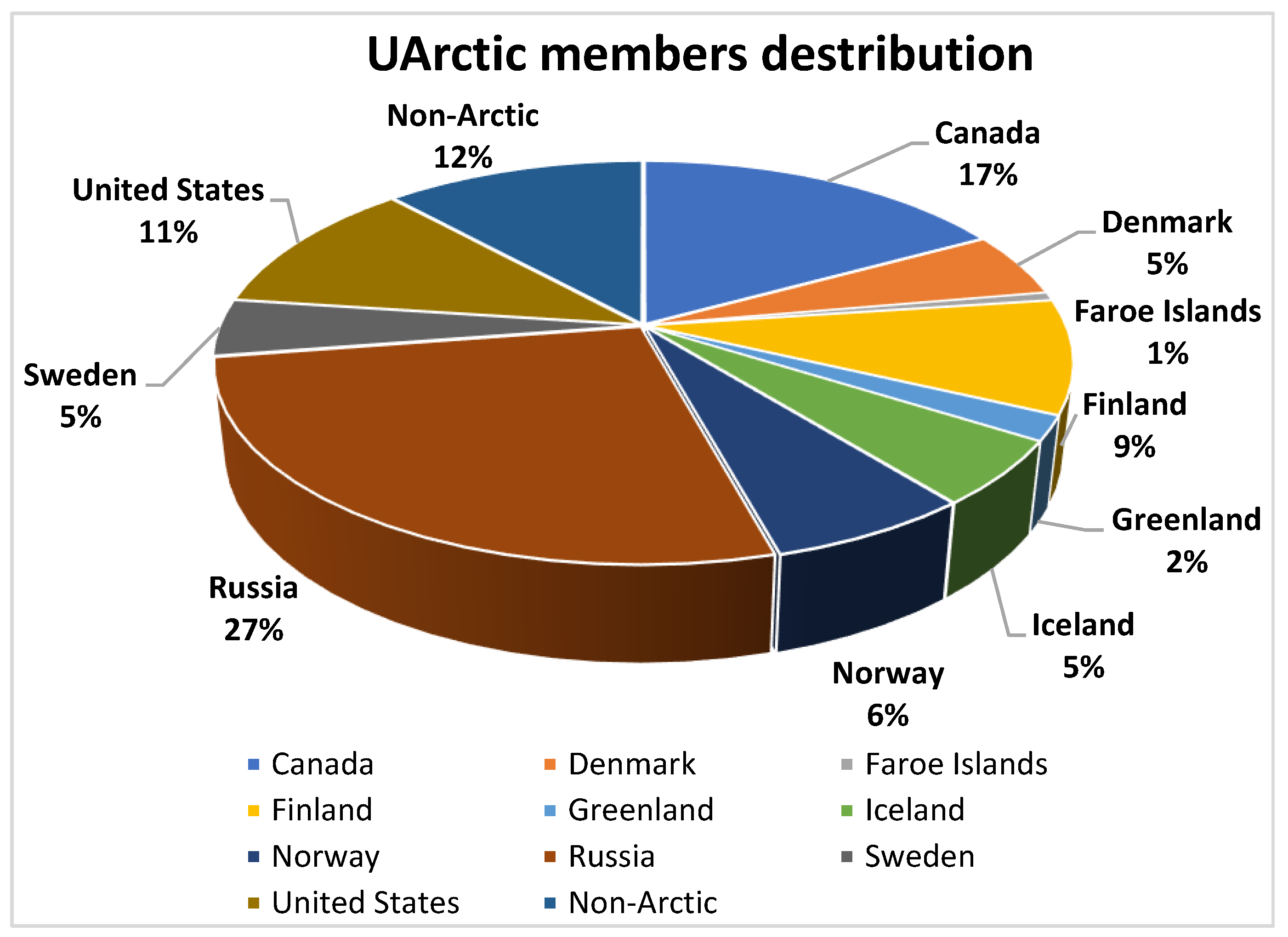
| Country | Number of Bachelor’s Programs/Courses | % | Country | Number of Master’s Programs/Courses | % | Country | Number of PhD Programs/Courses | % |
|---|---|---|---|---|---|---|---|---|
| Canada | 0/1 | -/2.3% | Canada | 1/1 | 1%/1% | Canada | 0/1 | -/2.9% |
| Denmark | 0 | Denmark | 17/3 | 21%/3% | Denmark | 0 | ||
| Faroe Islands | 0 | Faroe Islands | 0 | 0 | Faroe Islands | 0 | ||
| Finland | 3/7 | 17%/16% | Finland | 17/5 | 21%/6% | Finland | 1/4 | 50%/12% |
| Greenland | 0 | Greenland | 0 | Greenland | 0 | |||
| Iceland | 0/6 | -/13.9% | Iceland | 4/37 | 5%/43% | Iceland | 0/3 | -/8.8% |
| Norway | 11/6 | 61%/14% | Norway | 27/3 | 33%/3% | Norway | 0/3 | -/8.8% |
| Russia | 2/6 | 11%/14% | Russia | 8/6 | 10%/7% | Russia | 0/7 | -/21% |
| Sweden | 0/7 | -/16% | Sweden | 1/20 | 1%/23% | Sweden | 0/1 | -/2.9% |
| United States | 2/7 | 11%/16% | United States | 5/8 | 6%/9% | United States | 1/8 | 50%/24% |
| Non-Arctic | 0/2 | -/4.6% | Non-Arctic | 1/2 | 1%/2% | Non-Arctic | 0/6 | -/18% |
| No. | University | Educational Program |
|---|---|---|
| 1 | Far Eastern Federal University | School of Engineering “Ice Mechanics” Annual International Winter Course |
| 2 | Northern (Arctic) Federal University |
|
| 3 | Saint-Petersburg Mining University | Summer schools at Saint-Petersburg Mining University |
| 4 | Arctic State Agrotechnological University |
|
| 5 | Siberian Federal University | Biological Engineering |
| 6 | St. Petersburg University | Geology |
| 7 | Industrial University of Tyumen | Logistics and Supply Chain Management |
Publisher’s Note: MDPI stays neutral with regard to jurisdictional claims in published maps and institutional affiliations. |
© 2020 by the authors. Licensee MDPI, Basel, Switzerland. This article is an open access article distributed under the terms and conditions of the Creative Commons Attribution (CC BY) license (http://creativecommons.org/licenses/by/4.0/).
Share and Cite
Samylovskaya, E.; Kudryavtseva, R.-E.; Medvedev, D.; Grinyaev, S.; Nordmann, A. Transformation of the Personnel Training System for Oil and Gas Projects in the Russian Arctic. Resources 2020, 9, 137. https://doi.org/10.3390/resources9110137
Samylovskaya E, Kudryavtseva R-E, Medvedev D, Grinyaev S, Nordmann A. Transformation of the Personnel Training System for Oil and Gas Projects in the Russian Arctic. Resources. 2020; 9(11):137. https://doi.org/10.3390/resources9110137
Chicago/Turabian StyleSamylovskaya, Ekaterina, Regina-Elizaveta Kudryavtseva, Dmitriy Medvedev, Sergey Grinyaev, and Alfred Nordmann. 2020. "Transformation of the Personnel Training System for Oil and Gas Projects in the Russian Arctic" Resources 9, no. 11: 137. https://doi.org/10.3390/resources9110137
APA StyleSamylovskaya, E., Kudryavtseva, R.-E., Medvedev, D., Grinyaev, S., & Nordmann, A. (2020). Transformation of the Personnel Training System for Oil and Gas Projects in the Russian Arctic. Resources, 9(11), 137. https://doi.org/10.3390/resources9110137

