1. Introduction
The countryside and the city are interdependent yet distinct spatial entities, engaged in continuous reciprocal interactions [
1,
2,
3,
4], with rural areas characterized by lower population density, a primary reliance on agriculture, and distinct local customs [
5], contrasting with urban hubs of dense population and advanced commodity-based civilization [
6]. This distinguishing essence, termed rurality [
4,
7], has been diminished by the pervasive assimilation of urban traits into the countryside [
8,
9]. The countryside fulfills multifunctional roles—encompassing agricultural production, habitation, leisure, tourism, and ecological and cultural conservation [
1,
4,
7,
10]—which evolve with shifting urban-rural relationships, a process defined as rural transformation [
4,
5,
7]. As frontrunners in urbanization and globalization, Western nations have experienced pronounced shifts in this transformation [
1,
4]. Beginning in the 1950s, agricultural protectionism for food security solidified the countryside’s primary production function [
11], supported by subsidies integrating urban industrial outputs [
12]. The 1970s oil crisis prompted a relocation of industry and population to rural areas [
13], elevating the secondary and tertiary sectors [
14] and marking the first rural transformation from a production countryside to a consumption countryside [
8]. By the 1990s, counter-urbanization spurred demand for rural landscape, culture, and environment [
1], driving a second transformation to a diverse countryside. Since the 21st century, globalization has deeply restructured these spaces through global flows of capital, labour, and culture [
4,
10,
15], while digital networks blur spatial boundaries [
16,
17], constituting a third transformation towards a globalization countryside.
This study reconceptualises rural restructuring as the adaptive transition process within rural social–ecological systems, where internal elements and structures are reorganised under pressures like urbanisation and globalization [
3,
18]. This internal restructuring fundamentally drives the evolution of systemic properties and functions, with the resultant changed system state defined as rural transformation, establishing a clear causal linkage wherein restructuring is the mechanism and transformation the emergent outcome [
3,
18,
19]. Western nations have undergone three corresponding phases of rural restructuring. The first, economically dominated phase, commenced in the 1970s following post-war agricultural industrialisation via subsidies [
11,
12]. The oil crisis and ensuing surpluses accelerated the shifting of manufacturing to the countryside to lower costs [
20], pulling labour into non-agricultural sectors [
11] as new capital and industries penetrated rural areas [
8,
13]. Subsequent deindustrialisation and offshoring in the 1980s prompted an economic restructuring from manufacturing to services [
21,
22], marking a territorial shift driven by production factors [
23]. The second, socially dominated phase, beginning in the 1990s, was shaped by counter-urbanisation. Middle-class in-migrants, possessing economic and cultural capital, engaged in rural space reproduction, often marginalising incumbent groups [
24] and reshaping landscapes and social structures alongside a sustainability-focused policy turn. This led to gentrification and a social restructuring that reoriented development from original residents towards newcomers, altering territorial structure based on demography and social relations [
1,
8,
24]. The third phase, unfolding since the early 21st century, is led by globalisation. Factor flows (e.g., capital, labour) transitioned from national to global networks [
15], profoundly transforming the countryside [
10] and globalising its key elements [
4]. New actors, including multinationals and international migrants, entered [
17], fostering novel industries [
16] and altering socio-environmental relations [
25], ultimately transforming Western rural areas into multi-subject, multi-dimensional hybrid network spaces [
15,
26].
In contrast to the sequential progression observed in Western nations, rural restructuring and rural transformation in developing countries like China are characterized by parallel, compressed development [
3,
18]. Different rural areas experience distinct types of restructuring, often simultaneously [
18,
27], driven by the compounded effects of urbanization, industrialization, counter-urbanization, and globalization [
19,
27]. This results in spatio-temporal parallelism and compression, where phases like production, consumption, diversity, and globalization in the countryside may co-occur [
28,
29]. Existing scholarship extensively examines this process in rural China, focusing on three interconnected dimensions. Studies on spatial restructuring/transformation analyze changes in rural spatial form, emphasizing drivers like land policies (e.g., land consolidation), urbanization, and industrialization [
30,
31,
32,
33,
34,
35,
36,
37]. Research on economic restructuring/transformation explores shifts in agricultural modes—from labor-intensive to land-intensive production or land abandonment—due to labor outflows and economic incentives [
38,
39,
40,
41,
42], alongside new rural industries like e-commerce and tourism [
43,
44]. Finally, studies on social restructuring/transformation investigate the profound impacts of population mobility: outflow leads to curtailed public services and attenuated community resilience [
45,
46,
47,
48], while inflow can trigger community isolation and power structure changes [
36].
While the spatial, economic, and social dimensions of rural restructuring in China have been extensively studied, key gaps persist when examining this process through the lens of complex social–ecological systems. Although the rural territorial complex is recognized as an integrated regional system [
18], there remains a limited understanding of the co-evolutionary dynamics through which its key constituent agents—governments, enterprises, and villages—interact to reconfigure resources and functions [
49]. Specifically, current research often lacks a framework that treats these interactions as the core driver of systemic transformation. To address this, this article investigates the following research question: How do external forces (e.g., state and market) enter the rural system, how do internal actors of the system (e.g., communities) respond, what are their respective behavioral logics, and how does their interaction reconfigure the structure and functions of the system? Addressing this question is crucial for deciphering the endogenous mechanisms of rural transformation in developing countries. It elucidates how the entry of external governmental and market forces, coupled with the strategic responses of internal communities, co-produces the restructuring process. This analysis reveals the interactive dynamics through which the rural system evolves, navigating its inherent multifunctionality and engaging with the forces of globalization to forge a new developmental pathway.
4. Case Analysis: Process-Tracing the Transformation from Resource Revitalization to Adaptive Governance in Lin’an
The case study of Lin’an is consciously integrated with the macro context of Zhejiang’s Green Rural Revival Program (GRRP). It is noted that the case study employs a macro-to-micro approach. At first, the article delineates the overall context of Zhejiang’s GRRP. Subsequently, it outlines Lin’an’s execution in both village renovation and management phases. During the case analysis of Lin’an, an overview is provided about its general situation first; then, a description of the development of typical villages follows. The Jiusi village serves as an outstanding example for village renovation, whereas the LongMenMiJing (LMMJ) project exemplifies village management.
4.1. Case Context: The Green Rural Revival Program as an Exogenous Trigger
Zhejiang’s GRRP can be categorized into two stages: (1) village renovation (2003–2016). It was initiated by the government of Zhejiang province in 2003 with the objective of transforming the unsanitary and unfavorable living conditions in rural areas through village renovation, ultimately aiming to establish a comprehensive well-off society. In 2010, the government of Zhejiang province continued the program and upgraded it to the beautiful countryside movement. Governments took charge of planning, designing, constructing, and evaluating village renovation projects while enterprises and villages played cooperative roles. (2) village management (since 2016). It was commenced in 2016 when the government of Zhejiang province decided to further deepen the beautiful countryside movement by enhancing renovation standards and expanding its spatial scope. In 2017, a rural initiative was launched for 10,000 scenic spots to build 1000 Class-3A scenic spot villages and 10,000 Class-A scenic spot villages. The initiative aimed at exploring a market-oriented approach for government investment in rural public assets while converting natural beauty resources into economically prosperous assets. In 2021, GRRP was elevated into a common prosperity initiative as it had successfully established a novel model for village management where collaborative governance among governments, enterprises, and villagers is fostered. In conclusion, sustaining village renovation in rural areas solely through financial projects poses challenges. The success of village renovation and the construction of a beautiful countryside relies on external assistance and lacks the capacity for independent and endogenous development. Implementing village management based on multi-actor interest linkages demonstrates inherent vitality, while public and private capitals jointly facilitate independent and endogenous development, thereby transforming valuable resources into a prosperous economy.
4.2. Phase 1: Village Renovation (2003–2015)—Spatial Reordering and Physical Foundation
(1) Government actions. The period from 2003 to 2015 witnessed a significant government-led environmental improvement, marking the stage of village renovation. In this context, Lin’an initiated and executed village renovation and beautiful countryside construction movement. The objective of the movement was to achieve a “green home, rich and beautiful mountain village” through classified transformation. Villages were deliberately divided into boutique villages, feature villages, and renovation villages based on the principle of classified disposal. The objective for boutique villages was to embody highlights, characteristic villages to accentuate distinctive features, and renovation villages to showcase transformations. At this stage, governments provided financial project funds as subsidies for environmental improvement and beautification in order to transform the rural landscape. From the perspective of government behavior characteristics, the project was incorporated into the rural areas under the political performance evaluation mechanism. Office of Agricultural and Rural Affairs of Lin’an CPC (OARA) primarily led projects of village renovation and beautiful countryside construction, which were managed as construction projects in collaboration with various governmental departments and townships. OARA took charge of project planning, design, implementation, quality inspection, and performance evaluation. Local governments were responsible for administrative decision-making and implementation procedure while enterprises handled technical affairs such as planning, design, and project execution. The successful bidder was determined through legal procedures at the public resources trade center of governments. GRRP served as a core political task where OARA actively coordinated substantial project funds to be invested in rural areas while towns, villages, and enterprises cooperated in its implementation, resulting in a transformation from dirty and poor living environments to green-rich beautiful villages. Owing to exceptional performance from 2004 to 2015, Lin’an was consecutively awarded as an advanced organization in GRRP evaluation within Zhejiang province for more than ten years. In the case of the JiuSi Village, OARA implemented comprehensive projects of village renovation in collaboration with the XiTianMu Township, the JiuSi Village Committee, and the construction enterprise, aiming to enhance infrastructure and improve living conditions. To achieve the objective, three initiatives had been implemented, namely the “demolition campaign”, the “wall revolution”, and the “green action”. The “demolition campaign” aimed to demolish dilapidated houses, old houses, and attached houses in accordance with the principle of mandatory demolition for environmental remediation. The “wall revolution” focused on renovating old walls and vegetable gardens along the main road to create a visually appealing landscape on both sides of the road. The “green action” involved renovating individual households’ courtyards to comprehensively enhance the quality of the village environment.
(2) Enterprise actions. Enterprises that ventured into rural areas primarily collaborated with the government in planning and engineering of village renovation. However, some enterprises also integrated GRRP to utilize idle rural resources, as exemplified by the LianZhong corporation and its pioneering “LianZhong” mode. The innovative approach effectively tapped into Shanghai’s substantial demand for rural holiday consumption while capitalizing on Lin’an’s abundant rural resources and favorable environment. The approach of the “LianZhong” mode in the case of JiuSi Village is described as follows: In supply side, LianZhong acted as the initiator and entered into business contracts with rural households. The rural households provided land while LianZhong provided funds. Subsequently, the rural households applied for housing demolition and construction permits, and LianZhong organized activities of design and reconstruction. Upon completion of the rural house reconstruction, LianZhong freely offered new housing units to the rural household. It is noted that these housing units were typically located on the first floor and have a similar size to his original building. In return for this provision, LianZhong obtained a share in utilizing these houses. Generally situated from second to fourth floors, these houses were subject to a 30-year contract period after which they will be returned to the rural households without any cost incurred. Additionally, LianZhong paid a monthly labor fee (usually about 500 RMB) to the rural household for his property service. In consumption side, LianZhong signed lease agreements with urban residents by selling them use rights for these houses as an intermediary entity in Shanghai and other megacities, so that citizens residing in rural areas specifically catering towards elderly individuals. LianZhong played an important role in connecting urban and rural areas as an intermediary. Under the premise of safeguarding the interests of rural households, the LianZhong mode effectively facilitated mutual benefits among local households, foreign enterprises and citizens. Rural households accrued property and labor advantages, urban enterprises attained business benefits, while urban citizens enjoyed an affordable rural lifestyle. The renowned “LianZhong” mode had garnered extensive media coverage both in the Yangtze River Delta and nationwide. Subsequently, numerous imitators emerged in the TianMu mountain area of Lin’an. Initially, local governments tacitly endorsed the LianZhong mode; however, some imitators later violated land use regulations by constructing houses that encroached upon farmers’ interests. Consequently, local governments gradually intensified control measures to curtail the proliferation of the mode.
(3) Village actions. The primary role of the villages lied in collaborating with the government to facilitate village renovation and enhanced the aesthetic appeal of villages. However, they did not actively contribute towards utilizing idle resources. In instances where farmers’ interests were infringed upon by enterprises, it stimulated a collective response from the entire village society, leading to exclusionary behaviors against foreign enterprises and rendering industrial management for them challenging. From the standpoint of rural households, when they lacked market operation capabilities, they had the option to engage in partnerships with external enterprises to augment their income. In the case of the JiuSi Village, Wang Miaohua (the secretary of the village committee of CPC) and three other rural households sought collaboration with LianZhong while establishing the LianZhong mode. Apart from gaining complimentary access to newly constructed rural houses within the same area, these rural households provided property services for external enterprises and received a monthly remuneration of 500 RMB as labor fees—resulting in an annual increase of 6000 RMB. Additionally, rural households generated supplementary income by selling local specialties such as chicken and dried bamboo shoots to urban residents in the village, thereby increasing their annual earnings by nearly 20,000 RMB. When rural households possessed market operation capabilities, they would select suitable industries for business ventures. For instance, Wang Miaohua’s two sons had acquired expertise in the catering industry while working in the city. They identified new business opportunities through collaboration with LianZhong and utilized their newly constructed rural houses to operate their enterprise in their hometown, resulting in an annual income increase of almost 100,000 RMB. The statistics provided by the JiuSi village indicate that LianZhong had signed contracts with 23 households, while 7 households had chosen to seek company assistance in Shanghai for reconstruction purposes; the remaining houses remained unchanged, within ZhuTuoLing (a natural village of the JiuSi village), which consists of 40 households.
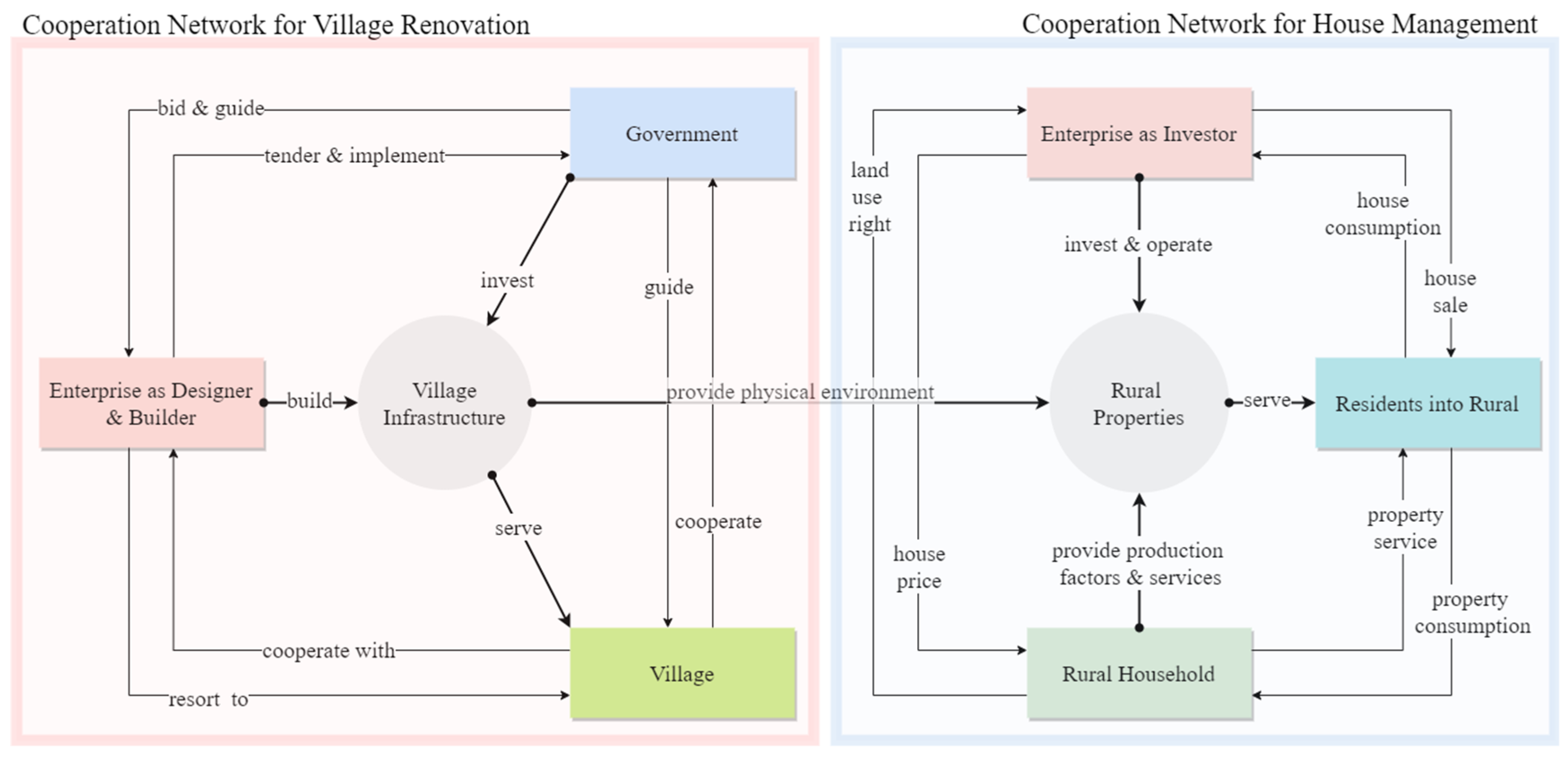
(4) Interest linkages. The interests of governments, enterprises, and villages were loosely interconnected, lacking a comprehensive cooperative network. Firstly, the government established an interest linkage with enterprises and villages in project investment and construction, while enterprises and villages collaborated with the government in these endeavors. Although the government’s financial projects contributed to creating a favorable habitat environment, their operational logic primarily revolves around political performance evaluation under administrative management. The selection and implementation of projects often neglected considerations for future industrial management requirements, resulting in a surplus of idle government investment assets. Secondly, the enterprises directly formed the interest linkage of individual rural housing management with the rural households without involving villages as intermediaries. Enterprises engaged in direct benefit exchanges with the individual rural households while assuming responsibility for mediating business disputes that arise between citizens, rural households, and themselves. Villages played a passive role by cooperating with government and business activities. While enterprises proactively took advantage of public assets invested by the government, they also tended to violate management regulations at times, which infringed upon farmers’ interests and led to social conflicts during their operations. In the case of JiuSi Village, OARA, the XiTianMu Township, the JiuSi Village Committee and the bid-winning enterprise jointly conducted the village renovation project; LianZhong and villagers of ZhuTuoLing jointly carried out the revitalization of rural housing (see
Figure 2).
4.3. Phase 2: Village Management and Operator Model (2016–Present)—Institutional Innovation and Economic Integration
(1) Government actions. Lin’an initiated a rural management policy in 2016, which encompassed two primary aspects: hardware (infrastructure development) and software (institutional establishment). As for hardware, OARA continued to take the lead in investing in creating picturesque villages. As for software, it consisted of two components: village management promoted, respectively, by the tourism department and agriculture department. The tourism department promoted open village operations to external entities through attracting and employing village operators from society as a whole, thereby achieving a tight integration between villages and markets while identifying viable approaches to strengthen communities and improve livelihoods. Village operators leveraged their resources by transforming them into products and services that catered to urban needs through operational planning, business model introduction, investment promotion, and marketing efforts. The tourism department oversaw village operators in terms of recruitment as well as performance evaluation. In terms of recruitment, village operators were primarily expected to possess the capacity for strategic cultural creation, resource acquisition and management, operational proficiency, and marketing expertise while embodying a deep understanding of rural contexts and demonstrating an artisanal spirit. In terms of evaluation, a comprehensive method had been devised encompassing 42 items across 7 dimensions with a total score of 200 points. These 7 dimensions included positioning and planning, institutional frameworks and mechanisms, product development, distinctiveness and integration strategies, effective management practices and training initiatives, successful marketing approaches leading to performance outcomes, as well as service provision quality assurance. According to the evaluation results (120, 140, 160, 180 points), the government provided financial incentives of 100,000, 300,000, 500,000 and 700,000 RMB, respectively, to eligible operators. Non-compliant operators were required to exit the market. The internal reform of village management, promoted by the agriculture department, encompassed the following key measures: firstly, implementing the reform of property rights system for rural collective economic organizations; secondly, establishing cooperative economic companies; thirdly, enhancing the governance structure of rural collective economy; fourthly, strengthening the management of village assets; and finally, creating favorable conditions for villages to undertake government projects in rural areas and engage in external cooperative operations. In the case of the LMMJ project, the multiple departments coordinated their actions to create conditions for village management. OARA was responsible for implementing projects such as the DaYu line of village road and the renovation of three villages of ShiMen, LongShang, and DaShan. The tourism department attracted local village operator Min Lou to design the LMMJ project for industrial operation. The agriculture department promoted reforms in the rural collective property rights system in the three villages.
(2) Enterprise actions. A village operator was responsible for holistic management of a village, while an individual investor focused on the individual operation of a rural house. Once a village operator entered a village, he or she undertook holistic management based on its unique features, creating a conducive business environment and flourishing rural industries: (1) Conducting resource surveys: Village operators began by thoroughly understanding the background and characteristics of each village through survey lists, thereby clarifying the industrial theme and market positioning. (2) Assembling a competent team: Village operators actively sought talents in planning, construction, copywriting, marketing, finance, and general management. (3) Developing thematic plans: Creativity played a pivotal role as operators meticulously plan distinctive industrial themes that served as the lifeblood of an attractive economy. The aim was to achieve unity within each village while preserving their individuality. For instance, the LMMJ project emphasized boutique homestays while the YunShang-BaiNiu project focused on folk experiences. (4) Attracting investments through business activities: Village operation followed an asset-light mode where operators concentrated on overall planning and management. By accurately attracting various individual investors according to local resource characteristics and investing in small yet exquisite ventures within villages (such as homestays, pick-your-own gardens, wood art workshops), Lin’an had successfully established additional attractions like wine workshops, art galleries, village bars, straw shoe halls, and rice cake workshops. (5) Marketing: Village operators employed market-oriented, Internet-style integrated marketing strategies both online and offline to precisely target potential customers for village products. This included devising various agricultural tourism activities, integrating new media publicity, and managing WeChat public accounts dedicated to rural products. (6) Social cooperation: With external support, village operators strengthen collaborations with network marketing organizations, TikTok teams, university training institutions, and enterprise associations. Additionally, individual investors specifically lease housing units from rural households for individual commercial operations while cooperating with village operators to establish a conducive business environment.
In the case of the LMMJ project, the village operator leveraged the natural resources of the three villages, including rural land, houses, forests, and streams, to design and develop scenic spots such as ancient villages, rock walls, stone henges, pine forests, terraces, and camping sites along the road of the Dayu line. These developments have led to the initiation of various tourism activities, such as traditional village tourism, rock climbing, geological heritage appreciation, mountain stream viewing, pine forest appreciation, terrace agriculture observation and experience, and stargazing. The scenic area as a whole had successfully established a total of six upscale homestays, forest cabins, and inns, offering 600 beds through its own investment or investment promotion. Additionally, it had developed six facilities, including the Folk Culture Hall, Nostalgia Memory Hall, and Rock Climbing Museum, as well as a Folk Snacks Experience Hall, Local Specialty Supermarket, Craft Beer Bar, Terrace Train, Conference Center, Music Barbecue, and other tourism-supporting amenities. Collectively, these attractions had constituted an integrated rural industrial cluster. The project had attracted over 150 million RMB in industrial and commercial capital, encouraged more than 40 young people to return to their hometowns and start businesses, created over 200 new job opportunities, and increased the village’s collective income by 4.27 million RMB and the villagers’ per capita income by 2400 RMB.
(3) Village actions. A village established an enriching village company (EVC) in accordance with the principles of property rights reform for rural collective economic organizations, to enhance the verification of collective assets, improve the governance structure of collective organizations, and strengthen the operational capacity of the collective economy. Management of an EVC was divided into external and internal aspects. As for the external aspect, an EVC collaborated with a village operator to conduct village operations by investigating and consolidating various idle resources in the village, particularly unused land and houses. A joint venture was constantly established with the village operator, utilizing social capital from within the community to consolidate idle land and houses in the village. This facilitated resource integration with the village operator in a comprehensive manner, avoiding fragmented transactions between the operator and the villagers, thereby reducing transaction costs. In cases where conflicts arose between foreign operators and local households over interests, an EVC acted as an intermediary to mediate these contradictions. It internally assumed the responsibility of executing government-funded village renovation projects. By leveraging the EVC as an entity, the project activated and utilized local labor resources to effectively implement the government’s village renovation initiatives, thereby enhancing both collective and individual income. Since villagers directly benefited from these renovation projects, government supervision costs can be significantly reduced through entrusting a local project to an EVC. The symbiotic relationship between internal and external interests of the EVC facilitated efficient village management operations. Consequently, the robust economic performance of the EVC established a solid foundation for achieving communal prosperity. In the case of the LMMJ project, the collective efforts of the three villages led to an integrated EVC. The EVC aggregated and warehoused unused rural land and properties within the scenic area, streamlining operations and generating over 1 million RMB in property rental revenue.
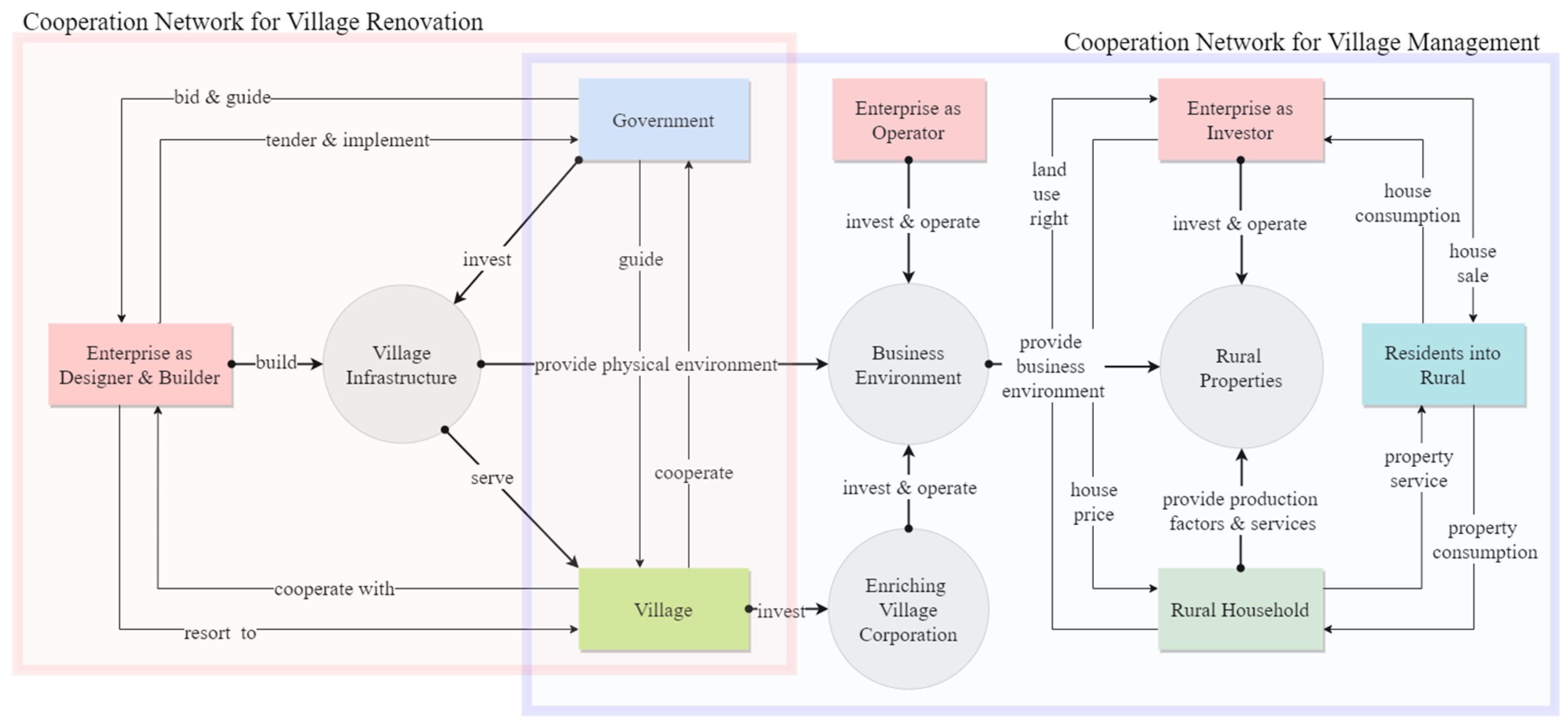
(4) Interest linkages. The formation of a densely interconnected network of interests in the rural village is a result of the intricate collaboration between the government-initiated cooperation networks of rural renovation and the operator-driven cooperation networks of rural management (see
Figure 3). Firstly, the agriculture department drove the establishment and operation of EVCs to create business opportunities for idle laborers in villages through government projects, while also allowing villagers to benefit from governmental initiatives. Additionally, EVCs facilitated further development of village industries by extensively acquiring idle rural land and houses within villages. Secondly, the tourism department attracted village operators and promoted the establishment of joint ventures between village operators and villages to facilitate cooperation in rural industries. Village operators and villages must meet the necessary criteria for conducting village operations. Secondly, the tourism department attracted village operators and promoted the establishment of joint ventures between village operators and villages to facilitate cooperative operations in rural industries. Village operators and villages met specific criteria for engaging in village operations. Once both parties expressed their willingness to cooperate, they proceeded with the interest linkage under government supervision: (1) signing a joint venture agreement; (2) registering and operating the joint venture within the village; (3) allowing both parties to negotiate an exit strategy if necessary; (4) evaluating and compensating operators by the government after completion of events. The village operator assumed responsibility for managing the holistic business environment of the village while acting as a representative connecting all available resources with the EVC. In a word, the village management had established a comprehensive interest linkage mechanism in which enterprises contributed funds, villages provided resources, villagers contributed labor, and governments offered policies. In the case of the LMMJ project, the township of GaoHong, the village operator, and the EVC form a closely knit interest linkage, with village operator and EVC shares being distributed at a ratio of 90% to 10%.
4.4. Case Analysis: Tracing the Emergence of Linkages and Systemic Outcomes
In the initial phase (2003–2015), government-led village renovation established a foundational spatial and environmental framework. The subsequent phase (since 2016) has been defined by strategic village management, aimed at activating industrial revitalization through partnerships between urban enterprises and rural collectives. This deliberate shift catalyzed a profound transition in Lin’an, driving its evolution from a primarily production-oriented space toward a multifunctional countryside characterized by functional diversification. The dominance of traditional agriculture has receded, making way for recreational agriculture, premium residential development, tourism, and leisure—all reflecting a broadened spectrum of rural functions. Concurrently, Lin’an has been progressively integrated into extra-regional networks, transforming into a globalizing countryside. This transformation is propelled by the influx of capital, entrepreneurial talent, and consumption patterns from globalized urban centers like Shanghai and Hangzhou. These external flows have fundamentally reshaped the local spatial order, economic base, and social fabric, embedding the village within wider circuits of mobility and investment.
This co-evolution of multifunctionality and globalization is substantiated by tangible outcomes (see
Table 1). From 2016 to 2022, twenty market-based operation teams were introduced into twenty villages. Their activities generated cumulative tourism revenue of approximately 490 million RMB, boosting collective village income by 89.3 million RMB and increasing villagers’ direct income by 21.69 million RMB (averaging 12,000 RMB per capita). By leveraging these operators for further investment promotion, Lin’an attracted 98 commercial projects with a total investment value of 340 million RMB. Furthermore, 3500 acres of idle residential land and 177 farmhouses were repurposed. These initiatives created around 1200 local jobs and successfully attracted over 800 young people to return to their hometowns for entrepreneurship, demonstrating the regenerative impact of this new developmental paradigm.
The test of the causal mechanism is outlined below (see
Table 1). (1) Government logic drives spatial restructuring. Government projects in the countryside have significantly improved the living environment and provided favorable external conditions for reutilizing idle rural resources. However, while the government excels at engineering construction for village renovation, it struggles with market operations for village management. This verifies H1.1. Performance-oriented projects in rural areas tend to become idle assets that do not meet the actual needs of the countryside. This verifies H1.2. In summary, government interventions in the countryside lead to rural spatial restructuring. Thus, H1 is supported.
(2) Enterprise logic drives economic restructuring. In the stage of village renovation, less capital flows into the countryside; in the stage of village management, capital is directed towards rural areas. This indicates that the integrated hardware and software construction policies implemented during the village management stage are effective. Village operators contribute to improving the overall business environment of villages, while industrial and commercial investments into rural areas contribute to increasing the economic income of rural households. This finding supports H2.1. However, a small number of enterprises infringe upon the interests of rural households. This observation confirms H2.2. In summary, capital inflow into the countryside results in rural economic restructuring. Therefore, H2 is validated.
(3) Village logic drives social restructuring. In the village renovation stage, the absence of an EVC serving as an intermediary forces urban enterprises to deal with scattered rural households, resulting in high transaction costs. When disputes arise, urban enterprises are prone to social exclusion, operational difficulties, and market withdrawal. This confirms H3.1. In the village management stage, an EVC collaborates with urban enterprises and acts as an intermediary to coordinate management conflicts, effectively reducing institutional costs for the enterprises. This verifies H3.2. In summary, village responses to capital from governments and enterprises lead to rural social restructuring. Consequently, H3 is supported.
(4) Interest linkage drives governance restructuring. In the village renovation stage, governments establish interest linkages with both villages and enterprises involved in project construction. Enterprises also form interest linkages with villagers during industrial operation. However, these two cooperative networks remain isolated from each other, hindering the effective resolution of potential disputes. This verifies H4.1. In the village management stage, the government-backed EVCs and village operators assume both internal and external management responsibilities, serving as crucial pivots that link the renovation and management collaboration networks. Despite potential conflicts among governments, enterprises, and villages, comprehensive and close cooperative networks help control these conflicts for sustainable village development. This finding supports H4.2. In summary, the interest linkages formed during village renovation and management result in rural governance restructuring. Thus, H4 is validated.
In sum, this study contributes to the literature on rural restructuring/transformation in China [
3,
18,
27,
28,
29,
30,
31,
32,
33,
34,
35,
36,
37,
38,
39,
40,
41,
42,
43,
44,
45,
46,
47,
48] by moving beyond the prevalent focus on static outcomes within distinct spatial, economic, and social dimensions. It explicates the dynamic co-evolutionary process between external interventions (e.g., state and market actors) and internal community responses. Specifically, the research identifies the critical role of the “village operator” as a pivotal institutional innovation. This entity functions as a key intermediary that effectively links external resources with endogenous assets, aligns divergent interests between outside investors and local villagers, and significantly reduces transaction costs. By doing so, it weaves the separate external intervention network and the internal response network into a cohesive, collaborative whole. Thus, the analysis provides a process-oriented framework that reveals how systemic transformation is co-produced through the mediation and integration of multi-scalar actor networks, advancing the mechanistic understanding of rural change in developing contexts.
5. Conclusions and Policy Implications: Pathways to Resilient and Sustainable Rural Systems
This study concludes that the sustainable revitalization of rural systems, particularly within the spatially parallel and temporally compressed context of China, is fundamentally driven by the co-evolutionary interaction of multiple-agent logics within a Complex Adaptive System. The Lin’an case demonstrates that, in navigating the multiplex transition towards a multifunctional and globally influenced countryside, instrumental rationalities of government and enterprise can be synergized with the value rationality of villages through adaptive intermediary mechanisms. The “village operator” model, rooted in the collective economy, exemplifies an institutional innovation that reconfigured spatial, economic, and social subsystems by aligning diverse interests. This transition from a state-led project to collaborative co-production is central to enhancing systemic resilience and achieving sustainable rural revitalization.
The theoretical implications extend the findings to the broader phenomenon of rural transformation in developing countries. The analytical triad of multi-agent logics, adaptive intermediaries, and synergistic subsystem restructuring provides a transferable framework for understanding how rural systems can manage the concurrent pressures of multifunctional development (e.g., production, consumption, conservation) and global integration. It underscores that successful adaptation does not stem from homogenizing forces but from institutional arrangements that productively channel the interplay of global linkages, state steering, market forces, and embedded community agency.
The primary policy implication is to prioritize governance frameworks that institutionalize sustained multi-agent collaboration beyond initial infrastructure investment. For developing countries undergoing similar multiplex transitions, policies must formally integrate long-term management mechanisms with physical renovation plans. This involves incentivizing enterprises and local collectives as core operational partners and legally embedding mediators (e.g., village operators) to reduce transaction costs and align interests among state, market, and community actors. Such a shift—from singular government projects to platforms for ongoing co-production—is essential for transforming latent resources into enduring socio-ecological vitality, offering a replicable pathway for sustainable rural revitalization in an era of globalized change.