


Abstract
The selection of the most economically advantageous tender (MEAT) in public procurement procedures requires transparent evaluation systems capable of integrating heterogeneous criteria, including qualitative ones, to reconcile quality and cost. This systematic review analyzes 74 studies published between 1998 and 2023 to explore the application of multi-criteria decision analysis (MCDA) methods in public construction procurement. The vast majority of MCDA applications focus on the award phase, with constant growth over the last 10 years. However, applications in the prequalification and verification phases are much less frequent and remain under-represented. Geographically, Europe is the most active area in terms of publications, followed by China and some countries in the Asia-Pacific area. In these regions, MCDA has been employed more systematically over time, while in other areas (e.g., Africa, Latin America), applications are sporadic or absent. Analytic Hierarchy Process (AHP) is confirmed as the most widely used technique. Emerging techniques (such as BWM, MABAC, EDAS, VIKOR, advanced TOPSIS) show greater computational rigor and in some cases better theoretical properties, but are less used due to complexity, less practical familiarity and the lack of accessible software tools. The operationalization of environmental and social criteria is still poorly standardized: clear indications on metrics, measurement scales and data sources are often lacking. In most cases, the criteria are treated in a generic or qualitative way, without common standards. Furthermore, the use of sensitivity analyses and procedures for aggregating judgments between evaluators is limited, with a consequent risk of poor robustness and transparency in the evaluation. In order to consider proposing a framework or guidelines based on the review findings, a six-step operational framework that connects selection of criteria and their operationalization, choice of method based on the context, robustness checks and standard minimum reporting, with clear assignment of roles and deliverables, is provided. The framework summarizes and makes the review evidence applicable.
1. Introduction
Public procurement (PP) has been identified as a strategic element for the provision of public services and regeneration initiatives [1,2] with direct impacts on the well-being of citizens, as evidenced during the 2020 pandemic. The efficiency, effectiveness and value-generating capacity of the public procurement system have become priorities for national and international policies, also because of its economic weight, which is around 12% of global GDP [3]. The increase in the weight of PP recorded in 2020 is attributable to two factors: firstly, the growth of public spending to cope with the health emergency, and secondly, the contraction of GDP. The PP encompasses all major public expenditure functions, ranging from health to environmental protection, infrastructure, and research, with a particularly high incidence of public works, whose centrality is set to be reinforced within the National Recovery and Resilience Plan. In this context, EU directives underscore the imperative for enhancing the quality of public procurement, with the overarching objectives being to prevent waste, enhance administrative efficiency, ensure transparency, and foster innovation in services. According to [4], an efficiency increase of 1% would generate savings estimated at EUR 20 billion per year. As part of the 2030 Agenda, Target 12.7.1 promotes the adoption of sustainable procurement policies aimed at market transformation. Significant innovations are introduced by Directives 2014/23/EU, 2014/24/EU and 2014/25/EU, in particular, the priority adoption of the Most Economically Advantageous Tender (MEAT) criterion, which is redefined as the best quality/price ratio. This criterion can be based on different approaches, including price, cost (e.g., life-cycle costs), default price/cost, or assessment on qualitative, environmental and social parameters (art. 67–68). The PP process is divided into five main stages [5]: (i) identification of needs, (ii) definition of services, (iii) identification of suppliers, (iv) selection, and (v) evaluation of performance. The evaluation phase of the offers is of particular criticality, in which the heterogeneity and possible contrast of criteria (e.g., high quality vs. low time and costs) require a multi-criteria approach. The presence of qualitative aspects that are difficult to measure (e.g., socio-economic and environmental impacts), the allocation of weights, the use of decision support tools and the need to respect design constraints and regulatory and procedural requirements further increase the complexity of the process, making the adoption of structured and transparent evaluation systems essential (Figure 1).
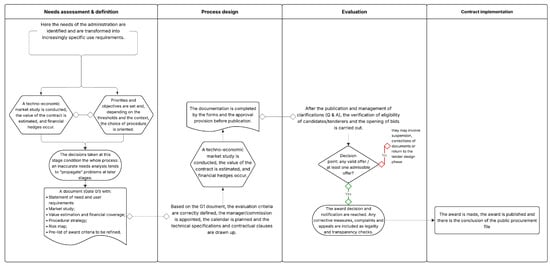
Figure 1.
General phases of the PP system (source: Authors’ elaboration).
This work provides a contribution to highlight the importance of designing multi-criteria systems in PP procedures worldwide. A significant number of existing studies concentrate on specific applications of multi-criteria techniques (e.g., AHP or TOPSIS) or on limited geographical contexts. This tends to result in a narrow focus on a limited number of criteria or the neglect of the integration between qualitative and quantitative criteria. For example, ref. [6] synthesizes MCDA applications without focusing on public procurement in the construction industry nor award criteria; ref. [7] treats supplier selection in a general sense, disregarding the MEAT context; ref. [8] compares the lowest price and multi-criteria approaches in terms of efficiency, without detailing methods/criteria; ref. [9] discusses clients’ preferences between the lowest price and multi-criteria, but without analyzing MCDAs; ref. [10] reviews MCDA cases in construction favoring the taxonomy of methods, without specific references to public investments and award criteria. This study focuses on the field of PP in the public construction sector, and it aims to investigate in depth specific dynamics related to the applications of MCDA in this sector. Moreover, the contribution aligns with the domains of network and decision theory and systems engineering management, framing the MEAT award as a multi-criteria decision problem within highly interdependent procurement chains. Coherence is also confirmed by other, similar studies, for example, DRAM/TOPSIS models for the risk of delays in road works [11], a decision-making framework for structural retrofit [12] and Delphi on the risk in the transport of dangerous goods in tunnels [13].
This research presents a comprehensive critical synthesis of the literature on PP techniques and criteria published over the past 25 years. The combination of temporal, geographical, and category criteria analysis provides a detailed understanding of existing practices and identifies the most effective techniques for different phases of PP. This research offers guidance for public authorities, encouraging the adoption of adaptive and scalable approaches. Starting from an initial database of 229 scientific records collected on Google Scholar and Scopus databases, exclusion criteria were applied, allowing for the analysis of 74 scientific papers, focusing on (i) understanding how multi-criteria techniques are used in PP procedures for supporting the most critical retrieved aspects and improve the efficiency of the evaluation of the most economically advantageous tender; (ii) identifying the awarding criteria that most of all guide the evaluation commission’s choices; (iii) highlighting the main advantages and limitations related to each collected multi-criteria technique for the different phases of the PP procedure.
The work is structured as follows: Section 2 describes each step of the adopted method for carrying out the literature review; Section 3 analyzes geographical and temporal trends of articles, provenance of authors and case studies, including the examination of methodology evolution; Section 4 is focused on the analysis of the objectives of each considered paper and the typologies of award criteria, linking the results to the presence of the sensitivity analysis. Section 5 investigates the preferences of mono and pluri-MCDA approaches for weighting and ranking PP phases. Section 6 provides for a deep critical results discussion by answering the three established research questions. In Section 7, the conclusions of the work are drawn, including future insights.
2. Methods
In the present study, a systematic literature review was carried out to systematically review the evidence provided by multi-criteria decision-making approaches in the PP field. The phases are (i) questions formulation for guiding the literature review according to the purposes of the work, (ii) identification and selection of sources; (iii) collection of records; (iv) screening of scientific papers; (v) analysis of temporal and geographical trends and identification of multi-criteria techniques; and (vi) in-depth critical analysis of the obtained results. This structure has been adapted for the specific purposes of analysis from the main methodological guidelines for systematic reviews [14,15]. This information is useful for understanding the dynamics of research development over time and in different territorial contexts.
The initial phase of the project entailed the formulation of three research questions, which served as the primary guiding principles throughout the research. In view of the main gaps that emerged in the literature—absence of a systematic reading of PP dynamics by stages, limited reporting on the robustness of the results and incomplete operationalization of the environmental and social criteria—the research questions were focused as follows:
- RQ1: In which phases of the PP procedure (prequalification, award, verification) are MCDA techniques used, with which frequencies by geographical area and over time?
- RQ2: Which technique is prevalent and why, in terms of properties required by practice (coherence of weights, transparency, computational burden, stakeholder acceptance), and how emerging techniques are positioned (e.g., BWM, DEA, MABAC, EDAS) than the consolidated?
- RQ3: How are award criteria operationalized (in particular, environmental and social: metrics/scales/data sources), and how much are sensitivity analyses and agreement procedures between evaluators reported in the applications?
The second phase of the process entailed the identification of the databases to be utilized in bibliographic research and the selection of keywords capable of identifying research papers that align with the objectives of the work. While there is no consensus regarding the most appropriate research databases, there is a consensus that Google Scholar and Scopus are accurate databases for this procedure. The specific base and robustness of search strings with the keywords and all the filters used in both databases are reported in the “Search strategies” file in Supplementary Materials.
The third phase consists in the collection of 229 scientific records that refer to the time span between 1998 and 2023.
The fourth phase concerns the application of exclusion and inclusion criteria. Following the Population, Concept, Context (PCC) framework recommended by the JBI Manual for Evidence Synthesis, clear inclusion and exclusion criteria were applied in the fourth phase of the review:
- Population: studies involving stakeholders engaged in tender evaluation or public procurement awarding processes;
- Concept: applications of multi-criteria decision analysis (MCDA) techniques for the evaluation of tenders or suppliers, with explicit use of MCDA methods (e.g., AHP, TOPSIS, VIKOR, etc.);
- Context: public procurement processes in construction sectors, infrastructure, or civil works.
Based on this structure, the following inclusion criteria were defined:
- Peer-reviewed journal articles published between 1998 and 2023;
- Studies written in English;
- Studies with accessible full text;
- Explicit use of MCDA techniques applied to tender evaluation or supplier selection within public procurement.
The following exclusion criteria were applied:
- Articles not addressing MCDA applications in public procurement;
- Studies focused on private procurement, supply chain ranking, or procurement unrelated to the construction sector;
- Papers without a multi-criteria decision-making framework;
- Opinion papers, theoretical essays without empirical analysis;
- Conference proceedings, book chapters, dissertations, and non-peer-reviewed literature.
This rigorous filtering process led to the identification of 74 relevant studies for final inclusion in the review. Each criterion adopted in the review process responds to methodological and scientific needs of transparency, quality, and relevance, in accordance with evidence-based synthesis standards:
English language only: studies in languages other than English were excluded to ensure linguistic consistency and allow for a rigorous comparative reading of technical terminology and methodologies. This decision also reflects the predominance of English in peer-reviewed scientific publications in the domain of decision science and public procurement.
Peer-reviewed journal articles only: to guarantee methodological soundness and academic reliability, the review only considered articles published in peer-reviewed scientific journals. Conference proceedings, opinion papers, and non-peer-reviewed contributions were excluded due to their frequently limited contents, lack of methodology applications, and lower quality assurance.
Full-text availability: only studies with full access to the complete text were included, to ensure that the methodology, data sources, and MCDA applications could be thoroughly assessed and coded.
Explicit MCDA use: studies were selected only if they implemented multi-criteria decision-making (MCDM/MCDA) methods in a clearly defined and replicable way. Generic decision models or descriptive narratives of procurement processes without methodological formalization were excluded.
Public procurement context: only contributions referring specifically to public procurement (PP) were included, as the objective was to investigate MCDA applications within public-sector tender evaluation. Applications in private procurement or internal company supplier selection were excluded due to substantial differences in governance, regulation, and evaluation logic.
Relevance to the construction sector: the analysis focused on public procurement in the construction and infrastructure domain, as it represents one of the most complex and resource-intensive fields for MCDA application. Studies referring exclusively to other sectors (e.g., energy procurement, IT systems, supply chain) were not considered sufficiently comparable and were therefore excluded.
These choices were made to ensure thematic coherence, comparability, and high quality of the reviewed material, in line with international guidance for systematic and scoping reviews (e.g., JBI Manual, PRISMA).
For reasons of maximum transparency, some articles excluded according to objective criteria are reported in the “Search strategies” file in Supplementary Materials. This allows the consistency and systematicity of the selection to be clarified, as required by the PRISMA and JBI guidelines.
To ensure the reliability of the inclusion and exclusion criteria, two independent reviewers screened the articles. Discrepancies were resolved through discussion and consensus. An inter-rater reliability index (Cohen’s kappa) was calculated, yielding a value of 0.78, indicative of a good agreement between the raters according to the scale of [16]. The decision matrix shown in Figure 2 below was used to select the final set of 74 articles from the screening process.
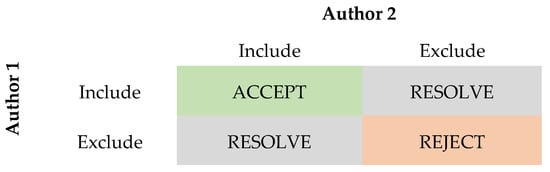
Figure 2.
Decision matrix for selecting articles (source: Authors’ elaboration).
In line with what is suggested by the methodological literature (e.g., JBI Manual for Evidence Synthesis, PRISMA 2020), it was considered appropriate to integrate a quality assessment grid into this study to systematically verify the transparency, coherence and methodological adequacy of the contributions examined.
Although it is not always customary to include a quality assessment in systematic review works on MCDA applied to public procurement, a structured sheet of 10 criteria inspired by the guidelines of [15,17] and adapted to the specific context of multi-criteria analysis in procurement was developed. These criteria include clarity of objectives, adequacy of the context, transparency of the method, stakeholder involvement, use of weights, validation, sensitivity analysis, completeness of documentation, replicability and overall transparency. The grid was applied to a significant subset of 10 studies among those included in the review (13.5% of the total). The aim was to provide evidence of the average methodological robustness of the contributions analyzed, as well as to identify any recurring gaps. Table S1 in the “Search Strategies” Supplementary Materials details the results of this qualitative assessment.
The fifth phase of the study was concerned with the analysis of temporal and geographical trends, with the identification of multi-criteria techniques. In other words, this phase of the systematic literature review entailed the initial stage of content analysis of the 74 selected papers. This analysis encompassed the following aspects: (i) the geographical provenance of the authors; (ii) the number of papers per geographical context of studied case; (iii) the temporal distribution of articles and (iv) the trend of MCDA methodologies.
The sixth phase was concerned with an in-depth level of content analysis. In particular, it involved a detailed examination and study of each of the 74 papers with regard to the following issues: (i) the objective of the MCDA application; (ii) the classification of awarding criteria; (iii) the typology and number of awarding criteria considered; (iv) sensitivity analysis application; (v) the integration of MCDA techniques and their specific use in PP steps. The relationships between policies and observed data and results are associative (temporal co-occurrence); it is important to highlight that causal identification or checks for confounding factors were not carried out. Figure 3 shows the six mentioned phases.
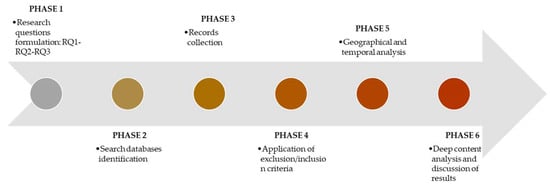
Figure 3.
Flow chart of the literature review procedure developed in the present analysis (source: Authors’ elaboration).
The following limitations are acknowledged:
- Sources coverage is limited to Scopus and Google Scholar, and non-English language conference proceedings and opinion papers have been excluded; this can introduce selection bias.
- Perfect reproducibility can be conditioned by the dynamic nature of the databases (updates, Scholar ranking).
- The high heterogeneity of contexts, metrics and reporting modalities in the included works does not allow for a comparable quantitative synthesis (e.g., meta-analysis).
- Sensitivity analysis reporting in included papers is often incomplete, limiting comparison of the robustness of the results.
- The taxonomy of the criteria may have partial categorical overlaps.
- The unbalanced geographical and temporal distribution of studies (with concentrations in a few countries) can be reflected in comparative inferences. Geographical analysis is based on indexed and English-language studies; this may underestimate contributions published on regional or local-language sites. In addition, variability in the openness of tender data between countries may affect the traceability of application studies.
3. Geographical and Temporal Distribution
The analysis of the temporal and geographical distribution of the studies was conducted via descriptive synthesis, as recommended by the Joanna Briggs Institute Reviewer’s Manual and the PRISMA guidelines. Annual frequencies and trends were calculated, and the countries of affiliation of the authors were analyzed to understand the main areas of scientific production on the topic.
3.1. Geographical Provenance of the Authors (Affiliations)
A total of 74 papers were considered, and a total of 206 authors affiliated with various research institutions across 31 different countries were identified (Figure 4). China was the country with the highest number of authors, with 32, followed by Italy and Spain (18), India (15), the United Kingdom, and Turkey (9 each). This result could be attributed to a number of factors, including the relevance assigned to this field of research within each institution by local and national administrations, the size of the academic population, and, more commonly, the importance of MCDA applications for the PP sector, in some cases supported by the reference regulatory context. For instance, the prevalence of Chinese authors in the present work might be attributed to this factor. Article 19 of the 1999 Tendering and Bidding Law refers to the examination of bidders’ qualifications and the evaluation of bids, indicating that these processes extend beyond the consideration of the lowest price. Furthermore, Article 41 stipulates that the winning bidder must be able to demonstrate that they meet the comprehensive assessment standards set out in the tender documents. This requirement can be readily met through the use of MCDA techniques.
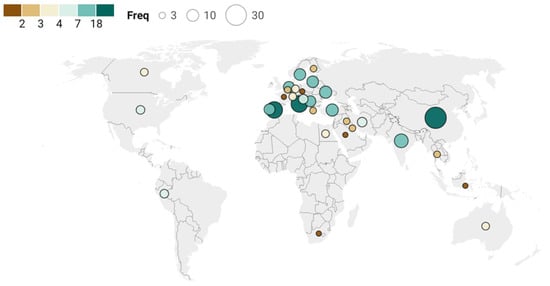
Figure 4.
Number of papers per geographical provenance of the authors (source: Authors’ elaboration).
It would be remiss not to consider the academic attention that European countries have devoted to this topic. The establishment of the European Directives 2014/24/UE and 2014/25/UE, which stipulate the primary use of the MEAT criterion for the PP selection procedure, has been accompanied by an increase in European contributions; the association is temporal and consistent with the regulatory framework, but does not demonstrate a causal effect.
The geographical provenance of the authors enables an understanding of which countries have received more academic attention with regard to the implementation of MCDA in PP procedures. The concentration of contributions in China, Italy and Spain may reflect a greater availability of data via e-procurement portals and searchable public tenders; an established academic tradition on the use of MCDA in PP and active research networks; the centrality of the MEAT criterion in EU countries, which incentivizes comparative studies between methods. On the contrary, the lower presence of Africa and South America may depend on data access barriers (non-uniform or unopened portals), language and indexing (many works published in local journals not indexed in international databases) and on the possible place of dissemination (technical reports or grey literature). These differences should not be read as the absence of practices: it is plausible that MCDA applications are present but less visible in the bibliometric sources used. This asymmetry is also discussed in the limits of this work. It is worth noting a partial correspondence with the geographical origin of the authors; this observation does not affect the independence of the two analyses (academic output vs. application context).
3.2. Geographical Context of Analysis (Case Studies)
The consideration of the geographical context of analysis to which each paper directly refers by applying the proposed MCDA technique or by mentioning it/them in the discussion can recognize (i) the relevance of the MCDA application in the PP sphere for each country, (ii) the PP dynamics and regulations and (iii) which countries are trying or needing to improve the PP procedures through the use of multi-criteria decision-making approaches. Among the sample, 35% of papers did not specify the geographical context of application of the proposed model. As demonstrated in Figure 5, the geographical context most frequently analyzed in the considered sample was Italy, followed by China and Spain. This finding may appear aligned with the geographical origins of the contributing authors. In Italy and Spain, members of the European Union, the public works sector has notable importance. Between 2009 and 2017, the construction sector was one of the most important in Spain in terms of the number and value of PP contracts. However, it is not possible to establish a causal link based on our data.
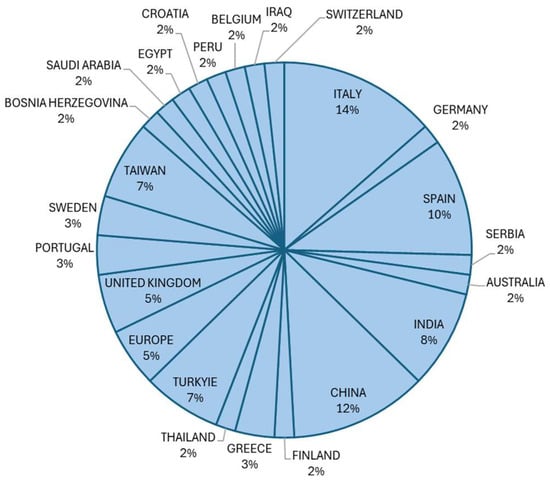
Figure 5.
Number of papers per geographical context of analysis (source: Authors’ elaboration).
The following factors may help to explain this territorial distribution: (i) the availability of data on PP interventions in certain geographical areas compared with others; (ii) the funding of research projects aimed at supporting specific PP interventions; (iii) regulatory gaps in the contexts analyzed; and (iv) collaborations between authors, institutions and local PP structures. In more general terms, it is observed that 39 of the 74 contributions (53%) focus on European case studies (Croatia, Sweden, Germany, Portugal, Greece, Lithuania, etc.). This trend aligns with the guidance set out in the 2014–2020 Cost-Benefit Analysis of Investment Projects for Cohesion Policy and may reflect its influence, on the understanding that other explanations are plausible.
A thorough analysis of the trend in construction spending in the US over the period 1993–2022 reveals that public expenditure remains consistently lower than that of private spending. This outcome indicates a divergent structural configuration of the market compared to the European context.
3.3. Temporal Distribution of Articles and Geographical Provenance of the Authors
The graph in Figure 6 shows the trend in the number of studies published per year in the period between 1998 and 2023. Academic output is initially very limited, with an average of around one or two studies per year until 2009. Starting from 2010, a first peak is observed (six studies in both 2010 and 2011), followed by an irregular but generally increasing trend. The maximum peak is recorded in 2020 with seven publications, followed by a level still sustained in the following three years (five studies in 2021, four in 2022 and three in 2023). Overall, the trend highlights a growing scientific focus on the topic of multi-criteria evaluation in public procurement, with a higher density of publications since 2010. This increase may reflect regulatory developments (e.g., introduction of the most economically advantageous offer—MEAT—criterion in the EU) and the growing interest in more transparent and rational decision-making tools in public procurement processes.
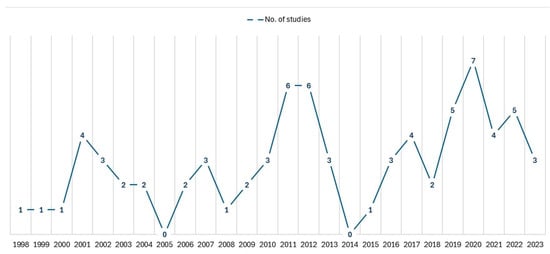
Figure 6.
Academic output over time (source: Author’s elaboration).
An analysis of the geographical origin of the authors of the 74 scientific articles included in the review reveals a marked heterogeneity in the distribution by country, with some significant recurrences and the presence of new emerging actors over time. In Figure 7, the most representative countries per each year are shown.
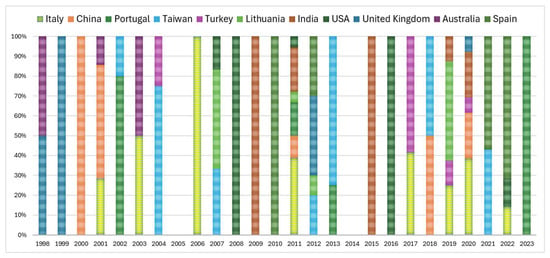
Figure 7.
Incidence of the most representative countries per each considered year in the time span 1998–2023 (source: Authors’ elaboration).
1998–2003: The analysis reveals a strong prevalence of the United Kingdom (50% in 1998, 100% in 1999, 40% in 2001), confirming an initial record in MCDA academic output applied to PP. The USA and China also appear among the most active countries in the early 2000s.
2004–2011: The roles of Lithuania, Italy, Iran and Taiwan begin to consolidate, each with peaks of presence > 20% in some years. Italy, for example, is the most represented country in 2005 (27%) and 2011 (28%). Spain and Türkiye also emerge.
2012–2016: We are witnessing a progressive rebalancing: Italy maintains a key role (30% in 2012), but Iran (2014 and 2016), India (2015) and Asian countries (Taiwan, China) emerge. In this period, there is a global diffusion of MCDA-PP research.
2017–2023: Italy dominates as the most representative country in 2017 (25%), 2019 (18%), 2020 (27%), 2021 (21%) and 2022 (17%). In 2023, France (21%) stands out as the leading country. In parallel, the Eastern European area (Lithuania, Serbia, Croatia) gains visibility.
At the same time, it was also possible to identify some emerging geographical areas, which, although starting from a zero or marginal incidence, show a significant increase in the final part of the period considered. Among these, Bosnia-Herzegovina, Portugal and Serbia stand out, which in 2023 reached an incidence of 33.3% on the total papers published in the year, compared to a total absence in previous decades. These data suggest the emergence of new poles of interest or expertise in research applied to the use of MCDA methods in public and infrastructural contexts.
During the analysis, it was possible to observe some long-term geographical trends that characterize the evolution of academic output on the topic of multi-criteria decision applied to the evaluation of bids in public procurement. Firstly, Europe confirms itself as the main focus of academic output in this area, with a particularly relevant role played by Italy, which is the most represented country in at least six separate years (2005, 2011, 2012, 2017, 2019 and 2020). Other European countries, such as Lithuania, Spain, France and, to a lesser extent, the United Kingdom, have also contributed significantly to the literature, outlining a panorama strongly centered on the European context.
In parallel, we observed the progressive emergence of new scientific poles in Asia, particularly in China, Taiwan, India and Iran. These countries began to appear among the most representative already in the early 2000s, but it was from 2014 that their contribution became more systematic and relevant. China, for example, shows a significant evolution over time, moving from a marginal role in 2000 to an increasingly established presence in more recent years. This dynamic testifies to the internationalization of research in the sector, which opens up to contributions from heterogeneous geographical contexts.
Another noteworthy trend is the progressive decline of the United Kingdom: if in the first years analyzed (1998–2001) this country represented one of the main reference poles, with percentages even higher than 50%, in the following years, its incidence visibly decreases, until it becomes residual in the second half of the period considered. A similar fate also concerns the United States, whose academic output in the specific field of MCDA applied to public procurement has proven to be relatively marginal compared to expectations.
Finally, it is possible to note the growing visibility of Eastern Europe, with countries such as Serbia, Croatia, Lithuania and Latvia which, although not reaching very high incidences in absolute terms, show a growing presence especially in the last decade. Overall, the analysis confirms a process of progressive geographical expansion and democratization of academic output on the topic, with a transition from an initial concentration in a few European countries to a broader and plural distribution that also includes emerging scientific realities. It points out, however, that the results presented are not generalizable to the entire body of international literature on the subject. The analysis is, in fact, based on a selected sample of articles that meet specific inclusion and exclusion criteria, as described in the methodological section. Therefore, the data reported here must be interpreted in relation to this selective context and must not be assumed to be representative in an absolute sense.
3.4. Trend of MCDA Methodologies
Among the 74 papers, it is possible to identify 39 adopted multi-criteria techniques, as shown in Figure 7 and also in the detailed list in Appendix A. Fuzzy logic was not considered in the present analysis as an individual multi-criteria technique, except when combined in specific versions of other MCDAs. The application of the principles of the fuzzy theory in the listed techniques AHP, ANP, TOPSIS, and UF produced other listed techniques, FAHP, FANP, FTOPSIS, FUF, and CBA. It is possible to find that in some papers, the proposed MCDA-based approach consists of more than one multi-criteria technique. Such alterations may be observed in the final ranking of the alternatives under assessment and the weighting of the considered evaluation criteria.
In terms of the frequency of application, the AHP is the most frequently adopted technique (26 times), followed by the FAHP and SAW, which were each adopted 10 times. The straightforward implementation of these techniques may explain this outcome. In particular, the AHP is a flexible technique that can determine the weights of the evaluation criteria by comparison matrices structuring and expert panel involvement; therefore, it is suitable for the PP procedures in the application of the MEAT criterion. Moreover, some of them are explicitly recalled and promoted in the national reference guide of PP procedures for the MEAT application, such as the SAW in the ANAC Guidelines authority for Italy [18]. Others frequently applied are UF (8), TOPSIS (6), FTOPSIS (3) and BWM (4). Ref. [19] proposed a multi-criteria decision analysis technique for contractor selection and bid evaluation, based on utility theory. They implemented the proposed method in a hypothetical case study conducting real interviews with four leading professionals to build the utility functions (UF). Ref. [20] proposed a contractor prequalification model which applied the TOPSIS method to classify contractors. This approach is based on the premise that the optimal alternative should be in closer alignment with the positive ideal solution and further removed from the negative ideal solution. In a similar vein, ref. [21] constructed a green evaluation system and derived the criteria weights using the BWM, thereby proposing a novel integrated model to study the selection of green suppliers and order allocation.
The 74 papers analyzed were distributed around 25 years (1998–2023) (Figure 8a–c). To analyze the methodological evolution over time, the time span was segmented into four periods (1998–2007; 2008–2014; 2015–2019; 2020–2023), with a comparison of prevalent MCDA families and share of hybrid approaches for each. Since the initial application of the AHP in 2001, it was consistently employed in subsequent years, particularly in papers published between 2012 and 2023. The FAHP was frequently used in the literature published between 2010 and 2012. In 2012, the number of applications of TOPSIS reached its maximum (ranked third). Recently, novel MCDA techniques have attracted academic attention: the SCORE and PANTURA methods in 2019; BMW, EDAS and DEMATEL in 2020; CBA in 2021; SWING, PAHP and DEA in 2022; and MABAC and MAUT in 2023. Ref. [22] proposed two multi-criteria decision analysis methods, called SCORE and PANTURA, to assess sustainability and to identify the most sustainable alternative during the procurement stage of infrastructure projects. Ref. [23] integrated the choosing by advantages (CBA) method (a multi-criteria decision-making method) into life cycle assessment (LCA). The aims were firstly to identify the effect of environmental impacts’ inclusion in decision-making in PP, and secondly to compare the obtained results with those from an exclusively LCA-oriented assessment. Recently, ref. [24] employed a multi-criteria decision-making methodology, designated as MABAC, within the domain of PP to evaluate and select a prospective winning strategy from a set of bidding alternatives.
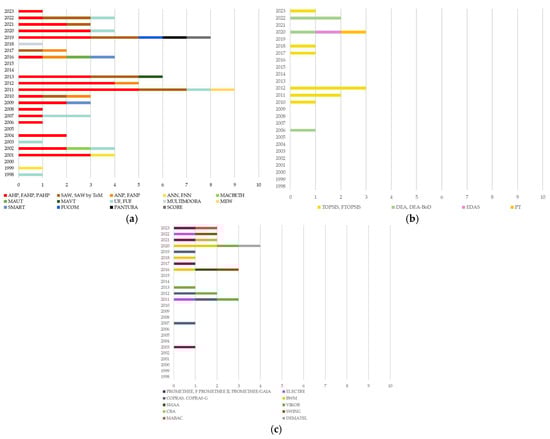
Figure 8.
Evolution of MCDA methodologies over time (1998–2023) (source: Authors’ elaboration). (a) Evolution of MCDA methodologies (first part) from 1998 to 2023; (b) Evolution of MCDA methodologies (second part) from 1998 to 2023; (c) Evolution of MCDA methodologies (third part) from 1998 to 2023.
4. Analysis of Objectives and Award Criteria
4.1. Objectives of the Works
Through the examination of the different objectives of the works subjected to systematic analysis (74), it is possible to identify the main operative fields of application of approaches based on MCDA techniques within PP procedures:
- the pre-selection and/or the selection of the best supplier,
- the selection of the best tender,
- the identification of the optimal weighting of awarding criteria and/or suitable set of criteria.
Of the contributions analyzed, 45 were allocated to the selection of the most suitable supplier, 41 to the selection of the most suitable offer, and four to the identification of evaluation criteria. In 15 cases, the studies encompassed both the selection of the supplier and the optimal offer. For instance, ref. [25] utilized an additive value model to evaluate tenders in a public tender, incorporating the award criteria, including both tenderers and their tenders. In the case study, the authors subsequently used the MACBETH technique for the weighting phase. Ref. [26] utilized the DEA to develop a pair comparison matrix and the AHP to support bid evaluation in a major project by ranking suppliers. Ref. [27] developed methods integrating DEA principles to provide a basis for objective determination of weights of assessment criteria. In addition, ref. [28] developed a decision support model for public authorities, based on the use of artificial neural networks (ANNs) to predict supplier suitability. In a similar vein, ref. [29] presented a decision support system for public authorities in urban infrastructure planning, integrating three MCDA methods (SAW, TOPSIS and ELECTRE I) with a GIS component to facilitate comparison of available alternatives.
4.2. Awarding Criteria Classification
The selection of the best tender or the best supplier requires attention to several features that characterize each proposal from different points of view, such as environmental, economic, and social aspects. In particular, the adoption of the MEAT criterion involves the consideration of many other aspects that are not only limited to the canonical sustainability spheres. By considering the awarding criteria collected from the papers—when the authors clearly stated them—eight categories were identified. In each category, the main awarding criteria retrieved from the considered papers are listed in Table 1.

Table 1.
Categorization and respective numbers of encountered awarding criteria.
As observed in Table 1, a total of 345 criteria were grouped. To classify each criterion in a single primary category (Cost, Quality, Suppliers’ past performance and current capabilities, Time, Environmental and social responsibility, Risk, Financial structure, Context), a simple and replicable logic, guided by the size actually measured, was applied. The unit of measurement: if the indicator is monetary, it is placed in “Cost”; if it is temporal, in “Time”; if it concerns economic-financial indices, in “Financial structure”. When unity is not enough, it could be possible to look at the content of the evaluations: if it describes attributes of the provider (experience, capacity, resources, reputation, method), it falls into “Suppliers’ past performance and current capabilities”; if it expresses performance/technical quality of the good/service it goes into “Quality”; if it concerns environment, health-safety or social aspects, into “Environmental and social responsibility”. Criteria representing uncertainty or exposure to risk were classified under “Risk”. Those related to external conditions (e.g., market, territorial impacts, political factors) were categorized as “Context”. For composite criteria, the category is assigned according to the primary evaluation focus (what is really measured); for certifications and indicators, “binary” or “rubric” (e.g., EPD, social clauses, H&D plans), the purpose is important: environmental/social outcomes of the project? It goes into “Environmental and social”; organizational capacity of the bidder? It goes into “Suppliers’ past performance”. To avoid double counting, a normalization of synonyms (e.g., price/bid price → Price) was carried out. For the reliability of the taxonomy of the eight groups, two authors independently carried out the coding of the criteria on a random sample of 20% of the included articles; discrepancies were discussed until consensus was obtained with the involvement of a third author in case of persistent disagreement. The agreement index (Cohen’s κ) on the primary classification of the criterion was equal to 0.76, downstream of the operational alignment (normalization of synonyms and disambiguation rules already defined). The same procedure was applied to a second 10% ex-post verification to control the stability of the agreement.
The most populated category was “Environmental and social responsibility” [43,44,45,46]. This could be not only a cultural trend: it also reflects the European legal framework that allows (and encourages) the integration of environmental and social aspects throughout the cycle of the procedure. In fact, Directive 2014/24/EU provides that the award can be based on the best quality/price ratio by including qualitative, environmental and/or social criteria (art. 67); it allows technical specifications with environmental characteristics (art. 42) and the use of labels (art. 43), and explicitly regulates life-cycle costing (LCC) to internalize acquisition costs, use, maintenance and end of life (art. 68). Conditions for performance of the contract may also incorporate environmental or social clauses (art. 70). In addition, the Commission’s Green Public Procurement (GPP) practice is gaining ground, making available sectoral criteria and guides for works/services, including construction. The GPP criteria for the design, construction and management of buildings provide examples of operational indicators—e.g., building energy performance, recycled material content, construction site waste management, indoor air quality, and, in terms of climate, impact indicators along the life cycle (e.g., GWP/CO2e) supported by EPDs and technical standards. This operational literature offers a repertoire of scales, sources and thresholds that contracting authorities can take up to transform “environment” and “social” into measurable and auditable items. The consolidation of environmental and social criteria improves alignment with sustainability objectives, but introduces critical measurement and comparability: heterogeneous metrics, greenwashing risk, asymmetric burdens for operators, possible duplications between sub-criteria and ranking fragility if E & S weights are not tested. To make this evolution robust and auditable, it could be useful to pre-specify a few measurable E & S criteria with verifiable sources, resorting to LCC when relevant, limiting the proliferation of sub-criteria, and providing a minimum sensitivity on weights to spell out cost/time trade-offs, within a standardized report. In light of these critical issues, a standardization check-list is proposed in §6 (method, variants, normalization, weights/consistency, parameters, tie-breaks, sensitivity and attached materials) to guarantee traceability and comparability between procedures.
4.3. Typology and Number of Considered Criteria
The awarding criteria can be classified into two typologies: quantitative or measured in numerical terms (such as price and costs); and qualitative or expressed through linguistic terms. A 74% share of the papers use both quantitative and qualitative awarding criteria, followed by 19% that employ only those of the quantitative typology and 7% only qualitative. To illustrate, ref. [30] considered a set of five quantitative criteria, specifically: (i) longevity as the number of years of material renovation, (ii) construction price as millions of euros, (iii) environmental protection as increased noise measured in decibels, (iv) economic viability as the average distance for soil transportation measured in meters, and (v) construction duration as the number of days of work. A mere five papers within the sample of 74 solely considered qualitative criteria. To illustrate, ref. [47] presented a decision-making support tool that incorporated individual judgments about the available alternatives, with the objective of enhancing awareness of the risks associated with these alternatives.
The majority of the analyzed papers, specifically 55 out of 74, considered a set of awarding criteria composed of both qualitative and quantitative criteria. In the selection of a contractor for a road building project, ref. [48] identified seven criteria, of which the qualitative criteria included the technical capability, experience, financial status, management capability and safety. The quantitative criteria were the cost and completion time provided by the contractors at the time of submitting their tender for the road building project. The distinction between quantitative and qualitative criteria hinges on the elements of the offer under evaluation by the selection commission. Qualitative criteria pertain to the technical aspects of the offer, elucidating the methodologies for undertaking the service (execution of the works and supply). In contrast, quantitative criteria encompass elements extrinsic to the offer, such as price.
In consideration of the average number of adopted criteria, it was equal to 6. The maximum number of criteria was equal to 21 and was employed by [49] for the development of a hierarchy model and a 21 criterion-based network model for the study of public bidding for the construction of an educational center at the Polytechnic University of Valencia. This was followed by an analysis of public bidding for the remodeling and improvement of national roads construction projects. The minimum number of criteria was two, as used by [50]. In this study, the author employed a utility theory-based model to address only two criteria: time and cost. In 41 out of the 87 sets of criteria encountered (as some papers address more than one selection problem), the criteria were better identified by sub-criteria. The mean number of sub-criteria considered was 19. The sub-criteria are frequently utilized for the specification of the various aspects and features that define the assessment criteria; thus, they are invariably more than the number of criteria. Ref. [31] utilized a total of 71 sub-criteria, representing the maximum number identified in the collected papers, for the quantitative assessment of social sustainability in public-works procurement.
4.4. Sensitivity Analysis
Despite its relevance, only 20 out of 74 studies (~27%) implement some form of sensitivity analysis. This analysis should be adopted systematically to evaluate how stable MCDA rankings remain as inputs plausibly vary. In our sample, the most common approaches concern (i) variations in criterion weights and (ii) modifications of the set/normalization of award criteria, e.g., [26,29,51].
5. Mono and Pluri-MCDA Approaches for Weighting and Ranking PP Phases
It is crucial to ascertain whether the methodologies proposed in each paper are based on a single or multiple multi-criteria techniques. This enables an understanding of whether the authors prioritize the simplicity and reproducibility of the approach by employing a single technique, or whether they are willing to accept the inherent complexity of a combined approach in order to address the challenges of each technique and combine their advantages.
The multi-criteria approaches based on a single technique turn out to be the most frequently applied [32,33,35,38,39,41,46,52,53,54,55,56,57,58,59,60]. In fact, 42 out of 74 proposed approaches were based on the employment of only one MCDA technique. Among these, ref. [61] proposed a nine-stage model based on the utilization of the AHP to select the most sustainable contractor in the Turkish construction project considered. Ref. [62] employed the DEA to guarantee the derivation of a robust tender ranking given that, with respect to clients’ preferences, irrelevant and insufficiently tailored tenders do not influence the scoring. Ref. [63] aimed to evaluate the suitability of the FNN model for contractor prequalification and selection regarding civil engineering projects in the public sector.
The extension of existing and integration of well-known methods or development of hybrid methods became common practice (primarily by the application of the fuzzy and grey systems theory). The remaining 32 papers provided pluri-MCDA-based approaches, employing different techniques in the steps of the PP process. Ref. [64] used the AHP method for the determination of the criteria weighting, and the “Complex Proportional Assessment of alternatives with Gray relations” (COPRAS-G) for the evaluation of the alternatives and the determination of the partial ranking. Ref. [36] propose a combined model based on BWM for evaluation and ranking of the selection criteria and the VIKOR for the final selection of companies. Ref. [65] presented a combined approach that integrated FAHP and SMART to address the weighting and ranking phases of the contractor selection problem in government procurement auctions.
The selection of an appropriate technique is primarily contingent upon the suitability of said technique to the specific requirements of the PP phase, particularly the criteria weighting phase and the final and/or partial ranking of the alternatives under evaluation. Another factor that influences the choice of technique is the specific focus of the evaluation. Some characteristics of the technique may be required, such as the ability to deal with conflicting objectives, to address vague and uncertain problems by using linguistic variables, to handle subjective judgments, and to provide a user-friendly interface to ensure speed, a high degree of comprehensibility, and ease of deployment.
Among the papers that used several techniques [31,48,66,67,68,69,70,71,72,73,74,75,76,77], the analysis of the specific use of the MCDA techniques showed that only 13 techniques were employed for both criteria weighting and ranking of the alternatives in the same paper. This occurs 17 times with AHP, three times with UF and FAHP, twice with ANP and DEA, and only once with FNN, FTOPSIS, FANP, SCORE, ELECTRE and PAHP. This finding confirms the relevance of AHP also from the specific use for which it is adopted for solving the problems of the PP procedures.
As can be seen from Figure 9 that represents the combination of the techniques in the pluri-MCDA approaches and the times that each technique is applied, AHP and FAHP [78] are the most frequently applied weighting methods, followed by BWM. The reason why AHP is particularly used in the weighting process can be mainly attributed to its capacity to structure a complex problem hierarchically and then to investigate each level individually [46]. In fact, the importance of each criterion with respect to the top goal is not directly assessed, and according to psychologists, expressing a preference between two options is easier and more precise rather than choosing among several alternatives [79]. It is also noteworthy that there is a tendency to employ other methods that do not fall within the purview of multi-criteria techniques for the determination of criteria weightings. Ref. [37] were confronted with the pivotal challenge of determining the relative importance of the various criteria in the social assessment of products, projects, or companies. In lieu of utilizing expert judgment, the authors assigned equal weighting to each criterion. This decision was based on the premise that expert comprehension and interpretation of the sustainability dimension may be constrained. In a similar manner, ref. [80] put forth advanced multi-criteria models with the objective of achieving efficient and sustainable e-marketplaces for the public construction sector. In this instance, the criteria weights were determined through an analytical process, taking into account the contracting authority’s preferences in relation to cost, duration and the reward of the tender. In the example, the following criteria weights are considered: the relative importance of the three criteria is as follows: cost (60%), duration (30%), and reward (10%).

Figure 9.
Combined application of the multi-criteria techniques for the PP procedural steps (source: Authors’ elaboration).
For the determination of the alternatives, the most applied techniques were ranked as follows: SAW and TOPSIS, followed by VIKOR, UF, and COPRAS. Ref. [81] proposed a multi-criteria approach aimed at the environmental sustainability of road infrastructure, still paying attention to the economic aspects. The criteria weights were determined by users’ inputs, while the chosen ranking method was the SAW. Ref. [19] presented a systematic MCDA technique for contractor selection and bid evaluation. The determination of the relative importance of the criteria was achieved through a ranking process, which was then followed by the assignment of a weighting to each criterion. After that, UF was applied to rank the alternatives. Ref. [30] followed the objective to develop a methodology for multi-criteria assessment of multi-alternative decisions in road design and construction. The weights of attributes were assessed by two expert groups of stakeholders. The priority order of the alternatives was determined by applying the COPRAS approach.
It is important to highlight that SAW stands out for its ease, since it is a linear additive aggregation method. The “simple” weighted sum is a special case in the general additive utility function, where functions are all linear. With regard to the COPRAS method, it has a straightforward procedure that enables both benefit and cost criteria to be incorporated into a single analysis. The level of satisfaction with the objective is determined for each alternative based on a description of the positive and negative aspects of the project. Subsequently, COPRAS is capable of demonstrating the degree of utility by comparing the significance of each alternative with that of the most rational project [30,82].
6. Critical Results Discussion
The field of PP is experiencing notable changes. In response to RQ1–RQ3, we discuss below the results.
- RQ1: In which phases of the PP procedure (prequalification, award, verification) are MCDA techniques used, with which frequencies by geographical area and over time?
In our sample, AHP remains predominant as a solution “single method”. Hybrid approaches (e.g., AHP/BWM + EDAS/MABAC/TOPSIS; ELECTRE/PRO-METHEE for screening) appear as pragmatic extensions, useful when evaluation requires separating weighing and ranking, introducing thresholds/veto or reducing cognitive load while maintaining traceability. In the absence of stringent time/resource constraints, the hybrid can offer greater adherence to the operational needs of PP; however, it increases reporting complexity and requires more rigorous documentation (see standardization check-list). Hybrids can increase complexity (multiple parameters to explain) and the risk of non-comparability; to mitigate, pre-specify when disciplining the pipeline (e.g., “AHP + EDAS”) and apply the reporting check-list (method/variants, normalization, weights/consistency, parameters, tie-break, sensitivity). However, a hybrid MCDA approach is preferable in case of
- Many criteria/bidders and tight deadlines: BWM/AHP for weights + EDAS/MABAC/TOPSIS for ranking (linear, transparent calculation).
- Minimum requirements/thresholds to be enforced: ELECTRE/PRO-METHEE for screening (veto/indifference/preference), and then compensatory method for final ranking.
- Pre-qualification/benchmarking with input–output data: DEA in pre-qualification, then weighing/ranking with AHP/BWM + EDAS/TOPSIS for the award phase.
- Priority institutional acceptance: single method (AHP or other already known), well documented and with minimal sensitivity.
In a PP key, a hybrid solution is often more functional: AHP/BWM for weighing (legitimation and transparency of the process) + EDAS/MABAC/TOPSIS for ranking (speed and traceability of the formulas). Outranking methods (ELECTRE/PRO-METHEE) can support screening with thresholds/veto, before the final ranking. When time/data constraints are stringent, a well-documented single method remains appropriate (Table 2).
Table 2.
Comparison of MCDA techniques and phases of PP procedure.
Geographical analysis of the distribution of efforts made in the literature shows that MCDA methods are adopted and used somewhat differently among countries, varying by each country’s socio-economic condition along with infrastructure development. In the countries with significant PP volumes of construction, such as China, Italy, and Spain, preference among alternative methods is drawn toward correspondence to their national policy more with specific challenges—sustainable development or cost-efficient practices. In this regard, the tendering process will most likely consider economic, technical, and environmental concerns for efficiency in countries where the public administration is more developed. Selection of a method in project management has often been related to legal and regulatory contexts. This European Union’s MEAT criterion in the updated version of Directives 2014/24/EU and 2014/25/EU could be probably the main driver for the acceptance of the AHP and SAW methods, as MEAT integrated cost, quality, and even sustainability criteria [40,49,83,84,85,86,87,88].
- RQ2: Which technique is prevalent and why, in terms of properties required by practice (coherence of weights, transparency, computational burden, stakeholder acceptance), and how emerging techniques are positioned (e.g., BWM, DEA, MABAC, EDAS) than the consolidated?
The AHP remains the most commonly applied technique in public procurement, due to its ability to combine simplicity, flexibility and effectiveness in a single framework. While newer methods such as the BWM are attracting attention, the proven track record and compatibility of AHP with procurement needs ensure that it remains the preferred solution for many decision-makers. Its popularity can be attributed to several reasons. Firstly, AHP is both flexible and straightforward to utilize. The method enables decision-makers to deconstruct complex problems into a hierarchical structure of criteria, thereby facilitating a systematic and structured evaluation of alternatives. The pairwise comparison method, which is central to AHP, serves to streamline the process by focusing on two elements at a time, thus avoiding the potential for overwhelming users with multiple options simultaneously. Secondly, AHP is particularly well-suited to the MEAT criterion. This criterion necessitates the evaluation of both quantitative factors, such as cost and time, and qualitative factors, including environmental and social impact. AHP is capable of handling this combination in a seamless manner, thereby enabling a comprehensive assessment of tenders. Additionally, AHP is a widely recognized and recommended approach in procurement guidelines [19,50,89,90,91]. However, in our sample, the techniques considered “emerging” (e.g., BWM, EDAS/MABAC, DEA at specific stages) seemed to take the form more of incremental or complementary evolutions than substitutes for AHP. In particular, compared to AHP, BWM reduces the number of comparisons to ≈2n − 3 (with n criteria) versus n(n − 1)/2 of AHP for the same matrix: this usually translates into lower cognitive load and shorter times of elicitation. Both offer a measure of consistency (CR in AHP; consistency index in BWM), but BWM requires the decision-maker to identify best and worst criteria, which many decision-makers in PP context find intuitive. On the other hand, AHP is better known in public administrations and often has tools already accepted/provided (auditability, tracing), as well as a broad tradition of group decisions and consistency checks. In the PP field for MEAT application:
- -
- if the goal is to contain time and burdensomeness of judgments, BWM is often preferable;
- -
- if it is required to have maximum institutional acceptance and established AHP practices, AHP remains a “low-friction” choice.
In both cases, it is good practice to report: n. comparisons, consistency outcome, and a minimum sensitivity analysis on weights.
Other techniques such as DEA, MABAC and EDAS bring added value and suitability for various procurement phases. DEA supports input–output efficiency comparison of operators/tenderers (useful in prequalification or ex post performance) but does not incorporate explicit preferences of the decision-maker; requires cardinal data and may be less explainable to the non-technical public. “Light” ranking methods (EDAS/MABAC) appear useful when the weights are already set and a transparent and replicable calculation is needed. MABAC/EDAS offer linear and traceable calculations, handle benefits/costs well and are quick to implement in spreadsheets. In general, new methods = better times and usability, classical methods = greater acceptance and standardization. The choice should reflect the PP phase, data quality/form, and transparency constraints. In Table 3, a brief description of the main strengths and considerations for the most-used techniques retrieved in our sample for PP selection is presented.
Table 3.
Comparison of performance metrics of traditional versus emerging MCDA techniques in the PP applications.
- RQ3: How are award criteria operationalized (in particular, environmental and social: metrics/scales/data sources) and how much are sensitivity analyses and agreement procedures between evaluators reported in the applications?
Closer examination of the criteria adopted by PP shows that the trend for qualitative assessment has been the norm. Generally, the metrics and scale of the qualitative award criteria are frequently transformed through the use of the fundamental scale of Saaty or triangular fuzzification. For example, in the work of [41], qualitative criteria for the selection of contractors (such as previous experience or technical skills) were assessed using the AHP and the fundamental scale proposed by Saaty, which involves comparative judgments from 1 to 9. In this scheme, for example, the value 1 indicates equal importance between two criteria, while the value 9 represents an extreme preference of one over the other. Similarly, in the study by [70] on provider evaluation in the public health sector, a model based on Fuzzy AHP was adopted, in which qualitative judgments were made by means of triangular fuzzy numbers corresponding to linguistic evaluations such as “low importance”, “moderate importance”, “high importance”. This allows the uncertainty and subjectivity inherent in the evaluation of qualitative criteria to be represented in a mathematically tractable way. Ref. [76] talks about three quantitative criteria, respectively: (i) price, (ii) reduction of execution time, (iii) post-delivery maintenance. The first is measured in EUR for the i-th supplier, the second in weeks, and the third in months. To take into account the thermal performance, ref. [33] uses W/m2K, or the maintenance cost as a percentage of the initial construction cost.
A second important point, often disregarded in practice, concerns sensitivity analysis. While it is optional, it may be crucial in establishing solid decisions by identifying how findings might change when there are other assumptions, as well as different data inputs [92,93]. To make MCDA-based MEAT assessments verifiable and robust, we propose a protocol in four levels: (1) one-way on weights (±10–20%, with renormalization) and ranking recalculation; (2) scenario analysis (official weights vs. equal weights; min–max vs. vector normalization; inclusion/exclusion of a non-core criterion); (3) method triangulation by re-running the matrix with an alternative MCDA method and comparing rankings; (4) switching analysis to estimate the minimum weight/score change necessary to change the winner. For approaches such as ELECTRE/PRO-METHEE, it is advisable to also vary the preference/indifference/veto thresholds to verify any rank reversal [77]. This protocol is consistent with recent good practices in evaluating public tenders with MCDA [94]. The final report should include the ΔRank for the top-3, Kendall’s τ/Spearman ρ between scenarios/methods and a brief summary of the robustness of the winner. Figure 10 shows the main features of the proposed protocol for implementing sensitivity analysis in PP.
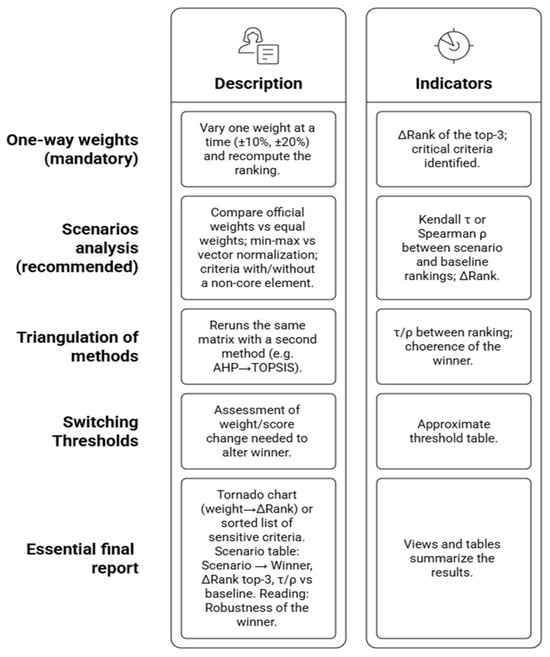
Figure 10.
Proposed protocol for implementing sensitivity analysis in PP (source: Authors’ elaboration).
The analysis of 74 research papers has yielded several noteworthy insights. In conclusion, PP is undergoing a period of transformation, and MCDA provides a structured yet flexible approach to addressing the increasing complexity of this field. The integration of transparent, equitable, and long-term public goal-oriented procurement processes can be achieved through the implementation of clear evaluation methods, sensitivity analysis, and a focus on qualitative criteria [43]. The results find a consistent reading in the light of established theoretical frameworks. The prevalence of AHP reflects adherence to the compensatory MAUT/MAVT family, which offers the transparency, traceability and auditability required by MEAT procedures. Where thresholds/veto and preferences are needed that are not fully compensatory, the use of outrankings (ELECTRE/PRO-METHEE) is consistent with the need for minimum requirements and screening. Deployment of DEAs in pre-qualification phases aligns with the input–output efficiency logic, as distinct from preference aggregation. The interest in BWM can be read in terms of bounded rationality and reduced cognitive load in commissions (fewer comparisons, shorter times) for equal consistency checking. The growth of environmental/social criteria relates to the idea of LCC and the internalization of externalities, while requiring standardized metrics. In summary, the choice of method appears to be a joint function of desired compensability, transparency/accountability constraints and information burdens/times of the specific procedure. A further implication relates to the digital transformation of tendering processes: increasingly, MCDA methods are incorporated into e-tendering platforms, into BIM-integrated tools (for tying criteria/quantities to model objects and LCCs) or into AI-assisted dashboards (for document extraction and analysis “what-if”). This integration could improve traceability, timing and replicability (scoring templates, audit logs, weight versioning), but it also opens up critical issues: risk of algorithmic opacity and vendor lock-in, data quality management, bias in automatic suggestions, as well as problems of comparability if the parameters remain closed in the platforms. Looking ahead, we believe it is useful to pre-specify the minimum metadata (method/normalization/weights/parameters, exportable via template or API), and evaluate the explainability and sensitivity of the rankings even when the calculation takes place “within” digital tools. This would make it possible to combine efficiency and transparency, maintaining comparability between procedures and studies.
The study is placed along the continuum of [95], mainly as an example of organizing and categorizing literature, with some aspects that may touch on the conceptual gaps identified. The main focus is on systematizing the existing literature, highlighting trends, key techniques and gaps, with a clear and categorized structure. However, the work includes some elements of “conceptual spotting gaps”, as it highlights areas that are little explored, such as
- The use of emerging techniques (e.g., best-worst method).
- The need for standardization in practical applications for public procurement.
With regard to the standardization issue, the increasing availability of MCDA techniques (AHP, BWM, TOPSIS, EDAS/MABAC, ELECTRE, DEA, hybrid approaches) can reduce the comparability and auditability of results if methods and parameters are not homogeneously documented. While respecting the regulatory framework on PP and MEAT criteria, there is no single prescribed technique: this makes a minimum standardization of reporting useful, so as to preserve replicability, traceability and comparability between procedures and studies, that could be structured as a check-list, as follows:
- Method and variant adopted (compensatory/outrankings/DEA; relevant version or settings).
- Weight derivation (AHP/BWM/equal/other) and consistency check (e.g., CR/index).
- Normalization rule and benefit/cost treatment for each criterion (with formula).
- Characteristic parameters of the method (e.g., preference/indifference/veto thresholds; metric/distance; cut-level).
- Data rules: management of missing/outlier values, possible tie-breaking and exclusion criteria.
- Final single score (explicit formula).
- Essential sensitivity analysis (±10–20% on weights + 1 alternative scenario on normalization or parameters; summary of winner robustness).
- Attached materials: datasets/extracts and templates (spreadsheet or script) to replicate calculations.
This check-list is compatible with the specifications of the contracting authorities and does not alter the legal framework: it only makes explicit formulas, parameters and checks already required in terms of transparency and traceability. In the presence of many available techniques, this standardization mitigates the risk of methodological “cherry-picking” and facilitates internal/external controls and comparisons between similar tenders. The mini-standardization proposal is designed to be implementable in the tender specifications, consistent with Art. 108 of Legislative Decree 36/2023 and with the ANAC schemes (Type Notice No 1/2023). Similar “evaluation template” models are already adopted in other systems (Crown Commercial Service, Birmingham, UK) and in the guidelines of multilateral banks, which require criteria, weights, method parameters and combination rules explained ex ante [96]. This study represents a bridge between theory and practice, providing a contextualized and systematic guide that addresses not only the use of multi-criteria techniques, but also the regulatory and operational implications in the public works sector.
Practical Implications and Actionable Recommendations
The results of the review are better understood when read in light of some essential theoretical references. The results are placed in three foundational frames. Decision science: the prevalence of compensatory approaches (MAUT/MAVT) explains the use of AHP/BWM for weighing and TOPSIS/EDAS for ranking in MEAT awards, while outrankings (ELECTRE/PRO-METHEE) are appropriate when the context requires thresholds/veto and preliminary screening; DEA is instead consistent with pre-qualification on input–output efficiency. Public procurement policy: the MEAT logic, life-cycle costing and transparency and pre-specific obligations (criteria, weights, normalizations) orient towards explainable and auditable methods, with a minimum sensitivity on weights/parameters to certify robustness. Governance: from a principal–agent and accountability perspective, the methodological choice must be replicable and traceable; integration into platforms (e-tendering/BIM) requires export of metadata (method, weights, parameters) to preserve comparability and control. In light of these frameworks, the operational recommendations to stakeholders (commissions, operators, audits) proposed in the text derive directly from these references and provide practical criteria “technical↔context” without sacrificing rigor and verifiability.
The choice of the MCDA method is not neutral but depends on the context. In terms of operational context of procurement, where MEAT awards need strong explainability and auditability, this means that the most balanced combination, in most cases, could be to use AHP or BWM for weighting and a simple and traceable compensatory method (e.g., EDAS/TOPSIS) for the final ranking; use ELECTRE/PROMETHEE when it is necessary to filter offers based on minimum requirements; and place DEA upstream, if necessary, for pre-qualification. From a geographical/institutional point of view, differences in regulatory framework, digital maturity (e-tendering/BIM), data availability (EPD/LCA, KPI H & S) and organizational capacity may guide choices: jurisdictions with emphasis on transparency and traceability tend to favor more explainable methods; where environmental data are scarce, rubrics and less data-intensive methods are used; where minimum thresholds are required for technical compliance/safety, outrankings are more suitable. In all cases, pre-specification method/weights/normalizations, essential sensitivity (±10–20%) and exportable calculation/log templates may preserve inter-context comparability and audibility.
For policy- and decision-makers, the priority is to foster comparability and transparency without plastering methodological innovation. Guidelines requiring pre-specification of methods and weights, standard minimum reporting (including normalization rules and method parameters), and mandatory sensitivity on weights—particularly for environmental and social criteria—help reduce heterogeneity and make choices contestable. Where possible, it is useful to promote column catalogs for recurring criteria (quality, safety, environmental/social), so as to reduce the risk of double counting and vagueness.
Economic operators and tenderers benefit from a clear set-up if they prepare an evidentiary package consistent with measurable headings and metrics (EPDs, certifications, KPIs), and if they simulate internally the effects of possible changes in weights. This allows for more targeted offers and facilitates technical dialogue during clarifications.
In the ecosystem of digital platforms, the integration of MCDA methods can improve time and traceability, provided that formulas, weights, normalizations and parameters remain visible, and that it is possible to version and export data and results. The aim is to avoid opacity or lock-in and to maintain the possibility of external verification.
Finally, for audit and control, the priority is to verify the existence of templates, consistency of weighing (AHP/BWM), documented sensitivity and transparent management of normalizations, parameters and tie-breaks. This type of control also works as an incentive to the quality of the ex ante design.
Therefore, if there are many criteria and time is short, weigh with BWM and close with a traceable compensatory ranking; if minimum thresholds or requirements are needed, place an outranking screening before it; if it is necessary to filter for efficiency, use DEA in pre-qualification; always, accompany the choice with sensitivity and minimum standard reporting, so as to combine effectiveness, transparency and comparability.
To propose a framework or guidelines based on the review findings, a six-step operational framework that connects selection of criteria and their operationalization, choice of method based on the context, robustness checks and standard minimum reporting, with clear assignment of roles and deliverables is provided. The framework summarizes and makes the review evidence applicable. This does not prescribe a single algorithm: it offers a practical path that translates the review into applicable steps, aligned with transparency, replicability and comparability of MEAT evaluations.
Purpose and Context
The starting point is to clarify why and how the evaluation is made: phase of the process (pre-qualification, screening, weighing, ranking), number of criteria/tenderers, available times, presence of minimum requirements/thresholds, digital maturity (e-tendering/BIM) and truly accessible data sources. The output is a short context sheet that makes constraints and objectives transparent and guides subsequent choices.
Criteria “Core” and Operationalization
Few core criteria are selected (ideally 5–9), avoiding overlaps. For each, a unit/scale, benefit/cost orientation, verifiable source (EPD/ISO/H & S, tender documents) and explicit scoring formula (including any targets/thresholds) are defined. Summary headings for qualitative criteria are attached. This step ensures measurability and audibility before weighting or calculating rankings.
Choice of Method Based on Context
The methodological pipeline adapts to the context that emerged: AHP (or BWM if the criteria are many/time is tight) for weighting; ELECTRE/PRO-METHEE for screening with thresholds/veto when minimum requirements are needed; EDAS/TOPSIS for the final ranking, favoring transparent and replicable calculations. In pre-qualification with input–output data, DEA can be used as an efficiency filter, before aggregation of preferences. The choice must be justified and accompanied by the specification of parameters and normalizations.
Robustness (Essential Sensitivity)
To make the outcome verifiable, a minimum protocol applies: (i) one-way variation of weights (±10–20%, with renormalization); (ii) at least one alternative methodological/normalization scenario; (iii) possible triangulation with a second method; (iv) a switching analysis (of how much a weight or score should change to change the winner). We report ΔRank of the first classified and a measure of concordance (e.g., Kendall/Spearman), plus a brief note on robustness.
Minimum Standard Reporting
The evaluation report must include method and variant, normalization rule, derivation of weights (with consistency testing for AHP/BWM), key parameters (veto, metrics), data rules (missing/outlier, tie-break), aggregation formula single score quality-price, sensitivity results and a template (sheet/script) to replicate the calculations. This maintains traceability and comparability.
Roles and Deliverables
Commission: define criteria, weights and pipelines, approve templates and sensitivities; Platform/IT: enable metadata exports (method, weights, parameters, normalizations) and audit-logs/versions; Economic operators: provide documentary evidence consistent with the headings; Audit/control: verify consistency, replicability and completeness of reporting. The final output is a clear report, reusable for comparisons over time and between procedures.
The proposed framework is designed as a coherent and subordinate operational support to Directive 2014/24/EU and Legislative Decree 36/2023/ANAC, useful for translating the requirements into replicable steps.
7. Conclusions
The PP entails the acquisition of works, goods, and services to fulfil the functions of public entities. A pivotal phase in the process is the selection of the most appropriate suppliers or projects. This is achieved through the MEAT approach, which seeks to achieve a balance between quality and cost. MCDA techniques are vital for guaranteeing transparency and efficiency; however, their implementation is hindered by disparate regulations and practices, particularly within the construction sector [97,98,99,100,101].
The study at hand presents a critical review of the current practices of MCDA in general, identifying the currently pivotal criteria, and assesses well-established methods like AHP and emerging ones such as BWM, which better cater to the current needs. Such methodologies include qualitative and quantitative criteria of social and environmental responsibility to perform an integrated evaluation. In addition to the methodological contribution, the results offer operational repercussions for the PP. First, the taxonomy of eight macro-categories (for 345 criteria) can serve as a check-list for MEAT specifications and grids, improving traceability and comparability between races. Second, the evidence of the centrality of environmental and social profiles (most populous category, 108 criteria) and the combined use of quantitative and qualitative criteria (74% of studies) legitimize structured and auditable evaluation sheets, beyond price alone. Third, the poor and uneven application of sensitivity analysis indicates the need for a minimum request for robustness tests (change in weights/sets of criteria) to be reported in the race minutes. Finally, the differences in adoption between countries—in particular, the weight of the MEAT framework in European systems—suggest contextualized but standardizable frameworks at a supranational level. Future research should aim to broaden the geographic scope, especially in underrepresented areas (e.g., Africa, Latin America, the Middle East), to understand whether observed trends are valid and what adjustments are needed to align them with local regulatory frameworks and cultural specificities.
The dominance of methods such as AHP and the limited use of sensitivity analysis may reflect features of bounded rationality, where decision-makers rely on simplified heuristics and familiar tools to manage complexity. Furthermore, the gradual incorporation of social and environmental criteria is in line with the need to mitigate principal–agent problems, increasing transparency and aligning procurement decisions with broader policy objectives. MCDA frameworks that support traceability and stakeholder engagement can therefore improve accountability, addressing both theoretical concerns and practical needs in public decision-making.
Three research directions derive from here: (i) experimental benchmarks between established and emerging techniques (e.g., AHP/SAW vs. BWM/DEA/MABAC) mapped to different process steps (prequalification, award, verification), by criterion type and operational burden; (ii) operationalization of environmental and social attributes with verifiable metrics and integration into digital platforms (e-tendering, BIM, support dashboards) to increase replicability and audibility; (iii) reporting protocols for studies and practices (including agreement between evaluators and minimum sensitivity tests) so as to bridge the gap between heterogeneous application cases and the need for common standards in PP procedures. Future work could map digital solutions incorporating MCDA, benchmark their audibility and explainability, and propose interoperable minimum reporting standards (e.g., export of scores/weights and version logs).
Supplementary Materials
The following supporting information can be downloaded at: https://www.mdpi.com/article/10.3390/systems13090777/s1, S1: Search strategy and information sources.
Author Contributions
Conceptualization, D.A., F.T. and P.M.; methodology, D.A. and P.M.; software, D.A.; validation, D.A., F.T. and P.M.; formal analysis, D.A.; investigation, D.A. and T.A.; data curation, D.A.; writing—original draft preparation, D.A. and T.A.; writing—review and editing, D.A.; visualization, D.A. and P.M.; supervision, D.A. All authors have read and agreed to the published version of the manuscript.
Funding
This research received no external funding.
Data Availability Statement
Data will be available on request.
Conflicts of Interest
The authors declare no conflicts of interest.
Appendix A
Table A1.
List of retrieved multi-criteria techniques in the considered sample.
Table A1.
List of retrieved multi-criteria techniques in the considered sample.
| No. | Multi-Criteria Technique | Acronim |
|---|---|---|
| 1 | Analytic Hierarchy Process | AHP |
| 2 | Analytic Network Process | ANP |
| 3 | Artificial Neural Network | ANN |
| 4 | Best Worst Method | BWM |
| 5 | Choosing By Advantage | CBA |
| 6 | Complex Proportional Assessment | COPRAS |
| 7 | COMPLEX PROPORTIONAL ASSESSMENT with Gray relations | COPRAS-G |
| 8 | Data envelopment analysis | DEA |
| 9 | Data Envelopment Analysis based on the Benefit-of-Doubt | DEA-BoD |
| 10 | Decision Making Trial And Evaluation Laboratory | DEMATEL |
| 11 | Elimination Et Choix Traduisant La Realité | ELECTRE |
| 12 | Evaluation based on Distance from Average Solution | EDAS |
| 13 | Full Consistency Method | FUCOM |
| 14 | Fuzzy Analytic Hierarchy Process | FAHP |
| 15 | Fuzzy Analytic Network Process | FANP |
| 16 | Fuzzy Neural Network | FNN |
| 17 | Fuzzy Preference Ranking Organization Method For Enriched Evaluation II | FPROMETHEE II |
| 18 | Fuzzy Technique Of Order Preference Similarity To The Ideal Solution | FTOPSIS |
| 19 | Fuzzy Utility Function | FUF |
| 20 | Measuring Attractiveness by a Categorical Based Evaluation Technique | MACBETH |
| 21 | Multi-Attribute Utility Theory | MAUT |
| 22 | Multi-Attribute Value Theory | MAVT |
| 23 | Multi-Attributive Border Approximation Area Comparison | MABAC |
| 24 | Multi-Objective Optimization On The Basis Of Ratio Analysis Plus Full Multiplicative Form | MULTIMOORA |
| 25 | Multiplicative Exponential Weighting | MEW |
| 26 | PANTURA method | PANTURA |
| 27 | Parsimonious Analytic Hierarchy Process | PAHP |
| 28 | Preference Ranking Organization Method For Enriched Evaluation | PROMETHEE |
| 29 | Preference Ranking Organization Method For Enriched Evaluation/Graphical Analysis For Interactive Aid | PROMETHEE GAIA |
| 30 | Prospect Theory | PT |
| 31 | Simple Additive Weighting | SAW |
| 32 | SIMPLE ADDITIVE WEIGHTING by trade-off matrix | SAW by TOM |
| 33 | Simple Multi-Attribute Rating Technique | SMART |
| 34 | Stochastic Multi-criteria Acceptability Analysis | SMAA |
| 35 | Sustainable Choice Of Remediation | SCORE |
| 36 | Swing | SWING |
| 37 | Technique of Order Preference Similarity to the Ideal Solution | TOPSIS |
| 38 | Utility function | UF |
| 39 | Viekriterijumska Optimizacija I Kompromisno Resenje | VIKOR |
Appendix B
Table A2.
List of criteria for each of the eight categories identified.
Table A2.
List of criteria for each of the eight categories identified.
| COST | ||
| No. | Criteria | Reference |
| 1 | Initial cost | [33] |
| 2 | Life cycle cost | |
| 3 | Construction price | [30] |
| 4 | Price | [25,52,86,90,93] |
| 5 | Bid price quoted | [65] |
| 6 | Bid price | [26,55] |
| 7 | Bid amount | [19] |
| 8 | Lowest bid | [45] |
| 9 | Investment cost | [31] |
| 10 | Infrastructure costs | [29] |
| 11 | Operating and maintenance costs | |
| 12 | Cost(s) | [25,47,55,66,68,78] |
| 13 | Performance costs | [64] |
| 14 | Project value | [28] |
| 15 | Mark-up | [85] |
| 16 | Purchase cost | [35] |
| 17 | Economic (investment cost) | [51] |
| 18 | Economic (operation and maintenance cost) | |
| 19 | Degree of Requirement Accomplishment- Budgeting | [92] |
| 20 | Cost overruns | [54] |
| 21 | Economic (costs/prices) | [82] |
| 22 | Cost criterion | [80] |
| 23 | Renovation cost | [32] |
| 24 | Economic/social (execution costs) | [23] |
| 25 | Economic domain | [22] |
| 26 | Project budget | [46] |
| 27 | Value | [24] |
| 28 | Low cost increase | [96] |
| 29 | Low annual costs | |
| 30 | Maintenance cost | [32,33] |
| 31 | Total Cost of Ownership | [90] |
| 32 | Construction value | [62] |
| 33 | Financial system | [88] |
| QUALITY | ||
| No. | Criteria | Reference |
| 1 | Life span | [33] |
| 2 | Ease of installation | |
| 3 | Freedom from maintenance | |
| 4 | Thermal performance | |
| 5 | Weight | |
| 6 | Thickness | |
| 7 | Overall quality of system and service to be provided | [25] |
| 8 | Quality | [25,26,52,66,68,78,86] |
| 9 | Longevity | [30] |
| 10 | Economic validity | |
| 11 | Energy consumption of district heat | [31] |
| 12 | Electricity for the facility | |
| 13 | Construction quality | [64] |
| 14 | Construction complexity | |
| 15 | Quality system | [85] |
| 16 | Green degree | [35] |
| 17 | Technological | [51] |
| 18 | Supplied material indicators | [53] |
| 19 | Building lot layout | [92] |
| 20 | Two-dimensional Planning | |
| 21 | Appearance modeling | |
| 22 | Electrical and mechanical systems | |
| 23 | Structural systems | |
| 24 | Degree of Requirement Accomplishment (accomplishment of requirement about building materials and equipment) | |
| 25 | Free maintenance time | [93] |
| 26 | Enhancement plans (technological improvements) | |
| 27 | Project conditions (lack in using new technologies in design) | [54,67] |
| 28 | Technique | [52] |
| 29 | Technical acceptable materials | [88] |
| 30 | Economic (quality, flexibility) | [82] |
| 31 | Improvement (structural improvement to existing or new buildings) | [86] |
| 32 | Condition of the roof | [32] |
| 33 | Selected materials | |
| 34 | Simplicity of renovation | |
| 35 | Thermal efficiency | |
| 36 | Sound efficiency | |
| 37 | Waterproofing | |
| 38 | Transparency | [23] |
| 39 | Critical requirements | [47] |
| 40 | Technical aspects | |
| 41 | Chances (quality) | |
| 42 | Quality performance | [34] |
| 43 | Project complexity | [46] |
| 44 | Expected quality | |
| 45 | Project unique futures | |
| 46 | Sensitivity of design change | |
| 47 | Win | [24] |
| 48 | Flexible system adaptation | [96] |
| 49 | Low future rehabilitation burden until 2050 | |
| 50 | Project (project complexity) | [56] |
| 51 | Expected duration | |
| 52 | Innovativeness of the proposal | |
| SUPPLIERS’ PAST PERFORMANCE AND CURRENT CAPABILITIES | ||
| No. | Criteria | Reference |
| 1 | Technical capacity | [20] |
| 2 | Past performance | |
| 3 | Experience | [20,26,34] |
| 4 | Management capability | [19,20] |
| 5 | Materials and Equipment | [45] |
| 6 | Experience of Technical Staff | |
| 7 | Number of Technical Staff | |
| 8 | Safety Plan and Safety Record | |
| 9 | Construction work quality reference | |
| 10 | Work experience document | |
| 11 | Similar work experience | |
| 12 | Length of time in construction sector | |
| 13 | Technical ability | [19] |
| 14 | Performance | |
| 15 | Curricular quality of the auditing team | [25] |
| 16 | Work methodology | |
| 17 | Duration [technical ability (creativity), manufacturer qualification manpower, planning and control, labor relations (resolving conflicts)] | [78] |
| 18 | Cost (historical performance) | |
| 19 | Quality [after-sales service (feedback facility about humanities), management organization (control), communication cooperation/subcontracting situation)] | |
| 20 | General experience | [28] |
| 21 | Reputation for completion on time | |
| 22 | Reputation for high-quality service | |
| 23 | Post-business relationship | |
| 24 | Efficient organization | |
| 25 | Personnel/team’s expertise | |
| 26 | Recent experience in similar projects | |
| 27 | Depth of technical resources | |
| 28 | Contractor’s experience | [63] |
| 29 | Response to the Brief | |
| 30 | Methodology and work program | |
| 31 | Staffing | |
| 32 | Cooperation and coordination offered | [65] |
| 33 | Delay in meeting of completion date | |
| 34 | Pollution control measure | |
| 35 | Quality of service during warranty period | |
| 36 | Value of work done in each of the past projects assigned to him | |
| 37 | Available physical resources | |
| 38 | Amount of similar work done | |
| 39 | Warranty period provided | |
| 40 | Co-design | [85] |
| 41 | Technological levels | |
| 42 | Technology capability | [35] |
| 43 | Reputation | [26] |
| 44 | Expertise | |
| 45 | Supplier transportation indicators | [53] |
| 46 | Supplier operational performance indicators | |
| 47 | Supplier management performance indicators | |
| 48 | Degree of Requirement Accomplishment (requirement accomplishment about planning) | [92] |
| 49 | Project conditions (breach of contract) | [54] |
| 50 | Lean process planning | [43] |
| 51 | Technique | [52] |
| 52 | Supplier profile | [88] |
| 53 | Buyer–supplier relations | |
| 54 | Supplier capacity | |
| 55 | Technology | [66] |
| 56 | Service | |
| 57 | Relationships | |
| 58 | Flexibility | |
| 59 | Social (reputation of the supplier) | [82] |
| 60 | Environmental (green competencies) | |
| 61 | Economic (technological capability, partnership relations) | |
| 62 | Chances (score) | [47] |
| 63 | Manpower resources | [34] |
| 64 | Equipment resources | |
| 65 | Current work load | |
| 66 | Experience record | [46] |
| 67 | Past performance record | |
| 68 | Current capabilities | |
| 69 | Contractor work strategy | |
| 70 | Project owner’s involvement in the management process | |
| 71 | Win | [24] |
| 72 | Safety | [68] |
| 73 | Quality (based on bidders’ past performance) | |
| 74 | Project (bidder’s qualifications) | [73] |
| 75 | High quality of management and operations; assessment framework for measuring improvements of an organization | [96] |
| 76 | Global prequalification scores | [55] |
| 77 | Service level | [57] |
| 78 | Plant performance | |
| 79 | Adequacy of the organizational model of the partnership with respect to the project objectives | [77] |
| 80 | Qualifications of the employees and the management | [61] |
| 81 | Supplier reliability | [39] |
| 82 | Reliability of the supplier’s suppliers | |
| TIME | ||
| No. | Criteria | Reference |
| 1 | Termination of Construction Work | [45] |
| 2 | Deadlines and coming into service | [25] |
| 3 | Deadline(s) | [24,25] |
| 4 | Construction duration | [26,30] |
| 5 | Construction speed | [64] |
| 6 | Duration (construction period or delivery capacity) | [78] |
| 7 | Time discount | [50] |
| 8 | Processing time | [85] |
| 9 | Prototyping time | |
| 10 | Design revision time | |
| 11 | Delivery level | [35] |
| 12 | Reduction in the execution time | [76,93] |
| 13 | Project conditions (project duration) | [54] |
| 14 | Time delays | |
| 15 | Time | [55,68,86] |
| 16 | Delivery | [52,66] |
| 17 | Economic (delivery) | [82] |
| 18 | Duration criterion | [80] |
| 19 | Renovation duration | [32] |
| 20 | Economic/social (execution time) | [23] |
| 21 | Schedule | [47] |
| 23 | Chances (time) | |
| 24 | Project time schedule | [46] |
| 25 | Project (project duration) | [56] |
| 26 | Time schedule | [77] |
| ENVIRONMENTAL AND SOCIAL RESPONSABILITY | ||
| No. | Criteria | Reference |
| 1 | Sustainability | [33] |
| 2 | Thermal performance | |
| 3 | Social costs associated with construction impacts | [29] |
| 4 | Health and safety record(s) | [19,28] |
| 5 | Environment protection | [30] |
| 6 | Energy consumption of district heat | [31] |
| 7 | Electricity for the facility | |
| 8 | safety and health, environment protection | [78] |
| 9 | Equipment resources (green building mark), warranty period (waste reduction, energy saving) | |
| 10 | Green degree | [35] |
| 11 | Environmental (NOX emission, CO2 emission, Land use) | [51] |
| 12 | Social (Social acceptability, Job creation) | |
| 13 | Enhancement plans (environmental improvements) | [93] |
| 14 | Child labor | [37] |
| 15 | Forced labor | |
| 16 | Freedom of association and collective bargaining | |
| 17 | Respect for indigenous rights | |
| 18 | Respect for intellectual rights | |
| 19 | Employment creation | |
| 20 | Job stability | |
| 21 | Social benefits and social security | |
| 22 | Occupational health and safety | |
| 23 | Occupational health and safety performance | |
| 24 | Non-discrimination and equal opportunities | |
| 25 | Fair wages and fair income distributions | |
| 26 | Sustainability training | |
| 27 | Cultural heritage appraisal and management plan | |
| 28 | Collaboration with historical or cultural preservationists | |
| 29 | Workplace health and safety management plan | |
| 30 | Work health and safety management officer | |
| 31 | Community relations program | |
| 32 | Effects on neighbors | |
| 33 | Social value | [37,44] |
| 34 | Technical training | |
| 35 | New staff hiring | [44] |
| 36 | Temporary contracts | |
| 37 | Employee turnover | |
| 38 | Investment in the health of employees | |
| 39 | Parental leave | |
| 40 | Training on health and safety | |
| 41 | Certificates in health and safety | |
| 42 | Fatalities | |
| 43 | Accidents | |
| 44 | Occupational disease | |
| 45 | Working days lost | |
| 46 | Female labor force participation | |
| 47 | Wage gap | |
| 48 | Women in executive management positions | |
| 49 | Disabled people | |
| 50 | Salary distribution | |
| 51 | Social ethics, social awareness, and human rights | |
| 52 | Research and Development | |
| 53 | Environmental conditions | [67] |
| 54 | Company conditions | |
| 55 | Usage of environment friendly technology | [43] |
| 56 | Environment friendly materials | |
| 57 | Green market share | |
| 58 | Partnership with green organizations | |
| 59 | Management commitment to green practices | |
| 60 | Adherence to environmental policies | |
| 61 | Involvement in green projects | |
| 62 | Staff training | |
| 63 | Design for environment | |
| 64 | Environmental certification | |
| 65 | Pollution control initiatives | |
| 66 | Ecological characteristics | [88] |
| 67 | Social (safety and health at work, employees’ rights, local community influence, training of employees, respect for rights and policies, disclosing information) | [82] |
| 68 | Environmental (green image, environmental protection management system, pollution control, green products, ECO design, consumption of resources, green competences) | |
| 69 | Thermal efficiency | [32] |
| 70 | Environment (global warming potential, fine particulate matter formation, damage to human health) | [23] |
| 71 | Environmental domain | [22] |
| 72 | Social domain | |
| 73 | Economic domain (social profitability) | |
| 74 | EMVB—Economically Most Viable Bid (sustainability and nuisance reduction) | [47] |
| 75 | Good chemical state of watercourses | [96] |
| 76 | Low negative hydraulic impacts | |
| 77 | Low contamination from sewers | |
| 78 | Low contamination from infiltration structures | |
| 79 | Nutrient recovery using the indicator phosphate recovery | |
| 80 | Efficient use of electrical energy | |
| 81 | Few gastro-intestinal infections through indirect contact with wastewater | |
| 82 | Few structural failures of drainage system | |
| 83 | Sufficient drainage capacity of drainage system | |
| 84 | High co-determination of citizens in infrastructure decisions | |
| 85 | Low time demand for end user | |
| 86 | Low additional area demand for end user | |
| 87 | Low unnecessary construction and road works | |
| 88 | Environmental aspects | [62] |
| 89 | Green purchasing and designing | [36] |
| 90 | Energy efficiency and cleaner technology | |
| 91 | Reverse logistics and waste minimization | |
| 92 | Emission and pollution minimization | |
| 93 | Green certification and accreditation | |
| 94 | Green practices and packaging | |
| 95 | Green manufacturing and marketing | |
| 96 | Outsourcing cost and benefits | |
| 97 | Financial and resources capacity | |
| 98 | Service delivery and access | |
| 99 | Technical and communication ability | |
| 100 | Safety, working conditions and health | |
| 101 | Rights for employees and fair wages | |
| 102 | Social welfare and development | |
| 103 | Women-specific issues and codes | |
| 104 | Equity of employee and community | |
| 105 | Community connection and support | |
| 106 | Ethical and transparent practices | |
| 107 | Indemnities paid for labor accidents during the last five years | [41] |
| 108 | Investment in health and safety | |
| RISK | ||
| No. | Criteria | Reference |
| 1 | Venture-related costs | [25] |
| 2 | Risk(s) | [24,47,66] |
| 3 | EMVB—Economically Most Viable Bid (specific client risks reduction) | [47] |
| 4 | Project owner’s willingness to share project risks | [46] |
| 5 | Corruption risk practices in planning stage | [38] |
| 6 | Corruption risk practices in design stage | |
| 7 | Corruption risk practices in tendering and signing contract stage | |
| 8 | Corruption risk practices in construction stage | |
| 9 | Corruption risk practices in operation and maintenance stage | |
| 10 | Owner (bidding urgency and avoiding controversy) | [56] |
| 11 | Country risk | [39] |
| FINANCIAL STRUCTURE | ||
| No. | Criteria | Reference |
| 1 | Financial stability of the contractor | [20,34,46] |
| 2 | Financial credibility | [45] |
| 3 | Financial strength | |
| 4 | Financial soundness | [19] |
| 5 | Payback period | [31] |
| 6 | Duration (financial status) | [78] |
| 7 | Financial standing and record | [28] |
| 8 | Approach to cost-effectiveness | [63] |
| 9 | Financial status | [65] |
| 10 | Available physical resources | |
| 11 | Financial discount | [50] |
| 12 | Finance | [26] |
| 13 | Financial resources | [54] |
| 14 | Payment method | [88] |
| 15 | Economic (financial ability) | [82] |
| 16 | Expected future performance reward criterion | [80] |
| 17 | Profit | [24] |
| 18 | Owner (owner’s budget tightness) | [56] |
| 19 | Economic and financial capacity | [40] |
| 20 | Return on net worth ratio | [41] |
| 21 | Credit ratio | |
| 22 | Current ratio | |
| 23 | Asset turnover ratio | |
| 24 | Ratio of fixed assets/long-term liabilities | |
| 25 | Firm’s growth | |
| 26 | Past profit in similar project | |
| CONTEXT | ||
| No. | Criteria | Reference |
| 1 | Water system benefits | [29] |
| 2 | Market conditions | [54] |
| 3 | Geographical location | [88] |
| 4 | Political factor | [46] |
| 5 | Environment (estimator’s accuracy, historical bidding ratio, market conditions) | [56] |
| 6 | Effects on neighbors | [37] |
| 7 | Preference of inhabitants | |
References
- Anelli, D.; Sica, F. The financial feasibility analysis of urban transformation projects: An application of a quick assessment model. In International Symposium: New Metropolitan Perspectives; Springer International Publishing: Cham, Switzerland, 2020; pp. 462–474. [Google Scholar]
- Morano, P.; Tajani, F.; Di Liddo, F.; Anelli, D. A feasibility analysis of the refurbishment investments in the Italian residential market. Sustainability 2020, 12, 2503. [Google Scholar] [CrossRef]
- Banca D’Italia. Questioni di Economia e Finanza, No. 659. 2021. Available online: https://www.bancaditalia.it/pubblicazioni/qef/2021-0659/QEF_659_21.pdf (accessed on 11 November 2023).
- Bergman, M.A.; Lundberg, S. Tender evaluation and supplier selection methods in public procurement. J. Purch. Supply Manag. 2013, 19, 73–83. [Google Scholar] [CrossRef]
- Hughes, M. Evaluation of the Local Government Procurement Agenda–Baseline Survey Report; The Office of the Deputy Prime Minister: London, UK, 2005. [Google Scholar]
- Azhar, N.A.; Radzi, N.A.; Wan Ahmad, W.S.H.M. Multi-criteria decision making: A systematic review. Recent Adv. Electr. Electron. Eng. 2021, 14, 779–801. [Google Scholar] [CrossRef]
- Agarwal, P.; Sahai, M.; Mishra, V.; Bag, M.; Singh, V. A review of multi-criteria decision making techniques for supplier evaluation and selection. Int. J. Ind. Eng. Comput. 2011, 2, 801–810. [Google Scholar] [CrossRef]
- Gálvez-Rodríguez, M.D.M.; López-Godoy, M.; Saraite-Sariene, L.; Caba-Pérez, C. Worldwide Trends in Public Procurement Efficiency Studies Under the Lens of Award Criteria. SAGE Open 2024, 14, 21582440241297400. [Google Scholar] [CrossRef]
- Wong, C.H.; Holt, G.D.; Harris, P. Multi-criteria selection or lowest price? Investigation of UK construction clients’ tender evaluation preferences. Eng. Constr. Archit. Manag. 2001, 8, 257–271. [Google Scholar]
- Jato-Espino, D.; Castillo-Lopez, E.; Rodriguez-Hernandez, J.; Canteras-Jordana, J.C. A review of application of multi-criteria decision making methods in construction. Autom. Constr. 2014, 45, 151–162. [Google Scholar] [CrossRef]
- Antoniou, F. Delay Risk Assessment Models for Road Projects. Systems 2021, 9, 70. [Google Scholar] [CrossRef]
- Oliveira, R.A.F.; Lopes, J.P.; Abreu, M.I. Sustainability Perspective to Support Decision Making in Structural Retrofitting of Buildings: A Case Study. Systems 2021, 9, 78. [Google Scholar] [CrossRef]
- Kalogeraki, M.; Antoniou, F. Improving Risk Assessment for Transporting Dangerous Goods through European Road Tunnels: A Delphi Study. Systems 2021, 9, 80. [Google Scholar] [CrossRef]
- Peters, M.D.; Godfrey, C.; McInerney, P.; Munn, Z.; Tricco, A.C.; Khalil, H. Chapter 11: Scoping reviews. In JBI Manual for Evidence Synthesis; JBI: Adelaide, South Australia, 2020; Volume 169, pp. 467–473. [Google Scholar]
- Page, M.J.; McKenzie, J.E.; Bossuyt, P.M.; Boutron, I.; Hoffmann, T.C.; Mulrow, C.D.; Shamseer, L.; Tetzlaff, J.M.; Akl, E.A.; Brennan, S.E.; et al. The PRISMA 2020 statement: An updated guideline for reporting systematic reviews. BMJ 2021, 372, 71. [Google Scholar] [CrossRef]
- Landis, J.R.; Koch, G.G. The measurement of observer agreement for categorical data. Biometrics 1977, 33, 159–174. [Google Scholar] [CrossRef]
- Montibeller, G.; Von Winterfeldt, D. Cognitive and motivational biases in decision and risk analysis. Risk Anal. 2015, 35, 1230–1251. [Google Scholar] [CrossRef]
- ANAC. Guidelines No. 2—Identifying the Methods for Determining the Remuneration for the Assignment of Professional Services, as well as the Criteria for Remunerating Professional Performances. Available online: https://www.anticorruzione.it/-/linee-guida-n.-2 (accessed on 10 October 2023).
- Hatush, Z.; Skitmore, M. Contractor selection using multicriteria utility theory: An additive model. Build. Environ. 1998, 33, 105–115. [Google Scholar] [CrossRef]
- Nieto-Morote, A.; Ruz-Vila, F. A fuzzy multi-criteria decision-making model for construction contractor prequalification. Autom. Constr. 2012, 25, 8–19. [Google Scholar] [CrossRef]
- Lo, H.W.; Liou, J.J.; Wang, H.S.; Tsai, Y.S. An integrated model for solving problems in green supplier selection and order allocation. J. Clean. Prod. 2018, 190, 339–352. [Google Scholar] [CrossRef]
- Ek, K.; Mathern, A.; Rempling, R.; Rosén, L.; Claeson-Jonsson, C.; Brinkhoff, P.; Norin, M. Multi-criteria decision analysis methods to support sustainable infrastructure construction. In Proceedings of the IABSE Symposium, Guimaraes, Portugal, 27–29 March 2019. [Google Scholar]
- Vázquez-Rowe, I.; Córdova-Arias, C.; Brioso, X.; Santa-Cruz, S. A method to include life cycle assessment results in choosing by advantage (CBA) multicriteria decision analysis. A case study for seismic retrofit in peruvian primary schools. Sustainability 2021, 13, 8139. [Google Scholar] [CrossRef]
- Štilić, A.; Puška, A.; Božanić, D.; Tešić, D. Multi-Criteria Decision-Making in Public Procurement: An Empirical Study of Contractor Selection for Landslide Rehabilitation. Information 2023, 14, 357. [Google Scholar] [CrossRef]
- Bana e Costa, C.A.; Correa, E.C.; De Corte, J.-M.; Vansnic, J.C. Facilitating Bid Evaluation in Public Call for Tenders: A Socio-Technical Approach. Omega 2002, 30, 227–242. [Google Scholar] [CrossRef]
- Zhao, L.; Liu, W.; Wu, Y. Bid evaluation decision for major project based on analytic hierarchy process and data envelopment analysis cross-efficiency model. J. Ambient. Intell. Humaniz. Comput. 2020, 11, 3639–3647. [Google Scholar] [CrossRef]
- Lorentziadis, P.L. Post-objective determination of weights of the evaluation factors in public procurement tenders. Eur. J. Oper. Res. 2010, 200, 261–267. [Google Scholar] [CrossRef]
- Khosrowshahi, F. Neural network model for contractors’ prequalification for local authority projects. Eng. Constr. Archit. Manag. 1999, 6, 315–328. [Google Scholar] [CrossRef]
- Coutinho-Rodrigues, J.; Simão, A.; Antunes, C.H. A GIS-based multicriteria spatial decision support system for planning urban infrastructures. Decis. Support Syst. 2011, 51, 720–726. [Google Scholar] [CrossRef]
- Zavadskas, E.K.; Kaklauskas, A.; Peldschus, F.; Turskis, Z. Multi-attribute assessment of road design solutions by using the COPRAS method. Balt. J. Road Bridge Eng. 2007, 2, 195–203. [Google Scholar]
- Medineckienė, M.; Björk, F. Owner preferences regarding renovation measures–the demonstration of using multi-criteria decision making. J. Civ. Eng. Manag. 2011, 17, 284–295. [Google Scholar] [CrossRef]
- Rogulj, K.; Jajac, N.; Batinić, K. Flat Roofs Renovation Planning on Public Buildings Using Fuzzy Multi-Criteria Analysis. Sustainability 2023, 15, 6280. [Google Scholar] [CrossRef]
- Rahman, S.; Odeyinka, H.; Perera, S.; Bi, Y. Product-cost modelling approach for the development of a decision support system for optimal roofing material selection. Expert Syst. Appl. 2012, 39, 6857–6871. [Google Scholar] [CrossRef]
- Al-Harbi, K.M.A.S. Application of the AHP in project management. Int. J. Proj. Manag. 2001, 19, 19–27. [Google Scholar] [CrossRef]
- Quan, M.Y.; Wang, Z.L.; Liu, H.C.; Shi, H. A hybrid MCDM approach for large group green supplier selection with uncertain linguistic information. IEEE Access 2018, 6, 50372–50383. [Google Scholar] [CrossRef]
- Garg, C.P.; Sharma, A. Sustainable outsourcing partner selection and evaluation using an integrated BWM–VIKOR framework. Environ. Dev. Sustain. 2020, 22, 1529–1557. [Google Scholar] [CrossRef]
- Montalbán-Domingo, L.; Pellicer, E.; García-Segura, T.; Sanz-Benlloch, A. An integrated method for the assessment of social sustainability in public-works procurement. Environ. Impact Assess. Rev. 2021, 89, 106581. [Google Scholar] [CrossRef]
- Alani, S.H.N.; Mahjoob, A.M.R. Using AHP to prioritize the corruption risk practices in the Iraqi construction sector. Asian J. Civ. Eng. 2021, 22, 1281–1299. [Google Scholar] [CrossRef]
- Levary, R.R. Using the analytic hierarchy process to rank foreign suppliers based on supply risks. Comput. Ind. Eng. 2008, 55, 535–542. [Google Scholar] [CrossRef]
- Mimović, P.; Krstić, A. Application of multi-criteria analysis in the public procurement process optimization. Econ. Themes 2016, 54, 103–128. [Google Scholar] [CrossRef]
- Anagnostopoulos, K.P.; Vavatsikos, A.P. An AHP model for construction contractor prequalification. Oper. Res. 2006, 6, 333–346. [Google Scholar] [CrossRef]
- Cengiz, A.E.; Aytekin, O.; Ozdemir, I.; Kusan, H.; Cabuk, A. A multi-criteria decision model for construction material supplier selection. Procedia Eng. 2017, 196, 294–301. [Google Scholar] [CrossRef]
- Awasthi, A.; Chauhan, S.S.; Goyal, S.K. A fuzzy multicriteria approach for evaluating environmental performance of suppliers. Int. J. Prod. Econ. 2010, 126, 370–378. [Google Scholar] [CrossRef]
- Montalbán-Domingo, L.; García-Segura, T.; Sanz-Benlloch, A.; Pellicer, E.; Torres-Machi, C.; Molenaar, K. Assessing social performance of construction companies in public works procurement: Data envelopment analysis based on the benefit of the doubt approach. Environ. Impact Assess. Rev. 2022, 96, 106844. [Google Scholar] [CrossRef]
- Alptekin, O.; Alptekin, N. Analysis of criteria influencing contractor selection using TOPSIS method. In IOP Conference Series: Materials Science and Engineering; IOP Publishing: Bristol, UK, 2017; Volume 245, p. 062003. [Google Scholar]
- Mahdi, I.M.; Riley, M.J.; Fereig, S.M.; Alex, A.P. A multi-criteria approach to contractor selection. Eng. Constr. Archit. Manag. 2002, 9, 29–37. [Google Scholar]
- van der Meer, J.; Hartmann, A.; van der Horst, A.; Dewulf, G. Raising risk awareness in multi-criteria design decisions for integrated design and construction tenders. Constr. Manag. Econ. 2022, 40, 296–312. [Google Scholar] [CrossRef]
- San Cristóbal, J.R. Contractor selection using multicriteria decision-making methods. J. Constr. Eng. Manag. 2012, 138, 751–758. [Google Scholar] [CrossRef]
- Pastor-Ferrando, J.P.; Aragonés-Beltrán, P.; Hospitaler-Pérez, A.; García-Melón, M. An ANP- and AHP-based approach for weighting criteria in public works bidding. J. Oper. Res. Soc. 2010, 61, 905–916. [Google Scholar] [CrossRef]
- Lambropoulos, S. The use of time and cost utility for construction contract award under European Union Legislation. Build. Environ. 2007, 42, 452–463. [Google Scholar] [CrossRef]
- Davoudabadi, R.; Mousavi, S.M.; Šaparauskas, J.; Gitinavard, H. Solving construction project selection problem by a new uncertain weighting and ranking based on compromise solution with linear assignment approach. J. Civ. Eng. Manag. 2019, 25, 241–251. [Google Scholar] [CrossRef]
- Lin, R.H. An integrated model for supplier selection under a fuzzy situation. Int. J. Prod. Econ. 2012, 138, 55–61. [Google Scholar] [CrossRef]
- Fung, R.Y.; Wong, C.F. Supplier Environmental Performance Evaluation Using AHP; City University of Hong Kong: Hong Kong, China, 2001; Volume 117, pp. 111–118. [Google Scholar]
- Issa, U.H.; Mosaad, S.A.; Hassan, M.S. Evaluation and selection of construction projects based on risk analysis. In Structures; Elsevier: Amsterdam, The Netherlands, 2020; Volume 27, pp. 361–370. [Google Scholar]
- Topcu, Y.I. A decision model proposal for construction contractor selection in Turkey. Build. Environ. 2004, 39, 469–481. [Google Scholar] [CrossRef]
- Wang, W.C. SIM-UTILITY: Model for project ceiling price determination. J. Constr. Eng. Manag. 2002, 128, 76–84. [Google Scholar] [CrossRef][Green Version]
- Cagno, E.; Caron, F.; Perego, A. Multi-criteria assessment of the probability of winning in the competitive bidding process. Int. J. Proj. Manag. 2001, 19, 313–324. [Google Scholar] [CrossRef]
- Rezaei, J.; Nispeling, T.; Sarkis, J.; Tavasszy, L. A supplier selection life cycle approach integrating traditional and environmental criteria using the best worst method. J. Clean. Prod. 2016, 135, 577–588. [Google Scholar] [CrossRef]
- Mukherjee, K.; Sarkar, B.; Bhattacharjya, A. Supplier’s selection strategy for mass customization. In Proceedings of the 2009 International Conference on Computers & Industrial Engineering, Troyes, France, 6–9 July 2009; IEEE: Piscataway, NJ, USA, 2009; pp. 892–895. [Google Scholar]
- Puri, D.; Tiwari, S. Efficient contractor selection and bid evaluation methods for construction industry in India. Int. J. Sci. Res. 2015, 4, 2319–7064. [Google Scholar]
- Erdogan, S.A.; Šaparauskas, J.; Turskis, Z. A multi-criteria decision-making model to choose the best option for sustainable construction management. Sustainability 2019, 11, 2239. [Google Scholar] [CrossRef]
- Niewerth, S.; Vogt, P.; Thewes, M. Tender evaluation through efficiency analysis for public construction contracts. Front. Eng. Manag. 2022, 9, 148–158. [Google Scholar] [CrossRef]
- Lam, K.C.; Hu, T.; Thomas Ng, S.; Skitmore, M.; Cheung, S.O. A fuzzy neural network approach for contractor prequalification. Constr. Manag. Econ. 2001, 19, 175–188. [Google Scholar] [CrossRef]
- Bitarafan, M.; Zolfani, S.H.; Arefi, S.L.; Zavadskas, E.K. Evaluating the construction methods of cold-formed steel structures in reconstructing the areas damaged in natural crises, using the methods AHP and COPRAS-G. Arch. Civ. Mech. Eng. 2012, 12, 360–367. [Google Scholar] [CrossRef]
- Padhi, S.S.; Mohapatra, P.K.J. Contractor selection in government procurement auctions: A case study. Eur. J. Ind. Eng. 2009, 3, 170–186. [Google Scholar] [CrossRef]
- Saputro, T.E.; Figueira, G.; Almada-Lobo, B. Hybrid MCDM and simulation-optimization for strategic supplier selection. Expert Syst. Appl. 2023, 219, 119624. [Google Scholar] [CrossRef]
- Wang, W.C.; Dzeng, R.J.; Lu, Y.H. Integration of simulation-based cost model and multi-criteria evaluation model for bid price decisions. Comput.-Aided Civ. Infrastruct. Eng. 2007, 22, 223–235. [Google Scholar] [CrossRef]
- Liu, S.L.; Lai, K.K.; Wang, S.Y. Multiple criteria models for evaluation of competitive bids. IMA J. Manag. Math. 2000, 11, 151–160. [Google Scholar] [CrossRef][Green Version]
- Pongpeng, J.; Liston, J. TenSeM: A multicriteria and multidecision-makers’ model in tender evaluation. Constr. Manag. Econ. 2003, 21, 21–30. [Google Scholar] [CrossRef]
- Yazdani, M.; Torkayesh, A.E.; Chatterjee, P. An integrated decision-making model for supplier evaluation in public healthcare system: The case study of a Spanish hospital. J. Enterp. Inf. Manag. 2020, 33, 965–989. [Google Scholar] [CrossRef]
- Huang, H.C. Weighted analysis on evaluation criteria of the most advantageous bid. Int. J. Comput. Eng. Res. 2012, 2, 1279–1282. [Google Scholar]
- Bakshi, T.; Sinharay, A.; Sarkar, B.; Sanyal, S.K. MCDM based project selection by F-AHP & VIKOR. In Proceedings of the Swarm, Evolutionary, and Memetic Computing: Second International Conference, SEMCCO 2011, Visakhapatnam, India, 19–21 December 2011; Proceedings, Part I 2. Springer: Berlin/Heidelberg, Germany, 2011; pp. 381–388. [Google Scholar]
- Wang, W.C.; Yu, W.D.; Yang, I.T.; Lin, C.C.; Lee, M.T.; Cheng, Y.Y. Applying the AHP to support the best-value contractor selection–lessons learned from two case studies in Taiwan. J. Civ. Eng. Manag. 2013, 19, 24–36. [Google Scholar] [CrossRef]
- Thipparat, T.; Thaseepetch, T. An integrated VIKOR and fuzzy AHP method for assessing a sustainable research project. World Appl. Sci. J. 2013, 22, 1729–1738. [Google Scholar]
- Marcarelli, G.; Nappi, A. Multicriteria approach to select the most economically advantageous tender: The application of AHP in Italian public procurement. J. Public Procure. 2019, 19, 201–223. [Google Scholar] [CrossRef]
- Sciancalepore, F.; Falagario, M.; Constantino, N.; Pietroforte, R. Multi-criteria bid evaluation of public projects. In Proceedings of the Management and Innovation for a Sustainable Built Environment MISBE 2011, Amsterdam, The Netherlands, 20–23 June 2011; ENHR and AESP: Uppsala, Sweden, 2011. [Google Scholar]
- Fattoruso, G.; Marcarelli, G. A Multi-criteria approach for public tenders. ELECTRE III and Parsimonious AHP: A comparative study. Soft Comput. 2022, 26, 11771–11781. [Google Scholar] [CrossRef]
- Cheng, M.Y.; Yeh, S.H.; Chang, W.C. Multi-criteria decision making of contractor selection in mass rapid transit station development using bayesian fuzzy prospect model. Sustainability 2020, 12, 4606. [Google Scholar] [CrossRef]
- Ishizaka, A.; Nemery, P. Multi-Criteria Decision Analysis: Methods and Software; John Wiley & Sons: Hoboken, NJ, USA, 2013. [Google Scholar]
- Costa, A.A.; Tavares, L.V. Advanced multicriteria models to promote quality and reputation in public construction e-marketplaces. Autom. Constr. 2013, 30, 205–215. [Google Scholar] [CrossRef]
- Moretti, L.; D’Andrea, A.; Di Mascio, P. Green public procurement criteria for road infrastructures: State of the art and proposal of a weighted sum multicriteria analysis to assessenvironmental impacts. J. Eng. Appl. Sci. 2017, 17, 4887–4894. [Google Scholar]
- Matić, B.; Jovanović, S.; Das, D.K.; Zavadskas, E.K.; Stević, Ž.; Sremac, S.; Marinković, M. A new hybrid MCDM model: Sustainable supplier selection in a construction company. Symmetry 2019, 11, 353. [Google Scholar] [CrossRef]
- Brans, J.P.; Mareschal, B. How to select and how to ran projects. The promethee method. Eur. J. Oper. Res. 1986, 24, 228–238. [Google Scholar] [CrossRef]
- Brans, J.P.; Mareschal, B. The PROMCALC & GAIA decision support system for multicriteria decision aid. Decis. Support Syst. 1994, 12, 297–310. [Google Scholar] [CrossRef]
- Dulmin, R.; Mininno, V. Supplier selection using a multi-criteria decision aid method. J. Purch. Supply Manag. 2003, 9, 177–187. [Google Scholar] [CrossRef]
- Ermolli, S.R.; De Toro, P. Process innovations for the digitalization of public procurement: Synergies between BIM and multi-criteria analysis. TECHNE-J. Technol. Archit. Environ. 2017, 13, 313–321. [Google Scholar]
- Marović, I.; Perić, M.; Hanak, T. A multi-criteria decision support concept for selecting the optimal contractor. Appl. Sci. 2021, 11, 1660. [Google Scholar] [CrossRef]
- El Sawalhi, N.I.; El Agha, O. Multi-attribute utility theory for selecting an appropriate procurement method in the construction projects. J. Constr. Dev. Ctries. 2017, 22, 75–96. [Google Scholar] [CrossRef]
- Chen, Z.; Yang, W. An MAGDM based on constrained FAHP and FTOPSIS and its application to supplier selection. Math. Comput. Model. 2011, 54, 2802–2815. [Google Scholar] [CrossRef]
- Garfamy, R.M. A data envelopment analysis approach based on total cost of ownership for supplier selection. J. Enterp. Inf. Manag. 2006, 19, 662–678. [Google Scholar] [CrossRef]
- Lehtonen, J.M.; Virtanen, K. Choosing the most economically advantageous tender using a multi-criteria decision analysis approach. J. Public Procure. 2022, 22, 164–179. [Google Scholar] [CrossRef]
- Hsieh, T.Y.; Lu, S.T.; Tzeng, G.H. Fuzzy MCDM approach for planning and design tenders selection in public office buildings. Int. J. Proj. Manag. 2004, 22, 573–584. [Google Scholar] [CrossRef]
- Costantino, N.; Dotoli, M.; Falagario, M.; Pia Fanti, M. Using fuzzy decision making for supplier selection in public procurement. J. Public Procure. 2011, 11, 403–427. [Google Scholar] [CrossRef]
- Dotoli, M.; Epicoco, N.; Falagario, M. Multi-Criteria Decision Making techniques for the management of public procurement tenders: A case study. Appl. Soft Comput. 2020, 88, 106064. [Google Scholar] [CrossRef]
- Breslin, D.; Gatrell, C. Theorizing through literature reviews: The miner-prospector continuum. Organ. Res. Methods 2023, 26, 139–167. [Google Scholar] [CrossRef]
- Zheng, J.; Egger, C.; Lienert, J. A scenario-based MCDA framework for wastewater infrastructure planning under uncertainty. J. Environ. Manag. 2016, 183, 895–908. [Google Scholar] [CrossRef] [PubMed]
- Locurcio, M.; Tajani, F.; Morano, P.; Anelli, D. A multi-criteria decision analysis for the assessment of the real estate credit risks. In Appraisal and Valuation: Contemporary Issues and New Frontiers; Springer International Publishing: Cham, Switzerland, 2020; pp. 327–337. [Google Scholar]
- Morano, P.; Guarini, M.R.; Sica, F.; Anelli, D. Ecosystem services and land take. A composite indicator for the assessment of sustainable urban projects. In International Conference on Computational Science and Its Applications; Springer International Publishing: Cham, Switzerland, 2021; pp. 210–225. [Google Scholar]
- Anelli, D.; Ranieri, R. Resilience of complex urban systems: A multicriteria methodology for the construction of an assessment index. In International Symposium: New Metropolitan Perspectives; Springer International Publishing: Cham, Switzerland, 2022; pp. 690–701. [Google Scholar]
- Locurcio, M.; Tajani, F.; Anelli, D.; Ranieri, R. A multi-criteria composite indicator to support sustainable investment choices in the built environment. Valori E Valutazioni 2022, 30, 85–100. [Google Scholar] [CrossRef]
- Locurcio, M.; Tajani, F.; Morano, P.; Di Liddo, F.; Anelli, D. To rebuild or to refurbish? An analysis of the financial convenience of interventions on urban consolidated contexts. WSEAS Trans. Environ. Dev. 2022, 18, 226–231. [Google Scholar] [CrossRef]
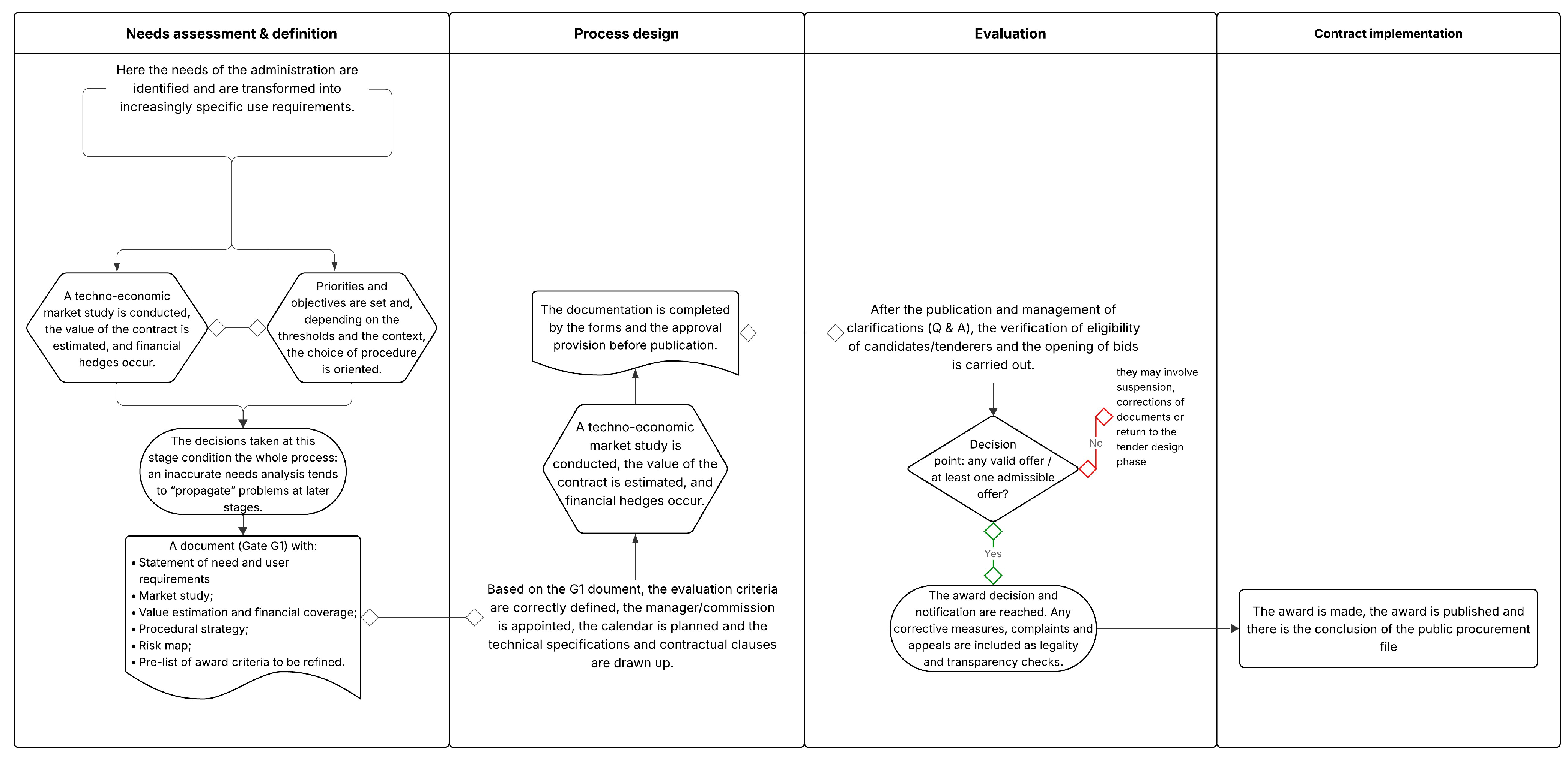
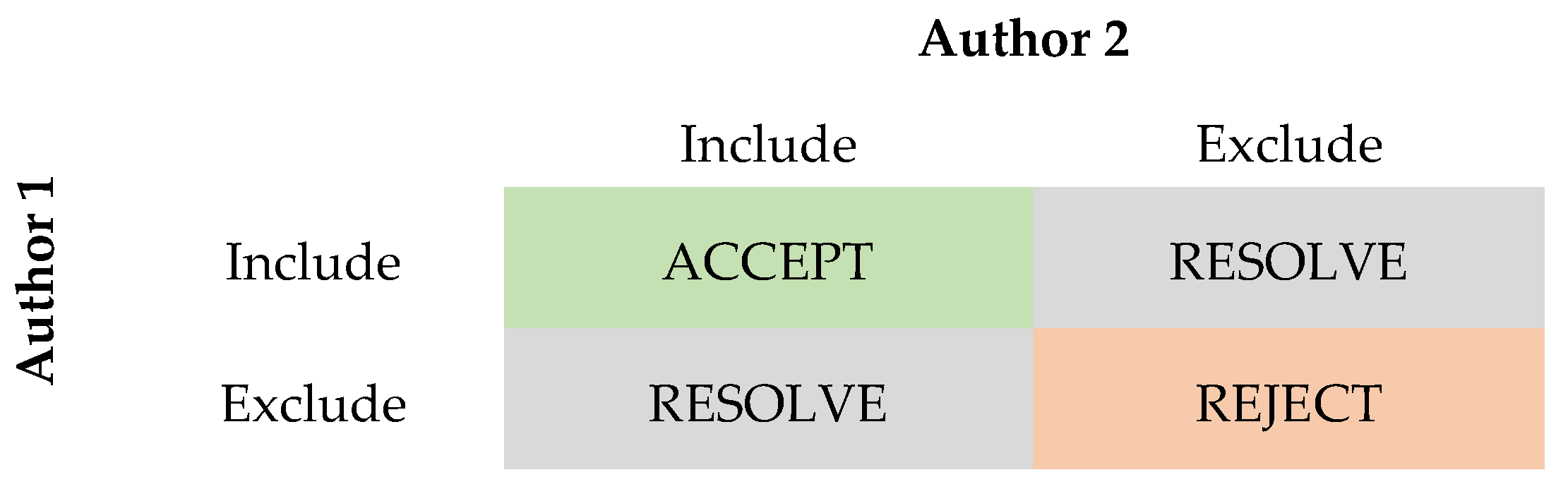
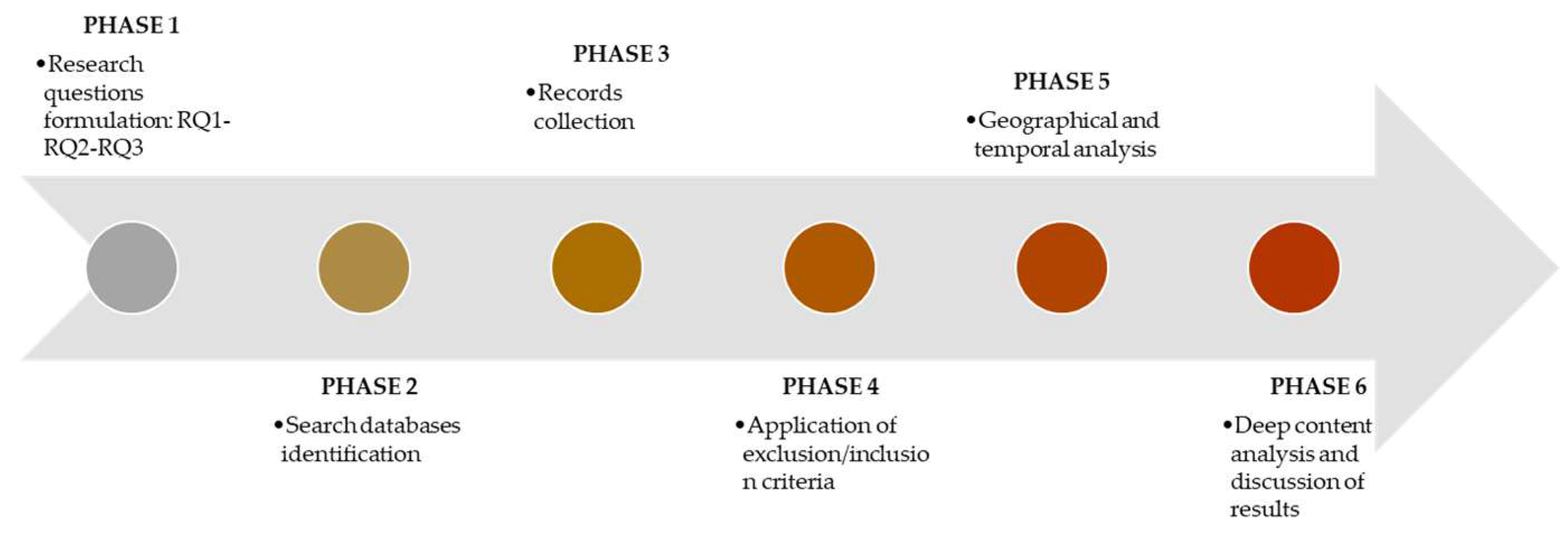
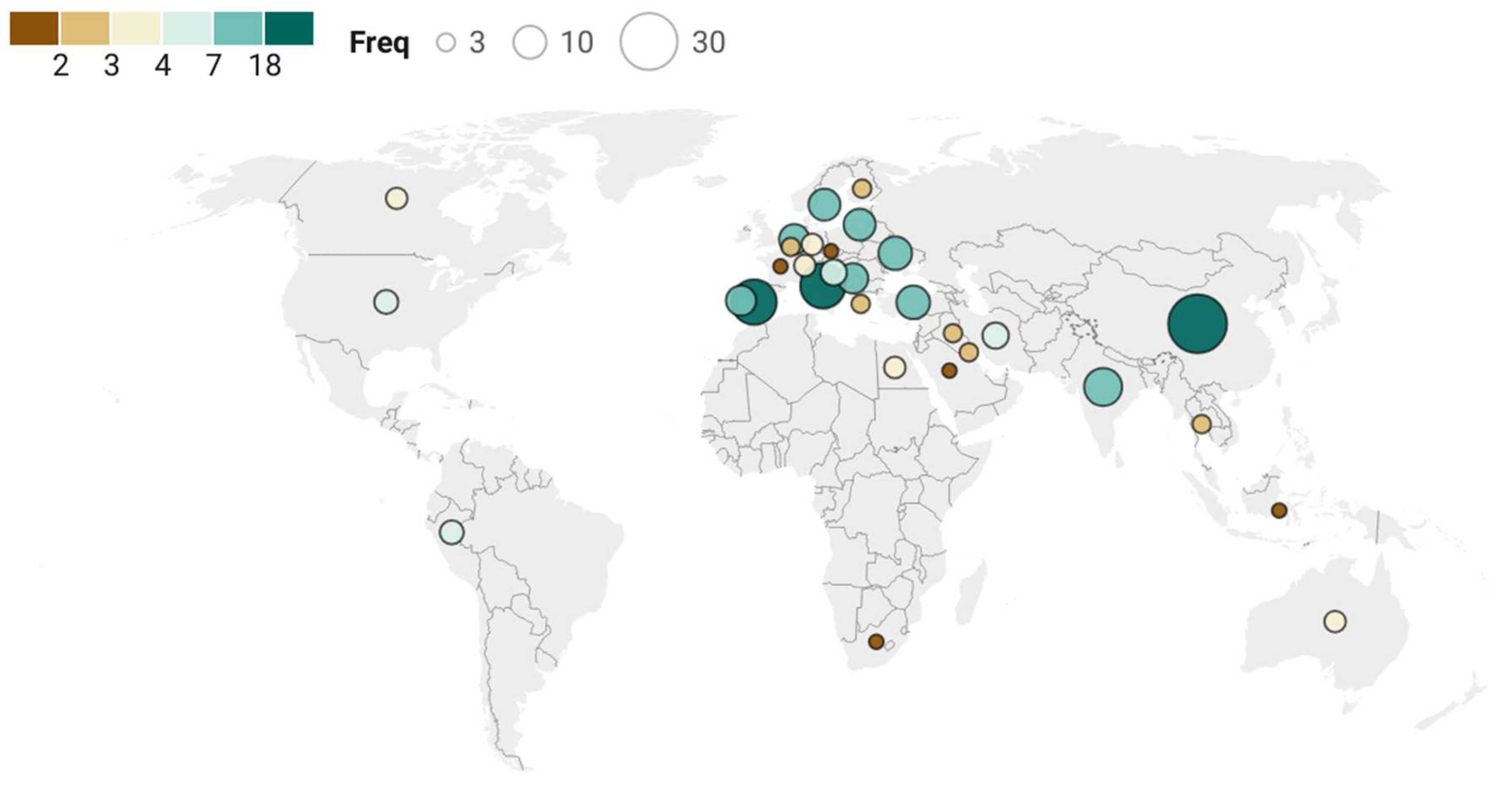
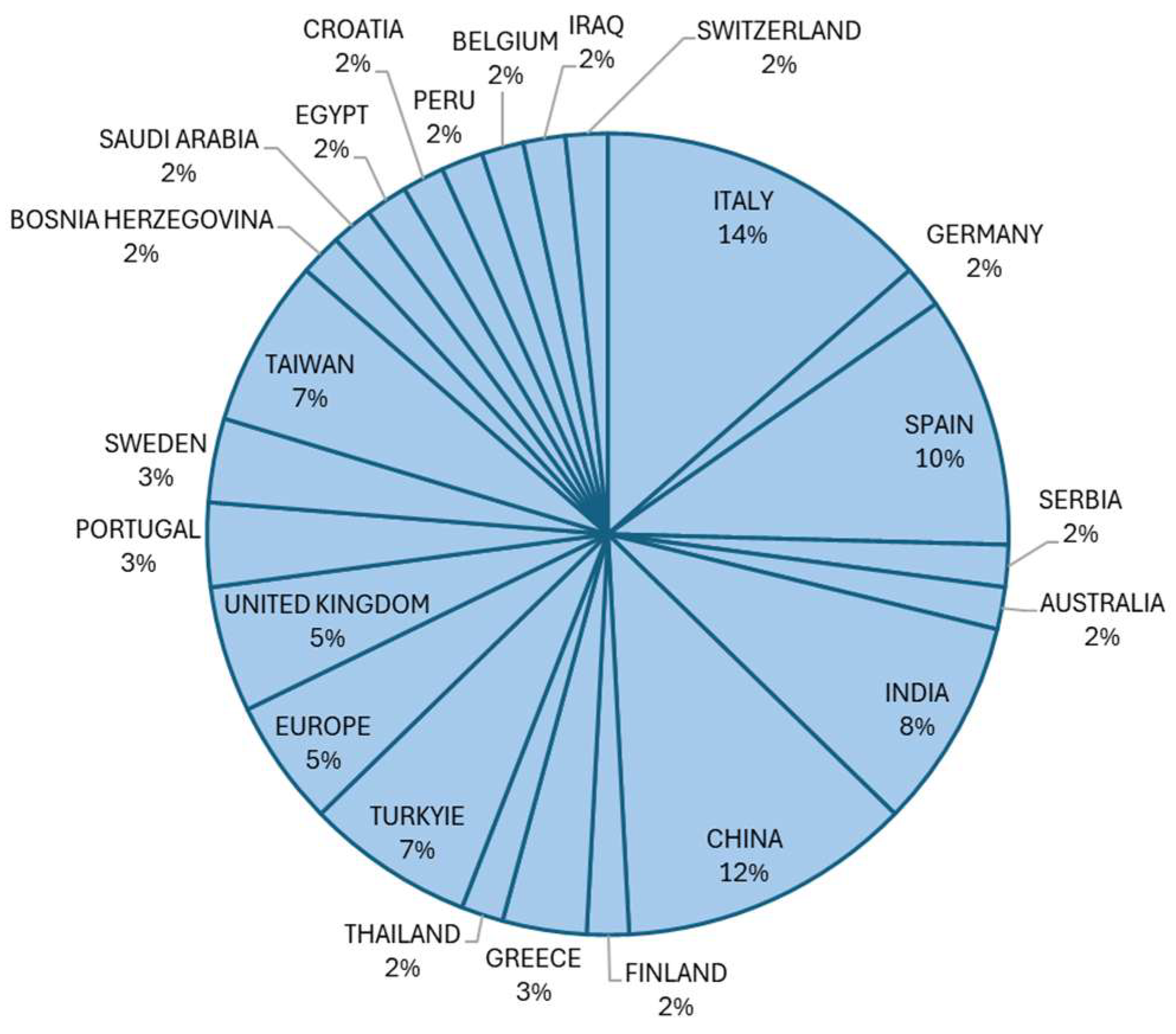
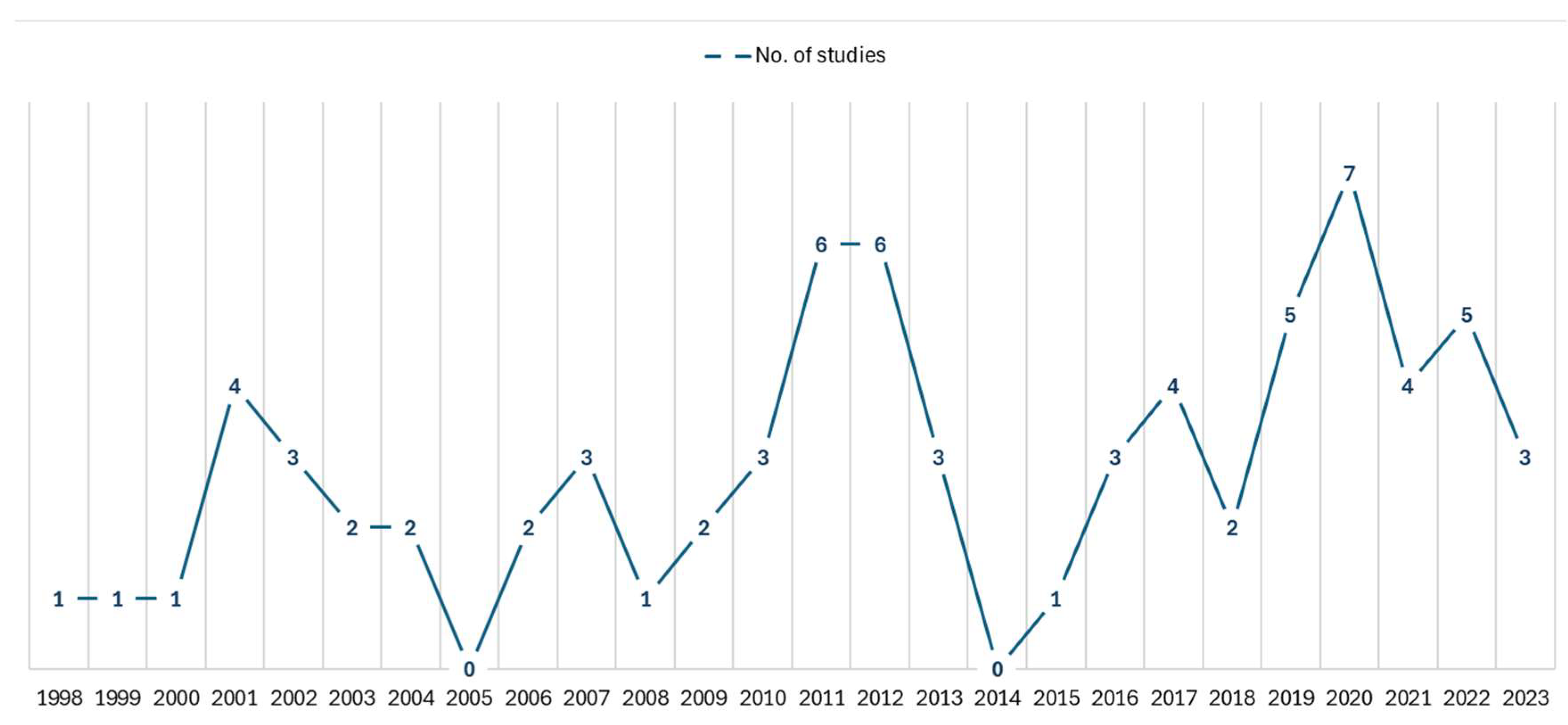
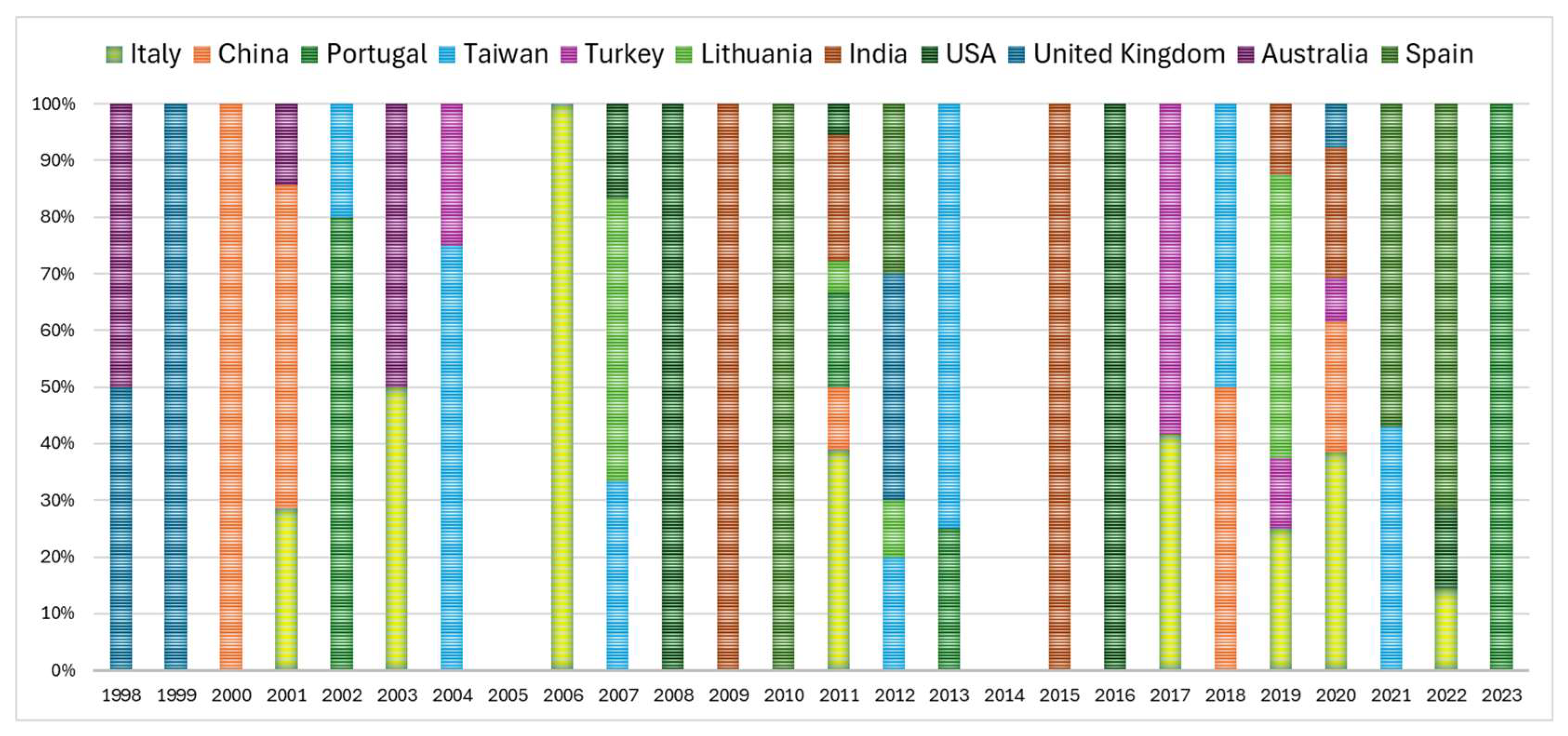
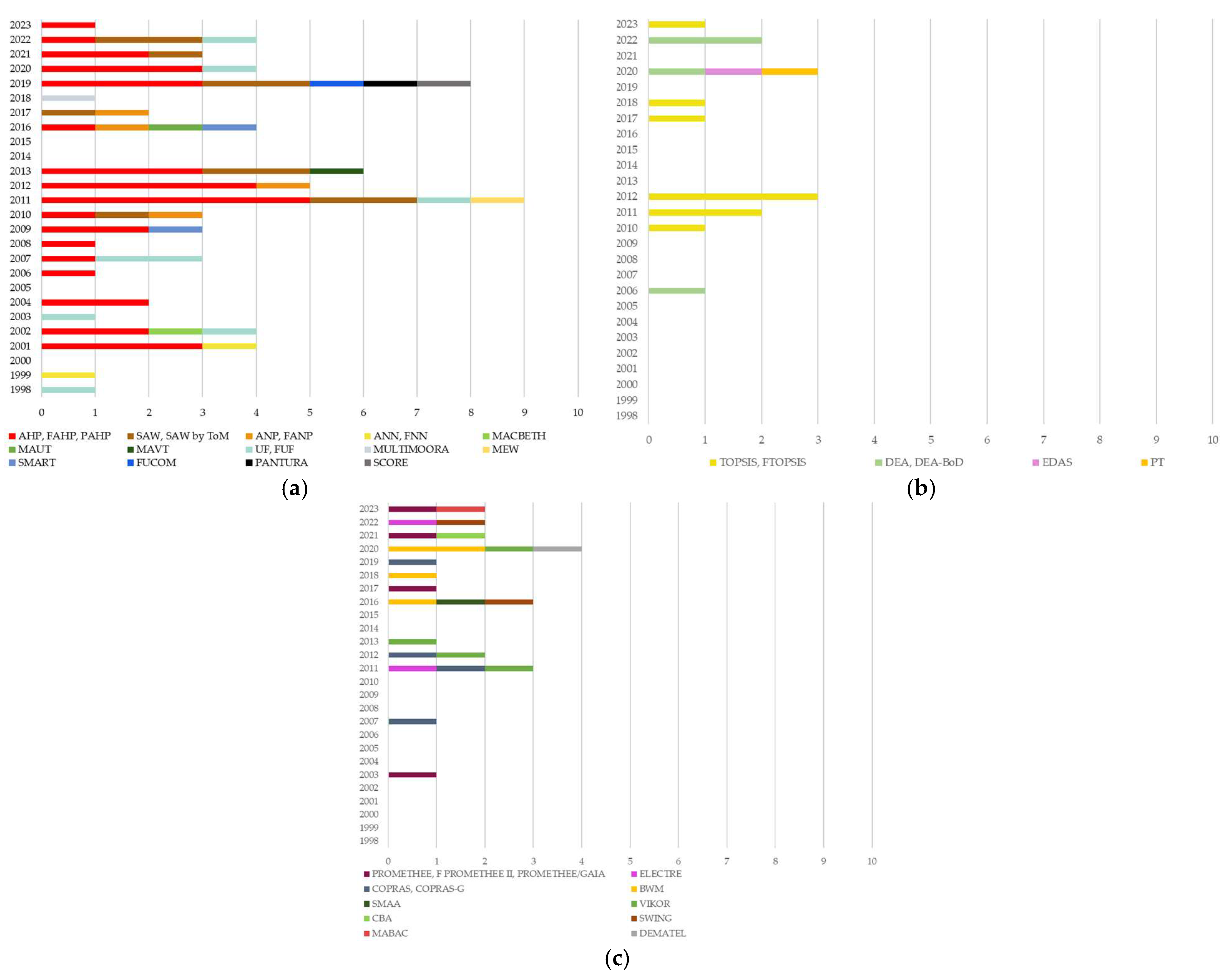

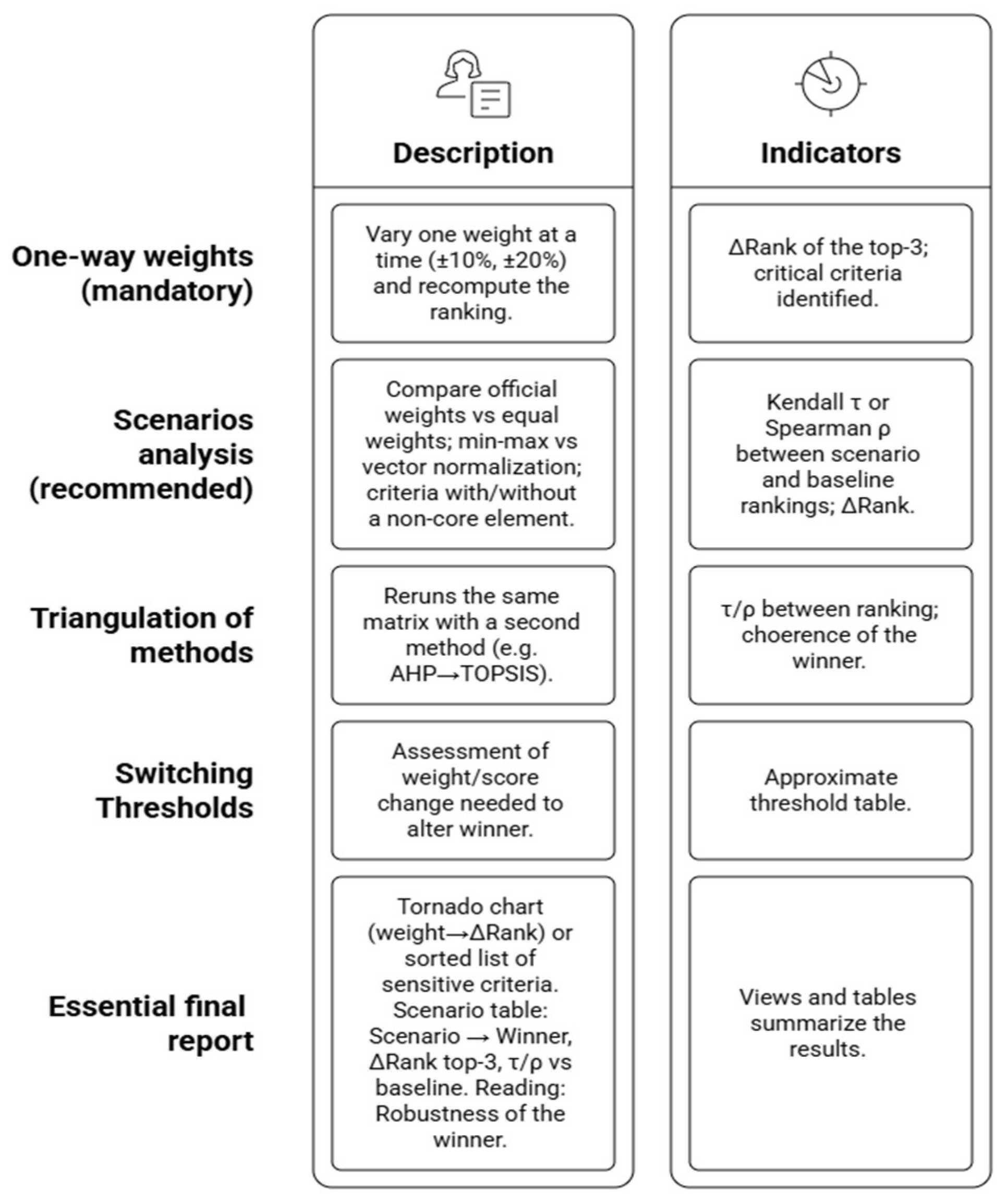
Disclaimer/Publisher’s Note: The statements, opinions and data contained in all publications are solely those of the individual author(s) and contributor(s) and not of MDPI and/or the editor(s). MDPI and/or the editor(s) disclaim responsibility for any injury to people or property resulting from any ideas, methods, instructions or products referred to in the content. |
© 2025 by the authors. Licensee MDPI, Basel, Switzerland. This article is an open access article distributed under the terms and conditions of the Creative Commons Attribution (CC BY) license (https://creativecommons.org/licenses/by/4.0/).