


Abstract
This study ground in the Innovation Diffusion Theory (IDT), explores the value of digital twin technology in cross-border logistics risk management. Using structural equation modeling, it examines how five innovation characteristics of digital twins—relative advantage, compatibility, complexity, trialability, and observability—influence risk management capabilities, specifically robustness and resilience, within cross-border logistics systems. The findings reveal that relative advantage, compatibility, trialability, and observability significantly enhance both robustness and resilience, while complexity does not show a significant negative impact. Furthermore, the study confirms that improvements in risk management capabilities contribute positively to competitive performance. This research not only enriches the theoretical understanding of digital twin applications in cross-border logistics but also offers valuable insights for practical implementation by enterprises.
1. Introduction
In the context of economic globalization, cross-border logistics has become a crucial bridge for facilitating international trade, and its risk management is gaining increasing attention [1]. It faces numerous challenges arising from complex geographical, political, economic, and cultural differences, as well as uncertainties such as natural disasters, policy changes, and market volatility [2]. Effectively managing these risks and ensuring the smooth and efficient operation of logistics chains is essential not only for enhancing firms’ international competitiveness but also for maintaining the stability of global supply chains [3]. Digital twins have been increasingly recognized as a promising technological tool for improving risk management in cross-border logistics [4].
Digital twins are digital replicas of physical entities that simulate, analyze, and optimize the performance of real-world systems [5]. They leverage physical models, sensor updates, and operational histories, integrating multidisciplinary, multiphysics, multiscale, and probabilistic simulations to map and represent the full lifecycle of physical assets in a virtual environment [6,7]. A defining feature of digital twins is their ability to dynamically replicate the behavior of physical objects [8].
Digital twins are widely applied across various fields such as manufacturing, smart cities, and healthcare, and are playing an increasingly important role in cross-border logistics [9]. In logistics, digital twins can create virtual representations of logistics systems, enabling real-time monitoring and analysis of key processes including transportation, warehousing, and distribution [10]. By simulating and predicting potential risks during logistics operations, firms can proactively design response strategies, thereby reducing the likelihood of disruptions [4,11]. digital twins also help optimize logistics workflows, improve efficiency, and reduce operational costs [6,12]. For example, in transport packaging design and management, digital twins can be used to predict the performance of new materials, simulate their resistance to temperature, humidity, vibration, and impact, and thus facilitate the development of lighter, more protective, and environmentally friendly packaging solutions [13]. In this study, the target firms met the criterion of having implemented digital twin technology in at least one phase of their cross-border logistics operations, such as transportation tracking, warehousing and inventory management, dynamic simulation, or intelligent forecasting.
In recent years, particularly after the global supply chain disruptions caused by COVID-19, researchers have increasingly focused on how to enhance the robustness and resilience of cross-border logistics risk management [1,14]). Studies have explored macro and micro-level factors, including the rise of cross-border e-commerce [15], firms’ innovation orientation [16], and the role of information sharing [17] and supply chain innovation [1] in fostering robustness. Although digital twins are being increasingly applied across various logistics stages [18], there is still a notable lack of empirical studies examining how the specific technological attributes of digital twins influence risk management capabilities within cross-border logistics systems. This study addresses this research gap by investigating how key innovation attributes of digital twins relate to two critical dimensions of logistics risk management capability (i.e., robustness and resilience), and how these capabilities contribute to improving firms’ competitive performance.
The Innovation Diffusion Theory (IDT) [19] offers a valuable lens for this inquiry. IDT posits that the adoption of innovations depends on specific attributes, namely relative advantage, complexity, trialability, compatibility, and observability [19]. These characteristics determine the rate of adoption, its diffusion within social systems, and ultimately the innovation’s social and economic impact [20]. By applying IDT to conceptualize digital twins, this study seeks to explore in greater depth how the attributes of digital twins influence logistics risk management, with a particular focus on robustness and resilience.
One of the core contributions of this study lies in its examination of the connection between digital twins and cross-border logistics risk management, addressing a clear gap in the existing literature. Previous studies on logistics risk management have primarily focused on perspectives such as innovation orientation and information sharing [1,15,16,17], while the role of advanced digital technologies has been relatively overlooked. This study systematically analyzes how the technical attributes of digital twins influence risk management, revealing their role in enhancing logistics robustness and resilience, and examining whether these improvements lead to greater competitive performance. Another important contribution is the use of IDT to conceptualize digital twins. IDT provides a theoretical framework to understand how new technologies are adopted in social systems. Applying this theory to digital twins in the context of cross-border logistics offers deeper insights into their diffusion process, influencing factors, and potential barriers to adoption.
2. Literature Review and Hypotheses Development
2.1. Innovation Diffusion Theory (IDT)
IDT is a classic sociological theory that explains how innovations—such as new ideas, products, or technologies—spread among members of a social system [19]. The theory posits that innovations do not diffuse randomly; rather, they are gradually accepted and adopted through a structured process, eventually becoming integrated into the social fabric [21]. At its core, IDT seeks to understand the various factors that influence the rate and extent of innovation diffusion, including innovation attributes, communication channels, characteristics of the social system, and the traits of individual adopters [20,22]. Together, these elements determine the pathway and impact of innovation diffusion within a society [23].
Rogers et al. [19] identifies five key attributes that affect the diffusion of innovations: relative advantage, compatibility, complexity, trialability, and observability [24]. Relative advantage refers to the degree to which an innovation is perceived as better than existing solutions. Compatibility denotes the extent to which the innovation aligns with potential adopters’ existing values, experiences, and needs. Complexity reflects how easy or difficult the innovation is to understand and use. Trialability refers to the possibility for potential users to experiment with the innovation before making a commitment. Observability pertains to how visible the outcomes of the innovation are to others [19,21]. These attributes jointly shape individuals’ willingness and speed to adopt an innovation, thus influencing its overall diffusion [23,25].
This study uses the five innovation attributes identified in IDT to conceptualize the characteristics of digital twin technology.
First, digital twins technology offers clear relative advantages over traditional methods. It enables highly accurate digital representations of physical entities and supports real-time data analytics for predictive and optimization purposes [9]. These capabilities deliver multiple benefits across logistics, including improved efficiency, cost reduction, and more informed decision-making [26].
Digital twins technology also demonstrates high compatibility, as it can be integrated with existing technical infrastructures, business processes, and workforce skills. With the advancement of the Internet of Things (IoT), big data, and artificial intelligence (AI), digital twins have evolved to seamlessly incorporate these technologies [27]. Moreover, digital twins solutions can be customized to meet the specific needs of different industries and enterprises [28].
Despite its advantages, digital twins technology also exhibits a degree of complexity. Building and maintaining digital twins requires knowledge from multiple technical domains, including data collection, processing, modeling, and analytics. Additionally, digital twins must interact with physical entities in real time, which further adds to the system’s complexity [29].
Trialability is another critical factor that influences the adoption of digital twins. Technology providers often offer trial versions or case studies that allow enterprises to experience digital twins functionalities firsthand. This exposure helps reduce uncertainty and build confidence among potential adopters, thereby encouraging adoption [30].
Lastly, the observability of digital twins technology is evident in its ability to produce visible and measurable outcomes. Through advanced visualization, organizations can monitor and analyze the status and performance of physical systems in real time, enabling more informed decision-making [31]. These tangible outcomes foster trust in digital twins and facilitate their wider diffusion.
2.2. Cross-Border Logistics Systems Risk Management Capability
As a vital link in global economic integration, cross-border logistics plays a key role in ensuring logistics efficiency, cost control, and supply chain security. Its risk management capability is thus of critical importance [2]. In the literature, robustness and resilience are widely recognized as the core components of logistics risk management capability [1].
Robustness refers to the ability of a logistics system to maintain stable operations in the face of both routine and unexpected risks [32]. It ensures the continuous and reliable flow of goods, even under challenging conditions. Achieving robustness depends on comprehensive risk management mechanisms, efficient information systems, and flexible logistics strategies [33].
Resilience, on the other hand, emphasizes the capacity of a logistics system to recover from major disruptions such as natural disasters, political unrest, or pandemics [34]. Enhancing resilience requires rapid response mechanisms, backup logistics channels, and strong supply chain collaboration [35].
In practice, robustness and resilience are mutually reinforcing in cross-border logistics risk management. Robustness provides a stable foundation that helps logistics systems withstand risks, while resilience enhances their ability to adapt and recover from disruptions, enabling systems to resume operations swiftly and effectively [1,33].
2.3. Digital Twins and Cross-Border Logistics Risk Management Capability
This study proposes that robustness and resilience—two core dimensions of cross-border logistics risk management capability—are closely linked to the five innovation attributes of digital twins.
2.3.1. Relative Advantage and Cross-Border Logistics Risk Management Capability
We draw on the IDT to suggest that the perceived relative advantage of digital twins may play a key role in enhancing risk management capabilities in cross-border logistics systems. Relative advantage refers to the extent to which an innovation is perceived as offering superior benefits compared to existing solutions. When firms perceive digital twins as offering clear benefits such as enhanced visibility, predictive analytics, and real-time optimization, they are more likely to leverage these technologies to improve operational stability and responsiveness. Prior research suggests that digital twins can simulate and analyze logistics processes, helping firms anticipate potential disruptions and adjust their operations accordingly [26]. For example, by forecasting congestion along transportation routes, firms may proactively reroute shipments to avoid delays, thus strengthening the robustness of logistics operations [36,37]. Moreover, digital twins allow logistics systems to respond swiftly to unforeseen events such as geopolitical shocks or supply chain interruptions, thereby enhancing resilience [6]. However, the extent to which the perceived benefits of digital twins translate into enhanced robustness and resilience remains underexplored, particularly in the cross-border logistics context. Based on this reasoning, we propose the following hypotheses:
Hypothesis 1 (H1).
The relative advantage of digital twins is significantly positively related to the robustness of cross-border logistics.
Hypothesis 2 (H2).
The relative advantage of digital twins is significantly positively related to the resilience of cross-border logistics.
2.3.2. Compatibility and Cross-Border Logistics Risk Management Capability
According to the Innovation Diffusion Theory (IDT), compatibility refers to the extent to which an innovation is consistent with an organization’s existing values, practices, and infrastructure. In the context of cross-border logistics, digital twins perceived as highly compatible are more likely to be smoothly integrated into existing logistics systems and operational workflows. This integration may help reduce risks associated with technological disruption or organizational misalignment [27]. A high degree of compatibility can contribute to the development of cohesive and responsive logistics operations by improving system efficiency and supporting operational continuity during external disturbances [4]. In addition, compatibility enables digital twins to work in conjunction with other technologies such as the Internet of Things and big data analytics, creating more intelligent and adaptable logistics systems [27]. These systems may respond more effectively to unexpected disruptions by reallocating resources and maintaining service performance in uncertain environments, which are essential attributes of resilience [38]. Although prior studies have recognized the value of technological alignment, there is still a lack of empirical research on how compatibility specifically influences risk management capabilities in cross-border logistics settings. To address this gap, we propose the following hypotheses:
Hypothesis 3 (H3).
The compatibility of digital twins is significantly positively related to the robustness of cross-border logistics.
Hypothesis 4 (H4).
The compatibility of digital twins is significantly positively related to the resilience of cross-border logistics.
2.3.3. Complexity and Cross-Border Logistics Risk Management Capability
According to the IDT, perceived complexity refers to the degree to which a new technology is viewed as difficult to understand or implement. In the context of cross-border logistics, digital twins perceived as highly complex may pose challenges to system integration, increase maintenance burdens, and require substantial investments in technical expertise and staff training [29,39]. These demands may place strain on organizational resources, potentially undermining a firm’s ability to maintain stable logistics operations under stress, thereby affecting robustness. Moreover, complex systems may reduce the adaptability of logistics networks. In emergency situations, systems that require elaborate coordination or rely on highly specialized components may respond less quickly, limiting the organization’s ability to recover from disruptions [40]. While complexity can sometimes be associated with advanced functionality, its perceived burden may outweigh these benefits in certain contexts. Given these considerations, we explore the following hypotheses:
Hypothesis 5 (H5).
Higher complexity of digital twins is negatively related to the robustness of cross-border logistics.
Hypothesis 6 (H6).
Higher complexity of digital twins is negatively related to the resilience of cross-border logistics.
2.3.4. Trialability and Cross-Border Logistics Risk Management Capability
In the framework of IDT, trialability refers to the degree to which an innovation can be tested or experimented with on a limited basis before full-scale adoption. This attribute may play a particularly important role in the context of digital twin implementation within cross-border logistics. When firms have the opportunity to engage with digital twins through pilot projects or trial versions, they can evaluate the technology’s feasibility, operational fit, and potential risks in advance [7]. This preliminary exposure may reduce uncertainty in decision-making and enable organizations to better prepare for integration. Furthermore, trialability allows for iterative refinement during implementation, which may increase alignment with specific logistics scenarios and operational requirements [41,42]. This adaptability could potentially strengthen the system’s ability to maintain continuity during disturbances and to recover swiftly from unforeseen disruptions. Despite these theoretical implications, there is limited empirical research examining how the perceived trialability of digital twins influences firms’ logistics risk management capabilities. To investigate this relationship, we propose the following hypotheses:
Hypothesis 7 (H7).
The trialability of digital twins is significantly positively related to the robustness of cross-border logistics.
Hypothesis 8 (H8).
The trialability of digital twins is significantly positively related to the resilience of cross-border logistics.
2.3.5. Observability and Cross-Border Logistics Risk Management Capability
The observability of digital twins allows the effects of their adoption to be displayed in real time [43]. By monitoring and analyzing the status and performance of logistics systems and identifying and addressing potential issues in a timely manner, management confidence can be strengthened. This capability supports the stability and reliability of logistics operations, enhancing robustness in cross-border logistics [44]. In addition, by observing and analyzing data and trends within digital twin models, enterprises can proactively predict and respond to potential risks. For example, monitoring congestion on transportation routes and adjusting strategies in advance can improve logistics system resilience in the face of sudden events [45]. Furthermore, sharing successful cases and showcasing technological outcomes can improve the visibility and influence of digital twins within the industry, promoting broader diffusion and further technological upgrades. Such upgrades can further enhance the risk management capability of cross-border logistics systems.
Hypothesis 9 (H9).
The observability of digital twins is significantly positively related to the robustness of cross-border logistics.
Hypothesis 10 (H10).
The observability of digital twins is significantly positively related to the resilience of cross-border logistics.
2.4. Risk Management Capability and Competitive Performance
Cross-border logistics risk management capability, which includes robustness and resilience, is increasingly viewed as a strategic asset in navigating today’s volatile global environment. Robustness may help firms maintain operational continuity amid external shocks, while resilience allows for rapid recovery and adaptation to changing conditions. These capabilities have the potential to reduce the frequency and severity of logistics disruptions, which could translate into improved service reliability and greater customer satisfaction [18,46].
Moreover, effective risk management may enhance operational efficiency by enabling firms to better anticipate disruptions, optimize resource allocation, and adjust transportation and inventory strategies in real time [47]. Such improvements could lead to cost savings and ultimately support financial performance [48]. From a strategic perspective, robust and resilient logistics operations may also reflect a firm’s managerial capability and technological readiness, which could enhance its reputation and attractiveness to business partners and customers [49,50].
Despite these theoretical linkages, empirical evidence on the performance implications of logistics risk management capability remains limited, particularly in the cross-border context. To examine these potential relationships, we propose the following hypotheses:
Hypothesis 11 (H11).
The robustness of cross-border logistics is significantly positively related to competitive performance.
Hypothesis 12 (H12).
The resilience of cross-border logistics is significantly positively related to competitive performance.
In summary, the theoretical model of this study is shown in Figure 1. The model illustrates how five innovation attributes of digital twins (i.e., relative advantage, compatibility, complexity, trialability, and observability), influence two key dimensions of cross-border logistics risk management capability, namely robustness and resilience. In turn, both robustness and resilience are hypothesized to positively impact competitive performance.
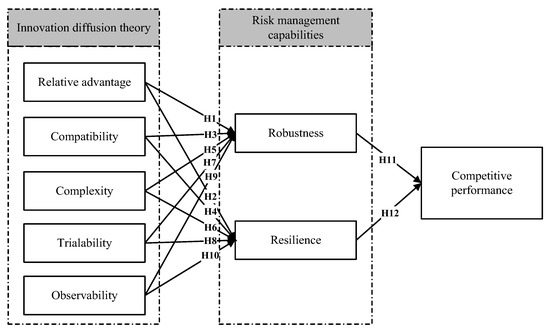
Figure 1.
Research Model.
3. Methodology
3.1. Sample
This study targets senior managers in cross-border logistics firms in mainland China. Demographic and firm-level information was also collected, including respondents’ job positions, years of experience, company age, company size, and total revenue. A summary of these characteristics is provided in Table 1 to offer a clearer overview of the sample profile. Notably, over 80% of the respondents reported having more than five years of work experience.

Table 1.
Respondent profile.
An anonymous cross-sectional survey was designed in collaboration with Credamo, a leading market research platform in China, to support data collection. Specifically, a random sampling strategy was adopted nationwide. The sampling criteria required that participating firms had implemented digital twin technology in at least one phase of their cross-border logistics operations. The most commonly modelled processes included transportation tracking, warehousing and inventory management, dynamic simulation, and intelligent forecasting. In many cases, third-party vendors provided modular digital twin solutions tailored to the specific needs of logistics operations.
To ensure data quality, several control measures were implemented, including an “anonymous commitment for scientific research only,” “predefined screening criteria,” and “statements assessing respondents’ familiarity with their company and confidence in their responses.” Such practices have been widely applied in supply chain management research [10,20]. Prior to the formal survey, a pilot test was conducted with 24 participants, and adjustments to the questionnaire were made based on their feedback. The original questionnaire was developed in English, and we employed a translation and back-translation procedure using a double-blind method to refine the instrument by comparing and resolving discrepancies.
To reduce common method bias, the survey was conducted in two stages. In the first stage, only perceptions related to the five innovation attributes (i.e., relative advantage, compatibility, complexity, trialability, and observability) were collected. In the second stage, data on cross-border logistics risk management capability and competitive performance were gathered. The data collection took place between November 2024 and March 2025, yielding a total of 255 responses. After removing low-quality responses, 206 valid responses were retained for the final analysis, representing an effective response rate of 80.78%. Following the recommendations of Brown [51], who suggests a minimum sample size of 100 to 200 for SEM and CFA, our sample meets this threshold, thereby supporting the reliability and validity of the analytical results.
3.2. Measurement
The questionnaire consists of three parts. The first part outlines the purpose, significance, and ethical standards of the research. The second part collects basic demographic and company information of the respondents. The third part contains items designed to assess respondents’ perceptions of various latent constructs. Multiple items were developed for each variable and measured using a seven-point Likert scale. All measurement items were adapted from established studies (see Table 2) and were revised based on practitioner feedback during the pilot test.
Table 2.
Survey Instrument.
Specifically, the five innovation attributes from the Innovation Diffusion Theory were measured using the approaches of Pang et al. [52] and Su et al. [23]. Robustness and resilience as components of risk management capability were measured based on the work of Kwak et al. [1] and Iftikhar et al. [53]. For competitive performance, items were adapted from Waheed and Zhang [54] and Mikalef et al. [55].
3.3. Bias Testing
We employed multiple methods to test for potential biases and ensure the robustness of our data and results. First, we conducted Harman’s one-factor test and found that the total variance explained by a single factor did not exceed 50% (29.202%), which meets the recommended threshold proposed by Podsakoff et al. [56]. In addition, we performed a t-test comparing early and late responses, and no significant differences were observed between the two groups. Furthermore, all variance inflation factor (VIF) values were below 10, indicating that multicollinearity is not a concern in our model. Lastly, we included a marker variable in the questionnaire—participants’ attitudes toward “smoking”—to test for common method bias. The results show that the marker variable is not significantly correlated with any of the main constructs, further suggesting that common method bias is not a serious issue in this study.
4. Results
4.1. Exploratory Factor Analysis
We evaluated the reliability and validity of the measurement constructs using SPSS 24. To examine construct validity, an exploratory factor analysis (EFA) was conducted. The Kaiser–Meyer–Olkin (KMO) value was 0.868, which is well above the acceptable threshold of 0.6 recommended by Kaiser [57], indicating sampling adequacy. Bartlett’s Test of Sphericity yielded statistically significant results (p < 0.001), confirming that the correlations among variables were appropriate for factor extraction. The total variance explained reached 75.68%, surpassing the 50% benchmark commonly used in the literature [58]. These findings indicate that the scales employed in this study exhibit satisfactory reliability and construct validity.
4.2. Confirmatory Factor Analysis
Confirmatory factor analysis (CFA) was conducted to assess the reliability and validity of the measurement model. As shown in Table 3, the model demonstrates a good fit, meeting the threshold values recommended by Hu and Bentler [59] (χ2/df = 1.757, p < 0.05, df = 499, CFI = 0.940; TLI = 0.932; IFI = 0.940; RMSEA = 0.061). In addition, all standardized factor loadings (λ) exceed 0.70, average variance extracted (AVE) values are above 0.50, and Cronbach’s alpha values are greater than 0.80. These results indicate that the measurement model has satisfactory reliability and validity, and is suitable for further analysis [58].
Table 3.
Confirmatory Factor Analysis.
As shown in Table 4, we assessed discriminant validity by comparing the square root of the average variance extracted (AVE) for each construct with the inter-construct correlation coefficients [58]. The results indicate that, for each construct, the AVE is greater than the squared correlations with other constructs. This suggests that each construct shares more variance with its own measurement items than with other constructs, thereby confirming adequate discriminant validity and supporting the suitability of the model for further analysis.
Table 4.
The Square of Correlations and Average Variance Extracted (AVE) Value of Each Construct.
4.3. Hypotheses Testing Results
The results of the hypothesis testing are visually presented to facilitate a straightforward interpretation of path significance. The structural equation model (SEM) shows a good model fit (χ2/df = 1.747, p < 0.05, df = 505; CFI = 0.940; TLI = 0.933; IFI = 0.940; RMSEA = 0.060). As shown in Figure 2, relative advantage is significantly positively associated with both robustness and resilience of cross-border logistics risk management capability (βRAD–RB = 0.196 **, βRAD–RL = 0.151 *), supporting H1 and H2. Compatibility also exhibits significant positive effects on both robustness and resilience (βCPA–RB = 0.308 ***, βCPA–RL = 0.197 **), supporting H3 and H4.
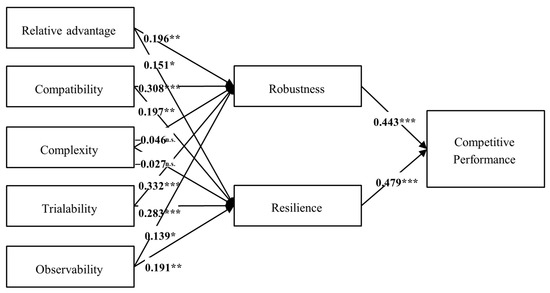
Figure 2.
Hypotheses test results. Note(s): Model fit indices: χ2/df = 1.747 (p < 0.05, df = 505); CFI = 0.940; TLI = 0.933; IFI = 0.94; RMSEA = 0.060, * p < 0.05, ** p < 0.01, *** p < 0.001, n.s. p > 0.05.
However, the complexity of digital twins does not show a significant relationship with either robustness or resilience, despite the negative signs of the standardized coefficients (βCOM–RB = −0.046 n.s., βCOM–RL = −0.027 n.s.). Thus, H5 and H6 are not supported. Regarding the trialability of digital twins, we find significant positive relationships with both robustness and resilience (βTRI–RB = 0.332 ***, βTRI–RL = 0.283 ***), supporting H7 and H8. Observability is also significantly positively related to both robustness and resilience of the cross-border logistics system (βOBI–RB = 0.139 *, βOBI–RL = 0.191 **), confirming H9 and H10. Finally, we find that both robustness and resilience significantly and positively influence competitive performance (βRB–CP = 0.443 ***, βRL–CP = 0.479 ***), supporting H11 and H12.
4.4. Effects Analysis
Table 5 presents the direct, indirect, and total effects of the exogenous variables on the endogenous variables. Based on the model’s hypothesized structure, the five innovation attributes of digital twins—relative advantage, compatibility, complexity, trialability, and observability—exert direct effects on the robustness and resilience of cross-border logistics risk management. In turn, both robustness and resilience have direct effects on firms’ competitive performance.
Table 5.
Direct, indirect, and total effects.
Regarding indirect effects, the results show that relative advantage (b13 = 0.159), compatibility (b23 = 0.231), complexity (b33 = −0.033), trialability (b43 = 0.283), and observability (b53 = 0.153) influence competitive performance indirectly through their impact on robustness and resilience. Among these, trialability has the largest indirect effect.
In terms of total effects, relative advantage (c13 = 0.159), compatibility (c23 = 0.231), complexity (c33 = −0.033), trialability (c43 = 0.283), observability (c53 = 0.153), robustness (c63 = 0.443), and resilience (c73 = 0.479) all exert influence on competitive performance. Among them, resilience demonstrates the strongest overall effect.
5. Discussion
5.1. Theoretical Contributions
First, prior research on enhancing the robustness and resilience of cross-border logistics risk management has primarily focused on perspectives such as innovation orientation, information sharing, and supply chain innovation. For example, Kwak et al. [1] examined how supply chain innovation affects risk management capability and competitive advantage, while Dovbischuk [16] studied the role of innovation-oriented dynamic capabilities in logistics service providers during the COVID-19 pandemic. However, these studies have largely overlooked the potential value of specific advanced digital technologies, such as digital twins, in cross-border logistics risk management. By systematically analyzing the technological attributes of digital twins and their impact on logistics risk management, this study reveals the unique role of digital twins in enhancing robustness and resilience, thereby addressing a notable gap in the literature.
Second, this study applies IDT as a theoretical framework to explore the relationship between digital twins and cross-border logistics risk management capability, offering a new theoretical perspective for understanding the application of digital twins in this domain. Through the lens of IDT’s five core dimensions—relative advantage, compatibility, complexity, trialability, and observability—this study empirically validates the characteristics of digital twins. The results show that relative advantage, compatibility, trialability, and observability significantly enhance robustness and resilience.
Interestingly, complexity does not show a significant negative effect on risk management capability. This unexpected finding may be related to the current level of acceptance, implementation capacity, and technological maturity of digital twins in cross-border logistics enterprises. From a theoretical perspective, complexity may have both positive and negative influences. While high complexity can discourage adoption, it may also indicate advanced functionalities that appeal to innovation-driven firms. These conflicting effects might offset each other, resulting in an insignificant overall impact. In practice, as digital twin solutions become more standardized and better supported by vendors, firms may no longer view them as overly difficult to adopt, which weakens the anticipated negative influence of complexity.
Finally, the study not only confirms the positive impact of digital twins on cross-border logistics risk management capability but also demonstrates that both robustness and resilience contribute significantly to competitive performance. By adopting the IDT framework, the study provides deeper insights into the diffusion process, influencing factors, and potential challenges of applying digital twins in cross-border logistics. The findings suggest that by using digital twins to enhance risk management capabilities, firms can more effectively respond to external uncertainties, optimize resource allocation, and improve operational efficiency—ultimately strengthening their market competitiveness. These results provide both empirical support and theoretical guidance for firms seeking to leverage digital twin technology for competitive advantage.
5.2. Practical Contributions
This study provides actionable insights for cross-border logistics enterprises by examining the application of digital twin technology in risk management. The findings indicate that the relative advantage, compatibility, trialability, and observability of digital twins significantly enhance the robustness and resilience of logistics systems. Specifically, firms can use digital twins to monitor logistics processes in real time and predict potential risks. For example, by simulating congestion along transportation routes, firms can proactively adjust plans to reduce delays and losses [60]. Additionally, the compatibility of digital twins enables seamless integration into existing logistics systems, reducing implementation difficulties and costs. Practical evidence shows that cross-border logistics firms using digital twins can recover from disruptions more quickly and improve overall operational efficiency.
The study also provides specific recommendations for enhancing risk management capability and competitive performance. First, firms should prioritize the adoption and application of digital twins to improve the accuracy and effectiveness of logistics decision-making. Second, they should strengthen integration with other advanced technologies such as the Internet of Things and big data to create smarter and more flexible logistics solutions that can adapt to complex and dynamic market conditions. Moreover, the importance of trialability and observability suggests that firms should provide trial versions or case demonstrations to build trust and increase user acceptance of digital twin technology. The observed impact of robustness and resilience on competitive performance implies that firms adopting these strategies can significantly improve their risk management capabilities and strengthen their competitiveness in the market.
6. Conclusions
This study applies the Innovation Diffusion Theory to examine the application of digital twin technology in cross-border logistics risk management. First, digital twins, through their relative advantage and compatibility, significantly enhance the robustness and resilience of logistics systems, enabling firms to better predict and respond to potential risks, optimize processes, and reduce operational costs. Second, the trialability and observability of digital twins also contribute positively to their adoption and to the improvement of logistics risk management. However, the complexity of digital twins does not show a significant negative impact on robustness or resilience.
Finally, the study confirms that enhanced robustness and resilience in risk management significantly improve firms’ competitive performance, offering a new source of competitive advantage. While this research yields important insights into the relationship between digital twins and cross-border logistics risk management capability, several limitations should be acknowledged.
First, the sample is drawn mainly from firms operating in mainland China, which may limit the generalizability of the findings. Differences in logistics environments, policy frameworks, and technological readiness across countries may affect the adoption and effectiveness of digital twins. Second, this study uses cross-sectional data, which does not capture the dynamic effects of technology adoption over time. Future research could incorporate longitudinal data or apply coupled coordination analysis methods to better understand the long-term effects of digital twin implementation. Coupled coordination analysis is a quantitative method used to assess the dynamic interactions and alignment between two or more systems over time, which can help evaluate the long-term coordination between digital twin adoption and logistics performance [61].
Finally, this study focuses on five innovation attributes of digital twins, but other contextual factors—such as industry characteristics or organizational technology acceptance—may also play important roles and warrant further exploration in future studies.
Author Contributions
S.L.: Conceptualization, Methodology, Funding acquisition, Writing—original draft, Writing—review and editing. P.J.: Conceptualization, Software, Formal analysis, Data curation, Resources. S.S.: Methodology, Writing—original draft, Writing—review and editing. J.Y.: Writing—original draft, Writing—review and editing, Validation. Q.P.: Conceptualization, Methodology, Resources, Investigation, Writing—review and editing. All authors have read and agreed to the published version of the manuscript.
Funding
This paper is a phased achievement of the National Social Science Fund (21BGJ034).
Institutional Review Board Statement
Ethical review and approval were waived for this study. This research was conducted in accordance with general ethical guidelines in psychology.
Data Availability Statement
The data that support the findings of this study are available from the corresponding author upon reasonable request.
Conflicts of Interest
The authors declare no conflict of interest.
References
- Kwak, D.W.; Seo, Y.J.; Mason, R. Investigating the relationship between supply chain innovation, risk management capabilities and competitive advantage in global supply chains. Int. J. Oper. Prod. Manag. 2018, 38, 2–21. [Google Scholar] [CrossRef]
- Giuffrida, M.; Jiang, H.; Mangiaracina, R. Investigating the relationships between uncertainty types and risk management strategies in cross-border e-commerce logistics. Int. J. Logist. Manag. 2021, 32, 1406–1433. [Google Scholar] [CrossRef]
- Ma, S.; Chai, Y.; Jia, F. Mitigating transaction risk for cross-border e-commerce firms: A multiagent-based simulation study. Int. Bus. Rev. 2022, 31, 101965. [Google Scholar] [CrossRef]
- Bhandal, R.; Meriton, R.; Kavanagh, R.E.; Brown, A. The application of digital twin technology in operations and supply chain management: A bibliometric review. Supply Chain Manag. Int. J. 2022, 27, 182–206. [Google Scholar] [CrossRef]
- Guo, D.; Mantravadi, S. The role of digital twins in lean supply chain management: Review and research directions. Int. J. Prod. Res. 2025, 63, 1851–1872. [Google Scholar] [CrossRef]
- Kamble, S.S.; Gunasekaran, A.; Parekh, H.; Mani, V.; Belhadi, A.; Sharma, R. Digital twin for sustainable manufacturing supply chains: Current trends, future perspectives, and an implementation framework. Technol. Forecast. Soc. Change 2022, 176, 121448. [Google Scholar] [CrossRef]
- Liu, W.; Zou, X.; Wen, Z.; Cheng, J.; Zuo, Y.; Zhang, C.; Liu, H.; Tao, F. Digital Twin-Based Production-Logistics Synchronization System for Satellite Mass Assembly Shop-Floor. Chin. J. Mech. Eng. 2024, 37, 163. [Google Scholar] [CrossRef]
- Ivanov, D. Intelligent digital twin (iDT) for supply chain stress-testing, resilience, and viability. Int. J. Prod. Econ. 2023, 263, 108938. [Google Scholar] [CrossRef]
- Maheshwari, P.; Kamble, S.; Belhadi, A.; Venkatesh, M.; Abedin, M.Z. Digital twin-driven real-time planning, monitoring, and controlling in food supply chains. Technol. Forecast. Soc. Change 2023, 195, 122799. [Google Scholar] [CrossRef]
- Pang, Q.; Wang, M.; Yao, J.; Fang, M. Employees’ perceived respect and performance in Logistics 4.0: A dyadic perspective of the congruence between employee voice and supervisor listening. Int. J. Phys. Distrib. Logist. Manag. 2025. [Google Scholar] [CrossRef]
- Wang, H.; Chen, Z.S.; Fang, M.; Wang, Y.; Liu, F. Panoramic sales insight: Using multimodal fusion to improve the effectiveness of flash sales. Decis. Support Syst. 2025, 190, 114401. [Google Scholar] [CrossRef]
- Liu, F.; Fang, M.; Xiao, S.; Shi, Y. Mitigating bullwhip effect in supply chains by engaging in digital transformation: The moderating role of customer concentration. Ann. Oper. Res. 2025, 344, 825–846. [Google Scholar] [CrossRef]
- Leng, J.; Yan, D.; Liu, Q.; Zhang, H.; Zhao, G.; Wei, L.; Zhang, D.; Yu, A.; Chen, X. Digital twin-driven joint optimisation of packing and storage assignment in large-scale automated high-rise warehouse product-service system. Int. J. Comput. Integr. Manuf. 2021, 34, 783–800. [Google Scholar] [CrossRef]
- Kim, W.; Fang, M.; Pang, Q.; Su, M. SME innovation, supply chain strategy fit and business performance: The moderating role of environmental uncertainty. Technol. Anal. Strateg. Manag. 2024, 36, 3772–3785. [Google Scholar] [CrossRef]
- Wu, H.; Qiao, Y.; Luo, C. Cross-border e-commerce, trade digitisation and enterprise export resilience. Financ. Res. Lett. 2024, 65, 105513. [Google Scholar] [CrossRef]
- Dovbischuk, I. Innovation-oriented dynamic capabilities of logistics service providers, dynamic resilience and firm performance during the COVID-19 pandemic. Int. J. Logist. Manag. 2022, 33, 499–519. [Google Scholar] [CrossRef]
- Brandon-Jones, E.; Squire, B.; Autry, C.W.; Petersen, K.J. A contingent resource-based perspective of supply chain resilience and robustness. J. Supply Chain. Manag. 2014, 50, 55–73. [Google Scholar] [CrossRef]
- Bandaranayake, N.; Kiridena, S.; Kulatunga, A.K.; Dam, H. Analysing cross-border logistics operations for performance improvement: Development and validation of a reference model. Oper. Manag. Res. 2024, 17, 1531–1552. [Google Scholar] [CrossRef]
- Rogers, E.M.; Singhal, A.; Quinlan, M.M. Diffusion of Innovations. In An Integrated Approach to Communication Theory and Research; Routledge: Oxfordshire, UK, 2014; pp. 432–448. [Google Scholar]
- Yao, J.; Pang, Q.; Fang, M.; Qiao, G. Dualistic perspectives of digital marketing strategies and sustainable performance of cultural heritage tourist sites: Based on qualitative and quantitative mixed methods. J. Sustain. Tour. 2025, 1–26. [Google Scholar] [CrossRef]
- Attié, E.; Meyer-Waarden, L. The acceptance and usage of smart connected objects according to adoption stages: An enhanced technology acceptance model integrating the diffusion of innovation, uses and gratification and privacy calculus theories. Technol. Forecast. Soc. Change 2022, 176, 121485. [Google Scholar] [CrossRef]
- Chen, J.V.; Yen, D.C.; Chen, K. The acceptance and diffusion of the innovative smart phone use: A case study of a delivery service company in logistics. Inf. Manag. 2009, 46, 241–248. [Google Scholar] [CrossRef]
- Su, M.; Fang, M.; Kim, J.; Park, K.S. Sustainable marketing innovation and consumption: Evidence from cold chain food online retail. J. Clean. Prod. 2022, 340, 130806. [Google Scholar] [CrossRef]
- Hazen, B.T.; Hanna, J.B.; Hall, D.J. Incorporating logistics enterprise architecture: A diffusion of innovation perspective. Int. J. Logist. Res. Appl. 2014, 17, 179–199. [Google Scholar] [CrossRef]
- Yuen, K.F.; Cai, L.; Qi, G.; Wang, X. Factors influencing autonomous vehicle adoption: An application of the technology acceptance model and innovation diffusion theory. Technol. Anal. Strateg. Manag. 2021, 33, 505–519. [Google Scholar] [CrossRef]
- Wu, W.; Shen, L.; Zhao, Z.; Harish, A.R.; Zhong, R.Y.; Huang, G.Q. Internet of everything and digital twin enabled service platform for cold chain logistics. J. Ind. Inf. Integr. 2023, 33, 100443. [Google Scholar] [CrossRef]
- Belfadel, A.; Hörl, S.; Tapia, R.J.; Politaki, D.; Kureshi, I.; Tavasszy, L.; Puchinger, J. A conceptual digital twin framework for city logistics. Comput. Environ. Urban Syst. 2023, 103, 101989. [Google Scholar] [CrossRef]
- Oehlschläger, D.; Glas, A.H.; Eßig, M. Acceptance of digital twins of customer demands for supply chain optimisation: An analysis of three hierarchical digital twin levels. Ind. Manag. Data Syst. 2024, 124, 1050–1075. [Google Scholar] [CrossRef]
- Caldarelli, G.; Arcaute, E.; Barthelemy, M.; Batty, M.; Gershenson, C.; Helbing, D.; Mancuso, S.; Moreno, Y.; Ramasco, J.J.; Rozenblat, C.; et al. The role of complexity for digital twins of cities. Nat. Comput. Sci. 2023, 3, 374–381. [Google Scholar] [CrossRef]
- Wu, W.; Zhao, Z.; Shen, L.; Kong, X.T.; Guo, D.; Zhong, R.Y.; Huang, G.Q. Just Trolley: Implementation of industrial IoT and digital twin-enabled spatial-temporal traceability and visibility for finished goods logistics. Adv. Eng. Inform. 2022, 52, 101571. [Google Scholar] [CrossRef]
- Zhang, L.; Wang, X.; Lin, H.; Piran, M.J. A crowdsourcing logistics solution based on digital twin and four-party evolutionary game. Eng. Appl. Artif. Intell. 2024, 130, 107797. [Google Scholar] [CrossRef]
- Ezaki, T.; Imura, N.; Nishinari, K. Towards understanding network topology and robustness of logistics systems. Commun. Transport. Res. 2022, 2, 100064. [Google Scholar] [CrossRef]
- Sun, H.; Li, J.; Wang, T.; Xue, Y. A novel scenario-based robust bi-objective optimization model for humanitarian logistics network under risk of disruptions. Transp. Res. Part E Logist. Transp. Rev. 2022, 157, 102578. [Google Scholar] [CrossRef]
- Gupta, H.; Yadav, A.K.; Kusi-Sarpong, S.; Khan, S.A.; Sharma, S.C. Strategies to overcome barriers to innovative digitalisation technologies for supply chain logistics resilience during pandemic. Technol. Soc. 2022, 69, 101970. [Google Scholar] [CrossRef]
- Song, M.; Ma, X.; Zhao, X.; Zhang, L. How to enhance supply chain resilience: A logistics approach. Int. J. Logist. Manag. 2022, 33, 1408–1436. [Google Scholar] [CrossRef]
- Pang, Q.; Lai, P.L.; Su, M.; Xing, J.; Fang, M. Talk is cheap; Show me the code: Managing the sustainable performance of shipping firms through big data analytics. Marit. Policy Manag. 2025, 1–16. [Google Scholar] [CrossRef]
- Fang, M.; Yu, Y.; Park, K.; Liu, F.; Xiao, S.S.; Shi, Y. Supply chain relationship dependencies and circular economy performance: The contingency role of digitalization capability. J. Purch. Supply Manag. 2024, 30, 100902. [Google Scholar] [CrossRef]
- Su, M.; Pang, Q.; Kim, W.; Yao, J.; Fang, M. Consumer participation in reusable resource allocation schemes: A theoretical conceptualization and empirical examination of Korean consumers. Resour. Conserv. Recycl. 2023, 189, 106747. [Google Scholar] [CrossRef]
- Pang, Q.; Liu, X.; Su, M. Leveraging Digital Intelligence Technologies for Green Shipping: Organization Information Processing and Contingency Perspective. Bus. Strategy Environ. 2025, 1–17. [Google Scholar] [CrossRef]
- Pan, Y.H.; Qu, T.; Wu, N.Q.; Khalgui, M.; Huang, G.Q. Digital twin based real-time production logistics synchronization system in a multi-level computing architecture. J. Manuf. Syst. 2021, 58, 246–260. [Google Scholar] [CrossRef]
- Sharma, A.; Kosasih, E.; Zhang, J.; Brintrup, A.; Calinescu, A. Digital Twins: State of the art theory and practice, challenges, and open research questions. J. Ind. Inf. Integr. 2022, 30, 100383. [Google Scholar] [CrossRef]
- Pang, Q.; Du, J.; Fang, M.; Wang, L. Strategic mechanism for enhanced sustainable practice performance in shipping organizations through big data analytics powered by artificial intelligence. J. Enterp. Inf. Manag. 2025. [Google Scholar] [CrossRef]
- Hu, S.; Li, Z. A digital twin approach for enforcing diagnosability in Petri nets. IEEE Trans. Autom. Sci. Eng. 2023, 21, 6068–6080. [Google Scholar] [CrossRef]
- Li, Y.; Liu, W.; Zhang, Y.; Zhang, W.; Gao, C.; Chen, Q.; Ji, Y. Interactive real-time monitoring and information traceability for complex aircraft assembly field based on digital twin. IEEE Trans. Ind. Inform. 2023, 19, 9745–9756. [Google Scholar] [CrossRef]
- Nag, D.; Brandel-Tanis, F.; Pramestri, Z.A.; Pitera, K.; Frøyen, Y.K. Exploring digital twins for transport planning: A review. Eur. Transp. Res. Rev. 2025, 17, 15. [Google Scholar] [CrossRef]
- Davis, D.F.; Friske, W. The role of public–private partnerships in facilitating cross-border logistics: A case study at the US/Canadian border. J. Bus. Logist. 2013, 34, 347–359. [Google Scholar] [CrossRef]
- Wankmüller, C.; Kunovjanek, M.; Mayrgündter, S. Drones in emergency response–evidence from cross-border, multi-disciplinary usability tests. Int. J. Disaster Risk Reduct. 2021, 65, 102567. [Google Scholar] [CrossRef]
- Panjehfouladgaran, H.; Lim, S.F.W. Reverse logistics risk management: Identification, clustering and risk mitigation strategies. Manag. Decis. 2020, 58, 1449–1474. [Google Scholar] [CrossRef]
- Tian, X.; Zhu, J.; Zhao, X.; Wu, J. Improving operational efficiency through blockchain: Evidence from a field experiment in cross-border trade. Prod. Plan. Control 2024, 35, 1009–1024. [Google Scholar] [CrossRef]
- Niu, B.; Chen, K.; Chen, L.; Ding, C.; Yue, X. Strategic waiting for disruption forecasts in cross-border E-commerce operations. Prod. Oper. Manag. 2021, 30, 2840–2857. [Google Scholar] [CrossRef]
- Brown, T.A. Confirmatory Factor Analysis for Applied Research; Guilford Publications: New York, NY, USA, 2015. [Google Scholar]
- Pang, Q.; Zhang, M.; Yuen, K.F.; Fang, M. When the winds of change blow: An empirical investigation of ChatGPT’s usage behaviour. Technol. Anal. Strateg. Manag. 2024, 1–15. [Google Scholar] [CrossRef]
- Iftikhar, A.; Ali, I.; Stevenson, M. The silver lining of supply chain complexity: Building supply chain resilience and robustness through exploitation and exploration. Supply Chain Manag. Int. J. 2024, 29, 244–259. [Google Scholar] [CrossRef]
- Waheed, A.; Zhang, Q. Effect of CSR and ethical practices on sustainable competitive performance: A case of emerging markets from stakeholder theory perspective. J. Bus. Ethics 2022, 175, 837–855. [Google Scholar] [CrossRef]
- Mikalef, P.; Pateli, A.; van de Wetering, R. IT architecture flexibility and IT governance decentralisation as drivers of IT-enabled dynamic capabilities and competitive performance: The moderating effect of the external environment. Eur. J. Inf. Syst. 2021, 30, 512–540. [Google Scholar] [CrossRef]
- Podsakoff, P.M.; MacKenzie, S.B.; Lee, J.Y.; Podsakoff, N.P. Common method biases in behavioral research: A critical review of the literature and recommended remedies. J. Appl. Psychol. 2003, 88, 879. [Google Scholar] [CrossRef] [PubMed]
- Kaiser, H.F. An index of factorial simplicity. Psychometrika 1974, 39, 31–36. [Google Scholar] [CrossRef]
- Hair, J.F.; Anderson, R.E.; Babin, B.J.; Black, W.C. Multivariate Data Analysis: A Global Perspective; Pearson Prentice Hall: Upper Saddle River, NJ, USA, 2010. [Google Scholar]
- Hu, L.T.; Bentler, P.M. Cutoff criteria for fit indexes in covariance structure analysis: Conventional criteria versus new alternatives. Struct. Equ. Model. Multidiscip. J. 1999, 6, 1–55. [Google Scholar] [CrossRef]
- Pang, Q.; Cai, L.; Wang, X.; Fang, M. Digital transformation as the fuel for sailing toward sustainable success: The roles of coordination mechanisms and social norms. J. Enterp. Inf. Manag. 2024, 37, 1069–1096. [Google Scholar] [CrossRef]
- Yao, J.; Wang, L.; Pang, Q.; Fang, M. Coupling coordination and spatial analyses of the MICE and tourism industries: Do they fit well? Curr. Issues Tour. 2024, 27, 2783–2796. [Google Scholar] [CrossRef]
Disclaimer/Publisher’s Note: The statements, opinions and data contained in all publications are solely those of the individual author(s) and contributor(s) and not of MDPI and/or the editor(s). MDPI and/or the editor(s) disclaim responsibility for any injury to people or property resulting from any ideas, methods, instructions or products referred to in the content. |
© 2025 by the authors. Licensee MDPI, Basel, Switzerland. This article is an open access article distributed under the terms and conditions of the Creative Commons Attribution (CC BY) license (https://creativecommons.org/licenses/by/4.0/).