1. Introduction
The food service industry has undergone significant transformation over the past decade due to shifting consumer preferences, technological advancements, and global disruptions such as the COVID-19 pandemic [
1]. The most notable innovation is the emergence of multi-brand kitchen restaurants—a model in which multiple food brands are operated within a shared kitchen infrastructure [
2].
In this paper, we use the term ‘multi-brand franchise system’ to refer to a multi-brand kitchen that operates under a franchising structure in which the franchisor develops, governs, and supports multiple brand concepts within a shared kitchen. This organizational form integrates the operational flexibility of cloud kitchens with the governance mechanisms of franchising—such as brand development, standardization, training, menu engineering, and marketing support—allowing a single restaurant unit to manage several brands simultaneously in a scalable and consistent manner.
In practice, multi-brand kitchen operations supported by franchising have been adopted by several well-known companies. Examples include Rebel Foods, Kitchen United, Taster, Nolboo, and DNY Hospitality, all of which operate multiple branded concepts within a shared kitchen infrastructure while relying on centralized brand development, operational standards, and marketing support. These firms illustrate how the multi-brand franchise system functions as an integrated organizational form that combines the flexibility of cloud kitchens with the governance advantages of franchising.
The shift from single-brand to multi-brand cloud kitchens can be seen as a strategic response to increasing market pressure and the risks of relying on a single brand. While single-brand cloud kitchen models provide operational advantages by eliminating physical dine-in spaces and lowering fixed costs [
1,
3], their reliance on the performance of a single brand makes them increasingly vulnerable in a competitive environment. In a contemporary environment increasingly dominated by third-party aggregators such as Uber Eats and DoorDash, the risks of operating under a single brand have grown more acute. These platforms control key aspects of customer access—visibility, digital placement, and delivery costs—leaving single-brand operators vulnerable to unfavorable fee structures, limited exposure, and high customer acquisition costs [
4,
5]. In response, firms like Rebel Foods (India), Kitchen United (USA), and Taster (Europe) have pioneered the multi-brand cloud kitchen model as a form of strategic adaptation [
6,
7,
8]. By offering multiple virtual restaurant brands from a single kitchen infrastructure, this model enhances customer value—allowing mixed-brand orders under one delivery fee—and boosts sustainable operational efficiency by sharing kitchen space, staff, and procurement systems [
4,
9,
10].
These multi-brand operations, compared with traditional single-brand restaurants, enable enhanced market expansion and operational flexibility [
6]. Moreover, multi-brand strategies help enhance sustainable restaurant operations by reducing redundant use of space, labor, and supply chain resources [
11,
12,
13].
Franchising naturally complements multi-brand kitchen operations and provides the structural support necessary for managing multiple brands within a single facility. They can take advantage of franchisors’ reputation, operational support, and expertise [
14]. Well-known brands can alleviate customers’ doubt about the taste and quality of the food itself and delivery which is especially crucial to online-based restaurants [
2]. The franchisor’s capabilities in standardized training, operational design, and centralized marketing can also help streamline workflows and reduce complexity in managing multiple brands [
15]. Moreover, in practice, the development and sustainable operations of multiple distinct brands is actually beyond the capacity of a single independent restaurant; such a model is feasible only within the structural and operational support of a franchise system.
A multi-brand franchise system also enhances supply chain resilience by pooling demand risks and enabling substitution across brands within a shared operational platform [
16]. Centralizing capacity or inventory across multiple demand streams reduces expected shortage and holding costs through risk pooling [
17]. Shared resources allow firms to dynamically reallocate inventory or production among products to buffer stochastic demand shocks [
18]. In the restaurant context, consumer substitution models indicate that diversified menus and brand portfolios sustain sales by redirecting customers toward available alternatives during disruptions [
19]. The multi-branding strategies of firms such as KFC–Taco Bell illustrate how cross-brand flexibility can stabilize revenues and maintain service continuity under fluctuating demand, although excessive operational complexity may limit these benefits [
20]. Collectively, these mechanisms explain how multi-brand franchise structures achieve revenue stability and adaptive recovery, key dimensions of supply chain resilience. In our context, supply chain resilience refers to the system’s ability to maintain revenue performance under unfavorable market shifts by exploiting cross-brand substitution, pooling demand risks, and reallocating shared resources within the multi-brand kitchen.
Accordingly, this study examines the resilience and sustainability of a new organizational form in the restaurant industry: the multi-brand franchise restaurant supply chain. While recent trends underscore the growing significance of multi-brand franchise strategies in the restaurant industry, academic research on this topic remains limited and fragmented. To address this gap, our study focuses on the structural and operational design of franchise supply chains that adopt multi-brand kitchens.
In doing so, we highlight how multi-brand franchising differs from both single-brand and cloud-kitchen models by introducing a decision regarding the number of brands operated—a strategic dimension absent in prior research. To this end, we introduce and compare various franchise-based restaurant supply chain models along key structural dimensions, including integration level (integrated vs. decentralized) and brand scope (single-brand vs. multi-brand). Specifically, we investigate the optimal pricing strategies, brand portfolio configurations, and royalty structures under each model.
Our objective is to derive managerial insights and strategic implications for franchise chains and restaurant operators considering the adoption and sustainable operations of multi-brand kitchen systems. We evaluate market performance and profit outcomes across different franchise structures and analyze how these outcomes change under various business environments.
From the franchisor’s perspective, the multi-brand model further provides resilient and sustainable advantages by enabling broader market coverage and reducing brand-specific demand risks. In traditional franchising, expanding brand presence often requires opening additional outlets under the same brand identity, a strategy that often leads to internal competition and market saturation [
21]. In contrast, multi-brand virtual operations allow franchisors to deploy differentiated brand concepts—such as premium, budget, health-conscious, or ethnic cuisines—without requiring separate physical storefronts. This segmentation enables lower demand risks and higher market penetration within a given geographic radius, especially in densely populated delivery zones, and reduces intra-brand cannibalization. Furthermore, by leveraging shared back-end infrastructure—kitchens, logistics, staff, and supply chains—franchisors benefit from economies of scale while maintaining brand differentiation at the front end [
8,
10]. This model aligns with platform-based scalability and enables franchisors to strengthen supply chain resilience by responding more effectively to volatile consumer trends and delivery platform dynamics. However, managing a diversified brand portfolio requires careful alignment, and franchise contract design plays a central role in coordinating franchisor–franchisee decisions.
Despite these promising characteristics, existing research remains limited. Prior studies have largely focused on comparing traditional and cloud kitchens without considering the franchise dimension [
7,
8]. Even the few studies that examine contract issues in franchise-based multi-brand settings—such as Kang and Yoo [
22]—restrict their analysis to the franchisee’s restaurant operations, omitting the broader implications for the franchise supply chain management [
22].
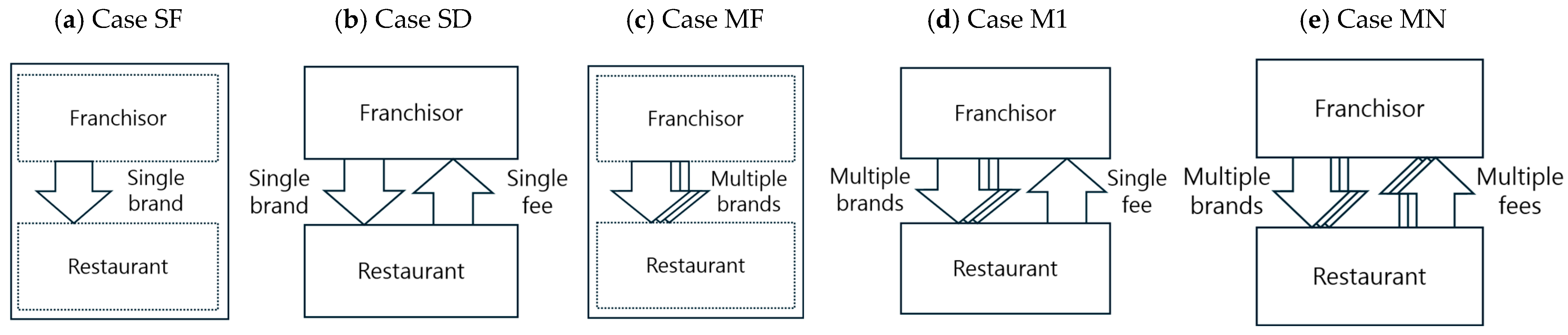
This study addresses critical gaps in the existing literature by examining the resilient and sustainable operations of multi-brand franchise supply chains from the perspectives of the franchisor, franchisee, and overall supply chain. We develop analytical models to determine the optimal pricing strategies, franchise contracts, and brand portfolio configurations under varying market conditions. To obtain new and important implications through a comprehensive comparison, we also analyze single-brand models and present five distinct cases: (1) Case SF: single-brand first-best case; (2) Case SD: single-brand, decentralized franchisor–franchisee supply chain; (3) Case MF: multi-brand first-best case; (4) Case M1: multi-brand, decentralized supply chain with a single franchise fee, regardless of the number of brands operated; (5) Case MN: multi-brand, decentralized supply chain with multiple franchise fees, proportional to the number of brands. We consider two different multi-brand decentralized supply chain cases, Cases M1 and MN, that are different in franchise fees. This is since in practice, we can often observe multi-brand franchise chains offering single franchise fee regardless of the number of brands, such as DNY Hospitality in India and Nolboo in Korea [
23,
24].
By evaluating and comparing the performance across these five models under various business environments, we provide actionable insights for designing brand portfolios and franchise contracts that enhance the sustainable operations and overall performance of multi-brand franchise supply chains.
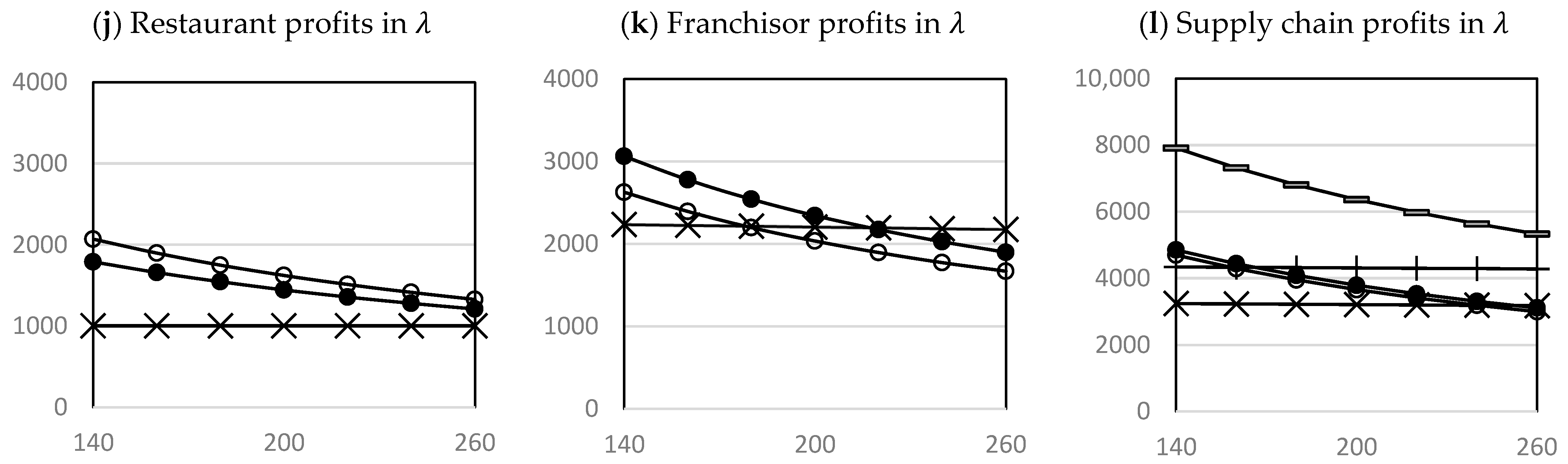
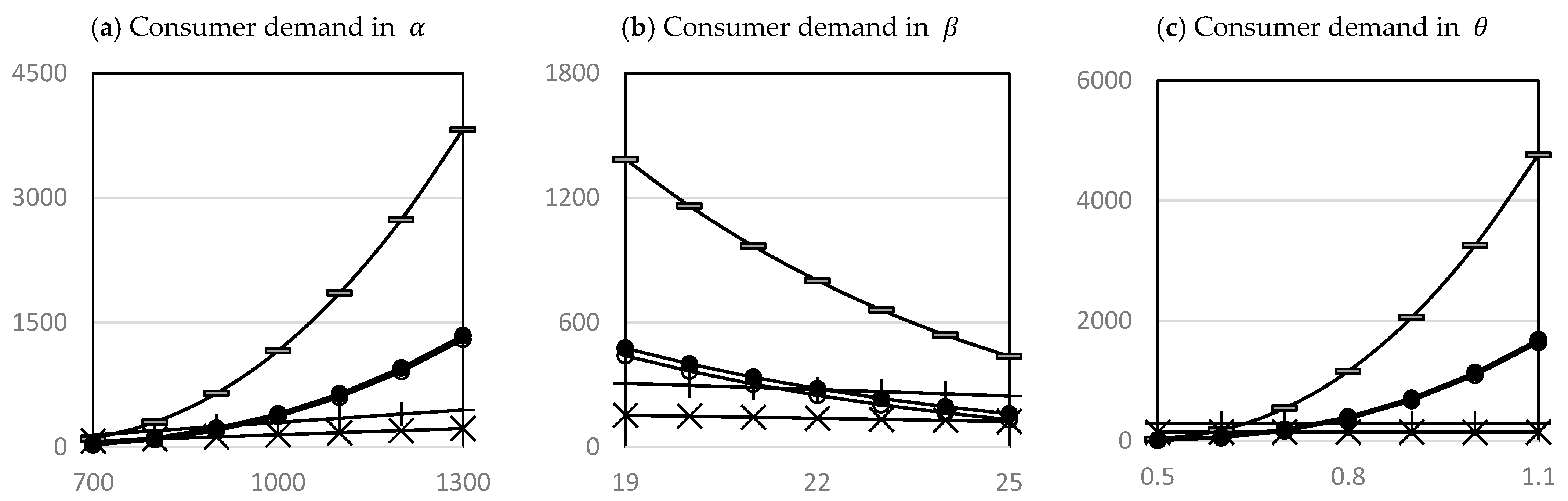
The key findings from the results can be summarized as follows. First, multi-brand kitchens tend to lead to higher profits, especially in the supply chain. Second, multi-brand kitchens are likely to experience greater profit fluctuations than single-brand kitchens as the business environment changes. Third, customer demand is crucial for the success of multi-brand kitchens. These findings help us understand how and when we can benefit from adopting multi-brand kitchens, providing managerial guidelines for restaurant operations in addition to contributing to the literature.
Although online delivery platforms play an important role in shaping consumer access and delivery fees, our analytical model does not treat platforms as strategic decision-makers in the supply chain. Instead, following prior analytical studies, we incorporate platform influences indirectly through the delivery cost parameter, allowing us to focus on the contractual and structural interactions between the franchisor and the franchisee.
4. Comparison
Comparing the solutions of the five cases, we obtain the following properties.
Proposition 1. Comparing Cases SF and SD, and always.
Proof. From
Table 3, we obtain
and
. In Equation (1),
, and it is reasonable to consider
. Therefore, the relationships in Proposition 1 hold. □
Proposition 1 indicates that the decentralized single-brand restaurant supply chain (Case SD) induces a higher sales price p compared to an integrated supply chain (Case SF), and hence it induces a lower demand q. The lowered demand caused by the price increase in the decentralized supply chain system would lead to inefficiency and lower the supply chain’s entire profit. This comparison highlights that the inefficiency arises from the lack of coordination between the franchisor and the restaurant in decentralized decision making. We will see this by applying a numerical example in the next section.
Proposition 2. Comparing Cases M1 and MN, , and always.
Proof. In
Table 4, we can observe that the solutions of Cases M1 and MN are very similar. Actually, they are the same except for the existence of the term
in Case MN in the square root terms. Therefore, the direct comparison of the square root terms is possible, and the square root term of Case MN is smaller than that of Case M1. Therefore, we can obtain the relationships of Proposition 2. □
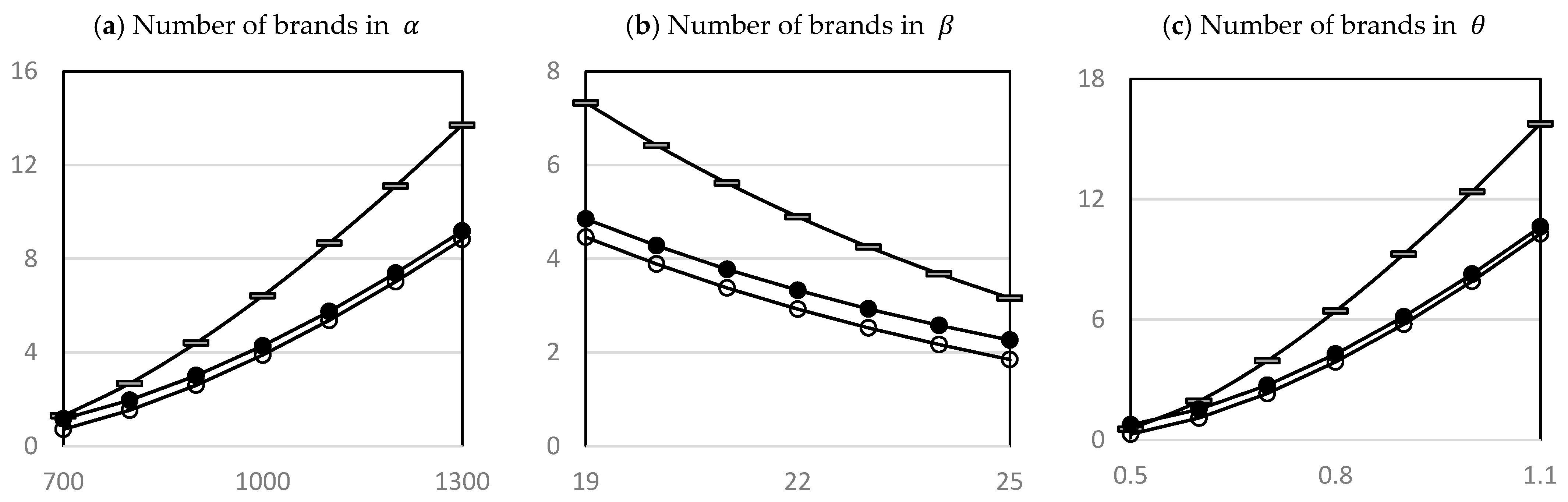
Proposition 2 points out the different decision structures of two decentralized multi-brand restaurant supply chains. Case MN induces a higher franchise fee by requesting to pay multiple franchise fees proportional to the number of brands. Therefore, to increase franchise fee revenue, the franchisor would develop a greater number of brands n, which in turn leads to a higher sales price p. While Case MN involves a higher franchise fee, it imposes a lower royalty than Case M1. This difference arises because a proportional fee structure gives the franchisor a direct incentive to expand the number of brands, which cannot be achieved under a single fixed fee.
The result of the number of brands n implies that Case MN can yield better supply chain resilience and environmental performance. By consolidating a greater number of brands, the multi-brand strategy of Case MN can enhance supply chain resilience by pooling demand risks and enabling substitution across brands within a shared operational platform. Case MN can also reduce land use, energy, water consumption, and food waste by streamlining restaurant operations across more brands and optimizing ingredient utilization and order delivery.
Propositions 1 and 2 reveal important differences between the models. However, due to mathematical complexities introduced by the square root terms as shown in
Table 4, it is practically difficult to analytically compare all five single-brand and multi-brand models. Accordingly, we employ a numerical example in the next section to derive additional managerial implications.
7. Conclusions
In this study, we examine the profitability of multi-brand kitchens under franchise contracts by modeling five different cases, varying in the number of brands, degree of decentralization, and franchise fee policy. Our analysis identifies the optimal price, royalties, and number of brands that maximize the profits of the restaurant, franchisor, and overall supply chain. We also explore how these outcomes change with shifts in the business environment.
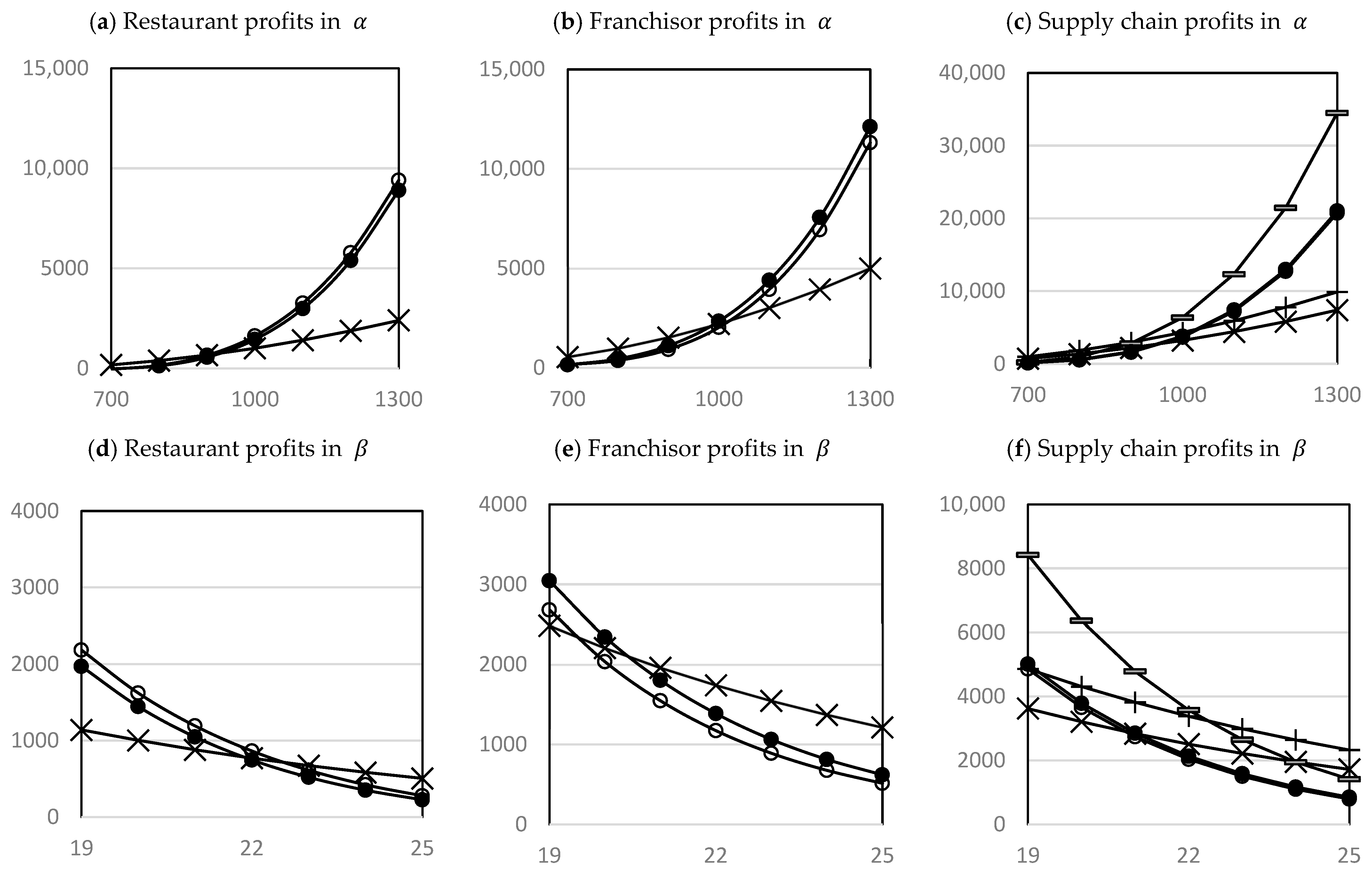
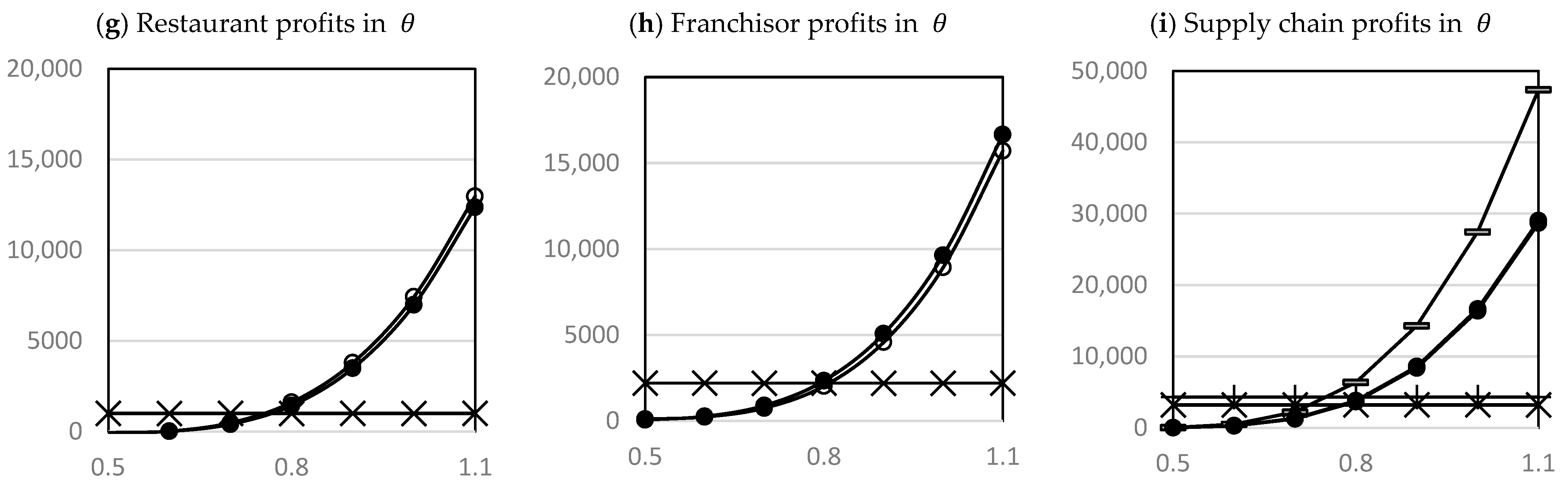
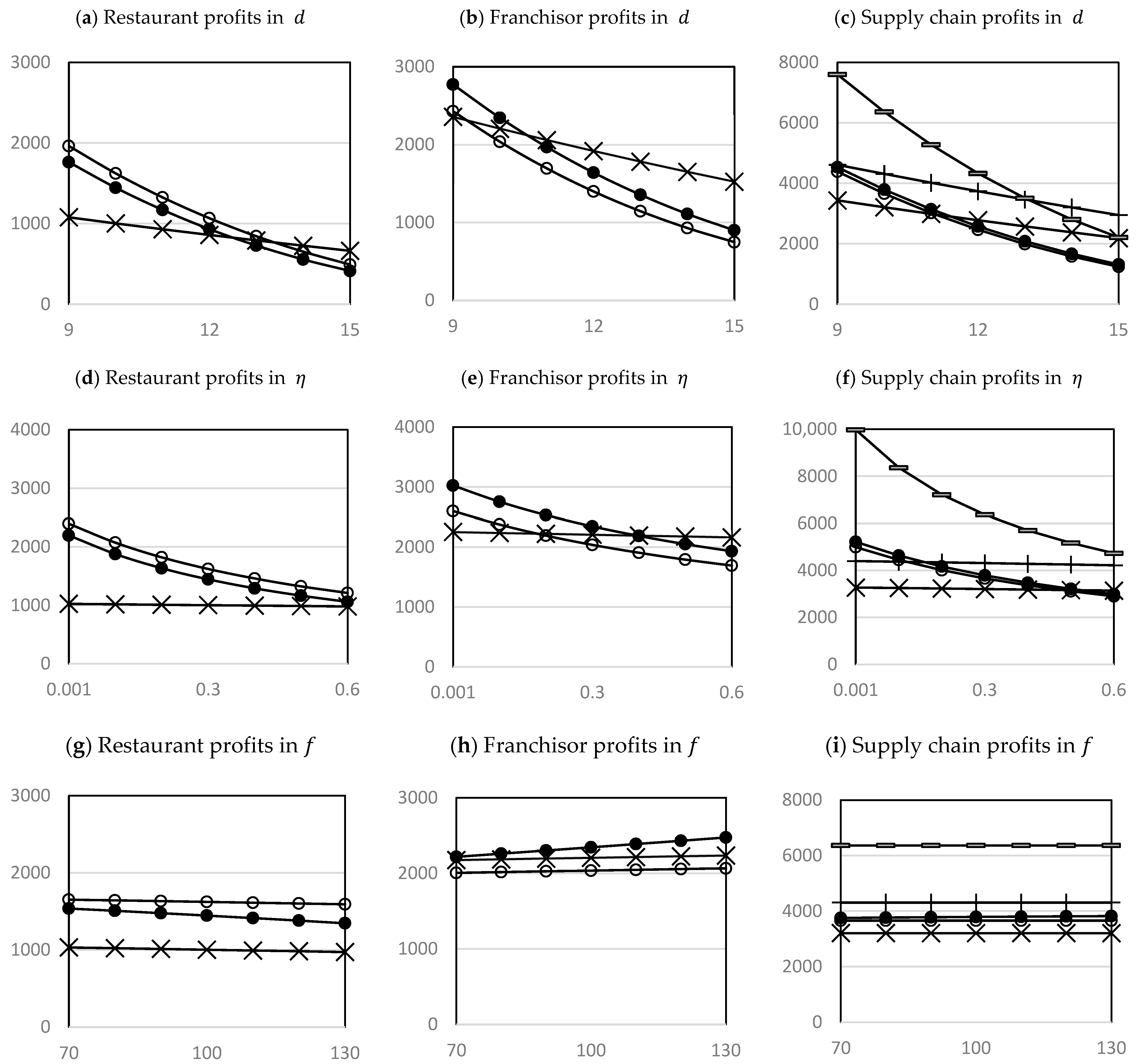
The results reveal that, in general, multi-brand kitchens yield not only better supply chain resilience and sustainability but also higher profits than single-brand kitchens, particularly at the supply chain level. This is mainly due to the increased total demand generated by multiple brands and the efficient utilization of shared resources. However, the profitability of multi-brand kitchens is not always guaranteed, as it is more sensitive to changes in key parameters such as delivery cost, inefficiency cost, and price sensitivity. Depending on the environment, multi-brand kitchens may even result in lower profits compared to single-brand operations. Interestingly, the consistency in profit trends across the restaurant, franchisor, and supply chain suggests that multi-brand kitchen adoption decisions may be aligned among supply chain players, reducing potential conflicts in contract negotiations. Furthermore, the choice between single and brand-specific franchise fee structures does not significantly impact total supply chain profitability, providing flexibility in contract design based on bargaining power.
Overall, the success of multi-brand kitchens depends heavily on demand-related factors rather than operational cost efficiency. To benefit from the resilient and sustainable operations of multi-brand kitchens, franchise companies should carefully assess market potential, delivery economics, and consumer price sensitivity. This study offers practical insights for restaurant operators and franchisors while contributing to the literature by incorporating a supply chain perspective in the analysis of multi-brand kitchen models.
This study has certain limitations. In particular, while our analytical framework captures key aspects of franchise supply chain interactions, it does not explicitly consider the role of third-party delivery platforms, which are increasingly important in practice. Future research could address this limitation by incorporating such platforms into the analytical setting to better reflect real-world operations. In addition, future research may incorporate time-varying demand environments and repeated interactions between franchisors and franchisees, thereby providing a richer understanding of long-term outcomes. Although the influence of online delivery platforms is reflected through delivery-related demand parameters in our model, future research may extend the framework by explicitly modeling platforms as additional strategic players interacting with franchisors and franchisees. Moreover, as this is one of the first studies considering multi-brand restaurant supply chains, our model does not incorporate a dynamic disruption process, but we investigate the supply chain resilience issues based on the comparative static analyses. We are planning a future study that focuses on the supply chain resilience performance under dynamic disruption scenarios. Finally, empirical analyses using industry data would complement the analytical findings and enhance the external validity of the results.