You are currently viewing a new version of our website. To view the old version click .
Systems
  • Article
  • Open Access

29 September 2024

Optimization Method for Allocating Peak-Period Parking Demand in Hub Parking Lot Clusters

,
,
,
and
1
Jiangsu Key Laboratory of Comprehensive Transportation Planning and Simulation, Southeast University, Nanjing 211189, China
2
School of Transportation, Southeast University, Nanjing 211189, China
3
Department of Transportation, Subei Navigation Management Office, Huai’an 223002, China
4
Faculty of Maritime and Transportation, Ningbo University, Ningbo 315211, China

Abstract

With the expansion of urban scale and the popularization of multi-modal transportation, transportation hubs, as the link of multi-modal travel, are becoming increasingly important in urban development and residents’ lives. In situations of high parking demand, the increase in road traffic volume and parking search delays exacerbates the service pressure on hub parking lots and the traffic congestion on surrounding roads. Therefore, reasonable parking demand allocation is one of the key solutions to this problem. Based on the analysis of the vehicle parking search process, this paper constructs a model for estimating parking search delay on roads outside hub parking lots and proposes an optimization model for parking demand allocation aimed at minimizing the total parking search delay of vehicles. Finally, taking a major transportation hub in Nanjing as a case study, data were obtained through field investigations and simulation experiments to identify peak parking demand periods and calibrate the model parameters. The results show that the average vehicle delay was reduced by 4.5%, with a total reduction of 13,860 s in vehicle delay for parking demands at the hub within one hour. Therefore, by optimizing the allocation of parking demand, the average delay for vehicles searching for parking can be reduced to a certain extent.

1. Introduction

Transportation hubs are major locations for transferring passengers and freight in cities. They are also critical nodes in urban road networks, playing an essential role in modern urban transportation systems. As gathering places for multimodal transport, these hubs face significant pressure for traffic conversion. The influx of a large number of private vehicles entering and exiting the hubs to drop off and pick up passengers poses severe challenges to the operational efficiency of the hubs and the traffic conditions both inside and around them.
Within large-scale transportation hubs, multiple parking facilities are often established, forming a hub parking cluster. These clusters, interconnected by urban roads, have a direct impact on the hubs’ capability to accommodate private vehicles. However, the road resources around transportation hubs are limited. They need to accommodate both vehicles with hub parking demands and those with non-hub parking demands. This situation becomes particularly problematic during peak demand periods. The limited parking resources at the hub conflict with the high volume of parking demand. As a result, the service efficiency of the parking lots decreases, leading to congestion on the roads surrounding the hub.
Existing research on the parking demand of vehicles in a hub parking cluster mainly focuses on the search process within parking lots. There is a lack of studies on the search process for vehicles outside the parking lots on the urban roads. However, the off-street parking search process is an important component of the overall parking search process for vehicles in a hub parking cluster. During peak demand periods, the off-street parking search process for vehicles is characterized by higher traffic volumes and complex road structures compared to the on-street parking search process. Therefore, this paper studies the parking demand allocation method for hub parking facilities during the peak demand periods, aiming to effectively improve the parking efficiency and operational efficiency of transportation hubs. Reasonably allocating parking choices for vehicles at the terminals can, significantly, provide clear driving targets for vehicles, reduce delays caused by disordered parking searches, and alleviate traffic pressure on transportation hubs.

3. Materials and Methods

To address the problem of optimizing the distribution of parking demand in hub parking lots during peak periods, the methodology of this study can be divided into the following two parts: (1) analyzing the delays that occur from the moment a vehicle starts searching for a parking space until it enters the lot to establish a model for vehicle parking search delays on the external roads of hub parking lots; (2) transforming the parking demand distribution problem into an optimization problem based on the structure of the hub road network, with the goal of minimizing overall parking search delays.

3.1. Notation

The symbols involved in the text and their corresponding explanations are shown in Table 1.
Table 1. Symbols and Explanations in the Model.

3.2. Optimization Methods for Parking Demand Allocation during Peak Demand Periods in Hub Parking Lot Clusters

To ensure that the research focuses on the influencing factors of road traffic flow, this study first makes the following assumptions regarding the calculation process of delays.
Assumption 1: Vehicles can pass through the downstream intersection smoothly without affecting the operation of vehicles on the segment. The assumption is intended to prevent scenarios where complete traffic congestion results in excessively large traffic delay values that are incomputable. Therefore, this assumption does not apply to situations of full congestion.
Assumption 2: Vehicles can easily find parking spaces after passing through the parking lot barrier gate. The assumption is made because this research focuses solely on the delays experienced by vehicles between the parking lots in the cluster, without considering scenarios inside the parking lots.
Assumption 3: Pedestrians will only use the sidewalks at the intersections. This assumption is intended to prevent vehicle delays caused by pedestrians crossing the road in violation of traffic rules, which are not considered in the model. Therefore, this assumption is applicable to areas with minimal or regulated pedestrian crossing behavior.
Assumption 4: There will be no vehicle pick-up and drop-off activities within the segment, nor will there be any bus stops. This assumption is intended to prevent delays on specific roads caused by the frequent starts and stops of public buses in practical applications. Therefore, this assumption applies to road segments without frequent pick-up/drop-off activities or bus stops.
Assumption 5: Vehicles will arrive at the traffic signal uniformly, and there will be no scenario where a large volume of traffic arrives at the traffic signal simultaneously to wait. This assumption is made because, when calculating signal-induced delays, the extent to which vehicles experience these delays is uneven. By assuming that vehicles arrive uniformly, we can focus on estimating the average delay. Therefore, this assumption is applicable in scenarios where traffic flow is relatively stable.
Assumption 6: The arriving traffic flow at each intersection is homogeneous, with parking demands and driving characteristics that are identical to those of traffic at other intersections, ensuring that vehicles will not exhibit parking preferences for any specific parking lots. This assumption eliminates the differences in the individual driver’s parking selection behaviors, allowing the model to better analyze the overall distribution of parking demand.
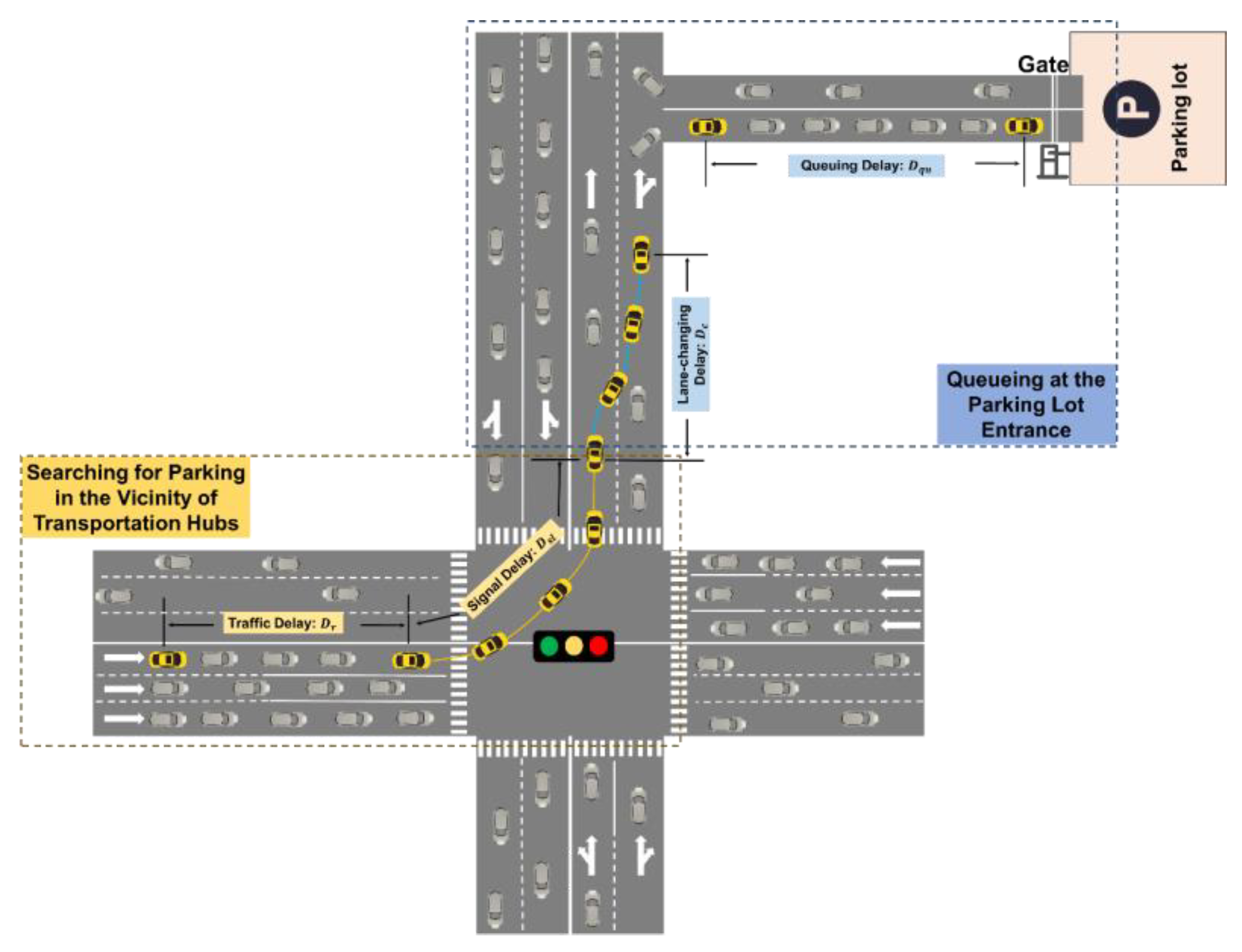
Based on the above assumptions, the analysis of the vehicle searching for parking process on the roads outside the hub parking lot can be divided into the following two parts: searching for parking on the surrounding roads and queuing at the parking lot entrance. The delays for these two parts are shown in Figure 1.
Figure 1. Schematic diagram of the vehicle searching for parking process on the roads outside the hub parking lot.
1.
Searching for Parking in the Vicinity of Transportation Hubs
After vehicles enter the surrounding roads from non-hub roads, they need to drive on the surrounding roads. When encountering traffic signal intersections, they must wait or proceed according to the traffic signal. The process of searching for parking on the surrounding roads ends when they arrive at the target parking lot. The delays during this process can be divided into roadway travel delays and signal delays.
Travel delay refers to the delay experienced by vehicles while driving on the surrounding roads of the hub due to high traffic volume, which prevents them from achieving free-flow speeds. This portion of the delay is defined as the actual travel time of the vehicles minus the time required for the vehicles to travel the same road under free-flow conditions. The calculation formula is shown in Equation (1):
D r = L v L v s
Traffic signal delay refers to the delay that vehicles experience while waiting at traffic lights when traveling to a target parking lot. This delay is not evenly distributed among vehicles, making it difficult to estimate the signal waiting delay for individual vehicles. Therefore, the average delay across the traffic flow is usually calculated for this part of the delay, as shown in Equation (2):
D s l = R T × R 2
2.
Searching for Parking in the Vicinity of Transportation Hubs
At the entrance to the parking lot, the process of vehicles entering the parking lot typically involves changing lanes to the far-right lane of the road and then slowing down to queue and pass through the entrance gate into the parking lot. During this process, the delays incurred by vehicles are concentrated during the lane-changing and the queuing at the gate. Therefore, the delay in this process can be divided into vehicle lane-changing delay and vehicle queuing delay.
Vehicle lane-changing delay refers to the delay caused by conflicts with other vehicles when a vehicle, after determining its target parking lot, changes lanes to the far-right lane of the road. Since the lane-changing vehicle must wait for an acceptable gap in the target lane that the driver deems safe before making the lane change, its driving logic is similar to the logic at major–minor road intersections. Therefore, this part of the delay can be considered as the delay incurred by minor road vehicles entering the main road, and it can be calculated using the acceptable gap theory, as shown in Equation (3):
D c = 1 e ( q p t c + q n t f ) 1 t f e q p t c q n + t f
Vehicle queuing delay refers to the delay that occurs when vehicles, after completing a lane-changing maneuver, line up in the far-right lane of the road and wait to pass through the gate to enter the parking lot. This part of the delay can be calculated using queueing theory. Based on queueing theory, the parking lot gate should be categorized into single-server and multi-server scenarios, with the calculation formulas given as in Equation (4):
D q u = 1 μ λ ( c = 1 ) c ρ c ρ c ! ( 1 ρ ) c λ × 1 k = 0 c 1 1 k ! ( λ μ ) k + 1 c ! ( 1 ρ ) ( λ μ ) c + 1 μ ( c > 1 )
Based on the above analysis, it is necessary to integrate the parking search delay for vehicles with parking demand based on the road network structure around the hub and to construct a model for the parking search delay of vehicles on the roads outside the parking lot. Assume that vehicles with parking demands enter the roads surrounding the hub from intersection i, pass through several traffic lights, and then through the last intersection j encountered before reaching the parking lot. They drive to the target parking lot t, complete lane-changing and queuing maneuvers, and enter the parking lot. Therefore, the total delay that the vehicle needs to bear is the sum of the aforementioned delays is as shown in Equation (5):
D i t = D r i t + D s l i j + D c t + D q u t = L i t v L i t v s + k = i j ( R k T k R k 2 ) + 1 e ( q p t t c t + q n t t f t ) 1 t f t e q p t t c t q n t + t f t + 1 μ t λ t
In a given parking demand scenario, the traffic flow proportions arriving at each parking lot can be adjusted to minimize the total delay for vehicles with parking demand at the hub. Based on the road network structure around the hub, the expression for the parking demand traffic volume can be completed, and the objective function to be optimized as shown in Equation (6):
min D = i t Q i p i t D i t
The optimization problem is subject to constraints as shown in Equations (7) and (8):
0 p i t 1
t p i t = 1
In the optimization model, the independent variable is p i t . By adjusting p i t , the distribution of parking demand can be adjusted to achieve the optimization goal of minimizing the total delay for vehicles with parking demand at the hub during peak demand periods. Since p i t is defined as the proportion of the number of vehicles for parking lot t relative to the total arriving traffic flow at intersection i, p i t must be within the range of 0 to 1. Moreover, all vehicles arriving at the intersections need to complete the search for parking, select the target parking lot, and finish the lane-changing and queuing before entering the parking lot. Therefore, for the arriving parking demand traffic at intersection i, the sum of p i t for all target parking lots must be 1, ensuring that all vehicles from the arriving parking demand traffic at intersection i complete the distribution of parking demand.

4. Case Study

Taking a large transportation hub A in Nanjing, Jiangsu Province, China, as the research object, this study obtains road traffic volumes and traffic flow direction ratios through field surveys and establishes a vehicle delay model under high demand scenarios. Combining the acquired video data and VISSIM simulations, the parameters within the model are calibrated. Finally, the particle swarm optimization algorithm (PSO) is used to solve the demand distribution optimization model, thereby obtaining the optimal parking demand distribution scheme under this research scenario.

4.1. Determining the Peak Parking Demand Period for the Hub

In this study, gate data from a single parking lot at Transportation Hub A were collected from 25 April 2022 to 15 May 2022, totaling 21 days, and comprising 107,042 gate records. To determine the peak parking demand period for the hub, an analysis of weekly and daily variations was conducted.
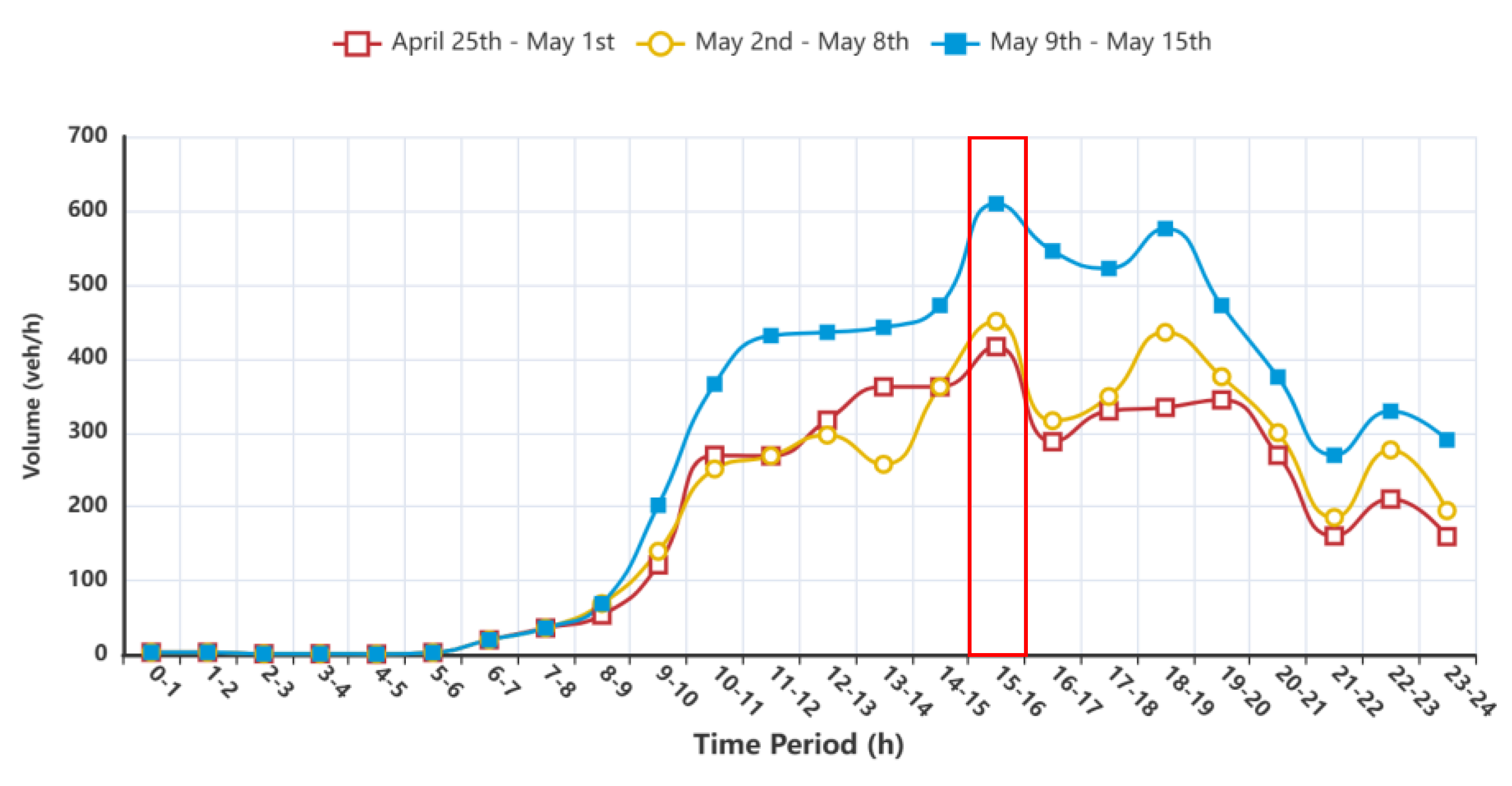
By calculating the average number of vehicles arriving and departing (where this number is the sum of vehicles arriving and leaving) each day over three consecutive weeks, a weekly variation graph of entry and exit volume can be shown in Figure 2. In the figure, the horizontal axis represents time, ranging from 0:00 to 24:00, while the vertical axis represents the volume of arrivals and departures. The three curves show the variation trends in arrival and departure volumes for different weeks.
Figure 2. The weekly variation graph of the average number of vehicle arrivals and departures at the parking lot, with the red box indicating the peak period from 15:00 to 16:00.
It can be observed that the characteristics of vehicle entries and exits through the gate are highly similar from week to week, with consistent trends and peak periods. The peak volumes of vehicle entries and exits within a single day occur between 3 and 4 p.m.
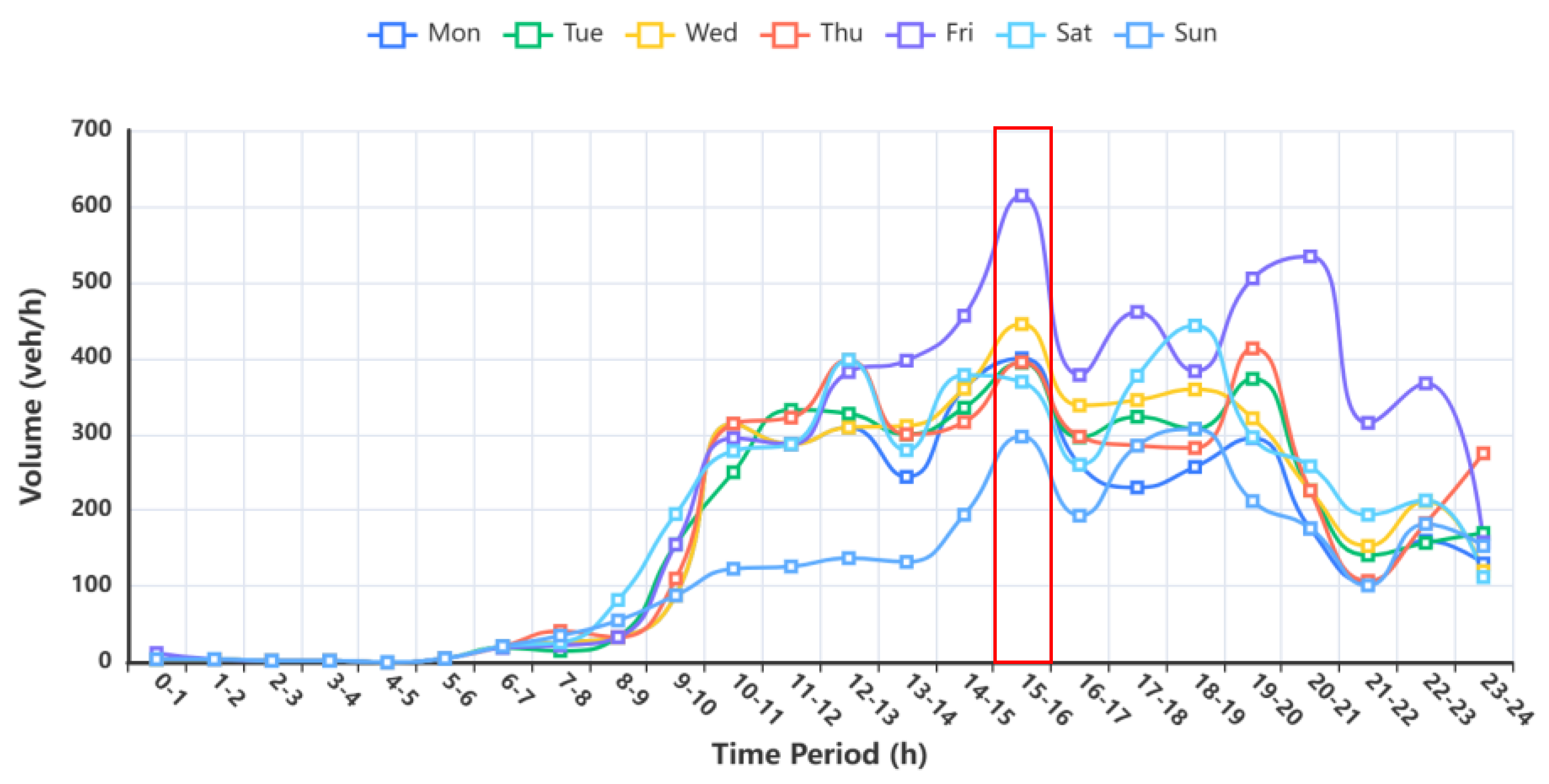
After determining the weekly variation characteristics of the vehicle entries and exits through the gate at the hub, we proceeded to analyze the daily variation characteristics. A line graph depicting the hourly vehicle entries and exits at the hub from 0:00 to 24:00 within a single week is shown in Figure 3. In the figure, the horizontal axis represents time, ranging from 0:00 to 24:00, and the vertical axis represents the volume of arrivals and departures. The seven curves represent the trends in arrivals and departures on different weeks during day x.
Figure 3. The daily variation graph of the average number of vehicle arrivals and departures at the parking lot, with the red box indicating the peak period from 15:00 to 16:00.
In crosswise, variations in the average number of vehicle arrivals and departures exhibits a bimodal pattern, with the primary peak occurring from 15:00 to 16:00 and the secondary peak from 19:00 to 20:00. A vertical comparison of the daily variations within a single week shows that the average number of vehicle arrivals and departures on Friday is significantly higher than at other times during the week. By synthesizing the daily and weekly variation characteristics, the peak demand period within a single week is identified as Friday from 15:00 to 16:00.

4.2. Calibration of Delay Model Parameters

In constructing the vehicle delay model, it is necessary to calibrate the parameters to facilitate subsequent optimization algorithm solutions for the delay model. The parameters in the model can be classified into those that can be obtained through field observations and those that cannot. For the former, this study conducted a traffic survey at the transportation hub A from 15:00 to 16:00 on Friday, 3 March 2023, to obtain parameters such as the service rate of the gates at various parking lots, the cycle duration of traffic signals, and the duration of red lights at various intersections. Detailed data can be found in Appendix A.
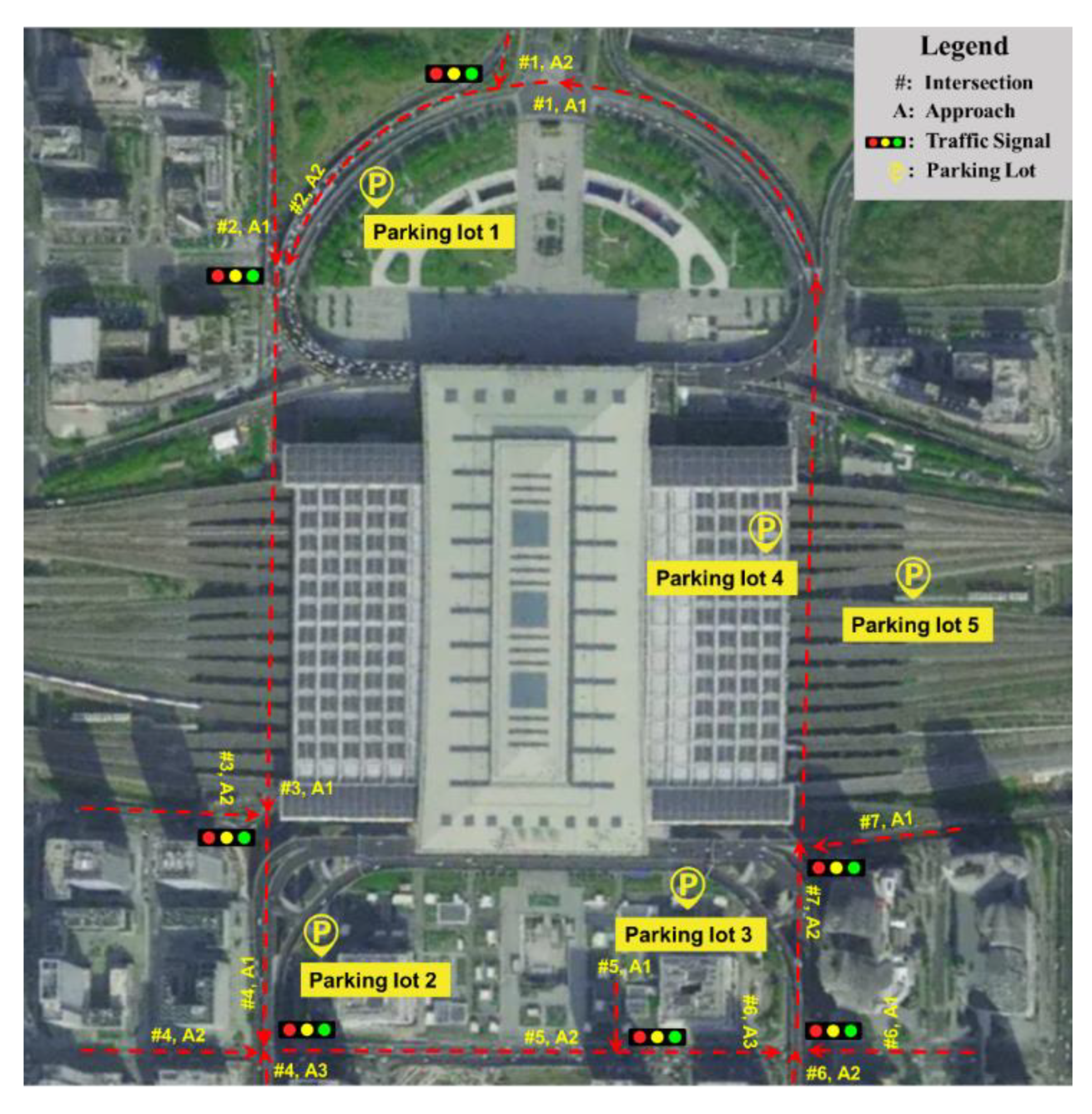
This large hub parking area has five parking lots open to the public, and there are seven major intersections on the surrounding roads of the hub. The directions of vehicles heading to the hub and surrounding intersections are shown in Figure 4. In the figure, the red lines represent the main roads around the hub, traffic lights indicate the major intersections, and the arrows along with the letter “A” denote different entry directions.
Figure 4. Diagram of Major Intersections, Parking Lots, and Vehicle Directions into the Surrounding Area of the Large Hub A.
For parameters that cannot be obtained through field observations, such as those related to delays caused by lane changes at the entrances of each parking lot, the minimum acceptable gap, and the follow-up time, this study uses a simulation experiment parameter calibration method to obtain them. Commonly used traffic simulation platforms include SimTraffic, CORSIM, and VISSIM. A comparison of the driving behavior models across these simulation platforms is shown in Table 2.
Table 2. Comparison of Driving Behavior Models Across Different Simulation Platforms.
From the table, it can be observed that VISSIM, as a widely applicable simulation software, offers comprehensive driving behavior models, enabling the efficient setup and execution of simulations for real-world traffic scenarios. Additionally, VISSIM features a high degree of visualization, with both the user interface and the simulation environment being fully visualized. This allows for the observation of each vehicle’s operational status and the retrieval of its operational parameters, facilitating the assessment of the simulation’s accuracy and realism. Therefore, VISSIM is selected for the calibration of simulation experiment parameters.
Firstly, the experimental scenario is constructed in VISSIM based on the structure of the real road network. Next, it adjusts the road traffic flow and parking demand within a reasonable range to conduct simulation experiments and obtain vehicle delays at parking lot entrances. Based on the data obtained from the traffic survey, the target lane traffic flow in the simulation experiment is set to range from 200 vehicles per hour to 500 vehicles per hour, with a value taken every 50 vehicles per hour. The initial lane traffic flow is set to range from 100 vehicles per hour to 200 vehicles per hour, with a value taken every 20 vehicles per hour. A total of 42 sets of simulation experiment data were collected for each parking lot entrance. Finally, the parameters are calibrated using the least squares method. The results are shown in Table 3.
Table 3. Parameter Calibration Table for Simulation Experiments.

4.3. Optimization of Parking Demand during Peak Demand Periods

During the traffic survey of hub A, aside from obtaining the parameters that need calibration, it is also necessary to collect traffic flow data and parking lot arrival numbers during peak periods to determine the parking demand at the hub. The external traffic flow at major intersections around the hub and the number of vehicles arriving at each parking lot are presented in Table 4.
Table 4. Equivalent Hourly Arrival Traffic Flow at Each Intersection and Parking Lot.
From the table, it can be seen that the total traffic flow of vehicles arriving at each intersection during the statistical period is approximately twice that of the parking lots. Moreover, under the assumptions of the delay calculation model, the incoming traffic at each intersection is considered to be homogeneous, so it can be assumed that about 50% of the vehicles arriving at each intersection have parking needs. After determining the parking demand, the optimization objective function of the model is shown in Equation (9):
min D = i t Q i p i t D i t = i t Q i p i t ( L i t v L i t v s + k = i j ( R k T k R k 2 ) + 1 e ( q p t t c t + q n t t f t ) 1 t f t e q p t t c t q n t + t f t + 1 μ t λ t )    
Since this problem is a multivariable optimization problem, it is typically solved using metaheuristic algorithms. Therefore, this paper uses the Particle Swarm Optimization (PSO) algorithm for the solution. The initial values of the particle swarm are set as random arrays between 0 and 1, the velocity threshold is set to 0.5, and the maximum number of iterations is set to 1000. The optimized results are shown in Table 5.
Table 5. Results of Parking Demand Allocation Optimization.
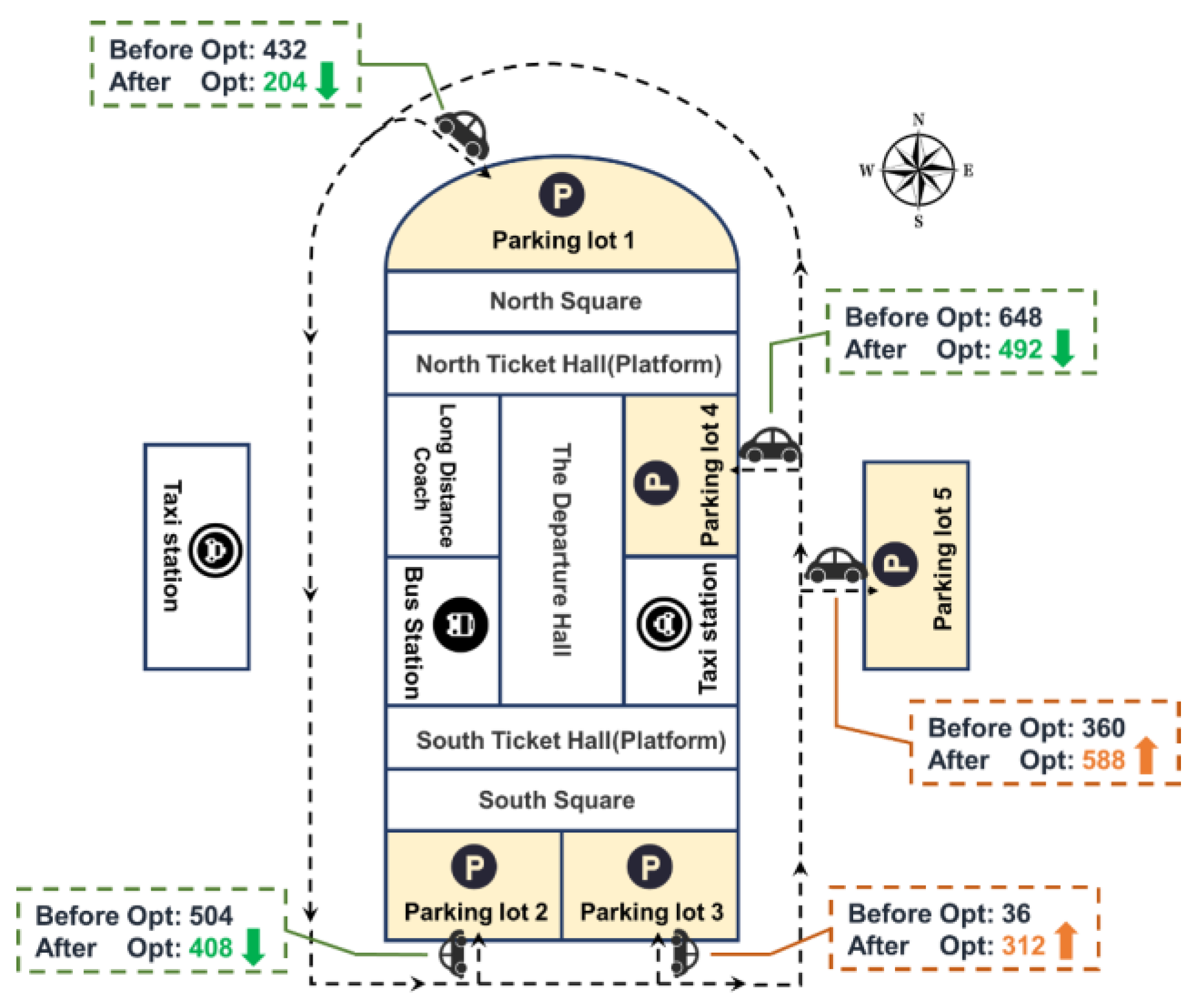
The results before and after the demand allocation optimization are shown in Figure 5. A comparison reveals that the parking demand allocation for Parking Lots 3 and 5 increased, while the parking demand allocation for Parking Lots 1, 2, and 4 decreased.
Figure 5. Comparison Chart of Results Before and After Parking Demand Allocation Optimization. A red upward arrow indicates that the demand for the parking lot has increased after optimization, while a green downward arrow indicates that the demand has decreased after optimization.
The corresponding explanations for the optimized allocation plan are as follows:
  • Due to the large driving distance between Parking Lot 1 and the other parking lots, many vehicles are unwilling to continue seeking parking after entering the surrounding roads of the hub. Instead, they choose to queue at the entrance of Parking Lot 1, resulting in higher queue delays. Guiding some of this traffic to other parking lots can significantly optimize the overall efficiency of parking at the hub.
  • The decrease in demand allocation for Parking Lot 2 is attributed to the low utilization rate of Parking Lot 3, which is relatively close to Parking Lot 2. Redirecting parked vehicles to Parking Lot 3 can improve the overall delays at the hub.
  • Parking Lots 4 and 5 are located close to each other, and neither has a spatial advantage over the other. However, the optimization plan reduces the allocation for Parking Lot 4 while increasing that for Parking Lot 5 because Parking Lot 5, with its dual service counters, has a higher service efficiency, resulting in significantly reduced queue delays.
Before optimizing the parking demand allocation, the average delay for vehicles was 162 s. After optimizing the parking demand allocation, the average delay was reduced to 155 s, an improvement of 4.5%, with the delay time for individual vehicles shortened by 7 s. During peak demand periods, the parking demand traffic volume is 1980 vehicles per hour. Therefore, after reallocating and guiding the parking demand vehicles during peak demand periods, the total delay for parking demand vehicles at the hub was reduced by 13,860 s within one hour.

5. Conclusions

Existing studies on the parking search behavior of vehicles with parking demands in a hub parking lot clusters mainly focus on the search process within the parking lots, lacking research on the search process on urban roads outside the hub parking lot clusters. However, the outside search process is an essential component of the overall search process for vehicles with parking demands in hub parking lot clusters. In contrast, this study analyzes the outside search process of vehicles in hub parking lot groups during peak demand periods, constructs mathematical expression models for various delays, and proposes an optimization model for parking demand allocation with the objective of minimizing delays.
Taking a large transportation hub in Nanjing as an example, this study demonstrates that through reasonable parking demand allocation, the average search delay time of vehicles during peak parking demand periods can be significantly reduced, effectively alleviating the congestion in hub parking lots and surrounding roads during peak demand periods. Additionally, it can provide data support for the management and control of outside parking search for vehicles with hub parking demands during peak hours.
In summary, this study effectively fills the research gap in the existing literature regarding the outside road search process of vehicles with parking demands in hub parking lot clusters. In practical applications, this method can be combined with intelligent transportation systems and navigation software to better serve users. It also provides strong support for improving the parking management level of transportation hubs and the connectivity efficiency of urban transportation.
However, this study still requires further research and improvement. Firstly, while the six assumptions proposed for the delay model help simplify the modeling process to some extent, it is acknowledged that they may have certain limitations in real-world applications. Therefore, future research should further explore the potential impact of these assumptions. Secondly, future research needs to further analyze the applicable scenarios and sensitivity. Thirdly, consider the impact of traffic and parking dynamics on the arrival rate and service rate. In addition, further optimization and improvement methods should be considered, such as constructing multi-objective optimization models [49] and employing Pareto optimization techniques [50]. Furthermore, factors such as traffic signal timing and green wave coordination of upstream and downstream traffic signals can be considered, which could significantly reduce the impact of traffic signals on the vehicle parking search process.

Author Contributions

The authors confirm their contributions to the paper as follows: C.Z.: Conceptualization, Methodology, Supervision, Writing—Review and Editing. W.L.: Conceptualization, Methodology, Investigation, Data Curation, Writing—Original Draft and Editing. C.Y.: Conceptualization, Methodology, Investigation, Data Curation, Writing—Original Draft. X.Y.: Supervision, Writing—Review and Editing. J.C.: Supervision, Writing—Review and Editing. All authors have read and agreed to the published version of the manuscript.

Funding

This work is sponsored by The National Natural Science Foundation of China (52302388), The Natural Science Foundation of Jiangsu Province (BK20230853), The Projects of the Fundamental Research Funds for the Provincial Universities of Zhejiang (SJLY2023009), and The Fundamental Research Funds for the Central Universities.

Data Availability Statement

The original contributions presented in the study are included in the article, further inquiries can be directed to the corresponding author/s.

Acknowledgments

The authors thank their mentors who provided instructions on writing this paper.

Conflicts of Interest

The authors declare no conflicts of interest.

Appendix A

This study conducted a traffic survey at Major Transport Hub A in Nanjing. The survey covered five parking lots and seven key intersections surrounding the hub. The data collected included traffic flow at the intersections, parking lot arrival data, vehicle queue delay data at each parking lot, gate service rates at the parking lots, and traffic signal parameters at the main intersections.
  • Traffic Flow at the Intersections
By conducting traffic flow statistics at key intersections on roads surrounding the transport hub, the vehicle flow from various directions at these intersections was determined, as shown in Table A1. The definitions of the road intersections and directions in the table are provided in Figure 4 of the main text.
Table A1. Traffic Flow Statistics for Major Intersections on Roads Surrounding Hub A.
Intersection NumberVehicle ApproachTraffic Flow (veh/h)Total Intersection Flow (veh/h)
Intersection 1Approach 19001260
Approach 2360
Intersection 2Approach 1444828
Approach 2384
Intersection 3Approach 1636780
Approach 2144
Intersection 4Approach 1241140
Approach 2120
Approach 3996
Intersection 5Approach 111161476
Approach 2360
Intersection 6Approach 18641828
Approach 2288
Approach 3676
Intersection 7Approach 12161244
Approach 21028
  • Parking Lot Arrival Data
By recording the number of parked vehicles at the entrances and exits of the parking lots, the parking demand at each parking lot during peak demand periods was determined, as shown in Table A2.
Table A2. Parking Demand During Peak Demand Periods.
Parking Lot NumberParking Lot 1Parking Lot 2Parking Lot 1Parking Lot 2Parking Lot 5
Parking Demand (veh/h)43252836848648
  • Vehicle Queue Delay Data
By observing each vehicle frame by frame in the videos recorded at the entrances and exits of the parking lots, the queue delay for each vehicle was determined. A 5 min delay analysis was conducted for each parking lot entrance and exit, and the average vehicle delay was calculated, as shown in Table A3.
Table A3. Vehicle Average Delay for Each Parking lot.
Parking Lot NumberParking Lot 1Parking Lot 2Parking Lot 1Parking Lot 2Parking Lot 5
Average Delay (s)14.9715.92131243.43
  • Gate Service Rates
By analyzing the time each vehicle passes through the gate in the video recorded at the entrances of the parking lots, the gate service rate for each parking lot could be determined. This rate was used to calculate the queue delay at the parking lot entrances. The statistical results are shown in Table A4.
Table A4. Gate Service Rates for Each Parking Lot at Hub A.
Parking Lot NumberParking Lot 1Parking Lot 2Parking Lot 1Parking Lot 2Parking Lot 5
Average Time for Vehicles to Pass Through Gate (s)5.86.85.2105.6
Gate Service Rate (veh/h)621529692360643
  • Traffic Signal Parameters at the Main Intersections
By analyzing the red signal duration and cycle duration at signalized intersections on roads surrounding the hub, as recorded in the video footage, the parameters for the signal delay component in the delay model were determined. The statistical results are shown in Table A5.
Table A5. Signal Parameters for Major Signalized Intersections on Roads Surrounding Hub A.
Intersection Number1234567
Red Signal Duration (s)\614038\3725
Green Signal Duration (s)40445740\
Yellow Signal Duration (s)33 3
Cycle Duration (s)104879580
For Intersection 1, as it serves as the starting point within the study area, its traffic signals do not impact the subjects of this study, so no signal timing data were collected for this intersection. For Intersections 4 and 7, because the roads surrounding Hub A are counterclockwise one-way streets, the placement of traffic signals does not affect vehicles searching for parking around the hub; vehicles can proceed simply by staying on the left side of the road. For Intersection 5, as it is a merge point between the elevated road traffic and the traffic on the roads surrounding the hub, no traffic signals are installed.

References

  1. Mahmassani, H.S.; Chang, G.-L. On Boundedly rational user equilibrium in transportation systems. Transp. Sci. 1987, 21, 89–99. [Google Scholar] [CrossRef]
  2. Jiang, G.; Fosgerau, M.; Lo, H.K. Route choice, travel time variability, and rational inattention. Transp. Res. Part B Methodol. 2020, 132, 188–207. [Google Scholar] [CrossRef]
  3. Bell, M.G.H. Stochastic user equilibrium assignment in networks with queues. Transp. Res. Part B Methodol. 1995, 29, 125–137. [Google Scholar] [CrossRef]
  4. Zhang, M.; Huang, T.; Guo, Z.; He, Z. Complex-network-based traffic network analysis and dynamics: A comprehensive review. Phys. A Stat. Mech. Its Appl. 2022, 607, 128063. [Google Scholar] [CrossRef]
  5. Kushchenko, L.E.; Kushchenko, S.V.; Novikov, A.N. The Application of Wavelet Analysis to Study the Characteristics of the Traffic Flow. In Proceedings of the 2020 International Multi-Conference on Industrial Engineering and Modern Technologies (FarEastCon), Vladivostok, Russia, 6–9 October 2020; IEEE: New York City, NY, USA, 2020; pp. 1–4. [Google Scholar]
  6. Islam, M.K.; Al-Muaybid, A.I.M.; Al-Saqer, M.F.A.; Al-Nagada, M.S.R.; Al-Newaihel, K.S.A.; Akter, R.; Gul, A.A.; Rhaman, M.M.; Shatnawi, Z. Assessing Survey Data to Study Traffic Flow Characteristics: An in-depth analysis of King Fahad Road, Al-Ahsa, Saudi Arabia. Forum Geografi. 2024, 38, 167–177. [Google Scholar] [CrossRef]
  7. Zang, J.; Jiao, P.; Liu, S.; Zhang, X.; Song, G.; Yu, L. Identifying traffic congestion patterns of urban road network based on traffic performance index. Sustainability 2023, 15, 948. [Google Scholar] [CrossRef]
  8. Mahmood, T.S.; Awad, H.A. Evaluating the traffic characteristics of the road network in Ramadi city using sustainable trans-portation indicators (Hazard Index). In IOP Conference Series: Earth and Environmental Science, Proceedings of the Fourth International Conference on Geotechnical Engineering-Iraq, 2024 (ICGE-Iraq, 2024) and Warith First International Conference of Engineering Sciences (WICES-2024), Karbala, Iraq, 18 April 2024; IOP Publishing: Bristol, UK, 2024; Volume 1374, p. 012051. [Google Scholar]
  9. Li, B.; Sun, X.; He, Y.; Zhang, M. A Dynamic Collision Risk Assessment Model for the Traffic Flow on Expressways in Urban Agglom-erations in North China. Systems 2024, 12, 86. [Google Scholar] [CrossRef]
  10. Han, Y.; Shan, J.; Wang, M.; Yang, G. Optimization design and evaluation of parking route based on automatic assignment mechanism of parking lot. Adv. Mech. Eng. 2017, 9, 1687814017712416. [Google Scholar] [CrossRef]
  11. Kim, O.T.T.; Tran, N.H.; Pham, C.; LeAnh, T.; Thai, M.T.; Hong, C.S. Parking assignment: Minimizing parking expenses and balancing parking demand among multiple parking lots. IEEE Trans. Autom. Sci. Eng. 2019, 17, 1320–1331. [Google Scholar]
  12. Nakazato, T.; Fujimaki, Y.; Namerikawa, T. Parking lot allocation using rematching and dynamic parking fee design. IEEE Trans. Control. Netw. Syst. 2022, 9, 1692–1703. [Google Scholar] [CrossRef]
  13. Duan, M.; Wu, D.; Liu, H. Bi-level programming model for resource-shared parking lots allocation. Transp. Lett. 2020, 12, 501–511. [Google Scholar] [CrossRef]
  14. Hassija, V.; Saxena, V.; Chamola, V.; Yu, F.R. A parking slot allocation framework based on virtual voting and adaptive pricing algorithm. IEEE Trans. Veh. Technol. 2020, 69, 5945–5957. [Google Scholar] [CrossRef]
  15. Parmar, J.; Das, P.; Dave, S.M. Study on demand and characteristics of parking system in urban areas: A review. J. Traffic Transp. Eng. (Engl. Ed.) 2020, 7, 111–124. [Google Scholar] [CrossRef]
  16. Xie, Z.; Wu, X.; Guo, J.; Zhan, Z. Parking lot allocation model considering conversion between dynamic and static traffic. J. Intell. Fuzzy Syst. 2021, 41, 5207–5217. [Google Scholar] [CrossRef]
  17. Guan, Y.; Wang, Y.; Yan, X.; Guo, H.; Zhou, Y. A Big-Data-Driven Framework for Parking Demand Estimation in Urban Central Districts. J. Adv. Transp. 2020, 2020, 8898848. [Google Scholar] [CrossRef]
  18. Chen, Y.; Wang, T.; Yan, X.; Wang, C. An ensemble optimization strategy for dynamic parking-space allocation. IEEE Intell. Transp. Syst. Mag. 2022, 15, 347–362. [Google Scholar] [CrossRef]
  19. Saharan, S.; Kumar, N.; Bawa, S. DyPARK: A dynamic pricing and allocation scheme for smart on-street parking system. IEEE Trans. Intell. Transp. Syst. 2023, 24, 4217–4234. [Google Scholar] [CrossRef]
  20. Hassine, S.B.; Mraihi, R.; Lachiheb, A.; Kooli, E. Modelling parking type choice behavior. Int. J. Transp. Sci. Technol. 2022, 11, 653–664. [Google Scholar] [CrossRef]
  21. Xie, M.; Lin, S.; Wu, Z.; Zhang, X.; Wang, Y. Optimal allocation and adjustment mechanism of shared parking slots considering combined parking resources. Transp. Lett. 2023, 15, 730–741. [Google Scholar] [CrossRef]
  22. Zhang, X.; Zhao, C.; Liao, F.; Li, X.; Du, Y. Online parking assignment in an environment of partially connected vehicles: A multi-agent deep reinforcement learning approach. Transp. Res. Part C Emerg. Technol. 2022, 138, 103624. [Google Scholar] [CrossRef]
  23. Zargayouna, M.; Balbo, F.; Ndiaye, K. Generic model for resource allocation in transportation. Application to urban parking management. Transp. Res. Part C Emerg. Technol. 2016, 71, 538–554. [Google Scholar] [CrossRef]
  24. Xie, M.; Zhang, X.; Wu, Z.; Wei, S.; Gao, Y.; Wang, Y. A shared parking optimization framework based on dynamic resource allocation and path planning. Phys. A Stat. Mech. Its Appl. 2023, 616, 128649. [Google Scholar] [CrossRef]
  25. Cai, Y.; Chen, J.; Zhang, C.; Wang, B. A parking space allocation method to make a shared parking strategy for appertaining parking lots of public buildings. Sustainability 2018, 11, 120. [Google Scholar] [CrossRef]
  26. Errousso, H.; El Ouadi, J.; Alaoui, E.A.A.; Benhadou, S. Dynamic parking space allocation at urban scale: Problem formulation and resolution. J. King Saud Univ.-Comput. Inf. Sci. 2022, 34, 9576–9590. [Google Scholar] [CrossRef]
  27. Mladenović, M.; Delot, T.; Laporte, G.; Wilbaut, C. A scalable dynamic parking allocation framework. Comput. Oper. Res. 2021, 125, 105080. [Google Scholar] [CrossRef]
  28. Guo, H.; Wang, Y.; Yan, X.; Guan, Y.; Zhou, Y. Parking Resource Allocation Optimization Framework Based on a Two-Level Grid Model. J. Adv. Transp. 2022, 2022, 5977168. [Google Scholar] [CrossRef]
  29. Wang, Y.; Chen, Q. Dynamic parking allocation model in a multidestination multiple parking lot system. IEEE Intell. Transp. Syst. Mag. 2022, 14, 195–208. [Google Scholar] [CrossRef]
  30. Yu, J.; Wan, Q.; Li, Z. Optimal distribution model of shared parking space in large shopping malls at night. IOP Conf. Ser. Earth Environ. Sci. 2018, 153, 032006. [Google Scholar] [CrossRef]
  31. Zhang, Y.; Zhang, Z.; Teng, S. Adaptive ant colony optimization for solving the parking lot assignment problem. In Proceedings of the 2018 14th International Conference on Natural Computation, Fuzzy Systems and Knowledge Discovery (ICNC-FSKD), Huangshan, China, 28–30 July 2018; IEEE: New York City, NY, USA, 2018; pp. 91–96. [Google Scholar]
  32. Li, Q.; Cheng, J.; Chen, L. Research on shared parking allocation considering the heterogeneity of parking slot providers’ temporary parking demand. Transp. Lett. 2024, 1–13. [Google Scholar] [CrossRef]
  33. Yang, Y.; Yang, B.; Yuan, Z.; Meng, R.; Wang, Y. Modelling and comparing two modes of sharing parking spots at residential area: Real-time and fixed-time allocation. IET Intell. Transp. Syst. 2024, 18, 599–618. [Google Scholar] [CrossRef]
  34. Elfaki, A.O.; Messoudi, W.; Bushnag, A.; Abuzneid, S.; Alhmiedat, T. Constraint Optimization Model for Dynamic Parking Space Allocation. Sensors 2024, 24, 3988. [Google Scholar] [CrossRef] [PubMed]
  35. Ji, Y.; Dong, J.; Lai, Z.; Feng, Q. Optimal allocation of shared parking spaces for hospital parkers considering parking choice behavior under bounded rationality. Transp. Lett. 2023, 15, 242–253. [Google Scholar] [CrossRef]
  36. Zhao, P.; Guan, H.; Wei, H.; Liu, S. Mathematical modeling and heuristic approaches to optimize shared parking resources: A case study of Beijing, China. Transp. Res. Interdiscip. Perspect. 2021, 9, 100317. [Google Scholar] [CrossRef]
  37. Ye, X.; Wang, Y.; Yan, X.; Tao, W.; Chen, J. Optimization model of autonomous vehicle parking facilities, developed with the nondominated sorting genetic algorithm with an elite strategy 2 and by comparing different moving strategies. IEEE Intell. Transp. Syst. Mag. 2022, 15, 82–100. [Google Scholar]
  38. Ye, X.; Sui, X.; Wang, T.; Yan, X.; Chen, J. Research on parking choice behavior of shared autonomous vehicle services by measuring users’ intention of usage. Transp. Res. Part F Traffic Psychol. Behav. 2022, 88, 81–98. [Google Scholar] [CrossRef]
  39. Ye, X.; Yang, C.; Wang, T.; Yan, X.; Li, S.; Chen, J. Research on parking app choice behavior based on MNL. Travel Behav. Soc. 2021, 25, 174–182. [Google Scholar] [CrossRef]
  40. Park, B.; Schneeberger, J.D. Microscopic simulation model calibration and validation: Case study of VISSIM simulation model for a coordinated actuated signal system. Transp. Res. Rec. 2003, 1856, 185–192. [Google Scholar] [CrossRef]
  41. Cervellera, C.; Macciò, D.; Rebora, F. Improving the variability of urban traffic microsimulation through the calibration of generative parameter models. J. Intell. Transp. Syst. 2022, 26, 544–556. [Google Scholar] [CrossRef]
  42. Hassan, M.A.S.A.; Puan, O.C. Calibration methodologies of VISSIM-based microsimulation model for heterogeneous traffic conditions—A survey. Adv. Transp. Stud. Int. J. 2023, 59, 123–146. [Google Scholar]
  43. Shi, X.; Yang, S.; Ye, Z. Development of a Unity–VISSIM Co-Simulation Platform to Study Interactive Driving Behavior. Systems 2023, 11, 269. [Google Scholar] [CrossRef]
  44. Abdeen, M.A.R.; Farrag, S.; Benaida, M.; Sheltami, T.; El-Hansali, Y. VISSIM calibration and validation of urban traffic: A case study Al-Madinah City. Pers. Ubiquitous Comput. 2023, 27, 1747–1756. [Google Scholar] [CrossRef]
  45. Laman, H.; Gregory, M.; Oloufa, A. Framework for Assessing the Sustainability Impacts of Truck Routing Strategies. Systems 2024, 12, 169. [Google Scholar] [CrossRef]
  46. Ullah, M.R.; Khattak, K.S.; Khan, Z.H.; Khan, M.A.; Minallah, N.; Khan, A.N. Vehicular traffic simulation software: A systematic comparative analysis. Pak. J. Eng. Technol. 2021, 4, 66–78. [Google Scholar]
  47. Arafat, M.; Nafis, S.R.; Sadeghvaziri, E.; Tousif, F. A data-driven approach to calibrate microsimulation models based on the degree of saturation at signalized intersections. Transp. Res. Interdiscip. Perspect. 2020, 8, 100231. [Google Scholar] [CrossRef]
  48. Ma, W.; Li, R. Research on detection data driven calibration method of traffic simulation parameters. J. Syst. Simul. 2022, 33, 2808–2819. [Google Scholar]
  49. Owais, M.; Osman, M.K.; Moussa, G. Multi-objective transit route network design as set covering problem. IEEE Trans. Intell. Transp. Syst. 2015, 17, 670–679. [Google Scholar] [CrossRef]
  50. Owais, M.; Alshehri, A. Pareto optimal path generation algorithm in stochastic transportation networks. IEEE Access 2020, 8, 58970–58981. [Google Scholar] [CrossRef]
Disclaimer/Publisher’s Note: The statements, opinions and data contained in all publications are solely those of the individual author(s) and contributor(s) and not of MDPI and/or the editor(s). MDPI and/or the editor(s) disclaim responsibility for any injury to people or property resulting from any ideas, methods, instructions or products referred to in the content.

Article Metrics

Citations

Article Access Statistics

Multiple requests from the same IP address are counted as one view.