Corneal Neovascularization: Pathogenesis, Current Insights and Future Strategies



Simple Summary
Abstract
1. Introduction
1.1. Methodology
1.2. Epidemiology and Aetiology
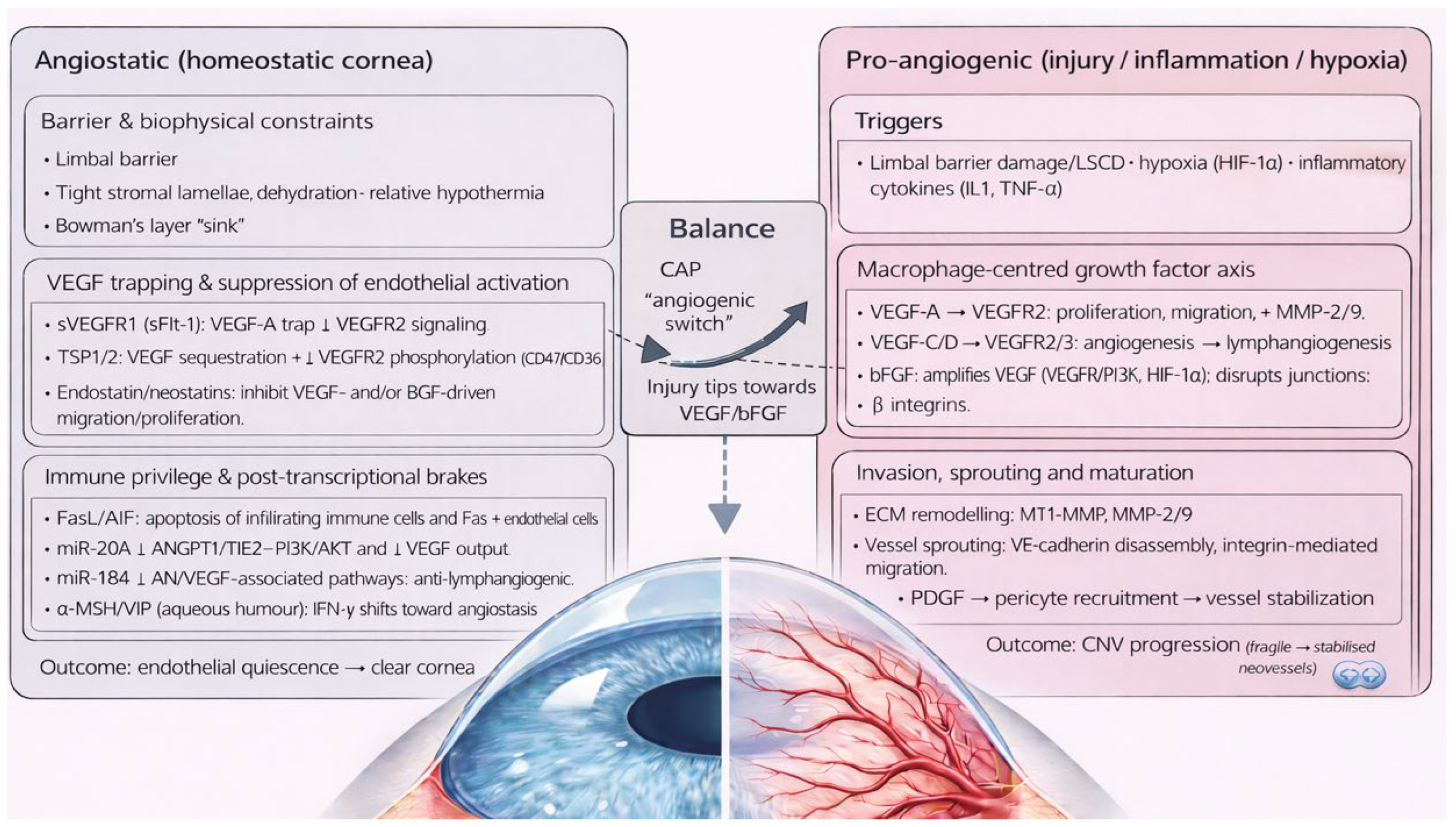
1.3. Pathophysiology
1.4. Clinical Assessment
2. Current Treatments
2.1. Corticosteroids
2.2. Non-Steroidal Anti-Inflammatory Drugs
2.3. Anti-VEGF Agents
2.3.1. Bevacizumab
- a.
- Topical
- b.
- Subconjunctival
- c.
- Intrastromal
2.3.2. Ranibizumab
2.3.3. Aflibercept
2.3.4. Tocilizumab
2.4. Fine Needle Diathermy
2.5. Laser Therapy
2.5.1. Argon
2.5.2. Nd:YAG
2.5.3. Femtosecond
2.5.4. Photodynamic Therapy
2.6. Immunomodulators
2.6.1. Cyclosporine
2.6.2. Tacrolimus
2.6.3. Sirolimus and Everolimus
2.7. Anti-Matrix Metalloproteinases
3. Future Therapies
3.1. Receptor Tyrosine Kinase Inhibitors
3.1.1. Pazopanib
3.1.2. Lapatinib
3.1.3. Regorafenib
3.1.4. Sunitinib
3.1.5. Axitinib
3.1.6. SU6668
3.2. Antifibrotic Agents
3.2.1. Losartan
3.2.2. Decorin
3.2.3. Pirfenidone and Nintedanib
3.3. Antioxidants and Redox-Modulating Therapies
3.3.1. Vitamin E (α-Tocopherol)
3.3.2. Coenzyme Q10
3.3.3. Gallic Acid, Epigallocatechin Gallate, and Related Polyphenols
3.4. Ocular Nanosystems
3.4.1. Nanoemulsions and Microemulsions
3.4.2. Nanowafers
3.5. Corneal Crosslinking
3.6. Mitomycin C Intravascular Chemoembolization
3.7. Gene Therapy
3.7.1. Aganirsen and Antisense Oligonucleotides
3.7.2. CRISPR-Cas 9
3.7.3. Viral Vectors
3.8. Stem Cell Therapy
3.8.1. Mesenchymal Stem Cells
3.8.2. Route of Administration
3.8.3. Extracellular Vesicles and Beyond
3.8.4. Summary of Mesenchymal Stem Cells
4. Conclusions
Future Directions
Author Contributions
Funding
Institutional Review Board Statement
Informed Consent Statement
Data Availability Statement
Conflicts of Interest
Abbreviations
| ACAID | anterior chamber–associated immune deviation |
| AAV | adeno-associated virus |
| AFL | aflibercept |
| AIF | apoptosis-inducing factor |
| α-MSH | alpha-melanocyte stimulating hormone |
| ANG2/ANGPT2 | angiopoietin-2 |
| ANGPT1 | angiopoietin-1 |
| ASO | antisense oligonucleotide |
| bFGF/FGF-2 | basic fibroblast growth factor/fibroblast growth factor-2 |
| BCZ | bevacizumab |
| BM | Bowman’s membrane |
| CAP | corneal angiogenic privilege |
| COX-2 | cyclooxygenase-2 |
| CoNV | corneal neovascularization |
| CRISPR | clustered regularly interspaced short palindromic repeats |
| CsA | cyclosporin A |
| CXL | corneal collagen cross-linking |
| ECM | extracellular matrix |
| EGCG | epigallocatechin gallate |
| EGFR | epidermal growth factor receptor |
| ERK | extracellular signal-regulated kinase |
| FasL | Fas ligand |
| FGFR | fibroblast growth factor receptor |
| FND | fine needle diathermy |
| HIF-1α | hypoxia inducible factor-1 alpha |
| HER2 | human epidermal growth factor receptor-2 |
| HSV-1 | herpes simplex virus-1 |
| ICG | indocyanine green (angiography) |
| IFN-γ | interferon gamma |
| IK | infectious keratitis |
| IL | interleukin (e.g., IL-1, IL-6, IL-8) |
| IPF | idiopathic pulmonary fibrosis |
| IRS-1 | insulin receptor substrate-1 |
| LSCD | limbal stem cell deficiency (concept used; abbreviate if you want) |
| MAPK | mitogen-activated protein kinase |
| MCP-1 | monocyte chemoattractant protein-1 |
| MICE | mitomycin-C intravascular chemoembolization |
| miR/miRNA | microRNA |
| MIF | macrophage migratory inhibitory factor |
| MMP | matrix metalloproteinase |
| mTOR | mammalian target of rapamycin |
| MT1-MMP | membrane type-1 matrix metalloproteinase |
| Nd:YAG | neodymium:yttrium-aluminium-garnet |
| NF-κB | nuclear factor kappa-B |
| NSAID | non-steroidal anti-inflammatory drug |
| PACK-CXL | photoactivated chromophore for keratitis–corneal cross-linking |
| PD-L1 | programmed death-ligand 1 |
| PDGF | platelet-derived growth factor |
| PDGFR | platelet-derived growth factor receptor |
| PI3K | phosphoinositide 3-kinase |
| PlGF | placental growth factor |
| PDT | photodynamic therapy |
| PRK | photorefractive keratectomy |
| QID | four times daily |
| RBZ | ranibizumab |
| RCT | randomised controlled trial |
| ROS | reactive oxygen species |
| RSL | refractive laser surgery (appears in one cited title/description; optional) |
| RTKI/TKI | receptor tyrosine kinase inhibitor/tyrosine kinase inhibitor |
| sVEGFR1/2 | soluble vascular endothelial growth factor receptor-1/-2 |
| TCZ | tocilizumab |
| TGF-β | transforming growth factor beta |
| Th17 | T helper 17 cell |
| TIMP | tissue inhibitor of metalloproteinases |
| TNF-α | tumour necrosis factor alpha |
| Treg | regulatory T cell |
| TSP-1/2 | thrombospondin-1/-2 |
| UVA | ultraviolet-A |
| VA | visual acuity |
| VEC | vascular endothelial cell |
| VEGF | vascular endothelial growth factor |
| VEGFR-1/-2/-3 | vascular endothelial growth factor receptor-1/-2/-3 |
| VIP | vasoactive intestinal peptide |
| Wnt/β-catenin | Wnt/beta-catenin signalling pathway |
References
- Petsoglou, C.; Balaggan, K.S.; Dart, J.K.G.; Bunce, C.; Xing, W.; Ali, R.R.; Tuft, S.J. Subconjunctival bevacizumab induces regression of corneal neovascularisation: A pilot randomised placebo-controlled double-masked trial. Br. J. Ophthalmol. 2013, 97, 28–32. [Google Scholar] [CrossRef] [PubMed]
- Chang, J.H.; Gabison, E.E.; Kato, T.; Azar, D.T. Corneal neovascularization. Curr. Opin. Ophthalmol. 2001, 12, 242–249. [Google Scholar] [CrossRef]
- Lai, S.C.; Loh, E.W.; Chiou, D.I.; Hong, C.T. Efficacy and safety of anti-vascular endothelial growth factor agents on corneal neovascularization: A meta-analysis. World J. Clin. Cases 2023, 11, 7337–7349. [Google Scholar] [CrossRef]
- Menzel-Severing, J. Emerging techniques to treat corneal neovascularisation. Eye 2012, 26, 2–12. [Google Scholar] [CrossRef]
- Ellenberg, D.; Azar, D.T.; Hallak, J.A.; Tobaigy, F.; Han, K.Y.; Jain, S.; Zhou, Z.; Chang, J.H. Novel aspects of corneal angiogenic and lymphangiogenic privilege. Prog. Retin. Eye Res. 2010, 29, 208–248. [Google Scholar] [CrossRef]
- Azar, D.T. Corneal angiogenic privilege: Angiogenic and antiangiogenic factors in corneal avascularity, vasculogenesis, and wound healing (an American Ophthalmological Society thesis). Trans. Am. Ophthalmol. Soc. 2006, 104, 264–302. [Google Scholar]
- Voiculescu, O.B.; Voinea, L.M.; Alexandrescu, C. Corneal neovascularization and biological therapy. J. Med. Life 2015, 8, 444–448. [Google Scholar] [PubMed]
- Lee, P.; Wang, C.C.; Adamis, A.P. Ocular Neovascularization. Surv. Ophthalmol. 1998, 43, 245–269. [Google Scholar] [CrossRef] [PubMed]
- Lasagni Vitar, R.M.; Triolo, G.; Fonteyne, P.; Acuti Martellucci, C.; Manzoli, L.; Rama, P.; Ferrari, G. Epidemiology of Corneal Neovascularization and Its Impact on Visual Acuity and Sensitivity: A 14-Year Retrospective Study. Front. Med. 2021, 8, 733538. [Google Scholar] [CrossRef]
- Gonzalez, L.; Loza, R.J.; Han, K.Y.; Sunoqrot, S.; Cunningham, C.; Purta, P.; Drake, J.; Jain, S.; Hong, S.; Chang, J.-H. Nanotechnology in Corneal Neovascularization Therapy—A Review. J. Ocul. Pharmacol. Ther. 2013, 29, 124–134. [Google Scholar] [CrossRef]
- Stevenson, W.; Cheng, S.F.; Dastjerdi, M.H.; Ferrari, G.; Dana, R. Corneal Neovascularization and the Utility of Topical VEGF Inhibition: Ranibizumab (Lucentis) Vs Bevacizumab (Avastin). Ocul. Surf. 2012, 10, 67–83. [Google Scholar] [CrossRef]
- Faraj, L.A.; Elalfy, M.S.; Said, D.G.; Dua, H.S. Fine needle diathermy occlusion of corneal vessels. Br. J. Ophthalmol. 2014, 98, 1287–1290. [Google Scholar] [CrossRef] [PubMed]
- Di Zazzo, A.; Gaudenzi, D.; Yin, J.; Coassin, M.; Fernandes, M.; Dana, R.; Bonini, S. Corneal angiogenic privilege and its failure. Exp. Eye Res. 2021, 204, 108457. [Google Scholar] [CrossRef]
- Wang, L.; Wang, R.; Xu, C.; Zhou, H. Pathogenesis of Herpes Stromal Keratitis: Immune Inflammatory Response Mediated by Inflammatory Regulators. Front. Immunol. 2020, 11, 766. [Google Scholar] [CrossRef]
- Giménez, F.; Suryawanshi, A.; Rouse, B.T. Pathogenesis of herpes stromal keratitis—A focus on corneal neovascularization. Prog. Retin. Eye Res. 2013, 33, 1–9. [Google Scholar] [CrossRef]
- Biswas, P.S.; Rouse, B.T. Early events in HSV keratitis—Setting the stage for a blinding disease. Microbes Infect. 2005, 7, 799–810. [Google Scholar] [CrossRef]
- Suryawanshi, A.; Mulik, S.; Sharma, S.; Reddy, P.B.J.; Sehrawat, S.; Rouse, B.T. Ocular Neovascularization Caused by Herpes Simplex Virus Type 1 Infection Results from Breakdown of Binding between Vascular Endothelial Growth Factor A and Its Soluble Receptor. J. Immunol. 2011, 186, 3653–3665. [Google Scholar] [CrossRef]
- Abdelfattah, N.S.; Amgad, M.; Zayed, A.A.; Salem, H.; Elkhanany, A.E.; Hussein, H.; El-Baky, N.A. Clinical correlates of common corneal neovascular diseases: A literature review. Int. J. Ophthalmol. 2015, 8, 182–193. [Google Scholar] [PubMed]
- Bachmann, B.; Taylor, R.S.; Cursiefen, C. Corneal Neovascularization as a Risk Factor for Graft Failure and Rejection after Keratoplasty. Ophthalmology 2010, 117, 1300–1305.e7. [Google Scholar] [CrossRef] [PubMed]
- Rolfsen, M.L.; Frisard, N.E.; Stern, E.M.; Foster, T.P.; Bhattacharjee, P.S.; McFerrin, H.E., Jr.; Clement, C.; Rodriguez, P.C.; Lukiw, W.J.; Bergsma, D.R.; et al. Corneal neovascularization: A review of the molecular biology and current therapies. Expert. Rev. Ophthalmol. 2013, 8, 167–189. [Google Scholar] [CrossRef]
- Inomata, T.; Mashaghi, A.; Di Zazzo, A.; Dana, R. Ocular surgical models for immune and angiogenic responses. J. Biol. Methods. 2015, 2, e27. [Google Scholar] [CrossRef]
- Liesegang, T.J. Physiologic changes of the cornea with contact lens wear. Eye Contact Lens 2002, 28, 12–27. [Google Scholar]
- Binder, P.S. The physiologic effects of extended wear soft contact lenses. Ophthalmology 1980, 87, 745–749. [Google Scholar] [CrossRef]
- Wu, D.; Chan, K.E.; Lim, B.X.H.; Lim, D.K.A.; Wong, W.M.; Chai, C.; Manotosh, R.; Lim, C.H.L. Management of corneal neovascularization: Current and emerging therapeutic approaches. Indian J. Ophthalmol. 2024, 72, S354–S371. [Google Scholar] [CrossRef]
- Bock, F.; Maruyama, K.; Regenfuss, B.; Hos, D.; Steven, P.; Heindl, L.M.; Cursiefen, C. Novel anti(lymph)angiogenic treatment strategies for corneal and ocular surface diseases. Prog. Retin. Eye Res. 2013, 34, 89–124. [Google Scholar] [CrossRef]
- Bock, F.; Onderka, J.; Braun, G.; Schneider, A.C.; Hos, D.; Bi, Y.; Bachmann, B.O.; Cursiefen, C. Identification of Novel Endogenous Anti(lymph)angiogenic Factors in the Aqueous Humor. Investig. Ophthalmol. Vis. Sci. 2016, 57, 6554–6560. [Google Scholar] [CrossRef] [PubMed]
- Ambati, B.K.; Nozaki, M.; Singh, N.; Takeda, A.; Jani, P.D.; Suthar, T.; Albuquerque, R.J.C.; Richter, E.; Sakurai, E.; Newcomb, M.T.; et al. Corneal avascularity is due to soluble VEGF receptor-1. Nature 2006, 443, 993–997. [Google Scholar] [CrossRef]
- Ambati, B.K.; Patterson, E.; Jani, P.; Jenkins, C.; Higgins, E.; Singh, N.; Suthar, T.; Vira, N.; Smith, K.; Caldwell, R. Soluble vascular endothelial growth factor receptor-1 contributes to the corneal antiangiogenic barrier. Br. J. Ophthalmol. 2007, 91, 505–508. [Google Scholar] [CrossRef] [PubMed]
- Kommineni, V.K.; Nagineni, C.N.; William, A.; Detrick, B.; Hooks, J.J. IFN-gamma acts as anti-angiogenic cytokine in the human cornea by regulating the expression of VEGF-A and sVEGF-R1. Biochem. Biophys. Res. Commun. 2008, 374, 479–484. [Google Scholar] [CrossRef]
- Liu, C.H.; Wang, Z.; Sun, Y.; Chen, J. Animal models of ocular angiogenesis: From development to pathologies. FASEB J. Off. Publ. Fed. Am. Soc. Exp. Biol. 2017, 31, 4665–4681. [Google Scholar] [CrossRef] [PubMed]
- Albuquerque, R.J.C.; Hayashi, T.; Cho, W.G.; Kleinman, M.E.; Dridi, S.; Takeda, A.; Baffi, J.Z.; Yamada, K.; Kaneko, H.; Green, M.G.; et al. Alternatively spliced vascular endothelial growth factor receptor-2 is an essential endogenous inhibitor of lymphatic vessel growth. Nat. Med. 2009, 15, 1023–1030. [Google Scholar] [CrossRef]
- Qazi, Y.; Wong, G.; Monson, B.; Stringham, J.; Ambati, B.K. Corneal transparency: Genesis, maintenance and dysfunction. Brain Res. Bull. 2010, 81, 198–210. [Google Scholar] [CrossRef]
- Hisatomi, T.; Nakao, S.; Murakami, Y.; Noda, K.; Nakazawa, T.; Notomi, S.; Connolly, E.; She, H.; Almulki, L.; Ito, Y.; et al. The regulatory roles of apoptosis-inducing factor in the formation and regression processes of ocular neovascularization. Am. J. Pathol. 2012, 181, 53–61. [Google Scholar] [CrossRef][Green Version]
- Adams, J.C.; Lawler, J. The thrombospondins. Cold Spring Harb. Perspect. Biol. 2011, 3, a009712. [Google Scholar]
- Foulsham, W.; Dohlman, T.H.; Mittal, S.K.; Taketani, Y.; Singh, R.B.; Masli, S.; Dana, R. Thrombospondin-1 in ocular surface health and disease. Ocul. Surf. 2019, 17, 374–383. [Google Scholar] [CrossRef] [PubMed]
- Greenaway, J.; Lawler, J.; Moorehead, R.; Bornstein, P.; Lamarre, J.; Petrik, J. Thrombospondin-1 inhibits VEGF levels in the ovary directly by binding and internalization via the low density lipoprotein receptor-related protein-1 (LRP-1). J. Cell. Physiol. 2007, 210, 807–818. [Google Scholar] [CrossRef] [PubMed]
- Zhang, X.; Kazerounian, S.; Duquette, M.; Perruzzi, C.; Nagy, J.A.; Dvorak, H.F.; Parangi, S.; Lawler, J. Thrombospondin-1 modulates vascular endothelial growth factor activity at the receptor level. FASEB J. 2009, 23, 3368–3376. [Google Scholar] [CrossRef] [PubMed]
- Lu, Y.; Tai, P.W.L.; Ai, J.; Gessler, D.J.; Su, Q.; Yao, X.; Zheng, Q.; Zamore, P.D.; Xu, X.; Gao, G. Transcriptome Profiling of Neovascularized Corneas Reveals miR-204 as a Multi-target Biotherapy Deliverable by rAAVs. Mol. Ther.-Nucleic Acids 2018, 10, 349–360. [Google Scholar] [CrossRef]
- Zhang, X.; Di, G.; Dong, M.; Qu, M.; Zhao, X.; Duan, H.; Hu, X.; Liu, T.; Zhou, Q.; Shi, W. Epithelium-derived miR-204 inhibits corneal neovascularization. Exp. Eye Res. 2018, 167, 122–127. [Google Scholar] [CrossRef]
- Zong, R.; Zhou, T.; Lin, Z.; Bao, X.; Xiu, Y.; Chen, Y.; Chen, L.; Ma, J.-X.; Liu, Z.; Zhou, Y. Down-Regulation of MicroRNA-184 Is Associated With Corneal Neovascularization. Investig. Ophthalmol. Vis. Sci. 2016, 57, 1398–1407. [Google Scholar] [CrossRef]
- Mukwaya, A.; Jensen, L.; Peebo, B.; Lagali, N. MicroRNAs in the cornea: Role and implications for treatment of corneal neovascularization. Ocul. Surf. 2019, 17, 400–411. [Google Scholar] [CrossRef]
- Cursiefen, C. Immune privilege and angiogenic privilege of the cornea. Chem. Immunol. Allergy 2007, 92, 50–57. [Google Scholar] [PubMed]
- Yoshida, S.; Yoshida, A.; Matsui, H.; Takada, Y.I.; Ishibashi, T. Involvement of macrophage chemotactic protein-1 and interleukin-1beta during inflammatory but not basic fibroblast growth factor-dependent neovascularization in the mouse cornea. Lab. Investig. J. Tech. Methods Pathol. 2003, 83, 927–938. [Google Scholar] [CrossRef] [PubMed]
- Figg, W.D.; Folkman, J. (Eds.) Angiogenesis; Springer: Boston, MA, USA, 2008; Available online: http://link.springer.com/10.1007/978-0-387-71518-6 (accessed on 8 December 2025).
- Fortingo, N.; Melnyk, S.; Sutton, S.H.; Watsky, M.A.; Bollag, W.B. Innate Immune System Activation, Inflammation and Corneal Wound Healing. Int. J. Mol. Sci. 2022, 23, 14933. [Google Scholar] [CrossRef]
- Cao, Y.; Linden, P.; Farnebo, J.; Cao, R.; Eriksson, A.; Kumar, V.; Qi, J.-H.; Claesson-Welsh, L.; Alitalo, K. Vascular endothelial growth factor C induces angiogenesis in vivo. Proc. Natl. Acad. Sci. USA 1998, 95, 14389–14394. [Google Scholar] [CrossRef] [PubMed]
- Cursiefen, C.; Chen, L.; Borges, L.P.; Jackson, D.; Cao, J.; Radziejewski, C.; D’Amore, P.A.; Dana, M.R.; Wiegand, S.J.; Streilein, J.W. VEGF-A stimulates lymphangiogenesis and hemangiogenesis in inflammatory neovascularization via macrophage recruitment. J. Clin. Investig. 2004, 113, 1040–1050. [Google Scholar] [CrossRef]
- Rissanen, T.T.; Markkanen, J.E.; Gruchala, M.; Heikura, T.; Puranen, A.; Kettunen, M.I.; Kholová, I.; Kauppinen, R.A.; Achen, M.G.; Stacker, S.A.; et al. VEGF-D is the strongest angiogenic and lymphangiogenic effector among VEGFs delivered into skeletal muscle via adenoviruses. Circ. Res. 2003, 92, 1098–1106. [Google Scholar] [CrossRef]
- Seghezzi, G.; Patel, S.; Ren, C.J.; Gualandris, A.; Pintucci, G.; Robbins, E.S.; Shapiro, R.L.; Galloway, A.C.; Rifkin, D.B.; Mignatti, P. Fibroblast growth factor-2 (FGF-2) induces vascular endothelial growth factor (VEGF) expression in the endothelial cells of forming capillaries: An autocrine mechanism contributing to angiogenesis. J. Cell Biol. 1998, 141, 1659–1673. [Google Scholar] [CrossRef]
- Presta, M.; Dell’Era, P.; Mitola, S.; Moroni, E.; Ronca, R.; Rusnati, M. Fibroblast growth factor/fibroblast growth factor receptor system in angiogenesis. Cytokine Growth Factor Rev. 2005, 16, 159–178. [Google Scholar] [CrossRef]
- Ferrara, N.; Kerbel, R.S. Angiogenesis as a therapeutic target. Nature 2005, 438, 967–974. [Google Scholar] [CrossRef]
- Esser, S.; Lampugnani, M.G.; Corada, M.; Dejana, E.; Risau, W. Vascular endothelial growth factor induces VE-cadherin tyrosine phosphorylation in endothelial cells. J. Cell Sci. 1998, 111, 1853–1865. [Google Scholar] [CrossRef] [PubMed]
- Dejana, E.; Orsenigo, F.; Lampugnani, M.G. The role of adherens junctions and VE-cadherin in the control of vascular permeability. J. Cell Sci. 2008, 121, 2115–2122. [Google Scholar] [CrossRef] [PubMed]
- Hajrasouliha, A.R.; Sadrai, Z.; Chauhan, S.K.; Dana, R. b-FGF induces corneal blood and lymphatic vessel growth in a spatially distinct pattern. Cornea 2012, 31, 804–809. [Google Scholar] [CrossRef]
- Murakami, M.; Simons, M. Fibroblast growth factor regulation of neovascularization. Curr. Opin. Hematol. 2008, 15, 215–220. [Google Scholar] [CrossRef]
- Brooks, P.C.; Clark, R.A.; Cheresh, D.A. Requirement of vascular integrin alpha v beta 3 for angiogenesis. Science 1994, 264, 569–571. [Google Scholar] [CrossRef]
- Folkman, J.; Shing, Y. Angiogenesis. J. Biol. Chem. 1992, 267, 10931–10934. [Google Scholar] [CrossRef]
- Yang, X.; Liaw, L.; Prudovsky, I.; Brooks, P.C.; Vary, C.; Oxburgh, L.; Friesel, R. Fibroblast growth factor signaling in the vasculature. Curr. Atheroscler. Rep. 2015, 17, 509. [Google Scholar] [CrossRef]
- Zheng, J.; Wen, Y.; Song, Y.; Wang, K.; Chen, D.B.; Magness, R.R. Activation of multiple signaling pathways is critical for fibroblast growth factor 2- and vascular endothelial growth factor-stimulated ovine fetoplacental endothelial cell proliferation. Biol. Reprod. 2008, 78, 143–150. [Google Scholar] [CrossRef]
- Lau, M.T.; So, W.K.; Leung, P.C.K. Fibroblast growth factor 2 induces E-cadherin down-regulation via PI3K/Akt/mTOR and MAPK/ERK signaling in ovarian cancer cells. PLoS ONE 2013, 8, e59083. [Google Scholar] [CrossRef]
- Chen, M.; Bao, L.; Zhao, M.; Cao, J.; Zheng, H. Progress in Research on the Role of FGF in the Formation and Treatment of Corneal Neovascularization. Front. Pharmacol. 2020, 11, 111. [Google Scholar] [CrossRef] [PubMed]
- Onguchi, T.; Han, K.Y.; Chang, J.H.; Azar, D.T. Membrane type-1 matrix metalloproteinase potentiates basic fibroblast growth factor-induced corneal neovascularization. Am. J. Pathol. 2009, 174, 1564–1571. [Google Scholar] [CrossRef]
- Oh, S.Y.; Choi, J.S.; Kim, E.J.; Chuck, R.S.; Park, C.Y. The role of macrophage migration inhibitory factor in ocular surface disease pathogenesis after chemical burn in the murine eye. Mol. Vis. 2010, 16, 2402–2411. [Google Scholar]
- Usui, T.; Yamagami, S.; Kishimoto, S.; Seiich, Y.; Nakayama, T.; Amano, S. Role of macrophage migration inhibitory factor in corneal neovascularization. Investig. Ophthalmol. Vis. Sci. 2007, 48, 3545–3550. [Google Scholar] [CrossRef]
- Cursiefen, C.; Hofmann-Rummelt, C.; Küchle, M.; Schlötzer-Schrehardt, U. Pericyte recruitment in human corneal angiogenesis: An ultrastructural study with clinicopathological correlation. Br. J. Ophthalmol. 2003, 87, 101–106. [Google Scholar] [CrossRef]
- Pérez-Santonja, J.J.; Campos-Mollo, E.; Lledó-Riquelme, M.; Javaloy, J.; Alió, J.L. Inhibition of corneal neovascularization by topical bevacizumab (Anti-VEGF) and Sunitinib (Anti-VEGF and Anti-PDGF) in an animal model. Am. J. Ophthalmol. 2010, 150, 519–528.e1. [Google Scholar] [CrossRef]
- Ferrari, G.; Dastjerdi, M.H.; Okanobo, A.; Cheng, S.F.; Amparo, F.; Nallasamy, N.; Dana, R.M. Topical ranibizumab as a treatment of corneal neovascularization. Cornea 2013, 32, 992–997. [Google Scholar] [CrossRef] [PubMed]
- Lee, Y.F.; Yong, D.W.W.; Manotosh, R. A Review of Contact Lens-Induced Limbal Stem Cell Deficiency. Biology 2023, 12, 1490. [Google Scholar] [CrossRef] [PubMed]
- Ahmad, S. Concise review: Limbal stem cell deficiency, dysfunction, and distress. Stem Cells Transl. Med. 2012, 1, 110–115. [Google Scholar] [CrossRef] [PubMed]
- Espana, E.M.; Ti, S.E.; Grueterich, M.; Touhami, A.; Tseng, S.C.G. Corneal stromal changes following reconstruction by ex vivo expanded limbal epithelial cells in rabbits with total limbal stem cell deficiency. Br. J. Ophthalmol. 2003, 87, 1509–1514. [Google Scholar] [CrossRef][Green Version]
- Grueterich, M.; Espana, E.M.; Tseng, S.C.G. Ex vivo expansion of limbal epithelial stem cells: Amniotic membrane serving as a stem cell niche. Surv. Ophthalmol. 2003, 48, 631–646. [Google Scholar] [CrossRef]
- Kenyon, K.R.; Tseng, S.C. Limbal autograft transplantation for ocular surface disorders. Ophthalmology 1989, 96, 709–722; discussion 722–723. [Google Scholar] [CrossRef]
- Tsai, R.J.; Tseng, S.C. Human allograft limbal transplantation for corneal surface reconstruction. Cornea 1994, 13, 389–400. [Google Scholar] [CrossRef]
- Tombrain-Tink, J.; Barnstable, C.J. (Eds.) Ocular Angiogenesis: Diseases, Mechanisms, and Therapeutics; Humana Press: Totowa, NJ, USA, 2006; Available online: https://link.springer.com/10.1007/978-1-59745-047-8 (accessed on 8 December 2025).
- Yang, Y.; Zhong, J.; Cui, D.; Jensen, L.D. Up-to-date molecular medicine strategies for management of ocular surface neovascularization. Adv. Drug Deliv. Rev. 2023, 201, 115084. [Google Scholar] [CrossRef]
- Anijeet, D.R.; Zheng, Y.; Tey, A.; Hodson, M.; Sueke, H.; Kaye, S.B. Imaging and evaluation of corneal vascularization using fluorescein and indocyanine green angiography. Investig. Ophthalmol. Vis. Sci. 2012, 53, 650–658. [Google Scholar] [CrossRef]
- Ang, M.; Sim, D.A.; Keane, P.A.; Sng, C.C.A.; Egan, C.A.; Tufail, A.; Wilkins, M.R. Optical Coherence Tomography Angiography for Anterior Segment Vasculature Imaging. Ophthalmology 2015, 122, 1740–1747. [Google Scholar] [CrossRef] [PubMed]
- Feizi, S.; Azari, A.A.; Safapour, S. Therapeutic approaches for corneal neovascularization. Eye Vis. 2017, 4, 28. [Google Scholar] [CrossRef]
- Carmeliet, P. Mechanisms of angiogenesis and arteriogenesis. Nat. Med. 2000, 6, 389–395. [Google Scholar] [CrossRef] [PubMed]
- Dana, M.R.; Streilein, J.W. Loss and restoration of immune privilege in eyes with corneal neovascularization. Investig. Ophthalmol. Vis. Sci. 1996, 37, 2485–2494. [Google Scholar]
- Haynes, W.L.; Proia, A.D.; Klintworth, G.K. Effect of inhibitors of arachidonic acid metabolism on corneal neovascularization in the rat. Investig. Ophthalmol. Vis. Sci. 1989, 30, 1588–1593. [Google Scholar]
- Nauck, M.; Karakiulakis, G.; Perruchoud, A.P.; Papakonstantinou, E.; Roth, M. Corticosteroids inhibit the expression of the vascular endothelial growth factor gene in human vascular smooth muscle cells. Eur. J. Pharmacol. 1998, 341, 309–315. [Google Scholar] [CrossRef]
- Musleh, M.G.; Bokre, D.; Dahlmann-Noor, A.H. Risk of intraocular pressure elevation after topical steroids in children and adults: A systematic review. Eur. J. Ophthalmol. 2020, 30, 856–866. [Google Scholar] [CrossRef]
- Fung, A.T.; Tran, T.; Lim, L.L.; Samarawickrama, C.; Arnold, J.; Gillies, M.; Catt, C.; Mitchell, L.; Symons, A.; Buttery, R.; et al. Local delivery of corticosteroids in clinical ophthalmology: A review. Clin. Exp. Ophthalmol. 2020, 48, 366–401. [Google Scholar] [CrossRef] [PubMed]
- Suwan-Apichon, O.; Reyes, J.M.; Herretes, S.; Vedula, S.S.; Chuck, R.S. Topical corticosteroids as adjunctive therapy for bacterial keratitis. Cochrane Database Syst. Rev. 2007, 10, CD005430. [Google Scholar]
- Rice, J.B.; White, A.G.; Scarpati, L.M.; Wan, G.; Nelson, W.W. Long-term Systemic Corticosteroid Exposure: A Systematic Literature Review. Clin. Ther. 2017, 39, 2216–2229. [Google Scholar] [CrossRef]
- Jang, Y.H.; Choi, E.Y.; Lee, H.; Woo, J.; Park, S.; Noh, Y.; Jeon, J.-Y.; Yoo, E.-Y.; Shin, J.-Y.; Lee, Y.W. Long-Term Use of Oral Corticosteroids and Safety Outcomes for Patients With Atopic Dermatitis. JAMA Netw. Open 2024, 7, e2423563. [Google Scholar] [CrossRef] [PubMed]
- Jan, B.M.; Khayat, M.A.; Bushnag, A.I.; Zahid, A.I.; Alkarim, A.S.; Alshehri, M.T.; Almasoudi, F.M.; Zahran, M.; A Almazrooa, S.; Mawardi, H.H. The Association Between Long-Term Corticosteroids Use and Dental Caries: A Systematic Review. Cureus 2023, 15, e44600. [Google Scholar] [CrossRef]
- Pakneshan, P.; Birsner, A.E.; Adini, I.; Becker, C.M.; D’Amato, R.J. Differential suppression of vascular permeability and corneal angiogenesis by nonsteroidal anti-inflammatory drugs. Investig. Ophthalmol. Vis. Sci. 2008, 49, 3909–3913. [Google Scholar] [CrossRef]
- Matsumura, T.; Iwasaki, K.; Arimura, S.; Takeda, R.; Takamura, Y.; Inatani, M. Topical bromfenac reduces multiple inflammatory cytokines in the aqueous humour of pseudophakic patients. Sci. Rep. 2021, 11, 6018. [Google Scholar] [CrossRef] [PubMed]
- Song, L.; Liu, X.; Chen, N.; Liu, J.; Nie, A.; Li, W. The Effect of Bromfenac Sodium Nanopolymer Used in Anterior Segment of the Eye on Corneal Neovascularization. Cell. Mol. Biol. Noisy—Gd. Front. 2022, 68, 330–338. [Google Scholar] [CrossRef]
- Flach, A.J. Corneal melts associated with topically applied nonsteroidal anti-inflammatory drugs. Trans. Am. Ophthalmol. Soc. 2001, 99, 205–210; discussion 210–212. [Google Scholar]
- Hoffman, R.S.; Braga-Mele, R.; Donaldson, K.; Emerick, G.; Henderson, B.; Kahook, M.; Mamalis, N.; Miller, K.M.; Realini, T.; Shorstein, N.H.; et al. Cataract surgery and nonsteroidal antiinflammatory drugs. J. Cataract. Refract. Surg. 2016, 42, 1368–1379. [Google Scholar] [CrossRef]
- Mikropoulos, D.G.; Kymionis, G.D.; Chatzea, M.S.; Xanthopoulou, K.; Ageladarakis, P.K.; Voudouragkaki, I.C.; Konstas, A.G. Acute Corneal Melting Induced by the Concomitant Use of a Non-steroidal Anti-inflammatory Agent with an Antiseptic Eye Drop. Ophthalmol. Ther. 2024, 13, 645–649. [Google Scholar] [CrossRef]
- Drzyzga, Ł.; Śpiewak, D.; Dorecka, M.; Wyględowska-Promieńska, D. Available Therapeutic Options for Corneal Neovascularization: A Review. Int. J. Mol. Sci. 2024, 25, 5479. [Google Scholar] [CrossRef]
- Shi, H.; Zhu, Y.; Xing, C.; Li, S.; Bao, Z.; Lei, L.; Lin, D.; Wang, Y.; Chen, H.; Xu, X. An injectable thermosensitive hydrogel for dual delivery of diclofenac and Avastin® to effectively suppress inflammatory corneal neovascularization. Int. J. Pharm. 2022, 625, 122081. [Google Scholar] [CrossRef]
- Chan, E.; Fan Gaskin, J.; Chan, E.C. Corneal Neovascularisation and Anti-VEGF Therapy. Targets 2025, 3, 9. [Google Scholar] [CrossRef]
- Wang, Y.; Fei, D.; Vanderlaan, M.; Song, A. Biological activity of bevacizumab, a humanized anti-VEGF antibody in vitro. Angiogenesis 2004, 7, 335–345. [Google Scholar] [CrossRef] [PubMed]
- Lowe, J.; Araujo, J.; Yang, J.; Reich, M.; Oldendorp, A.; Shiu, V.; Quarmby, V.; Lowman, H.; Lien, S.; Gaudreault, J.; et al. Ranibizumab inhibits multiple forms of biologically active vascular endothelial growth factor in vitro and in vivo. Exp. Eye Res. 2007, 85, 425–430. [Google Scholar] [CrossRef]
- Deissler, H.L.; Lang, G.K.; Lang, G.E. Capacity of aflibercept to counteract VEGF-stimulated abnormal behavior of retinal microvascular endothelial cells. Exp. Eye Res. 2014, 122, 20–31. [Google Scholar] [CrossRef] [PubMed]
- Keane, P.A.; Sadda, S.R. Development of Anti-VEGF Therapies for Intraocular Use: A Guide for Clinicians. J. Ophthalmol. 2012, 2012, 483034. [Google Scholar] [CrossRef]
- Levine, E.S.; Custo Greig, E.; Mendonça, L.S.M.; Gulati, S.; Despotovic, I.N.; Alibhai, A.Y.; Moult, E.; Muakkassa, N.; Maftouhi, M.Q.-E.; El Maftouhi, A.; et al. The long-term effects of anti-vascular endothelial growth factor therapy on the optical coherence tomography angiographic appearance of neovascularization in age-related macular degeneration. Int. J. Retin. Vitr. 2020, 6, 39. [Google Scholar] [CrossRef]
- Eski, M.T.; Teberik, K.; Oltulu, P.; Ankaralı, H.; Kaya, M.; Alpay, M. The effects of subconjunctival bevacizumab, ranibizumab, and aflibercept on corneal neovascularization. Hum. Exp. Toxicol. 2022, 41, 9603271221084674. [Google Scholar] [CrossRef]
- MacCumber, M.W.; Wykoff, C.C.; Karcher, H.; Adiguzel, E.; Sinha, S.B.; Vishwakarma, S.; LaPrise, A.; Igwe, F.; Freitas, R.; Ip, M.S.; et al. One-Year Brolucizumab Outcomes in Neovascular Age-Related Macular Degeneration from a Large United States Cohort in the IRIS® Registry. Ophthalmology 2023, 130, 937–946. [Google Scholar] [CrossRef] [PubMed]
- Chaudhary, V.; Guymer, R.; Artignan, A.; Downey, A.; Singh, R.P. Real-World Evidence for Faricimab in Neovascular Age-Related Macular Degeneration and Diabetic Macular Edema: A Scoping Review. Ophthalmol. Sci. 2025, 5, 100744. [Google Scholar] [CrossRef]
- Lupidi, M.; Iaculli, C.; Marco, L.; Rossi, S.; Sicari, E.; Villa, G.; Pirani, V. Faricimab in the Treatment of Exudative Neovascular Age-Related Macular Degeneration and Diabetic Macular Edema in Italy: The FARIT Real World Study. Ophthalmol. Ther. 2025, 14, 2197–2214. [Google Scholar] [CrossRef]
- Grisanti, S.; Ziemssen, F. Bevacizumab: Off-label use in ophthalmology. Indian J. Ophthalmol. 2007, 55, 417–420. [Google Scholar] [CrossRef] [PubMed]
- Koenig, Y.; Bock, F.; Horn, F.; Kruse, F.; Straub, K.; Cursiefen, C. Short- and long-term safety profile and efficacy of topical bevacizumab (Avastin) eye drops against corneal neovascularization. Graefe’s Arch. Clin. Exp. Ophthalmol. 2009, 247, 1375–1382. [Google Scholar] [CrossRef] [PubMed]
- Dastjerdi, M.H.; Al-Arfaj, K.M.; Nallasamy, N.; Hamrah, P.; Jurkunas, U.V.; Pineda, R.; Pavan-Langston, D.; Dana, R. Topical bevacizumab in the treatment of corneal neovascularization: Results of a prospective, open-label, noncomparative study. Arch. Ophthalmol. 2009, 127, 381–389. [Google Scholar] [CrossRef] [PubMed]
- Jamaludin, M.I.; Wan Abdul Halim, W.H.; Cheng, T.C. Clinical Outcomes of Topical Bevacizumab for the Treatment of Corneal Neovascularization. Cureus 2024, 16, e59548. [Google Scholar] [CrossRef]
- Kim, S.W.; Ha, B.J.; Kim, E.K.; Tchah, H.; Kim, T. The Effect of Topical Bevacizumab on Corneal Neovascularization. Ophthalmology 2008, 115, e33–e38. [Google Scholar] [CrossRef]
- Waisbourd, M.; Levinger, E.; Varssano, D.; Moisseiev, E.; Zayit-Soudri, S.; Barak, A.; Loewenstein, A.; Barequet, I. High-dose topical bevacizumab for corneal neovascularization. Pharmacology 2013, 92, 310–314. [Google Scholar] [CrossRef]
- Kuo, H.H.; Shen, E.P. Long-term topical bevacizumab for prevention of corneal graft rejections. Eur. J. Ophthalmol. 2021, 31, NP48–NP52. [Google Scholar] [CrossRef]
- Peng, W.Y.; He, L.W.; Yin, X.F.; Zhou, B.B.; Zhou, T.; Zhou, S.Y. Successful regression of newly formed corneal neovascularization by subconjunctival injection of bevacizumab in patients with chemical burns. Front. Med. 2023, 10, 1210765. [Google Scholar] [CrossRef]
- Rocher, M.; Benayoun, Y.; Quilbe, S.; Laribi, S.; Fournie, P.; Leveziel, N.; Trone, M.C.; Bourcier, T.; Robert, P.Y. A randomized study of subconjonctival bevacizumab (Avastin®) injection for corneal neovascularization. J. Front. Ophtalmol. 2024, 47, 104152. [Google Scholar]
- Chu, H.S.; Chen, T.C.; Hu, F.R.; Chen, W.L. Recurrence of corneal neovascularization associated with lipid deposition after subconjunctival injection of bevacizumab. Cornea 2013, 32, 1446–1453. [Google Scholar] [CrossRef]
- Agarwal, S.; Angayarkanni, N.; Iyer, G.; Srinivasan, B.; Natarajan, R.; Charola, S.; Arumugam, S.; Padmanabhan, P. Clinico-biochemical correlation of the effect of subconjunctival bevacizumab for corneal neovascularization. Cornea 2014, 33, 1016–1021. [Google Scholar] [CrossRef]
- Dohlman, T.H.; McSoley, M.; Amparo, F.; Carreno-Galeano, T.; Wang, M.; Dastjerdi, M.; Singh, R.B.; Coco, G.; Zazzo, A.D.; Shikari, H.; et al. Bevacizumab in High-Risk Corneal Transplantation: A Pilot Multicenter Prospective Randomized Control Trial. Ophthalmology 2022, 129, 865–879. [Google Scholar] [CrossRef]
- Dastjerdi, M.H.; Sadrai, Z.; Saban, D.R.; Zhang, Q.; Dana, R. Corneal penetration of topical and subconjunctival bevacizumab. Investig. Ophthalmol. Vis. Sci. 2011, 52, 8718–8723. [Google Scholar] [CrossRef]
- Ozdemir, O.; Altintas, O.; Altintas, L.; Ozkan, B.; Akdag, C.; Yüksel, N. Comparison of the effects of subconjunctival and topical anti-VEGF therapy (bevacizumab) on experimental corneal neovascularization. Arq. Bras. Oftalmol. 2014, 77, 209–213. [Google Scholar] [CrossRef]
- Papathanassiou, M.; Theodoropoulou, S.; Analitis, A.; Tzonou, A.; Theodossiadis, P.G. Vascular endothelial growth factor inhibitors for treatment of corneal neovascularization: A meta-analysis. Cornea 2013, 32, 435–444. [Google Scholar] [CrossRef] [PubMed]
- Gupta, A.A.; Mammo, D.A.; Page, M.A. Intrastromal bevacizumab in the management of corneal neovascularization: A retrospective review. Graefe’s Arch. Clin. Exp. Ophthalmol. 2020, 258, 167–173. [Google Scholar] [CrossRef] [PubMed]
- Sarah, B.; Ibtissam, H.; Mohammed, B.; Hasna, S.; Abdeljalil, M. Intrastromal Injection of Bevacizumab in the Management of Corneal Neovascularization: About 25 Eyes. J. Ophthalmol. 2016, 2016, 6084270. [Google Scholar] [CrossRef]
- Yeung, S.N.; Lichtinger, A.; Kim, P.; Amiran, M.D.; Slomovic, A.R. Combined use of subconjunctival and intracorneal bevacizumab injection for corneal neovascularization. Cornea 2011, 30, 1110–1114. [Google Scholar] [CrossRef]
- Liarakos, V.S.; Papaconstantinou, D.; Vergados, I.; Douvali, M.; Theodossiadis, P.G. The effect of subconjunctival ranibizumab on corneal and anterior segment neovascularization: Study on an animal model. Eur. J. Ophthalmol. 2014, 24, 299–308. [Google Scholar] [CrossRef]
- Kim, J.H.; Seo, H.W.; Han, H.C.; Lee, J.H.; Choi, S.K.; Lee, D. The effect of bevacizumab versus ranibizumab in the treatment of corneal neovascularization: A preliminary study. Korean J. Ophthalmol. KJO 2013, 27, 235–242. [Google Scholar] [CrossRef]
- Stewart, M.W. Aflibercept (VEGF-TRAP): The next anti-VEGF drug. Inflamm. Allergy Drug Targets 2011, 10, 497–508. [Google Scholar] [CrossRef] [PubMed]
- Papadopoulos, N.; Martin, J.; Ruan, Q.; Rafique, A.; Rosconi, M.P.; Shi, E.; Pyles, E.A.; Yancopoulos, G.D.; Stahl, N.; Wiegand, S.J. Binding and neutralization of vascular endothelial growth factor (VEGF) and related ligands by VEGF Trap, ranibizumab and bevacizumab. Angiogenesis 2012, 15, 171–185. [Google Scholar] [CrossRef] [PubMed]
- de Oliveira Dias, J.R.; de Andrade, G.C.; Novais, E.A.; Farah, M.E.; Rodrigues, E.B. Fusion proteins for treatment of retinal diseases: Aflibercept, ziv-aflibercept, and conbercept. Int. J. Retin. Vitr. 2016, 2, 3. [Google Scholar] [CrossRef]
- Oliveira, H.B.; Sakimoto, T.; Javier, J.A.D.; Azar, D.T.; Wiegand, S.J.; Jain, S.; Chang, J.H. VEGF Trap(R1R2) suppresses experimental corneal angiogenesis. Eur. J. Ophthalmol. 2010, 20, 48–54. [Google Scholar] [CrossRef] [PubMed]
- Park, Y.R.; Chung, S.K. Inhibitory Effect of Topical Aflibercept on Corneal Neovascularization in Rabbits. Cornea 2015, 34, 1303–1307. [Google Scholar] [CrossRef]
- Eiger-Moscovich, M.; Livny, E.; Sella, R.; Gal-Or, O.; Nisgav, Y.; Livnat, T.; Bahar, I. Comparison of Subconjunctival Aflibercept and Betamethasone for the Treatment of Formed Corneal Neovascularization in a Rabbit Model. Ophthalmic Res. 2019, 62, 116–122. [Google Scholar] [CrossRef]
- Sella, R.; Gal-Or, O.; Livny, E.; Dachbash, M.; Nisgav, Y.; Weinberger, D.; Livnat, T.; Bahar, I. Efficacy of topical aflibercept versus topical bevacizumab for the prevention of corneal neovascularization in a rat model. Exp. Eye Res. 2016, 146, 224–232. [Google Scholar] [CrossRef]
- Sella, R.; Ben Ishai, M.; Livny, E.; Nahum, Y.; Bahar, I. Subconjunctival Aflibercept for the Treatment of Formed Corneal Neovascularization. Eye Contact Lens 2021, 47, 180–184. [Google Scholar] [CrossRef]
- Aksoy, S. Treatment of corneal neovascularization with topical aflibercept in a case of exposure keratopathy following cerebellar astrocytoma surgery. Indian J. Ophthalmol. 2019, 67, 145–147. [Google Scholar] [CrossRef]
- Tian, X.; Zhang, M.; Wu, Y.; Zhang, L.; Zhang, L.; Zheng, X.; Ou, S.; Gu, H. Establishing a Severe Corneal Inflammation Model in Rats Based on Corneal Epithelium Curettage Combined with Corneal Sutures. J. Vis. Exp. JoVE 2024, 213, e67305. [Google Scholar] [CrossRef] [PubMed]
- Saud, E.E.; Moraes, H.V.; Marculino, L.G.C.; Gomes, J.A.P.; Allodi, S.; Miguel, N.C.O. Clinical and histopathological outcomes of subconjunctival triamcinolone injection for the treatment of acute ocular alkali burn in rabbits. Cornea 2012, 31, 181–187. [Google Scholar] [CrossRef]
- Yoo, A.R.; Chung, S.K. Effects of subconjunctival tocilizumab versus bevacizumab in treatment of corneal neovascularization in rabbits. Cornea 2014, 33, 1088–1094. [Google Scholar] [CrossRef]
- Sakimoto, T.; Sugaya, S.; Ishimori, A.; Sawa, M. Anti-inflammatory effect of IL-6 receptor blockade in corneal alkali burn. Exp. Eye Res. 2012, 97, 98–104. [Google Scholar] [CrossRef] [PubMed]
- Wu, X.S.; Lu, X.L.; Wu, J.; Ma, M.; Yu, J.; Zhang, Z.Y. Tocilizumab promotes corneal allograft survival in rats by modulating Treg-Th17 balance. Int. J. Ophthalmol. 2019, 12, 1823–1831. [Google Scholar] [CrossRef]
- Pillai, C.T.; Dua, H.S.; Hossain, P. Fine needle diathermy occlusion of corneal vessels. Investig. Ophthalmol. Vis. Sci. 2000, 41, 2148–2153. [Google Scholar]
- Wertheim, M.S.; Cook, S.D.; Knox-Cartwright, N.E.; Van, D.L.; Tole, D.M. Electrolysis-needle cauterization of corneal vessels in patients with lipid keratopathy. Cornea 2007, 26, 230–231. [Google Scholar] [CrossRef]
- Trikha, S.; Parikh, S.; Osmond, C.; Anderson, D.F.; Hossain, P.N. Long-term outcomes of Fine Needle Diathermy for established corneal neovascularisation. Br. J. Ophthalmol. 2014, 98, 454–458. [Google Scholar] [CrossRef]
- Koenig, Y.; Bock, F.; Kruse, F.E.; Stock, K.; Cursiefen, C. Angioregressive pretreatment of mature corneal blood vessels before keratoplasty: Fine-needle vessel coagulation combined with anti-VEGFs. Cornea 2012, 31, 887–892. [Google Scholar] [CrossRef]
- Mestanoglu, M.; Händel, A.; Cursiefen, C.; Hos, D. Three-year follow-up of high-risk keratoplasty following fine-needle diathermy of corneal neovascularization combined with bevacizumab. Graefe’s Arch. Clin. Exp. Ophthalmol. 2022, 260, 2383–2385. [Google Scholar] [CrossRef]
- Le, V.N.H.; Hou, Y.; Bock, F.; Cursiefen, C. Supplemental Anti Vegf A-Therapy Prevents Rebound Neovascularisation After Fine Needle Diathermy Treatment to Regress Pathological Corneal (LYMPH)Angiogenesis. Sci. Rep. 2020, 10, 3908. [Google Scholar] [CrossRef] [PubMed]
- Spiteri, N.; Romano, V.; Zheng, Y.; Yadav, S.; Dwivedi, R.; Chen, J.; Ahmad, S.; Willoughby, C.E.; Kaye, S.B. Corneal angiography for guiding and evaluating fine-needle diathermy treatment of corneal neovascularization. Ophthalmology 2015, 122, 1079–1084. [Google Scholar] [CrossRef]
- Cherry, P.M.; Garner, A. Corneal neovascularization treated with argon laser. Br. J. Ophthalmol. 1976, 60, 464–472. [Google Scholar] [CrossRef] [PubMed][Green Version]
- Baer, J.C.; Foster, C.S. Corneal laser photocoagulation for treatment of neovascularization. Efficacy of 577 nm yellow dye laser. Ophthalmology 1992, 99, 173–179. [Google Scholar] [CrossRef] [PubMed]
- Marsh, R.J. Argon laser treatment of lipid keratopathy. Br. J. Ophthalmol. 1988, 72, 900–904. [Google Scholar] [CrossRef]
- Lakshmipathy, M.; Susvar, P.; Popet, K.; Rajagopal, R. Subconjunctival bevacizumab and argon laser photocoagulation for preexisting neovascularization following deep lamellar anterior keratoplasty. Indian J. Ophthalmol. 2019, 67, 1193–1194. [Google Scholar] [CrossRef]
- Donato, M.G.; Donato, E.; Cordeiro, M.Á.d.C.; Martins de Andrade, M.; Holanda de Freitas, J.A. Treating corneal neovascularization using a combination of anti-VEGF injection and argon laser photocoagulation application—Case report. Rom. J. Ophthalmol. 2021, 65, 286–289. [Google Scholar] [CrossRef]
- Kumar, J.; Gehra, A.; Sirohi, N. Role of Frequency Doubled Nd: Yag Laser in Treatment of Corneal Neovascularisation. J. Clin. Diagn. Res. JCDR 2016, 10, NC01–NC04. [Google Scholar] [CrossRef]
- Parsa, C.F.; Temprano, J.; Wilson, D.; Green, W.R. Hemorrhage Complicating YAG Laser Feeder Vessel Coagulation of Cornea Vascularization. Cornea 1994, 13, 264–268. [Google Scholar] [CrossRef] [PubMed]
- Ratkay-Traub, I.; Ferincz, I.E.; Juhasz, T.; Kurtz, R.M.; Krueger, R.R. First clinical results with the femtosecond neodynium-glass laser in refractive surgery. J. Refract. Surg. 2003, 19, 94–103. [Google Scholar] [CrossRef] [PubMed]
- Kymionis, G.D.; Kankariya, V.P.; Plaka, A.D.; Reinstein, D.Z. Femtosecond laser technology in corneal refractive surgery: A review. J. Refract. Surg. 2012, 28, 912–920. [Google Scholar] [CrossRef]
- Sidhu, M.S.; Choi, M.Y.; Woo, S.Y.; Lee, H.K.; Lee, H.S.; Kim, K.J.; Jeoung, S.C.; Choi, J.-S.; Joo, C.-K.; Park, I.-H. Femtosecond laser-assisted selective reduction of neovascularization in rat cornea. Lasers Med. Sci. 2014, 29, 1417–1427. [Google Scholar] [CrossRef] [PubMed]
- Erikitola, O.C.; Crosby-Nwaobi, R.; Lotery, A.J.; Sivaprasad, S. Photodynamic therapy for central serous chorioretinopathy. Eye 2014, 28, 944–957. [Google Scholar] [CrossRef]
- Fossarello, M.; Peiretti, E.; Zucca, I.; Serra, A. Photodynamic therapy of corneal neovascularization with verteporfin. Cornea 2003, 22, 485–488. [Google Scholar] [CrossRef]
- Brooks, B.J.; Ambati, B.K.; Marcus, D.M.; Ratanasit, A. Photodynamic therapy for corneal neovascularisation and lipid degeneration. Br. J. Ophthalmol. 2004, 88, 840. [Google Scholar] [CrossRef]
- Al-Abdullah, A.A.; Al-Assiri, A. Resolution of bilateral corneal neovascularization and lipid keratopathy after photodynamic therapy with verteporfin. Optom.-J. Am. Optom. Assoc. 2011, 82, 212–214. [Google Scholar] [CrossRef]
- Yoon, K.C.; You, I.C.; Kang, I.S.; Im, S.K.; Ahn, J.K.; Park, Y.G.; Ahn, K.Y. Photodynamic therapy with verteporfin for corneal neovascularization. Am. J. Ophthalmol. 2007, 144, 390–395. [Google Scholar] [CrossRef]
- Al-Torbak, A. Photodynamic therapy with verteporfin for corneal neovascularization. Middle East Afr. J. Ophthalmol. 2012, 19, 185. [Google Scholar] [CrossRef]
- Hamdan, J.; Boulze, M.; Aziz, A.; Alessi, G.; Hoffart, L. Corneal neovascularisation treatments compared: Subconjunctival bevacizumab injections and/or photodynamic therapy. J. Front. Ophtalmol. 2015, 38, 924–933. [Google Scholar] [CrossRef]
- Sirks, M.J.; Van Dijk, E.H.C.; Rosenberg, N.; Hollak, C.E.M.; Aslanis, S.; Cheung, C.M.G.; Chowers, I.; Eandi, C.M.; Freund, K.B.; Holz, F.G.; et al. Clinical impact of the worldwide shortage of verteporfin (Visudyne®) on ophthalmic care. Acta Ophthalmol. 2022, 100, e1522–e1532. [Google Scholar] [CrossRef] [PubMed]
- Shah, G.; Middleton, F.A.; Gentile, K.L.; Tripathi, S.; Bruch, D.; Maier, K.G.; Kittur, D.S. Cyclosporine Inhibition of Angiogenesis Involves the Transcription Factor HESR1. J. Surg. Res. 2008, 149, 171–176. [Google Scholar] [CrossRef]
- Hernández, G.L.; Volpert, O.V.; Íñiguez, M.A.; Lorenzo, E.; Martínez-Martínez, S.; Grau, R.; Fresno, M.; Redondo, J.M. Selective Inhibition of Vascular Endothelial Growth Factor–Mediated Angiogenesis by Cyclosporin a. J. Exp. Med. 2001, 193, 607–620. [Google Scholar] [CrossRef] [PubMed]
- Bock, F.; Matthaei, M.; Reinhard, T.; Böhringer, D.; Christoph, J.; Ganslandt, T.; Cursiefen, C. High-Dose Subconjunctival Cyclosporine A Implants Do Not Affect Corneal Neovascularization after High-Risk Keratoplasty. Ophthalmology 2014, 121, 1677–1682. [Google Scholar] [CrossRef]
- Althaus, C.; Dagres, E.; Reinhard, T.; Christians, U.; Sundmacher, R. Cyclosporin-A and its metabolites in the anterior chamber after topical and systemic application as determined with high-performance liquid chromatography-electrospray mass spectrometry. Ger. J. Ophthalmol. 1996, 5, 189–194. [Google Scholar]
- Shimazaki, J.; Den, S.; Omoto, M.; Satake, Y.; Shimmura, S.; Tsubota, K. Prospective, Randomized Study of the Efficacy of Systemic Cyclosporine in High-Risk Corneal Transplantation. Am. J. Ophthalmol. 2011, 152, 33–39.e1. [Google Scholar] [CrossRef] [PubMed]
- Cejkova, J.; Cejka, C.; Trosan, P.; Zajicova, A.; Sykova, E.; Holan, V. Treatment of alkali-injured cornea by cyclosporine A-loaded electrospun nanofibers—An alternative mode of therapy. Exp. Eye Res. 2016, 147, 128–137. [Google Scholar] [CrossRef]
- Wang, M.; Zhou, J.; Niu, Q.; Wang, H. Mechanism of tacrolimus in the treatment of lupus nephritis. Front. Pharmacol. 2024, 15, 1331800. [Google Scholar] [CrossRef]
- Sloper, C.M.L.; Powell, R.J.; Dua, H.S. Tacrolimus (FK506) in the management of high-risk corneal and limbal grafts1 1The authors have no proprietary interest in any aspect of this work. Ophthalmology 2001, 108, 1838–1844. [Google Scholar] [CrossRef] [PubMed]
- Barbarino, J.M.; Staatz, C.E.; Venkataramanan, R.; Klein, T.E.; Altman, R.B. PharmGKB summary: Cyclosporine and tacrolimus pathways. Pharmacogenet. Genom. 2013, 23, 563–585. [Google Scholar] [CrossRef] [PubMed]
- Turgut, B.; Guler, M.; Akpolat, N.; Demır, T.; Celıker, U. The Impact of Tacrolimus on Vascular Endothelial Growth Factor in Experimental Corneal Neovascularization. Curr. Eye Res. 2011, 36, 34–40. [Google Scholar] [CrossRef] [PubMed]
- Park, J.H.; Joo, C.K.; Chung, S.K. Comparative Study of Tacrolimus and Bevacizumab on Corneal Neovascularization in Rabbits. Cornea 2015, 34, 449–455. [Google Scholar] [CrossRef]
- Chen, L.; Zhong, J.; Li, S.; Li, W.; Wang, B.; Deng, Y.; Yuan, J. The long-term effect of tacrolimus on alkali burn-induced corneal neovascularization and inflammation surpasses that of anti-vascular endothelial growth factor. Drug Des. Devel. Ther. 2018, 12, 2959–2969. [Google Scholar] [CrossRef]
- Zhai, L.Y.; Zhang, X.R.; Liu, H.; Ma, Y.; Xu, H.C. Observation of topical tacrolimus on high-risk penetrating keratoplasty patients: A randomized clinical trial study. Eye 2020, 34, 1600–1607. [Google Scholar] [CrossRef]
- Testa, S.; Bui, N.Q.; Ganjoo, K.N. Systemic Treatments and Molecular Biomarkers for Perivascular Epithelioid Cell Tumors: A Single-institution Retrospective Analysis. Cancer Res. Commun. 2023, 3, 1212–1223. [Google Scholar] [CrossRef]
- Wagner, A.J.; Malinowska-Kolodziej, I.; Morgan, J.A.; Qin, W.; Fletcher, C.D.M.; Vena, N.; Ligon, A.H.; Antonescu, C.R.; Ramaiya, N.H.; Demetri, G.D.; et al. Clinical Activity of mTOR Inhibition With Sirolimus in Malignant Perivascular Epithelioid Cell Tumors: Targeting the Pathogenic Activation of mTORC1 in Tumors. J. Clin. Oncol. 2010, 28, 835–840. [Google Scholar] [CrossRef]
- Gennatas, C.; Michalaki, V.; Vasilatou Kairi, P.; Kondi-Paphiti, A.; Voros, D. Successful treatment with the mTOR inhibitor everolimus in a patient with Perivascular epithelioid cell tumor. World J. Surg. Oncol. 2012, 10, 181. [Google Scholar] [CrossRef]
- Kahan, B.D. Efficacy of sirolimus compared with azathioprine for reduction of acute renal allograft rejection: A randomised multicentre study. Lancet 2000, 356, 194–202. [Google Scholar] [CrossRef]
- Wataya-Kaneda, M.; Ohno, Y.; Fujita, Y.; Yokozeki, H.; Niizeki, H.; Ogai, M.; Fukai, K.; Nagai, H.; Yoshida, Y.; Hamada, I.; et al. Sirolimus Gel Treatment vs Placebo for Facial Angiofibromas in Patients With Tuberous Sclerosis Complex: A Randomized Clinical Trial. JAMA Dermatol. 2018, 154, 781. [Google Scholar] [CrossRef] [PubMed]
- Sehgal, S.N. Sirolimus: Its discovery, biological properties, and mechanism of action. Transpl. Proc. 2003, 35, S7–S14. [Google Scholar] [CrossRef] [PubMed]
- Shin, Y.J.; Hyon, J.Y.; Choi, W.S.; Yi, K.; Chung, E.S.; Chung, T.Y.; Wee, W.R. Chemical Injury-Induced Corneal Opacity and Neovascularization Reduced by Rapamycin via TGF-β1/ERK Pathways Regulation. Investig. Opthalmol. Vis. Sci. 2013, 54, 4452. [Google Scholar] [CrossRef]
- Li, J.; Han, J.; Shi, Y.; Liu, M. Rapamycin inhibits corneal inflammatory response and neovascularization in a mouse model of corneal alkali burn. Exp. Eye Res. 2023, 233, 109539. [Google Scholar] [CrossRef]
- Çakmak, H.; Ergin, K.; Bozkurt, G.; Kocatürk, T.; Evliçoğlu, G.E. The effects of topical everolimus and sunitinib on corneal neovascularization. Cutan. Ocul. Toxicol. 2016, 35, 97–103. [Google Scholar] [CrossRef] [PubMed]
- Pittayapruek, P.; Meephansan, J.; Prapapan, O.; Komine, M.; Ohtsuki, M. Role of Matrix Metalloproteinases in Photoaging and Photocarcinogenesis. Int. J. Mol. Sci. 2016, 17, 868. [Google Scholar] [CrossRef]
- Schönbeck, U.; Mach, F.; Libby, P. Generation of biologically active IL-1 beta by matrix metalloproteinases: A novel caspase-1-independent pathway of IL-1 beta processing. J. Immunol. 1998, 161, 3340–3346. [Google Scholar]
- Bergers, G.; Brekken, R.; McMahon, G.; Vu, T.H.; Itoh, T.; Tamaki, K.; Tanzawa, K.; Thorpe, P.; Itohara, S.; Werb, Z.; et al. Matrix metalloproteinase-9 triggers the angiogenic switch during carcinogenesis. Nat. Cell Biol. 2000, 2, 737–744. [Google Scholar] [CrossRef]
- Kothari, P.; Pestana, R.; Mesraoua, R.; Elchaki, R.; Khan, K.M.F.; Dannenberg, A.J.; Falcone, D.J. IL-6–Mediated Induction of Matrix Metalloproteinase-9 Is Modulated by JAK-Dependent IL-10 Expression in Macrophages. J. Immunol. 2014, 192, 349–357. [Google Scholar] [CrossRef]
- Levi, E.; Fridman, R.; Miao, H.Q.; Ma, Y.S.; Yayon, A.; Vlodavsky, I. Matrix metalloproteinase 2 releases active soluble ectodomain of fibroblast growth factor receptor 1. Proc. Natl. Acad. Sci. USA 1996, 93, 7069–7074. [Google Scholar] [CrossRef]
- Samolov, B.; Steen, B.; Seregard, S.; Van Der Ploeg, I.; Montan, P.; Kvanta, A. Delayed inflammation-associated corneal neovascularization in MMP-2-deficient mice. Exp. Eye Res. 2005, 80, 159–166. [Google Scholar] [CrossRef]
- Raffetto, J.D.; Khalil, R.A. Matrix metalloproteinases and their inhibitors in vascular remodeling and vascular disease. Biochem. Pharmacol. 2008, 75, 346–359. [Google Scholar] [CrossRef]
- Dan, L.; Shi-long, Y.; Miao-li, L.; Yong-ping, L.; Hong-jie, M.; Ying, Z.; Xiang-Gui, W. Inhibitory Effect of Oral Doxycycline on Neovascularization in a Rat Corneal Alkali Burn Model of Angiogenesis. Curr. Eye Res. 2008, 33, 653–660. [Google Scholar] [CrossRef]
- Han, L.; Su, W.; Huang, J.; Zhou, J.; Qiu, S.; Liang, D. Doxycycline Inhibits Inflammation-Induced Lymphangiogenesis in Mouse Cornea by Multiple Mechanisms. PLoS ONE 2014, 9, e108931. [Google Scholar] [CrossRef]
- Gilbertson-Beadling, S.; Powers, E.A.; Stamp-Cole, M.; Scott, P.S.; Wallace, T.L.; Copeland, J.; Petzold, G.; Mitchell, M.; Ledbetter, S.; Poorman, R.; et al. The tetracycline analogs minocycline and doxycycline inhibit angiogenesis in vitro by a non-metalloproteinase-dependent mechanism. Cancer Chemother. Pharmacol. 1995, 36, 418–424. [Google Scholar] [CrossRef]
- Jovanovic, V.; Nikolic, L. The Effect of Topical Doxycycline on Corneal Neovascularization. Curr. Eye Res. 2014, 39, 142–148. [Google Scholar] [CrossRef]
- Lodhi, A.A.; Murtaza Ahmed, M.; Ahmed, N.; Haider, G.; Junejo, S.A.; Kamal, M. Role of Tetracycline in Corneal Neovascularization. Pak. J. Ophthalmol. 2015, 31, 150–153. [Google Scholar]
- Goktas, S.; Erdogan, E.; Sakarya, R.; Sakarya, Y.; Yılmaz, M.; Ozcimen, M.; Unlukal, N.; Alpfidan, I.; Tas, F.; Erdogan, E.; et al. Inhibition of Corneal Neovascularization by Topical and Subconjunctival Tigecycline. J. Ophthalmol. 2014, 2014, 452685. [Google Scholar] [CrossRef] [PubMed]
- Ghiasian, L.; Habibi, A.; Aliakbar Navahi, R.; Hadavandkhani, A.; Akbarian, S.; Alemzadeh, S.A.; Khorasani, M.A. Safety of the subconjunctival injection of doxycycline in rabbits. Cutan. Ocul. Toxicol. 2019, 38, 390–394. [Google Scholar] [CrossRef] [PubMed]
- Aydin, E.; Kivilcim, M.; Peyman, G.A.; Esfahani, M.R.; Kazi, A.A.; Sanders, D.R. Inhibition of Experimental Angiogenesis of Cornea by Various Doses of Doxycycline and Combination of Triamcinolone Acetonide With Low-molecular-weight Heparin and Doxycycline. Cornea 2008, 27, 446–453. [Google Scholar] [CrossRef]
- Murata, M.; Shimizu, S.; Horiuchi, S.; Taira, M. Inhibitory effect of triamcinolone acetonide on corneal neovascularization. Graefes. Arch. Clin. Exp. Ophthalmol. 2006, 244, 205–209. [Google Scholar] [CrossRef]
- Yamaoka, T.; Kusumoto, S.; Ando, K.; Ohba, M.; Ohmori, T. Receptor Tyrosine Kinase-Targeted Cancer Therapy. Int. J. Mol. Sci. 2018, 19, 3491. [Google Scholar] [CrossRef]
- Gotink, K.J.; Verheul, H.M.W. Anti-angiogenic tyrosine kinase inhibitors: What is their mechanism of action? Angiogenesis 2010, 13, 1–14. [Google Scholar] [CrossRef]
- Mederle, A.L.; Stana, L.G.; Ilie, A.C.; Borza, C.; Streian, C.G.; Nistor, D.; Cerbulescu, T.; Belovan, B.; Lascu, A. Efficacy and Safety of Pazopanib in the Treatment of Thyroid Cancer: A Systematic Review. Biomedicines 2024, 12, 2820. [Google Scholar] [CrossRef] [PubMed]
- Cella, D.; Beaumont, J.L. Pazopanib in the treatment of advanced renal cell carcinoma. Ther. Adv. Urol. 2016, 8, 61–69. [Google Scholar] [CrossRef]
- Amparo, F.; Sadrai, Z.; Jin, Y.; Alfonso-Bartolozzi, B.; Wang, H.; Shikari, H.; Ciolino, J.B.; Chodosh, J.; Jurkunas, U.; Schaumberg, D.A.; et al. Safety and Efficacy of the Multitargeted Receptor Kinase Inhibitor Pazopanib in the Treatment of Corneal Neovascularization. Investig. Opthalmol. Vis. Sci. 2013, 54, 537. [Google Scholar] [CrossRef]
- Dogan, I.; Yıldız, A.; Ahmed, M.A.; Vatansever, S. Efficacy of Lapatinib Plus Capecitabine After TDM-1 in HER2-Positive Metastatic Breast Cancer Patients. Indian J. Surg. Oncol. 2024, 15, 489–494. [Google Scholar] [CrossRef] [PubMed]
- Kaya, M.K.; Demir, T.; Bulut, H.; Akpolat, N.; Turgut, B. Effects of lapatinib and trastuzumab on vascular endothelial growth factor in experimental corneal neovascularization. Clin. Exp. Ophthalmol. 2015, 43, 449–457. [Google Scholar] [CrossRef]
- Bruix, J.; Qin, S.; Merle, P.; Granito, A.; Huang, Y.H.; Bodoky, G.; Pracht, M.; Yokosuka, O.; Rosmorduc, O.; Breder, V.; et al. Regorafenib for patients with hepatocellular carcinoma who progressed on sorafenib treatment (RESORCE): A randomised, double-blind, placebo-controlled, phase 3 trial. Lancet 2017, 389, 56–66. [Google Scholar] [CrossRef] [PubMed]
- Onder, H.I.; Erdurmus, M.; Bucak, Y.Y.; Simavli, H.; Oktay, M.; Kukner, A.S. Inhibitory effects of regorafenib, a multiple tyrosine kinase inhibitor, on corneal neovascularization. Int. J. Ophthalmol. 2014, 7, 220–225. [Google Scholar][Green Version]
- Ko, B.Y.; Kim, Y.; Baek, S.; Lee, G.; Kim, J.M.; Jean, W.S.; Lee, N.-S.; Kang, J. Inhibition of Corneal Neovascularization by Subconjunctival and Topical Bevacizumab and Sunitinib in a Rabbit Model. Cornea 2013, 32, 689–695. [Google Scholar] [CrossRef] [PubMed]
- Hashemian, M.N.; Mahrjerdi, H.Z.; Mazloumi, M.; Safizadeh, M.S.; Shakiba, Y.; Rahimi, F.; Afarideh, M.; Zare, M.A.; Tafti, M.F.; Sepidan, B.B.; et al. Comparison of different doses of subconjunctival sunitinib with bevacizumab in the treatment of corneal neovascularization in experimental rats. J. Res. Med. Sci. 2017, 22, 16. [Google Scholar] [CrossRef] [PubMed]
- Ekim, Y.; Kara, S.; Gencer, B.; Karaca, T. Efficacy of Sunitinib, Sunitinib-Hesperetin, and Sunitinib-Doxycycline Combinations on Experimentally-Induced Corneal Neovascularization. Curr. Eye Res. 2019, 44, 590–598. [Google Scholar] [CrossRef]
- Gomes Souza, L.; Antonio Sousa-Junior, A.; Alves Santana Cintra, B.; Vieira Dos Anjos, J.L.; Leite Nascimento, T.; Palmerston Mendes, L.; Vieira, M.d.S.; Ducas, R.D.N.; Valadares, M.C.; Mendanha, S.A.; et al. Pre-clinical safety of topically administered sunitinib-loaded lipid and polymeric nanocarriers targeting corneal neovascularization. Int. J. Pharm. 2023, 635, 122682. [Google Scholar] [CrossRef]
- Yang, J.; Luo, L.; Oh, Y.; Meng, T.; Chai, G.; Xia, S.; Emmert, D.; Wang, B.; Eberhart, C.G.; Lee, S.; et al. Sunitinib malate-loaded biodegradable microspheres for the prevention of corneal neovascularization in rats. J. Control. Release 2020, 327, 456–466. [Google Scholar] [CrossRef]
- Lledó Riquelme, M.; Campos-Mollo, E.; Fernández-Sánchez, L. Topical axitinib is a potent inhibitor of corneal neovascularization. Clin. Exp. Ophthalmol. 2018, 46, 1063–1074. [Google Scholar] [CrossRef]
- Bakri, S.J.; Lynch, J.; Howard-Sparks, M.; Saint-Juste, S.; Saim, S. Vorolanib, sunitinib, and axitinib: A comparative study of vascular endothelial growth factor receptor inhibitors and their anti-angiogenic effects. PLoS ONE 2024, 19, e0304782. [Google Scholar] [CrossRef]
- Klenke, F.M.; Abdollahi, A.; Bertl, E.; Gebhard, M.M.; Ewerbeck, V.; Huber, P.E.; Sckell, A. Tyrosine kinase inhibitor SU6668 represses chondrosarcoma growth via antiangiogenesis in vivo. BMC Cancer 2007, 7, 49. [Google Scholar] [CrossRef]
- Naumova, E.; Ubezio, P.; Garofalo, A.; Borsotti, P.; Cassis, L.; Riccardi, E.; Scanzani, E.; Eccles, S.A.; Bani, M.R.; Giavazzi, R. The Vascular Targeting Property of Paclitaxel Is Enhanced by SU6668, a Receptor Tyrosine Kinase Inhibitor, Causing Apoptosis of Endothelial Cells and Inhibition of Angiogenesis. Clin. Cancer Res. 2006, 12, 1839–1849. [Google Scholar] [CrossRef]
- Wu, H.; Ye, J.; Zhang, M.; Zhang, L.; Lin, S.; Li, Q.; Liu, Y.; Han, Y.; Huang, C.; Wu, Y.; et al. A SU6668 pure nanoparticle-based eyedrops: Toward its high drug Accumulation and Long-time treatment for corneal neovascularization. J. Nanobiotechnol. 2024, 22, 290. [Google Scholar] [CrossRef] [PubMed]
- Ye, J.; Cheng, Y.; Wen, X.; Han, Y.; Wei, X.; Wu, Y.; Chen, C.; Su, M.; Cai, S.; Pan, J.; et al. Biomimetic nanocomplex based corneal neovascularization theranostics. J. Control. Release Off. J. Control. Release Soc. 2024, 374, 50–60. [Google Scholar] [CrossRef]
- Habashi, J.P.; Judge, D.P.; Holm, T.M.; Cohn, R.D.; Loeys, B.L.; Cooper, T.K.; Myers, L.; Klein, E.C.; Liu, G.; Calvi, C.; et al. Losartan, an AT1 Antagonist, Prevents Aortic Aneurysm in a Mouse Model of Marfan Syndrome. Science 2006, 312, 117–121. [Google Scholar] [CrossRef]
- Sampaio, L.P.; Hilgert, G.S.L.; Shiju, T.M.; Murillo, S.E.; Santhiago, M.R.; Wilson, S.E. Topical losartan inhibits corneal scarring fibrosis and collagen type IV deposition after Descemet’s membrane-endothelial excision in rabbits. Exp. Eye Res. 2022, 216, 108940. [Google Scholar] [CrossRef] [PubMed]
- Pereira-Souza, A.L.; Ambrósio, R.; Bandeira, F.; Salomão, M.Q.; Souza Lima, A.; Wilson, S.E. Topical Losartan for Treating Corneal Fibrosis (Haze): First Clinical Experience. J. Refract. Surg. 2022, 38, 741–746. [Google Scholar] [CrossRef] [PubMed]
- Pucker, A.D.; Frogozo, M.; Malooley, M.M.; Harthan, J.S. Point-Counter Point: Treating Corneal Haze with 0.8 mg/mL Topical Losartan. Clin. Insights Eyecare 2024, 2, 1–6. [Google Scholar]
- Dutra, B.A.L.; Wilson, S.E. Topical Losartan in the Management of Corneal Scarring Fibrosis: Update on Dosage, Efficacy, and Potential Epithelial Toxicity. J. Ocul. Pharmacol. Ther. 2025, 41, 232–236. [Google Scholar] [CrossRef] [PubMed]
- Wilson, S.E. Two-phase mechanism in the treatment of corneal stromal fibrosis with topical losartan. Exp. Eye Res. 2024, 242, 109884. [Google Scholar] [CrossRef]
- Mohan, R.R.; Tovey, J.C.K.; Gupta, R.; Sharma, A.; Tandon, A. Decorin Biology, Expression, Function and Therapy in the Cornea. Curr. Mol. Med. 2011, 11, 110–128. [Google Scholar] [CrossRef]
- Santra, M.; Santra, S.; Zhang, J.; Chopp, M. Ectopic decorin expression up-regulates VEGF expression in mouse cerebral endothelial cells via activation of the transcription factors Sp1, HIF1α, and Stat3. J. Neurochem. 2008, 105, 324–337. [Google Scholar] [CrossRef]
- Khan, G.A.; Girish, G.V.; Lala, N.; Di Guglielmo, G.M.; Lala, P.K. Decorin Is a Novel VEGFR-2-Binding Antagonist for the Human Extravillous Trophoblast. Mol. Endocrinol. 2011, 25, 1431–1443. [Google Scholar] [CrossRef]
- Zhang, W.; Ge, Y.; Cheng, Q.; Zhang, Q.; Fang, L.; Zheng, J. Decorin is a pivotal effector in the extracellular matrix and tumour microenvironment. Oncotarget 2018, 9, 5480–5491. [Google Scholar] [CrossRef]
- Mohan, R.R.; Balne, P.K.; Muayad, M.S.; Tripathi, R.; Sinha, N.R.; Gupta, S.; Sinha, P.R.; Hesemann, N.P. Six-Month In Vivo Safety Profiling of Topical Ocular AAV5–Decorin Gene Transfer. Transl. Vis. Sci. Technol. 2021, 10, 5. [Google Scholar] [CrossRef]
- Balne, P.K.; Gupta, S.; Zhang, J.; Bristow, D.; Faubion, M.; Heil, S.D.; Sinha, P.R.; Green, S.L.; Iozzo, R.V.; Mohan, R.R. The functional role of decorin in corneal neovascularization in vivo. Exp. Eye Res. 2021, 207, 108610. [Google Scholar] [CrossRef]
- Noble, P.W.; Albera, C.; Bradford, W.Z.; Costabel, U.; Du Bois, R.M.; Fagan, E.A.; Fishman, R.S.; Glaspole, I.; Glassberg, M.K.; Lancaster, L.; et al. Pirfenidone for idiopathic pulmonary fibrosis: Analysis of pooled data from three multinational phase 3 trials. Eur. Respir. J. 2016, 47, 243–253. [Google Scholar] [CrossRef]
- Dixon, P.; Ghosh, T.; Mondal, K.; Konar, A.; Chauhan, A.; Hazra, S. Controlled delivery of pirfenidone through vitamin E-loaded contact lens ameliorates corneal inflammation. Drug Deliv. Transl. Res. 2018, 8, 1114–1126. [Google Scholar] [CrossRef] [PubMed]
- Diaz-Palomera, C.D.; Vidal-Paredes, I.A.; Navarro-Partida, J.; Cid-Hernandez, M.; Rosales-Rivera, L.C.; De La Rosa-Bibiano, R.; Monroy-Ramirez, H.C.; Santos, A.; Armendariz-Borunda, J. Topical Pirfenidone-Loaded Liposomes Ophthalmic Formulation Reduces Haze Development after Corneal Alkali Burn in Mice. Pharmaceutics 2022, 14, 316. [Google Scholar] [CrossRef] [PubMed]
- Aravena, C.; Labarca, G.; Venegas, C.; Arenas, A.; Rada, G. Pirfenidone for Idiopathic Pulmonary Fibrosis: A Systematic Review and Meta-Analysis. PLoS ONE 2015, 10, e0136160. [Google Scholar]
- King, T.E.; Bradford, W.Z.; Castro-Bernardini, S.; Fagan, E.A.; Glaspole, I.; Glassberg, M.K.; Gorina, E.; Hopkins, P.M.; Kardatzke, D.; Lancaster, L.; et al. A Phase 3 Trial of Pirfenidone in Patients with Idiopathic Pulmonary Fibrosis. N. Engl. J. Med. 2014, 370, 2083–2092. [Google Scholar] [CrossRef]
- Noble, P.W.; Albera, C.; Bradford, W.Z.; Costabel, U.; Glassberg, M.K.; Kardatzke, D.; King, T.E., Jr.; Lancaster, L.; Sahn, S.A.; Szwarcberg, J.; et al. Pirfenidone in patients with idiopathic pulmonary fibrosis (CAPACITY): Two randomised trials. Lancet 2011, 377, 1760–1769. [Google Scholar] [CrossRef]
- Behr, J.; Prasse, A.; Kreuter, M.; Johow, J.; Rabe, K.F.; Bonella, F.; Bonnet, R.; Grohe, C.; Held, M.; Wilkens, H.; et al. Pirfenidone in patients with progressive fibrotic interstitial lung diseases other than idiopathic pulmonary fibrosis (RELIEF): A double-blind, randomised, placebo-controlled, phase 2b trial. Lancet Respir. Med. 2021, 9, 476–486. [Google Scholar] [CrossRef]
- Bao, Y.; Huang, L.; Huang, X.; Gao, C.; Chen, Y.; Wu, L.; Zhu, S.; Song, Y. Pirfenidone ameliorates the formation of choroidal neovascularization in mice. Mol. Med. Rep. 2020, 21, 2162–2170. [Google Scholar] [CrossRef]
- Lin, T.; Gong, L. Inhibition of lymphangiogenesis in vitro and in vivo by the multikinase inhibitor nintedanib. Drug Des. Devel. Ther. 2017, 11, 1147–1158. [Google Scholar] [CrossRef]
- Chen, J.; Du, W.; Tang, X.; Yu, W.Z. Inhibition of corneal neovascularization by topical application of nintedanib in rabbit models. Int. J. Ophthalmol. 2021, 14, 1666–1673. [Google Scholar] [CrossRef] [PubMed]
- Liu, X.; Wu, S.; Gong, Y.; Yang, L. Effect of Nintedanib Nanothermoreversible Hydrogel on Neovascularization in an Ocular Alkali Burn Rat Model. Curr. Eye Res. 2022, 47, 1578–1589. [Google Scholar] [CrossRef] [PubMed]
- Gong, Y. Effect of nintedanib thermo-sensitive hydrogel on neovascularization in alkali burn rat model. Int. J. Ophthalmol. 2020, 13, 879–885. [Google Scholar] [CrossRef]
- Wang, W.; Deng, M.; Li, M.; Liu, L.; Zou, J.; Qian, Y. Exploring Corneal Neovascularization: An Integrated Approach Using Transcriptomics and Proteomics in an Alkali Burn Mouse Model. Investig. Ophthalmol. Vis. Sci. 2024, 65, 21. [Google Scholar] [CrossRef] [PubMed]
- Mittal, M.; Siddiqui, M.R.; Tran, K.; Reddy, S.P.; Malik, A.B. Reactive Oxygen Species in Inflammation and Tissue Injury. Antioxid. Redox. Signal. 2014, 20, 1126–1167. [Google Scholar] [CrossRef]
- Chang, J.H.; Garg, N.K.; Lunde, E.; Han, K.Y.; Jain, S.; Azar, D.T. Corneal neovascularization: An anti-VEGF therapy review. Surv. Ophthalmol. 2012, 57, 415–429. [Google Scholar] [CrossRef]
- Kvanta, A. Ocular angiogenesis: The role of growth factors. Acta Ophthalmol. Scand. 2006, 84, 282–288. [Google Scholar] [CrossRef]
- Özgür, A.; Özmen, M.C.; Yalınbaş Yeter, D.; İnan, M.A. Antineovascular Effects of Coenzyme Q10 and Vitamin E Combination in Corneal Neovascularization: A Pilot Study. J. Ocul. Pharmacol. Ther. Off. J. Assoc. Ocul. Pharmacol. Ther. 2025, 41, 418–423. [Google Scholar] [CrossRef]
- Li, K.; Gong, Q.; Lu, B.; Huang, K.; Tong, Y.; Mutsvene, T.E.; Lin, M.; Xu, Z.; Lu, F.; Li, X.; et al. Anti-inflammatory and antioxidative effects of gallic acid on experimental dry eye: In vitro and in vivo studies. Eye Vis. 2023, 10, 17. [Google Scholar] [CrossRef]
- Zhu, H.; Ye, J.; Wu, Y.; Cheng, Y.; Su, M.; Dai, Q.; Han, Y.; Pan, J.; Wu, Z.; Chen, C.; et al. A Synergistic Therapy With Antioxidant and Anti-VEGF: Toward its Safe and Effective Elimination for Corneal Neovascularization. Adv. Healthc. Mater. 2024, 13, e2302192. [Google Scholar] [CrossRef] [PubMed]
- Li, S.; Chen, L.; Fu, Y. Nanotechnology-based ocular drug delivery systems: Recent advances and future prospects. J. Nanobiotechnol. 2023, 21, 232. [Google Scholar] [CrossRef] [PubMed]
- Zhang, C.; Yin, Y.; Zhao, J.; Li, Y.; Wang, Y.; Zhang, Z.; Niu, L.; Zheng, Y. An Update on Novel Ocular Nanosystems with Possible Benefits in the Treatment of Corneal Neovascularization. Int. J. Nanomed. 2022, 17, 4911–4931. [Google Scholar] [CrossRef]
- Huang, X.; Wu, Y.; Li, K.; Xing, W.; Zhao, N.; Chen, Z.; Tao, W.; Zhou, X.; Yang, M.; Huang, J. Advanced Nanotechnology-Driven Innovations for Corneal Neovascularization Therapy: Smart Drug Delivery and Enhanced Treatment Strategies. Adv. Mater. 2025, 37, 2508726. [Google Scholar] [CrossRef]
- Weng, Y.; Liu, J.; Jin, S.; Guo, W.; Liang, X.; Hu, Z. Nanotechnology-based strategies for treatment of ocular disease. Acta Pharm. Sin. B 2017, 7, 281–291. [Google Scholar] [CrossRef] [PubMed]
- Bhia, M.; Motallebi, M.; Abadi, B.; Zarepour, A.; Pereira-Silva, M.; Saremnejad, F.; Santos, A.C.; Zarrabi, A.; Melero, A.; Jafari, S.M.; et al. Naringenin Nano-Delivery Systems and Their Therapeutic Applications. Pharmaceutics 2021, 13, 291. [Google Scholar] [CrossRef] [PubMed]
- Delgado-Tirado, S.; Gonzalez-Buendia, L.; An, M.; Amarnani, D.; Isaacs-Bernal, D.; Whitmore, H.; Arevalo-Alquichire, S.; Leyton-Cifuentes, D.; Ruiz-Moreno, J.M.; Arboleda-Velasquez, J.F.; et al. Topical Nanoemulsion of a Runt-related Transcription Factor 1 Inhibitor for the Treatment of Pathologic Ocular Angiogenesis. Ophthalmol. Sci. 2022, 2, 100163. [Google Scholar] [CrossRef]
- Zhang, R.; Yang, J.; Luo, Q.; Shi, J.; Xu, H.; Zhang, J. Preparation and in vitro and in vivo evaluation of an isoliquiritigenin-loaded ophthalmic nanoemulsion for the treatment of corneal neovascularization. Drug Deliv. 2022, 29, 2217–2233. [Google Scholar] [CrossRef]
- Shi, J.; Yang, J.; Xu, H.; Luo, Q.; Sun, J.; Zhang, Y.; Liang, Z.; Zhao, N.; Zhang, J. Preparation of a Sunitinib loaded microemulsion for ocular delivery and evaluation for the treatment of corneal neovascularization in vitro and in vivo. Front. Pharmacol. 2023, 14, 1157084. [Google Scholar] [CrossRef]
- Qi, Q.; Su, D.; Zhuang, S.; Yao, S.; Heindl, L.M.; Fan, X.; Lin, M.; Li, J.; Pang, Y. Progress in Nanotechnology for Treating Ocular Surface Chemical Injuries: Reflecting on Advances in Ophthalmology. Adv. Sci. 2025, 12, 2407340. [Google Scholar] [CrossRef]
- Mohapatra, D.; Yang, E.; Corson, T.W. Emulsion and Emulgel-Based Ophthalmic Drug Delivery Systems. Pharmaceutics 2025, 17, 1504. [Google Scholar] [CrossRef]
- Yuan, X.; Marcano, D.C.; Shin, C.S.; Hua, X.; Isenhart, L.C.; Pflugfelder, S.C.; Acharya, G. Ocular Drug Delivery Nanowafer with Enhanced Therapeutic Efficacy. ACS Nano 2015, 9, 1749–1758. [Google Scholar] [CrossRef]
- Bian, F.; Shin, C.S.; Wang, C.; Pflugfelder, S.C.; Acharya, G.; De Paiva, C.S. Dexamethasone Drug Eluting Nanowafers Control Inflammation in Alkali-Burned Corneas Associated With Dry Eye. Investig. Opthalmol. Vis. Sci. 2016, 57, 3222. [Google Scholar] [CrossRef]
- Ammassam Veettil, R.; Marcano, D.C.; Yuan, X.; Zaheer, M.; Adumbumkulath, A.; Lee, R.; Isenhart, L.C.; Soriano, N.; Mhatre, K.; Joseph, R.; et al. Dextran Sulfate Polymer Wafer Promotes Corneal Wound Healing. Pharmaceutics 2021, 13, 1628. [Google Scholar] [CrossRef] [PubMed]
- Li, J.; Ji, P.; Lin, X. Efficacy of Corneal Collagen Cross-Linking for Treatment of Keratoconus: A Meta-Analysis of Randomized Controlled Trials. PLoS ONE 2015, 10, e0127079. [Google Scholar] [CrossRef] [PubMed]
- Kobashi, H.; Rong, S.S. Corneal Collagen Cross-Linking for Keratoconus: Systematic Review. BioMed. Res. Int. 2017, 2017, 8145651. [Google Scholar] [CrossRef]
- Cehelyk, E.K.; Syed, Z.A. Long-term outcomes of corneal crosslinking. Curr. Opin. Ophthalmol. 2024, 35, 315–321. [Google Scholar] [CrossRef] [PubMed]
- Lu, N.J.; Torres-Netto, E.A.; Aydemir, M.E.; Kling, S.; Hafezi, N.; Kollros, L.; Hafezi, F. A Transepithelial Corneal Cross-linking (CXL) Protocol Providing the Same Biomechanical Strengthening as Accelerated Epithelium-off CXL. J. Refract. Surg. 2025, 41, e724–e730. [Google Scholar] [CrossRef]
- Said, D.G.; Elalfy, M.S.; Gatzioufas, Z.; El-Zakzouk, E.S.; Hassan, M.A.; Saif, M.Y.; Zaki, A.A.; Dua, H.S.; Hafezi, F. Collagen Cross-Linking with Photoactivated Riboflavin (PACK-CXL) for the Treatment of Advanced Infectious Keratitis with Corneal Melting. Ophthalmology 2014, 121, 1377–1382. [Google Scholar] [CrossRef]
- Ting, D.S.J.; Henein, C.; Said, D.G.; Dua, H.S. Photoactivated chromophore for infectious keratitis—Corneal cross-linking (PACK-CXL): A systematic review and meta-analysis. Ocul. Surf. 2019, 17, 624–634. [Google Scholar] [CrossRef]
- Hafezi, F.; Kanellopoulos, J.; Wiltfang, R.; Seiler, T. Corneal collagen crosslinking with riboflavin and ultraviolet A to treat induced keratectasia after laser in situ keratomileusis. J. Cataract. Refract. Surg. 2007, 33, 2035–2040. [Google Scholar] [CrossRef]
- Hafezi, F.; Hosny, M.; Shetty, R.; Knyazer, B.; Chen, S.; Wang, Q.; Hashemi, H.; Torres-Netto, E.A.; the PACK-CXL Working Group; Zhang, H.; et al. PACK-CXL vs. antimicrobial therapy for bacterial, fungal, and mixed infectious keratitis: A prospective randomized phase 3 trial. Eye Vis. 2022, 9, 2. [Google Scholar] [CrossRef]
- Knutsson, K.A.; Genovese, P.N.; Paganoni, G.; Ambrosio, O.; Ferrari, G.; Zennato, A.; Cataldo, M.; Caccia, M.; Rama, P. Evaluation of a Post-Operative Therapy Protocol after Epithelium-Off Corneal Cross-Linking in Patients Affected by Keratoconus. J. Clin. Med. 2022, 11, 7093. [Google Scholar] [CrossRef]
- Zhu, Y.; Li, L.; Reinach, P.S.; Li, Y.; Ge, C.; Qu, J.; Chen, W. Corneal Collagen Cross-Linking With Riboflavin and UVA Regulates Hemangiogenesis and Lymphangiogenesis in Rats. Investig. Ophthalmol. Vis. Sci. 2018, 59, 3702–3712. [Google Scholar] [CrossRef] [PubMed]
- Zhu, Y.; Reinach, P.S.; Ge, C.; Li, Y.; Wu, B.; Xie, Q.; Tong, L.; Chen, W. Corneal Collagen Cross-Linking Pretreatment Mitigates Injury-Induced Inflammation, Hemangiogenesis and Lymphangiogenesis In Vivo. Transl. Vis. Sci. Technol. 2021, 10, 11. [Google Scholar] [CrossRef] [PubMed]
- Hou, Y.; Le, V.N.H.; Tóth, G.; Siebelmann, S.; Horstmann, J.; Gabriel, T.; Bock, F.; Cursiefen, C. UV light crosslinking regresses mature corneal blood and lymphatic vessels and promotes subsequent high-risk corneal transplant survival. Am. J. Transpl. 2018, 18, 2873–2884. [Google Scholar] [CrossRef] [PubMed]
- Hou, Y.; Zhang, W.; Le, V.N.H.; Deng, S.; Hadrian, K.; Mestanoglu, M.; Musial, G.; Bock, F.; Cursiefen, C. Efficacy and safety of combined UV -light corneal crosslinking and fine-needle diathermy to regress pathological murine corneal (lymph)angiogenesis in vivo. Acta Ophthalmol. 2024, 102, e1002–e1010. [Google Scholar] [CrossRef]
- Schaub, F.; Hou, Y.; Zhang, W.; Bock, F.; Hos, D.; Cursiefen, C. Corneal Crosslinking to Regress Pathologic Corneal Neovascularization Before High-Risk Keratoplasty. Cornea 2021, 40, 147–155. [Google Scholar] [CrossRef]
- Wiedemann, J.; Hos, D.; Limburg, E.; Zettelmeyer, U.; Schiller, P.; Franklin, J.; Bachmann, B.; Böhringer, D.; Dietrich-Ntoukas, T.; Fuchsluger, T.A.; et al. UV light-mediated corneal crosslinking as (lymph)angioregressive pretreatment to promote graft survival after subsequent high-risk corneal transplantation (CrossCornealVision): Protocol for a multicenter, randomized controlled trial. Trials 2024, 25, 169. [Google Scholar] [CrossRef]
- Gulzar, A.; Yıldız, E.; Kaleli, H.N.; Nazeer, M.A.; Zibandeh, N.; Malik, A.N.; Taş, A.Y.; Lazoğlu, I.; Şahin, A.; Kizilel, S. Ruthenium-induced corneal collagen crosslinking under visible light. Acta Biomater. 2022, 147, 198–208. [Google Scholar] [CrossRef]
- Dhawan, S.; Rao, K.; Natrajan, S. Complications of Corneal Collagen Cross-Linking. J. Ophthalmol. 2011, 2011, 869015. [Google Scholar] [CrossRef]
- Zaher Addeen, S.; Oyoun, Z.; Alfhaily, H.; Anbari, A. CASE REPORT: Outcomes of mitomycin C intravascular chemoembolization (MICE) in refractory corneal neovascularization after failed keratoplasty. Digit. J. Ophthalmol. 2023, 29, 9–13. [Google Scholar] [CrossRef]
- Rangu, N.; Riaz, K.M. Mitomycin intravascular chemoembolization (MICE) to treat corneal vascularization prior to penetrating keratoplasty. Am. J. Ophthalmol. Case Rep. 2024, 33, 101993. [Google Scholar] [CrossRef]
- Velazquez, D.C.; Ortiz-Morales, G.; Vera-Duarte, G.R.; Navas, A.; Ramirez-Miranda, A.; Graue-Hernandez, E.O. Mitomycin Intravascular Chemoembolization for Corneal Neovascularization. Cornea 2025, 44, 965–969. [Google Scholar] [CrossRef] [PubMed]
- Roshandel, D.; Semnani, F.; Rayati Damavandi, A.; Masoudi, A.; Baradaran-Rafii, A.; Watson, S.L.; Morgan, W.H.; McLenachan, S. Genetic predisposition to ocular surface disorders and opportunities for gene-based therapies. Ocul. Surf. 2023, 29, 150–165. [Google Scholar] [CrossRef]
- Liu, S.; Romano, V.; Steger, B.; Kaye, S.B.; Hamill, K.J.; Willoughby, C.E. Gene-based antiangiogenic applications for corneal neovascularization. Surv. Ophthalmol. 2018, 63, 193–213. [Google Scholar] [CrossRef]
- Yoon, K.C.; Bae, J.A.; Park, H.J.; Im, S.K.; Oh, H.J.; Lin, X.H.; Kim, M.Y.; Lee, J.H.; E Lee, S.; Ahn, K.Y.; et al. Subconjunctival gene delivery of the transcription factor GA-binding protein delays corneal neovascularization in a mouse model. Gene Ther. 2009, 16, 973–981. [Google Scholar] [CrossRef] [PubMed]
- Berdugo, M.; Andrieu-Soler, C.; Doat, M.; Courtois, Y.; BenEzra, D.; Behar-Cohen, F. Downregulation of IRS-1 Expression Causes Inhibition of Corneal Angiogenesis. Investig. Opthalmol. Vis. Sci. 2005, 46, 4072. [Google Scholar] [CrossRef] [PubMed][Green Version]
- Cursiefen, C.; Viaud, E.; Bock, F.; Geudelin, B.; Ferry, A.; Kadlecová, P.; Lévy, M.; Al Mahmood, S.; Colin, S.; Thorin, E.; et al. Aganirsen antisense oligonucleotide eye drops inhibit keratitis-induced corneal neovascularization and reduce need for transplantation: The I-CAN study. Ophthalmology 2014, 121, 1683–1692. [Google Scholar] [CrossRef]
- Wade, M. High-Throughput Silencing Using the CRISPR-Cas9 System: A Review of the Benefits and Challenges. SLAS Discov. 2015, 20, 1027–1039. [Google Scholar] [CrossRef]
- Zeng, Z.; Li, S.; Ye, X.; Wang, Y.; Wang, Q.; Chen, Z.; Wang, Z.; Zhang, J.; Wang, Q.; Chen, L.; et al. Genome Editing VEGFA Prevents Corneal Neovascularization In Vivo. Adv. Sci. 2024, 11, 2401710. [Google Scholar] [CrossRef] [PubMed]
- Seijas, A.; Cora, D.; Novo, M.; Al-Soufi, W.; Sánchez, L.; Arana, Á.J. CRISPR/Cas9 Delivery Systems to Enhance Gene Editing Efficiency. Int. J. Mol. Sci. 2025, 26, 4420. [Google Scholar] [CrossRef] [PubMed]
- Ling, S.; Zhang, X.; Dai, Y.; Jiang, Z.; Zhou, X.; Lu, S.; Qian, X.; Liu, J.; Selfjord, N.; Satir, T.M.; et al. Customizable virus-like particles deliver CRISPR–Cas9 ribonucleoprotein for effective ocular neovascular and Huntington’s disease gene therapy. Nat. Nanotechnol. 2025, 20, 543–553. [Google Scholar] [CrossRef]
- Bae, S.; Park, J.; Kim, J.S. Cas-OFFinder: A fast and versatile algorithm that searches for potential off-target sites of Cas9 RNA-guided endonucleases. Bioinformatics 2014, 30, 1473–1475. [Google Scholar] [CrossRef]
- Wright, J.F. Manufacturing and characterizing AAV-based vectors for use in clinical studies. Gene Ther. 2008, 15, 840–848. [Google Scholar] [CrossRef]
- Lai, L.J.; Xiao, X.; Wu, J.H. Inhibition of corneal neovascularization with endostatin delivered by adeno-associated viral (AAV) vector in a mouse corneal injury model. J. Biomed. Sci. 2007, 14, 313–322. [Google Scholar] [CrossRef]
- Chen, P.; Yin, H.; Wang, Y.; Mi, J.; He, W.; Xie, L.; Wang, Y. Multi-gene targeted antiangiogenic therapies for experimental corneal neovascularization. Mol. Vis. 2010, 16, 310–319. [Google Scholar]
- Parker, M.; Bellec, J.; McFarland, T.; Scripps, V.; Appukuttan, B.; Hartzell, M.; Yeager, A.; Hady, T.; Mitrophanous, K.A.; Stout, T.; et al. Suppression of Neovascularization of Donor Corneas by Transduction with Equine Infectious Anemia Virus-Based Lentiviral Vectors Expressing Endostatin and Angiostatin. Hum. Gene Ther. 2014, 25, 408–418. [Google Scholar] [CrossRef] [PubMed]
- Yu, H.; Wu, J.; Li, H.; Wang, Z.; Chen, X.; Tian, Y.; Yi, M.; Ji, X.; Ma, J.; Huang, Q. Inhibition of corneal neovascularization by recombinant adenovirus-mediated sFlk-1 expression. Biochem. Biophys. Res. Commun. 2007, 361, 946–952. [Google Scholar] [CrossRef]
- Su, W.; Sun, S.; Tian, B.; Tai, P.W.L.; Luo, Y.; Ko, J.; Zhan, W.; Ke, X.; Zheng, Q.; Li, X.; et al. Efficacious, safe, and stable inhibition of corneal neovascularization by AAV-vectored anti-VEGF therapeutics. Mol. Ther.-Methods Clin. Dev. 2021, 22, 107–121. [Google Scholar] [CrossRef] [PubMed]
- Liu, F.; Li, R.; Zhu, Z.; Yang, Y.; Lu, F. Current developments of gene therapy in human diseases. MedComm 2024, 5, e645. [Google Scholar] [CrossRef]
- Banou, L.; Sarrafpour, S.; Teng, C.C.; Liu, J. Ocular Gene Therapy: An Overview of Viral Vectors, Immune Responses, and Future Directions. Yale J. Biol. Med. 2024, 97, 491–503. [Google Scholar] [CrossRef]
- Shen, Z.; Tang, X.; Zhang, Y.; Jia, Y.; Guo, X.; Guo, X.; Bao, J.; Xie, X.; Xing, Y.; Xing, J.; et al. Efficacy and safety of mesenchymal stem cell therapies for ischemic stroke: A systematic review and meta-analysis. Stem Cells Transl. Med. 2024, 13, 886–897. [Google Scholar] [CrossRef]
- Yáñez-Mó, M.; Siljander, P.R.-M.; Andreu, Z.; Bedina Zavec, A.; Borràs, F.E.; Buzas, E.I.; Buzas, K.; Casal, E.; Cappello, F.; Carvalho, J.; et al. Biological properties of extracellular vesicles and their physiological functions. J. Extracell. Vesicles 2015, 4, 27066. [Google Scholar] [CrossRef]
- Kobal, N.; Marzidovšek, M.; Schollmayer, P.; Maličev, E.; Hawlina, M.; Marzidovšek, Z.L. Molecular and Cellular Mechanisms of the Therapeutic Effect of Mesenchymal Stem Cells and Extracellular Vesicles in Corneal Regeneration. Int. J. Mol. Sci. 2024, 25, 11121. [Google Scholar] [CrossRef]
- Soma, T.; Oie, Y.; Takayanagi, H.; Matsubara, S.; Yamada, T.; Nomura, M.; Yoshinaga, Y.; Maruyama, K.; Watanabe, A.; Takashima, K.; et al. Induced pluripotent stem-cell-derived corneal epithelium for transplant surgery: A single-arm, open-label, first-in-human interventional study in Japan. Lancet 2024, 404, 1929–1939. [Google Scholar] [CrossRef] [PubMed]
- Luan, Y.; Musayeva, A.; Kim, J.; Le Blon, D.; van den Bogerd, B.; Dickman, M.M.; LaPointe, V.L.S.; Ni Dhubhghaill, S.; Oellerich, S. Clinical Applications of Corneal Cells Derived from Induced Pluripotent Stem Cells. Biomolecules 2025, 15, 1139. [Google Scholar] [CrossRef]
- Hirayama, M.; Hatou, S.; Nomura, M.; Hokama, R.; Hirayama, O.I.; Inagaki, E.; Aso, K.; Sayano, T.; Dohi, H.; Hanatani, T.; et al. A first-in-human clinical study of an allogenic iPSC-derived corneal endothelial cell substitute transplantation for bullous keratopathy. Cell. Rep. Med. 2025, 6, 101847. [Google Scholar] [CrossRef]
- Li, S.; Sun, H.; Chen, L.; Fu, Y. Targeting limbal epithelial stem cells: Master conductors of corneal epithelial regeneration from the bench to multilevel theranostics. J. Transl. Med. 2024, 22, 794. [Google Scholar] [CrossRef] [PubMed]
- Polisetty, N.; Fatima, A.; Madhira, S.L.; Sangwan, V.S.; Vemuganti, G.K. Mesenchymal cells from limbal stroma of human eye. Mol. Vis. 2008, 14, 431–442. [Google Scholar] [PubMed]
- Ryan, J.M.; Barry, F.P.; Murphy, J.M.; Mahon, B.P. Mesenchymal stem cells avoid allogeneic rejection. J. Inflamm. 2005, 2, 8. [Google Scholar] [CrossRef]
- Song, H.B.; Park, S.Y.; Ko, J.H.; Park, J.W.; Yoon, C.H.; Kim, D.H.; Kim, J.H.; Kim, M.K.; Lee, R.H.; Prockop, D.J.; et al. Mesenchymal Stromal Cells Inhibit Inflammatory Lymphangiogenesis in the Cornea by Suppressing Macrophage in a TSG-6-Dependent Manner. Mol. Ther. 2018, 26, 162–172. [Google Scholar] [CrossRef]
- Eslani, M.; Putra, I.; Shen, X.; Hamouie, J.; Afsharkhamseh, N.; Besharat, S.; Rosenblatt, M.I.; Dana, R.; Hematti, P.; Djalilian, A.R. Corneal Mesenchymal Stromal Cells Are Directly Antiangiogenic via PEDF and sFLT-1. Investig. Opthalmol. Vis. Sci. 2017, 58, 5507. [Google Scholar] [CrossRef]
- Eslani, M.; Putra, I.; Shen, X.; Hamouie, J.; Tadepalli, A.; Anwar, K.N.; Kink, J.A.; Ghassemi, S.; Agnihotri, G.; Reshetylo, S.; et al. Cornea-Derived Mesenchymal Stromal Cells Therapeutically Modulate Macrophage Immunophenotype and Angiogenic Function. Stem Cells 2018, 36, 775–784. [Google Scholar] [CrossRef]
- Almaliotis, D.; Koliakos, G.; Papakonstantinou, E.; Komnenou, A.; Thomas, A.; Petrakis, S.; Nakos, I.; Gounari, E.; Karampatakis, V. Mesenchymal stem cells improve healing of the cornea after alkali injury. Graefes. Arch. Clin. Exp. Ophthalmol. 2015, 253, 1121–1135. [Google Scholar] [CrossRef]
- Ghazaryan, E.; Zhang, Y.; He, Y.; Liu, X.; Li, Y.; Xie, J.; Su, G. Mesenchymal stem cells in corneal neovascularization: Comparison of different application routes. Mol. Med. Rep. 2016, 14, 3104–3112. [Google Scholar] [CrossRef] [PubMed]
- Pirounides, D.; Komnenou, A.; Papaioannou, N.; Gounari, E.; Stylianaki, I.; Alexandridis, A.; Chranioti, A.; Kofidou, E.; Koliakos, G.; Karampatakis, V. The Antiangiogenic Properties of Adipose-Derived Mesenchymal Stem/Stromal Cells in Corneal Neovascularization in a Rabbit Model. Med. Hypothesis Discov. Innov. Ophthalmol. J. 2020, 9, 74–84. [Google Scholar]
- Hussein Abed, H.; Hameed Fathullah AL-bayati, A. Clinical and histopathological study of Adipose-Derived Mesenchymal Stem Cells on corneal neovascularization after Alkali burn in rabbit model. Arch. Razi Inst. 2022, 77, 1715–1721. [Google Scholar] [CrossRef]
- Lin, K.J.; Loi, M.X.; Lien, G.S.; Cheng, C.F.; Pao, H.Y.; Chang, Y.C.; Ji, A.T.-Q.; Ho, J.H.-C. Topical administration of orbital fat-derived stem cells promotes corneal tissue regeneration. Stem Cell Res. Ther. 2013, 4, 72. [Google Scholar] [CrossRef] [PubMed]
- Bhujel, B.; Oh, S.H.; Kim, C.M.; Yoon, Y.J.; Kim, Y.J.; Chung, H.S.; Ye, E.-A.; Lee, H.; Kim, J.-Y. Mesenchymal Stem Cells and Exosomes: A Novel Therapeutic Approach for Corneal Diseases. Int. J. Mol. Sci. 2023, 24, 10917. [Google Scholar] [CrossRef]
- Saccu, G.; Menchise, V.; Gai, C.; Bertolin, M.; Ferrari, S.; Giordano, C.; Manco, M.; Dastrù, W.; Tolosano, E.; Bussolati, B.; et al. Bone Marrow Mesenchymal Stromal/Stem Cell-Derived Extracellular Vesicles Promote Corneal Wound Repair by Regulating Inflammation and Angiogenesis. Cells 2022, 11, 3892. [Google Scholar] [CrossRef]
- Ong, H.S.; Riau, A.K.; Yam, G.H.F.; Yusoff, N.Z.B.M.; Han, E.J.Y.; Goh, T.W.; Lai, R.C.; Lim, S.K.; Mehta, J.S. Mesenchymal Stem Cell Exosomes as Immunomodulatory Therapy for Corneal Scarring. Int. J. Mol. Sci. 2023, 24, 7456. [Google Scholar] [CrossRef]
- Long, Q.; Huang, C.; Zhang, L.; Jiang, H.; Zhao, S.; Zhang, L.; Zheng, X.; Ou, S.; Gu, H. A novel tissue-engineered corneal epithelium based on ultra-thin amniotic membrane and mesenchymal stem cells. Sci. Rep. 2024, 14, 17407. [Google Scholar] [CrossRef]
- El Zarif, M.; Alió, J.L.; Alió Del Barrio, J.L.; Abdul Jawad, K.; Palazón-Bru, A.; Abdul Jawad, Z.; De Miguel, M.P.; Makdissy, N. Corneal Stromal Regeneration Therapy for Advanced Keratoconus: Long-term Outcomes at 3 Years. Cornea 2021, 40, 741–754. [Google Scholar] [CrossRef]
- Calonge, M.; Nieto-Miguel, T.; De La Mata, A.; Galindo, S.; Herreras, J.M.; López-Paniagua, M. Goals and Challenges of Stem Cell-Based Therapy for Corneal Blindness Due to Limbal Deficiency. Pharmaceutics 2021, 13, 1483. [Google Scholar] [CrossRef] [PubMed]
- Boto De Los Bueis, A.; Vidal Arranz, C.; Del Hierro-Zarzuelo, A.; Díaz Valle, D.; Méndez Fernández, R.; Gabarrón Hermosilla, M.I.; del Castillo, J.M.B.; García-Arranz, M. Long-Term Effects of Adipose-Derived Stem Cells for the Treatment of Bilateral Limbal Stem Cell Deficiency. Curr. Eye. Res. 2024, 49, 345–353. [Google Scholar] [CrossRef]
- Møller-Hansen, M.; Larsen, A.C.; Toft, P.B.; Lynggaard, C.D.; Schwartz, C.; Bruunsgaard, H.; Haack-Sørensen, M.; Ekblond, A.; Kastrup, J.; Heegaard, S. Safety and feasibility of mesenchymal stem cell therapy in patients with aqueous deficient dry eye disease. Ocul. Surf. 2021, 19, 43–52. [Google Scholar] [CrossRef] [PubMed]
- Bhujel, B.; Oh, S.H.; Kim, C.M.; Yoon, Y.J.; Chung, H.S.; Ye, E.A.; Lee, H.; Kim, J.-Y. Current Advances in Regenerative Strategies for Dry Eye Diseases: A Comprehensive Review. Bioengineering 2023, 11, 39. [Google Scholar] [CrossRef]
- Agorogiannis, G.I.; Alexaki, V.I.; Castana, O.; Kymionis, G.D. Topical application of autologous adipose-derived mesenchymal stem cells (MSCs) for persistent sterile corneal epithelial defect. Graefes. Arch. Clin. Exp. Ophthalmol. 2012, 250, 455–457. [Google Scholar] [CrossRef] [PubMed]
- Roshandel, D.; Eslani, M.; Baradaran-Rafii, A.; Cheung, A.Y.; Kurji, K.; Jabbehdari, S.; Maiz, A.; Jalali, S.; Djalilian, A.R.; Holland, E.J. Current and emerging therapies for corneal neovascularization. Ocul. Surf. 2018, 16, 398–414. [Google Scholar] [CrossRef] [PubMed]
- Kuriyan, A.E.; Albini, T.A.; Townsend, J.H.; Rodriguez, M.; Pandya, H.K.; Leonard, R.E.; Parrott, M.B.; Rosenfeld, P.J.; Flynn, H.W.J.; Goldberg, J.L. Vision Loss after Intravitreal Injection of Autologous “Stem Cells” for AMD. N. Engl. J. Med. 2017, 376, 1047–1053. [Google Scholar] [CrossRef] [PubMed]
- Nirwan, R.S.; Albini, T.A.; Sridhar, J.; Flynn, H.W.; Kuriyan, A.E. Assessing “Cell Therapy” Clinics Offering Treatments of Ocular Conditions using Direct-to-Consumer Marketing Websites in the United States. Ophthalmology 2019, 126, 1350–1355. [Google Scholar]


| FACTOR | PRIMARY SOURCE/LOCATION | MECHANISM | |
|---|---|---|---|
| Barrier AND biophysical constraints | Limbal barrier | -- | Physical/functional boundary restricting vascular ingrowth from limbal/conjunctival vessels. |
| Tight stromal collagen lamellae; stromal dehydration | -- | Dense, highly ordered ECM and low hydration reduce permissiveness for endothelial invasion (limits migration tracks and sprout extension). | |
| Relative corneal hypothermia | -- | Lower temperature suppresses enzymatic and signalling kinetics that support angiogenesis. | |
| Bowman’s layer (putative “sink”) | -- | Proposed sequestration/compartmentalisation of pro-angiogenic factors, limiting diffusion to responsive stromal endothelium. | |
| VEGF ligand trapping (dominant angiostatic axis) | sVEGFR1 | Corneal epithelium & stroma | Binds VEGF-A with high affinity, functioning as an endogenous VEGF-A trap; prevents VEGF-A binding membrane VEGFRs (particularly VEGFR2-driven angiogenic signalling). |
| sVEGFR2 | Corneal epithelium & stroma | Soluble decoy activity preferentially restricts lymphangiogenic signalling. | |
| Immune-modulatory soluble inhibitors | α-MSH; VIP | Aqueous humour | Anti-inflammatory neuropeptides that dampen inflammatory activation (thereby indirectly suppressing induction of VEGF/bFGF/PDGF in injury contexts. |
| IFN-γ | T-lymphocytes, NK cells | Shifts tissue state toward angiostasis by suppressing VEGF induction programs and increasing immune checkpoint/angiostatic factors (e.g., PD-L1; sVEGFR1). | |
| ECM-associated angiostatic signalling | TSP-1 | Epithelial basement membrane and ECM | Multifunctional inhibitor: (i) binds VEGF and suppresses VEGFR2 phosphorylation/signalling; (ii) ligates CD47 (and CD36) to inhibit endothelial responses and promote apoptosis (caspase-linked programmes in remodelling endothelium). |
| TSP-2 | Epithelial basement membrane and ECM | Constitutive ECM angiostatic glycoprotein; complements TSP1-mediated suppression of endothelial activation. | |
| Proteolytic ECM fragments (“matrikines”) | Endostatin | Collagen XVIII C-terminal fragment | Potent inhibitor of corneal angiogenesis and lymphangiogenesis: inhibits VEGF- and bFGF-driven angiogenic programmes, promotes VEC apoptosis through Caspase3 activity. |
| Neostatin-7/-14 | Collagen XVIII fragments; MMP-7 and membrane type 1 -MMP cleavage, respectively | Selectively antagonise bFGF-induced corneal NV, dampening bFGF-dependent endothelial migration and downstream matrix-remodelling programmes. | |
| Arrestin, canstatin, tumstatin | MMP cleavage of Collagen IV | Antiangiogenic matrikines, promote VEC apoptosis. | |
| Immune privilege–linked apoptosis | Fas ligand (FasL) | Corneal epithelium/endothelial cells | Engagement of Fas on infiltrating inflammatory cells and Fas+ VECs triggers apoptosis, limiting inflammatory amplification and VEC proliferation. |
| AIF | VEC, macrophages | Pro-apoptotic signalling contributing to deletion of pro-angiogenic inflammatory and endothelial effector cells. | |
| Post-transcriptional angiostatic control | miR-204 | Corneal epithelium | Limits pathological angiogenesis by repressing ANGPT1/TIE2–PI3K/AKT survival signalling and reducing VEGF pathway output (reported decreases in ANGPT1/VEGF axis in corneal NV models). |
| miR-184 | Corneal epithelium | Angiostatic/anti-lymphangiogenic microRNA; suppresses key pro-angiogenic signalling modules including Akt and VEGF-associated pathways; reduces lymphatic endothelial activation in corneal lymphangiogenesis models. |
| CLASS | FACTOR/PROCESS | PRIMARY SOURCE/TRIGGER | MECHANISM (EXPANDED) |
|---|---|---|---|
| Initiation (“angiogenic switch”) | Inflammatory or hypoxic injury | Infection, trauma, hypoxia | Induces a tissue state shift toward pro-angiogenic transcription and secretion (HIF-linked VEGF induction; cytokine-driven growth factor release). |
| Limbal stem cell damage/deficiency | Chemical injury, contact lens overwear, systemic inflammatory/autoimmune disease, congenital, iatrogenic/surgical trauma | Removes the limbal “gatekeeper,” enabling vessel entry and sustained surface inflammation that maintains VEGF/bFGF/PDGF production. | |
| Upstream inflammatory drivers | IL-1α, IL-1β, TNF-α | Activated macrophages | Induce macrophage and stromal production of VEGF, bFGF and PDGF; amplify leukocyte recruitment and endothelial activation (per your text). |
| Core angiogenic ligands | VEGF-A | Macrophages, neutrophils, dendritic cells; stressed epithelial and endothelial cells, stromal keratocytes | Binding VEGFR2 activates pro-angiogenic signalling (MAPK/ERK and PI3K/AKT survival; permeability and migration programmes) and induces MMP-2/MMP-9, enabling stromal invasion and sprout extension. |
| VEGF-C/VEGF-D | Macrophages | Promote blood vessel growth (VEGFR2) and lymphangiogenesis (VEGFR3), expanding the vascular/immune trafficking network. | |
| bFGF as an amplifier AND “sprouting enabler” | bFGF (FGF-2) | Macrophages, stressed epithelial and endothelial cells, stromal keratocytes | Multimodal pro-angiogenic driver: (i) increases VEGF output via ERK/PI3K-dependent transcription and HIF-1α stabilisation; (ii) disrupts endothelial junctional integrity (VE-cadherin complex destabilisation); (iii) induces pro-migratory integrins (αvβ3, α5β1); (iv) promotes MT1-MMP/MMP axis activation supporting ECM invasion; (v) stimulates endothelial proliferation via MAPK/PI3K signalling. |
| Matrix remodelling (permissive stromal invasion) | MMP-2, MMP-9 | VEGF-activated VECs; macrophages | Degrades stromal ECM, creates migration paths, and remodels BM barriers; facilitates “tip/stalk” advance and dendritic projections releasing more proteases. |
| MT1-MMP (MMP14) | Endothelial cells/fibroblasts | Supports bFGF-driven programmes and promotes stromal invasion; integrates with Ras–ERK pathways in bFGF→VEGF-A upregulation within corneal fibroblasts. | |
| Endothelial activation modules | VE-cadherin junction disassembly | bFGF-driven phosphorylation events | Weakens adherens junctions → endothelial sprouting and increased permeability (leaky nascent vessels). |
| Integrins αvβ3 and α5β1 | Endothelial surface | Promote adhesion to ECM, cytoskeletal remodelling, and directional migration into stroma; associated with ocular surface angiogenesis contexts. | |
| Macrophage-mediated reinforcement | MIF (macrophage migratory inhibitory factor) | Macrophages | Enhances endothelial migration and sustains a pro-angiogenic cytokine milieu (including VEGF/IL-8 as in your text). |
| Vessel maturation AND persistence (therapy-relevant) | PDGF (PDGF-B/PDGFRβ axis) | Inflammatory/stromal signals | Recruits pericytes and smooth muscle cells → neovessel stabilisation, reduced leakiness, and reduced responsiveness to anti-VEGF monotherapy; substantial pericyte coverage occurs early in human corneal NV. |
| Therapy/Agent | Class | Molecular Size/Modality | Route (s) | Relative Cost | Key Advantages | Key Limitations/Adverse Effects |
|---|---|---|---|---|---|---|
| Corticosteroids (e.g., dexamethasone, prednisolone) | Anti-inflammatory | ~390–430 Da | Topical, subconjunctival, systemic | Low | Potent suppression of IL-1, IL-6, TNF-α; rapid onset | Ocular hypertension, glaucoma, cataract, infection; unsuitable long term |
| NSAIDs (e.g., bromfenac, diclofenac) | Anti-inflammatory | ~250–350 Da | Topical, systemic | Low–moderate | COX inhibition; suppresses prostaglandin-driven VEGF/bFGF; steroid-sparing | Epithelial toxicity, corneal melt; limited monotherapy efficacy |
| Cyclosporine A | Immunomodulator | 1202 Da | Topical, systemic | Moderate | T-cell suppression; inhibits VEGF-mediated migration | Limited stromal penetration; renal and systemic toxicity |
| Tacrolimus | Immunomodulator | 804 Da | Topical, systemic | Moderate | Potent steroid-sparing; suppresses VEGF, PDGF, IL-1, IL-6, TNF-α | Infection risk; ocular surface irritation |
| Sirolimus/Everolimus | Immunomodulator (mTOR inhibitors) | ~914/~958 Da | Topical, systemic | High | Suppresses VEGF, HIF-1α, IL-6; anti-angiogenic and immunosuppressive | Limited human data; corneal toxicity profile unclear |
| Tocilizumab | IL-6R antibody | ~148 kDa | Topical (experimental), subconjunctival | High | Targets IL-6–VEGF axis; potential steroid-sparing | Experimental for CoNV; no established dosing |
| Bevacizumab (BCZ) | Anti-VEGF | ~149 kDa | Topical, subconjunctival, intrastromal | Low | Cost-effective; widely available; effective in early CoNV | Reduced efficacy in mature vessels; epithelial toxicity with prolonged topical use |
| Ranibizumab (RBZ) | Anti-VEGF | ~48 kDa | Topical, subconjunctival | High | Smaller size → improved tissue penetration; high VEGF-A affinity | No clear superiority over BCZ; short half-life; high cost |
| Aflibercept (AFL) | Anti-VEGF/PlGF | ~115 kDa | Topical, subconjunctival | Very high | Very high VEGF affinity; binds PlGF and PDGF | Mixed efficacy; limited clinical data in CoNV |
| Brolucizumab | Anti-VEGF | ~26 kDa | Not studied in CoNV | Very high | Small size; potent pan-VEGF inhibition | No CoNV data; safety unknown |
| Faricimab | Anti-VEGF-A/Ang-2 | ~150 kDa | Not studied in CoNV | Very high | Dual-pathway inhibition | No preclinical or clinical CoNV data |
| Fine needle diathermy (FND) | Procedural | Thermal occlusion | Intrastromal | Low | Effective for mature, PDGF-stabilised vessels; repeatable | Intrastromal haemorrhage; rare perforation; rebound angiogenesis |
| Argon laser | Procedural | Energy-based | Stromal | Moderate | Selective haemoglobin absorption | Thermal injury; limited stromal depth |
| Nd:YAG laser | Procedural | Energy-based | Stromal | Moderate | Effective vessel ablation | Iris damage, haemorrhage; recanalisation |
| Femtosecond laser | Procedural | Photodisruption | Stromal | Very high | Minimal collateral damage | Limited availability; sparse human data |
| Photodynamic therapy (PDT) | Procedural | Verteporfin-mediated | Stromal | High | Selective VEC occlusion; minimal tissue injury | Cost; verteporfin shortages; recurrence |
| Doxycycline/tetracyclines | Adjunctive (anti-MMP) | Small molecule | Oral, topical | Low | MMP inhibition; ↓ IL-1, IL-6, VEGF-C; promotes epithelial healing | Limited clinical evidence; adjunctive role |
| THERAPY/AGENT | CLASS | PRIMARY MOLECULAR TARGETS/MECHANISM | ROUTE (S) STUDIED | STAGE OF EVIDENCE | KEY ADVANTAGES | KEY LIMITATIONS/TRANSLATIONAL BARRIERS |
|---|---|---|---|---|---|---|
| Pazopanib | RTKI | VEGFR-1–3, PDGFR, FGFR inhibition | Topical | Early human prospective study | Multi-pathway angiogenic blockade; topical efficacy with minimal systemic exposure | Limited clinical data; no RCTs; systemic toxicity if absorbed |
| Lapatinib | RTKI | EGFR/HER2 inhibition; ↓ VEGF, MMP activity | Oral (animal) | Preclinical | Inhibits angiogenesis and ECM remodelling | No ocular PK/safety data; unclear translational role |
| Regorafenib | RTKI | VEGFR, PDGFR, FGFR | Topical (animal) | Preclinical | Broad kinase inhibition | No superiority over BCZ or steroids |
| Sunitinib | RTKI | VEGFR-2, PDGFR-β, FGFR-1, EGFR | Topical, subconjunctival (animal) | Strong preclinical | Potent dual VEGF/PDGF inhibition; superior to BCZ in models | No human trials; experimental |
| Axitinib | RTKI | VEGFR, PDGFR; high TIE2 affinity | Topical (animal) | Preclinical | Strong inhibition of angiogenesis | Potential disruption of TIE2 vascular stability signalling |
| SU6668 | RTKI | VEGFR-2, PDGFR-β, FGFR-1 inhibition | Topical (nanoparticle eye drops ± photothermal activation) | Preclinical | Multi-pathway angiogenic inhibition; short-term CoNV suppression in rat models; potential synergy with photothermal vessel occlusion | Evidence limited to animal models |
| Losartan | Antifibrotic | TGF-β inhibition; ↓ collagen deposition | Topical, systemic | Preclinical + early human | Reduces fibrosis and stromal haze; low toxicity | Indirect anti-angiogenic effect |
| Decorin | Antifibrotic/gene therapy | TGF-β inhibition; VEGF suppression (context-dependent) | AAV-mediated gene delivery | Preclinical | Endogenous molecule; sustained anti-angiogenic effect | Dual pro/anti-angiogenic roles; gene delivery challenges |
| Pirfenidone | Antifibrotic | TGF-β modulation; ↓ fibroblast activation | Topical, intravitreal (animal) | Preclinical | Antifibrotic and anti-inflammatory | Limited CoNV-specific data |
| Nintedanib | RTKI/antifibrotic | VEGFR-2, PDGFR; ↓ MAPK/AKT signalling | Topical, systemic (animal) | Preclinical | Superior to BCZ in models; dual anti-fibrotic/anti-angiogenic | No human trials |
| Vitamin E | Antioxidant/delivery modifier | ROS scavenging; lipid barrier slows drug diffusion | Topical (lenses, polymers) | Preclinical (alkali burn) | Prolongs ocular residence; enhances bioavailability | Limited direct CoNV endpoints; formulation-dependent |
| Coenzyme Q10 | Antioxidant (mitochondrial) | Topical | Preclinical | Reduced CoNV in inflammatory models; good safety profile | No human CoNV data | |
| Epigallocatechin gallate (EGCG) | Polyphenolic antioxidant | Antioxidant; ↓ VEGF-associated pathways | Topical | Preclinical | Demonstrated CoNV reduction in models | Poor stability; formulation required |
| Nanoemulsions/microemulsions | Nanodelivery | Enhanced ocular bioavailability | Topical | Preclinical | Improved penetration and sustained release | Formulation complexity; no human data |
| Nanowafers | Drug delivery platform | Sustained corneal drug release | Topical | Preclinical | Improved compliance; superior to drops in models | Long-term safety and cost unknown |
| CXL | Physical/biomechanical | ↓ angiogenic gene expression; stromal stabilisation | UVA-riboflavin | Early clinical | Neoadjuvant for high-risk grafts; reduces inflammation | HSV reactivation risk; protocol optimisation needed |
| MICE | Cytotoxic vascular occlusion | DNA cross-linking in neovessels | Intravascular stromal | Early clinical | Targets mature vessels; durable occlusion | Off-licence; limited patient numbers |
| Aganirsen | Gene-based (antisense) | IRS-1 inhibition → ↓ VEGF | Topical | Phase III | Reduced CoNV; orphan designation | Not commercially available |
| CRISPR-Cas9 | Gene editing | Permanent VEGF-A disruption | Subconjunctival (animal) | Preclinical | Long-term suppression potential | Delivery, off-target effects, immune responses |
| Viral gene therapy (AAV, lentivirus) | Gene therapy | Endostatin, angiostatin, sVEGFR | Intrastromal | Preclinical | Sustained anti-angiogenic expression | Cost; regulatory and safety barriers |
| Mesenchymal stem cells (MSCs) | Cell-based therapy | Immunomodulation; ↓ VEGF-C/D | Subconjunctival, intrastromal | Preclinical | Anti-inflammatory and regenerative | Tumorigenicity; standardisation challenges |
| MSC-derived extracellular vesicles | Cell-free therapy | Delivery of anti-angiogenic mediators | Topical | Preclinical | Lower risk than whole cells | Variable efficacy; early stage |
| iPSC-derived cells | Regenerative | Restoration of corneal homeostasis | Transplantation | Early clinical (non-CoNV) | Regenerative and immunoregulatory | Tumorigenicity; scalability |
Disclaimer/Publisher’s Note: The statements, opinions and data contained in all publications are solely those of the individual author(s) and contributor(s) and not of MDPI and/or the editor(s). MDPI and/or the editor(s) disclaim responsibility for any injury to people or property resulting from any ideas, methods, instructions or products referred to in the content. |
© 2026 by the authors. Licensee MDPI, Basel, Switzerland. This article is an open access article distributed under the terms and conditions of the Creative Commons Attribution (CC BY) license.
Share and Cite
Muller, E.; Feinberg, L.; Woronkowicz, M.; Roberts, H.W. Corneal Neovascularization: Pathogenesis, Current Insights and Future Strategies. Biology 2026, 15, 136. https://doi.org/10.3390/biology15020136
Muller E, Feinberg L, Woronkowicz M, Roberts HW. Corneal Neovascularization: Pathogenesis, Current Insights and Future Strategies. Biology. 2026; 15(2):136. https://doi.org/10.3390/biology15020136
Chicago/Turabian StyleMuller, Evita, Leo Feinberg, Małgorzata Woronkowicz, and Harry W. Roberts. 2026. "Corneal Neovascularization: Pathogenesis, Current Insights and Future Strategies" Biology 15, no. 2: 136. https://doi.org/10.3390/biology15020136
APA StyleMuller, E., Feinberg, L., Woronkowicz, M., & Roberts, H. W. (2026). Corneal Neovascularization: Pathogenesis, Current Insights and Future Strategies. Biology, 15(2), 136. https://doi.org/10.3390/biology15020136