Simple Summary
This study aims to elucidate the phylogeny of two closely related Rosaceae genera, Eriobotrya and Rhaphiolepis inferred from integrated nuclear, mitochondrial and micromorphological methods with dense taxon sampling. Eriobotrya and Rhaphiolepis are classified as distinct, monophyletic genera based on congruent evidence from complete nuclear ribosomal DNA sequences (nrDNA) and a comprehensive analysis of micromorphological variables. Diagnostic features for distinguishing and classifying both Eriobotrya and Rhaphiolepis include epidermal cell shapes and anticlinal walls on both surfaces, cuticular folding, stomatal complexes and distribution, colleters, hydathodes, amphistomatic-type stomata located near the leaf margin, petiole surface sculpture and cross-section outline, fruit surface sculpture, and the outer and inner surfaces of the fruit apical sepals. These features are consistent with the well-supported phylogeny from nrDNA. The mtDNA gene tree exhibited a strong discordance signal, indicating a complex evolutionary history.
Abstract
Eriobotrya and Rhaphiolepis are two closely related genera within the Maleae tribe of Rosaceae, and delineation of the boundary between these genera requires clarification. This study aims to reassess the phylogeny of two genera by integrating data from nuclear ribosomal DNA (nrDNA), mitochondrial DNA (mtDNA), and the micromorphological features of leaves, petioles, fruits, and fruit apical sepals from 53 accessions, including 16 nrDNA and one mtDNA sequences acquired from NCBI, representing 25 Eriobotrya, and 14 Rhaphiolepis species. Prior taxonomic investigations have often relied on either morphological or molecular methods; however, resolving the complex evolutionary background of these genera benefits from the application of molecular data with in-depth micromorphological analysis. Our findings indicate that molecular phylogeny derived from nrDNA sequences and leaf micromorphology elucidates the relationship between Eriobotrya and Rhaphiolepis, supporting the monophyly of Rhaphiolepis (with high support) and Eriobotrya (with moderate to low support). Supplementary micromorphological features (petioles, fruits, fruit apical sepals) support their classification as separate genera and aid in identification. Nevertheless, the mtDNA gene tree derived from 52 protein-coding genes offered restricted evolutionary insights due to low sequence variability, and displayed incongruence with the robust nuclear and morphological topologies. Furthermore, the mtDNA gene tree exhibited incongruent placements for four Eriobotrya species (E. hookeriana, E. laoshanica, E. deflexa, and E. fragrans) which clustered within the Rhaphiolepis clade, with support values ranging from low to high confidence. The observed topological incongruences, mito-nuclear discordance, and the congruent patterns of micromorphological and nrDNA sequences indicate a reticulate history. Further research employing whole genome sequencing may shed further light on the complex evolutionary history of this key clade.
1. Introduction
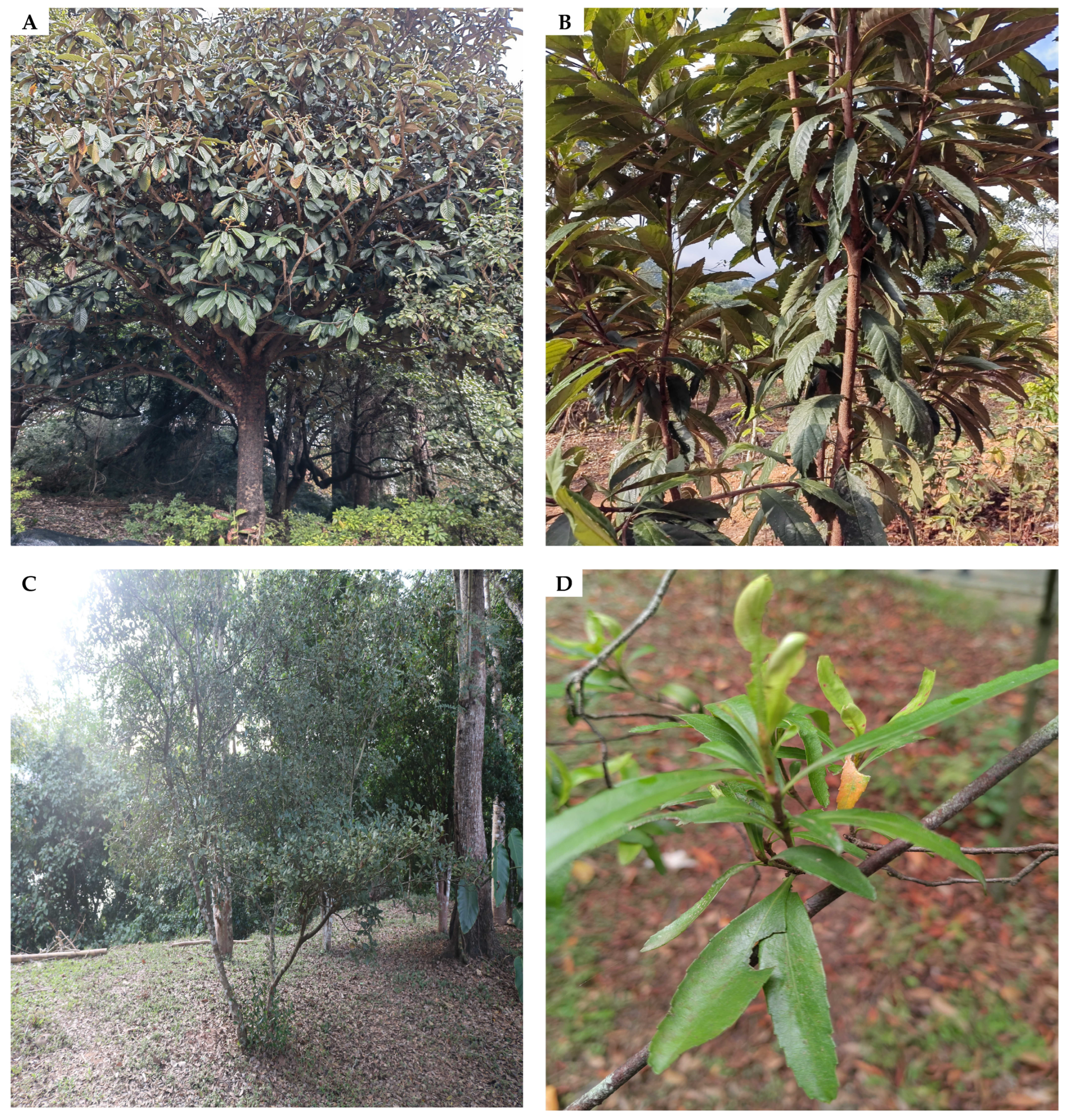
Within the Maleae group of Rosaceae, Eriobotrya Lindl. [1] and Rhaphiolepis Lindl. [2] are two closely related genera (Figure 1), with approximately 36 species and 15 species recognized, respectively [3]. Eriobotrya species are evergreen, medium-sized trees characterized by the following: persistent stipules and apical sepals of the fruit; leaves exhibiting excurrent lateral veins; partially adnate, rectilinear, and paniculate inflorescences; fruit with reduced or absent sclereids; and three to five carpels (rarely two), which are free or up to one-third fused, with closed sutures—distinctive traits that distinguish Eriobotrya from other genera in Maleae [4,5,6,7,8,9,10]. The genus is prevalent in Eastern Asia (China, Taiwan), the East and West Himalayas (Bengal, Bhutan, Nepal, Assam and Sikkim), and Southeast Asia (especially Thailand, Indonesia, Myanmar, Vietnam, and Laos) [11,12,13,14]. Conversely, Rhaphiolepis species are evergreen shrubs or small trees, with caducous stipules and apical sepals of the fruit; leaves with curved lateral veins; inflorescences that are typically fully adnate, racemose, or rarely elongated paniculate; numerous scattered sclereids within the flesh of pomes; and generally two carpels (rarely three), fused at the base, with open sutures [4,5,6,7,8,9,10,15]. These species are extensively distributed in Eastern and Southeastern Asia, encompassing China (Taiwan, Hainan and Fujian), Japan, Central Malaya, northern Borneo, the Philippines, and Vietnam [16,17].
Figure 1.
Gross morphology of Eriobotrya and Rhaphiolepis: (A) Eriobotrya japonica, (B) E. deflexa, (C) Rhaphiolepis indica, and (D) R. salcifolia.
Eriobotrya and Rhaphiolepis have been treated as distinct genera based solely on morphology [1,2,4,7,11,18,19,20,21,22,23], and later molecular evidence [24,25,26,27,28,29,30,31,32,33,34,35,36,37], in the floristic literature [9,10,11,12,13,15,17,18,38]. The issue of generic identity emerged when Fay and Christenhusz [39] initially treated the genus Eriobotrya as a synonym of Pyrus L., and subsequently included it within Rhaphiolepis [40]. Nonetheless, recent research refutes the conclusions of Liu et al., and has resulted in gene trees that demonstrate Eriobotrya is distinct from Rhaphiolepis, exhibiting a robust monophyly [33,34,36,37]. The Plant of the World Online database [3] lists Eriobotrya as an accepted genus, while new species, including E. tsiangii [36], continue to be described in China, and other general and horticultural references continue to accept Eriobotrya [41,42,43].
In the Maleae tribe (Rosaceae), which includes several significant fruit crops and decorative plants (Malus Mill., Sorbus L., Pyrus L., Rhaphiolepis, and Eriobotrya), both intra- and inter-generic hybridization frequently occurs. This phenomenon aids in speciation and adaptation [26,44]. Approximately 54 million years ago (Ma), close to the Early Eocene Climatic Optimum, whole genome duplication (WGD) occurred in the most recent common ancestor of Maleae [37]. This agrees with the idea that Gillenieae (x = 9) served as a parental lineage for Maleae (x = 17). Rapid radiations, allopolyploid events, intergeneric hybridizations, gene copy loss after duplication, and ancient divergences among particular clades have historically made the genera in the tribe Maleae challenging to classify [7,37,44,45]. Eriobotrya experienced many ancient hybridization and chloroplast capture episodes on the Yunnan-Guizhou Plateau [40,46]. For a clearer taxonomic and systematic assessment, these two closely related genera (Eriobotrya and Rhaphiolepis) require further morphological and molecular information.
Several studies in the Rosaceae have demonstrated that examining the micromorphology of leaves and fruits with a scanning electron microscope (SEM) can provide new characters that help to identify and classify plants at the genus or species level. A few studies have examined the morphology of Eriobotrya and Rhaphiolepis species, including the whole plant [9,11,12,15,40,47], leaves [20], carpels [4], fruits/pome [6,48], flowers [49], pollens [21], and wood anatomy [50,51]. Although Zhang et al. [23], and Idrees et al. [52] provided a wide-ranging study of Eriobotrya using both qualitative and quantitative characters, other investigations focused on the leaf indumentum [53], leaf epidermis [54], leaf dimensions [55], leaf size, style count, and stamens [56], and fruit stone cells (sclereids) [22,57]; these studies lacked a micromorphological character analysis for both genera. Progress in this area necessitates the investigation of other features to gain a deeper understanding of the evolutionary traits and phylogenetic relationships between two closely related genera. These genera form a robustly supported monophyletic group within the tribe Maleae [25,26,34], excluding Malus, Sorbus, and Pourthiaea Decne. [37], a finding consistent with that of Robertson et al. [7] which also includes Pyrus. To our knowledge, no research has combined the micromorphological traits of Eriobotrya and Rhaphiolepis species in a phylogenetic framework.
There is a lack of consensus and clarity concerning the evolutionary relationships, taxonomy, and classification of the two genera. Many early methods for defining generic or species relationships and classifications depended on a limited number of species. To resolve the disputes regarding the taxonomy and phylogeny of Eriobotrya and Rhaphiolepis, we reconstructed the dated phylogeny utilizing expanded taxonomic sampling (including outgroups) and employing complete nuclear ribosomal DNA (nrDNA), mitochondrial DNA (mtDNA), and micromorphological characteristics to (1) evaluate the phylogenetic status of the genera Eriobotrya and Rhaphiolepis; (2) elucidate the micromorphological polymorphism, identifying the most informative features for distinguishing the two genera; and (3) offer an enhanced and stable taxonomic treatment of Eriobotrya and Rhaphiolepis that conveys optimal morphological and molecular information.
2. Materials and Methods
2.1. Plant Materials
In China, 53 accessions of Eriobotrya and Rhaphiolepis were collected, with 32 Eriobotrya accessions representing 25 species (including forms and unknown species) and 21 Rhaphiolepis accessions representing 14 species (including varieties). We obtained GenBank sequences for sixteen species of Eriobotrya and Rhaphiolepis for nuclear DNA study, as well as one species of Eriobotrya (E. japonica) for mitochondrial DNA. In addition, three species of Phippsiomeles B.B.Liu & J.Wen, and Stranvaesia Lindl. (nrDNA), and two species of Malus Mill., and Pyrus L. (mtDNA) were used as outgroups to help us comprehend their evolutionary relationships. Between 2016 and 2025, Eriobotrya and Rhaphiolepis species were collected from all around China through fieldwork or material exchange with botanical gardens. The obtained plant materials were stored at the College of Life Science Herbarium (NJTC). Tables S1–S3 contain details about the plant materials, as well as nrDNA and mtDNA sequence information.
2.2. Sequencing and Assembly
Fresh and silica-gel dried leaves were sent to Novogene Bioinformatics Technology Co., Ltd. (Beijing, China) for extraction of total genomic DNA for library preparation and Illumina sequencing. Sonication (Covaris LE220R-plus, Covaris USA, Woburn, MA, USA) was used to fragment the genomic DNA sample into 350 bp segments. Subsequently, DNA fragments were A-tailed, end-polished, and ligated using the full-length Illumina sequencing adapter, and further PCR amplification was performed. The Beckman Coulter, Beverly, MA, USA, AMPure XP equipment was used to purify the PCR products. After testing the library quality with the Agilent 5400 system (AATI), real-time PCR (1.5 nM) was used to quantify the results. More than 10 Gb of data were obtained for each sample after the qualifying libraries were combined and sequenced using the Illumina NovaSeq platform (Illumina, San Diego, CA, USA) with PE150 (Novogene, Beijing, China). Raw readings were cleaned and trimmed in paired-end mode using Fastp version 0.23.1 [58]. Reads shorter than 140 bp were eliminated (-l 140), as were sequence artifacts like adapter reads (>10 nucleotides aligned to the adapter, permitting ≤ 10% mismatches), unrecognizable bases (exceeding 10% uncertainty in either read), and reads with low quality bases (Phred quality < 5). To reconstruct mitochondrial genomic data, we first downloaded a set of conserved mitochondrial orthologous genes, and used Read2Tree v1.5.3 [59] to establish the reference framework. Paired-end reads were then mapped against these orthologs using minimap2 v2.30 [60], from which species-specific alignments were obtained. Read2Tree was subsequently employed to generate consensus sequences in phylogenetic alignment format across species. For the nuclear ribosomal DNA (nrDNA) region, consensus sequences were recovered using GetOrganelle v1.7.5.3 [61], which assembled the targeted region based on read mapping. Finally, progressiveMauve v2 [62] was applied to identify conserved blocks (regions shared across all sampled species) within the nrDNA alignments, providing reliable homologous sequences for phylogenetic analyses.
2.3. Phylogenetic Analysis
For phylogenetic inference, we first determined the best-fit substitution model using the ModelFinder module [63] implemented in IQ-TREE according to Bayesian Information Criteria (BIC), which were TIM3e + I + G4 (nrDNA) and TPM2u + F + I + G4 (mtDNA), respectively. Then, phylogenetic trees were reconstructed using IQ-TREE2 v2.2 [64], which combined maximum likelihood (ML) and Bayesian inference (BI) methods. The ML tree nodal support was assessed using SH-aLRT and 1000 ultrafast bootstrap repetitions, while the BI tree was inferred simultaneously to provide additional topological support. Figtree v1.4.5 [65] was then used to illustrate the tree.
Phylogenomic Discordance
Using the neighbor-net approach in SPLITSTREE v4, phylogenetic networks were constructed to investigate the evolutionary relationships within the lineages of both genera and to illustrate conflicts between gene trees [66]. This method has been widely used to display phylogenetic conflict and uncertainty resulting from possible reticulated evolution, as well as to identify species groups.
2.4. Morphological Evaluation
The micromorphologies of Eriobotrya and Rhaphiolepis species, encompassing adaxial and abaxial leaf surfaces, fruit surfaces, and the apical sepals of the fruits, were analyzed utilizing a light microscope and a scanning electron microscope (Thermo Scientific, Prisma, Shanghai, China) at Nanjing Forestry University. Fragments of leaves, fruits, and fruit apical sepals were dissected from the center, and surface pubescence was meticulously excised with fine tweezers under a stereomicroscope. To preserve surface morphology and prevent shrinkage, the samples underwent the following pretreatment. Specimens were preserved in 2.5% glutaraldehyde in a 0.1 M phosphate buffer (pH 7.2) at 4 °C for 6–8 h (or overnight for exceptionally thick samples); vacuum infiltration (two cycles of ~1–2 min of vacuum) was employed at the onset of fixation to improve reagent penetration. Subsequent to primary fixation, the samples were subjected to three rinses in the same solution (10 min each), and post-fixed in 1% osmium tetroxide (OsO4) in a 0.1 M phosphate buffer for 1 h (performed in a fume hood, protected from light). Following post-fixation, the specimens were rinsed once more (3 × 10 min) and dehydrated using a graded ethanol series: 30%, 50% (10 min each), 70%, 80%, 90%, 95% (15 min each), and 100% ethanol (two changes, 15 min each). Dehydrated samples were treated using a critical point dryer (CO2) following the manufacturer’s protocol to optimally preserve leaf surface and microstructure. Additionally, hexamethyldisilazane (HMDS) drying was employed as an alternative: samples were submerged in a 1:1 ethanol–HMDS solution for 10 min, then transferred to 100% HMDS for another 10 min. Subsequently, the samples were removed and air-dried in a fume hood for 30–60 min and then placed in a desiccator (or left overnight in a dry environment) to ensure full desiccation. The specimens were then affixed to aluminum stubs using double-sided conductive carbon tape and analyzed under a stereomicroscope to ensure integrity. The samples were sputter-coated with gold (Au) to a nominal thickness of 8–12 nm to ensure surface conductivity. SEM imaging was conducted at accelerating voltages of 15 kV for one to three minutes, with working distances of 8–15 mm.
The quantitative variables of the leaves were assessed using digital SEM photos processed with ImageJ v 1.54p software [67]. The adaxial surface included 7 qualitative variables including the epidermal cell shapes, the cuticular folding patterns, the anticlinal walls, the fine microrelief, the papillae, the base of trichomes, and the epicuticular wax deposits. The abaxial surface included 7 qualitative and 10 quantitative variables including the epidermal cell shapes, the anticlinal and periclinal walls, the base of fallen trichomes, the persistent non-glandular trichomes, the epicuticular wax deposits, the distribution of stomata, the primary and secondary stomata lengths and widths (µm), the outer ledge apertures of the primary and secondary stomata lengths and widths (µm), and stomatal density (stomatal number per 300 µm2). We additionally included 2 quantitative variables (leaf size and width) following the regional floras treatment, such as Flore du Cambodge, du Laos et du Vietnam [12], and Flora of China [9,15] (Table S4). The terminology about leaves was employed in accordance with the research of Song et al. [68,69] and Kumschova et al. [70].
To find significant differences across genera or species, one-way ANOVA was conducted in SPSS v26, and post hoc comparisons using the Least Significant Difference (LSD) were used to assume equal variance, interpreted at a significance level of p < 0.05. To ascertain the possible taxonomic diagnostic significance of various factors, cluster analysis was used to compare the leaf micromorphological characteristics of the two genera. We examined 16 qualitative and 10 quantitative variables in 32 accessions, treating each accession as an operational taxonomic unit (OTU) and assigning a taxonomic code (Table 1 and Table S4), following the process of Zhang et al. [23] without data standardization. Furthermore, we also evaluated the 9 stomatal variables separately, and data were standardized using SPSS software. Then, using the program PAST v.5 [71], the matrix was submitted to cluster analysis utilizing the Gower’s distance (for 16 qualitative and 10 quantitative variables), Euclidean distance (for stomatal variables), and UPGMA algorithm [23,72]. Principal Component Analysis (PCA) was performed using 26 variables, as indicated in Table 1 and Table S4, while 9 quantitative characteristics (stomatal variables) were used from the original data, following the approaches of Greenacre et al. [73] and Idrees et al. [52]. All multivariate analyses were conducted using PAST v.5 [71].
Table 1.
Micromorphological features of Eriobotrya and Rhaphiolepis species under scanning electron microscopy.
3. Results
3.1. Phylogenetic Analysis
3.1.1. Taxon and Sequence Characteristics
The dataset used in this investigation comprised 53 accessions in total: 1 mtDNA and 16 nrDNA sequences of Eriobotrya and Rhaphiolepis species acquired from NCBI, with 17 newly added nrDNA and 38 mtDNA sequences from both genera. From the annotated mitochondrial genomes of the two genera, we identified 52 orthologous gene sets, with sdh4, nad1, nad7, rps12, rnaseH, and mttB genes having high nucleotide diversity, while ORF300, ORF369 and matR genes had high GC contents (Table S5). Multiple sequence alignments of these orthologs produced a concatenated dataset of 42,440 aligned matrices containing 349 parsimony-informative (PI) sites and 592 variable sites, with total GC contents of 43.5%, which served as the basis for subsequent mtDNA analyses. In comparison, the nrDNA dataset produced 39,394 aligned matrices containing 1079 parsimony-informative (PI) sites and 2031 variable sites, with 55% total GC contents. Table 2 shows details on the recently identified sequences.
Table 2.
Sequence information and variability of nuclear vs. mitochondrial sequences in Eriobotrya and Rhaphiolepis species.
3.1.2. Phylogenetic Analysis Based on Complete nrDNA Sequences
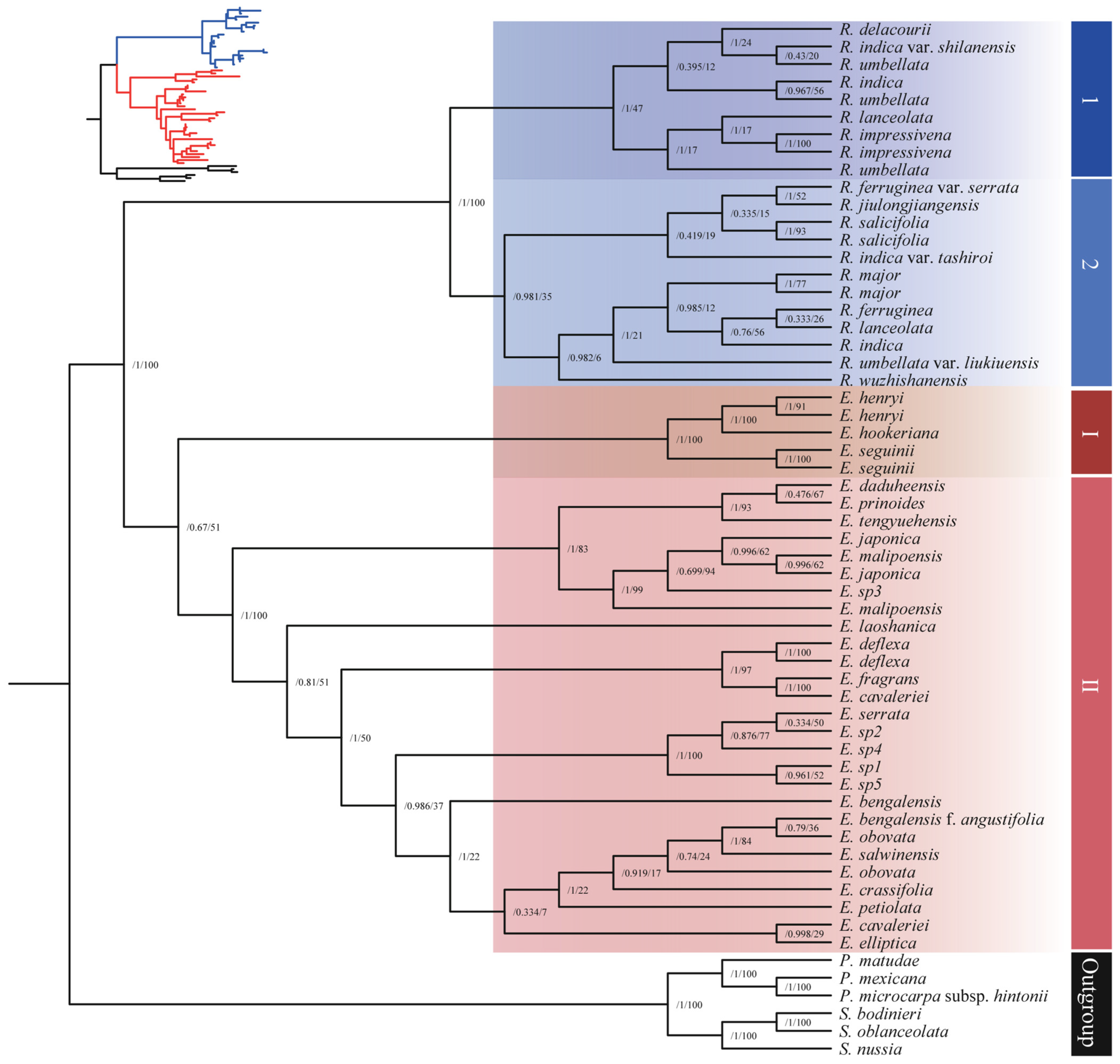
The nrDNA matrix comprises 53 accessions, including 25 Eriobotrya species, 14 Rhaphiolepis species, and 6 additional species which serve as an outgroup. Our findings indicate that the complete nrDNA sequences elucidated the phylogenetic relationships between two closely related genera, affirming that Rhaphiolepis is monophyletic with high support (ML: 100% and BI: 1.0 posterior probability, respectively), while Eriobotrya is low to moderately supported (ML: 51% and BI: posterior probability 0.67, respectively) as a monophyletic group (Figure 2). This may be due to the uncertain phylogenetic positions of three Eriobotrya species (E. henryi, E. hookeriana, and E. seguini). The nrDNA phylogenetic tree identified two prominent clades within Eriobotrya and two within Rhaphiolepis. Clade I of Eriobotrya contained five accessions representing three species: two from China, E. henryi (from GenBank), and E. seguinii (from GenBank), and one from Bhutan, E. hookeriana, all of which had strong support values (ML: 91–100% and BI: posterior probability 1.0, respectively). Clade II is separated further into two subclades: A and B. Subclade A had eight accessions representing six species: E. × daduheensis, E. prinoides, E. japonica, E. japonica (from GenBank), E. malipoensis, E. malipoensis (from GenBank), E. tengyuehensis, and E. sp3, with low to moderate bootstrap values (ML: 62–99% and BI: posterior probability 0.47–1.0, respectively). Subclade B comprised 19 accessions representing 16 species: E. laoshanica, E. deflexa, E. deflexa (from GenBank), E. cavaleriei, E. cavaleriei (from GenBank), E. fragrans, E. serrata, E. bengalensis, E. bengalensis f. angustifolia, E. salwinensis (from GenBank), E. obovata, E. obovata (from GenBank), E. crassifolia, E. elliptica, E. petiolata, and E. sp1 to E. sp5, exhibiting low to moderate support values. E. deflexa, E. deflexa (from GenBank), E. cavaleriei, E. cavaleriei (from GenBank), and E. fragrans exhibited high bootstrap values (91–100%).
Figure 2.
Phylogenetic tree of 53 accessions of Eriobotrya and Rhaphiolepis based on nrDNA sequences using both maximum likelihood (ML) and Bayesian inference (BI). The numbers at each node are the maximum likelihood bootstrap support/Bayesian posterior probabilities. The tree was rooted using the nrDNA sequences of Phippsiomeles and Stranvaesia species as outgroups.
The ML tree separated Rhaphiolepis species into two major clusters, 1 and 2 (Figure 2). Clade 1 includes nine accessions representing six species, R. indica, R. indica var. shilanensis, R. × delacourii, R. umbellata1, R. umbellata2, R. umbellata (from GenBank), R. impressivena, R. impressivena (from GenBank), and R. lanceolata, with low support values. Clade 2 is further subdivided into two subclades. Subclade I comprised five accessions representing four species, R. ferrugenia var. serrata, R. jiulongjiangensis, R. salicifolia, and R. indica var. tashiroi, with an additional R. salicifolia accession from GenBank. Subclade II encompassed seven accessions representing four species, R. major, R. umbelatta var. liukiuensis, E. wuzhishanensis, and four species from GenBank including R. major, R. ferruginea, R. indica, and R. lanceolata, with low bootstrap values.
3.1.3. Phylogenetic Analysis Based on mtDNA Sequences
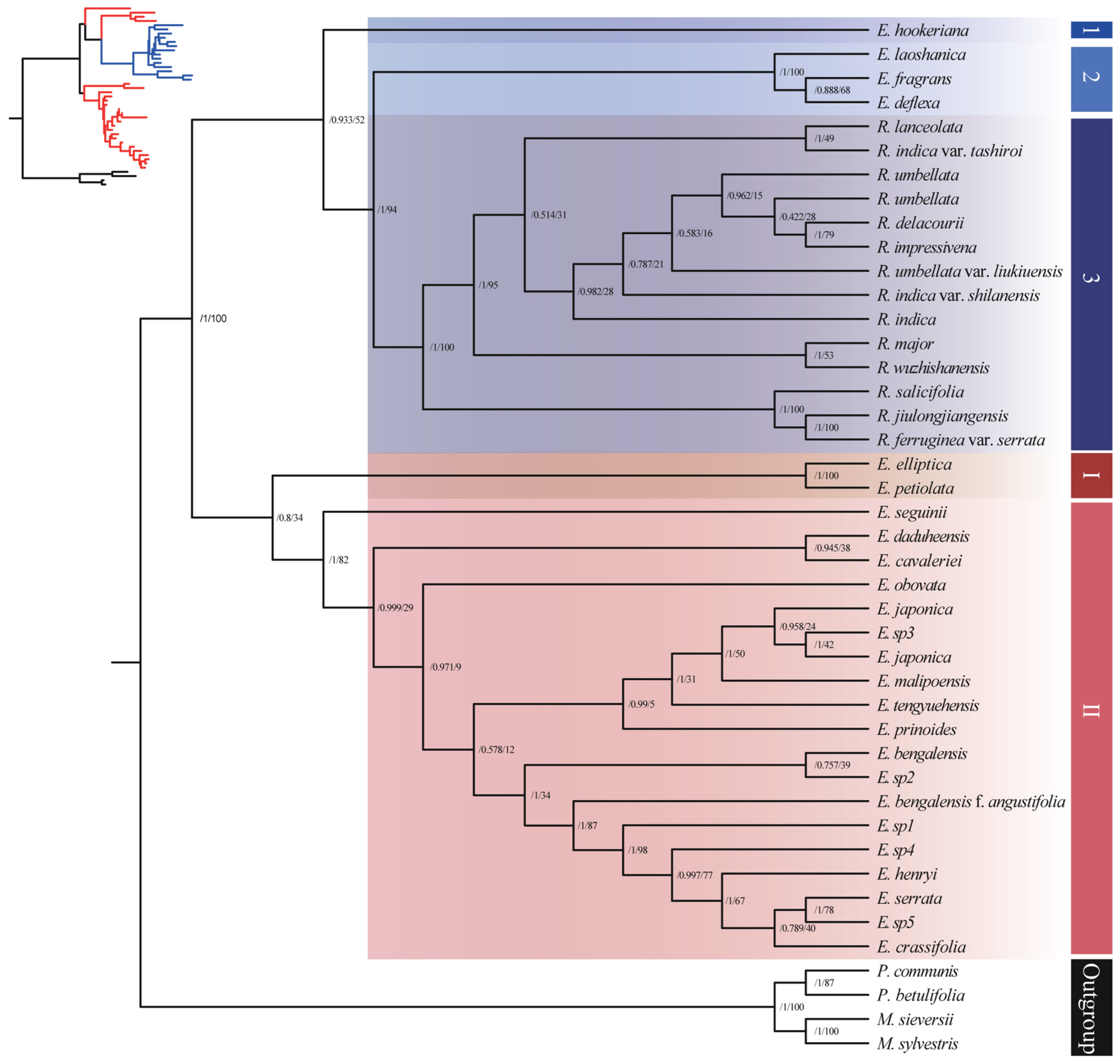
The mtDNA matrix based on 52 protein coding genes contained 43 accessions, representing 25 Eriobotrya species, 13 Rhaphiolepis species, and 4 of them were outgroups. The mtDNA sequences gene tree showed a strong discordance signal (Figure 3), with four distinct species of Eriobotrya (E. hookeriana, E. laoshanica, E. deflexa, and E. fragrans) forming a sister group within the Rhaphiolepis clade, with support values ranging from low to high (ML: 52–94% and BI: posterior probability 0.93–1.0, respectively). The relationships among the major subclades of Eriobotrya exhibited low support (ML: 34% and BI: posterior probability 0.8, respectively), while relationships within the Rhaphiolepis subclades showed high support values (ML: 100% and BI: posterior probability 1.0, respectively). This showed a complex hybridization from Rhaphiolepis into Eriobotrya species, actual biological conflict among loci, or a lack of informative characters. These results further support the previously published phylogeny based on nuclear and chloroplast genomes which highlights phylogenetic incongruence within the Eriobotrya–Rhaphiolepis complex [40].
Figure 3.
Phylogenetic tree of 39 accessions of Eriobotrya and Rhaphiolepis based on mtDNA sequences using both maximum likelihood (ML) and Bayesian inference (BI). The numbers at each node are the maximum likelihood bootstrap support/Bayesian posterior probabilities. The tree was rooted using the nrDNA sequences of Pyrus and Malus species as outgroups.
3.1.4. Network Analysis
The generated networks indicated both inter- and intrageneric reticulations in Eriobotrya and Rhaphiolepis (Figure S1a). The four complex Eriobotrya species, E. deflexa, E. fragrans, E. laoshanica, and E. hookeriana, despite having discordant phylogenetic positions in the distinct gene trees, formed complex networks, implying that multiple hybridization events took place among these species. Furthermore, the data demonstrated that these species, with E. petiolata and E. elliptica, are hybrid bridges; their presence increases network complexity, implying that there may be incomplete lineage sorting due to recent divergence from a common ancestor shared with Rhaphiolepis or ancient hybridization (ongoing introgression) from Rhaphiolepis into Eriobotrya. When the complex species were eliminated, there was no reticulation, confirming that they are causing the phylogenetic conflict (Figure S1b).
3.2. Morphological Analysis
3.2.1. Adaxial Surface of the Leaf
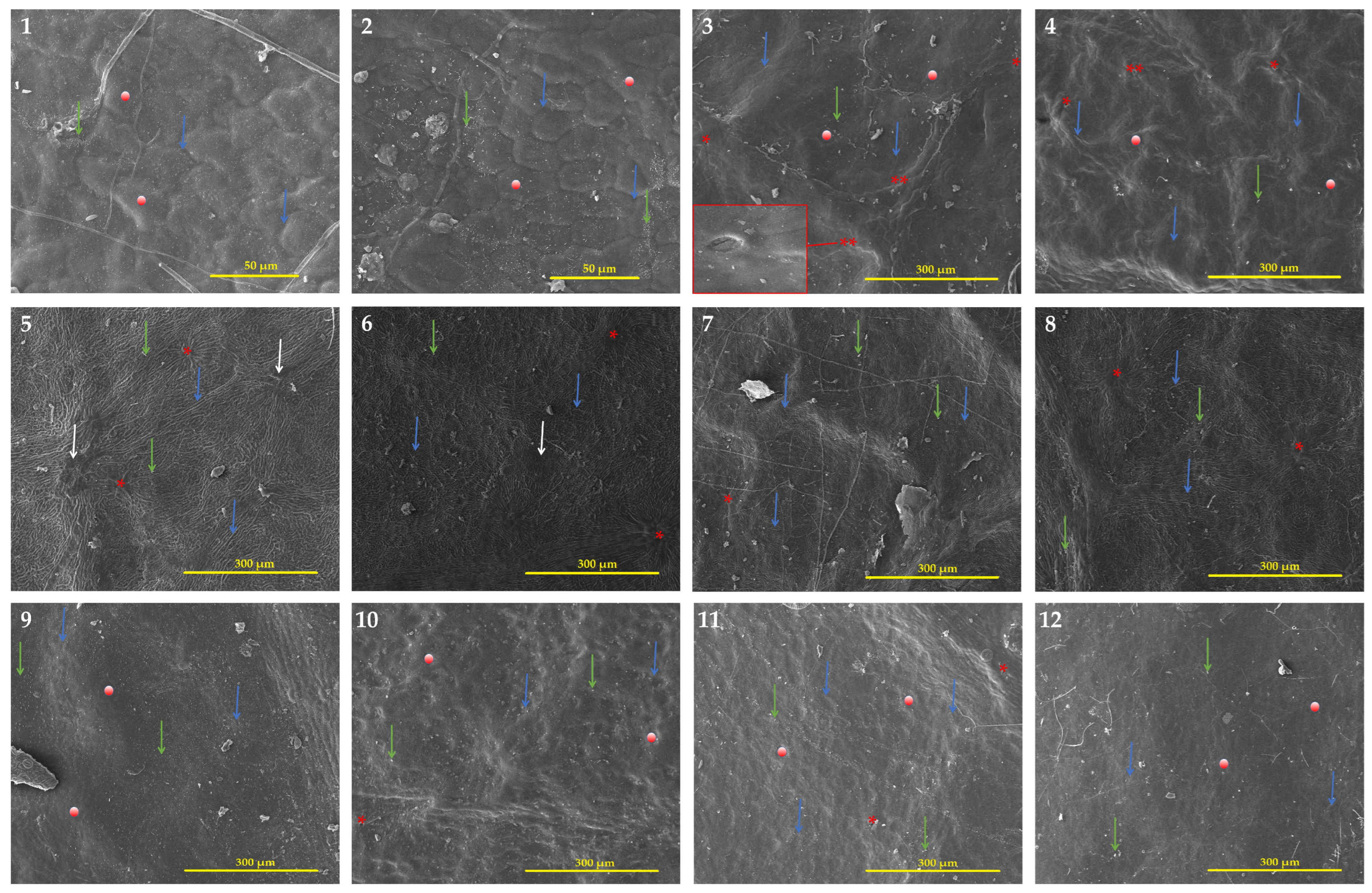
Table 3 provides information on the quantitative and qualitative characteristics of the leaf epidermis, whereas Figure 4 showed selected species SEM images and Figures S2–S8 showed all species within both genera. Regarding the adaxial epidermal cell shape of Eriobotrya and Rhaphiolepis, three groups were recognized: irregular (Group 1), and polygonal (Group 2) within Eriobotrya species, and irregular-polygonal or thin-verrucous (Group 3) in Rhaphiolepis species. On the investigated species epidermal surface, a folded microrelief with a distinct arrangement was discovered. Three distinct kinds were noted: long, straight-curve folds that covered the entire surface; small, straight or undulate folds; and smooth cuticular folds with several flat areas in between. Due to the numerous folds that were situated beside dense parallel cuticular folds and grooves, for most Eriobotrya species, the anticlinal walls of the epidermal cells were not discernible in the SEM. The cuticular folds formed papillae formations with folded microrelief on the epidermal cell surface of both genera. A mature papilla is composed of two structural components or parts: a leg with strong radially diverging ribs and a head that compacts the expanded top. In most cases, the ribs of the cell leg are joined to the microtension bar or to comparable formations of the nearby cells. Some cells were classified as sparse because they lacked or had diminished papillary structures. In both genera, the pavement cells’ anticlinal walls created patterns that were either raised or depressed, with the periclinal walls’ flat surfaces or ridge-convex striated surfaces being highlighted. The adaxial surface of the leaves was covered in simple multi-cellular trichomes, which mainly fell during the early stages of development, or remained persistent throughout. Two Eriobotrya species (E. bengalensis and E. condaoensis), and one Rhaphiolepis (R. jiulongjiangensis) are completely glabrous in life, as evidenced by the absence of a trichome base. In Eriobotrya, a rosette of four to six cells rose above the pavement cells, encircling the base of the descending trichomes with parallel striate ornamentation, whereas in Rhaphiolepis, the base of the fallen trichomes was tubular and circular above the cells. Epicuticular wax deposits were detected in both genera, and four forms of wax were identified: granule, sparsely granule, rodlet, and sparsely rodlet. Granules are identified as irregular, mainly amorphous, spherical crystalloids on the surface, whereas rodlets are identified as slender needle-shaped waxes that are primarily narrow and create elongated threads on the surface. In all the tested species, a combination of the aforementioned wax types was found on the surface of the inspected specimens, hence wax type cannot be utilized to distinguish between the two genera.
Table 3.
Adaxial quantitative and qualitative variables assessed for study on the micromorphological features of Eriobotrya and Rhaphiolepis species under scanning electron microscopy.
Figure 4.
SEM micrographs of the adaxial surface of the leaves of Eriobotrya and Rhaphiolepis species: (1) E. cavaleriei, (2) E. grandiflora, (3) E. japonica, (4) E. malipoensis, (5) E. bengalensis f. angustifolia, (6) E. deflexa, (7) E. elliptica, (8) E. tengyuehensis, (9) R. × delacourii, (10) R. integerrima, (11) R. indica, and (12) R. lanceolata. Designations: The blue arrows are anticlinal walls, the green arrows are wax deposits, the white arrows are papillae formations, the white-red circles are periclinal walls, a single asterisk indicates the base of fallen trichomes, and double asterisks indicates stomata. Scale bars: 50–300 µm.
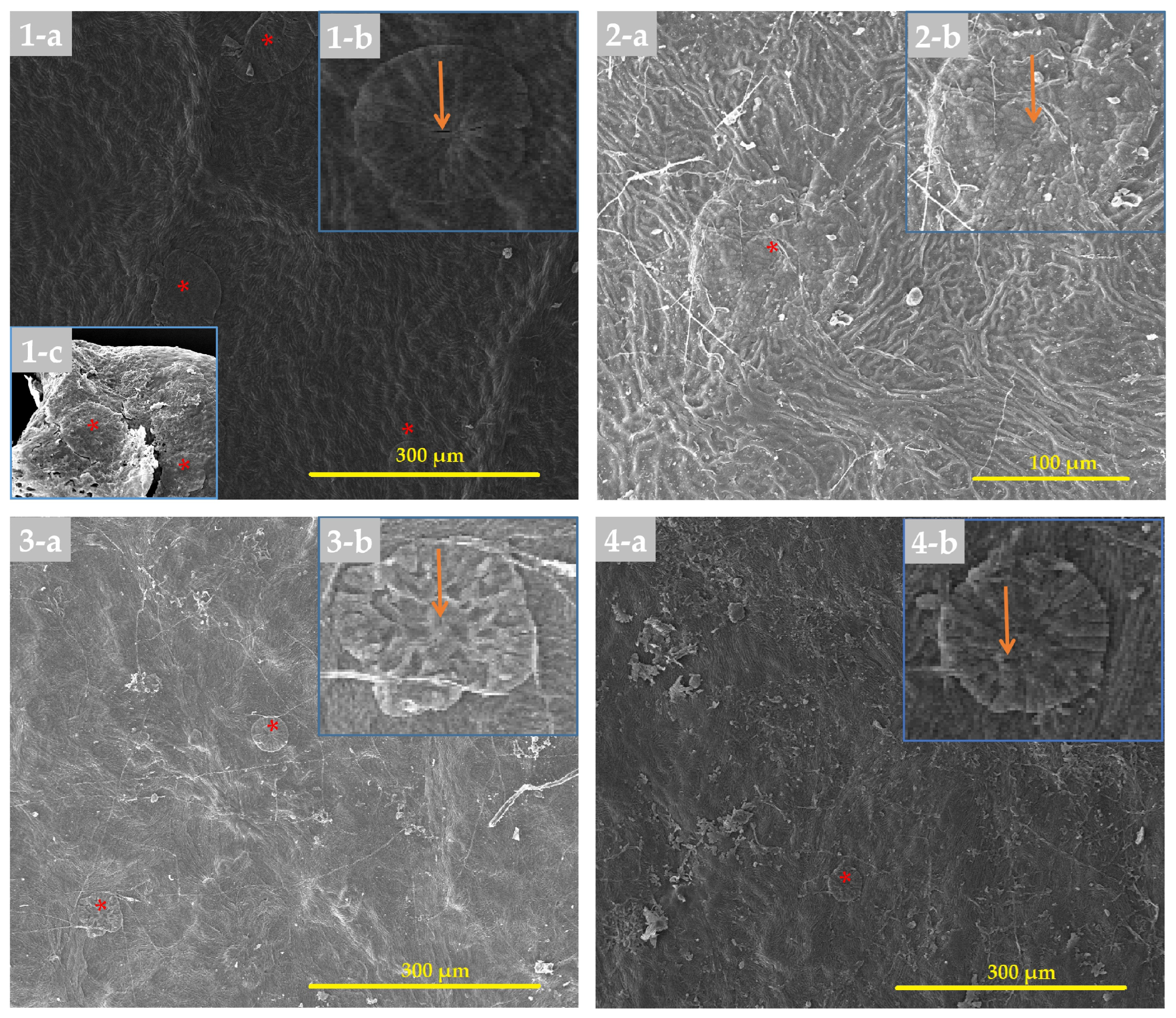
The structure of laminar hydathodes in the studied Eriobotrya species was largely preserved. All species possessed epithemal hydathodes, consisting of three primary components: water holes, epithems, and tracheids. The water hole comprised open or slightly recessed pairs of guard cells, partially concealed by subsidiary cells. The epithem appeared as a group of tiny achlorophyllous cells beneath the water pores. An improperly organized network of xylem tracheids provided water to the epithelium and connected it to the leaf apex. The same structure was observed in Eriobotrya species, including E. fragrans, E. salwinensis, E. obovata, and an unknown sample from Yunnan, China (Figure 5), but not in any Rhaphiolepis species. Hydathode distribution (laminar, marginal, and apical) varied by species, although they were always more common, if not exclusively, on the surface most of those exposed to the atmosphere. In addition, another undiscovered volcano-like structure was discovered in two Eriobotrya species, E. condaoensis and E. henryi, with a rounded apex, raphides, and a sunken pore.
Figure 5.
Laminar hydathodes on the adaxial leaf surface of Eriobotrya, using SEM micrography: (1-a–1-c) E. fragrans, (2-a–2-b) E. obovata, (3-a–3-b) E. unknown sample, and (4-a–4-b) E. serrata. Designations: The orange arrows indicate open pores, and a single asterisk indicates hydathodes. Scale bars: 100–300 µm.
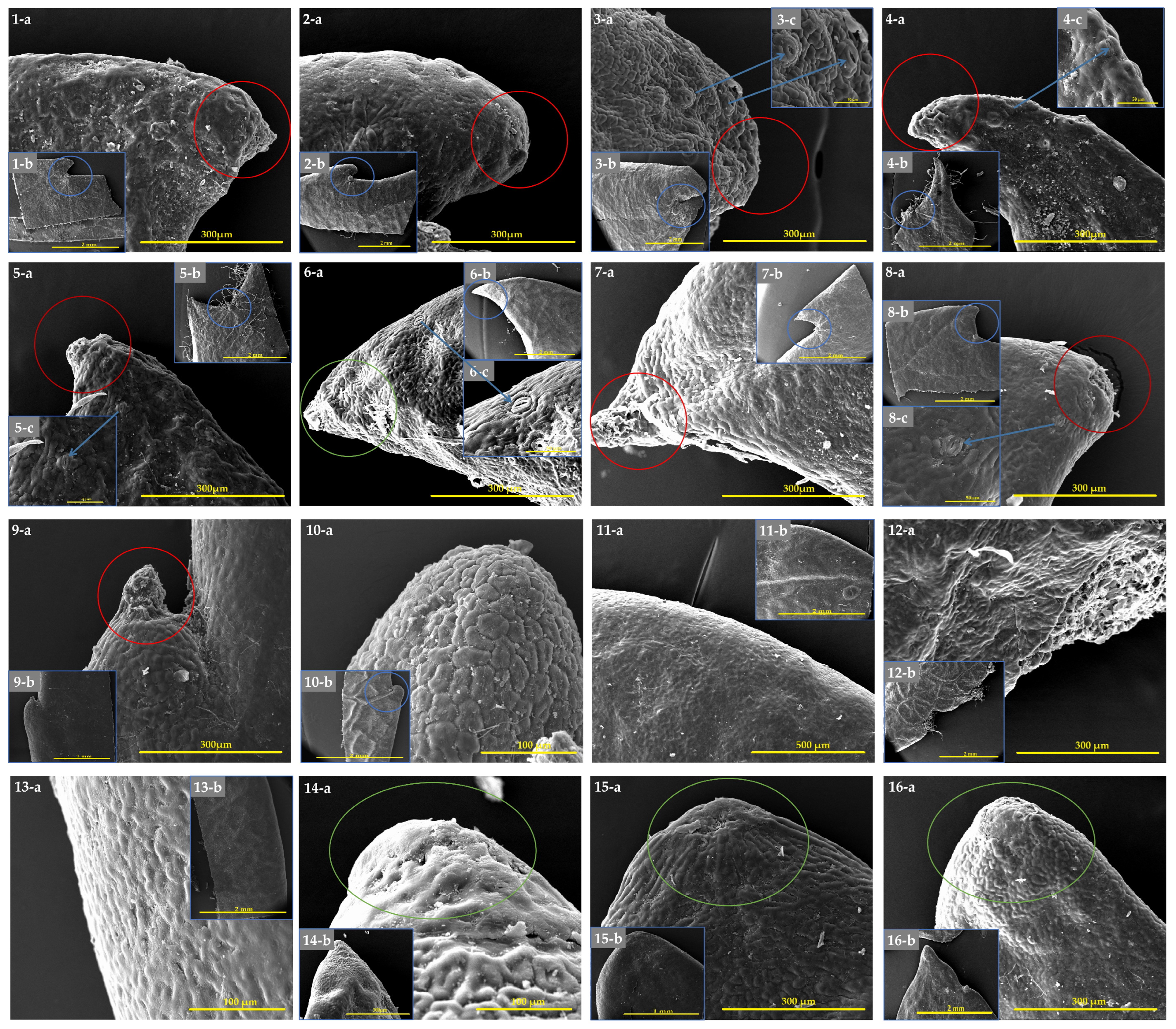
Leaf margin colleters have a short stalk with two to three rows of cells and a multi-cellular head. As a colleter’s head dries out over time, an abscission zone forms in the stalk. Under certain circumstances, secretion continues nearly until the leaves completely separate. Droplets of the secretion are released at the head and then spread out over the surface of the leaf tooth. Colleters are categorized in the literature as marginal, located at the apices of the teeth, and apical, ending the main vein (Figure 6). Spherical colleter heads have been discovered in the sinuses between the leaf margin apex, and the secretory head can be either elongated or triangular. Eriobotrya (Figure 6: nos. 1–8) had secretory “colleters” at the leaf teeth apex and in the sinuses between the leaf teeth. The adaxial surface of the leaf had many anomocytic stomata, primarily on the surface close to the margin apex, while colleters were found at the leaf margin apex in R. lanceolata (Figure 6: no. 9), in sinuses between the leaf teeth in R. jiulongjiangensis (Figure 6: no. 10), and on the adaxial surface of either the leaf apex or the margin apex of R. indica, R. lanceolata, and R. salicifolia (Figure 6: nos. 14–16), without any surrounding anomocytic stomata. We were unable to observe the colleters in most Rhaphiolepis species because the leaf margin and apex were completly entire (Figure 6: nos. 11–13).
Figure 6.
Colleters in Eriobotrya and Rhaphiolepis associated with the leaf margin apex (1–16-a), in sinuses between leaf margin apex (1–16-b), with surrounding stomata (3–6c), and colleters on the leaf apex (6-a,b, 14–16-a,b): (1-a–1-b) E. bengalensis, (2-a–2-b) E. bengalensis f. angustifolia, (3-a–3-c) E. crassifolia, (4-a–4-c) E. malipoensis, (5-a–5-c) E. deflexa, (6-a–6-b) E. deflexa leaf apex, (7-a–7-b) E. henryi, (8-a–8-c) E. prinoides, (9-a–9-b) R. lanceolata, (10-a–10-b) R. jiulongjiangensis, (11-a–11-b) R. umbellata, (12-a–12-b) R. wuzhishanensis, (13-a–13-b) R. × delacourii, (14-a–14-b) R. indica leaf apex, (15-a–15-b) R. lanceolata leaf apex, and (16-a–16-b) R. salicifolia leaf apex. Designations: The red circles are colleters in the leaf margin, the blue circles are colleters in the sinuses between the leaf margin; the green circles indicate colleters in the leaf apex, and the blue arrows indicate stomata. Scale bars: 100–500 µm and 1–2 mm.
3.2.2. Abaxial Surface of the Leaf
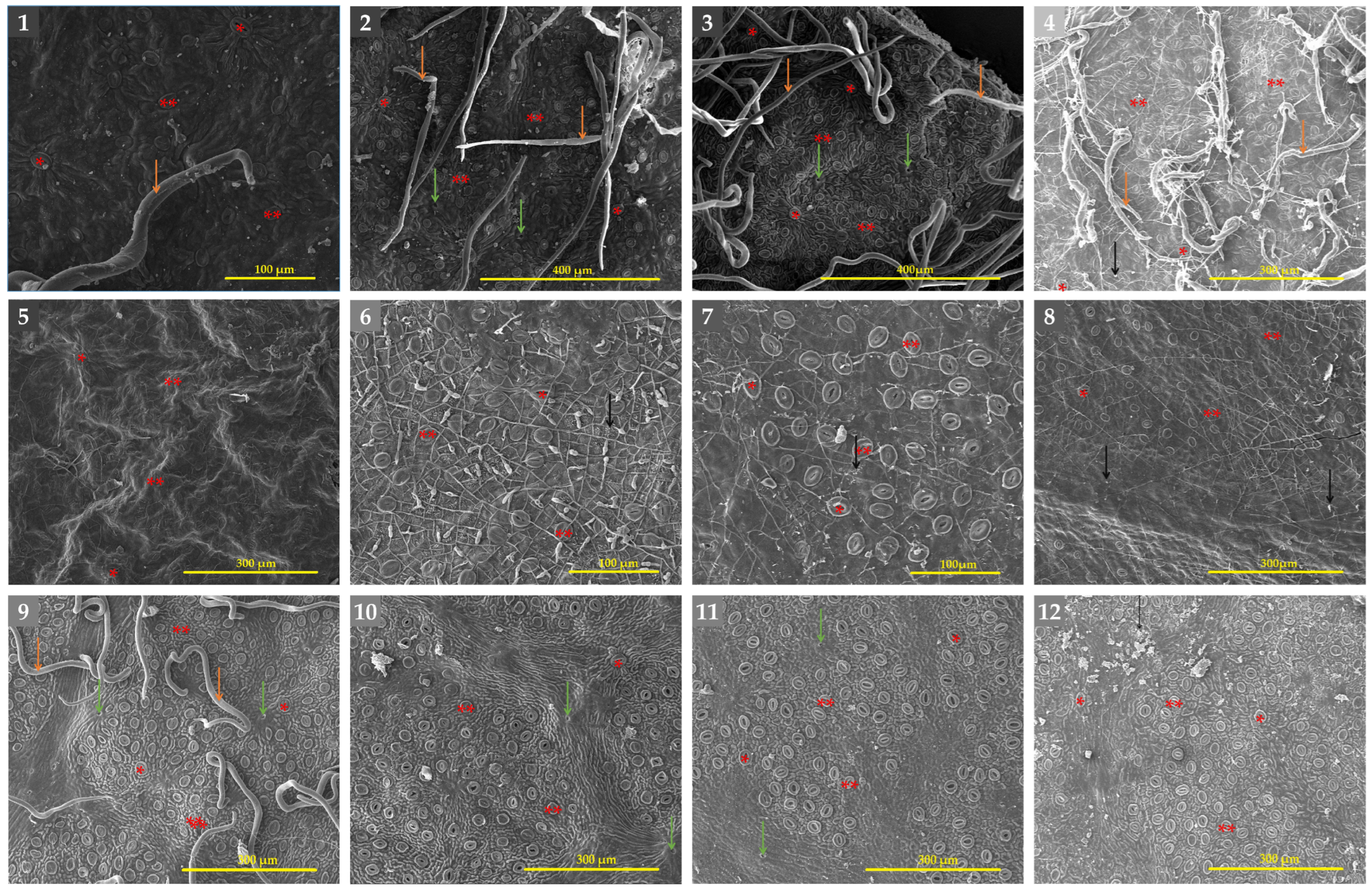
Table 4 provides information on the quantitative and qualitative characteristics of the leaf epidermis, whereas Figure 7 shows selected species SEM images and Figures S2–S8 show all species within both genera. The abaxial epidermal cell shapes of Eriobotrya and Rhaphiolepis differed significantly; three categories were identified: irregular, with a parallel straight-curve (Group I), polygonal (Group II) within Eriobotrya species, and irregular, with a short straight-curve or irregular-undulate (Group III) within Rhaphiolepis species. The anticlinal walls of the pavement cells in most Eriobotrya species are not visible due to the cuticular microrelief that masks them (Figure 7), and the periclinal walls were either flat or convex. However, in Rhaphiolepis, only raised anticlinal walls, with convex periclinal walls were seen. The abaxial surfaces of the leaves were characterized by persistent non-granular multi-cellular trichomes, reported in seven species of Eriobotrya (E. × daduheensis, E. malipoensis, E. japonica, E. prinoides, E. deflexa, E. salwinensis, and E. tengyuehensis, mentioned in Figure S2: no. 4; Figure S4: nos. 9–10; Figure S5: no. 14; Figure S6: nos. 18–20, and two Rhaphiolepis species (R. ferruginea, and R. umbellata) (Figure S7: no. 26; Figure S7: no. 29)). In three species in Eriobotrya and three in Rhaphiolepis, the base of fallen trichome was not seen indicating these species are entirely glabrous throughout their life. Furthermore, if the trichome has fallen, it indicates that the species was initially tomentose, and later glabrescent when mature. Epicuticular wax deposits were identified in both genera, and the four forms of wax deposits seen were similar to those reported for the adaxial surfaces. Interestingly, five Eriobotrya species and three Rhaphiolepis species did not have epicuticular wax.
Table 4.
Abaxial quantitative and qualitative variables assessed for study on the micromorphological features of Eriobotrya and Rhaphiolepis species under scanning electron microscopy.
Figure 7.
SEM micrographs of the adaxial surfaces of the leaves of Eriobotrya and Rhaphiolepis species: (1) E. japonica, (2) E. × daduheensis, (3) E. tengyuehensis, (4) E. salwinensis, (5) E. crassifolia, (6) E. bengalensis, (7) E. henryi, (8) E. laoshanica, (9) R. umbellata, (10) R. integerrima, (11) R. × delacourii, and (12) R. jiulongjiangensis. Designations: The orange arrows are non-glandular trichomes, the green arrows are bases of fallen trichomes, the black arrows are epicuticular waxes, a single asterisk indicate primary stomata, and double asterisks indicate secondary stomata. Scale bars: 100–400 µm.
In terms of stomata size, Eriobotrya and Rhaphiolepis species displayed two main types: primary solitary stomata and secondary stomata (Table 4, Figure 7). Primary stomata are uncommon, typically large, and found alone in the center of a clump of medium-sized secondary stomata. The length and width of solitary stomata are much greater than those of secondary stomata. The average length and width of the primary stomata in Eriobotrya species varied from 22.95 to 35 × 15.54 to 26.64 µm, while those in Rhaphiolepis species ranged from 29.93 to 41.3 × 24.51 to 37.03 µm, respectively. Eriobotrya and Rhaphiolepis differed significantly in terms of secondary stomata size, secondary stomata outer ledge aperture size, and stomata ridge/rim width. Eriobotrya species had the smallest average secondary stomata size, outer ledge aperture size, and stomata rim width (17.09–26.84 × 13.39–20.93 µm, 13.12–22.79 × 10.06–16.04 µm, and 1.09–2.71 µm), while those in Rhaphiolepis species had the largest (29.3–35.07 × 23.87–30.94 µm, 22.84–29.11 × 16.21–23.64 µm, and 2.62–3.95 µm). In Eriobotrya, E. elliptica had the smallest secondary stomata (17.09 × 13.39 µm), while E. prinoides had the largest (26.84 µm). E. hookeriana had the widest width (20.93 µm), while E. malipoensis had the smallest (13.39 µm). In Rhaphiolepis, R. ferruginea had the smallest length of all the secondary stomata (29.3 µm) and the largest was in R. × delacourii (35.07 µm). R. jiulongjiangensis had the smallest width (23.87 µm), while R. wuzhishanensis had the largest (30.94 µm). E. elliptica had the smallest outer ledge aperture (13.12 × 10.06 µm), while R. lanceolata had the largest (29.11 µm). Furthermore, E. malipoensis had the shortest stomatal rim (13.39 µm), while R. jiulongjiangensis had the largest (3.95 µm). Eriobotrya species with a high stomata placement density per µm2, including E. bengalensis, E. cavaleriei, E. deflexa, E. fragrans, E. malipoensis, E. japonica, and E. prinoides, while E. bengalensis f. angustifolia, E. crassifolia, E. henryi, E. tengyuehensis, E. serrata, R. indica, R. lanceolata, R. major, R. × delacourii, R. integerrima, R. wuzhishanensis, and R. jiulongjiangensis had moderate placement density.
All Eriobotrya and Rhaphiolepis species studied have anomocytic stomata (as shown in Figure 7). Eriobotrya species had stomata on their abaxial surfaces, while Rhaphiolepis species lacked them. Eriobotrya stomata are evenly or regularly distributed in the areole regions, elliptical in shape, and located near or slightly above the pavement cells, whereas Rhaphiolepis stomata are unevenly or irregularly distributed, elliptical to round in shape, and located above the pavement cells. However, adaxial stomata are only recognized in E. japonica (Figure 7: no. 3). A regular arrangement of more robust radial folds was positioned adjacent to the prominent primary stomata. In Eriobotrya species (Figure 7: nos. 1–8), the nearest 2–3 parallel arrays of radial folds with all sides were discovered, whereas concentric to radially divergent folds were noted in Rhaphiolepis species, as depicted in Figure 7: nos. 9–12.
3.2.3. Other Diagnostic Features
We reported other diagnostic micromorphological characteristics, including petiole surface sculpture, cross-sectional architecture, fruit surface, and the outer and inner surfaces of the fruit apical sepals, which can distinctly differentiate the two genera. The petioles of Eriobotrya species are glabrous or possess non-glandular trichomes (tomentose), exhibiting a smooth surface or long parallel ridges, with a circular outline in the cross-section, a well-developed circular arrangement of vascular bundles (amphicribral bundles), and possessing more mechanically supportive cells, including collenchyma and sclerenchyma (Figure S9). In contrast, the petioles of Rhaphiolepis species are either glabrous or hairy (non-glandular trichomes), characterized by an irregular polygonal shape with rounded ridges, triangular in the cross-section, and display a V-shaped or horizontally flattened arrangement of vascular bundles, with fewer supportive cells, comprising only collenchyma.
The fruit surface of Eriobotrya species is either glabrous or covered in non-glandular trichomes, featuring smooth to polygonal epidermal cells with parallel grooves, a smooth cuticle, and the presence of stomata (Figure S10). The outer surface sculpture of the apical fruit sepals of Eriobotrya species is consistently hairy (non-glandular trichomes), featuring irregular-undulate epidermal cells with cuticular striations, while epicuticular wax is absent. The inner surface is entirely glabrous, exhibiting irregular-undulate epidermal cells, depressed anticlinal walls, and convex periclinal walls; it also lacks epicuticular waxes, but containing stomata (Figure S10). In contrast, Rhaphiolepis species lack these characteristics. The principal diagnostic characteristics within and between genera are listed in the taxonomic treatment (for details, see Table 3, Table 4 and Table 5; Figure 4, Figure 5, Figure 6 and Figure 7). Conversely, the fruit surface of Rhaphiolepis is either glabrous or hairy (non-glandular trichome), characterized by irregularly polygonal epidermal cells with a rounded network of ridges, a glossy cuticle, and the presence of stomata (Figure S11).
Table 5.
Summary of the quantitative variables for assessment of the relationships among Eriobotrya and Rhaphiolepis species under SEM.
Taxonomic treatment
Key to the genera Eriobotrya and Rhaphiolepis based on micromorphology.
- Petioles exhibit a smooth surface or with long parallel ridges that are circular in the cross-section, and amphicribral bundles; the leaf adaxial surface is polygonal or irregular with long straight-curve cuticular folding patterns. The leaf abaxial surface is irregular, with long straight-curve or polygonal epidermal cells. Primary stomata are small, 22.95–35 × 15.54–26.64 µm; secondary stomata are small 17.09–26.84 × 13.39–20.93 µm. The outer stomata ledge aperture is small, 13.12–22.79 × 10.06–16.04 µm; the stomatal ridge rim is small, 1.09–2.71 µm. Fruit adaxial epidermal cells are smooth to polygonal with parallel grooves. The outer surface of the apical fruit sepals are non-granular trichomes, and the inner surface contains irregular-undulate epidermal cells. Laminar hydathodes, colleters and stomata are present near the leaf margin........................................................................ Eriobotrya
- Petioles exhibit an irregularly polygonal surface with rounded ridges that are triangular in the cross-section, and V-shaped bundles; the leaf adaxial surface is irregular–polygonal, with smooth cuticular folding patterns, and the leaf abaxial surface is irregular, with short straight-curve or undulate epidermal cells. Primary stomata are large, 29.93–41.3 × 24.51–37.03 µm, and secondary stomata are large, 29.3–35.07 × 23.87–30.94 µm. The outer stomata ledge aperture is large, 22.84–29.11 × 16.21–23.64 µm; the stomatal ridge rim is large 2.62–3.95 µm. The outer surface of the fruit epidermal cells are irregularly polygonal with a rounded network of ridges; apical fruit sepals are absent. Laminar hydathodes, and stomata are absent near the leaf margin; colleters are usually absent, but were seen in one species on marginal teeth apices.......................................................................... Rhaphiolepis
Generic description
Eriobotrya
Leaf adaxial surface exhibited the following: Group 1: Polygonal (E. crassifolia, E. × daduheensis, E. malipoensis, E. japonica, E. prinoides, E. cavaleriei, E. grandiflora, E. laoshanica, E. seguinii, and E. henryi), Group 2: irregular epidermal cells (E. bengalensis, E. condaoensis, E. bengalensis f. angustifolia, E. deflexa, E. elliptica, E. fragrans, E. petiolata, E. hookeriana, E. salwinensis, E. tengyuehensis, E. obovata and E. serrata); depressed (for species with polygonal epidermal cells) or raised anticlinal walls (for species with irregularly shaped epidermal cells); smooth (for species with polygonal epidermal cells) or with long, straight-curve cuticular folding patterns (for species with irregularly shaped epidermal cells); fine microrelief striation flat patterns (for species with irregularly shaped epidermal cells) or with convex striation (for species with irregularly shaped epidermal cells); papillae were absent (E. japonica, E. prinoides, E. laoshanica, E. salwinensis, E. tengyuehensis, and E. obovata) or present to sparsely present (other species); the base of fallen trichomes were absent (E. bengalensis, E. condaoensis, and E. grandiflora) or present (other species); the epicuticular waxes were present in all species except E. fragrans; and well-developed laminar hydathodes were present in E. fragrans, E. salwinensis, E. obovata, and an unknown sample from Yunnan, China.
Leaf abaxial surfaces exhibited the following: anomocytic stomata; Group I: irregular, with long, straight-curve epidermal cells (E. prinoides, E. tengyuehensis, and E. obovata), Group II: polygonal epidermal cells (other species); raised anticlinal walls (E. bengalensis, E. condaoensis, E. bengalensis f. angustifolia, E. deflexa, E. × daduheensis, E. prinoides, E. cavaleriei, E. salwinensis, E. tengyuehensis, and E. obovata) or depressed anticlinal walls (other species); flat periclinal walls (E. crassifolia, E. grandiflora, E. elliptica, E. serrata, E. laoshanica, E. seguinii, and E. henryi) or convex periclinal walls (other species); the base of fallen trichomes were absent (E. bengalensis, E. condaoensis, E. cavaleriei, and E. elliptica) or present (other species); non-glandular trichomes were present in E. × daduheensis, E. deflexa, E. japonica, E. prinoides, E. malipoensis, E. salwinensis, and E. tengyuehensis; epicuticular waxes were absent in E. crassifolia, E. condaoensis, E. deflexa, E. petiolata, and E. prinoides, or present (other species).
Stomatal distribution was as follows: amphistomatic, hypostomatic, and evenly/regularly distributed.
Stomata size and frequency: Primary solitary stomata were 22.95–35 × 15.54–26.64 µm. Secondary stomata were 17.09–26.84 × 13.39–20.93 µm; outer stomatal ledge apertures were 13.12–22.79 × 10.06–16.04 µm. The widths of stomatal ridge rims were 1.09–2.71 µm, and 134–578/0.09 µm2.
Petioles outlines included the following: glabrous or non-glandular trichomes (tomentose), surface sculptures were smooth or had long parallel ridges that were circular in the cross-section, with a well-developed circular arrangement of vascular bundles (amphicribral bundles), and more mechanistically supportive cells including collenchyma and sclerenchyma.
Fruit surfaces were as follows: glabrous or hairy (non-glandular trichomes), containing smooth to polygonal epidermal cells, with parallel grooves; and smooth cuticles, with the presence of stomata.
The outer surfaces of the apical fruit sepals were as follows: hairy (non-glandular trichomes), irregular-undulate epidermal cells with cuticle striation, and epicuticular wax was absent.
The inner surfaces of the apical fruit sepals were glabrous overall, with irregular-undulate epidermal cells, depressed anticlinal walls, and convex periclinal walls; epicuticular waxes were absent and stomata were present.
Colleters and stomata at the leaf margin presented as follows: colleters were along the leaf marginal teeth apices, with stomata aggregated around the margin and in the sinuses between the leaf teeth in the majority of Eriobotrya species.
Rhaphiolepis
Leaf adaxial surfaces exhibited the following: Group 3: overall irregular-polygonal or thin-verrucous epidermal cells; depressed anticlinal walls except in R. major and R. wuzhishanensis (raised); smooth cuticular folding patterns except in R. major and R. wuzhishanensis, which had an irregular surface, with short, straight-curve cuticular folding; fine flat microrelief (R. indica, R. lanceolata, R. umbellata, R. umbellata var. liukiuensis, R. × delacourii, and R. integerrima) or with convex striation patterns (R. major, R. wuzhishanensis, R. jiulongjiangensis, and R. ferruginea); papillae were absent (R. indica, R. lanceolata, R. jiulongjiangensis, R. ferruginea, and R. × delacourii) or present to sparsely present (other species); the base of fallen trichomes was present (all species); epicuticular waxes were present (all species); and laminar hydathodes were not seen in the studied species.
Leaf abaxial surfaces exhibited the following: anomocytic stomata; Group III: irregular, with short straight-curve or undulate epidermal cells (all species) except R. major (polygonal-undulate or irregular undulate); raised anticlinal walls (all species); convex periclinal walls (all species); the base of fallen trichomes was absent (R. jiulongjiangensis) or present (other species); non-glandular trichomes were present in R.umbellata, R. wuzhishanensis, and R. ferruginea; epicuticular waxes were absent in R.umbellata, and R. major or present (other species).
Stomatal distribution was as follows: hypostomatic, and unevenly/irregularly distributed.
Stomata size and frequency: Primary solitary stomata were 29.93–41.3 × 24.51–37.03 µm. Secondary stomata were 29.3–35.07 × 23.87–30.94 µm; outer stomata ledge apertures were 22.84–29.11 × 16.21–23.64 µm. The widths of stomatal ridge rims were 2.62–3.95 µm, and 334–467/0.09 µm2.
Petioles outlines were as follows: glabrous or hairy (non-glandular trichomes), with irregularly polygonal surface sculptures with rounded ridges that are triangular in the cross-section, a V-shaped or horizontally flattened arrangement of vascular bundles, and less supportive cells with collenchyma only.
Fruit surfaces were as follows: glabrous or hairy, epidermal cells were irregularly polygonal with a rounded network of ridges, glossy cuticles, and the presence of stomata.
Outer surfaces of the apical fruit sepals: lack all species.
Inner surfaces of the apical fruit sepals: lack all species.
Colleters and stomata at the leaf margin and apex presented as follows: a colleter was located along the leaf margin apex in R. lanceolata, and in the sinuses between the leaf teeth in R. jiulongjiangensis, without adjacent stomata, while another colleter was found at the leaf apex in R. indica, R. lanceolata, and R. salicifolia.
3.2.4. Principal Component Analysis (PCA) and Cluster Analysis (CA)
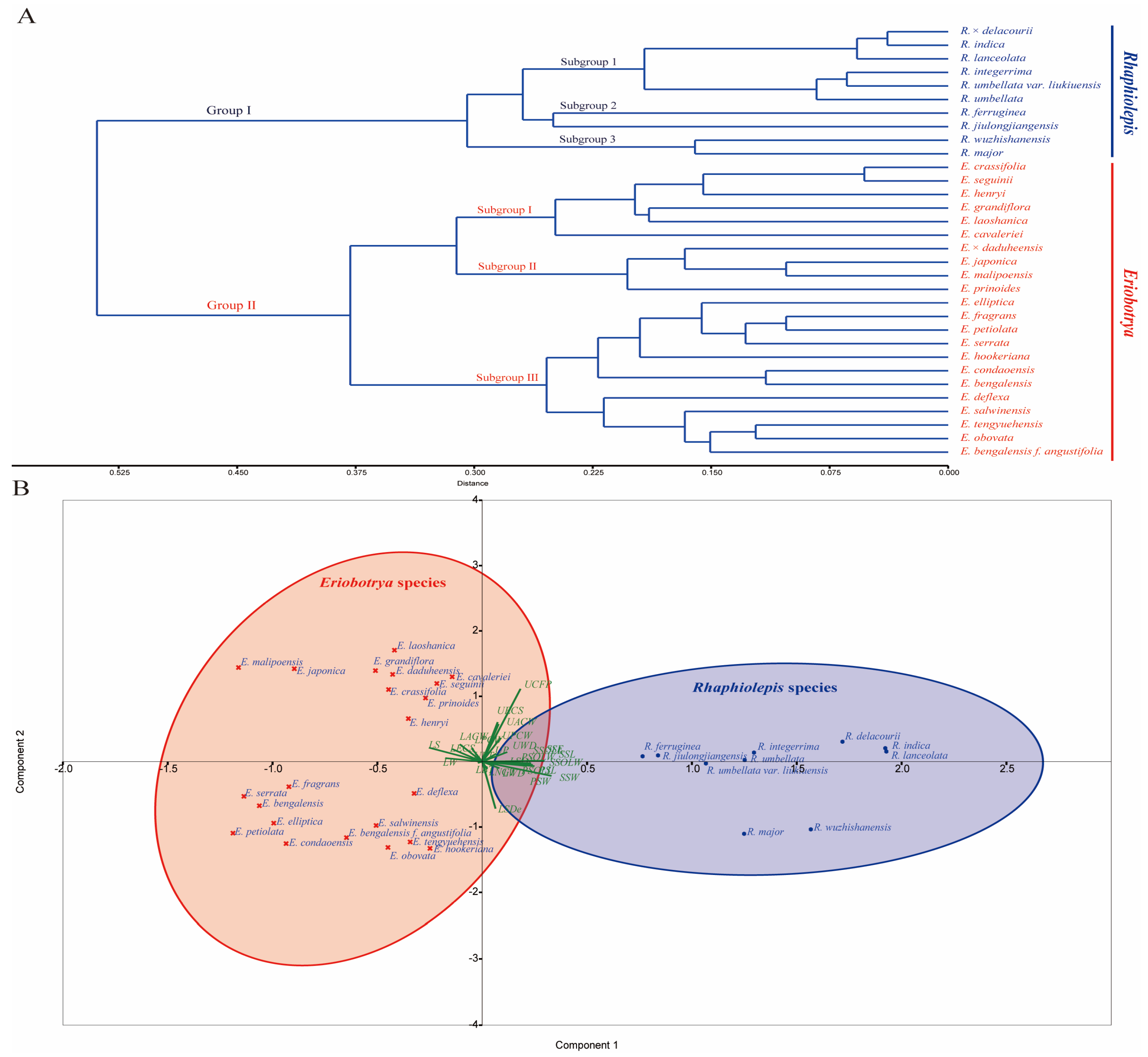
The principal component analysis plot revealed a clear subdivision of the studied species of Eriobotrya and Rhaphiolepis (Table S4) into two distinct groups, which was predominantly driven by principal components 1 and 2 (PC1 and PC2) (Table S6). Furthermore, the first two components from the PCA accounted for 53.292% of the total variation (Table S6). The first principal component accounted for 39.86% of the variation, with epidermal cell shapes, anticlinal and periclinal walls, cuticular folding, stomatal complexes and distribution as the most important variables, while the second component accounted for 13.432% of the variation, with epidermal cell shapes, anticlinal and periclinal walls on both surfaces, and non-glandular trichomes and stomatal complexes identified as the most important variables (Figure 8). The result based on nine stomatal variables also showed a clear subdivision of the studied species of Eriobotrya and Rhaphiolepis into two distinct groups (Figure S12).
Figure 8.
(A) Cladogram of 32 Eriobotrya and Rhaphiolepis species based on 26 micromorphological variables. (B) Principal Component Analysis graph showing the contributions of these variables to the explanation of leaf micromorphological variation. The Red cross indicate Eriobotrya species, and Blue circle indicate Rhaphiolepis species.
Species from the two genera were divided into two main groups based on the cluster analysis of the 26 leaf morphoanatomy variables (Table 1, Table 3, Table 4, Table 5 and Table S4, Figure 8), while the analysis based on stomatal complexes is presented in Table 5, Tables S7 and S8, and Figure S12. In the cluster analysis, Group I included all 10 of the Rhaphiolepis species, and was further separated into two subgroups 1, 2, and 3: subgroup 1 comprised R. × delacourii, R. indica, R. lanceolata, R. integerrima, R. umbellata, and R. umbellata var. liukiuensis; subgroup 2 comprised R. ferruginea, and R. jiulongjiangensis; whereas subgroup 3 included R. major, and R. wuzhishanensis. Group II included 22 species of Eriobotrya, and was further divided into three subgroups, I, II, and III: subgroup I had six species, comprising E. crassifolia, E. laoshanica, E. cavaleriei, E. grandiflora, E. seguinii, and E. henryi. Subgroup II had 5 species, including E. × daduheensis, E. japonica, E. malipoensis, and E. prinoides, while subgroup III had 12 species, including E. bengalensis, E. bengalensis f. angustifolia, E. condaoensis, E. elliptica, E. serrata, E. salwinensis, E. fragrans, E. deflexa, E. tengyuehensis, E. obovata, E. petiolata, and E. hookeriana.
4. Discussion
Numerous documented instances among closely related extant genera suggested that the tribe (Maleae) of Rosaceae experienced extensive intergeneric and trigeneric hybridization, ancient and recent radiations, incomplete lineage sorting (ILS), polyploidy events, the loss of gene copies following duplication events, or ancient divergence among certain clades [7,26,28,37,44,74,75,76,77]. It is possible that Maloideae evolved polychotomously from an allopolyploid gene pool that resulted from hybridization between an Amygdaloideae ancestor (x = 8) and a Spiraeoideae ancestor (x = 9) [8,78,79] or that the original rootstock was solely spiraeoid [80]. The ancestor of Maleae (x = 17) and Gillenieae (x = 9) may have originated through hybridization between two distantly related Amygdaloideae lineages, according to a recent phylogenomic study [81]. In addition, it has been proposed that the genera Phippsiomeles B.B.Liu & J.Wen [82], Micromeles Decne., Pseudocydonia (C.K.Schneid.) C.K.Schneid. [28], and Sorbus L., and Micromeles [83] have hybrid origins. Eriobotrya has long been thought to be prone to hybridization [84,85], and despite the existence of intergeneric hybrids [28,38,84], almost all studies involving the genera Eriobotrya and Rhaphiolepis have found close genetic and morphological relationships [26,28,30,31,33,34,36]; however, there is no reason to combine them [24,44]. There may be incongruence between these disparate data sources because sequences from different genomes exhibit different inheritance patterns (e.g., nuclear genes are for biparentally inherited, plastid genes and mitochondrial genes are for maternally inherited genes) [86,87,88,89]. At a deeper level, in Eriobotrya, Liu et al. [40] documented a hybridization event involving Rhaphiolepis using a phylogenomic approach. Furthermore, Chen et al. [46] found numerous occurrences of multiple ancient hybridization events, and chloroplast capture events within Eriobotrya. When the evolutionary histories of various genes conflict, hybridization is frequently identified by gene tree discordance [90]. These discrepancies could be explained by gene flow (introgression, allopolypoloidy, hybridization), mitochondrial or chloroplast capture events, horizontal gene transfer, ILS, and errors in gene tree estimation.
4.1. Phylogenetic Relationships
The phylogenetic status of the two genera within the Maleae tribe has been contentious, and their evolutionary relationships remain similarly contentious. Phylogenetic analyses utilizing nuclear genome data have affirmed the monophyly of both genera [25,26,29,34,37], whereas alternative studies employing nrDNA and cpDNA data have classified them as paraphyletic [40,44,55]. Integrative taxonomy, which synthesizes information from several fields including morphology, phylogenomics, cytology, and ecology, has been advocated for as a normative approach in taxonomic research [91]. This study employs a multi-evidence approach, utilizing molecular (nrDNA, and mtDNA) and micromorphological analyses (26 variables) for the first time to clarify the phylogenetic relationships between two genera, elucidate the micromorphological patterns of variation, and identify the most informative features for differentiating the two genera and assessing their taxonomic relationship. The phylogenetic trees (Figure 2 and Figure 8) derived from complete nrDNA sequences and micromorphological variables support the monophyly of each genus, with high support for Rhaphiolepis (BS = 100%, PP = 1.0) and moderate to low support for Eriobotrya (BS = 51%, PP = 0.67). These findings align with previously published molecular research [33,34,35,36,37,92] and morphological studies [7,9,11,12,15,17,19,20,23,38,47,52], although the relationships among and within the clades varied in each analysis. Two principal clusters within Eriobotrya (25 species) and two within Rhaphiolepis (14 species) were discerned. The phylogenomic topologies established herein align with previously documented phylogenetic relationships [33,34], which delineated the relationships among 17 and 18 Eriobotrya species, respectively. The majority of interspecies relationships within Eriobotrya (22 species) have been elucidated and validated through recent nrDNA (ITS) research [36], which will not be reiterated here; instead, this discussion will concentrate on problematic species, using both molecular and morphological evidence. Previously, a robust interspecies or possibly infraspecies relationship was documented between E. fragrans and E. cavaleriei [27,33,34] and it is addressed herein. Our analysis of nrDNA indicated that E. cavaleriei from GenBank and E. fragrans formed a sister clade to E. deflexa, while another sample of E. cavaleriei from Chongqing formed a clade with E. elliptica. Morphologically, E. fragrans closely resembles E. deflexa but differs from it by the presence of non-glandular trichomes on the abaxial surface, epicuticular wax deposits on both surfaces, and stomatal complexes (Table 3, Table 4 and Table 5; Figures S2 and S3). E. fragrans is further distinguished from E. cavaleriei by several traits (Table 3, Table 4 and Table 5; Figure 8, Figures S3 and S5), including irregular epidermal cell shapes, with cuticle striation patterns (vs. a polygonal shape, without cuticle striation in E. cavaleriei), raised anticlinal and convex periclinal walls (vs. depressed and flat walls in E. cavaleriei), as well as variations in the epicuticular waxes, stomatal complexes, and frequencies (Table 3, Table 4 and Table 5). E. × daduheensis, E. prinoides, E. japonica, E. malipoensis, and E. tengyuehensis, constituted a cluster in nrDNA, mtDNA, and micromorphological analyses gene trees, signifying close relationships, consistent with recent publications [33,34,36,55,92]. All of these species exhibited polygonal epidermal cell morphology, depressed anticlinal cell walls, smooth periclinal walls, and non-glandular simple trichomes (indumentum) on both surfaces. In contrast, E. prinoides and E. tengyuehensis displayed an irregular abaxial surface characterized by long, straight-curve epidermal cells, raised anticlinal walls, and convex periclinal walls. Dong et al. [34] showed that E. prinoides is closely related to E. serrata and E. elliptica. Our findings however, revealed a discrepancy; morphological and molecular evidence corroborated the aforementioned relationships, as cited above, while our results aligned with Dong et al. regarding the phylogenetic positioning of E. bengalensis, E. salwinensis, E. bengalensis f. angustifolia, and E. obovata, which, with the addition of E. crassifolia, E. elliptica, E. petiolata and E. cavaleriei, form a closely related group consistent with other studies [33,36].
In the genus Rhaphiolepis, the designation R. jiulongjiangensis was omitted from the Flora of China [15], which indicated the necessity for further investigation. However, with the increasing number of species, we have confirmed its phylogenetic position, establishing a clade with R. ferruginea var. serrata in both nrDNA and mtDNA (Figure 2 and Figure 3). Micromorphologically (Figure 8), R. jiulongjiangensis is closely related to R. ferruginea, forming a clade but differing due to the absence of fallen trichomes (glabrous) on the adaxial surface (vs. their presence in R. ferruginea), and primary stomatal dimensions of 32.04 × 24.51 (vs. 29.93 × 28.29 in R. ferruginea) (Table 3, Table 4 and Table 5; Figure S7). Moreover, recent research indicated that R. jiulongjiangensis constituted a distinct clade, and established a sister group with other Rhaphiolepis species [36], which could aid in understanding the evolution of Rhaphiolepis and its relationship with Eriobotrya. Our findings supported its evolutionary position, and morphological affinities with the closest species.
Rhaphiolepis × delacourii constituted a clade with R. indica var. shilanensis (Figure 2), while morphologically it is closely related to R. indica (Figure 8) but differs in having polygonal-undulate epidermal cells (vs. irregular, small, straight-curve cells in R. indica), and distinct stomatal complexes (Table 3, Table 4 and Table 5). Huang & Li [93] regarded R. umbellata var. liukiuensis as a synonym of R. umbellata, indicating that they differ in their leaf margins. Our findings showed that R. umbellata var. liukiuensis formed a sister clade with other Rhaphilepis species, including R. major, in the nrDNA analysis, whereas micromorphological and mtDNA phylogenies (Figure 3 and Figure 8) indicated its sister clades R. integerrima, and R. umbellata. Nonetheless, it is distinguishable from R. umbellata by the presence of distinct trichomes and epicuticular waxes on both surfaces. We additionally elucidated the relationships among 17 species of Eriobotrya and Rhaphiolepis, specifically E. laoshanica, E. crassifolia, E. sp1 to E. sp5, E. hookeriana, R. indica var. shilanensis, R. jiulongjiangensis, R. umbellata var. liukiuensis, R. × delacourii, and R. wuzhishanensis.
4.2. Conflict
Although Eriobotrya monophyly was well supported in both nuclear and leaf micromorphology phylogenies (Figure 2 and Figure 8), we discovered mito-nuclear discordance within this genus (Figure 3). Conflicts between organelle genomic data and nrDNA are common in the Eriobotrya-Rhaphiolepis clade [40,46], and have been reported in many Rosaceae genera, including Prunus L. [94], Cotoneaster Medik. [95], and Potentilla L. [96]. The cyto-nuclear discordance phenomenon is difficult to avoid due to the inherent difference of evolutionary histories between nuclear and cytoplasmic genomes. We found topological congruences between nrDNA and micromorphology, as well as major inconsistencies in the partial mtDNA. Although the mtDNA gene tree derived from 52 protein-coding genes shows generally low resolution (with weakly supported nodes) due to low sequence variability, the discordant clade comprising the four Eriobotrya species nested within Rhaphiolepis is significant, with support ranging from low (for E. hookeriana: BS = 52%, PP = 0.93) to strong confidence (for E. fragrans, E. deflexa and E. laoshanica: BS = 94%, PP = 1.0) (Figure 3). Tree topological incongruence can be caused by a variety of biological patterns, including gene flow (e.g., hybridization and introgression), mitochondrial capture events, gene choice, or technological causes (e.g., insufficient data) [86]. In both nrDNA and micromorphological investigations, these species formed a distinct clade within Eriobotrya. First, E. deflexa has close relationships with E. fragrans in both nrDNA and mtDNA trees (with BS–PP 97 and 1) (Figure 2 and Figure 3), which is consistent with recently published phylogenetic studies [34,36,46], though these species morphologically differ from Rhaphilolepis by having abaxial epidermal cell shapes, primary and secondary stomata, outer primary and secondary ledge apertures, stomata distribution, fruit surfaces, and the outer and inner surfaces of the fruit apical sepals (Table 3 and Table 5; Figures S2–S8). Second, E. laoshanica formed a sister clade with E. deflexa and E. fragrans; although the morphological tree revealed that it formed a clade with E. grandiflora, they differed from each other in terms of stomatal complexes and frequency. Furthermore, this species is distinguished from Rhaphiolepis species by its abaxial epidermal cell shapes, stomatal complexes, fruit surface, and the sculpture of the outer and inner surfaces of the fruit apical sepals. Third, E. hookeriana formed a sister clade with E. henryi and E. seguinii in Clade I of the nrDNA gene tree, and the morphological tree revealed that it formed a sister clade with E. elliptica. Additionally, E. hookeriana species differ from Rhaphiolepis by having an abaxial leaf surface, fruit surfaces, and the outer and inner surfaces of the fruit apical sepals (see Table 3, Table 4 and Table 5; Figures S2–S8). The majority of the species relationships within the genera Eriobotrya and Rhaphiophis are consistent with those of the nrDNA results. For example, E. prinoides, E. japonica, E. malipoensis, and E. tengyuehensis formed a clade, and E. elliptica, and E. petiolata formed a clade, aligning with prior research. Furthermore, the resulting network revealed that these species have a complex evolutionary history (Figure S1); their presence increases network complexity, which could be due to frequent hybridization from Rhaphiolepis into Eriobotrya or a lack of informative characters. The removal of these species resulted in no reticulation, confirming their involvement in the evolutionary debate. Previous studies [40] found cyto-nuclear conflicts in both genera, indicating hybridization. Compared to hybridization or introgression, fewer studies have reported cyto-nuclear discordance attributed primarily to ILS. This is most likely because ILS is more difficult to identify and less appealing than the rush of cytoplasmic genome capture or nuclear gene flow among phylogenetically distant species, which may produce more eye-catching topologically incongruent patterns [87]. Furthermore, phylogenetic trees built on diverse data matrices frequently produce inconsistent results [88]. Such different topologies can perplex taxonomists, perhaps leading to inaccurate taxonomic treatments.
4.3. Morphological Relationships
The micromorphological structure of leaf blades displays variability among different genera, while remaining rather uniform within a species, thereby facilitating the use of these traits for taxonomic classification [97]. Comprehensive investigations of leaf surface micromorphology in Aronia Medik., and Pourthiaea Decne., by Vinogradova [98], distinguished the genera by the presence of colleters on the midrib of adaxial surfaces and cuticular folding. Song and Hong [68], and Song et al. [69] distinguished the tribes Spiraeeae, Sorbarieae, and Neillieae by stomatal complexes, surface anticlinal walls, wax deposits, and trichome diversity; the genus Cotoneaster was distinguished by Niaki et al. [99] by epidermal cells, anticlinal walls, stomatal types, epicuticular waxes, cuticle density, and trichomes. Dryadoideae (Rosaceae) was distinguished by Babosha et al. [97] by stomata, cuticular folding patterns, and trichomes with hydathodes. Genera in the Rosaceae can be distinguished by cuticular folding patterns and microstructure [70]. Nonetheless, there is limited evidence concerning the micromorphology of the leaf epidermises, petioles, pollens, fruits, and fruit apical sepals of Eriobotrya and Rhaphiolepis, which is crucial for classification. Additionally, anomocytic stomata were identified in the Rosaceae [50], with the first documentation in E. japonica by de Sauza et al. [54], which is consistent with the present study. The anatomy and significance of hydathodes in the Rosaceae remain largely unexamined. Guttation has been documented in Rosoideae and Spiraeoideae, while hydathodes, or water pores, and colleters were documented exclusively in six genera (Eriobotrya, Crataegus L., Malus Mill., Mespilus L., Amelanchier Medik., and Sorbus L.) in the tribe Maleae [70,100]. Lippmann [101] observed the presence of water pores but the absence of epithem in Malus floribunda, concluding that neither structure is found in Crataegus, Pyrus, Cotoneaster, and Malus spectabilis. The present investigation revealed that the adaxial surface of Eriobotrya had well-developed laminar hydathodes (water pores and epithem), in accordance with Lersten and Curtis [102] (Figure 5), as well as colleters at the apex of leaf marginal teeth and in the sinuses between the leaf marginal teeth (Figure 6), and surrounding stomata were observed on the leaf teeth. In Rhaphiolepis species, colleters were found at the leaf margin apex in R. lanceolata, while in R. jiulongjiangensis, they were noted in the sinuses between the leaf teeth, without surrounding stomata on the adaxial surface, near the margin apex, or at the leaf apex. It is important to highlight that the stomata are present at the leaf margin apex in Eriobotrya species while absent in Rhaphiolepis; while the same structures were previously identified as water pores in various genera of Rosaceae [102,103], we refer to them here as adaxial stomata. Colleters of the same type were documented on the leaf serrations of Prunus [104] and Eriobotrya japonica [105]. Colleters are secretory structures that assist in safeguarding meristems and growing organs by preventing dehydration [106]. Moreover, large, flat marginal glands and dark punctate spots on leaves were observed in both genera (Figure S13), comprising a glandular zone and its associated parenchyma cell stalk tissues [107]. These structures were exclusively identified in Prunus [108], which secretes sugars and attracts ant visitation during active secretion [109]. Comprehensive descriptions of hydathodes, colleters, or glandular anatomy employing modern approaches are necessary to determine the functionality of the reported structures for guttation and secretions. Thus, we determined that the adaxial epidermal cells, anticlinal walls, periclinal walls, abaxial epidermal cells, cuticular folding, stomatal complexes and distribution, colleters, hydathodes, stomata near the leaf margin apex, petiole surface sculpture and cross-section outline, fruit surface sculpture, and the outer and inner surfaces of the fruit apical sepals are critical diagnostic traits for the classification of these two genera in the Rosaceae. Additionally, within these genera, the shape of the epidermal cells, anticlinal walls, non-glandular trichomes, and stomatal complexes are notable features. It has also been established that a number of micromorphological characteristics, such as quantitative and qualitative variables, were helpful in differentiating between and within the two genera. This study is the first to demonstrate that using SEM in conjunction with DNA evidence for taxonomic purposes reflects the benefits of detailed morphological data and large-scale analysis. These data can also be a valuable source of knowledge and a thorough archive of micromorphological databases with a wide range of uses in teaching and research.
4.4. Morphological Comparison with Previous Studies
Prior research showed that E. henryi, E. seguinii, E. bengalensis f. angustifolia, E. salwinensis, and E. obovata formed a sister clade to the Rhaphiolepis clade, with robust support values [40]. Moreover, the author determined that the apical sepals of the fruit in E. henryi are not persistent, and the lateral veins of the leaves in both E. henryi and E. seguinii exhibit curvatures. This leads to the classification of both genera under a single genus based on two synapomorphies, as outlined by Aldarsoro et al. [24]: a lack of endosperm and the existence of rounded or broad elliptic seeds. Our finding based on nrDNA showed that E. seguinii, E. henryi, and E. hookeriana formed a closely related group, considered to be the earliest diverging extant lineage within Eriobotrya. This agrees with earlier studies based on molecular evidence [27,33,35,55]. Furthermore, we verified here (see Figure S10: nos. 9–12; Figure S13: nos. 8–16) that a persistent sepal effectively distinguished the two genera, including E. seguinii, and E. henryi, along with the fruit adaxial surface sculpture and petiole cross-section (Figures S9 and S10). Based on leaf venation, taxonomic studies [7,8,9,15] indicated that Eriobotrya displays both camptodromous and craspedodromous leaf venation patterns. Furthermore, Aldarsoro et al. [24] previously determined that the absence of endosperm along with rounded or broadly elliptic seeds in one Eriobotrya and one Rhaphiolepis species, which constituted a sister clade in the phenogram, differentiated them from other Maloideae genera characterized by 8 to 18 seed coat layers and broadly elliptic or oval seeds [6,7]. It is noteworthy that both genera possess proportionally larger seeds compared to other Maloideae and reside in the understory of tropical or subtropical evergreen forests with diminished light intensity [22,110]. Furthermore, Eriobotrya cotyledons exhibit photosynthesis, turning green after germination [111]. Gu and Spongberg [9,15] reported obovoid, ovoid to ovoid-globose, elliptic, globose, or pyriform to subglobose fruit shapes within Eriobotrya and exclusively globose fruit shapes in Rhaphiolepis (Figure S13). Robertson et al. [7] recognized both genera as distinct, noting that “the narrow petals and elongated panicles resemble those of Amelanchier while the thin endocarp and one or two seeds are similar to Eriobotrya, except that the calyx is quickly deciduous as a unit, leaving an annular ring” (see Figure S13: nos. 8–16). They further observed that sclereids are absent to densely and evenly distributed in Eriobotrya, in contrast to the numerous, scattered sclereids in Rhaphiolepis, which aligns with the previous findings [6,8].
Overall, congruences in morphological and molecular data were observed in the studied genera, reinforcing traditional taxonomy. The morphological analysis revealed that none of the examined characteristics of the four distinct Eriobotrya species (including abaxial and adaxial leaves, stomatal complexes, petiole cross-sectional outlines, fruit surface, and the outer and inner surfaces of the apical fruit sepals) were similar to those of Rhaphiolepis. The observed mtDNA incongruence is most consistent with mito-nuclear discordance potentially resulting from ancient hybridization, mitochondrial capture events, incomplete lineage sorting, gene choice, or technological causes (e.g., insufficient data). Furthermore, the slow evolutionary rate and lack of relevant features in the mtDNA protein coding genes employed in this study preclude a robust phylogenetic reconstruction, making this genome particularly sensitive to representing ancient hybridization events. Future studies incorporating whole genome sequencing may offer additional insight into the intricate evolutionary history of this significant group, even though the creation of new sequence data will continue to be crucial.
5. Conclusions
The classification of Eriobotrya and Rhaphiolepis as distinct, monophyletic genera is supported by congruent evidence from the complete nuclear ribosomal DNA sequences (nrDNA) and a comprehensive analysis of micromorphological features (including the diagnostic features of leaves, petioles, fruits, apical sepals of the fruit, etc.). We recommend that Eriobotrya and Rhaphiolepis be classified as distinct genera. Leaf epidermal micromorphological features, such as epidermal cell shapes and the anticlinal walls on both surfaces, cuticular folding, stomatal complexes and distribution, colleters, hydathodes, amphistomatic leaves, stomata located near the leaf margin, petiole surface sculpture and cross-section outline, fruit surface sculpture, and the outer and inner surfaces of the fruit apical sepals, were effective for distinguishing and classifying both Eriobotrya and Rhaphiolepis and are consistent with the well-supported phylogeny from nrDNA. Furthermore, epidermal cell shapes, anticlinal walls, non-glandular trichomes, and stomatal complexes were important characteristics for distinguishing species within these genera. The outcomes of this study support the idea that SEM imaging of leaf, petiole, and fruit micromorphology is advantageous for delineation at the generic level, and upholds them as distinct genera. Furthermore, this approach enabled us to collect a vast quantity of quantitative and qualitative data on the leaves, petioles, and fruit surfaces with high accuracy, which promises to be very useful in resolving the taxonomic classification of Eriobotrya and Rhaphiolepis. The aberrant mtDNA signal, which showed four distinct Eriobotrya species, formed a sister group within the Rhaphiolepis clade, inferred a complex evolutionary history involving ancient hybridization, mitochondrial capture, or phylogenetic error. While molecular (nrDNA) and micromorphological evidence of four distinct Eriobotrya species clearly supports their classification as Eriobotrya, future studies that include whole genome sequencing may shed further light on the complex evolutionary history of this key clade.
Supplementary Materials
The following supporting information can be downloaded at https://www.mdpi.com/article/10.3390/biology14121740/s1: Figure S1: Mitochondrial DNA (mtDNA) gene tree-based filtered super-networks. (A) All species were included. (B) Four Eriobotrya species were excluded. Figure S2: Leaf micromorphology of Eriobotrya species (1a–4a indicates adaxial; 1b–4b indicates an abaxial surface). (1) E. bengalensis, (2) E. bengalensis f. angustifolia, (3) E. condaoensis, and (4) E. deflexa. Scale bars: 50–100 µm. Figure S3: Leaf micromorphology of Eriobotrya species (1a–4a indicates an adaxial surface; 1b–4b indicates an abaxial surface). (5) E. elliptica, (6) E. fragrans, (7) E. petiolata, and (8) E. hookeriana. Scale bars: 50–200 µm. Figure S4: Leaf micromorphology of Eriobotrya species (1a–4a indicates an adaxial surface; 1b–4b indicates an abaxial surface). (9) E. salwinensis, (10) E. tengyuehensis, (11) E. obovata, and (12) E. serrata. Scale bars: 50–300 µm. Figure S5: Leaf micromorphology of Eriobotrya species (1a–4a indicates an adaxial surface; 1b–4b indicates an abaxial surface). (13) E. crassifolia, (14) E. × daduheensis, (15) E. cavaleriei, (16) E. grandiflora, and (17) E. laoshanica. Scale bars: 50–300 µm. Figure S6: Leaf micromorphology of Eriobotrya species (1a–4a indicates an adaxial surface; 1b–4b indicates an abaxial surface). (18) E. japonica, (19) E. prinoides, (20) E. malipoensis, (21) E. seguinii, and (22) E. henryi. Scale bars: 50–300 µm. Figure S7: Leaf micromorphology of Rhaphiolepis species (1a–4a indicates an adaxial surface; 1b–4b indicates an abaxial surface). (23) R. × delacourii, (24) R. integerrima, (25) R. indica, (26) R. ferruginea, and (27) R. jiulongjiangensis. Scale bars: 50–300 µm. Figure S8: Leaf micromorphology of Rhaphiolepis species (1a–4a indicates an adaxial surface; 1b–4b indicates an abaxial surface). (28) R. lanceolata, (29) R. umbellata, (30) R. umbellata var. liukiuensis, (31) R. wuzhishanensis, and (32) R. major. Scale bars: 50–100 µm. Figure S9: Anatomical description of petiole cross-section outline of Eriobotrya and Rhaphioelpis species. (1) E. prinoides, (2) E. bengalensis, (3) E. japonica, (4) R. major, (5) R. lanceolata, and (6) R. indica. Scale bars: 2 mm and 500 µm. Figure S10: Micromorphology of fruit surfaces of Eriobotrya species. Fruit surface: (1) E. × daduheensis, (2) E. hookeriana, (3) E. prinoides, (4) E. bengalensis f. angustifolia, (5) E. japonica, (6) E. kwangsiensis, (7) E. henryi, and (8) E. seguinii; The outer and inner surfaces of the fruit apical sepals: (9a–9b) E. crassifolia, (10a–10b) E. kwangsiensis, (11a–11b) E. deflexa, and (12a–12b) E. seguinii. Designations: The yellow arrows are non-glandular trichomes; the pink arrows are stomata. Scale bars: 1 mm and 200–500 µm. Figure S11: Micromorphology of fruit surfaces of Rhaphiolepis species. (1) R. jiulongjiangensis, (2) R. lanceolata, (3) R. philippinensis, and (4) R. salcifolia. Designation: The yellow arrows are non-glandular trichomes. Scale bars: 1 mm and 500 µm. Figure S12: Cladogram, Principal Component Analysis (PCA) and Correlation matrix based on 9 stomatal variables between Eriobotrya and Rhaphioelpis. (A) Cladogram, (B) PCA graph showing contribution of these variables’ attributes to explaining variations in leaf micromorphological features within 32 Eriobotrya and Rhaphiolepis species. (C) Correlation matrix with p < 0.05 significance. Figure S13: Morphological variables of Eriobotrya and Rhaphioelpis. (1) Eriobotrya japonica, (2) E. prinoides, (3) E. bengalensis, (4) E. serrata, (5) E. henryi, (6) E. deflexa, (7) E. fragrans, (8) E. malipoensis, (9) Rhaphiolepis indica, (10) R. jiulongjiangensis, (11) R. salicifolia, (12) R. lanceolata, (13) R. ferrugenia, (14) R. × delacourii, (15) R. umbellata, and (16) R. wuzhishanensis. Scale bars: 50 µm. Table S1: Summary of studied samples included in this study. Number in parentheses indicates the estimated total number of species described in each genus. Number near parentheses indicates the sampling in this study. Table S2: Information on all species included in this study. Table S3: Species and sequence information from NCBI used to construct nuclear phylogeny in this study. Table S4: Micromorphological variables of Eriobotrya and Rhaphiolepis. Table S5: Individual mitochondrial genes, nucleotide diversity, and GC contents in this study. Table S6: Eigenvalues and cumulative variances for 2 major factors obtained from PCA analysis and 26 variables for each factor within Eriobotrya and Rhaphiolepis. Table S7: Statistical analysis of 9 quantitative stomatal variables within Eriobotrya and Rhaphiolepis species. Table S8: Eigenvalues and cumulative variances for 2 major factors obtained from PCA analysis and 9 quantitative stomatal variables for each factor within Eriobotrya and Rhaphiolepis.
Author Contributions
Conceptualization, M.I. and Z.Z.; methodology, M.I., M.L. and Y.L.; software, M.I. and Y.L.; validation, M.I., Z.Z. and J.M.H.S.; formal analysis, M.L. and Y.L.; investigation, H.W., F.C. and N.Z.; resources, M.I., M.L. and H.W.; data curation, M.I.; writing—original draft preparation, M.I.; writing—review and editing, M.L. and J.M.H.S.; visualization, F.C., Z.Z. and N.Z.; supervision, M.I.; project administration, M.I.; funding acquisition, M.I. All authors have read and agreed to the published version of the manuscript.
Funding
This research was funded by the National Natural Science Foundation of China (Grant No. 32350410399).
Institutional Review Board Statement
Not applicable.
Informed Consent Statement
Not applicable.
Data Availability Statement
All data generated and analyzed during this study are included in the main text and Supplementary Materials. All nuclear and mitochondrial data used in this study can be found in GenBank (accession numbers are provided in Table S2).
Acknowledgments
The authors would like to thank the Editor and the two anonymous reviewers for their helpful suggestions to improve our manuscript. We are grateful to the directors of the herbaria PE, IBSC, CDBI, SZ, NAS, KUN, HIBC, AU, and IBK for permitting us to examine the specimens and thankful to Jianing (Nanjing Forestry University) for examining and providing the SEM photos.
Conflicts of Interest
The authors declare no conflicts of interest.
Abbreviations
The following abbreviations are used in this manuscript:
| nrDNA | Nuclear Ribosomal DNA |
| mtDNA | Mitochondrial DNA |
| SEM | Scanning Electron Microscope |
| PCA | Principal Component Analysis |
References
- Lindley, J. Observation on the natural group of plants called Pomaceae. Trans. Linn. Soc. Lond. 1821, 8, 102. [Google Scholar] [CrossRef]
- Lindley, J. Rhaphiolepia indica. In The Botanical Register: Consisting of Coloured Figures of Exotic Plants Cultivated in British Gardens with Their History and Mode of Treatment; Lindley, J., Edwards, S.T., Eds.; James Ridgway: London, UK, 1820; Volume 6, pp. 436–520. [Google Scholar]
- POWO. The Plants of the World Online Database. Facilitated by the Royal Botanic Gardens, Kew, 2025. Available online: http://www.plantsoftheworldonline.org/ (accessed on 1 August 2025).
- Sterling, C. Comparative morphology of the Carpel in the Rosaceae. VI. Pomoideae: Eriobotrya, Heteromeles, Photinia, Pourthiaea, Raphiolepis, Stranvaesia. Am. J. Bot. 1965, 52, 938–946. [Google Scholar] [CrossRef]
- Hooker, J.D. Eriobotrya Lindl. In The Flora of British India; Hooker, J.D., Ed.; Reeve: London, UK, 1878; pp. 370–372. [Google Scholar]
- Rohrer, J.R.; Robertson, K.R.; Phipps, J.B. Variation in structure among fruits of Maloideae (Rosaceae). Am. J. Bot. 1991, 78, 1617–1635. [Google Scholar] [CrossRef]
- Robertson, K.R.; Phipps, J.B.; Rohrer, J.R.; Smith, P.G. A Synopsis of Genera in Maloideae (Rosaceae). Syst. Bot. 1991, 16, 376–394. [Google Scholar] [CrossRef]
- Phipps, J.B.; Robertson, K.R.; Rohrer, J.R.; Smith, P.G. Origins and Evolution of Subfam. Maloideae (Rosaceae). Syst. Bot. 1991, 16, 303–332. [Google Scholar] [CrossRef]
- Gu, C.Z.; Spongberg, S.A. Eriobotrya Lindley. In Flora of China; Wu, Z.Y., Raven, P.H., Hong, D.Y., Eds.; Science Press: Beijing, China; Missouri Botanical Garden Press: St. Louis, MO, USA, 2003; Volume 9, pp. 138–141. [Google Scholar]
- Dash, A.A.; Pramanick, D.D.; Krishna, G.; Mao, A.A. (Eds.) Flora of India; Rosaceae to Neuradaceae; Botanical Survey of India: Kolkata, India, 2025; Volume 8. [Google Scholar]
- Vidal, J.E. Notes sur quelques Rosacees asiatiques (III). Revision du genre Eriobotrya (Pomoideae). Adansonia 1965, 5, 537–580. [Google Scholar] [CrossRef]
- Vidal, J.E. Eriobotrya Lindl. In Flore du Cambodge du Laos et du Vietnam Fascicule: ROSACEAE I (excl. RUBUS); Vidal, J.E., Ed.; Mémoires du Muséum national d’Histoire naturelle; Laboratoire de Phanérogamie: Paris, France, 1968; Volume 6, pp. 60–82. [Google Scholar]
- Pham, H.H. Rosaceae. In An illustrated Flora of Vietnam; Pham, H.H., Ed.; Young Publishing House: Ho Chi Minh City, Vietnam, 2000; Volume 1, pp. 776–779. [Google Scholar]
- Lin, S.Q.; Yang, X.H.; Liu, C.M.; Hu, Y.L.; He, Y.H.; Hu, G.B.; Zhang, H.L.; He, X.L.; Liu, Y.X.; Liu, Z.L. Natural geographical distribution of genus Eriobotrya plants in China. Acta Hort. Sin. 2004, 31, 569–573. [Google Scholar]
- Gu, C.Z.; Spongberg, S.A. Rhaphiolepis Lindley. In Flora of China; Wu, Z.Y., Raven, P.H., Hong, D.Y., Eds.; Science Press: Beijing, China; Missouri Botanical Garden Press: St. Louis, MO, USA, 2003; Volume 9, pp. 141–144. [Google Scholar]
- Kalkman, C. Rosaceae. In Flora Malesiana Series I-Spermatophyta Flowering Plants; Wilde, W.J.J.d., Nooteboom, H.P., Kalkman, C., Eds.; Rijksherbarium: Leiden, The Netherlands, 1993; pp. 227–351. [Google Scholar]
- Kalkman, C. Rosaceae. In The Families and Genera of Vascular Plants. VI Flowering Plants-Dicotyledons Celastrales, oxalidales, Rosales, Cornales, Ericales; Kubitzki, K., Ed.; Springer: Berlin, Germany, 2004; pp. 338–343. [Google Scholar]
- Vidal, J.E. Rosaceae. In Flora of Thailand; Smith, T., Larsen, K., Eds.; Applied Scientific Research Corporation of Thailand: Bangkok, Thailand, 1970; Volume 2, pp. 31–74. [Google Scholar]
- Phipps, J.B.; Robertson, K.R.; Smith, P.G.; Rohrer, J.R. A checklist of subfamily Maloideae (Rosaceae). Can. J. Bot. 1990, 68, 2209–2269. [Google Scholar] [CrossRef]
- Robertson, K.R.; Phipps, J.B.; Rohrer, J.R. Summary of leaves in the genera of Maloideae (Rosaceae). Ann. Mo. Bot. Gard. 1992, 79, 81–94. [Google Scholar] [CrossRef]
- Zhou, L.H.; Wei, Z.X.; Wu, Z.Y. Pollen morphology of Maloideae of China (Rosaceae). Acta Bot. Yunnanica 2000, 22, 47–52. [Google Scholar]
- Chang, K.-C. A Taxonomic Study of Maloideae (Rosaceae) in Taiwan, Biology, Environmental Science. Ph.D Thesis, National Chung Hsing University, Taichung City, Taiwan, 2011. (In Chinese). [Google Scholar]
- Zhang, Z.; Li, G.F.; Yang, X.H.; Lin, S.Q. Taxonomic studies using multivariate analysis of Eriobotrya based on morphological traits. Phytotaxa 2017, 302, 122–132. [Google Scholar] [CrossRef]
- Aldasoro, J.J.; Aedo, C.; Navarro, C. Phylogenetic and Phytogeographical Relationships in Maloideae (Rosaceae) Based on Morphological and Anatomical Characters. Blumea 2005, 50, 3–32. [Google Scholar] [CrossRef]
- Campbell, C.S.; Donoghue, M.J.; Baldwin, B.G.; Wojciechowski, M.F. Phylogenetic Relationships in Maloideae (Rosaceae): Evidence from Sequences of the Internal Transcribed Spacers of Nuclear Ribosomal DNA and its Congruence with Morphology. Am. J. Bot. 1995, 82, 903–918. [Google Scholar] [CrossRef]
- Campbell, C.S.; Evans, R.C.; Morgan, D.R.; Dickinson, T.A.; Arsenault, M.P. Phylogeny of Subtribe Pyrinae (Formerly the Maloideae, Rosaceae): Limited Resolution of a Complex Evolutionary History. Plant Syst. Evol. 2007, 266, 119–145. [Google Scholar] [CrossRef]
- Li, P.; Lin, S.Q.; Yang, X.H.; Hu, G.B.; Jiang, Y.M. Molecular phylogeny of Eriobotrya Lindl. (loquat) inferred from internal transcribed spacer sequences of nuclear ribosome. Pak. J. Bot. 2009, 41, 185–193. [Google Scholar]
- Lo, E.Y.Y.; Donoghue, M.J. Expanded Phylogenetic and Dating Analyses of the Apples and Their Relatives (Pyreae, Rosaceae). Mol. Phyl. Evol. 2012, 63, 230–243. [Google Scholar] [CrossRef]
- Li, Q.Y.; Guo, W.; Liao, W.; Macklin, J.A.; Li, J.H. Generic limits of Pyrinae: Insights from Nuclear Ribosomal DNA Sequences. Bot. Stud. 2012, 53, 151–164. [Google Scholar]
- Xiang, Y.; Huang, C.H.; Hu, Y.; Wen, J.; Li, S.; Yi, T.; Chen, H.; Xiang, J.; Ma, H. Evolution of Rosaceae fruit types based on nuclear phylogeny in the context of geological times and genome duplication. Mol. Biol. Evol. 2017, 34, 262–281. [Google Scholar] [CrossRef]
- Zhang, S.D.; Jin, J.J.; Chen, S.Y.; Chase, M.W.; Soltis, D.E.; Li, H.T.; Yang, J.B.; Li, D.Z.; Yi, T.S. Diversification of Rosaceae since the Late Cretaceous based on plastid phylogenomics. New Phytol. 2017, 214, 1355–1367. [Google Scholar] [CrossRef]
- Sun, J.; Shi, S.; Li, J.; Yu, J.; Yu, J.; Wang, L.; Yang, X.; Guo, L.; Zhou, S. Phylogeny of Maleae (Rosaceae) based on Multiple Chloroplast Regions: Implications to Genera Circumscription. Biomed. Res. Int. 2018, 2018, 7627191. [Google Scholar] [CrossRef] [PubMed]
- Kang, D.-H.; Ong, H.G.; Lee, J.-H.; Jung, E.-K.; Kyaw, N.-O.; Fan, Q.; Kim, Y.-D. A new broad-leaved species of loquat from Eastern Myanmar and its phylogenetic affinity in the genus Eriobotrya (Rosaceae). Phytotaxa 2021, 482, 279–290. [Google Scholar] [CrossRef]
- Dong, Z.; Qu, S.; Landrein, S.; Yu, W.B.; Xin, J.; Zhao, W.; Song, Y.; Tan, Y.; Xin, P. Increasing taxa sampling provides new insights on the phylogenetic relationship between Eriobotrya and Rhaphiolepis. Front. Genet. 2022, 13, 831206. [Google Scholar] [CrossRef] [PubMed]
- Idrees, M.; Tariq, A.; Pathak, M.L.; Gao, X.-F.; Sadia, S.; Zhang, Z.Y.; Zeng, F.J. Phylogenetic relationships of the genus Eriobotrya Lindl. (Rosaceae) based on ITS sequence. Pak. J. Bot. 2020, 52, 1679–1684. [Google Scholar]
- Idrees, M.; Li, M.; Shaw, J.M.H.; Zhang, Z.Y.; Ahamd, M. New species, combinations and synonyms in Eriobotrya (Rosaceae). Phytotaxa 2025, 712, 31–46. [Google Scholar] [CrossRef]
- Zhang, L.; Morales-Briones, D.F.; Li, Y.; Zhang, G.; Zhang, T.; Huang, C.H.; Guo, P.; Zhang, K.; Wang, Y.; Wang, H.; et al. Phylogenomics insights into gene evolution, rapid species diversification, and morphological innovation of the apple tribe (Maleae, Rosaceae). New Phytol. 2023, 240, 2102–2120. [Google Scholar] [CrossRef]
- Idrees, M.; Li, M.; Pathak, M.L.; Qaiser, M.; Zhang, Z.Y.; Gao, X.-F. A taxonomic revision of the genus Eriobotrya Lindl. (Rosaceae). Pak. J. Bot. 2022, 54, 985–1017. [Google Scholar] [CrossRef]
- Fay, M.F.; Christenhusz, M.J.M. Rosaceae. In The Global Flora: A Practical Flora to Vascular Plant Species of the World; Christenhusz, M.J.M., Fay, M.F., Byng, J.W., Eds.; Plant Gateway Ltd.: Bradford, UK, 2018; Volume 4, pp. 94–126. [Google Scholar]
- Liu, B.B.; Liu, G.N.; Hong, D.Y.; Wen, J. Eriobotrya belongs to Rhaphiolepis (Maleae, Rosaceae): Evidence from chloroplast genome and nuclear Ribosomal DNA Data. Front. Plant Sci. 2020, 10, 1731. [Google Scholar] [CrossRef]
- Nagano, Y.; Tashiro, H.; Nishi, S. Genetic diversity of loquat (Eriobotrya japonica) revealed using RAD-Seq SNP markers. Sci. Rep. 2022, 12, 10200. [Google Scholar] [CrossRef]
- Lin, Z.; Guo, Q.; Ma, S.; Lin, H.; Lin, S.; Wu, J. Chloroplast genomes of Eriobotrya elliptica and an unknown wild loquat “YN-1”. Sci. Rep. 2024, 14, 18816. [Google Scholar] [CrossRef]
- Son, H.G.; Lee, J.Y.; Kim, H.; Cho, Y.M.; Lee, Y.H. Eriobotrya japonica leaf extract Ameliorates Benign Prostatic Hyperplasia by regulating Inflammation. J. Med. Food. 2025, 18, 1069–1078. [Google Scholar] [CrossRef] [PubMed]
- Sun, J.; Zhao, D.; Qiao, P.; Wang, Y.; Wu, P.; Wang, K.; Guo, L.; Huang, L.; Zhou, S. Phylogeny of genera in Maleae (Rosaceae) based on chloroplast genome analysis. Front. Plant Sci. 2024, 15, 1367645. [Google Scholar] [CrossRef] [PubMed]
- Liu, B.B.; Ren, C.; Kwak, M.; Hodel, R.G.J.; Xu, C.; He, J.; Zhou, W.B.; Huang, C.H.; Ma, H.; Qian, G.Z.; et al. Phylogenomic conflict analyses in the apple genus Malus s.l. reveal widespread hybridization and allopolyploidy driving diversification, with insights into the complex biogeographic history in the Northern Hemisphere. J. Int. Plant Biol. 2022, 64, 1020–1043. [Google Scholar] [CrossRef] [PubMed]
- Chen, S.; Milne, R.; Zhou, R.; Meng, K.; Yin, Q.; Guo, W.; Ma, Y.; Mao, K.; Xu, K.; Kim, Y.D.; et al. When tropical and subtropical congeners met: Multiple ancient hybridization events within Eriobotrya in the Yunnan-Guizhou Plateau, a tropical-subtropical transition area in China. Mol. Ecol. 2021, 31, 1543–1561. [Google Scholar] [CrossRef]
- Kalkman, C. The malesian species of the subfamily Maloideae (Rosaceae). Blumea 1973, 21, 413–442. [Google Scholar]
- Iketani, H.; Ohashi, H. Anatomical structure of fruits and evolution of the tribe Sorbeae in the subfamily Maloideae (Rosaceae). J. Jap. Bot. 1991, 66, 319–351. [Google Scholar]
- Rohrer, J.R.; Robertson, K.R.; Phipps, J.B. Floral morphology of Maloideae (Rosaceae) and its systematic relevance. Am. J. Bot. 1994, 81, 574–581. [Google Scholar] [CrossRef]
- Metcalfe, C.R.; Chalk, L. Anatomy of the dicotyledons leaves, stem, and wood in relation to toaxonomy with notes on economic uses. Q. Rev. Bio. 1950, 26, 294. [Google Scholar]
- Zhang, S.-Y.; Baas, P. Wood anatomy of Trees and Shrubs from China. iii. Rosaceae. IAWA Bull. 1992, 13, 21–91. [Google Scholar] [CrossRef]
- Idrees, M.; Pathak, M.L.; Memon, N.H.; Khan, S.; Zhang, Z.Y.; Gao, X.-F. Morphological and morphometric analysis of the genus Eriobotrya Lindl. (Rosaceae). J. Anim. Plant Sci. 2021, 31, 1087–1100. [Google Scholar]
- Yü, T.T. Rosaceae (1). Spiraeoideae-Maloideae; Flora Reipublicae Popularis Sinicae: Beijing, China, 1974; Volume 36. [Google Scholar]
- de Sauza, W.M.; de Santosa, C.A.; Duarte, M.d.R.; Bardal, D. Morfo-anatomia das folhas da nespereira Eriobotrya japnocia Lindl., Rosaceae. Rev. Bras. Farmacog. 2003, 13, 41–49. [Google Scholar] [CrossRef]
- Yang, X.; Najafabadi, S.K.; Shahid, M.Q.; Zhang, Z.; Jing, Y.; Wei, W.; Wu, J.; Gao, Y.; Lin, S. Genetic relationships among Eriobotrya species revealed by genome-wide RAD sequence data. Ecol. Evol. 2017, 7, 2861–2867. [Google Scholar] [CrossRef] [PubMed]
- Yang, X.H.; Lin, S.Q. New ideas on the classification of loquat. South China Fruit 2007, 36, 28–31. [Google Scholar]
- Lin, S.; Lin, D.; Wu, B.; Ma, S.; Sun, S.; Zhang, T.; Zhang, W.; Bai, Y.; Wang, Q.; Wu, J. Morphological and Developmental Features of Stone Cells in Eriobotrya Fruits. Front. Plant Sci. 2022, 13, 823993. [Google Scholar] [CrossRef]
- Chen, S.; Zhou, Y.; Chen, Y.; Gu, J. Fastp: An ultra-fast all-in-one Fastq preprocessor. Bioinformatics 2018, 34, i884–i890. [Google Scholar] [CrossRef]
- Dylus, D.; Altenhoff, A.; Majidian, S.; Sedlazeck, F.J.; Dessimoz, C. Inference of phylogenetic trees directly from raw sequencing reads using Read2Tree. Nat. Biotechnol. 2024, 42, 139–147. [Google Scholar] [CrossRef]
- Li, H. New strategies to improve minimap2 alignment accuracy. Bioinformatics 2021, 37, 4572–4574. [Google Scholar] [CrossRef]
- Jin, J.J.; Yu, W.B.; Yang, J.B.; Song, Y.; dePamphilis, C.W.; Yi, T.S.; Li, D.Z. GetOrganelle: A fast and versatile toolkit for accurate de novo assembly of organelle genomes. Genome Biol. 2020, 21, 241. [Google Scholar] [CrossRef]
- Darling, A.E.; Mau, B.; Perna, N.T. progressiveMauve: Multiple Genome Alignment with Gene Gain, Loss and Rearrangement. PLoS ONE 2010, 5, e11147. [Google Scholar] [CrossRef]
- Kalyaanamoorthy, S.; Minh, B.Q.; Wong, T.K.F.; von Haeseler, A.; Jermiin, L.S. ModelFinder: Fast model selection for accurate phylogenetic estimates. Nat. Methods 2017, 14, 587–589. [Google Scholar] [CrossRef]
- Minh, B.Q.; Schmidt, H.A.; Chernomor, O.; Schrempf, D.; Woodhams, M.D.; von Haeseler, A.; Lanfear, R. IQ-TREE 2: New Models and Efficient Methods for Phylogenetic Inference in the Genomic Era. Mol. Biol. Evol. 2020, 37, 1530–1534. [Google Scholar] [CrossRef]
- Rambaut, A. FigTree v 1.4.5pre; University of Edinburgh: Edinburgh, UK, 2024. [Google Scholar]
- Huson, D.H.; Bryant, D. Application of phylogenetic networks in evolutionary studies. Mol. Biol. Evol. 2006, 23, 254–267. [Google Scholar] [CrossRef]
- Schneider, C.A.; Rasband, W.S.; Eliceiri, K.W. Nih Image to Imagej: 25 Years of Image Analysis. Nat. Methods 2012, 9, 671–675. [Google Scholar] [CrossRef] [PubMed]
- Song, J.H.; Hong, S.P. The systematic implications of leaf micromorphological characteristics in the tribe Neillieae (Spiraeoideae, Rosaceae). Korean J. Plant Taxon. 2017, 47, 222–235. [Google Scholar] [CrossRef]
- Song, J.-H.; Oak, M.-K.; Hong, S.-P. Leaf micromorphology in Rosaceae tribe Spiraeeae (subfamily Amygdaloideae) and its systematic and ecological implications. Bot. J. Linn. Soc. 2024, 205, 116–131. [Google Scholar] [CrossRef]
- Kumachova, T.; Babosha, A.; Ryabchenko, A.; Ivanova, T.; Voronkov, A. Leaf epidermis in Rosaceae: Diversity of the cuticular folding and Microstructure. Proc. Natl. Acad. Sci. India Sect. B Biol. Sci. 2021, 91, 455–470. [Google Scholar] [CrossRef]
- Hammer, O.; Harper, D.A.T.; Ryan, P.D. PAST: Paleontological Statistics Software Package for education and data analysis. Palaeontol. Electron. 2001, 4, 1–9. [Google Scholar]
- Vianna, S.A.; Carmelo-Guerreiro, S.M.; Noblick, L.R.; Colombo, C.A. Leaf Anatomy of Acrocomia (Arecaceae): An additional contribution to the taxonomic resolution of a genus with great economic potential. Plant Syst. Evol. 2017, 303, 233–248. [Google Scholar] [CrossRef]
- Greenacre, M.; Groenen, P.J.F.; Hastie, T.; D’Enza, A.I.; Markos, A.; Tuzhilina, E. Principal component analysis. Nat. Rev. Methods Primers 2022, 2, 100. [Google Scholar] [CrossRef]
- McAllister, H.A. The Rowan and Its Relatives (Sorbus spp.). Ph.D Thesis, Ness Gardens (University of Liverpool Botanic Gardens), Ness, UK, 1986. [Google Scholar]
- Robertson, K.R. The genera of Rosaceae in the southeastern United States. J. Arnold Arbor. 1974, 55, 303–332, 344–401, 611–662. [Google Scholar]
- Dang, J.; Wu, T.; Liang, G.L.; Wu, D.; He, Q.; Guo, Q. Identification and Characterization of a Loquat Aneuploid with Novel Leaf Phenotypes. HortScience 2019, 54, 804–808. [Google Scholar] [CrossRef]
- Wang, H.; Li, X.Y.; Jiang, Y.; Jin, Z.T.; Ma, D.K.; Liu, B.; Xu, C.; Ge, B.J.; Wang, T.; Fan, Q.; et al. Refining the phylogeny and taxonomy of the apple tribe Maleae (Rosaceae): Insights from phylogenomic analyses of 563 plastomes and a taxonomic synopsis of Photinia and its allies in the Old World. PhytoKeys 2024, 242, 161–227. [Google Scholar] [CrossRef] [PubMed]
- Challice, J.S.; Kovanda, M. Chemotaxonomic studies in the family Rosaceae and the evolutionary origins of the subfamily Maloideae. Preslia 1981, 53, 289–304. [Google Scholar]
- Sax, K. The origin and relationships of Pomoideae. J. Arnold Arbor. 1931, 12, 3–22. [Google Scholar] [CrossRef]
- Gladkova, V.N. On the origin of subfamily Maloideae. Bot. Z. Leningard. 1972, 57, 42–49. (In Russian) [Google Scholar]
- Hodel, R.G.J.; Zimmer, E.A.; Liu, B.B.; Wen, J. Synthesis of Nuclear and Chloroplast data combined with network analyses supports the polyploid origin of the Apple Tribe and the Hybrid Origin of the Maleae-Gillenieae Clade. Front. Plant Sci. 2022, 12, 820997. [Google Scholar] [CrossRef]
- Liu, B.B.; Hong, D.Y.; Zhou, S.L.; Xu, C.; Dong, W.P.; Johnson, G.; Wen, J. Phylogenomic analyses of the Photinia complex support the recognition of a new genus Phippsiomeles and the resurrection of a redefined Stranvaesia in Maleae (Rosaceae). J. Syst. Evol. 2019, 57, 678–694. [Google Scholar] [CrossRef]
- Ohashi, H.; Hoshi, H.; Iketani, H. Taxonomy and pollen morphology of hybrids between Sorbus and Micromeles in the genus Sorbus (Rosaceae subfamily Maloideae). J. Jpn. Bot. 1991, 66, 110–124. [Google Scholar]
- Fan, Q.; Chen, S.; Li, M.; Guo, W.; Jing, H.; Wu, W.; Zhou, R.; Liao, W. Molecular evidence for natural hybridization between wild loquat (Eriobotrya japonica) and its relatives E. prinoides. BMC Plant Biol. 2014, 14, 275. [Google Scholar] [CrossRef]
- Li, G.; Zhang, Z.; Yang, X.; Qiao, Y.; He, X.; Gao, Y.; Jiang, Y.; Lin, S. Inter-specific and Inter-generic hybridization compatibility of Eriobotrya species (loquat) and related genera. Hort. Plant J. 2016, 2, 315–322. [Google Scholar] [CrossRef]
- Wendel, J.F.; Doyle, J.J. Phylogenetic incongruence: Window into genome history and molecular evolution. In Molecular Systematics of Plants II: DNA Sequencing; Soltis, D.E., Soltis, P.S., Doyle, J.J., Eds.; Kluwer Academic Publishers: Boston, MA, USA, 1998; pp. 256–296. [Google Scholar]
- Duan, L.; Fu, L.; Chen, H.F. Phylogenomic cytonuclear discordance and evolutionary histories of plants and animals. Sci. China Life Sci. 2023, 66, 2946–2948. [Google Scholar] [CrossRef] [PubMed]
- Yi, T.S.; Jin, G.H.; Wen, J. Chloroplast capture and intra- and inter-continental biogeographic diversification in the Asian-New World disjunct plant genus Osmorhiza (Apiaceae). Mol. Phylogenet. Evol. 2015, 85, 10–21. [Google Scholar] [CrossRef] [PubMed]
- Schneider, A. Organelle inheritance: Understanding the basis of plastid tansmission for transgenic Engineering. J. Mitochondria Plast. Endosymbiosis 2023, 1, 2261790. [Google Scholar] [CrossRef]
- Linder, C.R.; Rieseberg, L.H. Reconstructing patterns of reticulate evolution in plants. Am. J. Bot. 2004, 91, 1700–1708. [Google Scholar] [CrossRef]
- Schlick-Steiner, B.C.; Steiner, F.M.; Seifert, B.; Stauffer, C.; Christian, E.; Crozier, R.H. Integrative taxonomy: A multisource approach to exploring biodiversity. Annu. Rev. Entomol. 2010, 55, 421–438. [Google Scholar] [CrossRef]
- Ulaszewski, B.; Jankowska-Wróblewska, S.; Świło, K.; Burczyk, J. Phylogeny of Maleae (Rosaceae) Based on Complete Chloroplast Genomes Supports the Distinction of Aria, Chamaemespilus and Torminalis as Separate Genera, Different from Sorbus sp. Plants 2021, 10, 2534. [Google Scholar] [CrossRef]
- Li, K.M. New materials of Flora from Fujian. J. Nanjing Inst. Forest. 1989, 13, 85–90. [Google Scholar]
- Hodel, R.G.J.; Zimmer, E.; Wen, J. A phylogenomic approach resolves the backbone of Prunus (Rosaceae) and identifies signals of hybridization and allopolyploidy. Mol. Phylogenet. Evol. 2021, 160, 107118. [Google Scholar] [CrossRef]
- Meng, K.; Fan, Q.; Lin, M. The plastome and phylogenetic status of Cotoneaster rosiflorus (Rosaceae). Mitochondrial DNA B Resour. 2024, 9, 949–953. [Google Scholar] [CrossRef]
- Xue, T.T.; Janssens, S.B.; Liu, B.B.; Yu, S.X.; Yu, S.X. Phylogenomic conflict analyses of the plastid and mitochondrial genomes via deep genome skimming highlight their independent evolutionary histories: A case study in the cinquefoil genus Potentilla sensu lato (Potentilleae, Rosaceae). Mol. Phylogenet. Evol. 2024, 190, 107956. [Google Scholar] [CrossRef]
- Babosha, A.; Ryabchenko, A.; Kumachova, T.; Komarova, G.; Yatsenko, I. Micromorphology of the leaf surface in some species of Dryadoideae (Rosaceae). Micron 2023, 167, 103428. [Google Scholar] [CrossRef] [PubMed]
- Vinogradova, Y.K.; Babosha, A.V.; Ryabchenko, A.S.; Kumachova, T. Micromorphology of the leaf structures of Aronia Medik. and Pourthiaea Decne (Rosaceae). Trees 2024, 38, 1509–1532. [Google Scholar] [CrossRef]
- Niaki, N.A.R.; Attar, F.; Mirtadzadini, M.; Mahdigholi, K.; Sheidai, M. Micromorphological studies of the leaf epidermis of Iranian Cotoneaster Medik. Nordic J. Bot. 2019, 37, e02074. [Google Scholar] [CrossRef]
- DeBary, A. Comparative Anatomy of the Vegetative Organs of the Phanerogams and Ferns; Clarendon Press: Oxford, UK, 1884. [Google Scholar]
- Lippmann, E. Über das vorkommen der verschiedenen arten der guttation undeinige physiologische und okologische beziehungen. Bot. Arch. 1925, 11, 361–464. [Google Scholar]
- Lersten, N.R.; Curtis, J.D. Hydathodes in Physocarpus (Rosaceae: Spiraeoideae). Can. J. Bot. 1982, 60, 850–855. [Google Scholar] [CrossRef]
- Jauneau, A.; Cerutti, A.; Auriac, M.C.; Noël, L.D. Anatomy of leaf apical hydathodes in four monocotyledon plants of economic and academic relevance. PLoS ONE 2020, 15, e0232566. [Google Scholar] [CrossRef]
- Chin, S.W.; Lutz, S.; Wen, J.; Potter, D. The Bitter and the Sweet: Inference of Homology and Evolution of Leaf Glands in Prunus (Rosaceae) through Anatomy, Micromorphology, and Ancestral–Character State Reconstruction. Int. J. Plant Sci. 2013, 174, 27–46. [Google Scholar] [CrossRef]
- de Silva, M.S.; Coutinho, I.A.C.; Dalvi, V.C. Anatomical and histochemical characterization of glands associated with the leaf teeth in Rhaphiolepis loquata B.B. Liu & J. Wen (Rosaceae Juss.). Flora 2022, 293, 15211. [Google Scholar]
- Costa, I.S.C.; Lucena, E.M.P.; Bonilla, O.H.; Guesdon, I.R.G.; Coutinho, I.A.C. Seasonal variation in colleter excudates in Myrcia splendens (Myrtaceae). Aust. J. Bot. 2020, 68, 403–412. [Google Scholar] [CrossRef]
- Gregory, C.T. The taxonomic value and structure of the peach leaf glands. NY Agric. Exp. Stn. Bull. 1915, 365, 183–222. [Google Scholar]
- Kalkman, C. The Old World species of Prunus subgenus Laurocerasus including those formerly referred to Pygeum. Blumea 1965, 13, 1–115. [Google Scholar]
- Mathews, C.R.; Bottrell, D.G.; Brown, M.W. Extrafloral nectaries alter arthropod community structure and mediate peach (Prunus persica) plant defense. Ecol. Appl. 2009, 19, 722–730. [Google Scholar] [CrossRef]
- Foster, S.A. On the adaptative value of large seeds for tropical moist forest trees: A review and synthesis. Bot. Rev. 1986, 52, 260–299. [Google Scholar] [CrossRef]
- Ernst, S. Das Ergrünen der Samen von Eriobotrya japonica (Thbg.) Lindl. Beih. Bot. Centralbl. 1906, 19, 118–130. [Google Scholar]
Disclaimer/Publisher’s Note: The statements, opinions and data contained in all publications are solely those of the individual author(s) and contributor(s) and not of MDPI and/or the editor(s). MDPI and/or the editor(s) disclaim responsibility for any injury to people or property resulting from any ideas, methods, instructions or products referred to in the content. |
© 2025 by the authors. Licensee MDPI, Basel, Switzerland. This article is an open access article distributed under the terms and conditions of the Creative Commons Attribution (CC BY) license (https://creativecommons.org/licenses/by/4.0/).