Heterogeneous Lineages of DNA Transposons Encode a TET/JBP Dioxygenase in Fungi


Simple Summary
Abstract
1. Introduction
2. Materials and Methods
2.1. Characterization of TET+ Transposons (Transposons Encoding a TET/JBP Dioxygenase)
2.2. Protein Sequence Alignment and Phylogenetic Analysis of Transposases
2.3. Protein Sequence Alignment and Phylogenetic Analysis of TET/JBP Dioxygenases
3. Results
3.1. DNA Transposons Encoding a TET/JBP Dioxygenase in Pucciniomycotina, Basidiomycota
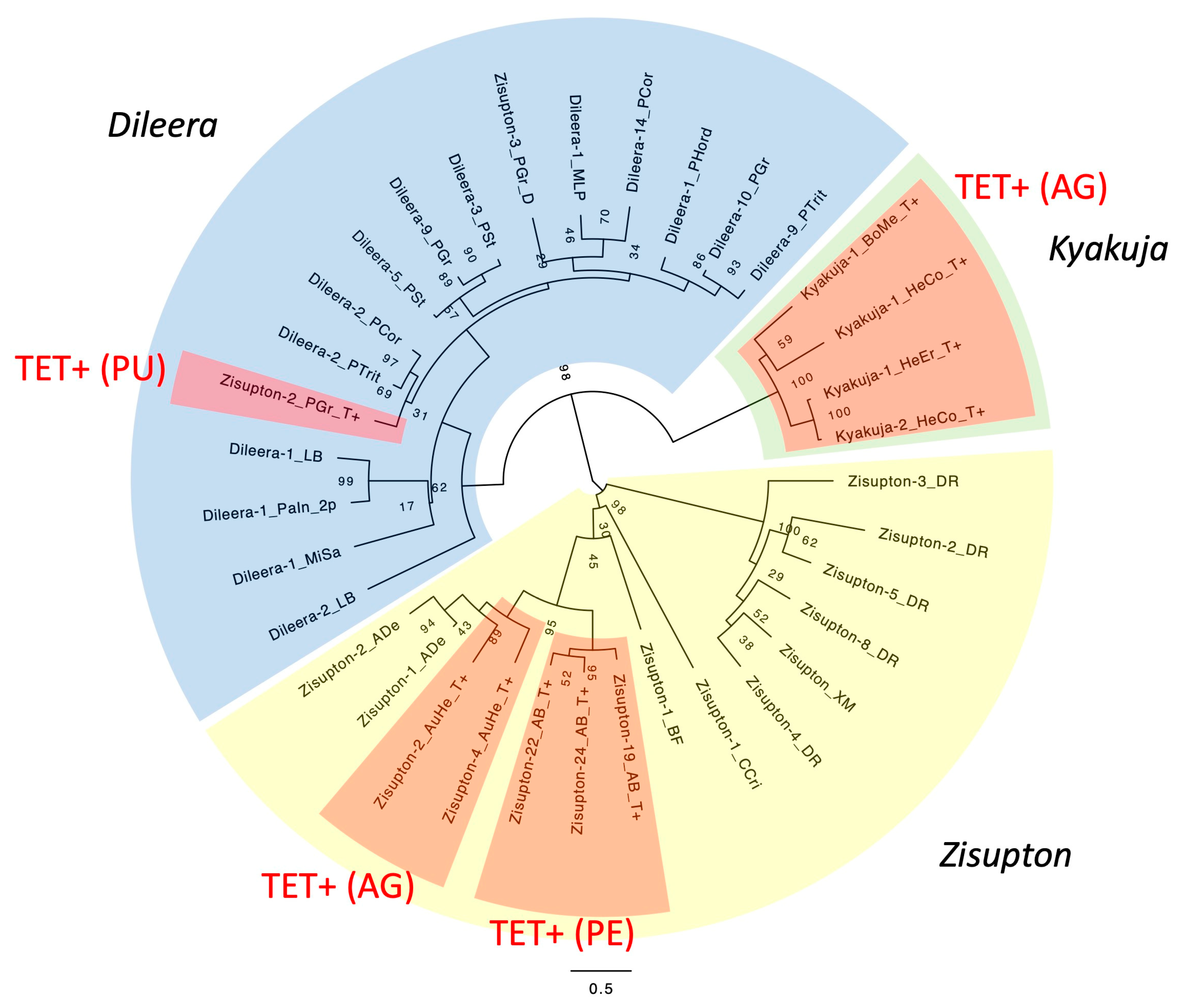
3.1.1. Dileera in KDZ (Kyakuja-Dileera-Zisupton)
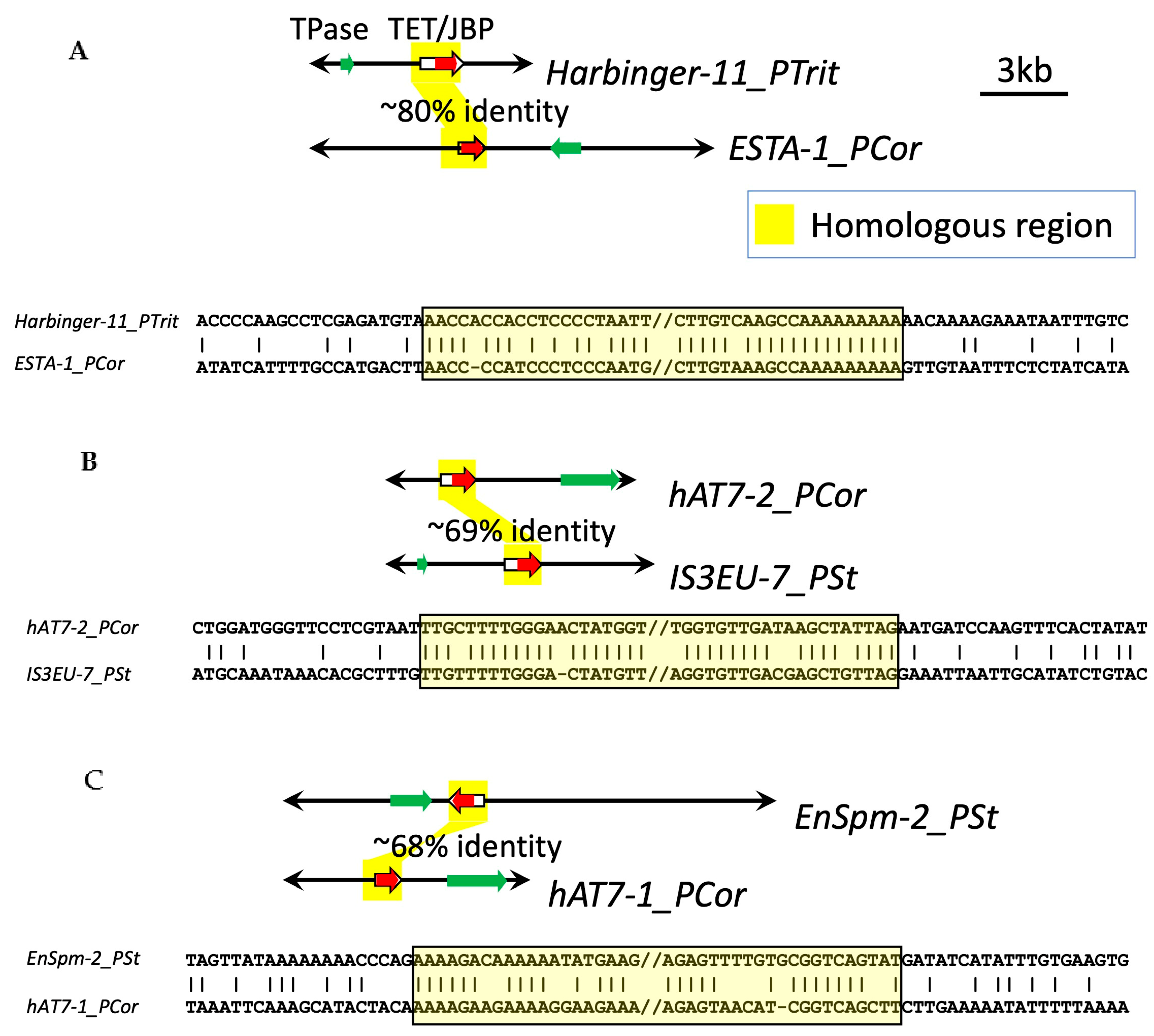
3.1.2. hAT7 in hAT
3.1.3. IS3EU
3.1.4. PHISTA in PHIS (PIF/Harbinger-ISL2EU-Spy)
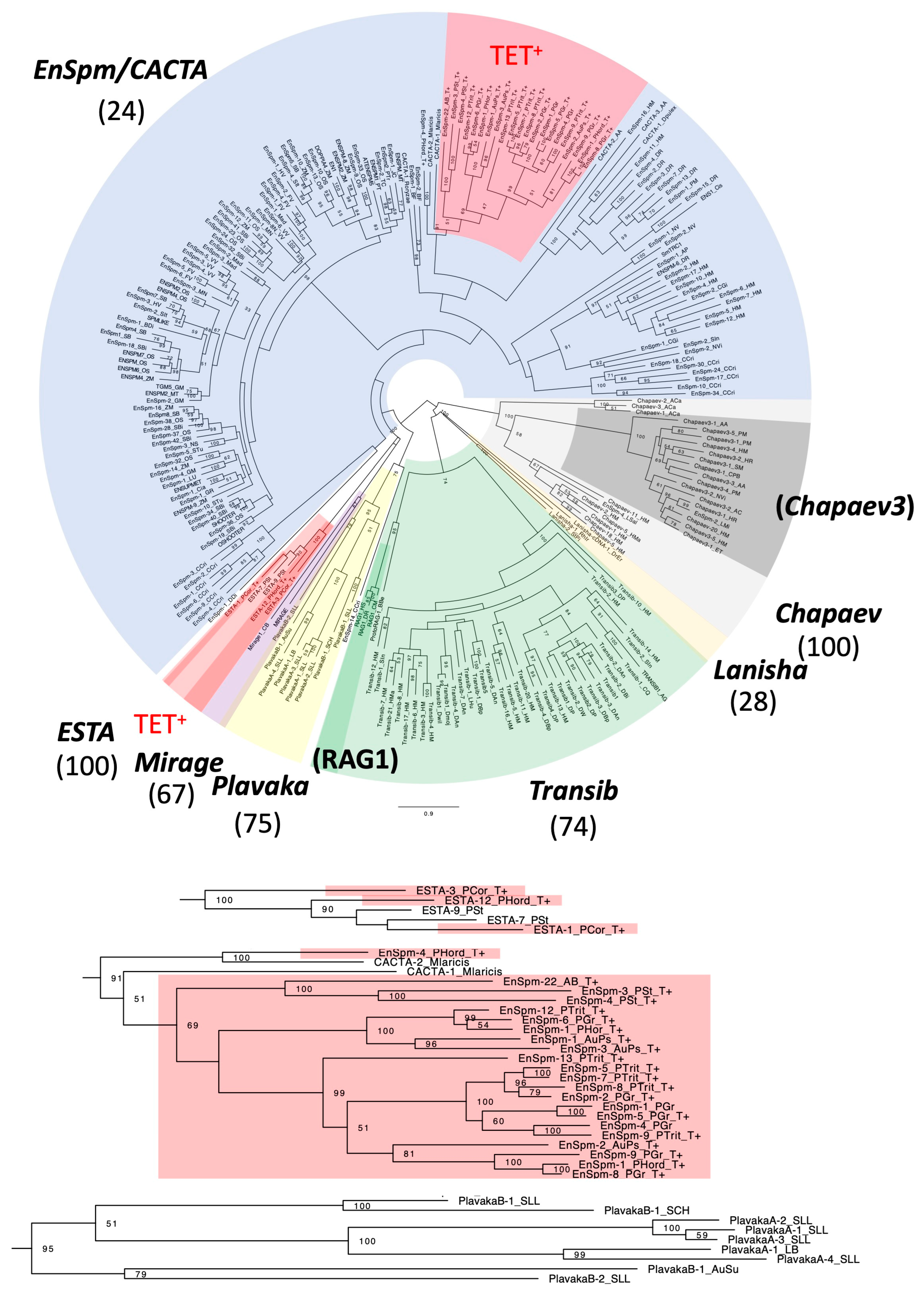
3.1.5. EnSpm in CMCT (CACTA/EnSpm-Mirage-Chapaev-Transib)
3.1.6. ESTA in CMCT (CACTA/EnSpm-Mirage-Chapaev-Transib)
3.1.7. Helitron1 in Helitron
3.2. DNA Transposons Encoding a TET/JBP Dioxygenase in Agaricomycotina, Basidiomycota
3.2.1. Kyakuja in KDZ (Kyakuja-Dileera-Zisupton)
3.2.2. Plavaka in CMCT (CACTA/EnSpm-Mirage-Chapaev-Transib)
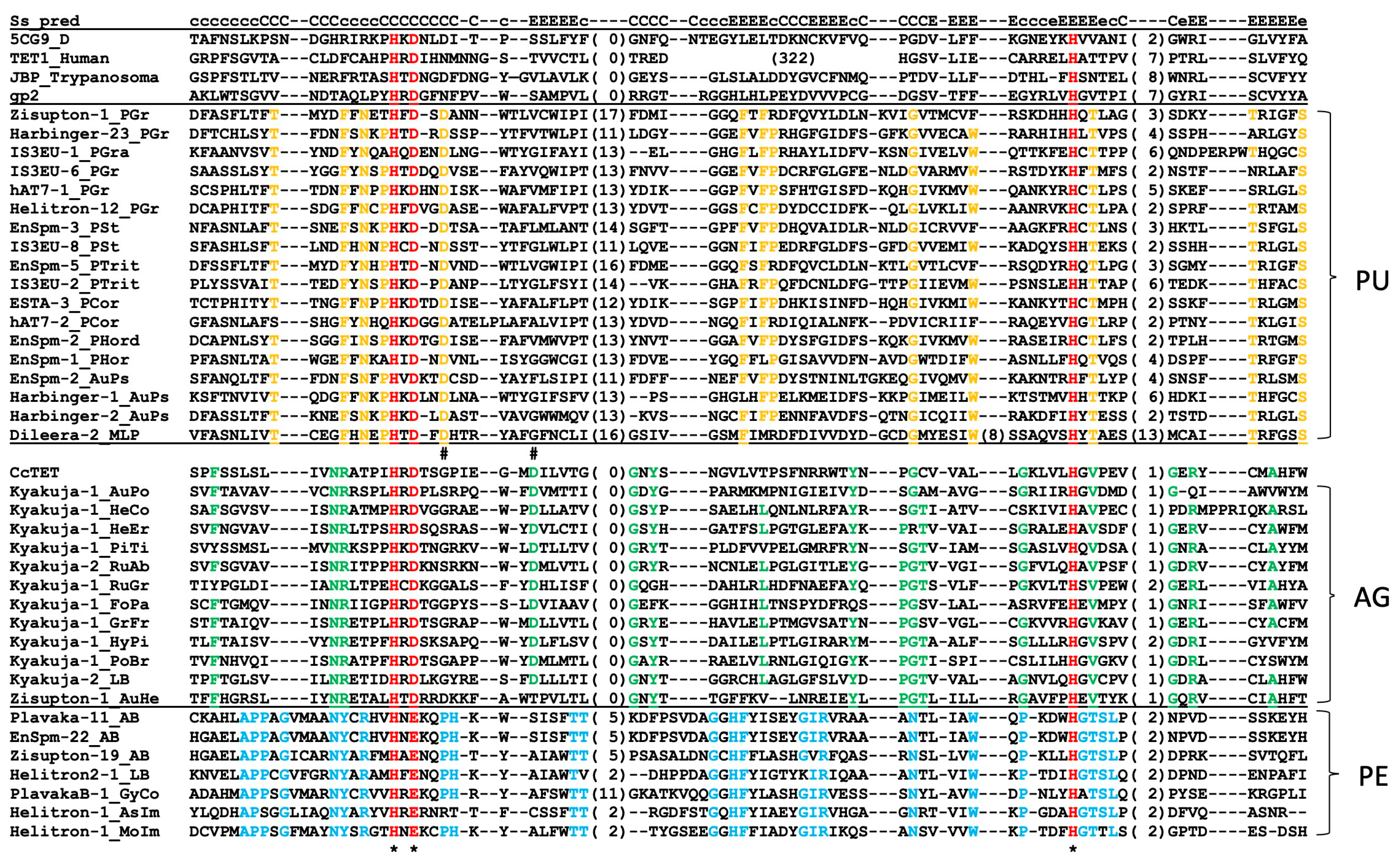
3.2.3. Distinct TET/JBP Dioxygenase-like Proteins
3.3. DNA Transposons Encoding a TET/JBP Dioxygenase in Pezizomycotina, Ascomycota
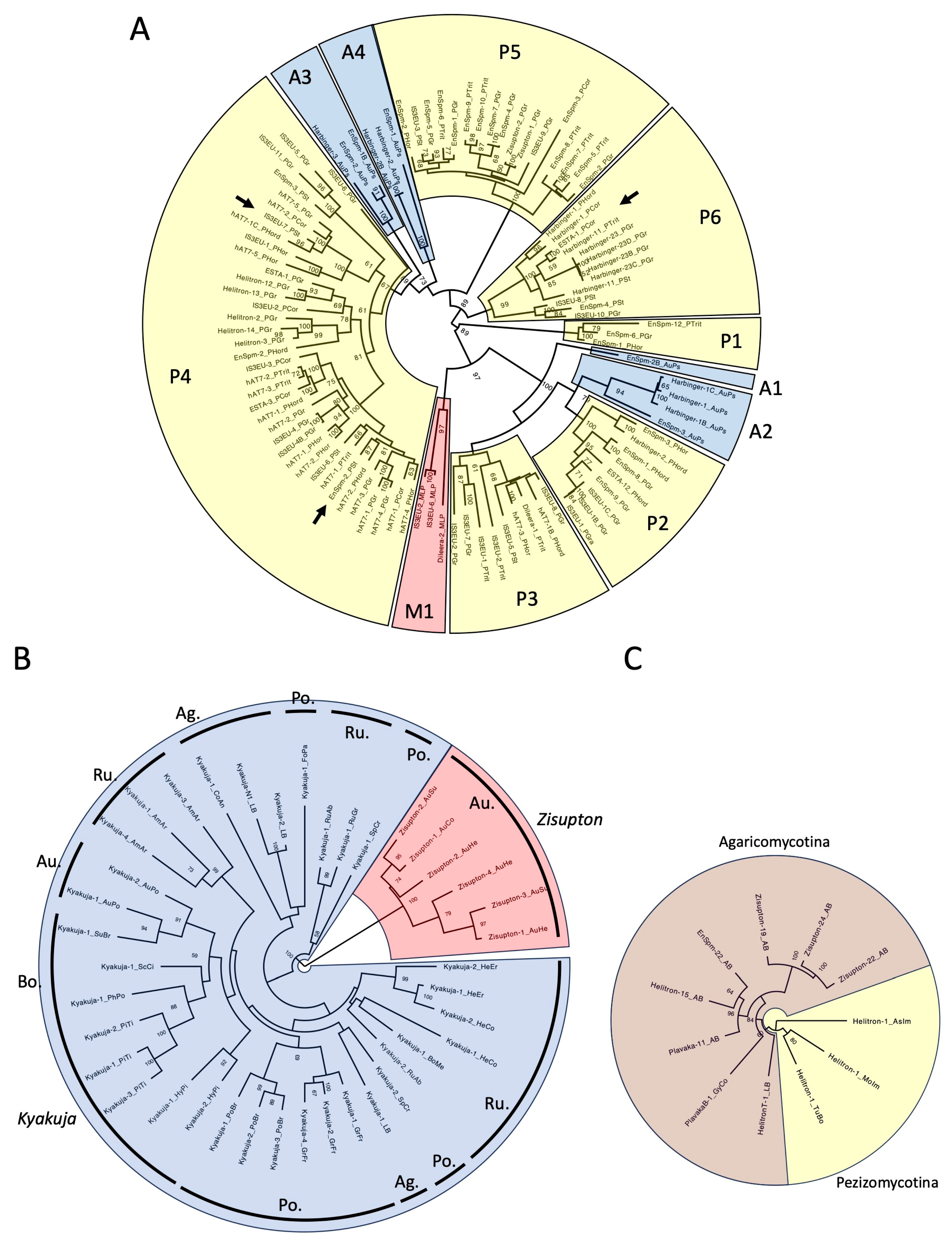
3.4. Phylogenetic Relationships of TET/JBP Dioxygenases and Possible Mechanisms of Horizontal Transmission


4. Discussion
4.1. The Mode of Transmission of TET/JBP Genes Between Superfamilies of Transposons
4.2. TET/JBP Dioxygenases and Fungal Transposon-Silencing Mechanisms
5. Conclusions
Supplementary Materials
Funding
Institutional Review Board Statement
Data Availability Statement
Conflicts of Interest
Abbreviations
| TIR | Terminal inverted repeat |
| TSD | Target site duplication |
| aLRT | approximate likelihood-ratio test for branches |
| RIP | Repeat-induced point mutation |
| MIP | Methylation induced premeiotically |
References
- Jones, P.A. Functions of DNA methylation: Islands, start sites, gene bodies and beyond. Nat. Rev. Genet. 2012, 13, 484–492. [Google Scholar] [CrossRef] [PubMed]
- Oliveira, P.H.; Touchon, M.; Rocha, E.P. The interplay of restriction-modification systems with mobile genetic elements and their prokaryotic hosts. Nucleic Acids Res. 2014, 42, 10618–10631. [Google Scholar] [CrossRef] [PubMed]
- Iyer, L.M.; Zhang, D.; Burroughs, A.M.; Aravind, L. Computational identification of novel biochemical systems involved in oxidation, glycosylation and other complex modifications of bases in DNA. Nucleic Acids Res. 2013, 41, 7635–7655. [Google Scholar] [CrossRef]
- Wang, L.; Chen, S.; Xu, T.; Taghizadeh, K.; Wishnok, J.S.; Zhou, X.; You, D.; Deng, Z.; Dedon, P.C. Phosphorothioation of DNA in bacteria by dnd genes. Nat. Chem. Biol. 2007, 3, 709–710. [Google Scholar] [CrossRef]
- Gordeeva, J.; Morozova, N.; Sierro, N.; Isaev, A.; Sinkunas, T.; Tsvetkova, K.; Matlashov, M.; Truncaite, L.; Morgan, R.D.; Ivanov, N.V.; et al. BREX system of Escherichia coli distinguishes self from non-self by methylation of a specific DNA site. Nucleic Acids Res. 2019, 47, 253–265. [Google Scholar] [CrossRef]
- Feng, S.; Cokus, S.J.; Zhang, X.; Chen, P.Y.; Bostick, M.; Goll, M.G.; Hetzel, J.; Jain, J.; Strauss, S.H.; Halpern, M.E.; et al. Conservation and divergence of methylation patterning in plants and animals. Proc. Natl. Acad. Sci. USA 2010, 107, 8689–8694. [Google Scholar] [CrossRef]
- Choi, J.; Lyons, D.B.; Kim, M.Y.; Moore, J.D.; Zilberman, D. DNA Methylation and Histone H1 Jointly Repress Transposable Elements and Aberrant Intragenic Transcripts. Mol. Cell 2020, 77, 310–323.e317. [Google Scholar] [CrossRef]
- Hosaka, A.; Saito, R.; Takashima, K.; Sasaki, T.; Fu, Y.; Kawabe, A.; Ito, T.; Toyoda, A.; Fujiyama, A.; Tarutani, Y.; et al. Evolution of sequence-specific anti-silencing systems in Arabidopsis. Nat. Commun. 2017, 8, 2161. [Google Scholar] [CrossRef]
- Kojima, K.K.; Jurka, J. HarbingerS, a novel clade of Harbinger DNA transposons encoding a SET domain histone lysine methyltransferase. Repbase Rep. 2014, 14, 2243–2250. [Google Scholar]
- Kojima, K.K.; Jurka, J. DNA transposons from oomycetes. Repbase Rep. 2014, 14, 2112–2231. [Google Scholar]
- Kohli, R.M.; Zhang, Y. TET enzymes, TDG and the dynamics of DNA demethylation. Nature 2013, 502, 472–479. [Google Scholar] [CrossRef] [PubMed]
- Borst, P.; Sabatini, R. Base J: Discovery, biosynthesis, and possible functions. Annu. Rev. Microbiol. 2008, 62, 235–251. [Google Scholar] [CrossRef]
- Finnegan, D.J. Eukaryotic transposable elements and genome evolution. Trends Genet. 1989, 5, 103–107. [Google Scholar] [CrossRef]
- Bao, W.; Kojima, K.K.; Kohany, O. Repbase Update, a database of repetitive elements in eukaryotic genomes. Mob. DNA 2015, 6, 11. [Google Scholar] [CrossRef]
- Kojima, K.K. Structural and sequence diversity of eukaryotic transposable elements. Genes Genet. Syst. 2020, 94, 233–252. [Google Scholar] [CrossRef]
- Hickman, A.B.; Chandler, M.; Dyda, F. Integrating prokaryotes and eukaryotes: DNA transposases in light of structure. Crit. Rev. Biochem. Mol. Biol. 2010, 45, 50–69. [Google Scholar] [CrossRef]
- Yuan, Y.W.; Wessler, S.R. The catalytic domain of all eukaryotic cut-and-paste transposase superfamilies. Proc. Natl. Acad. Sci. USA 2011, 108, 7884–7889. [Google Scholar] [CrossRef] [PubMed]
- Kapitonov, V.V.; Jurka, J. RAG1 core and V(D)J recombination signal sequences were derived from Transib transposons. PLoS Biol. 2005, 3, e181. [Google Scholar] [CrossRef] [PubMed]
- Grabundzija, I.; Messing, S.A.; Thomas, J.; Cosby, R.L.; Bilic, I.; Miskey, C.; Gogol-Doring, A.; Kapitonov, V.; Diem, T.; Dalda, A.; et al. A Helitron transposon reconstructed from bats reveals a novel mechanism of genome shuffling in eukaryotes. Nat. Commun. 2016, 7, 10716. [Google Scholar] [CrossRef]
- Kapitonov, V.V.; Jurka, J. Rolling-circle transposons in eukaryotes. Proc. Natl. Acad. Sci. USA 2001, 98, 8714–8719. [Google Scholar] [CrossRef]
- Iyer, L.M.; Zhang, D.; de Souza, R.F.; Pukkila, P.J.; Rao, A.; Aravind, L. Lineage-specific expansions of TET/JBP genes and a new class of DNA transposons shape fungal genomic and epigenetic landscapes. Proc. Natl. Acad. Sci. USA 2014, 111, 1676–1683. [Google Scholar] [CrossRef] [PubMed]
- Iyer, L.M.; Tahiliani, M.; Rao, A.; Aravind, L. Prediction of novel families of enzymes involved in oxidative and other complex modifications of bases in nucleic acids. Cell Cycle. 2009, 8, 1698–1710. [Google Scholar] [CrossRef] [PubMed]
- Bohne, A.; Zhou, Q.; Darras, A.; Schmidt, C.; Schartl, M.; Galiana-Arnoux, D.; Volff, J.N. Zisupton--a novel superfamily of DNA transposable elements recently active in fish. Mol. Biol. Evol. 2012, 29, 631–645. [Google Scholar] [CrossRef]
- Kohany, O.; Gentles, A.J.; Hankus, L.; Jurka, J. Annotation, submission and screening of repetitive elements in Repbase: RepbaseSubmitter and Censor. BMC Bioinform. 2006, 7, 474. [Google Scholar] [CrossRef] [PubMed]
- Zimmermann, L.; Stephens, A.; Nam, S.Z.; Rau, D.; Kubler, J.; Lozajic, M.; Gabler, F.; Soding, J.; Lupas, A.N.; Alva, V. A Completely Reimplemented MPI Bioinformatics Toolkit with a New HHpred Server at its Core. J. Mol. Biol. 2018, 430, 2237–2243. [Google Scholar] [CrossRef]
- Solovyev, V.; Kosarev, P.; Seledsov, I.; Vorobyev, D. Automatic annotation of eukaryotic genes, pseudogenes and promoters. Genome Biol. 2006, 7 (Suppl. S1), S10. [Google Scholar] [CrossRef]
- Siguier, P.; Perochon, J.; Lestrade, L.; Mahillon, J.; Chandler, M. ISfinder: The reference centre for bacterial insertion sequences. Nucleic Acids Res. 2006, 34, D32–D36. [Google Scholar] [CrossRef]
- Katoh, K.; Standley, D.M. MAFFT multiple sequence alignment software version 7: Improvements in performance and usability. Mol. Biol. Evol. 2013, 30, 772–780. [Google Scholar] [CrossRef]
- Gouy, M.; Guindon, S.; Gascuel, O. SeaView version 4: A multiplatform graphical user interface for sequence alignment and phylogenetic tree building. Mol. Biol. Evol. 2010, 27, 221–224. [Google Scholar] [CrossRef]
- Guindon, S.; Dufayard, J.F.; Lefort, V.; Anisimova, M.; Hordijk, W.; Gascuel, O. New algorithms and methods to estimate maximum-likelihood phylogenies: Assessing the performance of PhyML 3.0. Syst. Biol. 2010, 59, 307–321. [Google Scholar] [CrossRef]
- Kapitonov, V.V.; Jurka, J. hAT5—A novel group of autonomous hAT DNA transposons characterized by 5-bp target site duplications. Repbase Rep. 2007, 7, 1188–1191. [Google Scholar]
- Kapitonov, V.V.; Jurka, J. hAT6—A novel group of hAT DNA transposons characterized by 6-bp target site duplications. Repbase Rep. 2007, 7, 1192–1204. [Google Scholar]
- Han, M.J.; Xiong, C.L.; Zhang, H.B.; Zhang, M.Q.; Zhang, H.H.; Zhang, Z. The diversification of PHIS transposon superfamily in eukaryotes. Mob. DNA 2015, 6, 12. [Google Scholar] [CrossRef]
- Han, M.J.; Xu, H.E.; Zhang, H.H.; Feschotte, C.; Zhang, Z. Spy: A new group of eukaryotic DNA transposons without target site duplications. Genome Biol. Evol. 2014, 6, 1748–1757. [Google Scholar] [CrossRef]
- Maumus, F.; McDaniel, S.F.; Carey, S.B. Lanisha: A proposed novel superfamily of cut-and-paste DNA transposons. Repbase Rep. 2020, 20, 2521. [Google Scholar]
- Bao, W.; Jurka, J. Homologues of bacterial TnpB_IS605 are widespread in diverse eukaryotic transposable elements. Mob. DNA 2013, 4, 12. [Google Scholar] [CrossRef] [PubMed]
- Mu, Y.; Zhang, L.; Hu, J.; Zhou, J.; Lin, H.W.; He, C.; Chen, H.Z.; Zhang, L. A fungal dioxygenase CcTet serves as a eukaryotic 6mA demethylase on duplex DNA. Nat. Chem. Biol. 2022, 18, 733–741. [Google Scholar] [CrossRef]
- Zhang, L.; Mu, Y.; Li, T.; Hu, J.; Lin, H.; Zhang, L. Molecular basis of an atypical dsDNA 5mC/6mA bifunctional dioxygenase CcTet from Coprinopsis cinerea in catalyzing dsDNA 5mC demethylation. Nucleic Acids Res. 2024, 52, 3886–3895. [Google Scholar] [CrossRef]
- Zhang, L.; Chen, W.; Iyer, L.M.; Hu, J.; Wang, G.; Fu, Y.; Yu, M.; Dai, Q.; Aravind, L.; He, C. A TET homologue protein from Coprinopsis cinerea (CcTET) that biochemically converts 5-methylcytosine to 5-hydroxymethylcytosine, 5-formylcytosine, and 5-carboxylcytosine. J. Am. Chem. Soc. 2014, 136, 4801–4804. [Google Scholar] [CrossRef] [PubMed]
- Martinez, S.; Hausinger, R.P. Catalytic Mechanisms of Fe(II)- and 2-Oxoglutarate-dependent Oxygenases. J. Biol. Chem. 2015, 290, 20702–20711. [Google Scholar] [CrossRef]
- Li, W.; Zhang, T.; Sun, M.; Shi, Y.; Zhang, X.J.; Xu, G.L.; Ding, J. Molecular mechanism for vitamin C-derived C(5)-glyceryl-methylcytosine DNA modification catalyzed by algal TET homologue CMD1. Nat. Commun. 2021, 12, 744. [Google Scholar] [CrossRef] [PubMed]
- Gladyshev, E.; Kleckner, N. Recombination-independent recognition of DNA homology for repeat-induced point mutation. Curr. Genet. 2017, 63, 389–400. [Google Scholar] [CrossRef] [PubMed]
- Watters, M.K.; Randall, T.A.; Margolin, B.S.; Selker, E.U.; Stadler, D.R. Action of repeat-induced point mutation on both strands of a duplex and on tandem duplications of various sizes in Neurospora. Genetics 1999, 153, 705–714. [Google Scholar] [CrossRef] [PubMed]
- van Wyk, S.; Wingfield, B.D.; De Vos, L.; van der Merwe, N.A.; Steenkamp, E.T. Genome-Wide Analyses of Repeat-Induced Point Mutations in the Ascomycota. Front. Microbiol. 2020, 11, 622368. [Google Scholar] [CrossRef]
- Montanini, B.; Chen, P.Y.; Morselli, M.; Jaroszewicz, A.; Lopez, D.; Martin, F.; Ottonello, S.; Pellegrini, M. Non-exhaustive DNA methylation-mediated transposon silencing in the black truffle genome, a complex fungal genome with massive repeat element content. Genome Biol. 2014, 15, 411. [Google Scholar] [CrossRef]
- Horns, F.; Petit, E.; Yockteng, R.; Hood, M.E. Patterns of repeat-induced point mutation in transposable elements of basidiomycete fungi. Genome Biol. Evol. 2012, 4, 240–247. [Google Scholar] [CrossRef]
- Amselem, J.; Lebrun, M.H.; Quesneville, H. Whole genome comparative analysis of transposable elements provides new insight into mechanisms of their inactivation in fungal genomes. BMC Genom. 2015, 16, 141. [Google Scholar] [CrossRef][Green Version]
- Tobias, P.A.; Schwessinger, B.; Deng, C.H.; Wu, C.; Dong, C.; Sperschneider, J.; Jones, A.; Lou, Z.; Zhang, P.; Sandhu, K.; et al. Austropuccinia psidii, causing myrtle rust, has a gigabase-sized genome shaped by transposable elements. G3 2021, 11, jkaa015. [Google Scholar] [CrossRef] [PubMed]
- Sonnenberg, A.S.M.; Sedaghat-Telgerd, N.; Lavrijssen, B.; Ohm, R.A.; Hendrickx, P.M.; Scholtmeijer, K.; Baars, J.J.P.; van Peer, A. Telomere-to-telomere assembled and centromere annotated genomes of the two main subspecies of the button mushroom Agaricus bisporus reveal especially polymorphic chromosome ends. Sci. Rep. 2020, 10, 14653. [Google Scholar] [CrossRef]
- Chavez, L.; Huang, Y.; Luong, K.; Agarwal, S.; Iyer, L.M.; Pastor, W.A.; Hench, V.K.; Frazier-Bowers, S.A.; Korol, E.; Liu, S.; et al. Simultaneous sequencing of oxidized methylcytosines produced by TET/JBP dioxygenases in Coprinopsis cinerea. Proc. Natl. Acad. Sci. USA 2014, 111, E5149–E5158. [Google Scholar] [CrossRef]
- Licyte, J.; Kvederaviciute, K.; Ruksenaite, A.; Godliauskaite, E.; Gibas, P.; Tomkute, V.; Petraityte, G.; Masevicius, V.; Klimasauskas, S.; Kriukiene, E. Distribution and regulatory roles of oxidized 5-methylcytosines in DNA and RNA of the basidiomycete fungi Laccaria bicolor and Coprinopsis cinerea. Open Biol. 2022, 12, 210302. [Google Scholar] [CrossRef]
- Kharat, S.S.; Sharan, S.K. 5-Hydroxymethylcytosine: A key epigenetic mark in cancer and chemotherapy response. Epigenetics Chromatin 2025, 18, 73. [Google Scholar] [CrossRef] [PubMed]
- Burke, E.J.; Rodda, S.S.; Lund, S.R.; Sun, Z.; Zeroka, M.R.; O’Toole, K.H.; Parker, M.J.; Doshi, D.S.; Guan, C.; Lee, Y.J.; et al. Phage-encoded ten-eleven translocation dioxygenase (TET) is active in C5-cytosine hypermodification in DNA. Proc. Natl. Acad. Sci. USA 2021, 118, e2026742118. [Google Scholar] [CrossRef] [PubMed]
- van Luenen, H.G.; Farris, C.; Jan, S.; Genest, P.A.; Tripathi, P.; Velds, A.; Kerkhoven, R.M.; Nieuwland, M.; Haydock, A.; Ramasamy, G.; et al. Glucosylated hydroxymethyluracil, DNA base J, prevents transcriptional readthrough in Leishmania. Cell 2012, 150, 909–921. [Google Scholar] [CrossRef] [PubMed]


Disclaimer/Publisher’s Note: The statements, opinions and data contained in all publications are solely those of the individual author(s) and contributor(s) and not of MDPI and/or the editor(s). MDPI and/or the editor(s) disclaim responsibility for any injury to people or property resulting from any ideas, methods, instructions or products referred to in the content. |
© 2025 by the author. Licensee MDPI, Basel, Switzerland. This article is an open access article distributed under the terms and conditions of the Creative Commons Attribution (CC BY) license (https://creativecommons.org/licenses/by/4.0/).
Share and Cite
Kojima, K.K. Heterogeneous Lineages of DNA Transposons Encode a TET/JBP Dioxygenase in Fungi. Biology 2025, 14, 1741. https://doi.org/10.3390/biology14121741
Kojima KK. Heterogeneous Lineages of DNA Transposons Encode a TET/JBP Dioxygenase in Fungi. Biology. 2025; 14(12):1741. https://doi.org/10.3390/biology14121741
Chicago/Turabian StyleKojima, Kenji K. 2025. "Heterogeneous Lineages of DNA Transposons Encode a TET/JBP Dioxygenase in Fungi" Biology 14, no. 12: 1741. https://doi.org/10.3390/biology14121741
APA StyleKojima, K. K. (2025). Heterogeneous Lineages of DNA Transposons Encode a TET/JBP Dioxygenase in Fungi. Biology, 14(12), 1741. https://doi.org/10.3390/biology14121741