


Simple Summary
Plant mitochondria play essential roles in cellular energy metabolism and have variable and complex structures of their mitogenomes. However, no complete mitogenome has been used to explore the genetic mechanisms underlying drought resistance in S. moorcroftiana. Here, we sequenced the first mitogenome of S. moorcroftiana and analyzed its structure, codon usage, evolutionary relationships, and RNA editing site distribution. Conjoint analysis of the mitogenome and transcriptome further identified RNA editing sites and differentially expressed genes, as well as elevated physiological indicators in S. moorcroftiana roots under drought treatment. The present study offers valuable resources for future studies on the molecular mechanisms and breeding strategies aimed at enhancing drought resistance in this species.
Abstract
Sophora moorcroftiana is a perennial deciduous dwarf shrub that exhibits remarkable ecological adaptability, including strong drought resistance on the Tibetan Plateau. In this study, the complete mitogenome of S. moorcroftiana was reported and assembled for the first time, representing a circular molecule of 534,205 bp with a GC content of 44.93%. The mitogenome was annotated to include 33 unique protein-coding genes (PCGs), 19 tRNA genes, and three rRNA genes. Phylogenetic and collinearity analyses of the mitogenomes of S. moorcroftiana and related species revealed their evolutionary relationships and a non-conserved structure. The codon usage of the PCGs and 166 simple sequence repeats was also analyzed. Conjoint analysis of the transcriptome and mitogenome identified 587 RNA editing sites across 33 PCGs, with 14 genes significantly induced in the roots under drought treatment. Moreover, the levels of proline, soluble sugar, soluble protein, and peroxidase activity were significantly elevated in S. moorcroftiana roots subjected to different PEG6000 concentrations. These findings provide valuable insights into the molecular mechanisms underlying drought responses and offer genetic resources for improving drought resistance in S. moorcroftiana.
1. Introduction
Sophora moorcroftiana (Benth.) Baker belongs to the genus Sophora and is a perennial deciduous dwarf shrub widely distributed on the Tibetan Plateau [1]. S. moorcroftiana exhibits strong ecological adaptability, including high resistance to drought, wind, and sand, as well as tolerance to barren conditions and the presence of medicinal compounds. These traits, especially drought resistance, make the species highly valuable for ecological restoration and economic development in the plateau region [2,3,4]. Drought stress severely affects plant biomass production and physiological, biochemical, morphological, and molecular attributes, with adverse effects on photosynthetic capacity [5]. Approaches for enhancing drought resistance include breeding strategies, changes in physiological and biochemical traits, and molecular and genomic perspectives, including multi-omics technologies [5,6]. However, the genetic mechanisms underlying drought resistance in S. moorcroftiana remain largely unidentified.
Previous studies have revealed that photosynthetic efficiency and antioxidative capacity of S. moorcroftiana are closely associated with water stress [7]. Transcriptome analysis identified a drought-induced DREB transcription factor gene (SmDREB1), which enhanced drought resistance in the model plant Arabidopsis through genetic engineering [8]. Furthermore, the assembled genome of S. moorcroftiana (737.35 Mb) was analyzed through metabolomic and transcriptomic profiling, leading to the identification of α-amylase and β-fructofuranosidase in sucrose metabolism, which are closely associated with drought adaptation [9,10].
Mitochondria and RNA editing processes play critical roles in modulating osmotic potential and maintaining reactive oxygen species (ROS) homeostasis to regulate drought tolerance [10,11,12]. Plant mitochondria are primary energy suppliers and are essential for cellular energy metabolism [13,14]. They regulate oxidative phosphorylation to generate adenosine triphosphate (ATP) and produce metabolic intermediates required for plant growth, development, and stress resistance [15]. The mitochondrial genome exhibits structural diversity and complexity across species [16,17,18]. RNA editing contributes to nucleotide substitutions, deletions, and insertions, mainly within coding regions, thereby promoting mRNA translatability and altering RNA structure, splicing, and stability [16,19,20]. For instance, the pentatricopeptide repeat protein OsPPR674 regulates RNA editing of the ccmC gene, controlling cytochrome c synthesis and influencing rice growth and drought sensitivity [21]. In addition, transgenic maize overexpressing ZmCYB5-1 (cytochrome b5 protein gene) exhibited significantly reduced drought tolerance compared with wild-type plants [22]. However, the mitochondrial genome (mitogenome or mtDNA) of S. moorcroftiana has not been reported, which has restricted genetic studies on the molecular mechanisms of this species.
In this study, a combination of Illumina and Nanopore sequencing data was employed to assemble and annotate the S. moorcroftiana mitogenome. Subsequently, the repeat sequences, evolution, DNA transfer from chloroplasts, RNA editing, and genomic recombination events of the S. moorcroftiana mitogenome were analyzed. Drought-responsive genes modulated by RNA editing of mitochondrial transcripts were identified through a conjoint analysis of the mitogenome and long non-coding RNA (lncRNA) transcriptome. Physiological indicators, including proline (Pro), malondialdehyde (MDA), soluble sugar, soluble protein, and peroxidase (POD) activity, were also measured in S. moorcroftiana seedlings under drought treatment. These results imply that RNA editing events of mitochondrial genes, lncRNA expression, and physiological traits may be related to the drought resistance mechanism of S. moorcroftiana, thereby providing genetic resources for future breeding improvement of drought resistance.
2. Materials and Methods
2.1. Plant Materials, DNA Isolation, and DNA Sequencing
The leaves of two-year-old S. moorcroftiana were collected from the Tibet Academy of Forest Trees (N: 29°34′17.92″, E: 91°1′28.73″) in the summer of 2024, and high-quality genomic DNA was isolated using an optimized extraction method [23]. The quality, purity, and concentration of the DNA were determined using a Qubit fluorometer and a NanoDrop spectrophotometer (Thermo Scientific, Waltham, MA, USA). DNA integrity was confirmed by visualization on a 1% agarose gel. Long and short reads were generated using the PromethION sequencer (Oxford Nanopore Technologies, Oxford, UK) and Illumina NovaSeq platform (Illumina, San Diego, CA, USA), respectively, to obtain full-length mitogenome sequences.
2.2. Assembly and Annotation of the S. moorcroftiana Mitogenome
The S. moorcroftiana mitogenome was assembled using Flye software with the parameters “--min-overlap 2000” based on long-read data to obtain the graphical assembly results in GFA format [24]. Subsequently, for all assembled contigs in FASTA format, the makeblastdb and BLASTn programs (NCBI, Bethesda, MD, USA) were used to build a database and identify contig fragments containing the mitochondrial genome by referencing Arabidopsis thaliana sequences, with the parameters set as “-evalue 1e-5 -fmt 6-max_hsps 10-word_size 7-task blastn-short”. Bandage software (v0.8.1) (https://github.com/rrwick/Bandage, accessed on 10 November 2025) was used to generate a draft mitogenome by screening the mitochondrial contigs based on BLASTn results [25]. Subsequently, Unicycler (GPLv3) (github.com/rrwick/Unicycler, accessed on 10 November 2025) and Bandage were used to assemble and visualize the complete S. moorcroftiana mitogenome [25,26]. The sequence of the S. moorcroftiana mitogenome was submitted to the NCBI under accession number PX569965.
The annotation of the S. moorcroftiana mitogenome was performed using reference mitogenomes, including Sophora japonica (MG757109), Medicago truncatula (KT971339), M. pinnata (JN872550), Vigna angularis (AP012599), V. radiata (HM367685), and G. max (JX463295). The PMGA tool (http://1kmpg.cn/pmga/, accessed on 10 November 2025) was used for annotation, with an emphasis on trans-splicing genes and splice sites [27]. tRNA genes were identified using tRNAscan-SE (v.2.0.11) (http://lowelab./tRNAscan-SE/index.html, accessed on 10 November 2025), and rRNA genes were annotated using BLASTn [28]. Finally, Apollo software (v1.11.8) (http://www.ensembl.org/apollo, accessed on 10 November 2025) was used to manually correct errors in the mitogenome annotations [29].
2.3. Detection of Repeats and Codon Usage Analysis
The software MISA (v2.1) (https://webblast.ipk-gatersleben.de/misa/, accessed on 10 November 2025), Tandem Repeats Finder (v4.09) (https://tandem.bu.edu/trf/trf.unix.help.html, accessed on 10 November 2025), and the REPuter network server (https://bibiserv.cebitec.uni-bielefeld.de/reputer/, accessed on 10 November 2025) were employed to predict and identify the repeat sequences of the mitogenome, including tandem repeats, dispersed repetitive sequences, and simple sequence repeats (SSRs) [30,31,32]. The Circos package (v0.69.9) (http://circos.ca/in_literature/scientific/, accessed on 10 November 2025) and Excel (2021) were used for result visualization [33]. The protein-coding genes (PCGs) of the S. moorcroftiana mitogenome were identified using Phylosuite (v1.1.16) (https://github.com/dongzhang0725/PhyloSuite, accessed on 20 November 2025) and Geneious Prime 2021 [34,35]. Codon usage was analyzed using MEGA (v7.0) (www.megasoftware.net, accessed on 20 November 2025), and the values of the Relative Synonymous Codon Usage (RSCU) were calculated across the 33 PCGs [36].
2.4. Phylogenetic Analysis
PhyloSuite (v1.1.16) (https://github.com/dongzhang0725/PhyloSuite, accessed on 20 November 2025) was used to extract and analyze common genes from the mitogenomes of species closely related to S. moorcroftiana [34]. Sequence alignment was performed using MAFFT (v7.505) (https://mafft.cbrc.jp/alignment/software/index.html, accessed on 20 November 2025) [37]. IQ-TREE software (v1.6.12) (http://www.cibiv.at/software/iqtree, accessed on 20 November 2025) was subsequently used to construct a phylogenetic tree with the best-fit model (GTR + F + R3), and the bootstrap analysis was assessed with 1000 replicates [38]. Finally, the phylogenetic results were visualized using the iTOL (v4) (https://itol.embl.de/, accessed on 20 November 2025) [39].
2.5. Transfer Fragment and Colinear Analysis
A circular S. moorcroftiana chloroplast genome was assembled using GetOrganelle software (https://github.com/Kinggerm/GetOrganelle, accessed on 20 November 2025) with the parameters “-R 15-F embplant_pt” [40]. The CPGAVAS2 tool (https://houseandacres.com/cpgavas2, accessed on 20 November 2025) was used to annotate the chloroplast genome [41], and tRNAs were annotated using tRNAscan-SE (v.2.0.11) (http://lowelab./tRNAscan-SE/index.html, accessed on 20 November 2025). rRNA genes were annotated using BLASTn [28]. Subsequently, transfer and homologous fragments were analyzed using the Circos package (v0.69.9) (http://circos.ca/in_literature/scientific/, accessed on 20 November 2025) and BLASTn [33].
Conserved homologous sequences of chloroplast and mitochondrial genomes were identified using BLASTn, and contiguous blocks longer than 500 bp were selected for further analysis. MCScanX software (http://chibba.pgml.uga.edu/mcscan2/, accessed on 20 November 2025) was then employed to construct a multiple synteny plot and assess the sequence similarity between S. moorcroftiana and its related species through pairwise alignments [42].
2.6. Identification and Distribution Analysis of RNA Editing Sites
Deepred-mt (https://github.com/aedera/deepredmt, accessed on 20 November 2025) was used to predict and analyze RNA editing sites in the mitochondrial PCGs of S. moorcroftiana using a convolutional neural network model [43]. All mitochondrial PCGs of S. moorcroftiana were extracted and analyzed with probability values > 0.9.
Specifically, the identification requirements for RNA editing sites included: (i) the coverage depth should be at least 100×; (ii) the number of bases with RNA editing should account for more than 10% of the total bases at that site; and (iii) only C-to-U RNA editing types were retained. Based on the transcriptomic data, we first obtained transcripts from the mitochondrial genome by filtering and mapped them to the complete mitochondrial DNA sequences. Subsequently, the differences between DNA and RNA sequences were further compared using Deepred-mt and REDItools (v2.0) (http://code.google.com/p/reditools/, accessed on 20 November 2025) to identify and visualize the distribution of potential RNA editing sites (such as C to U editing) supported by most reads [43,44].
2.7. Drought Treatments and Long Non-Coding RNA Transcriptome Assay
Two-year-old S. moorcroftiana seedlings were treated with 10%, 20%, and 30% polyethylene glycol (PEG)-6000 solutions using the root-dipping method for 20 d, while an equal volume of distilled water was used as the control. Every 4 d, 100 mL of distilled water or PEG6000 solution was applied to each seedling. Root samples were collected after 20 d of treatment, with three biological replicates per group. Twelve samples were used to construct lncRNA-seq libraries with rRNA removed using the Ribo-off rRNA depletion kit (Vazyme, Nanjing, China). The lncRNA and mRNA sequencing were performed using an Illumina HiSeq 4000 platform (Illumina, Inc., USA). The sequence quality was assessed using FastQC, and reads with low quality, undetermined bases, or adaptor contamination were removed [45]. Clean data were then aligned with the mitogenome of S. moorcroftiana using StringTie (v2.2.1) (http://ccb.jhu.edu/software/stringtie/, accessed on 20 November 2025) [46], and mapped to the PCGs and transcripts using Bowtie2 (http://bowtie-bio.sourceforge.net/bowtie2/index.shtml, accessed on 20 November 2025) and TopHat2 (http://ccb.jhu.edu/software/tophat, accessed on 20 November 2025) [47,48]. LncRNAs were a class of RNA molecules with a transcript length of more than 200 nt, which did not encode proteins. The lncRNAs were identified using CNCI (http://www.bioinfo.org/software/cnci, accessed on 20 November 2025) [49], CPC2 (http://cpc2.cbi.pku.edu.cn, accessed on 20 November 2025) [50], and PLEK (https://sourceforge.net/projects/plek/files/, accessed on 20 November 2025) [51], and selected the intersection of these transcripts with no coding potential as a reliable prediction result. The expression levels of lncRNAs between different groups were quantified using StringTie (v2.2.1) (http://ccb.jhu.edu/software/stringtie/, accessed on 20 November 2025) by calculating fragments per kilobase of transcript per million mapped reads (FPKM) values [46,52]. There were three main ways, namely antisense analysis, prediction of cis-acting target genes, and prediction of trans-acting target genes, to predict the lncRNA target genes. We used the ViennaRNA (v2.3.3) (http://www.tbi.univie.ac.at/RNA, accessed on 20 November 2025) and RNAplex (http://www.tbi.univie.ac.at/~htafer/, accessed on 20 November 2025) to predict the base pairing relationship and interaction between antisense lncRNA and mRNA according to the minimum free energy of thermodynamic structure [53,54]. Prediction of cis-acting target genes mainly involved the assumption that lncRNAs located upstream or downstream might participate in gene co-expression, so we selected the target genes within 100 kb upstream and downstream of the lncRNAs. For the prediction of trans-acting target genes, we used the Pearson correlation coefficient method to analyze the correlation between LncRNA and target genes, and the genes with a coefficient greater than 0.9 with LncRNA were selected as their target genes. Differential expression analysis was performed by comparing the expression profiles of lncRNAs, and differentially expressed genes (DEGs) were identified using a threshold of |log2 FoldChange| ≥ 0.8 [55]. The Tbtools package (https://github.com/CJ-Chen/TBtools/releases, accessed on 20 November 2025) was used to generate heatmaps to visualize the relative expression levels of lncRNA target genes in the S. moorcroftiana mitogenome [56].
2.8. Measurement of Various Physiological Indices of S. moorcroftiana Seedlings Under Drought Stress
Detection kits and a spectrophotometer were used to determine the contents of soluble protein, Pro, soluble sugar, and MDA, as well as POD activity in the roots of S. moorcroftiana seedlings subjected to drought stress induced by PEG6000 treatment. Distilled water served as the control, and each treatment was performed in three biological replicates.
For MDA quantification, an MDA content assay kit (Order No. D799561, Sangon Biotech, Shanghai, China) and a colorimetric method were employed. According to the manufacturer’s instructions, 0.1 g of the sample was homogenized in 1 mL of extraction solution using a grinder at 0 °C and centrifuged at 4000 rpm for 3 min. The resulting supernatant was centrifuged at 800× g at 4 °C for 10 min, and 1.2 mL of the preheated working solution was combined with 0.4 mL of the supernatant and 0.4 mL of reagent three, followed by incubation in boiling water for 1 h. After cooling, the mixture was centrifuged at 10,000× g at 25 °C for 10 min, and 1 mL of the supernatant was collected for absorbance measurement at 532 and 600 nm using a spectrophotometer.
Similarly, a Pro content assay kit (Order No. D799575, Sangon Biotech, Shanghai, China) and a POD activity assay kit (Order No. D799591, Sangon Biotech, Shanghai, China) were employed to determine Pro content and POD activity, respectively. The contents of soluble protein and soluble sugar in the roots of S. moorcroftiana under drought stress were measured using Coomassie Brilliant Blue and colorimetric methods [57,58]. All experiments were conducted in at least three replicates. GraphPad Prism version 6 was used for statistical analyses, and significant differences between the treatment and control groups were determined using Student’s t-test.
2.9. Statistical Analysis
The raw sequence data of the S. moorcroftiana mitogenome and transcriptome were deposited in NCBI under BioProject accession numbers PRJNA1336633, PRJNA1335579, and PRJNA1335384, respectively. All experimental data were analyzed using the general linear model procedure (SPSS, Ver. 16.0), and analysis of variance (ANOVA) was performed to reveal and assess significant differences among the groups.
3. Results
3.1. Mitogenome Assembly and Characterization
An accurate mitogenome of S. moorcroftiana was successfully assembled and annotated using Illumina and Nanopore sequencing data. The mitogenome consisted of a single circular molecule of 534,205 bp with a GC content of 44.93% (Figure 1 and Table 1). Mitogenome annotation revealed 33 unique PCGs, including two multi-copy genes, with 24 core genes and 9 variable genes. In addition, 19 tRNA genes (three multi-copy) and 3 rRNA genes were annotated (Supplementary Table S1). The core genes were conserved, and functional categorization included nine NADH dehydrogenase genes, five ATP synthase genes, four cytochrome c biogenesis genes, three cytochrome c oxidase genes, one ubiquinol–cytochrome c reductase gene, one membrane transport protein gene, and one maturation enzyme gene. The nine variable genes included two ribosomal protein large subunit genes, six ribosomal protein small subunit genes, and one succinate dehydrogenase gene (Figure 1 and Supplementary Table S1).
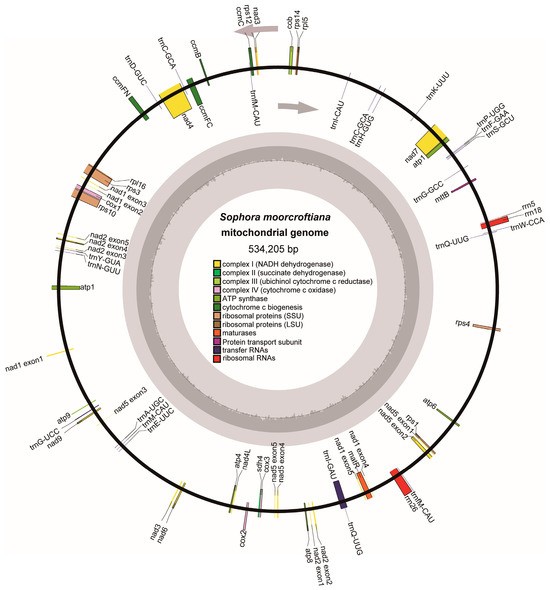
Figure 1.
Circular structure of the S. moorcroftiana mitochondrial genome. The map illustrates 33 annotated genes shown in different colors, according to their functional classification. Arrows indicate that genes listing outside the circle are transcribed in a clockwise direction, and genes inside are transcribed in a counterclockwise direction.

Table 1.
Basic information on the S. moorcroftiana mitogenome.
3.2. Repeat Sequences and DNA Transfer Analysis
The mitogenome contains tandem and dispersed repeats that are frequently used as molecular markers to examine host phylogeny. To investigate these repeat fragments in the S. moorcroftiana mitogenome, we analyzed the distribution of SSRs, tandem repeats, and dispersed repeats. A total of 166 SSRs were identified, including 58 monomers, 34 dimers, 16 trimers, 51 tetramers, and 7 pentamers (Figure 2A and Supplementary Table S2). Nine tandem repeats with similarities above 81% and lengths ranging from 12 to 28 bp were also detected (Supplementary Table S3). Moreover, 421 dispersed repeats were observed, with lengths ≥ 30 bp, comprising 214 palindromic and 207 forward repeats. The longest palindromic repeat was 308 bp, and the longest forward repeat was 2755 bp. No reverse or complementary repeats were identified in the S. moorcroftiana mitogenome (Figure 2B and Supplementary Table S4).
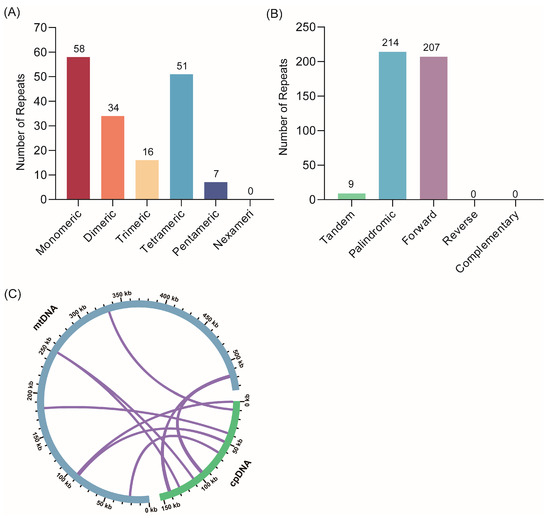
Figure 2.
Repeat elements and cpDNA transfer in the S. moorcroftiana mitogenome: (A) Number and types of SSRs distributed in the mitogenome. (B) Numbers and types of tandem and dispersed repeats. The x-axis indicates the repeat types, and the y-axis indicates the number of repeated fragments. (C) DNA sequence migration analysis. The green and blue arcs indicate the chloroplast genome and mitogenome, respectively. The purple line connecting the arcs corresponds to homologous genomic segments.
Furthermore, chloroplast fragments integrated into the S. moorcroftiana mitogenome were examined. Sequence similarity and length of the migrating fragments varied among species, and seven homologous fragments were identified between the chloroplast and mitochondrial genomes of S. moorcroftiana. These fragments totaled 2816 bp, representing approximately 0.53% of the mitogenome (Figure 2C). The longest fragment, MTP1, was 1617 bp, and four additional tRNA genes (trnW-CCA, trnN-GUU, trnH-GUG, and trnM-CAU) were detected within these homologous fragments.
3.3. Codon Usage Analysis of S. moorcroftiana Mitochondrial Genome
Codon usage bias in the mitochondrial genome represents an important evolutionary phenomenon arising from the interplay of natural selection, gene mutation, and genetic drift. To investigate the codon usage of the S. moorcroftiana mitogenome, the codon distribution across 33 PCGs was systematically analyzed, and the corresponding amino acid changes were examined (Supplementary Table S5). Codon usage was observed to be preferentially associated with amino acids having RSCU values > 1. A general preference for codon usage was identified in the S. moorcroftiana PCGs, except for the start codon AUG and tryptophan codon UGG. Additionally, a notable preference was observed for the stop codon UAA, which exhibited the highest RSCU value of 1.7 (Figure 3 and Supplementary Table S5).
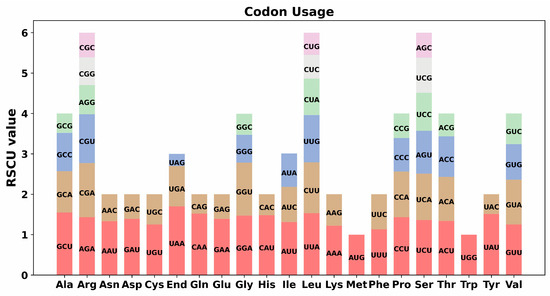
Figure 3.
Codon usage preferences in the S. moorcroftiana mitochondrial genome. The y-axis indicates the RSCU values, which show the preferences among synonymous codons.
3.4. Phylogenetic and Collinearity Analysis
To further explore the evolutionary relationships of the S. moorcroftiana mitogenome, all genes from the mitogenomes were analyzed along with the sequences of 43 closely related species obtained from GenBank. A total of 21 shared PCGs were selected to construct a phylogenetic tree. The results indicated that 42 mitogenomes, including that of S. moorcroftiana, clustered within Fabales species, whereas two mitogenomes of Zygophyllales were adopted as the outgroup (Figure 4 and Supplementary Table S6). The mitochondrial DNA-based analysis confirmed the placement of S. moorcroftiana within the order Fabales, family Fabaceae. Seven closely related species from the same group, namely Echinosophora koreensis, Sophora flavescens, Ammopiptanthus mongolicus, A. nanus, Lupinus albus, and Ormosia boluoensis, were selected for comparative analysis based on their homology (Figure 4). High-quality mitogenomes of these seven species were obtained from NCBI, with GC content and genome size (Supplementary Table S6).
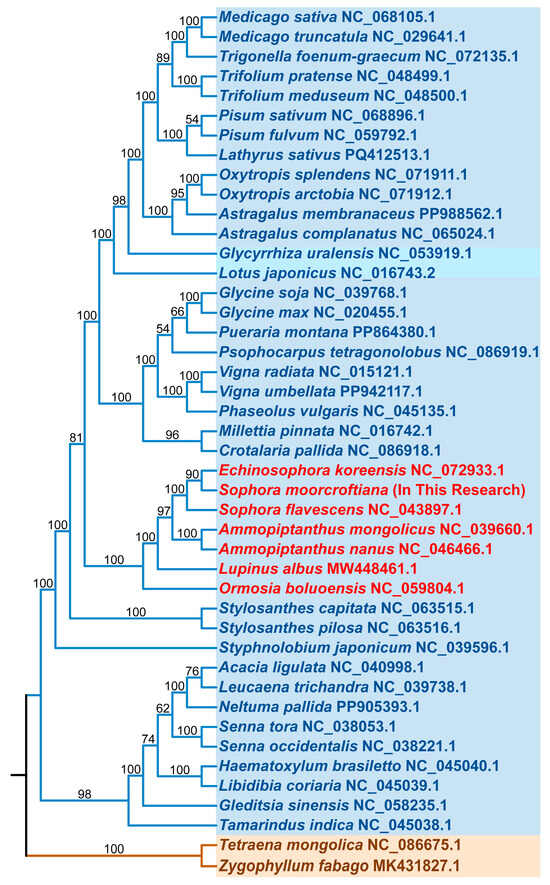
Figure 4.
Phylogenetic analysis of S. moorcroftiana and related genera. A phylogenetic tree was constructed for the mitogenomes of S. moorcroftiana and 43 other plant species using the maximum-likelihood method. Bootstrap support values are shown at the nodes, and branch colors indicate different taxonomic orders.
To further investigate the homology of the S. moorcroftiana mitogenome, collinearity analysis was performed using seven closely related species within Fabaceae. MCScanX was used to construct multiple synteny plots. The results revealed multiple colinear blocks between S. moorcroftiana and the six other closely related species. The red arc region represents the inverted regions, whereas the gray region represents the colinear blocks with good synteny (Figure 5). Numerous collinear blocks were identified, whereas blocks shorter than 0.5 kb were excluded. These findings demonstrate that collinearity orders among the seven species were inconsistent and not structurally conserved, suggesting that the S. moorcroftiana mitogenome underwent extensive rearrangements compared with those of closely related species.
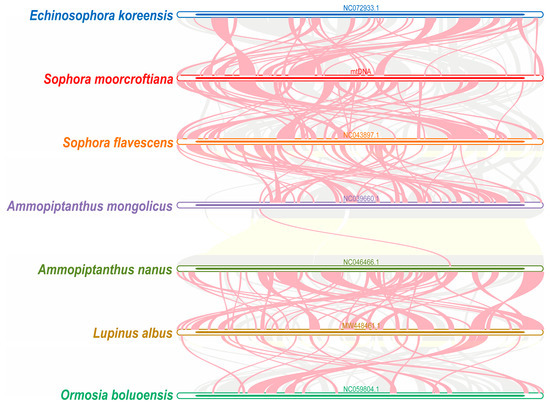
Figure 5.
Collinearity analysis between mitogenomes of S. moorcroftiana and six related species. Each bar represents a mitogenome, and ribbons denote homologous regions between S. moorcroftiana and the other six related plant species. The gray area indicates regions with homology, and the red arc area indicates inverted regions.
3.5. Characteristics and Distribution of RNA Editing Sites
RNA editing events are categorized as a form of post-transcriptional modification that increases the similarity of mitochondrial protein sequences in plant species. This process alters amino acid sequences, frequently converting hydrophilic amino acids into hydrophobic ones, thereby enhancing protein folding and its stability. Moreover, RNA editing generates novel start and stop codons, producing proteins with greater conservation in those species. The S. moorcroftiana transcriptome and mitogenome were further analyzed using Deepred-mt and REDItools to identify and visualize the distribution of potential RNA editing sites. A total of 587 C-to-U editing sites were identified across 33 PCGs in the S. moorcroftiana mitogenome. Notably, the number of editing sites varied across different genes, with nad4 and mttB genes containing 50 and 40 sites, respectively (Figure 6A and Supplementary Table S7). These editing sites were predominantly located at non-synonymous positions, leading to amino acid substitutions. In addition, 81 potential synonymous mutation sites were identified. The majority of RNA editing resulted in three amino acid substitutions: Pro to Leu (No. 122), Ser to Leu (No. 106), and Ser to Phe (No. 78) (Figure 6B).
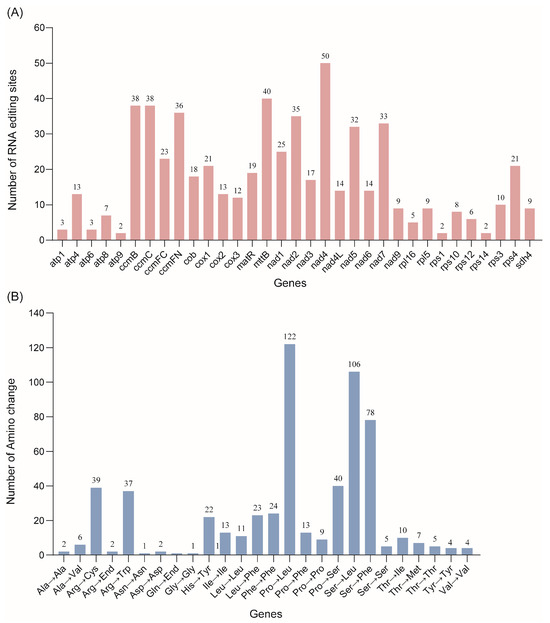
Figure 6.
Distribution of RNA editing sites identified in the PCGs of the S. moorcroftiana mitogenome: (A) Number of RNA editing sites distributed across S. moorcroftiana PCGs. The x-axis indicates gene names, and the y-axis indicates the number of RNA editing sites. (B) Changes in the encoded amino acids caused by RNA editing. The x-axis represents the type of amino acid change, and the y-axis indicates the number of amino acid changes.
3.6. Comprehensive Analysis of the Mitogenome and lncRNAs Involved in Drought Tolerance of S. moorcroftiana
To further examine drought-responsive genes in the mitogenome, lncRNA and mRNA sequencing were performed to analyze the expression of lncRNAs and their target genes in S. moorcroftiana under 10%, 20%, and 30% (w/v) PEG6000 treatments. LncRNAs primarily regulate target gene expression through three mechanisms: base-pairing with mRNAs, cis-regulation, and trans-regulation. The results revealed that 14 genes were significantly induced by PEG6000 treatment compared with the control, using a threshold of |log2 FoldChange| ≥ 0.8. Among them, eight genes (rrn18, rrn26, rps1, rpl16, trnI-CAU, trnG-UCC, trnG-GCC, and trnW-CCA) were upregulated, and six genes (ccmFN, nad3, trnE-UUC, trnF-GAA, trnK-UUU, and trnP-UGG) were downregulated after PEG6000 treatments (Figure 7). Notably, rrn18, rrn26, and trnW-CCA exhibited high expression levels and were upregulated after 10% and 30% (w/v) PEG6000 treatments. rpl16, rps1, trnG-UCC, and trnG-GCC were significantly upregulated and induced by 30% (w/v) PEG6000 treatment. Additionally, transcript level of ccmFN was downregulated after 10% (w/v) PEG6000 treatment, whereas nad3 was significantly downregulated and induced by 20% and 30% (w/v) PEG6000 treatments. The transcript levels of trnE-UUC, trnF-GAA, trnK-UUU, and trnP-UGG were significantly higher and downregulated in the 30% (w/v) PEG6000-treated seedlings. These observations suggest that the identified genes are closely associated with drought resistance. Functional category analysis indicated that DEGs were enriched in categories such as organic cyclic compound binding, NAD(P)H dehydrogenase activity, ribosomes, non-membrane-bound organelles, and so on (Supplementary Figure S1).
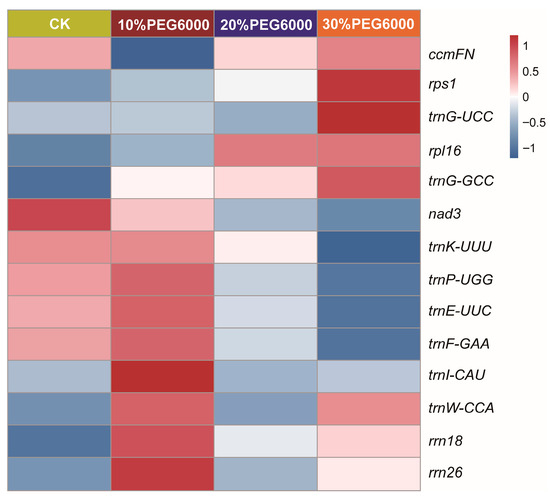
Figure 7.
Transcriptomic analysis of lncRNA–target genes interactions related to drought tolerance in Sophora moorcroftiana. Heatmap showing the expression of related DEGs in S. moorcroftiana roots under 10%, 20%, and 30% (w/v) PEG6000 treatments. The expression levels were calculated using FPKM data. The color scale represents the values with Z-score normalization. Gene expression differences are shown using color bars, with red and blue indicating the genes that are more highly or weakly expressed, respectively. Horizontal and vertical labels represent the treatments and gene names, respectively.
3.7. Physiological Responses of S. moorcroftiana Seedlings Under Drought Stress
Pro, MDA, soluble sugars, and soluble proteins are key osmoregulatory substances that contribute to drought resistance by maintaining intracellular osmotic pressure and reducing water loss. Moreover, plants enhance antioxidant activities, such as POD activity, to mitigate cellular damage and thereby strengthen overall drought resistance. Changes in physiological indicators, including Pro, soluble sugar, soluble protein, and MDA, as well as POD activity, were measured in S. moorcroftiana seedlings subjected to 10%, 20%, and 30% (w/v) PEG6000 treatments. The Pro content and POD activity exhibited significant increases following PEG6000 treatment. Similarly, soluble sugar and protein contents increased markedly under 10% and 30% PEG6000 treatments, respectively. Conversely, MDA levels were significantly reduced following PEG6000 treatment (Figure 8). These results indicate that high levels of osmoregulatory substances and enhanced antioxidant enzyme activity are pivotal for the drought resistance of S. moorcroftiana seedlings under drought stress.
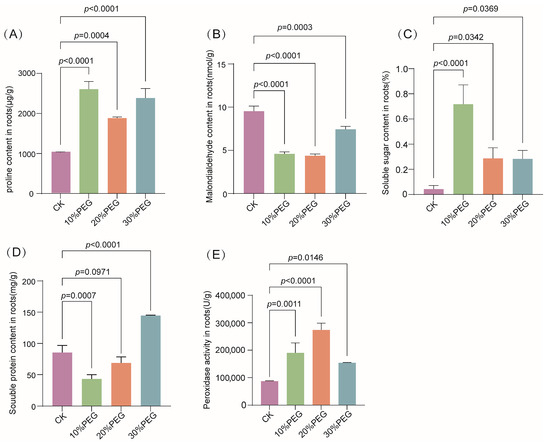
Figure 8.
Changes in osmoregulatory substances and peroxidase activity in S. moorcroftiana under PEG6000 treatment: (A–D) Contents of proline (Pro), malondialdehyde (MDA), soluble sugar, and soluble protein in S. moorcroftiana roots under 10%, 20%, and 30% (w/v) PEG6000 treatments. (E) Peroxidase (POD) activity in S. moorcroftiana roots under the same treatments. Data are presented as mean ± SD (n = 3). Significant differences were determined using Dunnett’s multiple comparison test (each treatment vs. each control, n = 3).
4. Discussion
4.1. Characteristic of S. moorcroftiana and Its Mitogenome
S. moorcroftiana is an endemic leguminous shrub that occurs exclusively in the arid and semi-arid regions of the Tibetan Plateau, exhibiting high drought and sand tolerance, rendering it valuable for ecological restoration [1,2,3]. This species possesses a deep and extensive root system that ensures its survival in highly drought-prone areas [10]. Previous studies have demonstrated that mitochondria can generate ROS and other metabolites, some of which act as retrograde signals essential for stress responses [59,60]. In the present study, the complete S. moorcroftiana mitogenome was analyzed and annotated with 33 unique protein-coding genes, including ATP synthase, cytochrome c biogenesis, and NADH dehydrogenase (Figure 1 and Supplementary Table S1). Mitochondrial dysfunction involving pentatricopeptide repeat proteins or DEXH-box RNA helicases has been reported to regulate ROS accumulation and influence plant adaptation to the stress hormone abscisic acid (ABA) [61]. Similarly, mitochondrial complex I mutants have been found to cause excessive ROS accumulation, suppress the expression of cold-responsive genes, and confer chilling and freezing sensitivities [62]. Mutants or alterations affecting mitochondria have also revealed the importance of maintaining antioxidant balance and organelle interactions to enhance stress resistance [63]. In addition, 166 SSRs and 421 pairs of repeat sequences were identified in the S. moorcroftiana mitogenome (Figure 2). These sequences serve as molecular markers and may be valuable genetic resources for future research. Furthermore, phylogenetic tree construction and collinearity analysis between S. moorcroftiana and its closely related species revealed high levels of genome rearrangement in the protein-coding genes (Figure 4 and Figure 5). Such structural features of the mitogenome could offer important insights into the molecular mechanisms underlying drought tolerance and may serve as a reference for breeding strategies to enhance drought resistance in S. moorcroftiana.
4.2. RNA Editing Events in the S. moorcroftiana Mitogenome
Plant mitochondria exhibit numerous RNA editing events characterized by C-to-U nucleotide modifications [64]. RNA editing sites have been identified in both PCGs and non-coding regions, including introns, UTRs, and tRNAs [64,65]. Considerable variations in the number of editing sites have been observed among plant species, with 200–700 sites typically detected in angiosperms and approximately 500 in gymnosperms [66,67]. In the present study, 587 RNA editing sites were identified across the 33 PCGs of the S. moorcroftiana mitogenome, all of which represented C-to-U modifications (Figure 6). Notably, nad4, mttB, ccmC, ccmB, and ccmFN exhibited extensive editing, with more than 35 editing sites each. The tomato (Solanum lycopersicum) gene SlWHY2 encodes a mitochondrial single-stranded DNA-binding protein that regulates the expression of mitochondrial NAD4, thereby maintaining mitochondrial function and enhancing drought tolerance [68]. In maize (Zea mays L.), the empty pericarp9 (emp9) mutant abolishes the C-to-U editing of ccmB-43 and rps4-335 sites in mitochondria, thereby affecting the maturation of cytochrome c and impairing the biogenesis of mitochondrial respiratory complexes [69]. These RNA editing sites participate in complex biological processes that regulate plant evolution, development, and adaptation [70,71].
Among these sites, 16 synonymous mutations and 474 non-synonymous changes were identified, altering amino acid sequences. Previous studies have indicated that RNA editing tends to increase amino acid conservation, thereby enhancing protein folding and physicochemical properties to support multiple biological functions [72]. Two stop codons (UGA) and seven conventional start codons (AUG) were detected owing to RNA editing site changes in the S. moorcroftiana mitogenome (Supplementary Table S7). Both stop codons resulted from CGA-to-UGA conversions in ccmFC and rps10, which contributed to truncated amino acid sequences. Nine start codons were introduced by ACG-to-AUG conversions in rps1, rps10, cob, cox2, nad1, nad4L, nad5, and nad7, thereby enabling translation initiation with methionine. Previous studies have demonstrated that C-to-U RNA editing in the mitogenome increases UV resistance in higher plants [73]. RNA editing can also alter protein translation and play a critical role in plant acclimatization and survival [74,75]. In Triticum aestivum, RNA editing patterns differ between drought-tolerant and drought-sensitive cultivars, inducing structural and functional modifications of NAD9 to enhance drought resilience [76]. Rice pentatricopeptide repeat (PPR) genes are involved in the regulation of mitochondrial RNA editing. PPR035 regulates RNA editing at rps4-926 and orfX-406, whereas PPR406 regulates RNA editing at orfX-355, both contributing to improved drought tolerance in upland rice [77]. Collectively, the identification and analysis of RNA editing sites in the S. moorcroftiana mitogenome offer promising prospects for improving drought resistance and provide essential insights into the molecular mechanisms underlying its remarkable drought tolerance.
4.3. Plant Mitochondria and the RNA Editing Process Regulate Drought Tolerance
Drought stress is recognized as a major environmental factor that negatively influences plant growth and development by causing excessive water loss, reduced photosynthetic activity, and altered stomatal conductance [78,79]. Mitochondria and the RNA editing process within them play critical roles in regulating intracellular ATP production and maintaining ROS homeostasis, thereby contributing to plant adaptation to drought stress and growth [21,80,81]. Through the conjoint analysis of the S. moorcroftiana mitochondrial genome and transcriptome, eight genes were identified as upregulated (rrn18, rrn26, rps1, rpl16, trnI-CAU, trnG-UCC, trnG-GCC, and trnW-CCA) and six as downregulated (ccmFN, nad3, trnE-UUC, trnF-GAA, trnK-UUU, and trnP-UGG) under drought treatment (Figure 7). In rice, OsPPR674 knockout plants exhibited ROS accumulation due to defective RNA editing of the mitochondrial cytochrome ccmC gene, resulting in reduced plant height and poor drought tolerance [21]. Furthermore, ABA has been shown to induce H2O2 accumulation in guard cell mitochondria, promoting stomatal closure, reducing water loss, and ultimately enhancing drought resistance [11]. In cotton, mitochondrial genome and transcriptome analyses revealed 339 RNA editing sites distributed across 28 GhAGC genes, with GhAGC5, GhAGC9, GhAGC23, and GhAGC24 exhibiting high transcript abundance under drought stress [82]. Overall, these DEGs and RNA editing sites in the S. moorcroftiana mitogenome were strongly correlated with drought resistance and performed important functions in regulating plant stress tolerance in future studies.
5. Conclusions
In this study, the S. moorcroftiana mitogenome was sequenced, assembled, and annotated to include 33 unique PCGs, 19 tRNA genes, and three rRNA genes, representing a circular molecule of 534,205 bp, with a GC content of 44.93%. Comparative analyses were performed on genome structure, repeat sequences, codon usage, phylogenetic relationships, and RNA editing site distribution. Furthermore, conjoint analysis of the transcriptome and mitogenome identified 587 RNA editing sites across 33 PCGs, and found that 14 lncRNA–target genes were significantly induced in the roots under drought treatment. In addition, physiological indicators, including Pro, soluble sugar, soluble protein, and peroxidase activity, in S. moorcroftiana seedlings were significantly induced by PEG6000 treatment. These findings provide comprehensive insights into the molecular basis of drought tolerance in S. moorcroftiana, offering valuable resources for future studies on the molecular mechanisms and breeding strategies aimed at enhancing drought resistance in this species.
Supplementary Materials
The following supporting information can be downloaded at: https://www.mdpi.com/article/10.3390/biology14121711/s1, Figure S1: GO enrichment analysis of the DEGs showing the GO terms; Table S1: The encoding genes of S. moorcroftiana mitogenome; Table S2: The SSRs in the mitochondrial genome of S. moorcroftiana; Table S3: Tandem repeat sequences in the mitochondrial genome of S. moorcroftiana; Table S4: Dispersed repeat sequences in the mitochondrial genome of S. moorcroftiana; Table S5: Relative synonymous codon usage of each amino acid pair in the S. moorcroftiana mitochondrial genome; Table S6: The 44 homology of the mitogenomes; Table S7: The identified RNA editing sites in the S. moorcroftiana mitogenome.
Author Contributions
Experiments were designed by B.L. and Q.G. Experiments were performed by J.X., Y.S., Y.W., J.N., B.L. and Q.G.; J.X. and B.L. drafted and revised the manuscript. All authors have read and agreed to the published version of the manuscript.
Funding
This research was supported by the Tibet Autonomous Region Science and Technology Plan Project of China (grant nos. XZ202401YD0026 and XZ202501YD0019).
Institutional Review Board Statement
Not applicable.
Informed Consent Statement
Not applicable.
Data Availability Statement
Our mitochondrial genomic and transcriptomic data associated with this study have been submitted to the NCBI under accession numbers PRJNA1336633, PRJNA1335579, and PRJNA1335384, respectively.
Conflicts of Interest
All authors declare that they have no competing interests.
References
- Liu, Y.; Yi, F.; Yang, G.J.; Wang, Y.T.; Pubu, C.; He, R.H.; Xiao, Y.; Wang, J.C.; Lu, N.; Wang, J.H.; et al. Geographic population genetic structure and diversity of Sophora moorcroftiana based on genotyping-by-sequencing (GBS). PeerJ 2020, 8, e9609. [Google Scholar] [CrossRef]
- Dong, R.; Yang, S.; Wang, X.; Xie, L.; Ma, Y.; Wang, Y.; Zhang, L.; Zhang, M.; Qin, J. C:N:P stoichiometry in plant, soil and microbe in Sophora moorcroftiana shrubs across three sandy dune types in the middle reaches of the Yarlung Zangbo River. Front. Plant Sci. 2023, 13, 1060686. [Google Scholar] [CrossRef]
- Dong, R.; Guo, Q.Q.; Li, H.E.; Li, J.R.; Zuo, W.W.; Long, C. Estimation of morphological variation in seed traits of Sophora moorcroftiana using digital image analysis. Front. Plant Sci. 2023, 14, 1185393. [Google Scholar] [CrossRef]
- Liu, Y.; Ge, W.; Danzeng, L.; Wang, J.; Danzeng, N.; Ma, W.; Wang, Y.; Gesang, Q. Population genomics provides new insights into the genetic variation patterns, population demographic history, and high-altitude adaptation of Sophora moorcroftiana. BMC Plant Biol. 2025, 25, 899. [Google Scholar] [CrossRef]
- Seleiman, M.F.; Al-Suhaibani, N.; Ali, N.; Akmal, M.; Alotaibi, M.; Refay, Y.; Dindaroglu, T.; Abdul-Wajid, H.H.; Battaglia, M.L. Drought Stress Impacts on Plants and Different Approaches to Alleviate Its Adverse Effects. Plants 2021, 10, 259. [Google Scholar] [CrossRef] [PubMed]
- Sallam, A.; Alqudah, A.M.; Dawood, M.F.; Baenziger, P.S.; Börner, A. Drought stress tolerance in wheat and barley: Advances in physiology, breeding and genetics research. Int. J. Mol. Sci. 2019, 20, 3137. [Google Scholar] [CrossRef] [PubMed]
- Guo, Q.Q.; Zhang, W.H.; Li, H.E. Comparison of photosynthesis and antioxidative protection in Sophora moorcroftiana and Caragana maximovicziana under water stress. J. Arid. Land 2014, 6, 637–645. [Google Scholar] [CrossRef][Green Version]
- Li, H.E.; Zhang, Y.F.; Guo, Q.Q.; Yao, W.J. Molecular characterisation of a DREB gene from Sophora moorcroftiana, an endemic species of plateau. Protoplasma 2017, 254, 1735–1741. [Google Scholar] [CrossRef]
- Li, H.E.; Yao, W.J.; Fu, Y.R.; Li, S.K.; Guo, Q.Q. De Novo Assembly and Discovery of Genes That Are Involved in Drought Tolerance in Tibetan Sophora moorcroftiana. PLoS ONE 2015, 10, e111054. [Google Scholar] [CrossRef]
- Yin, X.; Yang, D.N.; Liu, Y.M.; Yang, S.H.; Zhang, R.; Sun, X.L.; Liu, H.X.; Duan, Y.W.; Yang, Y.Q.; Yang, Y.P. Sophora moorcroftiana genome analysis suggests association between sucrose metabolism and drought adaptation. Plant Physiol. 2023, 191, 844–848. [Google Scholar] [CrossRef]
- Postiglione, A.E.; Muday, G.K. Abscisic acid increases hydrogen peroxide in mitochondria to facilitate stomatal closure. Plant Physiol. 2023, 192, 469–487. [Google Scholar] [CrossRef]
- Bao, L.F.; Liu, J.H.; Mao, T.Y.; Zhao, L.B.; Wang, D.S.; Zhai, Y.L. Nanobiotechnology-mediated regulation of reactive oxygen species homeostasis under heat and drought stress in plants. Front. Plant Sci. 2024, 15, 1418515. [Google Scholar] [CrossRef]
- Igamberdiev, A.U.; Bykova, N.V. Mitochondria in photosynthetic cells: Coordinating redox control and energy balance. Plant Physiol. 2023, 191, 2104–2119. [Google Scholar] [CrossRef]
- Siqueira, J.A.; Hardoim, P.; Ferreira, P.C.G.; Nunes-Nesi, A.; Hemerly, A.S. Unraveling Interfaces between Energy Metabolism and Cell Cycle in Plants. Trends Plant Sci. 2018, 23, 731–747. [Google Scholar] [CrossRef] [PubMed]
- Van Aken, O. Mitochondrial redox systems as central hubs in plant metabolism and signaling. Plant Physiol. 2021, 186, 36–52. [Google Scholar] [CrossRef] [PubMed]
- Qu, Y.S.; Zhou, P.Y.; Tong, C.F.; Bi, C.W.; Xu, L.A. Assembly and analysis of the Populus deltoides mitochondrial genome: The first report of a multicircular mitochondrial conformation for the genus Populus. J. For. Res. 2023, 34, 717–733. [Google Scholar] [CrossRef]
- Wang, M.T.; Yang, J.P.; Hou, Z.Y.; Li, C.; Niu, Z.T.; Zhang, B.H.; Xue, Q.Y.; Liu, W.; Ding, X.Y. The multi-chromosomal structure of mitogenomes provided new insights into the accurate authentication of medicinal Dendrobium species. BMC Plant Biol. 2025, 25, 202. [Google Scholar] [CrossRef]
- Lu, G.L.; Li, Q. Complete mitochondrial genome of Syzygium samarangense reveals genomic recombination, gene transfer, and RNA editing events. Front. Plant Sci. 2024, 14, 1301164. [Google Scholar] [CrossRef]
- Lukeš, J.; Kaur, B.; Speijer, D. RNA Editing in Mitochondria and Plastids: Weird and Widespread. Trends Genet. 2021, 37, 99–102. [Google Scholar] [CrossRef]
- Wu, D.; Fu, W.T.; Fan, G.L.; Huang, D.F.; Wu, K.Y.; Zhan, Y.F.; Tu, X.M.; He, J.W. Characteristics and Comparative Analysis of the Special-Structure (Non-Single-Circle) Mitochondrial Genome of Capsicum pubescens Ruiz & Pav. Genes 2024, 15, 152. [Google Scholar]
- Li, J.L.; Zhang, L.H.; Li, C.Y.; Chen, W.J.; Wang, T.K.; Tan, L.; Qiu, Y.X.; Song, S.F.; Li, B.; Li, L. The Pentatricopeptide Repeat Protein OsPPR674 Regulates Rice Growth and Drought Sensitivity by Modulating RNA Editing of the Mitochondrial Transcript ccmC. Int. J. Mol. Sci. 2025, 26, 2646. [Google Scholar] [CrossRef] [PubMed]
- Che, R.H.; Tan, X.T.; Meng, X.N.; Li, H. ZmCYB5-1, a cytochrome b5 Gene, negatively regulates drought stress tolerance in maize. Gene 2025, 954, 149422. [Google Scholar] [CrossRef] [PubMed]
- Tel-Zur, N.; Abbo, S.; Myslabodski, D.; Mizrahi, Y. Modified CTAB procedure for DNA isolation from epiphytic cacti of the genera Hylocereus and Selenicereus (Cactaceae). Plant Mol. Biol. Rep. 1999, 17, 249–254. [Google Scholar] [CrossRef]
- Kolmogorov, M.; Yuan, J.; Lin, Y.; Pevzner, P.A. Assembly of long, error-prone reads using repeat graphs. Nat. Biotechnol. 2019, 37, 540–546. [Google Scholar] [CrossRef]
- Wick, R.R.; Schultz, M.B.; Zobel, J.; Holt, K.E. Bandage: Interactive visualization of de novo genome assemblies. Bioinformatics 2015, 31, 3350–3352. [Google Scholar] [CrossRef]
- Wick, R.R.; Judd, L.M.; Gorrie, C.L.; Holt, K.E. Unicycler: Resolving bacterial genome assemblies from short and long sequencing reads. PLoS Comput. Biol. 2017, 13, e1005595. [Google Scholar] [CrossRef]
- Li, J.; Ni, Y.; Lu, Q.; Chen, H.; Liu, C. PMGA: A plant mitochondrial genome annotator. Plant Commun. 2025, 6, 101191. [Google Scholar] [CrossRef]
- Lowe, T.M.; Eddy, S.R. tRNAscan-SE: A program for improved detection of transfer RNA genes in genomic sequence. Nucleic Acids Res. 1997, 25, 955–964. [Google Scholar] [CrossRef]
- Lewis, S.E.; Searle, S.M.J.; Harris, N.; Gibson, M.; Lyer, V.; Richter, J.; Wiel, C.; Bayraktaroglu, L.; Birney, E.; Crosby, M.A.; et al. Apollo: A sequence annotation editor. Genome Biol. 2002, 3, research0082.1. [Google Scholar] [CrossRef]
- Beier, S.; Thiel, T.; Münch, T.; Scholz, U.; Mascher, M. MISA-web: A web server for microsatellite prediction. Bioinformatics 2017, 33, 2583–2585. [Google Scholar] [CrossRef]
- Wynn, E.L.; Christensen, A.C. Repeats of Unusual Size in Plant Mitochondrial Genomes: Identification, Incidence and Evolution. G3 Genes Genomes Genet. 2019, 9, 549–559. [Google Scholar] [CrossRef]
- Behboudi, R.; Nouri-Baygi, M.; Naghibzadeh, M. RPTRF: A rapid perfect tandem repeat finder tool for DNA sequences. Biosystems 2023, 226, 104869. [Google Scholar] [CrossRef]
- Zhang, H.E.; Meltzer, P.; Davis, S. RCircos: An R package for Circos 2D track plots. BMC Bioinform. 2013, 14, 244. [Google Scholar] [CrossRef] [PubMed]
- Zhang, D.; Gao, F.L.; Jakovlic, I.; Zou, H.; Zhang, J.; Li, W.X.; Wang, G.T. PhyloSuite: An integrated and scalable desktop platform for streamlined molecular sequence data management and evolutionary phylogenetics studies. Mol. Ecol. Resour. 2020, 20, 348–355. [Google Scholar] [CrossRef] [PubMed]
- Han, Y.; Feng, Y.L.; Wang, J.; Zhu, S.S.; Jin, X.J.; Wu, Z.Q.; Zhang, Y.H. Comprehensive Analysis of the Complete Mitochondrial Genome of Rehmannia chingii: An Autotrophic Species in the Orobanchaceae Family. Genes 2024, 15, 98. [Google Scholar] [CrossRef] [PubMed]
- Kumar, S.; Stecher, G.; Tamura, K. MEGA7: Molecular Evolutionary Genetics Analysis Version 7.0 for Bigger Datasets. Mol. Biol. Evol. 2016, 33, 1870–1874. [Google Scholar] [CrossRef]
- Katoh, K.; Standley, D.M. MAFFT Multiple Sequence Alignment Software Version 7: Improvements in Performance and Usability. Mol. Biol. Evol. 2013, 30, 772–780. [Google Scholar] [CrossRef]
- Nguyen, L.T.; Schmidt, H.A.; von Haeseler, A.; Minh, B.Q. IQ-TREE: A Fast and Effective Stochastic Algorithm for Estimating Maximum-Likelihood Phylogenies. Mol. Biol. Evol. 2015, 32, 268–274. [Google Scholar] [CrossRef]
- Letunic, I.; Bork, P. Interactive Tree Of Life (iTOL) v4: Recent updates and new developments. Nucleic Acids Res. 2019, 47, W256–W259. [Google Scholar] [CrossRef]
- Jin, J.J.; Yu, W.B.; Yang, J.B.; Song, Y.; dePamphilis, C.W.; Yi, T.S.; Li, D.Z. GetOrganelle: A fast and versatile toolkit for accurate de novo assembly of organelle genomes. Genome Biol. 2020, 21, 241. [Google Scholar] [CrossRef]
- Shi, L.C.; Chen, H.M.; Jiang, M.; Wang, L.Q.; Wu, X.; Huang, L.F.; Liu, C. CPGAVAS2, an integrated plastome sequence annotator and analyzer. Nucleic Acids Res. 2019, 47, W65–W73. [Google Scholar] [CrossRef]
- Wang, Y.P.; Tang, H.B.; DeBarry, J.D.; Tan, X.; Li, J.P.; Wang, X.Y.; Lee, T.H.; Jin, H.Z.; Marler, B.; Guo, H.; et al. MCScanX: A toolkit for detection and evolutionary analysis of gene synteny and collinearity. Nucleic Acids Res. 2012, 40, e49. [Google Scholar] [CrossRef] [PubMed]
- Edera, A.A.; Small, I.; Milone, D.H.; Sanchez-Puerta, M.V. Deepred-Mt: Deep representation learning for predicting C-to-U RNA editing in plant mitochondria. Comput. Biol. Med. 2021, 136, 104682. [Google Scholar] [CrossRef] [PubMed]
- Picardi, E.; Pesole, G. REDItools: High-throughput RNA editing detection made easy. Bioinformatics 2013, 29, 1813–1814. [Google Scholar] [CrossRef] [PubMed]
- Martin, M. Cutadapt removes adapter sequences from high-throughput sequencing reads. EMB Net J. 2011, 17, 10–12. [Google Scholar] [CrossRef]
- Frazee, A.C.; Pertea, G.; Jaffe, A.E.; Langmead, B.; Salzberg, S.L.; Leek, J.T. Ballgown bridges the gap between transcriptome assembly and expression analysis. Nat. Biotechnol. 2015, 33, 243–246. [Google Scholar] [CrossRef]
- Langmead, B.; Salzberg, S.L. Fast gapped-read alignment with Bowtie 2. Nat. Methods 2012, 9, 354–357. [Google Scholar] [CrossRef]
- Kim, D.; Pertea, G.; Trapnell, C.; Pimentel, H.; Kelley, R.; Salzberg, S.L. TopHat2: Accurate alignment of transcriptomes in the presence of insertions, deletions and gene fusions. Genome Biol. 2013, 14, R36. [Google Scholar] [CrossRef]
- Sun, L.; Luo, H.; Bu, D.; Zhao, G.; Yu, K.; Zhang, C.; Liu, Y.; Chen, R.; Zhao, Y. Utilizing sequence intrinsic composition to classify protein-coding and long non-coding transcripts. Nucleic Acids Res. 2013, 41, e166. [Google Scholar] [CrossRef]
- Kang, Y.J.; Yang, D.C.; Kong, L.; Hou, M.; Meng, Y.Q.; Wei, L.; Gao, G. CPC2: A fast and accurate coding potential calculator based on sequence intrinsic features. Nucleic Acids Res. 2017, 45, W12–W16. [Google Scholar] [CrossRef]
- Li, A.; Zhang, J.; Zhou, Z. PLEK: A tool for predicting long non-coding RNAs and messenger RNAs based on an improved k-mer scheme. BMC Bioinform. 2014, 15, 311. [Google Scholar] [CrossRef]
- Punta, M.; Coggill, P.C.; Eberhardt, R.Y.; Mistry, J.; Tate, J.; Boursnell, C.; Pang, N.; Forslund, K.; Ceric, G.; Clements, J.; et al. The Pfam protein families database. Nucleic Acids Res. 2012, 40, D290–D301. [Google Scholar] [CrossRef]
- Lorenz, R.; Bernhart, S.H.; Höner Zu Siederdissen, C.; Tafer, H.; Flamm, C.; Stadler, P.F.; Hofacker, I.L. ViennaRNA Package 2.0. Algorithms Mol. Biol. 2011, 6, 26. [Google Scholar] [CrossRef]
- Tafer, H.; Hofacker, I.L. RNAplex: A fast tool for RNA-RNA interaction search. Bioinformatics 2008, 24, 2657–2663. [Google Scholar] [CrossRef] [PubMed]
- Gregori, J.; Villarreal, L.; Sánchez, A.; Baselga, J.; Villanueva, J. An effect size filter improves the reproducibility in spectral counting-based comparative proteomics. J. Proteom. 2013, 95, 55–65. [Google Scholar] [CrossRef] [PubMed]
- Chen, C.J.; Wu, Y.; Li, J.W.; Wang, X.; Zeng, Z.H.; Xu, J.; Liu, Y.L.; Feng, J.T.; Chen, H.; He, Y.H.; et al. TBtools-II: A “one for all, all for one” bioinformatics platform for biological big-data mining. Mol. Plant 2023, 16, 1733–1742. [Google Scholar] [CrossRef] [PubMed]
- Kielkopf, C.L.; Bauer, W.; Urbatsch, I.L. Methods for Measuring the Concentrations of Proteins. Cold Spring Harb. Protoc. 2020, 2020, 102277. [Google Scholar] [CrossRef]
- Rashidi, M.A.; Falahi, S.; Farhang Dehghan, S.; Ebrahimzadeh, H.; Ghaneialvar, H.; Zendehdel, R. Green synthesis of silver nanoparticles by Smyrnium cordifolium plant and its application for colorimetric detection of ammonia. Sci. Rep. 2024, 14, 24161. [Google Scholar] [CrossRef]
- Ng, S.; De Clercq, I.; Van Aken, O.; Law, S.R.; Ivanova, A.; Willems, P.; Giraud, E.; Van Breusegem, F.; Whelan, J. Anterograde and Retrograde Regulation of Nuclear Genes Encoding Mitochondrial Proteins during Growth, Development, and Stress. Mol. Plant 2014, 7, 1075–1093. [Google Scholar] [CrossRef]
- Zhu, J.K. Abiotic Stress Signaling and Responses in Plants. Cell 2016, 167, 313–324. [Google Scholar] [CrossRef]
- He, J.N.; Duan, Y.; Hua, D.P.; Fan, G.J.; Wang, L.; Liu, Y.; Chen, Z.Z.; Han, L.H.; Qu, L.J.; Gong, Z.Z. DEXH Box RNA Helicase-Mediated Mitochondrial Reactive Oxygen Species Production in Arabidopsis Mediates Crosstalk between Abscisic Acid and Auxin Signaling. Plant Cell 2012, 24, 1815–1833. [Google Scholar] [CrossRef]
- Lee, B.H.; Lee, H.J.; Xiong, L.M.; Zhu, J.K. A mitochondrial complex I defect impairs cold-regulated nuclear gene expression. Plant Cell 2002, 14, 1235–1251. [Google Scholar] [CrossRef] [PubMed]
- Dutilleul, C.; Garmier, M.; Noctor, G.; Mathieu, C.; Chétrit, P.; Foyer, C.H.; de Paepe, R. Leaf mitochondria modulate whole cell redox homeostasis, set antioxidant capacity, and determine stress resistance through altered signaling and diurnal regulation. Plant Cell 2003, 15, 1212–1226. [Google Scholar] [CrossRef] [PubMed]
- Small, I.D.; Schallenberg-Rüdinger, M.; Takenaka, M.; Mireau, H.; Ostersetzer-Biran, O. Plant organellar RNA editing: What 30 years of research has revealed. Plant J. 2020, 101, 1040–1056. [Google Scholar] [CrossRef] [PubMed]
- Dietrich, A.; Wallet, C.; Iqbal, R.K.; Gualberto, J.M.; Lotfi, F. Organellar non-coding RNAs: Emerging regulation mechanisms. Biochimie 2015, 117, 48–62. [Google Scholar] [CrossRef]
- Mower, J.P. The PREP suite: Predictive RNA editors for plant mitochondrial genes, chloroplast genes and user-defined alignments. Nucleic Acids Res. 2009, 37, W253–W259. [Google Scholar] [CrossRef]
- Salmans, M.L.; Chaw, S.M.; Lin, C.P.; Shih, A.C.C.; Wu, Y.W.; Mulligan, R.M. Editing site analysis in a gymnosperm mitochondrial genome reveals similarities with angiosperm mitochondrial genomes. Curr. Genet. 2010, 56, 439–446. [Google Scholar] [CrossRef]
- Meng, C.; Yang, M.; Wang, Y.; Chen, C.; Sui, N.; Meng, Q.; Zhuang, K.; Lv, W. SlWHY2 interacts with SlRECA2 to maintain mitochondrial function under drought stress in tomato. Plant Sci. 2020, 301, 110674. [Google Scholar] [CrossRef]
- Yang, Y.Z.; Ding, S.; Wang, H.C.; Sun, F.; Huang, W.L.; Song, S.; Xu, C.; Tan, B.C. The pentatricopeptide repeat protein EMP9 is required for mitochondrial ccmB and rps4 transcript editing, mitochondrial complex biogenesis and seed development in maize. New Phytol. 2017, 214, 782–795. [Google Scholar] [CrossRef]
- Ichinose, M.; Sugita, M. RNA Editing and Its Molecular Mechanism in Plant Organelles. Genes 2017, 8, 5. [Google Scholar] [CrossRef]
- Tang, W.; Luo, C. Molecular and Functional Diversity of RNA Editing in Plant Mitochondria. Mol. Biotechnol. 2018, 60, 935–945. [Google Scholar] [CrossRef]
- Guo, S.; Li, Z.Y.; Li, C.L.; Liu, Y.; Liang, X.L.; Qin, Y.M. Assembly and characterization of the complete mitochondrial genome of Ventilago leiocarpa. Plant Cell Rep. 2024, 43, 77. [Google Scholar] [CrossRef] [PubMed]
- Fujii, S.; Small, I. The evolution of RNA editing and pentatricopeptide repeat genes. New Phytol. 2011, 191, 37–47. [Google Scholar] [CrossRef] [PubMed]
- Gommans, W.M.; Mullen, S.P.; Maas, S. RNA editing: A driving force for adaptive evolution? Bioessays 2009, 31, 1137–1145. [Google Scholar] [CrossRef] [PubMed]
- Yang, L.L.; Liu, J.; Guo, W.J.; Zheng, Z.H.; Xu, Y.F.; Xia, H.J.; Xiao, T. Insights into the multi-chromosomal mitochondrial genome structure of the xero-halophytic plant Haloxylon Ammodendron (C.A.Mey.) Bunge ex Fenzl. BMC Genom. 2024, 25, 123. [Google Scholar] [CrossRef]
- Mohamed, N.G.; Ramadan, A.M.; Amer, M.; Morsy, Y.; Mohamed, R.A.; Said, O.A.M.; Alnufaei, A.A.; Ibrahim, M.I.M.; Hassanein, S.E.; Eissa, H.F. RNA editing-induced structural and functional adaptations of NAD9 in Triticum aestivum under drought stress. Front. Plant Sci. 2024, 15, 1490288. [Google Scholar] [CrossRef]
- Luo, Z.; Xiong, J.; Xia, H.; Wang, L.; Hou, G.; Li, Z.; Li, J.; Zhou, H.; Li, T.; Luo, L. Pentatricopeptide Repeat Gene-Mediated Mitochondrial RNA Editing Impacts on Rice Drought Tolerance. Front. Plant Sci. 2022, 13, 926285. [Google Scholar] [CrossRef]
- Fahad, S.; Bajwa, A.A.; Nazir, U.; Anjum, S.A.; Farooq, A.; Zohaib, A.; Sadia, S.; Nasim, W.; Adkins, S.; Saud, S.; et al. Crop Production under Drought and Heat Stress: Plant Responses and Management Options. Front. Plant Sci. 2017, 8, 1147. [Google Scholar] [CrossRef]
- Lamaoui, M.; Jemo, M.; Datla, R.; Bekkaoui, F. Heat and Drought Stresses in Crops and Approaches for Their Mitigation. Front. Chem. 2018, 6, 26. [Google Scholar] [CrossRef]
- Ghifari, A.S.; Saha, S.; Murcha, M.W. The biogenesis and regulation of the plant oxidative phosphorylation system. Plant Physiol. 2023, 192, 728–747. [Google Scholar] [CrossRef]
- Hu, Y.X.; Huang, A.; Li, Y.; Molloy, D.P.; Huang, C. Emerging roles of the C-to-U RNA editing in plant stress responses. Plant Sci. 2024, 349, 112263. [Google Scholar] [CrossRef]
- Ahmad, F.; Abdullah, M.; Khan, Z.; Stepien, P.; Rehman, S.U.; Akram, U.; Rahman, M.H.U.; Ali, Z.; Ahmad, D.; Gulzar, R.M.A.; et al. Genome-wide analysis and prediction of chloroplast and mitochondrial RNA editing sites of AGC gene family in cotton (Gossypium hirsutum L.) for abiotic stress tolerance. BMC Plant Biol. 2024, 24, 888. [Google Scholar] [CrossRef]
Disclaimer/Publisher’s Note: The statements, opinions and data contained in all publications are solely those of the individual author(s) and contributor(s) and not of MDPI and/or the editor(s). MDPI and/or the editor(s) disclaim responsibility for any injury to people or property resulting from any ideas, methods, instructions or products referred to in the content. |
© 2025 by the authors. Licensee MDPI, Basel, Switzerland. This article is an open access article distributed under the terms and conditions of the Creative Commons Attribution (CC BY) license (https://creativecommons.org/licenses/by/4.0/).