Synergistic Aging Resistance and Autonomous Self-Healing in Trimethylolpropane Triglycidyl Ether-Based Anti-Icing Coatings
Abstract
1. Introduction
2. Materials and Methods
2.1. Materials
2.2. Preparation of Anti-Icing Coatings
2.3. Characterization
2.3.1. Physical Characterization
2.3.2. Anti-Icing Performance
- (1)
- Average icing temperature test
- (2)
- Icing delay time test
- (3)
- Ice adhesion strength test
2.3.3. Self-Healing Performance Test
2.3.4. Aging Test
3. Results and Discussion
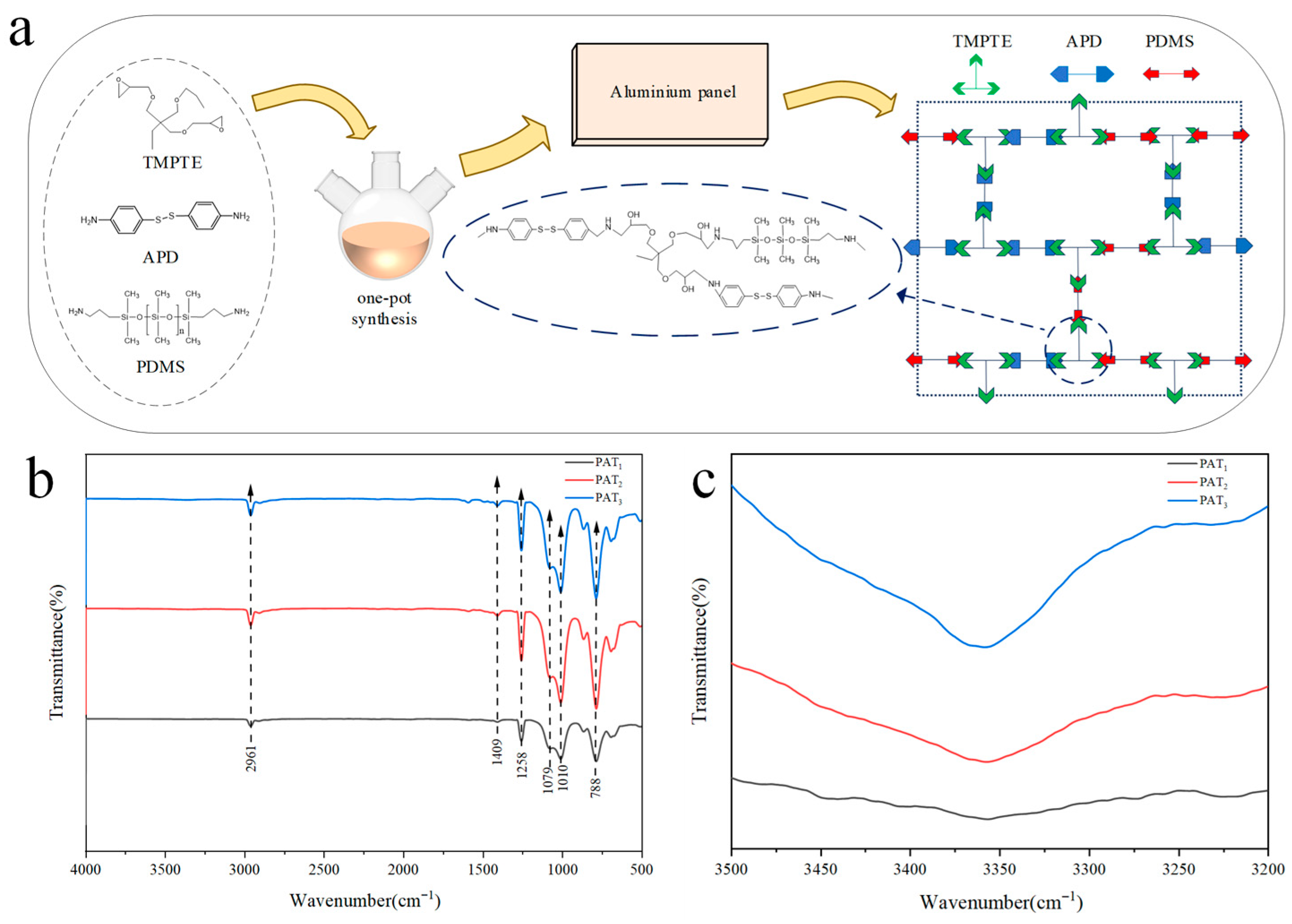
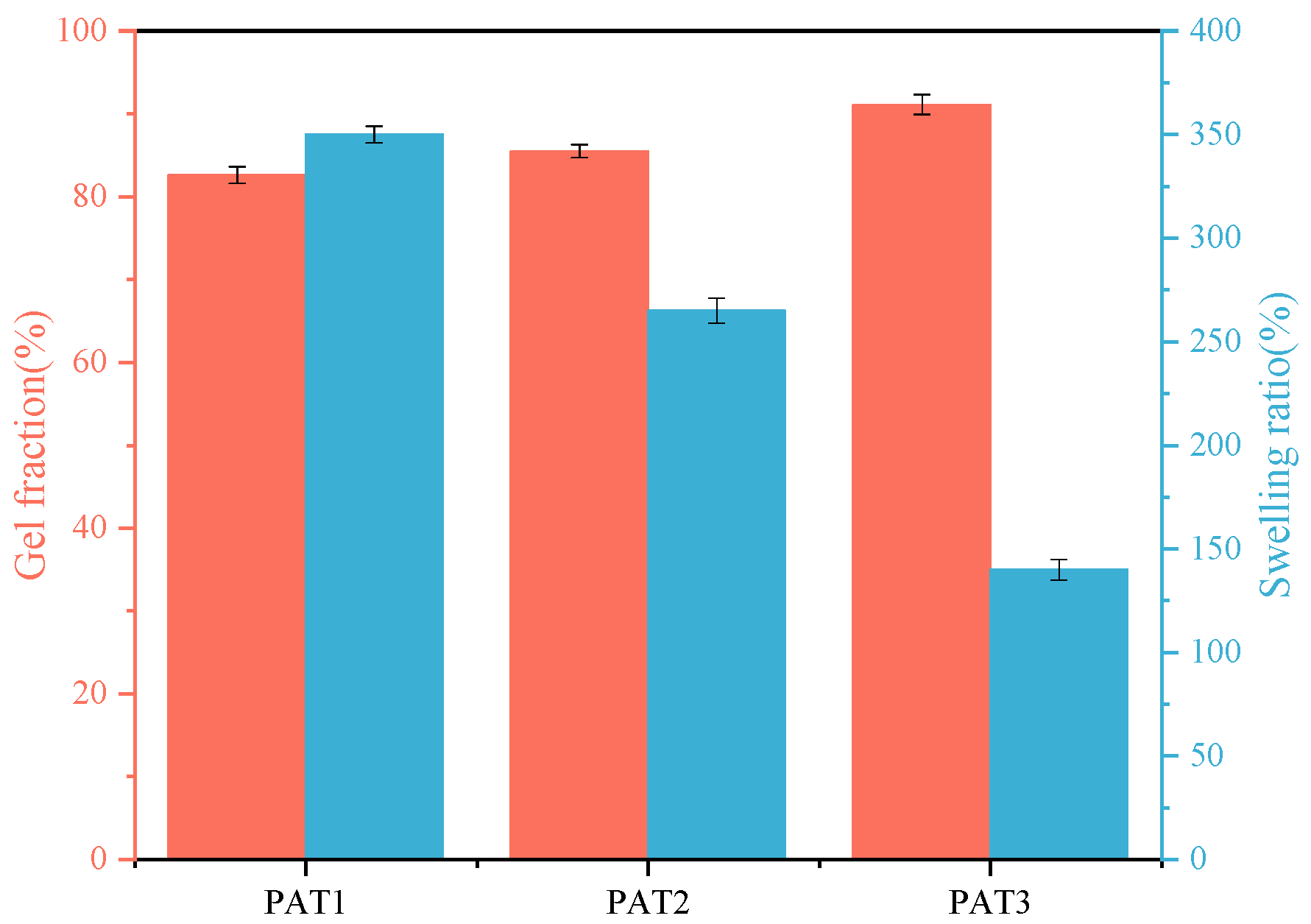
3.1. Molecular Structure
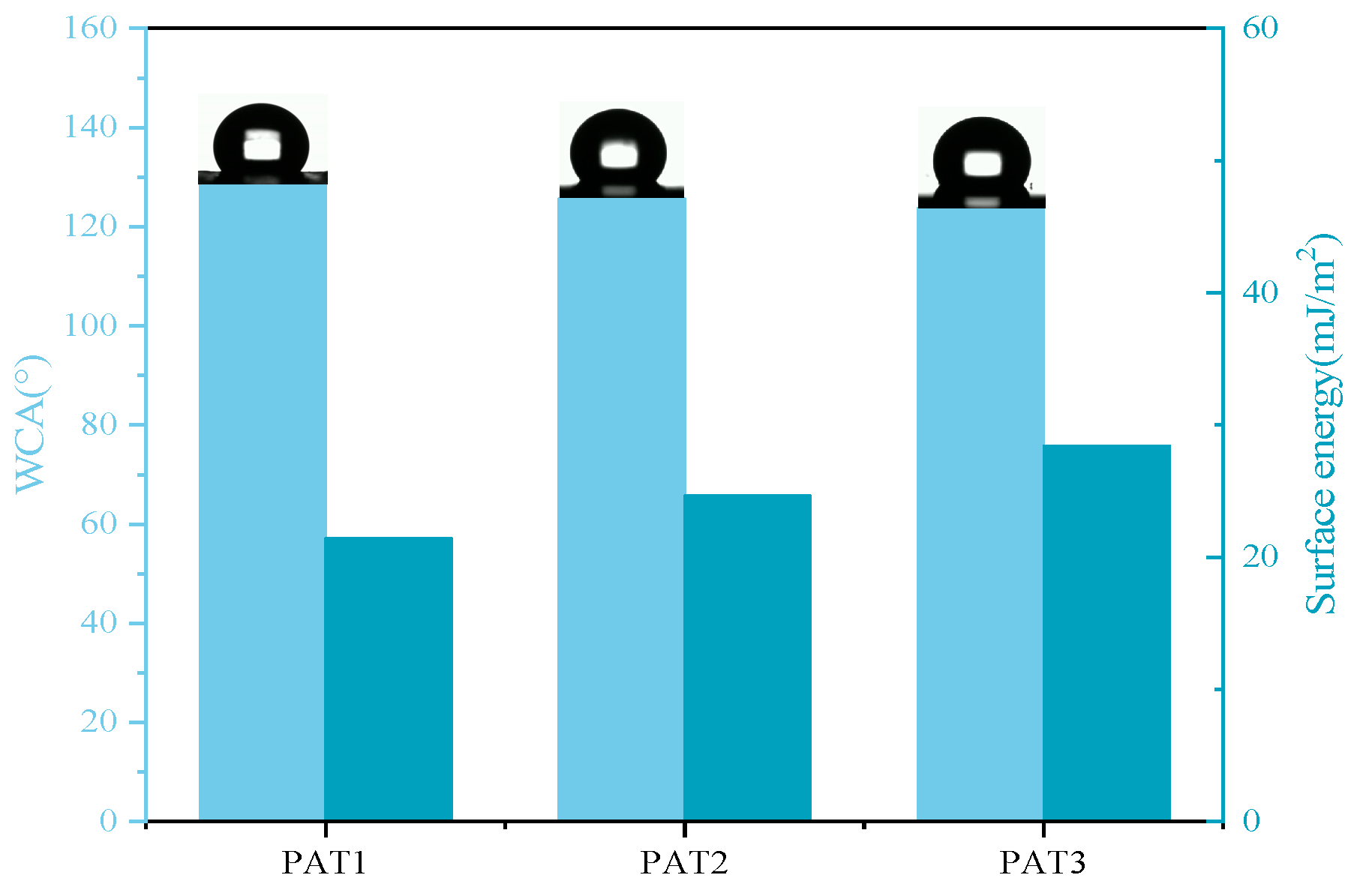
3.2. Wettability and Surface Energy
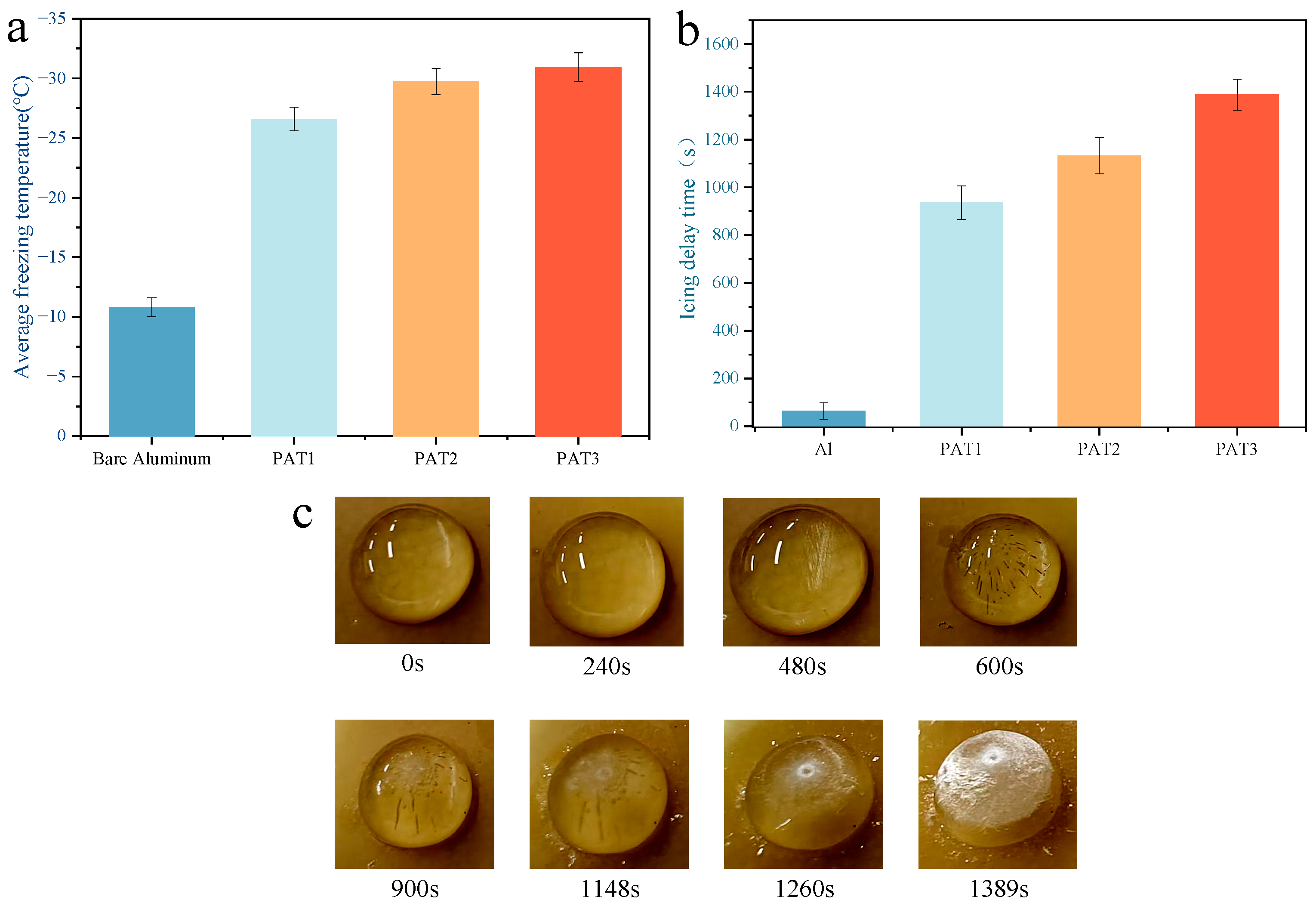
3.3. Anti-Icing Properties
3.4. Self-Healing Properties
3.5. Anti-Aging Performance
4. Conclusions
- (1)
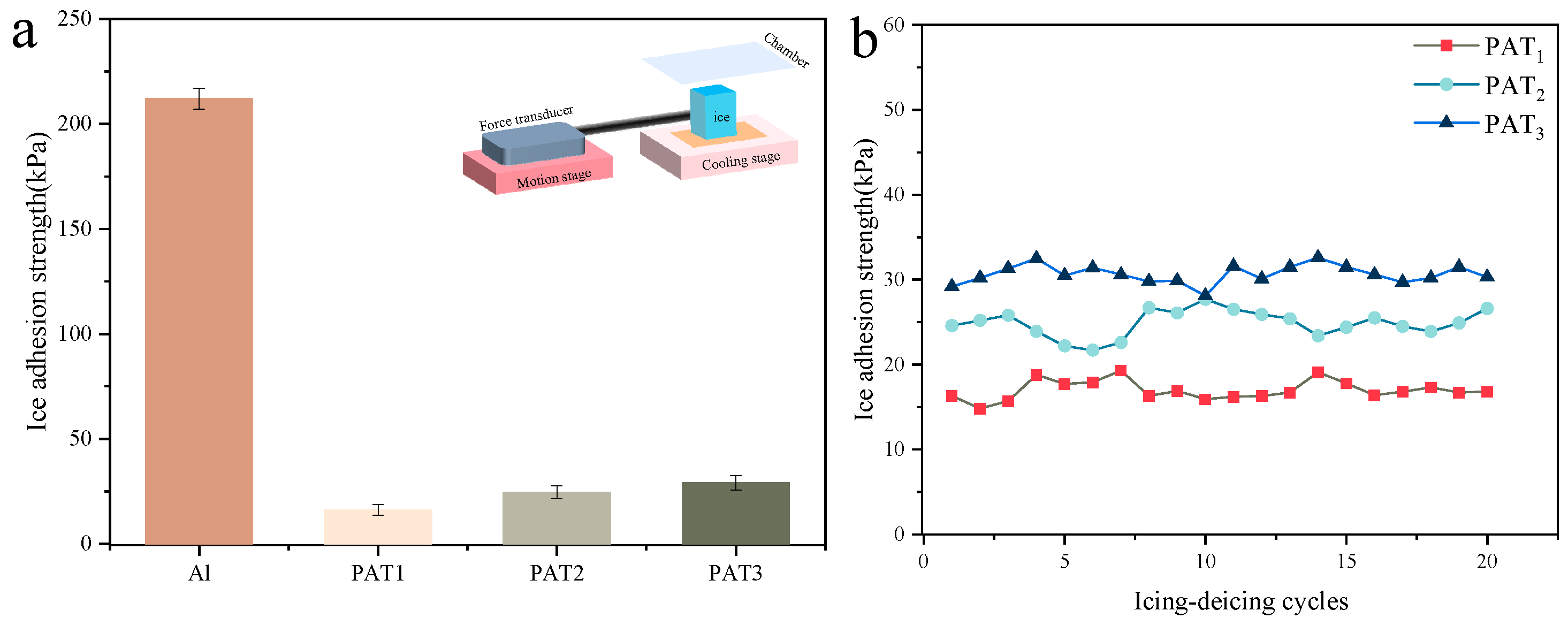
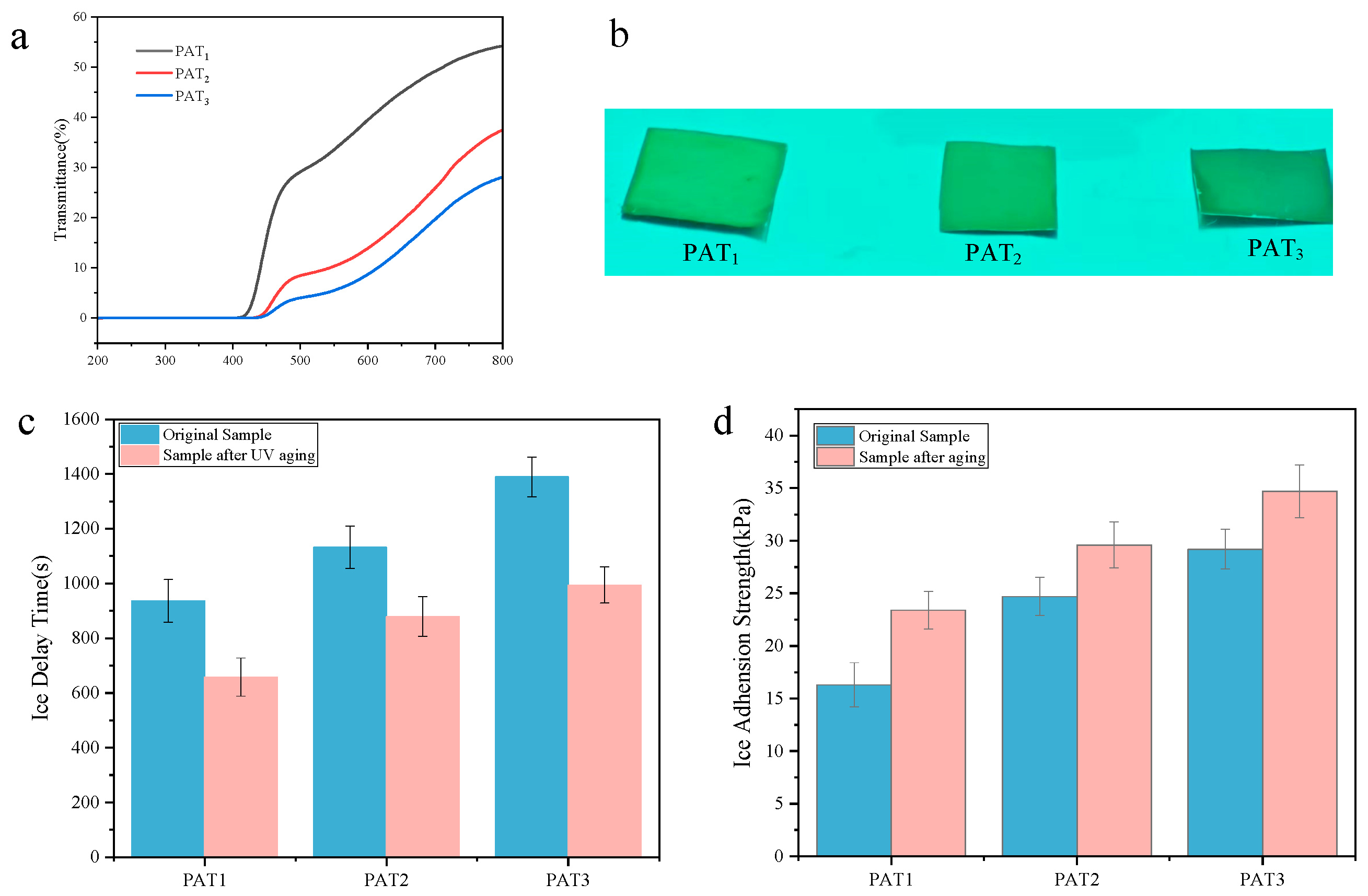
- In terms of anti-icing performance, PAT3 exhibited the lowest freezing temperature (−30.96 ℃) and the longest anti-icing delay time (1389 s). These anti-icing properties stem from hydrogen bonding interactions between hydrophilic groups and water molecules, effectively hindering ice crystal nucleation through kinetic delay and thermodynamic inhibition. However, due to hydrogen bonding interactions with water molecules, PAT3 exhibits an ice adhesion strength of 29.2 kPa, slightly higher than PAT1 and PAT2.
- (2)
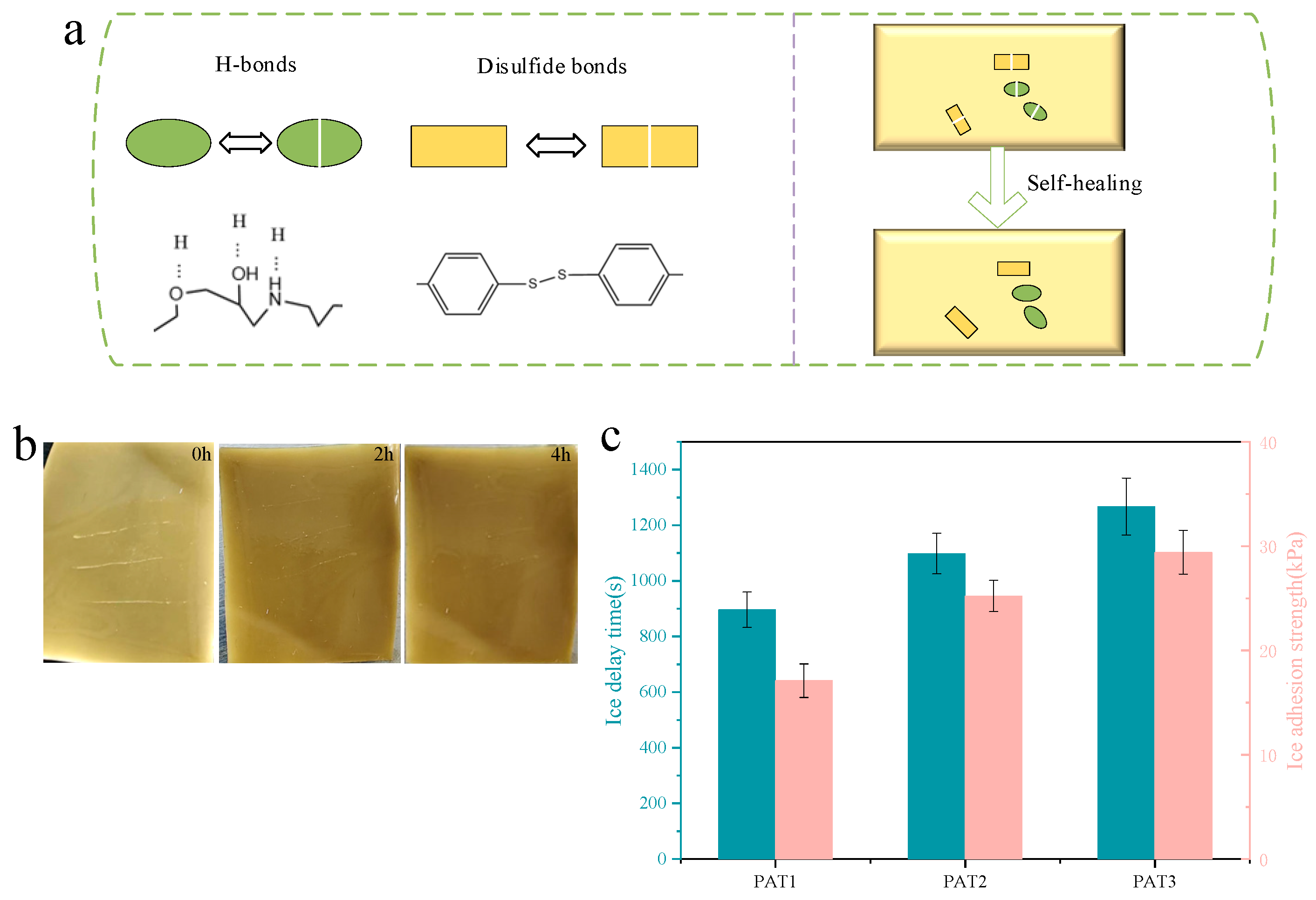
- PAT coatings offer excellent self-healing and aging resistance, with a self-healing efficiency of 99.31% at 60 °C, as well as outstanding abrasion and UV resistance. These multifunctional properties result from the supramolecular network structure formed by PDMS and APD. A synergistic combination of dynamic disulfide exchange and hydrogen bonding interactions promotes autonomous damage recovery.
- (3)
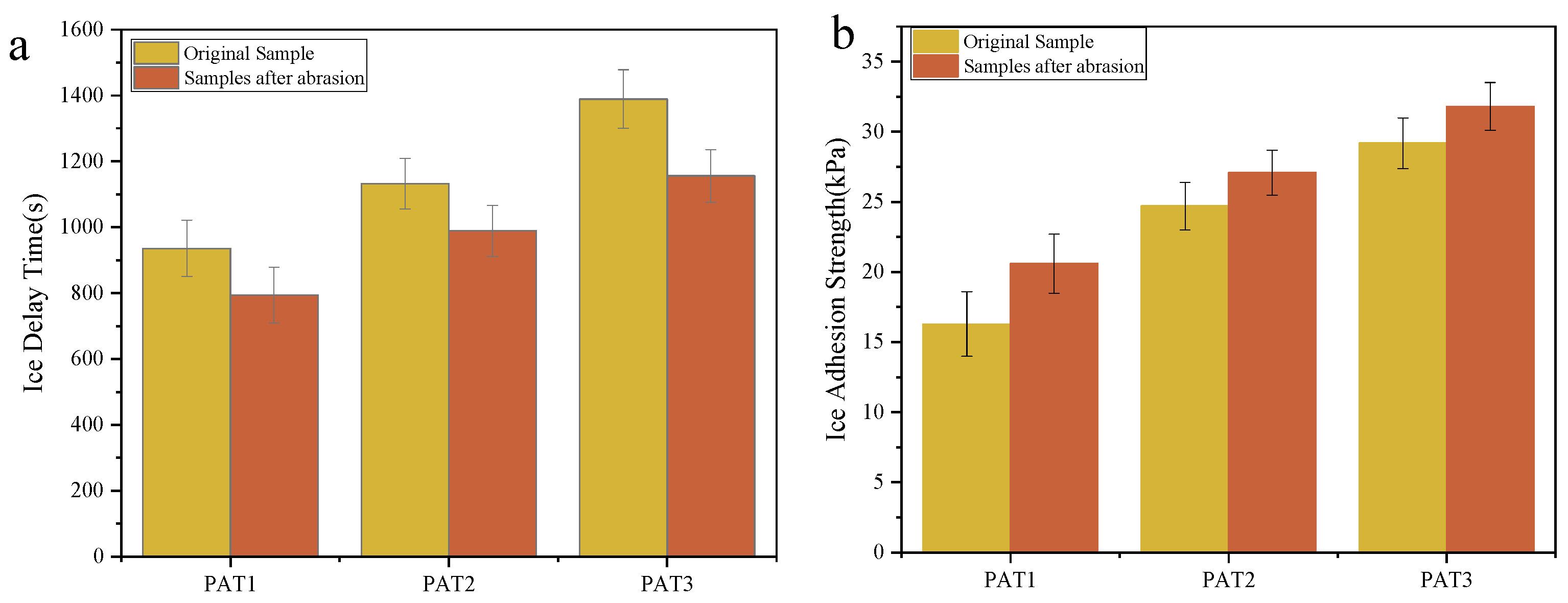
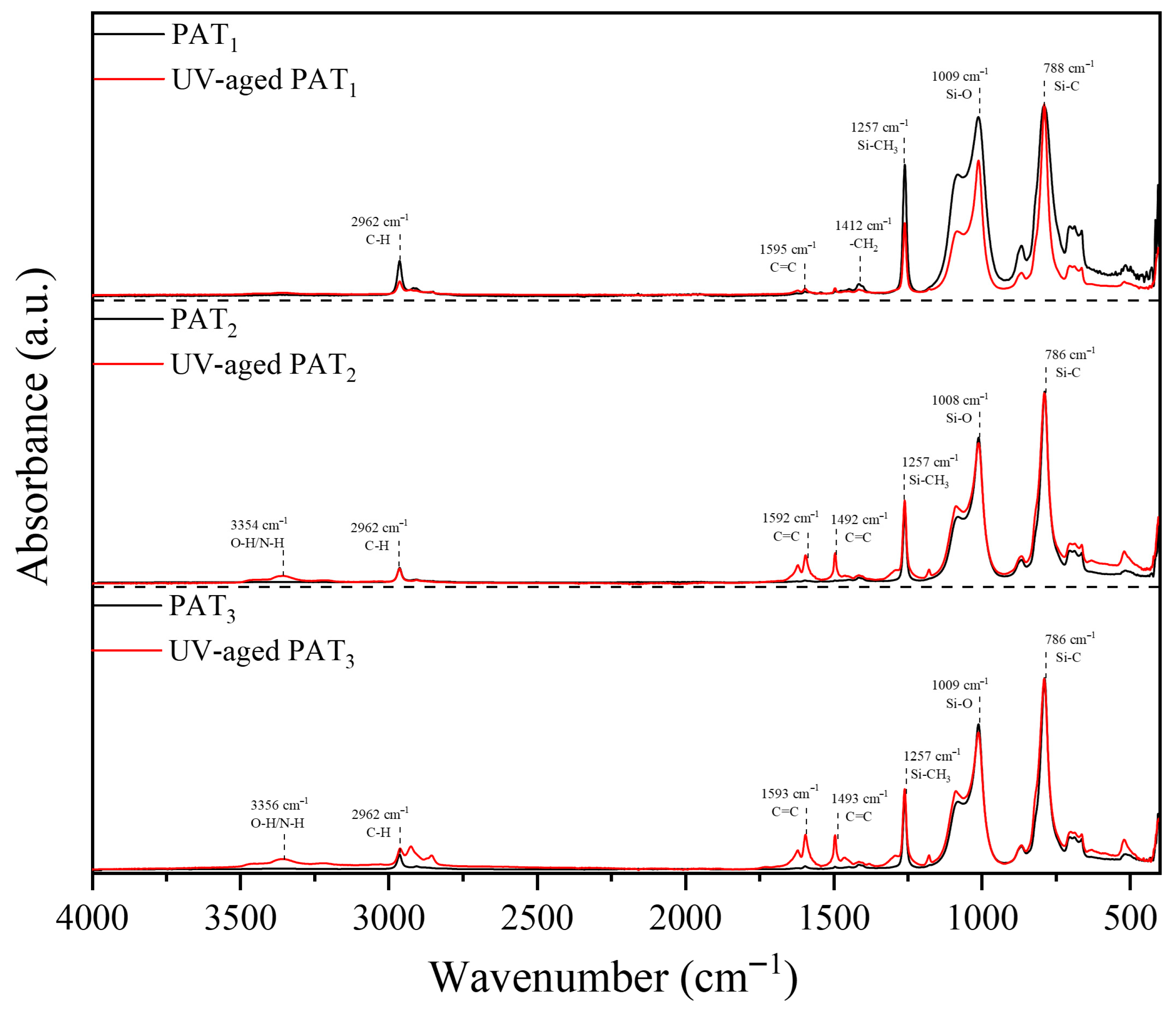
- The PAT coatings exhibited outstanding durability, with the highest retention rates reaching 91.2% for abrasive wear and 84.1% for UV aging resistance. The entanglement of long molecular chains dissipates impact forces through elastic deformation and reduces wear and tear. The π → π* electron leaps in the aromatic ring system enhance UV attenuation, and the increase in benzene ring density improves radiation absorption.
Supplementary Materials
Author Contributions
Funding
Institutional Review Board Statement
Data Availability Statement
Conflicts of Interest
References
- Kreder, M.J.; Alvarenga, J.; Kim, P.; Aizenberg, J. Design of anti-icing surfaces: Smooth, textured or slippery? Nat. Rev. Mater. 2016, 1, 15003. [Google Scholar] [CrossRef]
- Liu, Y.; Wu, Y.; Liu, S.; Zhou, F. Material strategies for ice accretion prevention and easy removal. ACS Mater. Lett. 2022, 4, 246–262. [Google Scholar] [CrossRef]
- Fakorede, O.; Feger, Z.; Ibrahim, H.; Ilinca, A.; Perron, J.; Masson, C. Ice protection systems for wind turbines in cold climate: Characteristics, comparisons and analysis. Renew. Sustain. Energy Rev. 2016, 65, 662–675. [Google Scholar] [CrossRef]
- Jiang, L.; Jiang, Z.; Lu, J.; Hu, D.; Xie, P.; Huang, X. Accumulation characteristics of precipitation static on rotating wind turbine blades and its influence on the lightning attachment characteristics. High Volt. 2024, 9, 1270–1279. [Google Scholar] [CrossRef]
- He, Q.; Xu, Y.; Zhang, F.; Jia, Y.; Du, Z.; Li, G.; Shi, B.; Li, P.; Ning, P.; Li, A. Preparation methods and research progress of super-hydrophobic anti-icing surface. Adv. Colloid Interface Sci. 2024, 323, 103069. [Google Scholar] [CrossRef]
- Wu, Y.; Dong, L.; Shu, X.; Yang, Y.; Feng, P.; Ran, Q. Recent advancements in photothermal anti-icing/deicing materials. Chem. Eng. J. 2023, 469, 143924. [Google Scholar] [CrossRef]
- Tan, Y.; Pang, C.; Hong, L. Versatile and environmentally benign polyurethane coatings enabled by the multiple facets of tannic acid. Prog. Org. Coat. 2025, 209, 109606. [Google Scholar] [CrossRef]
- Kawakami, N.; Iwata, K.; Shiotari, A.; Sugimoto, Y. Intrinsic reconstruction of ice-I surfaces. Sci. Adv. 2020, 6, eabb7986. [Google Scholar] [CrossRef]
- Mochizuki, K.; Adachi, Y.; Koga, K. Close-packed ices in nanopores. ACS Nano 2024, 18, 347–354. [Google Scholar] [CrossRef]
- Liu, K.; Wang, C.; Ma, J.; Shi, G.; Yao, X.; Fang, F.; Song, Y.; Wang, J. Janus effect of antifreeze proteins on ice nucleation. Proc. Natl. Acad. Sci. USA 2016, 113, 14739–14744. [Google Scholar] [CrossRef]
- Zhuo, Y.; Hakonsen, V.; He, Z.; Xiao, S.; He, J.; Zhang, Z. Enhancing the mechanical durability of icephobic surfaces by introducing autonomous self-healing function. ACS Appl. Mater. Interfaces 2018, 10, 11972–11978. [Google Scholar] [CrossRef] [PubMed]
- Boinovich, L.B.; Emelyanenko, A.M. Recent progress in understanding the anti-icing behavior of materials. Adv. Colloid Interface Sci. 2024, 323, 103057. [Google Scholar] [CrossRef] [PubMed]
- Xuan, S.; Yin, H.; Li, G.; Zhang, Z.; Jiao, Y.; Liao, Z.; Li, J.; Liu, S.; Wang, Y.; Tang, C. Trifolium repens L.-like periodic micronano structured superhydrophobic surface with ultralow ice adhesion for efficient anti-icing/deicing. ACS Nano 2023, 17, 21749–21760. [Google Scholar] [CrossRef]
- Cheng, Y.; Wang, Y.; Zhang, X.; Zhang, J.; He, Z.; Wang, J.; Zhang, J. Spontaneous, and scalable, and self-similar superhydrophobic coatings for all-weather deicing. Nano Res. 2023, 16, 7171–7179. [Google Scholar] [CrossRef]
- Shen, Y.; Wu, X.; Tao, J.; Zhu, C.; Lai, Y.; Chen, Z. Ice phobic materials: Fundamentals, performance evaluation and applications. Prog. Mater. Sci. 2019, 103, 509–557. [Google Scholar] [CrossRef]
- Kong, W.; Yang, K.; Chen, Y.; Shao, W.; Jia, C.; Zhu, J.; He, J. Study on preparation and performance of anti-icing Superhydrophobic coating applied to composite insulators. Prog. Org. Coat. 2025, 198, 108934. [Google Scholar] [CrossRef]
- Zhao, X.; Peng, J.; Gao, S.; Zhu, K.; Zhao, Y.; Li, X.; Yuan, X. Self-healing anti-icing coatings prepared from PDMS polyurea. Sci. China Technol. Sci. 2021, 64, 1535–1543. [Google Scholar] [CrossRef]
- Wang, L.; Guo, Z.; Guo, D.; Li, J.; Janaswamy, S.; Yang, G.; Ji, X.; Lyu, G. Constructing industrial lignin into robust and multifunctional superhydrophobic coating for effective anti-icing. Int. J. Biol. Macromol. 2025, 289, 138891. [Google Scholar] [CrossRef]
- Liu, Z.; Xu, Q.; Xu, N.; Deng, W.; Chu, H. Preparation of photothermal superhydrophobic iron foam coating and its application in passive anti-icing/active de-icing and anti-corrosion. Int. J. Therm. Sci. 2025, 211, 109745. [Google Scholar] [CrossRef]
- Huang, Y.; Huang, J.; Xiao, G.; Liu, S.; Lin, O.; Liu, Z. Research Progresses of Superhydrophobic Surface Processing Technology and Abrasion Resistance. Chin. Mech. Eng. 2024, 35, 2–26. [Google Scholar] [CrossRef]
- Xun, M.; Li, Z. Research Progress on Superhydrophobic Surface Preparation Methods and Mechanical Durability. Recent Pat. Eng. 2025, 19, E150124225661. [Google Scholar] [CrossRef]
- Zhang, H.; Wang, F.; Guo, Z.; Wang, F.; Guo, Z. Ultraslippery surface for efficient fog harvesting and anti-icing/fouling. Small 2024, 20, 2405875. [Google Scholar] [CrossRef]
- Zhu, X.; Yao, Y.; Li, J.; Mu, L.; Liu, Q.; Sun, C.; Zhang, N.; He, J.; Qu, M. A mechanically durable slippery liquid-infused porous surface based on distinctive ‘jaboticaba-like’ TiO2/sepiolite nanocomposites with superior hot water repellency and anti-corrosion for protecting various substrates. Chem. Eng. J. 2024, 481, 148667. [Google Scholar] [CrossRef]
- Tian, S.; Li, R.; Liu, X.; Wang, J.; Yu, J.; Xu, S.; Tian, Y.; Yang, J.; Zhang, L. Inhibition of defect-Induced ice nucleation, propagation, and adhesion by bioinspired self-healing anti-Icing coatings. Research 2023, 6, 0140. [Google Scholar] [CrossRef]
- Rong, J.; Zhong, J.; Yan, W.; Liu, M.; Zhang, Y.; Qiao, Y.; Fu, C.; Gao, F.; Shen, L.; He, H. Study on waterborne self-healing polyurethane with dual dynamic units of quadruple hydrogen bonding and disulfide bonds. Polymer 2021, 221, 123625. [Google Scholar] [CrossRef]
- Wang, W.; Li, Y.; Ma, Z.; Chen, Q.; Zhang, W.; Yang, T.; Xie, Y.; Sun, J. Ultra-tough poly(urea-urethane) plastics with superior impact resistance for cryogenic applications. Adv. Mater. 2025, 37, 2509421. [Google Scholar] [CrossRef] [PubMed]
- Li, Z.; Lu, J.; Xue, Y.; Zhao, L.; Zhao, K.; Jia, B.; Wang, B.; Wang, J.; Zhang, S.; Jiang, Z. Self-healing hydrogel bioelectronics. Adv. Mater. 2023, 36, 2306350. [Google Scholar] [CrossRef] [PubMed]
- Liu, X.; Li, Y.; Fang, X.; Zhang, Z.; Li, S.; Sun, J. Healable and recyclable polymeric materials with high mechanical robustness. ACS Mater. Lett. 2022, 4, 554–571. [Google Scholar] [CrossRef]
- Utrera-Barrios, S.; Verdejo, R.; López-Manchado, M.A.; Santana, M.H. Evolution of self-healing elastomers, from extrinsic to combined intrinsic mechanisms: A review. Mater. Horiz. 2020, 7, 2882–2902. [Google Scholar] [CrossRef]
- Wang, X.; Xie, D.; Zhao, X.; Li, Y.; Zeng, J. Sustainable, malleable, and recyclable castor oil-derived poly(urethane urea) networks with tunable mechanical properties and shape memory performance based on dynamic piperazine-urea bonds. Macromolecules 2022, 55, 2243–2251. [Google Scholar] [CrossRef]
- Pei, F.; Wu, L.; Zhang, Y.; Liao, Y.; Kang, Q.; Han, Y.; Zhang, H.; Shen, Y.; Xu, H.; Li, Z.; et al. Interfacial self-healing polymer electrolytes for long-cycle solid-state lithium-sulfur batteries. Nat. Commun. 2024, 15, 351. [Google Scholar] [CrossRef]
- Zhang, Z. Preparation and Characterization of Anisotropic Self-Healing Polymer Materials; Qingdao University of Science and Technology: Qingdao, China, 2022. [Google Scholar]
- Bhunia, S.; Chandel, S.; Karan, S.K.; Dey, S.; Tiwari, A.; Das, S.; Kumar, N.; Chowdhury, R.; Mondal, S.; Ghosh, I.; et al. Autonomous self-repair in piezoelectric molecular crystals. Science 2021, 373, 321–327. [Google Scholar] [CrossRef]
- Dhanumalayan, E.; Joshi, G.M. Performance properties and applications of polytetrafluoroethylene (PTFE)—A review. Adv. Compos. Hybrid Mater. 2018, 1, 247–268. [Google Scholar] [CrossRef]
- Wong, I.; Ho, C. Surface molecular property modifications for poly (dimethylsiloxane)(PDMS) based microfluidic devices. Microfluid. Nanofluid. 2009, 7, 291–306. [Google Scholar] [CrossRef] [PubMed]
- Chen, J.; Luo, Z.; An, R.; Marklund, P.; Björling, M.; Shi, Y. Novel intrinsic self-healing poly-silicone-urea with super-low ice adhesion strength. Small 2022, 18, 2200532. [Google Scholar] [CrossRef] [PubMed]
- Liu, Z.; Zhang, Y.; Li, Y. Superhydrophobic coating for blade surface ice-phobic properties of wind turbines: A review. Prog. Org. Coat. 2024, 187, 108145. [Google Scholar] [CrossRef]
- Wang, L.; Liu, M.; Yadav, A.; Wu, Y.; Zheng, H. A method for preparing and investigating anti-/de-icing surface by integration of laser-induced graphene (LIG) with a silica sol adhesive (SMP@ M-SiO2). Surf. Coat. Technol. 2023, 474, 130111. [Google Scholar] [CrossRef]
- Hou, L.; Ju, H.; Hao, X.; Zhang, H.; Zhang, L.; He, Z.; Wang, J.; Zheng, Q.; Wu, Z. Intrinsic anti-freezing and unique phosphorescence of glassy hydrogels with ultrahigh stiffness and toughness at low temperatures. Adv. Mater. 2023, 35, 2300244. [Google Scholar] [CrossRef] [PubMed]
- Zhang, R.; Ding, Z.; Wang, K.; Zhang, H.; Li, J. Enhanced anti/de-icing performance on rough surfaces based on the synergistic effect of fluorinated resin and embedded graphene. Small Methods 2024, 8, 2301262. [Google Scholar] [CrossRef]
- Li, J.; Jiao, W.; Jin, H.; Lu, Q.; Sun, H.; Yin, Y.; He, X. Robust polyurea icephobic coatings with static large-scale de-icing and dynamic anti-icing performance. Chem. Eng. J. 2023, 478, 147339. [Google Scholar] [CrossRef]
- Smith, J.G.; Wohl, C.J.; Kreeger, R.E.; Palacios, J.; Knuth, T. Surface chemical functionality effect upon ice adhesion shear strength. In Proceedings of the 8th AIAA Atmospheric and Space Environments Conference, Washington, DC, USA, 13–17 June 2016; Volume 3444. [Google Scholar] [CrossRef]
- Cao, Z.; Cao, P. Research progress on low-surface-energy antifouling coatings for ship hulls: A review. Biomimetics 2023, 8, 502. [Google Scholar] [CrossRef]
- Allahdini, A.; Jafari, R.; Momen, G. Transparent non-fluorinated superhydrophobic coating with enhanced anti-icing performance. Prog. Org. Coat. 2022, 165, 106758. [Google Scholar] [CrossRef]
- Jiang, J.; Shen, Y.; Xu, Y.; Wang, Z.; Tao, J.; Liu, S.; Liu, W.; Chen, H. An energy-free strategy to elevate anti-icing performance of superhydrophobic materials through interfacial airflow manipulation. Nat. Commun. 2024, 15, 777. [Google Scholar] [CrossRef] [PubMed]
- Karachevtsev, V.A.; Plokhotnichenko, A.M.; Karachevtsev, M.V.; Leontiev, V.S. Decrease of carbon nanotube UV light absorption induced by π–π-stacking interaction with nucleotide bases. Carbon 2010, 48, 3682–3691. [Google Scholar] [CrossRef]
- Xu, J.; Shi, Z.; Xing, Y.; Niu, W.; Yang, Y.; Xu, X.; Zhang, F. Rapid UV-curable constructing rosin-based superhydrophobic composite coatings with self-healing properties for anticorrosion and anti-icing. Prog. Org. Coat. 2025, 205, 109314. [Google Scholar] [CrossRef]
- Fraind, A.M.; Tovar, J.D. Comparative survey of conducting polymers containing benzene, naphthalene, and anthracene cores: Interplay of localized aromaticity and polymer electronic structures. J. Phys. Chem. B 2010, 114, 3104–3116. [Google Scholar] [CrossRef]



| Anti-Ice Coating | Surface Freezing Temperature | Delayed Icing Time | Ice Adhesion Strength |
|---|---|---|---|
| Laser-induced graphene silica sol coating [39] | −10 °C | 840 s | 30 kPa |
| Manipulating airflow superhydrophobic surfaces [36] | −20 °C | 1381 s | 50 kPa |
| Fluorinated resin/graphene composite coating [40] | −15.5 °C | 958 s | 30 kPa |
| This research | −30.96 °C | 1389 s | <30 kPa |
| Sample | Pristine IDT(s) | Post-Healing IDT(s) | Repair Efficiency | Pristine τice (kPa) | Post-Healing τice (kPa) | Repair Efficiency |
|---|---|---|---|---|---|---|
| PAT1 | 936 | 896 | 95.73% | 16.3 | 17.1 | 95.32% |
| PAT2 | 1132 | 1098 | 96.99% | 24.7 | 25.2 | 98.01% |
| PAT3 | 1389 | 1267 | 91.21% | 29.2 | 29.4 | 99.31% |
| Sample | Original Sample | Samples After Abrasion | Sample After UV Aging | |||||||
|---|---|---|---|---|---|---|---|---|---|---|
| IDT(s) | τice (kPa) | IDT(s) | Retention Rates | τice (kPa) | Retention Rates | IDT(s) | Retention Rates | τice (kPa) | Retention Rates | |
| PAT1 | 936 | 16.3 | 794 | 84.8% | 20.6 | 79.1% | 658 | 70.2% | 23.4 | 69.7% |
| PAT2 | 1132 | 24.7 | 989 | 87.4% | 27.1 | 91.1% | 879 | 77.6% | 29.6 | 83.4% |
| PAT3 | 1389 | 29.2 | 1156 | 83.2% | 31.8 | 91.2% | 994 | 71.6% | 34.7 | 84.1% |
Disclaimer/Publisher’s Note: The statements, opinions and data contained in all publications are solely those of the individual author(s) and contributor(s) and not of MDPI and/or the editor(s). MDPI and/or the editor(s) disclaim responsibility for any injury to people or property resulting from any ideas, methods, instructions or products referred to in the content. |
© 2025 by the authors. Licensee MDPI, Basel, Switzerland. This article is an open access article distributed under the terms and conditions of the Creative Commons Attribution (CC BY) license.
Share and Cite
Yan, S.; Tang, Z.; Pan, B.; Chen, X.; Zhang, B.; Lu, J. Synergistic Aging Resistance and Autonomous Self-Healing in Trimethylolpropane Triglycidyl Ether-Based Anti-Icing Coatings. Coatings 2026, 16, 13. https://doi.org/10.3390/coatings16010013
Yan S, Tang Z, Pan B, Chen X, Zhang B, Lu J. Synergistic Aging Resistance and Autonomous Self-Healing in Trimethylolpropane Triglycidyl Ether-Based Anti-Icing Coatings. Coatings. 2026; 16(1):13. https://doi.org/10.3390/coatings16010013
Chicago/Turabian StyleYan, Siyu, Zhuang Tang, Bichen Pan, Xin Chen, Bohang Zhang, and Jiazheng Lu. 2026. "Synergistic Aging Resistance and Autonomous Self-Healing in Trimethylolpropane Triglycidyl Ether-Based Anti-Icing Coatings" Coatings 16, no. 1: 13. https://doi.org/10.3390/coatings16010013
APA StyleYan, S., Tang, Z., Pan, B., Chen, X., Zhang, B., & Lu, J. (2026). Synergistic Aging Resistance and Autonomous Self-Healing in Trimethylolpropane Triglycidyl Ether-Based Anti-Icing Coatings. Coatings, 16(1), 13. https://doi.org/10.3390/coatings16010013