1. Introduction
Droplet solidification is a very common phenomenon in both natural and industrial settings and plays an important role in processes such as thermal spray [
1], inkjet printing [
2], welding [
3], and additive manufacturing [
4]. In thermal spray, molten droplets spread and rapidly freeze upon impact with a cold substrate, forming splats that determine coating microstructure and performance. The same physics also underlies icing phenomena on aircraft components, where supercooled droplets can pose safety risks [
5].
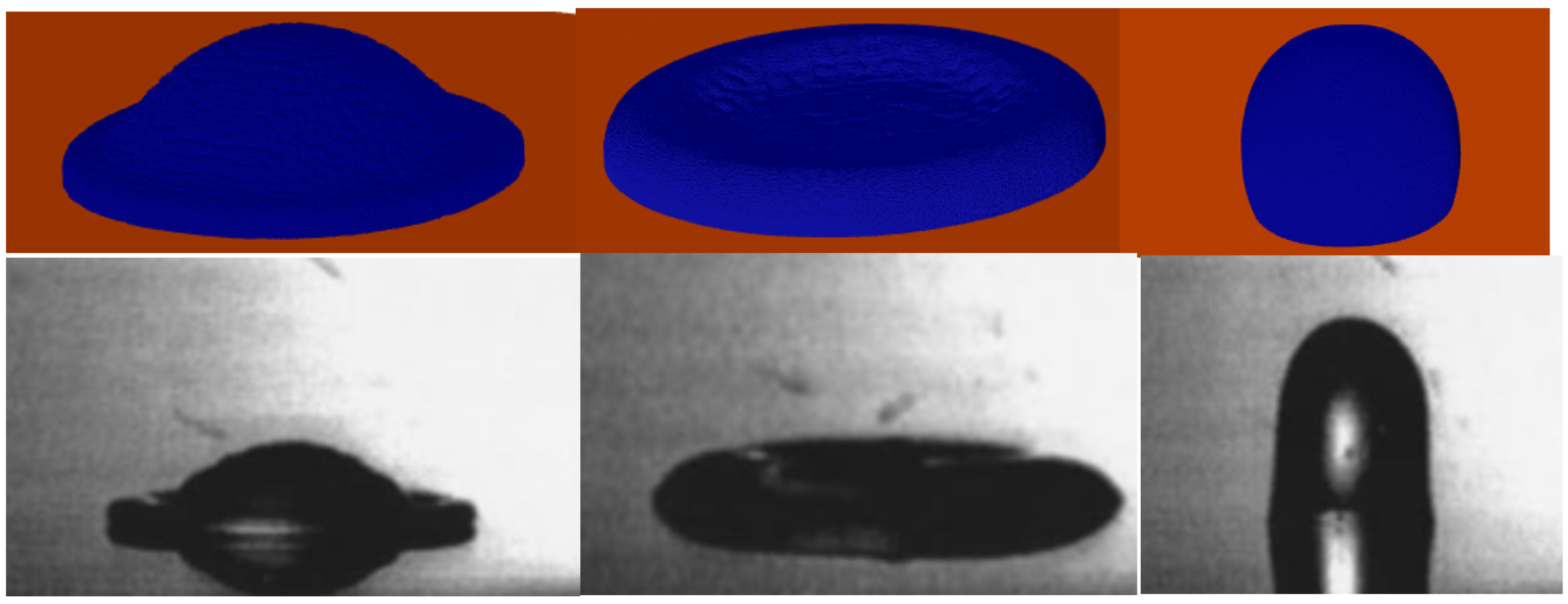
Accurate prediction of splat formation requires resolving large free-surface deformations together with moving solidification fronts. Experiments typically rely on high-speed imaging and particle image velocimetry to capture surface morphologies and internal flow during freezing [
6,
7]. While experiments provide insights into the physical process, they are often challenging to conduct and observe, with results limited to a narrow parameter space.
Numerical simulation offers a complementary approach to studying droplet impact and solidification, enabling detailed analysis of fluid dynamics and thermal evolution under controlled conditions. Mesh-based interface-capturing approaches such as the volume-of-fluid (VOF) and level-set (LS) methods have been widely used to study freezing and rebound behaviors, often coupled with enthalpy-porosity or nucleation models to capture phase change.
Moussa Tembely et al. [
8] developed a coupled VOF method and nucleation theory to simulate the impact and freezing of a supercooled droplet on a superhydrophobic surface, revealing how the solidification time evolves with the maximum spreading diameter of the droplet. Zhang Xuan et al. [
9] used the VOF method to simulate the freezing process of droplets on an ultra-cold surface and discovered the scaling law between the maximum spreading factor of droplets and the effective Reynolds number. Li Wen et al. [
10] combined the level-set method with an enthalpy–porosity model to investigate the rebound dynamics of supercooled water droplets on a cold superhydrophobic surface and discovered four different modes.
The lattice Boltzmann method (LBM), a mesoscopic approach based on kinetic theory, has been applied to multiphase flows with complex boundaries. Zhiyuan Ma et al. [
11,
12] used LBM to study droplet solidification on cold substrates, highlighting how surface roughness affects solidification morphology and dynamics. Yiqing Guo et al. [
13] developed an LBM model that accounts for the solid–liquid density ratio influence on solidification behavior.
VOF schemes can exhibit numerical interface diffusion when handling complex, topology-changing interfaces, necessitating careful interface reconstruction to limit errors. Level-set methods handle topological changes more naturally but can suffer from mass non-conservation. The lattice Boltzmann method (LBM) offers advantages for complex boundaries at mesoscopic scales, though it is typically more computationally demanding.
Smoothed Particle Hydrodynamics (SPH) is a mesh-free, Lagrangian particle method originally developed for astrophysics [
14,
15] and subsequently adapted for fluid dynamics. Its Lagrangian nature makes SPH well suited to flows with large deformations and evolving free surfaces, so it has been widely applied to multiphase problems such as droplet impact and solidification.
Cui et al. [
16] used SPH to study the solidification dynamics of supercooled large droplets on cold substrates. Lee et al. [
17] simulated YSZ droplet impact in thermal spraying, highlighting the roles of impact velocity and substrate temperature on splat morphology. Subedi et al. [
18] employed SPH with solidification and heat transfer models to show how a modified Biot number and thermal diffusivity affect freezing behavior. Bobzin et al. [
19] demonstrated how substrate preheating and roughness alter splat shape and solidification in thermal-spray contexts.
However, most prior studies focus on single-droplet impact and freezing; interactions among multiple droplets—common in practical thermal spraying—remain relatively underexplored.
Here, an SPH model is developed to simulate droplet impact and solidification on cold substrates. The model is validated against benchmark problems, such as Young–Laplace, wetting dynamics, single-droplet impact and the Stefan problem. Then applied to study the solidification dynamics of multiple impacting droplets.
The remainder of the paper is organized as follows:
Section 2 describes the numerical model, including SPH formulations, the fluid-solid interaction and wetting models, and the heat transfer and solidification treatments.
Section 3 presents model validation against benchmark cases.
Section 4 applies the model to simulate multiple-droplet impacts and analyzes the effects of droplet interactions.
Section 5 concludes with the main findings and outlines directions for future work.
2. Numerical Simulation Model
This section presents the governing SPH equations, solidification model, solid boundary treatment, surface tension model, time integration and implementation on GPU.
2.1. SPH Equations
The SPH method is a mesh-free Lagrangian particle method.
SPH approximates field quantities using a smoothing (kernel) function that replaces the Dirac
function. By the reproducing property of the kernel, any scalar field
may be written in integral form as
where
and
h correspond to the position vector and the smoothing length,
is the domain where the function
is nonzero, and
is the variable of integration.
Replacing the integral by a summation over particles (the particle approximation) yields
where
denotes the value of
A at particle
i,
and
denote the mass and density for the neighbor particle
j around the particle
i, respectively, and
.
Let
A represent the particle density; then,
This can be used as the continuity equation [
20].
In this paper, the smoothing length for particle
i is calculated as follows:
where
is the spatial dimension of the simulation, and
is the smoothing length coefficient.
The hyperbolic kernel function is chosen, which could make the particles distribute more uniformly, and avoid the particle tensile instability [
21].
where
, and
is the normalization factor, equal to
in 2D and
in 3D.
The momentum equation is written as
where
is the material derivative as
, with local derivative and convection terms. The symbols
,
,
, and
denote velocity, gravity, surface tension, and shear viscosity for particle
i, respectively. The pressure
is given by a weakly compressible equation of state as
where
is the reference density, which is set to the initial density, and
c is the numerical speed of sound, which is much larger than the typical fluid velocity to be simulated, for example, ten times it. Note that the numerical speed of sound is not necessarily equal to the physical speed of sound.
The gradient of pressure is discretized using a symmetric scheme for particle
i,
The viscous stress is discretized as
The energy equation, which considers the effects of thermal capacity, heat convection enduced by particle movement and heat conduction, is given by
where
is the temperature,
is the thermal conductivity, and
is the internal energy per unit mass of particle
i.
where
is the specific heat capacity at constant volume. As in ref. [
22], differences between solid and fluid particles in heat transfer modeling are neglected.
Thus, Equation (
10) is discretized as
2.2. Solidification Model
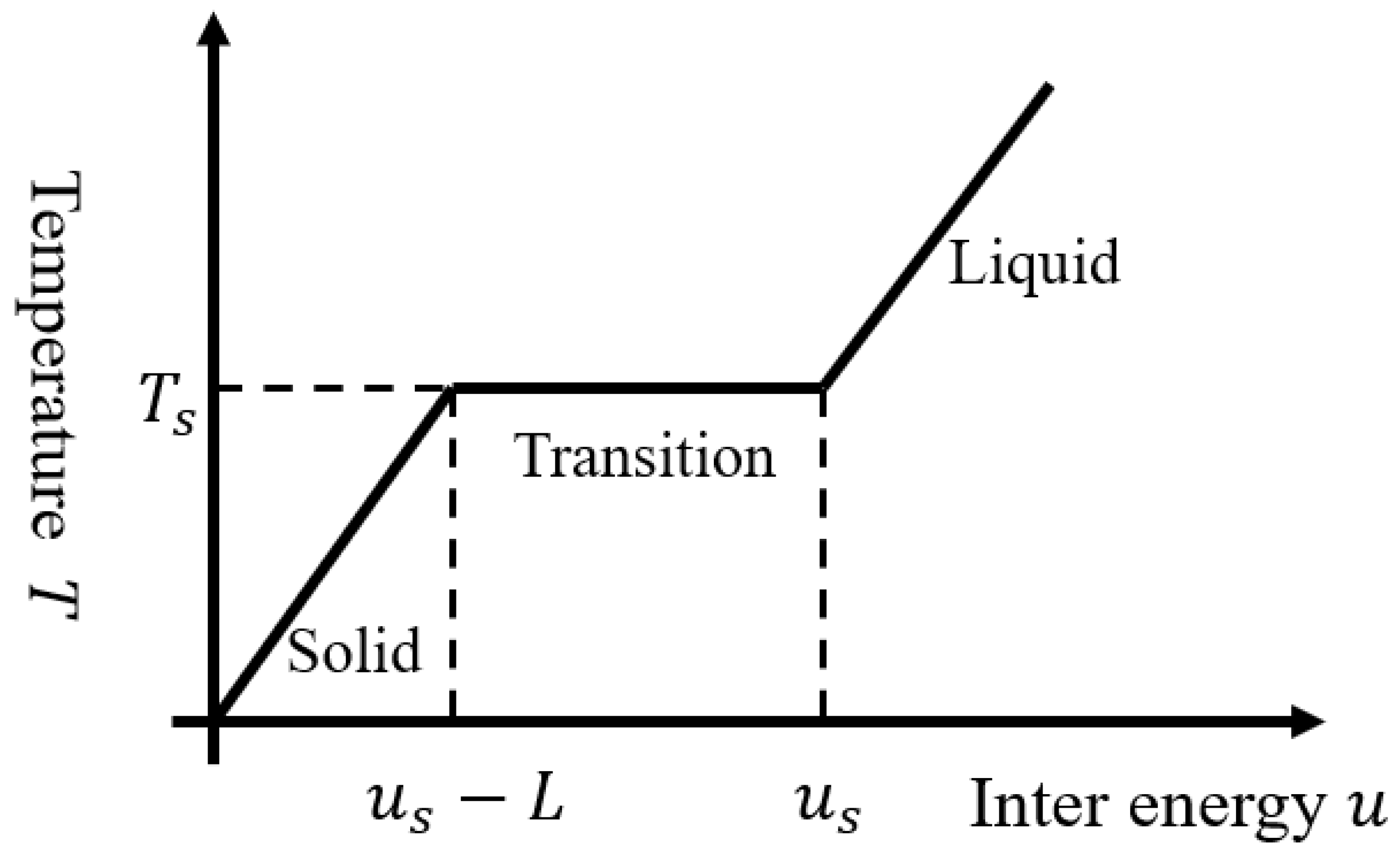
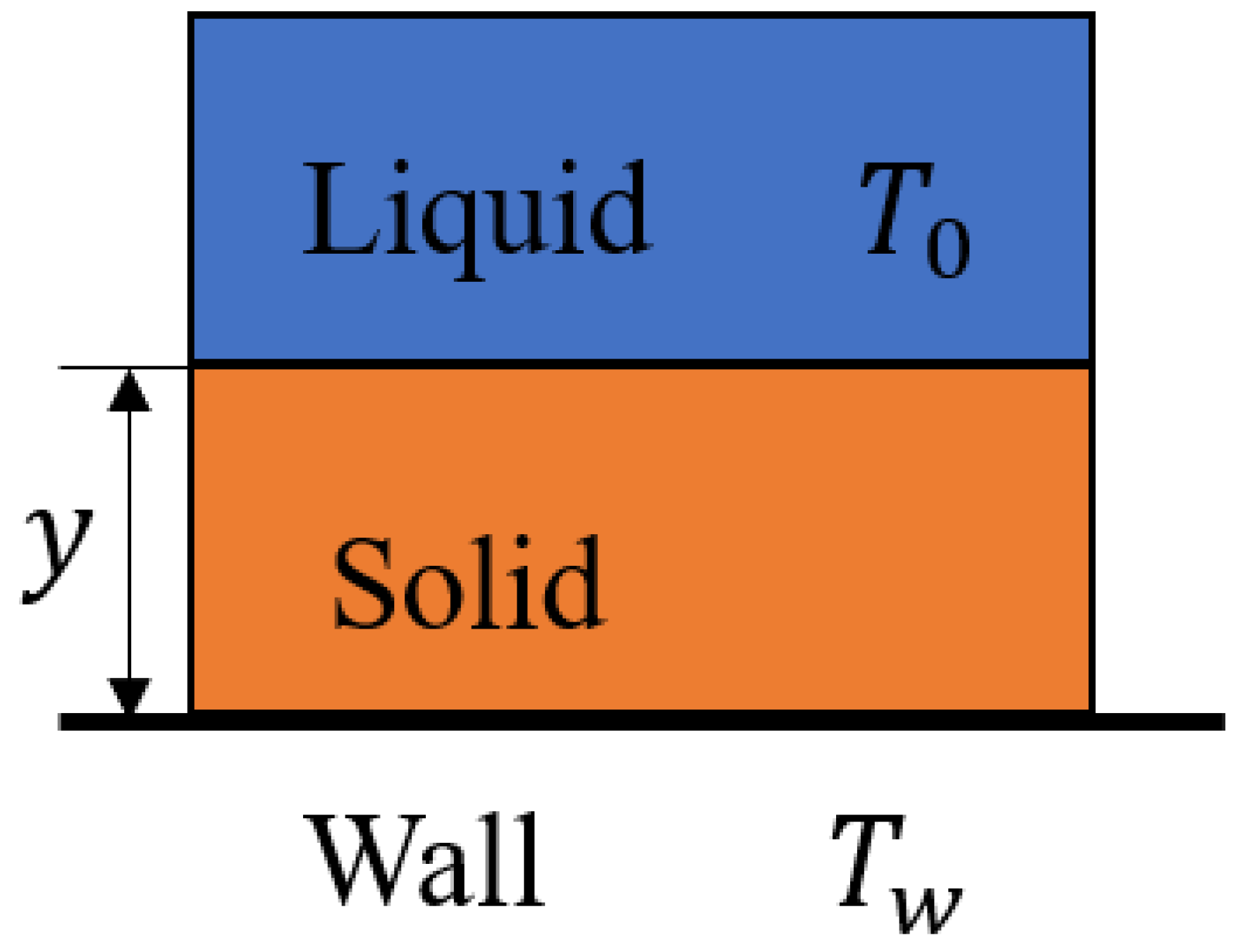
Figure 1 shows the relationship between the particle temperature and its internal energy during the solidification process, where the temperature remains constant but the internal energy continues decreasing. Neglecting the difference between the solid and liquid properties as well as the interfacial resistance, particles are fully solidified when they gradually lose all the latent heat of fusion
L given by the system. Note that such an assumption does not consider the voids caused by changes in liquid and solid density. Also, it might overestimate the process of solidification, as there may exist a certain degree of supercooling at the liquid–solid solidification interface.
Although this method is simple, it is effective. Xiangda Cui also applied it to simulate the freezing process of supercooled large droplets [
16]. Zhang enwei et al. used the same method to simulate droplet solidification on cold plates [
23].
2.3. Solid Boundary
Ghost particles are placed outside the boundary. Their temperature is fixed to the user-specified value, while pressure and velocity are extrapolated from nearby fluid particles. For a ghost particle
i, its velocity is updated from surrounding fluid particles as
and the pressure is determined by
2.4. Surface Tension Model
In the van der Waals equation of state, the negative pressure term
corresponds to attractive intermolecular forces that contribute to surface tension [
24,
25]. Inspired by this, the negative pressure term
i is introduced to model the surface tension term in Equation (
6) in the simulation.
where
a is an attraction coefficient.
Similarly to the discretization of pressure, the SPH form of the surface tension is
where the superscript
H indicates that the smoothing radius of this kernel function is twice that of the others, which makes the computation more stable [
25].
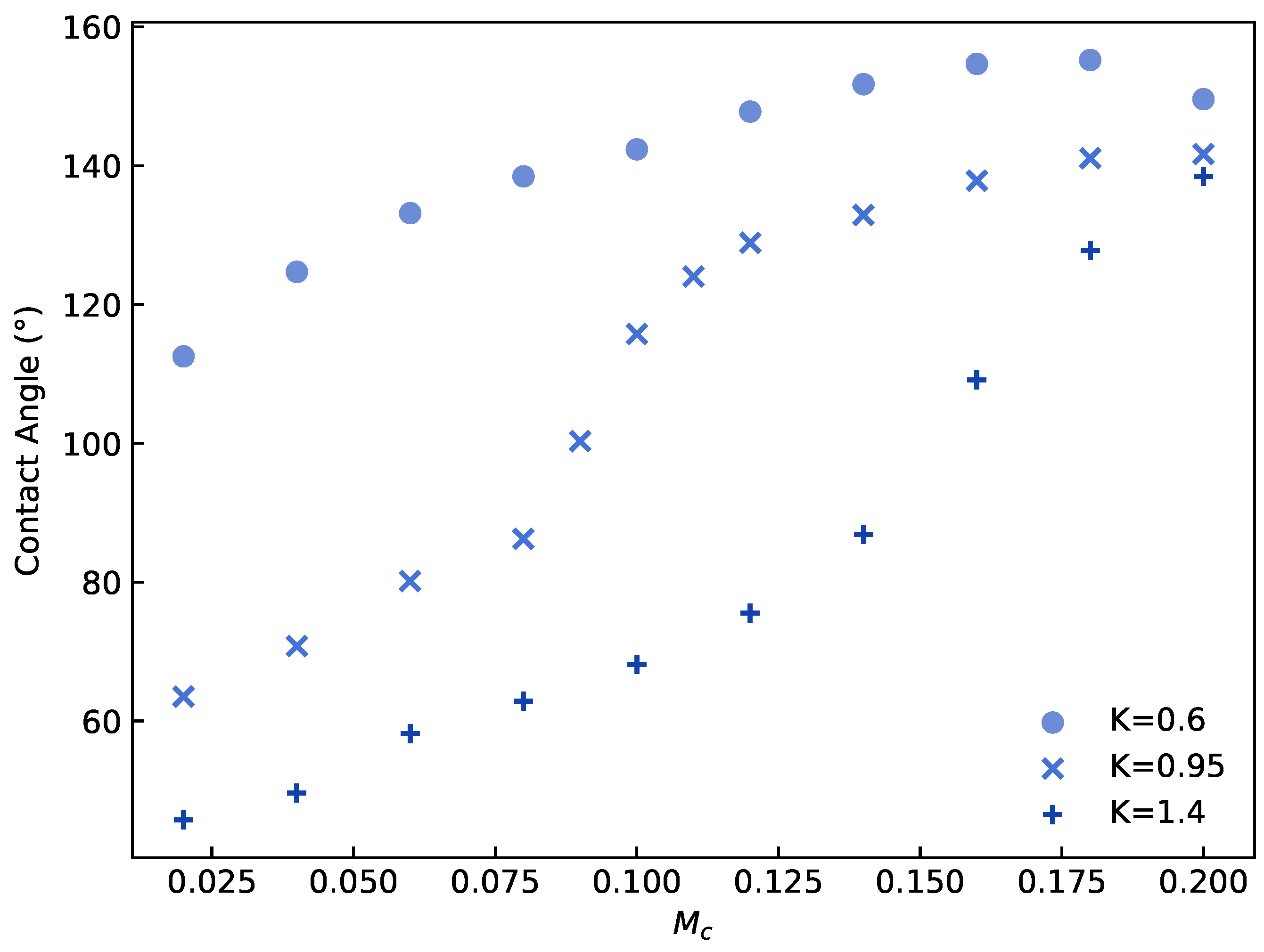
To simulate the contact angle, a color function is used [
24]. It is initialized as
Then, only the color of the ghost particles will be updated, as follows:
where
K is a coefficient corresponding to the attraction between solid and fluid, and
is the critical value related to the contact angle.
Finally, the surface tension is updated in the following form:
2.5. Time Integration
The leap-frog scheme is used for time integration. It requires two stages per update. First, particle quantities at
are calculated by
After updating
and other physical quantities at
, the method proceeds to the next stage,
For stability,
2.6. Implementation on GPU
In SPH, neighbor searches and particle interactions dominate the runtime, yet the computations for different particles are largely identical and independent since each particle interacts only with its neighbors. This parallelism allows the data to be distributed across many threads that execute the same operations concurrently, accelerating the simulation.
Graphics processing units (GPUs) are now standard in high-performance scientific computing because they efficiently handle massively parallel workloads. Leveraging NVIDIA’s Compute Unified Device Architecture (CUDA) harnesses thousands of GPU cores, enabling large-scale simulations to run efficiently on general-purpose workstations.
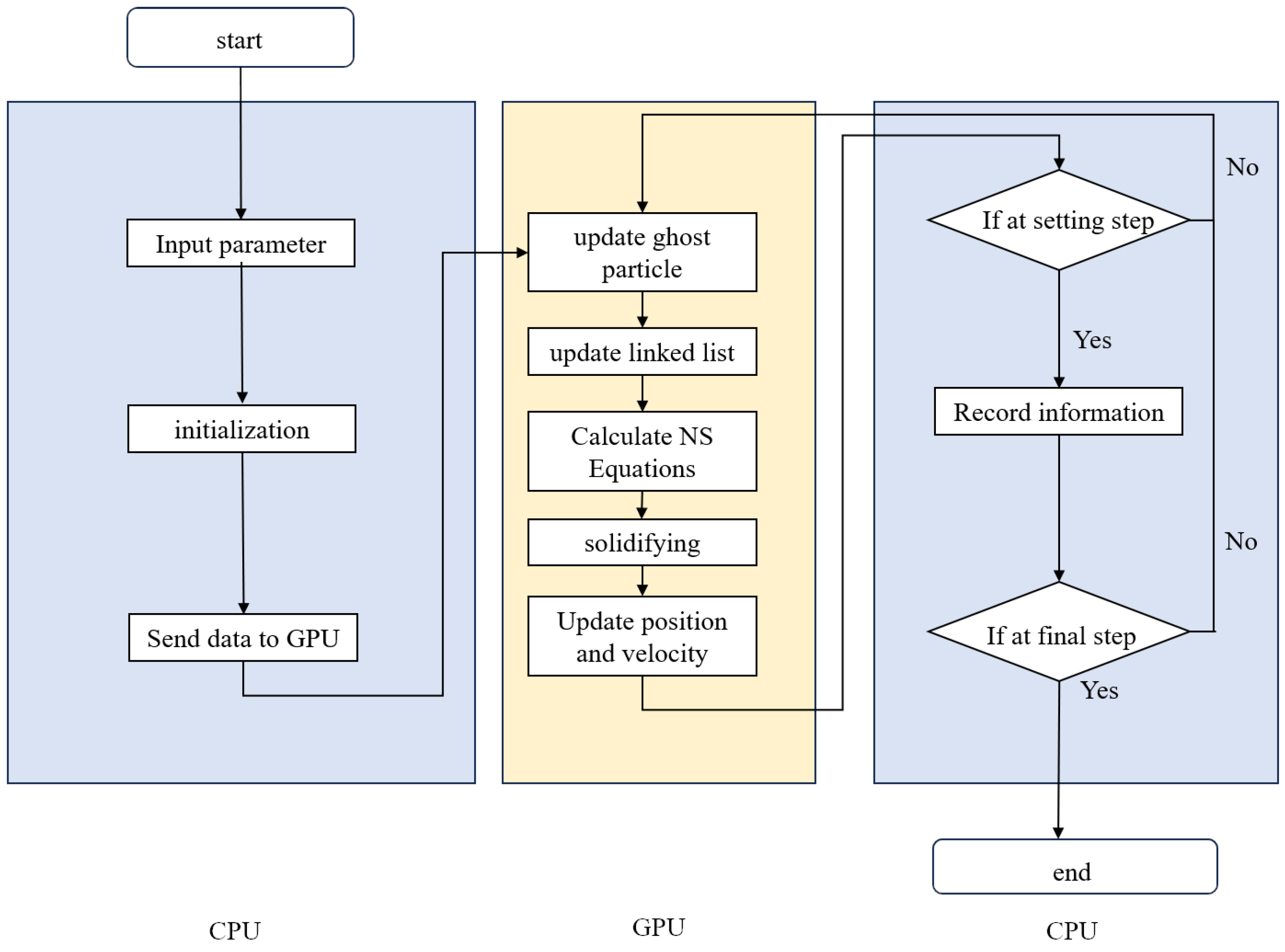
The SPH solver and the linked-list neighbor search are implemented in CUDA Fortran. The flowchart of the GPU-accelerated SPH method is shown in
Figure 2. Generally, the procedure has 10 steps: (1) input parameters; (2) initialize on the CPU; (3) send data to the GPU; (4) update ghost particles; (5) search and update the linked list; (6) calculate the Navier–Stokes equations; (7) determine whether a particle has solidified; (8) update position and velocity; (9) if at an output/sampling step, send data back to the CPU and record information, otherwise repeat steps (4)–(8); and (10) finalize and output results.
4. Results
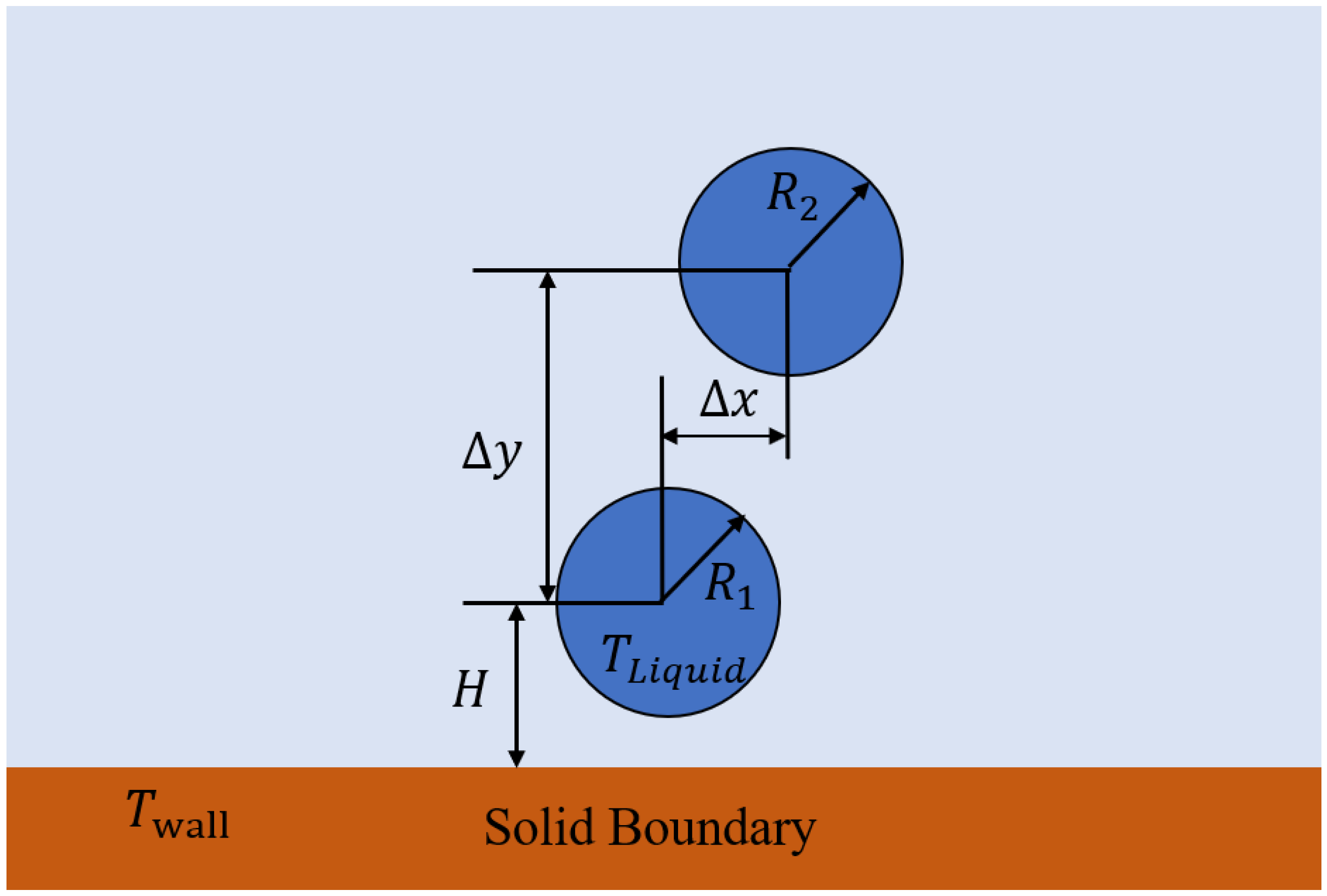
The numerical setup is illustrated in
Figure 10. Two droplets, modeled in 2D, are placed in a sufficiently large simulation domain with vertical and horizontal separations of
and
, respectively. A low-temperature solid wall is located at the bottom.
In all simulations, the Reynolds number is defined as
where
denotes the droplet impact velocity,
R is the droplet radius,
is the fluid density, and
is the shear viscosity of the fluid. In
Section 4.1 and
Section 4.2, two-droplet collision and solidification process is distinguished as convex pattern (CVP) or concave pattern (CCP), depending on their final splat morphologies. Here, we use two typical Reynolds numbers of Re = 9.9 or Re = 19.8 for CVP and CCP, respectively, with the same Stefan number of
. The Stefan number is defined as
where
is the fluid specific heat capacity,
is the temperature difference between the droplet and the wall, and
L is the latent heat of the fluid.
4.1. Convex Pattern
Reynolds number is set to , vertical distance , and horizontal distance .
In
Figure 11,
denotes the dimensionless time, where
.
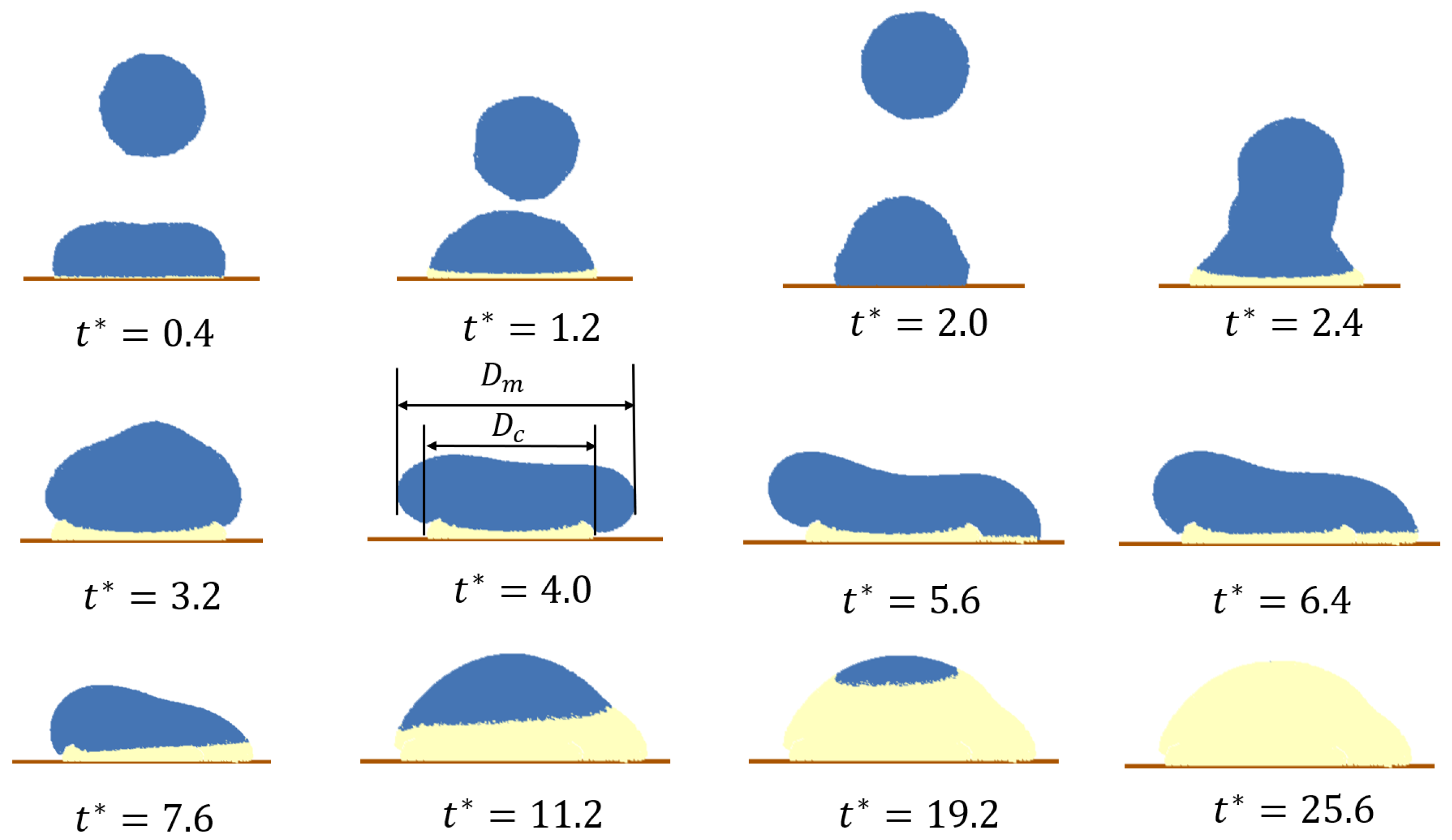
Figure 11 presents the collision and solidification process for the CVP. After solidification, the droplet exhibits a convex, mountain-like morphology.
Before collision, the leading droplet completes spreading and begins to recoil. Upon impact by the trailing droplet, deformation initiates near the peak of the leading droplet. Due to the asymmetric initial offset, only the right side of the deformed droplet initially contacts the substrate. Driven by surface tension, the left deforming region retracts toward the peak, whereas the right region solidifies more rapidly owing to a larger temperature difference with the substrate.
As shown in
Figure 11, two kinds of spreading diameters are defined: the maximum diameter of the merged droplet
, and the contact diameter
, which is the diameter of the region in contact with the substrate. Thus, two kinds of spreading ratios are defined:
where
is the initial diameter of a single droplet.
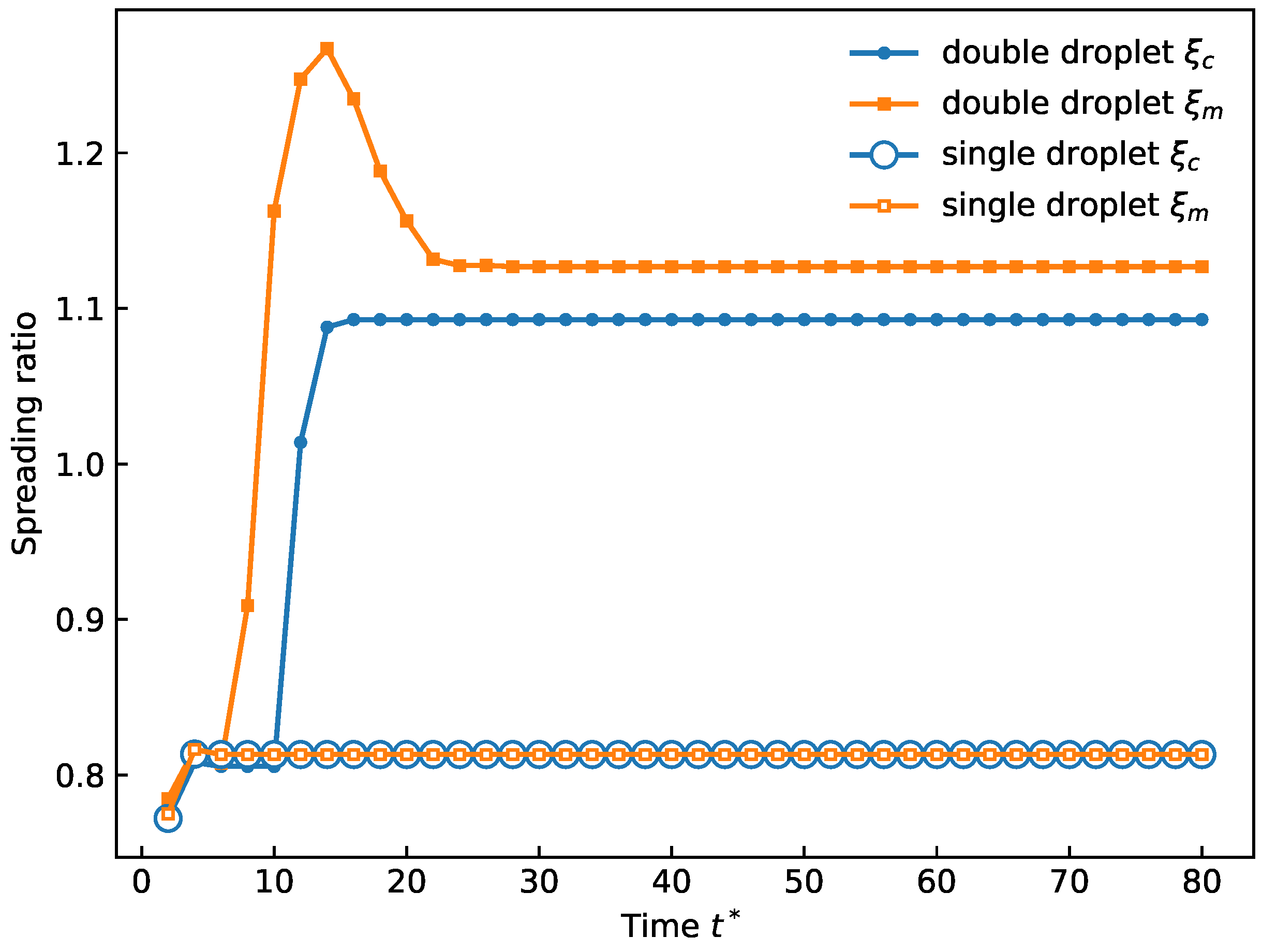
Figure 12 shows Two-droplet spreading ratios in CVP compared with a single droplet. Before collision, the spreading ratios of the two droplets coincide with that of a single droplet. At impact, the maximum spreading ratio
rises sharply as deformation develops. The contact spreading ratio
remains unchanged initially because the bottom region solidifies first. Once the deformed region meets the substrate,
increases abruptly. Subsequent recoil of the upper portion reduces
before complete solidification. After the bottom region solidifies, both
and
remain nearly constant.
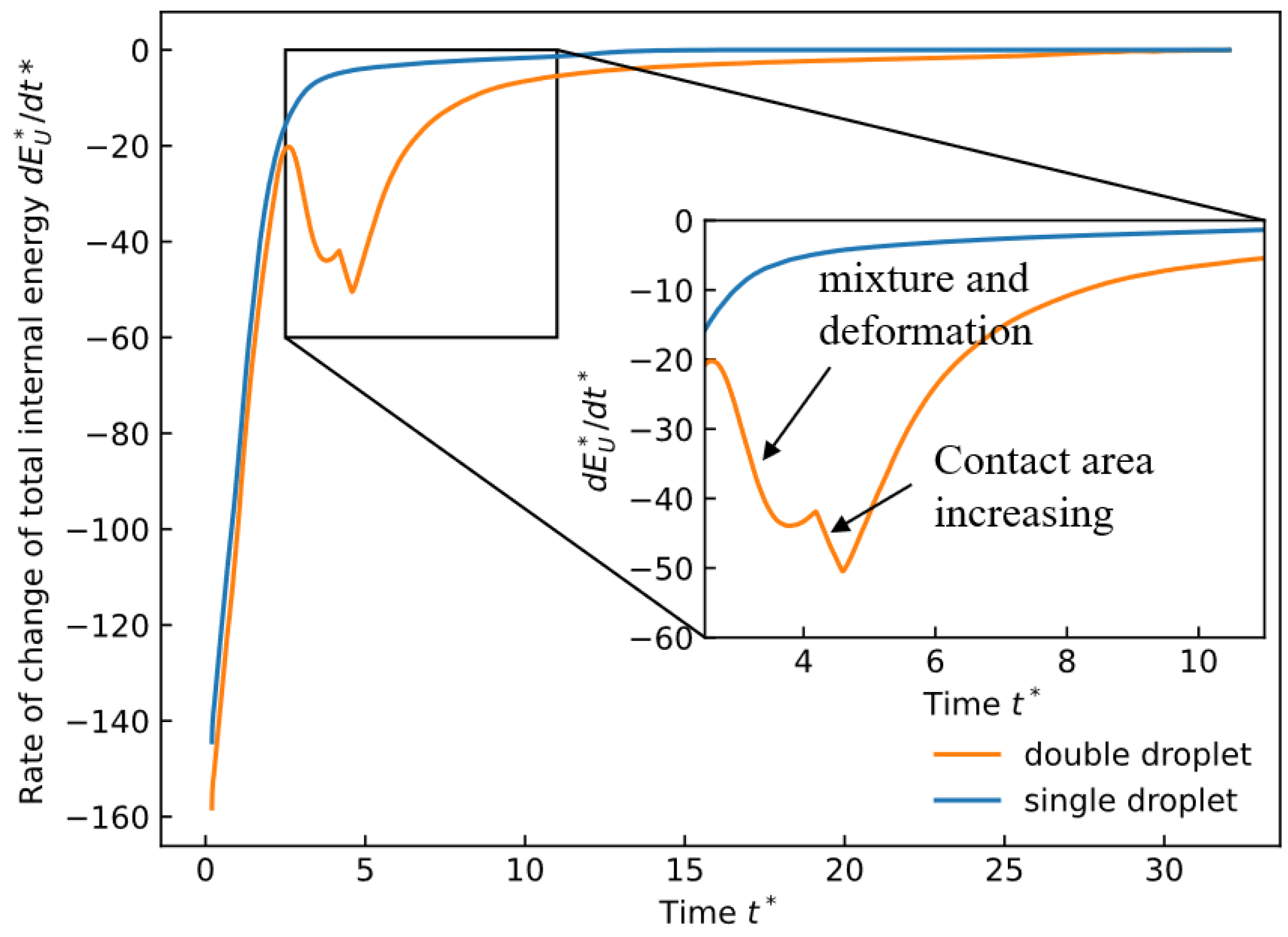
On the other hand, the temporal evolution of the internal energy change rate is investigated and compared with the single-droplet case.
Figure 13 plots the dimensionless internal energy change rate for both the two-droplet and single-droplet cases.
is defined as
, where
is the total internal energy at any time and
is the initial total internal energy.
According to Fourier’s law of heat conduction and Gauss’s theorem, the internal energy change rate of the droplet can be expressed as
where
A is the area of the droplet surface in contact with the substrate. The negative sign indicates that the droplet releases heat to the substrate.
Prior to the collision of the second droplet, the internal energy of the two-droplet system is consistent with that of the single droplet. Upon the second collision, the internal energy change rate surges abruptly because of mixing, which elevates the droplet temperature and the temperature difference with the substrate; consequently, the temperature gradient is augmented, which boosts the heat release rate. As solidification advances and the droplet temperature declines, the temperature gradient lessens and the internal energy change rate correspondingly decreases. When liquid deformation continues, the contact area A keeps expanding, leading to a transient increase in the internal energy change rate, but it then diminishes again as solidification continues and the temperature difference reduces.
4.2. Concave Pattern
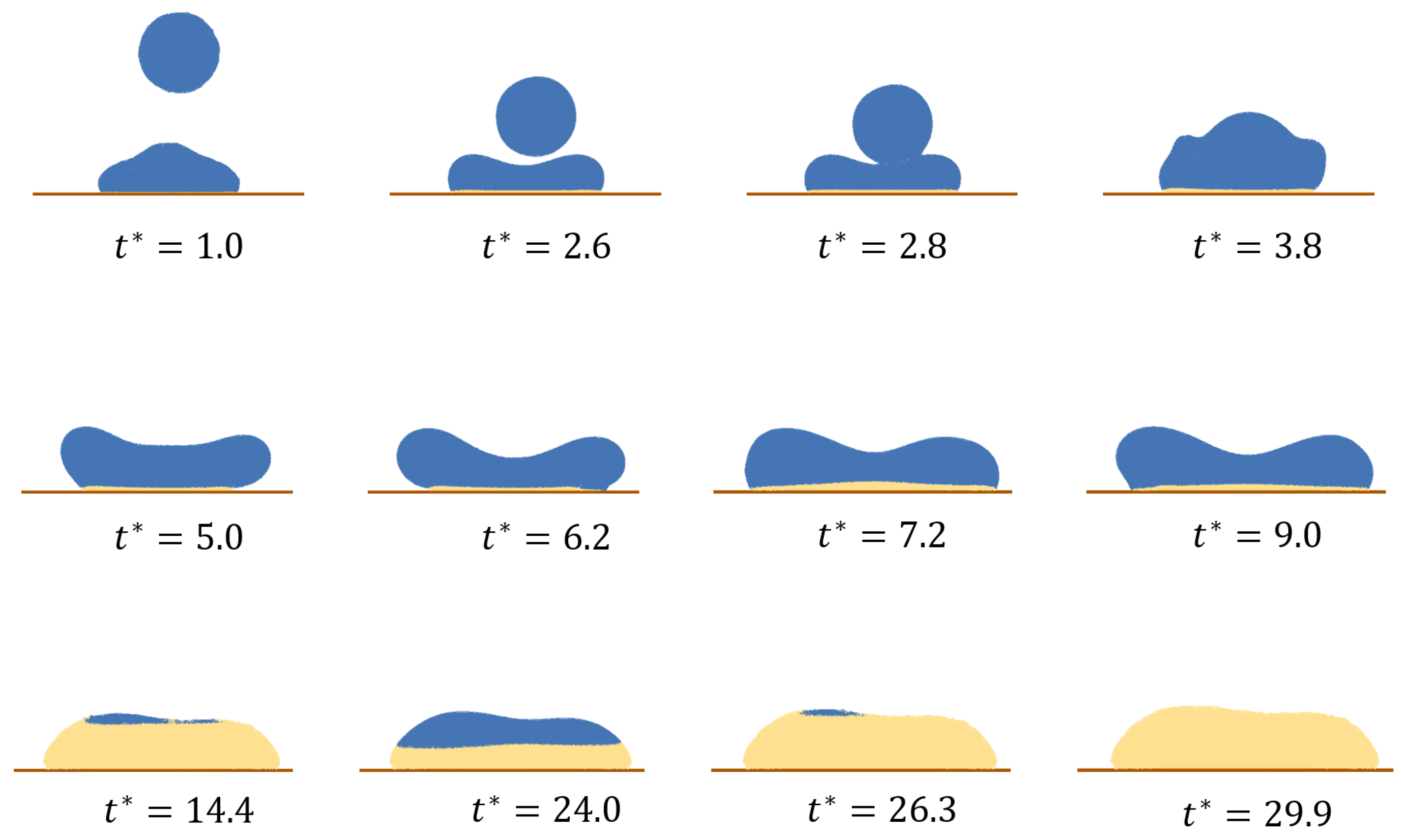
In this case, the Reynolds number is set to , and the remaining parameters match those of the convex pattern. This pattern arises when the leading droplet spreads before collision. After solidification, the morphology is concave, resembling a valley with two flanking peaks of different heights.
Figure 14 depicts the collision and solidification process for the concave pattern. Before the collision of the trailing droplet, the leading droplet of the two-particle case spreads in a manner similar to that of a single droplet case. Upon being impacted by the trailing droplet, significant deformation and mixing take place. Partial solidification at the bottom of the leading droplet restricts the expansion of the contact area until the deformed region makes contact with the substrate. As the collision is off-center, the deformation is asymmetric. In this instance, despite the trailing droplet being offset only by 0.25R to the right, the final morphology of the merged mass shifts significantly to the right, showing a greater height and a larger radius at the left than the right. At the end of the solidification process, the highest pool on the left eventually solidifies due to its relatively long distance from the cold substrate.
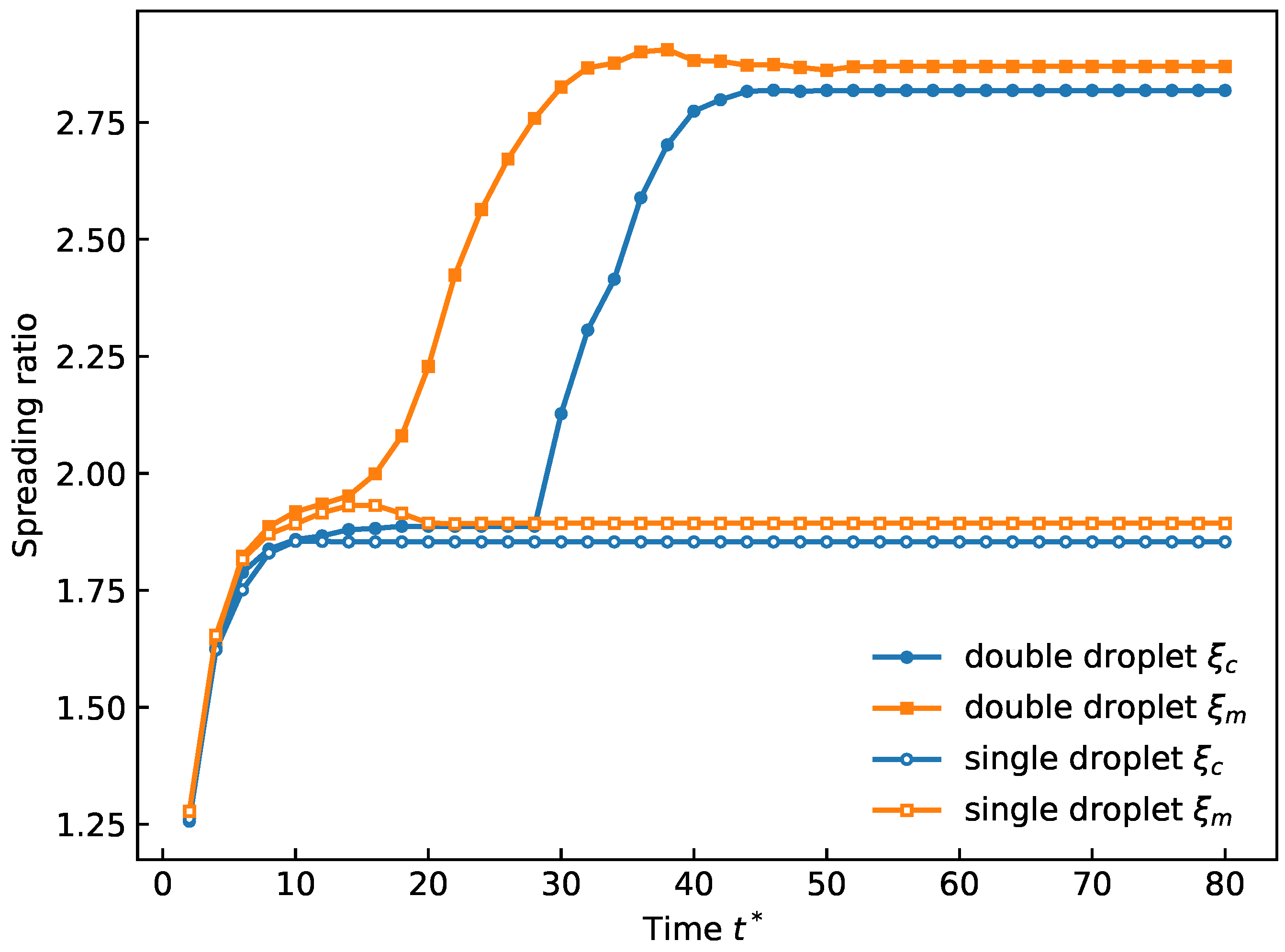
As illustrated in
Figure 15, during the initial stage the spreading behavior under continuous droplet impact is similar to that of a single droplet impact. The maximum spreading ratio increases substantially because of severe collision-induced deformation. In contrast, the contact spreading ratio increases only after the deformed portion touches the substrate, as the bottom layer solidifies earlier. Because the upper region does not solidify completely, shrinkage can occur, slightly reducing the maximum spreading ratio, while the contact spreading ratio remains approximately constant after reaching its final value.
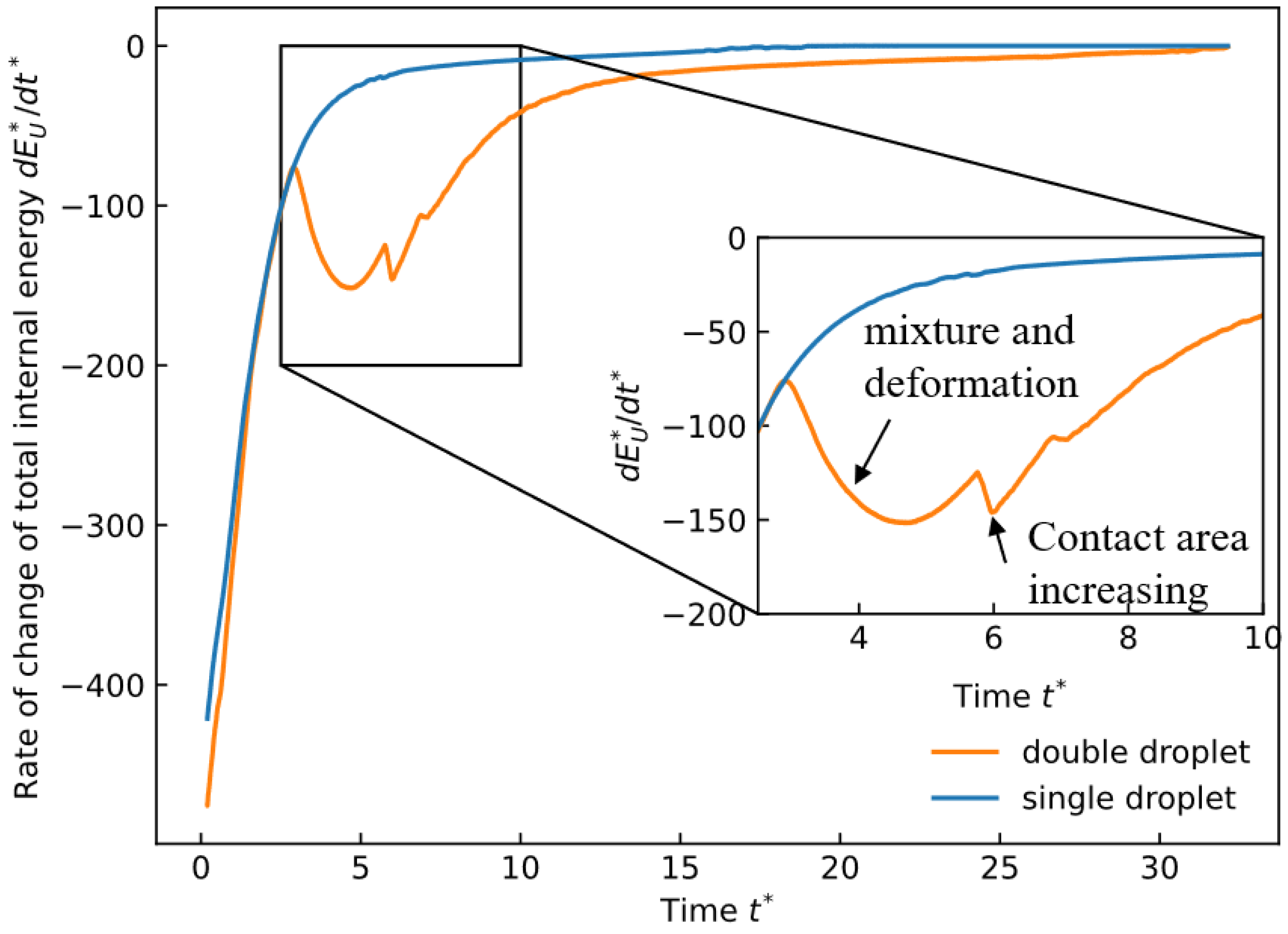
In
Figure 16, a negative value indicates heat release from the droplet. When the two droplets do not collide, the internal energy change rate follows single-droplet solidification behavior. Once the trailing droplet collides with the leading droplet, deformation accompanies heat transfer between the droplets. Because the trailing droplet is hotter, mixing raises the mixed-droplet temperature, increasing the temperature difference with the substrate, steepening the temperature gradient
, and enhancing the internal energy change rate. As temperature decreases, the rate diminishes. When the deformed region later contacts the substrate, the contact area increases and the rate rises again. After the bottom part solidifies and the contact area stabilizes, the rate decreases as the temperature difference diminishes.
4.3. Category of CVP and CCP
A concise table that summarizes the key differences between CVP and CCP is presented in
Table 1. the comparison between these two patterns becomes clear when examining the characteristics of CVP and CCP. CCP exhibits a higher Reynolds number, which is an important dimensionless quantity in fluid dynamics used to predict flow patterns in different flow situations. Furthermore, CCP shows a valley-like splat morphology, while CVP displays a mountain-like shape. In addition, CCP has a larger final maximum spreading ratio, indicating that it spreads more extensively in the end compared with CVP. Moreover, CCP demonstrates stronger mixing capabilities, suggesting that the internal components involved in CCP are more thoroughly blended than those in CVP.
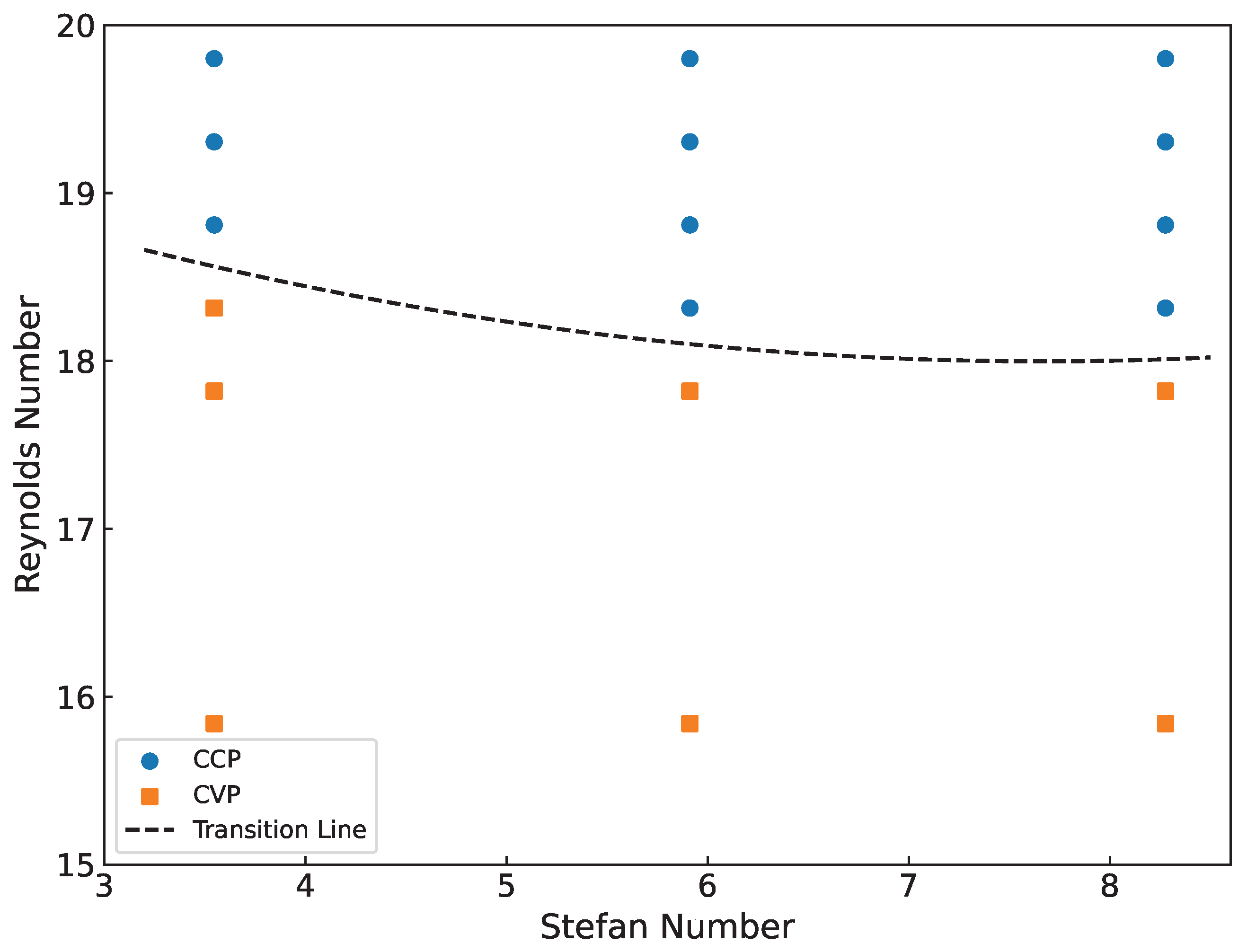
Figure 17 presents a detailed category that illustrates the various patterns of droplet solidification under different conditions. At relatively low Reynolds numbers (
), solidification predominantly occurs in the CVP mode. As the Reynolds number increases (
), the preferred mode shifts to CCP.
Relative to the pronounced effect of the Reynolds number on the solidification mode, the Stefan number has a much weaker influence. Low Stefan numbers lead to slower solidification speed and greater retraction, making CVP more likely than at high Stefan numbers. This slightly reduces the critical Reynolds number for the transition between CCP and CVP. Nevertheless, it should be noted the effect is minor and does not materially alter droplet solidification behavior.
4.4. Effect of and
The effects of horizontal distance and vertical distance between two droplets on spreading and solidification in CCP are investigated, since mixing is stronger in CCP than in CVP.
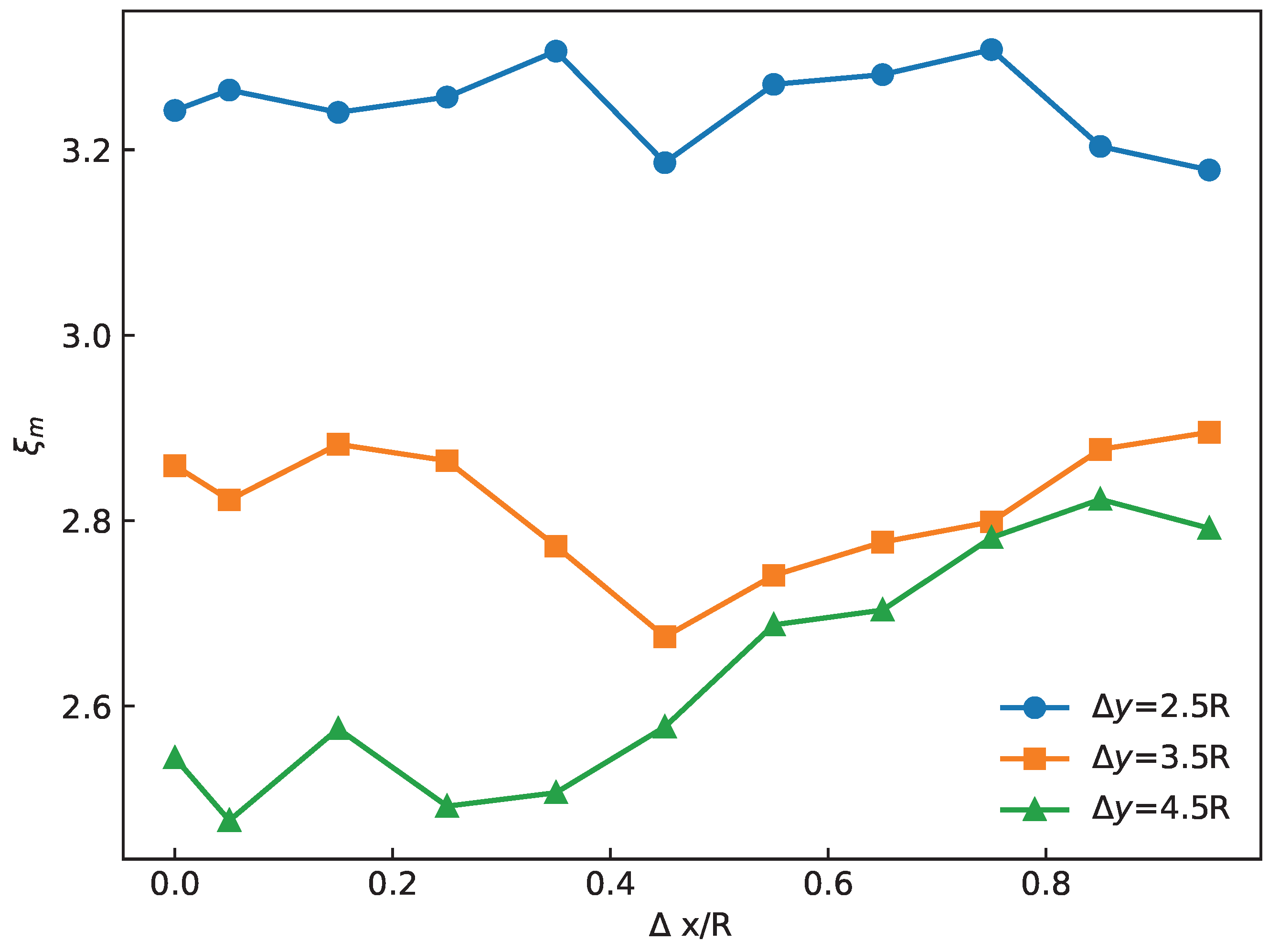
Figure 18 shows how
varies with horizontal distance
at different vertical distances
. When
,
exceeds that of the other two cases for all
and remains nearly constant. For
,
is smaller at
but becomes larger at
. For
,
increases with
, reaching about 9.75% above the center collision case.
Theoretically, a greater drop height increases gravitational potential energy and thus kinetic energy at impact, which promotes spreading. However, a larger vertical distance also allows the leading droplet more time to solidify before collision, leaving less liquid available to spread at impact. Thus, spreading and solidification exhibit a competitive relationship. This explains why the case yields the smallest spreading ratio in our simulations.
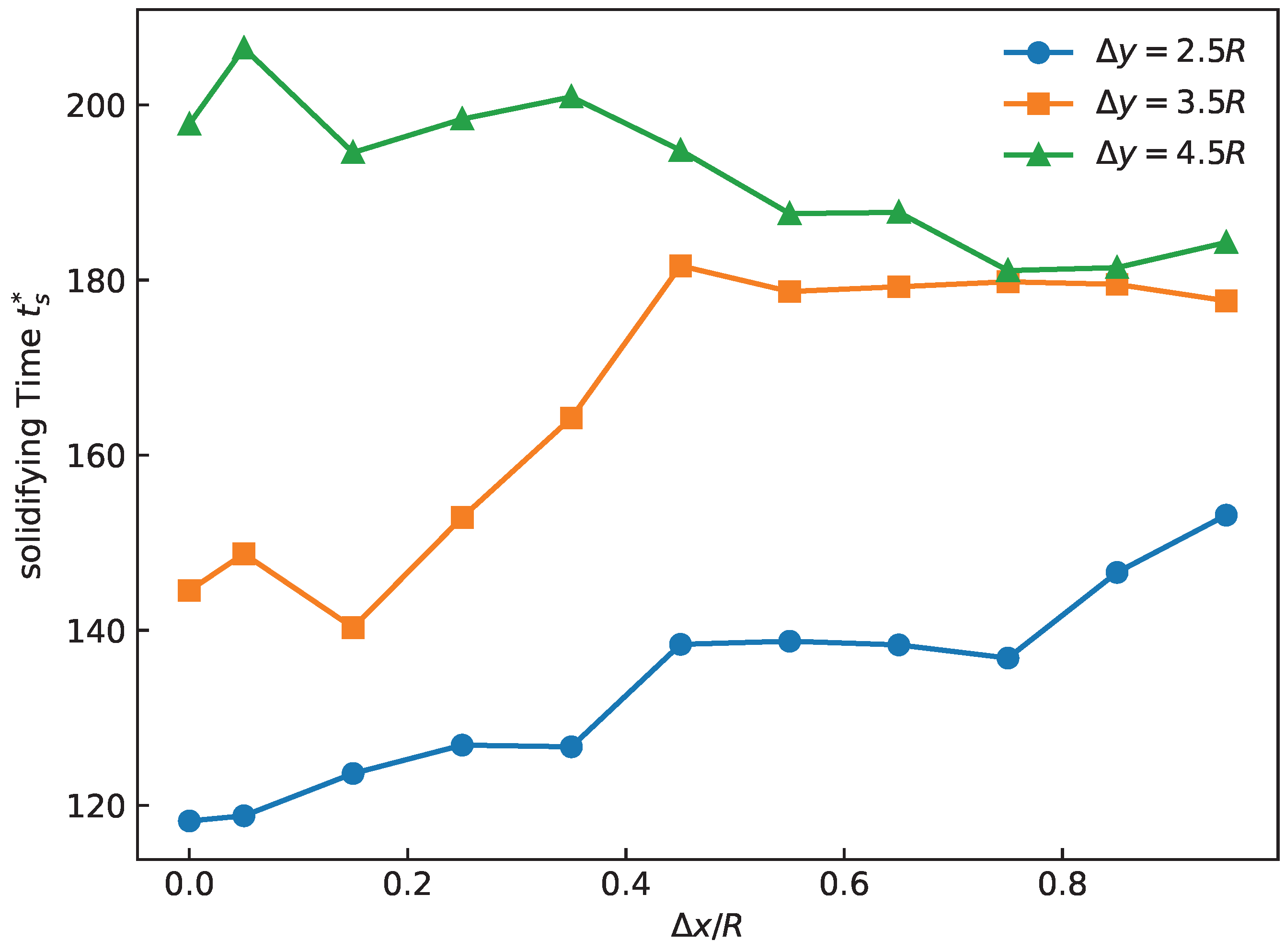
Figure 19 shows that the dimensionless total solidification time
varies with horizontal distance
at different vertical distances
. The
is defined as
, where
is the dimensional total solidification time of the two droplets, and
.
When , the total solidification time is the shortest and increases with ; in this case, the maximum solidification time exceeds the minimum by about 29.55%. For , the total solidification time remains nearly constant for , with a maximum about 29.45% larger than the minimum. For , the total solidification time is the longest because the trailing droplet takes longer to fall from a higher position; in this case, the solidification time decreases with because larger yields a larger contact area and faster solidification.
5. Conclusions
In this study, a SPH model is developed to simulate the dynamics of multiple droplets impacting and solidifying on a cold surface.
The simulations revealed that droplet interactions significantly influence solidification patterns, highlighting the complex competitive relationship between thermal and fluid-dynamic effects.
Two distinct solidification patterns are observed. For and , droplets tend to solidify in a convex pattern; for and , they tend to solidify in a concave pattern. When , droplets tend to solidify in CVP; at higher Reynolds numbers (), they tend to solidify in CCP. An increase in the Stefan number slightly decreases the critical Reynolds number for the CCP-CVP transition, but the effect is minor.
Relative to single-droplet impact and solidification, the spreading and heat transfer behavior of two droplets is strongly affected by mixing and spreading, exhibiting multi-stage characteristics. When the two droplets are horizontally offset, the trailing droplet’s spreading substantially influences the overall spreading factor. The mixing effect is more pronounced in the concave pattern and competes with solidification, thereby altering the spreading factor under different vertical offsets. In our simulations, at shorter vertical distances, the solidification time increases with horizontal offset by more than 29%, whereas at longer vertical distances the solidification time decreases slightly. These findings provide insights into droplet solidification behavior in applications such as thermal spraying.
This study encompasses several limitations that probably need attention in future research: (1) The material density change and shrinkage during solidification are neglected, thus requiring an analysis of their influence on coating porosity. (2) Some complex non-equilibrium phenomena during solidification are neglected for simplicity, such as supercooling and nucleation. (3) The effect of wettability on spreading and solidification demands further investigation. (4) Substrate melting and oxidation might be incorporated. (5) Three-dimensional simulation is needed when computational efficiency and storage are improved. These aspects will be addressed in our future research to improve the model accuracy and result reliability.