Multimodal Implementations to Reduce Neonatal Ventilator-Associated Pneumonia and Colistin Use: An Interrupted Time Series

 , , , , , ,
Abstract
1. Introduction
2. Results
3. Discussion
4. Materials and Methods
4.1. Study Setting and Period
4.2. General and Specific IPC Strategies
4.3. Definitions
4.4. Statistical Analysis
5. Conclusions
Author Contributions
Funding
Institutional Review Board Statement
Informed Consent Statement
Data Availability Statement
Conflicts of Interest
Abbreviations
| AUR | Antimicrobial use rate |
| BPD | Bronchopulmonary dysplasia |
| BW | Birth weight |
| CPAP | Continuous positive airway pressure |
| CRAB | Carbapenem-resistant A. baumannii |
| GA | Gestational age |
| HFOV | High-frequency oscillatory ventilation |
| HME | Heat and moisture exchanger |
| INICC | International Nosocomial Infection Control Consortium |
| IPC | Infection prevention and control |
| IPPV | Intermittent positive pressure ventilation |
| nCPAP | Nasal continuous positive airway pressure |
| nHFOV | Nasal high frequency oscillatory ventilation |
| NICU | Neonatal intensive care unit |
| NHSN | National Healthcare Safety Network |
| NIV | Noninvasive ventilation |
| nSIPPV | Nasal synchronized intermittent positive pressure ventilation |
| MDR | Multidrug-resistant |
| VAP | Ventilator-associated pneumonia |
| VD | Ventilator days |
| VUR | Ventilator utilization ratio |
References
- Rangelova, V.; Kevorkyan, A.; Raycheva, R.; Krasteva, M. Ventilator-associated pneumonia in the neonatal intensive care unit-incidence and strategies for prevention. Diagnostics 2024, 14, 240. [Google Scholar] [CrossRef]
- Rosenthal, V.D.; Bijie, H.; Maki, D.G.; Mehta, Y.; Apisarnthanarak, A.; Medeiros, E.A.; Leblebicioglu, H.; Fisher, D.; Alvarez-Moreno, C.; Khader, I.A.; et al. International Nosocomial Infection Control Consortium (INICC) report, data summary of 36 countries, for 2004–2009. Am. J. Infect. Control 2012, 40, 396–407. [Google Scholar] [CrossRef] [PubMed]
- Rosenthal, V.D.; Bat-Erdene, I.; Gupta, D.; Belkebir, S.; Rajhans, P.; Zand, F.; Myatra, S.N.; Afeef, M.; Tanzi, V.L.; Muralidharan, S.; et al. International Nosocomial Infection Control Consortium (INICC) report, data summary of 45 countries for 2012–2017: Device-associated module. Am. J. Infect. Control 2020, 48, 423–432. [Google Scholar] [CrossRef]
- Huo, M.; Liu, C.; Mei, H.; Zhang, Y.; Liu, C.; Song, D.; Zhang, Y.; Zhang, Y.; Xin, C. Intervention effect of oropharyngeal administration of colostrum in preterm infants: A meta-analysis. Front. Pediatr. 2022, 10, 895375. [Google Scholar] [CrossRef]
- Thatrimontrichai, A.; Surachat, K.; Singkhamanan, K.; Thongsuksai, P. Long duration of oral care using mother’s own milk influences oral microbiota and clinical outcomes in very-low-birthweight infants: Randomized controlled trial. Pediatr. Infect. Dis. J. 2023, 42, 804–810. [Google Scholar] [CrossRef]
- Alriyami, A.; Kiger, J.R.; Hooven, T.A. Ventilator-associated pneumonia in the neonatal intensive care unit. Neoreviews 2022, 23, e448–e461. [Google Scholar] [CrossRef]
- Cai, M.; Lin, L.; Peng, Y.; Chen, L.; Lin, Y. Effect of breast milk oral care on mechanically ventilated preterm infants: A systematic review and meta-analysis of randomized controlled trials. Front. Pediatr. 2022, 10, 899193. [Google Scholar] [CrossRef] [PubMed]
- Shalish, W.; Sant’Anna, G.M. Optimal timing of extubation in preterm infants. Semin. Fetal Neonatal Med. 2023, 28, 101489. [Google Scholar] [CrossRef] [PubMed]
- De Luca, D.; Centorrino, R. Nasal high-frequency ventilation. Clin. Perinatol. 2021, 48, 761–782. [Google Scholar] [CrossRef]
- Ognean, M.L.; Bivoleanu, A.; Cucerea, M.; Galiș, R.; Roșca, I.; Surdu, M.; Stoicescu, S.M.; Ramanathan, R. Nasal high-frequency oscillatory ventilation use in Romanian neonatal intensive care units-the results of a recent survey. Children 2024, 11, 836. [Google Scholar] [CrossRef]
- Moretti, C.; Gizzi, C. Synchronized nasal intermittent positive pressure ventilation. Clin. Perinatol. 2021, 48, 745–759. [Google Scholar] [CrossRef]
- Gaertner, V.D.; Rüegger, C.M. Optimising success of neonatal extubation: Respiratory support. Semin. Fetal Neonatal Med. 2023, 28, 101491. [Google Scholar] [CrossRef] [PubMed]
- Thatrimontrichai, A.; Rujeerapaiboon, N.; Janjindamai, W.; Dissaneevate, S.; Maneenil, G.; Kritsaneepaiboon, S.; Tanaanantarak, P. Outcomes and risk factors of ventilator-associated pneumonia in neonates. World J. Pediatr. 2017, 13, 328–334. [Google Scholar] [CrossRef]
- Thatrimontrichai, A.; Techato, C.; Dissaneevate, S.; Janjindamai, W.; Maneenil, G.; Kritsaneepaiboon, S.; Tanaanantarak, P. Risk factors and outcomes of carbapenem-resistant Acinetobacter baumannii ventilator-associated pneumonia in the neonate: A case-case-control study. J. Infect. Chemother. 2016, 22, 444–449. [Google Scholar] [CrossRef]
- Sitaruno, S.; Jaroenmark, T.; Wani, A.; Dangchuen, T.; Binyala, W.; Morapan, N.; Vattanavanit, V. Epidemiology of sepsis and septic shock in the medical intensive care unit after implementing the national early warning score for sepsis detection. J. Health Sci. Med. Res. 2025, 43, 20251181. [Google Scholar] [CrossRef]
- Nakwan, N.; Chokephaibulkit, K.; Imberti, R. The use of colistin for the treatment of multidrug-resistant Gram-negative infections in neonates and infants: A review of the literature. Pediatr. Infect. Dis. J. 2019, 38, 1107–1112. [Google Scholar] [CrossRef]
- Nakwan, N.; Usaha, S.; Chokephaibulkit, K.; Villani, P.; Regazzi, M.; Imberti, R. Pharmacokinetics of colistin following a single dose of intravenous colistimethate sodium in critically ill neonates. Pediatr. Infect. Dis. J. 2016, 35, 1211–1214. [Google Scholar] [CrossRef]
- Nakwan, N.; Chokephaibulkit, K. Can intravenous colistin effectively treat ventilator-associated pneumonia in the pediatric and neonatal patients? Eur. J. Pediatr. 2011, 170, 1355–1356. [Google Scholar] [CrossRef]
- Ackermann, B.W.; Klotz, D.; Hentschel, R.; Thome, U.H.; van Kaam, A.H. High-frequency ventilation in preterm infants and neonates. Pediatr. Res. 2023, 93, 1810–1818. [Google Scholar] [CrossRef]
- Cools, F.; Offringa, M.; Askie, L.M. Elective high frequency oscillatory ventilation versus conventional ventilation for acute pulmonary dysfunction in preterm infants. Cochrane Database Syst. Rev. 2015, 2015, CD000104. [Google Scholar] [CrossRef] [PubMed]
- Henderson-Smart, D.J.; De Paoli, A.G.; Clark, R.H.; Bhuta, T. High frequency oscillatory ventilation versus conventional ventilation for infants with severe pulmonary dysfunction born at or near term. Cochrane Database Syst. Rev. 2009, 2009, CD002974. [Google Scholar]
- Mukerji, A.; Shah, P.S.; Kadam, M.; Borhan, S.; Razak, A. Non-invasive respiratory support in preterm infants as primary mode: A network meta-analysis. Cochrane Database Syst. Rev. 2025, 7, CD014895. [Google Scholar]
- Razak, A.; Shah, P.S.; Kadam, M.; Borhan, S.; Mukerji, A. Postextubation use of non-invasive respiratory support in preterm infants: A network meta-analysis. Cochrane Database Syst. Rev. 2025, 7, CD014509. [Google Scholar]
- Prasad, R.; Saha, B.; Sk, M.H.; Sahoo, J.P.; Gupta, B.K.; Shaw, S.C. Noninvasive high-frequency oscillation ventilation as post- extubation respiratory support in neonates: Systematic review and meta-analysis. PLoS ONE 2024, 19, e0307903. [Google Scholar] [CrossRef] [PubMed]
- Dudeck, M.A.; Edwards, J.R.; Allen-Bridson, K.; Gross, C.; Malpiedi, P.J.; Peterson, K.D.; Pollock, D.A.; Weiner, L.M.; Sievert, D.M. National Healthcare Safety Network report, data summary for 2013, device-associated module. Am. J. Infect. Control 2015, 43, 206–221. [Google Scholar] [CrossRef] [PubMed]
- Huang, J.; Cayabyab, R.; Cielo, M.; Ramanathan, R. Incidence, risk factors, short-term outcomes, and microbiome of ventilator-associated pneumonia in very-low-birth-weight infants: Experience at a single level iii neonatal intensive care unit. Pediatr. Infect. Dis. J. 2024, 43, 1083–1089. [Google Scholar] [CrossRef] [PubMed]
- Thatrimontrichai, A.; Janjindamai, W.; Dissaneevate, S.; Maneenil, G.; Kritsaneepaiboon, S. Risk factors and outcomes of ventilator-associated pneumonia from a neonatal intensive care unit, Thailand. Southeast Asian J. Trop. Med. Public Health 2019, 50, 537–545. [Google Scholar]
- Flannery, D.D.; Zevallos Barboza, A.; Mukhopadhyay, S.; Wade, K.C.; Gerber, J.S.; Shu, D.; Puopolo, K.M. Antibiotic use among infants admitted to neonatal intensive care units. JAMA Pediatr. 2023, 177, 1354–1356. [Google Scholar] [CrossRef]
- Shipp, K.D.; Chiang, T.; Karasick, S.; Quick, K.; Nguyen, S.T.; Cantey, J.B. Antibiotic stewardship challenges in a referral neonatal intensive care unit. Am. J. Perinatol. 2016, 33, 518–524. [Google Scholar]
- Cantey, J.B.; Wozniak, P.S.; Sánchez, P.J. Prospective surveillance of antibiotic use in the neonatal intensive care unit: Results from the SCOUT study. Pediatr. Infect. Dis. J. 2015, 34, 267–272. [Google Scholar] [CrossRef]
- Schulman, J.; Dimand, R.J.; Lee, H.C.; Duenas, G.V.; Bennett, M.V.; Gould, J.B. Neonatal intensive care unit antibiotic use. Pediatrics 2015, 135, 826–833. [Google Scholar] [CrossRef]
- Schulman, J.; Profit, J.; Lee, H.C.; Dueñas, G.; Bennett, M.V.; Parucha, J.; Jocson, M.A.L.; Gould, J.B. Variations in neonatal antibiotic use. Pediatrics 2018, 142, e20180115. [Google Scholar] [CrossRef]
- Singh, H.P.; Wilkinson, S.; Kamran, S. Decreasing antibiotic use in a community neonatal intensive care unit: A quality improvement initiative. Am. J. Perinatol. 2024, 41, e2767–e2775. [Google Scholar] [CrossRef]
- Jiang, S.; Zhang, L.; Yan, W.; Li, S.; Han, J.; Zhou, Q.; Yang, Y.; Lee, S.K.; Cao, Y. Antibiotic use in neonatal intensive care units in China: A multicenter cohort study. J. Pediatr. 2021, 239, 136–142.e4. [Google Scholar] [CrossRef]
- Ren, Z.; Yang, S.; Han, J.; Nie, C.; Wang, C.; Wang, J.; Zheng, X.; Yang, H.; Zhang, Q.; Pei, J.; et al. Reduction of antibiotic use and multi-drug resistance bacteria infection in neonates after improvement of antibiotics use strategy in a level 4 neonatal intensive care unit in southern China. Eur. J. Clin. Microbiol. Infect. Dis. 2023, 42, 87–98. [Google Scholar] [CrossRef]
- Spencer, H.J.J.; Dantuluri, K.L.; Thurm, C.; Griffith, H.; Grijalva, C.G.; Banerjee, R.; Howard, L.M. Variation in antibiotic use among neonatal intensive care units in the United States. Infect. Control Hosp. Epidemiol. 2022, 43, 1945–1947. [Google Scholar] [CrossRef] [PubMed]
- Gandra, S.; Alvarez-Uria, G.; Murki, S.; Singh, S.K.; Kanithi, R.; Jinka, D.R.; Chikkappa, A.K.; Subramanian, S.; Sharma, A.; Dharmapalan, D.; et al. Point prevalence surveys of antimicrobial use among eight neonatal intensive care units in India: 2016. Int. J. Infect. Dis. 2018, 71, 20–24. [Google Scholar] [CrossRef] [PubMed]
- Hematian, F.; Aletayeb, S.M.H.; Dehdashtian, M.; Aramesh, M.R.; Malakian, A.; Aletayeb, M.S. Frequency and types of antibiotic usage in a referral neonatal intensive care unit, based on the world health organization classification (AwaRe). BMC Pediatr. 2025, 25, 60. [Google Scholar] [CrossRef] [PubMed]
- Hussain, K.; Salat, M.S.; Ambreen, G.; Mughal, A.; Idrees, S.; Sohail, M.; Iqbal, J. Intravenous vs intravenous plus aerosolized colistin for treatment of ventilator-associated pneumonia—A matched case-control study in neonates. Expert Opin. Drug Saf. 2020, 19, 1641–1649. [Google Scholar] [CrossRef]
- Kang, C.H.; Tsai, C.M.; Wu, T.H.; Wu, H.Y.; Chung, M.Y.; Chen, C.C.; Huang, Y.C.; Liu, S.F.; Liao, D.L.; Niu, C.K.; et al. Colistin inhalation monotherapy for ventilator-associated pneumonia of Acinetobacter baumannii in prematurity. Pediatr. Pulmonol. 2014, 49, 381–388. [Google Scholar] [CrossRef]
- Kaya, T.B.; Sürmeli Onay, Ö.; Aydemir, Ö.; Tekin, A.N. Ten-year single center experience with colistin therapy in NICU. Pediatr. Infect. Dis. J. 2024, 43, 165–169. [Google Scholar] [CrossRef] [PubMed]
- Alan, S.; Yildiz, D.; Erdeve, O.; Cakir, U.; Kahvecioglu, D.; Okulu, E.; Ates, C.; Atasay, B.; Arsan, S. Efficacy and safety of intravenous colistin in preterm infants with nosocomial sepsis caused by Acinetobacter baumannii. Am. J. Perinatol. 2014, 31, 1079–1086. [Google Scholar] [CrossRef]
- Seanglaw, D.; Morasert, T. Development of a prediction model for acute kidney injury after colistin treatment for multidrug-resistant acinetobacter baumanii ventilator-associated pneumonia: A pilot study. J. Health Sci. Med. Res. 2023, 41, e2022891. [Google Scholar] [CrossRef]
- CDC and NHSN. Pneumonia (Ventilator-Associated [VAP] and Non-Ventilator-Associated Pneumonia [PNEU]) Event. Available online: http://www.cdc.gov/nhsn/pdfs/pscmanual/6pscvapcurrent.pdf (accessed on 3 July 2025).
- Schmidt, B.; Roberts, R.S.; Davis, P.; Doyle, L.W.; Barrington, K.J.; Ohlsson, A.; Solimano, A.; Tin, W. Caffeine therapy for apnea of prematurity. N. Engl. J. Med. 2006, 354, 2112–2121. [Google Scholar] [CrossRef]
- Schmidt, B.; Roberts, R.S.; Davis, P.; Doyle, L.W.; Barrington, K.J.; Ohlsson, A.; Solimano, A.; Tin, W. Long-term effects of caffeine therapy for apnea of prematurity. N. Engl. J. Med. 2007, 357, 1893–1902. [Google Scholar] [CrossRef]
- Mürner-Lavanchy, I.M.; Doyle, L.W.; Schmidt, B.; Roberts, R.S.; Asztalos, E.V.; Costantini, L.; Davis, P.G.; Dewey, D.; D’Ilario, J.; Grunau, R.E.; et al. Neurobehavioral outcomes 11 years after neonatal caffeine therapy for apnea of prematurity. Pediatrics 2018, 141, e20174047. [Google Scholar] [CrossRef] [PubMed]
- Thatrimontrichai, A.; Pannaraj, P.S.; Janjindamai, W.; Dissaneevate, S.; Maneenil, G.; Apisarnthanarak, A. Intervention to reduce carbapenem-resistant Acinetobacter baumannii in a neonatal intensive care unit. Infect. Control Hosp. Epidemiol. 2020, 41, 710–715. [Google Scholar] [CrossRef] [PubMed]
- Phatigomet, M.; Thatrimontrichai, A.; Maneenil, G.; Dissaneevate, S.; Janjindamai, W. Reintubation rate between nasal high-frequency oscillatory ventilation versus synchronized nasal intermittent positive pressure ventilation in neonates: A parallel randomized controlled trial. Am. J. Perinatol. 2024, 41, 1504–1511. [Google Scholar] [CrossRef]
- Jobe, A.H.; Bancalari, E. Bronchopulmonary Dysplasia. Am. J. Respir. Crit. Care Med. 2001, 163, 1723–1729. [Google Scholar] [CrossRef]
- R Core Team. R-4.5.1 for Windows. Available online: https://cran.r-project.org/bin/windows/base/ (accessed on 3 July 2025).
- Chongsuvivatwong, V. Epicalc: Epidemiological Calculator. Available online: https://medipe.psu.ac.th/epicalc/ (accessed on 3 July 2025).


| Baseline Characteristics | 2014–2017 (n = 1930) | 2018–2020 (n = 1402) | 2021–2024 (n = 2082) | p-Value |
|---|---|---|---|---|
| Gestational age, weeks 1 | 35 (32, 38) | 36 (32, 38) | 37 (34, 38) | <0.001 |
| Birth weight, g 1 | 2300 (1585, 3000) | 2441 (1656, 3076) | 2716 (1996, 3176) | <0.001 |
| less 751 g, n (%) | 63 (3.3) | 45 (3.2) | 49 (2.4) | |
| 751–1000 g, n (%) | 111 (5.7) | 79 (5.6) | 89 (4.3) | |
| 1001–1500 g, n (%) | 262 (13.6) | 169 (12.1) | 172 (8.3) | |
| 1501–2500 g, n (%) | 663 (34.4) | 429 (30.6) | 554 (26.6) | |
| more 2500 g, n (%) | 831 (43.0) | 680 (48.5) | 1218 (58.5) | |
| Birth weight compared to gestational age, n (%) | 0.009 | |||
| appropriate for gestational age | 1582 (82.0) | 1177 (84.0) | 1730 (83.1) | |
| small for gestational age | 112 (5.8) | 44 (3.1) | 97 (4.7) | |
| large for gestational age | 236 (12.2) | 181 (12.9) | 255 (12.2) | |
| Male, n (%) | 1046 (54.2) | 822 (58.6) | 1181 (56.7) | 0.03 |
| Cesarean section, n (%) | 1251 (64.8) | 930 (66.3) | 1439 (69.1) | 0.01 |
| Multifetal gestation, n (%) | 280 (14.5) | 161 (11.5) | 230 (11.0) | 0.002 |
| 1 min Apgar score 1 | 8 (6, 9) | 8 (6, 8) | 8 (7, 8) | 0.003 |
| 5 min Apgar score 1 | 9 (8, 9) | 9 (8, 9) | 9 (8, 9) | <0.001 |
| Respiratory distress syndrome, n (%) | 508 (26.3) | 306 (21.8) | 380 (18.3) | <0.001 |
| Surfactant administration, n (%) | 170 (8.8) | 128 (9.1) | 181 (8.7) | 0.91 |
| Meconium aspiration syndrome, n (%) | 133 (6.9) | 83 (5.9) | 132 (6.3) | 0.52 |
| Outcomes | 2014–2017 (n = 1930) | 2018–2020 (n = 1402) | 2021–2024 (n = 2082) | p-Value |
| Death or moderate to severe bronchopulmonary dysplasia, n (%) | 223 (11.6) | 136 (9.7) | 151 (7.3) | <0.001 |
| Death, n (%) | 151 (7.8) | 85 (6.1) | 93 (4.5) | <0.001 |
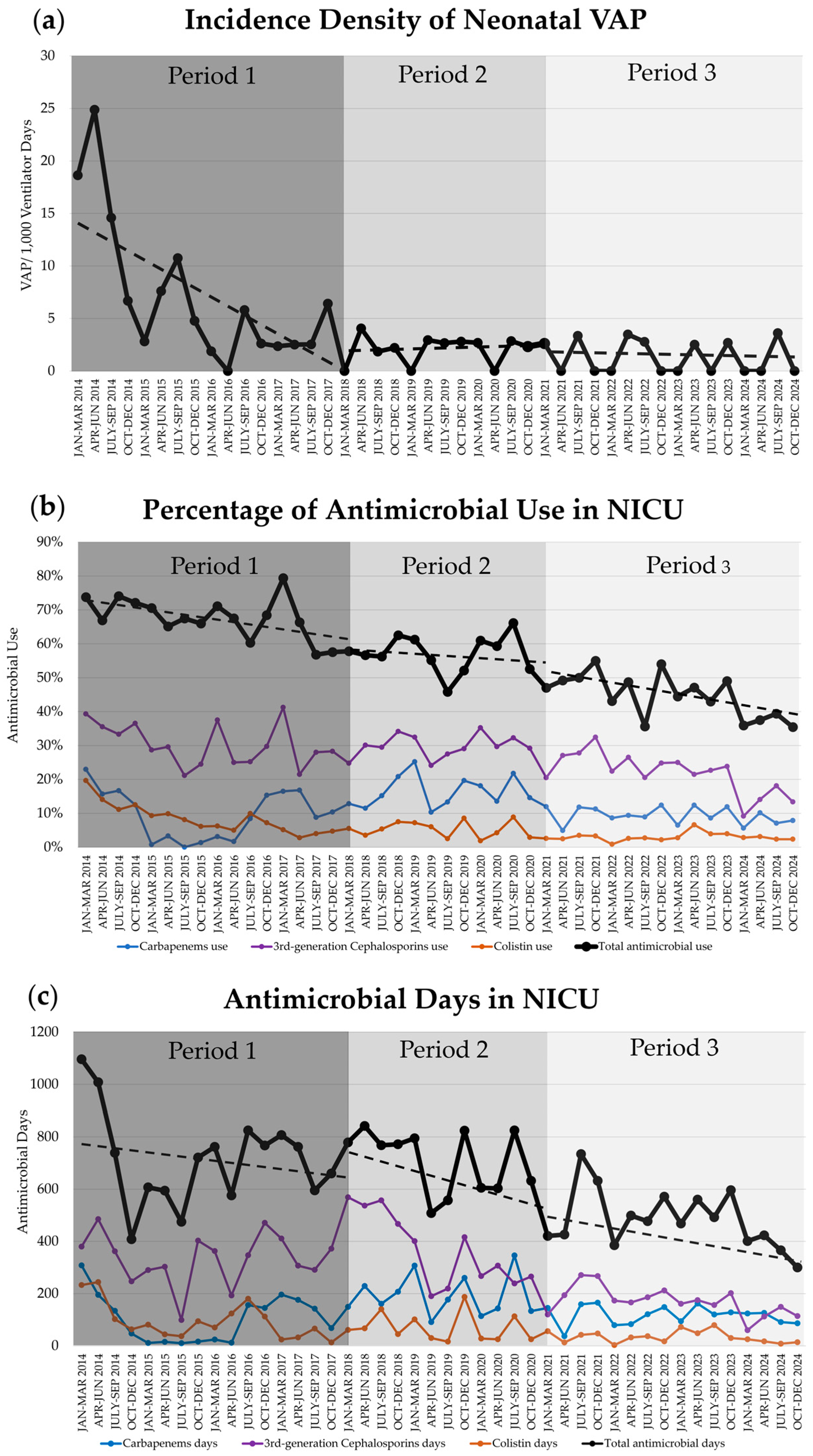
| Antimicrobial use rate, % (antimicrobial days/patient days) | 31.5 (11,402/36,146) | 32.8 (8510/25,959) | 23.4 (7751/33,046) | <0.001 |
| Number of neonates who used total antimicrobials, n (%) | 1303 (67.5) | 801 (57.1) | 931 (44.7) | <0.001 |
| Number of neonates who used carbapenems, n (%) | 176 (9.1) | 230 (16.4) | 196 (9.4) | <0.001 |
| Number of neonates who used the 3rd-generation cephalosporins, n (%) | 581 (30.1) | 418 (29.8) | 456 (21.9) | <0.001 |
| Number of neonates who used colistin, n (%) | 165 (8.5) | 75 (5.3) | 63 (3.0) | <0.001 |
| Year of Birth | Number of Intubated Neonates, n (%) | Ventilator Utilization Ratio (Ventilator Days/Patient Days) | Incidence of VAP per 1000 Ventilator Days (VAP/Ventilator Days) | Incidence Density Ratio of VAP (95% Confidence Interval) |
|---|---|---|---|---|
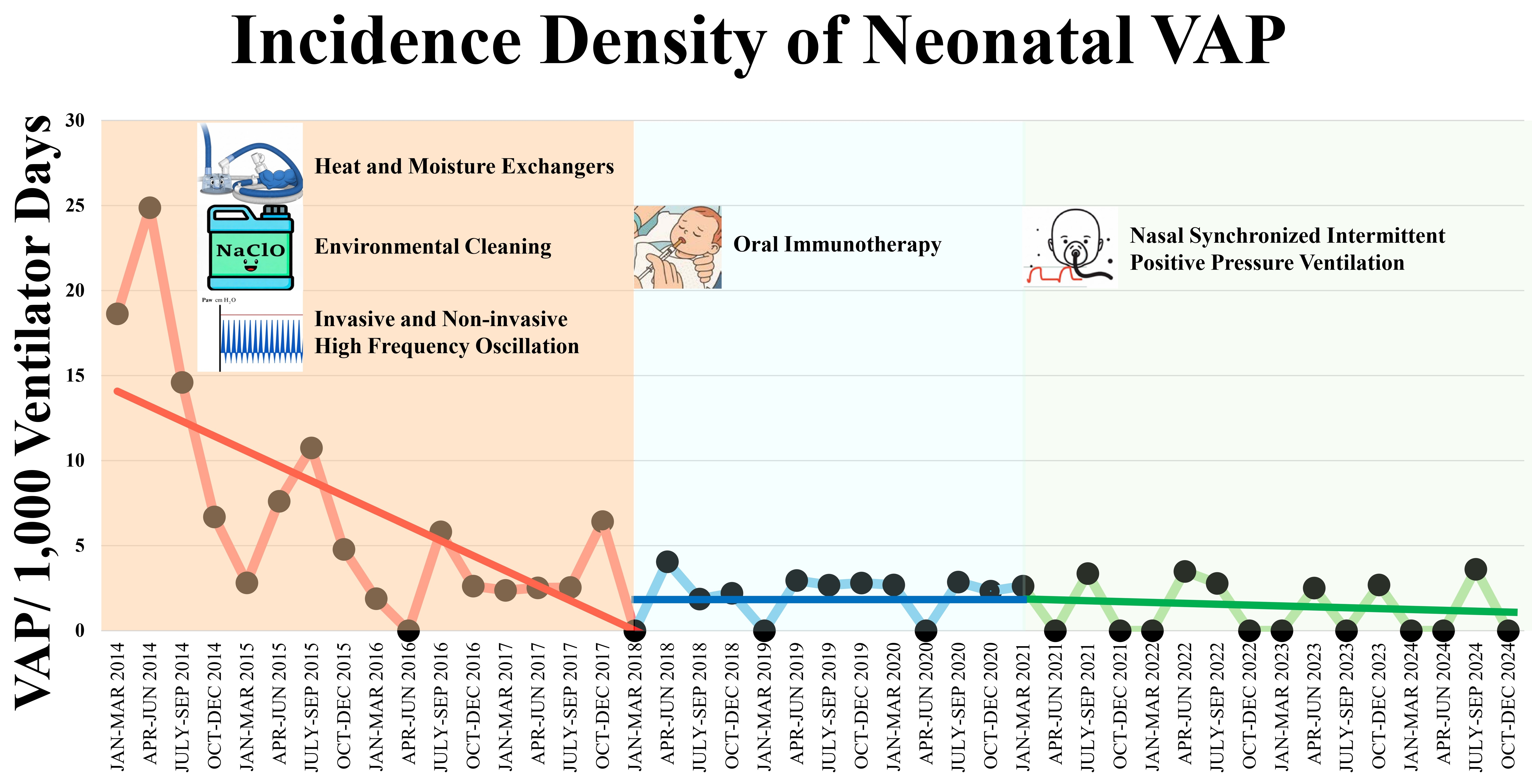
| 2014 | 242/455 (53.2) | 0.24 (2251/9410) | 17.77 (40/2251) | 1 |
| 2015 | 232/550 (42.2) | 0.15 (1446/9569) | 6.91 (10/1446) | 0.35 (0.17, 0.71) |
| 2016 | 251/490 (51.2) | 0.20 (1656/9117) | 3.02 (5/1656) | 0.16 (0.06, 0.40) |
| 2017 | 236/435 (54.3) | 0.21 (1685/8050) | 3.56 (6/1685) | 0.20 (0.08, 0.47) |
| 2018 | 246/454 (54.2) | 0.21 (1941/9097) | 2.06 (4/1941) | 0.16 (0.04, 0.32) |
| 2019 | 232/464 (50.0) | 0.22 (1861/8413) | 2.15 (4/1861) | 0.12 (0.04, 0.33) |
| 2020 | 243/484 (50.2) | 0.22 (1875/8449) | 2.13 (4/1875) | 0.12 (0.04, 0.33) |
| 2021 | 238/534 (44.6) | 0.15 (1285/8860) | 1.56 (2/1285) | 0.09 (0.02, 0.36) |
| 2022 | 216/516 (41.9) | 0.19 (1605/8309) | 1.87 (3/1605) | 0.10 (0.03, 0.34) |
| 2023 | 200/508 (39.4) | 0.16 (1331/8432) | 1.50 (2/1331) | 0.08 (0.02, 0.35) |
| 2024 | 134/524 (25.6) | 0.12 (884/7445) | 1.13 (1/884) | 0.06 (0.01, 0.46) |
| 2014–2017 | 961/1930 (49.8) | 0.19 (7038/36,146) | 8.67 (61/7038) | 1 |
| 2018–2020 | 721/1402 (51.4) | 0.22 (5677/25,959) | 2.11 (12/5677) | 0.25 (0.14, 0.47) |
| 2021–2024 | 788/2082 (37.8) | 0.15 (5105/33,046) | 1.57 (8/5105) | 0.19 (0.09, 0.39) |
| Total | 2470/5414 (45.6) | 0.19 (17,820/95,151) | 4.55 (81/17,820) | - |
| Incidence and Antimicrobial Use | Baseline Trend | Change in Level | Change in Slope | |||
|---|---|---|---|---|---|---|
| Mean (95% CI) | p-Value | Mean (95% CI) | p-Value | Mean (95% CI) | p-Value | |
| Incidence Density of Ventilator-Associated Pneumonia | ||||||
| Period 2 vs. Period 1 | −1.02 (−1.44, −0.60) | <0.001 | 2.19 (−3.85, 8.23) | 0.48 | 1.06 (0.29, 1.83) | 0.01 |
| Period 3 vs. Period 2 | 0.04 (−0.21, 0.29) | 0.73 | −0.60 (−2.85, 1.66) | 0.61 | −0.09 (−0.38, 0.21) | 0.58 |
| Ventilator Utilization Ratio | ||||||
| Period 2 vs. Period 1 | −0.005 (−0.008, −0.001) | 0.005 | 0.028 (−0.022, 0.078) | 0.28 | 0.005 (−0.001, 0.011) | 0.11 |
| Period 3 vs. Period 2 | 0.0002 (−0.004, 0.004) | 0.90 | −0.022 (−0.055, 0.012) | 0.20 | −0.004 (−0.008, 0.001) | 0.09 |
| Total Antimicrobial Use | ||||||
| Period 2 vs. Period 1 | −21.20 (−68.57, 26.17) | 0.39 | 722.83 (675.46, 770.20) | 0.048 | −26.13 (−113.17, 60.91) | 0.56 |
| Period 3 vs. Period 2 | −47.33 (−110.97, 16.31) | 0.16 | −191.58 (−766.15, 382.99) | 0.52 | 23.66 (−52.19, 99.51) | 0.55 |
| The 3rd-generation Cephalosporins Use | ||||||
| Period 2 vs. Period 1 | −0.06 (−11.33, 11.20) | 0.99 | 234.99 (130.78, 454.34) | 0.005 | −30.36 (−57.36, −15.96) | 0.004 |
| Period 3 vs. Period 2 | −30.43 (−49.92, −23.52) | <0.001 | 20.45 (−80.81, 157.60) | 0.70 | 24.22 (14.78, 46.26) | <0.001 |
| Carbapenems Use | ||||||
| Period 2 vs. Period 1 | −1.22 (−12.75, 13.49) | 0.80 | 93.54 (−79.74, 297.10) | 0.19 | 2.03 (−24.08, 24.14) | 0.82 |
| Period 3 vs. Period 2 | 0.81 (−15.02, 15.82) | 0.87 | −76.80 (−235.99, 42.41) | 0.11 | −1.28 (−21.14, 15.62) | 0.83 |
| Colistin Use | ||||||
| Period 2 vs. Period 1 | −8.24 (−14.68, −2.03) | 0.02 | 50.94 (−39.66, 142.10) | 0.28 | 6.04 (−5.43, 17.82) | 0.31 |
| Period 3 vs. Period 2 | −2.20 (−9.52, 5.20) | 0.52 | −15.81 (−77.81, 55.02) | 0.60 | 1.23 (−7.89, 9.65) | 0.76 |
Disclaimer/Publisher’s Note: The statements, opinions and data contained in all publications are solely those of the individual author(s) and contributor(s) and not of MDPI and/or the editor(s). MDPI and/or the editor(s) disclaim responsibility for any injury to people or property resulting from any ideas, methods, instructions or products referred to in the content. |
© 2025 by the authors. Licensee MDPI, Basel, Switzerland. This article is an open access article distributed under the terms and conditions of the Creative Commons Attribution (CC BY) license.
Share and Cite
Maneenil, G.; Thatrimontrichai, A.; Chareesri, P.; Pakhathirathien, P.; Praditaukrit, M.; Dissaneevate, S.; Kritsaneepaiboon, S.; Apisarnthanarak, A. Multimodal Implementations to Reduce Neonatal Ventilator-Associated Pneumonia and Colistin Use: An Interrupted Time Series. Antibiotics 2026, 15, 19. https://doi.org/10.3390/antibiotics15010019
Maneenil G, Thatrimontrichai A, Chareesri P, Pakhathirathien P, Praditaukrit M, Dissaneevate S, Kritsaneepaiboon S, Apisarnthanarak A. Multimodal Implementations to Reduce Neonatal Ventilator-Associated Pneumonia and Colistin Use: An Interrupted Time Series. Antibiotics. 2026; 15(1):19. https://doi.org/10.3390/antibiotics15010019
Chicago/Turabian StyleManeenil, Gunlawadee, Anucha Thatrimontrichai, Praew Chareesri, Pattima Pakhathirathien, Manapat Praditaukrit, Supaporn Dissaneevate, Supika Kritsaneepaiboon, and Anucha Apisarnthanarak. 2026. "Multimodal Implementations to Reduce Neonatal Ventilator-Associated Pneumonia and Colistin Use: An Interrupted Time Series" Antibiotics 15, no. 1: 19. https://doi.org/10.3390/antibiotics15010019
APA StyleManeenil, G., Thatrimontrichai, A., Chareesri, P., Pakhathirathien, P., Praditaukrit, M., Dissaneevate, S., Kritsaneepaiboon, S., & Apisarnthanarak, A. (2026). Multimodal Implementations to Reduce Neonatal Ventilator-Associated Pneumonia and Colistin Use: An Interrupted Time Series. Antibiotics, 15(1), 19. https://doi.org/10.3390/antibiotics15010019