Antimicrobial Resistance in Selected Enterobacteriaceae from Broilers and Their Environment: ESBL, AmpC, Carbapenemases, Colistin, and Fluoroquinolone Resistance—A Systematic Review and Meta-Analysis

 and
and
Abstract
1. Introduction
2. Results
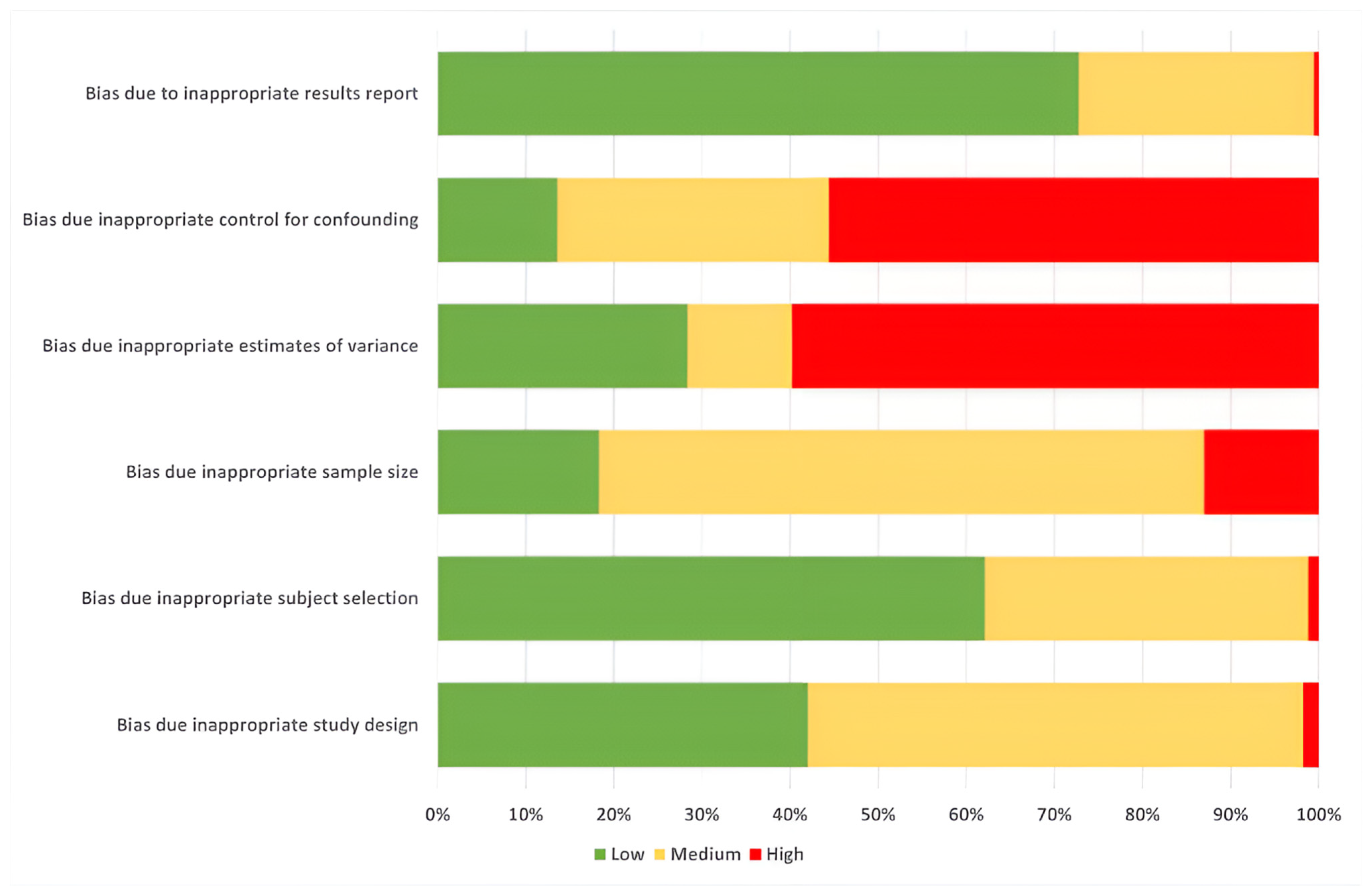
2.1. Quality Assessment
2.2. Beta-Lactam Resistance (ESBL- and AmpC-Producing Enterobacteriaceae)
2.2.1. Enterobacteriaceae—Prevalence in Feces
2.2.2. Enterobacteriaceae—Prevalence in Slaughterhouses
2.2.3. Enterobacteriaceae—Prevalence in Meat
2.2.4. Clinical Samples

| Author | DOI | Year | Country | Sample Type | Bacteria | n Samples (Isolates) | % Pheno-ESBL | % Pheno-AmpC | % Geno-ESBL | % Geno-AmpC | Denominator |
|---|---|---|---|---|---|---|---|---|---|---|---|
| Maciuca et al. [51] | 10.1089/mdr.2014.0248 | 2015 | Romania | cecal | E. coli | 127 (90) | 70.87% | 37.79% | 70.87% | 37.79% | S |
| Reich et al. [36] | 10.1016/j.fm.2015.10.020 | 2015 | Germany | neck skin/cecal | E. coli | 1800 | neck skin: 93.30%, cecal 90.00% | S | |||
| Alba et al. [52] | 10.3389/fmicb.2018.01217 | 2018 | Italy | cecal | E. coli | 300 (300) | 81.33% | S, I | |||
| Messaili et al. [53] | 10.12834/VetIt.799.3865.2 | 2019 | Algeria | intestine | E. coli | 100 (100) | 73.00% | 70.00% | S, I | ||
| Boulianne et al. [54] | n.a. | 2015 | Canada | cecal | E. coli | 1500 (962) | 45.11% | I | |||
| Romero-Barrios et al. [37] | 10.1089/fpd.2019.2776 | 2020 | Canada | carcasses | E. coli | (1135) | 35.95% | I | |||
| Belmahdi et al. [55] | 10.1016/j.jgar.2016.04.006 | 2016 | Algeria | cecal | E. coli | 61 (61) | 32.79% | 80.00% | 20.00% | I | |
| Parker et al. [56] | 10.1136/vr.103579 | 2016 | UK | cecal | E. coli | 125 | 28.80% | 9.60% | 28.00% | 6.40% | S |
| Thorsteinsdottir et al. [57] | 10.1111/j.1863-2378.2009.01256.x | 2008 | Iceland | cecal | E. coli | 146 (185) | 0.00% | S | |||
| Randall et al. [58] | 10.1093/jac/dkq396 | 2010 | UK | cecal | E. coli | 388 | 4.38% | 3.61% | S | ||
| Dierikx et al. [59] | 10.1016/j.vetmic.2010.03.019 | 2010 | The Netherlands | cecal | E. coli | (153) | 14.38% | 95.45% | 22.73% | I | |
| Girlich et al. [60] | 10.1128/AEM.02491-06 | 2007 | France | cecal | E. coli | 112 | 10.71% | 10.71% | S | ||
| Päivärinta et al. [61] | 10.1016/j.ijfoodmicro.2019.108361 | 2019 | Finland | cecal | E. coli | 605 (605) | 18.00% | 0.83% | 18.84% | S |
| Author | DOI | Year | Country | Bacteria | n Samples (Isolates) | % Pheno-ESBL | % Pheno-AmpC | % Geno-ESBL | % Geno-AmpC | Denominator |
|---|---|---|---|---|---|---|---|---|---|---|
| Egea et al. [62] | 10.1016/j.ijfoodmicro.2012.08.002 | 2012 | Spain | E. coli | 15 | 93.33% | S | |||
| Ghodousi et al. [63] | 10.1089/fpd.2015.1936 | 2015 | Italy | E. coli | 163 (134) | 91.79% | 98.51% | 11.19% | I | |
| Casella et al. [64] | 10.1016/j.ijfoodmicro.2017.07.005 | 2017 | France | E. coli | 48 (77) | 91.67% | 4.05% | 100% | 3.90% | I |
| Clemente et al. [65] | 10.3390/antibiotics10111333 | 2021 | Portugal | E. coli | 198 (60) | 76.67% | 21.67% | 100% | 1.67% | I |
| Kaesbohrer et al. [66] | 10.1016/j.vetmic.2019.03.025 | 2019 | Germany | E. coli | 199 (192) | 74.9% | 71.87% | 26.04% | S | |
| Belmar Campos et al. [67] | 10.1016/j.ijmm.2014.04.012 | 2014 | Germany | E. coli, Klebsiella spp. | 120 (87) | E. coli 60.00%, Klebsiella spp. 1.67% | 100% a | S | ||
| Overdevest et al. [68] | 10.3201/eid1707.110209 | 2011 | The Netherlands | E. coli, Klebsiella spp. | 89 (71) | E. coli 76.40%, Klebsiella spp. 6.74% | 83.15% a | S | ||
| Vogt et al. [69] | 10.1089/mdr.2013.0210 | 2014 | Switzerland | E. coli | 75 (68) | 73.33% | 73.33% | 17.33% | S | |
| Randall et al. [70] | 10.1016/j.ijfoodmicro.2016.10.036 | 2016 | UK | E. coli | 159 | 65.41% | 65.41% | S | ||
| Zarfel et al. [71] | 10.3390/ijerph111212582 | 2014 | Austria | E. coli | 50 | 52.00% | 52.00% | S | ||
| Forward et al. [72] | 10.1155/2004/695305 | 2004 | Canada | E. coli | 75 (43) | 97.67% | 90.70% | 90.7% | I | |
| Awosile et al. [73] | 10.1139/cjm-2020-0442 | 2020 | Canada | E. coli | 144 | 65.28% | 61.81% | 21.53% | 26.39% | S |
| Mollenkopf et al. [40] | 10.1089/fpd.2017.2390 | 2018 | USA | E. coli | 497 | 11.10% | 77.80% | 17.51% | 12.88% | S |
| Author | DOI | Year | Country | Bacteria | n Samples (Isolates) | % Pheno-ESBL | % Pheno-AmpC | % Geno-ESBL | % Geno-AmpC | Denominator |
|---|---|---|---|---|---|---|---|---|---|---|
| Abdallah et al. [74] | 10.1371/journal.pone.0136052 | 2015 | Egypt | KEC, E. coli | 100 (106) | Klebsiella spp. 41.07%, Enterobacter spp. 11.61%, Citrobacter spp. 0.00%, E. coli 8.93% | 65.09% a | S | ||
| Sheikh et al. [75] | 10.1089/fpd.2011.1078 | 2012 | Canada | E. coli | 206 (193) | 28.15% | 75.13% | 25.24% | S | |
| Moawad et al. [76] | 10.1186/s13099-017-0206-9 | 2017 | Egypt | E. coli | 90 (15) | 40.00% | 66.67% | I | ||
| Kola et al. [77] | 10.1093/jac/dks295 | 2012 | Germany | E. coli, Enterobacter spp. | 399 | 46.30% a | I | |||
| Hadžić-Hasanović et al. [78] | 10.17392/1206-20 | 2020 | Bosnia and Herzegovina | E. coli | 100 (64) | 29.00% | 24.00% | S | ||
| Randall et al. [79] | 10.1111/jam.14687 | 2020 | UK | E. coli | 622 | 2016: 45.00%, 2018: 13.60% | 11.25% | 18.48% | S | |
| Börjesson et al. [80] | 10.3201/eid2204.151142 | 2016 | Sweden | E. coli | 368 (190) | 8.42% | 40.49% | S |
| Author | DOI | Year | Country | Bacteria | n Samples (Isolates) | % Pheno-ESBL (S/I) | % Pheno-AmpC (S/I) | % Geno-ESBL (S/I) | % Geno-AmpC (S/I) | Denominator |
|---|---|---|---|---|---|---|---|---|---|---|
| Ružauskas et al. [81] | n.a. | 2010 | Lithuania | E. coli | 240 (100) | 7% | S | |||
| Agersø et al. [82] | 10.1093/jac/dkr507 | 2012 | Denmark | E. coli | 153 | 3.3% | 35.75% | 47.83% | S | |
| Chenouf et al. [83] | 10.1089/mdr.2020.0024 | 2020 | Algeria | E. coli, Klebsiella spp. | 136 (78) | E. coli 5.88%, Klebsiella spp. 3.58% | 9.56% a | S | ||
| Mollenkopf et al. [40] | 10.1089/fpd.2017.2390 | 2018 | USA | E. coli | 497 | 11.1% | 77.8% | S |
2.2.5. Comparison of Different Farming Conditions
2.2.6. Wastewater
2.2.7. Studies Investigating Only Klebsiella spp.
2.2.8. Other Targets
2.3. Carbapenem Resistance
2.4. Colistin Resistance
2.4.1. Prevalence Studies
2.4.2. Comparison of Different Farming Conditions
2.4.3. Clinical Samples
2.4.4. Wastewater
2.4.5. Other Targets
2.5. Fluoroquinolone Resistance
2.5.1. Prevalence Studies
2.5.2. Studies with Non-Prevalence Primary Objectives
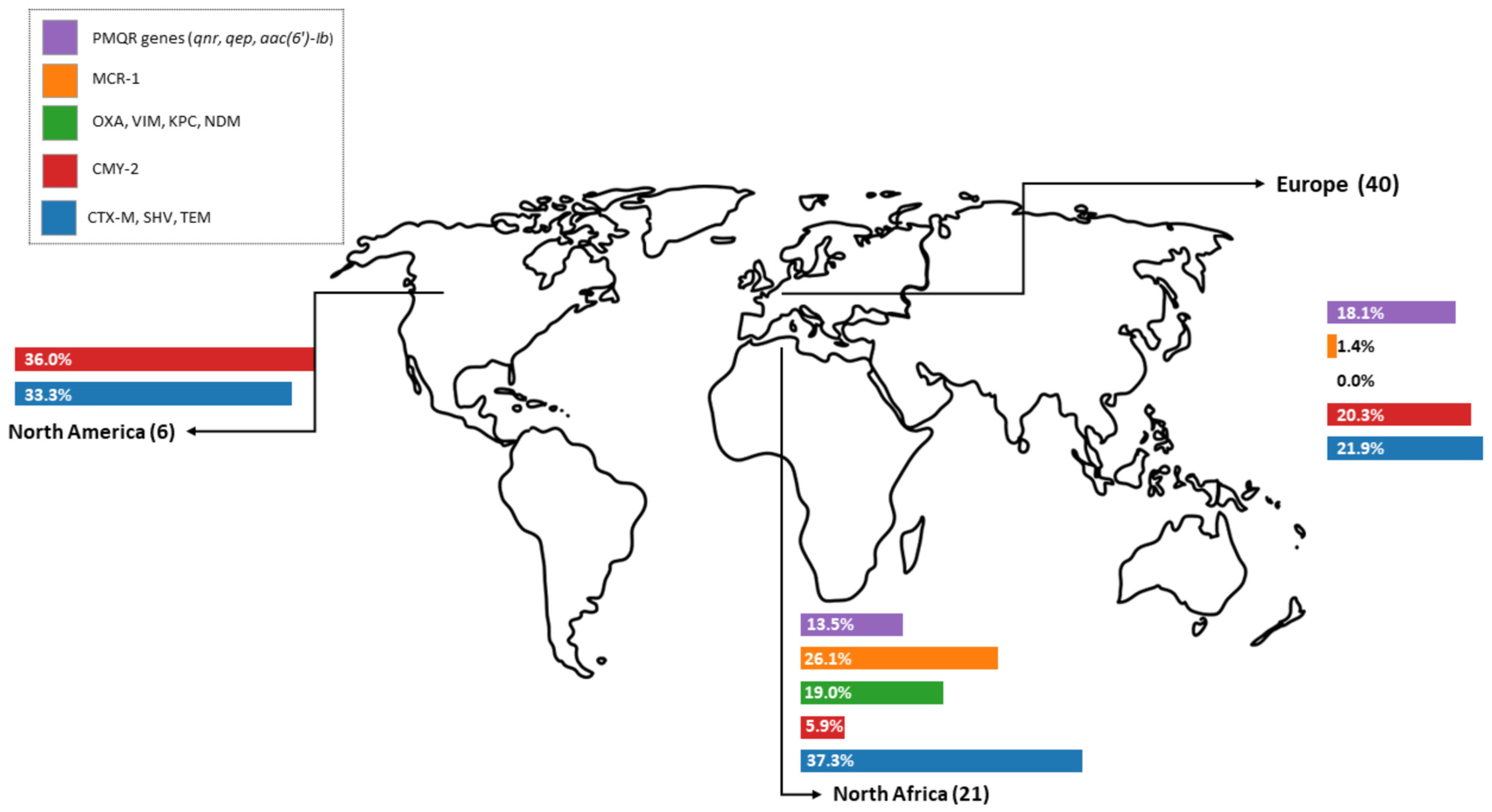
Europe
North America
North Africa
Wastewater
Clinical Samples
Other Targets
| Author | DOI | Year | Country | Sample Type | Bacteria | n Samples (Isolates) | % Pheno-R | Denominator |
|---|---|---|---|---|---|---|---|---|
| Ramadan and Awad [99] | 10.1186/s12941-016-0174-9 | 2016 | Egypt | samples other than feces | E. coli | 400 (116) | 41.38% | I |
| Ceccarelli et al. [34] | 10.1099/jmm.0.001176 | 2020 | The Netherlands | feces | E. coli | (1811) | 62.23% | I |
| Gousia et al. [116] | 10.1089=fpd.2010.0577 | 2011 | Greece | meat | E. coli | 19 (8) | 62.50% | I |
| Hanon et al. [38] | 10.1016/j.prevetmed.2015.09.001 | 2015 | Belgium | samples other than feces | E. coli | (1132) | >50.00% | I |
| Kaesbohrer et al. [145] | 10.1111/j.1863-2378.2011.01451.x | 2012 | Germany | meat, feces | E. coli | (397) | meat: 53.10%, feces: 43.10% | I |
| Mainali et al. [146] | 10.4315/0362-028X.JFP-13-203 | 2013 | Canada | samples other than feces | E. coli | (600) | 0.00% | I |
| Ružauskas et al. [81] | n.a. | 2010 | Lithuania | samples other than feces | E. coli | 240 (100) | 47.00% | I |
| Zhao et al. [147] | 10.1128/AEM.07522-11 | 2012 | USA | meat | E. coli | (2494) | 0.00% | I |
| Manageiro et al. [124] | 10.1016/j.ijfoodmicro.2017.10.007 | 2017 | Portugal | samples other than feces | E. coli | 680 (202) | 90.60% | S, I |
| Chenouf et al. [83] | 10.1089/mdr.2020.0024 | 2020 | Algeria | meat | E. coli, Klebsiella spp. | 136 (78) | 60.20% a | I |
| Thorsteinsdottir et al. [57] | 10.1111/j.1863-2378.2009.01256.x | 2010 | Iceland | cecal, meat | E. coli | 146 (185) | cecal: 18.20%, meat: 36.00% | I |
| Author | DOI | Year | Country | Sample Type | Bacteria | n Samples (Isolates) | % Pheno-R | Denominator |
|---|---|---|---|---|---|---|---|---|
| Casella et al. [64] | 10.1016/j.ijfoodmicro.2017.07.005 | 2017 | France | meat | E. coli | 48 (77) | 20.80% | I |
| Egea et al. [122] | 10.1016/j.ijfoodmicro.2012.08.002 | 2012 | Spain | meat | E. coli | 15 | 32.26% | I |
| Fetahagić et al. [28] | 10.2478/aiht-2021-72-3560 | 2021 | Bosnia and Herzegovina | feces | E. coli | 108 | 10.67% | I |
| Geser et al. [27] | 10.1186/1746-6148-8-21 | 2012 | Switzerland | feces | E. coli | 93 | 6.45% | I |
| Gregova et al. [108] | 2012 | Slovakia | processing plant of a slaughterhouse | E. coli | (48) | 43.00% | I | |
| Hricová et al. [148] | 10.21101/cejph.a4328 | 2017 | Czech Republic | bedding | E. coli | 126 (126) | 61.11% | S, I |
| Martínez-Álvarez et al. [112] | 10.3390/antibiotics11040444 | 2022 | Spain | air, manure | E. coli | 111 (111) | 38.70% | S, I |
| Musa et al. [87] | 10.3390/ani10071215 | 2020 | Italy | cloacal, skin | E. coli | (conventional 135, ABF 131, organic 140) | conventional 44.4%, ABF 20.6%, organic 23.6% | I |
| Zarfel et al. [71] | 10.3390/ijerph111212582 | 2014 | Austria | meat | E. coli | 50 | 0.00% | S |
| De Koster et al. [19] | 10.3390/antibiotics10080945 | 2021 | Belgium, The Netherlands | feces | E. coli | 779 | 84.81% | S |
| García-Béjar et al. [114] | 10.3390/ani11113197 | 2021 | Spain | meat | E. coli | 30 (240) | ca. 25.00% | I |
| Randall et al. [70] | 10.1093/jac/dkq396 | 2010 | UK | cecal | E. coli | 388 | 4.60% | I |
| Much et al. [88] | 10.1016/j.prevetmed.2019.104755 | 2019 | Austria | cecal | E. coli | 1031 (962) | 63.83% | I |
| Pesciaroli et al. [89] | 10.1016/j.ijfoodmicro.2019.108391 | 2019 | Italy | cecal, different production systems | E. coli | 855 (854) | conventional 67.7%, ABF 42.8%, organic 45.2% | I |
| Maciuca et al. [51] | 10.1089/mdr.2014.0248 | 2015 | Romania | cecal | E. coli | 127 (90) | 87.79% | I |
| Myrenås et al. [135] | 10.1016/j.vetmic.2017.11.015 | 2017 | Norway, Sweden, Iceland | cecal, meat | E. coli | (319) | 13.50% | I |
| Pavlickova et al. [117] | 10.1080/03601234.2015.1011959 | 2014 | Czech Republic | meat | E. coli | (75) | 16.00% | I |
| Persoons et al. [30] | 10.1089/mdr.2009.0062 | 2010 | Belgium | cloacal, cecal, neck skin | E. coli, Enterobacter spp. | 2249 (2076) | 14.98% a | I |
| Vanni et al. [149] | 10.3382/ps.2013-03627 | 2014 | Italy | feces, organ | E. coli | (235) | 24.20% | I |
| Wasyl et al. [150] | 10.3389/fmicb.2013.00221 | 2013 | Poland | cloacal | E. coli | 753 (682) | 72.24% | S |
| Galler et al. [151] | 10.3390/antibiotics10040466 | 2021 | Austria | intestine | E. coli | 100 | 0.00% | S |
2.5.3. Comparison of Phenotypic and Genotypic Fluoroquinolone-Resistant Enterobacteriaceae
2.5.4. PCR-Confirmed Fluoroquinolone-Resistant Enterobacteriaceae
2.6. Regional and Overall Occurrence of Genotypic Resistance Patterns
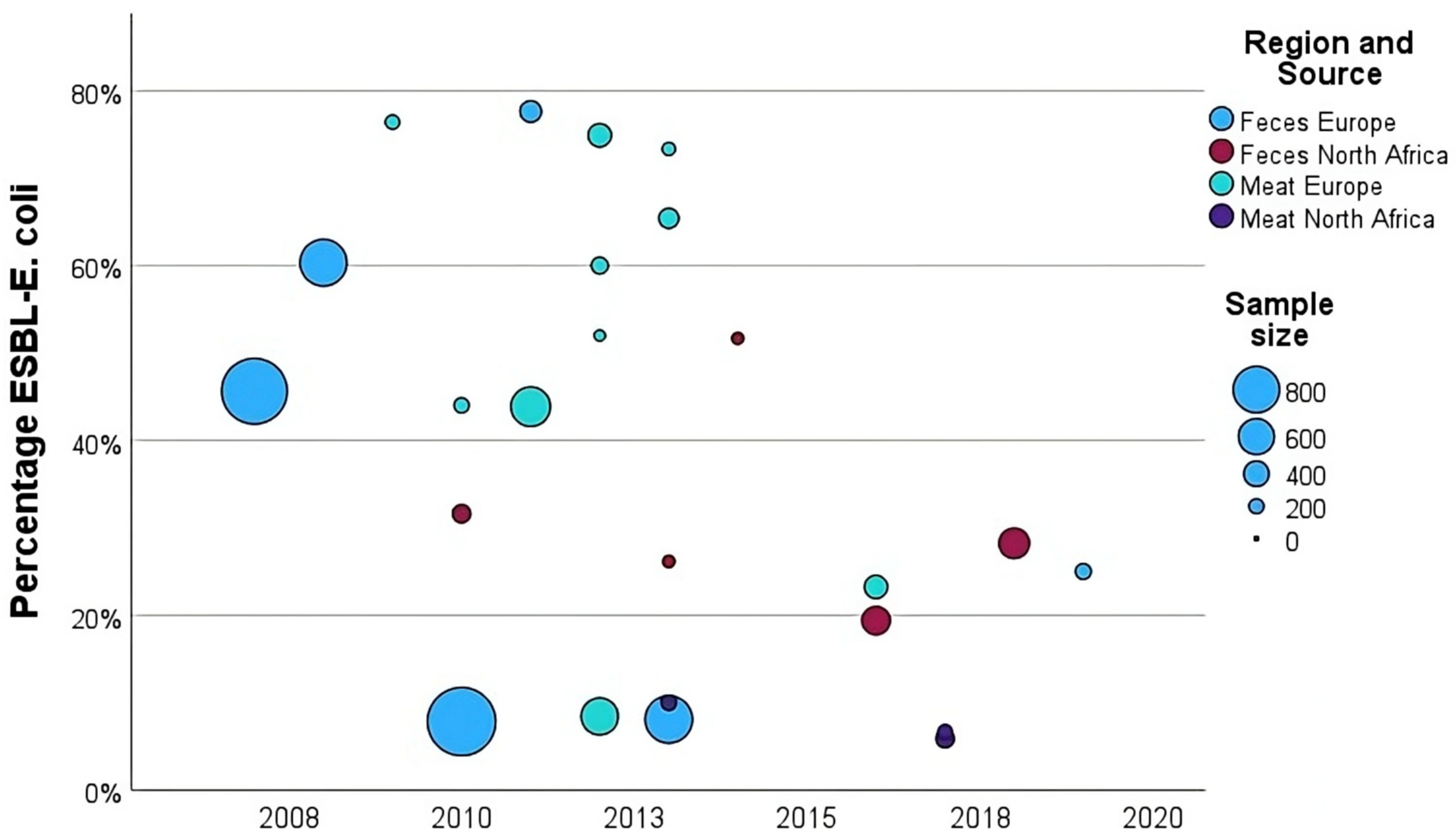
2.7. Prevalence in Meat and Feces
2.7.1. Negative Binomial Regression Model
2.7.2. Meta-Analyses
3. Discussion
3.1. General
3.2. Beta-Lactam Resistance (ESBL- and AmpC-Producing Enterobacteriaceae)
3.3. Carbapenem Resistance
3.4. Colistin Resistance
3.5. Fluoroquinolone Resistance
3.6. Regional and Overall Occurrence (Genotypic)
3.7. Analyses of Prevalence Data
Meta-Analyses
3.8. Conclusions
4. Materials and Methods
4.1. Inclusion and Exclusion
4.2. Search Strategy
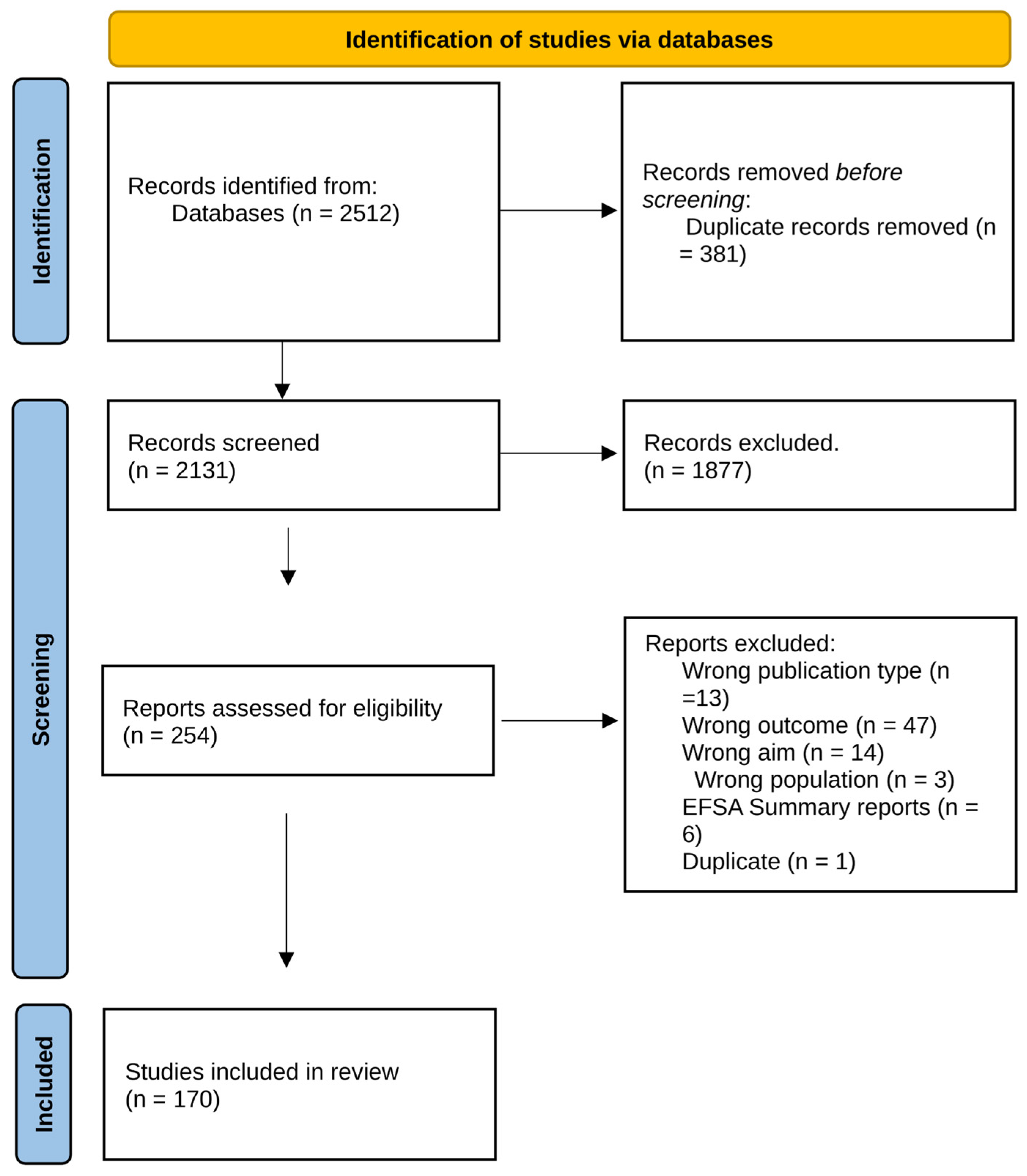
4.3. Study Selection
4.4. Data Extraction from Eligible Studies
4.5. Data Analysis
4.6. Regional and Overall Occurrence of Genotypic Resistance Patterns
4.7. Analyses of Prevalence Data
4.8. Meta-Analyses
4.9. Quality Assessment
Supplementary Materials
Author Contributions
Funding
Institutional Review Board Statement
Informed Consent Statement
Data Availability Statement
Acknowledgments
Conflicts of Interest
References
- Ferri, M.; Ranucci, E.; Romagnoli, P.; Giaccone, V. Antimicrobial resistance: A global emerging threat to public health systems. Crit. Rev. Food Sci. Nutr. 2017, 57, 2857–2876. [Google Scholar] [CrossRef]
- Luz, C.F.; van Niekerk, J.M.; Keizer, J.; Jong, N.B.; Braakman-Jansen, L.; Stein, A.; Sinha, B.; van Gemert-Pijnen, J.; Glasner, C. Mapping Twenty Years of Antimicrobial Resistance Research Trends. Artif. Intell. Med. 2022, 123, 102216. [Google Scholar] [CrossRef] [PubMed]
- Abreu, R.; Semedo-Lemsaddek, T.; Cunha, E.; Tavares, L.; Oliveira, M. Antimicrobial Drug Resistance in Poultry Production: Current Status and Innovative Strategies for Bacterial Control. Microorganisms 2023, 11, 953. [Google Scholar] [CrossRef] [PubMed]
- Madni, W.A.; Zahoor, M.A.; Nawaz, Z.; Khurshid, M. Prevalence and Sequence Analysis of Escherichia coli Harboring Colistin, Gentamicin, Streptomycin, Tetracycline and Quinolones Resistant Genes from Commercial Broilers. Pak. Vet. J. 2025, 45, 390–395. [Google Scholar] [CrossRef]
- Shoaib, M.; Hameed, M.F.; Aqib, A.I.; Wang, W.; Wang, Q.; Wang, S.; Pu, W. Emerging threat of antimicrobial resistance determinants and plasmid replicon types acquisition by Escherichia coli of poultry and other food-producing animal origin in China: Local findings with global implications. Poult. Sci. 2025, 104, 106055. [Google Scholar] [CrossRef]
- Laube, H.; Friese, A.; von Salviati, C.; Guerra, B.; Käsbohrer, A.; Kreienbrock, L.; Roesler, U. Longitudinal monitoring of extended-spectrum-beta-lactamase/AmpC-producing Escherichia coli at German broiler chicken fattening farms. Appl. Environ. Microbiol. 2013, 79, 4815–4820. [Google Scholar] [CrossRef]
- Dierikx, C.; van der Goot, J.; Fabri, T.; van Essen-Zandbergen, A.; Smith, H.; Mevius, D. Extended-spectrum-β-lactamase- and AmpC-β-lactamase-producing Escherichia coli in Dutch broilers and broiler farmers. J. Antimicrob. Chemother. 2013, 68, 60–67. [Google Scholar] [CrossRef]
- Landoni, M.F.; Albarellos, G. The use of antimicrobial agents in broiler chickens. Vet. J. 2015, 205, 21–27. [Google Scholar] [CrossRef]
- Kyung-Hyo, D.; Su-Jin, C.; Chang, J.M.; Seong-Won, L.; Suk-Kyung, L.; Hyun-Mi, K.; Kwang-Won, S.; Wan-Kyu, L. Comparative Analysis of Biosecurity Practices, Antimicrobial Usage and Antimicrobial Resistance in Korean Pig Farms by Farm Type. Pak. Vet. J. 2025, 45, 873. [Google Scholar] [CrossRef]
- Van Boeckel, T.P.; Brower, C.; Gilbert, M.; Grenfell, B.T.; Levin, S.A.; Robinson, T.P.; Teillant, A.; Laxminarayan, R. Global trends in antimicrobial use in food animals. Proc. Natl. Acad. Sci. USA 2015, 112, 5649–5654. [Google Scholar] [CrossRef]
- Ribeiro, J.; Silva, V.; Monteiro, A.; Vieira-Pinto, M.; Igrejas, G.; Reis, F.S.; Barros, L.; Poeta, P. Antibiotic Resistance among Gastrointestinal Bacteria in Broilers: A Review Focused on Enterococcus spp. and Escherichia coli. Animals 2023, 13, 1362. [Google Scholar] [CrossRef] [PubMed]
- Nawaz, S.; Shoaib, M.; Huang, C.; Jiang, W.; Bao, Y.; Wu, X.; Nie, L.; Fan, W.; Wang, Z.; Chen, Z.; et al. Molecular Characterization, Antibiotic Resistance, and Biofilm Formation of Escherichia coli Isolated from Commercial Broilers from Four Chinese Provinces. Microorganisms 2025, 13, 1017. [Google Scholar] [CrossRef] [PubMed]
- Nhung, N.T.; Chansiripornchai, N.; Carriquw-Mas, J.J. Antimicrobial Resistance in Bacterial Poultry Pathogens: A Review. Front. Vet. Sci. 2017, 4, 126. [Google Scholar] [CrossRef] [PubMed]
- Iskandar, K.; Molinier, L.; Hallit, S.; Sartelli, M.; Hardcastle, T.C.; Haque, M.; Lugova, H.; Dhingra, S.; Sharma, P.; Islam, S.; et al. Surveillance of antimicrobial resistance in low- and middle-income countries: A scattered picture. Antimicrob. Resist. Infect. Control 2021, 10, 63. [Google Scholar] [CrossRef]
- ENVIRE. Research Consortium ENVIRE: Interventions to Control the Dynamics of Antimicrobial Resistance from Chickens Through the Environment. Available online: https://www.envire-project.de/ (accessed on 14 January 2025).
- Mesa, R.J.; Blanc, V.; Blanch, A.R.; Cortés, P.; González, J.J.; Lavilla, S.; Miró, E.; Muniesa, M.; Saco, M.; Tórtola, M.T.; et al. Extended-spectrum beta-lactamase-producing Enterobacteriaceae in different environments (humans, food, animal farms and sewage). J. Antimicrob. Chemother. 2006, 58, 211–215. [Google Scholar] [CrossRef]
- Blanc, V.; Mesa, R.; Saco, M.; Lavilla, S.; Prats, G.; Miró, E.; Navarro, F.; Cortés, P.; Llagostera, M. ESBL- and plasmidic class C beta-lactamase-producing E. coli strains isolated from poultry, pig and rabbit farms. Vet. Microbiol. 2006, 118, 299–304. [Google Scholar] [CrossRef]
- Abreu, R.; Castro, B.; Espigares, E.; Rodríguez-Álvarez, C.; Lecuona, M.; Moreno, E.; Espigares, M.; Arias, Á. Prevalence of CTX-M-Type extended-spectrum β-lactamases in Escherichia coli strains isolated in poultry farms. Foodborne Pathog. Dis. 2014, 11, 868–873. [Google Scholar] [CrossRef]
- De Koster, S.; Ringenier, M.; Lammens, C.; Stegeman, A.; Tobias, T.; Velkers, F.; Vernooij, H.; Kluytmans-van den Bergh, M.; Kluytmans, J.; Dewulf, J.; et al. ESBL-Producing, Carbapenem- and Ciprofloxacin-Resistant Escherichia coli in Belgian and Dutch Broiler and Pig Farms: A Cross-Sectional and Cross-Border Study. Antibiotics 2021, 10, 945. [Google Scholar] [CrossRef]
- Huijbers, P.M.C.; Graat, E.A.M.; Haenen, A.P.J.; van Santen, M.G.; van Essen-Zandbergen, A.; Mevius, D.J.; van Duijkeren, E.; van Hoek, A.H.A.M. Extended-spectrum and AmpC β-lactamase-producing Escherichia coli in broilers and people living and/or working on broiler farms: Prevalence, risk factors and molecular characteristics. J. Antimicrob. Chemother. 2014, 69, 2669–2675. [Google Scholar] [CrossRef]
- Huijbers, P.M.C.; van Hoek, A.H.A.M.; Graat, E.A.M.; Haenen, A.P.J.; Florijn, A.; Hengeveld, P.D.; van Duijkeren, E. Methicillin-resistant Staphylococcus aureus and extended-spectrum and AmpC β-lactamase-producing Escherichia coli in broilers and in people living and/or working on organic broiler farms. Vet. Microbiol. 2015, 176, 120–125. [Google Scholar] [CrossRef]
- Smet, A.; Martel, A.; Persoons, D.; Dewulf, J.; Heyndrickx, M.; Catry, B.; Herman, L.; Haesebrouck, F.; Butaye, P. Diversity of extended-spectrum beta-lactamases and class C beta-lactamases among cloacal Escherichia coli Isolates in Belgian broiler farms. Antimicrob. Agents Chemother. 2008, 52, 1238–1243. [Google Scholar] [CrossRef] [PubMed]
- Hering, J.; Frömke, C.; von Münchhausen, C.; Hartmann, M.; Schneider, B.; Friese, A.; Rösler, U.; Kreienbrock, L.; Hille, K. Cefotaxime-resistant Escherichia coli in broiler farms-A cross-sectional investigation in Germany. Prev. Vet. Med. 2016, 125, 154–157. [Google Scholar] [CrossRef] [PubMed]
- Sghaier, S.; Abbassi, M.S.; Pascual, A.; Serrano, L.; Díaz-De-Alba, P.; Said, M.B.; Hassen, B.; Ibrahim, C.; Hassen, A.; López-Cerero, L. Extended-spectrum β-lactamase-producing Enterobacteriaceae from animal origin and wastewater in Tunisia: First detection of O25b-B2(3)-CTX-M-27-ST131 Escherichia coli and CTX-M-15/OXA-204-producing Citrobacter freundii from wastewater. J. Glob. Antimicrob. Resist. 2019, 17, 189–194. [Google Scholar] [CrossRef]
- Päivärinta, M.; Pohjola, L.; Fredriksson-Ahomaa, M.; Heikinheimo, A. Low Occurrence of Extended-Spectrum β-lactamase-Producing Escherichia coli in Finnish Food-Producing Animals. Zoonoses Public Health 2016, 63, 624–631. [Google Scholar] [CrossRef]
- Costa, D.; Vinué, L.; Poeta, P.; Coelho, A.C.; Matos, M.; Sáenz, Y.; Somalo, S.; Zarazaga, M.; Rodrigues, J.; Torres, C. Prevalence of extended-spectrum beta-lactamase-producing Escherichia coli isolates in faecal samples of broilers. Vet. Microbiol. 2009, 138, 339–344. [Google Scholar] [CrossRef]
- Geser, N.; Stephan, R.; Hächler, H. Occurrence and characteristics of extended-spectrum β-lactamase (ESBL) producing Enterobacteriaceae in food producing animals, minced meat and raw milk. BMC Vet. Res. 2012, 8, 21. [Google Scholar] [CrossRef]
- Fetahagić, M.; Ibrahimagić, A.; Uzunović, S.; Beader, N.; Elveđi-Gašparović, V.; Luxner, J.; Gladan, M.; Bedenić, B. Detection and characterisation of extended-spectrum and plasmid-mediated AmpC β-lactamase. Arch. Ind. Hyg. Toxicol. 2021, 72, 305–314. [Google Scholar] [CrossRef]
- Balázs, B.; Bálint, N.J.; Tóth, Z.; Nagy, F.; Károlyi, S.; Turcsányi, I.; Bistyák, A.; Kálmán, A.; Sárközi, R.; Kardos, G. Occurrence of Escherichia coli producing extended spectrum ß-lactamases in food-producing animals. Acta Vet. Hung 2021, 69, 211–215. [Google Scholar] [CrossRef]
- Persoons, D.; Dewulf, J.; Smet, A.; Herman, L.; Heyndrickx, M.; Martel, A.; Catry, B.; Butaye, P.; Haesebrouck, F. Prevalence and persistence of antimicrobial resistance in broiler indicator bacteria. Microb. Drug Resist. 2010, 16, 67–74. [Google Scholar] [CrossRef]
- Abbassi, M.S.; Kilani, H.; Abid, I.; Sáenz, Y.; Hynds, P.; Lengliz, S.; Ben Chehida, N.; Boutiba-Ben Boubaker, I. Genetic Background of Antimicrobial Resistance in Multiantimicrobial-Resistant Escherichia coli Isolates from Feces of Healthy Broiler Chickens in Tunisia. BioMed Res. Int. 2021, 2021, 1269849. [Google Scholar] [CrossRef]
- Moawad, A.A.; Hotzel, H.; Neubauer, H.; Ehricht, R.; Monecke, S.; Tomaso, H.; Hafez, H.M.; Roesler, U.; El-Adawy, H. Antimicrobial resistance in Enterobacteriaceae from healthy broilers in Egypt: Emergence of colistin-resistant and extended-spectrum β-lactamase-producing Escherichia coli. Gut Pathog. 2018, 10, 39. [Google Scholar] [CrossRef]
- Agunos, A.; Arsenault, R.K.; Avery, B.P.; Deckert, A.E.; Gow, S.P.; Janecko, N.; Léger, D.F.; Parmley, E.J.; Reid-Smith, R.J.; McEwen, S.A. Changes in antimicrobial resistance levels among Escherichia coli, Salmonella, and Campylobacter in Ontario broiler chickens between 2003 and 2015. Can. J. Vet. Res. 2018, 82, 163–177. [Google Scholar] [PubMed]
- Ceccarelli, D.; Hesp, A.; van der Goot, J.; Joosten, P.; Sarrazin, S.; Wagenaar, J.A.; Dewulf, J.; Mevius, D.J.; on behalf of the Effort Consortium. Antimicrobial resistance prevalence in commensal Escherichia coli from broilers, fattening turkeys, fattening pigs and veal calves in European countries and association with antimicrobial usage at country level. J. Med. Microbiol. 2020, 69, 537–547. [Google Scholar] [CrossRef]
- Wasyl, D.; Hasman, H.; Cavaco, L.M.; Aarestrup, F.M. Prevalence and characterization of cephalosporin resistance in nonpathogenic Escherichia coli from food-producing animals slaughtered in Poland. Microb. Drug Resist. 2012, 18, 79–82. [Google Scholar] [CrossRef]
- Reich, F.; Schill, F.; Atanassova, V.; Klein, G. Quantification of ESBL-Escherichia coli on broiler carcasses after slaughtering in Germany. Food Microbiol. 2016, 54, 1–5. [Google Scholar] [CrossRef]
- Romero-Barrios, P.; Deckert, A.; Parmley, E.J.; Leclair, D. Antimicrobial Resistance Profiles of Escherichia coli and Salmonella Isolates in Canadian Broiler Chickens and Their Products. Foodborne Pathog. Dis. 2020, 17, 672–678. [Google Scholar] [CrossRef]
- Hanon, J.-B.; Jaspers, S.; Butaye, P.; Wattiau, P.; Méroc, E.; Aerts, M.; Imberechts, H.; Vermeersch, K.; Van der Stede, Y. A trend analysis of antimicrobial resistance in commensal Escherichia coli from several livestock species in Belgium (2011–2014). Prev. Veter. Med. 2015, 122, 443–452. [Google Scholar] [CrossRef]
- Pacholewicz, E.; Liakopoulos, A.; Swart, A.; Gortemaker, B.; Dierikx, C.; Havelaar, A.; Schmitt, H. Reduction of extended-spectrum-β-lactamase- and AmpC-β-lactamase-producing Escherichia coli through processing in two broiler chicken slaughterhouses. Int. J. Food Microbiol. 2015, 215, 57–63. [Google Scholar] [CrossRef]
- Mollenkopf, D.F.; De Wolf, B.; Feicht, S.M.; Cenera, J.K.; King, C.A.; van Balen, J.C.; Wittum, T.E. Salmonella spp. and Extended-Spectrum Cephalosporin-Resistant Escherichia coli Frequently Contaminate Broiler Chicken Transport Cages of an Organic Production Company. Foodborne Pathog. Dis. 2018, 15, 583–588. [Google Scholar] [CrossRef]
- Amer, M.M.; Mekky, H.M.; Amer, A.M.; Fedawy, H.S. Antimicrobial resistance genes in pathogenic Escherichia coli isolated from diseased broiler chickens in Egypt and their relationship with the phenotypic resistance characteristics. Vet. World 2018, 11, 1082–1088. [Google Scholar] [CrossRef]
- Awad, A.; Arafat, N.; Elhadidy, M. Genetic elements associated with antimicrobial resistance among avian pathogenic Escherichia coli. Ann. Clin. Microbiol. Antimicrob. 2016, 15, 59. [Google Scholar] [CrossRef]
- Badr, H.; Reda, R.M.; Hagag, N.M.; Kamel, E.; Elnomrosy, S.M.; Mansour, A.I.; Shahein, M.A.; Ali, S.F.; Ali, H.R. Multidrug-Resistant and Genetic Characterization of Extended-Spectrum Beta-Lactamase-Producing E. coli Recovered from Chickens and Humans in Egypt. Animals 2022, 12, 346. [Google Scholar] [CrossRef]
- Dhaouadi, S.; Soufi, L.; Hamza, A.; Fedida, D.; Zied, C.; Awadhi, E.; Mtibaa, M.; Hassen, B.; Cherif, A.; Torres, C.; et al. Co-occurrence of mcr-1 mediated colistin resistance and β-lactamase-encoding genes in multidrug-resistant Escherichia coli from broiler chickens with colibacillosis in Tunisia. J. Glob. Antimicrob. Resist. 2020, 22, 538–545. [Google Scholar] [CrossRef]
- El-Shazly, D.A.; Nasef, S.A.; Mahmoud, F.F.; Jonas, D. Expanded spectrum β-lactamase producing Escherichia coli isolated from chickens with colibacillosis in Egypt. Poult. Sci. 2017, 96, 2375–2384. [Google Scholar] [CrossRef]
- Varga, C.; Brash, M.L.; Slavic, D.; Boerlin, P.; Ouckama, R.; Weis, A.; Petrik, M.; Philippe, C.; Barham, M.; Guerin, M.T. Evaluating Virulence-Associated Genes and Antimicrobial Resistance of Avian Pathogenic Escherichia coli Isolates from Broiler and Broiler Breeder Chickens in Ontario, Canada. Avian Dis. 2018, 62, 291–299. [Google Scholar] [CrossRef]
- Huang, T.-M.; Lin, T.L.; Wu, C.C. Antimicrobial susceptibility and resistance of chicken Escherichia coli, Salmonella spp., and Pasteurella multocida isolates. Avian Dis. 2009, 53, 89–93. [Google Scholar] [CrossRef]
- Michael, G.B.; Kaspar, H.; Siqueira, A.K.; de Freitas Costa, E.; Corbellini, L.G.; Kadlec, K.; Schwarz, S. Extended-spectrum β-lactamase (ESBL)-producing Escherichia coli isolates collected from diseased food-producing animals in the GERM-Vet monitoring program 2008–2014. Vet. Microbiol. 2017, 200, 142–150. [Google Scholar] [CrossRef]
- Mesa-Varona, O.; Kaspar, H.; Grobbel, M.; Tenhagen, B.-A. Phenotypical antimicrobial resistance data of clinical and non-clinical Escherichia coli from poultry in Germany between 2014 and 2017. PLoS ONE 2020, 15, e0243772. [Google Scholar] [CrossRef]
- Niero, G.; Bortolaia, V.; Vanni, M.; Intorre, L.; Guardabassi, L.; Piccirillo, A. High diversity of genes and plasmids encoding resistance to third-generation cephalosporins and quinolones in clinical Escherichia coli from commercial poultry flocks in Italy. Vet. Microbiol. 2018, 216, 93–98. [Google Scholar] [CrossRef]
- Maciuca, I.E.; Williams, N.J.; Tuchilus, C.; Dorneanu, O.; Guguianu, E.; Carp-Carare, C.; Rimbu, C.; Timofte, D. High Prevalence of Escherichia coli-Producing CTX-M-15 Extended-Spectrum Beta-Lactamases in Poultry and Human Clinical Isolates in Romania. Microb. Drug Resist. 2015, 21, 651–662. [Google Scholar] [CrossRef]
- Alba, P.; Battisti, A.; Bortolaia, V.; Caprioli, A.; Feltrin, F.; Franco, A.; Hendriksen, R.S.; Ianzano, A.; Leekitcharoenphon, P.; Stravino, F. Molecular Epidemiology of mcr-Encoded Colistin Resistance in Enterobacteriaceae From Food-Producing Animals in Italy Revealed Through the EU Harmonized Antimicrobial Resistance Monitoring. Front. Microbiol. 2018, 9, 1217. [Google Scholar] [CrossRef]
- Messaili, C.; Messai, Y.; Bakour, R. Virulence gene profiles, antimicrobial resistance and phylogenetic groups of fecal Escherichia coli strains isolated from broiler chickens in Algeria. Vet. Ital. 2019, 55, 35–46. [Google Scholar] [CrossRef]
- Boulianne, M.; Arsenault, J.; Daignault, D.; Archambault, M.; Letellier, A.; Dutil, L. Drug use and antimicrobial resistance among Escherichia coli and Enterococcus spp. isolates from chicken and turkey flocks slaughtered in Quebec, Canada. Can. J. Vet. Res. 2016, 80, 49–59. [Google Scholar]
- Belmahdi, M.; Bakour, S.; Al Bayssari, C.; Touati, A.; Rolain, J.-M. Molecular characterisation of extended-spectrum β-lactamase- and plasmid AmpC-producing Escherichia coli strains isolated from broilers in Béjaïa, Algeria. J. Glob. Antimicrob. Resist. 2016, 6, 108–112. [Google Scholar] [CrossRef]
- Parker, D.; Lemma, F.; Randall, L. Industry survey of Great Britain-sourced broilers for extended-spectrum beta-lactamase and Amp C beta-lactamase-producing Escherichia coli. Vet. Rec. 2016, 178, 474. [Google Scholar] [CrossRef]
- Thorsteinsdottir, T.R.; Haraldsson, G.; Fridriksdottir, V.; Kristinsson, K.G.; Gunnarsson, E. Prevalence and genetic relatedness of antimicrobial-resistant Escherichia coli isolated from animals, foods and humans in Iceland. Zoonoses Public Health 2010, 57, 189–196. [Google Scholar] [CrossRef]
- Randall, L.P.; Clouting, C.; Horton, R.A.; Coldham, N.G.; Wu, G.; Clifton-Hadley, F.A.; Davies, R.H.; Teale, C.J. Prevalence of Escherichia coli carrying extended-spectrum β-lactamases (CTX-M and TEM-52) from broiler chickens and turkeys in Great Britain between 2006 and 2009. J. Antimicrob. Chemother. 2011, 66, 86–95. [Google Scholar] [CrossRef]
- Dierikx, C.; van Essen-Zandbergen, A.; Veldman, K.; Smith, H.; Mevius, D. Increased detection of extended spectrum beta-lactamase producing Salmonella enterica and Escherichia coli isolates from poultry. Vet. Microbiol. 2010, 145, 273–278. [Google Scholar] [CrossRef]
- Girlich, D.; Poirel, L.; Carattoli, A.; Kempf, I.; Lartigue, A.-F.; Bertini, A.; Nordmann, P. Extended-spectrum beta-lactamase CTX-M-1 in Escherichia coli isolates from healthy poultry in France. Appl. Environ. Microbiol. 2007, 73, 4681–4685. [Google Scholar] [CrossRef]
- Päivärinta, M.; Latvio, S.; Fredriksson-Ahomaa, M.; Heikinheimo, A. Whole genome sequence analysis of antimicrobial resistance genes, multilocus sequence types and plasmid sequences in ESBL/AmpC Escherichia coli isolated from broiler caecum and meat. Int. J. Food Microbiol. 2020, 315, 108361. [Google Scholar] [CrossRef]
- Egea, P.; López-Cerero, L.; Torres, E.; Gómez-Sánchez, M.d.C.; Serrano, L.; Sánchez-Ortiz, M.D.N.; Rodriguez-Baño, J.; Pascual, A. Increased raw poultry meat colonization by extended spectrum beta-lactamase-producing Escherichia coli in the south of Spain. Int. J. Food Microbiol. 2012, 159, 69–73. [Google Scholar] [CrossRef]
- Ghodousi, A.; Bonura, C.; Di Noto, A.M.; Mammina, C. Extended-Spectrum ß-Lactamase, AmpC-Producing, and Fluoroquinolone-Resistant Escherichia coli in Retail Broiler Chicken Meat, Italy. Foodborne Pathog. Dis. 2015, 12, 619–625. [Google Scholar] [CrossRef]
- Casella, T.; Nogueira, M.C.L.; Saras, E.; Haenni, M.; Madec, J.-Y. High prevalence of ESBLs in retail chicken meat despite reduced use of antimicrobials in chicken production, France. Int. J. Food Microbiol. 2017, 257, 271–275. [Google Scholar] [CrossRef]
- Clemente, L.; Leão, C.; Moura, L.; Albuquerque, T.; Amaro, A. Prevalence and Characterization of ESBL/AmpC Producing Escherichia coli from Fresh Meat in Portugal. Antibiotics 2021, 10, 1333. [Google Scholar] [CrossRef] [PubMed]
- Kaesbohrer, A.; Bakran-Lebl, K.; Irrgang, A.; Fischer, J.; Kämpf, P.; Schiffmann, A.; Werckenthin, C.; Busch, M.; Kreienbrock, L.; Hille, K. Diversity in prevalence and characteristics of ESBL/pAmpC producing E. coli in food in Germany. Vet. Microbiol. 2019, 233, 52–60. [Google Scholar] [CrossRef] [PubMed]
- Belmar Campos, C.; Fenner, I.; Wiese, N.; Lensing, C.; Christner, M.; Rohde, H.; Aepfelbacher, M.; Fenner, T.; Hentschke, M. Prevalence and genotypes of extended spectrum beta-lactamases in Enterobacteriaceae isolated from human stool and chicken meat in Hamburg, Germany. Int. J. Med. Microbiol. 2014, 304, 678–684. [Google Scholar] [CrossRef]
- Overdevest, I.; Willemsen, I.; Rijnsburger, M.; Eustace, A.; Xu, L.; Hawkey, P.; Heck, M.; Savelkoul, P.; Vandenbroucke-Grauls, C.; van der Zwaluw, K.; et al. Extended-spectrum β-lactamase genes of Escherichia coli in chicken meat and humans, The Netherlands. Emerg. Infect. Dis. 2011, 17, 1216–1222. [Google Scholar] [CrossRef]
- Vogt, D.; Overesch, G.; Endimiani, A.; Collaud, A.; Thomann, A.; Perreten, V. Occurrence and genetic characteristics of third-generation cephalosporin-resistant Escherichia coli in Swiss retail meat. Microb. Drug Resist. 2014, 20, 485–494. [Google Scholar] [CrossRef]
- Randall, L.P.; Lodge, M.P.; Elviss, N.C.; Lemma, F.L.; Hopkins, K.L.; Teale, C.J.; Woodford, N. Evaluation of meat, fruit and vegetables from retail stores in five United Kingdom regions as sources of extended-spectrum beta-lactamase (ESBL)-producing and carbapenem-resistant Escherichia coli. Int. J. Food Microbiol. 2017, 241, 283–290. [Google Scholar] [CrossRef]
- Zarfel, G.; Galler, H.; Luxner, J.; Petternel, C.; Reinthaler, F.F.; Haas, D.; Kittinger, C.; Grisold, A.J.; Pless, P.; Feierl, G. Multiresistant bacteria isolated from chicken meat in Austria. Int. J. Environ. Res. Public Health 2014, 11, 12582–12593. [Google Scholar] [CrossRef]
- Forward, K.R.; Matheson, K.M.; Hiltz, M.; Musgrave, H.; Poppe, C. Recovery of cephalosporin-resistant Escherichia coli and Salmonella from pork, beef and chicken marketed in Nova Scotia. Can. J. Infect. Dis. Med. Microbiol. 2004, 15, 226–230. [Google Scholar] [CrossRef] [PubMed]
- Awosile, B.; Eisnor, J.; Saab, M.E.; Heider, L.; McClure, J.T. Occurrence of extended-spectrum β-lactamase and AmpC-producing Escherichia coli in retail meat products from the Maritime Provinces, Canada. Can. J. Microbiol. 2021, 67, 537–547. [Google Scholar] [CrossRef] [PubMed]
- Abdallah, H.; Reuland, E.; Wintermans, B.; Al Naiemi, N.; Koek, A.; Abdelwahab, A.; Ammar, A.; Mohamed, A.; Vandenbroucke-Grauls, C. Extended-Spectrum β-Lactamases and/or Carbapenemases-Producing Enterobacteriaceae Isolated from Retail Chicken Meat in Zagazig, Egypt. PLoS ONE 2015, 10, e0136052. [Google Scholar] [CrossRef] [PubMed]
- Sheikh, A.A.; Checkley, S.; Avery, B.; Chalmers, G.; Bohaychuk, V.; Boerlin, P.; Reid-Smith, R.; Aslam, M. Antimicrobial resistance and resistance genes in Escherichia coli isolated from retail meat purchased in Alberta, Canada. Foodborne Pathog. Dis. 2012, 9, 625–631. [Google Scholar] [CrossRef]
- Moawad, A.A.; Hotzel, H.; Awad, O.; Tomaso, H.; Neubauer, H.; Hafez, H.M.; El-Adawy, H. Occurrence of Salmonella enterica and Escherichia coli in raw chicken and beef meat in northern Egypt and dissemination of their antibiotic resistance markers. Gut Pathog. 2017, 9, 57. [Google Scholar] [CrossRef]
- Kola, A.; Kohler, C.; Pfeifer, Y.; Schwab, F.; Kühn, K.; Schulz, K.; Balau, V.; Breitbach, K.; Bast, A.; Witte, W.; et al. High prevalence of extended-spectrum-β-lactamase-producing Enterobacteriaceae in organic and conventional retail chicken meat, Germany. J. Antimicrob. Chemother. 2012, 67, 2631–2634. [Google Scholar] [CrossRef]
- Hadžić-Hasanović, V.; Jerković-Mujkić, A.; Hasanović, E.; Bačić, A.; Hukić, M. Phenotypic and genotypic detection of ESBL-producing E. coli isolates from chicken skin in Bosnia and Herzegovina. Med. Glas. 2020, 17, 308–315. [Google Scholar] [CrossRef]
- Randall, L.P.; Horton, R.H.; Chanter, J.I.; Lemma, F.; Evans, S.J. A decline in the occurrence of extended-spectrum β-lactamase-producing Escherichia coli in retail chicken meat in the UK between 2013 and 2018. J. Appl. Microbiol. 2021, 130, 247–257. [Google Scholar] [CrossRef]
- Börjesson, S.; Ny, S.; Egervärn, M.; Bergström, J.; Rosengren, Å.; Englund, S.; Löfmark, S.; Byfors, S. Limited Dissemination of Extended-Spectrum β-Lactamase- and Plasmid-Encoded AmpC-Producing Escherichia coli from Food and Farm Animals, Sweden. Emerg. Infect. Dis. 2016, 22, 634–640. [Google Scholar] [CrossRef]
- Ružauskas, M.; Šiugždiniene, R.; Krikštolaitis, R.; Virgailis, M.; Zienius, D. Prevalence and antimicrobial resistance of E. coli isolated from chicken liver sold in retail markets. Vet. IR Zootech. 2010, 52, 67–72. [Google Scholar]
- Agersø, Y.; Aarestrup, F.M.; Pedersen, K.; Seyfarth, A.M.; Struve, T.; Hasman, H. Prevalence of extended-spectrum cephalosporinase (ESC)-producing Escherichia coli in Danish slaughter pigs and retail meat identified by selective enrichment and association with cephalosporin usage. J. Antimicrob. Chemother. 2012, 67, 582–588. [Google Scholar] [CrossRef] [PubMed]
- Chenouf, N.S.; Carvalho, I.; Messaï, C.R.; Ruiz-Ripa, L.; Mama, O.M.; Titouche, Y.; Zitouni, A.; Hakem, A.H.; Torres, C. Extended Spectrum β-Lactamase-Producing Escherichia coli and Klebsiella pneumoniae from Broiler Liver in the Center of Algeria, with Detection of CTX-M-55 and B2/ST131-CTX-M-15 in Escherichia coli. Microb. Drug Resist. 2021, 27, 268–276. [Google Scholar] [CrossRef] [PubMed]
- Stuart, J.C.; van den Munckhof, T.; Voets, G.; Scharringa, J.; Fluit, A.; Leverstein-Van Hall, M. Comparison of ESBL contamination in organic and conventional retail chicken meat. Int. J. Food Microbiol. 2012, 154, 212–214. [Google Scholar] [CrossRef]
- Chalmers, G.; Cobean, J.; Snyder, R.P.; Barta, J.R.; Boerlin, P. Extended-spectrum cephalosporin resistance in Escherichia coli from broiler chickens raised with or without antibiotics in Ontario, Canada. Vet. Microbiol. 2021, 258, 109116. [Google Scholar] [CrossRef] [PubMed]
- Musa, L.; Proietti, P.C.; Marenzoni, M.L.; Stefanetti, V.; Kika, T.S.; Blasi, F.; Magistrali, C.F.; Toppi, V.; Ranucci, D.; Branciari, R.; et al. Susceptibility of Commensal E. coli Isolated from Conventional, Antibiotic-Free, and Organic Meat Chickens on Farms and at Slaughter toward Antimicrobials with Public Health Relevance. Antibiotics 2021, 10, 1321. [Google Scholar] [CrossRef] [PubMed]
- Musa, L.; Casagrande Proietti, P.; Branciari, R.; Menchetti, L.; Bellucci, S.; Ranucci, D.; Marenzoni, M.L.; Franciosini, M.P. Antimicrobial Susceptibility of Escherichia coli and ESBL-Producing Escherichia coli Diffusion in Conventional, Organic and Antibiotic-Free Meat Chickens at Slaughter. Animals 2020, 10, 1215. [Google Scholar] [CrossRef] [PubMed]
- Much, P.; Sun, H.; Lassnig, H.; Koeberl-Jelovcan, S.; Schliessnig, H.; Stueger, H.P. Differences in antimicrobial resistance of commensal Escherichia coli isolated from caecal contents of organically and conventionally raised broilers in Austria, 2010–2014 and 2016. Prev. Vet. Med. 2019, 171, 104755. [Google Scholar] [CrossRef] [PubMed]
- Pesciaroli, M.; Magistrali, C.F.; Filippini, G.; Epifanio, E.M.; Lovito, C.; Marchi, L.; Maresca, C.; Massacci, F.R.; Orsini, S.; Scoccia, E.; et al. Antibiotic-resistant commensal Escherichia coli are less frequently isolated from poultry raised using non-conventional management systems than from conventional broiler. Int. J. Food Microbiol. 2020, 314, 108391. [Google Scholar] [CrossRef]
- Voets, G.M.; Fluit, A.C.; Scharringa, J.; Schapendonk, C.; van den Munckhof, T.; Leverstein-van Hall, M.A.; Stuart, J.C. Identical plasmid AmpC beta-lactamase genes and plasmid types in E. coli isolates from patients and poultry meat in The Netherlands. Int. J. Food Microbiol. 2013, 167, 359–362. [Google Scholar] [CrossRef]
- Baron, S.; Jouy, E.; Larvor, E.; Eono, F.; Bougeard, S.; Kempf, I. Impact of third-generation-cephalosporin administration in hatcheries on fecal Escherichia coli antimicrobial resistance in broilers and layers. Antimicrob. Agents Chemother. 2014, 58, 5428–5434. [Google Scholar] [CrossRef]
- Merchant, L.E.; Rempel, H.; Forge, T.; Kannangara, T.; Bittman, S.; Delaquis, P.; Topp, E.; Ziebell, K.A.; Diarra, M.S. Characterization of antibiotic-resistant and potentially pathogenic Escherichia coli from soil fertilized with litter of broiler chickens fed antimicrobial-supplemented diets. Can. J. Microbiol. 2012, 58, 1084–1098. [Google Scholar] [CrossRef]
- Sabaté, M.; Prats, G.; Moreno, E.; Ballesté, E.; Blanch, A.R.; Andreu, A. Virulence and antimicrobial resistance profiles among Escherichia coli strains isolated from human and animal wastewater. Res. Microbiol. 2008, 159, 288–293. [Google Scholar] [CrossRef] [PubMed]
- Facciola, A.; Virga, A.; Gioffré, M.E.; Laganá, P. Evaluation of Antibiotic Resistance in Bacterial Strains Isolated from Sewage of Slaughterhouses Located in Sicily (Italy). Int. J. Environ. Res. Public Health 2021, 18, 9611. [Google Scholar] [CrossRef] [PubMed]
- Savin, M.; Bierbaum, G.; Hammerl, J.A.; Heinemann, C.; Parcina, M.; Sib, E.; Voigt, A.; Kreyenschmidt, J. ESKAPE Bacteria and Extended-Spectrum-β-Lactamase-Producing Escherichia coli Isolated from Wastewater and Process Water from German Poultry Slaughterhouses. Appl. Environ. Microbiol. 2020, 86, e02748-19. [Google Scholar] [CrossRef]
- Savin, M.; Alexander, J.; Bierbaum, G.; Hammerl, J.A.; Hembach, N.; Schwartz, T.; Schmithausen, R.M.; Sib, E.; Voigt, A.; Kreyenschmidt, J. Antibiotic-resistant bacteria, antibiotic resistance genes, and antibiotic residues in wastewater from a poultry slaughterhouse after conventional and advanced treatments. Sci. Rep. 2021, 11, 16622. [Google Scholar] [CrossRef] [PubMed]
- Savin, M.; Bierbaum, G.; Kreyenschmidt, J.; Schmithausen, R.M.; Sib, E.; Schmoger, S.; Käsbohrer, A.; Hammerl, J.A. Clinically Relevant Escherichia coli Isolates from Process Waters and Wastewater of Poultry and Pig Slaughterhouses in Germany. Microorganisms 2021, 9, 698. [Google Scholar] [CrossRef]
- Homeier-Bachmann, T.; Heiden, S.E.; Lübcke, P.K.; Bachmann, L.; Bohnert, J.A.; Zimmermann, D.; Schaufler, K. Antibiotic-Resistant Enterobacteriaceae in Wastewater of Abattoirs. Antibiotics 2021, 10, 568. [Google Scholar] [CrossRef]
- Ramadan, H.; Awad, A. Phenotypic and genetic characterization of β-lactam resistance in Klebsiella from retail chicken meat in Mansoura, Egypt. Iran. J. Microbiol. 2017, 9, 74–81. [Google Scholar]
- Daehre, K.; Projahn, M.; Friese, A.; Semmler, T.; Guenther, S.; Roesler, U.H. ESBL-Producing Klebsiella pneumoniae in the Broiler Production Chain and the First Description of ST3128. Front. Microbiol. 2018, 9, 2302. [Google Scholar] [CrossRef]
- Savin, M.; Bierbaum, G.; Mutters, N.T.; Schmithausen, R.M.; Kreyenschmidt, J.; García-Meniño, I.; Schmoger, S.; Käsbohrer, A.; Hammerl, J.A. Genetic Characterization of Carbapenem-Resistant Klebsiella spp. from Municipal and Slaughterhouse Wastewater. Antibiotics 2022, 11, 435. [Google Scholar] [CrossRef]
- Savin, M.; Bierbaum, G.; Schmithausen, R.M.; Heinemann, C.; Kreyenschmidt, J.; Schmoger, S.; Akbaba, I.; Käsbohrer, A.; Hammerl, J.A. Slaughterhouse wastewater as a reservoir for extended-spectrum β-lactamase (ESBL)-producing, and colistin-resistant Klebsiella spp. and their impact in a “One Health” perspective. Sci. Total Environ. 2022, 804, 150000. [Google Scholar] [CrossRef] [PubMed]
- Elmonir, W.; Abd El-Aziz, N.K.; Tartor, Y.H.; Moustafa, S.M.; Abo Remela, E.M.; Eissa, R.; Saad, H.A.; Tawab, A.A. Emergence of Colistin and Carbapenem Resistance in Extended-Spectrum β-Lactamase Producing Klebsiella pneumoniae Isolated from Chickens and Humans in Egypt. Biology 2021, 10, 373. [Google Scholar] [CrossRef] [PubMed]
- Ghosh, K.K.; Lebert, L.A.; McEwen, S.A.; Reid-Smith, R.J.; Deckert, A.E.; Agunos, A.; Reid, A.; Rubin, J.E. Extended-Spectrum β-Lactamase and AmpC β-Lactamase-Producing Escherichia coli Isolates from Chickens Raised in Small Flocks in Ontario, Canada. Microb. Drug Resist. 2019, 25, 1250–1256. [Google Scholar] [CrossRef] [PubMed]
- Saidani, M.; Messadi, L.; Chaouechi, A.; Tabib, I.; Saras, E.; Soudani, A.; Daaloul-Jedidi, M.; Mamlouk, A.; Ben Chehida, F.; Chakroun, C.; et al. High Genetic Diversity of Enterobacteriaceae Clones and Plasmids Disseminating Resistance to Extended-Spectrum Cephalosporins and Colistin in Healthy Chicken in Tunisia. Microb. Drug Resist. 2019, 25, 1507–1513. [Google Scholar] [CrossRef]
- Hassen, B.; Abbassi, M.S.; Ruiz-Ripa, L.; Mama, O.M.; Hassen, A.; Torres, C.; Hammami, S. High prevalence of mcr-1 encoding colistin resistance and first identification of bla(CTX-M-55) in ESBL/CMY-2-producing Escherichia coli isolated from chicken faeces and retail meat in Tunisia. Int. J. Food Microbiol. 2020, 318, 108478. [Google Scholar] [CrossRef]
- Irrgang, A.; Roschanski, N.; Tenhagen, B.-A.; Grobbel, M.; Skladnikiewicz-Ziemer, T.; Thomas, K.; Roesler, U.; Käsbohrer, A. Prevalence of mcr-1 in E. coli from Livestock and Food in Germany, 2010–2015. PLoS ONE 2016, 11, e0159863. [Google Scholar] [CrossRef]
- Gregova, G.; Kmetova, M.; Kmet, V.; Venglovsky, J.; Feher, A. Antibiotic resistance of Escherichia coli isolated from a poultry slaughterhouse. Ann. Agric. Environ. Med. AAEM 2012, 19, 75–77. [Google Scholar]
- Solá-Ginés, M.; González-López, J.J.; Cameron-Veas, K.; Piedra-Carrasco, N.; Cerdá -Cuéllar, M.; Migura-Garcia, L. Houseflies (Musca domestica) as Vectors for Extended-Spectrum β-Lactamase-Producing Escherichia coli on Spanish Broiler Farms. Appl. Environ. Microbiol. 2015, 81, 3604–3611. [Google Scholar] [CrossRef]
- Laube, H.; Friese, A.; von Salviati, C.; Guerra, B.; Rösler, U. Transmission of ESBL/AmpC-producing Escherichia coli from broiler chicken farms to surrounding areas. Vet. Microbiol. 2014, 172, 519–527. [Google Scholar] [CrossRef]
- Huijbers, P.M.; Graat, E.A.; van Hoek, A.H.A.M.; Veenman, C.; de Jong, M.C.M.; van Duijkeren, E. Transmission dynamics of extended-spectrum beta-lactamase and AmpC beta-lactamase-producing Escherichia coli in a broiler flock without antibiotic use. Prev. Vet. Med. 2016, 131, 12–19. [Google Scholar] [CrossRef]
- Martínez-Álvarez, S.; Sanz, S.; Olarte, C.; Hidalgo-Sanz, R.; Carvalho, I.; Fernández-Fernández, R.; Campaña-Burguet, A.; Latorre-Fernández, J.; Zarazaga, M.; Torres, C. Antimicrobial Resistance in Escherichia coli from the Broiler Farm Environment, with Detection of SHV-12-Producing Isolates. Antibiotics 2022, 11, 444. [Google Scholar] [CrossRef]
- Wadepohl, K.; Müller, A.; Seinige, D.; Rohn, K.; Blaha, T.; Meemken, D.; Kehrenberg, C. Association of intestinal colonization of ESBL-producing Enterobacteriaceae in poultry slaughterhouse workers with occupational exposure-A German pilot study. PLoS ONE 2020, 15, e0232326. [Google Scholar] [CrossRef]
- García-Béjar, B.; de Blas Martín, I.G.; Arévalo-Villena, M.; Pérez, A.B. High Prevalence of Antibiotic-Resistant Escherichia coli Isolates from Retail Poultry Products in Spain. Animals 2021, 11, 3197. [Google Scholar] [CrossRef]
- Ramadan, H.; Jackson, C.R.; Frye, J.G.; Hiott, L.M.; Samir, M.; Awad, A.; Woodley, T.A. Antimicrobial Resistance, Genetic Diversity and Multilocus Sequence Typing of Escherichia coli from Humans, Retail Chicken and Ground Beef in Egypt. Pathogens 2020, 9, 357. [Google Scholar] [CrossRef]
- Gousia, P.; Economou, V.; Sakkas, H.; Leveidiotou, S.; Papadopoulou, C. Antimicrobial resistance of major foodborne pathogens from major meat products. Foodborne Pathog. Dis. 2011, 8, 27–38. [Google Scholar] [CrossRef]
- Pavlickova, S.; Dolezalova, M.; Holko, I. Resistance and virulence factors of Escherichia coli isolated from chicken. J. Environ. Sci. health. Part. B Pestic. Food Contam. Agric. Wastes 2015, 50, 417–421. [Google Scholar] [CrossRef]
- Ojer-Usoz, E.; González, D.; Vitas, A.I.; Leiva, J.; García-Jalón, I.; Febles-Casquero, A.; de la Soledad Escolano, M. Prevalence of extended-spectrum β-lactamase-producing Enterobacteriaceae in meat products sold in Navarra, Spain. Meat Sci. 2013, 93, 316–321. [Google Scholar] [CrossRef]
- Sgariglia, E.; Aconiti Mandolini, N.; Napoleoni, M.; Medici, L.; Fraticelli, R.; Conquista, M.; Gianfelici, P.; Staffolani, M.; Fisichella, S.; Capuccella, M.; et al. Antibiotic resistance pattern and virulence genesin avian pathogenic Escherichia coli (APEC) from different breeding systems. Vet. Ital. 2019, 55, 26–33. [Google Scholar] [CrossRef]
- Hamza, E.; Dorgham, S.M.; Hamza, D.A. Carbapenemase-producing Klebsiella pneumoniae in broiler poultry farming in Egypt. J. Glob. Antimicrob. Resist. 2016, 7, 8–10. [Google Scholar] [CrossRef]
- Halfaoui, Z.; Menoueri, N.M.; Bendali, L.M. Serogrouping and antibiotic resistance of Escherichia coli isolated from broiler chicken with colibacillosis in center of Algeria. Vet. World 2017, 10, 830–835. [Google Scholar] [CrossRef]
- Egea, P.; López-Cerero, L.; Navarro, M.D.; Rodríguez-Baño, J.; Pascual, A. Assessment of the presence of extended-spectrum beta-lactamase-producing Escherichia coli in eggshells and ready-to-eat products. Eur. J. Clin. Microbiol. Infect. Dis. 2011, 30, 1045–1047. [Google Scholar] [CrossRef]
- Mnif, B.; Ktari, S.; Rhimi, F.M.; Hammami, A. Extensive dissemination of CTX-M-1- and CMY-2-producing Escherichia coli in poultry farms in Tunisia. Lett. Appl. Microbiol. 2012, 55, 407–413. [Google Scholar] [CrossRef]
- Manageiro, V.; Clemente, L.; Graça, R.; Correia, I.; Albuquerque, T.; Ferreira, E.; Caniça, M. New insights into resistance to colistin and third-generation cephalosporins of Escherichia coli in poultry, Portugal: Novel bla(CTX-M-166) and bla(ESAC) genes. Int. J. Food Microbiol. 2017, 263, 67–73. [Google Scholar] [CrossRef]
- Amato, H.K.; Wong, N.M.; Pelc, C.; Taylor, K.; Price, L.B.; Altabet, M.; Jordan, T.E.; Graham, J.P. Effects of concentrated poultry operations and cropland manure application on antibiotic resistant Escherichia coli and nutrient pollution in Chesapeake Bay watersheds. Sci. Total Environ. 2020, 735, 139401. [Google Scholar] [CrossRef]
- Agabou, A.; Lezzar, N.; Ouchenane, Z.; Khemissi, S.; Satta, D.; Sotto, A.; Lavigne, J.; Pantel, A. Clonal relationship between human and avian ciprofloxacin-resistant Escherichia coli isolates in North-Eastern Algeria. Eur. J. Clin. Microbiol. Infect. Dis. 2016, 35, 227–234. [Google Scholar] [CrossRef]
- Perrin-Guyomard, A.; Bruneau, M.; Houée, P.; Deleurme, K.; Legrandois, P.; Poirier, P.; Soumet, C.; Sanders, P. Prevalence of mcr-1 in commensal Escherichia coli from French livestock, 2007 to 2014. Eurosurveillance 2016, 21, 1–3. [Google Scholar] [CrossRef]
- El Garch, F.; de Jong, A.; Bertrand, X.; Hocquet, D.; Sauget, M. mcr-1-like detection in commensal Escherichia coli and Salmonella spp. from food-producing animals at slaughter in Europe. Vet. Microbiol. 2018, 213, 42–46. [Google Scholar] [CrossRef]
- Clemente, L.; Manageiro, V.; Correia, I.; Amaro, A.; Albuquerque, T.; Themudo, P.; Ferreira, E.; Caniça, M. Revealing mcr-1-positive ESBL-producing Escherichia coli strains among Enterobacteriaceae from food-producing animals (bovine, swine and poultry) and meat (bovine and swine), Portugal, 2010–2015. Int. J. Food Microbiol. 2019, 296, 37–42. [Google Scholar] [CrossRef]
- Majewski, M.; Łukomska, A.; Wilczyński, J.; Wystalska, D.; Racewicz, P.; Nowacka-Woszuk, J.; Pszczola, M.; Anusz, K. Colistin resistance of non-pathogenic strains of Escherichia coli occurring as natural intestinal flora in broiler chickens treated and not treated with colistin sulphate. J. Vet. Res. 2020, 64, 399–405. [Google Scholar] [CrossRef]
- Ribeiro, S.; Mourão, J.; Novais, Á.; Campos, J.; Peixe, L.; Antunes, P. From farm to fork: Colistin voluntary withdrawal in Portuguese farms reflected in decreasing occurrence of mcr-1-carrying Enterobacteriaceae from chicken meat. Environ. Microbiol. 2021, 23, 7563–7577. [Google Scholar] [CrossRef]
- Majewski, M.; Józefiak, A.; Kimsa-Furdzik, M.; Dziubdziela, L.; Hudak-Nowak, M.; Wilczyński, J.; Anusz, K. Antimicrobial resistance of Escherichia coli and Klebsiella spp. conventionally sampled from factory-farmed chickens—Clinical submissions. Ann. Agric. Environ. Med. 2021, 28, 271–276. [Google Scholar] [CrossRef] [PubMed]
- Badr, H.; Samir, A.; El-Tokhi, E.I.; Shahein, M.A.; Rady, F.M.; Hakim, A.S.; Fouad, E.A.; El-Sady, E.F.; Ali, S.F. Phenotypic and Genotypic Screening of Colistin Resistance Associated with Emerging Pathogenic Escherichia coli Isolated from Poultry. Vet. Sci. 2022, 9, 282. [Google Scholar] [CrossRef] [PubMed]
- van den Bergh, M.K.; Huizinga, P.; Bonten, M.; Bos, M.; De Bruyne, K.; Friedrich, A.; Rossen, J.; Savelkoul, P.; Kluytmans, J. Presence of mcr-1-positive Enterobacteriaceae in retail chicken meat but not in humans in The Netherlands since 2009. Eurosurveillance 2016, 21, 30149. [Google Scholar] [CrossRef] [PubMed]
- Myrenås, M.; Slettemeås, J.S.; Thorsteinsdottir, T.R.; Bengtsson, B.; Börjesson, S.; Nilsson, O.; Landén, A.; Sunde, M. Clonal spread of Escherichia coli resistant to cephalosporins and quinolones in the Nordic broiler production. Vet. Microbiol. 2018, 213, 123–128. [Google Scholar] [CrossRef]
- Schwaiger, K.; Bauer, J.; Hölzel, C.S. Selection and persistence of antimicrobial-resistant Escherichia coli including extended-spectrum β-lactamase producers in different poultry flocks on one chicken farm. Microb. Drug Resist. 2013, 19, 498–506. [Google Scholar] [CrossRef]
- Chaalal, N.; Touati, A.; Yahiaoui-Martinez, A.; Aissa, M.A.; Sotto, A.; Lavigne, J.-P.; Pantel, A. Colistin-Resistant Enterobacterales Isolated from Chicken Meat in Western Algeria. Microb. Drug Resist. 2021, 27, 991–1002. [Google Scholar] [CrossRef]
- Vounba, P.; Arsenault, J.; Bada-Alambédji, R.; Fairbrother, J.M. Antimicrobial Resistance and Potential Pathogenicity of Escherichia coli Isolates from Healthy Broilers in Québec, Canada. Microb. Drug Resist. 2019, 25, 1111–1121. [Google Scholar] [CrossRef]
- Varga, C.; Guerin, M.T.; Brash, M.L.; Slavic, D.; Boerlin, P.; Susta, L. Antimicrobial resistance in fecal Escherichia coli and Salmonella enterica isolates: A two-year prospective study of small poultry flocks in Ontario, Canada. BMC Vet. Res. 2019, 15, 464. [Google Scholar] [CrossRef]
- Bessalah, S.; Fairbrother, J.M.; Salhi, I.; Vanier, G.; Khorchani, T.; Seddik, M.M.; Hammadi, M. Characterization and antimicrobial susceptibility of Escherichia coli isolated from healthy farm animals in Tunisia. Anim. Biotechnol. 2021, 32, 748–757. [Google Scholar] [CrossRef]
- Benameur, Q.; Gervasi, T.; Giarratana, F.; Vitale, M.; AnzÃ, D.; La Camera, E.; Nostro, A.; Cicero, N.; Marino, A. Virulence, Antimicrobial Resistance and Biofilm Production of Escherichia coli Isolates from Healthy Broiler Chickens in Western Algeria. Antibiotics 2021, 10, 1157. [Google Scholar] [CrossRef]
- Hamed, E.A.; Abdelaty, M.f.; Sorour, H.K.; Roshdy, H.; AbdelRahman, M.A.A.; Magdy, O.; Ibrahim, W.A.; Sayed, A.; Mohamed, H.; Youssef, M.I.; et al. Monitoring of Antimicrobial Susceptibility of Bacteria Isolated from Poultry Farms from 2014 to 2018. Vet. Med. Int. 2021, 2021, 6739220. [Google Scholar] [CrossRef]
- Mohamed, M.A.; Shehata, M.A.; Rafeek, E. Virulence Genes Content and Antimicrobial Resistance in Escherichia coli from Broiler Chickens. Vet. Med. Int. 2014, 2014, 195189. [Google Scholar] [CrossRef] [PubMed]
- Machado, E.; Coque, T.M.; Cantón, R.; Peixe, L.; Sousa, J.C. Antibiotic resistance integrons and extended-spectrum beta-lactamases among Enterobacteriaceae isolates recovered from chickens and swine in Portugal. J. Antimicrob. Chemother. 2008, 62, 296–302. [Google Scholar] [CrossRef] [PubMed]
- Kaesbohrer, A.; Schroeter, A.; Tenhagen, B.-A.; Alt, K.; Guerra, B.; Appel, B. Emerging antimicrobial resistance in commensal Escherichia coli with public health relevance. Zoonoses Public Health 2012, 59, 158–165. [Google Scholar] [CrossRef] [PubMed]
- Mainali, C.; McFall, M.; King, R.; Irwin, R. Evaluation of antimicrobial resistance profiles of Escherichia coli isolates of broiler chickens at slaughter in Alberta, Canada. J. Food Prot. 2013, 76, 2045–2051. [Google Scholar] [CrossRef]
- Zhao, S.; Blickenstaff, K.; Bodeis-Jones, S.; Gaines, S.A.; Tong, E.; McDermott, P.F. Comparison of the prevalences and antimicrobial resistances of Escherichia coli isolates from different retail meats in the United States, 2002 to 2008. Appl. Environ. Microbiol. 2012, 78, 1701–1707. [Google Scholar] [CrossRef]
- Hricová, K.; Röderová, M.; Pudová, V.; Hanulik, V.; Halová, D.; Julínková, P.; Dolejská, M.; Papoušek, I.; Bardoň, J. Quinolone-resistant Escherichia coli in Poultry Farming. Cent. Eur. J. Public Health 2017, 25, 163–167. [Google Scholar] [CrossRef]
- Vanni, M.; Meucci, V.; Tognetti, R.; Cagnardi, P.; Montesissa, C.; Piccirillo, A.; Rossi, A.M.; Di Bello, D.; Intorre, L. Fluoroquinolone resistance and molecular characterization of gyrA and parC quinolone resistance-determining regions in Escherichia coli isolated from poultry. Poult. Sci. 2014, 93, 856–863. [Google Scholar] [CrossRef]
- Wasyl, D.; Hoszowski, A.; Zając, M.; Szulowski, K. Antimicrobial resistance in commensal Escherichia coli isolated from animals at slaughter. Front. Microbiol. 2013, 4, 221. [Google Scholar] [CrossRef]
- Galler, H.; Luxner, J.; Petternel, C.; Reinthaler, F.F.; Habib, J.; Haas, D.; Kittinger, C.; Pless, P.; Feierl, G.; Zarfel, G. Multiresistant Bacteria Isolated from Intestinal Faeces of Farm Animals in Austria. Antibiotics 2021, 10, 466. [Google Scholar] [CrossRef]
- Röderova, M.; Halova, D.; Papousek, I.; Dolejska, M.; Masarikova, M.; Hanulik, V.; Pudova, V.; Broz, P.; Htoutou-Sedlakova, M.; Sauer, P.; et al. Characteristics of Quinolone Resistance in Escherichia coli Isolates from Humans, Animals, and the Environment in the Czech Republic. Front. Microbiol. 2016, 7, 2147. [Google Scholar] [CrossRef]
- Literak, I.; Reitschmied, T.; Bujnakova, D.; Dolejska, M.; Cizek, A.; Bardon, J.; Pokludova, L.; Alexa, P.; Halova, D.; Jamborova, I. Broilers as a Source of Quinolone-Resistant and Extraintestinal Pathogenic Escherichia coli in the Czech Republic. Microb. Drug Resist. 2013, 19, 57–63. [Google Scholar] [CrossRef] [PubMed]
- Kmet, V.; Kmetová, M. High level of quinolone resistance in Escherichia coli from healthy chicken broilers. Folia Microbiol. 2010, 55, 79–82. [Google Scholar] [CrossRef] [PubMed]
- Kocúreková, T.; Karahutová, L.; Bujňáková, D. Antimicrobial Susceptibility and Detection of Virulence-Associated Genes in Escherichia coli Strains Isolated from Commercial Broilers. Antibiotics 2021, 10, 1303. [Google Scholar] [CrossRef] [PubMed]
- Racewicz, R.; Majewski, M.; Biesiada, H.; Nowaczewski, S.; Wilczyński, J.; Wystalska, D.; Kubiak, M.; Pszczoła, M.; Madeja, Z.E. Prevalence and characterisation of antimicrobial resistance genes and class 1 and 2 integrons in multiresistant Escherichia coli isolated from poultry production. Sci. Rep. 2022, 12, 6062. [Google Scholar] [CrossRef]
- Laarem, M.; Barguigua, A.; Nayme, K.; Akila, A.; Zerouali, K.; El Mdaghri, N.; Timinouni, M. Occurrence of plasmid-mediated quinolone resistance and virulence genes in avian Escherichia coli isolates from Algeria. J. Infect. Dev. Ctries. 2017, 11, 143–151. [Google Scholar] [CrossRef]
- Kilani, H.; Abbassi, M.S.; Ferjani, S.; Mansouri, R.; Sghaier, S.; Ben Salem, R.B.; Jaouani, I.; Douja, G.; Brahim, S.; Hammami, S.; et al. Occurrence of bla CTX-M-1, qnrB1 and virulence genes in avian ESBL-producing Escherichia coli isolates from Tunisia. Front. Cell. Infect. Microbiol. 2015, 5, 38. [Google Scholar] [CrossRef]
- Börjesson, S.; Bengtsson, B.; Jernberg, C.; Englund, S. Spread of extended-spectrum beta-lactamase producing Escherichia coli isolates in Swedish broilers mediated by an incl plasmid carrying bla(CTX-M-1). Acta Vet. Scand. 2013, 55, 3. [Google Scholar] [CrossRef]
- Akeemat, A.O.; Mateus, A.L.P. Extended-spectrum beta-lactamases in poultry in Africa: A systematic review. Front. Antibiot. 2023, 2, 1140750. [Google Scholar] [CrossRef]
- Apostolakos, I.; Piccirillo, A. A review on the current situation and challenges of colistin resistance in poultry production. Avian Pathol. 2018, 47, 546–558. [Google Scholar] [CrossRef]
- Foyle, L.; Burnett, M.; Creaser, A.; Hens, R.; Keough, J.; Madin, L.; Price, R.; Smith, H.; Stone, S.; Kinobe, R.T. Prevalence and distribution of antimicrobial resistance in effluent wastewater from animal slaughter facilities: A systematic review. Environ. Pollut. 2023, 318, 120848. [Google Scholar] [CrossRef] [PubMed]
- Köck, R.; Daniels-Haardt, I.; Becker, K.; Mellmann, A.; Friedrich, A.W.; Mevius, D.; Schwarz, S.; Jurke, A. Carbapenem-resistant Enterobacteriaceae in wildlife, food-producing, and companion animals: A systematic review. Clin. Microbiol. Infect. 2018, 24, 1241–1250. [Google Scholar] [CrossRef] [PubMed]
- Kuhnke, D.; Werner, N.; Kreienbrock, L. Occurrence of ESBL-producing Escherichia coli in healthy, living food-producing animals in Europe: A systematic review. CABI Rev. 2020. [Google Scholar] [CrossRef]
- Silley, P.; de Jong, A.; Simjee, S.; Thomas, V. Harmonisation of resistance monitoring programmes in veterinary medicine: An urgent need in the EU? Int. J. Antimicrob. Agents 2011, 37, 504–512. [Google Scholar] [CrossRef] [PubMed]
- European Food Safety Authority; European Centre for Disease Prevention and Control. The European Union Summary Report on Antimicrobial Resistance in zoonotic and indicator bacteria from humans, animals and food in 2019–2020. EFSA J. 2022, 20, e07209. [Google Scholar] [CrossRef]
- Projahn, M.; von Tippelskirch, P.; Semmler, T.; Guenther, S.; Alter, T.; Roesler, U. Contamination of chicken meat with extended-spectrum beta-lactamase producing- Klebsiella pneumoniae and Escherichia coli during scalding and defeathering of broiler carcasses. Food Microbiol. 2019, 77, 185–191. [Google Scholar] [CrossRef]
- Kimera, Z.I.; Mshana, S.E.; Rweyemamu, M.M.; Mboera, L.E.G.; Matee, M.I.N. Antimicrobial use and resistance in food-producing animals and the environment: An African perspective. Antimicrob. Resist. Infect. Control 2020, 9, 37. [Google Scholar] [CrossRef]
- Sohad, D.M.; Amany, A.A.; Eman, I.S.; Abeer, A.M. Carbapenem-resistant Acinetobacter baumannii in Raw Milk from Egyptian Dairy Farm Animals with Subclinical Mastitis. Int. J. Vet. Sci. 2024, 13, 813–818. [Google Scholar] [CrossRef]
- Wang, R.; van Dorp, L.; Shaw, L.P.; Bradley, P.; Wang, Q.; Wang, X.; Jin, L.; Zhang, Q.; Liu, Y.; Rieux, A.; et al. The global distribution and spread of the mobilized colistin resistance gene mcr-1. Nat. Commun. 2018, 9, 1179. [Google Scholar] [CrossRef]
- Järhult, J.D. Exploring the Antibiotic Resistance Burden in Livestock, Livestock Handlers and Their Non-Livestock Handling Contacts: A One Health Perspective. Front. Microbiol. 2021, 12, 651461. [Google Scholar] [CrossRef]
- Roth, N.; Käsbohrer, A.; Mayrhofer, S.; Zitz, U.; Hofacre, C.; Domig, K.J. The application of antibiotics in broiler production and the resulting antibiotic resistance in Escherichia coli: A global overview. Poult. Sci. 2019, 98, 1791–1804. [Google Scholar] [CrossRef]
- Vougat Ngom, R.; Jajere, S.M.; Ayissi, G.J.; Tanyienow, A.; Moffo, F.; Watsop, H.M.; Mimboe, L.M.; Mouiche, M.M.; Schüpbach-Regula, G.; Carmo, L.P. Unveiling the landscape of resistance against high priority critically important antimicrobials in food-producing animals across Africa: A scoping review. Prev. Vet. Med. 2024, 226, 106173. [Google Scholar] [CrossRef]
- European Centre for Disease Prevention and Control (ECDC); European Food Safety Authority (EFSA); European Medicines Agency (EMA). ECDC/EFSA/EMA second joint report on the integrated analysis of the consumption of antimicrobial agents and occurrence of antimicrobial resistance in bacteria from humans and food-producing animals: Joint Interagency Antimicrobial Consumption and Resistance Analysis (JIACRA) Report. EFSA J. 2017, 15, e04872. [Google Scholar] [CrossRef]
- Thornton, A. Publication bias in meta-analysis: Its causes and consequences. J. Clin. Epidemiol. 1999, 53, 207–216. [Google Scholar] [CrossRef]
- Zhang, X.; Peng, Z.; Li, P.; Mao, Y.; Shen, R.; Tao, R.; Diao, X.; Liu, L.; Zhao, Y.; Luo, X. Complex Internal Microstructure of Feather Follicles on Chicken Skin Promotes the Bacterial Cross-Contamination of Carcasses During the Slaughtering Process. Front. Microbiol. 2020, 11, 571913. [Google Scholar] [CrossRef]
- Koga, V.L.; Rodrigues, G.R.; Scandorieiro, S.; Vespero, E.C.; Oba, A.; de Brito, B.G.; de Brito, K.C.; Nakazato, G.; Kobayashi, R.K. Evaluation of the Antibiotic Resistance and Virulence of Escherichia coli Strains Isolated from Chicken Carcasses in 2007 and 2013 from Paraná, Brazil. Foodborne Pathog. Dis. 2015, 12, 479–485. [Google Scholar] [CrossRef]
- Page, M.J.; McKenzie, J.E.; Bossuyt, P.M.; Boutron, I.; Hoffmann, T.C.; Mulrow, C.D.; Shamseer, L.; Tetzlaff, J.M.; Akl, E.A.; Brennan, S.E.; et al. The PRISMA 2020 statement: An updated guideline for reporting systematic reviews. BMJ 2021, 372, n71. [Google Scholar] [CrossRef]
- Schwarzer, G. Meta: General Package for Meta-Analysis; R Foundation for Statistical Computing: Vienna, Austria, 2023. [Google Scholar]
- Kmet, L.M.; Lee, R.C.; Cook, L.S. Standard Quality Assessment Criteria for Evaluating Primary Research Papers from a Variety of Fields; University of Alberta: Edmonton, AB, Canada, 2004; Available online: https://era.library.ualberta.ca/items/48b9b989-c221-4df6-9e35-af782082280e (accessed on 24 January 2025).


| Author | DOI | Year | Country | Bacteria | n Samples (Isolates) | % Pheno-ESBL | % Pheno-AmpC | % Geno-ESBL | % Geno-AmpC | Denominator |
|---|---|---|---|---|---|---|---|---|---|---|
| Mesa et al. [16] | 10.1093/jac/dkl211 | 2006 | Spain | E. coli | 100 (51) | 100% | S, I | |||
| Abreu et al. [18] | 10.1089/fpd.2014.1796 | 2014 | Spain | E. coli | 260 | 91.15% | 44.62% | S | ||
| De Koster et al. [19] | 10.3390/antibiotics10080945 | 2021 | Belgium, The Netherlands | E. coli | 779 | 56.74% | S | |||
| Huijbers et al. [20] | 10.1093/jac/dku178 | 2014 | The Netherlands | E. coli | 500 (500) | 96.40% | 61.36% | 38.64% | I | |
| Huijbers et al. [21] | 10.1016/j.vetmic.2014.12.010 | 2014 | The Netherlands | E. coli | 150 | 86.67% | 65.31% | 34.69% | I | |
| Smet et al. [22] | 10.1128/AAC.01285-07 | 2008 | Belgium | E. coli | 489 (489) | 60.33% | 25.97% | S, I | ||
| Hering et al. [23] | 10.1016/j.prevetmed.2016.01.003 | 2016 | Germany | E. coli | 295 (295) | 77.63% | S | |||
| Sghaier et al. [24] | 10.1016/j.jgar.2019.01.002 | 2019 | Tunisia | E. coli, Klebsiella spp. | 60 (60) | E. coli 56.70%, Klebsiella spp. 6.67% | I | |||
| Päivärinta et al. [25] | 10.1111/zph.12277 | 2016 | Finland | E. coli | 495 (41) | 97.56% | 5.45% | 31.71% | 53.66% | I |
| Author | DOI | Year | Country | Bacteria | n Samples (Isolates) | % Pheno-ESBL | % Geno-ESBL | Denominator |
|---|---|---|---|---|---|---|---|---|
| Costa et al. [26] | 10.1016/j.vetmic.2009.03.029 | 2009 | Portugal | E. coli | 76 (152) | 42.11% | 91.18% | I |
| Geser et al. [27] | 10.1186/1746-6148-8-21 | 2012 | Switzerland | E. coli | 93 | 43.30% | I | |
| Fetahagić et al. [28] | 10.2478/aiht-2021-72-3560 | 2021 | Bosnia and Herzegovina | E. coli | 108 | 36.00% | I | |
| Balázs et al. [29] | 10.1556/004.2021.00036 | 2021 | Hungary | E. coli | 114 | 34.21% | 34.20% | S |
| Persoons et al. [30] | 10.1089/mdr.2009.0062 | 2010 | Belgium | E. coli | 2249 (2076) | ~38.00% | I |
| Author | DOI | Year | Country | Bacteria | n Samples (Isolates) | % Pheno-ESBL | % Pheno-AmpC | % Geno-ESBL | % Geno-AmpC | Denominator |
|---|---|---|---|---|---|---|---|---|---|---|
| Abbassi et al. [31] | 10.1155/2021/1269849 | 2021 | Tunisia | E. coli | 170 (83) | 1.2% | 1.2% | I | ||
| Moawad et al. [32] | 10.1186/s13099-018-0266-5 | 2018 | Egypt | E. coli, KEC | 576 (E. coli 56, KEC 9) | E. coli 12.50%, KEC 44.4% | 20.00% a | 3.08% a | I | |
| Agunos et al. [33] | 2018 | Canada | E. coli | (271) | 12.92% | I | ||||
| Ceccarelli et al. [34] | 10.1099/jmm.0.001176 | 2020 | The Netherlands | E. coli | (1811) | 6.18% | I | |||
| Wasyl et al. [35] | 10.1089/mdr.2011.0033 | 2012 | Poland | E. coli | 181 | 4.70% | 9.39% | 0.55% | 5.53% | S |
| Author | DOI | Year | Country | Sample Type | Bacteria | n Samples (Isolates) | % Pheno-R | % Geno-R | Denominator |
|---|---|---|---|---|---|---|---|---|---|
| Ghodousi et al. [63] | 10.1089/fpd.2015.1936 | 2015 | Italy | meat | E. coli | 163 (134) | 81.34% | 81.34% | I |
| Röderova et al. [152] | 10.3389/fmicb.2016.02147 | 2017 | Czech Republic | bedding | E. coli | 2628 | 5.93% | 10.90% | S, I |
| Literak et al. [153] | 10.1089/m d r.2012.0124 | 2013 | Czech Republic | skin | E. coli | 319 (114) | 26.32% | 4.30% | I |
| Kmet et al. [154] | 10.1007/s12223-010-0013-x | 2009 | Slovakia | feces | E. coli | (317) | 45.11% | 0.32% | I |
| Kocúreková et al. [155] | 10.3390/antibiotics10111303 | 2021 | Slovakia | cloacal | E. coli | (115) | 60.87% | n.r. | I |
| Racewicz et al. [156] | 10.1038/s41598-022-09996-y | 2022 | Poland | litter, cloacal, neck skin | E. coli | (74) | litter 81.00%, feces 92.00%, meat 79.00% | 31.00% | I |
| Author | DOI | Year | Country | Sample Type | Bacteria | n Samples (Isolates) | % Pheno-R | % Geno-R | Denominator |
|---|---|---|---|---|---|---|---|---|---|
| Awad et al. [42] | 10.1186/s12941-016-0174-9 | 2016 | Egypt | organ | E. coli | 400 (116) | 41.38% | 33.33% | I |
| Laarem et al. [157] | 10.3855/jidc.8643 | 2016 | Algeria | meat | E. coli | 33 | 45.45% | 9.09% | S |
| Messaili et al. [53] | 10.12834/VetIt.799.3865.2 | 2019 | Algeria | intestine | E. coli | 100 (100) | 62.00% | 13.00% | I |
| Mnif et al. [123] | 10.1111/j.1472-765X.2012.03309.x | 2012 | Tunisia | feces | E. coli | 136 | 71.6% of ESBL positives | 8.96% | S |
| Moawad et al. [76] | 10.1186/s13099-017-0206-9 | 2017 | Egypt | meat | E. coli | 90 (15) | 26.67% | 33.33% | I |
| Belmahdi et al. [55] | 10.1016/j.jgar.2016.04.006 | 2016 | Algeria | cecal | E. coli | 61 (61) | 90.00% | 0.00% | I |
| Agabou et al. [126] | 10.1007/s10096-015-2534-3 | 2015 | Algeria | feces | E. coli | 70 | 51.42% | 11.43% | S |
| Parameter | Estimate | Standard Error | 95% CI | p-Value |
|---|---|---|---|---|
| Intercept | 135.7128 | 85.9145 | −32.6765–304.1021 | 0.1142 |
| Region (Europe) | 1.6908 | 0.4380 | 0.8324–2.5492 | 0.0001 |
| Region (North Africa) | 0.0000 | 0.0000 | 0.0000–0.0000 | |
| Year | −0.0686 | 0.0426 | −0.1522–0.0149 | 0.1228 |
| Sample type (Feces) | 1.3435 | 0.4514 | 0.4587–2.2283 | 0.0029 |
| Sample type (Meat) | 0.0000 | 0.0000 | 0.0000–0.0000 | |
| Region (Europe) × Sample type (Feces) | −1.7540 | 0.5319 | −2.7965–(−0.7115) | 0.0010 |
| Region (Europe) × Sample type (Meat) | 0.0000 | 0.0000 | 0.0000–0.0000 | |
| Region (North Africa) × Sample type (Feces) | 0.0000 | 0.0000 | 0.0000–0.0000 | |
| Region (North Africa) × Sample type (Meat) | 0.0000 | 0.0000 | 0.0000–0.0000 | |
| Distribution | 0.2873 | 0.0830 | 0.1631–0.5061 |
| Population | Broiler Chicken |
|---|---|
| Sample categories |
|
| Bacteria | E. coli, Klebsiella spp., Enterobacter spp., and Citrobacter spp. |
| Resistance patterns | Beta-Lactam Resistance (ESBLs, AmpC) Carbapenemases Colistin Resistance Fluoroquinolones Resistance |
| Region | Europe North Africa (Algeria, Egypt, Tunisia, Morocco) North America (USA, Canada) |
| Language | English or German |
| Time | 1 January 2002–31 July 2022 |
Disclaimer/Publisher’s Note: The statements, opinions and data contained in all publications are solely those of the individual author(s) and contributor(s) and not of MDPI and/or the editor(s). MDPI and/or the editor(s) disclaim responsibility for any injury to people or property resulting from any ideas, methods, instructions or products referred to in the content. |
© 2025 by the authors. Licensee MDPI, Basel, Switzerland. This article is an open access article distributed under the terms and conditions of the Creative Commons Attribution (CC BY) license (https://creativecommons.org/licenses/by/4.0/).
Share and Cite
Kiparski, J.v.; Sarnino, N.; Vargas, D.; Atanasova, A.; Merle, R. Antimicrobial Resistance in Selected Enterobacteriaceae from Broilers and Their Environment: ESBL, AmpC, Carbapenemases, Colistin, and Fluoroquinolone Resistance—A Systematic Review and Meta-Analysis. Antibiotics 2025, 14, 1268. https://doi.org/10.3390/antibiotics14121268
Kiparski Jv, Sarnino N, Vargas D, Atanasova A, Merle R. Antimicrobial Resistance in Selected Enterobacteriaceae from Broilers and Their Environment: ESBL, AmpC, Carbapenemases, Colistin, and Fluoroquinolone Resistance—A Systematic Review and Meta-Analysis. Antibiotics. 2025; 14(12):1268. https://doi.org/10.3390/antibiotics14121268
Chicago/Turabian StyleKiparski, Julia von, Nunzio Sarnino, Diana Vargas, Aleksandra Atanasova, and Roswitha Merle. 2025. "Antimicrobial Resistance in Selected Enterobacteriaceae from Broilers and Their Environment: ESBL, AmpC, Carbapenemases, Colistin, and Fluoroquinolone Resistance—A Systematic Review and Meta-Analysis" Antibiotics 14, no. 12: 1268. https://doi.org/10.3390/antibiotics14121268
APA StyleKiparski, J. v., Sarnino, N., Vargas, D., Atanasova, A., & Merle, R. (2025). Antimicrobial Resistance in Selected Enterobacteriaceae from Broilers and Their Environment: ESBL, AmpC, Carbapenemases, Colistin, and Fluoroquinolone Resistance—A Systematic Review and Meta-Analysis. Antibiotics, 14(12), 1268. https://doi.org/10.3390/antibiotics14121268