
Silver Nanoparticles Used in Medical–Dental Plastics for Therapeutic Purposes: A Comprehensive Review

 ,
,  , , , , , ,
  , and
, and
Abstract
1. Introduction
2. Results
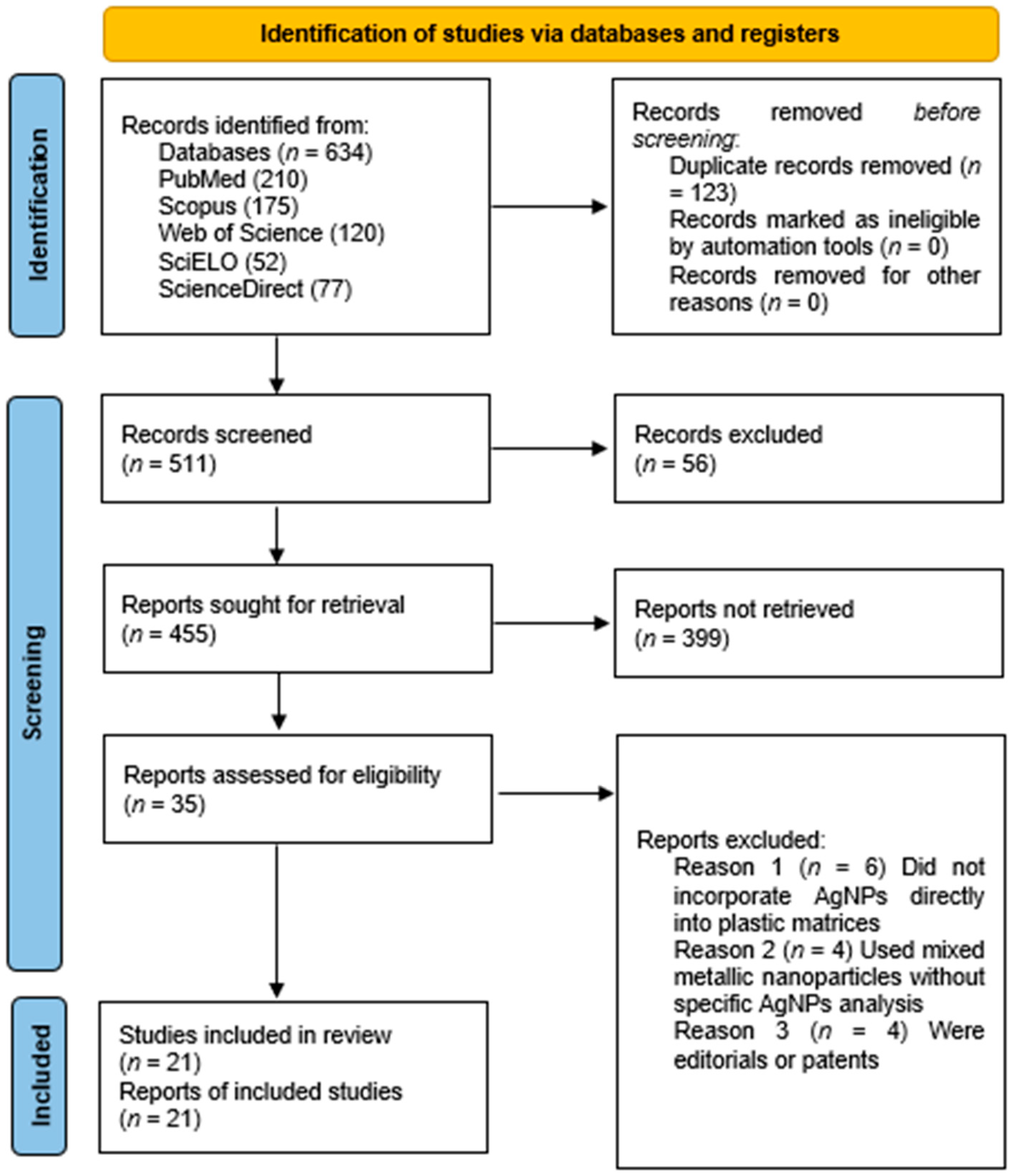
2.1. Search Results
2.2. Qualitative Synthesis
2.3. Polymer Type Used
2.4. Microorganisms Evaluated
- -
- Gram-negative bacteria: Escherichia coli, Pseudomonas aeruginosa;
- -
- Gram-positive bacteria: Staphylococcus aureus;
- -
- Fungi: Candida albicans.
2.5. AgNP Incorporation Methods
- -
- Electrospinning: Enabled the production of nanofibers with a high porosity and an active surface area, facilitating controlled Ag+ release.
- -
- Direct impregnation: Used in PU foams; it demonstrated good nanoparticle retention and antimicrobial activity.
- -
- Green synthesis: Applied to PLA and PVP, using plant extracts as reducing agents, with positive outcomes in microbial reduction and lower toxicity.
- -
- Cathodic sputtering and chemical functionalization: Applied to polymers such as PEEK and HDPE, achieving homogeneous AgNP distribution and high bactericidal efficacy.
2.6. Observed Biological Effects
- -
- Cytocompatibility: AgNP concentrations of ≤0.05% w/w maintained >80% cell viability in L929 fibroblasts.
- -
- Cell proliferation: Increased proliferation of fibroblasts and keratinocytes was observed in in vitro models.
- -
- Cell migration and epithelialization: These processes were enhanced in the presence of AgNPs, promoting tissue regeneration.
- -
- Accelerated wound healing: Reduced healing time, increased collagen deposition, and granulation tissue formation were documented in animal models.
- -
- Anti-inflammatory and antioxidant effects: In vitro models have documented increased proliferation of fibroblasts and keratinocytes, as well as improved cell migration, resulting in faster epithelialization. In vivo studies, conducted primarily in rats and rabbits, have shown a significant reduction in healing time, along with increased collagen deposition and granulation tissue formation.
2.7. Comparison with Other Antimicrobial Strategies
2.8. Clinical Applications
- -
- Dental resins containing AgNPs in patients with orthodontic appliances, showing reduced plaque accumulation and decreased gingival inflammation.
- -
- AgNP-impregnated dressings in chronic wounds, with positive outcomes in healing, infection control, and clinical tolerance.
2.9. Advantages
2.10. Limitations
2.11. Regulatory Considerations
3. Discussion
4. Materials and Methods
4.1. Search Strategy
4.2. Search
4.3. Risk-of-Bias Assessment
4.4. Limitations and Strengths of This Study
4.4.1. Strengths
4.4.2. Limitations
5. Conclusions
Author Contributions
Funding
Institutional Review Board Statement
Informed Consent Statement
Data Availability Statement
Conflicts of Interest
Abbreviations
| MDIs | Medical device-associated infections |
| PMMA | Polymethyl methacrylate |
| PE | Polyethylene |
| PP | Polypropylene |
| PU | Polyurethane |
References
- Bayda, S.; Adeel, M.; Tuccinardi, T.; Cordani, M.; Rizzolio, F. The History of Nanoscience and Nanotechnology: From Chemical–Physical Applications to Nanomedicine. Molecules 2020, 25, 112. [Google Scholar] [CrossRef] [PubMed]
- Espinosa Cristóbal, L.; Tovar Carrillo, K.; Donohue Cornejo, A.; Cuevas González, C.; Nava Martínez, S.; Cortés, D.; García Zamarron, D.; Valenzuela Chacón, M.; Pérez Sáenz, M. Nanopartículas de plata contra bacterias presentes en biofilm dental de pacientes pediátricos. Rev. Asoc. Dent. Mex. 2022, 79, 198–203. (In Spanish) [Google Scholar] [CrossRef] [PubMed]
- World Health Organization. Oral Health [Internet]. Available online: https://www.who.int/es/news-room/fact-sheets/detail/oral-health (accessed on 14 August 2024).
- Guevara Ruiz, L.M.; Bonilla Valladares, P.M.; Caicedo Breedy, M.F. Actividad antimicrobiana de adhesivo ortodóntico con nanopartículas de plata sobre Streptococcus mutans. Odontología 2020, 22, 33–44. (In Spanish) [Google Scholar] [CrossRef]
- Kang, Y.; Liu, X.; Chen, X.; Duan, Y.; Wang, J.; Gao, C. Advances of Nanobiomaterials for Treating Skin Pathological Fibrosis. Adv. NanoBiomed Res. 2024, 4, 2400008. [Google Scholar] [CrossRef]
- Raza, M.A.; Sharma, M.K.; Nagori, K.; Jain, P.; Ghosh, V.; Gupta, U.; Ajazuddin. Recent trends on polycaprolactone as sustainable polymer-based drug delivery system in the treatment of cancer: Biomedical applications and nanomedicine. Int. J. Pharm. 2024, 666, 124734. [Google Scholar] [CrossRef]
- De Morais, D.C.; Jackson, J.K.; Kong, J.H.; Ghaffari, S.; Palma-Dibb, R.G.; Carvalho, R.M.; Lange, D.; Manso, A.P. Characterization of polymethylmethacrylate microspheres loaded with silver and doxycycline for dental materials applications. Dent. Mater. 2022, 38, 946–959. [Google Scholar] [CrossRef]
- Hao, T.; Gao, Y.; Zheng, E.; Yang, H.; Pan, Y.; Zhang, P.; Xu, J.; Hou, Z. Multifunctional poly(ether-urethane) elastomer based on dynamic phenol-urethane and disulfide bonds: Simultaneously showing superior toughness, self-healing, shape memory, antibacterial, and antioxidative properties. Eur. Polym. J. 2024, 220, 113–118. [Google Scholar] [CrossRef]
- Hernández-Gómora, A.E.; Lara-Carrillo, E.; Robles-Navarro, J.B.; Scougall-Vilchis, R.J.; Hernández-López, S.; Medina-Solís, C.E.; Morales-Luckie, R.A. Biosynthesis of Silver Nanoparticles on Orthodontic Elastomeric Modules: Evaluation of Mechanical and Antibacterial Properties. Molecules 2017, 22, 1407. [Google Scholar] [CrossRef]
- Sousa, M.C.S.d.; Cavalcante, J.A.P.; Ferraz, A.d.V. Production of Biodegradable Nanocomposite Film with Antibacterial Properties for Use as Active Packaging. Mat. Res. 2025, 28, e20250013. [Google Scholar] [CrossRef]
- Wen, W.; Ma, L.; He, W.; Tang, X.; Zhang, Y.; Wang, X.; Liu, L.; Fan, Z. Silver-nanoparticle-coated biliary stent inhibits bacterial adhesion in bacterial cholangitis in swine. Hepatobiliary Pancreat Dis. Int. 2016, 15, 87–92. [Google Scholar] [CrossRef] [PubMed]
- Christensen, G.; Baldassarri, L.; Andrew, W. Methods for Studying Microbial Colonization of Plastics. Methods Enzymol. 1995, 253, 477–500. [Google Scholar] [CrossRef]
- Silva, R.R.; Ribeiro, S.J.L.; Barud, H.S.; Barud, H.O.; Oliveira, O.N.; Mejía-Salazar, J.R. 11—Biopolymer-Metal Composites. In Nanophotonics; Kassab, L.R.P., De Araujo, C.B., Eds.; Elsevier: Amsterdam, The Netherlands, 2019; pp. 261–301. ISBN 978-0-08-102378-5. [Google Scholar]
- Pelgrift, R.; Friedman, A. Nanotechnology as a therapeutic tool to combat microbial resistance. Adv. Drug Deliv. Rev. 2013, 65, 1803–1815. [Google Scholar] [CrossRef]
- Tang, D.-X.; Liu, K.; Yang, J.-Y.; Wang, Z.-J.; Fu, L.-L.; Yang, X.-J.; Li, Y.-S.; Huang, B.; Liu, Y. Artificial nonenzymatic antioxidant Prussian blue/KGM-BSA nanocomposite hydrogel dressing as ROS scavenging for diabetic wound healing. Int. J. Biol. Macromol. 2024, 266, 131106. [Google Scholar] [CrossRef] [PubMed]
- Orhan, B.; Karadeniz, D.; Kalaycıoğlu, Z. Foam-based antibacterial hydrogel composed of carboxymethyl cellulose/polyvinyl alcohol/cerium oxide nanoparticles for potential wound dressing. Int. J. Biol. Macromol. 2025, 291, 138–145. [Google Scholar] [CrossRef] [PubMed]
- Gupta, I.; Gandhi, S.; Sapra, S. 16—Metal/metal oxide nanoparticles reinforced biocomposites for drug delivery. In Fiber and Textile Engineering in Drug Delivery Systems; The Textile Institute Book Series; Sharma, N., Butola, B.S., Eds.; Woodhead Publishing: Cambridge, UK, 2023; pp. 461–485. ISBN 978-0-323-96117-2. [Google Scholar]
- Wang, Y.; Cai, B.; Ni, D. A novel antibacterial and antifouling nanocomposite coated endotracheal tube to prevent ventilator-associated pneumonia. J. Nanobiotechnol 2022, 20, 112. [Google Scholar] [CrossRef] [PubMed]
- Figueroa, L.; Arenas, M.; Díaz, A. Antimicrobial and cytotoxic properties of an orthodontic adhesive added with silver nanoparticles applications. Mundo Nano 2019, 12, 59–71. [Google Scholar] [CrossRef]
- Chang, T.Y.; Chen, C.C.; Cheng, K.M.; Chin, C.Y.; Chen, Y.H.; Chen, X.A.; Sun, J.R.; Young, J.J.; Chiueh, T.S. Trimethyl chitosan-capped silver nanoparticles with positive surface charge: Their catalytic activity and antibacterial spectrum including multidrug-resistant strains of Acinetobacter baumannii. Colloids Surf. B. Biointerfaces 2017, 155, 61–70. [Google Scholar] [CrossRef]
- Yoon, J.; Choi, H.K.; Shin, M.; Lim, J.; Choi, J.-W. Nanobiohybrid Materials for Development of Biosensors. In Biomaterials-Based Sensors: Recent Advances and Applications; Springer: Singapore, 2023; pp. 27–72. [Google Scholar]
- Li, K.; Rehman, A.; Rahman, S.u.; Basit, F.; Liu, X.; Wong, A.; Alabbosh, K.F.; Li, H.; Hui, N.; Khalid, M. Interplay between green-synthesized nanoparticles and plant performance is mediated by the microbial community in the rhizocompartments. Ind. Crop. Prod. 2024, 215, 118623. [Google Scholar] [CrossRef]
- Kovendan, K.; Fabiola, M.; Jebanesan, A.; Rajaganesh, R. Green synthesis of Malvastrum coromandelianum fabricated AgNPs: Anti-dengue and mosquitocidal studies. Inorg. Chem. Commun. 2024, 161, 112067. [Google Scholar] [CrossRef]
- Ghosh, S.; Sarkar, B.; Thongmee, S.; Mostafavi, E. Chapter 14—Hybrid Antibacterial, Antifungal, and Antiviral Smart Coatings; In Antiviral and Antimicrobial Smart Coatings: Fundamentals and Applications; Kumar, A., Behera, A., Nguyen, T.A., Bilal, M., Gupta, R.K., Eds.; Elsevier: Amsterdam, The Netherlands, 2023; pp. 431–452. ISBN 978-0-323-99291-6. [Google Scholar]
- Halachmi, S.; Marquart, L. Regulation of Medical Devices for Dermatology. Dermatol. Clin. 2022, 40, 297–305. [Google Scholar] [CrossRef]
- Sun, J.; Wang, L.; Wang, J.; Li, Y.; Zhou, X.; Guo, X.; Zhang, T.; Guo, H. Characterization and evaluation of a novel silver nanoparticles-loaded polymethyl methacrylate denture base: In vitro and in vivo animal study. Dental Mat. J. 2021, 40, 1100–1108. [Google Scholar] [CrossRef] [PubMed]
- Ortiz-Magdaleno, M.; Sánchez-Vargas, L.; Gardea-Contreras, D.; Campos-Ibarra, V.; Pozos-Guillén, A.; Márquez-Preciado, R. Antibiofilm properties of silver nanoparticles incorporated into polymethyl methacrylate used for dental applications. Biomed. Mater. Eng. 2023, 34, 357–373. [Google Scholar] [CrossRef] [PubMed]
- Choi, H.J.; Thambi, T.; Yang, Y.H.; Bang, S.I.; Kim, B.S.; Pyun, D.G.; Lee, D.S. AgNP and rhEGF-incorporating synergistic polyurethane foam as a dressing material for scar-free healing of diabetic wounds. RSC Adv. 2017, 7, 13714–13725. [Google Scholar] [CrossRef]
- Ahire, J.H.; Wang, Q.; Rowley, G.; Chambrier, I.; Crack, J.C.; Bao, Y.; Chao, Y. Polyurethane infused with heparin capped silver nanoparticles dressing for wound healing application: Synthesis, characterization and antimicrobial studies. Int. J. Biol. Macromol. 2024, 282, 136557. [Google Scholar] [CrossRef]
- Zhang, D.; Yao, D.; Ma, R.; Nan, S.; Lv, Y.; Zhu, Y.; Zhu, S. Effect of Silver Nanoparticles With Thermoplastic Polyurethane on Postoperative Rehabilitation of Diabetic Patients With Open Fracture of Lower Extremities. Front. Surg. 2022, 9, 954155. [Google Scholar] [CrossRef]
- Sienkiewicz, N.; Członka, S. Natural Additives Improving Polyurethane. Polymers 2022, 21, 2533. [Google Scholar] [CrossRef]
- Jamnongkan, T.; Sirichaicharoenkol, K.; Kongsomboon, V.; Srinuan, J.; Srisawat, N.; Pangon, A.; Mongkholrattanasit, R.; Tammasakchai, A.; Huang, C.F. Innovative Electrospun Nanofiber Mats Based on Polylactic Acid Composited with Silver Nanoparticles for Medical Applications. Polymers 2024, 16, 409. [Google Scholar] [CrossRef]
- Samokhin, Y.; Varava, Y.; Diedkova, K.; Yanko, I.; Korniienko, V.; Husak, Y.; Iatsunskyi, I.; Grebnevs, V.; Bertiņs, M.; Banasiuk, R.; et al. Electrospun Chitosan/Polylactic Acid Nanofibers with Silver Nanoparticles: Structure, Antibacterial, and Cytotoxic Properties. ACS Appl. Bio. Mater. 2025, 8, 1027–1037. [Google Scholar] [CrossRef]
- Kahya, N.; Kartun, A.; Korkut, I.N.; Usta, C.; Kuruca, D.S.; Gürarslan, A. Silver Nanowire-Coated Porous Alginate Films for Wound Dressing Applications: Antibacterial Activity, Cell Proliferation, and Physical Characterization. ACS Omega 2024, 9, 49032–49042. [Google Scholar] [CrossRef]
- Heo, D.N.; Lee, D.; Heo, M.; Rim, H.; Zhang, L.G.; Park, S.A.; Do, S.H.; Moon, J.H.; Kwon, I.K. One-Step Fabrication of AgNPs Embedded Hybrid Dual Nanofibrous Oral Wound Dressings. J. Biomed. Nanotechnol. 2016, 12, 2041–2050. [Google Scholar] [CrossRef]
- Gómez-Lázaro, B.; López-Saucedo, F.; Flores-Rojas, G.G.; Camacho-Cruz, A.; Bucio, E. Antimicrobial silver loading onto reused high-density polyethylene matrices grafted with poly(4-vinylpyridine). J. Polym. Res 2024, 31, 234. [Google Scholar] [CrossRef]
- Sofi, H.S.; Akram, T.; Tamboli, A.H.; Majeed, A.; Shabir, N.; Sheikh, F.A. Novel lavender oil and silver nanoparticles simultaneously loaded onto polyurethane nanofibers for wound-healing applications. Int J Pharm. 2019, 569, 118590. [Google Scholar] [CrossRef]
- Choi, Y.; Kim, H.-A.; Kim, K.-W.; Lee, B.-T. Comparative toxicity of silver nanoparticles and silver ions to Escherichia coli. J. Environ. Sci. 2018, 66, 50–60. [Google Scholar] [CrossRef]
- Soltanzadeh, M.M.; Hojjati, M.R.; Hassanajili, S.; Mohammadi, A.A. Development and characterization of bio-based polyurethane flexible foams containing silver nanoparticles for efficient dermal healing application. New J. Chem. 2024, 48, 1809–1827. [Google Scholar] [CrossRef]
- Barik, B.; Satapathy, B.S. Sustainable synthesis of silver nanoparticles from Azadirachta indica: Antimicrobial, antioxidant and in silico analysis for periodontal treatment. Front Chem. 2024, 12, 1489253. [Google Scholar] [CrossRef] [PubMed]
- Liang, W.; Ni, N.; Huang, Y.; Lin, C. An Advanced Review: Polyurethane-Related Dressings for Skin Wound Repair. Polymers 2023, 15, 4301. [Google Scholar] [CrossRef] [PubMed]
- Sabarees, G.; Velmurugan, V.; Tamilarasi, G.P.; Alagarsamy, V.; Raja Solomon, V. Recent Advances in Silver Nanoparticles Containing Nanofibers for Chronic Wound Management. Polymers 2022, 14, 3994. [Google Scholar] [CrossRef] [PubMed]
- Wang, F.; Zhou, L.; Mu, D.; Zhang, H.; Zhang, G.; Huang, X.; Xiong, P. Current research on ecotoxicity of metal-based nanoparticles: From exposure pathways, ecotoxicological effects to toxicity mechanisms. Front. Public Health 2024, 12, 1390099. [Google Scholar] [CrossRef] [PubMed]
- Ahmed, I.; Zhang, B.; Muneeb-Ur-Rehman, M.; Fan, W. Effect of different shapes of Nano-Cu2O and humic acid on two-generations of Daphnia Magna. Ecotoxicol. Environ. Saf. 2021, 207, 111274. [Google Scholar] [CrossRef]
- Sari, B.R.; Yesilot, S.; Ozmen, O.; Acar, C.A. Superior In Vivo Wound—Healing Activity of Biosynthesized Silver Nanoparticles with Nepeta cataria (Catnip) on Excision Wound Model in Rat. Biol. Trace Elem. Res. 2024, 203, 1502–1517. [Google Scholar] [CrossRef]
- Gasga-Tapia, V.; Hamdan-Partida, A.; Sánchez Pérez, T.L.; Martínez Ruiz, F.J.; Bustos-Martínez, J. Usos de las nanopartículas de plata (AgNPs) en odontología. Mundo Nano 2024, 17, e69816. [Google Scholar] [CrossRef]
- Abdul-Zahra, M.A.; Abbass, N.M. Synthesis and Characterization of Nano-Composites of Polypropylene/Cr2O3 Nanoparticles Using Licorice Extract. Iraqi J. Sci. 2024, 65, 623–633. [Google Scholar] [CrossRef]
- Bi, X.; Li, M.; Zhang, Y.; Yin, M.; Che, W.; Bi, Z.; Yang, Y.; Ouyang, J. Polyetheretherketone (PEEK) as a Potential Material for the Repair of Maxillofacial Defect Compared with E-poly(tetrafluoroethylene) (e-PTFE) and Silicone. ACS Biomater. Sci. Eng 2023, 9, 4328–4340. [Google Scholar] [CrossRef] [PubMed]
- Luo, Q.; Yang, J.; Yang, M.; Wang, Y.; Liu, Y.; Liu, J.; Kalvakolanu, D.V.; Cong, X.; Zhang, J.; Zhang, L.; et al. Utilization of nanotechnology to surmount the blood-brain barrier in disorders of the central nervous system. Mater. Today Bio. 2025, 31, 101457. [Google Scholar] [CrossRef] [PubMed]
- Bozkaya, O.; Arat, E.; Gün Gök, Z.; Yiğitoğlu, M.; Vargel, İ. Production and characterization of hybrid nanofiber wound dressing containing Centella asiatica coated silver nanoparticles by mutual electrospinning method. Eur. Polym. J. 2022, 166, 111023. [Google Scholar] [CrossRef]
- Dugam, S.; Jain, R.; Dandekar, P. Silver nanoparticles loaded triple-layered cellulose-acetate based multifunctional dressing for wound healing. Int. J. Biol. Macromol 2024, 276, 133837. [Google Scholar] [CrossRef] [PubMed]
- Francis, A.; Namasivayam, S.; Samrat, K. Potential of silver nanoparticles synthesized from Justicia adhatoda metabolites for inhibiting biofilm on urinary catheters. Microb. Pathog. 2024, 196, 106957. [Google Scholar] [CrossRef]
- Dąbrowska-Bouta, B.; Zięba, M.; Orzelska-Górka, J.; Skalska, J.; Sulkowski, G.; Frontczak-Baniewicz, M.; Talarek, S.; Listos, J.; Strużyńska, L. Influence of a low dose of silver nanoparticles on cerebral myelin and behavior of adult rats. Toxicology 2016, 363–364, 29–36. [Google Scholar] [CrossRef]
- Das, R.; Kumar, A.; Singh, C.; Kayastha, A.M. Innovative synthesis approaches and health implications of organic-inorganic Nanohybrids for food industry applications. Food Chem. 2025, 464, 141905. [Google Scholar] [CrossRef]
- Jakinala, P.; Naik, H.; Angali, N.; Ganderla, S.; Inampudi, K.K.; Balaji, S.; Srinivas, M.; Rao, M. Green synthesis of ZnO-Ag nanocomposite using Stenotaphrum secundatum grass extract: Antibacterial activity and anticancer effect in oral squamous cell carcinoma CAL 27 cells. Inorg. Chem. Commun. 2023, 152, 110735. [Google Scholar] [CrossRef]
- Zhang, K.; Zhang, N.; Weir, M.D.; Reynolds, M.A.; Bai, Y.; Xu, H.H.K. Bioactive Dental Composites and Bonding Agents Having Remineralizing and Antibacterial Characteristics. Dent. Clin. N. Am. 2017, 61, 669–687. [Google Scholar] [CrossRef]
- Argueta, L.; Torres, N.; Scougall, R.; García, R. Biocompatibility and nanotoxicology of titanium dioxide in the oral cavity: Systematic review. Investig. Clin. 2018, 59, 352–368. Available online: https://produccioncientificaluz.org/index.php/investigacion/article/view/31688 (accessed on 14 August 2024).
- ISO 10993-5:2009; Biological Evaluation of Medical Devices—Part 5: Tests for In Vitro Cytotoxicity. ISO: Geneva, Switzerland, 2009.
- Breitwieser, D.; Moghaddam, M.M.; Spirk, S.; Baghbanzadeh, M.; Pivec, T.; Fasl, H.; Ribitsch, V.; Kappe, C.O. In situ preparation of silver nanocomposites on cellulosic fibers microwave vs conventional heating. Carbohydr. Polym. 2013, 94, 677–686. [Google Scholar] [CrossRef] [PubMed]
- Raychaudhuri, R.; Naik, S.; Shreya, A.B.; Kandpal, N.; Pandey, A.; Kalthur, G.; Mutalik, S. Pullulan based stimuli responsive and sub cellular targeted nanoplatforms for biomedical application: Synthesis, nanoformulations and toxicological perspective. Int. J. Biol. Macromol. 2020, 161, 1189–1205. [Google Scholar] [CrossRef] [PubMed]
- Dukle, A.; Sankar, M.R. 3D-printed polylactic acid scaffolds for bone tissue engineering: Bioactivity enhancing strategies based on composite filaments and coatings. Mater. Today Commun. 2024, 40, 109776. [Google Scholar] [CrossRef]
- Ntrivala, M.; Pitsavas, A.C.; Lazaridou, K.; Baziakou, Z.; Karavasili, D.; Papadimitriou, M.; Ntagkopoulou, C.; Balla, E.; Bikiaris, D.N. Polycaprolactone (PCL): The biodegradable polyester shaping the future of materials—A review on synthesis, properties, biodegradation, applications and future perspectives. Eur. Polym. J. 2025, 234, 114033. [Google Scholar] [CrossRef]
- Salla, R.; Oliveira, F.; Jacintho, J.C.; Cirqueira, F.; Tsukada, E.; Vieira, L.; Rocha, T. Microplastics and TiO2 nanoparticles mixture as an emerging threat to amphibians: A case study on bullfrog embryos. Environ. Pollut. 2024, 346, 123624. [Google Scholar] [CrossRef]
- Sun, Y.; Juncos, A.; Boyd, P.; Dunne, N.; McCarthy, H. Application of 3D printing & 3D bioprinting for promoting cutaneous wound regeneration. Bioprinting 2022, 28, e00230. [Google Scholar] [CrossRef]
- Ji, Y.; Wang, Y.; Wang, X.; Lv, C.; Zhou, Q.; Jiang, G.; Yan, B.; Chen, L. Beyond the promise: Exploring the complex interactions of nanoparticles within biological systems. J. Hazard. Mater. 2024, 468, 133800. [Google Scholar] [CrossRef]


| Nº | Author (Year) | Polymer | Type of Study | AgNPs: Size/Conc. | Synthesis Method | Key Findings |
|---|---|---|---|---|---|---|
| 1 | Sun J. et al. (2021) [26] | PMMA | In vitro + animal | ~20 nm/0.05% | N/D | Biofilm reduction and good cytocompatibility |
| 2 | Ortiz-Magdaleno M. et al. (2023) [27] | PMMA | In vitro | 15–30 nm/0.03% | Wet chemistry | Inhibits S. mutans, and mechanical properties are preserved |
| 3 | Choi H.-J. et al. (2017) [28] | PU foam | Animal | 10–50 nm/ND | N/D | Improved wound healing in diabetic mice |
| 4 | Ahire, J.H. et al. (2024) [29] | PU nanofiber | In vitro | ≤20 nm/0.01% | Electrospinning + loading | 99% bacterial efficacy and sustained release |
| 5 | Zhang D. et al. (2022) [30] | TPU | Clinical study | N/D | N/D | Reduction in postoperative infection |
| 6 | Sienkiewicz N. and Członka S. (2022) [31] | PU foam | In vitro | N/D | Direct impregnation | >4 log10 reduction in E. coli and S. aureus |
| 7 | Jamnongkan T. et al. (202) [32] | PLA | In vitro | 10–25 nm/0.02% | Electrospinning | Reduction of 5 log10 in 6 h |
| 8 | Samokhin Y. et al. (2025) [33] | PLA/CS | In vitro | N/D | Electrospinning | Antibacterial effect and good cell adhesion |
| 9 | Kahya N. et al. (2024) [34] | PVA/AgNW | In vitro | Nanothreads/ND | Physical | Photothermal and bactericidal effect |
| 10 | Lee S.J. et al. (2016) [35] | PEEK | In vitro | ~30 nm | Cathodic sputtering | >99% bactericidal efficacy |
| 11 | Gómez-Lázaro B. et al. (2024) [36] | HDPE (high-density polyethylene) | In vitro | N/D | Chemical functionalization | High efficacy against S. aureus |
| 12 | Sofi H.S. et al. (2019) [37] | PU | in vitro | 300 nm | N/D | Antibiofilm and cytocompatibility |
| 13 | Choi Y. et al. (2018) [38] | PLA/PU | In vitro | ~25 nm/0.05% | Chemical reduction | High absorption and antimicrobial activity against E. coli |
| 14 | Soltanzadeh M.M. et al. (2024) [39] | PU | In vitro | N/D | Direct dispersion | Reduced adhesion of E. coli |
| 15 | Barik B. et al. (2024) [40] | RPO | In vitro | N/D | Green synthesis | Bacterial reduction |
| 16 | Liang W. (2023) [41] | Various | Review | – | – | Systematic summary of 45 studies |
| 17 | Sabarees G. (2022) [42] | Various | Review | - | N/D | Comprehensive review of recent advancements |
| 18 | Wang F. et al. (2024) [43] | PMMA | In vitro | ~15 nm | Physical synthesis | Sustained Ag+ release and low toxicity |
| 19 | Ahmed I. et al. (2021) [44] | PVP + humic acid | In vitro | N/D | Green synthesis | 5 log10 microbial reduction |
| 20 | Sari B.R. et al. (2021) [45] | PU | In vivo | N/D | N/D | Positive immunomodulation, rapid tissue regeneration |
| 21 | Gasga-Tapia V. et al. (2024) [46] | PU | Ecotoxicity | ≤1 µg/L | Controlled release | Moderate environmental impact |
| Database | Date Range | Search Strategy | Records (n) |
|---|---|---|---|
| PubMed | 2013–2024 | “Silver nanoparticles” [MeSH] AND plastic AND therapeutic | 210 |
| Scopus | 2013–2024 | TITLE-ABS-KEY (“AgNPs” AND plastic AND therapeutic) | 175 |
| Web of Science | 2013–2024 | TS = (“silver nanoparticles” AND polymer AND antimicrobial) | 120 |
| SciELO | 2013–2024 | “Silver nanoparticles” AND plastic | 52 |
| ScienceDirect | 2013–2024 | “Silver nanoparticles” AND resin AND medical | 77 |
| Total | 634 |
| Study Type | Criteria Assessed | Main Strengths | Main Limitations | Overall Risk of Bias |
|---|---|---|---|---|
| In vitro (n = 15) |
| Most studies provided detailed methods and adequate controls | Some lacked standardized nanoparticle characterization, and small sample sizes | Moderate |
| In vivo (n = 4) |
| Ethical approval reported; outcomes relevant to biocompatibility | Randomization/blinding rarely described; limited sample sizes | Moderate to high |
| Clinical trials (n = 2) |
| Both trials reported ethical approval and clinical relevance | Small sample sizes; limited follow-up; blinding unclear | Moderate |
Disclaimer/Publisher’s Note: The statements, opinions and data contained in all publications are solely those of the individual author(s) and contributor(s) and not of MDPI and/or the editor(s). MDPI and/or the editor(s) disclaim responsibility for any injury to people or property resulting from any ideas, methods, instructions or products referred to in the content. |
© 2025 by the authors. Licensee MDPI, Basel, Switzerland. This article is an open access article distributed under the terms and conditions of the Creative Commons Attribution (CC BY) license (https://creativecommons.org/licenses/by/4.0/).
Share and Cite
Maruri-Casas, J.L.; Lara-Carrillo, E.; Toral-Rizo, V.H.; Morales-Luckie, R.A.; Guzmán-Celaya, G.E.; Ibañez-Mancera, N.G.; Tejeda-Nava, F.J.; Guadarrama-Reyes, S.C.; Salmerón-Valdés, E.N.; Santillán-Reyes, A.M. Silver Nanoparticles Used in Medical–Dental Plastics for Therapeutic Purposes: A Comprehensive Review. Antibiotics 2025, 14, 1267. https://doi.org/10.3390/antibiotics14121267
Maruri-Casas JL, Lara-Carrillo E, Toral-Rizo VH, Morales-Luckie RA, Guzmán-Celaya GE, Ibañez-Mancera NG, Tejeda-Nava FJ, Guadarrama-Reyes SC, Salmerón-Valdés EN, Santillán-Reyes AM. Silver Nanoparticles Used in Medical–Dental Plastics for Therapeutic Purposes: A Comprehensive Review. Antibiotics. 2025; 14(12):1267. https://doi.org/10.3390/antibiotics14121267
Chicago/Turabian StyleMaruri-Casas, José Luis, Edith Lara-Carrillo, Víctor Hugo Toral-Rizo, Raúl Alberto Morales-Luckie, Gloria Elena Guzmán-Celaya, Norma Guadalupe Ibañez-Mancera, Francisco Javier Tejeda-Nava, Saraí Carmina Guadarrama-Reyes, Elías Nahúm Salmerón-Valdés, and Ana Miriam Santillán-Reyes. 2025. "Silver Nanoparticles Used in Medical–Dental Plastics for Therapeutic Purposes: A Comprehensive Review" Antibiotics 14, no. 12: 1267. https://doi.org/10.3390/antibiotics14121267
APA StyleMaruri-Casas, J. L., Lara-Carrillo, E., Toral-Rizo, V. H., Morales-Luckie, R. A., Guzmán-Celaya, G. E., Ibañez-Mancera, N. G., Tejeda-Nava, F. J., Guadarrama-Reyes, S. C., Salmerón-Valdés, E. N., & Santillán-Reyes, A. M. (2025). Silver Nanoparticles Used in Medical–Dental Plastics for Therapeutic Purposes: A Comprehensive Review. Antibiotics, 14(12), 1267. https://doi.org/10.3390/antibiotics14121267