1. Introduction
High Electron Mobility Transistors (HEMTs) and other next-generation high-power and high-frequency electronic devices are built on the rapidly developing wide-bandgap semiconductors, especially gallium nitride, GaN [
1,
2,
3]. GaN-based HEMTs rely heavily on the generation of a two-dimensional electron gas (2DEG) at the interface of the GaN channel and a high-bandgap barrier layer, which is commonly AlGaN or AlN. The performance and, more importantly, long-term reliability of these devices are inextricably tied to the thermal stability of this interface.
It is widely recognized that interface characteristics have a substantial impact on electronic device performance. As a result, research has concentrated on both thin film interface diffusion and film–substrate diffusion. Cai et al. [
4] investigated the diffusion depth within AlGaN/GaN superlattices and proposed a simple method to reduce the abruptness of the AlGaN/GaN interfaces. They detected a significant asymmetry in Al diffusion depth between the upper (0.62 nm) and lower (0.96 nm) AlGaN contact borders. In addition, Li and Zhu [
5] demonstrated that Al diffused from the Al
2O
3 substrate into the buffer layer during the growth of single-crystal GaN films, resulting in a buffer layer containing both GaN and AlN, despite the fact that Al was not added intentionally during the growth process. Furthermore, Haneda et al. [
6] used a simplified error function model to investigate the Al ion diffusion patterns at the substrate/GaN thin film interface and concluded that the Al concentration within the films was higher than predicted by volume diffusion. Focusing on the GaN/sapphire interface, Kang et al. [
7] determined the interdiffusion coefficients at 850 °C from SIMS profiles to be D
Al = 3.98 × 10
−17 cm
2 s
−1 and D
Ga = 4.81 × 10
−17 cm
2 s
−1. Furthermore, Fung et al. [
8] studied the distribution of Ga and Al near the n-GaN/sapphire interface using X-ray energy-dispersive spectroscopy (XRDS) on a cross-section of the interface plane of n-GaN produced on sapphire using MOCVD. Their experimental results showed that Ga diffused further away from the sapphire substrate, whereas Al diffused less. In a recent work, we revealed that Al diffusion at the GaN/Al
2O
3 interface has an activation energy of 2.8 eV, implying that the process is dominated by a native defect-assisted substitutional diffusion mechanism rather than pure interstitial movement, whereas the interdiffusion of oxygen from the sapphire substrate into the GaN layer was found to have a substantially lower activation energy of approximately 1.24 eV, which we attributed to an interstitial migration mechanism [
9].
Based on our previous study of Al diffusion during the growth of AlGaN/GaN and AlN/GaN heterostructures, in which we confirmed Al tailing into GaN layers and calculated the Al diffusion coefficients D
Al under Metal–Organic Vapor Phase Epitaxy (MOVPE) conditions [
10], we now investigate further into the fundamental mechanism governing this Al migration. The initial work highlighted that D
Al is low (10
−14–10
−15 cm
2 s
−1 at 1100 °C) and strongly influenced by the interface quality and defect density, with diffusion being one order of magnitude higher at the highly mismatched AlN/GaN interface compared to AlGaN/GaN (x < 4). However, the simultaneous nature of high-temperature growth and diffusion makes it difficult to precisely isolate the thermodynamic parameters governing Al transport. To separate the diffusion process from growth kinetics and precisely define the controlling mechanism, this study used a systematic thermal annealing treatment of samples. We want to precisely determine the Al diffusion activation energy (E
a) by identifying changes in the Al depth profiles during post-growth annealing at various temperatures. This critical parameter, combined with the slow diffusion rate, will allow us to definitively confirm whether Al diffusion in GaN is mediated. This complete technique is critical for attaining the required control over Al distribution at nitride interfaces to construct high-performance electrical and optoelectronic devices.
The effectiveness of two widely utilized barrier materials, a composite AlGaN layer and a pure AlN layer, is directly compared in the current study. We obtained high-resolution compositional depth profiles following high-temperature thermal annealing using Secondary Ion Mass Spectrometry (SIMS) to measure the thermal stability of these interfaces. The basic activation energies (Ea) for Al diffusion were then computed using the Arrhenius equation after the experimental findings were analyzed using Fick’s diffusion laws to achieve the diffusion coefficients DAl. The aim of this work is to determine the activation energies (Ea) and pre-factors (D0), which will provide the fundamental kinetic parameters needed for optimizing thermally stable GaN device structures, and to quantitatively compare the aluminum diffusion coefficients DAl across the interfaces of the AlGaN/GaN and AlN/GaN heterostructures during thermal annealing using SIMS depth profiling.
3. Results
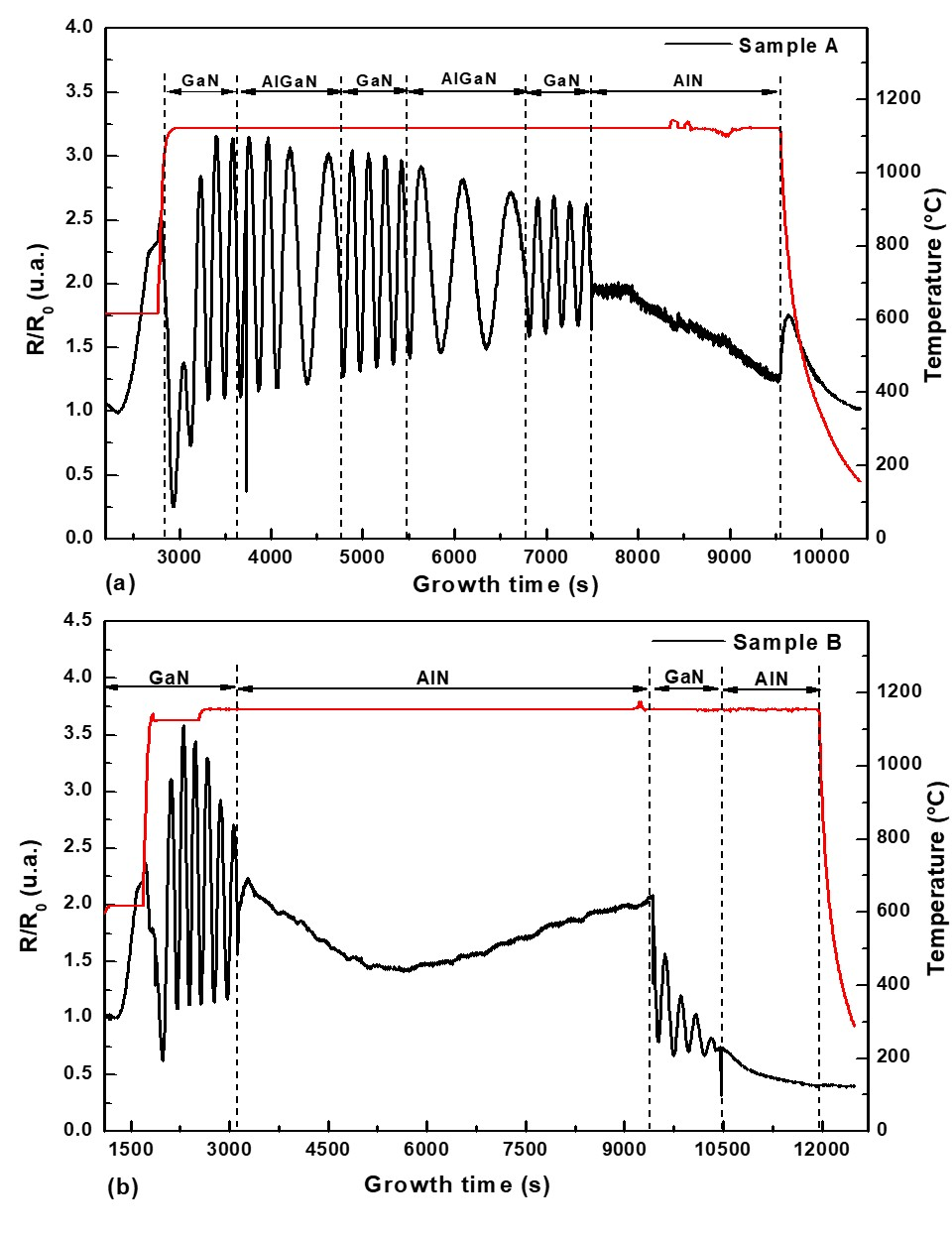
The growth process of both Sample A (AlGaN/GaN multi-layer structure) and Sample B (GaN/AlN structure) was monitored in situ using laser reflectivity.
Figure 2 shows the normalized reflectivity signals (R/R
0) for the two different structures tested in this work. The reflectivity trace of Sample A (
Figure 2a) shows distinct oscillations, indicating a steady, two-dimensional (2D) growth mode with smooth surfaces. The period and amplitude change as the GaN layers transition to the AlGaN barrier layers. These changes are consistent with the modification of the material’s refractive index and the change in the growth rate of the AlGaN composition when compared to GaN. The persistence of these distinct oscillations during the different phases of GaN/AlGaN suggests a highly stable and reproducible growth mode, which is critical for realizing the multi-layer heterostructure illustrated in
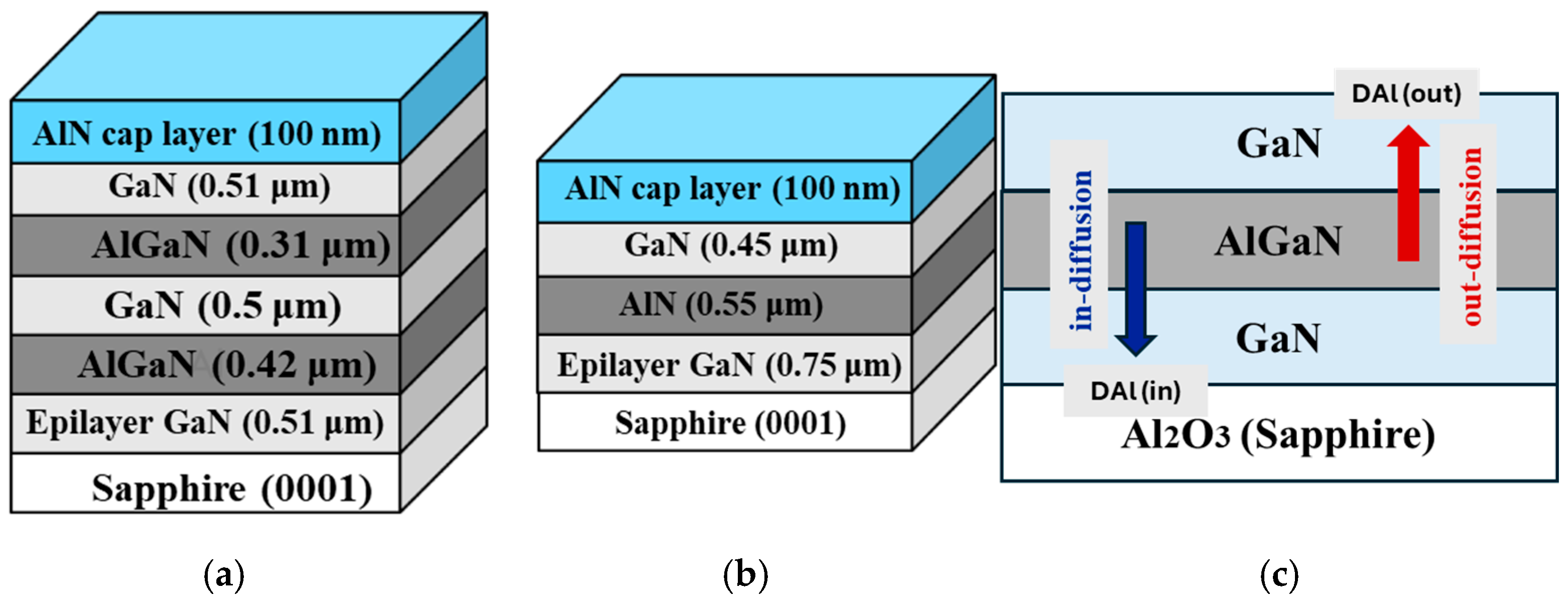
Figure 1. The reflectivity curve of Sample B (
Figure 2b), which corresponds to the structure with a single, pure AlN barrier, similarly shows well-defined oscillations in the first GaN layer, suggesting an initial 2D development phase. However, after the thick AlN barrier is initiated, the oscillations dampen dramatically and become nearly flat. This substantial dampening and subsequent signal stabilization are expected for the formation of a thick AlN layer, implying an increase in surface roughness or a shift to a three-dimensional (3D) growth component. The abrupt return of clear, high-amplitude oscillations following the addition of the final GaN cap layer demonstrates the technique’s sensitivity to the material being deposited and implies that the GaN can easily smooth the underlying AlN surface.
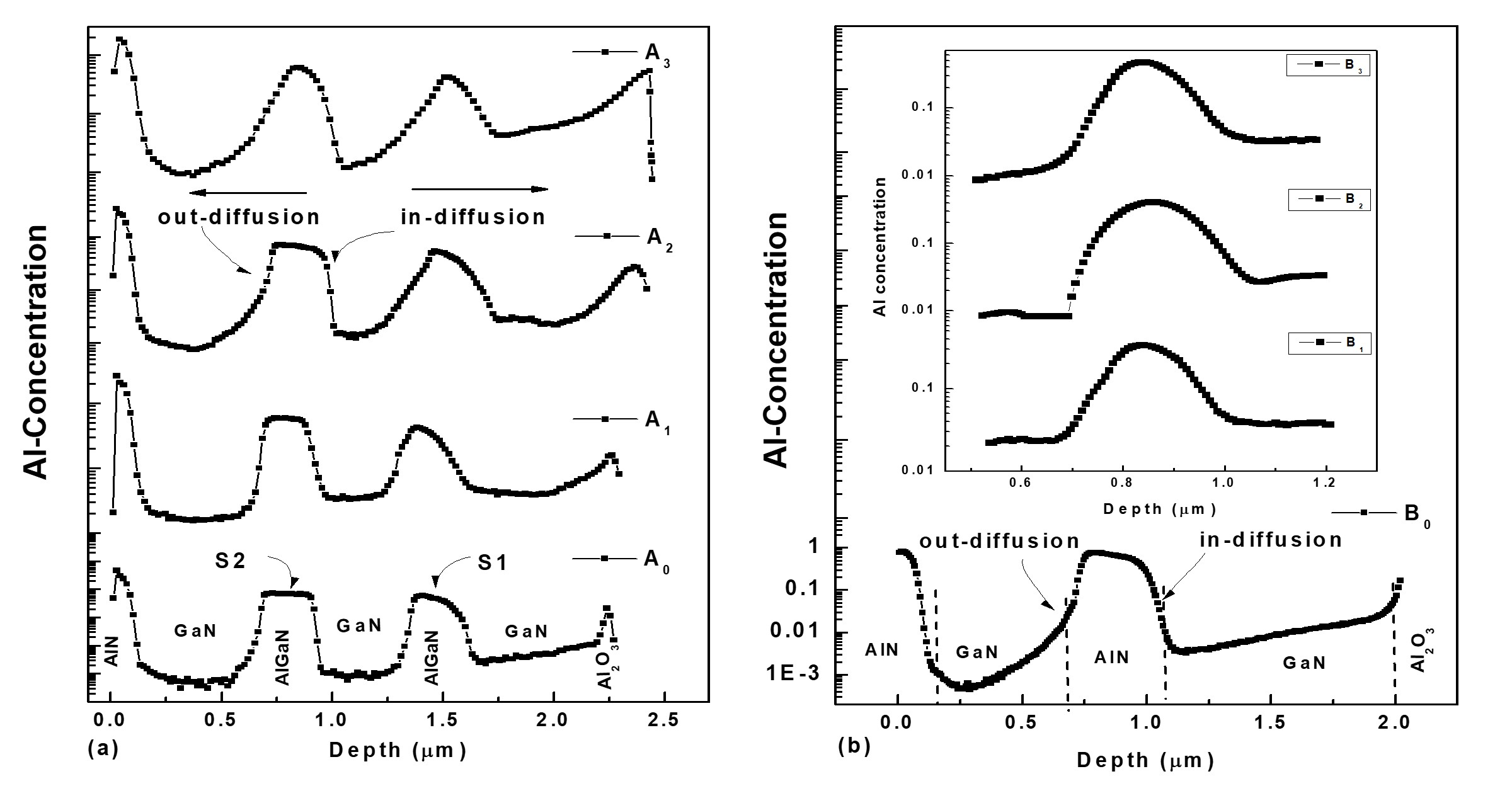
Figure 3a,b depicts the SIMS profiles of as-grown and annealed samples for both A and B structures. The results show how the thermal annealing temperature affects the concentration of aluminum (Al) within the heterostructures as a function of the depth. As shown in
Figure 3a, Sample A
0 (as-grown) serves as the reference, with abrupt interfaces and a nearly square-wave profile for Al intensity, which are typical of the initial, well-defined AlN cap, GaN spacers, and AlGaN interlayers (S1 and S2). However, for the annealed samples (A
1, A
2, and A
3) at higher temperatures (1050 °C to 1150 °C), the Al SIMS profile gradually broadens, demonstrating a clear relationship between increased thermal energy and Al diffusion. This diffusion is characterized by two processes, as shown in Sample A
2. The terms out-diffusion and in-diffusion are defined by the direction of aluminum (Al) migration relative to the intentionally grown barrier layer. Out-diffusion refers to Al atoms migrating from the barrier layer toward the top surface of the sample. This occurs along the c-axis [0001] direction of the GaN crystal lattice. In-diffusion refers to Al atoms moving from the barrier layer toward the sapphire substrate. This occurs along the -c-axis [000-1] direction. The two sandwiched AlGaN spikes (S1 and S2) were identified. We found 1.9% and 2.3% of Al solid composition in S1 and S2, respectively. The Al solid composition of the AlGaN layer (the peak intensity) remains practically constant, implying that the diffusion mechanism impacts the interfacial areas rather than causing Al redistribution throughout the interlayer volume. The SIMS depth profiles (
Figure 3b) for the AlN/GaN structure (Sample B), which has a single AlN interlayer, clearly indicate a thermally activated diffusion process, resulting in significant interface broadening and a significant decrease in the AlN peak concentration (from B
0 to B
3). The higher loss of Al from the layer when compared to the AlGaN structure is due to the pure AlN (x = 1) acting as a more concentrated Al source.
For a quantitative investigation, the SIMS depth profiles can be modeled using a solution to Fick’s second law, described by the following equation [
10]:
where C is the Al concentration at a given depth x after annealing time t, C
0 is the initial concentration, x
0 is the interface position, and D is the diffusion coefficient.
The increase in broadening observed in the profiles A
1–A
3 and B
1–B
3 suggests a direct increase in the Al diffusion coefficient (D
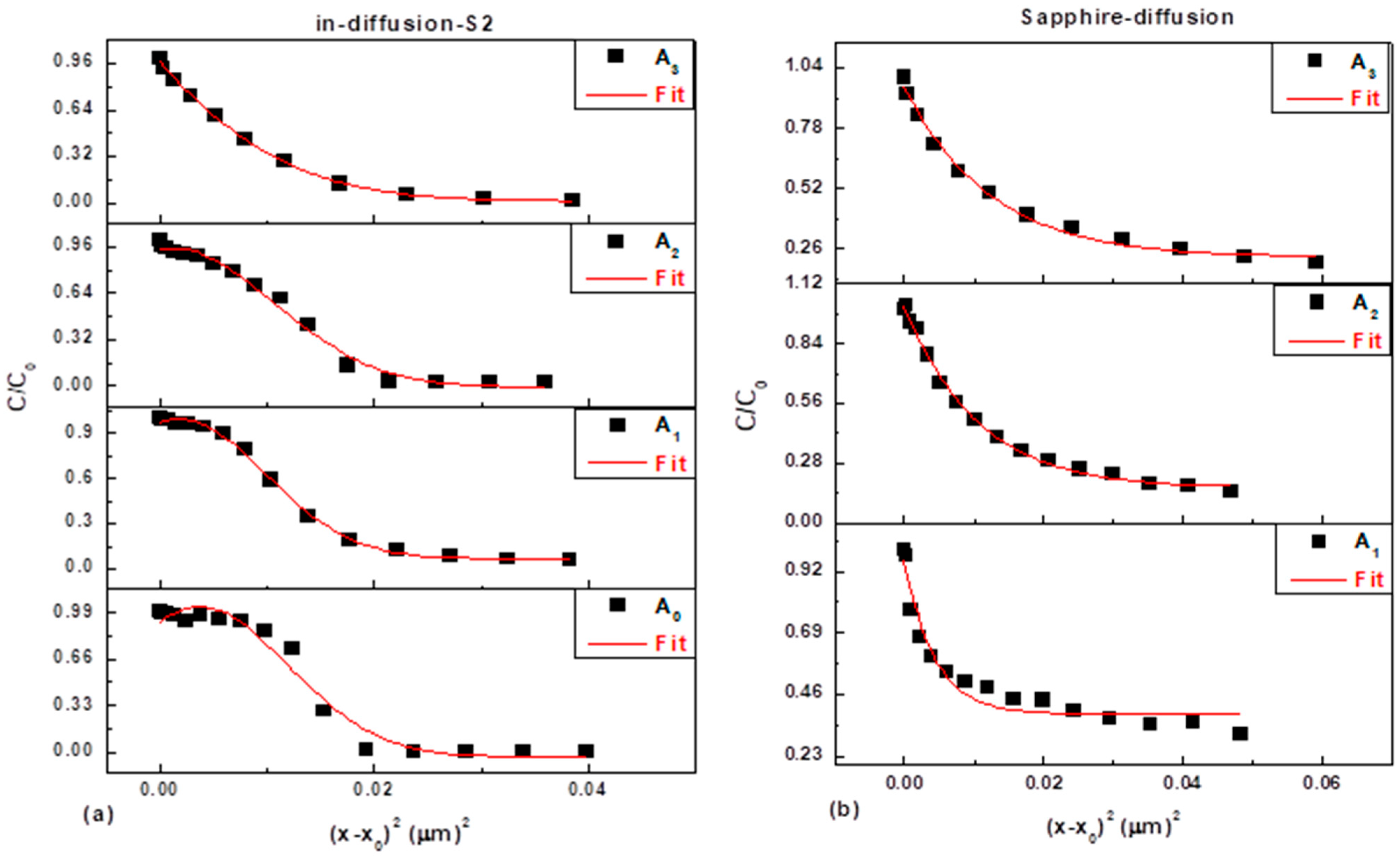
Al) as the thermal annealing temperature increases. This temperature dependence is crucial for understanding and controlling thermal stability at the AlGaN/GaN and AlN/GaN interfaces. To quantify this process, the SIMS data was successfully fitted using the Gaussian function solution to Fick’s second law, as shown in
Figure 4, confirming that the diffusion process can be accurately modeled across various interfaces.
Table 1 summarizes the results of the Al diffusion coefficient for the in-diffusion (D
in) and out-diffusion processes (D
out) at the various AlGaN/GaN interfaces of sample (A).
The comprehensive fitting of the Al diffusion coefficients (D
Al) across the two AlGaN/GaN interfaces, S1 and S2, indicates a highly complicated and asymmetric thermal instability. The dominant process at the inner AlGaN/GaN interface (S1) is in-diffusion (D
in-S1), in which Al atoms migrate into the AlGaN layer at a rate up to ten times faster than out-diffusion at 1050 °C. The thermal diffusion results for D
in-S1 show a near-constant behavior across the temperature range studied, with values decreasing slightly from 1.51 × 10
−14 cm
2 s
−1 at 1050 °C to 1.17 × 10
−14 cm
2 s
−1 at 1150 °C. This non-Arrhenius behavior indicates that the process is not simply thermally activated; it is probably dominated by a competing mechanism, such as stress relaxation or a temperature-driven change in native defect concentration that restricts Al mobility at higher temperatures. The inner interface out-diffusion (D
out-S1) is slower but is thermally activated. Conversely, the AlGaN/GaN interface (S2), displays a clear and distinct behavior: out-diffusion (D
out-S2) is the dominant mechanism, showing a rapid rate of between 2.01 × 10
−14 cm
2 s
−1 and 9.50 × 10
−14 cm
2 s
−1, with D
out-S2 being up to 100 times larger than D
in-S2. This dominant out-diffusion of Al from the barrier layer into the adjacent GaN layer is the primary cause of interface broadening. Our results reveal a distinct variation in diffusion kinetics between S1 and S2. This difference is attributed to the evolution of the GaN buffer morphology during growth. The first interface (S1) was deposited on a GaN layer prior to full coalescence, a phase where the material contains a higher concentration of grain boundaries and structural defects. According to our previous structural investigation of GaN growth stages, this near-interface region is characterized by a high threading dislocation (TD) density; the total density is estimated to be significantly higher than the values found in fully coalesced films. Specifically, the screw-type dislocation density in the early growth stages can reach 10
9 cm
−2, while edge-type dislocations are even more prevalent, at approximately 10
10 cm
−2 [
12]. These defects act as primary sources for gallium vacancies (V
Ga) and provide efficient pathways for the substitute migration of Al atoms. As growth proceeds to the second interface (S2), the GaN template reaches full coalescence and transitions to a 2D growth mode, leading to a substantial reduction in the density of these structural pathways. For fully coalesced layers, the dislocation density effectively drops by nearly an order of magnitude, with screw-type densities falling to 10
8 cm
−2. This reduction explains the observed stability and lower diffusion rates at the S2 interface compared to the S1 region. Furthermore, the enhanced Al diffusion toward the top AlN cap (D
out-S2) compared to the limited diffusion toward the sapphire substrate (D
in-S2) can be attributed to the strain gradient induced by the AlN cap. This strain gradient influences atomic diffusion by introducing a stress-assisted flux that enhances migration toward layers with larger lattice mismatch. The top AlN cap exerts a stronger compressive strain on the adjacent GaN layers compared to the strain regime near the sapphire substrate, thereby favoring upward Al migration in the second AlGaN layer (S2) [
13].
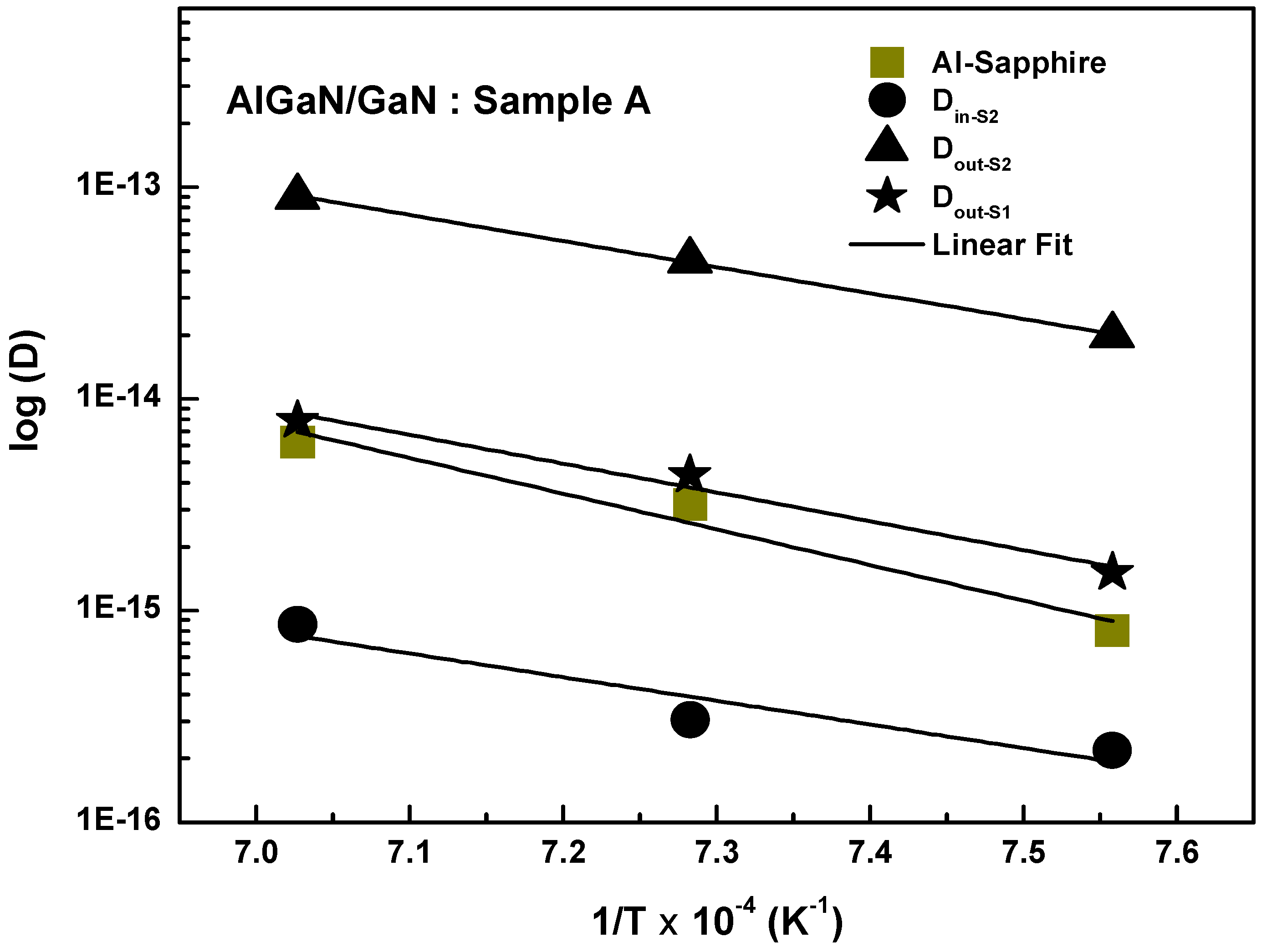
The diffusion determined from these fits was then analyzed using the Arrhenius relation,
, as shown in
Figure 5, where D
0 is a pre-factor, E
a is the activation energy, T is the annealing temperature, and K
B is the Boltzmann constant, confirming that all three processes, D
out-S1, D
in-S2 and D
out-S2, are thermally activated.
The extracted activation energies (E
a) and pre-factors (D
0) provide the microscopic interpretation of the diffusion mechanism. The D
out-S2 (out-diffusion from AlGaN) is characterized by the following equation:
. The relatively low E
a = 2.44 eV suggests a defect-mediated mechanism, likely via Ga (V
Ga) and N (V
N) vacancies, which are easily formed in the strained AlGaN layer [
14,
15]. The high D
0 = 4.03 × 10
−5 cm
2 s
−1 (the largest at the S2 interface) is the rate-determining factor for Al out-diffusion, indicating a significantly higher concentration of (V
Ga) defects within the AlGaN layer compared to the GaN layer. The D
in-S2 (in-diffusion into AlGaN) is described by
. The inner interface out-diffusion (D
out-S1) follows the standard Arrhenius law:
.
The activation energies E
a = 2.44 eV, E
a = 2.21 eV, and E
a = 2.70 eV are comparable and close to the 2.6 eV migration barrier reported for N vacancies in GaN [
15], implying that the fundamental microscopic jump mechanism is a native defect-assisted substitutional diffusion. These low E
a values, when compared to the [3–5 eV] range for Al diffusion [
9,
15], are inconsistent with a simple interstitial mechanism and may thus be ruled out. Our findings support the basic principle that the local distribution and migration rate of native defects influence atomic behavior and diffusion rate. The quantitative analysis of the SIMS profiles indicates that aluminum (Al) diffusion occurs not only at the AlGaN/GaN interface, but also at the deeper GaN/sapphire interface, as illustrated in
Figure 5. Diffusion at the substrate interface is defined by the following equation:
. The quantitative analysis of Al diffusion from the sapphire (Al
2O
3) substrate into the GaN buffer layer yielded a diffusion coefficient of D
Al = 3.18 × 10
−15 cm
2 s
−1 at 1100 °C and an activation energy (E
a) of 3.34 eV. This value is precisely within the high [3–5 eV] range typically expected for Al diffusion in GaN, demonstrating that the process is highly thermally activated and must overcome a significant energy barrier. This high E
a significantly supports the claim that Al diffusion in GaN is slow and not controlled by a simple interstitial mechanism. Furthermore, our measured E
a of 3.34 eV is consistent with an investigation in the literature into Al diffusion from sapphire to GaN, which found an E
a of 3.35 eV [
6]. This activation value is quite similar to the reported thermal migration barriers for GaN thermal degradation (3.2 eV), supporting the significance of native defects in Al migration. According to Deppe et al., the self-diffusion of column III lattice atoms in semiconductors has to proceed via native crystal defects, and the overall diffusivity is determined by the native defect migration rate and concentration [
16]. Ono et al. observed this concept, reporting that the local distribution of vacancies in the crystal controls Al atomic behavior during diffusion [
17]. Despite the consistency in the E
a (the energy barrier), our measured diffusion coefficient at 1100 °C is two orders of magnitude lower (D
Al = 3.18 × 10
−15 cm
2 s
−1) than the (D
Al = 4.8 × 10
−14 cm
2 s
−1) extrapolated from Haneda et al. [
6]. The lower D
Al in our work indicates that the GaN/sapphire interface is less dislocated than the material examined by Haneda et al. Our estimated pre-factor (D
0 = 4.85 × 10
−3 cm
2 s
−1) for the GaN/sapphire interface, which is in fact two orders of magnitude greater than those of the AlGaN interfaces, reflects this. However, the activation energy (E
a) also has a significant influence on the diffusion coefficient D
Al. According to our findings, E
a is significantly greater for the sapphire interface (3.34 eV) than for the AlGaN/GaN interfaces (2.2–2.7 eV). The strong Al-O bonds in the sapphire (Al
2O
3) lattice, which need more thermal energy to break than the Al-N bonds in the strained AlGaN layer, are the cause of this high barrier. This larger energy barrier acts as the dominant limiting factor, resulting in a lower diffusion coefficient (D
Al) despite the higher defect concentration at the sapphire interface.
Table 2 summarizes the results of Al diffusion coefficients for in-diffusion (D
in) and out-diffusion processes (D
out) from sample (B) AlN/GaN interfaces.
The diffusion coefficients for the annealed samples (B
1–B
3) are often lower than that for the as-grown sample (B
0). This emphasizes the distinction between diffusion during MOVPE growth and during post-growth thermal annealing. Unlike the complex behavior seen at the AlGaN/GaN interfaces, D
in and D
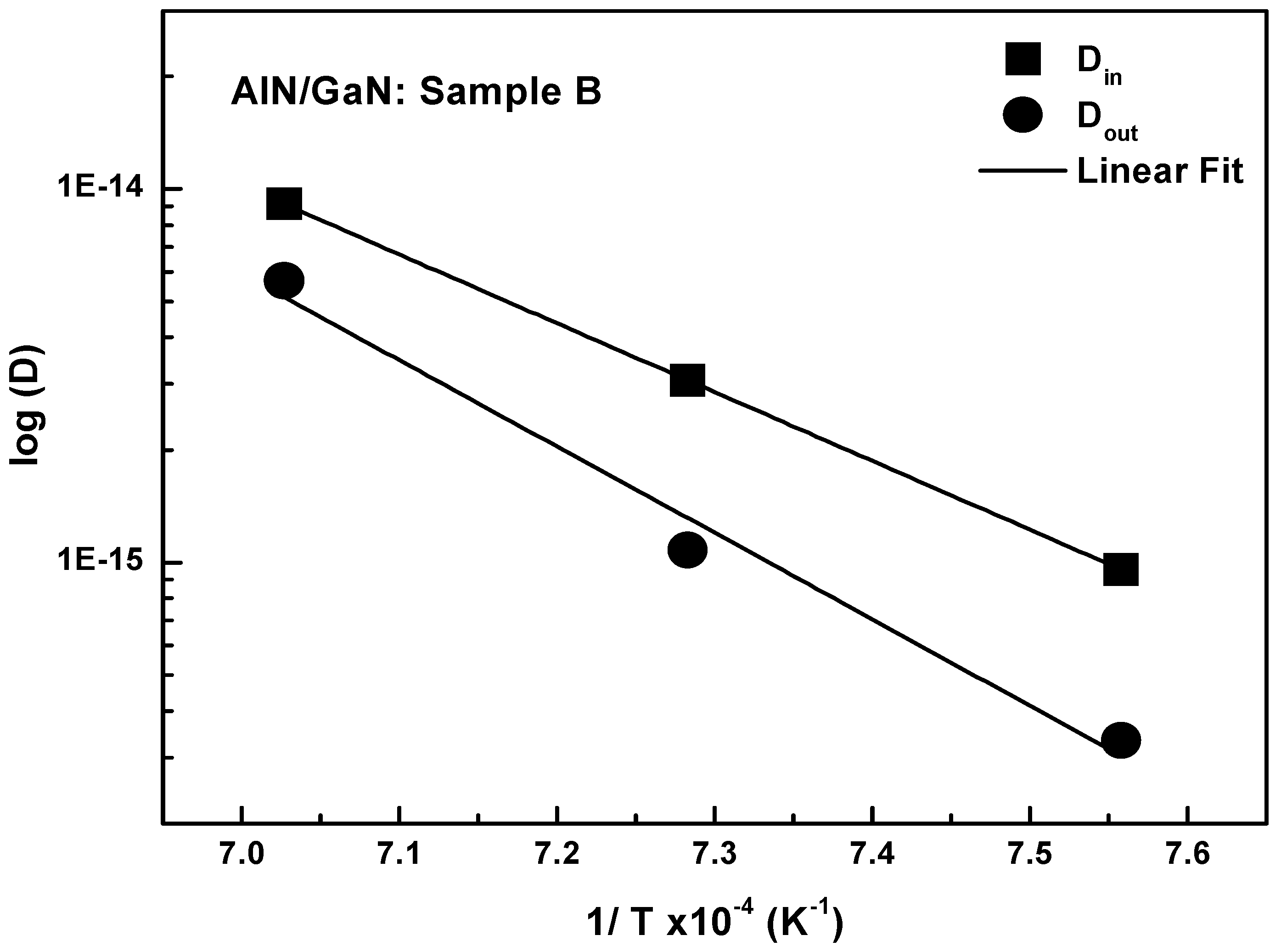
out in the AlN/GaN structure increase monotonically when the annealing temperature rises from 1050 °C to 1150 °C. This temperature dependence implies that both diffusion processes are predominantly controlled by an Arrhenius-type thermally activated mechanism. The quantitative analysis of the structure (B), supported by the Arrhenius plot (
Figure 6), reveals a shift in the kinetic control of the diffusion asymmetry, with D
in-AlN being more pronounced than D
out-AlN.
The in-diffusion process (Din-AlN) is described by
. The out-diffusion process Dout-AlN) is described by
. In this AlN/GaN structure, the Ea values (3.66 eV for Din-AlN and 4.59 eV for Dout-AlN) are significantly higher than those found in the AlGaN/GaN structure (2.2–2.4 eV), indicating a much more stable interface with a higher energy barrier required for Al diffusion. This enhanced stability is most likely due to the stronger binding strength and probably lower defect concentration in pure AlN compared to the AlGaN layer. The high Ea of 4.59 eV severely hinders the process of Al out-diffusion from the AlN layer, suggesting that the mechanism for Al escape from the concentrated AlN layer into the GaN requires overcoming a significant energy barrier, possibly due to a reduction in the required mobile defects at the boundary. In contrast, Al in-diffusion is promoted by a significantly lower Ea of 3.66 eV and a higher D0 (8.11 × 10⁻² cm2 s−1), which is nearly eight times larger than the D0 for out-diffusion (1.09 × 10⁻² cm2 s−1). The stress state at the bottom interface (S1, in-diffusion) differs from the top interface (S2, out-diffusion) as the layer relaxes. A higher activation energy for out-diffusion (Ea = 4.59 eV) indicates that the Al atoms are more bound in the AlN lattice near the surface, requiring more thermal energy to break their bonds and initiate migration. There is typically a higher density of dislocations near the first AlN/GaN interface compared to the top of the layer. These defects effectively lower the average energy barrier for Al atoms to jump, resulting in a lower Ea of 3.66 eV.
The strong asymmetry observed in the AlN/GaN structure is determined by the combination of a lower Ea and a greater D0, making Al in-diffusion the predominant route for interfacial mixing. This finding emphasizes that the kinetic control of Al diffusion is significantly altered by the particular composition (AlN vs. AlGaN) and the corresponding strain or defect distribution, necessitating careful attention when building thermally stable high-power electronic devices. Indeed, the AlN layer thickness significantly exceeds the critical thickness (~10 nm), resulting in a large density of misfit and threading dislocations as well as significant strain relaxation. In contrast to the ideal lattice, these defects offer high-diffusivity paths that promote Al migration. As a result, the mismatched AlN/GaN interface has a greater diffusion coefficient (DAl) than the AlGaN/GaN interface. Higher pre-factors (D0) further support this, indicating that dislocations serve as sources of gallium vacancies (VGa), which raise the frequency of atomic jumps. Ultimately, while the Al-N bond strength imposes a high activation energy (Ea), these growth-induced defects dominate the intermixing kinetics, explaining why AlN exhibits a higher D0 than the AlGaN layer. The improved intrinsic thermal stability of the pure AlN layer is confirmed by the significant rise in (Ea), by more than 1.2 eV when compared to AlGaN, which is probably caused by its stronger Al-N bonds and distinct equilibrium defect concentration. Our findings verify that the AlN structure is maintained by a high energy barrier (Ea), leading to noticeably better thermal stability for applications requiring high-temperature operation. These findings have important implications for the design of AlGaN/GaN HEMTs utilizing AlN interlayers. To improve 2DEG mobility, these interlayers must be kept thin enough to avoid reaching the critical relaxation threshold. Our data shows that once the layer relaxes and develops defects, these defects create highly diffusive pathways. In this state, the many high-speed pathways created by these defects (high D0) overcome the resistance of the strong chemical bonds, allowing atoms to migrate across the interface easily. Consequently, a relaxed AlN layer promotes faster intermixing across the interface. This causes interfacial intermixing and weakens the 2DEG confinement, which can compromise the device’s performance during high-temperature fabrication.