3.1. Influence of Neighbor Search Strategy on Network Identification Efficiency
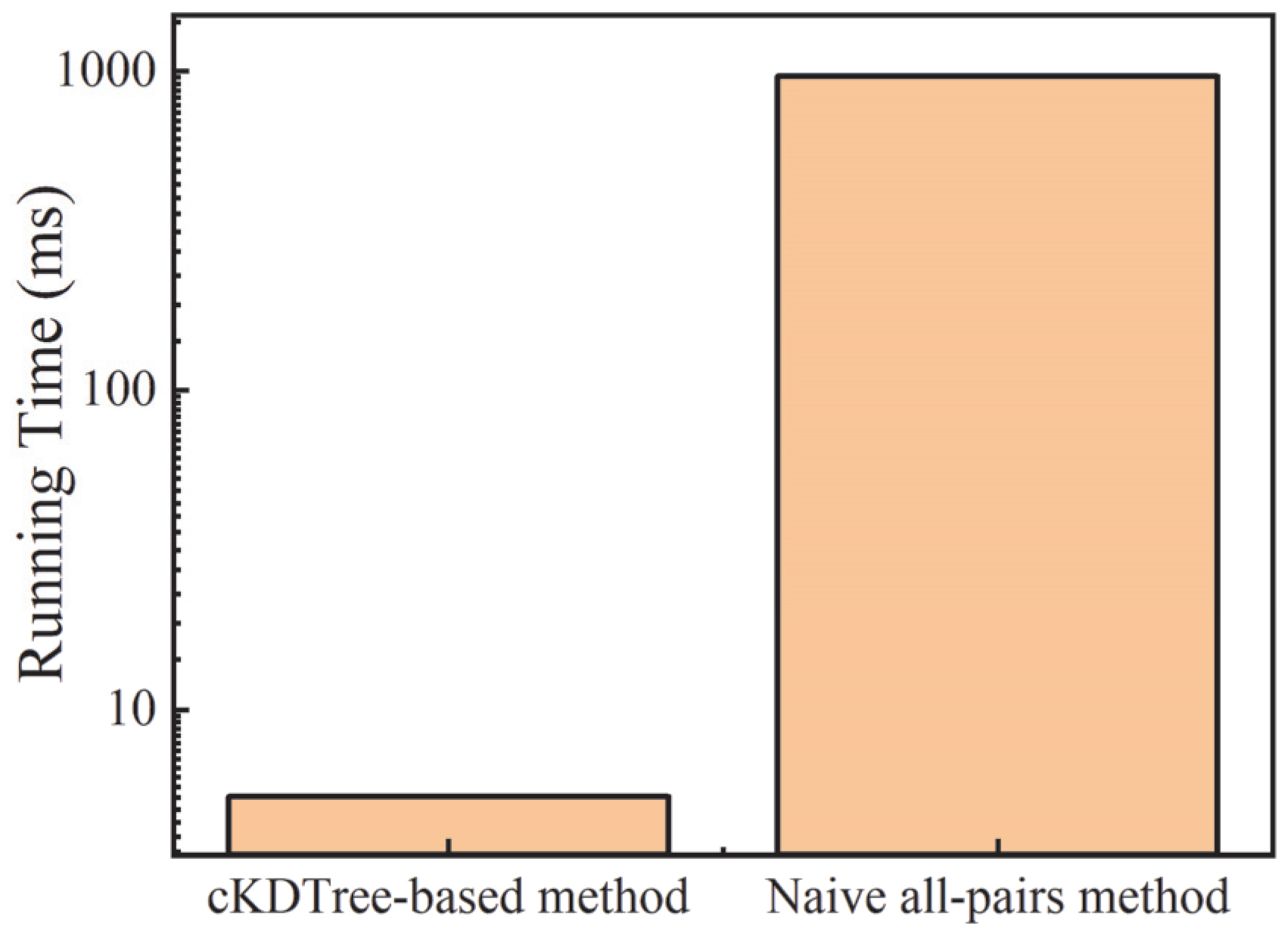
A critical step in identifying conductive filler networks is the detection of all filler pairs that satisfy the tunneling criterion. For large-scale systems containing thousands to tens of thousands of filler beads, the efficiency of the neighbor search algorithm directly determines the feasibility and reliability of percolation analysis. In this paper, a cKDTree-based neighbor search strategy was employed and systematically compared with the conventional naive all-pairs method [
27]. In the naive all-pairs method, distances between all possible bead pairs must be explicitly evaluated, leading to a computational cost that scales quadratically with the number of particles. For the systems considered here, this resulted in an average computational time of 964.63 ms per simulation frame, rendering large-scale statistical analysis computationally prohibitive. By contrast, the cKDTree-based method constructs a spatial indexing structure and restricts distance evaluations to particles located within a local neighborhood. This approach significantly reduces the number of distance calculations required for each frame. The average computational time per frame using the cKDTree-based method is reduced to 5.33 ms under identical conditions as shown in
Figure 1, corresponding to an approximately 180-fold improvement in computational efficiency relative to the naive all-pairs method. These results demonstrate that the cKDTree-based neighbor search is essential for efficient and scalable identification of conductive networks in large nanofiller systems, enabling reliable percolation statistics without compromising computational accuracy.
By adopting the cKDTree-based method, the total computational time for the entire dataset is reduced to approximately 50 s, which makes it feasible to systematically explore a broad parameter space spanning multiple filler VFs and compositional ratios. Moreover, the advantage of the cKDTree-based approach becomes even more pronounced in the vicinity of the percolation threshold. Filler clusters grow rapidly and large connected components emerge leading the naive all-pairs method to perform an excessive number of redundant pairwise distance checks within dense clusters, thereby further increasing its computational cost. In contrast, the localized query structure of the cKDTree-based method maintains stable performance even in highly connected and spatially dense regions, ensuring consistent efficiency across the entire percolation transition.
3.2. RDF Analysis of Fillers with Different Morphologies
RDF is a fundamental structural descriptor for characterizing the spatial organization of nanofillers in composite systems. By comparing the RDFs with different morphologies, insights can be obtained into their local packing characteristics and short-range ordering. Such structural information can provide a microscopic basis for understanding the mechanisms governing conductive network formation. In this paper, the spatial organization of the three types of fillers embedded in the polymer matrix is systematically examined from two complementary perspectives, which are variations in the overall filler VF and changes in the compositional ratios among different fillers. This combined analysis allows to disentangle the effects of VF and morphology on inter-filler spatial correlations.
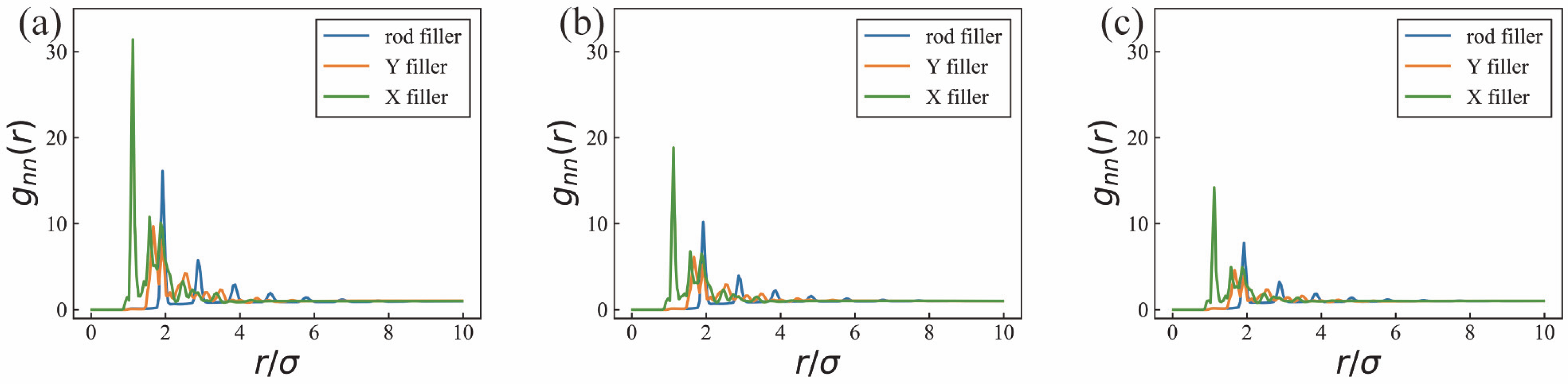
Under an equimolar composition of rod, Y and X fillers,
Figure 2 presents the RDFs of the three filler types at total filler VFs of 2.87%, 4.62% and 6.23%, respectively. As the overall filler concentration increases, a pronounced decrease in the height of the first peak of g
nn(r) is observed, indicating a progressive reduction in short-range structural order. This behavior can be primarily attributed to the continuous reduction in free volume in the system. When the VF is 2.87%, individual fillers possess ample accessible space, which facilitates the formation of well-defined preferred inter-filler distances and leads to a sharp and prominent first RDF peak, consistent with previous simulation studies of nanofiller dispersion in polymer matrices at low loadings [
7,
15]. In contrast, at higher VF, the average center-to-center distance between fillers decreases, and steric crowding increasingly constrains local arrangements. As a consequence, local structural correlations are weakened, leading to a broader and flatter RDF profile.
In addition to this dependence on the total nanofiller VF, systematic differences are observed in both the positions and intensities of the first RDF peaks among the three filler morphologies. The first peak appears at the smallest r/σ for X fillers followed by Y fillers, while rod fillers exhibit the largest first-peak position. This ordering is directly related to geometric characteristics. X fillers feature a compact four-arm structure, which allows for smaller minimum approach distances between filler centers. Y fillers display intermediate behavior due to their three-arm geometry. In contrast, rod fillers possess a high aspect ratio that imposes more stringent geometric constraints during close approach. To minimize steric repulsion, contacts between rod fillers typically involve axial offsets or tilted configurations, causing the effective contact points to be displaced away from the geometric centers of the rods. As a result, the rod-rod center-to-center distances are systematically larger, shifting the first RDF peak to higher r/σ values compared with X and Y fillers. However, the relative heights of the first RDF peaks exhibit an inconsistent order, with X fillers showing the highest peak intensity, followed by rod fillers and then Y fillers. This hierarchy reflects differences in the degree of geometric determinacy of nearest-neighbor configurations. The compact and nearly symmetric geometry of X fillers gives rise to a relatively narrow distribution of nearest-neighbor separations, leading to a higher probability of finding neighboring fillers at similar distances and thus a more pronounced RDF peak. Rod fillers, although capable of forming close contacts, allow for a broader range of contact modes, such as end–end, end–side, and axially staggered arrangements, each of which is associated with a distinct center-to-center distance. This diversity broadens the nearest-neighbor distribution and reduces the peak intensity relative to X fillers. By contrast, the three-armed geometry of Y fillers permits highly diverse contact orientations without favoring a unique nearest-neighbor separation, resulting in a more dispersed local packing environment and the lowest first-peak intensity. Consequently, while increasing filler concentration universally weakens short-range order, the local packing specificity imposed by filler geometry governs the relative peak intensities observed.
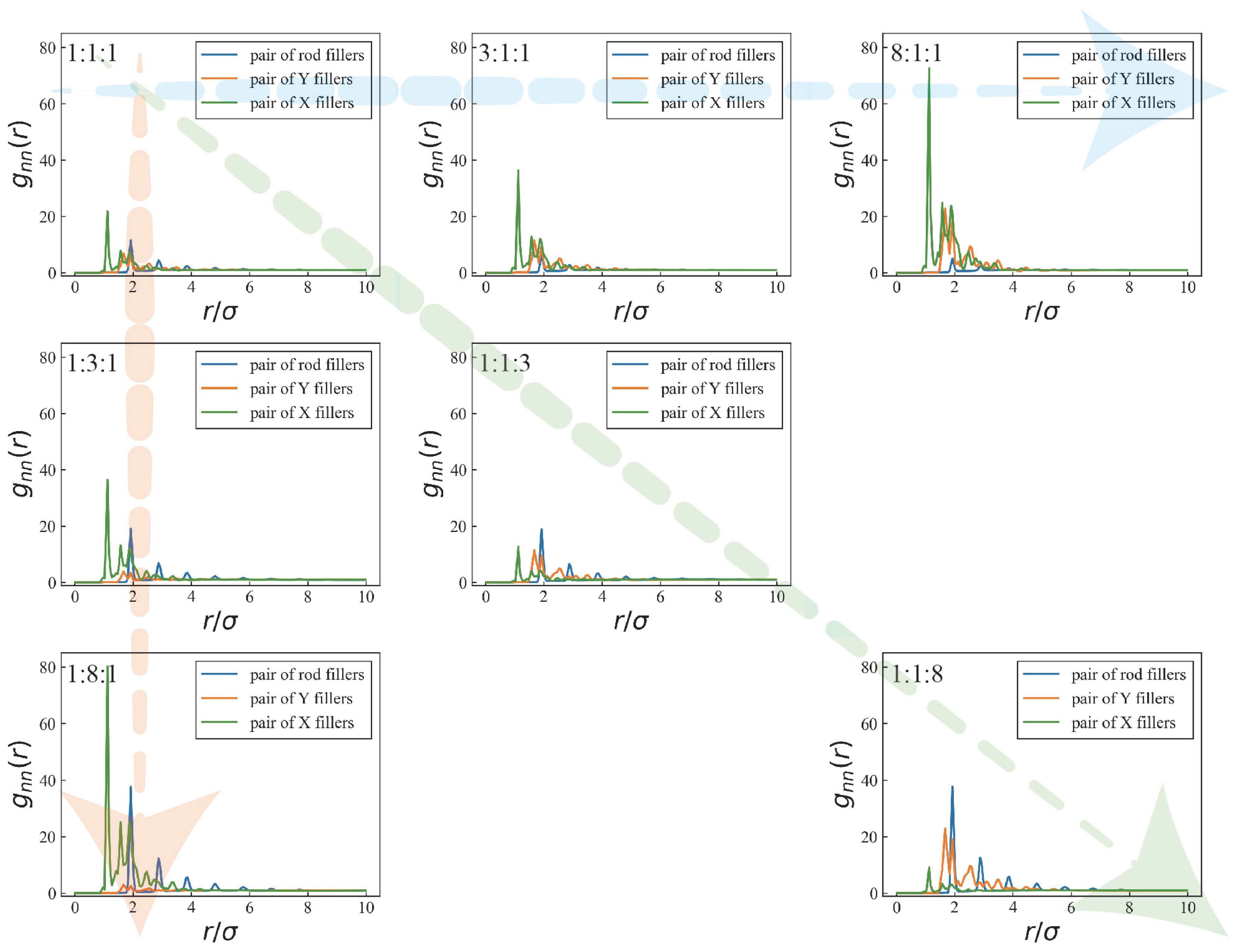
Figure 3 illustrates the influence of filler composition on the RDFs under a fixed total filler number of 390 nanofillers, with varying ratios of rod, Y, and X fillers. All seven compositional systems exhibit pronounced morphology-dependent structural features, indicating that local inter-filler organization is governed not only by the overall filler VF but also by competitive packing effects arising from the coexistence of fillers with distinct geometries.
As the VF of rod fillers increases, a clear reduction in the peak intensity of rod-rod gnn(r) is observed. This trend can be attributed to the high aspect ratio of rod fillers. At low rod filler concentrations, short-range correlations between rods are primarily established through end–end or end–side point contacts, leading to relatively well-defined nearest-neighbor configurations. With increasing rod filler, excluded-volume effects become increasingly significant, favoring arrangements such as line contacts or axially staggered configurations that maximize configurational entropy. This transition toward more orientationally flexible and loosely packed structures weakens distinct nearest-neighbor correlations, resulting in a suppressed RDF peak. At the same time, increasing the rod filler VF leads to an enhancement of the RDF peak intensities for X-X and Y-Y correlations, as anisotropic crowding reduces the accessible free volume for X and Y fillers and biases them toward more confined local environments, thereby strengthening their short-range correlations.
When the VF of Y fillers increases, a progressive reduction in the peak intensity of the Y-Y RDF is observed, accompanied by a pronounced flattening of the first peak. Owing to their three-armed geometry, Y fillers permit contact configurations distributed over multiple directions, which does not favor the formation of a unique or well-defined nearest-neighbor distance. As a result, Y–Y separations span a broad and nearly continuous range, leading to intrinsically weak short-range order. With further increasing Y filler, this geometric flexibility amplifies configurational diversity, causing the Y–Y RDF peak to become flatter than those of rod–rod and X–X correlations. Meanwhile, the presence of abundant Y fillers facilitates efficient accommodation of local voids, partially relaxing excluded-volume constraints experienced by rod and X fillers and thereby enhancing their short-range correlations.
By contrast, increasing the VF of X fillers leads to a reduction and a pronounced broadening of the first peak in the X–X RDF. Due to their four-armed geometry with nearly orthogonal directions, neighboring X fillers are less likely to achieve compact contacts through symmetric or well-defined geometric configurations. The resulting geometric incompatibility produces a complex excluded-volume shape and a broad distribution of nearest-neighbor separations. As the X filler fraction increases, such configurational disorder becomes increasingly pronounced, leading to a progressive weakening of short-range correlations and a diminished first RDF peak.
3.3. Percolation Behavior and Conductive Network Formation
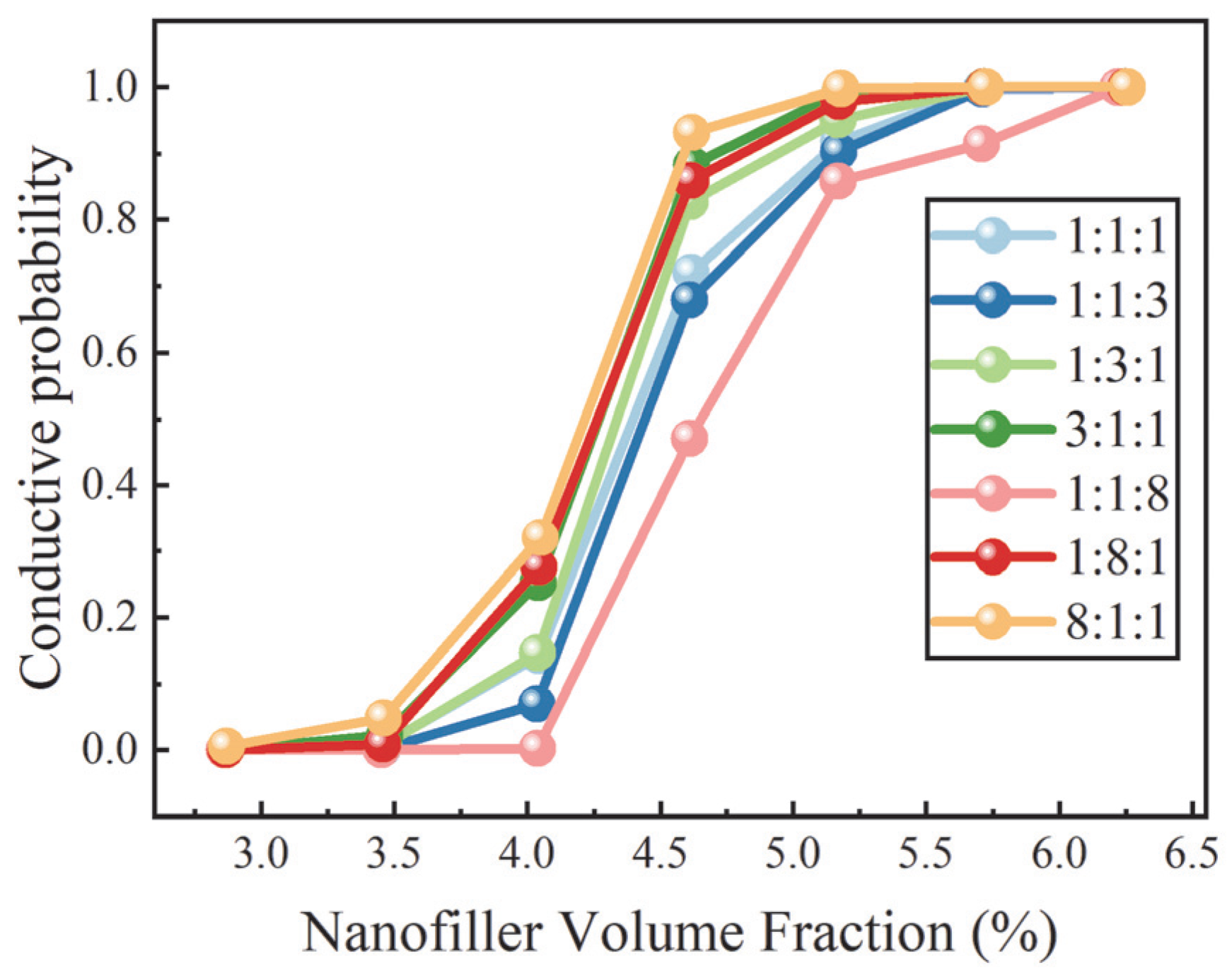
Figure 4 presents the dependence of the conductive probability on the total nanofiller VF for systems with different filler composition ratios. Overall, the systems exhibit characteristic percolation behavior, with a rapid increase in conductive probability as the filler loading increases. However, the compositional ratios of different nanofillers exert a pronounced influence on both the onset of the transition region and the location of the percolation threshold.
In the low VF regime (approximately 2.87–3.46%), the conductive probability increases only gradually. In this range, the overall filler density remains insufficient to form system-spanning conductive pathways, and most connections are limited to short-range local contacts or small isolated clusters. Although increasing filler content enhances the likelihood of close inter-filler proximity, the separations between individual clusters remain relatively large, preventing these local structures from establishing effective long-range connectivity. As a result, despite the continuous increase in filler loading, the global connectivity of the system improves only slowly, giving rise to a smooth and gradual increase in conductive probability.
When the nanofiller VF enters the range of approximately 4.04–4.62%, the conductive probability exhibits a markedly accelerated increase, signaling a critical transition from local connectivity to system-spanning network formation. In this regime, the average inter-filler separation decreases substantially, enabling previously isolated small clusters to merge through the formation of bridging fillers, which rapidly expands the size of the dominant connected cluster. As percolation is a critical phenomenon, small structural perturbations near the threshold are strongly amplified. Consequently, the conductive probability rises sharply within this narrow concentration window. At this stage, the nanofiller network reaches a critical connectivity condition, such that the addition of only a small amount of filler is sufficient to establish a stable three-dimensional percolating pathway across the system. Consistent with percolation theory, crossing the critical threshold is accompanied by an abrupt growth of the largest cluster. Beyond the percolation threshold, the conductive probability gradually approaches unity. In this post-percolation regime, the conductive network is essentially fully established, and the overall connectivity becomes insensitive to local structural fluctuations, exhibiting instead a slow and steady saturation behavior.
In finite-size systems, the conductive probability increases continuously from 0 to 1 as the nanofiller VF increases. Following a commonly adopted criterion in percolation analysis, the VF at which conductive probability is 0.5 is taken as the percolation threshold. Based on this definition,
Figure 4 reveals a pronounced dependence of the percolation threshold on filler morphology ratios. Among the compositions examined, the system with a ratio of 8:1:1 exhibits the lowest percolation threshold, whereas the threshold reaches its highest value when the filler ratio is 1:1:8.
This trend reflects the distinct abilities of fillers with different morphologies to construct system-spanning conductive networks. Owing to their high aspect ratio, rod fillers can establish extended effective connectivity over larger spatial distances even at relatively low concentrations, thereby participating more efficiently in the formation of percolating conductive pathways. According to excluded-volume theory, particles with higher aspect ratios exhibit lower critical percolation VF, as their excluded volume increases strongly with particle length. This enlarged excluded volume enhances the probability that rod fillers bridge local gaps and connect otherwise isolated clusters, enabling network formation across length scales and ultimately leading to global percolation.
In contrast, X fillers exhibit a relatively compact structure, resulting in more limited excluded-volume effects and contact geometries that are unfavorable for long-range connectivity. As a consequence, X fillers are less effective at establishing stable connections across multiple length scales, making the formation of system-spanning networks more difficult. When X fillers dominate the composition, inter-filler connections are largely confined to local regions, leading to a higher percolation threshold. In other words, a high fraction of X fillers tends to promote the formation of multiple small clusters rather than a single large percolating cluster, such that a substantially higher overall filler loading is required to achieve three-dimensional connectivity throughout the system.
To further elucidate the influence of filler morphology ratios on the evolution of conductive network structures,
Figure 5 and
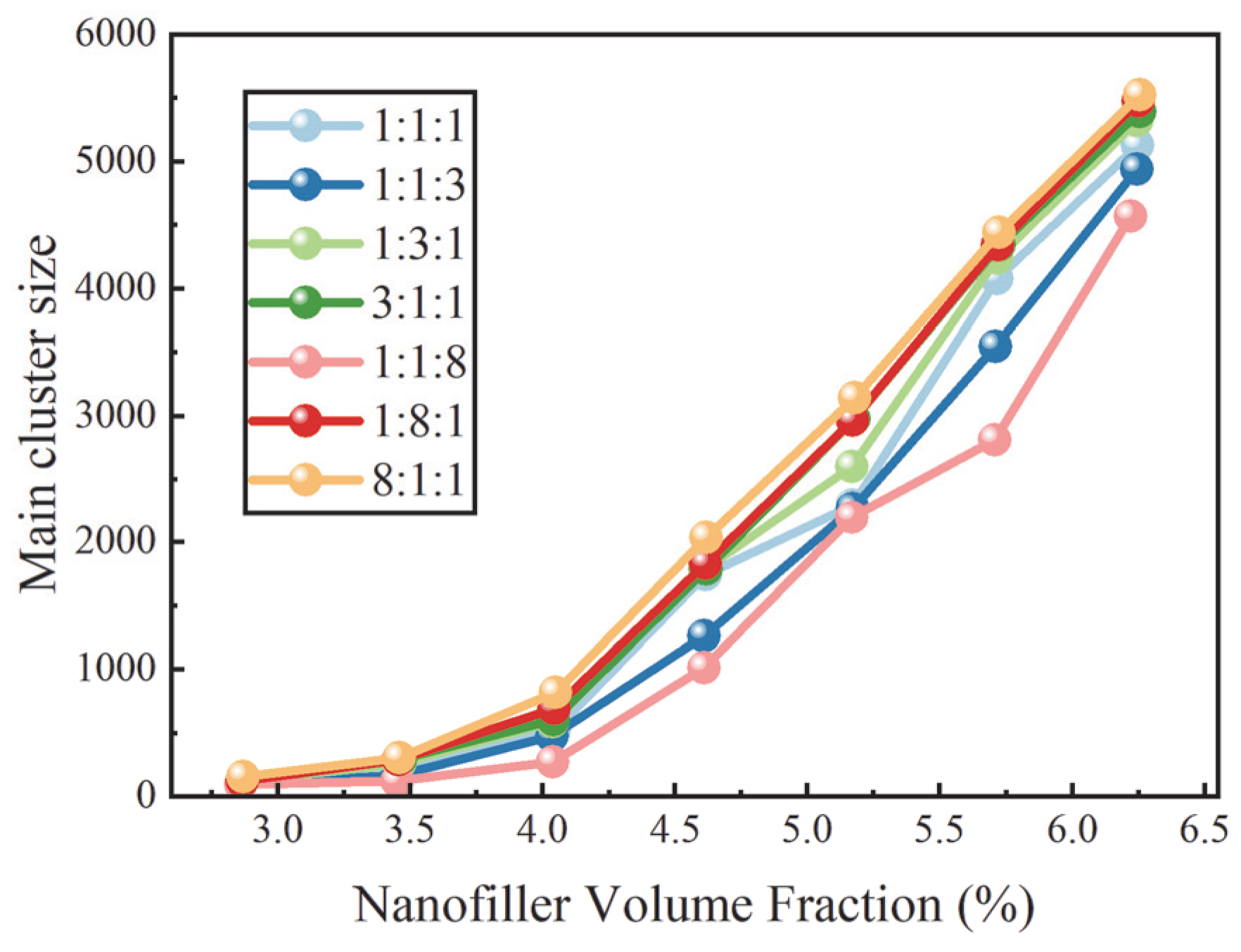
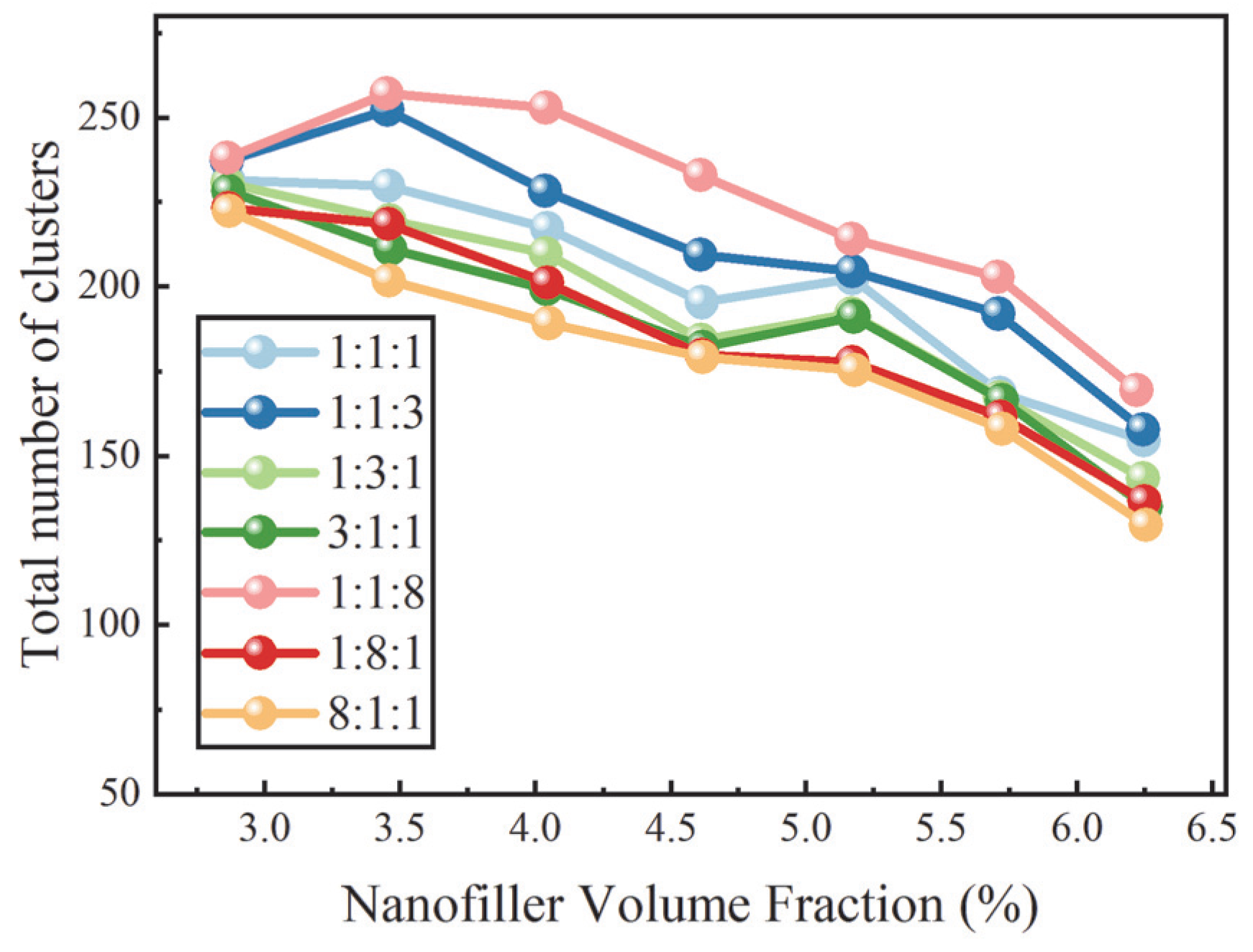
Figure 6 present the variations in the MCs and the Nc as functions of the filler VF, respectively. At a given filler VF, systems characterized by a larger dominant cluster and a smaller number of clusters exhibit stronger inter-filler connectivity and are therefore more likely to develop system-spanning conductive networks. As shown in
Figure 5, MCs exhibits pronounced dependence on the filler composition ratio. Among all systems examined, the composition with a ratio of 8:1:1 consistently displays the largest dominant cluster across the investigated VF range. This behavior arises from the high aspect ratio of rod fillers, which enables them to act as effective bridging elements in space, rapidly merging local clusters into larger connected structures through extended geometric contacts and axially staggered arrangements. As the fraction of rod fillers decreases, their ability to construct and sustain large-scale networks is progressively weakened, leading to a marked reduction in MCs. This trend closely mirrors the corresponding evolution of the conductive probability, further confirming the critical role of rod fillers in promoting network connectivity.
By contrast, increasing the fraction of X fillers leads to pronounced network fragmentation, characterized by a significant decrease in the MCs and a concurrent increase in Nc. This behavior can be primarily attributed to the geometric characteristics of X fillers. Featuring a four-armed structure with nearly orthogonal arms, X fillers possess a more complex and strongly anisotropic excluded-volume shape, which makes it difficult for neighboring X fillers to identify stable and repeatedly occurring matching orientations in space. As a result, the formation of robust and extended contact chains is disfavored. Moreover, the geometry of X fillers also weakens their effectiveness as connectors that couple fillers of different morphologies into a unified network. Instead, X-rich systems tend to sustain multiple small- to intermediate-sized clusters rather than merging into a single dominant percolating cluster, thereby inhibiting the development of large-scale connectivity.
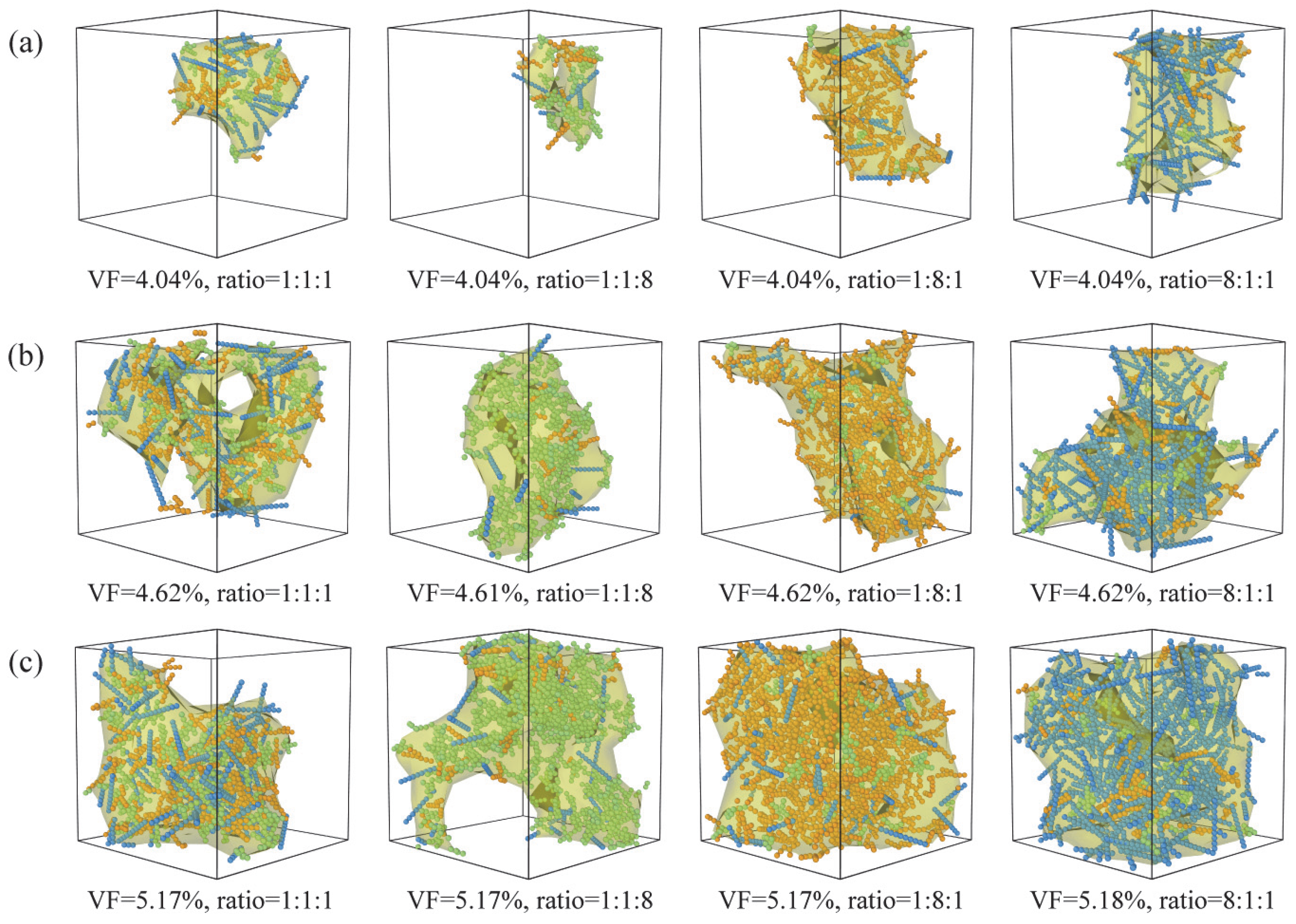
Figure 7 presents representative configuration snapshots of systems dominated by rod, Y, and X fillers, respectively, at nanofiller VFs of 4.04%, 4.62%, and 5.17%, illustrating the evolution of conductive network structures with increasing filler loading and varying morphology ratios. At the lower VF of 4.04%, the dominant clusters in all systems remain spatially limited, forming only several locally connected regions that are insufficient to span the simulation box. Consequently, the systems remain in a non-percolated state. As the VF increases to 4.62%, the conductive networks begin to develop significantly. Previously isolated local clusters gradually merge through the action of bridging fillers, leading to a marked increase in the size of the dominant cluster and the emergence of near-percolating network structures. At a VF of 5.17%, the conductive networks are essentially fully established. The dominant cluster spans the system continuously along all three orthogonal directions, forming a stable three-dimensional percolating network.
Distinct network morphologies observed at identical filler VF for systems dominated by different filler types are also clearly illustrated in
Figure 7. When rod fillers constitute the majority, the system more readily develops a larger and more extended dominant cluster, resulting in a more continuous conductive backbone. In contrast, systems dominated by Y fillers exhibit dominant clusters of intermediate size, corresponding to a moderate level of network connectivity. For X-rich systems, the dominant clusters are noticeably smaller, reflecting a more fragmented network structure. These trends are fully consistent with the quantitative results obtained for the conductive probability, MCs, and Nc discussed, further highlighting the pronounced influence of filler morphology on network formation. Specifically, rod fillers, owing to their high aspect ratio, are more effective at constructing system-spanning conductive structures, whereas the geometric characteristics of X fillers favor the formation of dispersed and fragmented networks, making the attainment of three-dimensional percolation more difficult.