Abstract
The implementation of photoelectric conversion in photoelectric integrated systems requires the design of photodetectors (PDs) with quick response times and low power consumption. In this work, the self-powered photodetector was prepared by antimony selenide (Sb2Se3) microwires (MW)/Se microtube (MT) heterojunction by coating Ag nanowires (NW). The incorporation of Ag-NW involves dual enhancement mechanisms. First, the surface plasmon resonance (SPR) effect amplifies the light absorption across UV–vis–NIR spectra, and the conductive networks facilitate the rapid carrier transport. Second, the type-II band alignment between Sb2Se3 and Se synergistically separates photogenerated carriers, while the Ag-NW further suppress the recombination through built-in electric field modulation. The optimized device achieves remarkable responsivity of 122 mA W−1 at 368 nm under zero bias, with a response/recovery time of 8/10 ms, outperforming most reported Sb2Se3-based detectors. The heterostructure provides an effective strategy for developing self-powered photodetectors with broadband spectral adaptability. The switching ratio, responsivity, and detectivity of the Sb2Se3-MW/Se-MT/Ag-NW device increased by 260%, 810%, and 849% at 368 nm over the Sb2Se3-MW/Se-MT device, respectively. These results show that the addition of Ag-NW effectively improves the photoelectric performance of the Sb2Se3-MW/Se-MT heterojunction, providing new possibilities for the application of self-powered optoelectronic devices.
1. Introduction
Photodetectors (PDs) convert optical signals into electrical signals, acting as an indispensable key component in modern optoelectronic systems [1,2,3,4]. According to the spectral response range, standard PDs can be divided into three categories: ultraviolet (UV) light (200–400 nm), visible light (400–760 nm), and near-infrared light (760–1000 nm) [5]. However, traditional PDs with external power sources exhibit significantly low portability and energy efficiency. In addition, scalable deployment is particularly hampered by high drive voltage, which can reach hundreds of volts for UV detectors. To remove the external power, emerging self-powered architectures, which take advantage of the built-in electric fields, provide revolutionary alternatives. Heterojunction-based solutions, which combine multispectral photon capture with interfacial energy band regulation, have great application potentials [6,7,8]. However, to achieve high responsiveness over a wide spectral range without the need for external bias still remains a major challenge. Innovative material systems like Sb2Se3 micro–nanostructures are of high value when fabricating self-powered broadband PDs [9,10,11,12,13,14]. Sb2Se3 exhibits high carrier transfer efficiency, strong light absorption capacity, a suitable band structure, and adjustable physical properties, making it suitable for use in PDs with high responsivity and sensitivity [15].
Among the Sb2Se3 micro–nanostructures, the one-dimensional crystal structure of Sb2Se3 can more easily obtain high-quality micro–nanostructures [16]. Highly crystalline Sb2Se3 nanowires (NW) prepared by a hydrothermal method showed a good response to visible light and a fast response speed of less than 0.3 s [17]. Under 3 V bias and 600 nm light irradiation, the responsiveness and external quantum efficiency is 8.0 A W−1 and 1650%, respectively. Liu et al. prepared uniform-sized Sb2Se3 nanowires by the microwave-assisted method and constructed nanowire thin film PDs. The switching ratio and response time of the device under 10 V bias was over 150 and 0.2/1.2s [18]. To further address the shortcomings of Sb2Se3 micro–nano PDs, such as low responsivity and the absence of self-driving capability, there are numerous reports on the fabrication of Sb2Se3-based heterojunction PDs [19]. Chen et al. constructed Sb2Se3/AgSbSe2 PDs by a two-step selenization process. Compared with Sb2Se3 nanorod PDs, the responsivity of this heterojunction PD is improved by 4.2 times, showing excellent photoelectric performance [20]. Overall, these advancements highlight the potential for Sb2Se3 micro–nanostructures in high-performance photodetection applications, yet disadvantages such as low responsivity and the demand for external power remain to be addressed.
Se, as a p-type inorganic semiconductor material, has a bandgap of about 1.77 eV and a melting point of 217 °C, exhibiting the advantages of low cost, high crystallization performance, and a high response rate [21,22,23]. The response speed of Se-based micro–nanostructure PDs is in the millisecond level. Se microtube (MT) PDs prepared by Hu et al. exhibit a responsivity of 19 mA W−1 at 610 nm, with rise and fall times of 0.32 ms and 23.02 ms, respectively [24]. To enhance the responsiveness and response time of Se PD, a common way is to construct a heterojunction with CsPbBr3, graphene, PEDOT, InSe, etc. [25,26,27]. Yu et al. fabricated a novel heterojunction structure based on p-type selenium nanoflowers (Se-f) and p-type polyaniline. This device exhibited excellent photoresponse characteristics, particularly achieving a high responsivity of 72.9 mA·W−1, a good detectivity of 1.98 × 10¹² Jones, and fast response times (rise time of 8.6 μs and fall time of 3.24 ms) under unbiased 610 nm illumination [28].
The introduction of metal plasma into Se-based heterojunctions can significantly improve the key performance parameters such as the responsiveness and response speed of PDs. The Local Surface Plasmon Resonance (LSPR) effect is discovered to be crucial in improving the absorption capacity and the local electric field of the devices to generate more photogenerated electrons and holes and further improving the responsivity and self-powered photovoltaic performance [29,30,31]. The noble metals (e.g., Au, Ag, Al) generally exhibit LSPR activity but are limited in practical use by inherent optical losses due to interband electron transitions and free carrier scattering [32,33,34,35]. In particular, silver exhibits superior visible plasmonic efficiency due to resonant matching between its electron cloud oscillation frequency and visible wavelengths, critical for optimal LSPR excitation. Jing et al. achieved a 470% increase in responsivity of 2.97 × 10⁴ A W−1 in MoS2-based PDs by integrating Ag nanoparticles [36]. Young et al. reported a silver nanoparticle (NPs)/zinc oxide (ZnO) nanorods PD, which exhibited enhanced photoelectrochemical performance with a photocurrent density of 3.22 × 10⁻⁶ A, and the photoresponsive on/off ratio demonstrated significant improvement from 560 to 5640, which can be attributed to the LSPR effect induced by the incorporated Ag NPs [37]. Therefore, the unique advantages of plasmonic silver nanostructures in UV–visible spectrum detection (350–700 nm), where LSPR effectively promotes the generation of photogenerated electron hole pairs and hot carriers, improves the collection efficiency of photogenerated carriers and greatly enhances the responsiveness and overall photoelectric performance of selenium-based PDs, thus overcoming its performance bottlenecks.
In this work, Se microtubes were prepared by chemical vapor deposition, and we constructed a self-powered heterojunction PD with Sb2Se3-MW. Ag-NW were coated on the Sb2Se3-MW/Se-MT device to optimize the photoelectric performances in the UV region. The proposed Sb2Se3-MW/Se-MT/Ag-NW device exhibits a peak responsivity of 228 mA W−1 and a peak detectivity of 1.6 × 10¹² Jones at 368 nm illumination.
2. Materials and Methods
2.1. Preparation of the Se-MT
The Se-MT was prepared by chemical vapor deposition in a horizontal tube furnace. A quartz boat with an appropriate amount of Se powder (A.R. 99%) was placed in the center of the tube furnace. A Si/SiO2 sheet as a substrate with the size of 2 × 1 cm was washed with acetone, ethanol, and deionized water and then placed 28 cm downstream to the quartz boat. High-purity nitrogen was injected into the horizontal tube furnace at a flow rate of 500 mL min−1 for over 20 min to exhaust the air in the furnace. The temperature of the furnace was raised to 300 °C from room temperature in 1 h and maintained for 5 h at a nitrogen flow rate of 200 mL min−1. The Se-MT was obtained on the Si/SiO2 substrate upon completion of the deposition process.
2.2. Preparation of the Sb2Se3-MW
The Sb2Se3-MW was prepared by the hydrothermal method. Antimony acetate (Sb(CH3COO)3, 0.26 g), sodium selenite (Na2SeO3, 0.85 g), and hydrazine hydrate (0.15 mL, 80 wt%) were dissolved together in deionized water (25 mL) and stirred thoroughly to form a mixed solution. Then, it was transferred to a 30 mL hydrothermal kettle with a Teflon liner, stirred, and then heated to 120 °C in muffle furnace for 8 h. The obtained Sb2Se3-MW was washed by deionized water and ethanol for several times.
2.3. Preparation of the Sb2Se3-MW/Se-MT and the Sb2Se3-MW/Se-MT/Ag-NW Heterojunctions
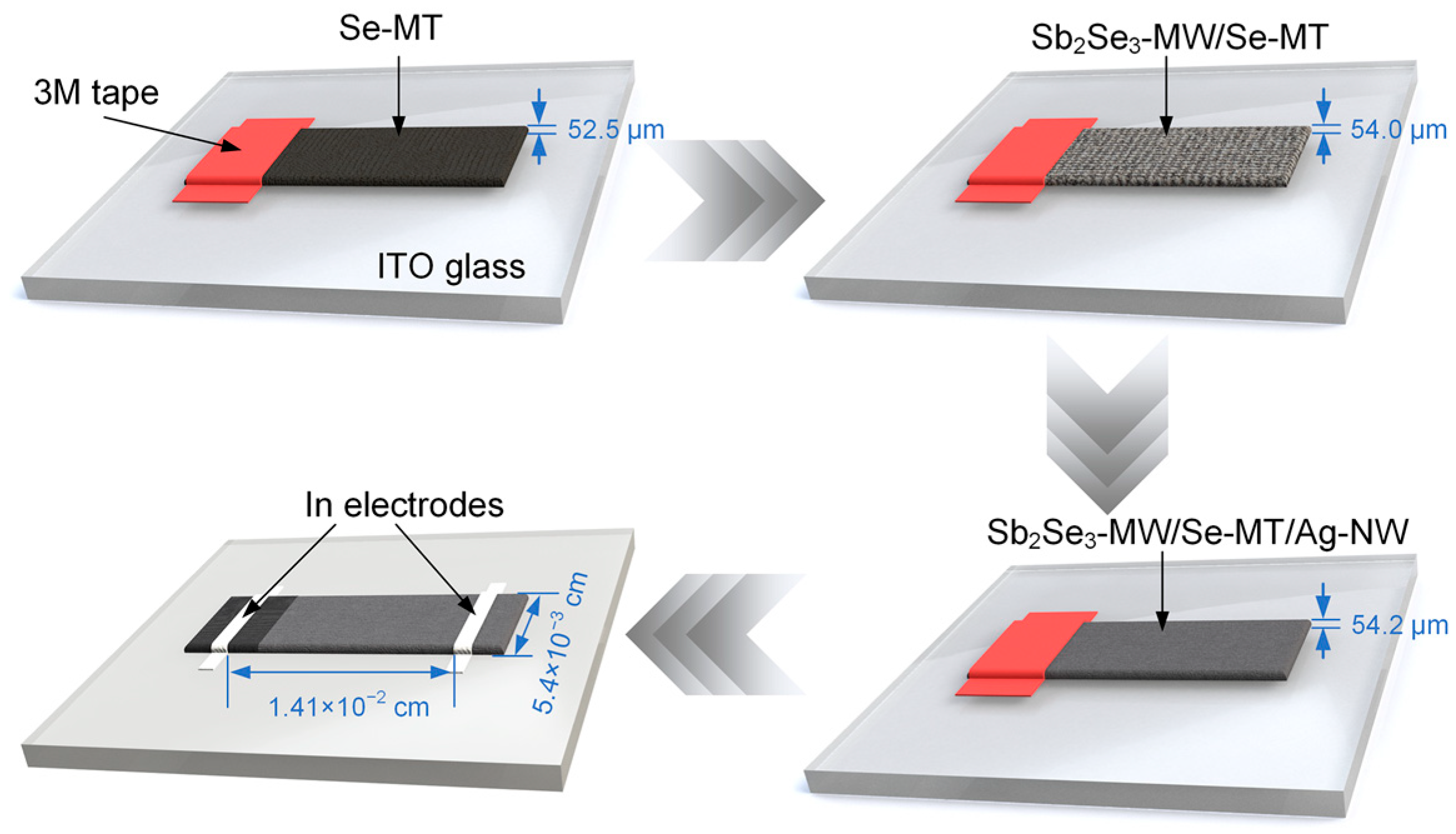
Figure 1 shows the fabrication of the Sb2Se3-MW/Se-MT and Sb2Se3-MW/Se-MT/Ag-NW heterojunctions. The Se-MT on the Si/SiO2 substrate was transferred to an Indium–Tin Oxide (ITO) glass, and one end of the Se-MT was covered and fixed by 3M tape. Thus, the rest of the Se-MT was sprayed with the Sb2Se3-MW solution. After drying for two minutes at 50 °C in a vacuum oven, the Sb2Se3-MW/Se-MT heterojunction was achieved. Then, with the 3M tape removed and an electrode attached, a PD device was ready for testing. Similarly, to create the Sb2Se3-MW/Se-MT/Ag-NW heterojunction PD, Ag-NW was further sprayed onto the part where the Sb2Se3-MW/Se-MT heterojunction formed and was then heated for 5 min at 45 °C. The Ag-NW, with an average diameter of 50 nm and length of 60 μm, were purchased from XFNANO (Nanjing, China) in the form of dispersion (XFJ162, 10 mg mL−1). With a typical device area of around 0.0141 cm × 0.0054 cm, 1 μL Ag-NW dispersion was used.
Figure 1.
Fabrication flow of the Sb2Se3-MW/Se-MT/Ag-NW heterojunction.
2.4. Material Characterization
The morphology of the synthesized Sb2Se3-MW/Se-MT/Ag-NW nanostructures was analyzed via scanning electron microscopy (SEM), conducted with a JEOL (Tokyo, Japan) JSM-7000F system. Crystalline phase and structural information were obtained through X-ray diffraction (XRD) measurements performed on a Bruker (Berlin, Germany) D8 A25 diffractometer utilizing Cu Kα radiation (λ = 1.5405 Å). The optical absorption characteristics were characterized with a UV–visible spectrophotometer Shimadzu (Kyoto, Japan) UV-2700. The optoelectronic performance and spectral optical responses of the fabricated devices were evaluated utilizing a semiconductor parameter analyzer Keithley (Cleveland, OH, USA) 2636B coupled with a multi-wavelength laser source. The final data were obtained after hundreds of cycles to ensure the accuracy.
3. Results and Discussion
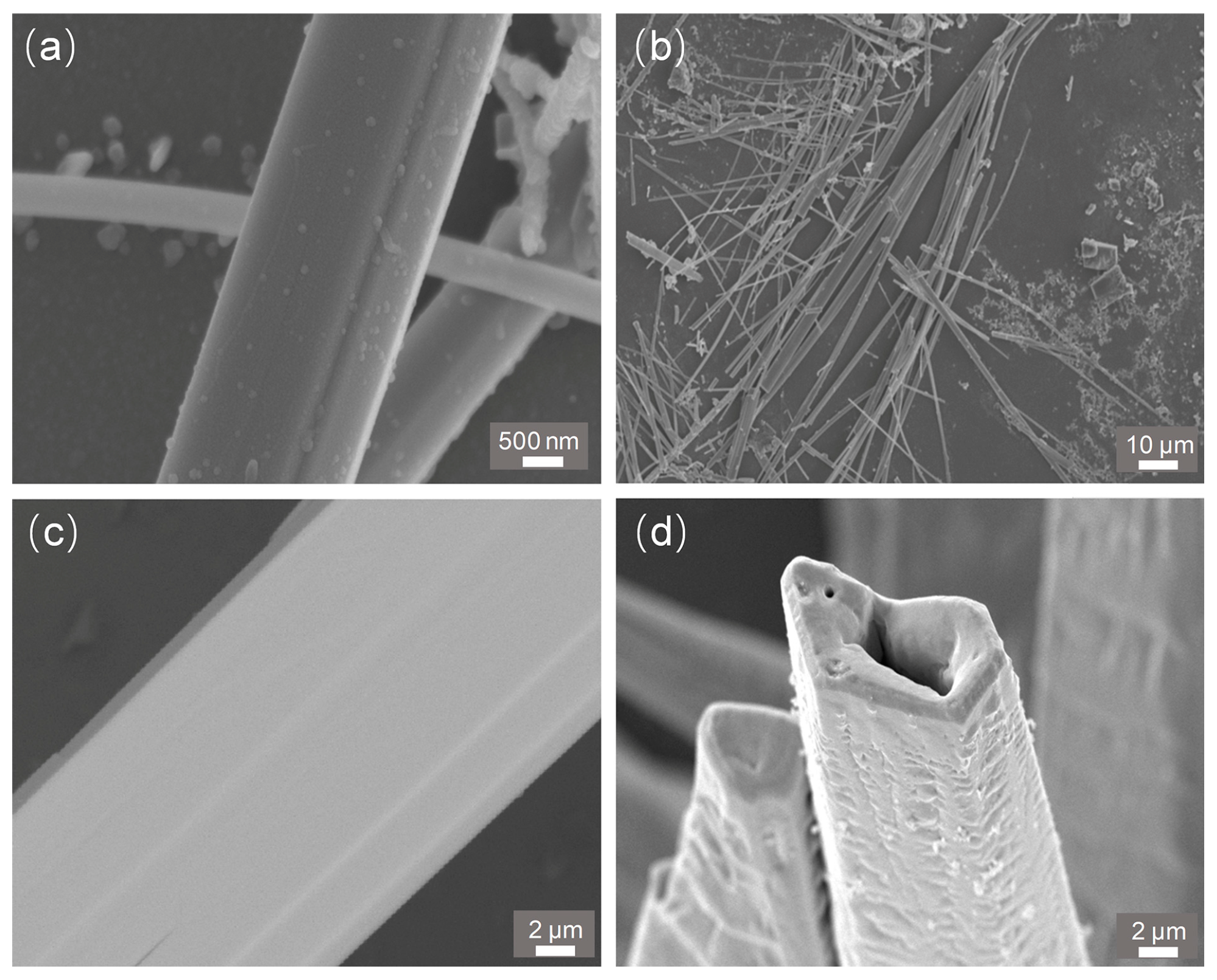
Figure 2a shows the SEM image of a single Sb2Se3 microwire exhibiting a few unreacted particles. Sb2Se3-MW shows its length in the range of 100 to 200 μm and diameter of about 1 to 4 μm, as displayed in Figure 2b. The Sb2Se3-MW can be easily transferred to the Se-MT substrate. The Se-MT generated by chemical vapor deposition process is shown in Figure 2c, exhibiting a ultralong tubular form with an external diameter of about 20 μm. The high crystalline Se-MT grew well and exhibits its hexagonal structure with a side length of approximately 5 μm (Figure 2d).
Figure 2.
SEM images of the Sb2Se3-MW with different scale bars: 500 nm (a) and 10 μm (b) and the surface (c) and cross-section (d) SEM images of the Se-MT.
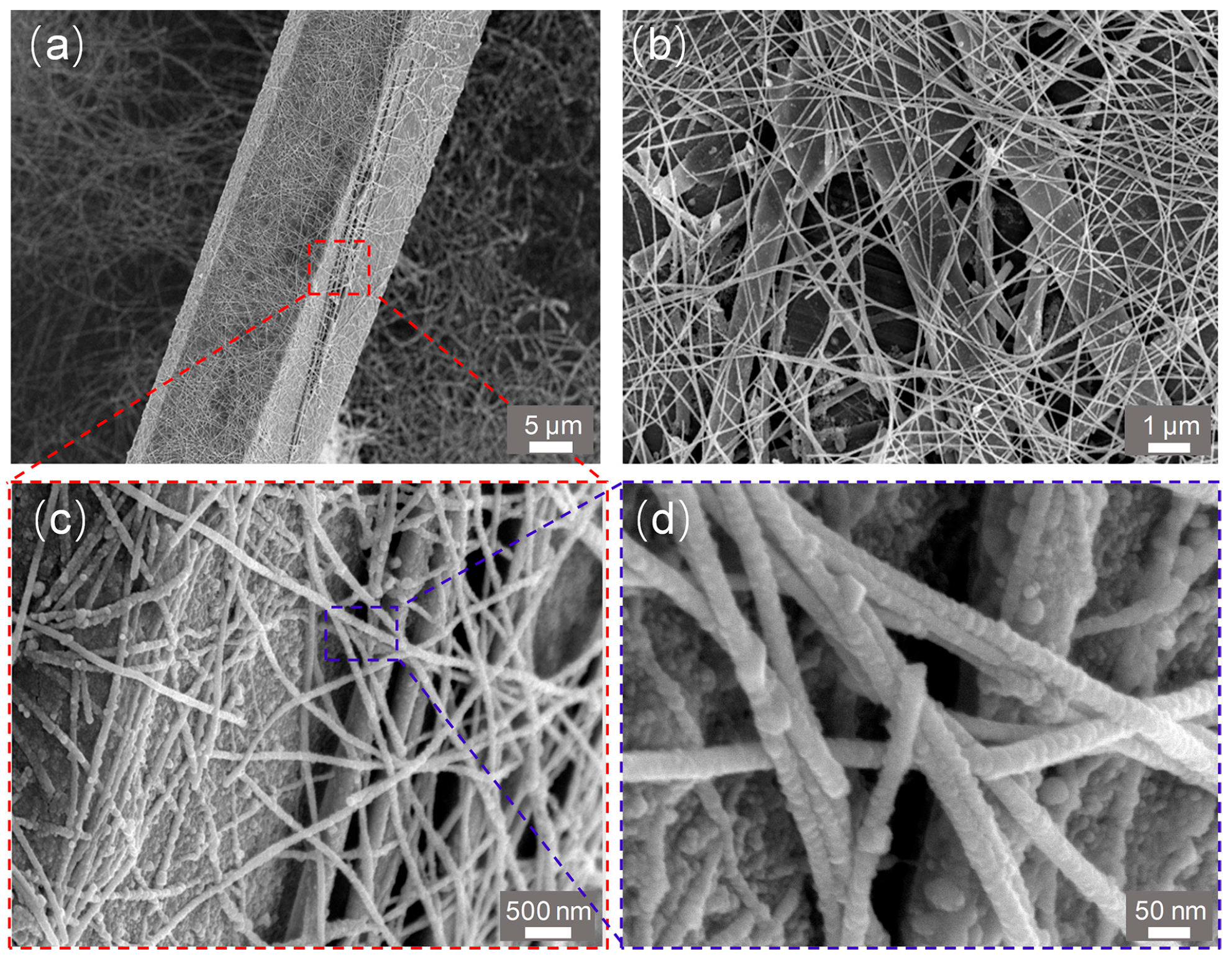
After the Ag-NW were sprayed onto the surface of the Sb2Se3-MW/Se-MT heterojunction, the Sb2Se3-MW/Se-MT/Ag-NW heterojunction was obtained as shown in Figure 3a. The layer of the Ag-NW evenly wrappers the Sb2Se3-MW/Se-MT (Figure 3b) like a spider web. Therefore, the heterojunction is exposed and ready to absorb more light. Moreover, through the procedure of fully spraying Ag-NW on Sb2Se3-MW/Se-MT, good contact among Sb2Se3-MW, Se-MT, and Ag-NW was guaranteed, as shown in Figure 3c. The Ag-NW exhibit regular fiber morphology with a diameter of about 35–50 nm (Figure 3d).
Figure 3.
SEM images of the Sb2Se3-MW/Se-MT/Ag-NW with different scale bars: (a) 5 μm, (b) 1 μm, (c) 500 nm, and (d) 50 nm.
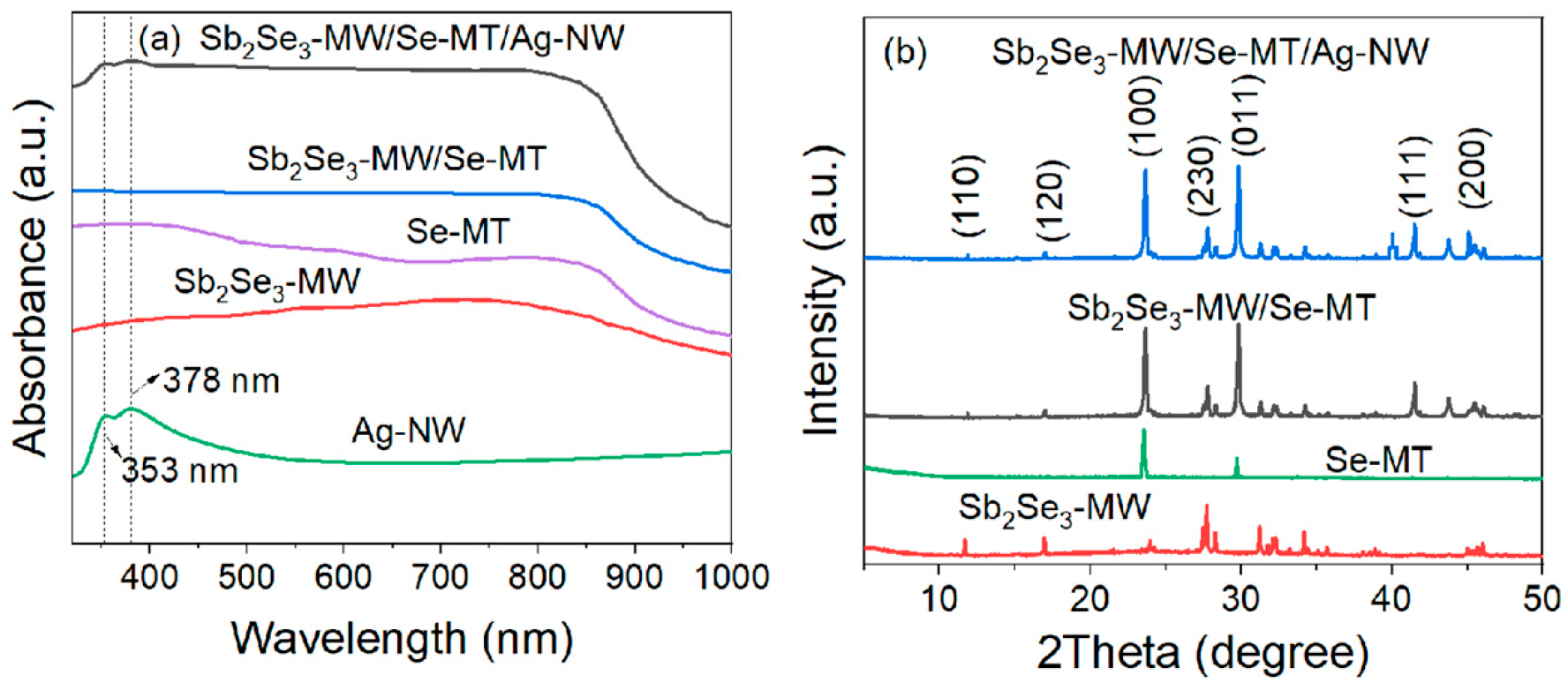
Figure 4a shows the UV–vis absorption spectra of the Ag-NW, Sb2Se3-MW, Se-MT, Sb2Se3-MW/Se-MT, and Sb2Se3-MW/Se-MT/Ag-NW. As can be seen, the Sb2Se3-MW shows a wide range of absorption from 300 to 1000 nm, culminating at about 750 nm, indicating it is a wide wavelength photoelectric material. Meanwhile, the optical absorption of the Se-MT mainly ranges from 300 to 850 nm, with a significant decrease when the wavelength is bigger than 850 nm. The Sb2Se3-MW/Se-MT heterojunction exhibits higher light absorption than both the Sb2Se3-MW and the Se-MT; therefore, it is able to receive more light energy. The Ag-NW absorption curves show two peaks at 353 and 378 nm. After Ag-NW are coated on Sb2Se3-MW/Se-MT, an absorption enhancement at 353 and 378 nm of the heterojunction appears. This connection exactly corresponds to the transverse and longitudinal plasma resonance peaks of Ag-NW excited by the LSPR effect. The absorption spectra thus show the good performance of the Sb2Se3-MW/Se-MT/Ag-NW heterojunction. The diffraction peaks of Se-MT, as shown in Figure 4b, correspond to the standard card of No. 65-1876 in the JCPDS library (lattice parameters are a = b = 0.4364 nm, c = 0.4959 nm), which proves the high crystalline of Se-MT. From the XRD spectrum of Sb2Se3-MW/Se-MT, the diffraction peaks corresponding to the (100) and (011) crystal planes of Se-MT, as well as those corresponding to the (110), (120), (230), (221), (240), (141), (111), (200), and (530) crystal planes of Sb2Se3-MW, are observed. Compared with Sb2Se3-MW/Se-MT, the XRD spectrum of Sb2Se3-MW/Se-MT/Ag-NW showed diffraction peaks belonging to the (111) and (200) crystal planes of Ag-NW, which is consistent with the results of No. 04-0783 in the JCPDS standard card library [38]. This clearly shows that the Sb2Se3-MW/Se-MT/Ag-NW device was successfully prepared.
Figure 4.
UV–vis absorption spectra of the Ag-NW, Sb2Se3-MW, Se-MT, Sb2Se3-MW/Se-MT, and Sb2Se3-MW/Se-MT/Ag-NW (a) and XRD patterns of the Sb2Se3-MW, Se-MT, Sb2Se3-MW/Se-MT, and Sb2Se3-MW/Se-MT/Ag-NW (b).
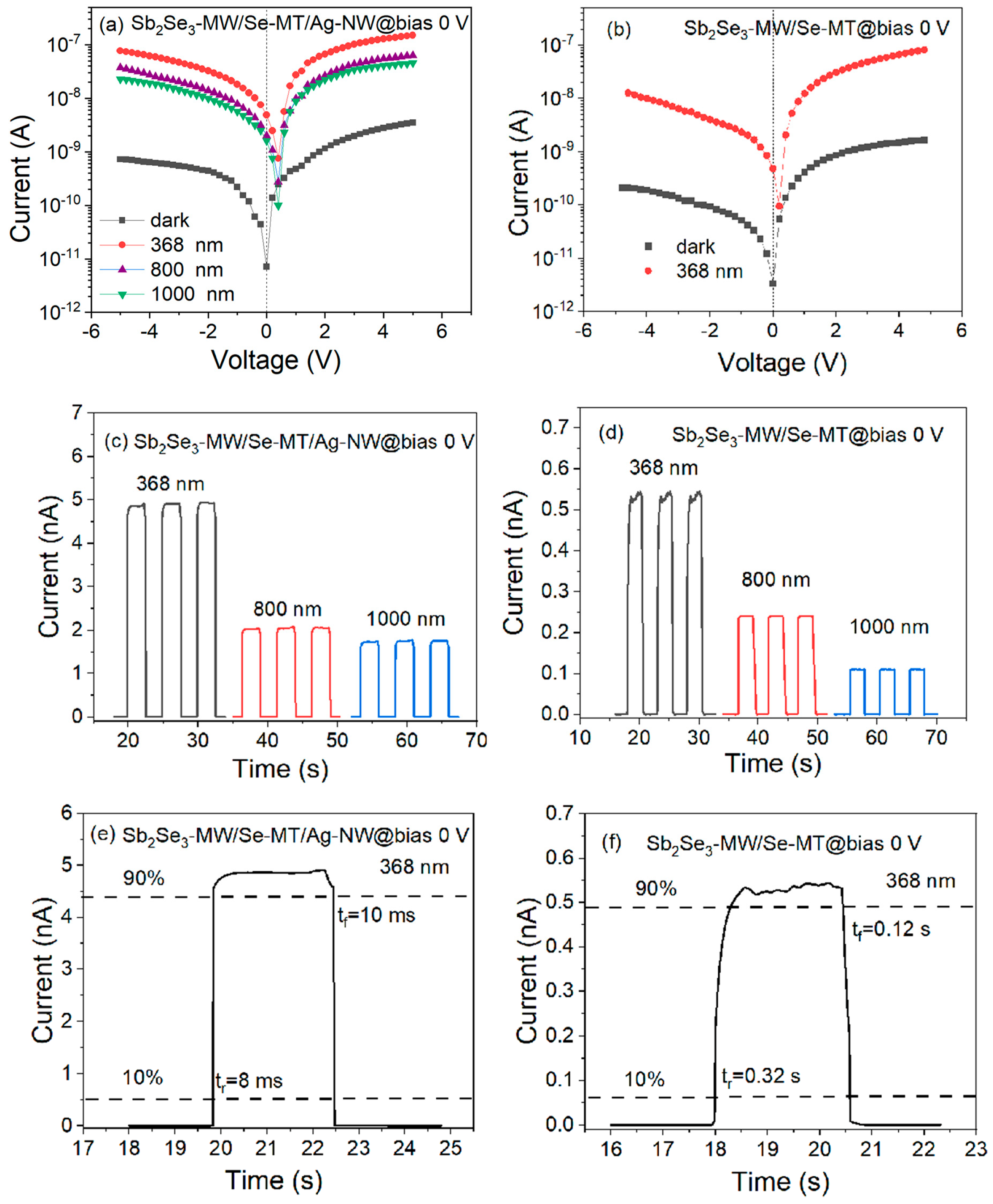
To further confirm that the enhancement of the photoelectric performance was induced by the LSPR effect, the Sb2Se3-MW/Se-MT and the Sb2Se3-MW/Se-MT/Se-MT/Ag-NW heterojunctions were both attached to in electrode to form ohmic contact for the current–voltage (I-V) test. The I-V curves of the Sb2Se3-MW/Se-MT/Se-MT/Ag-NW under darkness and illumination at 368, 800, and 1000 nm are shown in Figure 5a. The current in darkness is approximately 7.78 × 10⁻¹² A and remains the lowest. Under illumination, the open-circuit voltage (Voc) indicated by the voltage offset equals about 0.18 V, which resulted from a built-in electric field. Thus, the built-in electric field enables a photoresponse without the requirement for external drives, demonstrating the self-powering capability. The light current (Ilight) in the ultraviolet region (368 nm) is increased by about two orders of magnitude from the dark current and appears to be the highest among all wavelengths. It drops by 50 nA at 800 nm under 5 V bias and then shows a slight decrease when the wavelength reaches 1000 nm. Non-ideally, the I-V curves in logarithmic coordinates at forward and reverse bias appear to be asymmetric. This may mainly result from the low barrier height of the ohmic contact and the different degrees of contact of the In electrode. Nevertheless, with a value of about 2.0, the rectification ratio is negligibly small. Overall, Figure 5a indicates a good broadband photoelectronic performance of the Sb2Se3-MW/Se-MT/Se-MT/Ag-NW heterojunction. Figure 5b shows the I-V characteristic curves of the Sb2Se3-MW/Se-MT device under no illumination and 368 nm light sources. By comparison, it can be found that under a 368 nm light source, the Ilight of the Sb2Se3-MW/Se-MT/Ag-NW device is much larger than that of the Sb2Se3-MW/Se-MT device. The introduction of the Ag-NW into the Sb2Se3-MW/Se-MT heterojunction can greatly enhance the photoresponse of the device.
Figure 5.
I-V characteristic curves under different illumination conditions of the Sb2Se3-MW/Se-MT/Ag-NW (a) and the Sb2Se3-MW/Se-MT (b). Multi-cycle I-t curves under different illumination conditions of the Sb2Se3-MW/Se-MT/Ag-NW (c) and the Sb2Se3-MW/Se-MT (d). Single-cycle I-t curves under 368 nm illumination of the Sb2Se3-MW/Se-MT/Ag-NW (e) and the Sb2Se3-MW/Se-MT (f).
The current–time (I-t) curves of the two devices are shown in Figure 5c,d, respectively. As can be seen from Figure 5c, the Ilight of the Sb2Se3-MW/Se-MT/Ag-NW device under 0 V bias and 368, 800, and 1000 nm light sources is 4.81, 2.09, and 1.72 nA, respectively. Divided by the dark current of 7.78 pA, the corresponding on/off ratios are calculated as 618, 269, and 221, respectively. In Figure 5d, the average Ilight of the Sb2Se3-MW/Se-MT device at 0 V bias and 368 nm is about 0.533 nA, and the dark current of it is 3.12 pA (Figure 5b), leading to an on/off ratio of 171. Comparing the on/off ratios at 368 nm, the performance of the Sb2Se3-MW/Se-MT/Ag-NW device is significantly (260%) higher than that of the Sb2Se3-MW/Se-MT device. This can be explained by the stronger built-in electric field induced by Ag-NW that separates the electron–hole pairs more efficiently, thus considerably increasing the photocurrent. I-t curves of the devices biased at −4 V are presented as Supporting Information (Figure S1), and similar results are obtained.
Interestingly, the addition of Ag-NW can effectively improve the optoelectronic performances of Sb2Se3-MW/Se-MT heterojunction devices. As the time interval from 10% to 90% of the maximum current of the device under illumination is defined as the rise time (tr), the time interval from 90% to 10% of the maximum current of the device after the light is removed is defined as the fall time (tf). The rise/fall time can well characterize the response speed of the optoelectronic device to the incident light. From the single-cycle I-t curve shown in Figure 5e, the rise/fall time of the Sb2Se3-MW/Se-MT/Ag-NW device is 8 and 10 ms at zero bias, respectively. From Figure 5f, it can be seen that the rise/fall time of the Sb2Se3-MW/Se-MT device is 0.32 and 0.12 s at zero bias, which is much larger. Therefore, the response of the Sb2Se3-MW/Se-MT/Ag-NW device is faster than that of the Sb2Se3-MW/Se-MT device; the Ag-NW-induced superior light absorption ability not only enhances the light current but also reduces the response time. The capacitance of the depletion region in the Sb2Se3-MW/Se-MT/Ag-NW device surpasses that of the Sb2Se3-MW/Se-MT device, resulting in a shorter photogenerated carrier transit time and a reduced device fall time.
To determine the optoelectronic capability of the devices, the key parameters of photoresponsivity (Rλ) and the specific detectivity (D*) of the Sb2Se3-MW/Se-MT and the Sb2Se3-MW/Se-MT/Ag-NW device are evaluated. The photoresponsivity can be calculated by
where Iph is the photocurrent, Pλ is the optical power density of the incident light (368 nm of 0.52 mW cm−2, 800 nm of 0.30 mW cm−2, and 1000 nm of 0.28 mW cm−2), and S is the effective irradiated area of the device (7.6 × 10⁻⁵ cm2). The photocurrent can be determined by
where Ilight and Id denote the light and dark current, respectively. Specific detectivity, another important parameter of PDs, is calculated by [28]
where B stands for the measurement bandwidth, and NEP is short for the noise equivalent power. Calculation details can be found in Figure S2 and Table S1.
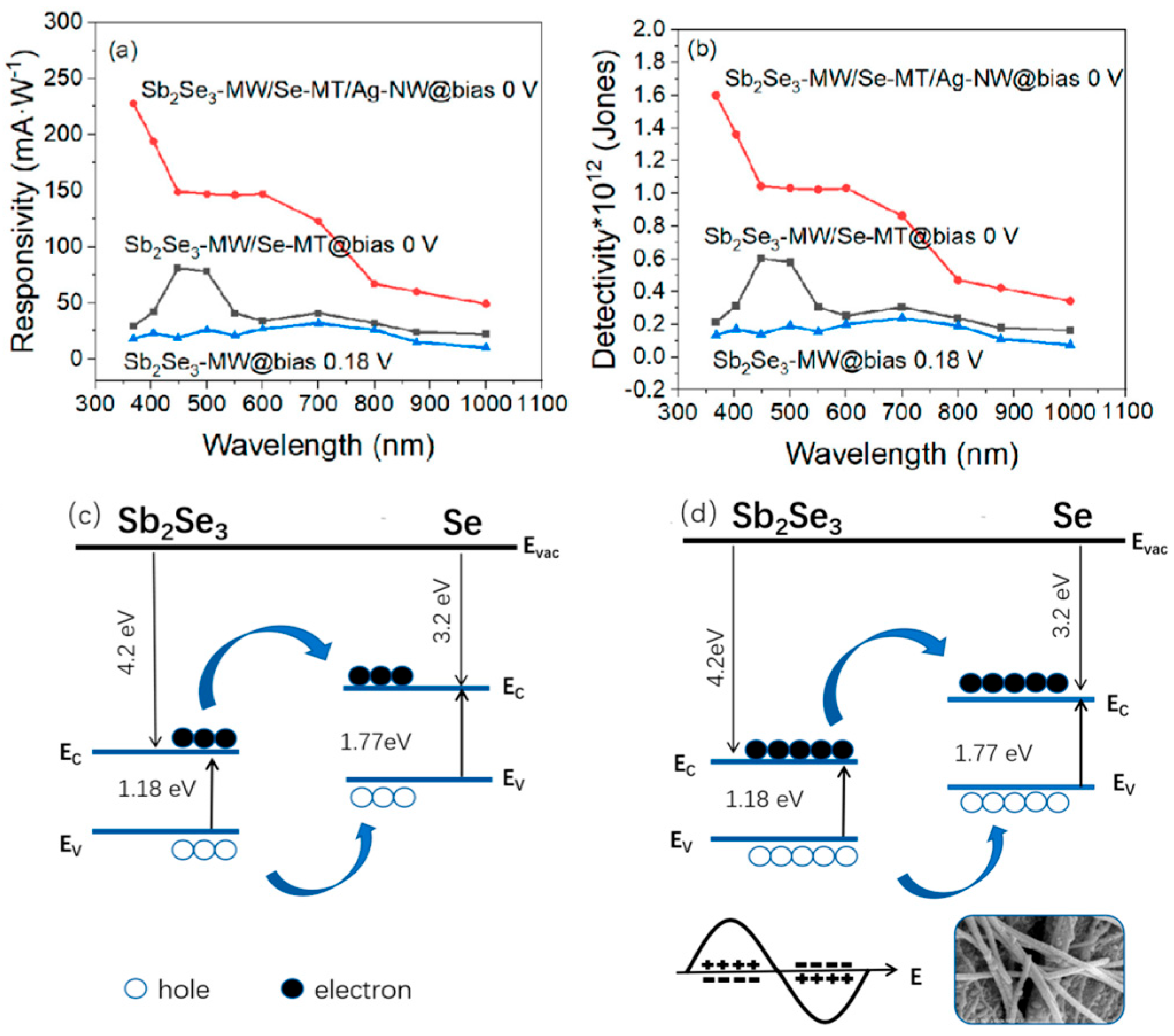
As can be seen in Figure 6a, the calculated Rλ values for all three PDs vary with the wavelength. The responsivity value for the Sb2Se3-MW device at 0.18 V bias stays below 26 mA W−1 across the UV–vis range. Compared with the Sb2Se3-MW/Se-MT PD, the overall responsivity of the Sb2Se3-MW/Se-MT/Ag-NW device has a huge advantage. The maximal responsivity value for the Sb2Se3-MW/Se-MT/Ag-NW device reaches 122 mA W−1 at 368 nm and zero bias, which is 810% higher than that of the Sb2Se3-MW/Se-MT device, of which the value about 13.4 mA W−1. Here, it should be noticed that the maximum responsivity value (about 25 mA W−1) for the Sb2Se3-MW/Se-MT device is not at 368 nm but appears at 448 nm. The responsivity of the Sb2Se3-MW/Se-MT/Ag-NW device monotonically decreases while that of the Sb2Se3-MW/Se-MT device first increases and subsequently decreases as a function of wavelength. This can be explained by the decreasing penetration depth of photon light and the increasing recombination of the electron–hole carriers when wavelength becomes larger. Similarly, as can be seen in Figure 6b, the trend of the specific detectivity is basically consistent with the responsivity. The peak detectivity of the Sb2Se3-MW/Se-MT/Ag-NW PD at 368 nm and zero bias reaches 1.69 × 10¹¹ Jones, which is 849% higher than that of the Sb2Se3-MW/Se-MT (1.78 × 10¹⁰ Jones), demonstrating its high capacity for tolerating the fixed noise when detecting optical signals in real applications. The above comparison results show that the LSPR effect stimulated by the addition of Ag-NW can well improve the responsivity and specific detectivity of Sb2Se3-MW/Se-MT heterojunction devices.
Figure 6.
Responsivity curves (a) and specific detectivity curves (b) of the Sb2Se3-MW/Se-MT/Ag-NW and the Sb2Se3-MW/Se-MT devices at 0 V bias. The schematic diagrams of the energy band of the Sb2Se3-MW/Se-MT (c) and the Sb2Se3-MW/Se-MT/Ag-NW (d) devices.
The proposed Sb2Se3-MW/Se-MT/Ag-NW PD exhibits the largest photocurrent, the highest on/off ratio, and the fastest response speed among all the three PDs. In terms of the key parameters like Rλ and D*, it also performs the best, showing a decisive edge over the competitors. To further reveal the LSPR of Ag-NW in the proposed PD, the working mechanism of Sb2Se3-MW/Se-MT and Sb2Se3-MW/Se-MT/Ag-NW devices is compared. In Figure 6c,d, the energy band diagrams of the two PDs are shown. The band gaps of the Sb2Se3-MW and the Se-MT are 1.18 V [39] and 1.77 eV [24], respectively. The energy levels of the two in contact form a type II heterojunction. Under illumination conditions, the electrons in the valence band of the Se-MT are excited by the photons and jump to the conduction band, creating photogenerated electron–hole pairs. Due to the energy band difference between Se-MT and Sb2Se3-MW, the photogenerated electrons transfer from the conduction band of Se-MT to the conduction band of Sb2Se3-MW. At the same time, the holes in the valence band of Sb2Se3-MW also transfer to the valence band of Se-MT, completing the separation of the photogenerated electron–hole pairs, which are finally collected by the electrodes, thereby generating a larger photocurrent. After adding Ag-NW, the light absorption of Sb2Se3-MW/Se-MT was enhanced due to the LSPR effect. Comparing Figure 6d with Figure 6c, the Sb2Se3-MW/Se-MT/Ag-NW PD produces more electron–hole pairs under the influence of the LSPR effect; so, the photocurrent of the device is improved.
Table 1 lists the comparison of the main performance indicators of the PDs in this paper and others reported. Compared with other reported PDs in the table, the Sb2Se3-MW/Se-MT/Ag-NW device has great advantages in terms of the switch ratio, responsivity, and detection rate. At the same time, compared with the Sb2Se3-MW/Se-MT, the responsivity of the Sb2Se3-MW/Se-MT/Ag-NW device is improved overall, among which the peak responsivity at 368 nm under 0 V bias is 228 mA W−1, and the switch ratio reaches 657, which are 470% and 780% higher than Sb2Se3-MW/Se-MT, respectively. The LSPR effect stimulated by the addition of Ag-NW can greatly improve the photoelectric performance of the Sb2Se3-MW/Se-MT heterojunction device, which provides a new idea for further in-depth research on Sb2Se3-based PDs and utilization of the LSPR effect.
Table 1.
Comparison of the key performance of the Sb2Se3-based PDs proposed in this paper and others reported in recent years.
4. Conclusions
A Sb2Se3-MW/Se-MT/Ag-NW heterojunction was prepared by spray coating, and a photodetector was built. The photoelectric performance of the Sb2Se3-MW/Se-MT/Ag-NW heterojunction device was studied. By introducing Ag-NW and utilizing its LSPR effect, the light absorption capacity and photoelectric response of the device were significantly improved. Compared with Sb2Se3-MW/Se-MT, the overall responsivity of the Sb2Se3-MW/Se-MT/Ag-NW device was improved. The specific detectivity, peak responsivity, and on–off ratio at 368 nm under 0 V bias was 1.69 × 10¹¹ Jones, 122 mA W−1, and 618, which are 849%, 810%, and 260% higher than those of Sb2Se3-MW/Se-MT, respectively. The experimental results show that the photocurrent and responsivity of the device at a specific wavelength are greatly improved, showing excellent photoelectric performance. In addition, the analysis of the energy band diagram reveals the working mechanism of the device, further confirming the key role of Ag-NW in improving the photoelectric performance. Compared with reported PDs, this device exhibits advantages in key performance indicators, showing broad application prospects in the field of photodetection and providing new ideas and methods for the design and preparation of high-performance PDs.
Supplementary Materials
The following supporting information can be downloaded at https://www.mdpi.com/article/10.3390/nano15241849/s1, Figure S1. I-t curves under different illumination conditions of the Sb2Se3-MW/Se-MT/Ag-NW (a) and the Sb2Se3-MW/Se-MT (b) at −4V bias. Figure S2. Noise power density (NPD) as a function of bias voltage of the Sb2Se3-MW/Se-MT/Ag-NW (a) and the Sb2Se3-MW/Se-MT (b) device. Table S1. Performance of the proposed devices at 0 and −4 V bias.
Author Contributions
Conceptualization, S.Z. and P.Y.; Methodology, S.Z. and P.Y.; Software, S.Z.; Validation, J.C.; Formal analysis, S.Z.; Investigation, S.Z., X.W. and J.C.; Resources, P.Y.; Data curation, X.W. and J.C.; Writing—original draft, S.Z. and X.W.; Writing—review & editing, S.Z. and P.Y.; Supervision, Y.J. and P.Y.; Project administration, Y.J. and P.Y.; Funding acquisition, S.Z. All authors have read and agreed to the published version of the manuscript.
Funding
This research was funded by the National Key R&D Program of China (No. 2024YFB4505400), the National Natural Science Foundation of China (No. 62204100), the Postdoctoral Science Foundation of China (No. 2021M691360), and the Postdoctoral Research Foundation of Zhejiang Province (No. ZJ2020101).
Data Availability Statement
The original contributions presented in this study are included in the article/Supplementary Material. Further inquiries can be directed to the corresponding author(s).
Conflicts of Interest
The authors declare no conflicts of interest.
References
- Wu, D.; Xu, G.H.; Tan, J.; Wang, X.; Zhang, Y.L.; Ma, L.; Chen, W.; Wang, K. Nanophotonic structures energized short-wave infrared quantum dot photodetectors and their advancements in imaging and large-scale fabrication techniques. Nanoscale 2025, 17, 8239–8269. [Google Scholar] [CrossRef]
- Zhang, X.W.; Li, W.Z.; Xie, F.S.; Wang, K.; Li, G.K.; Liu, S.L.; Wang, M.Y.; Tang, Z.J.; Zeng, L.H. Metamaterials for high-performance photodetectors. Appl. Phys. Rev. 2024, 11, 041316. [Google Scholar] [CrossRef]
- Tian, Y.; Liu, H.; Li, J.; Liu, B.; Liu, F. Recent Developments of Advanced Broadband Photodetectors Based on 2D Materials. Nanomaterials 2025, 15, 431. [Google Scholar] [CrossRef]
- Huang, Y.; Li, P.; Yu, X.; Feng, S.; Jiang, Y.; Yu, P. CNT:TiO2-Doped Spiro-MeOTAD/Selenium Foam Heterojunction for High-Stability Self-Powered Broadband Photodetector. Nanomaterials 2025, 15, 916. [Google Scholar] [CrossRef] [PubMed]
- Wang, H.Y.; Li, Z.X.; Li, D.Y.; Chen, P.; Pi, L.J.; Zhou, X.; Zhai, T.Y. Van der Waals Integration Based on Two-Dimensional Materials for High-Performance Infrared Photodetectors. Adv. Funct. Mater. 2021, 31, 23. [Google Scholar] [CrossRef]
- Abdullah, M.; Younis, M.; Sohail, M.T.; Asif, M.; Jinde, Y.; Peiguang, Y.; Junle, Q.; Ping, Z. Recent advancements in novel quantum 2D layered materials hybrid photodetectors from IR to THz: From principles to performance enhancement strategies. Chem. Eng. J. 2025, 504, 158917. [Google Scholar] [CrossRef]
- Liu, Y.Q.; Lin, Y.H.; Hu, Y.B.; Wang, W.Z.; Chen, Y.M.; Liu, Z.H.; Wan, D.; Liao, W.G. 1D/2D Heterostructures: Synthesis and Application in Photodetectors and Sensors. Nanomaterials 2024, 14, 1724. [Google Scholar] [CrossRef]
- Wang, F.; Zhang, T.; Xie, R.Z.; Liu, A.N.; Dai, F.X.; Chen, Y.; Xu, T.F.; Wang, H.L.; Wang, Z.; Liao, L.; et al. Next-Generation Photodetectors beyond Van Der Waals Junctions. Adv. Mater. 2023, 36, 2301197. [Google Scholar] [CrossRef]
- Li, J.P.; Cheng, W.; Dong, J.B.; Cao, Z.X.; Hu, S.H.; Meng, R.T.; Xu, X.J.; Wu, X.; Wu, L.; Zhang, Y. Ultra-High Performance Broadband Self-Powered Photodetector Based on Modified Sb2Se3/ZnO Heterojunction. Adv. Opt. Mater. 2025, 13, 2402264. [Google Scholar] [CrossRef]
- Kim, S.; Kim, M.; Kim, H. Self-powered photodetectors based on two-dimensional van der Waals semiconductors. Nano Energy 2024, 127, 109725. [Google Scholar] [CrossRef]
- Vidyanagar, A.V.; Benny, S.; Bhat, S.V. Antisolvent Treatment for Antimony Selenide Thin Film Augmenting Optoelectronic Performance. Adv. Opt. Mater. 2025, 13, 2500175. [Google Scholar] [CrossRef]
- Cao, Y.; Qu, P.; Wang, C.G.; Zhou, J.; Li, M.H.; Yu, X.M.; Yu, X.; Pang, J.B.; Zhou, W.J.; Liu, H.; et al. Epitaxial Growth of Vertically Aligned Antimony Selenide Nanorod Arrays for Heterostructure Based Self-Powered Photodetector. Adv. Opt. Mater. 2022, 10, 2200816. [Google Scholar] [CrossRef]
- Suleman, M.; Kim, M.; Rehmat, A.; Elahi, E.; Asim, M.; Riaz, M.; Kumar, S.; Jung, J.; Seo, Y. Exploring Double NDR Modulation and UV-NIR Photodetection in MoS2/Sb2Se3 Heterostructures. Adv. Opt. Mater. 2025, 13, e01177. [Google Scholar] [CrossRef]
- Anandan, R.; Malar, P. Broadband feeble light detection using n-Si/ quasi-1D Sb2Se3 heterojunction photodetectors. Sens. Actuators A Phys. 2025, 387, 116428. [Google Scholar] [CrossRef]
- Liu, J.J.; Chen, Z.B.; Wu, C.; Yu, X.M.; Yu, X.; Chen, C.; Li, Z.H.; Qiao, Q.; Cao, Y.; Zhou, Y.T. Recent Advances in Antimony Selenide Photodetectors. Adv. Mater. 2024, 36, e2406028. [Google Scholar] [CrossRef]
- Wen, X.X.; Lu, Z.H.; Li, B.X.; Wang, G.C.; Washington, M.A.; Zhao, Q.; Lu, T.M. Free-standing [001]-oriented one-dimensional crystal-structured antimony selenide films for self-powered flexible near-infrared photodetectors. Chem. Eng. J. 2023, 462, 142026. [Google Scholar] [CrossRef]
- Zhai, T.Y.; Ye, M.F.; Li, L.; Fang, X.S.; Liao, M.Y.; Li, Y.F.; Koide, Y.; Bando, Y.; Golberg, D. Single-Crystalline Sb2Se3 Nanowires for High-Performance Field Emitters and Photodetectors. Adv. Mater. 2010, 22, 4530–4533. [Google Scholar] [CrossRef] [PubMed]
- Liu, Y.J.; Liu, C.; Shen, K.; Sun, P.; Li, W.J.; Zhao, C.; Ji, Z.; Mai, Y.H.; Mai, W.J. Underwater Multispectral Computational Imaging Based on a Broadband Water-Resistant Sb2Se3 Heterojunction Photodetector. Acs Nano 2022, 16, 5820–5829. [Google Scholar] [CrossRef]
- Yang, P.; Chen, Y.; Yu, X.; Qiang, P.; Wang, K.; Cai, X.; Tan, S.; Liu, P.; Song, J.; Mai, W. Reciprocal alternate deposition strategy using metal oxide/carbon nanotube for positive and negative electrodes of high-performance supercapacitors. Nano Energy 2014, 10, 108–116. [Google Scholar] [CrossRef]
- Chen, S.; Qiao, X.S.; Wang, F.X.; Luo, Q.; Zhang, X.H.; Wan, X.; Xu, Y.; Fan, X.P. Facile synthesis of hybrid nanorods with the Sb2Se3/AgSbSe2 heterojunction structure for high performance photodetectors. Nanoscale 2016, 8, 2277–2283. [Google Scholar] [CrossRef]
- Bae, J.; Song, M.K.; Park, Y.J.; Kim, J.M.; Liu, M.; Wang, Z.L. Fiber supercapacitors made of nanowire-fiber hybrid structures for wearable/flexible energy storage. Angew. Chem. Int. Ed. Engl. 2011, 50, 1683–1687. [Google Scholar] [CrossRef]
- Yang, J.; Li, X.; Gu, J.; Yu, F.; Chen, J.; Lu, W.; Chen, X. High-Stability WSe2 Homojunction Photodetectors via Asymmetric Schottky and PIN Architectures. Coatings 2025, 15, 301. [Google Scholar] [CrossRef]
- Xu, M.; Lan, C.; Zeng, J.; Yin, Y.; Li, C. Research Progress on TeSe-Alloy-Based Heterojunction Photodetectors. Photonics 2025, 12, 1190. [Google Scholar] [CrossRef]
- Hu, K.; Chen, H.Y.; Jiang, M.M.; Teng, F.; Zheng, L.X.; Fang, X.S. Broadband Photoresponse Enhancement of a High-Performance t-Se Microtube Photodetector by Plasmonic Metallic Nanoparticles. Adv. Funct. Mater. 2016, 26, 6641–6648. [Google Scholar] [CrossRef]
- Zeng, L.H.; Wu, D.; Lin, S.H.; Xie, C.; Yuan, H.Y.; Lu, W.; Lau, S.P.; Chai, Y.; Luo, L.B.; Li, Z.J.; et al. Controlled Synthesis of 2D Palladium Diselenide for Sensitive Photodetector Applications. Adv. Funct. Mater. 2019, 29, 1806878. [Google Scholar] [CrossRef]
- Zheng, T.X.; Du, Q.Y.; Wang, W.W.; Duan, W.; Feng, S.L.; Chen, R.P.; Wan, X.; Jiang, Y.F.; Yu, P.P. High performance and self-powered photodetectors based on Se/CsPbBr3 heterojunctions. J. Mater. Chem. C 2023, 11, 3841–3847. [Google Scholar] [CrossRef]
- Yu, X.W.; Huang, Y.X.; Li, P.F.; Feng, S.L.; Wan, X.; Jiang, Y.F.; Yu, P.P. Self-Powered Photodetectors with High Stability Based on Se Paper/P3HT:Graphene Heterojunction. Nanomaterials 2024, 14, 1923. [Google Scholar] [CrossRef] [PubMed]
- Yu, P.P.; Du, Q.Y.; Zheng, T.X.; Wang, W.W.; Wan, X.; Jiang, Y.F. Reduced Graphene Oxide/Se Microtube p-p Heterojunction for Self-Powered UV-NIR Broadband Photodetectors. Acs Appl. Nano Mater. 2024, 7, 5103–5112. [Google Scholar] [CrossRef]
- Zhang, J.R.; Ma, C. Recent Progress and Future Opportunities for Optical Manipulation in Halide Perovskite Photodetectors. Nanomaterials 2025, 15, 816. [Google Scholar] [CrossRef]
- Lian, S.S.; Liu, Z.Y.; Fu, X.L.; Zhu, F.H.; Zhang, J.Q.; Cao, G.Q.; Ma, H.; Tang, S.W.; Zheng, L.; Xu, W.W.; et al. Nanoresonance Cavity and Localized Surface Plasmon Resonance Enhanced Broad-Spectral Photodetector for Versatile Applications. Nano Lett. 2025, 25, 6583–6591. [Google Scholar] [CrossRef]
- Updhay, V.V.; Nagabhooshanam, N.; Rathore, S.; Lal, M.; Sheela, A.C.S.; Beulah, D.; Rajaram, A. Graphene-Plasmon Hybrid Interlayers for Dynamically Tunable Hot Electron Generation in Visible-to-NIR Ranges. Plasmonics 2025. [Google Scholar] [CrossRef]
- Gu, H.; Weng, Z.X.; Chen, J. Near-infrared photodetector based on single-walled carbon nanotubes/Al2O3/In0.53Ga0.47As hetero-structure enhanced by silver nanoparticles. Infrared Phys. Technol. 2025, 151, 106153. [Google Scholar] [CrossRef]
- Li, F.; Wu, J.B.; Luo, C.; Ze, S.H.; Chen, T.X.; Zhang, Z.G.; Liu, F.; Li, J.; Liu, B.D. Liquid Metal Based Synthesis of GaN Nanosheets with Ag Nanoparticle Modification for Enhanced Ultraviolet Photodetection. ACS Appl. Nano Mater. 2025, 8, 12764–12774. [Google Scholar] [CrossRef]
- Takahashi, Y.; Yamadori, Y.; Murayama, T.; Shingo, S.; Yamada, S. Plasmon-Induced Charge Separation at Ag/p-NiO Nanocomposites for Solid-State Photodetectors. ACS Appl. Electron. Mater. 2025, 7, 5412–5417. [Google Scholar] [CrossRef]
- Wang, F.; Xu, R.; Ye, X.H.; Zhu, Y.T.; Wang, J.Y.; Cheng, K.F.; Xu, K.J.; Qian, Y.Y. LSPR-driven synergistic photoelectric enhancement for broadband and self-powered photodetection in Au/InSb nanohybrids. J. Alloys Compd. 2025, 1030, 180890. [Google Scholar] [CrossRef]
- Jing, W.K.; Ding, N.; Li, L.Y.; Jiang, F.; Xiong, X.; Liu, N.S.; Zhai, T.Y.; Gao, Y.H. Ag nanoparticles modified large area monolayer MoS2 phototransistors with high responsivity. Opt. Express 2017, 25, 14565–14574. [Google Scholar] [CrossRef]
- Young, S.J.; Chu, Y.J.; Liu, Y.H. Low-Dark Current UV Photodetector Based on Photochemical Reduction Ag-Nanoparticles Decoration ZnO Nanostructure. IEEE Sens. J. 2024, 24, 36664–36671. [Google Scholar] [CrossRef]
- Shkir, M.; Khan, M.T.; Ashraf, I.M.; AlFaify, S.; El-Toni, A.M.; Aldalbahi, A.; Ghaithan, H.; Khan, A. Rapid microwave-assisted synthesis of Ag-doped PbS nanoparticles for optoelectronic applications. Ceram. Int. 2019, 45, 21975–21985. [Google Scholar] [CrossRef]
- Yu, P.P.; Hu, K.; Chen, H.Y.; Zheng, L.X.; Fang, X.S. Novel p-p Heterojunctions Self-Powered Broadband Photodetectors with Ultrafast Speed and High Responsivity. Adv. Funct. Mater. 2017, 27, 10. [Google Scholar] [CrossRef]
- Lu, Z.T.; Gao, Z.Y.; Sun, L.; Yu, P.P. Sb2Se3 microwires/ZnO nanoparticles heterojunction for high performances self-powered photodetector. Nanotechnology 2025, 36, 335201. [Google Scholar] [CrossRef]
- He, X.W.; Xu, J.P.; Shi, S.B.; Kong, L.N.; Zhang, X.S.; Li, L. Enhancing the Performance of Broadband Sb2Se3/Ga2O3 Self-Powered Photodetectors via Modulation of Ga2O3 Surface States and Their Application in All-Day Corona Detection. ACS Appl. Mater. Interfaces 2025, 17, 36192–36202. [Google Scholar] [CrossRef] [PubMed]
- Wu, W.; Li, Y.; Liang, L.M.; Hao, Q.Y.; Zhang, J.; Liu, H.; Liu, C.C. Enhanced Broadband Responsivity of Ni-Doped Sb2Se3 Nanorod Photodetector. J. Phys. Chem. C 2019, 123, 14781–14789. [Google Scholar] [CrossRef]
- Vashishtha, P.; Dash, A.; Walia, S.; Gupta, G. Self-bias Mo-Sb-Ga multilayer photodetector encompassing ultra-broad spectral response from UV-C to IR-B. Opt. Laser Technol. 2025, 181, 111705. [Google Scholar] [CrossRef]
- Wan, P.; Tang, K.; Wei, Y.; Xu, T.; Sha, S.L.; Shi, D.N.; Kan, C.X.; Jiang, M.M. Self-powered polarization-sensitive photodetection and imaging based on Sb2Se3 microbelt/Si van der Waals heterojunction with MXene transmittance window. Appl. Surf. Sci. 2024, 649, 159162. [Google Scholar] [CrossRef]
- Kim, S.K.; You, H.K.; Yun, K.R.; Kim, J.H.; Seong, T.Y. Fabrication of High-Responsivity Sb2Se3-Based Photodetectors through Selenization Process. Adv. Opt. Mater. 2023, 11, 2202625. [Google Scholar] [CrossRef]
- Yu, P.P.; Yu, X.T.; Kong, Y.Q.; Sun, L.; Jiang, Y.F. Sb2Se3 Microbelt/PEDOT Heterojunction for a Self-Powered Visible to Near-Infrared Photodetector with High Polarization-Sensitive Imaging. ACS Appl. Electron. Mater. 2025, 7, 1684–1693. [Google Scholar] [CrossRef]
Disclaimer/Publisher’s Note: The statements, opinions and data contained in all publications are solely those of the individual author(s) and contributor(s) and not of MDPI and/or the editor(s). MDPI and/or the editor(s) disclaim responsibility for any injury to people or property resulting from any ideas, methods, instructions or products referred to in the content. |
© 2025 by the authors. Licensee MDPI, Basel, Switzerland. This article is an open access article distributed under the terms and conditions of the Creative Commons Attribution (CC BY) license (https://creativecommons.org/licenses/by/4.0/).