Numerical Solution of Magnetized Williamson Nanofluid Flow over an Exponentially Stretching Permeable Surface with Temperature Dependent Viscosity and Thermal Conductivity

 , , ,
, , ,
Abstract
1. Introduction
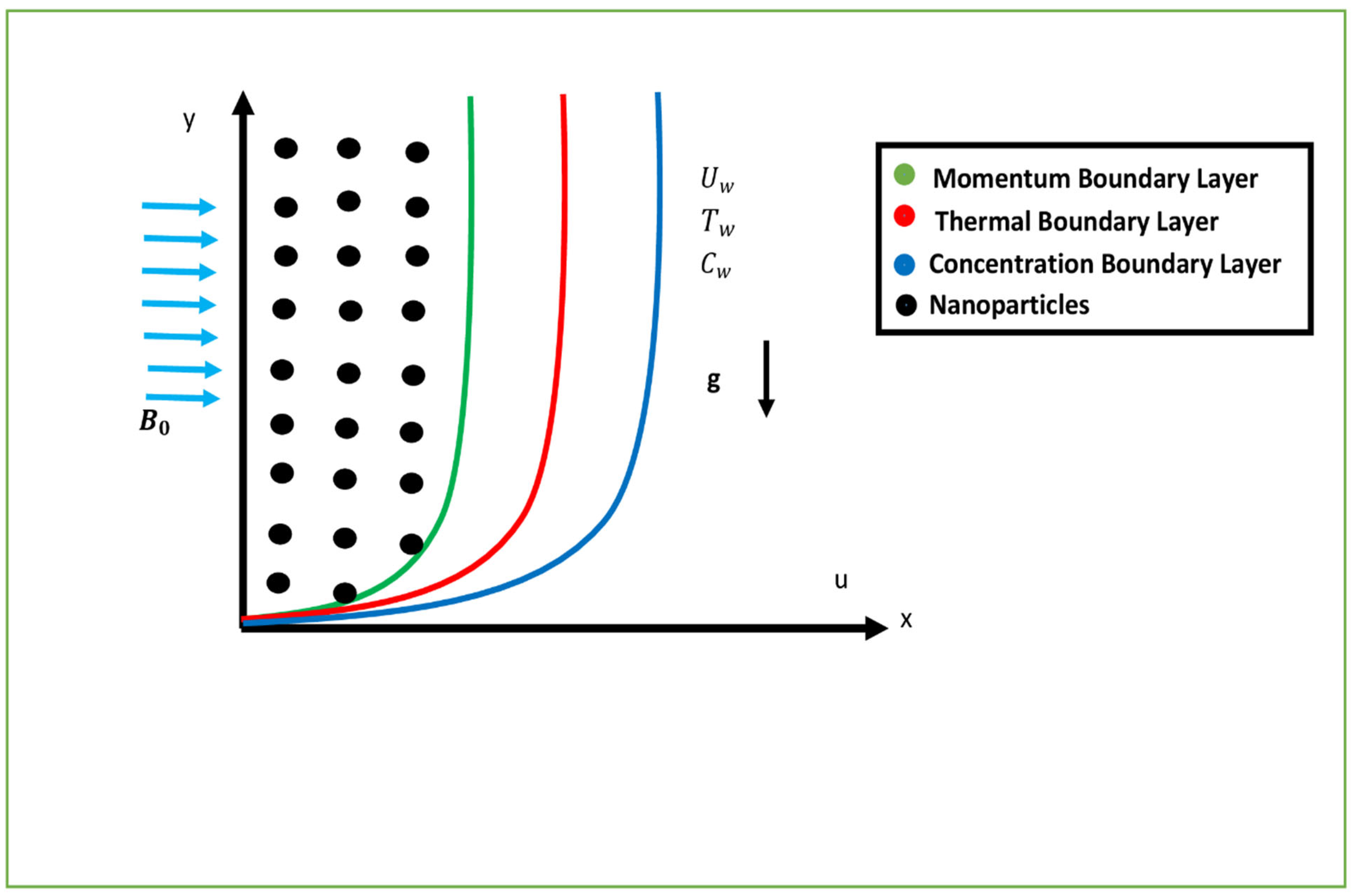
2. Problem Description
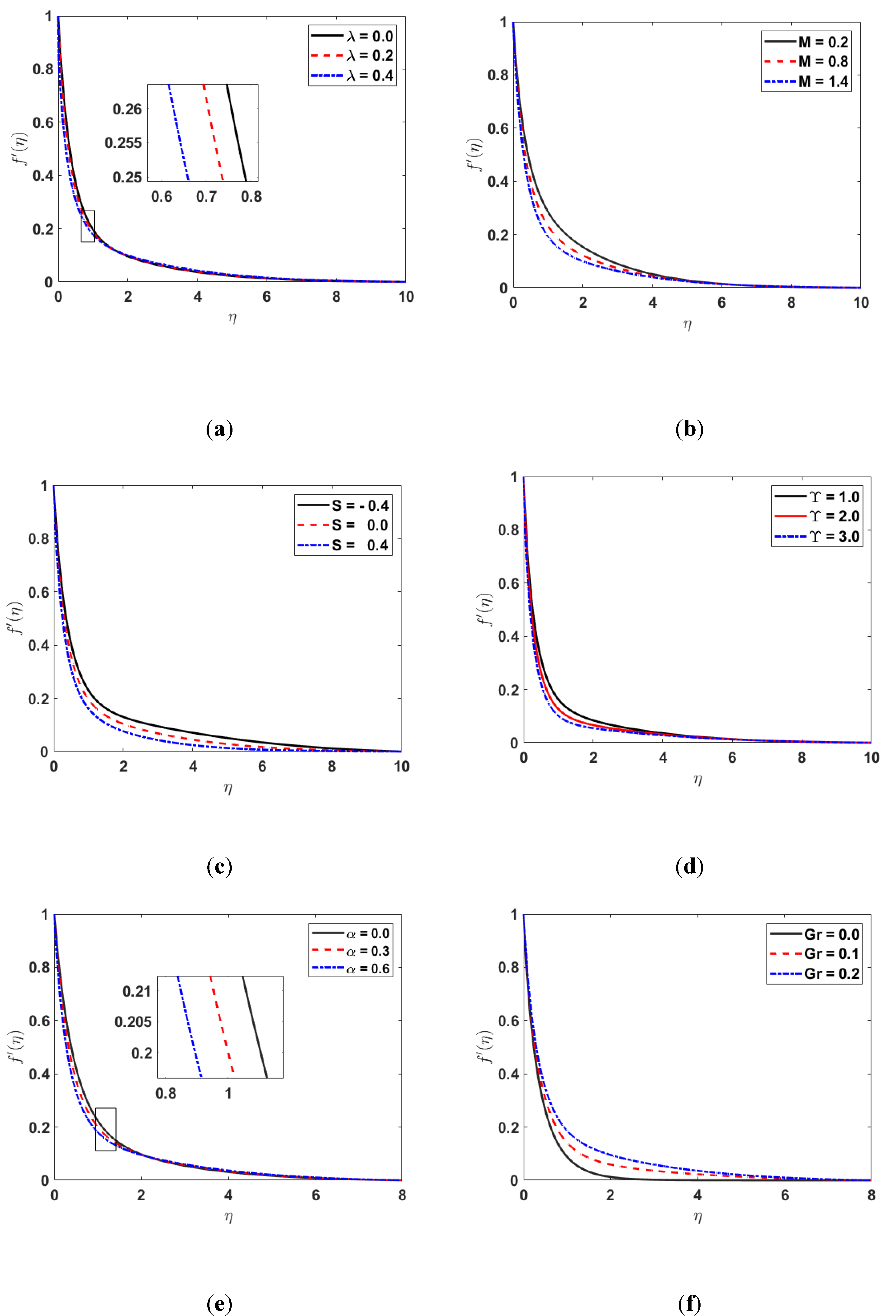
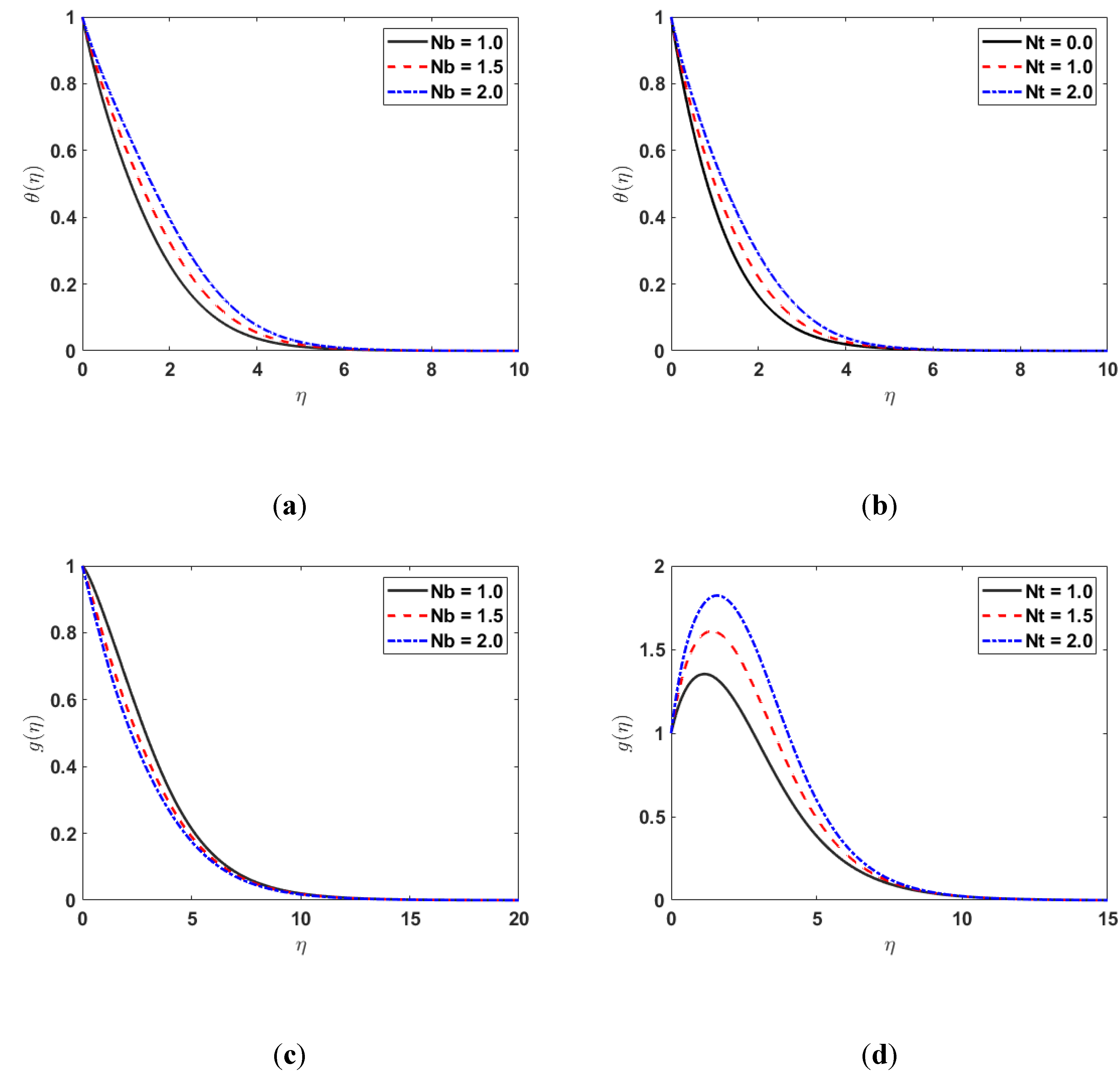
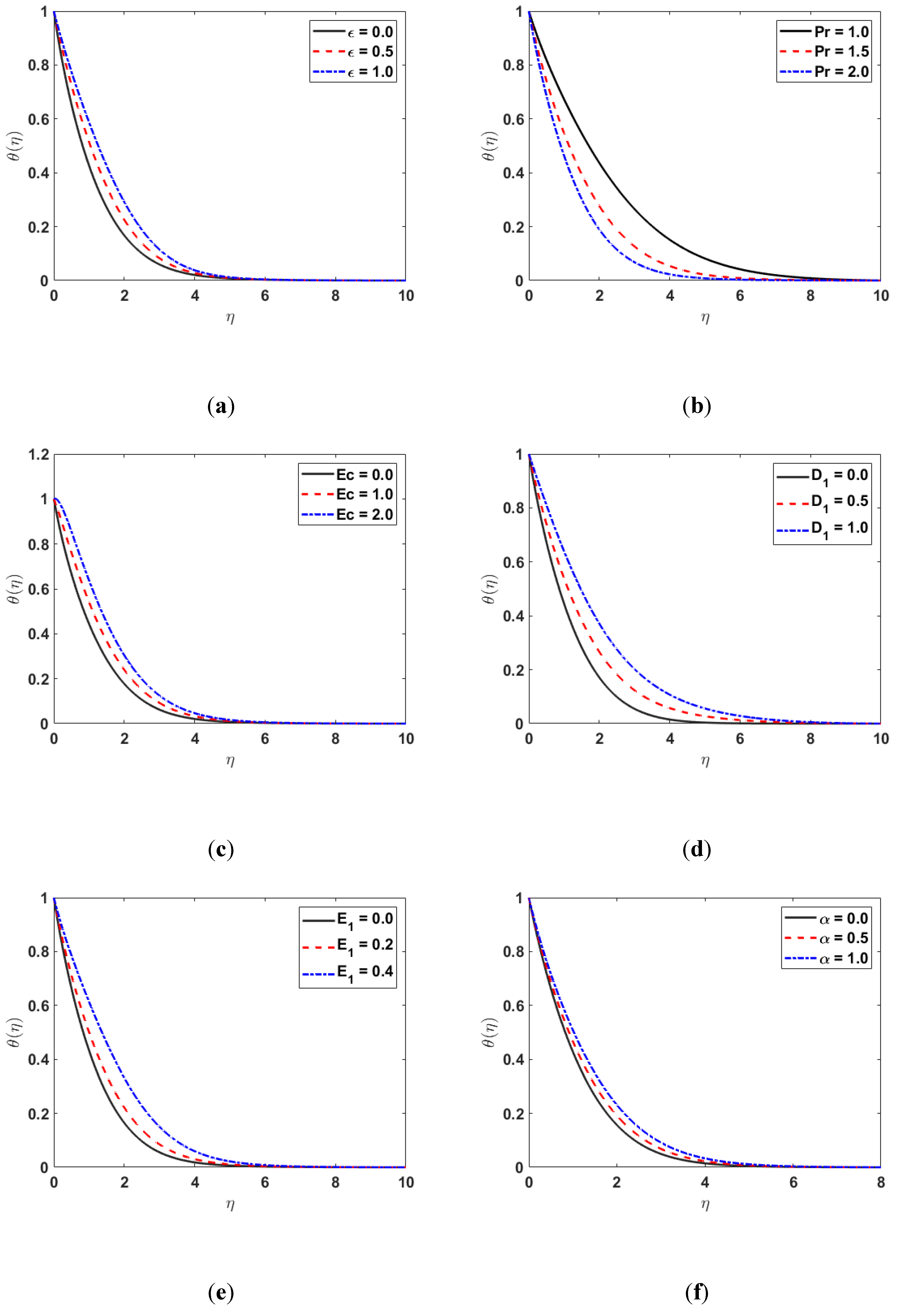
3. Results and Discussion
4. Conclusions
- , , , , and reduce the velocity profile.
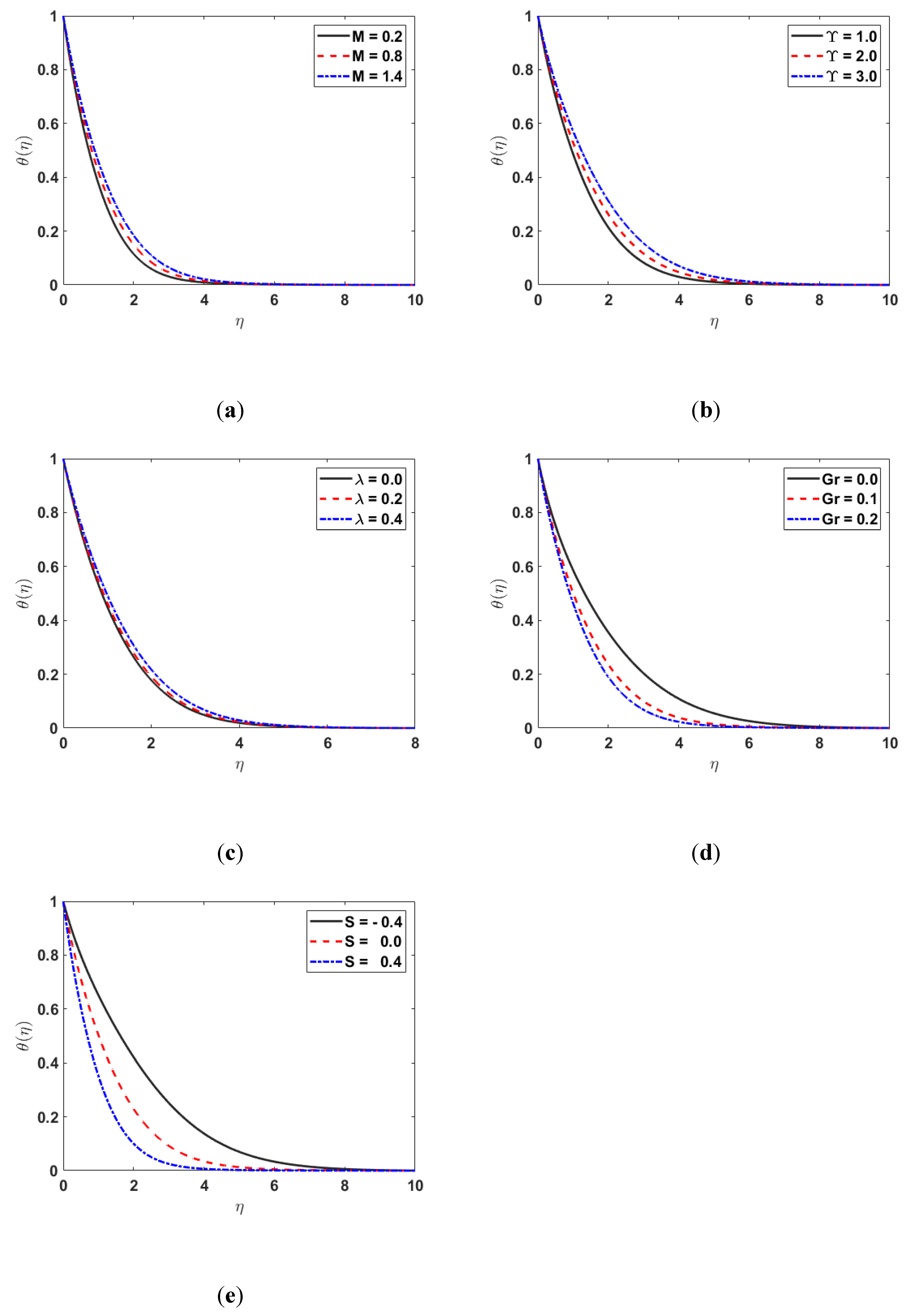
- Increases in , , , , , , , , , and enhance the temperature profile , whereas increasing values of , , and decrease the temperature profile .
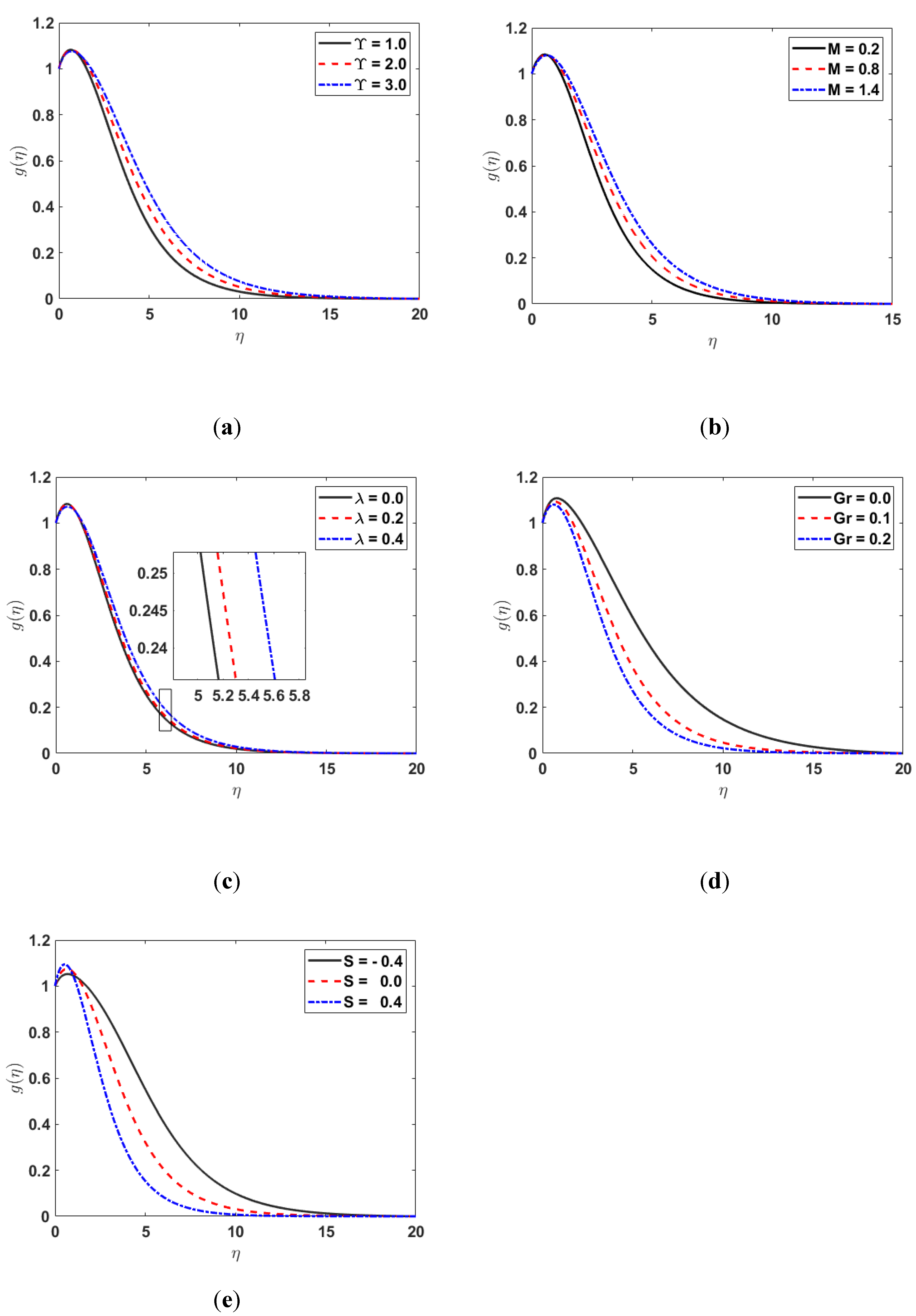
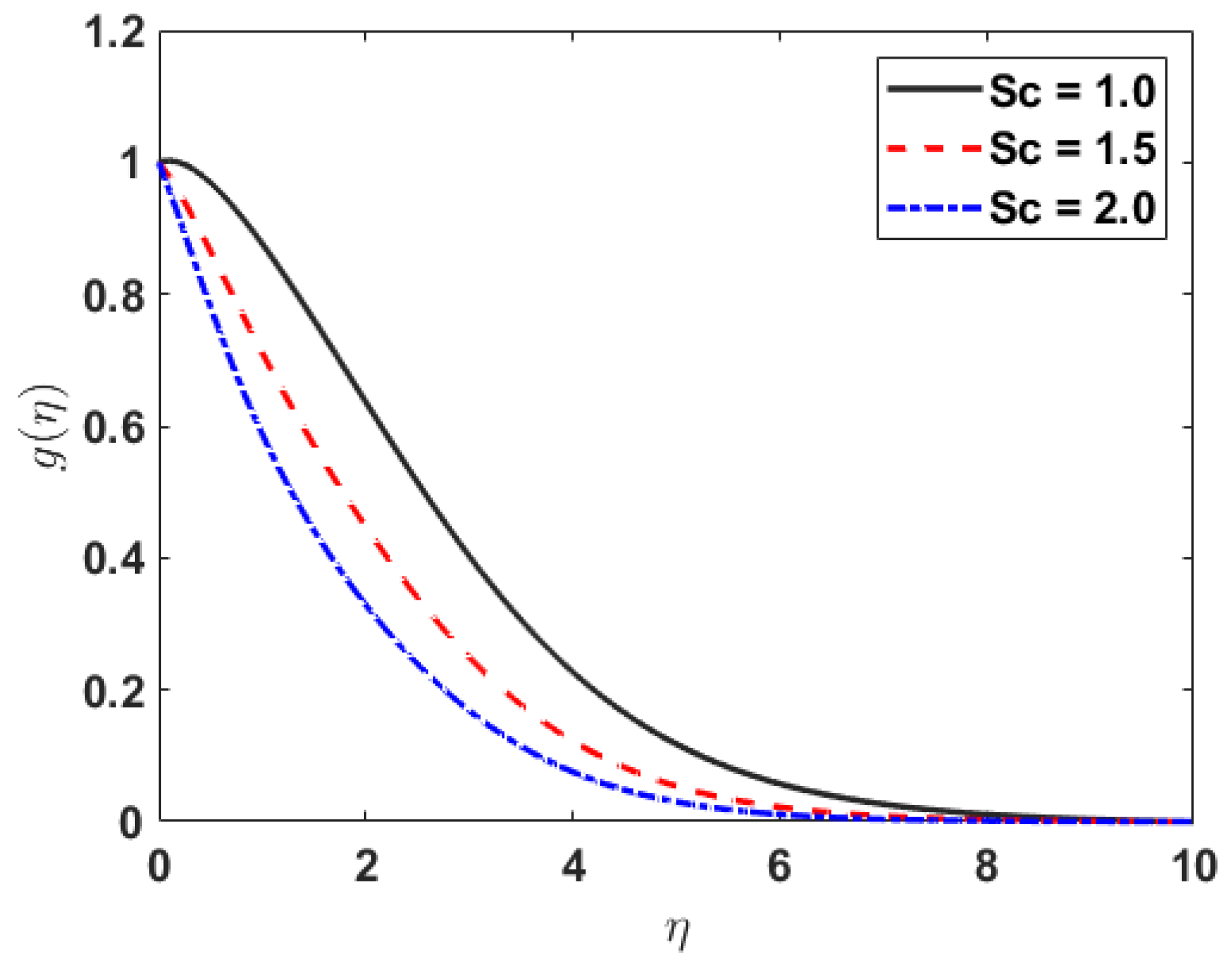
- When , , , and are increased, the concentration profile also increased, however the concentration profile decreases by increasing the , , , and .
- reduces for the increasing values of , , , , , , and , whereas it grows for the increasing values of , , , , and Pr.
- The temperature profile reduces by increasing the values of , , , , , , , , , and .
- Increasing values of , , and will increase the Nusselt number.
- The Sherwood number grows for the increasing values of , , , , , , , , , , and reduces for the varying values of and .
Author Contributions
Funding
Data Availability Statement
Conflicts of Interest
Nomenclature
| Cartesian coordinates | |
| Velocity components | |
| Rate of stretching surface | |
| Thermal expansion coefficient | |
| Concentration expansion coefficient | |
| Magnetic field strength | |
| Skin friction coefficient | |
| Prandtl number | |
| Magnetic parameter | |
| Fluid temperature | |
| Concentration of nanoparticles at the surface [mol] | |
| Variable thermal conductivity | |
| Concentration of nanoparticles | |
| Ambient concentration of nanoparticles | |
| Velocity at the wall | |
| Suction/injection parameter | |
| Temperature profile | |
| Concentration profile | |
| Thermophoretic parameter | |
| Local Nusselt number | |
| Local Sherwood number | |
| Surface temperature | |
| Ambient temperature | |
| Dimensionless stream function | |
| Nanoparticle volume fraction | |
| Schmidt number | |
| Brownian diffusion coefficient | |
| Thermophoresis diffusion coefficient | |
| Space-dependent heat source/sink | |
| Time-dependent heat source/sink | |
| Infinite viscosity | |
| Variable viscosity | |
| Heat capacity of the nanofluid | |
| Reynold number | |
| Magnetic parameter | |
| Velocity profile | |
| Dimensionless similarity variable | |
| Electrical conductivity | |
| Positive time constant | |
| Thermal diffusivity | |
| Heat capacity of nanoparticles | |
| Kinematic viscosity | |
| Density | |
| Williamson fluid parameter | |
| Dimensionless parameter for variable thermal conductivity | |
| Nonuniform heat source/sink [K/S] | |
| Thermal Grashof number | |
| Concentrated Grashof number |
References
- Williamson, R.V. The Flow of Pseudoplastic Materials. Ind. Eng. Chem. 1929, 21, 1108–1111. [Google Scholar] [CrossRef]
- Nadeem, S.; Hussain, S.T. Heat Transfer Analysis of Williamson Fluid over Exponentially Stretching Surface. Appl. Math. Mech. 2014, 35, 489–502. [Google Scholar] [CrossRef]
- Amjad, M.; Ahmed, K.; Akbar, T.; Muhammad, T.; Ahmed, I.; Alshomrani, A.S. Numerical Investigation of Double Diffusion Heat Flux Model in Williamson Nanofluid over an Exponentially Stretching Surface with Variable Thermal Conductivity. Case Stud. Therm. Eng. 2022, 36, 102231. [Google Scholar] [CrossRef]
- Kothandapani, M.; Prakash, J. Effects of Thermal Radiation Parameter and Magnetic Field on the Peristaltic Motion of Williamson Nanofluids in a Tapered Asymmetric Channel. Int. J. Heat Mass Transf. 2015, 81, 234–245. [Google Scholar] [CrossRef]
- Ahmed, K.; Akbar, T. Numerical Investigation of Magnetohydrodynamics Williamson Nanofluid Flow over an Exponentially Stretching Surface. Adv. Mech. Eng. 2021, 13, 16878140211019876. [Google Scholar] [CrossRef]
- Hayat, T.; Bashir, G.; Waqas, M.; Alsaedi, A. MHD 2D Flow of Williamson Nanofluid over a Nonlinear Variable Thicked Surface with Melting Heat Transfer. J. Mol. Liq. 2016, 223, 836–844. [Google Scholar] [CrossRef]
- Ahmed, K.; Akbar, T.; Muhammad, T.; Alghamdi, M. Heat Transfer Characteristics of MHD Flow of Williamson Nanofluid over an Exponential Permeable Stretching Curved Surface with Variable Thermal Conductivity. Case Stud. Therm. Eng. 2021, 28, 101544. [Google Scholar] [CrossRef]
- Ahmed, K.; McCash, L.B.; Akbar, T.; Nadeem, S. Effective Similarity Variables for the Computations of MHD Flow of Williamson Nanofluid over a Non-Linear Stretching Surface. Processes 2022, 10, 1119. [Google Scholar] [CrossRef]
- Ahmed, K.; Akbar, T.; Muhammad, T. Physical Aspects of Homogeneous-Heterogeneous Reactions on MHD Williamson Fluid Flow across a Nonlinear Stretching Curved Surface Together with Convective Boundary Conditions. Math. Probl. Eng. 2021, 2021, 7016961. [Google Scholar] [CrossRef]
- Ahmed, K.; Khan, W.A.; Akbar, T.; Rasool, G.; Alharbi, S.O.; Khan, I. Numerical Investigation of Mixed Convective Williamson Fluid Flow over an Exponentially Stretching Permeable Curved Surface. Fluids 2021, 6, 260. [Google Scholar] [CrossRef]
- Makinde, O.D.; Mabood, F.; Ibrahim, M.S. Chemically Reacting on MHD Boundary-Layer Flow of Nanofluids over a Non-Linear Stretching Sheet with Heat Source/Sink and Thermal Radiation. Therm. Sci. 2018, 22, 495–506. [Google Scholar] [CrossRef]
- Turkyilmazoglu, M. An Analytical Treatment for the Exact Solutions of MHD Flow and Heat over Two--Three Dimensional Deforming Bodies. Int. J. Heat Mass Transf. 2015, 90, 781–789. [Google Scholar] [CrossRef]
- Mabood, F.; Ibrahim, S.M.; Lorenzini, G. Chemical Reaction Effects on MHD Rotating Fluid over a Vertical Plate Embedded in Porous Medium with Heat Source. J. Eng. Thermophys. 2017, 26, 399–415. [Google Scholar] [CrossRef]
- Hashemi-Tilehnoee, M.; Dogonchi, A.S.; Seyyedi, S.M.; Chamkha, A.J.; Ganji, D.D. Magnetohydrodynamic Natural Convection and Entropy Generation Analyses inside a Nanofluid-Filled Incinerator-Shaped Porous Cavity with Wavy Heater Block. J. Therm. Anal. Calorim. 2020, 141, 2033–2045. [Google Scholar] [CrossRef]
- Rashidi, S.; Esfahani, J.A.; Maskaniyan, M. Applications of Magnetohydrodynamics in Biological Systems—Review on the Numerical Studies. J. Magn. Magn. Mater. 2017, 439, 358–372. [Google Scholar] [CrossRef]
- Madhu, M.; Shashikumar, N.S.; Thriveni, K.; Gireesha, B.J.; Mahanthesh, B. Irreversibility Analysis of the MHD Williamson Fluid Flow through a Microchannel with Thermal Radiation. Waves Random Complex Media 2022, 1–23. [Google Scholar] [CrossRef]
- Mishra, P.; Kumar, D.; Kumar, J.; Abdel-Aty, A.-H.; Park, C.; Yahia, I.S. Analysis of MHD Williamson Micropolar Fluid Flow in Non-Darcian Porous Media with Variable Thermal Conductivity. Case Stud. Therm. Eng. 2022, 36, 102195. [Google Scholar] [CrossRef]
- Almaneea, A. Numerical Study on Heat and Mass Transport Enhancement in MHD Williamson Fluid via Hybrid Nanoparticles. Alexandria Eng. J. 2022, 61, 8343–8354. [Google Scholar] [CrossRef]
- Reddy, M.V.; Lakshminarayana, P. MHD Radiative Flow of Williamson Nanofluid with Cattaneo-Christov Model over a Stretching Sheet through a Porous Medium in the Presence of Chemical Reaction and Suction/Injection. J. Porous Media 2022, 25, 1–15. [Google Scholar] [CrossRef]
- Asjad, M.I.; Zahid, M.; Inc, M.; Baleanu, D.; Almohsen, B. Impact of Activation Energy and MHD on Williamson Fluid Flow in the Presence of Bioconvection. Alexandria Eng. J. 2022, 61, 8715–8727. [Google Scholar] [CrossRef]
- Choi, S.U.S.; Eastman, J.A. Enhancing Thermal Conductivity of Fluids with Nanoparticles; OSTI: Oak Ridge, TN, USA, 1995.
- Azam, M.; Xu, T.; Nayak, M.K.; Khan, W.A.; Khan, M. Gyrotactic Microorganisms and Viscous Dissipation Features on Radiative Casson Nanoliquid over a Moving Cylinder with Activation Energy. Waves Random Complex Media 2022, 1–23. [Google Scholar] [CrossRef]
- Azam, M.; Abbas, N.; Ganesh Kumar, K.; Wali, S. Transient Bioconvection and Activation Energy Impacts on Casson Nanofluid with Gyrotactic Microorganisms and Nonlinear Radiation. Waves Random Complex Media 2022, 1–20. [Google Scholar] [CrossRef]
- Azam, M. Effects of Cattaneo-Christov Heat Flux and Nonlinear Thermal Radiation on MHD Maxwell Nanofluid with Arrhenius Activation Energy. Case Stud. Therm. Eng. 2022, 34, 102048. [Google Scholar] [CrossRef]
- Azam, M.; Mabood, F.; Khan, M. Bioconvection and Activation Energy Dynamisms on Radiative Sutterby Melting Nanomaterial with Gyrotactic Microorganism. Case Stud. Therm. Eng. 2022, 30, 101749. [Google Scholar] [CrossRef]
- Azam, M. Bioconvection and Nonlinear Thermal Extrusion in Development Ofchemically Reactive Sutterby Nano-Material Due to Gyrotactic Microorganisms. Int. Commun. Heat Mass Transf. 2022, 130, 105820. [Google Scholar] [CrossRef]
- Sahu, S.K.; Shaw, S.; Thatoi, D.N.; Azam, M.; Nayak, M.K. Darcy-Forchheimer Flow Behavior and Thermal Inferences with SWCNT/MWCNT Suspensions Due to Shrinking Rotating Disk. Waves Random Complex Media 2022, 1–29. [Google Scholar] [CrossRef]
- Magyari, E.; Pantokratoras, A. Note on the Effect of Thermal Radiation in the Linearized Rosseland Approximation on the Heat Transfer Characteristics of Various Boundary Layer Flows. Int. Commun. Heat Mass Transf. 2011, 38, 554–556. [Google Scholar] [CrossRef]
- Chamkha, A.J.; Aly, A.M. MHD Free Convection Flow of a Nanofluid Past a Vertical Plate in the Presence of Heat Generation or Absorption Effects. Chem. Eng. Commun. 2010, 198, 425–441. [Google Scholar] [CrossRef]
- Gorla, R.S.R.; Chamkha, A. Natural Convective Boundary Layer Flow over a Nonisothermal Vertical Plate Embedded in a Porous Medium Saturated with a Nanofluid. Nanoscale Microscale Thermophys. Eng. 2011, 15, 81–94. [Google Scholar] [CrossRef]
- Chamkha, A.J.; Abbasbandy, S.; Rashad, A.M.; Vajravelu, K. Radiation Effects on Mixed Convection about a Cone Embedded in a Porous Medium Filled with a Nanofluid. Meccanica 2013, 48, 275–285. [Google Scholar] [CrossRef]
- RamReddy, C.; Murthy, P.; Chamkha, A.J.; Rashad, A.M. Soret Effect on Mixed Convection Flow in a Nanofluid under Convective Boundary Condition. Int. J. Heat Mass Transf. 2013, 64, 384–392. [Google Scholar] [CrossRef]
- Ishak, A.; Nazar, R.; Bachok, N.; Pop, I. MHD Mixed Convection Flow near the Stagnation-Point on a Vertical Permeable Surface. Phys. A Stat. Mech. its Appl. 2010, 389, 40–46. [Google Scholar] [CrossRef]
- Manjunatha, S.; Gireesha, B.J. Effects of Variable Viscosity and Thermal Conductivity on MHD Flow and Heat Transfer of a Dusty Fluid. Ain Shams Eng. J. 2016, 7, 505–515. [Google Scholar] [CrossRef]
- Khan, Y.; Wu, Q.; Faraz, N.; Yildirim, A. The Effects of Variable Viscosity and Thermal Conductivity on a Thin Film Flow over a Shrinking/Stretching Sheet. Comput. Math. Appl. 2011, 61, 3391–3399. [Google Scholar] [CrossRef]
- Palani, G.; Kim, K.-Y. Numerical Study on a Vertical Plate with Variable Viscosity and Thermal Conductivity. Arch. Appl. Mech. 2010, 80, 711–725. [Google Scholar] [CrossRef]
- Abu-Nada, E. Effects of Variable Viscosity and Thermal Conductivity of Al2O3--Water Nanofluid on Heat Transfer Enhancement in Natural Convection. Int. J. Heat Fluid Flow 2009, 30, 679–690. [Google Scholar] [CrossRef]
- Salawu, S.O.; Dada, M.S. Radiative Heat Transfer of Variable Viscosity and Thermal Conductivity Effects on Inclined Magnetic Field with Dissipation in a Non-Darcy Medium. J. Niger. Math. Soc. 2016, 35, 93–106. [Google Scholar] [CrossRef]
- Choudhury, M.; Hazarika, G.C. The Effects of Variable Viscosity and Thermal Conductivity on Mhd Flow Due to a Point Sink. Matemáticas Enseñanza Univ. 2008, 16, 21–28. [Google Scholar]
- Shojaeian, M.; Yildiz, M.; Koşar, A. Convective Heat Transfer and Second Law Analysis of Non-Newtonian Fluid Flows with Variable Thermophysical Properties in Circular Channels. Int. Commun. Heat Mass Transf. 2015, 60, 21–31. [Google Scholar] [CrossRef]
- Alarifi, I.M.; Abokhalil, A.G.; Osman, M.; Lund, L.A.; Ayed, M.B.; Belmabrouk, H.; Tlili, I. MHD Flow and Heat Transfer over Vertical Stretching Sheet with Heat Sink or Source Effect. Symmetry 2019, 11, 297. [Google Scholar] [CrossRef]
- Khan, M.; Karim, I.; Rahman, M.; Arifuzzaman, S.M.; Biswas, P.; Karim, I. Williamson Fluid Flow Behaviour of MHD Convective-Radiative Cattaneo--Christov Heat Flux Type over a Linearly Stretched-Surface with Heat Generation and Thermal-Diffusion. Front. Heat Mass Transf. 2017, 9, 15. [Google Scholar] [CrossRef]
- Vittal, C.; Reddy, M.C.K.; Vijayalaxmi, T. MHD Stagnation Point Flow and Heat Transfer of Williamson Fluid over Exponential Stretching Sheet Embedded in a Thermally Stratified Medium. Glob. J. Pure Appl. Math. 2017, 13, 2033–2056. [Google Scholar]
- M Megahed, A. Williamson Fluid Flow Due to a Nonlinearly Stretching Sheet with Viscous Dissipation and Thermal Radiation. J. Egypt. Math. Soc. 2019, 27, 12. [Google Scholar] [CrossRef]
- Mukhopadhyay, S. MHD Boundary Layer Flow and Heat Transfer over an Exponentially Stretching Sheet Embedded in a Thermally Stratified Medium. Alexandria Eng. J. 2013, 52, 259–265. [Google Scholar] [CrossRef]
- Bidin, B.; Nazar, R. Numerical Solution of the Boundary Layer Flow over an Exponentially Stretching Sheet with Thermal Radiation. Eur. J. Sci. Res. 2009, 33, 710–717. [Google Scholar]
- Hayat, T.; Abbasi, F.M.; Ahmad, B.; Alsaedi, A. MHD Mixed Convection Peristaltic Flow with Variable Viscosity and Thermal Conductivity. Sains Malays. 2014, 43, 1583–1590. [Google Scholar]
- Gangaiah, T.; Saidulu, N.; Lakshmi, A.V. The Influence of Thermal Radiation on MHD Tangent Hyperbolic Fluid Flow with Zero Normal Flux of Nanoparticles over an Exponential Stretching Sheet. Appl. Appl. Math. Int. J. 2019, 14, 2. [Google Scholar]




| Bidin and Nazar [45] | Ishak et al. [33] | Gangaiah et al. [47] | Present | |
|---|---|---|---|---|
| 01 | 0.9547 | 0.9548 | 0.9547 | 0.954810 |
| 02 | 1.4714 | 1.4715 | 1.4714 | 1.471454 |
| 03 | 1.8691 | 1.8691 | 1.8691 | 1.869068 |
| 0.1 | 1.5 | 0.1 | 0.5 | 0.5 | 0.2 | 2.727752 | 0.775284 | −0.293661 |
| 0.2 | 2.571702 | 0.761552 | −0.287289 | |||||
| 0.3 | 1.526073 | 0.742947 | −0.278067 | |||||
| 0.2 | 0.1 | 1.998213 | 0.944614 | −0.358783 | ||||
| 0.2 | 2.046830 | 0.929656 | −0.354155 | |||||
| 0.3 | 2.094035 | 0.915051 | −0.349443 | |||||
| 0.1 | 2.571702 | 0.761552 | −0.287289 | |||||
| 0.2 | 2.660746 | 0.831095 | −0.321924 | |||||
| 0.3 | 2.752719 | 0.904827 | −0.358963 | |||||
| 0.1 | 655 | 2.426609 | 0.781899 | −0.282999 | ||||
| 0.2 | 2.464228 | 0.776845 | −0.284455 | |||||
| 0.3 | 2.500928 | 0.771766 | −0.285645 | |||||
| 0.1 | 3.142260 | 0.803924 | −0.300502 | |||||
| 0.2 | 2.994002 | 0.793901 | −0.298051 | |||||
| 0.3 | 2.849485 | 0.783491 | −0.295032 | |||||
| 0.1 | 2.690235 | 0.726148 | −0.303969 | |||||
| 0.2 | 2.571702 | 0.761552 | −0.287289 | |||||
| 0.3 | 2.453274 | 0.785131 | −0.269947 |
| 0.1 | 0.2 | 0.1 | 2.0 | 0.1 | 0.5 | 0.5 | 0.1 | 2.574717 | 0.808828 | −0.332979 |
| 0.2 | 0.2 | 0.1 | 2.0 | 0.1 | 0.5 | 0.5 | 0.1 | 2.571702 | 0.761552 | −0.287289 |
| 0.3 | 0.2 | 0.1 | 2.0 | 0.1 | 0.5 | 0.5 | 0.1 | 2.568694 | 0.714233 | −0.241554 |
| 0.2 | 0.1 | 0.1 | 2.0 | 0.1 | 0.5 | 0.5 | 0.1 | 2.575906 | 0.812989 | −0.336233 |
| 0.2 | 0.2 | 0.1 | 2.0 | 0.1 | 0.5 | 0.5 | 0.1 | 2.571702 | 0.761552 | −0.287289 |
| 0.2 | 0.3 | 0.1 | 2.0 | 0.1 | 0.5 | 0.5 | 0.1 | 2.567902 | 0.716566 | −0.244622 |
| 0.2 | 0.2 | 0.1 | 2.0 | 0.1 | 0.5 | 0.5 | 0.1 | 2.571702 | 0.761552 | −0.287289 |
| 0.2 | 0.2 | 0.2 | 2.0 | 0.1 | 0.5 | 0.5 | 0.1 | 2.568182 | 0.721545 | −0.249389 |
| 0.2 | 0.2 | 0.3 | 2.0 | 0.1 | 0.5 | 0.5 | 0.1 | 2.564637 | 0.681163 | −0.211136 |
| 0.2 | 0.2 | 0.1 | 1.1 | 0.1 | 0.5 | 0.5 | 0.1 | 2.542794 | 0.464327 | −0.008792 |
| 0.2 | 0.2 | 0.1 | 1.2 | 0.1 | 0.5 | 0.5 | 0.1 | 2.546907 | 0.505713 | −0.047645 |
| 0.2 | 0.2 | 0.1 | 1.3 | 0.1 | 0.5 | 0.5 | 0.1 | 2.550705 | 0.544153 | −0.083669 |
| 0.2 | 0.2 | 0.1 | 2.0 | 0.1 | 0.5 | 0.5 | 0.1 | 2.571702 | 0.761552 | −0.287289 |
| 0.2 | 0.2 | 0.1 | 2.0 | 0.2 | 0.5 | 0.5 | 0.1 | 2.565090 | 0.693452 | −0.223557 |
| 0.2 | 0.2 | 0.1 | 2.0 | 0.3 | 0.5 | 0.5 | 0.1 | 2.557173 | 0.614035 | −0.149533 |
| 0.2 | 0.2 | 0.1 | 2.0 | 0.1 | 0.1 | 0.5 | 0.1 | 2.599697 | 0.813838 | 0.198771 |
| 0.2 | 0.2 | 0.1 | 2.0 | 0.1 | 0.2 | 0.5 | 0.1 | 2.592340 | 0.800852 | 0.068572 |
| 0.2 | 0.2 | 0.1 | 2.0 | 0.1 | 0.3 | 0.5 | 0.1 | 2.585221 | 0.787761 | −0.055755 |
| 0.2 | 0.2 | 0.1 | 2.0 | 0.1 | 0.5 | 0.1 | 0.1 | 2.472216 | 0.914849 | −3.30832 |
| 0.2 | 0.2 | 0.1 | 2.0 | 0.1 | 0.5 | 0.2 | 0.1 | 2.539176 | 0.862518 | −1.416708 |
| 0.2 | 0.2 | 0.1 | 2.0 | 0.1 | 0.5 | 0.3 | 0.1 | 2.559441 | 0.824444 | −0.787946 |
| 0.2 | 0.2 | 0.1 | 2.0 | 0.1 | 0.5 | 0.5 | 0.1 | 2.564745 | 0.881992 | −0.639324 |
| 0.2 | 0.2 | 0.1 | 2.0 | 0.1 | 0.5 | 0.5 | 0.2 | 2.566273 | 0.855000 | −0.565911 |
| 0.2 | 0.2 | 0.1 | 2.0 | 0.1 | 0.5 | 0.5 | 0.3 | 2.567733 | 0.828938 | −0.492478 |
Publisher’s Note: MDPI stays neutral with regard to jurisdictional claims in published maps and institutional affiliations. |
© 2022 by the authors. Licensee MDPI, Basel, Switzerland. This article is an open access article distributed under the terms and conditions of the Creative Commons Attribution (CC BY) license (https://creativecommons.org/licenses/by/4.0/).
Share and Cite
Amjad, M.; Ahmed, I.; Ahmed, K.; Alqarni, M.S.; Akbar, T.; Muhammad, T. Numerical Solution of Magnetized Williamson Nanofluid Flow over an Exponentially Stretching Permeable Surface with Temperature Dependent Viscosity and Thermal Conductivity. Nanomaterials 2022, 12, 3661. https://doi.org/10.3390/nano12203661
Amjad M, Ahmed I, Ahmed K, Alqarni MS, Akbar T, Muhammad T. Numerical Solution of Magnetized Williamson Nanofluid Flow over an Exponentially Stretching Permeable Surface with Temperature Dependent Viscosity and Thermal Conductivity. Nanomaterials. 2022; 12(20):3661. https://doi.org/10.3390/nano12203661
Chicago/Turabian StyleAmjad, Muhammad, Iftikhar Ahmed, Kamran Ahmed, Marei Saeed Alqarni, Tanvir Akbar, and Taseer Muhammad. 2022. "Numerical Solution of Magnetized Williamson Nanofluid Flow over an Exponentially Stretching Permeable Surface with Temperature Dependent Viscosity and Thermal Conductivity" Nanomaterials 12, no. 20: 3661. https://doi.org/10.3390/nano12203661
APA StyleAmjad, M., Ahmed, I., Ahmed, K., Alqarni, M. S., Akbar, T., & Muhammad, T. (2022). Numerical Solution of Magnetized Williamson Nanofluid Flow over an Exponentially Stretching Permeable Surface with Temperature Dependent Viscosity and Thermal Conductivity. Nanomaterials, 12(20), 3661. https://doi.org/10.3390/nano12203661