
Synthesis, Functionalization, and Biomedical Applications of Iron Oxide Nanoparticles (IONPs)



Abstract
1. Introduction
2. Synthesis Methods
2.1. Chemical-Assisted Techniques
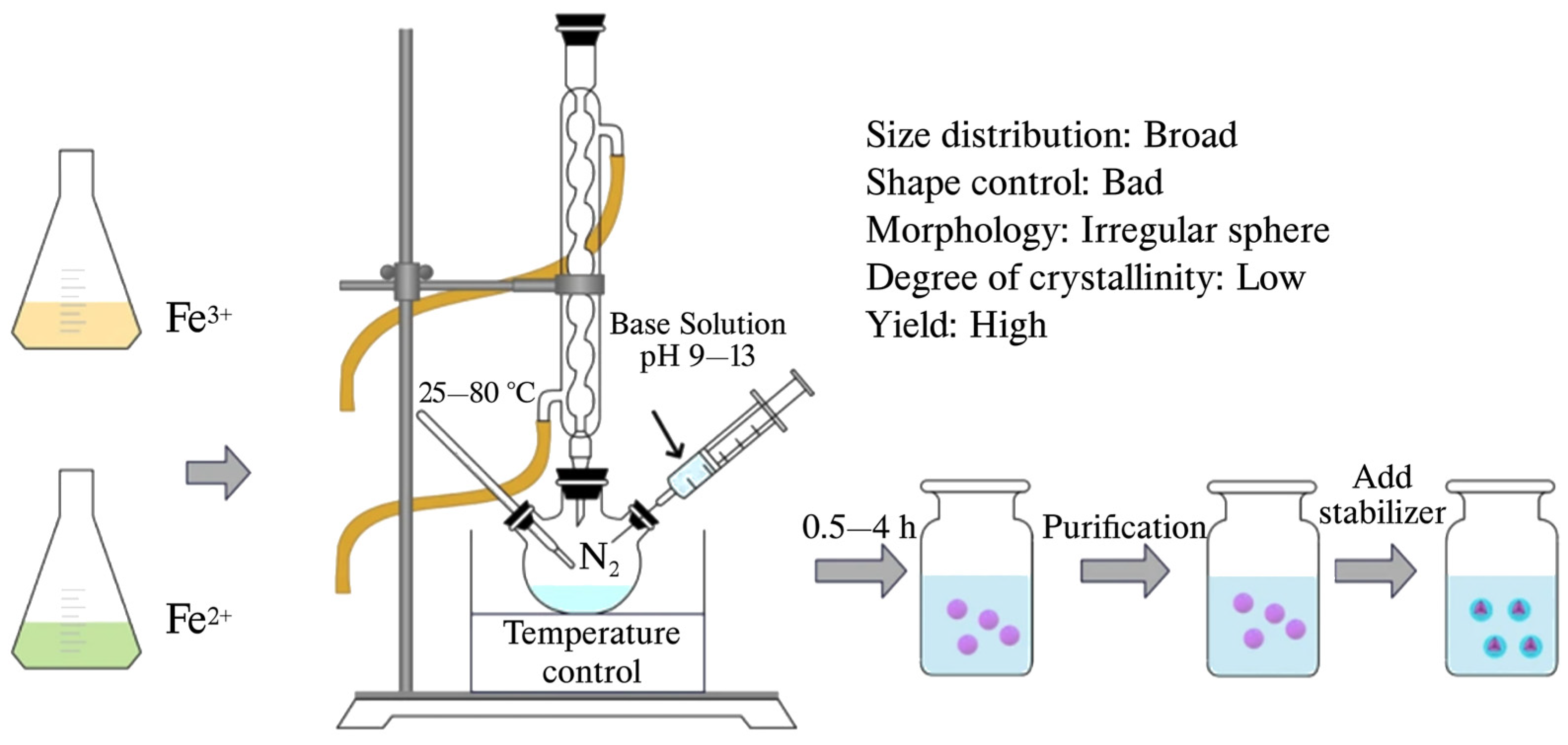
2.1.1. Coprecipitation
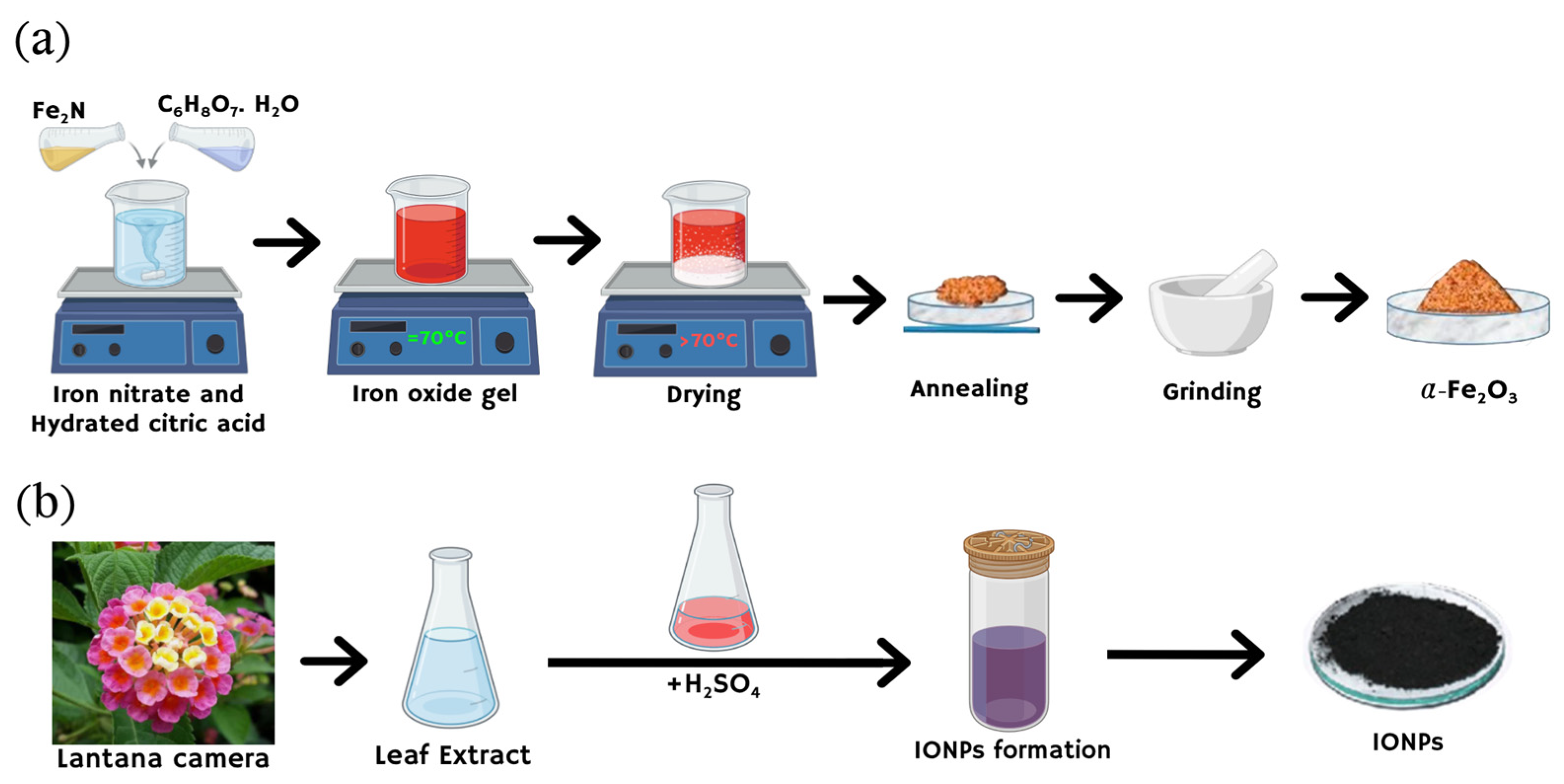
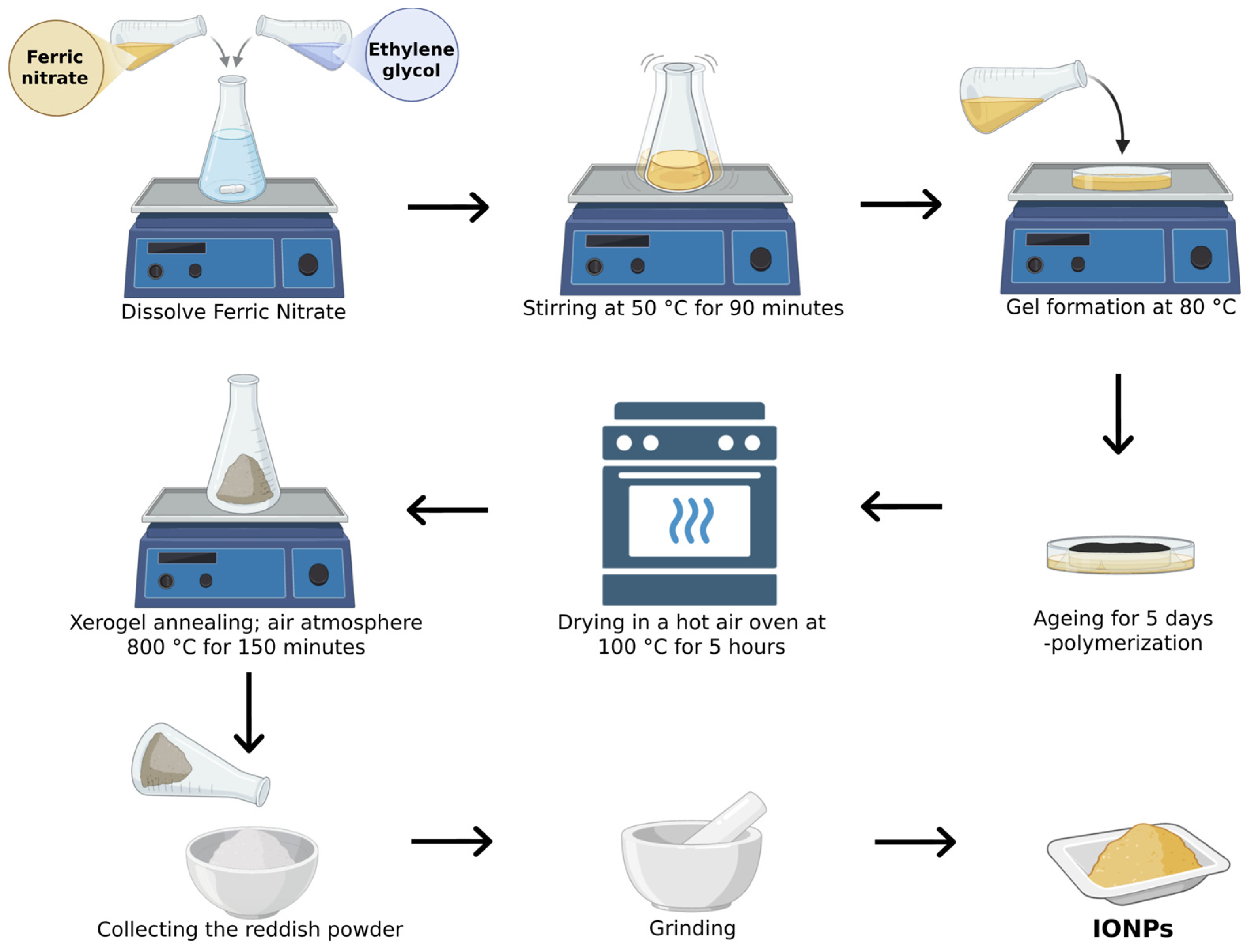
2.1.2. Sol–Gel Process
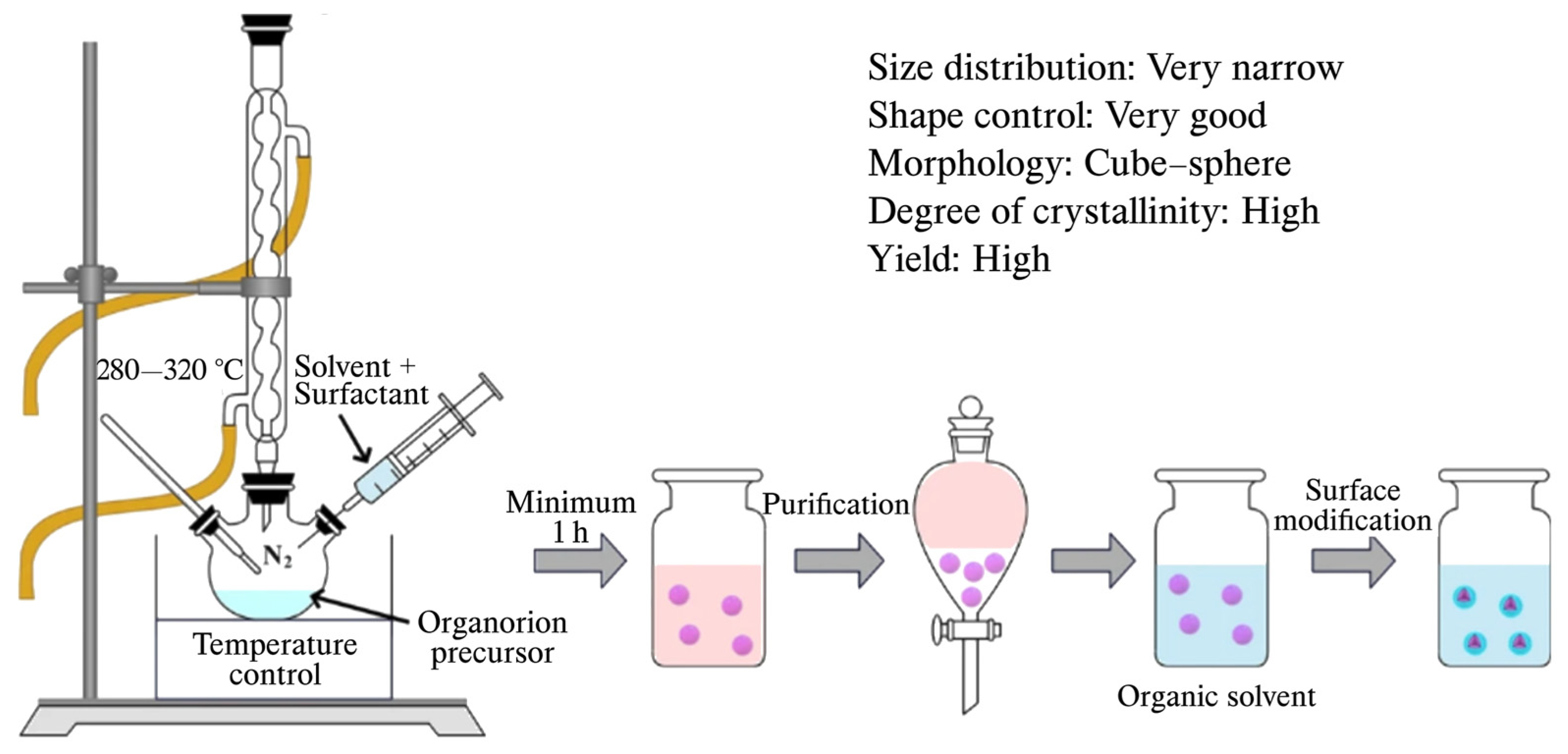
2.1.3. Thermal Breakdown
2.1.4. Hydrothermal Synthesis
2.1.5. Sonochemical Route
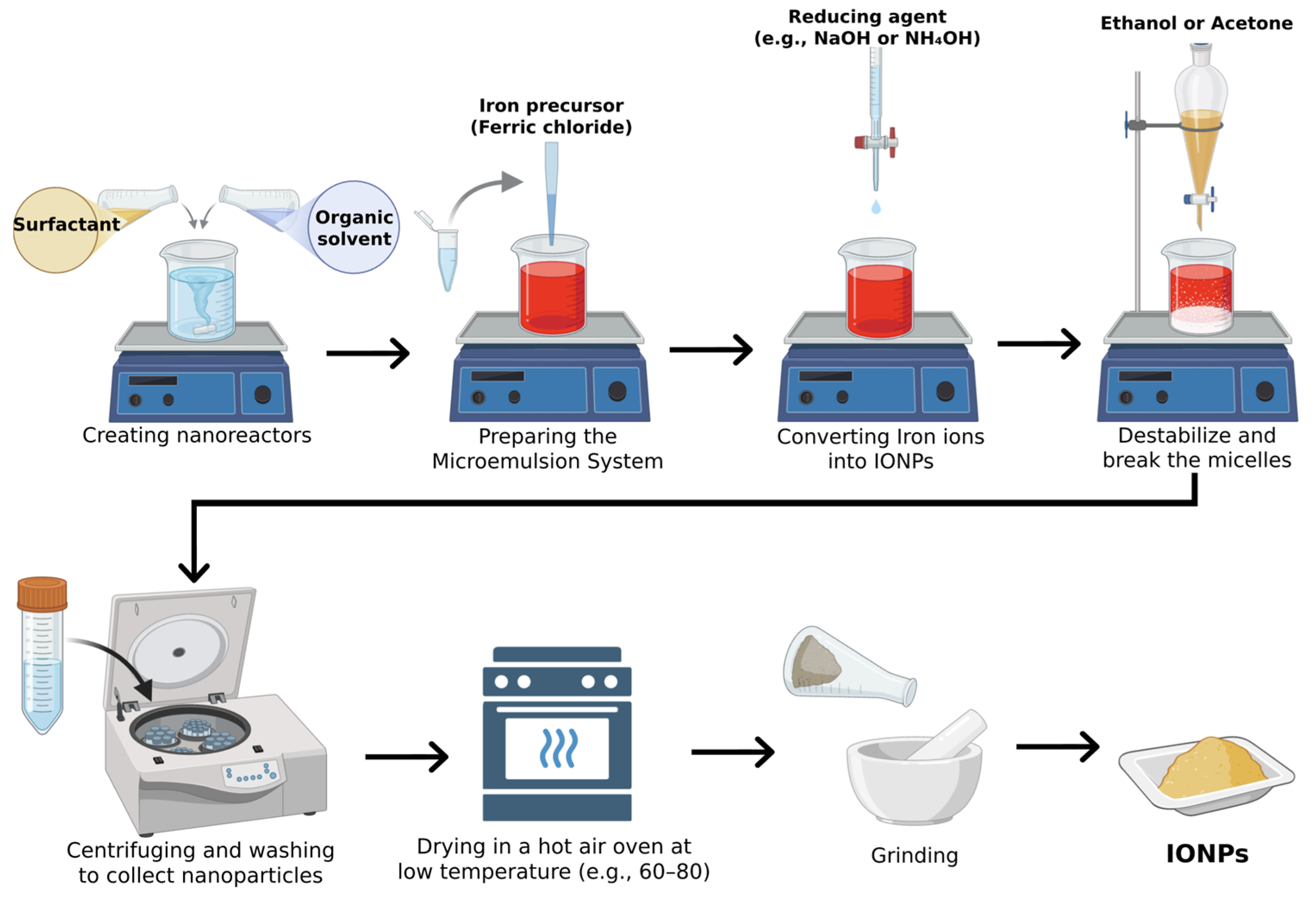
2.1.6. Microemulsion Method
2.1.7. Polyol Method
2.2. Physically Driven Techniques
2.2.1. Aerosol/Vapor-Phase Methods
2.2.2. Pulse Laser Ablation
2.2.3. Biomimetic/Green Synthesis Techniques
3. Surface Functionalization
3.1. Ligand Exchange
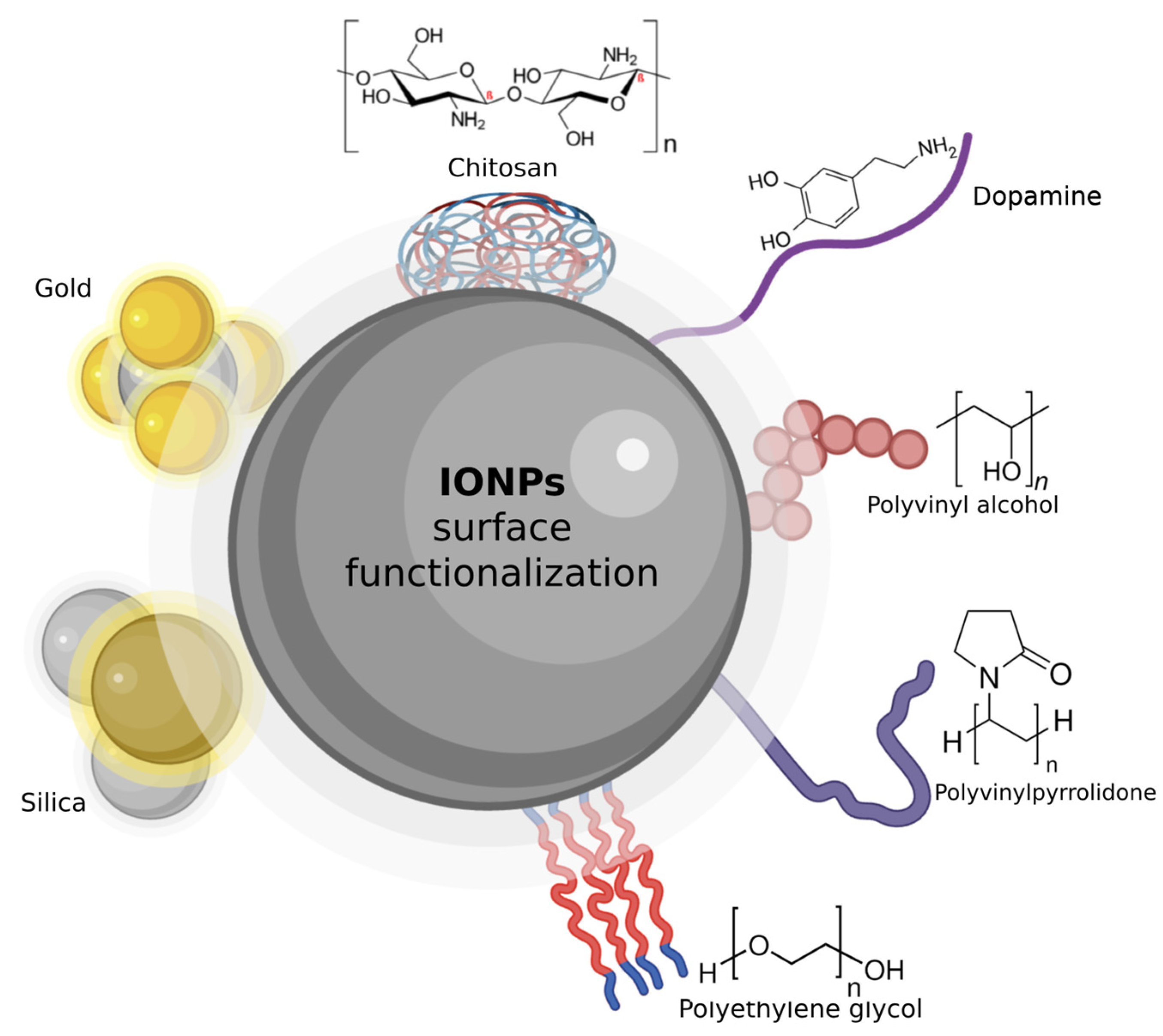
3.2. Ligand Encapsulation

| Polymers | Advantages | Application | Ref. |
|---|---|---|---|
| Polyethylene Glycol (PEG) | Biocompatible, reduces immunogenicity, enhances circulation time | Drug delivery, MRI contrast agents, hyperthermia treatment | [164] |
| Dextran | Biocompatible, enhances stability, reduces opsonization, faster degradation in body fluid | Drug delivery, MRI contrast agents, cell labeling | [49] |
| Chitosan | Biodegradable, biocompatible, enhances cellular uptake | Gene delivery, drug delivery | [165] |
| Polyvinylpyrrolidone (PVP) | Biocompatible, enhances stability, reduces aggregation | Drug delivery, MRI contrast agents | [49] |
| Polyethyleneimine (PEI) | Enhances cellular uptake, facilitates gene transfection | Gene and drug delivery, cell labeling | [165] |
| Poly(vinyl alcohol) (PVA) | Reduces affrication | Cytotoxicity, drug delivery | [166,167] |
| Gelatin | Biocompatible, biodegradable | MRI contrast agents, biosensing | [168] |
| Alginate | Biocompatible, biodegradable, enhances stability | Drug delivery, wound healing, tissue engineering | [164,169] |
| Hyaluronic Acid | Biocompatible, enhances cellular uptake, reduces immunogenicity | Drug delivery, tissue engineering, wound healing | [49] |
3.3. Silanization
4. Biomedical Application
4.1. MRI
4.2. Targeting Drug Delivery
4.3. Tissue Engineering
4.4. Stem Cell
4.5. Biosensors and Diagnostic Tools
4.5.1. Electrochemical Biosensor
4.5.2. Optical Biosensor
4.5.3. Field-Effect Transistor Biosensor
4.5.4. Nanopore Biosensor
| Type of Sensor | Target | Limit of Detection | Dynamic Range | Ref. |
|---|---|---|---|---|
| Electrochemical biosensor | ||||
| CA a | Carcinoembronic antigen | - | 4–25 ng/mL | [279] |
| CV b | Glucose | 0.5 mM | 0.5–22 mM | [280] |
| CA | Proteins | 750 nM | 25 μM–2.0 mM | [281] |
| CC c | miRNA | 100 fM | 100 fM–1.0 μM | [282] |
| DPV d | Human papillomavirus (HPV) | 0.1 nM | 10−4–1 μM | [283] |
| DPV | Amyloid-beta oligomers (AβO) | 3.4 fM | 10 fM–10 μM | [284] |
| EIS e | Paracetamol | 0.3 μM | 1–5 mM | [285] |
| CA | Glucose | 0.38 µM | 1–400 µM | [286] |
| EIS | D aminoacid (DAA) | 02–0.80 μM | 0.02 μM | [287] |
| DPV | SARS-CoV-2 | 0.932 pg/mL | 1 pg/mL–1 µg/mL | [288] |
| Amperometric | Dopamine | 0.001 μM | 0.006–635 μM | [240] |
| DPV | DNA | 7.96 × 10⁻¹³ M | 1.0 × 10⁻⁶–1.0 × 10⁻¹² M | [241] |
| DPV | DNA | 2 aM | 10 aM–1 nM | [242] |
| CV | Glucose | 8 μM | 5 × 10⁻³–30 mM | [243] |
| DPV | Ops | 5.6 × 10⁻⁴ ng/mL | 1.0 × 10⁻³–10 ng/mL | [247] |
| EIS/SPR | OTA i | 0.01 ng/mL | 0.01–5 ng/mL | [248] |
| SPR f | OTA | 0.94 ng/mL | 1–50 ng/mL | [248] |
| CV | Dopamine | 182 nM | 6.0 × 10⁻⁷–8.0 × 10⁻⁴ M | [249] |
| EIS | DNA | 3.0 × 10⁻¹⁷ | 1.0 × 10⁻¹⁶–1.0 × 10⁻⁸ | [251] |
| Optical biosensor | ||||
| SERS g | CTCs j | 1 cell/mL | 1–250 cell/mL | [257] |
| PEC h | PSA k | 5.0 pg/mL | 1.0 × 10⁻¹¹–5.0 × 10⁻⁸ g/mL | [258] |
| Fluorescent | 17β-estradiol | 0.03 μM | 0.10–70 μM | [259] |
| FET biosensor | ||||
| I–V | Glucose | 12 μM | 0.05–18 mM | [266] |
| I–V | Cholesterol | 0.06 mM | 0.1–60.0 mM | [267] |
5. Challenges and Futures Perspective
Author Contributions
Funding
Institutional Review Board Statement
Informed Consent Statement
Data Availability Statement
Conflicts of Interest
References
- Ling, D.; Hyeon, T. Chemical Design of Biocompatible Iron Oxide Nanoparticles for Medical Applications. Small 2013, 9, 1450–1466. [Google Scholar] [CrossRef] [PubMed]
- Wu, W.; Wu, Z.; Yu, T.; Jiang, C.; Kim, W.S. Recent Progress on Magnetic Iron Oxide Nanoparticles: Synthesis, Surface Functional Strategies and Biomedical Applications. Sci. Technol. Adv. Mater. 2015, 16, 023501. [Google Scholar] [CrossRef] [PubMed]
- Lin, M.M.; Kim, H.-H.; Kim, H.; Muhammed, M.; Kim, D.K. Iron Oxide-Based Nanomagnets in Nanomedicine: Fabrication and Applications. Nano Rev. 2010, 1, 4883. [Google Scholar] [CrossRef]
- Roca, A.G.; Gutiérrez, L.; Gavilán, H.; Fortes Brollo, M.E.; Veintemillas-Verdaguer, S.; Morales, M. del P. Design Strategies for Shape-Controlled Magnetic Iron Oxide Nanoparticles. Adv. Drug Deliv. Rev. 2019, 138, 68–104. [Google Scholar] [CrossRef]
- Boxall, C.; Kelsall, G.; Zhang, Z. Photoelectrophoresis of Colloidal Iron Oxides. Part 2.—Magnetite (Fe3O4). J. Chem. Soc. Faraday Trans. 1996, 92, 791–802. [Google Scholar] [CrossRef]
- Sun, Y.; Gray, S.K.; Peng, S. Surface Chemistry: A Non-Negligible Parameter in Determining Optical Properties of Small Colloidal Metal Nanoparticles. Phys. Chem. Chem. Phys. 2011, 13, 11814–11826. [Google Scholar] [CrossRef]
- Tringides, M.C.; Jałochowski, M.; Bauer, E. Quantum Size Effects in Metallic Nanostructures. Phys. Chem. Chem. Phys. 2011, 13, 11814–11826. [Google Scholar] [CrossRef]
- Li, Q.; Kartikowati, C.W.; Horie, S.; Ogi, T.; Iwaki, T.; Okuyama, K. Correlation between Particle Size/Domain Structure and Magnetic Properties of Highly Crystalline Fe3O4 Nanoparticles. Sci. Rep. 2017, 7, 9894. [Google Scholar] [CrossRef]
- Colombo, M.; Carregal-Romero, S.; Casula, M.F.; Gutiérrez, L.; Morales, M.P.; Böhm, I.B.; Heverhagen, J.T.; Prosperi, D.; Parak, W.J. Biological Applications of Magnetic Nanoparticles. Soc. Rev. 2012, 41, 4306–4334. [Google Scholar] [CrossRef]
- Xie, J.; Liu, G.; Eden, H.S.; Ai, H.; Chen, X. Surface-Engineered Magnetic Nanoparticle Platforms for Cancer Imaging and Therapy. Acc. Chem. Res. 2011, 44, 883–892. [Google Scholar] [CrossRef]
- Veiseh, O.; Gunn, J.W.; Zhang, M. Design and Fabrication of Magnetic Nanoparticles for Targeted Drug Delivery and Imaging. Adv. Drug Deliv. Rev. 2010, 62, 284–304. [Google Scholar] [CrossRef] [PubMed]
- Jun, Y.W.; Seo, J.W.; Cheon, J. Nanoscaling Laws of Magnetic Nanoparticles and Their Applicabilities in Biomedical Sciences. Acc. Chem. Res. 2008, 41, 179–189. [Google Scholar] [CrossRef] [PubMed]
- Nel, A.E.; Mädler, L.; Velegol, D.; Xia, T.; Hoek, E.M.V.; Somasundaran, P.; Klaessig, F.; Castranova, V.; Thompson, M. Understanding Biophysicochemical Interactions at the Nano-Bio Interface. Nat. Mater. 2009, 8, 543–557. [Google Scholar] [CrossRef] [PubMed]
- Krug, H.F.; Wick, P.; Krug, H.F.; Wick, P. Nanotoxicology: An Interdisciplinary Challenge. Angew. Chem. Int. Ed. 2011, 50, 1260–1278. [Google Scholar] [CrossRef]
- Lewinski, N.; Colvin, V.; Drezek, R. Cytotoxicity of Nanoparticles. Small 2008, 4, 26–49. [Google Scholar] [CrossRef]
- Love, S.A.; Maurer-Jones, M.A.; Thompson, J.W.; Lin, Y.S.; Haynes, C.L. Assessing Nanoparticle Toxicity. Annu. Rev. Anal. Chem. 2012, 5, 181–205. [Google Scholar] [CrossRef]
- Rishton, S.A.; Lu, Y.; Altman, R.A.; Marley, A.C.; Bian, X.P.; Jahnes, C.; Viswanathan, R.; Xiao, G.; Gallagher, W.J.; Parkin, S.S.P. Magnetic Tunnel Junctions Fabricated at Tenth-Micron Dimensions by Electron Beam Lithography. Microelectron. Eng. 1997, 35, 249–252. [Google Scholar] [CrossRef]
- Škorvánek, I.; O’Handley, R.C. Fine-Particle Magnetism in Nanocrystalline Fe—Cu—Nb—Si—B at Elevated Temperatures. J. Magn. Magn. Mater. 1995, 140–144, 467–468. [Google Scholar] [CrossRef]
- Tang, J.; Myers, M.; Bosnick, K.A.; Brus, L.E. Magnetite Fe3O4 Nanocrystals: Spectroscopic Observation of Aqueous Oxidation Kinetics. J. Phys. Chem. B 2003, 107, 7501–7506. [Google Scholar] [CrossRef]
- Kandpal, N.D.; Sah, N.; Loshali, R.; Joshi, R.; Prasad, J. Co-Precipitation Method of Synthesis and Characterization of Iron Oxide Nanoparticles. J. Sci. Ind. Res. 2014, 73, 87–90. [Google Scholar]
- Lee, C.S.; Lee, H.; Westervelt, R.M. Microelectromagnets for the Control of Magnetic Nanoparticles. Appl. Phys. Lett. 2001, 79, 3308–3310. [Google Scholar] [CrossRef]
- Yusefi, M.; Shameli, K.; Ali, R.R.; Pang, S.W.; Teow, S.Y. Evaluating Anticancer Activity of Plant-Mediated Synthesized Iron Oxide Nanoparticles Using Punica Granatum Fruit Peel Extract. J. Mol. Struct. 2020, 1204, 127539. [Google Scholar] [CrossRef]
- Chen, Z.; Wu, C.; Zhang, Z.; Wu, W.; Wang, X.; Yu, Z. Synthesis, Functionalization, and Nanomedical Applications of Functional Magnetic Nanoparticles. Chin. Chem. Lett. 2018, 29, 1601–1608. [Google Scholar] [CrossRef]
- Elahi, N.; Rizwan, M. Progress and Prospects of Magnetic Iron Oxide Nanoparticles in Biomedical Applications: A Review. Artif. Organs 2021, 45, 1272–1299. [Google Scholar] [CrossRef]
- Gudkov, S.V.; Burmistrov, D.E.; Serov, D.A.; Rebezov, M.B.; Semenova, A.A.; Lisitsyn, A.B. Do Iron Oxide Nanoparticles Have Significant Antibacterial Properties? Antibiotics 2021, 10, 884. [Google Scholar] [CrossRef] [PubMed]
- Gupta, A.K.; Wells, S. Surface-Modified Superparamagnetic Nanoparticles for Drug Delivery: Preparation, Characterization, and Cytotoxicity Studies. IEEE Trans. Nanobiosci. 2004, 3, 66–73. [Google Scholar] [CrossRef]
- Gupta, A.K.; Gupta, M. Synthesis and Surface Engineering of Iron Oxide Nanoparticles for Biomedical Applications. Biomaterials 2005, 26, 3995–4021. [Google Scholar] [CrossRef]
- Ansari, S.A.M.K.; Ficiarà, E.; Ruffinatti, F.A.; Stura, I.; Argenziano, M.; Abollino, O.; Cavalli, R.; Guiot, C.; D’Agata, F. Magnetic Iron Oxide Nanoparticles: Synthesis, Characterization and Functionalization for Biomedical Applications in the Central Nervous System. Materials 2019, 12, 465. [Google Scholar] [CrossRef]
- Rajiv, P.; Bavadharani, B.; Kumar, M.N.; Vanathi, P. Synthesis and Characterization of Biogenic Iron Oxide Nanoparticles Using Green Chemistry Approach and Evaluating Their Biological Activities. Biocatal. Agric. Biotechnol. 2017, 12, 45–49. [Google Scholar] [CrossRef]
- Hoque, M.A.; Ahmed, M.R.; Rahman, G.T.; Rahman, M.T.; Islam, M.A.; Khan, M.A.; Hossain, M.K. Fabrication and Comparative Study of Magnetic Fe and α-Fe2O3 Nanoparticles Dispersed Hybrid Polymer (PVA + Chitosan) Novel Nanocomposite Film. Results Phys. 2018, 10, 434–443. [Google Scholar] [CrossRef]
- Osial, M.; Rybicka, P.; Pękała, M.; Cichowicz, G.; Cyrański, M.K.; Krysiński, P. Easy Synthesis and Characterization of Holmium-Doped SPIONs. Nanomaterials 2018, 8, 430. [Google Scholar] [CrossRef] [PubMed]
- Yazdani, F.; Seddigh, M. Magnetite Nanoparticles Synthesized by Co-Precipitation Method: The Effects of Various Iron Anions on Specifications. Mater. Chem. Phys. 2016, 184, 318–323. [Google Scholar] [CrossRef]
- Wang, A.; Sudarsanam, P.; Xu, Y.; Zhang, H.; Li, H.; Yang, S. Functionalized Magnetic Nanosized Materials for Efficient Biodiesel Synthesis via Acid–Base/Enzyme Catalysis. Green Chem. 2020, 22, 2977–3012. [Google Scholar] [CrossRef]
- Chandrakala, V.; Aruna, V.; Angajala, G. Review on Metal Nanoparticles as Nanocarriers: Current Challenges and Perspectives in Drug Delivery Systems. Emergent Mater. 2022, 5, 1593–1615. [Google Scholar] [CrossRef] [PubMed]
- Lin, M.M.; Li, S.; Kim, H.H.; Kim, H.; Lee, H.B.; Muhammed, M.; Kim, D.K. Complete Separation of Magnetic Nanoparticles via Chemical Cleavage of Dextran by Ethylenediamine for Intracellular Uptake. J. Mater. Chem. 2009, 20, 444–447. [Google Scholar] [CrossRef]
- Liong, S. A Multifunctional Approach to Development, Fabrication, and Characterization of Fe3O4 Composites. Ph.D. Thesis, Georgia Institute of Technology, Atlanta, GA, USA, 2005. Available online: https://repository.gatech.edu/entities/publication/825a2180-3957-4479-98a7-1753136918e6/full (accessed on 7 November 2024).
- Belaïd, S.; Stanicki, D.; Vander Elst, L.; Muller, R.N.; Laurent, S. Influence of Experimental Parameters on Iron Oxide Nanoparticle Properties Synthesized by Thermal Decomposition: Size and Nuclear Magnetic Resonance Studies. Nanotechnology 2018, 29, 165603. [Google Scholar] [CrossRef]
- Lassoued, A.; Dkhil, B.; Gadri, A.; Ammar, S. Control of the Shape and Size of Iron Oxide (α-Fe2O3) Nanoparticles Synthesized through the Chemical Precipitation Method. Results Phys. 2017, 7, 3007–3015. [Google Scholar] [CrossRef]
- Gnanaprakash, G.; Mahadevan, S.; Jayakumar, T.; Kalyanasundaram, P.; Philip, J.; Raj, B. Effect of Initial PH and Temperature of Iron Salt Solutions on Formation of Magnetite Nanoparticles. Mater. Chem. Phys. 2007, 103, 168–175. [Google Scholar] [CrossRef]
- Kim, D.K.; Zhang, Y.; Voit, W.; Rao, K.V.; Kehr, J.; Bjelke, B.; Muhammed, M. Superparamagnetic Iron Oxide Nanoparticles for Bio-Medical Applications. Scr. Mater. 2001, 44, 1713–1717. [Google Scholar] [CrossRef]
- Kim, D.K.; Mikhaylova, M.; Zhang, Y.; Muhammed, M. Protective Coating of Superparamagnetic Iron Oxide Nanoparticles. Chem. Mater. 2003, 15, 1617–1627. [Google Scholar] [CrossRef]
- Bee, A.; Massart, R.; Neveu, S. Synthesis of Very Fine Maghemite Particles. J. Magn. Magn. Mater. 1995, 149, 6–9. [Google Scholar] [CrossRef]
- Kim, D.K.; Mikhaylova, M.; Wang, F.H.; Kehr, J.; Bjelke, B.; Zhang, Y.; Tsakalakos, T.; Muhammed, M. Starch-Coated Superparamagnetic Nanoparticles as MR Contrast Agents. Chem. Mater. 2003, 15, 4343–4351. [Google Scholar] [CrossRef]
- Wang, Y.-X.J. Superparamagnetic Iron Oxide Based MRI Contrast Agents: Current Status of Clinical Application. Quant. Imaging Med. Surg. 2011, 1, 35–40. [Google Scholar] [CrossRef] [PubMed]
- Jolivet, J.P.; Chanéac, C.; Tronc, E. Iron Oxide Chemistry. From Molecular Clusters to Extended Solid Networks. Chem. Commun. 2004, 4, 481–483. [Google Scholar] [CrossRef]
- Talbot, D.; Queiros Campos, J.; Checa-Fernandez, B.L.; Marins, J.A.; Lomenech, C.; Hurel, C.; Godeau, G.D.; Raboisson-Michel, M.; Verger-Dubois, G.; Obeid, L.; et al. Adsorption of Organic Dyes on Magnetic Iron Oxide Nanoparticles. Part I: Mechanisms and Adsorption-Induced Nanoparticle Agglomeration. ACS Omega 2021, 6, 19086–19098. [Google Scholar] [CrossRef]
- Shalaby, S.M.; Madkour, F.F.; El-Kassas, H.Y.; Mohamed, A.A.; Elgarahy, A.M. Green Synthesis of Recyclable Iron Oxide Nanoparticles Using Spirulina Platensis Microalgae for Adsorptive Removal of Cationic and Anionic Dyes. Environ. Sci. Pollut. Res. Int. 2021, 28, 65549–65572. [Google Scholar] [CrossRef]
- Pereira, C.; Pereira, A.M.; Fernandes, C.; Rocha, M.; Mendes, R.; Fernández-García, M.P.; Guedes, A.; Tavares, P.B.; Grenéche, J.M.; Araújo, J.P.; et al. Superparamagnetic MFe2O4 (M = Fe, Co, Mn) Nanoparticles: Tuning the Particle Size and Magnetic Properties through a Novel One-Step Coprecipitation Route. Chem. Mater. 2012, 24, 1496–1504. [Google Scholar] [CrossRef]
- Meng, Y.Q.; Shi, Y.N.; Zhu, Y.P.; Liu, Y.Q.; Gu, L.W.; Liu, D.D.; Ma, A.; Xia, F.; Guo, Q.Y.; Xu, C.C.; et al. Recent Trends in Preparation and Biomedical Applications of Iron Oxide Nanoparticles. J. Nanobiotechnol. 2024, 22, 24. [Google Scholar] [CrossRef]
- Hasany, S.F.; Ahmed, I.; J, R.; Rehman, A. Systematic Review of the Preparation Techniques of Iron Oxide Magnetic Nanoparticles. Nanosci. Nanotechnol. 2012, 2, 148–158. [Google Scholar] [CrossRef]
- Riaz, S.; Shah, S.Z.H.; Kayani, Z.N.; Naseem, S. Magnetic and Structural Phase Transition in Iron Oxide Nanostructures. Mater. Today Proc. 2015, 2, 5280–5287. [Google Scholar] [CrossRef]
- Raja, K.; Mary Jaculine, M.; Jose, M.; Verma, S.; Prince, A.A.M.; Ilangovan, K.; Sethusankar, K.; Jerome Das, S. Sol–Gel Synthesis and Characterization of α-Fe2O3 Nanoparticles. Superlattices Microstruct. 2015, 86, 306–312. [Google Scholar] [CrossRef]
- Dhlamini, M.S.; Noto, L.L.; Mothudi, B.M.; Chithambo, M.; Mathevula, L.E. Structural and Optical Properties of Sol-Gel Derived α-Fe2O3 Nanoparticles. J. Lumin. 2017, 192, 879–887. [Google Scholar] [CrossRef]
- Kayani, Z.N.; Arshad, S.; Riaz, S.; Naseem, S. Synthesis of Iron Oxide Nanoparticles by Sol-Gel Technique and Their Characterization. IEEE Trans. Magn. 2014, 50, 1–4. [Google Scholar] [CrossRef]
- Niederberger, M. Nonaqueous Sol-Gel Routes to Metal Oxide Nanoparticles. Acc. Chem. Res. 2007, 40, 793–800. [Google Scholar] [CrossRef]
- Imran, M.; Riaz, S.; Shah, S.M.H.; Batool, T.; Khan, H.N.; Sabri, A.N.; Naseem, S. In-Vitro Hemolytic Activity and Free Radical Scavenging by Sol-Gel Synthesized Fe3O4 Stabilized ZrO2 Nanoparticles. Arab. J. Chem. 2020, 13, 7598–7608. [Google Scholar] [CrossRef]
- Parashar, M.; Shukla, V.K.; Singh, R. Metal Oxides Nanoparticles via Sol–Gel Method: A Review on Synthesis, Characterization and Applications. J. Mater. Sci. Mater. Electron. 2020, 31, 3729–3749. [Google Scholar] [CrossRef]
- MODAN, E.M.; PLĂIAȘU, A.G. Advantages and Disadvantages of Chemical Methods in the Elaboration of Nanomaterials. Ann. “Dunarea De Jos” Univ. Galati. Fascicle IX Metall. Mater. Sci. 2020, 43, 53–60. [Google Scholar] [CrossRef]
- Almessiere, M.A.; Trukhanov, A.V.; Khan, F.A.; Slimani, Y.; Tashkandi, N.; Turchenko, V.A.; Zubar, T.I.; Tishkevich, D.I.; Trukhanov, S.V.; Panina, L.V.; et al. Correlation between Microstructure Parameters and Anti-Cancer Activity of the [Mn0.5Zn0.5](EuxNdxFe2-2x)O4 Nanoferrites Produced by Modified Sol-Gel and Ultrasonic Methods. Ceram. Int. 2020, 46, 7346–7354. [Google Scholar] [CrossRef]
- Gonzalez-Moragas, L.; Yu, S.M.; Murillo-Cremaes, N.; Laromaine, A.; Roig, A. Scale-up Synthesis of Iron Oxide Nanoparticles by Microwave-Assisted Thermal Decomposition. Chem. Eng. J. 2015, 281, 87–95. [Google Scholar] [CrossRef]
- Effenberger, F.B.; Couto, R.A.; Kiyohara, P.K.; Machado, G.; Masunaga, S.H.; Jardim, R.F.; Rossi, L.M. Economically Attractive Route for the Preparation of High Quality Magnetic Nanoparticles by the Thermal Decomposition of Iron(III) Acetylacetonate. Nanotechnology 2017, 28, 115603. [Google Scholar] [CrossRef]
- Hufschmid, R.; Arami, H.; Ferguson, R.M.; Gonzales, M.; Teeman, E.; Brush, L.N.; Browning, N.D.; Krishnan, K.M. Synthesis of Phase-Pure and Monodisperse Iron Oxide Nanoparticles by Thermal Decomposition. Nanoscale 2015, 7, 11142–11154. [Google Scholar] [CrossRef] [PubMed]
- Lu, A.H.; Salabas, E.L.; Schüth, F. Magnetic Nanoparticles: Synthesis, Protection, Functionalization, and Application. Angew. Chem. Int. Ed. 2007, 46, 1222–1244. [Google Scholar] [CrossRef] [PubMed]
- Biehl, P.; von der Lühe, M.; Dutz, S.; Schacher, F.H. Synthesis, Characterization, and Applications of Magnetic Nanoparticles Featuring Polyzwitterionic Coatings. Polymers 2018, 10, 91. [Google Scholar] [CrossRef] [PubMed]
- Jović Orsini, N.; Babić-Stojić, B.; Spasojević, V.; Calatayud, M.P.; Cvjetićanin, N.; Goya, G.F. Magnetic and Power Absorption Measurements on Iron Oxide Nanoparticles Synthesized by Thermal Decomposition of Fe(Acac)3. J. Magn. Magn. Mater. 2018, 449, 286–296. [Google Scholar] [CrossRef]
- Wetterskog, E.; Agthe, M.; Mayence, A.; Grins, J.; Wang, D.; Rana, S.; Ahniyaz, A.; Salazar-Alvarez, G.; Bergström, L. Precise Control over Shape and Size of Iron Oxide Nanocrystals Suitable for Assembly into Ordered Particle Arrays. Sci. Technol. Adv. Mater. 2014, 15, 055010. [Google Scholar] [CrossRef]
- Li, W.; Lee, S.S.; Wu, J.; Hinton, C.H.; Fortner, J.D. Shape and Size Controlled Synthesis of Uniform Iron Oxide Nanocrystals through New Non-Hydrolytic Routes. Nanotechnology 2016, 27, 324002. [Google Scholar] [CrossRef]
- Kim, B.H.; Lee, N.; Kim, H.; An, K.; Park, Y.I.; Choi, Y.; Shin, K.; Lee, Y.; Kwon, S.G.; Na, H.B.; et al. Large-Scale Synthesis of Uniform and Extremely Small-Sized Iron Oxide Nanoparticles for High-Resolution T 1 Magnetic Resonance Imaging Contrast Agents. J. Am. Chem. Soc. 2011, 133, 12624–12631. [Google Scholar] [CrossRef]
- Nejati, K.; Zabihi, R. Preparation and Magnetic Properties of Nano Size Nickel Ferrite Particles Using Hydrothermal Method. Chem. Cent. J. 2012, 6, 23. [Google Scholar] [CrossRef]
- Ozel, F.; Kockar, H.; Karaagac, O. Growth of Iron Oxide Nanoparticles by Hydrothermal Process: Effect of Reaction Parameters on the Nanoparticle Size. J. Supercond. Nov. Magn. 2015, 28, 823–829. [Google Scholar] [CrossRef]
- Ozel, F.; Kockar, H. Growth and Characterizations of Magnetic Nanoparticles under Hydrothermal Conditions: Reaction Time and Temperature. J. Magn. Magn. Mater. 2015, 373, 213–216. [Google Scholar] [CrossRef]
- Dunne, P.W.; Munn, A.S.; Starkey, C.L.; Huddle, T.A.; Lester, E.H. Continuous-Flow Hydrothermal Synthesis for the Production of Inorganic Nanomaterials. Philos. Trans. R. Soc. A Math. Phys. Eng. Sci. 2015, 373, 20150015. [Google Scholar] [CrossRef] [PubMed]
- Darr, J.A.; Zhang, J.; Makwana, N.M.; Weng, X. Continuous Hydrothermal Synthesis of Inorganic Nanoparticles: Applications and Future Directions. Chem. Rev. 2017, 117, 11125–11238. [Google Scholar] [CrossRef] [PubMed]
- Bilecka, I.; Niederberger, M. Microwave Chemistry for Inorganic Nanomaterials Synthesis. Nanoscale 2010, 2, 1358–1374. [Google Scholar] [CrossRef] [PubMed]
- Eycken, E.V. Van der Practical Microwave Synthesis for Organic Chemists.Strategies, Instruments, and Protocols. Edited by C. Oliver Kappe, Doris Dallinger and Shaun Murphree. Angew. Chem. Int. Ed. 2009, 48, 2828–2829. [Google Scholar] [CrossRef]
- Schütz, M.B.; Xiao, L.; Lehnen, T.; Fischer, T.; Mathur, S. Microwave-Assisted Synthesis of Nanocrystalline Binary and Ternary Metal Oxides. Int. Mater. Rev. 2018, 63, 341–374. [Google Scholar] [CrossRef]
- Wang, W.W.; Zhu, Y.J.; Ruan, M.L. Microwave-Assisted Synthesis and Magnetic Property of Magnetite and Hematite Nanoparticles. J. Nanoparticle Res. 2007, 9, 419–426. [Google Scholar] [CrossRef]
- Khan, S.B.; Maqsood, A.; Hessien, M. Methylene Blue Dye Adsorption on Iron Oxide-Hydrochar Composite Synthesized via a Facile Microwave-Assisted Hydrothermal Carbonization of Pomegranate Peels’ Waste. Molecules 2023, 28, 4526. [Google Scholar] [CrossRef]
- Khabibullin, V.R.; Chetyrkina, M.R.; Obydennyy, S.I.; Maksimov, S.V.; Stepanov, G.V.; Shtykov, S.N. Study on Doxorubicin Loading on Differently Functionalized Iron Oxide Nanoparticles: Implications for Controlled Drug-Delivery Application. Int. J. Mol. Sci. 2023, 24, 4480. [Google Scholar] [CrossRef]
- Lv, M.; Zhang, Z.; Zeng, J.; Liu, J.; Sun, M.; Yadav, R.S.; Feng, Y. Roles of Magnetic Particles in Magnetic Seeding Coagulation-Flocculation Process for Surface Water Treatment. Sep. Purif. Technol. 2019, 212, 337–343. [Google Scholar] [CrossRef]
- Hassanjani-Roshan, A.; Vaezi, M.R.; Shokuhfar, A.; Rajabali, Z. Synthesis of Iron Oxide Nanoparticles via Sonochemical Method and Their Characterization. Particuology 2011, 9, 95–99. [Google Scholar] [CrossRef]
- Salavati-Niasari, M.; Hosseinzadeh, G.; Amiri, O. Synthesis of Monodisperse Lanthanum Hydroxide Nanoparticles and Nanorods by Sonochemical Method. J. Clust. Sci. 2012, 23, 459–468. [Google Scholar] [CrossRef]
- Gupta, A.; Srivastava, R. Mini Submersible Pump Assisted Sonochemical Reactors: Large-Scale Synthesis of Zinc Oxide Nanoparticles and Nanoleaves for Antibacterial and Anti-Counterfeiting Applications. Ultrason. Sonochem. 2019, 52, 414–427. [Google Scholar] [CrossRef] [PubMed]
- Ghanbari, D.; Salavati-Niasari, M.; Ghasemi-Kooch, M. A Sonochemical Method for Synthesis of Fe3O4 Nanoparticles and Thermal Stable PVA-Based Magnetic Nanocomposite. J. Ind. Eng. Chem. 2014, 20, 3970–3974. [Google Scholar] [CrossRef]
- Wegmann, M.; Scharr, M. Synthesis of Magnetic Iron Oxide Nanoparticles. In Precision Medicine Tools and Quantitative Approaches; Elsevier: New York, NY, USA, 2018; pp. 145–181. [Google Scholar] [CrossRef]
- Salvador, M.; Gutiérrez, G.; Noriega, S.; Moyano, A.; Blanco-López, M.C.; Matos, M. Microemulsion Synthesis of Superparamagnetic Nanoparticles for Bioapplications. Int. J. Mol. Sci. 2021, 22, 427. [Google Scholar] [CrossRef] [PubMed]
- Grüttner, C.; Müller, K.; Teller, J.; Westphal, F. Synthesis and Functionalisation of Magnetic Nanoparticles for Hyperthermia Applications. Int. J. Hyperth. 2013, 29, 777–789. [Google Scholar] [CrossRef]
- Makovec, D.; Košak, A.; Žnidaršič, A.; Drofenik, M. The Synthesis of Spinel–Ferrite Nanoparticles Using Precipitation in Microemulsions for Ferrofluid Applications. J. Magn. Magn. Mater. 2005, 289, 32–35. [Google Scholar] [CrossRef]
- Vidal-Vidal, J.; Rivas, J.; López-Quintela, M.A. Synthesis of Monodisperse Maghemite Nanoparticles by the Microemulsion Method. Colloids Surf. A Physicochem. Eng. Asp. 2006, 288, 44–51. [Google Scholar] [CrossRef]
- López, R.G.; Pineda, M.G.; Hurtado, G.; de León, R.D.; Fernández, S.; Saade, H.; Bueno, D. Chitosan-Coated Magnetic Nanoparticles Prepared in One Step by Reverse Microemulsion Precipitation. Int. J. Mol. Sci. 2013, 14, 19636–19650. [Google Scholar] [CrossRef]
- Kekalo, K.; Koo, K.; Zeitchick, E.; Baker, I. Microemulsion Synthesis of Iron Core/Iron Oxide Shell Magnetic Nanoparticles and Their Physicochemical Properties. Mater. Res. Soc. Symp. Proc. 2012, 1416, 61–66. [Google Scholar] [CrossRef]
- Hachani, R.; Lowdell, M.; Birchall, M.; Hervault, A.; Mertz, D.; Begin-Colin, S.; Thanh, N.T.B.D.K. Polyol Synthesis, Functionalisation, and Biocompatibility Studies of Superparamagnetic Iron Oxide Nanoparticles as Potential MRI Contrast Agents. Nanoscale 2016, 8, 3278–3287. [Google Scholar] [CrossRef]
- Cheng, C.; Xu, F.; Gu, H. Facile Synthesis and Morphology Evolution of Magnetic Iron Oxide Nanoparticles in Different Polyol Processes. New J. Chem. 2011, 35, 1072–1079. [Google Scholar] [CrossRef]
- Kotoulas, A.; Dendrinou-Samara, C.; Angelakeris, M.; Kalogirou, O. The Effect of Polyol Composition on the Structural and Magnetic Properties of Magnetite Nanoparticles for Magnetic Particle Hyperthermia. Materials 2019, 12, 2663. [Google Scholar] [CrossRef]
- Wan, J.; Cai, W.; Meng, X.; Liu, E. Monodisperse Water-Soluble Magnetite Nanoparticles Prepared by Polyol Process for High-Performance Magnetic Resonance Imaging. Chem. Commun. 2007, 47, 5004–5006. [Google Scholar] [CrossRef]
- Qiao, R.; Fu, C.; Forgham, H.; Javed, I.; Huang, X.; Zhu, J.; Whittaker, A.K.; Davis, T.P. Magnetic Iron Oxide Nanoparticles for Brain Imaging and Drug Delivery. Adv. Drug Deliv. Rev. 2023, 197, 114822. [Google Scholar] [CrossRef]
- Park, J.-H.; Shin, S.-H.; Kim, S.-H.; Park, J.-K.; Lee, J.-W.; Shin, J.-H.; Park, J.-H.; Kim, S.-W.; Choi, H.-J.; Lee, K.-S.; et al. Effect of Synthesis Time and Composition on Magnetic Properties of FeCo Nanoparticles by Polyol Method. J. Nanosci. Nanotechnol. 2018, 18, 7115–7119. [Google Scholar] [CrossRef]
- Hemery, G.; Keyes, A.C.; Garaio, E.; Rodrigo, I.; Garcia, J.A.; Plazaola, F.; Garanger, E.; Sandre, O. Tuning Sizes, Morphologies, and Magnetic Properties of Monocore Versus Multicore Iron Oxide Nanoparticles through the Controlled Addition of Water in the Polyol Synthesis. Inorg. Chem. 2017, 56, 8232–8243. [Google Scholar] [CrossRef] [PubMed]
- Debataraja, A.; Zulhendri, D.W.; Yuliarto, B.; Nugraha; Hiskia; Sunendar, B. Investigation of Nanostructured SnO2 Synthesized with Polyol Technique for CO Gas Sensor Applications. Procedia Eng. 2017, 170, 60–64. [Google Scholar] [CrossRef]
- Hurley, K.R.; Lin, Y.S.; Zhang, J.; Egger, S.M.; Haynes, C.L. Effects of Mesoporous Silica Coating and Postsynthetic Treatment on the Transverse Relaxivity of Iron Oxide Nanoparticles. Chem. Mater. 2013, 25, 1968–1978. [Google Scholar] [CrossRef]
- Köçkar, H.; Karaagac, O.; Özel, F. Effects of Biocompatible Surfactants on Structural and Corresponding Magnetic Properties of Iron Oxide Nanoparticles Coated by Hydrothermal Process. J. Magn. Magn. Mater. 2019, 474, 332–336. [Google Scholar] [CrossRef]
- Aliofkhazraei, M.; Ali, N. PVD Technology in Fabrication of Micro- and Nanostructured Coatings. In Comprehensive Materials Processing; Elsevier publishing: Oxford, UK, 2014; Volume 7, pp. 49–84. [Google Scholar] [CrossRef]
- Rane, A.V.; Kanny, K.; Abitha, V.K.; Thomas, S. Methods for Synthesis of Nanoparticles and Fabrication of Nanocomposites. In Synthesis of Inorganic Nanomaterials: Advances and Key Technologies; Woodhead Publishing: Cambridge, UK, 2018; pp. 121–139. [Google Scholar] [CrossRef]
- Kruis, F.E.; Fissan, H.; Peled, A. Synthesis of Nanoparticles in the Gas Phase for Electronic, Optical and Magnetic Applications—a Review. J. Aerosol. Sci. 1998, 29, 511–535. [Google Scholar] [CrossRef]
- Xu, J.K.; Zhang, F.F.; Sun, J.J.; Sheng, J.; Wang, F.; Sun, M. Bio and Nanomaterials Based on Fe3O4. Molecules 2014, 19, 21506–21528. [Google Scholar] [CrossRef] [PubMed]
- Strobel, R.; Pratsinis, S.E. Direct Synthesis of Maghemite, Magnetite and Wustite Nanoparticles by Flame Spray Pyrolysis. Adv. Powder Technol. 2009, 20, 190–194. [Google Scholar] [CrossRef]
- Thorek, D.L.J.; Chen, A.K.; Czupryna, J.; Tsourkas, A. Superparamagnetic Iron Oxide Nanoparticle Probes for Molecular Imaging. Ann. Biomed. Eng. 2006, 34, 23–38. [Google Scholar] [CrossRef]
- Balasubramaniam, B.; Ghosh, B.; Chaturvedi, R.; Gupta, R.K. Iron Oxides and Their Prospects for Biomedical Applications. In Metal Oxides for Biomedical and Biosensor Applications; Elsevier: Amsterdam, The Netherlands, 2022; pp. 503–524. [Google Scholar] [CrossRef]
- Pecharromán, C.; González-Carreño, T.; Iglesias, J.E. The Infrared Dielectric Properties of Maghemite, γ-Fe2O3, from Reflectance Measurement on Pressed Powders. Phys. Chem. Miner. 1995, 22, 21–29. [Google Scholar] [CrossRef]
- Mohapatra, M.; Anand, S. Synthesis and Applications of Nano-Structured Iron Oxides/Hydroxides—A Review. Int. J. Eng. Sci. Technol. 2010, 2, 127–146. [Google Scholar] [CrossRef]
- González-Carreño, T.; Morales, M.P.; Gracia, M.; Serna, C.J. Preparation of Uniform γ-Fe2O3 Particles with Nanometer Size by Spray Pyrolysis. Mater. Lett. 1993, 18, 151–155. [Google Scholar] [CrossRef]
- Tartaj, P.; Del Puerto Morales, M.; Veintemillas-Verdaguer, S.; González-Carreño, T.; Serna, C.J. The Preparation of Magnetic Nanoparticles for Applications in Biomedicine. J. Phys. D Appl. Phys. 2003, 36, R182. [Google Scholar] [CrossRef]
- Veintemillas-Verdaguer, S.; Morales, M.P.; Serna, C.J. Continuous Production of γ-Fe2O3 Ultrafine Powders by Laser Pyrolysis. Mater. Lett. 1998, 35, 227–231. [Google Scholar] [CrossRef]
- Julián-López, B.; Boissière, C.; Chanéac, C.; Grosso, D.; Vasseur, S.; Miraux, S.; Duguet, E.; Sanchez, C. Mesoporous Maghemite–Organosilica Microspheres: A Promising Route towards Multifunctional Platforms for Smart Diagnosis and Therapy. J. Mater. Chem. 2007, 17, 1563–1569. [Google Scholar] [CrossRef]
- Liu, P.; Cai, W.; Zeng, H. Fabrication and Size-Dependent Optical Properties of FeO Nanoparticles Induced by Laser Ablation in a Liquid Medium. J. Phys. Chem. C 2008, 112, 3261–3266. [Google Scholar] [CrossRef]
- Yang, G.W. Laser Ablation in Liquids: Applications in the Synthesis of Nanocrystals. Prog. Mater. Sci. 2007, 52, 648–698. [Google Scholar] [CrossRef]
- Amendola, V.; Riello, P.; Meneghetti, M. Magnetic Nanoparticles of Iron Carbide, Iron Oxide, Iron@iron Oxide, and Metal Iron Synthesized by Laser Ablation in Organic Solvents. J. Phys. Chem. C 2011, 115, 5140–5146. [Google Scholar] [CrossRef]
- Amendola, V.; Meneghetti, M. Laser Ablation Synthesis in Solution and Size Manipulation of Noble Metal Nanoparticles. Phys. Chem. Chem. Phys. 2009, 11, 3805–3821. [Google Scholar] [CrossRef] [PubMed]
- Amendola, V.; Riello, P.; Polizzi, S.; Fiameni, S.; Innocenti, C.; Sangregorio, C.; Meneghetti, M. Magnetic Iron Oxide Nanoparticles with Tunable Size and Free Surface Obtained via a “Green” Approach Based on Laser Irradiation in Water. J. Mater. Chem. 2011, 21, 18665–18673. [Google Scholar] [CrossRef]
- Maneeratanasarn, P.; Van Khai, T.; Kim, S.Y.; Choi, B.G.; Shim, K.B. Synthesis of Phase-Controlled Iron Oxide Nanoparticles by Pulsed Laser Ablation in Different Liquid Media. Phys. Status Solidi (A) 2013, 210, 563–569. [Google Scholar] [CrossRef]
- Svetlichnyi, V.A.; Shabalina, A.V.; Lapin, I.N.; Goncharova, D.A.; Velikanov, D.A.; Sokolov, A.E. Characterization and Magnetic Properties Study for Magnetite Nanoparticles Obtained by Pulsed Laser Ablation in Water. Appl. Phys. A Mater. Sci. Process. 2017, 123, 763. [Google Scholar] [CrossRef]
- Vitta, Y.; Piscitelli, V.; Fernandez, A.; Gonzalez-Jimenez, F.; Castillo, J. α-Fe Nanoparticles Produced by Laser Ablation: Optical and Magnetic Properties. Chem. Phys. Lett. 2011, 512, 96–98. [Google Scholar] [CrossRef]
- Franzel, L.; Bertino, M.F.; Huba, Z.J.; Carpenter, E.E. Synthesis of Magnetic Nanoparticles by Pulsed Laser Ablation. Appl. Surf. Sci. 2012, 261, 332–336. [Google Scholar] [CrossRef]
- Hou, Y.; Xu, Z.; Sun, S. Controlled Synthesis and Chemical Conversions of FeO Nanoparticles. Angew. Chem. Int. Ed. 2007, 46, 6329–6332. [Google Scholar] [CrossRef]
- Samrot, A.V.; Sahithya, C.S.; Selvarani A, J.; Purayil, S.K.; Ponnaiah, P. A Review on Synthesis, Characterization and Potential Biological Applications of Superparamagnetic Iron Oxide Nanoparticles. Curr. Res. Green Sustain. Chem. 2021, 4, 100042. [Google Scholar] [CrossRef]
- Yew, Y.P.; Shameli, K.; Miyake, M.; Ahmad Khairudin, N.B.B.; Mohamad, S.E.B.; Naiki, T.; Lee, K.X. Green Biosynthesis of Superparamagnetic Magnetite Fe3O4 Nanoparticles and Biomedical Applications in Targeted Anticancer Drug Delivery System: A Review. Arab. J. Chem. 2020, 13, 2287–2308. [Google Scholar] [CrossRef]
- Patra, J.K.; Baek, K.H. Green Nanobiotechnology: Factors Affecting Synthesis and Characterization Techniques. J. Nanomater. 2014, 2014, 417305. [Google Scholar] [CrossRef]
- Barzinjy, A.A.; Azeez, H.H. Green Synthesis and Characterization of Zinc Oxide Nanoparticles Using Eucalyptus Globulus Labill. Leaf Extract and Zinc Nitrate Hexahydrate Salt. SN Appl. Sci. 2020, 2, 991. [Google Scholar] [CrossRef]
- Frankel, R.B.; Bazylinski, D.A. Biologically Induced Mineralization by Bacteria. Rev. Mineral. Geochem. 2003, 54, 95–114. [Google Scholar] [CrossRef]
- de Araujo, F.F.T.; Pires, M.A.; Frankel, R.B.; Bicudo, C.E.M. Magnetite and Magnetotaxis in Algae. Biophys. J. 1986, 50, 375. [Google Scholar] [CrossRef]
- Baumgartner, J.; Morin, G.; Menguy, N.; Gonzalez, T.P.; Widdrat, M.; Cosmidis, J.; Faivre, D. Magnetotactic Bacteria Form Magnetite from a Phosphate-Rich Ferric Hydroxide via Nanometric Ferric (Oxyhydr)Oxide Intermediates. Proc. Natl. Acad. Sci. USA 2013, 110, 14883–14888. [Google Scholar] [CrossRef]
- Faivre, D.; Godec, T.U. From Bacteria to Mollusks: The Principles Underlying the Biomineralization of Iron Oxide Materials. Angew. Chem. Int. Ed. 2015, 54, 4728–4747. [Google Scholar] [CrossRef]
- Bazylinski, D.A.; Frankel, R.B. Magnetosome Formation in Prokaryotes. Nat. Rev. Microbiol. 2004, 2, 217–230. [Google Scholar] [CrossRef]
- Xie, S.; Yin, G.; Pu, X.; Hu, Y.; Huang, Z.; Liao, X.; Yao, Y.; Chen, X. Biomimetic Mineralization of Tumor Targeted Ferromagnetic Iron Oxide Nanoparticles Used for Media of Magnetic Hyperthermia. Curr. Drug Deliv. 2017, 14, 349–356. [Google Scholar] [CrossRef]
- Muthiah, M.; Park, I.K.; Cho, C.S. Surface Modification of Iron Oxide Nanoparticles by Biocompatible Polymers for Tissue Imaging and Targeting. Biotechnol. Adv. 2013, 31, 1224–1236. [Google Scholar] [CrossRef]
- Sodipo, B.K.; Aziz, A.A. Recent Advances in Synthesis and Surface Modification of Superparamagnetic Iron Oxide Nanoparticles with Silica. J. Magn. Magn. Mater. 2016, 416, 275–291. [Google Scholar] [CrossRef]
- Gu, L.; Fang, R.H.; Sailor, M.J.; Park, J.H. In Vivo Clearance and Toxicity of Monodisperse Iron Oxide Nanocrystals. ACS Nano 2012, 6, 4947–4954. [Google Scholar] [CrossRef] [PubMed]
- Comanescu, C. Recent Advances in Surface Functionalization of Magnetic Nanoparticles. Coatings 2023, 13, 1772. [Google Scholar] [CrossRef]
- Jaskólska, D.E.; Brougham, D.F.; Warring, S.L.; McQuillan, A.J.; Rooney, J.S.; Gordon, K.C.; Meledandri, C.J. Competition-Driven Ligand Exchange for Functionalizing Nanoparticles and Nanoparticle Clusters without Colloidal Destabilization. ACS Appl. Nano Mater. 2019, 2, 2230–2240. [Google Scholar] [CrossRef]
- Sharma, S.; Lamichhane, N.; Parul; Sen, T.; Roy, I. Iron Oxide Nanoparticles Conjugated with Organic Optical Probes for In Vivo Diagnostic and Therapeutic Applications. Nanomedicine 2021, 16, 943–962. [Google Scholar] [CrossRef]
- Bohara, R.A.; Thorat, N.D.; Pawar, S.H. Role of Functionalization: Strategies to Explore Potential Nano-Bio Applications of Magnetic Nanoparticles. RSC Adv. 2016, 6, 43989–44012. [Google Scholar] [CrossRef]
- Habib, S.; Talhami, M.; Hassanein, A.; Mahdi, E.; AL-Ejji, M.; Hassan, M.K.; Altaee, A.; Das, P.; Hawari, A.H. Advances in Functionalization and Conjugation Mechanisms of Dendrimers with Iron Oxide Magnetic Nanoparticles. Nanoscale 2024, 16, 13331–13372. [Google Scholar] [CrossRef]
- Chiozzi, V.; Rossi, F. Inorganic–Organic Core/Shell Nanoparticles: Progress and Applications. Nanoscale Adv. 2020, 2, 5090–5105. [Google Scholar] [CrossRef]
- Sun, Z.; Yathindranath, V.; Worden, M.; Thliveris, J.A.; Chu, S.; Parkinson, F.E.; Hegmann, T.; Miller, D.W. Characterization of Cellular Uptake and Toxicity of Aminosilane-Coated Iron Oxide Nanoparticles with Different Charges in Central Nervous System-Relevant Cell Culture Models. Int. J. Nanomed. 2013, 8, 961–970. [Google Scholar] [CrossRef]
- Sodipo, B.K.; Aziz, A.A. One Minute Synthesis of Amino-Silane Functionalized Superparamagnetic Iron Oxide Nanoparticles by Sonochemical Method. Ultrason. Sonochem. 2018, 40, 837–840. [Google Scholar] [CrossRef]
- Sun, X.; Liu, B.; Chen, X.; Lin, H.; Peng, Y.; Li, Y.; Zheng, H.; Xu, Y.; Ou, X.; Yan, S.; et al. Aptamer-Assisted Superparamagnetic Iron Oxide Nanoparticles as Multifunctional Drug Delivery Platform for Chemo-Photodynamic Combination Therapy. J. Mater. Sci. Mater. Med. 2019, 30, 76. [Google Scholar] [CrossRef] [PubMed]
- Valadi, F.M.; Ekramipooya, A.; Gholami, M.R. Selective Separation of Congo Red from a Mixture of Anionic and Cationic Dyes Using Magnetic-MOF: Experimental and DFT Study. J. Mol. Liq. 2020, 318, 114051. [Google Scholar] [CrossRef]
- Sarin, H.; Kanevsky, A.S.; Wu, H.; Brimacombe, K.R.; Fung, S.H.; Sousa, A.A.; Auh, S.; Wilson, C.M.; Sharma, K.; Aronova, M.A.; et al. Effective Transvascular Delivery of Nanoparticles across the Blood-Brain Tumor Barrier into Malignant Glioma Cells. J. Transl. Med. 2008, 6, 80. [Google Scholar] [CrossRef]
- Sosa-Acosta, J.R.; Silva, J.A.; Fernández-Izquierdo, L.; Díaz-Castañón, S.; Ortiz, M.; Zuaznabar-Gardona, J.C.; Díaz-García, A.M. Iron Oxide Nanoparticles (IONPs) with Potential Applications in Plasmid DNA Isolation. Colloids Surf. A Physicochem. Eng. Asp. 2018, 545, 167–178. [Google Scholar] [CrossRef]
- Dong, A.; Ye, X.; Chen, J.; Kang, Y.; Gordon, T.; Kikkawa, J.M.; Murray, C.B. A Generalized Ligand-Exchange Strategy Enabling Sequential Surface Functionalization of Colloidal Nanocrystals. J. Am. Chem. Soc. 2011, 133, 998–1006. [Google Scholar] [CrossRef] [PubMed]
- Wan, J.; Yuan, R.; Zhang, C.; Wu, N.; Yan, F.; Yu, S.; Chen, K. Stable and Biocompatible Colloidal Dispersions of Superparamagnetic Iron Oxide Nanoparticles with Minimum Aggregation for Biomedical Applications. J. Phys. Chem. C 2016, 120, 23799–23806. [Google Scholar] [CrossRef]
- Genchi, G.G.; Ciofani, G. Bioapplications of Boron Nitride Nanotubes. Nanomedicine 2015, 10, 3315–3319. [Google Scholar] [CrossRef] [PubMed]
- Pourzamani, H.; Jafari, E.; Rozveh, M.; Mohammadi, H.; Rostami, M.; Mengelizadeh, N. Degradation of Ciprofloxacin in Aqueous Solution by Activating the Peroxymonosulfate Using Graphene Based on CoFe2O4. Desalination Water Treat. 2019, 167, 156–169. [Google Scholar] [CrossRef]
- Liang, Y.Y.; Zhang, L.M.; Jiang, W.; Li, W. Embedding Magnetic Nanoparticles into Polysaccharide-Based Hydrogels for Magnetically Assisted Bioseparation. ChemPhysChem 2007, 8, 2367–2372. [Google Scholar] [CrossRef]
- Lin, P.-C.; Chou, P.-H.; Chen, S.-H.; Liao, H.-K.; Wang, K.-Y.; Chen, Y.-J.; Lin, C.-C.; Lin, P.-C.; Chou, P.-H.; Chen, S.-H.; et al. Ethylene Glycol-Protected Magnetic Nanoparticles for a Multiplexed Immunoassay in Human Plasma. Small 2006, 2, 485–489. [Google Scholar] [CrossRef]
- Aurich, K.; Schwalbe, M.; Clement, J.H.; Weitschies, W.; Buske, N. Polyaspartate Coated Magnetite Nanoparticles for Biomedical Applications. J. Magn. Magn. Mater. 2007, 311, 1–5. [Google Scholar] [CrossRef]
- Ren, J.; Hong, H.; Ren, T.; Teng, X. Preparation and Characterization of Magnetic PLA–PEG Composite Nanoparticles for Drug Targeting. React. Funct. Polym. 2006, 66, 944–951. [Google Scholar] [CrossRef]
- Arias, J.L.; López-Viota, M.; Sáez-Fernández, E.; Ruiz, M.A.; Delgado, Á.V. Engineering of an Antitumor (Core/Shell) Magnetic Nanoformulation Based on the Chemotherapy Agent Ftorafur. Colloids Surf. A Physicochem. Eng. Asp. 2011, 384, 157–163. [Google Scholar] [CrossRef]
- Muthiah, M.; Lee, S.J.; Moon, M.; Lee, H.J.; Bae, W.K.; Chung, I.J.; Jeong, Y.Y.; Park, I.K. Surface Tunable Polymersomes Loaded with Magnetic Contrast Agent and Drug for Image Guided Cancer Therapy. J. Nanosci. Nanotechnol. 2013, 13, 1626–1630. [Google Scholar] [CrossRef]
- Yu, W.W.; Chang, E.; Sayes, C.M.; Drezek, R.; Colvin, V.L. Aqueous Dispersion of Monodisperse Magnetic Iron Oxide Nanocrystals through Phasetransfer. Nanotechnology 2006, 17, 4483. [Google Scholar] [CrossRef]
- Lu, Y.; Yin, Y.; Mayers, B.T.; Xia, Y. Modifying the Surface Properties of Superparamagnetic Iron Oxide Nanoparticles through a Sol-Gel Approach. Nano Lett. 2002, 2, 183–186. [Google Scholar] [CrossRef]
- Dubertret, B.; Skourides, P.; Norris, D.J.; Noireaux, V.; Brivanlou, A.H.; Libchaber, A. In Vivo Imaging of Quantum Dots Encapsulated in Phospholipid Micelles. Science 2002, 298, 1759–1762. [Google Scholar] [CrossRef] [PubMed]
- Dehghani, P.; Rad, M.E.; Zarepour, A.; Sivakumar, P.M.; Zarrabi, A. An Insight into the Polymeric Nanoparticles Applications in Diabetes Diagnosis and Treatment. Mini-Rev. Med. Chem. 2021, 23, 192–216. [Google Scholar] [CrossRef]
- Gambhir, R.P.; Vibhute, A.A.; Patil, T.P.; Tiwari, A.P. Surface-Functionalized Iron Oxide (Fe3O4) Nanoparticles for Biomedical Applications. In Chemically Deposited Metal Chalcogenide-Based Carbon Composites for Versatile Applications; Springer International Publishing: Cham, Switzerland, 2023; pp. 11–432. [Google Scholar] [CrossRef]
- Yang, J.; Fan, L.; Xu, Y.; Xia, J. Iron Oxide Nanoparticles with Different Polymer Coatings for Photothermal Therapy. J. Nanoparticle Res. 2017, 19, 333. [Google Scholar] [CrossRef]
- Khodadadi, A.; Talebtash, M.R.; Farahmandjou, M. Effect of PVA/PEG-Coated Fe3O4 Nanoparticles on the Structure, Morphology and Magnetic Properties. Phys. Chem. Res. 2022, 10, 537–547. [Google Scholar] [CrossRef]
- Hutami Rahayu, L.B.; Wulandari, I.O.; Santjojo, D.H.; Sabarudin, A. Synthesis and Characterization of Fe3O4 Nanoparticles Using Polyvinyl Alcohol (PVA) as Capping Agent and Glutaraldehyde (GA) as Crosslinker. IOP Conf. Ser. Mater. Sci. Eng. 2018, 299, 012062. [Google Scholar] [CrossRef]
- Corem-Salkmon, E.; Perlstein, B.; Margel, S. Design of Near-Infrared Fluorescent Bioactive Conjugated Functional Iron Oxide Nanoparticles for Optical Detection of Colon Cancer. Int. J. Nanomed. 2012, 7, 5517–5527. [Google Scholar] [CrossRef]
- Arias, L.S.; Pessan, J.P.; Vieira, A.P.M.; De Lima, T.M.T.; Delbem, A.C.B.; Monteiro, D.R. Iron Oxide Nanoparticles for Biomedical Applications: A Perspective on Synthesis, Drugs, Antimicrobial Activity, and Toxicity. Antibiotics 2018, 7, 46. [Google Scholar] [CrossRef] [PubMed]
- Li, Q.; Tang, G.; Xue, S.; He, X.; Miao, P.; Li, Y.; Wang, J.; Xiong, L.; Wang, Y.; Zhang, C.; et al. Silica-Coated Superparamagnetic Iron Oxide Nanoparticles Targeting of EPCs in Ischemic Brain Injury. Biomaterials 2013, 34, 4982–4992. [Google Scholar] [CrossRef] [PubMed]
- Sun, S.N.; Wei, C.; Zhu, Z.Z.; Hou, Y.L.; Venkatraman, S.S.; Xu, Z.C. Magnetic Iron Oxide Nanoparticles: Synthesis and Surface Coating Techniques for Biomedical Applications. Chin. Phys. B 2014, 23, 037503. [Google Scholar] [CrossRef]
- Rivet, C.J.; Yuan, Y.; Borca-Tasciuc, D.A.; Gilbert, R.J. Altering Iron Oxide Nanoparticle Surface Properties Induce Cortical Neuron Cytotoxicity. Chem. Res. Toxicol. 2012, 25, 153–161. [Google Scholar] [CrossRef]
- Billotey, C.; Wilhelm, C.; Devaud, M.; Bacri, J.C.; Bittoun, J.; Gazeau, F. Cell Internalization of Anionic Maghemite Nanoparticles: Quantitative Effect on Magnetic Resonance Imaging. Magn. Reson. Med. 2003, 49, 646–654. [Google Scholar] [CrossRef]
- Lévy, M.; Wilhelm, C.; Devaud, M.; Levitz, P.; Gazeau, F. How Cellular Processing of Superparamagnetic Nanoparticles Affects Their Magnetic Behavior and NMR Relaxivity. Contrast Media Mol. Imaging 2012, 7, 373–383. [Google Scholar] [CrossRef]
- Qiao, R.; Yang, C.; Gao, M. Superparamagnetic Iron Oxide Nanoparticles: From Preparations to in Vivo MRI Applications. J. Mater. Chem. 2009, 19, 6274–6293. [Google Scholar] [CrossRef]
- Blanco-Andujar, C.; Walter, A.; Cotin, G.; Bordeianu, C.; Mertz, D.; Felder-Flesch, D.; Begin-Colin, S. Design of Iron Oxide-Based Nanoparticles for MRI and Magnetic Hyperthermia. Nanomedicine 2016, 11, 1889–1910. [Google Scholar] [CrossRef]
- Lee, J.H.; Huh, Y.M.; Jun, Y.W.; Seo, J.W.; Jang, J.T.; Song, H.T.; Kim, S.; Cho, E.J.; Yoon, H.G.; Suh, J.S.; et al. Artificially Engineered Magnetic Nanoparticles for Ultra-Sensitive Molecular Imaging. Nat. Med. 2007, 13, 95–99. [Google Scholar] [CrossRef] [PubMed]
- Smolensky, E.D.; Park, H.Y.E.; Zhou, Y.; Rolla, G.A.; Marjańska, M.; Botta, M.; Pierre, V.C. Scaling Laws at the Nanosize: The Effect of Particle Size and Shape on the Magnetism and Relaxivity of Iron Oxide Nanoparticle Contrast Agents. J. Mater. Chem. B 2013, 1, 2818–2828. [Google Scholar] [CrossRef]
- Hu, F.; Wei, L.; Zhou, Z.; Ran, Y.; Li, Z.; Gao, M. Preparation of Biocompatible Magnetite Nanocrystals for In Vivo Magnetic Resonance Detection of Cancer. Adv. Mater. 2006, 18, 2553–2556. [Google Scholar] [CrossRef]
- Hurley, K.R.; Ring, H.L.; Etheridge, M.; Zhang, J.; Gao, Z.; Shao, Q.; Klein, N.D.; Szlag, V.M.; Chung, C.; Reineke, T.M.; et al. Predictable Heating and Positive MRI Contrast from a Mesoporous Silica-Coated Iron Oxide Nanoparticle. Mol. Pharm. 2016, 13, 2172–2183. [Google Scholar] [CrossRef]
- Bigall, N.C.; Dilena, E.; Dorfs, D.; Beoutis, M.L.; Pugliese, G.; Wilhelm, C.; Gazeau, F.; Khan, A.A.; Bittner, A.M.; Garcia, M.A.; et al. Hollow Iron Oxide Nanoparticles in Polymer Nanobeads as MRI Contrast Agents. J. Phys. Chem. C 2015, 119, 6246–6253. [Google Scholar] [CrossRef]
- Kim, M.C.; Lin, M.M.; Sohn, Y.; Kim, J.J.; Kang, B.S.; Kim, D.K. Polyethyleneimine-Associated Polycaprolactone-Superparamagnetic Iron Oxide Nanoparticles as a Gene Delivery Vector. J. Biomed. Mater. Res. B Appl. Biomater. 2017, 105, 145–154. [Google Scholar] [CrossRef] [PubMed]
- Yang, J.; Feng, J.; Yang, S.; Xu, Y.; Shen, Z. Exceedingly Small Magnetic Iron Oxide Nanoparticles for T1-Weighted Magnetic Resonance Imaging and Imaging-Guided Therapy of Tumors. Small 2023, 19, 2302856. [Google Scholar] [CrossRef]
- Lapusan, R.; Borlan, R.; Focsan, M. Advancing MRI with Magnetic Nanoparticles: A Comprehensive Review of Translational Research and Clinical Trials. Nanoscale Adv. 2024, 6, 2234–2259. [Google Scholar] [CrossRef]
- Wu, Y.; Huang, Q.; Wang, J.; Dai, Y.; Xiao, M.; Li, Y.; Zhang, H.; Xiao, W. The Feasibility of Targeted Magnetic Iron Oxide Nanoagent for Noninvasive IgA Nephropathy Diagnosis. Bioeng. Biotechnol. 2021, 9, 755692. [Google Scholar] [CrossRef]
- Bierry, G.; Jehl, F.; Boehm, N.; Robert, P.; Prévost, G.; Dietemann, J.L.; Desal, H.; Kremer, S. Macrophage Activity in Infected Areas of an Experimental Vertebral Osteomyelitis Model: USPIO-Enhanced MR Imaging—Feasibility Study. Radiology 2008, 248, 114–123. [Google Scholar] [CrossRef]
- Zhang, J.; Ning, Y.; Zhu, H.; Rotile, N.J.; Wei, H.; Diyabalanage, H.; Hansen, E.C.; Zhou, I.Y.; Barrett, S.C.; Sojoodi, M.; et al. Fast Detection of Liver Fibrosis with Collagen-Binding Single-Nanometer Iron Oxide Nanoparticles via T1-Weighted MRI. Proc. Natl. Acad. Sci. USA 2023, 120, e2220036120. [Google Scholar] [CrossRef] [PubMed]
- Wang, A.; Han, X.; Qi, W.; Du, S.; Jiang, Z.; Tang, X. The Design of Abnormal Microenvironment Responsive MRI Nanoprobe and Its Application. Int. J. Mol. Sci. 2021, 22, 5147. [Google Scholar] [CrossRef] [PubMed]
- Zhao, S.; Yu, X.; Qian, Y.; Chen, W.; Shen, J. Multifunctional Magnetic Iron Oxide Nanoparticles: An Advanced Platform for Cancer Theranostics. Theranostics 2020, 10, 6278–6309. [Google Scholar] [CrossRef]
- Low, L.E.; Lim, H.P.; Ong, Y.S.; Siva, S.P.; Sia, C.S.; Goh, B.H.; Chan, E.S.; Tey, B.T. Stimuli-Controllable Iron Oxide Nanoparticle Assemblies: Design, Manipulation and Bio-Applications. J. Control. Release 2022, 345, 231–274. [Google Scholar] [CrossRef] [PubMed]
- Cai, Z.; Wu, C.; Yang, L.; Wang, D.; Ai, H. Assembly-Controlled Magnetic Nanoparticle Clusters as MRI Contrast Agents. ACS Biomater. Sci. Eng. 2020, 6, 2533–2542. [Google Scholar] [CrossRef]
- Ellis, C.M.; Pellico, J.; Davis, J.J. Magnetic Nanoparticles Supporting Bio-Responsive T1/T2 Magnetic Resonance Imaging. Materials 2019, 12, 4096. [Google Scholar] [CrossRef]
- Shin, T.H.; Kim, P.K.; Kang, S.; Cheong, J.; Kim, S.; Lim, Y.; Shin, W.; Jung, J.Y.; Lah, J.D.; Choi, B.W.; et al. High-Resolution T1 MRI via Renally Clearable Dextran Nanoparticles with an Iron Oxide Shell. Nat. Biomed. Eng. 2021, 5, 252–263. [Google Scholar] [CrossRef]
- Durán, J.D.G.; Arias, J.L.; Gallardo, V.; Delgado, A.V. Magnetic Colloids As Drug Vehicles. J. Pharm. Sci. 2008, 97, 2948–2983. [Google Scholar] [CrossRef]
- Cao, S.-W.; Zhu, Y.-J.; Ma, M.-Y.; Li, L.; Zhang, L. Hierarchically Nanostructured Magnetic Hollow Spheres of Fe3O4 and γ-Fe2O3: Preparation and Potential Application in Drug Delivery. J. Phys. Chem. C 2008, 112, 1851–1856. [Google Scholar] [CrossRef]
- Laurent, S.; Forge, D.; Port, M.; Roch, A.; Robic, C.; Vander Elst, L.; Muller, R.N. Magnetic Iron Oxide Nanoparticles: Synthesis, Stabilization, Vectorization, Physicochemical Characterizations and Biological Applications. Chem. Rev. 2008, 108, 2064–2110. [Google Scholar] [CrossRef]
- Owen, J.; Pankhurst, Q.; Stride, E. Magnetic Targeting and Ultrasound Mediated Drug Delivery: Benefits, Limitations and Combination. Int. J. Hyperth. 2012, 28, 362–373. [Google Scholar] [CrossRef] [PubMed]
- Bae, Y.H.; Park, K. Targeted Drug Delivery to Tumors: Myths, Reality and Possibility. J. Control. Release 2011, 153, 198–205. [Google Scholar] [CrossRef]
- Pankhurst, Q.A.; Connolly, J.; Jones, S.K.; Dobson, J. Applications of Magnetic Nanoparticles in Biomedicine. J. Phys. D Appl. Phys. 2003, 36, R167. [Google Scholar] [CrossRef]
- Dobson, J. Gene Therapy Progress and Prospects: Magnetic Nanoparticle-Based Gene Delivery. Gene Ther. 2006, 13, 283–287. [Google Scholar] [CrossRef] [PubMed]
- Hasenpusch, G.; Geiger, J.; Wagner, K.; Mykhaylyk, O.; Wiekhorst, F.; Trahms, L.; Heidsieck, A.; Gleich, B.; Bergemann, C.; Aneja, M.K.; et al. Magnetized Aerosols Comprising Superparamagnetic Iron Oxide Nanoparticles Improve Targeted Drug and Gene Delivery to the Lung. Pharm. Res. 2012, 29, 1308–1318. [Google Scholar] [CrossRef] [PubMed]
- Xu, H.L.; Mao, K.L.; Huang, Y.P.; Yang, J.J.; Xu, J.; Chen, P.P.; Fan, Z.L.; Zou, S.; Gao, Z.Z.; Yin, J.Y.; et al. Glioma-Targeted Superparamagnetic Iron Oxide Nanoparticles as Drug-Carrying Vehicles for Theranostic Effects. Nanoscale 2016, 8, 14222–14236. [Google Scholar] [CrossRef]
- Park, J.; Kadasala, N.R.; Abouelmagd, S.A.; Castanares, M.A.; Collins, D.S.; Wei, A.; Yeo, Y. Polymer-Iron Oxide Composite Nanoparticles for EPR-Independent Drug Delivery. Biomaterials 2016, 101, 285–295. [Google Scholar] [CrossRef]
- Dehghani, P.; Jahed, V.; Zarrabi, A. Advances and Challenges toward Neural Regenerative Medicine. In Neural Regenerative Nanomedicine; Elsevier: Amsterdam, The Netherlands, 2020; pp. 1–23. [Google Scholar] [CrossRef]
- Phalake, S.S.; Somvanshi, S.B.; Tofail, S.A.M.; Thorat, N.D.; Khot, V.M. Functionalized Manganese Iron Oxide Nanoparticles: A Dual Potential Magneto-Chemotherapeutic Cargo in a 3D Breast Cancer Model. Nanoscale 2023, 15, 15686–15699. [Google Scholar] [CrossRef]
- Liu, J.; Li, X.; Chen, J.; Zhang, X.; Guo, J.; Gu, J.; Mei, C.; Xiao, Y.; Peng, C.; Liu, J.; et al. Arsenic-Loaded Biomimetic Iron Oxide Nanoparticles for Enhanced Ferroptosis-Inducing Therapy of Hepatocellular Carcinoma. ACS Appl. Mater. Interfaces 2023, 15, 6260–6273. [Google Scholar] [CrossRef]
- Oberdick, S.D.; Jordanova, K.V.; Lundstrom, J.T.; Parigi, G.; Poorman, M.E.; Zabow, G.; Keenan, K.E. Iron Oxide Nanoparticles as Positive T1 Contrast Agents for Low-Field Magnetic Resonance Imaging at 64 MT. Sci. Rep. 2023, 13, 11520. [Google Scholar] [CrossRef]
- Segers, F.M.E.; Ruder, A.V.; Westra, M.M.; Lammers, T.; Dadfar, S.M.; Roemhild, K.; Lam, T.S.; Kooi, M.E.; Cleutjens, K.B.J.M.; Verheyen, F.K.; et al. Magnetic Resonance Imaging Contrast-Enhancement with Superparamagnetic Iron Oxide Nanoparticles Amplifies Macrophage Foam Cell Apoptosis in Human and Murine Atherosclerosis. Cardiovasc. Res. 2023, 118, 3346–3359. [Google Scholar] [CrossRef] [PubMed]
- Chen, J.; Yang, R.; Yu, H.; Wu, H.; Wu, N.; Wang, S.; Yin, X.; Shi, X.; Wang, H. Ultrasmall Iron Oxide Nanoparticles with MRgFUS for Enhanced Magnetic Resonance Imaging of Orthotopic Glioblastoma. J. Mater. Chem. B 2024, 12, 4833–4842. [Google Scholar] [CrossRef] [PubMed]
- Wang, T.; Zhao, H.; Jing, S.; Fan, Y.; Sheng, G.; Ding, Q.; Liu, C.; Wu, H.; Liu, Y. Magnetofection of MiR-21 Promoted by Electromagnetic Field and Iron Oxide Nanoparticles via the P38 MAPK Pathway Contributes to Osteogenesis and Angiogenesis for Intervertebral Fusion. J. Nanobiotechnol. 2023, 21, 27. [Google Scholar] [CrossRef]
- Shanmugam, R.; Tharani, M.; Abullais, S.S.; Patil, S.R.; Karobari, M.I. Black Seed Assisted Synthesis, Characterization, Free Radical Scavenging, Antimicrobial and Anti-Inflammatory Activity of Iron Oxide Nanoparticles. BMC Complement. Med. Ther. 2024, 24, 241. [Google Scholar] [CrossRef]
- Darroudi, M.; Gholami, M.; Rezayi, M.; Khazaei, M. An Overview and Bibliometric Analysis on the Colorectal Cancer Therapy by Magnetic Functionalized Nanoparticles for the Responsive and Targeted Drug Delivery. J. Nanobiotechnol. 2021, 19, 399. [Google Scholar] [CrossRef]
- Lavik, E.; Langer, R. Tissue Engineering: Current State and Perspectives. Microbiol. Biotechnol. 2004, 65, 1–8. [Google Scholar] [CrossRef]
- Fallahiarezoudar, E.; Ahmadipourroudposht, M.; Idris, A.; Mohd Yusof, N. A Review of: Application of Synthetic Scaffold in Tissue Engineering Heart Valves. Mater. Sci. Eng. C Mater. Biol. Appl. 2015, 48, 556–565. [Google Scholar] [CrossRef]
- Zhao, Y.; Song, S.; Ren, X.; Zhang, J.; Lin, Q.; Zhao, Y. Supramolecular Adhesive Hydrogels for Tissue Engineering Applications. Chem. Rev. 2022, 122, 5604–5640. [Google Scholar] [CrossRef] [PubMed]
- Ito, A.; Jitsunobu, H.; Kawabe, Y.; Kamihira, M. Construction of Heterotypic Cell Sheets by Magnetic Force-Based 3-D Coculture of HepG2 and NIH3T3 Cells. J. Biosci. Bioeng. 2007, 104, 371–378. [Google Scholar] [CrossRef]
- Ito, A.; Akiyama, H.; Kawabe, Y.; Kamihira, M. Magnetic Force-Based Cell Patterning Using Arg-Gly-Asp (RGD) Peptide-Conjugated Magnetite Cationic Liposomes. J. Biosci. Bioeng. 2007, 104, 288–293. [Google Scholar] [CrossRef]
- Thomson, J.A.; Itskovitz-Eldor, J.; Shapiro, S.S.; Waknitz, M.A.; Swiergiel, J.J.; Marshall, V.S.; Jones, J.M. Embryonic Stem Cell Lines Derived from Human Blastocysts. Science 1998, 282, 1145–1147. [Google Scholar] [CrossRef] [PubMed]
- Wen, B.; Li, E.; Ustiyan, V.; Wang, G.; Guo, M.; Na, C.L.; Kalin, G.T.; Galvan, V.; Xu, Y.; Weaver, T.E.; et al. In Vivo Generation of Lung and Thyroid Tissues from Embryonic Stem Cells Using Blastocyst Complementation. Am. J. Respir. Crit. Care Med. 2021, 203, 471–483. [Google Scholar] [CrossRef] [PubMed]
- Denton, K.R.; Xu, C.; Shah, H.; Li, X.J. Modeling Axonal Defects in Hereditary Spastic Paraplegia with Human Pluripotent Stem Cells. Front. Biol. 2016, 11, 339–354. [Google Scholar] [CrossRef] [PubMed]
- Jiang, Y.; Jahagirdar, B.N.; Reinhardt, R.L.; Schwartz, R.E.; Keene, C.D.; Ortiz-Gonzalez, X.R.; Reyes, M.; Lenvik, T.; Lund, T.; Blackstad, M.; et al. Pluripotency of Mesenchymal Stem Cells Derived from Adult Marrow. Nature 2002, 418, 41–49. [Google Scholar] [CrossRef] [PubMed]
- Gage, F.H. Mammalian Neural Stem Cells. Science 2000, 287, 1433–1438. [Google Scholar] [CrossRef]
- Weissman, I.L. Translating Stem and Progenitor Cell Biology to the Clinic: Barriers and Opportunities. Science 2000, 287, 1442–1446. [Google Scholar] [CrossRef]
- Frankel, M.S. In Search of Stem Cell Policy. Science (1979) 2000, 287, 1397. [Google Scholar] [CrossRef]
- García-Soriano, D.; Milán-Rois, P.; Lafuente-Gómez, N.; Navío, C.; Gutiérrez, L.; Cussó, L.; Desco, M.; Calle, D.; Somoza, Á.; Salas, G. Iron Oxide-Manganese Oxide Nanoparticles with Tunable Morphology and Switchable MRI Contrast Mode Triggered by Intracellular Conditions. J. Colloid Interface Sci. 2022, 613, 447–460. [Google Scholar] [CrossRef]
- Oehlsen, O.; Cervantes-Ramírez, S.I.; Cervantes-Avilés, P.; Medina-Velo, I.A. Approaches on Ferrofluid Synthesis and Applications: Current Status and Future Perspectives. ACS Omega 2022, 7, 3134. [Google Scholar] [CrossRef]
- Hinds, K.A.; Hill, J.M.; Shapiro, E.M.; Laukkanen, M.O.; Silva, A.C.; Combs, C.A.; Varney, T.R.; Balaban, R.S.; Koretsky, A.P.; Dunbar, C.E. Highly Efficient Endosomal Labeling of Progenitor and Stem Cells with Large Magnetic Particles Allows Magnetic Resonance Imaging of Single Cells. Blood 2003, 102, 867–872. [Google Scholar] [CrossRef]
- Yang, G.; Ma, W.; Zhang, B.; Xie, Q. The Labeling of Stem Cells by Superparamagnetic Iron Oxide Nanoparticles Modified with PEG/PVP or PEG/PEI. Mater. Sci. Eng. C 2016, 62, 384–390. [Google Scholar] [CrossRef] [PubMed]
- Skelton, R.J.P.; Khoja, S.; Almeida, S.; Rapacchi, S.; Han, F.; Engel, J.; Zhao, P.; Hu, P.; Stanley, E.G.; Elefanty, A.G.; et al. Magnetic Resonance Imaging of Iron Oxide-Labeled Human Embryonic Stem Cell-Derived Cardiac Progenitors. Stem Cells Transl. Med. 2016, 5, 67–74. [Google Scholar] [CrossRef] [PubMed]
- Han, J.; Kim, B.; Shin, J.Y.; Ryu, S.; Noh, M.; Woo, J.; Park, J.S.; Lee, Y.; Lee, N.; Hyeon, T.; et al. Iron Oxide Nanoparticle-Mediated Development of Cellular Gap Junction Crosstalk to Improve Mesenchymal Stem Cells’ Therapeutic Efficacy for Myocardial Infarction. ACS Nano 2015, 9, 2805–2819. [Google Scholar] [CrossRef]
- Jung, M.; Kim, H.; Hwang, J.W.; Choi, Y.; Kang, M.; Kim, C.; Hong, J.; Lee, N.K.; Moon, S.; Chang, J.W.; et al. Iron Oxide Nanoparticle-Incorporated Mesenchymal Stem Cells for Alzheimer’s Disease Treatment. Nano Lett. 2023, 23, 476–490. [Google Scholar] [CrossRef]
- Shi, Z.; Jia, L.; Zhang, Q.; Sun, L.; Wang, X.; Qin, X.; Xia, Y. An Altered Oral Microbiota Induced by Injections of Superparamagnetic Iron Oxide Nanoparticle-Labeled Periodontal Ligament Stem Cells Helps Periodontal Bone Regeneration in Rats. Bioeng. Transl. Med. 2023, 8, e10466. [Google Scholar] [CrossRef] [PubMed]
- Shanbhag, M.M.; Manasa, G.; Mascarenhas, R.J.; Mondal, K.; Shetti, N.P. Fundamentals of Bio-Electrochemical Sensing. Chem. Eng. J. Adv. 2023, 16, 100516. [Google Scholar] [CrossRef]
- Arora, S.; Ahmed, N.; Sucheta; Siddiqui, S. Detecting Food Borne Pathogens Using Electrochemical Biosensors: An Overview. Int. J. Chem. Stud. 2018, 6, 1031–1039. [Google Scholar]
- Zhang, L.; Guo, W.; Lv, C.; Liu, X.; Yang, M.; Guo, M.; Fu, Q. Electrochemical Biosensors Represent Promising Detection Tools in Medical Field. Adv. Sens. Energy Mater. 2023, 2, 100081. [Google Scholar] [CrossRef]
- Dehghani, P.; Karthikeyan, V.; Tajabadi, A.; Assi, D.S.; Catchpole, A.; Wadsworth, J.; Leung, H.Y.; Roy, V.A.L. Rapid Near-Patient Impedimetric Sensing Platform for Prostate Cancer Diagnosis. ACS Omega 2024, 9, 14580–14591. [Google Scholar] [CrossRef]
- Pingarrón, J.M.; Yáñez-Sedeño, P.; Campuzano, S. New Tools of Electrochemistry at the Service of (Bio)Sensing: From Rational Designs to Electrocatalytic Mechanisms. J. Electroanal. Chem. 2021, 896, 115097. [Google Scholar] [CrossRef]
- Monteiro, T.; Almeida, M.G. Electrochemical Enzyme Biosensors Revisited: Old Solutions for New Problems. Crit Rev Anal Chem 2019, 49, 44–66. [Google Scholar] [CrossRef] [PubMed]
- Singh, A.; Sharma, A.; Ahmed, A.; Sundramoorthy, A.K.; Furukawa, H.; Arya, S.; Khosla, A. Recent Advances in Electrochemical Biosensors: Applications, Challenges, and Future Scope. Biosensors 2021, 11, 336. [Google Scholar] [CrossRef] [PubMed]
- Kokulnathan, T.; Joseph Anthuvan, A.; Chen, S.M.; Chinnuswamy, V.; Kadirvelu, K. Trace Level Electrochemical Determination of the Neurotransmitter Dopamine in Biological Samples Based on Iron Oxide Nanoparticle Decorated Graphene Sheets. Inorg. Chem. Front. 2018, 5, 705–718. [Google Scholar] [CrossRef]
- Hazani, M.; Zaid, M.; Engku, C.; Che-Engku-Chik, N.; Yusof, N.A.; Abdullah, J.; Othman, S.S.; Issa, R.; Fairulnizal, M.; Noh, M.; et al. DNA Electrochemical Biosensor Based on Iron Oxide/Nanocellulose Crystalline Composite Modified Screen-Printed Carbon Electrode for Detection of Mycobacterium Tuberculosis. Molecules 2020, 25, 3373. [Google Scholar] [CrossRef]
- Teymourian, H.; Salimi, A.; Khezrian, S. Development of a New Label-Free, Indicator-Free Strategy toward Ultrasensitive Electrochemical DNA Biosensing Based on Fe3O4 Nanoparticles/Reduced Graphene Oxide Composite. Electroanalysis 2017, 29, 409–414. [Google Scholar] [CrossRef]
- Sanaeifar, N.; Rabiee, M.; Abdolrahim, M.; Tahriri, M.; Vashaee, D.; Tayebi, L. A Novel Electrochemical Biosensor Based on Fe3O4 Nanoparticles-Polyvinyl Alcohol Composite for Sensitive Detection of Glucose. Anal. Biochem. 2017, 519, 19–26. [Google Scholar] [CrossRef]
- Patel, M.S.; M, S.; Rahman Faisal, A.; B, A.; BW, S.; Chaudhary, V.; C, M. Functionalized Iron Oxide Nanostructures: Recent Advances in the Synthesis, Characterization, and Electrochemical Biosensor Applications. ECS Trans. 2022, 107, 15477–15486. [Google Scholar] [CrossRef]
- Öztürk, M.; Okutan, M.; Coşkun, R.; Çolak, B.; Yalçın, O. Evaluation of the Effect of Dose Change of Fe3O4 Nanoparticles on Electrochemical Biosensor Compatibility Using Hydrogels as an Experimental Living Organism Model. J. Mol. Liq. 2021, 322, 114574. [Google Scholar] [CrossRef]
- Adampourezare, M.; Hasanzadeh, M.; Hoseinpourefeizi, M.A.; Seidi, F. Iron/Iron Oxide-Based Magneto-Electrochemical Sensors/Biosensors for Ensuring Food Safety: Recent Progress and Challenges in Environmental Protection. RSC Adv. 2023, 13, 12760–12780. [Google Scholar] [CrossRef]
- Gan, N.; Yang, X.; Xie, D.; Wu, Y.; Wen, W. A Disposable Organophosphorus Pesticides Enzyme Biosensor Based on Magnetic Composite Nano-Particles Modified Screen Printed Carbon Electrode. Sensors 2010, 10, 625–638. [Google Scholar] [CrossRef]
- Zamfir, L.G.; Geana, I.; Bourigua, S.; Rotariu, L.; Bala, C.; Errachid, A.; Jaffrezic-Renault, N. Highly Sensitive Label-Free Immunosensor for Ochratoxin A Based on Functionalized Magnetic Nanoparticles and EIS/SPR Detection. Sens. Actuators B Chem. 2011, 159, 178–184. [Google Scholar] [CrossRef]
- Martín, M.; Salazar, P.; Villalonga, R.; Campuzano, S.; Pingarrón, J.M.; González-Mora, J.L. Preparation of Core–Shell Fe3O4@poly(Dopamine) Magnetic Nanoparticles for Biosensor Construction. J. Mater. Chem. B 2014, 2, 739–746. [Google Scholar] [CrossRef] [PubMed]
- Shamsipur, M.; Emami, M.; Farzin, L.; Saber, R. A Sandwich-Type Electrochemical Immunosensor Based on in Situ Silver Deposition for Determination of Serum Level of HER2 in Breast Cancer Patients. Biosens. Bioelectron. 2018, 103, 54–61. [Google Scholar] [CrossRef] [PubMed]
- Benvidi, A.; Jahanbani, S. Self-Assembled Monolayer of SH-DNA Strand on a Magnetic Bar Carbon Paste Electrode Modified with Fe3O4@Ag Nanoparticles for Detection of Breast Cancer Mutation. J. Electroanal. Chem. 2016, 768, 47–54. [Google Scholar] [CrossRef]
- Chen, C.; Wang, J. Optical Biosensors: An Exhaustive and Comprehensive Review. Analyst 2020, 145, 1605–1628. [Google Scholar] [CrossRef]
- Ligler, F.S.; Gooding, J.J. Lighting Up Biosensors: Now and the Decade to Come. Anal. Chem. 2019, 91, 8732–8738. [Google Scholar] [CrossRef]
- Dolci, M.; Bryche, J.F.; Leuvrey, C.; Zafeiratos, S.; Gree, S.; Begin-Colin, S.; Barbillon, G.; Pichon, B.P. Robust Clicked Assembly Based on Iron Oxide Nanoparticles for a New Type of SPR Biosensor. J. Mater. Chem. C Mater. 2018, 6, 9102–9110. [Google Scholar] [CrossRef]
- Dolci, M.; Bryche, J.F.; Moreau, J.; Leuvrey, C.; Begin-Colin, S.; Barbillon, G.; Pichon, B.P. Investigation of the Structure of Iron Oxide Nanoparticle Assemblies in Order to Optimize the Sensitivity of Surface Plasmon Resonance-Based Sensors. Appl. Surf. Sci. 2020, 527, 146773. [Google Scholar] [CrossRef]
- Putu Tedy Indrayana, I.; Tabita Tuny, M.; Almi Putra, R.; Suharyadi, E.; Kato, T.; Iwata, S. Synthesis, characterization, and application of Fe3O4 nanoparticles as a signal amplifier element in surface plasmon resonance biosensing. J. Online Phys. 2020, 5, 65–74. [Google Scholar] [CrossRef]
- Xue, T.; Wang, S.; Ou, G.; Li, Y.; Ruan, H.; Li, Z.; Ma, Y.; Zou, R.; Qiu, J.; Shen, Z.; et al. Detection of Circulating Tumor Cells Based on Improved SERS-Active Magnetic Nanoparticles. Anal. Methods 2019, 11, 2918–2928. [Google Scholar] [CrossRef]
- Cao, J.T.; Lv, J.L.; Dong, Y.X.; Liao, X.J.; Ren, S.W.; Liu, Y.M. Sensitive and High-Throughput Protein Analysis Based on CdS@g-C3N4 Heterojunction-Modified Spatial-Resolved Rotatable Electrode Array. J. Electroanal. Chem. 2021, 895, 115468. [Google Scholar] [CrossRef]
- Ming, W.; Wang, X.; Lu, W.; Zhang, Z.; Song, X.; Li, J.; Chen, L. Magnetic Molecularly Imprinted Polymers for the Fluorescent Detection of Trace 17β-Estradiol in Environmental Water. Sens. Actuators B Chem. 2017, 238, 1309–1315. [Google Scholar] [CrossRef]
- Salehirozveh, M.; Dehghani, P.; Zimmermann, M.; Roy, V.A.L.; Heidari, H. Graphene Field Effect Transistor Biosensors Based on Aptamer for Amyloid-β Detection. IEEE Sens. J. 2020, 20, 12488–12494. [Google Scholar] [CrossRef]
- Hao, R.; Liu, L.; Yuan, J.; Wu, L.; Lei, S. Recent Advances in Field Effect Transistor Biosensors: Designing Strategies and Applications for Sensitive Assay. Biosensors 2023, 13, 426. [Google Scholar] [CrossRef] [PubMed]
- Zhang, Y.; Chen, D.; He, W.; Chen, N.; Zhou, L.; Yu, L.; Yang, Y.; Yuan, Q. Interface-Engineered Field-Effect Transistor Electronic Devices for Biosensing. Adv. Mater. 2023, 2306252. [Google Scholar] [CrossRef]
- Manimekala, T.; Sivasubramanian, R.; Dharmalingam, G. Nanomaterial-Based Biosensors Using Field-Effect Transistors: A Review. J. Electron. Mater. 2022, 51, 1950–1973. [Google Scholar] [CrossRef]
- Ahmad, R.; Mahmoudi, T.; Ahn, M.S.; Hahn, Y.B. Recent Advances in Nanowires-Based Field-Effect Transistors for Biological Sensor Applications. Biosens. Bioelectron. 2018, 100, 312–325. [Google Scholar] [CrossRef]
- Singh, A.; Kumar, V. Iron Oxide Nanoparticles in Biosensors, Imaging and Drug Delivery Applications—A Complete Tool. Intell. Syst. Ref. Libr. 2020, 180, 243–252. [Google Scholar] [CrossRef]
- Ahmad, R.; Ahn, M.S.; Hahn, Y.B. Fabrication of a Non-Enzymatic Glucose Sensor Field-Effect Transistor Based on Vertically-Oriented ZnO Nanorods Modified with Fe2O3. Electrochem. Commun. 2017, 77, 107–111. [Google Scholar] [CrossRef]
- Khan, M.; Nagal, V.; Masrat, S.; Tuba, T.; Tripathy, N.; Parvez, M.K.; Al-Dosari, M.S.; Khosla, A.; Furukawa, H.; Hafiz, A.K.; et al. Wide-Linear Range Cholesterol Detection Using Fe2O3 Nanoparticles Decorated ZnO Nanorods Based Electrolyte-Gated Transistor. J. Electrochem. Soc. 2022, 169, 027512. [Google Scholar] [CrossRef]
- Choi, K.S.; Park, S.; Chang, S.P. Enhanced Ethanol Sensing Properties Based on SnO2 Nanowires Coated with Fe2O3 Nanoparticles. Sens. Actuators B Chem. 2017, 238, 871–879. [Google Scholar] [CrossRef]
- Wibowo, N.A.; Kurniawan, C.; Kusumahastuti, D.K.A.; Setiawan, A.; Suharyadi, E. Review—Potential of Tunneling Magnetoresistance Coupled to Iron Oxide Nanoparticles as a Novel Transducer for Biosensors-on-Chip. J. Electrochem. Soc. 2024, 171, 017512. [Google Scholar] [CrossRef]
- Shi, W.; Friedman, A.K.; Baker, L.A. Nanopore Sensing. Anal. Chem. 2017, 89, 157–188. [Google Scholar] [CrossRef]
- Rahman, M.; Sampad, M.J.N.; Hawkins, A.; Schmidt, H. Recent Advances in Integrated Solid-State Nanopore Sensors. Lab Chip 2021, 21, 3030–3052. [Google Scholar] [CrossRef]
- Liang, L.; Qin, F.; Wang, S.; Wu, J.; Li, R.; Wang, Z.; Ren, M.; Liu, D.; Wang, D.; Astruc, D. Overview of the Materials Design and Sensing Strategies of Nanopore Devices. Coord. Chem. Rev. 2023, 478, 214998. [Google Scholar] [CrossRef]
- Chen, X.; Zhou, S.; Wang, Y.; Zheng, L.; Guan, S.; Wang, D.; Wang, L.; Guan, X. Nanopore Single-Molecule Analysis of Biomarkers: Providing Possible Clues to Disease Diagnosis. TrAC Trends Anal. Chem. 2023, 162, 117060. [Google Scholar] [CrossRef]
- Ying, Y.L.; Hu, Z.L.; Zhang, S.; Qing, Y.; Fragasso, A.; Maglia, G.; Meller, A.; Bayley, H.; Dekker, C.; Long, Y.T. Nanopore-Based Technologies beyond DNA Sequencing. Nat. Nanotechnol. 2022, 17, 1136–1146. [Google Scholar] [CrossRef]
- Salehirozveh, M.; Kure Larsen, A.K.; Stojmenovic, M.; Thei, F.; Dong, M. In-Situ PLL-g-PEG Functionalized Nanopore for Enhancing Protein Characterization. Chem. Asian J. 2023, 18, e202300515. [Google Scholar] [CrossRef] [PubMed]
- Song, Y.; Zhang, J.; Li, D. Microfluidic and Nanofluidic Resistive Pulse Sensing: A Review. Micromachines 2017, 8, 204. [Google Scholar] [CrossRef]
- Billinge, E.R.; Broom, M.; Platt, M. Monitoring Aptamer-Protein Interactions Using Tunable Resistive Pulse Sensing. Anal. Chem. 2014, 86, 1030–1037. [Google Scholar] [CrossRef]
- Wang, H.; Tang, H.; Yang, C.; Li, Y. Selective Single Molecule Nanopore Sensing of MicroRNA Using PNA Functionalized Magnetic Core-Shell Fe3O4-Au Nanoparticles. Anal. Chem. 2019, 91, 7965–7970. [Google Scholar] [CrossRef] [PubMed]
- Kumar, S.; Umar, M.; Saifi, A.; Kumar, S.; Augustine, S.; Srivastava, S.; Malhotra, B.D. Electrochemical Paper Based Cancer Biosensor Using Iron Oxide Nanoparticles Decorated PEDOT:PSS. Anal. Chim. Acta 2019, 1056, 135–145. [Google Scholar] [CrossRef] [PubMed]
- Kaushik, A.; Khan, R.; Solanki, P.R.; Pandey, P.; Alam, J.; Ahmad, S.; Malhotra, B.D. Iron Oxide Nanoparticles–Chitosan Composite Based Glucose Biosensor. Biosens. Bioelectron. 2008, 24, 676–683. [Google Scholar] [CrossRef]
- Magro, M.; Baratella, D.; Miotto, G.; Frömmel, J.; Šebela, M.; Kopečná, M.; Agostinelli, E.; Vianello, F. Enzyme Self-Assembly on Naked Iron Oxide Nanoparticles for Aminoaldehyde Biosensing. Amino Acids 2019, 51, 679–690. [Google Scholar] [CrossRef] [PubMed]
- Kamal Masud, M.; Islam, M.N.; Haque, M.H.; Tanaka, S.; Gopalan, V.; Alici, G.; Nguyen, N.T.; Lam, A.K.; Hossain, M.S.A.; Yamauchi, Y.; et al. Gold-Loaded Nanoporous Superparamagnetic Nanocubes for Catalytic Signal Amplification in Detecting MiRNA. Chem. Commun. 2017, 53, 8231–8234. [Google Scholar] [CrossRef]
- Rasouli, E.; Basirun, W.J.; Johan, M.R.; Rezayi, M.; Mahmoudian, M.R.; Poenar, D.P. Electrochemical DNA-Nano Biosensor for the Detection of Cervical Cancer-Causing HPV-16 Using Ultrasmall Fe3O4-Au Core-Shell Nanoparticles. Sens. Biosens. Res. 2023, 40, 100562. [Google Scholar] [CrossRef]
- Ren, Z.; Guo, W.; Sun, S.; Liu, X.; Fan, Z.; Wang, F.; Ibrahim, A.A.; Umar, A.; Alkhanjaf, A.A.M.; Baskoutas, S. Dual-Mode Transfer Response Based on Electrochemical and Fluorescence Signals for the Detection of Amyloid-Beta Oligomers (AβO). Microchim. Acta 2023, 190, 438. [Google Scholar] [CrossRef]
- Khasim, S.; Almutairi, H.M.; Eid Albalawi, S.; Salem Alanazi, A.; Alshamrani, O.A.; Pasha, A.; Darwish, A.A.A.; Hamdalla, T.A.; Panneerselvam, C.; Al-Ghamdi, S.A. Graphitic Carbon Nitride Decorated with Iron Oxide Nanoparticles as a Novel High-Performance Biomimetic Electrochemical Sensing Platform for Paracetamol Detection. J. Inorg. Organomet. Polym. Mater. 2022, 32, 3170–3180. [Google Scholar] [CrossRef]
- Shamili, C.; Pillai, A.S.; Saisree, S.; Chandran, A.; Varma, M.R.; Kuzhichalil Peethambharan, S. All-Printed Wearable Biosensor Based on MWCNT-Iron Oxide Nanocomposite Ink for Physiological Level Detection of Glucose in Human Sweat. Biosens. Bioelectron. 2024, 258, 116358. [Google Scholar] [CrossRef]
- Pundir, C.S.; Lata, S.; Batra, B.; Ahlawat, J. An Improved Amperometric D-Amino Acid Biosensor Based on Immobilization of D-Amino Acid Oxidase on Nanocomposite of Chitosan/Fe3O4NPs/CMWCNT/GC Electrode. Curr. Anal. Chem. 2023, 19, 621–631. [Google Scholar] [CrossRef]
- Sarkar, T.; Dutta, N.; Dutta, G. A New Biosensing Platform Based on L-Cysteine-Capped Fe3O4 Nanoparticles Embedded in Chitosan-MWCNT Matrix: Electrochemical Kinetic and Sensing Studies. Biosens. Bioelectron. X 2023, 15, 100412. [Google Scholar] [CrossRef]
- Chuah, K.; Wu, Y.; Vivekchand, S.R.C.; Gaus, K.; Reece, P.J.; Micolich, A.P.; Gooding, J.J. Nanopore Blockade Sensors for Ultrasensitive Detection of Proteins in Complex Biological Samples. Nat. Commun. 2019, 10, 2109. [Google Scholar] [CrossRef] [PubMed]
- Miles, B.N.; Ivanov, A.P.; Wilson, K.A.; Dogan, F.; Japrung, D.; Edel, J.B. Single Molecule Sensing with Solid-State Nanopores: Novel Materials, Methods, and Applications. Chem. Soc. Rev. 2013, 42, 15–28. [Google Scholar] [CrossRef] [PubMed]
- Wu, L.Z.; Ye, Y.; Wang, Z.X.; Ma, D.; Li, L.; Xi, G.H.; Bao, B.Q.; Weng, L.X. Sensitive Detection of Single-Nucleotide Polymorphisms by Solid Nanopores Integrated With DNA Probed Nanoparticles. Front. Bioeng. Biotechnol. 2021, 9, 690747. [Google Scholar] [CrossRef]


| Functionalization Strategies | Type of Material | Advantages | Disadvantages | Ref. |
|---|---|---|---|---|
| Ligand exchange | Functional molecules like thiols and amines | Improves water solubility, stability in biological environments, versatile ligand choices | Complications regarding stability over extended durations, necessitating meticulous regulation of ligand concentration | [138,139] |
| Encapsulation | Organic encapsulation: polymers, citrates | Enhances biocompatibility, stability, and dispersibility in water | Influence magnetic characteristics, possibility for large particle dimensions | [140,141] |
| Inorganic-encapsulation: Au, metal oxide | Provides strong stability and inert surface for further functionalization, enhances biocompatibility | More complex synthesis, potential for reduced surface reactivity | [142,143] | |
| Assembly | Self-assembly: Biomolecules like peptides and DNA | Precise control over structure, allows for functional complexity | Require specific environmental conditions for stability | [138] |
| LbL assembly: polyelectrolyte deposition consecutively | Layered structure allows precise control over thickness and function, high versatility | Time-consuming and complex, risk of layer separation | [141] | |
| Silanization | Silica, aminosilan | Increases colloidal stability, good for functionalization, enhances biocompatibility | Thick silica coating may reduce magnetic response, complex procedure | [144,145] |
| Targeting agent | Antibodies, peptides, small molecules | Enables selective targeting of specific cells or tissues (e.g., tumors) | Functionalization may reduce stability or induce immune response | [141,146] |
| Host-Gust strategy | Cyclodextrins, Curcurbits | Facilitates reversible binding, good for drug delivery applications | Requires precise control of host-guest interactions, limited to specific ligand types | [147] |
| click-chemistry | Azides, alkynes | Enables highly selective and bioorthogonal reactions, fast reaction speed | Requires specific reactants, some click-chemistry reactions can be toxic or sensitive | [141] |
Disclaimer/Publisher’s Note: The statements, opinions and data contained in all publications are solely those of the individual author(s) and contributor(s) and not of MDPI and/or the editor(s). MDPI and/or the editor(s) disclaim responsibility for any injury to people or property resulting from any ideas, methods, instructions or products referred to in the content. |
© 2024 by the authors. Licensee MDPI, Basel, Switzerland. This article is an open access article distributed under the terms and conditions of the Creative Commons Attribution (CC BY) license (https://creativecommons.org/licenses/by/4.0/).
Share and Cite
Salehirozveh, M.; Dehghani, P.; Mijakovic, I. Synthesis, Functionalization, and Biomedical Applications of Iron Oxide Nanoparticles (IONPs). J. Funct. Biomater. 2024, 15, 340. https://doi.org/10.3390/jfb15110340
Salehirozveh M, Dehghani P, Mijakovic I. Synthesis, Functionalization, and Biomedical Applications of Iron Oxide Nanoparticles (IONPs). Journal of Functional Biomaterials. 2024; 15(11):340. https://doi.org/10.3390/jfb15110340
Chicago/Turabian StyleSalehirozveh, Mostafa, Parisa Dehghani, and Ivan Mijakovic. 2024. "Synthesis, Functionalization, and Biomedical Applications of Iron Oxide Nanoparticles (IONPs)" Journal of Functional Biomaterials 15, no. 11: 340. https://doi.org/10.3390/jfb15110340
APA StyleSalehirozveh, M., Dehghani, P., & Mijakovic, I. (2024). Synthesis, Functionalization, and Biomedical Applications of Iron Oxide Nanoparticles (IONPs). Journal of Functional Biomaterials, 15(11), 340. https://doi.org/10.3390/jfb15110340