

Understanding Love in the L1 and the Additional Language: Evidence from Semantic Fluency and Graph Analysis

Abstract
1. Introduction
2. Expressing and Understanding Emotion in L2 vs. L1
3. Love as a Primary and Universal Emotion
- How do participants conceptualize Love in Spanish L1 and English FL? What are the differences and similarities between L1 and FL conceptualization?
- Are there any differences in the conceptualization of Love in L1 and FL between monolingual and bilingual EFL learners?
4. Method
4.1. Sample of Participants
4.2. Instruments
4.3. Analysis and Procedures
5. Results and Discussion
6. Conclusions
Funding
Institutional Review Board Statement
Informed Consent Statement
Data Availability Statement
Conflicts of Interest
| 1 | Participants’ results in the OPT were as follows, and revealed no significant differences among the two learners cohorts: Proficiency level scores in EFL. For Spanish-only learners had a mean of 25.56 (S.D. 6.2), Spannish-Arabic learners obtained a mean score of 24.48 (S.D. 4.8), Wilcoxon signed-rank test values were: (W = 1507, p = .737). |
| 2 | It appears in 10th position of accessibility for the Spanish–Arabic group. |
| 3 | It appears in 6th position of accessibility for the Spanish-only group. |
| 4 | In the graph, Figure 1, Figure 2, Figure 3, Figure 4, Figure 5, Figure 6, Figure 7 and Figure 8, different colors indicate the different communities, the size of the node indicates degree or number of connections, and the numbers attached to the edges indicate number of repetitions of the association or bigram. |
References
- Altarriba, J. (2003). Does Cariño equal “liking”? Theoretical approach to conceptual non-equivalence between languages. International Journal of Bilingualism, 7(3), 305–322. [Google Scholar] [CrossRef] [Scilit]
- Altarriba, J., & Bauer, L. M. (2004). The distinctiveness of emotion concepts: A comparison between emotion, abstract, and concrete words. American Journal of Psychology, 117(3), 389–410. [Google Scholar] [CrossRef] [Scilit]
- Altarriba, J., & Canary, T. M. (2004). Affective priming: The automatic activation of arousal. Journal of Multilingual and Multicultural Development, 25, 248–265. [Google Scholar] [CrossRef] [Scilit]
- APA Dictionary of Psychology. (n.d.). Complex emotion. Available online: https://dictionary.apa.org/complex-emotion (accessed on 28 August 2025).
- Bisquerra Alzina, R., Pérez González, J. C., & García Navarro, E. (2015). Inteligencia emocional en educación. Editorial Síntesis. [Google Scholar]
- Blanco, Ó. E. (2022). El léxico de las emociones en el contexto de aula de clases: Un estudio desde la disponibilidad léxica [Tesis doctoral inédita, Universidad de Concepción]. [Google Scholar]
- Blanco, Ó. E., Salcedo Lagos, P., & Kotz Grabole, G. E. (2020). Análisis del léxico de las emociones: Una aproximación desde la disponibilidad léxica y la teoría de los grafos léxicos. Lingüística y Literatura, 78, 55–83. [Google Scholar] [CrossRef] [Scilit]
- Borodkin, K., Kenett, Y. N., Faust, M., & Mashal, N. (2016). When pumpkin is closer to onion than to squash: The structure of the second language lexicon. Cognition, 156, 60–70. [Google Scholar] [CrossRef] [Scilit] [PubMed]
- Bradley, M. M., & Lang, P. J. (1999). Affective norms for English words (ANEW). The NIMH Center for Emotion and Attention, University of Florida. [Google Scholar]
- Caldwell-Harris, C. L. (2014). Emotionality differences between a native and foreign language: Theoretical implications. Frontiers in Psychology, 5, 1055. [Google Scholar] [CrossRef] [Scilit] [PubMed]
- Chaouch-Orozco, A., & Martín-Villena, F. (2025). Network science reveals the early signs of L1 lexical attrition: Introducing the lexical attrition foundation (LeAF) framework. Bilingualism: Language and Cognition, 28(1), 43–53. [Google Scholar] [CrossRef] [Scilit]
- Cherven, K. (2015). Mastering Gephi network visualization. Packt Publishing. [Google Scholar]
- Cohrssen-Hernández, M. (2021). Emotion disclosure in Spanish and English bilinguals. Scripps Senior Theses. 1778. Available online: https://scholarship.claremont.edu/scripps_theses/1778 (accessed on 28 August 2025).
- De Deyne, S., & Storms, G. (2008). Word associations: Network and semantic properties. Behavior Research Methods, 40(1), 213–231. [Google Scholar] [CrossRef] [Scilit] [PubMed]
- Degner, J., Doycheva, C., & Wentura, D. (2012). It matters how much you talk: On the automaticity of affective connotations of first and second language words. Bilingualism: Language and Cognition, 15(1), 181–189. [Google Scholar] [CrossRef] [Scilit]
- Dewaele, J.-M. (2008). The emotional weight of I love you in multilinguals’ languages. Journal of Pragmatics, 40, 1753–1780. [Google Scholar] [CrossRef] [Scilit]
- Dewaele, J.-M., & Pavlenko, A. (2002). Emotion vocabulary in interlanguage. Language Learning, 52(2), 263–322. [Google Scholar] [CrossRef] [Scilit]
- Dubé, F., & Thordardottir, E. (2024). Using semantic verbal fluency to estimate the relative and absolute vocabulary size of bilinguals: An exploratory study of children and adolescents. Journal of Communication Disorders, 111, 106450. [Google Scholar] [CrossRef] [Scilit] [PubMed]
- Eilola, T. M., Havelka, J., & Sharma, D. (2007). Emotional activation in the first and second language. Cognition and Emotion, 21(5), 1064–1076. [Google Scholar] [CrossRef] [Scilit]
- Feng, X., & Liu, J. (2024). The structure of lexical-semantic networks at global and local levels: A comparison between L1 and L2. Complexity, 2024, 8644384. Available online: https://consensus.app/papers/the-structure-of-lexicalsemantic-networks-at-global-and-feng-liu/fbaa1286e8da54d5b032fe5e6e709b31/?utm_source=chatgpt (accessed on 28 August 2025).
- Ferré, P., García, T., Fraga, I., Sánchez-Casas, R., & Molero, M. (2010). Memory for emotional words in bilinguals: Do words have the same emotional intensity in the first and in the second language? Cognition and Emotion, 24(5), 760–785. [Google Scholar] [CrossRef] [Scilit]
- Ferré, P., Guasch, M., Stadthagen-Gonzalez, H., & Comesaña, M. (2022). Love me in L1, but hate me in L2. Bilingualism. Language and cognition, 25(5), 786–800. [Google Scholar] [CrossRef] [Scilit]
- Foolen, A. (2012). The relevance of emotion for language and linguistics. In A. Foolen, U. M. Lüdtke, T. P. Racine, & J. Zlatev (Eds.), Moving ourselves, moving others. Motion and emotion in intersubjectivity, consciousness and language. John Benjamins Publishing Company. [Google Scholar]
- Frances, C., de Bruin, A., & Duñabeitia, J. A. (2020). The effects of language and emotionality of stimuli on vocabulary learning. PLoS ONE, 15(10), e0240252. [Google Scholar] [CrossRef] [Scilit]
- Grabois, H. (1999). The convergence of sociocultural theory and cognitive linguistics: Lexical semantics and the L2 acquisition of love, fear, and happiness. In G. B. Palmer, & D. Occhi (Eds.), Languages of sentiment: Pragmatic and cognitive approaches to understanding cultural constructions of emotional substrates (pp. 201–233). John Benjamins. [Google Scholar]
- Grünewald Soto, U., & Osorio, J. (2010). Sentir, decir y hacer: Variedad expresiva y prototipos de emoción en el vocabulario juvenil. Onomázein, 22, 125–163. [Google Scholar] [CrossRef] [Scilit]
- Harris, C. L., Ayçiçeği, A., & Gleason, J. B. (2003). Taboo words and reprimands elicit greater autonomic reactivity in a first than in a second language. Applied Psycholinguistics, 4, 561–578. [Google Scholar] [CrossRef] [Scilit]
- Harris, C. L., Gleason, J. B., & Ayçiçegi, A. (2006). When is a first language more emotional? Psychophysiological evidence from bilingual speakers. In A. Pavlenko (Ed.), Bilingual minds: Emotional experience, expression, and representation (pp. 257–283). Multilingual Matters. [Google Scholar]
- Hernández Muñoz, N., Tomé Cornejo, C., & López, M. (2025). Redefining linguistic categories through network theory. Language and Cognition, 17, e40. [Google Scholar] [CrossRef] [Scilit]
- Hernández Muñoz, N., Tomé Cornejo, C., López García, M., & Hernández, Á. B. (2023). Manual de lexpro. Available online: https://dispogram.usal.es/wp-content/uploads/sites/44/2023/05/Manual-de-LexPro.pdf (accessed on 28 August 2025).
- Kenett, Y. N., Kenett, D. Y., Ben-Jacob, E., & Faust, M. (2011). Faust Global and local features of semantic networks: Evidence from the Hebrew mental lexicon. PLoS ONE, 6(8), e23912. [Google Scholar] [CrossRef] [Scilit] [PubMed]
- Kroll, J. F., & Stewart, E. (1994). Category interference in translation and picture naming: Evidence for asymmetric connections between bilingual memory representations. Journal of Memory and Language, 33(2), 149–174. [Google Scholar] [CrossRef] [Scilit]
- Lam, B. P. W., & Marquardt, T. (2022). Performance gaps between English speakers and Chinese-English speakers on classic semantic, action, and emotional verbal fluency. International Journal of Bilingualism, 27, 4. [Google Scholar] [CrossRef] [Scilit]
- Lam, B. P. W., & Yoon, J. (2023). Dual-language testing of emotional verbal fluency: A closer look at “joy,” “sadness,” “fear,” “anger,” and “disgust”. Archives of Clinical Neuropsychology, 38(1), 91–105. [Google Scholar] [CrossRef] [Scilit]
- Mavrou, I., Bustos, F., & Chao, J. (2023). Emotional vocabulary in immigrants’ L2 written discourse: Is linguistic distance a proxy for L2 emotionality? Journal of Multilingual and Multicultural Development, 46(8), 2325–2341. [Google Scholar] [CrossRef] [Scilit]
- Mirman, D., Landrigan, J. F., & Britt, A. E. (2017). Taxonomic and thematic semantic systems. Psycholinguistic Bulletin, 143(5), 499–520. [Google Scholar] [CrossRef] [Scilit] [PubMed]
- Pavlenko, A. (2008). Emotion and emotion-laden words in the bilingual lexicon. Bilingualism: Language and Cognition, 11, 147–164. [Google Scholar] [CrossRef] [Scilit]
- Redondo, J., Fraga, I., Padrón, I., & Comesaña, M. (2007). The Spanish adaptation of the ANEW (affective norms for English words). Behavior Research Methods, 39(3), 600–605. [Google Scholar] [CrossRef] [Scilit]
- Robinson, C. J., & Altarriba, J. (2014). The interrelationship between emotion, cognition, and bilingualism. Yearbook of the Poznan Linguistic Meeting, 1, 103–117. [Google Scholar] [CrossRef] [Scilit]
- Sabater, L., Ponari, M., Haro, J., Fernández-Folgueiras, U., Moreno, E. M., Pozo, M. A., Ferré, P., & Hinjosa, J. (2023). The acquisition of emotion-laden words from childhood to adolescence. Current Psychology, 42, 29280–29290. [Google Scholar] [CrossRef] [Scilit]
- Tang, D. (2024). Processing of emotion-label words and emotion-laden words in L1 and L2. Behavioral and electrophysiological evidence [Ph.D. dissertation, University of Jyväskylä]. [Google Scholar]
- Tomé Cornejo, C., Hernández Muñoz, N., & López García, M. (2025). The network as a process. On the role of the speaker in the construction of semantic networks in Spanish L1 and L2. Caplletra. Revista Internacional De Filologia, 78, 33–52. [Google Scholar] [CrossRef] [Scilit]
- Wierzbicka, A. (1999). Emotions across languages and cultures: Diversity and universals. Cambridge University Press. [Google Scholar]
- Winskel, H. (2013). The emotional Stroop task and emotionality rating of negative and neutral words in late Thai-English bilinguals. International Journal of Psychology, 48(6), 1090–1098. [Google Scholar] [CrossRef] [Scilit] [PubMed]
- Yang, H., Huang, W., Li, L., & Zhang, S. (2024). Color metaphor mappings for love concepts: Empirical Evidence from Chinese Speakers. Metaphor and Symbol, 40(1), 1–16. [Google Scholar] [CrossRef] [Scilit]
- Yao, Y., Connell, K., & Politzer-Ahles, S. (2023). Hearing emotion in two languages: A pupillometry study of Cantonese-Mandarin bilinguals’ perception of affective cognates in L1 and L2. Bilingualism, 26(4), 795–808. [Google Scholar] [CrossRef] [Scilit]

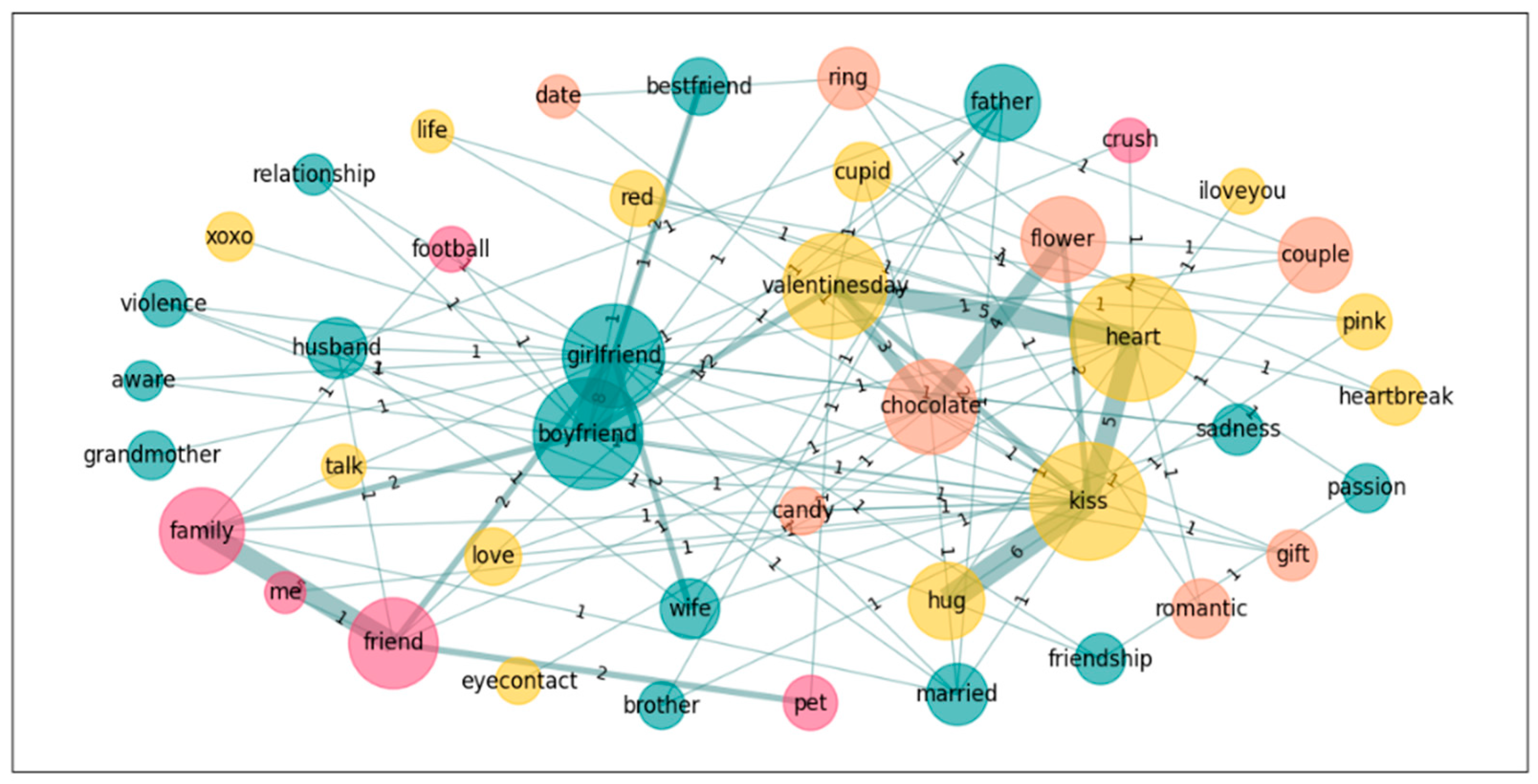


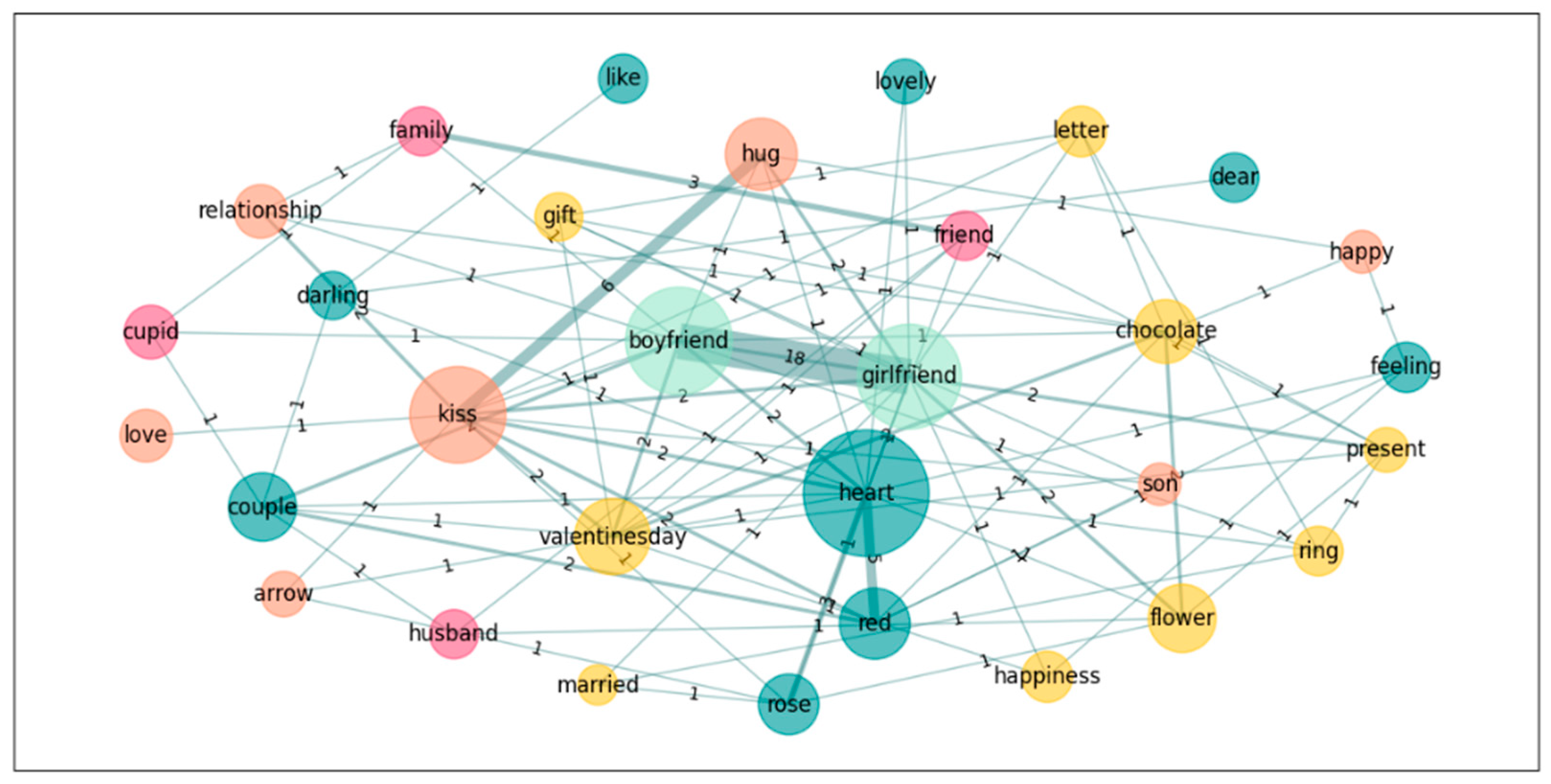



| Variable | Love | Amor | ||
|---|---|---|---|---|
| Spanish-Only | Spanish–Arabic | Spanish-Only | Spanish–Arabic | |
| Total tokens | 257 | 263 | 414 | 348 |
| Types | 96 | 110 | 138 | 129 |
| Mean tokens | 7.78 | 7.97 | 12.54 | 10.55 |
| Cohesion index | 0.08 | 0.07 | 0.09 | 0.08 |
| Love | Amor | ||
|---|---|---|---|
| Spanish Only | Spanish–Arabic | Spanish Only | Spanish–Arabic |
| Heart | Heart | Novio | Abrazo |
| Boyfriend | Kiss | Pareja | Novio |
| Girlfriend | Boyfriend | Corazón | Beso |
| Kiss | Valentinesday | Novia | Pareja |
| valentinesday | Girlfriend | Beso | Novia |
| Hug | Chocolate | Abrazo | Carta |
| Red | Friend | Sanvalentin | Chocolate |
| Couple | Family | Boda | Flor |
| Flower | Flower | Bombon | Corazón |
| Chocolate | Mother | Chocolate | Sanvalentin |
| Rose | Hug | Regalo | Regalo |
| relationship | Father | Cariño | Familia |
| Cupid | Couple | Querer | Peluche |
| Love | Card | Sentimiento | Caricia |
| happiness | Ring | Flor | Amigo |
| Letter | Married | Amigo | Enamorarse |
| feeling | Husband | Cupido | Relacion |
| Ring | Wife | Flecha | Matrimonio |
| Like | Romantic | Familia | Amistad |
| Dear | Cupid | Confianza | Querer |
| family | Fallinlove | Relacion | Cariño |
| Friend | Girl | Rojo | Amor |
| husband | Love | Carta | Ruptura |
| Gift | Bestfriend | Amistad | Hermano |
| darling | Boy | Enamorado | Prometido |
| Arrow | Red | Fidelidad | Bombon |
| Lovely | Pink | Anillo | Padre |
| present | Heartbreak | Respeto | Cita |
| You | Pet | Hacerelamor | Boda |
| romantic | Friendship | Peluche | Esposa |
| Crush | Son | Sexo | Mascota |
| Hurt | Sadness | Caricia | Chica |
| Pear | Gift | Marido | Anillo |
| Card | Lesbian | Felicidad | Chico |
| happy | Book | Matrimonio | Casarse |
| Son | Gay | Enamorarse | Madre |
| confidence | Happiness | Padre | Cena |
| friendship | Passion | Hijo | Sentimiento |
| Wife | Horny | Mujer | Abuelo |
| Enjoy | Xoxo | Bonito | Confianza |
| beautiful | Fantastic | Sentir | Película |
| heartbreak | Film | Apreciar | Rojo |
| myboo | Sunset | Desear | Romántico |
| loyalty | Grandmother | Gustar | Besarse |
| wedding | Sister | Pasión | Teamo |
| Help | Wedding | Amor | No |
| Married | Bombastic | Respetar | Casado |
| Baby | Person | Detalle | Declararse |
| Feel | Teddy | Compromiso | Aniversario |
| Child | Videogame | Encantar | Romance |
| Average Degree | Average Path Length | Clustering Coefficient | Sigma | Modularity | ||
|---|---|---|---|---|---|---|
| Love | Spanish-Only | 3.73 | 3.67 | 0.15 | 3.89 | 0.46 |
| Spanish–Arabic | 3.38 | 4.26 | 0.09 | 3.9 | 0.52 | |
| Amor | Spanish-Only | 4.36 | 3.78 | 0.12 | 4.55 | 0.47 |
| Spanish–Arabic | 3.95 | 3.72 | 0.10 | 4.43 | 0.53 |
| Spanish Only | Spanish–Arabic |
|---|---|
| Kiss, hug, wedding, person, pink, fall in love | Kiss, heart, Valentine’s day, hug, cupid, red, heartbreak, passion, crush, pink, cry, emotion, eye contact, I miss you |
| Couple, husband, cupid, 14th February, child, father, bridge, lovesong, wife | Chocolate, flower, gift, candy, love, talk, card, teddy, music, comfortable, letter, honest |
| Valentine’s Day, chocolate, flower, gift, letter, bestfriend, embrace, bouquet, candy, detail, house, dollar, beach with friends | Father, mother, videogame, confident, holiday, sensitive, star |
| Arrow, lovely, red, heart, need, angel, bow | Boyfriend, girlfriend, bestfriend, violence, relationship, husband, wife, relationship, sadness, fall in love, exgirlfriend |
| Heart, red, rose, feeling, son, happy, heartbreak, romantic, anniversary, daughter, loyalty, female, male, help, care, sex, hurt | Friend, family, married, son, pet, boy, happy, poem, balloon, football, world, engaged, happy life, God, paradise |
| Girlfriend, boyfriend, ring, married, confidence, celebration, bride | Couple, brother, wedding, sister, happiness, grandmother, gay, lesbian, sunset, grandfather, uncle, transsexual, sunrise, sad, horny |
| Friend, family, relationship, present, respect, friendship, bestie, pet, time, crush, sweetheart | Ring, romantic, date, marriage, fantastic, bombastic, amazing, good, sex |
| Darling, happiness, love, like, dear enjoy, feel, incredible, true love, spectacular, baby, sweetie, a lot, so much | Film, book, person, romance |
| Butterfly, attention, self-love, date, film | Food, train, time, quality, respect, peace, money, clothes |
| Spanish Only | Spanish–Arabic |
|---|---|
| Novio, novia, amigo, familia, padres, marido, mujer, casarse, divorcio, libertad, embarazo, casa | Pareja, novio, novia, familia, amigo, hijo, amistad, prometido, mascota, casarse, cita, rubia, manipulación, violencia, rubia, ojos azules |
| Beso, cariño, abrazo, bombón, chocolate, hijo, caricia, peluche, felicidad, respeto, sexo, atardecer, afecto, amor eterno, amor incondicional, ramo de flores | Abrazo, chocolate, san Valentin, regalo, flor, carta, beso, peluche, bombón, caricia, cupido, romance |
| Confianza, enamorado, aniversario, fidelidad, romántico, compromiso, luna de miel, bonito, risa, diversión, enamorada, cuernos, manipulación, seguridad, cumplido, ayuda | Confianza, chico, chica, ruptura, poema, aprendizaje, distancia, gay, lesbiana, fiesta, celos, toxico |
| Querer, amistad, sentir, apreciar, respetar, gustar, lealtad, conexión, disfrutar, confiar, regalar, extrañar, encantar, gustar, hermosura, educación, química, aprecio | Matrimonio, boda, mujer, cena, casado, marido, nieta, charla, poema, enamoramiento, pedida de mano, confesión |
| Flor, regalo, detalle, enamorarse, anillo, casado, suegro, suegra, vivir juntos, prometido | Enamorarse, esposa, aniversario, declararse, sexo, corazón roto, futbol, pasión, religión, tarta de boda |
| Corazón, pareja, sentimiento, boda, San Valentin, cupido, flecha, relación, carta, rojo, matrimonio, rosa, pasión | Corazón, querer, sentimiento, amor, cariño, relación, rojo, felicidad, infidelidad, acariciar, romántico, emoción, traición, libre, |
| Amar, prometida, besar, abrazar | Hija, relación sexual, prueba de amor |
| Amor a primera vista, cita, flechazo, cena, celebración, tolerancia, caballerosidad | Película, libro, habitación, cine, música, chuches |
| Atención, dedicación, demostración, plan, viaje | Hermano, padre, abuelo, madre, primo, abuela, tia, tio, hermana, prima, tatarabuela |
| Average Degree | Average Path Length | Clustering Coefficient | Sigma | Modularity | ||
|---|---|---|---|---|---|---|
| Love | Spanish-Only | 4.58 | 2.30 | 0.36 | 2.64 | 0.36 |
| Spanish–Arabic | 4.19 | 2.43 | 0.31 | 1.91 | 0.40 | |
| Amor | Spanish-Only | 5.75 | 2.34 | 0.30 | 2.34 | 0.37 |
| Spanish–Arabic | 4.48 | 2.47 | 0.23 | 2.44 | 0.40 |
| Average Degree | Average Path Length | Clustering Coefficient | Sigma | Modularity | ||
|---|---|---|---|---|---|---|
| Love | Spanish-Only | 5.48 | 2.19 | 0.32 | 1.66 | 0.31 |
| Spanish–Arabic | 4.42 | 2.78 | 0.19 | 1.9 | 0.45 | |
| Amor | Spanish-Only | 6.47 | 2.34 | 0.26 | 2 | 0.39 |
| Spanish–Arabic | 5.19 | 2.70 | 0.18 | 2.35 | 0.46 |
Disclaimer/Publisher’s Note: The statements, opinions and data contained in all publications are solely those of the individual author(s) and contributor(s) and not of MDPI and/or the editor(s). MDPI and/or the editor(s) disclaim responsibility for any injury to people or property resulting from any ideas, methods, instructions or products referred to in the content. |
© 2025 by the author. Licensee MDPI, Basel, Switzerland. This article is an open access article distributed under the terms and conditions of the Creative Commons Attribution (CC BY) license.
Share and Cite
Agustín Llach, M.P. Understanding Love in the L1 and the Additional Language: Evidence from Semantic Fluency and Graph Analysis. J. Intell. 2026, 14, 3. https://doi.org/10.3390/jintelligence14010003
Agustín Llach MP. Understanding Love in the L1 and the Additional Language: Evidence from Semantic Fluency and Graph Analysis. Journal of Intelligence. 2026; 14(1):3. https://doi.org/10.3390/jintelligence14010003
Chicago/Turabian StyleAgustín Llach, Maria Pilar. 2026. "Understanding Love in the L1 and the Additional Language: Evidence from Semantic Fluency and Graph Analysis" Journal of Intelligence 14, no. 1: 3. https://doi.org/10.3390/jintelligence14010003
APA StyleAgustín Llach, M. P. (2026). Understanding Love in the L1 and the Additional Language: Evidence from Semantic Fluency and Graph Analysis. Journal of Intelligence, 14(1), 3. https://doi.org/10.3390/jintelligence14010003



