


Abstract
Digitalization, including the implementation of artificial intelligence (AI) applications, is one of the key enablers of business agility in contemporary enterprises. Micro and small enterprises (MSEs) are increasingly expected to adopt scalable and cost-effective AI tools as part of their digital transformation. This study investigates the implementation of an AI-powered chatbot in a Slovak micro-enterprise operating an e-commerce platform, aiming to assess its effectiveness in automating customer service processes. Using a mixed-method case study approach, the research combines quantitative data on service performance (e.g., number of inquiries handled, response time, and automation rate) with qualitative insights from employee and customer feedback. The findings show that the chatbot significantly reduced staff workload and improved response speed and customer satisfaction. However, challenges were identified in handling ambiguous queries and maintaining empathetic communication in complex situations, underscoring the need for regular updates and human oversight. The study contributes to the limited empirical literature on AI integration in micro-enterprises and provides practical recommendations for MSEs seeking to enhance their operational efficiency through AI-driven tools without large-scale investments. These results offer a nuanced perspective on how even resource-constrained businesses can benefit from AI adoption when implementation is carefully aligned with their specific needs and capabilities.
1. Introduction
In the era of rapid technological advancement, artificial intelligence (AI) has emerged as a transformative force across virtually all sectors of the economy. From predictive analytics and supply chain optimization to customer engagement and decision support, AI-driven tools are increasingly integrated into business processes to improve efficiency, agility, and competitiveness [1,2]. However, the adoption of such technologies has been uneven, with large enterprises at the forefront of implementation, while small- and medium-sized enterprises (MSEs)—and particularly micro-enterprises—continue to lag behind due to various structural and resource-related constraints [1,2].
Despite their limited financial and technical capacities, MSEs face mounting pressure to embrace digital transformation [3,4]. Competitive markets, shifting customer expectations, and the rise in digital-native businesses demand faster, more personalized, and more cost-effective services—demands that AI tools are uniquely positioned to meet [5,6]. For MSEs, digital transformation is not only an opportunity for growth but increasingly a necessity for survival. Yet the practical integration of AI into their workflows remains challenging due to factors such as a lack of expertise, limited access to infrastructure, uncertainty about return on investment, and perceived risks related to automation [7,8].
Digitalization and the use of AI applications are now widely recognized as key enablers of business agility—the organization’s ability to sense, adapt, and respond to change effectively. Through automation, data-driven insights, and continuous learning mechanisms, AI technologies support agile decision-making and operational flexibility, enabling firms to adjust strategies and processes in real time [9]. For micro- and small enterprises, AI adoption represents not only a technological upgrade but also a strategic pathway toward sustainable competitiveness and resilience in volatile markets [10].
Slovakia represents a digitally connected but unevenly digitalized business environment. According to Eurostat data and the Digital Economy and Society Index (DESI), internet penetration and basic digital infrastructure in Slovakia have reached a relatively high level, creating favorable conditions for e-commerce and online service delivery [11]. At the same time, the level of advanced digital technology adoption among Slovak small and micro-enterprises remains below the EU average, particularly in areas such as artificial intelligence, data analytics, and automation [12]. Recent studies confirm that while Slovak firms widely use basic ICT tools (websites, e-mail, e-shops), the integration of intelligent systems and AI-based applications is still in an early stage and strongly dependent on managerial attitudes, digital skills, and perceived economic benefits [13]. This gap between relatively mature digital infrastructure and limited organizational digital readiness creates a specific national context in which AI adoption in micro-enterprises occurs—one characterized by high technological availability but constrained internal absorptive capacity. As a result, AI tools such as chatbots represent a realistic entry point for incremental digital transformation in Slovak micro-firms, allowing experimentation with automation without requiring large-scale investments or IT departments [14].
One of the most accessible AI applications for MSEs is the chatbot—a conversational agent designed to automate interactions with users, most commonly in the context of customer service. Chatbots can handle high volumes of customer inquiries simultaneously, provide instant responses, and free up human resources for more complex tasks. Their implementation is often viewed as a “quick win” for digitalization efforts, offering tangible benefits without the need for large-scale IT infrastructure or long development cycles [15]. While Chatbot usage is widespread in large companies and customer service platforms [16], their integration in micro-enterprise environments has received relatively little attention [5]. Important questions remain about how effectively chatbots function in such settings, how customers perceive AI-mediated interactions, and what limitations emerge when chatbots are used to replace human contact in emotionally nuanced or non-standard situations [3]. While the papers outline how chatbots improve customer experience and reduce costs [15,16,17], they do not mention case-specific deployments, especially not in Slovakia or micro-enterprises. Chatbot deployment in e-commerce MSEs is still emerging and underdocumented, and specifics such as micro-enterprise and country-level case studies are lacking. To contribute to this underexplored area, the present study investigates the deployment of an AI-powered chatbot in a Slovak micro-enterprise operating in the e-commerce sector [18,19]. The company, like many micro-firms, operates with a small team managing multiple roles and relying heavily on effective customer communication. The chatbot was introduced to ease employee workload and enhance responsiveness without raising costs. This study applies a mixed-method approach, integrating quantitative metrics with qualitative insights to holistically evaluate chatbot performance and user experience. This methodology is widely used in AI chatbot research to capture both system efficiency and human-centered perspectives [20,21].
Beyond documenting operational outcomes, this study explicitly links chatbot adoption to the broader concepts of digital capability building and micro-enterprise agility. By analyzing real-world deployment in a resource-constrained context, this research contributes new empirical evidence to the growing body of knowledge on scalable and responsible AI adoption in micro- and small enterprise settings.
Based on the identified research gap and theoretical background, the study is guided by the following research questions:
RQ1: How did the implementation of an AI chatbot affect the operational performance of customer service in a Slovak micro-enterprise?
RQ2: How did chatbot deployment influence employee workload, work organization, and perceptions of AI in daily operations?
RQ3: How do customers perceive AI-based customer service in terms of satisfaction, accessibility, and communication quality?
RQ4 (Sub-question): To what extent can chatbot adoption be interpreted as a driver of micro-enterprise agility and digital capability development?
2. Literature Review
The adoption of artificial intelligence in small and micro-enterprises has gained increasing scholarly attention due to its potential to reshape operational efficiency, competitiveness, and innovation capability. Early research on digital transformation in SMEs emphasizes that technology adoption is shaped not only by financial capacity but also by managerial orientation, digital skills, and perceived strategic value [4,6,7]. Recent studies confirm that AI-driven tools are becoming progressively accessible to small firms, yet their deployment remains uneven due to adoption barriers such as limited technical expertise, data constraints, and perceived implementation risk [5,9,22,23].
From the perspective of organizational agility, information technologies are widely recognized as fundamental enablers of sensing and responding capabilities [11]. Digitalization strengthens business agility by accelerating information flows, enabling rapid decision-making, and supporting adaptive process redesign [12]. For micro-enterprises in particular, agility is not achieved through scale but through flexibility and rapid reconfiguration of limited resources. In this context, AI functions as a catalyst rather than a replacement for human decision-making, aligning with the concept of hybrid intelligence that combines human and artificial capabilities [24].
Chatbots represent one of the most mature and commercially deployable AI applications within customer service. Prior studies demonstrate that chatbots improve response speed, reduce operational costs, and enhance service availability through 24/7 interaction [18,25]. In e-commerce settings, chatbots are particularly effective in handling structured and repetitive inquiries related to order status, product availability, payments, and returns [16,18]. Case-based evidence from Nze [19] and Rasheed and Sami [26] further confirms improvements in operational indicators and customer sentiment, while simultaneously emphasizing the continued need for human oversight, continuous content updates, and context-sensitive chatbot design. These findings provide evidence-based guidance for micro- and small enterprises (MSEs) pursuing digital transformation under resource constraints, as also emphasized by Abayomi and Mgbame [27], and contribute to the growing literature on scalable and responsible AI adoption strategies [28,29]. At the same time, limitations remain evident in handling emotionally complex, ambiguous, or context-dependent interactions [30,31].
Customer acceptance of chatbot technologies is frequently analyzed through technology acceptance and service quality perspectives. The Unified Theory of Acceptance and Use of Technology (UTAUT) highlights performance expectancy, effort expectancy, and facilitating conditions as key determinants of AI adoption [32]. Empirical evidence suggests that while customers value speed and convenience, perceived lack of empathy and human sensitivity remains a critical limitation of conversational AI [28,29]. Trust in automated systems, therefore, depends on both technical accuracy and perceived service fairness.
Employee perspectives play an equally important role in successful AI integration. Research on human–AI collaboration indicates that automation yields positive outcomes when employees remain involved in supervision, system training, and exception handling [24,27]. In small firms, resistance to AI adoption is often driven by fear of job displacement, lack of prior experience with intelligent systems, and uncertainty about control over automated decision-making [21,22]. However, studies also show that once practical benefits become visible, attitudes frequently shift toward acceptance and collaborative use [25,26].
Despite the expanding body of literature on AI in service operations, empirical case studies focusing specifically on micro-enterprises remain scarce. Most existing research concentrates on SMEs or large organizations, often in technology-intensive markets or emerging economies outside Europe [15,18,22]. Country-specific and micro-level investigations are therefore essential for understanding how AI adoption unfolds under severe resource constraints, where managerial multitasking, informal processes, and limited IT infrastructure shape implementation dynamics.
This study directly responds to this gap by providing a detailed case analysis of chatbot deployment in a Slovak micro-enterprise. By combining operational performance metrics with employee and customer perspectives, the research contributes empirical evidence to the emerging field of AI-supported service automation in micro-enterprises. In addition, it strengthens the theoretical link between chatbot adoption, organizational agility, and hybrid human–AI service models under real-world constraints.
3. Materials and Methods
This study employed a mixed-method case study design to investigate the implementation and effects of an AI chatbot in a Slovak micro-enterprise operating in the e-commerce sector. The goal was to evaluate the chatbot’s impact on three key dimensions of customer service performance: efficiency, employee workload, and customer satisfaction. A single-case approach was selected to allow for an in-depth exploration of contextual and behavioral factors surrounding technology adoption within a real-world business environment. The design follows recommendations for mixed-method inquiry in micro and small enterprises (MSEs), combining operational metrics with experiential insights to achieve a comprehensive understanding of the studied phenomenon.
3.1. Case Selection and Context
The selected enterprise is an anonymized micro-business operating in the Slovak e-commerce sector, established in the late 2010s and employing fewer than ten full-time staff, which meets the EU criteria for micro-enterprise classification. The company manages a domestic online retail platform focused on consumer goods and processes several hundred customer orders and inquiries per month, depending on seasonal demand. At the time of chatbot implementation, the firm experienced a growing volume of customer messages related primarily to order status, product availability, and delivery issues, which placed substantial pressure on its limited human resources. As the enterprise operates without a dedicated customer service department, front-line operational employees—primarily involved in logistics, packaging, and order processing—simultaneously handled customer communication, leading to workflow fragmentation and extended response times. To address these constraints, a commercial AI-powered chatbot solution was deployed as a cost-effective and scalable automation tool. The system was integrated into the company’s website and linked to the internal order management database, enabling real-time retrieval of basic transactional information (e.g., order status, delivery times, and product availability). The chatbot was launched into live operation in January 2025 following a short internal pilot phase focused on response accuracy and escalation logic.
The implemented solution was a commercial web-based AI chatbot platform based on a hybrid architecture combining rule-based dialogue flows with natural language processing (NLP) for intent recognition. The system primarily relied on predefined scenario trees to handle frequently asked questions, while NLP was used to classify user inputs and route them to appropriate response modules. The chatbot did not utilize generative large language models; instead, it employed a deterministic rule–NLP structure typical for small-scale e-commerce automation and resource-constrained business environments.
3.2. Data Collection
The Key Customer Service Indicators were extracted directly from the company’s operational information systems and chatbot administration dashboard. These indicators represent complete monthly population data rather than samples, as all customer inquiries recorded by the system during the observed period (October 2024–April 2025) were included in the analysis. The dataset, therefore, covers the total volume of customer messages, response times, chatbot-handled interactions, escalations to human operators, and post-interaction satisfaction ratings. Because the data originate from automated system logs, the risk of reporting bias is minimized, and the indicators are considered fully representative of actual customer service performance during the study period. A triangulated data collection approach was adopted, integrating both quantitative and qualitative sources, as summarized below. This mixed-method approach is well established in AI and SME research for providing a comprehensive understanding of both technical performance and user experience [22,23].
The interviewed employees represented key operational roles within the micro-enterprise. Two respondents were front-line customer service operators with more than three years of experience in daily customer communication, order processing, and logistics coordination. The third respondent was an administrative coordinator responsible for supervising order fulfillment and system integration. To minimize potential bias in data collection, several measures were applied. Interviews were conducted individually to avoid peer influence, using a standardized semi-structured interview guide to ensure consistency across respondents. Questions were phrased neutrally and focused on concrete experiences before and after chatbot implementation. In addition, interview findings were triangulated with system logs and customer feedback to reduce subjectivity and enhance the credibility of qualitative interpretations.
- •
- Quantitative metrics extracted from internal system logs and chatbot performance dashboards, including:
- Number of customer inquiries per month (reflecting communication volume),
- Average response time (in minutes) (measuring efficiency),
- Automation rate (expressed as the percentage of inquiries resolved without human intervention),
- Customer satisfaction scores (based on a post-interaction survey using a 5-point Likert scale).
- •
- Qualitative data: the qualitative part of the research aimed to capture human, experiential, and contextual aspects of chatbot adoption. Specifically, it examined how employees and customers perceived, adapted to, and interacted with the new technology. The qualitative data focused on several core information domains:
- Employee perceptions of workload changes, efficiency, and cooperation between human agents and AI,
- Customer experience in terms of clarity, speed, responsiveness, and availability,
- System limitations, including the misunderstanding of non-standard language and the need for manual interventions.
Three complementary data sources were used to collect qualitative material:
- Semi-structured interviews with two front-line employees and one administrative coordinator, focusing on experiences before and after chatbot implementation, perceived benefits, challenges, and workflow changes. Each interview lasted 45–60 min and was conducted in person at the company site.
- Observation of chatbot–customer interactions, using anonymized conversation logs exported from the chatbot platform. These logs enabled the identification of common question types, escalation patterns, and response effectiveness.
- Customer feedback, including ratings and open-ended comments gathered through the chatbot’s built-in survey form, provided direct user evaluation of chatbot performance and communication quality.
This combination of sources ensured data triangulation—capturing both quantitative performance outcomes and qualitative user experiences, which together enabled a more holistic interpretation of the chatbot’s organizational impact.
3.3. Research Hypotheses
To formally assess the statistical impact of chatbot implementation on customer service performance, the following hypotheses were formulated in direct alignment with the key indicators presented in Table 2:
Hypothesis 1 (H1).
The implementation of the AI chatbot leads to a statistically significant reduction in the average customer service response time.
Hypothesis 2 (H2).
The implementation of the AI chatbot leads to a statistically significant increase in customer satisfaction.
Hypothesis 3 (H3).
The implementation of the AI chatbot leads to a statistically significant change in the average monthly number of customer inquiries.
These hypotheses were tested using the non-parametric Mann–Whitney U test to compare pre-implementation (October 2024–January 2025) and post-implementation (February–April 2025) periods.
3.4. Data Analysis
Quantitative data were analyzed using basic descriptive statistics, including mean, percentage change, and trend visualization across the pre- and post-implementation periods. The main goal was to identify observable shifts in key service performance indicators following the introduction of the chatbot. To statistically assess whether the observed differences between the pre- and post-implementation periods were significant, the non-parametric Mann–Whitney U test was applied, as the sample sizes were small and normality could not be assumed.
Specifically:
- •
- The average response time was used to measure efficiency improvement.
- •
- The number of inquiries and shares handled by the chatbot served as indicators of automation effectiveness.
- •
- Customer satisfaction scores captured the end-user perception of service quality.
Data was processed in Microsoft Excel and Statistica 12, and results were visualized using line and bar charts to depict temporal trends and relative changes.
The qualitative data were analyzed using inductive thematic analysis, following the six-phase framework of Braun and Clarke [33]. This method was selected for its flexibility and rigor in identifying emerging patterns within complex, text-based feedback, particularly in exploratory studies of AI implementation in organizational settings [33]. The process involved six iterative steps: familiarization with data, initial coding, theme development, theme review, theme definition, and final reporting.
- •
- Familiarization with the data—Reading and re-reading interview summaries, chatbot logs, and customer comments to identify initial ideas.
- •
- Generating initial codes—Assigning descriptive labels to key segments of text representing specific meanings (e.g., skepticism toward automation, time savings, need for empathy).
- •
- Searching for themes—Grouping related codes into broader categories such as employee adaptation, efficiency gains, and customer experience.
- •
- Reviewing and refining themes—Comparing emerging themes across data sources and refining their definitions for clarity and coherence.
- •
- Defining and naming themes—Developing concise thematic labels supported by illustrative excerpts.
- •
- Integrating with quantitative findings—Comparing qualitative insights with numerical results to provide complementary interpretations.
To increase the transparency and objectivity of qualitative interpretation, two supplementary analytic techniques were applied:
- •
- Thematic Coding with Frequency Counts: Each identified theme was accompanied by a frequency tally representing the number of coded references. This provided a semi-quantitative indication of the most salient topics within the data (e.g., efficiency and workload reduction were most frequent).
- •
- Sentiment Trend Analysis: Customer comments were categorized as positive, neutral/adaptive, or negative based on tone and content. This classification allowed the tracking of overall sentiment orientation toward chatbot usage and performance.
The combined use of thematic and sentiment analysis provided a structured yet flexible means of capturing both the content and emotional tone of employee and customer perceptions. Analytical rigor was maintained through iterative coding, memo writing, and cross-source comparison, ensuring credibility, consistency, and traceability of the results.
4. Results
This section presents a comprehensive analysis of the effects of AI chatbot implementation in a Slovak micro-enterprise operating in the e-commerce sector. The results are divided into quantitative and qualitative findings, offering a holistic view of the chatbot’s performance from the perspectives of order volume trends, employee experiences, chatbot interactions, and customer satisfaction. It should be noted that the indicator “total inquiries” represents the total number of customer messages submitted to the system within a given month, not the number of unique customers. A single customer could generate multiple messages related to one order, while many orders required no customer contact at all. This explains the relatively high inquiry-to-order ratio observed in certain months, such as April 2025, when 581 inquiries were recorded alongside approximately 940 orders.
Company Profile and Context: The enterprise in question is a micro-sized business with 8 employees, selling niche fashion items via an online store. As customer inquiries steadily increased alongside growing order volumes, the manually operated customer service became increasingly unsustainable. In early 2025, the company introduced an AI-powered chatbot to alleviate pressure on staff and improve customer support response times.
All reported performance indicators are based on complete system log data representing the full population of customer inquiries during the observed period, ensuring full representativeness of the results.
4.1. Order Volume and Inquiry Trends
Figure 1: The graph illustrates the monthly number of customer orders from October 2024 to April 2025, with a clear annotation marking the implementation of the AI chatbot in February 2025. While there is a noticeable dip in orders in February (895 orders), this is likely to reflect seasonal or external factors rather than the chatbot deployment itself. The subsequent rebound in March (964 orders) suggests that the implementation did not negatively affect customer engagement—in fact, it may have contributed to stabilizing order volumes after the initial drop.
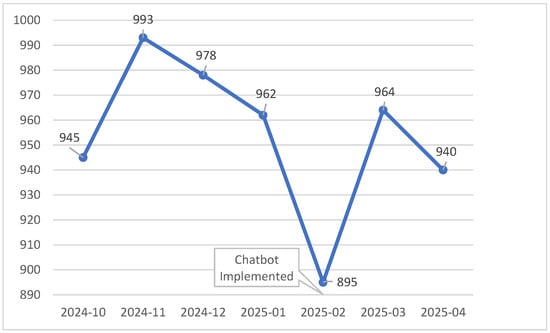
Figure 1.
Monthly order volume.
The data labels and annotation “Chatbot Implemented” improve interpretability, and the point markers help readers trace the trend accurately.
Monitoring the evolution of order volume represents a critical component of this case study, as it serves as an indicator of the company’s overall operational load. This workload directly influences the demand for customer support services. Generally, a higher number of orders corresponds with an increase in customer inquiries, requests, and interactions, which in turn places greater demands on response times, support availability, and communication efficiency. Therefore, tracking order volume is used as a contextual indicator that helps explain the rationale behind the implementation of the AI chatbot.
4.2. Quantitative Impact of Chatbot Implementation
The data in Table 1 reveals a clear transformation in customer service performance following the implementation of the AI chatbot in February 2025. Prior to its deployment, all customer inquiries were handled manually by operators, resulting in high response times—consistently above 115 min—and modest customer satisfaction scores ranging between 3.7 and 3.8. In February, the chatbot began handling a significant share of inquiries (349 out of 574 total), which contributed to a dramatic reduction in the average response time to 88 min. The monthly increase in the proportion of inquiries handled autonomously by the chatbot (from 61% to 85%) reflects the system’s adaptation and continuous knowledge base expansion during the initial deployment phase. This monthly increase reflects the system’s adaptation and continuous knowledge base expansion during the initial deployment phase. As chatbot coverage expanded, the number of requests escalated to human agents declined accordingly—down to just 85 in April. Importantly, customer satisfaction scores improved in parallel with chatbot deployment, rising from 3.8 in January to 4.1 in March and peaking at 4.4 in April. Overall, the data indicates that the chatbot not only alleviated the workload on human operators but also enhanced service responsiveness and customer satisfaction.

Table 1.
Monthly Customer Service Performance Indicators.
Figure 2 illustrates the shift in workload from human operators to the AI chatbot starting in February 2025. As the proportion of chatbot-handled inquiries increased, average customer satisfaction steadily rose from 3.8 to 4.4. This indicates a strong correlation between automation and improved service perception.
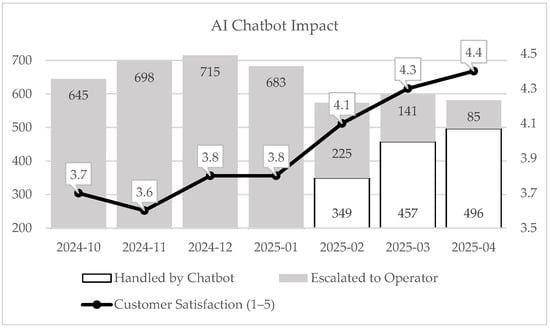
Figure 2.
AI Chatbot Impact.
Table 2 provides a summary of the key customer service performance indicators before and after the implementation of the AI chatbot. The average response time dropped significantly from 118.25 min to 64.00 min, representing a 45.88% reduction. Similarly, customer satisfaction improved from an average score of 3.73 to 4.27, marking a 14.54% increase. The total number of monthly inquiries decreased by 14.73%, which may be partly related to reduced follow-up communication enabled by faster automated responses and possible seasonal variation in demand. It should be noted that the structure of customer inquiries changed after chatbot deployment. Following implementation, routine and repetitive requests were primarily absorbed by the chatbot, while more complex and non-standard cases were escalated to human operators. As a result, post-implementation response times reflect a structurally different composition of inquiries, and the observed efficiency gains derive from both automation and task redistribution between AI and human agents. While no inquiries were previously handled by automation, the chatbot processed an average of 74.2% of total inquiries after deployment, confirming a substantial shift toward automated service delivery. Statistical testing using the Mann–Whitney U test indicates that only the increase in customer satisfaction is statistically significant (p < 0.05), whereas changes in response time and inquiry volume do not reach conventional significance levels.
Table 2.
Summary of Key Customer Service Indicators Before and After AI Chatbot Implementation.
4.3. Employee Perspectives on AI Chatbot Implementation: A Qualitative View
Insights from two semi-structured interviews were analyzed to capture employees’ reflections on the integration of the chatbot into daily operations. Initially, employees expressed skepticism regarding the system’s ability to replace the “human touch” and concerns about potential misunderstandings and increased workload. As the chatbot’s database evolved through real user interactions, perceptions shifted toward recognizing tangible benefits. Repetitive inquiries—particularly those related to delivery status, product availability, returns, and payments—were increasingly handled automatically, leading to reduced workload and greater task focus. The system’s continuous availability also enhanced communication efficiency and decreased the volume of informal or after-hours inquiries, contributing to improved work–life balance. Despite minor initial issues with language accuracy, regular updates and staff feedback strengthened overall system reliability. The qualitative findings thus highlight recurring themes of reduced workload, enhanced organization, and growing trust in automation, offering contextual depth to the quantitative assessment that follows.
4.3.1. Thematic Coding with Frequency Counts
To complement the descriptive interpretation of interview findings, an objective thematic analysis was conducted using frequency counts to identify the most recurrent topics and concepts mentioned by employees.
As shown in Table 3, Perceived Benefits emerged as the dominant theme, accounting for nearly half of all coded references (48.5%). Employees most frequently emphasized efficiency gains, workload reduction, and improved work–life balance resulting from chatbot automation. Themes related to Challenges and Improvements/Adaptation appeared with comparable frequency, reflecting a realistic adjustment phase marked by initial technical limitations and the subsequent need for iterative system updates and staff learning. Mentions of Initial Attitudes were least frequent, indicating that early skepticism and resistance to change diminished rapidly once tangible benefits became evident in daily operations. Overall, the thematic distribution underscores a clear shift from uncertainty toward positive acceptance and integration of AI-based tools in micro-enterprise settings.
Table 3.
Thematic coding results with frequency counts.
In summary, the thematic analysis revealed a clear progression in employee perceptions—from initial skepticism and adaptation challenges to a strong recognition of the chatbot’s long-term benefits in daily operations. While frequency coding provided an overview of dominant discussion topics, it does not capture the emotional tone behind these narratives. Therefore, the following section applies a sentiment trend analysis to examine how the underlying attitudes evolved qualitatively over time.
4.3.2. Sentiment Trend Analysis
To complement the frequency-based thematic overview, sentiment trend analysis was conducted to assess the emotional polarity of employee narratives before and after chatbot implementation. The analysis focused on identifying positive, neutral, and negative sentiment expressions within the interview summaries, allowing for a more nuanced interpretation of how staff attitudes shifted as system familiarity and trust increased (Table 4).
Table 4.
Sentiment distribution across employee reflections.
The distribution of sentiments illustrates a balanced but transitional emotional pattern during the implementation phase. Early responses were divided between negative (36.8%) and skeptical tones, emphasizing fears of losing personal contact, concerns about chatbot accuracy, and uncertainty about additional workload. These reactions reflected an initial lack of familiarity with AI tools and apprehension about their impact on interpersonal communication. As employees gained experience with the system, neutral or adaptive statements (26.3%) emerged, describing adjustment processes such as database updates, ongoing learning, and procedural refinements. By the later stage of implementation, positive sentiment (36.8%) became equally strong, highlighting increased efficiency, reduced routine tasks, and improved work–life balance. This sentiment shift suggests a steady normalization of AI-assisted routines, where practical benefits replaced early doubts. The presence of adaptive expressions also indicates that acceptance was not abrupt but developed through continuous feedback and incremental improvements.
4.4. Customer Perspective: Observation of Chatbot and Feedback Analysis
The customer-side analysis draws on chatbot interaction logs and anonymized feedback excerpts provided by the company. A summative content-analysis approach was applied to classify recurring question categories, assess response effectiveness, and evaluate sentiment orientation across customer comments. The analysis focuses on observable usage patterns—including the types of inquiries managed autonomously, the proportion of escalations to human operators, and the overall tone of customer evaluations—to provide an integrated understanding of user experience and satisfaction following chatbot implementation.
The observation period covered three months after the chatbot’s launch (February–April 2025). Analysis of conversation logs identified five dominant thematic categories, together representing over 90% of all customer interactions:
- Order status and delivery tracking :
Questions such as “When will my package arrive?” and “Can I change the delivery address?” accounted for the largest share of inquiries. The chatbot effectively handled these through direct access to delivery and order data.
- 2.
- Product availability and variants:
Queries like “Do you have this model in another color?” were reliably resolved using integrated inventory information.
- 3.
- Returns and complaints:
Frequent questions such as “How do I return an item?” or “Where do I send it for a refund?” were addressed through standardized templates and links to forms.
- 4.
- Payments and invoicing:
Included requests for payment confirmation or invoice reissue; while less frequent, these occasionally required operator assistance.
- 5.
- Discounts and promotional codes:
Covered inquiries about coupon functionality or combination rules, typically handled by short, predefined responses.
Routine, clearly formulated questions were processed autonomously and answered instantly, while complex or ambiguous cases—including emotionally charged messages—were automatically escalated to human agents. Although the total number of customer inquiries represented only a fraction of all monthly orders, approximately 10–15% of these conversations required human intervention, indicating effective first-line resolution by the chatbot. Observation confirmed that the chatbot served as an efficient first-line support tool, improving response speed, ensuring 24/7 availability, and enabling the enterprise to manage growing communication volumes without increasing staff workload.
Customer feedback was analyzed to assess satisfaction with the chatbot’s performance and the perceived quality of digital service. Qualitative comments in Table 5 were examined to identify recurring satisfaction drivers and pain points.
Table 5.
Summary of customer feedback by sentiment.
Customer feedback largely corroborated the internal findings of increased efficiency and service availability. Most comments expressed positive evaluations, emphasizing rapid communication, ease of use, and the ability to obtain information without delays or registration barriers. Neutral remarks highlighted minor linguistic or tonal limitations, while negative comments revealed the boundaries of automated interaction, particularly when empathy, nuanced understanding, or personalized responses were required. The prevalence of positive over negative sentiments demonstrates that customers readily accepted AI-assisted communication for routine inquiries, while continuing to value human support for more complex or emotionally sensitive interactions. The results thus confirm that the chatbot effectively fulfilled its intended role as a front-line automation tool, streamlining service delivery without compromising overall satisfaction.
Taken together, the internal and customer perspectives reveal a consistent pattern of performance improvement and user adaptation following chatbot implementation. Quantitative metrics demonstrated measurable gains in response time and satisfaction, while qualitative evidence highlighted growing employee trust and positive customer reception. These converging results suggest that even within a micro-enterprise context, the integration of AI-driven tools can meaningfully enhance operational efficiency and service quality. The following section discusses these findings in relation to existing literature and practical implications for small business digitalization.
5. Discussion
This study examined the impact of AI chatbot implementation on customer service performance in a Slovak micro-enterprise using a mixed-method case study design. The results indicate that chatbot deployment can generate measurable operational improvements while simultaneously reshaping employee routines and customer experiences. However, the findings also reveal important structural and behavioral nuances that temper overly optimistic interpretations of automation effects. From a theoretical perspective, the results support the view that AI adoption in micro-enterprises is not a purely technical intervention but a socio-technical transformation process embedded in organizational routines, perceptions, and capability development.
From a quantitative perspective, chatbot implementation was associated with a substantial reduction in average response time (−45.9%) and a statistically significant increase in customer satisfaction (+14.5%). These changes align with prior research demonstrating that AI-based service automation enhances responsiveness and perceived service quality in e-commerce environments [15,25]. The findings are also consistent with service automation theory, which suggests that speed and availability represent primary value drivers of technology-mediated service delivery in low-contact service settings. At the same time, the decrease in total monthly inquiries (−14.7%) suggests that improved response speed and availability may have reduced the need for repeated follow-up messages. This indicates that part of the observed efficiency gain may result from both automation and a behavioral shift on the customer side.
It is also important to note that the structure of customer inquiries changed after chatbot deployment. Once routine inquiries related to order status, availability, and payments were absorbed by the chatbot, human operators handled proportionally more complex and exceptional cases. Consequently, post-implementation response times reflect a different inquiry composition than in the pre-chatbot period. This structural shift explains why not all efficiency indicators reached statistical significance despite large relative changes. This finding supports the concept of task reallocation in hybrid service systems, where automation modifies not only performance levels but also the qualitative nature of human work.
Qualitative employee findings reveal a more ambivalent pattern. While staff reported clear benefits in terms of workload reduction, better task focus, and improved work–life balance, negative and positive statements were represented in approximately equal proportions. This indicates that although operational relief was achieved, full attitudinal acceptance of the chatbot had not yet been completed within the short observation period. These findings are consistent with technology acceptance research in small firms, which emphasizes that initial skepticism often coexists with perceived benefits during early adoption phases [32]. The results further support Kamar’s [24] concept of hybrid intelligence, in which AI performs repetitive, standardized tasks while humans retain control over complex, emotional, and exception-based interactions. This reinforces the theoretical argument that AI does not replace human labor in micro-enterprises but rather reshapes its content toward supervisory, cognitive, and relational functions.
From the customer perspective, chatbot usage clearly improved accessibility and service continuity. Customers primarily valued 24/7 availability, instant responses, and ease of interaction—determinants of satisfaction repeatedly confirmed in conversational AI research [19,20]. Nevertheless, negative comments highlighted persistent limitations related to empathy, contextual understanding, and flexibility, especially in emotionally sensitive or non-standard situations. These limitations mirror widely documented challenges in chatbot design, where authentic emotional responsiveness remains difficult to achieve through current AI systems [30,31,34]. The findings, therefore, reinforce the necessity of hybrid service models combining automation with human support. This aligns with service-dominant logic, which emphasizes co-creation of value and the irreplaceable role of human interaction in emotionally complex service encounters.
In the broader context of micro-enterprise digitalization, this case demonstrates that even firms with very limited technical and financial resources can successfully integrate AI tools when implementation is incremental, feedback-driven, and aligned with concrete operational needs. Rather than scale, adaptability appears to be the key competitive asset of micro-enterprises. This conclusion is consistent with prior research showing that micro-firms compensate for resource scarcity through organizational flexibility and rapid reconfiguration [35]. From a strategic management perspective, the results indicate that chatbot adoption can be interpreted as a micro-foundation of enterprise agility, enabling faster sensing and response to customer needs without structural expansion. At the same time, this study illustrates that technical feasibility alone does not guarantee full social acceptance, particularly among employees whose work roles are directly affected.
Despite its valuable insights, this study is subject to several limitations that should be acknowledged when interpreting the results. First, the analysis was based on a single-case study—an approach commonly used in research on MSEs and SMEs due to its contextual depth [23]—conducted within one Slovak micro-enterprise, which limits the generalizability of the findings to other organizational or sectoral contexts. The unique internal culture, management style, and resource constraints of the case company may have influenced both the implementation process and user perceptions. Second, while the quantitative indicators provided a clear overview of performance changes, the dataset covered a relatively short observation period following chatbot deployment. This restricts the ability to assess the long-term sustainability of the observed improvements. Third, the qualitative data, although rich and triangulated, relied on a limited number of interviews and summarized customer comments rather than full transcripts, which may have constrained the depth of interpretive analysis. Finally, the study did not measure the economic return of chatbot implementation (e.g., cost savings or productivity metrics), which would be a valuable extension for future research.
Despite these limitations, the mixed-method approach ensured internal validity through data triangulation, while the findings provide a credible, evidence-based illustration of how small firms can pragmatically integrate AI into their customer service processes. The study thus contributes to both the empirical and theoretical understanding of how hybrid human–AI service systems operate under conditions of severe resource constraints.
Future research should build on these insights by examining longitudinal effects—particularly whether chatbot performance and user satisfaction remain stable over time, and how learning mechanisms within AI systems evolve with continued human feedback. Expanding the sample to include multiple firms and customer segments would also allow comparative analysis and more generalizable conclusions about the interplay between automation, efficiency, and human experience in small business environments.
6. Conclusions
This study demonstrated that the implementation of an AI chatbot in a micro-enterprise setting can generate tangible operational and experiential benefits. Quantitative indicators confirmed shorter response times and higher customer satisfaction, while qualitative evidence revealed a transition from employee skepticism to trust and collaboration. On the customer side, automation improved service accessibility and efficiency but also underscored the continuing importance of human empathy in complex or emotionally charged interactions.
From a theoretical perspective, the research contributes to the growing body of knowledge on digital transformation in micro-enterprises, offering empirical evidence that even firms with minimal technological capacity can successfully integrate AI-driven tools when the process is incremental, context-sensitive, and feedback-oriented. The study advances understanding of how hybrid human–AI models operate in small organizational contexts, illustrating that automation does not replace human roles but rather redefines them—shifting employees toward higher-value, supervisory, and adaptive tasks. These insights enrich current frameworks on technology acceptance and AI adoption in resource-constrained environments.
The practical implications are equally significant. For practitioners and small business owners, the case demonstrates that AI adoption is achievable without large-scale investment, if implementation is aligned with real communication needs and accompanied by employee involvement in system training and refinement. The findings suggest that chatbots can serve as scalable, affordable tools to relieve customer service workloads, improve response speed, and support better work–life balance. Moreover, the results emphasize the necessity of maintaining a hybrid support model, where automation is complemented by human oversight to ensure empathy, flexibility, and customer trust. Overall, this study provides a replicable framework for micro-enterprises seeking to enhance their competitiveness and sustainability through gradual digitalization. It bridges the gap between theoretical discussions of AI adoption and the practical realities of small business operations, highlighting that strategic and human-centered implementation can unlock both efficiency gains and organizational resilience in the age of intelligent automation.
Author Contributions
Conceptualization, K.M. and A.J.S.; methodology, K.M.; validation, K.M. and A.J.S.; formal analysis, K.M.; investigation, R.Ď.; resources, K.M.; data curation, R.Ď.; writing—original draft preparation, K.M.; writing—review and editing, K.M. and A.J.S.; visualization, K.M.; supervision, A.J.S.; project administration, K.M.; funding acquisition, A.J.S. All authors have read and agreed to the published version of the manuscript.
Funding
This research was funded by the Slovak Scientific Grant Agency (VEGA), grant number VEGA 1/0204/25.
Institutional Review Board Statement
Ethical review and approval were waived for this study due to the non-invasive nature of the research. The study involved only anonymized employee interviews and analysis of customer interaction logs, conducted in accordance with institutional ethical standards and the Declaration of Helsinki. The study was conducted in the Slovak Republic in accordance with the national Code of Conduct for Research Integrity and Ethics in Slovakia and the institutional regulations of the Technical University in Zvolen. Under this framework, the study did not require formal approval by an ethics committee because it involved non-interventional, voluntary interviews with adult participants and analyzed only anonymized data, in line with Act No. 18/2018 Coll. and Regulation (EU) 2016/679 (GDPR).
Informed Consent Statement
Informed consent was obtained from all subjects involved in the study. Participants were informed about the purpose of the research and their right to withdraw at any time.
Data Availability Statement
The datasets generated and analyzed during the current study are not publicly available due to confidentiality agreements with the participating company, but are available from the corresponding author upon reasonable request. The shared materials include anonymized performance data, chatbot interaction summaries, and coded qualitative excerpts supporting the reported findings.
Acknowledgments
The paper is a partial result of the scientific grant project VEGA 1/0204/25, Building and Managing Enterprise Agility in the Context of Sustainable Competitiveness. The authors also gratefully acknowledge Rastislav Ďurica, whose bachelor’s thesis provided the empirical foundation for this case study.
Conflicts of Interest
The authors declare no conflicts of interest. The funders had no role in the design of the study; in the collection, analyses, or interpretation of data; in the writing of the manuscript; or in the decision to publish the results.
Abbreviations
The following abbreviations are used in this manuscript:
| AI | Artificial Intelligence |
| MSE | Micro and Small Enterprises |
| VEGA | Slovak Scientific Grant Agency |
References
- Kukreja, A. AI Adoption in SMEs: Integrating Supply Chain and Financial Strategies for Competitive Advantage. Int. J. Multidiscip. Res. 2025, 7, 1–27. [Google Scholar]
- Panigrahi, R.; Shrivastava, A.; Qureshi, K.; Mewada, B.; Alghamdi, S.; Almakayeel, N.; Almuflih, A.; Qureshi, M.R. AI Chatbot Adoption in SMEs for Sustainable Manufacturing Supply Chain Performance: A Mediational Research in an Emerging Country. Sustainability 2023, 15, 13743. [Google Scholar] [CrossRef]
- Faruque, M.O.; Chowdhury, S.; Rabbani, G.; Nure, A. Technology Adoption and Digital Transformation in Small Businesses: Trends, Challenges, and Opportunities. Int. J. Multidiscip. Res. 2024, 6, 1–21. [Google Scholar] [CrossRef]
- Yusuf, S.; Durodola, R.; Ocran, G.; Abubakar, J.; Amarachi, Z.; Echere, A.; Paul-Adeleye, A. Challenges and Opportunities in AI and Digital Transformation for SMEs: A Cross-Continental Perspective. World J. Adv. Res. Rev. 2024, 23, 668–678. [Google Scholar] [CrossRef]
- Ta, V.; Lin, C.-Y. Exploring the Determinants of Digital Transformation Adoption for SMEs in an Emerging Economy. Sustainability 2023, 15, 7093. [Google Scholar] [CrossRef]
- Shoib, A.; Hermawan, A. The Impact of Artificial Intelligence (AI) on Consumer Behavior in Digital Marketing: A Systematic Literature Review. Int. J. Financ. Bus. Manag. 2025, 3, 161–176. [Google Scholar] [CrossRef]
- Aniebonam, E.; Nwabekee, U.; Elumilade, O.; Ogunsola, O.; Pub, A. A Digital Transformation Maturity Model for Improving Financial Reporting Accuracy and Scalability in Small-to-Medium Enterprises. Int. J. Manag. Organ. Res. 2022, 1, 113–126. [Google Scholar] [CrossRef]
- Dheerajkumar, M.D. Enterprise AI Transformation: Case Studies on Successful Implementation and ROI. J. Inf. Syst. Eng. Manag. 2025, 10, 592–602. [Google Scholar] [CrossRef]
- Tallon, P.P.; Pinsonneault, A. Competing perspectives on the link between strategic information technology alignment and organizational agility. MIS Q. 2011, 35, 463–486. [Google Scholar] [CrossRef]
- Fuchs, C.; Hess, T. Becoming Agile in the Digital Transformation: The Process of a Large-Scale IT Transformation. MIS Q. Exec. 2018, 17, 31–54. [Google Scholar]
- European Commission. Digital Economy and Society Index (DESI): Slovakia Country Report 2024; Publications Office of the European Union: Luxembourg, 2024.
- Tóth, T.; Hallová, M. Artificial Intelligence in Enterprises: A Comparative Analysis of Slovakia and EU Member States. In International Scientific Days 2024 “From Field to Finance: Addressing Economic Challenges”; Slovak University of Agriculture in Nitra: Nitra, Slovakia, 2024; pp. 429–437. [Google Scholar] [CrossRef]
- Pilková, A.; Holienka, M.; Mikuš, J. Drivers of SME digital transformation in the context of intergenerational cooperation in Slovakia. In Handbook of research on Smart Management for Digital Transformation; IGI Global Scientific Publishing: Hershey, PA, USA, 2022. [Google Scholar] [CrossRef]
- Klučka, J.; Hunková, L. Slovak Smes facing new challenges (with an emphasis on the implementation of artificial intelligence). Soc. Econ. Rev. 2024, 22, 13–21. [Google Scholar] [CrossRef]
- Ejimuda, K.; Idemudia, K.; Ijomah, T. AI Chatbot Integration in SME Marketing Platforms: Improving Customer Interaction and Service Efficiency. Int. J. Manag. Entrep. Res. 2024, 6, 2332–2341. [Google Scholar] [CrossRef]
- Ramki, G.; Markan, R.; Natarajan, S.; Rajalakshmi, M. AI-Powered Chatbots in Customer Service: Impact on Brand Loyalty and Conversion Rates. Econ. Sci. 2024, 20, 190–203. [Google Scholar] [CrossRef]
- Kanthed, S. The Role of Chatbots in Reducing Customer Support Response Time in E-Commerce. Int. J. Sci. Res. Eng. Manag. 2023, 7, 1–7. [Google Scholar] [CrossRef]
- Vebrianti, R.; Aras, M.; Putri, M.; Swandewi, I. AI Chatbots in E-Commerce: Enhancing Customer Engagement, Satisfaction and Loyalty. PaperAsia 2025, 41, 248–260. [Google Scholar] [CrossRef]
- Nze, S. AI-Powered Chatbots. Glob. J. Hum. Resour. Manag. 2024, 12, 34–45. [Google Scholar] [CrossRef]
- Shahabadi, S. Customer Service Chatbot with AI. Int. J. Sci. Res. Eng. Manag. 2025, 7, 1–10. [Google Scholar] [CrossRef]
- Ryan, W.B.; Lay, J.J.; Chia, A.; Gui, A. Transforming E-Commerce: AI Chatbots for Supercharged Customer Experiences. In Proceedings of the 2024 International Conference on Information Technology Research and Innovation (ICITRI), Jakarta, Indonesia, 5–6 September 2024; pp. 299–304. [Google Scholar] [CrossRef]
- Muminova, E.; Ashurov, M.; Akhunova, S.; Turgunov, M. AI in Small and Medium Enterprises: Assessing the Barriers, Benefits, and Socioeconomic Impacts. In Proceedings of the 2024 International Conference on Knowledge Engineering and Communication Systems (ICKECS), Tashkent, Uzbekistan, 18–19 April 2024; pp. 1–6. [Google Scholar] [CrossRef]
- Paul, S.; Daga, V.; Gupta, T.; Aishwarya, S. A Study on the Impact of Artificial Intelligence in Small and Medium Enterprises. Int. J. Multidiscip. Res. 2023, 5, 111–145. [Google Scholar] [CrossRef]
- Kamar, E. Directions in Hybrid Intelligence: Complementing AI Systems with Human Intelligence. In Proceedings of the Twenty-Fifth International Joint Conference on Artificial Intelligence (IJCAI), New York, NY, USA, 9–15 July 2016; pp. 4070–4073. [Google Scholar]
- Kamatala, S.; Naayini, P. The Rise of AI Chatbots: Balancing Customer Satisfaction and Operational Efficiency. Int. J. Curr. Sci. Res. Rev. 2025, 8, i3–i17. [Google Scholar] [CrossRef]
- Rasheed, M.; Sami, I.; Tabassam, A. The Impact of AI-Powered Chatbots on Customer Satisfaction and Business Performance in E-Commerce. Soc. Sci. Rev. Arch. 2025, 3, 2390–2401. [Google Scholar] [CrossRef]
- Abayomi, A.; Mgbame, A.; Akpe, O.; Ogbuefi, E.; Adeyelu, O. Automated Decision Support Systems for Resource-Constrained Businesses: A Technical Review. Int. J. Soc. Sci. Except. Res. 2022, 1, 246–262. [Google Scholar] [CrossRef]
- Chandrakanth, L.; Engineer, K. Overcoming Adoption Barriers: Strategies for Scalable AI Transformation in Enterprises. J. Informatics Educ. Res. 2025, 5, 1–10. [Google Scholar] [CrossRef]
- Chinnaraju, A. AI-Driven Strategic Decision-Making on Innovation: Scalable, Ethical Approaches and AI Agents for Startups. World J. Adv. Res. Rev. 2025, 25, 2219–2248. [Google Scholar] [CrossRef]
- Rostami, M.; Navabinejad, S. Artificial Empathy: User Experiences with Emotionally Intelligent Chatbots. AI Tech. Behav. Soc. Sci. 2023, 1, 19–27. [Google Scholar] [CrossRef]
- Dobbala, M.K.; Lingolu, M.S.S. Conversational AI and Chatbots: Enhancing User Experience on Websites. Am. J. Comput. Sci. Technol. 2024, 7, 11. [Google Scholar] [CrossRef]
- Venkatesh, V.; Morris, M.G.; Davis, G.B.; Davis, F.D. User Acceptance of Information Technology: Toward a Unified View. MIS Q. 2003, 27, 425–478. [Google Scholar] [CrossRef]
- Braun, V.; Clarke, V. Using Thematic Analysis in Psychology. Qual. Res. Psychol. 2006, 3, 77–101. [Google Scholar] [CrossRef]
- Zhong, W. Towards Humanized Open-Domain Conversational Agents. Ph.D. Thesis, Nanyang Technological University, Singapore, 2021. Available online: https://dr.ntu.edu.sg/server/api/core/bitstreams/e5f99c3b-9e92-47fc-b993-088019cd524e/content (accessed on 10 October 2025).
- Fitz, L.R.G.; Scheeg, J. Small Businesses Participating in Digital Platform Ecosystems: A Descriptive Literature Review. In Digital Platforms and Ecosystems; Springer: Cham, Switzerland, 2023; pp. 38–55. [Google Scholar]
Disclaimer/Publisher’s Note: The statements, opinions and data contained in all publications are solely those of the individual author(s) and contributor(s) and not of MDPI and/or the editor(s). MDPI and/or the editor(s) disclaim responsibility for any injury to people or property resulting from any ideas, methods, instructions or products referred to in the content. |
© 2025 by the authors. Licensee MDPI, Basel, Switzerland. This article is an open access article distributed under the terms and conditions of the Creative Commons Attribution (CC BY) license (https://creativecommons.org/licenses/by/4.0/).