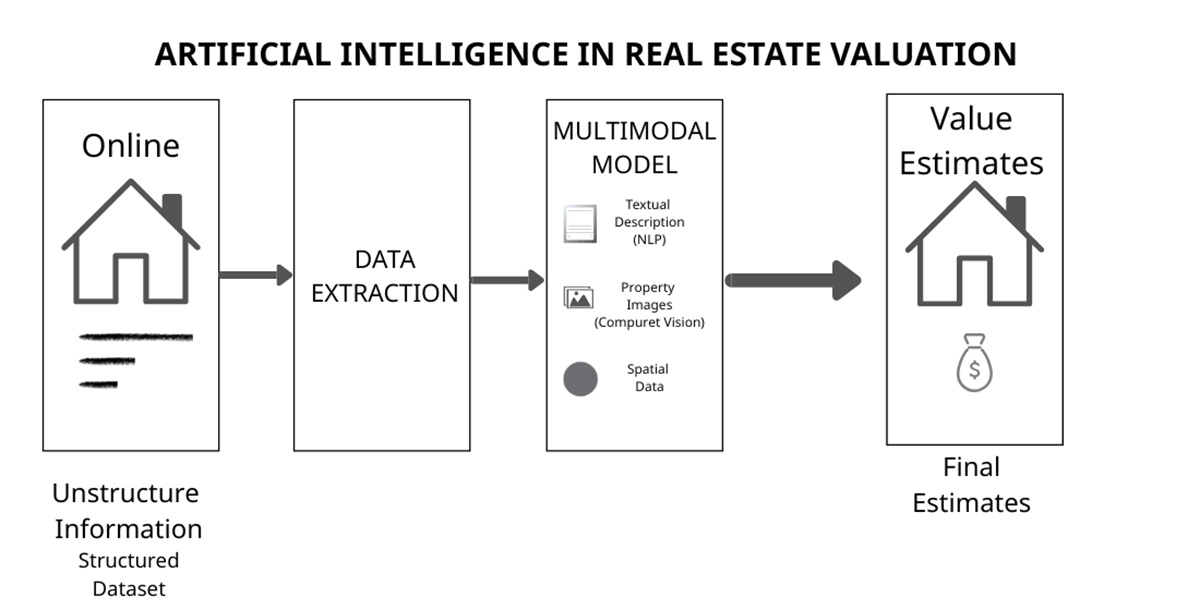
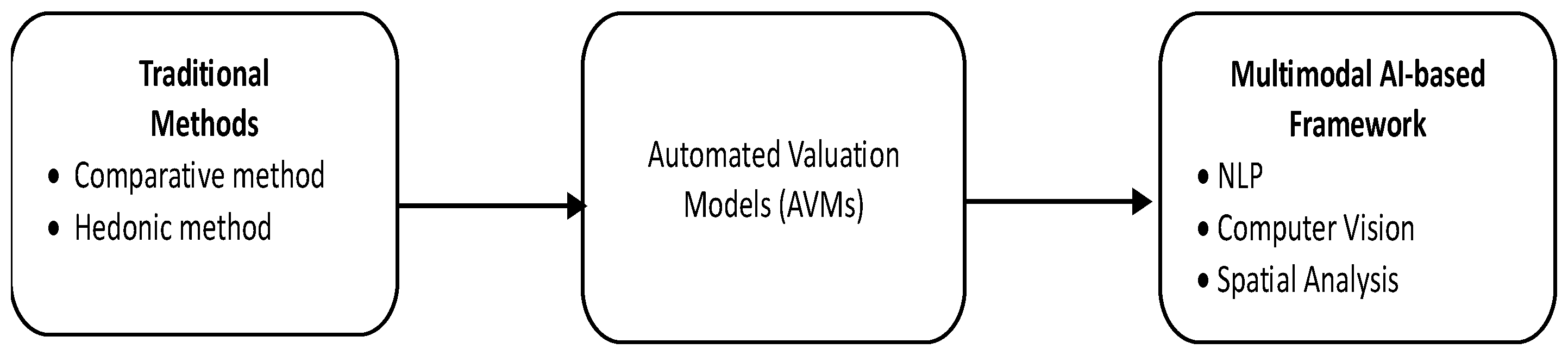
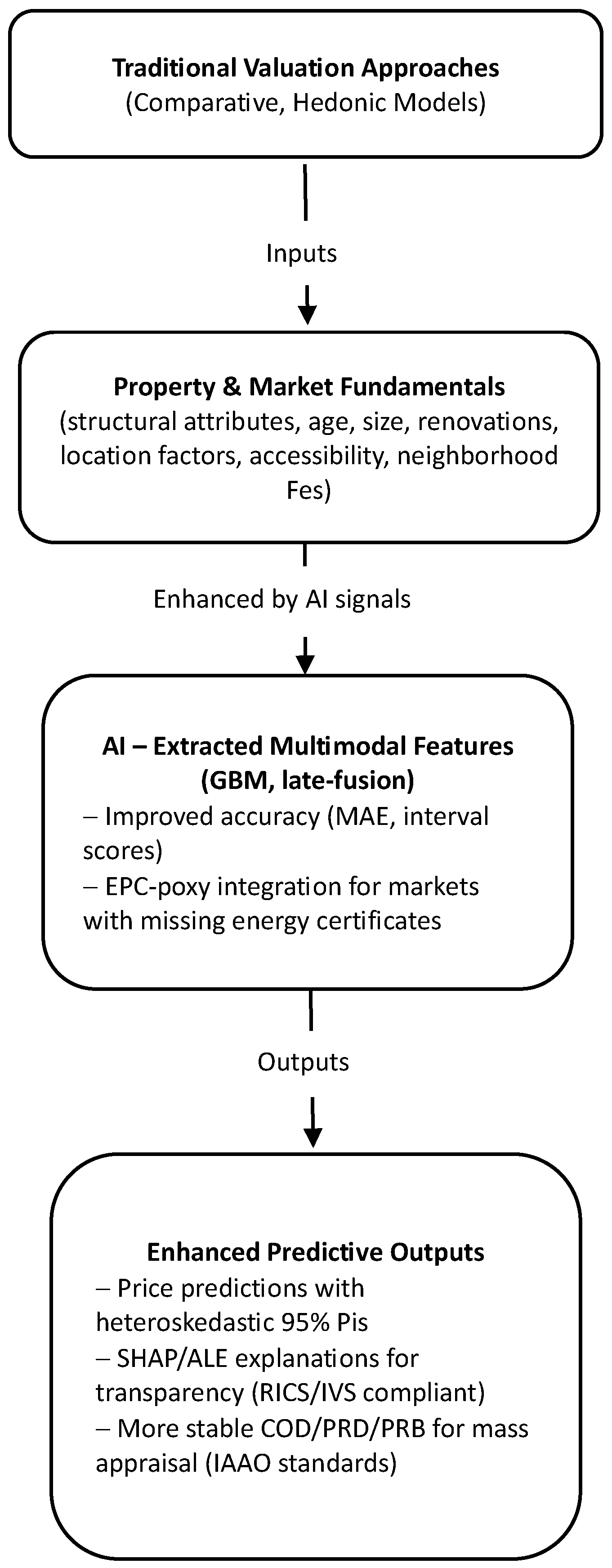
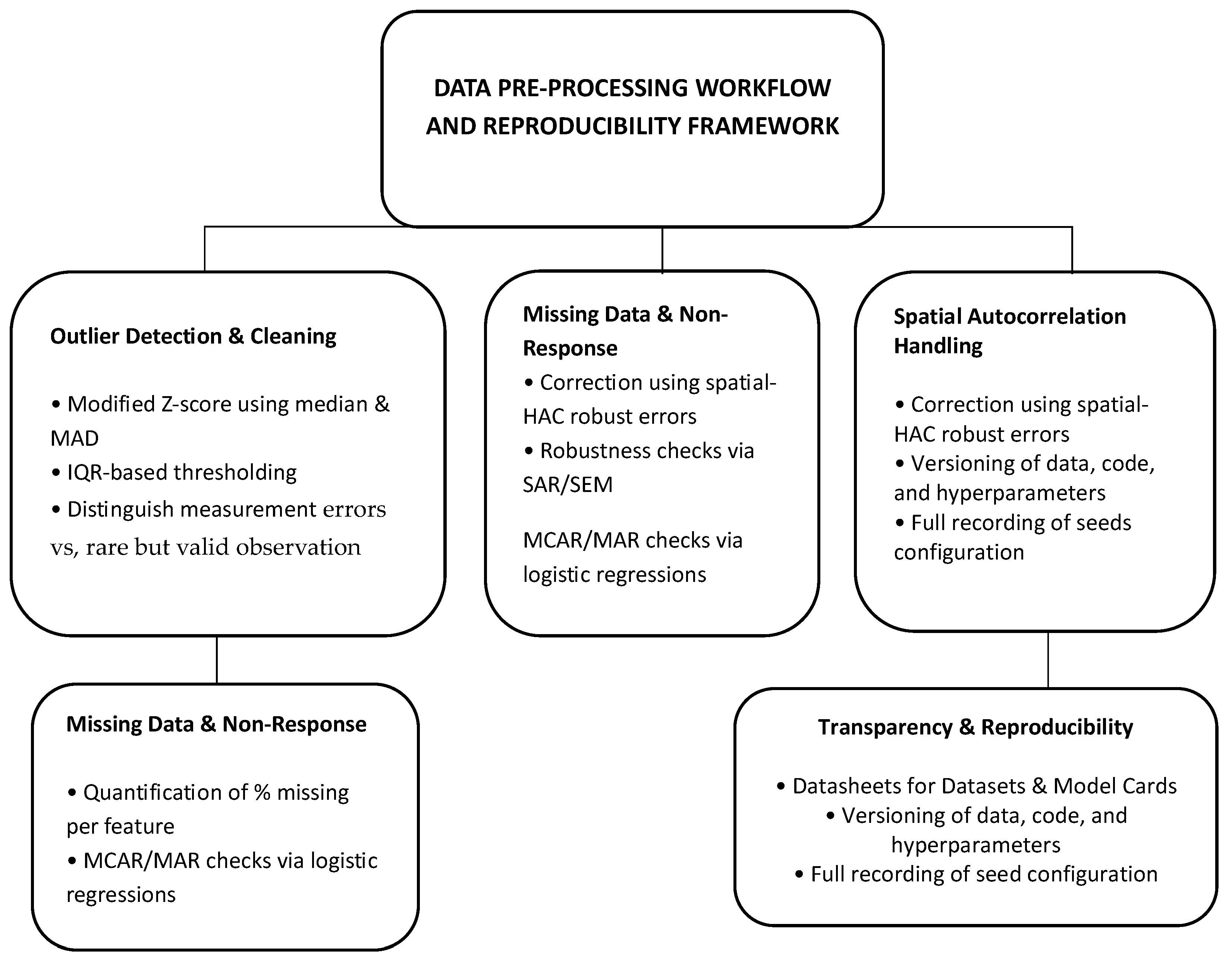
Artificial Intelligence and Real Estate Valuation: The Design and Implementation of a Multimodal Model



Abstract
1. Introduction
- (a)
- How can natural language processing and visual intelligence techniques extract reliable characteristics from unstructured real estate advertisements?
- (b)
- To what extent does the multimodal integration of textual, visual, and geographical data improve the accuracy of estimates compared to the conventional comparative method?
- (c)
- By what mechanisms do the interpretation tools contribute to the transparency and reliability of a modern AVM? The formulation of these questions identifies the theoretical framework within which the proposed methodology is developed and grounds its contribution to both classical valuation literature and contemporary AI research.
2. Literature Review
2.1. Theoretical Foundations of Hedonic Pricing Models
2.2. Traditional Valuation Methods and Modern AVMs
2.3. Standards and Regulations for Valuations and AVMs (IVS, RICS, IAAO, QCS)
2.4. Determinants of Values
2.5. Energy Efficiency (EPC/BER) and Housing Values
2.6. From Listings to Features: NLP in Property Description Texts
2.7. Computer Vision and Multimodal Models (Images + Text + Space)
- Late fusion;
- Early/intermediate fusion.
- Representativeness of the photos (listing bias);
- Spatial dependence and data leakage;
- Interpretability;
- Ethical issues.
- (a)
- Min-spec of images per ad (e.g., ≥5 photos with key spaces);
- (b)
- Standardization of analysis/shooting angles;
- (c)
- External visual features of the neighborhood (Street View) to capture the micro-environment;
- (d)
- Integration with NLP/spatial features in late-fusion architecture as a baseline;
- (e)
- Complete out-of-time/out-of-area evaluations with calibration checks.
2.8. Machine Learning and AVMs in Home Value Estimation
2.9. Explainability and Transparency in AVMs (SHAP, LIME, PDP/ALE, Grad-CAM)
- (a)
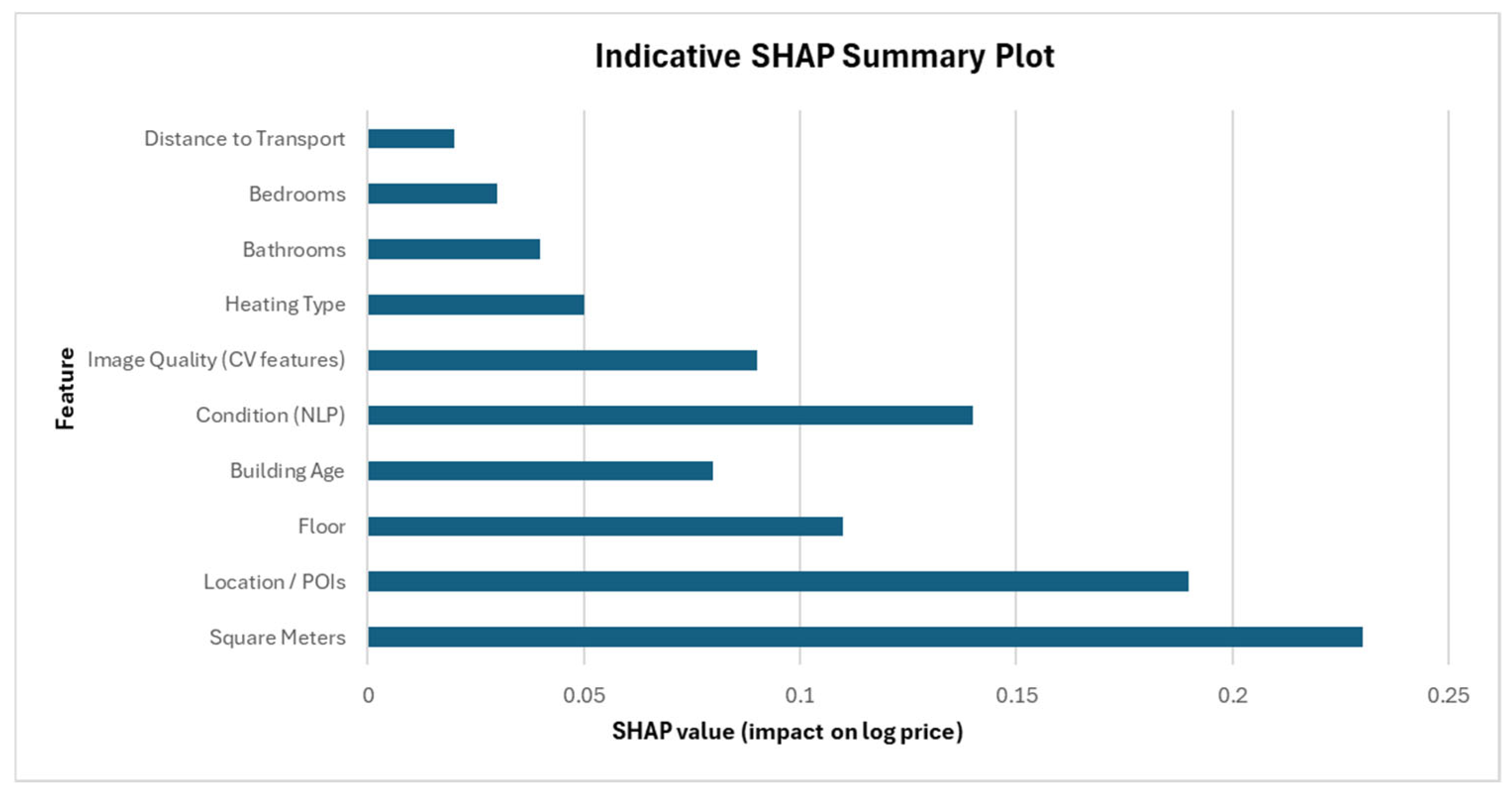
- Global significances (SHAP summary);
- (b)
- PDP/ALE curves for key features;
- (c)
- Local explanation cards;
- (d)
- Spatiotemporal stability checks.
2.10. Data Quality, Bias, and Concept Drift in Advertisements/AVMs
2.11. Spatial Enrichment: Accessibility Indicators and POIs in the Formation of Values
- (a)
- Temporal distances with different means;
- (b)
- Multiscale POI indicators with categorization/diversity;
- (c)
- Nonlinearity/interaction checks;
- (d)
- OOT/OOA evaluation;
- (e)
- Source documentation (OSM, GTFS, registries).
2.12. Summary of Literature Gaps and Contributions
- (a)
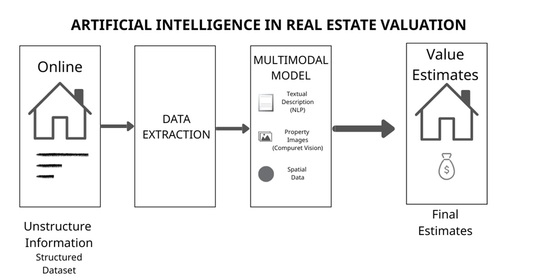
- Developing a multimodal pipeline with NLP, Vision, and POIs;
- (b)
- Introducing EPC-proxy from advertisements;
- (c)
- Adopting OOT/OOA evaluation with leakage checks;
- (d)
- Incorporating calibrated uncertainty and explanations (TreeSHAP, PDP/ALE, Grad-CAM);
- (e)
- Aligning with governance standards for repeatability and regulatory compliance.
3. Data and Model Implementation
3.1. Data Sources, Ethics, Legal Issues, and Documentation
3.2. Cleansing, De-Duplication, and Geocoding
3.3. NLP Schema, Computer Vision Features, and EPC-Proxy Definition
3.3.1. Entity Schema and Text Extraction (NLP)
3.3.2. Image Features (CV)
3.3.3. Definition and Calibration of EPC-Proxy
3.3.4. Modal Coupling and Leakage Checks
3.3.5. Quality Metrics and Governance
3.4. Spatial Enrichment and Access Times
- Cumulative opportunities: Number of destinations Oj within a time threshold T.
- Gravity-based:with decreasing f(⋅) (exponential/log) calibrated to empirical travel distributions.
- Minimum generalized cost: Minimum generalized time/cost to the nearest suitable destination (e.g., metro station).
3.5. Target Variable and Transformations
3.6. Training Schemes, OOT/OOA Evaluation, and Leakage Checks
4. Modeling Methodology
4.1. Linear/Hedonic Models (Baselines)
4.2. Machine Learning Models (GBMs, RF, Neural for Tabular) and Training Practices
- GBMs: Learning rate, number of trees, maximum depth/leaf, subsampling (lines/features), min-data-in-leaf, with early stopping in OOT validation.
- RF: Number of shallow trees, depth, min samples, max features.
- Neural: Width/depth, embeddings, dropout/weight decay, one-cycle or cosine schedulers.
4.3. Avoiding Overfitting and “Fair” Comparison of Models
- (a)
- (b)
- Leakage control: All transformations are performed out-of-fold (scalers, target/impact encoders, feature selection). Look-ahead variables (e.g., “days on market”) and duplicate appearances of the same property/image between train–test are excluded, in accordance with established leakage detection/avoidance guidelines (Kaufman, Rosset, & Perlich, 2012) [102].
- (c)
- Equality of experimental conditions: All models are trained on the same OOT/OOA splits, with the same set of features and the same target/input transformations. The overparameterization budget (iterations/time) is equalized, and the selection criteria (e.g., MAE in the outer fold) are common (Bergstra & Bengio, 2012) [103].
- (d)
- Stochasticity and statistical comparison: Accuracy differences are accompanied by blocked bootstrap confidence intervals (time/space) and Diebold–Mariano tests for prediction (Efron, 1979 [97]; Diebold & Mariano, 1995 [116]). Benjamini–Hochberg FDR is applied for multiple comparisons; corrected tests (e.g., 5 × 2 cv) are used as a robustness check for small samples (Benjamini & Hochberg, 1995 [117]; Dietterich, 1998 [118]).
- (e)
- Reporting and reproducibility: MAE/RMSE/MAPE tables per split, learning curves (error vs. train size), and subgroup diagnostics (e.g., by value/area/age quotient) are published. All seeds, configs, feature hashes, and library versions are documented so that results are one-to-one reproducible.
4.4. Explainability and Decompositions (SHAP, PDP/ALE/ICE, Visual Explanations)
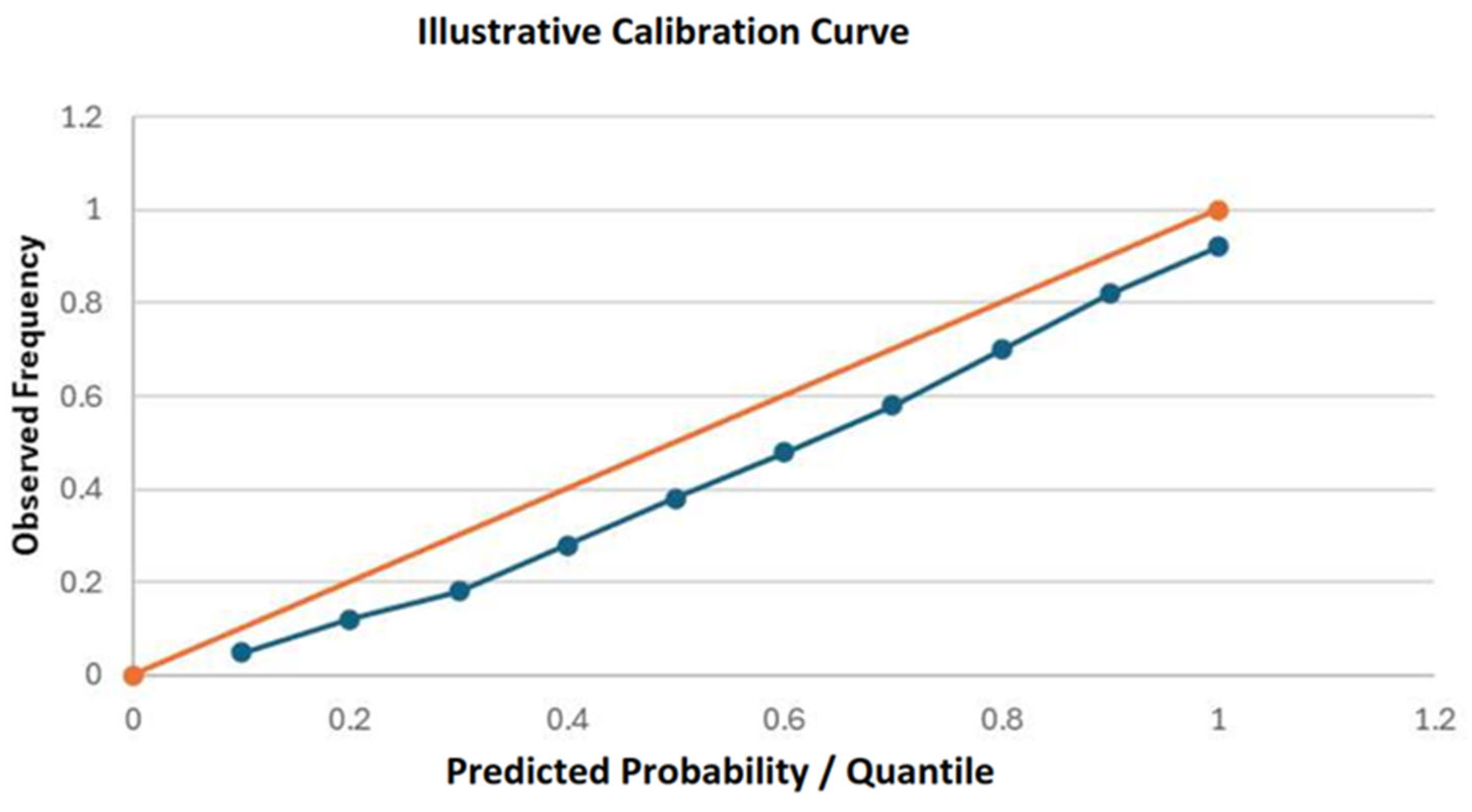
4.5. Uncertainty, Prediction Intervals, and Calibration
4.5.1. Model-Centered Approaches
4.5.2. Error-Based Approaches
4.5.3. Conformal Prediction
4.5.4. Calibration of Quantiles/Probabilities
4.5.5. Uncertainty Assessment
4.5.6. Tracking and Recalibration
4.6. Model Governance and Compliance (RICS/IVS, IAAO, QCS)
- (a)
- Roles and life cycle. Model owner (purpose, assumptions, limits of use/risks), data steward (origin/licenses, quality, GDPR/retention), independent validator (technical verification, reproducibility, stress tests), change manager (versioning, change log, rollback). Cycle: design → development → independent validation → approval → production → monitoring/recalibration → declassification.
- (b)
- Documentation/transparency. Datasheets (sources, licenses/ToS, biases), Model Cards (purpose, data window, attributes, metrics, constraints), full audit trail (seeds/configs/libraries), uncertainty reports (PI coverage) and statements that the AVM does not replace inspection/certification, as required by the Red Book (RICS/IVS), are adopted.
- (c)
- Quality and ratio studies (IAAO). In mass appraisal, ratio studies (COD/PRD/PRB) are regularly performed by category and zone on OOT/OOA samples, with a parallel PI coverage report to ensure error uniformity (IAAO).
- (d)
- QCS requirements and bias testing. QCS (CFPB et al., 2024) [19] mandates documented QA/VV before and during use, prevention of conflicts of interest and systematic bias testing for AVMs. Subgroup errors (area/range/type), parity indicators are monitored, and mitigation measures are implemented (feature review, monotonic constraints, reweighting).
- (e)
- Leakage, drift, and change checks. Out-of-fold preprocessing, avoid look-ahead variables, group splits at building level; monthly PSI/KS on inputs/residuals, coverage tracking of PIs and triggers for recalibration/retrain; standard change control with RFCs, acceptance criteria (MAE/COD/coverage), shadow/A-B before full rollout.
- (f)
- Ethics and privacy. ToS/license and GDPR compliance (minification, pseudonymization, EXIF removal, face/plate blurring). Avoid extraction/inference of sensitive attributes. EPC-proxies are declared as information signals, not certifications.
- (g)
- Independent validation and reproducibility. Each major release undergoes cold-start verification on fresh OOT/OOA, transparency package (SHAP/PDP/ALE/indicative Grad-CAM), and backtesting. Data/code are released as versioned artifacts for one-to-one iteration.
- (h)
- Reporting to stakeholders. Standard dashboards with MAE/RMSE/COD/PRD/PRB, PI coverage/width, drift, bias tests, and change log. Each prediction is accompanied by a 95% PI and a local explanation card.
4.7. Implementation, MLOps, and Reproducibility (Pipeline, Registries, Monitoring)
- Data layer: Versioned repositories (raw → curated) with proactive shape/range/uniqueness checks before each run to avoid “silent” failures.
- Feature store: Unified feature definitions (structured, NLP, CV, spatial), offline/online computation equivalence, and version tags per set (Baylor et al., 2017) [129].
- Training layer: Reproducible runs with MLflow, stable seeds, and environment snapshots; accompanying Model Cards (Mitchell et al., 2019 [77]).
- Model registry: Versions with metadata (data window, OOT/OOA metrics, PI coverage, bias tests) and approval gates.
- Serving layer: Batch (mass evaluations) and lightweight online endpoint with low coupling from upstream sources (Paleyes, Urma, & Lawrence, 2020 [130]).
- ML Test Score: Unit/integration tests in ETL, input distribution checks, training repeatability, explanation stability, alarms on deviations.
- Repro CI/CD: Every change goes through CI with synthetic fixtures and small-sample re-training for early detection of regressions (Sculley et al., 2015 [128]).
- Experimental control: Mandatory ablations and parity with baselines before promotion.
- Data/feature drift: PSI/KS on basic inputs and EPC-proxy.
- Prediction and uncertainty drift: Rolling PIs coverage (90/95%), interval score/CRPS, comparison against “last stable” version.
- Bias/stability dashboards: Errors per subgroup (price/age/area quotients, zones) and global SHAP stability over time; findings → mitigation (reweighting, monotonic constraints, retrain) (Gama et al., 2014) [67].
4.8. Limitations, Threats to Validity, and Limits of Generalizability
- (a)
- Measurement errors: Inaccuracies in critical attributes (sq m, floor, renovation status) may introduce attenuation or nonlinear biases; domain dictionaries, double coding, and robust losses mitigate these without nullifying them (Carroll et al., 2006) [65].
- (b)
- Information leakage: implicit look-ahead or reappearance of the same property/images between train–test; out-of-fold pipelines and grouped splits substantially reduce the risk (Kaufman, Rosset, & Perlich, 2012) [102].
- (c)
- Concept/covariate drift: abrupt changes in preferences/regulations can degrade performance; monitoring and (re)calibration/retraining are required (Gama et al., 2014) [67].
Ethical Issues, Data Privacy, and Legal Compliance
5. Model Tests
5.1. Descriptive Statistics and Diagnostic Tests
5.2. Baseline Performance vs. ML
5.3. Ablation Studies and Channel Contribution
5.4. Subgroup Performance, Uniformity, and Ratio Studies
- Recalibration (quantile or error-based) in validation, targeted per zone/subgroup.
- Monotonic constraints on key features (e.g., area) and grouped explanations (grouped SHAP) to identify associations that create pseudo-monotonicities.
- Reweighting/propensity when OOT/OOA sets have a different mix.
- Policy notes in reports: transparent reporting of ratio studies findings and implications for AVM use. In scenarios falling under QCS (USA), we explicitly document bias testing and mitigation plans (CFPB et al., 2024) [19].
5.5. Uncertainty and Calibration
5.6. Explainability (Global/Local)—Summary of Findings
- Area: Decreasing marginal benefit (log-relation) and soft saturation thresholds.
- Age: U–type shape (old/historical premium, with penalty at intermediate ages) with moderation when renovation status = full.
- Accessibility: Positive slopes up to medium values and inversion very close to busy nodes (comfort/nuisance trade-off).
- EPC-proxy: Stable positive signal, stronger in areas with lower average energy stock.
5.7. Visual Explanations, Case Studies, and Robustness
6. Results
6.1. Discussion of Results and Practical Implications
- Incorporating advert text and photographs substantially improves accuracy, especially in subsets with missing structural information.
- Multiscale spatial indicators (buffers, times) add value but need attention to MAUP and nonlinearities.
6.2. Limitations and External Validity
6.3. Model Interpretability
6.4. Future Research
- (a)
- Causal identification and heterogeneity of effects. Beyond predictive accuracy, designs for causal estimation of “marginal willingness to pay” (e.g., for accessibility, energy upgrades) are needed. Priorities: double/debiased ML for partial effects under high dimensionality and nonlinearity, causal forests for heterogeneity, and staggered DiD for infrastructure/policy interventions. (Chernozhukov, Chetverikov, Demirer, Duflo, Hansen, Newey, & Robins, 2018 [139]; Wager & Athey, 2018 [140]; Callaway & Sant’Anna, 2021 [141]).
- (b)
- Transferability to new markets. Systematic study of domain adaptation/transfer learning (from mature to sparse markets) with covariate shift corrections, representative sampling, and hierarchical/multilevel models that allow for common information but also local deviations. (Ben-David, Blitzer, Crammer, & Pereira, 2010 [142]; Pan & Yang, 2010 [143]).
- (c)
- Multimodal fundamental models. Investigation of self-/weakly supervised multimodal architectures (text + image + space) that learn robust embeddings from large markets and then adapt to smaller samples (few-shot). Attention to documentation and avoidance of leakage from spatial patterns.
- (d)
- Energy efficiency and “performance gap”. Deeper external validation of EPC-proxy against official EPCs and actual consumptions, with measurement error modeling and couplings with causal designs for renovation impacts. (Sunikka-Blank & Galvin, 2012) [34].
- (e)
- Adaptive uncertainty in real time. Online conformal and adaptive calibration for stable coverage in changing regimes, with local similarity weights and drift-aware interval width updating. (Angelopoulos & Bates, 2022) [144].
- (f)
- Fair/responsible assessment. Integrate fairness analyses (error parity, conditional coverage) and counterfactual fairness techniques in subgroups/zones; documented with Model Cards/Datasheets and open replication protocols.
- (g)
- Synthetic data and privacy. Securely deploy synthetic arrays/images that preserve association structure for independent validation, with similarity/privacy metrics and stress tests of influence on inferences.
7. Conclusions
Author Contributions
Funding
Data Availability Statement
Acknowledgments
Conflicts of Interest
Abbreviations
| AI | Artificial Intelligence |
| NLP | Natural Language Processing |
| AVM | Automated Valuation Model |
| MWTP | Marginal Willingness To Pay |
| IAAO | International Association of Assessing Officers |
| RICS | Royal Institution of Chartered Surveyors |
| ML | Machine Learning |
| DL | Deep Learning |
| RF | Random Forest |
| GBDT/GBM | Gradient-Boosted Decision Trees/Gradient Boosting Machine |
| QCS | Quality Control Standards |
| TOD | Transit-Oriented Development |
| EPC/BER | Energy Performance Certificate/Building Energy Rating |
| EPC-proxy | Proxy Energy Performance Certificate Indicator |
| NER | Named Entity Recognition |
| BERT/mBERT/XLM-R | Bidirectional Encoder Representations from Transformers (and multilingual variants) |
| GIS | Geographic Information Systems |
| COD | Coefficient of Dispersion |
| PRD | Price-Related Differential |
| PRB | Price-Related Bias |
| SHAP | SHapley Additive exPlanations |
| ALE | Accumulated Local Effects |
| LIME | Local Interpretable Model-Agnostic Explanations |
| PDP/ALE/ICE | Partial Dependence/Accumulated Local Effects/Individual Conditional Expectation |
| Grad-CAM | Gradient-Weighted Class Activation Mapping |
| CV | Computer Vision |
| OOT/OOA | Out-of-Time/Out-of-Attribute validation |
| PSI/KS | Population Stability Index/Kolmogorov–Smirnov statistic |
| SLA/SLO | Service-Level Agreement/Service-Level Objective |
| POI | Point of Interest |
| GTFS | General Transit Feed Specification |
| MAUP | Modifiable Areal Unit Problem |
| OSM | OpenStreetMap |
| GDPR | General Data Protection Regulation |
| DPIA | Data Protection Impact Assessment |
| EXIF | Exchangeable Image File Format |
| TF-IDF | Term Frequency–Inverse Document Frequency |
| SSIM | Structural Similarity Index Measure |
| WGS84 | World Geodetic System 1984 |
| P/R/F1 | Precision/Recall/F1-score |
| CNN/ResNet | Convolutional Neural Network/Residual Network |
| AUC/AUROC | Area Under ROC Curve |
| OD-matrix | Origin–Destination Matrix |
| 2SFCA | Two-Step Floating Catchment Area |
| CRS | Coordinate Reference System |
| MLE | Maximum Likelihood Estimation |
| IQR/MAD | Interquartile Range/Median Absolute Deviation |
| MSE/RMSE/MAE/MAPE | Mean Squared Error/Root Mean Squared Error/Mean Absolute Error/Mean Absolute Percentage Error (Standard regression accuracy metrics) |
| CI/PI | Confidence Interval/Prediction Interval |
| FDR | False Discovery Rate |
| PIT | Probability Integral Transform |
| NGBoost | Natural Gradient Boosting |
| LOWESS | Locally Weighted Scatterplot Smoothing |
| DiD | Difference-in-Differences |
| QA/VV | Quality Assurance/Validation & Verification |
| RFCs | Random Forest Classifiers (ή Requests for Comments, ανάλογα το context) |
| MLOps/ETL/CI/CD | Machine Learning Operations/Extract–Transform–Load/Continuous Integration–Continuous Deployment |
| PII | Personally Identifiable Information |
Appendix A
Appendix A.1

| Stage | Procedures (From Main Text) | Source Sections |
|---|---|---|
| Data ingestion and quality control |
| Section 3.2 and Section 4.7 |
| Feature engineering |
| Section 4.7 Feature Store |
| Model training |
| Section 4.1, Section 4.2, Section 4.3, Section 4.4 and Section 4.7 Training layer |
| Validation |
| Section 3.3.5 and Section 4.6 Governance, Section 4.7 Validation |
| Uncertainty quantification |
| Section 3.3.5 and Section 4.6 Calibration/PI |
| Bias and fairness checks |
| Section 4.6 and Section 4.7 Bias tests (QCS) |
| Explainability |
| Section 3.3.5 and Section 4.7 Explainability |
| Model registry |
| Section 4.7 Model Registry |
| Deployment |
| Section 4.7 Deployment |
| Monitoring |
| Section 4.7 Monitoring/Drift |
| Auditability and reproducibility |
| Section 4.7 Auditability |
Appendix A.2
| Artifact Category | Description | Representative Code Snippet (Depersonalized) |
|---|---|---|
| Configuration Files | Contain preprocessing rules (transformations, Winsorization thresholds), missingness policies, seed values, hyperparameters, and metadata of OOT/OOA splits. All operations are applied out-of-fold. | yaml\npreprocess:\n Winsor: [0.01, 0.99]\n missing: median_plus_indicator\nsplits:\n type: oot_ooa\n time_block: quarter\nmodel:\n algo: gbm\n tuning: random + bayes\n |
| Feature-Set Definitions | Versioned structured, NLP, CV, and spatial feature sets accompanied by feature hashes to ensure exact reconstruction of the feature store. | yaml\nfeatures:\n structured: v5\n nlp: v4\n cv: v3\n spatial: v2\n |
| Splits Metadata (OOT/OOA) | Documentation of temporal and spatial block splits, buffers, and grouped property/building splits, ensuring no overlap or leakage. | python\nsplits = make_splits(df,\n method = \”oot_ooa\”,\n spatial = \”zone\”)\n |
| Hyperparameter Dictionaries | Final hyperparameters per model (GBM, RF, NN) obtained through nested tuning using random search + Bayesian optimization. | yaml\nhyperparams:\n learning_rate: 0.05\n max_depth: 6\n min_leaf: 20\n |
| Model Cards/Datasheets | Provide data window, input features, MAE/RMSE/MAPE, COD/PRD/PRB, PI coverage (90/95%), drift/bias tests, and version metadata. | Document-type artifact—no code snippet required |
| Logged Artifacts | Seeds, library versions, feature hashes, MLflow runs, hyperparameter configs, and environment snapshots allow 1-to-1 replication. | python\nmlflow.log_params(hparams)\nmlflow.log_artifacts(config_path)\n |
| Explainability Packages | Depersonalized SHAP/ALE/PDP summaries and Grad-CAM visual checks for optical features. | python\nshap_vals = shap_calc(model, X_sample)\n |
| Synthetic/Depersonalized Samples | Only statistical structures or synthetic samples preserving correlations are shared; no raw media or identifiable information. | python\nsynth = generate_synthetic(df,\n keep_correlations = True)\n |
Appendix A.3
| Section | Description | Representative Code Snippet (Depersonalized) |
|---|---|---|
| Y.1. Preprocessing | Out-of-fold preprocessing and feature transformation, applied without information leakage. | python\nX = preprocess(df,\n out_of_fold = True)\n |
| Y.2. OOT/OOA Splits | Construction of temporal and spatial block splits ensuring no overlap or leakage between train/validation/test sets. | python\nsplits = make_splits(df,\n method = “oot_ooa”,\n spatial = “zone”)\n |
| Y.3. Nested Training | Model training with nested hyperparameter tuning (random + Bayesian search) using only training folds. | python\nmodel = nested_cv(X, y,\n method = “random + bayes”)\n |
| Y.4. Prediction Intervals | Generation of prediction intervals using quantile-based or calibrated approaches. | python\npi = predict_intervals(model,\n X_test)\n |
| Y.5. Logging Artifacts | Logging of model outputs, configuration files and metadata to ensure full reproducibility. | python\nlog_run(model,\n config = “config_v3.yaml”)\n |
References
- Lancaster, K. A new approach to consumer theory. Am. Econ. Rev. 1966, 56, 133–157. [Google Scholar]
- Rosen, S. Hedonic prices and implicit markets: Product differentiation in pure competition. J. Political Econ. 1974, 82, 34–55. [Google Scholar] [CrossRef]
- Ekeland, I.; Heckman, J.J.; Nesheim, L. Identification and estimation of hedonic models. J. Political Econ. 2004, 112, S60–S109. [Google Scholar] [CrossRef]
- Bajari, P.; Benkard, C.L. Demand estimation with heterogeneous consumers and unobserved product characteristics: A hedonic approach. J. Political Econ. 2005, 113, 1239–1276. [Google Scholar] [CrossRef]
- Cropper, M.L.; Deck, L.B.; McConnell, K.E. On the choice of functional form for hedonic price functions. Rev. Econ. Stat. 1988, 70, 668–675. [Google Scholar] [CrossRef]
- Halvorsen, R.; Palmquist, R. The interpretation of dummy variables in semilogarithmic equations. Am. Econ. Rev. 1980, 70, 474–475. [Google Scholar]
- Kuminoff, N.V.; Parmeter, C.F.; Pope, J.C. Which hedonic models can we trust to recover the marginal willingness to pay for environmental amenities? J. Environ. Econ. Manag. 2010, 60, 145–160. [Google Scholar] [CrossRef]
- Palmquist, R.B. Property value models. In Handbook of Environmental Economics; Mäler, K.-G., Vincent, J.R., Eds.; Elsevier: Amsterdam, The Netherlands, 2006; Volume 2, pp. 763–819. [Google Scholar] [CrossRef]
- Freeman, A.M., III; Herriges, J.A.; Kling, C.L. The Measurement of Environmental and Resource Values: Theory and Methods, 3rd ed.; RFF Press: Washington, DC, USA; Routledge: Oxfordshire, UK, 2014. [Google Scholar]
- Pagourtzi, E.; Assimakopoulos, V.; French, N.; Wyatt, P. Real estate appraisal: A review of valuation methods. J. Prop. Investig. Financ. 2003, 21, 383–401. [Google Scholar] [CrossRef]
- Appraisal Institute. The Appraisal of Real Estate, 15th ed.; Appraisal Institute: Chicago, IL, USA, 2020; Available online: https://www.appraisalinstitute.org/insights-and-resources/resources/books/the-appraisal-of-real-estate-15th-edition (accessed on 15 October 2025).
- International Association of Assessing Officers (IAAO). Standard on Verification and Adjustment of Sales; IAAO: Kansas City, MO, USA, 2020; Available online: https://www.iaao.org/wp-content/uploads/Standard_on_Verification_Adjustment_of_Sales.pdf (accessed on 15 October 2025).
- International Association of Assessing Officers (IAAO). Standard on Mass Appraisal of Real Property; IAAO: Kansas City, MO, USA, 2021; Available online: https://www.iaao.org/wp-content/uploads/StandardOnMassAppraisal.pdf (accessed on 15 October 2025).
- International Association of Assessing Officers (IAAO). Standard on Automated Valuation Models (AVMs); IAAO: Kansas City, MO, USA, 2018; Available online: https://www.iaao.org/wp-content/uploads/Standard_on_Automated_Valuation_Models.pdf (accessed on 15 October 2025).
- Royal Institution of Chartered Surveyors (RICS). RICS Valuation—Global Standards (Red, Book). Available online: https://www.rics.org/profession-standards/rics-standards-and-guidance/sector-standards/valuation-standards/red-book (accessed on 15 October 2025).
- Jafary, P.; Shojaei, D.; Rajabifard, A.; Ngo, T. Automated land valuation models: A comparative study of machine learning and deep learning techniques. Cities 2024, 145, 105056. [Google Scholar] [CrossRef]
- Moreno-Foronda, I.; Sánchez-Martínez, M.-T.; Pareja-Eastaway, M. Comparative analysis of advanced models for predicting real estate prices: A systematic review. Urban Sci. 2025, 9, 32. [Google Scholar] [CrossRef]
- Tapia, J.; Chavez-Garzon, N.; Pezoa, R.; Suarez-Aldunate, P.; Pilleux, M. Comparing automated valuation models for real estate assessment in the Santiago Metropolitan Region: A study on machine learning algorithms and hedonic pricing with spatial adjustments. PLoS ONE 2025, 20, e0318701. [Google Scholar] [CrossRef]
- Consumer Financial Protection Bureau (CFPB); Office of the Comptroller of the Currency (OCC); Board of Governors of the Federal Reserve System (FRB); Federal Deposit Insurance Corporation (FDIC); National Credit Union Administration (NCUA); Federal Housing Finance Agency (FHFA). Quality Control Standards for Automated Valuation Models (Final Rule). 2024. Available online: https://www.consumerfinance.gov/rules-policy/final-rules/quality-control-standards-for-automated-valuation-models/ (accessed on 15 October 2025).
- Federal Register. Quality Control Standards for Automated Valuation Models. 2024. Available online: https://www.federalregister.gov/documents/2024/08/07/2024-16197/quality-control-standards-for-automated-valuation-models (accessed on 15 October 2025).
- Federal Reserve. Agencies Issue Final Rule to Help Ensure Credibility and Integrity of Automated Valuation Models. 2024. Available online: https://www.federalreserve.gov/newsevents/pressreleases/bcreg20240717a.htm (accessed on 15 October 2025).
- International Valuation Standards Council. International Valuation Standards (IVS); IVSC: London, UK, 2025; Available online: https://ivsc.org/new-edition-of-the-international-valuation-standards-ivs-published/ (accessed on 15 October 2025).
- Sirmans, G.S.; Macpherson, D.A.; Zietz, E.N. The value of housing characteristics: A meta analysis. J. Real Estate Financ. Econ. 2006, 33, 215–240. [Google Scholar] [CrossRef]
- Debrezion, G.; Pels, E.; Rietveld, P. The impact of railway stations on residential and commercial property value: A meta-analysis. J. Real Estate Financ. Econ. 2007, 35, 161–180. [Google Scholar] [CrossRef]
- Mohammad, S.I.; Graham, D.J.; Melo, P.C.; Anderson, R.J. A meta-analysis of the impact of rail projects on land and property values. Transp. Res. Part A Policy Pract. 2013, 50, 158–170. [Google Scholar] [CrossRef]
- Rennert, L. A meta-analysis of the impact of rail stations on property values. Transp. Res. Part A Policy Pract. 2022, 161, 57–86. [Google Scholar] [CrossRef]
- Gibbons, S.; Machin, S. Valuing rail access using transport innovations. J. Urban Econ. 2005, 57, 148–169. [Google Scholar] [CrossRef]
- Rojas, A. Train stations’ impact on housing prices: Direct and indirect effects. Transp. Res. Part A Policy Pract. 2024, 183, 103709. [Google Scholar] [CrossRef]
- Hyland, M.; Lyons, R.C.; Lyons, S. The value of domestic building energy efficiency: Evidence from Ireland. Energy Econ. 2013, 40, 943–952. [Google Scholar] [CrossRef]
- Brounen, D.; Kok, N. On the economics of energy labels in the housing market. J. Environ. Econ. Manag. 2011, 62, 166–179. [Google Scholar] [CrossRef]
- Fuerst, F.; McAllister, P.; Nanda, A.; Wyatt, P. Does energy efficiency matter to home-buyers? An investigation of EPC ratings and transaction prices in England. Energy Econ. 2015, 48, 145–156. [Google Scholar] [CrossRef]
- Fuerst, F.; McAllister, P.; Nanda, A.; Wyatt, P. Energy performance ratings and house prices in Wales. Energy Policy 2016, 92, 20–33. [Google Scholar] [CrossRef]
- Céspedes-López, M.F.; Rubio-Bellido, C.; Muñoz-González, C.M. Meta-analysis of price premiums in housing with energy performance certificates (EPC). Sustainability 2019, 11, 6303. [Google Scholar] [CrossRef]
- Sunikka-Blank, M.; Galvin, R. Introducing the prebound effect: The gap between performance and actual energy consumption. Build. Res. Inf. 2012, 40, 260–273. [Google Scholar] [CrossRef]
- Galvin, R. Quantification of (p)rebound effects in retrofit policies: The performance gap revisited. Energy 2016, 107, 47–58. [Google Scholar] [CrossRef]
- Ruggieri, G.; Maduta, C.; Melica, G. Progress on the Implementation of Energy Performance Certificates (EPCs) Across the EU; Joint Research Centre, European Commission: Brussels, Belgium, 2024; Available online: https://publications.jrc.ec.europa.eu/repository/handle/JRC135473 (accessed on 15 October 2025).
- Sesana, M.M.; Salvalai, G.; Della Valle, N.; Melica, G.; Bertoldi, P. Towards harmonising energy performance certificate methodologies across Europe. Energy Rep. 2024, 10, 11906–11920. [Google Scholar] [CrossRef]
- Shen, L.; Ross, S.L. Information value of property description: A machine learning approach. J. Urban Econ. 2021, 121, 103299. [Google Scholar] [CrossRef]
- Zhang, H.; Campoverde, D.; Avelar, J.; Lim, K. Describe the house and I will tell you the price: House price prediction with textual description data. Nat. Lang. Eng. 2024, 30, 661–695. [Google Scholar] [CrossRef]
- Bottero, M.; Greco, S.; Vernero, F. Geo-NLP insights: Unveiling residential real estate drivers through text and spatial data integration. In Advances in Human Factors, Business Management and Leadership; Springer: Berlin/Heidelberg, Germany, 2024; pp. 139–149. [Google Scholar] [CrossRef]
- Keraghel, I.; Morbieu, S.; Nadif, M. Recent Advances in Named Entity Recognition: A Comprehensive Survey and Comparative Study. arXiv 2024, arXiv:2401.10825. [Google Scholar]
- Poursaeed, O.; Matera, T.; Belongie, S. Vision-based real estate price estimation. Mach. Vis. Appl. 2018, 29, 667–676. [Google Scholar] [CrossRef]
- Law, S.; Paige, B.; Russell, C. Take a look around: Using Street View and satellite images to estimate house prices. ACM Trans. Intell. Syst. Technol. 2019, 10, 1–19. [Google Scholar] [CrossRef]
- You, Q.; Pang, R.; Luo, J. Image-based appraisal of real estate properties. IEEE Trans. Multimed. 2016, 19, 2751–2759. [Google Scholar] [CrossRef]
- Chen, M.; Liu, Y.; Arribas-Bel, D.; Singleton, A. Assessing the value of user-generated images of urban surroundings for house price estimation. Landsc. Urban Plan. 2022, 226, 104486. [Google Scholar] [CrossRef]
- Chahal, B.K. Using Deep Learning to Infer House Prices from Street View, Satellite and Aerial Imagery. Doctoral Dissertation, University of Warwick, Coventry, UK, 2022. Available online: https://wrap.warwick.ac.uk/id/eprint/177026/ (accessed on 15 October 2025).
- Baur, K. Automated real estate valuation with machine learning models using property descriptions. Expert Syst. Appl. 2023, 213, 119147. [Google Scholar] [CrossRef]
- Meszaros, J. A Brief Review of House Price Forecasting Methods. Real Estate Issues (Couns. Real Estate). 2024. Available online: https://cre.org/real-estate-issues/a-brief-review-of-house-price-forecasting-methods/ (accessed on 15 October 2025).
- Ecker, M.D. Cross-validation techniques for resampling housing sales. J. Prop. Tax Assess. Adm. 2022, 19, 29–44. [Google Scholar] [CrossRef]
- International Association of Assessing Officers (IAAO). Standard on Ratio Studies (Exposure Draft); IAAO: Kansas City, MO, USA, 2025; Available online: https://www.iaao.org/wp-content/uploads/2025_Ratio_Studies_Exposure_Draft.pdf (accessed on 15 October 2025).
- Yakima County, W.A. 2026 Value Models (Public AVM Performance Dashboard). 2025. Available online: https://www.yakimacounty.us/3041/2026-Value-Models (accessed on 15 October 2025).
- Krause, A.; Martin, A.; Fix, M. Uncertainty in Automated Valuation Models (Working Paper). 2019. Available online: https://www.andykrause.com/files/krause_etal_avmunc.pdf (accessed on 15 October 2025).
- Pollestad, A.J. Towards a better uncertainty quantification in AVMs. J. Real Estate Financ. Econ. 2024. [Google Scholar] [CrossRef]
- Levi, D.; Gispan, L.; Giladi, N.; Fetaya, E. Evaluating and calibrating uncertainty prediction in regression tasks. Patterns 2022, 3, 5540. [Google Scholar] [CrossRef] [PubMed]
- Lundberg, S.M.; Lee, S.-I. A unified approach to interpreting model predictions. Adv. Neural Inf. Process. Syst. 2017, 30, 4765–4774. [Google Scholar]
- Lundberg, S.M.; Erion, G.G.; Lee, S.-I. From local explanations to global understanding with explainable AI for trees. Nat. Mach. Intell. 2020, 2, 56–67. [Google Scholar] [CrossRef]
- Ribeiro, M.T.; Singh, S.; Guestrin, C. “Why should I trust you?” Explaining the predictions of any classifier. In Proceedings of the 22nd ACM SIGKDD Conference, San Francisco, CA, USA, 13–17 August 2016; pp. 1135–1144. [Google Scholar] [CrossRef]
- Friedman, J.H. Greedy function approximation: A gradient boosting machine. Ann. Stat. 2001, 29, 1189–1232. [Google Scholar] [CrossRef]
- Goldstein, A.; Kapelner, A.; Bleich, J.; Pitkin, E. Peeking inside the black box: Visualizing statistical learning with plots of individual conditional expectation. J. Comput. Graph. Stat. 2015, 24, 44–65. [Google Scholar] [CrossRef]
- Apley, D.W.; Zhu, J. Visualizing the effects of predictor variables in black box supervised learning models. J. R. Stat. Soc. Ser. B 2020, 82, 1059–1086. [Google Scholar] [CrossRef]
- Selvaraju, R.R.; Cogswell, M.; Das, A.; Vedantam, R.; Parikh, D.; Batra, D. Grad-CAM: Visual explanations from deep networks via gradient-based localization. In Proceedings of the IEEE International Conference on Computer Vision, Venice, Italy, 22–29 October 2017; pp. 618–626. [Google Scholar] [CrossRef]
- Molnar, C. Interpretable Machine Learning, 2nd ed.; Leanpub: Victoria, BC, Canada, 2022. [Google Scholar]
- Lipton, Z.C. The mythos of model interpretability: In search of the science of machine learning explanation. ACM Queue 2016, 16, 30–57. [Google Scholar]
- Heckman, J.J. Sample selection bias as a specification error. Econometrica 1979, 47, 153–161. [Google Scholar] [CrossRef]
- Carroll, R.J.; Ruppert, D.; Stefanski, L.A.; Crainiceanu, C. Measurement Error in Nonlinear Models, 2nd ed.; Chapman & Hall/CRC: Boca Raton, FL, USA, 2006. [Google Scholar]
- Zandbergen, P.A. A comparison of address point, parcel and street geocoding techniques. Comput. Environ. Urban Syst. 2008, 32, 214–232. [Google Scholar] [CrossRef]
- Gama, J.; Žliobaitė, I.; Bifet, A.; Pechenizkiy, M.; Bouchachia, A. A survey on concept drift adaptation. ACM Comput. Surv. 2014, 46, 44. [Google Scholar] [CrossRef]
- Lu, J.; Liu, A.; Dong, F.; Guo, Y.; Zhang, G. Learning under concept drift: A review. IEEE Trans. Knowl. Data Eng. 2018, 31, 2346–2363. [Google Scholar] [CrossRef]
- Hansen, W.G. How accessibility shapes land use. J. Am. Inst. Plan. 1959, 25, 73–76. [Google Scholar] [CrossRef]
- Geurs, K.T.; van Wee, B. Accessibility evaluation of land-use and transport strategies: Review and research directions. J. Transp. Geogr. 2004, 12, 127–140. [Google Scholar] [CrossRef]
- El-Geneidy, A.; Levinson, D. Access to destinations: Development of accessibility measures. In Minnesota Department of Transportation Report; University of Minnesota: Minneapolis, MN, USA, 2006. [Google Scholar]
- Duncan, M. The impact of transit-oriented development on housing prices in San Diego, CA. Urban Stud. 2011, 48, 101–127. [Google Scholar] [CrossRef] [PubMed]
- Ewing, R.; Cervero, R. Travel and the built environment: A meta-analysis. J. Am. Plan. Assoc. 2010, 76, 265–294. [Google Scholar] [CrossRef]
- Crompton, J.L. The impact of parks on property values: A review of the empirical evidence. J. Leis. Res. 2001, 33, 1–31. [Google Scholar] [CrossRef]
- European Union. Regulation (EU) 2016/679 of the European Parliament and of the Council (General Data Protection Regulation—GDPR); European Union: Brussels, Belgium, 2016. [Google Scholar]
- Gebru, T.; Morgenstern, J.; Vecchione, B.; Vaughan, J.W.; Wallach, H.; Daumé, H., III; Crawford, K. Datasheets for datasets. Commun. ACM 2021, 64, 86–92. [Google Scholar] [CrossRef]
- Mitchell, M.; Wu, S.; Zaldivar, A.; Barnes, P.; Vasserman, L.; Hutchinson, B.; Spitzer, E.; Raji, I.D.; Gebru, T. Model cards for model reporting. In Proceedings of the Conference on Fairness, Accountability, and Transparency, Atlanta, Georgia, 29–31 January 2019; pp. 220–229. [Google Scholar] [CrossRef]
- Fellegi, I.P.; Sunter, A.B. A theory for record linkage. J. Am. Stat. Assoc. 1969, 64, 1183–1210. [Google Scholar] [CrossRef]
- Christen, P. Data Matching: Concepts and Techniques for Record Linkage, Entity Resolution, and Duplicate Detection; Springer: Berlin/Heidelberg, Germany, 2012. [Google Scholar]
- Jaro, M.A. Advances in record-linkage methodology as applied to the 1985 census of Tampa. J. Am. Stat. Assoc. 1989, 84, 414–420. [Google Scholar] [CrossRef]
- Winkler, W.E. Overview of record linkage and current research directions. In U.S. Census Bureau Research Report; U.S. Census Bureau: Suitland, MD, USA, 2006. [Google Scholar]
- Zauner, C. Implementation and Benchmarking of Perceptual Image Hash Functions. Master’s Thesis, University of Applied Sciences Hagenberg, Mühlkreis, Austria, 2010. [Google Scholar]
- Wang, Z.; Bovik, A.C.; Sheikh, H.R.; Simoncelli, E.P. Image quality assessment: From error visibility to structural similarity. IEEE Trans. Image Process. 2004, 13, 600–612. [Google Scholar] [CrossRef]
- Chapman, W.W.; Bridewell, W.; Hanbury, P.; Cooper, G.F.; Buchanan, B.G. A simple algorithm for identifying negated findings and diseases in discharge summaries. J. Biomed. Inform. 2001, 34, 301–310. [Google Scholar] [CrossRef]
- Devlin, J.; Chang, M.-W.; Lee, K.; Toutanova, K. BERT: Pre-training of deep bidirectional transformers for language understanding. In Proceedings of the 2019 Conference of the North American Chapter of the Association FOR Computational Linguistics: Human Language Technologies, Minneapolis, MN, USA, 2–7 June 2019; pp. 4171–4186. [Google Scholar]
- Conneau, A.; Khandelwal, K.; Goyal, N.; Chaudhary, V.; Wenzek, G.; Guzmán, F.; Grave, E.; Ott, M.; Zettlemoyer, L.; Stoyanov, V. Unsupervised cross-lingual representation learning at scale. In Proceedings of the 58th Annual Meeting of the Association for Computational Linguistics, Virtual, 5–10 July 2020; pp. 8440–8451. [Google Scholar]
- Ratner, A.; Bach, S.H.; Ehrenberg, H.; Fries, J.; Wu, S.; Ré, C. Snorkel: Rapid training data creation with weak supervision. In Proceedings of the VLDB Endowment. International Conference on Very Large Data Bases, Munich, Germany, 28 August–1 September 2017; Volume 11, pp. 269–282. [Google Scholar]
- Saito, T.; Rehmsmeier, M. The precision-recall plot is more informative than the ROC plot when evaluating binary classifiers on imbalanced datasets. PLoS ONE 2015, 10, e0118432. [Google Scholar] [CrossRef] [PubMed]
- He, K.; Zhang, X.; Ren, S.; Sun, J. Deep residual learning for image recognition. In Proceedings of the IEEE Conference on Computer Vision and Pattern Recognition, Las Vegas, NV, USA, 27–30 June 2016; pp. 770–778. [Google Scholar]
- Dosovitskiy, A. An image is worth 16 × 16 words: Transformers for image recognition at scale. In Proceedings of the ICLR, Virtual, 3–7 May 2021. [Google Scholar]
- Luo, W.; Wang, F. Measures of spatial accessibility to health care in a GIS environment: Synthesis and a case study in the Chicago region. Environ. Plan. B Plan. Des. 2003, 30, 865–884. [Google Scholar] [CrossRef]
- Box, G.E.P.; Cox, D.R. An analysis of transformations. J. R. Stat. Soc. Ser. B 1964, 26, 211–252. [Google Scholar] [CrossRef]
- Yeo, I.K.; Johnson, R.A. A new family of power transformations to improve normality or symmetry. Biometrika 2000, 87, 954–959. [Google Scholar] [CrossRef]
- Iglewicz, B.; Hoaglin, D.C. How to Detect and Handle Outliers; ASQ Quality Press: Milwaukee, WI, USA, 1993. [Google Scholar]
- Huber, P.J. Robust estimation of a location parameter. Ann. Math. Stat. 1964, 35, 73–101. [Google Scholar] [CrossRef]
- Koenker, R.; Bassett, G. Regression quantiles. Econometrica 1978, 46, 33–50. [Google Scholar] [CrossRef]
- Efron, B. Bootstrap methods: Another look at the jackknife. Ann. Stat. 1979, 7, 1–26. [Google Scholar] [CrossRef]
- Kennedy, P.E. Estimation with correctly interpreted dummy variables in semilogarithmic equations. Am. Econ. Rev. 1981, 71, 801. [Google Scholar]
- Roberts, D.R.; Bahn, V.; Ciuti, S.; Boyce, M.S.; Elith, J.; Guillera-Arroita, G.; Hauenstein, S.; Lahoz-Monfort, J.J.; Schröder, B.; Thuiller, W.; et al. Cross-validation strategies for data with temporal, spatial, hierarchical, or phylogenetic structure. Ecography 2017, 40, 913–929. [Google Scholar] [CrossRef]
- Tashman, L.J. Out-of-sample tests of forecasting accuracy: An analysis and review. Int. J. Forecast. 2000, 16, 437–450. [Google Scholar] [CrossRef]
- Valavi, R.; Elith, J.; Lahoz-Monfort, J.J.; Guillera-Arroita, G. blockCV: An R package for generating spatially or environmentally separated folds for k-fold cross-validation of species distribution models. Methods Ecol. Evol. 2019, 10, 225–232. [Google Scholar] [CrossRef]
- Kaufman, S.; Rosset, S.; Perlich, C. Leakage in data mining: Formulation, detection, and avoidance. ACM Trans. Knowl. Discov. Data 2012, 6, 15. [Google Scholar] [CrossRef]
- Bergstra, J.; Bengio, Y. Random search for hyper-parameter optimization. J. Mach. Learn. Res. 2012, 13, 281–305. [Google Scholar]
- Snoek, J.; Larochelle, H.; Adams, R.P. Practical Bayesian optimization of machine learning algorithms. Adv. Neural Inf. Process. Syst. 2012, 25, 2951–2959. [Google Scholar]
- Wooldridge, J.M. Econometric Analysis of Cross Section and Panel Data, 2nd ed.; MIT Press: Cambridge, MA, USA, 2010. [Google Scholar]
- Conley, T.G. GMM estimation with cross sectional dependence. J. Econom. 1999, 92, 1–45. [Google Scholar] [CrossRef]
- Anselin, L. Spatial Econometrics: Methods and Models; Kluwer Academic: Dordrecht, The Netherlands, 1988. [Google Scholar]
- Chen, T.; Guestrin, C. XGBoost: A scalable tree boosting system. In Proceedings of the 22nd ACM Sigkdd International Conference on Knowledge Discovery and Data Mining, San Francisco, CA, USA, 13–17 August 2016; pp. 785–794. [Google Scholar] [CrossRef]
- Ke, G.; Meng, Q.; Finley, T.; Wang, T.; Chen Ma, W.; Ye, Q.; Liu, T.-Y. LightGBM: A highly efficient gradient boosting decision tree. Adv. Neural Inf. Process. Syst. 2017, 30, 3146–3154. [Google Scholar]
- Prokhorenkova, L.; Gusev, G.; Vorobev, A.; Dorogush, A.V.; Gulin, A. CatBoost: Unbiased boosting with categorical features. Adv. Neural Inf. Process. Syst. 2018, 31, 6638–6648. [Google Scholar]
- Arik, S.O.; Pfister, T. TabNet: Attentive interpretable tabular learning. In Proceedings of the AAAI Conference on Artificial Intelligence, Honolulu, HI, USA, 27–28 January 2019; pp. 6679–6687. [Google Scholar]
- Gorishniy, Y.; Rubachev, I.; Khrulkov, V.; Babenko, A. Revisiting deep learning models for tabular data. Adv. Neural Inf. Process. Syst. 2021, 34, 18932–18943. [Google Scholar]
- Wolpert, D.H. Stacked generalization. Neural Netw. 1992, 5, 241–259. [Google Scholar] [CrossRef]
- Varma, S.; Simon, R. Bias in error estimation when using cross-validation for model selection. BMC Bioinform. 2006, 7, 91. [Google Scholar] [CrossRef]
- Cawley, G.C.; Talbot, N.L.C. On over-fitting in model selection and subsequent selection bias in performance evaluation. J. Mach. Learn. Res. 2010, 11, 2079–2107. [Google Scholar]
- Diebold, F.X.; Mariano, R.S. Comparing predictive accuracy. J. Bus. Econ. Stat. 1995, 13, 253–263. [Google Scholar] [CrossRef]
- Benjamini, Y.; Hochberg, Y. Controlling the false discovery rate: A practical and powerful approach to multiple testing. J. R. Stat. Soc. Ser. B 1995, 57, 289–300. [Google Scholar] [CrossRef]
- Dietterich, T.G. Approximate statistical tests for comparing supervised classification learning algorithms. Neural Comput. 1998, 10, 1895–1923. [Google Scholar] [CrossRef]
- Alvarez-Melis, D.; Jaakkola, T.S. On the robustness of interpretability methods. In Proceedings of the ICML Workshop on Human Interpretability in ML, Stockholm, Sweden, 14 July 2018. [Google Scholar]
- Wachter, S.; Mittelstadt, B.; Russell, C. Counterfactual explanations without opening the black box: Automated decisions and the GDPR. Harv. J. Law Technol. 2018, 31, 841–887. [Google Scholar] [CrossRef]
- Gneiting, T.; Raftery, A.E. Strictly proper scoring rules, prediction, and estimation. J. Am. Stat. Assoc. 2007, 102, 359–378. [Google Scholar] [CrossRef]
- Duan, T.; Avati, A.; Ding, D.Y.; Liu, A.; Ng, A.Y. NGBoost: Natural gradient boosting for probabilistic prediction. In Proceedings of the International Conference on Machine Learning, Virtual, 13–18 July 2020. [Google Scholar]
- Vovk, V.; Gammerman, A.; Shafer, G. Algorithmic Learning in a Random World; Springer: Berlin/Heidelberg, Germany, 2005. [Google Scholar]
- Barber, R.F.; Candès, E.J.; Ramdas, A.; Tibshirani, R.J. Predictive inference with the jackknife+. Ann. Stat. 2021, 49, 486–507. [Google Scholar] [CrossRef]
- Romano, Y.; Patterson, E.; Candès, E. Conformalized quantile regression. Adv. Neural Inf. Process. Syst. 2019, 32. [Google Scholar] [CrossRef]
- Kuleshov, V.; Fenner, N.; Ermon, S. Accurate uncertainties for deep learning using calibrated regression. In Proceedings of the International Conference on Machine Learning, Stockholm, Sweden, 10–15 July 2018; pp. 2796–2804. [Google Scholar]
- Winkler, R.L. A decision-theoretic approach to interval estimation. J. Am. Stat. Assoc. 1972, 67, 187–191. [Google Scholar] [CrossRef]
- Sculley, D.; Holt, G.; Golovin, D.; Davydov, E.; Phillips, T.; Ebner, D.; Choudhary, V.; Young, M.; Crespo, J.F.; Dennison, D. Hidden technical debt in machine learning systems. In Proceedings of the Advances in Neural Information Processing Systems (NIPS 2015), Montreal, QC, Canada, 7–12 December 2015; Volume 28, pp. 2503–2511. [Google Scholar]
- Baylor, D.; Breck, E.; Cheng, H.T.; Fiedel, N.; Foo, C.Y.; Haque, Z.; Haykal, S.; Ispir, M.; Jain, V.; Koc, L.; et al. TFX: A TensorFlow-based production-scale machine learning platform. In Proceedings of the 23rd ACM SIGKDD International Conference on Knowledge Discovery and Data Mining, Halifax, NS, Canada, 13–17 August 2017; pp. 1387–1395. [Google Scholar]
- Paleyes, A.; Urma, R.-G.; Lawrence, N.D. Challenges in deploying machine learning: A survey of case studies. arXiv 2020, arXiv:2011.09926. [Google Scholar] [CrossRef]
- Humble, J.; Farley, D. Continuous Delivery; Addison-Wesley: Boston, MA, USA, 2010. [Google Scholar]
- Pearl, J.; Bareinboim, E. External validity: From do-calculus to transportability across populations. Stat. Sci. 2014, 29, 579–595. [Google Scholar] [CrossRef]
- Shadish, W.R.; Cook, T.D.; Campbell, D.T. Experimental and Quasi-Experimental Designs for Generalized Causal Inference; Houghton Mifflin: Boston, MA, USA, 2002. [Google Scholar]
- Tukey, J.W. Exploratory Data Analysis; Addison-Wesley: Boston, MA, USA, 1977. [Google Scholar]
- Little, R.J.A.; Rubin, D.B. Statistical Analysis with Missing Data, 3rd ed.; Wiley: Hoboken, NJ, USA, 2019. [Google Scholar]
- Austin, P.C. Balance diagnostics for comparing the distribution of baseline covariates. Stat. Med. 2009, 28, 3083–3107. [Google Scholar] [CrossRef]
- Kutner, M.H.; Nachtsheim, C.J.; Neter, J. Applied Linear Regression Models, 4th ed.; McGraw-Hill: Columbus, OH, USA, 2004. [Google Scholar]
- Breiman, L. Random forests. Mach. Learn. 2001, 45, 5–32. [Google Scholar] [CrossRef]
- Chernozhukov, V.; Chetverikov, D.; Demirer, M.; Duflo, E.; Hansen, C.; Newey, W.; Robins, J. Double/debiased machine learning for treatment and structural parameters. Econom. J. 2018, 21, C1–C68. [Google Scholar] [CrossRef]
- Wager, S.; Athey, S. Estimation and inference of heterogeneous treatment effects using random forests. J. Am. Stat. Assoc. 2018, 113, 1228–1242. [Google Scholar] [CrossRef]
- Callaway, B.; Sant’Anna, P.H.C. Difference-in-differences with multiple time periods. J. Econom. 2021, 225, 200–230. [Google Scholar] [CrossRef]
- Ben-David, S.; Blitzer, J.; Crammer, K.; Pereira, F. A theory of learning from different domains. Mach. Learn. 2010, 79, 151–175. [Google Scholar] [CrossRef]
- Pan, S.J.; Yang, Q. A survey on transfer learning. IEEE Trans. Knowl. Data Eng. 2010, 22, 1345–1359. [Google Scholar] [CrossRef]
- Angelopoulos, A.N.; Bates, S. A gentle introduction to conformal prediction and distribution-free uncertainty quantification. arXiv 2021, arXiv:2107.07511. [Google Scholar]


| Concept | Description |
|---|---|
| Predictive Models | XGBoost, LightGBM, CatBoost, TabNet, ResNet-18 (image-based architectures) |
| Hyperparameter Tuning | Random search and Bayesian optimization |
| Model Validation | Nested cross-validation integrating temporal and spatial stratification |
| Leakage Prevention | Grouped splits by property, exclusion of overlapping temporal windows and EXIF metadata, and strict separation of images across folds |
Disclaimer/Publisher’s Note: The statements, opinions and data contained in all publications are solely those of the individual author(s) and contributor(s) and not of MDPI and/or the editor(s). MDPI and/or the editor(s) disclaim responsibility for any injury to people or property resulting from any ideas, methods, instructions or products referred to in the content. |
© 2025 by the authors. Licensee MDPI, Basel, Switzerland. This article is an open access article distributed under the terms and conditions of the Creative Commons Attribution (CC BY) license (https://creativecommons.org/licenses/by/4.0/).
Share and Cite
Karanikolas, N.; Kyriakidou, E.; Athanasouli, E. Artificial Intelligence and Real Estate Valuation: The Design and Implementation of a Multimodal Model. Information 2025, 16, 1049. https://doi.org/10.3390/info16121049
Karanikolas N, Kyriakidou E, Athanasouli E. Artificial Intelligence and Real Estate Valuation: The Design and Implementation of a Multimodal Model. Information. 2025; 16(12):1049. https://doi.org/10.3390/info16121049
Chicago/Turabian StyleKaranikolas, Nikolaos, Eleni Kyriakidou, and Eleni Athanasouli. 2025. "Artificial Intelligence and Real Estate Valuation: The Design and Implementation of a Multimodal Model" Information 16, no. 12: 1049. https://doi.org/10.3390/info16121049
APA StyleKaranikolas, N., Kyriakidou, E., & Athanasouli, E. (2025). Artificial Intelligence and Real Estate Valuation: The Design and Implementation of a Multimodal Model. Information, 16(12), 1049. https://doi.org/10.3390/info16121049