

Beyond Service Inventories: A Three-Dimensional Framework for Diagnosing Structural Barriers in Academic Library Research Dataset Management


Abstract
1. Introduction
- -
- -
- -
- To examine the effectiveness of academic library services in supporting diverse datasets across disciplines, using institutional readiness indicators.
- To explore the challenges associated with managing, accessing, and using research data in academic libraries, mapped against service maturity levels.
- To establish patterns in how library services support data-driven research relative to international standards, assessed through information flow efficiency metrics.
2. Materials and Methods
2.1. Analytical Framework Development
2.1.1. Institutional Readiness Index (IRI)
- -
- Technical Infrastructure: repository systems, storage capacity, preservation tools, metadata systems, discovery tools.
- -
- Governance Structures: formalised policies, cross-unit coordination, decision-making authority, compliance frameworks, strategic planning integration.
- -
- Resource Allocation: dedicated staffing, operational budgets, training programmes, infrastructure investment.
- -
- Coding criteria: Low = 0–3 indicators; Moderate = 4–6 indicators; High = 7–9 indicators across the three components.
2.1.2. Service Maturity Level (SML)
- -
- Stage 1—Awareness: reactive, unstructured responses with no formalised services.
- -
- Stage 2—Initial: basic advisory services with designated contact persons and emerging FAIR awareness.
- -
- Stage 3—Developing: structured training programmes, repository deployment, emerging metadata support.
- -
- Stage 4—Managed: integrated workflows, formalised policies with enforcement, automated systems, operational cross-unit collaboration.
- -
- Stage 5—Transformational: advanced analytics services, leadership in standards development, innovative service models, full FAIR compliance with demonstrable impact.
2.1.3. Information Flow Efficiency (IFE)
- -
- Discoverability: inadequate metadata, poor search functionality, and absence of persistent identifiers.
- -
- Accessibility: authentication restrictions, format incompatibilities, mediated deposit requirements.
- -
- Interoperability: heterogeneous metadata standards, proprietary formats, lack of API integration.
- -
- Preservation: insufficient backup systems, format obsolescence, and uncertain sustainability funding.
2.2. Methods for Identifying and Filtering Sources
- -
- Population: Academic libraries.
- -
- Concept: Research datasets, including management, curation, and utilisation.
- -
- Context: Academic and research environments (universities, colleges, and higher education institutions).
- -
- Language: English only.
- -
- Publication period: January 2015–September 2025.
- -
- Methodological and conceptual relevance: Studies with clear research data concepts, rigorous methodologies, and findings that inform library support for data-driven research.
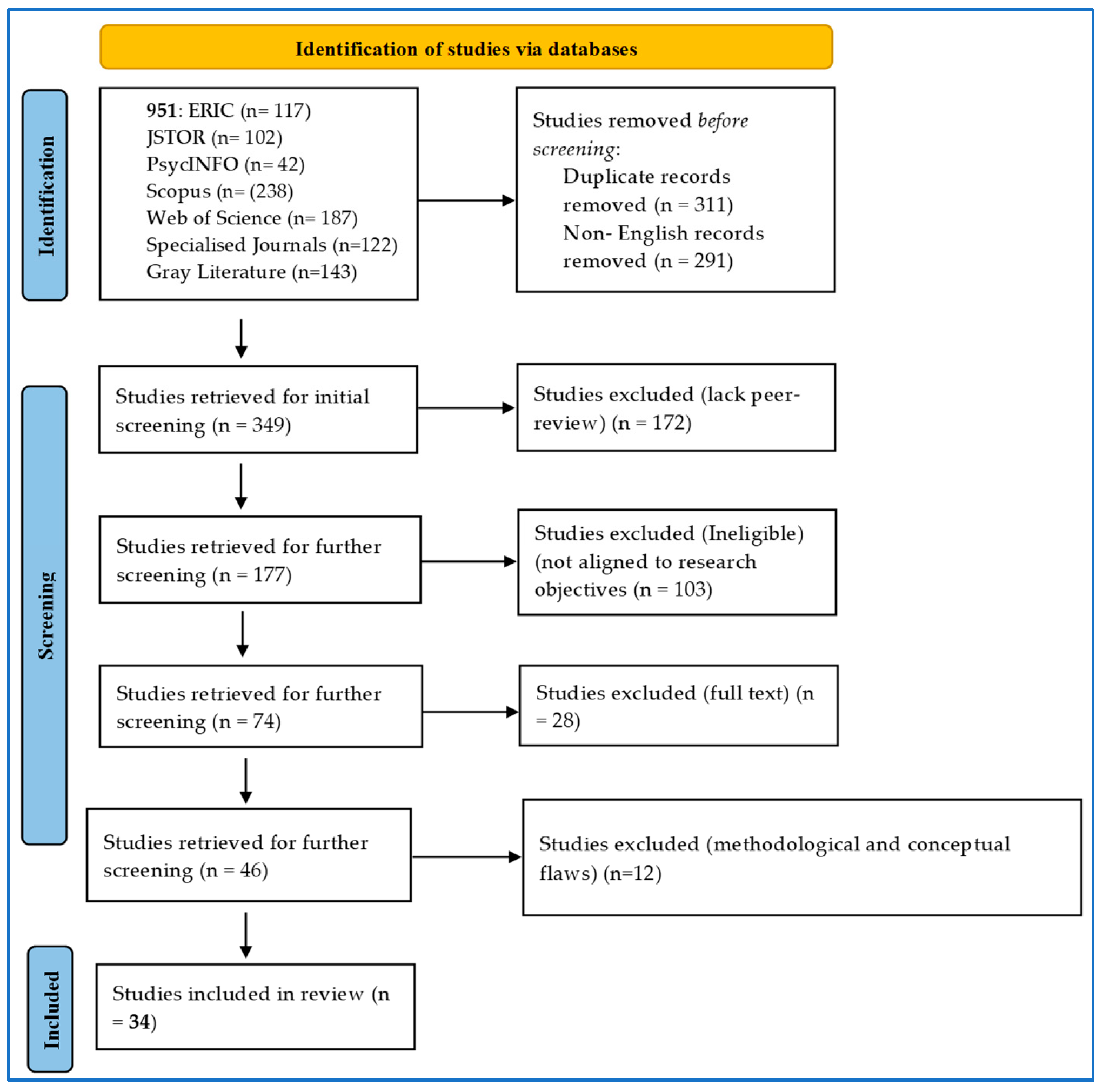
2.3. Study Selection Process
2.4. Inter-Rater Reliability and Consistency
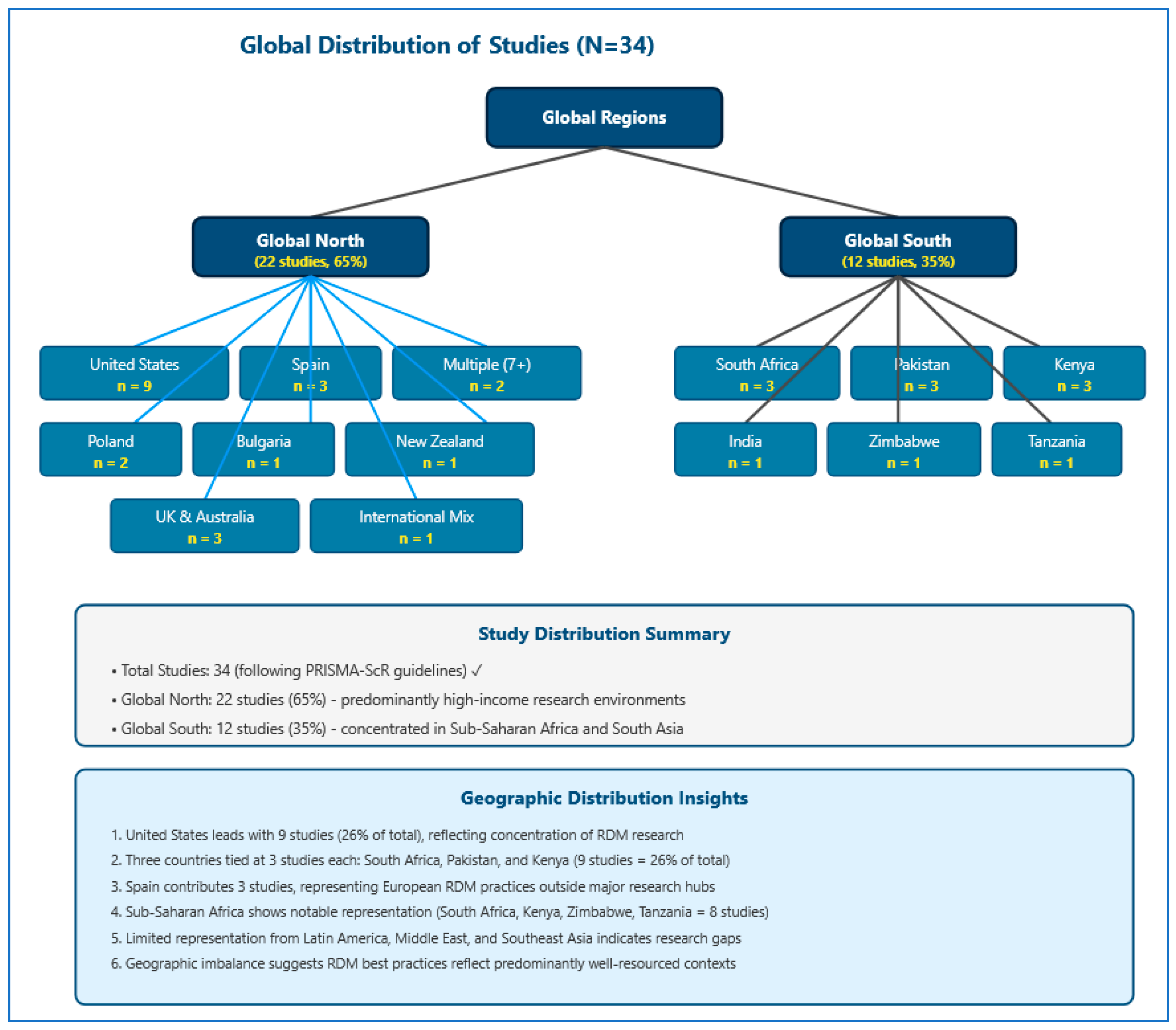
2.5. Data Extraction and Charting
- -
- Bibliographic details: Author, year, journal/source, country.
- -
- Study context: Library type, disciplinary focus, institutional setting.
- -
- Dataset characteristics: Types, formats, size, metadata standards.
- -
- Library services: Access, curation, training, repository platforms, policy guidance.
- -
- Researcher engagement: Dataset usage, barriers, and FAIR awareness.
- -
- Standards alignment: FAIR principles, open science, SDGs.
- -
- Analytical framework indicators: IRI, SML, IFE.
- -
- Key findings: Trends, challenges, innovations.
2.6. Data Synthesis and Analysis
- Descriptive analysis: summarised publication year, country, library type, and disciplinary focus.
- Thematic analysis: identified recurring concepts through iterative coding.
- Framework coding: positioned studies along IRI, SML, and IFE dimensions.
3. Findings
3.1. Effectiveness of Academic Library Services in Supporting Diverse Research Datasets: An Institutional Readiness Analysis
- -
- -
- -
3.2. Challenges in Research Data Management: A Service Maturity Lens
- -
- -
- -
- -
- -
- Stage 5 (Transformational): Minimal challenges; systematic solutions across all categories [67]
- -
- Stage 1–2 Transition: Overcoming awareness; establishing basic infrastructure; securing minimal resources.
- -
- Stage 2–3 Transition: Building technical infrastructure; developing training programs; formalising initial policies.
- -
- Stage 3–4 Transition: Resolving infrastructure gaps; professionalising staff competencies; establishing governance frameworks; achieving cross-unit collaboration.
- -
- Stage 4–5 Transition: Advanced analytics capabilities; innovative service models; comprehensive FAIR implementation; full researcher engagement.
3.3. Alignment with International Standards: Information Flow Efficiency Assessment
- -
- -
- -
4. Discussion
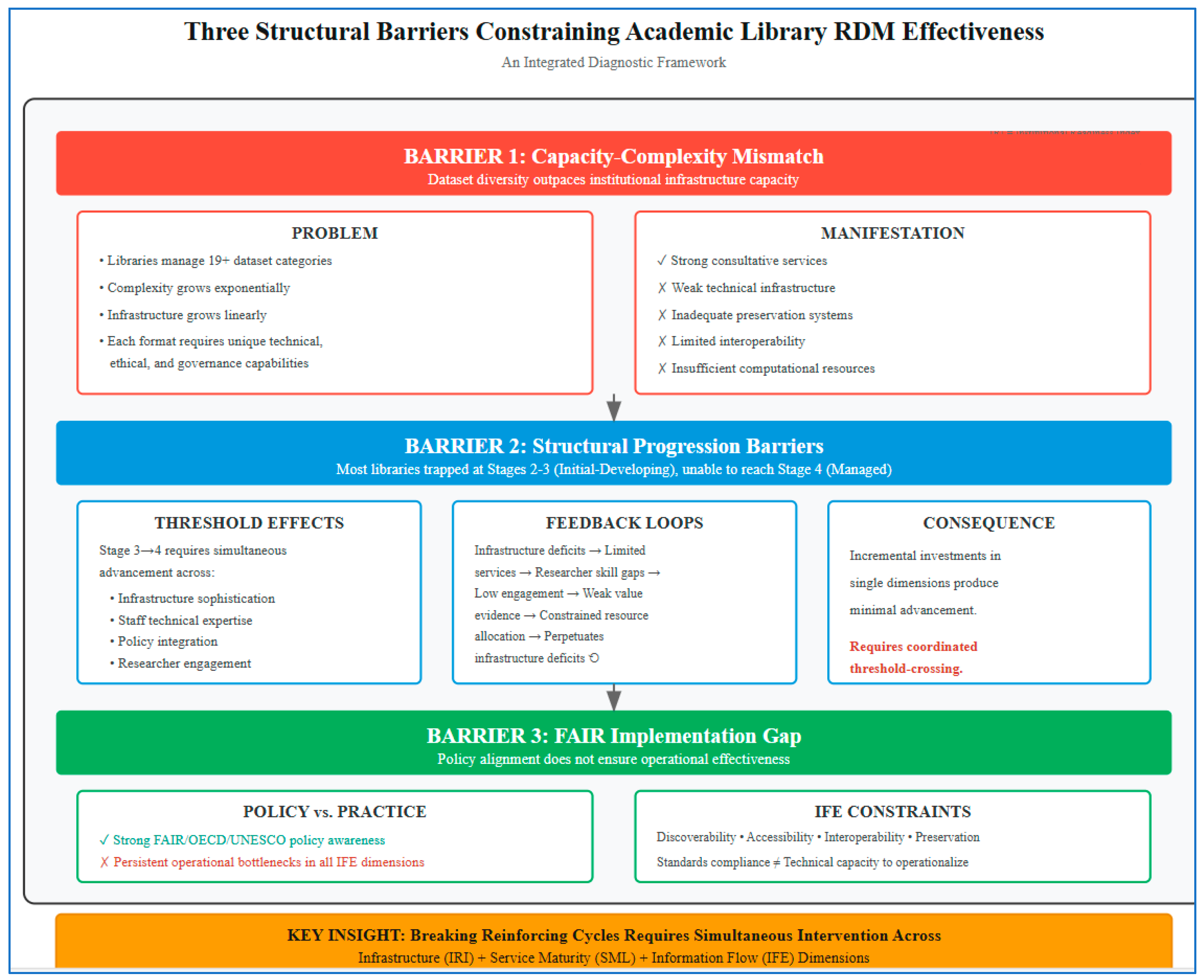
4.1. The Capacity-Complexity Paradox: Why Dataset Diversity Outpaces Institutional Capacity
4.2. Structural Barriers to Service Progression
4.3. The Implementation Gap
4.4. Ecosystem Dependencies and Geographic Considerations
4.5. Framework Contribution and Diagnostic Utility
- -
- Libraries with strong IRI may exhibit low SML if unable to operationalise infrastructure into effective services.
- -
- High SML without adequate IRI may prove unsustainable as service demands exceed capacity.
- -
- Policy alignment (apparent high maturity) may mask operational ineffectiveness (low IFE) when implementation gaps persist.
- -
- IFE assessment exposes whether stated capabilities translate into actual information flows.
5. Conclusions and Recommendations
6. Limitations and Future Research Directions
Supplementary Materials
Author Contributions
Funding
Institutional Review Board Statement
Informed Consent Statement
Data Availability Statement
Acknowledgments
Conflicts of Interest
Abbreviations
| CASP | Critical Appraisal Skills Programme |
| DMP | Data Management Plan |
| FAIR | Findable, Accessible, Interoperable, Reusable |
| IFE | Information Flow Efficiency |
| IRI | Institutional Readiness Index |
| OECD | Organisation for Economic Co-operation and Development |
| OSF | Open Science Framework |
| PRISMA-ScR | Preferred Reporting Items for Systematic Reviews and Meta-Analyses Extension for Scoping Reviews |
| RDA | Research Data Alliance |
| RDM | Research Data Management |
| SDGs | Sustainable Development Goals |
| SML | Service Maturity Level |
| UNESCO | United Nations Educational, Scientific and Cultural Organisation |
Appendix A

| References Citation | Title | Research Design | Publisher | Major Findings |
|---|---|---|---|---|
| [18] | Maturing research data services and the transformation of academic libraries | Mixed methods/survey | Journal of Documentation | Undergraduate engagement in data practices varied; RDM services emerging. Highlights the need for librarian support, targeted instruction, and redefinition of “data” within academic contexts. |
| [38] | Research librarians’ experiences of research data management activities at an academic library in a developing country | Qualitative case study | Data and Information Management | UON Library had RDM policies but gaps in curation, staff skills, infrastructure, and collaboration. Recommends structured RDM units, training, ICT upgrades, policies, and partnerships. |
| [39] | Research data management in academic libraries: Institutional repositories as a reservoir for research data | Qualitative study | Library Management | Examines RDM through institutional repositories; identifies lifecycle stages, stakeholder roles, and ethical aspects. Advocates training, user-friendly interfaces, and clear policy frameworks. |
| [40] | Data literacy: A catalyst for improving research publication productivity of Kyambogo University academic staff | Qualitative | Journal of eScience Librarianship | Data literacy enhances research productivity via access, visualisation, ethical use, and preservation. Recommends institutional policies, infrastructure, and data support roles. |
| [41] | Research data curation at Kenya’s agricultural research institute libraries: Opportunities and challenges | Qualitative multiple case study | KLISC Journal of Information Science & Knowledge Management | RDM is fragmented, with weak policy guidance, skill gaps, and poor coordination. Recommends governance structures, RDM departments, training, and infrastructure. |
| [42] | Data Literacy Practices of Students Conducting Undergraduate Research | Survey and poster analysis | College & Research Libraries | Students demonstrate basic data practices but lack advanced metadata and cleaning skills. Calls for library-led advanced data literacy instruction. |
| [43] | FAIR EVA: Bringing institutional multidisciplinary repositories into the FAIR picture | Tool development and pilot implementation | Scientific Data | Developed FAIR EVA assessment tool; pilot revealed uneven FAIR adoption. Provides actionable metrics for repository managers. |
| [44] | Data literacy in flux: Perspectives of community college librarians on evolving educational demands and library capacities | Qualitative | Library & Information Science Research | Librarians view data literacy as essential for student success and workforce readiness. Libraries bridge institutional skills gaps. |
| [45] | Student Engagement in Academic Libraries: A Conceptual Framework | Qualitative | College & Research Libraries | Developed SEAL framework outlining antecedents, dimensions, and outcomes of engagement. Encourages strategic approaches beyond usage metrics. |
| [46] | Research data management literacy amongst lecturers at Strathmore University, Kenya | Survey | Library Management | RDM literacy is uneven; knowledge gaps in sharing, legislation, and security. Recommends structured training and policy formulation. |
| [47] | A survey of the state of research data services in 35 U.S. academic libraries | Survey | Research Ideas and Outcomes | All libraries provided some RDS, advisory and workshop services. Highlights gaps in preservation, metadata support, and staffing. |
| [48] | Research data management practices in university libraries: A study | Comparative survey | DESIDOC Journal of Library & Information Technology | Indian universities lag behind global peers; limited policies, repositories, and training. Advocates for DMP guidance and cross-departmental collaboration. |
| [49] | Research data services (RDS) in Spanish academic libraries | Quantitative website content analysis | The Journal of Academic Librarianship | RDS implementation uneven; advisory and repository services common, but formal policies rare. Calls for technical support and training. |
| [50] | Identifying and implementing relevant research data management services for the library at the University of Dodoma, Tanzania | Qualitative case study | Data Science Journal | RDM awareness is low, but library support is strong. Recommends phased implementation focusing on infrastructure, training, and metadata. |
| [51] | The uptake and usage of a national higher education libraries statistics database in South Africa | Survey and case study | South African Journal of Libraries and Information Science | CHELSA database adoption is limited due to definitional and training challenges. Suggests enhanced capacity building for data interpretation. |
| [52] | Policy and planning of research data management in university libraries of Pakistan | Mixed methods | Collection and Curation | Few libraries have formal RDM policies; major barriers include skill gaps and poor coordination. Recommends policy enforcement and collaboration. |
| [53] | Research data management at an African medical university: Implications for academic librarianship | Mixed methods | The Journal of Academic Librarianship | RDM is undeveloped; preservation is inconsistent; librarians are constrained by infrastructure and training deficits. Libraries are positioned as key data stewards. |
| [54] | Enhancing the role of libraries in South African higher education institutions through research data management: A case study of Cape Peninsula University of Technology | Qualitative case study | University of Cape Town | CPUT Libraries adopted the DCC Lifecycle Model, strong leadership and policy alignment. Challenges: staff readiness and researcher engagement. |
| [55] | Research Support in New Zealand University Libraries | Survey | New Review of Academic Librarianship | RDM services mature; limited Kaupapa Māori support. Recommends national coordination and recognition of research support roles. |
| [56] | Building a Research Data Management Service at the University of California, Berkeley: A tale of collaboration | Case study | IFLA Journal | Developed collaborative RDM service via library–IT partnership. Emphasises culture, privacy, and researcher-centred design. |
| [57] | Developments in research data management in academic libraries: Towards an understanding of research data service maturity | International survey (7 countries) | Journal of the Association for Information Science and Technology | Libraries lead RDM policy/advisory functions; technical services are underdeveloped. Proposes a four-level maturity model. |
| [58] | The role of academic libraries in research data management: A case in Ghanaian university libraries | Survey and thematic analysis | Open Access Library Journal | Ghanaian libraries in early RDM stages; lack policies, infrastructure, and metadata expertise. Highlights IT collaboration as essential. |
| [59] | Big data-driven investigation into the maturity of library research data services (RDS) | Big data analysis | The Journal of Academic Librarianship | Most libraries are at the stewardship level; few offer transformational services. Calls for skill development and strategic integration. |
| [60] | Digital data sets management in university libraries: Challenges and opportunities | Cross-sectional survey | Global Knowledge, Memory and Communication | LIS professionals are well-positioned for data management but face leadership and policy challenges. Emphasises skill development and collaboration. |
| [61] | Changes in academic libraries in the era of Open Science | Case study | Education for Information | Libraries’ expanding roles in RDM, data curation, and data science literacy. New competencies and institutional policies are required. |
| [62] | Developing Data Services Skills in Academic Libraries | Survey | College & Research Libraries | Librarians are strong in communication and instruction; they lack technical skills. Self-directed learning is prevalent; it calls for dedicated data roles. |
| [63] | Research data management in research institutions in Zimbabwe | Mixed methods | Data Science Journal | RDM practices are underdeveloped; policy and infrastructure gaps. Recommends compliant repositories and capacity-building partnerships. |
| [64] | Exploring data literacy via a librarian–faculty learning community: A case study | Case study | The Journal of Academic Librarianship | Learning communities enhanced the curriculum integration of data literacy. Barriers: role clarity and interdisciplinary coordination. |
| [65] | Data literacy training needs of researchers at South African universities | Survey | Global Knowledge, Memory and Communication | Training is uneven; many researchers are unaware of needs. Priorities: DMPs, metadata, version control, and data citation. |
| [66] | Research data services from the perspective of academic librarians | Nationwide online survey | Digital Library Perspectives | Librarians prioritise advisory services over technical functions. Collaboration and DMP guidance are critical. |
| [67] | Leading FAIR adoption across the institution: A collaboration between an academic library and a technology provider | Case study | Data Science Journal | Library–industry collaboration facilitated FAIR adoption. Sustained engagement and workflow integration are essential. |
| [68] | Discovery and reuse of open datasets: An exploratory study | Exploratory analysis | Journal of eScience Librarianship | High-quality metadata enhances reuse; repositories aid discovery. Gaps in licensing and preservation persist. |
| [69] | The perception of LIS professionals about RDM services in university libraries of Pakistan | Survey | Libri | RDM services are underdeveloped; LIS professionals require training and motivation. Recommends policy and donor engagement. |
| [70] | Academic library resources and research support services for English teachers in higher education institutions | Quantitative | Journal of Electronic Resources Librarianship | Faculty benefit from library resources for research and teaching. Suggests expanding digital resources and specialised research support. |
References
- Ghanad, A. An Overview of Quantitative Research Methods. Int. J. Multidiscip. Res. Anal. 2023, 6, 3794–3803. [Google Scholar] [CrossRef]
- Boté-Vericad, J.-J.; Healy, S. Academic libraries and research data management: A systematic review. Vjesn. Bibl. Hrvat. 2022, 65, 171–193. [Google Scholar] [CrossRef]
- Goodman, S.N.; Fanelli, D.; Ioannidis, J.P.A. What does research reproducibility mean? Sci. Transl. Med. 2016, 8, 341ps12. [Google Scholar] [CrossRef] [PubMed]
- Pröll, S.; Rauber, A. Enabling Reproducibility for Small and Large Scale Research Data Sets. D-Lib Mag. 2017, 23. [Google Scholar] [CrossRef]
- Lindner, A. Leveraging Postgraduate Education for Sustainable Development: The Resource-Nexus and Environmental Management in Global South Partnerships. Ph.D. Thesis, Technische Universität Dresden, Dresden, Germany, 2023. [Google Scholar] [CrossRef]
- Pilling, D.; Bélanger, J.; Diulgheroff, S.; Koskela, J.; Leroy, G.; Mair, G.; Hoffmann, I. Global status of genetic resources for food and agriculture: Challenges and research needs. Genet. Resour. 2020, 1, 4–16. [Google Scholar] [CrossRef]
- United Nations Economic Commission for Europe. Global values, regional circumstances, priorities and needs for resource management. In United Nations Resource Management System; United Nations: New York, NY, USA, 2021; pp. 45–52. [Google Scholar] [CrossRef]
- International Federation of Library Associations and Institutions (IFLA). Three (and a Half) Strategies to Help Academic Libraries Achieve Student Success. 2024. Available online: https://www.ifla.org/news/three-and-a-half-strategies-to-help-academic-libraries-achieve-student-success/ (accessed on 28 July 2025).
- Corrall, S.; Schlak, T.; Bracke, P. The Social Mission of Academic Libraries in Higher Education. In The Social Future of Academic Libraries: New Perspectives on Communities, Networks, and Engagement; Facet Publishing: London, UK, 2022; pp. 109–148. [Google Scholar]
- Dabengwa, I.M. Are Academic Libraries Doing Enough to Support the Sustainable Development Goals (SDGs)? A Mixed-Methods Review. Evid. Based Libr. Inf. Pract. 2025, 20, 148–184. [Google Scholar] [CrossRef]
- De-Graft Johnson Dei, F.Y.A. Role of academic libraries in the achievement of quality education as a sustainable development goal. Libr. Manag. 2022, 43, 439–459. [Google Scholar] [CrossRef]
- Andrikopoulou, A.; Rowley, J.; Walton, G. Research Data Management (RDM) and the Evolving Identity of Academic Libraries and Librarians: A Literature Review. New Rev. Acad. Librariansh. 2021, 28, 349–365. [Google Scholar] [CrossRef]
- Koltay, T. Research 2.0 and Research Data Services in academic and research libraries: Priority issues. Libr. Manag. 2017, 38, 345–353. [Google Scholar] [CrossRef]
- Sheikh, A.; Malik, A.; Adnan, R. Evolution of research data management in academic libraries: A review of the literature. Inf. Dev. 2023, 41, 305–319. [Google Scholar] [CrossRef]
- Dumontier, M.; Wesley, K. Advancing Discovery Science with FAIR Data Stewardship: Findable, Accessible, Interoperable, Reusable. Ser. Libr. 2018, 74, 39–48. [Google Scholar] [CrossRef]
- Hettne, K.M.; Verhaar, P.; Schultes, E.; Sesink, L. From FAIR Leading Practices to FAIR Implementation and Back: An Inclusive Approach to FAIR at Leiden University Libraries. Data Sci. J. 2020, 19, 40. [Google Scholar] [CrossRef]
- Payal, M.; Awasthi, S.; Tripathi, M. A Selective Review of Literature on Research Data Management in Academic Libraries. DESIDOC J. Libr. Inf. Technol. 2019, 39, 338–345. [Google Scholar] [CrossRef]
- Cox, A.M.; Kennan, M.A.; Lyon, E.; Pinfield, S.; Sbaffi, L. Maturing research data services and the transformation of academic libraries. J. Doc. 2019, 75, 1432–1462. [Google Scholar] [CrossRef]
- Garoufallou, E.; Gaitanou, P. Big Data: Opportunities and Challenges in Libraries, a Systematic Literature Review. Coll. Res. Libr. 2021, 82, 410. [Google Scholar] [CrossRef]
- Mavodza, J. Librarians and Research Data in the Current Information Terrain. In Proceedings of the Evolving Health Information Landscape Symposium, Doha, Qatar, 2 December 2022; Hamad bin Khalifa University Press (HBKU Press): Doha, Qatar, 2022; Volume 2022, p. 2. [Google Scholar] [CrossRef]
- Hussain, A.; Shahid, R. Impact of big data on library services: Prospect and challenges. Libr. Hi Tech News 2022, 39, 17–20. [Google Scholar]
- Boté-Vericad, J.-J.; Adilović, E.; Caellas-Camprubí, A.; Labastida, I. Curating the Future of Research: Navigating FAIR Challenges in Academic Repositories. DESIDOC J. Libr. Inf. Technol. 2024, 44, 284–288. [Google Scholar] [CrossRef]
- Birkbeck, G.; Nagle, T.; Sammon, D. Challenges in research data management practices: A literature analysis. J. Decis. Syst. 2022, 31, 153–167. [Google Scholar] [CrossRef]
- Johnston, L.R.; Carlson, J.; Hudson-Vitale, C.; Imker, H.; Kozlowski, W.; Olendorf, R.; Stewart, C. How Important is Data Curation? Gaps and Opportunities for Academic Libraries. J. Librariansh. Sch. Commun. 2018, 6, eP2198. [Google Scholar] [CrossRef]
- Ashiq, M.; Usmani, M.H.; Naeem, M. A systematic literature review on research data management practices and services. Glob. Knowl. Mem. Commun. 2022, 71, 649–671. [Google Scholar] [CrossRef]
- Nel, M.A.; Makhera, P.; Moreana, M.M.; Maritz, M. Linking faculty research output and activities to sustainable development goals: Opportunities for metadata specialists. Digit. Libr. Perspect. 2024, 40, 392–403. [Google Scholar] [CrossRef]
- Arksey, H.; O’Malley, L. Scoping studies: Towards a methodological framework. Int. J. Soc. Res. Methodol. 2005, 8, 19–32. [Google Scholar] [CrossRef]
- Munn, Z.; Pollock, D.; Khalil, H.; Alexander, L.; McInerney, P.; Godfrey, C.M.; Peters, M.; Tricco, A.C. What are scoping reviews? Providing a formal definition of scoping reviews as a type of evidence synthesis. JBI Evid. Synth. 2022, 20, 950–952. [Google Scholar] [CrossRef]
- Peters, M.D.J.; Marnie, C.; Tricco, A.C.; Pollock, D.; Munn, Z.; Alexander, L.; McInerney, P.; Godfrey, C.M.; Khalil, H. Updated methodological guidance for the conduct of scoping reviews. JBI Evid. Synth. 2020, 18, 2119–2126. [Google Scholar] [CrossRef] [PubMed]
- Westphaln, K.K.; Regoeczi, W.; Masotya, M.; Vazquez-Westphaln, B.; Lounsbury, K.; McDavid, L.; Lee, H.N.; Johnson, J. From Arksey and O’Malley and beyond: Customizations to enhance a team-based, mixed methods approach to scoping review methodology. MethodsX 2021, 8, 101375. [Google Scholar] [CrossRef] [PubMed]
- Higgins, S. DCC diffuse Standards Frameworks: A Standards Path through the Curation Lifecycle. Int. J. Digit. Curation 2009, 4, 61–66. [Google Scholar] [CrossRef]
- Tricco, A.C.; Lillie, E.; Zarin, W.; O’Brien, K.K.; Colquhoun, H.; Levac, D.; Moher, D.; Straus, S.E. PRISMA Extension for Scoping Reviews (PRISMA-ScR): Checklist and Explanation. Ann. Intern. Med. 2018, 169, 467–473. [Google Scholar] [CrossRef]
- Li, M.; Gao, Q.; Yu, T. Kappa statistic considerations in evaluating inter-rater reliability between two raters: Which, when and context matters. BMC Cancer 2023, 23, 799. [Google Scholar] [CrossRef]
- Rayyan. Faster Systematic Reviews. Available online: https://www.rayyan.ai (accessed on 20 March 2025).
- ASReview. Join the Movement Towards Fast, Open, and Transparent Systematic Reviews. Available online: https://asreview.nl/local-installation/ (accessed on 1 April 2025).
- Critical Appraisal Skills Programme (CASP). CASP Checklists. Available online: https://casp-uk.net/casp-tools-checklists/ (accessed on 20 April 2025).
- Sivakumar, I.; Lobner, K.; Walden, R.L.; Weiss, C.R. Creating and publishing systematic reviews, meta-analyses, and scoping reviews: A 10-step guide for students and trainees. Acad. Radiol. 2025, 32, 2357–2363. [Google Scholar] [CrossRef]
- Masinde, J.; Chen, J.; Wambiri, D.; Mumo, A. Research librarians’ experiences of research data management activities at an academic library in a developing country. Data Inf. Manag. 2021, 5, 412–424. [Google Scholar] [CrossRef]
- Dube, T.V. Research data management in academic libraries: Institutional repositories as a reservoir for research data. Libr. Manag. 2025; in press. [Google Scholar]
- Buwule, R.; Nassali State, E.; Mukiibi, E. Data literacy: A catalyst for improving research publication productivity of Kyambogo University academic staff. J. eSci. Librariansh. 2023, 12, e646. [Google Scholar] [CrossRef]
- Ng’eno, E.J.; Odero, D.; Amoth, D. Research data curation at Kenya’s agricultural research institute libraries: Opportunities and challenges. KLISC J. Inf. Sci. Knowl. Manag. 2025, 2, 11–27. [Google Scholar] [CrossRef]
- Burress, T. Data Literacy Practices of Students Conducting Undergraduate Research. Coll. Res. Libr. 2022, 83, 434. [Google Scholar] [CrossRef]
- Aguilar Gómez, F.; Bernal, I. FAIR EVA: Bringing institutional multidisciplinary repositories into the FAIR picture. Sci. Data 2023, 10, 764. [Google Scholar] [CrossRef]
- Kim, J.; Evans, S.; Hong, L.; Rice-Oyler, E.; Ogbadu-Oladapo, L. Data literacy in flux: Perspectives of community college librarians on evolving educational demands and library capacities. Libr. Inf. Sci. Res. 2024, 46, 101327. [Google Scholar] [CrossRef]
- Zhu, X.; Whitaker, E.; Cho, M.; Zhang, M. Student Engagement in Academic Libraries: A Conceptual Framework. Coll. Res. Libr. 2025, 86, 275. [Google Scholar] [CrossRef]
- Adika, F.O.; Kwanya, T. Research data management literacy amongst lecturers at Strathmore University, Kenya. Libr. Manag. 2020, 41, 447–466. [Google Scholar] [CrossRef]
- Murray, M.; O’Donnell, M.; Laufersweiler, M.J.; Novak, J.; Rozum, B.; Thompson, S. A survey of the state of research data services in 35 U.S. academic libraries, or “Wow, what a sweeping question”. Res. Ideas Outcomes 2019, 5, e48809. [Google Scholar] [CrossRef]
- Tripathi, M.; Shukla, A.; Sonker, S.K. Research data management practices in university libraries: A study. DESIDOC J. Libr. Inf. Technol. 2017, 37, 417–424. [Google Scholar] [CrossRef]
- Martin-Melon, R.; Hernández-Pérez, T.; Martínez-Cardama, S. Research data services (RDS) in Spanish academic libraries. J. Acad. Librariansh. 2023, 49, 102732. [Google Scholar] [CrossRef]
- Mushi, G.E.; Pienaar, H.; van Deventer, M. Identifying and implementing relevant research data management services for the library at the University of Dodoma, Tanzania. Data Sci. J. 2020, 19, 1–9. [Google Scholar] [CrossRef]
- Chiware, E.; Becker, D. The uptake and usage of a national higher education libraries statistics database in South Africa. S. Afr. J. Libr. Inf. Sci. 2015, 81, 1. [Google Scholar] [CrossRef]
- Piracha, H.A.; Ameen, K. Policy and planning of research data management in university libraries of Pakistan. Collect. Curation 2019, 38, 39–44. [Google Scholar] [CrossRef]
- Chawinga, W.D.; Zinn, S. Research data management at an African medical university: Implications for academic librarianship. J. Acad. Librariansh. 2020, 46, 102161. [Google Scholar] [CrossRef]
- Ntja, B. Enhancing the Role of the Libraries in South African Higher Education Institutions Through Research Data Management: A Case Study of Cape Peninsula University of Technology. Master’s Thesis, University of Cape Town, Cape Town, South Africa, 2022. Available online: https://open.uct.ac.za/server/api/core/bitstreams/c3f05df2-d9eb-4dab-9bbe-1e1a7eb28808/content (accessed on 10 March 2025).
- Howie, J.; Kara, H. Research Support in New Zealand University Libraries. New Rev. Acad. Librariansh. 2020, 28, 7–36. [Google Scholar] [CrossRef]
- Wittenberg, J.; Elings, M. Building a Research Data Management Service at the University of California, Berkeley: A tale of collaboration. IFLA J. 2017, 43, 89–97. [Google Scholar] [CrossRef]
- Cox, A.M.; Kennan, M.A.; Lyon, L.; Pinfield, S. Developments in research data management in academic libraries: Towards an understanding of research data service maturity. J. Assoc. Inf. Sci. Technol. 2017, 68, 2182–2200. [Google Scholar] [CrossRef]
- Abankwa, F.; Run, Y. The role of academic libraries in research data management: A case in Ghanaian university libraries. Open Access Libr. J. 2019, 6, 1–16. [Google Scholar] [CrossRef]
- Nahotko, M.; Zych, M.; Januszko-Szakiel, A.; Jaskowska, M. Big data-driven investigation into the maturity of library research data services (RDS). J. Acad. Librariansh. 2023, 49, 102646. [Google Scholar] [CrossRef]
- Shah, N.U.; Naeem, S.B.; Bhatti, R. Digital data sets management in university libraries: Challenges and opportunities. Glob. Knowl. Mem. Commun. 2025, 74, 446–462. [Google Scholar] [CrossRef]
- Tzanova, S. Changes in academic libraries in the era of Open Science. Educ. Inf. 2020, 36, 281–299. [Google Scholar] [CrossRef]
- Fuhr, J. Developing Data Services Skills in Academic Libraries. Coll. Res. Libr. 2022, 83, 474. [Google Scholar] [CrossRef]
- Chigwada, J.; Chiparausha, B.; Kasiroori, J. Research data management in research institutions in Zimbabwe. Data Sci. J. 2017, 16, 31. [Google Scholar] [CrossRef]
- Burress, T.; Mann, E.; Neville, T. Exploring data literacy via a librarian-faculty learning community: A case study. J. Acad. Librariansh. 2020, 46, 102076. [Google Scholar] [CrossRef]
- Moyo, M.; Bangani, S. Data literacy training needs of researchers at South African universities. Glob. Knowl. Mem. Commun. 2025, 74, 1–18. [Google Scholar] [CrossRef]
- Joo, S.; Schmidt, G.M. Research data services from the perspective of academic librarians. Digit. Libr. Perspect. 2021, 37, 242–256. [Google Scholar] [CrossRef]
- Nitecki, D.A.; Alter, A. Leading FAIR adoption across the institution: A collaboration between an academic library and a technology provider. Data Sci. J. 2021, 20, 6. [Google Scholar] [CrossRef]
- Mannheimer, S.; Sterman, L.B.; Borda, S. Discovery and reuse of open datasets: An exploratory study. J. eSci. Librariansh. 2016, 5, 5. [Google Scholar] [CrossRef]
- Ashiq, M.; Saleem, Q.; Asim, M. The Perception of Library and Information Science (LIS) Professionals about Research Data Management Services in University Libraries of Pakistan. Libri 2021, 71, 239–249. [Google Scholar] [CrossRef]
- Shoaib, M.; Rasool, S.; Anwar, B.; Ali, R. Academic library resources and research support services to English teachers in higher education institutions. J. Electron. Resour. Librariansh. 2023, 35, 17–27. [Google Scholar] [CrossRef]
- Lang, K.; Assmann, C.; Neute, N.; Gerlach, R.; Rex, J. FAIR Assessment Tools Overview (1.0), 3rd Saxon FDM Conference; Zenodo: Leipzig, Germany , 2022.


| CASP Domain | Key Criteria | Example Questions | Exclusion Reasons | Studies Excluded (n) |
|---|---|---|---|---|
| Validity (Internal Rigour) | Clarity of aim; appropriateness of design; recruitment/sampling adequacy; transparency in data collection |
| Studies with unclear aims, inappropriate design, or poorly described data collection | 5 |
| Results (Reliability of Findings) | Consistency, credibility, transparency of findings; adequacy of analysis; bias handling |
| Studies with inconsistent results, inadequate analysis, or unaddressed bias | 4 |
| Applicability (Relevance and Contribution) | Relevance to objectives; transferability; implications for practice/policy |
| Studies with limited relevance, weak applicability, or unsupported findings | 3 |
| Dataset Category | Specific Types | Key Management Practices | Studies (n) | References |
|---|---|---|---|---|
| Textual and Documentary | Theses, dissertations, reports, manuscripts, survey transcripts | Appraisal, metadata creation, preservation workflows, and institutional repository curation | 2 | [38,39] |
| Numerical and Statistical | Experimental results, survey data, spreadsheets, quantitative research outputs | Data management plans (DMPs), statistical analysis training, and secure storage solutions | 2 | [18,40] |
| Multimedia and Geospatial | Geographic Information Systems (GIS), images, video recordings, audio files | Digital asset management, format migration, and limited preservation infrastructure | 1 | [41] |
| Scientific and Agricultural | Laboratory data, chemical/biological datasets, and agricultural research outputs | FAIR-compliant management, domain-specific metadata, specialised repositories | 1 | [41] |
| Open and Government | Public sector datasets, NGO data, government statistics | Reuse training, ethical compliance guidance, licensing support | 1 | [40] |
| Student-Generated | Undergraduate/postgraduate research outputs, datasets, posters, and capstone projects | Citation training, data cleaning instruction, and visualisation support | 2 | [18,42] |
| Metadata and Documentation | Data dictionaries, codebooks, catalogues, annotations, schema | FAIR evaluation tools, metadata standards implementation, quality assessment | 2 | [38,43] |
| Sensitive and Ethical | Human subjects’ data, health records, personal information | Anonymisation protocols, licensing frameworks, and ethical compliance oversight | 2 | [38,39] |
| Educational and Institutional | Teaching datasets, budgeting data, institutional planning records, and staffing information | Internal use management, decision support, and benchmarking applications | 2 | [44,45] |
| Behavioural and Engagement | Library usage data, student engagement measures, psychological assessments, and alumni loyalty data | Analytics support, survey data management, engagement tracking | 1 | [45] |
| Faculty Research | Researcher-generated data across lifecycle stages (creation, analysis, storage, archiving) | Full lifecycle support, research output integration, and long-term preservation | 1 | [46] |
| Repository-Hosted | Collections in institutional/disciplinary repositories (DSpace, Digital Commons, Zenodo, Dataverse, Dryad) | Platform management, deposit workflows, discovery optimisation | 4 | [47,48,49,50] |
| Administrative and Statistical | Library operations data, staffing records, budget information, service statistics | Benchmarking, advocacy support, and national database contributions | 1 | [51] |
| Policy-Governed | Datasets with eligibility restrictions, file type requirements, and sensitive data protocols | Embargo management, Creative Commons licensing, and DOI assignment | 2 | [47,52] |
| Medical and Health Research | Biomedical datasets, clinical research outputs, and health research linked to publications | Specialised biomedical repositories, ethical oversight, restricted access protocols | 2 | [53,54] |
| Impact and Indigenous | Bibliometric data, altmetrics, Māori data sovereignty (taonga) datasets | Impact assessment, culturally appropriate stewardship, and sovereignty protocols | 1 | [55] |
| Cross-Disciplinary | Multi-domain datasets spanning the humanities, sciences, and social sciences | Subject guides, interdisciplinary repositories, and cross-domain training programs | 6 | [48,49,56,57,58,59] |
| Digital and Open Access | Born-digital datasets, open platforms content | Discoverability enhancement, reuse facilitation, and LIS professional curation | 1 | [60] |
| Big Data and Open Science | Large-scale datasets, open data collections, open access resources | Advanced analytics integration, computational infrastructure, scalable repositories | 2 | [59,61] |
| Service Category | Specific Services Provided | IRI Component | Implementation Characteristics | Effectiveness Indicators | Studies (n) | References |
|---|---|---|---|---|---|---|
| Advisory and Consultation | RDM guidance, data curation consultation, FAIR principles advice, research mentoring, DMP review | Resource Allocation (staffing); Governance (advisory frameworks) | Offered through scheduled consultations; librarians serve as strategic advisors; consultative role well-established across institutions | Strong in institutions with moderate-high IRI; limited effectiveness in low IRI contexts due to infrastructure gaps | 9 | [38,40,41,44,47,49,56,57,62] |
| Repository and Technical Infrastructure | Institutional repository implementation, DMP tools (Version: v5.47) deployment, metadata support systems, storage solutions, preservation infrastructure | Technical Infrastructure (all components) | Technical services remain underdeveloped relative to demand; infrastructure gaps persist in long-term preservation, interoperability, and advanced analytics | Critical bottleneck limiting service effectiveness; requires substantial capital investment for improvement | 9 | [39,40,42,47,48,54,59,63] |
| Training and Capacity Building | Staff-led workshops, cohort-based training programs, data literacy curriculum integration, structured learning initiatives, embedded instruction | Resource Allocation (training programs); Governance (educational policies) | Active delivery through formal programs; emphasis on metadata, file management, and compliance; integration into academic curricula increasing | Effective when sustained and integrated into curricula; limited impact when delivered as isolated workshops | 8 | [38,41,45,46,50,62,64,65] |
| Policy Development and Cross-Unit Collaboration | RDM policy formulation, institutional guideline development, collaboration with IT and research offices, advocacy for best practices, and strategic planning | Governance (policy frameworks); Resource Allocation (coordination mechanisms) | Essential for institutional RDM growth; collaboration facilitates integrated service delivery; policy harmonisation remains a challenge | Effectiveness depends on enforcement mechanisms and cross-unit buy-in; weak in institutions with siloed structures | 9 | [47,48,55,56,61,66,67,68,69] |
| Open Data and Sharing Support | Open dataset promotion, data discovery facilitation, persistent identifier assignment, metadata standards implementation, and reuse guidance | Technical Infrastructure (discovery tools); Governance (open science policies) | Critical for supporting the Open Science movement; metadata quality and persistent identifiers are central to success; increasingly aligned with funder requirements | Effectiveness varies by metadata quality and repository sophistication; high effectiveness in high IRI institutions | 5 | [18,42,43,68,70] |
| Competency Domain | Specific Skills | IRI Resource Analysis | Development Approaches | Studies (n) | References |
|---|---|---|---|---|---|
| Library Staff Technical Competencies | Technical RDM, curation, FAIR implementation | Critical constraint: Staff skill gaps limit readiness | Strong consultative skills; gaps in advanced technical competencies | 10 | [38,39,40,41,56,59,62,63,69,70] |
| Researcher Data Management Skills | Metadata creation, DMP development, and version control | Indirect readiness indicator: Competency gaps constrain utilisation | Structured training; cohort instruction; learning communities | 4 | [41,64,65,68] |
| Curriculum Integration | Programme embedding, learning communities, collaborative teaching | Strategic investment: Long-term capacity building | Systematic integration through librarian-faculty partnerships | 2 | [64,65] |
| FAIR and Open Science Literacy | FAIR principles, Open Science practices, data sharing ethics | Governance-resource intersection: Reflects staff expertise and policy alignment | Collaborative initiatives; targeted guidance; framework alignment | 3 | [61,67,70] |
| Support Type | Specific Activities | IRI Output Analysis | Service Delivery Model | Studies (n) | References |
|---|---|---|---|---|---|
| Direct RDM Guidance | Consultations, project support, curation guidance | Governance output: Translates policy into practice | One-on-one consultations; embedded librarians; lifecycle engagement | 8 | [38,39,40,41,42,56,66,67] |
| Training and Capacity Building | Workshops, cohort training, embedded instruction | Resource output: Reflects instructional infrastructure investment | Formal sessions; learning communities; discipline-specific workshops | 4 | [41,50,64,65] |
| Infrastructure and Tools Provision | Repository access, DMP tools, technical platforms | Infrastructure output: Direct manifestation of infrastructure readiness | Technology-mediated support; varying technical sophistication | 5 | [42,48,54,59,63] |
| Policy and Strategic Navigation | Policy interpretation, funder guidance, compliance support | Governance output: Demonstrates governance maturity | Advisory role in policy landscape; strategic positioning | 4 | [47,55,60,69] |
| Open Data and Reuse Facilitation | Open dataset guidance, persistent identifiers, and metadata consultation | Infrastructure-governance integration | Active sharing facilitation; Open Science alignment | 3 | [18,43,68] |
| Challenge Category | Specific Barriers | Impact on Research Practice | SML Stage Correlation | Studies (n) | References |
|---|---|---|---|---|---|
| Discovery and Awareness | Lack of awareness of available datasets, unclear dataset locations, inadequate discovery tools, insufficient promotional efforts | Researchers are unable to locate relevant datasets; missed opportunities for data reuse; reduced research efficiency and reproducibility | Most prevalent in Stage 1–2 (Awareness/Initial); persists in Stage 3 (Developing); minimal in Stage 4–5 | 4 | [50,53,58,65] |
| Technical Skills and Competencies | Insufficient data management skills, limited understanding of FAIR principles, inadequate metadata creation abilities, weak repository proficiency | Inability to effectively engage with datasets; poor data documentation; non-compliant data practices; barriers to contributing data | Critical barrier across all SML stages; mitigated by training in Stage 3–4 but not eliminated | 5 | [48,59,64,65,68] |
| Data Quality and Documentation | Incomplete metadata, inconsistent formatting, inadequate documentation, missing persistent identifiers, and poor data descriptions | Data reuse severely hindered; interoperability challenges; reduced trust in dataset validity; increased effort required for data interpretation | Reflects institutional SML level; severe in Stage 1–2; improving in Stage 3; addressed systematically in Stage 4–5 | 4 | [47,49,57,68] |
| Access and Preservation Barriers | Technical access restrictions, mediated deposit requirements, paywall limitations, inadequate long-term preservation, and format obsolescence concerns | Delayed or prevented access to datasets; uncertainty about long-term availability; concerns about data loss; restricted data sharing | Infrastructure-related; severe in Stage 1–3; partially resolved in Stage 4; comprehensively addressed in Stage 5 | 4 | [47,48,53,59] |
| Institutional Support Gaps | Limited guidance and mentorship, insufficient embedded support, lack of dedicated RDM staff, inadequate technical assistance for data-intensive projects | Researchers lack the necessary support for complex data management tasks; an increased burden on researchers; and suboptimal data practices | Directly correlates with SML level; severe in Stage 1–2; moderate in Stage 3; minimal in Stage 4–5, where embedded support exists | 3 | [50,56,66] |
| Policy and Compliance Confusion | Ambiguous data-sharing policies, unclear copyright and licensing requirements, complex funder compliance mandates, and conflicting institutional guidelines | Hesitancy to share data; compliance failures; risk aversion; delayed dataset publication; ethical concerns | Policy clarity improves with SML progression; severe in Stage 1–2; improving in Stage 3–4; clear frameworks in Stage 5 | 4 | [48,55,60,61] |
| Challenge Category | Specific Issues | Organizational Impact | SML Progression Pattern | Studies (n) | References |
|---|---|---|---|---|---|
| Technical Infrastructure Limitations | Inadequate repository platforms, insufficient storage capacity, unreliable backup systems, limited technical tools, and scalability constraints | Inability to support full RDM lifecycle; service delivery gaps; poor user experience; preservation risks; competitive disadvantage | Fundamental barrier preventing SML progression beyond Stage 2–3; requires capital investment to advance | 6 | [38,47,48,54,59,69] |
| Staff Skills and Competencies | Strong consultative skills but weak technical RDM competencies; limited data curation expertise; insufficient FAIR implementation knowledge; gaps in specialised domain knowledge | Service quality limitations; inability to provide advanced technical support; dependence on external expertise; staff frustration; restricted service expansion | Limits progression to Stage 4–5; professional development enables advancement | 4 | [57,58,62,66] |
| Resource and Funding Constraints | Limited budgets, insufficient staffing levels, competing institutional priorities, unsustainable service models, and the inability to invest in infrastructure | Restricted training programs; delayed repository development; inability to scale services; staff burnout; service discontinuation risks | Constrains all SML stages; particularly limits Stage 3–4 transition | 6 | [55,56,60,65,69,70] |
| Policy and Governance Gaps | Inconsistent institutional policies, unclear service mandates, poor coordination with IT and research offices, and the absence of strategic frameworks | Operational inefficiencies; duplicated efforts; confused service responsibilities; poor integration with research workflows; reduced institutional impact | Prevents systematic SML advancement; formalisation enables Stage 3–4 progression | 4 | [47,48,56,67] |
| Researcher Engagement Challenges | Low researcher participation, reluctance to deposit data, limited awareness of library services, and disciplinary cultural barriers | Underutilised services; limited RDM adoption; reduced library relevance; difficulty demonstrating value; perpetuation of poor data practices | Present across all SML stages; diminishes as services mature and demonstrate value | 4 | [48,50,53,54] |
| Data Heterogeneity and Standards | Diverse disciplinary practices, inconsistent data formats, multiple metadata standards, complex interoperability requirements, varying quality expectations | Management complexity; preservation challenges; discovery difficulties; resource-intensive customisation requirements; barriers to cross-disciplinary use | Complexity increases with SML advancement; it requires sophisticated solutions at Stage 4–5 | 4 | [47,49,57,68] |
| Service Area | Implementation Status | Alignment with Standards | IFE Classification | FAIR Dimension Supported | Studies (n) | References |
|---|---|---|---|---|---|---|
| RDM Advisory and Consultation Services | Advisory services, consultations, and DMP support are widely implemented; consistency varies across institutions | Aligns with OECD RDM guidelines; DMP guidance meets major funder requirements (NIH, NSF, ERC); consultative model consistent with international best practices | Moderate-High IFE: Supports Findability (guidance on metadata) and Accessibility (DMP advisory); limited impact on Interoperability and Reusability due to infrastructure gaps | Findable (advisory on metadata); Accessible (DMP compliance guidance) | 6 | [38,47,48,54,59,69] |
| Data Literacy Training Programs | Structured programs and learning communities enhance competencies in metadata, file management, FAIR principles, and open data | Supports FAIR compliance; strengthens capacity for data sharing and reuse; aligns with UNESCO Open Science recommendations and RDA guidelines | Moderate IFE: Improves Findability (metadata skills) and Reusability (documentation practices); coverage uneven; curriculum integration emerging | Findable (metadata creation); Reusable (documentation standards) | 4 | [56,62,64,65] |
| Repository and Technical Infrastructure | Institutional repositories implemented; mediated deposits common; metadata support systems variable; long-term preservation gaps evident | Supports FAIR principles (Findable, Accessible); contributes to global RDM stewardship frameworks; partial compliance with CoreTrustSeal requirements | Low-Moderate IFE: Basic Findability and Accessibility achieved; Interoperability limited by proprietary systems; Reusability constrained by preservation gaps | Findable (basic discovery); Accessible (mediated access); limited Interoperable and Reusable | 6 | [49,57,59,68,69,70] |
| Policy Development and Governance | RDM policies developed; institutional guidelines established; advocacy for responsible data management; alignment efforts ongoing | Complies with OECD principles, UNESCO recommendations, and major funder standards; ensures legal, ethical, and preservation compliance; contributes to national RDM frameworks | Moderate IFE: Establishes governance for all FAIR dimensions; implementation inconsistency creates IFE bottlenecks; enforcement mechanisms are weak | All FAIR dimensions (governance frameworks) | 4 | [48,56,61,67] |
| Cross-Institutional Collaboration | Collaboration with IT departments, research offices, and academic faculties; integrated service models; shared governance structures | Supports FAIR and Open Science frameworks promoting interoperable and collaborative stewardship; aligns with consortium models (LIBER, CNI) | Moderate IFE: Improves Interoperability through cross-unit coordination; organisational silos persist; strategic partnerships are developing | Interoperable (cross-system coordination); Accessible (integrated access) | 4 | [47,56,66,67] |
| Open Science and Open Data Support | Promotion of open access; persistent identifier assignment; metadata standards implementation; discovery tools; data reuse support | Directly supports FAIR principles, Open Science practices, and discipline-specific reproducibility standards; aligns with Plan S, UNESCO, and Berlin Declaration | Moderate-High IFE: Strong Findability (persistent identifiers); improving Accessibility (open access); Interoperability advancing (standards); Reusability enhanced (licensing clarity) | All FAIR dimensions (comprehensive Open Science support) | 3 | [49,61,68] |
Disclaimer/Publisher’s Note: The statements, opinions and data contained in all publications are solely those of the individual author(s) and contributor(s) and not of MDPI and/or the editor(s). MDPI and/or the editor(s) disclaim responsibility for any injury to people or property resulting from any ideas, methods, instructions or products referred to in the content. |
© 2025 by the authors. Licensee MDPI, Basel, Switzerland. This article is an open access article distributed under the terms and conditions of the Creative Commons Attribution (CC BY) license (https://creativecommons.org/licenses/by/4.0/).
Share and Cite
Ncube, M.M.; Ngulube, P. Beyond Service Inventories: A Three-Dimensional Framework for Diagnosing Structural Barriers in Academic Library Research Dataset Management. Information 2025, 16, 1046. https://doi.org/10.3390/info16121046
Ncube MM, Ngulube P. Beyond Service Inventories: A Three-Dimensional Framework for Diagnosing Structural Barriers in Academic Library Research Dataset Management. Information. 2025; 16(12):1046. https://doi.org/10.3390/info16121046
Chicago/Turabian StyleNcube, Mthokozisi Masumbika, and Patrick Ngulube. 2025. "Beyond Service Inventories: A Three-Dimensional Framework for Diagnosing Structural Barriers in Academic Library Research Dataset Management" Information 16, no. 12: 1046. https://doi.org/10.3390/info16121046
APA StyleNcube, M. M., & Ngulube, P. (2025). Beyond Service Inventories: A Three-Dimensional Framework for Diagnosing Structural Barriers in Academic Library Research Dataset Management. Information, 16(12), 1046. https://doi.org/10.3390/info16121046