On Exploiting Rating Prediction Accuracy Features in Dense Collaborative Filtering Datasets




Abstract
1. Introduction
- We explore the same rating prediction accuracy features in dense CF datasets but with different parameter values. For example, our previous work showed that, for sparse CF datasets, when a rating prediction is formulated using the real ratings of ≥4 NNs, it is an indication of a highly accurate rating prediction. For dense CF datasets, however, a user can have hundreds or even thousands of NNs. As a result, the percentage of the rating predictions formulated with ≥4 NNs is almost 100% and hence the output of the previous work cannot be applied in dense CF datasets;
- We examine (evaluate and parameterise) the effects of one extra rating prediction accuracy feature, namely the NN variety, which, in contrast to sparse CF datasets, can be reliably quantified in dense CF datasets.
2. Related Work
3. Exploring Rating Prediction Features
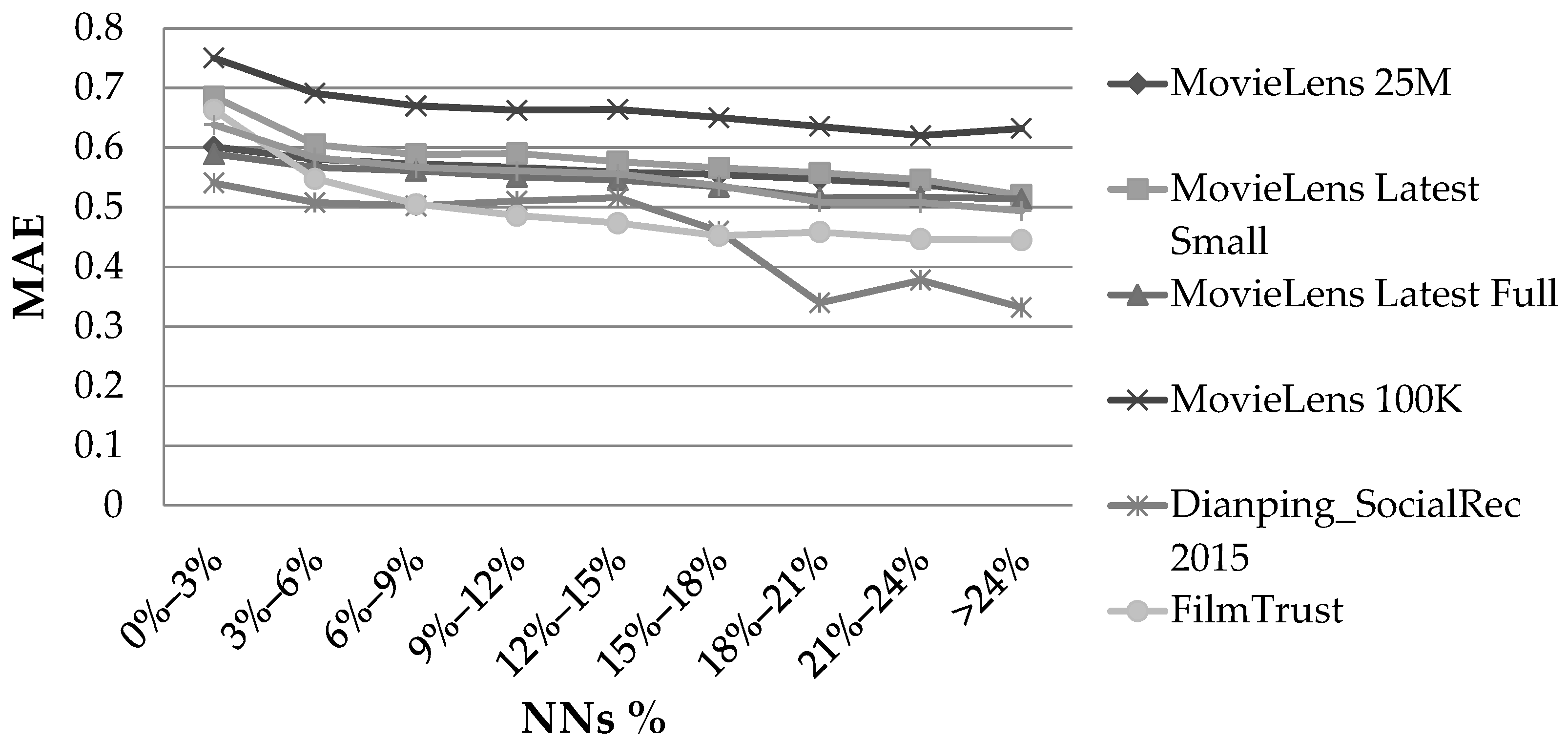
- The percentage of the active user U’s near neighbours (NNs) taking part in the rating prediction (NN%): for this feature, we examined values from 0% to 24%, with the increment step set to 3%;
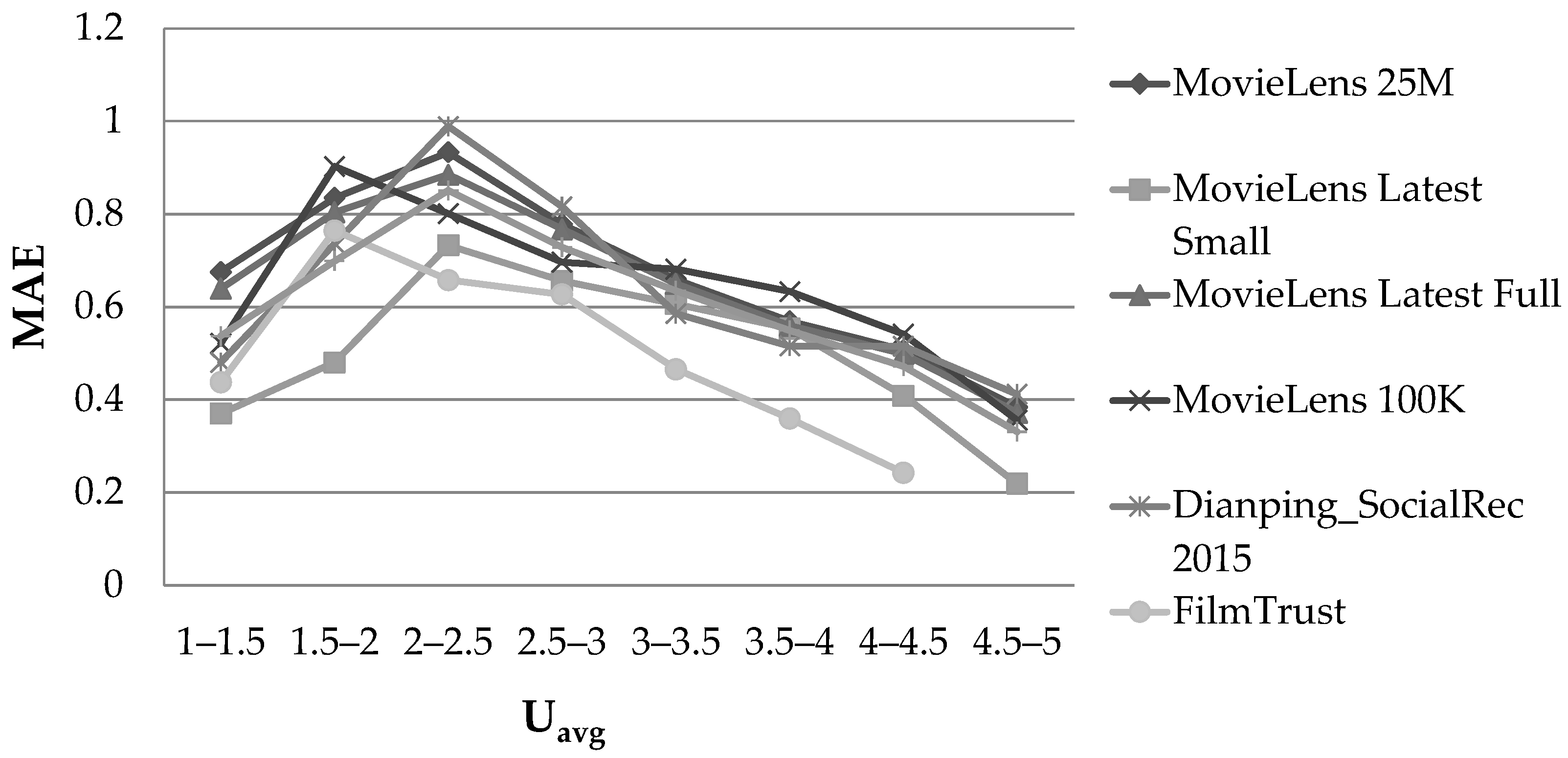
- The active user’s U average rating value (Uavg): for this feature, we examined the range from the minimum allowed rating value to the maximum allowed rating value in the dataset, with the increment step set to 0.5;
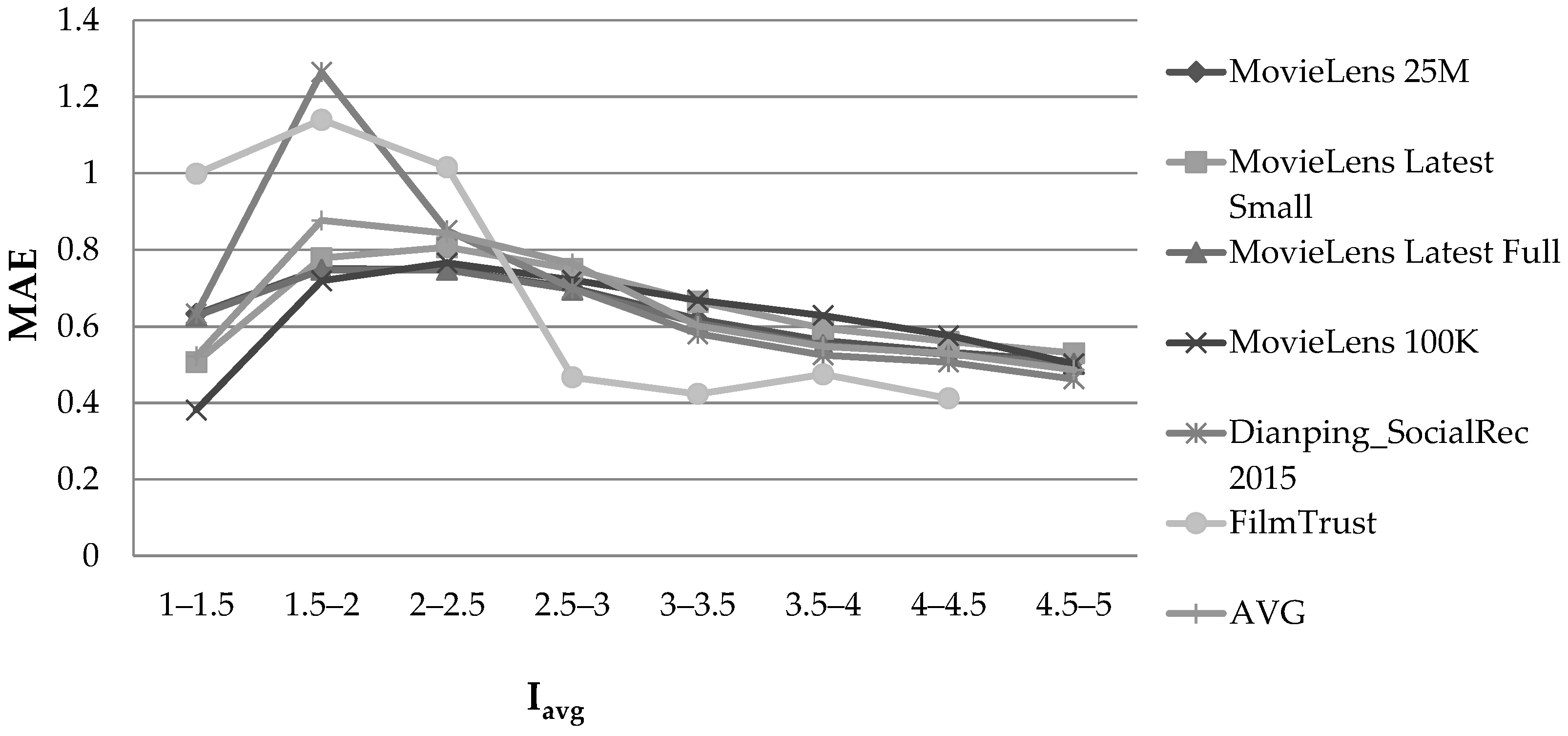
- The average rating value of the item for which the prediction is computed (Iavg): for this feature, we examined the range from the minimum allowed rating value to the maximum allowed rating value in the dataset, with the increment step set to 0.5;
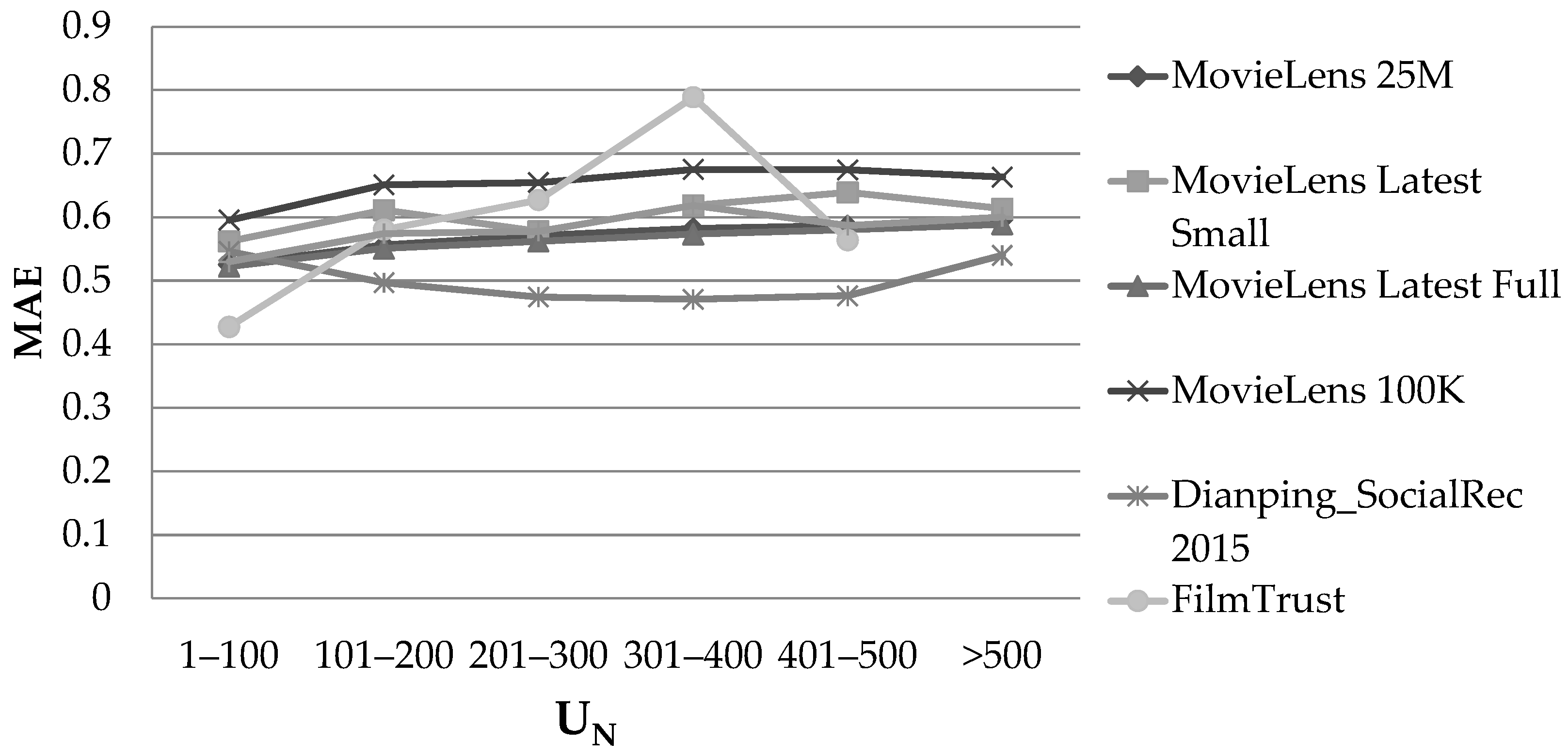
- The number of items that the active user U has rated (UN): for this feature, we examined values from 100 to 500, and an extra case of >500, with the increment step set to 100;
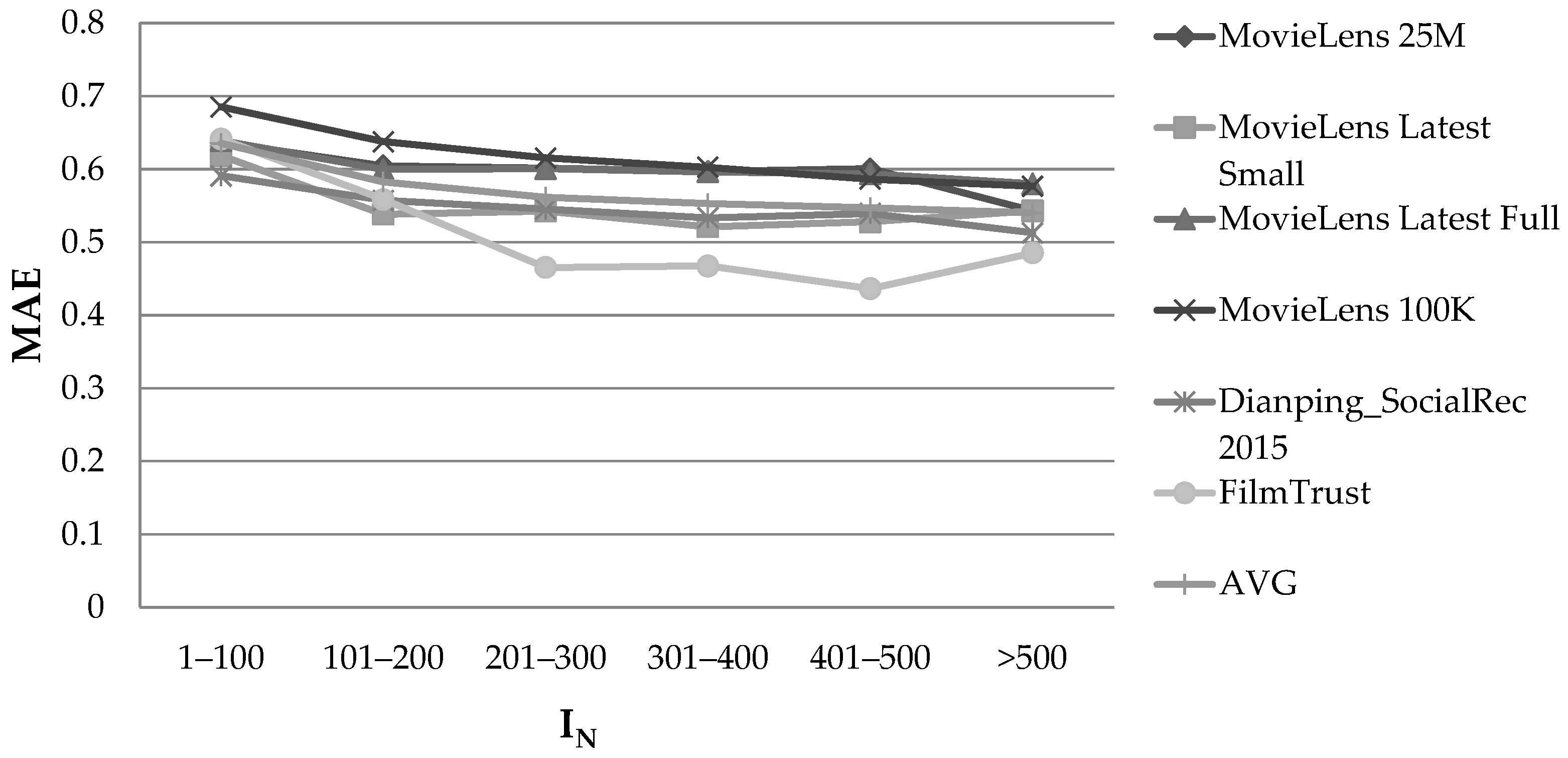
- The number of users that have rated item i for which the prediction is computed (IN): for this feature, we examined values from 100 to 500 and an extra case of >500, with the increment step set to 100;
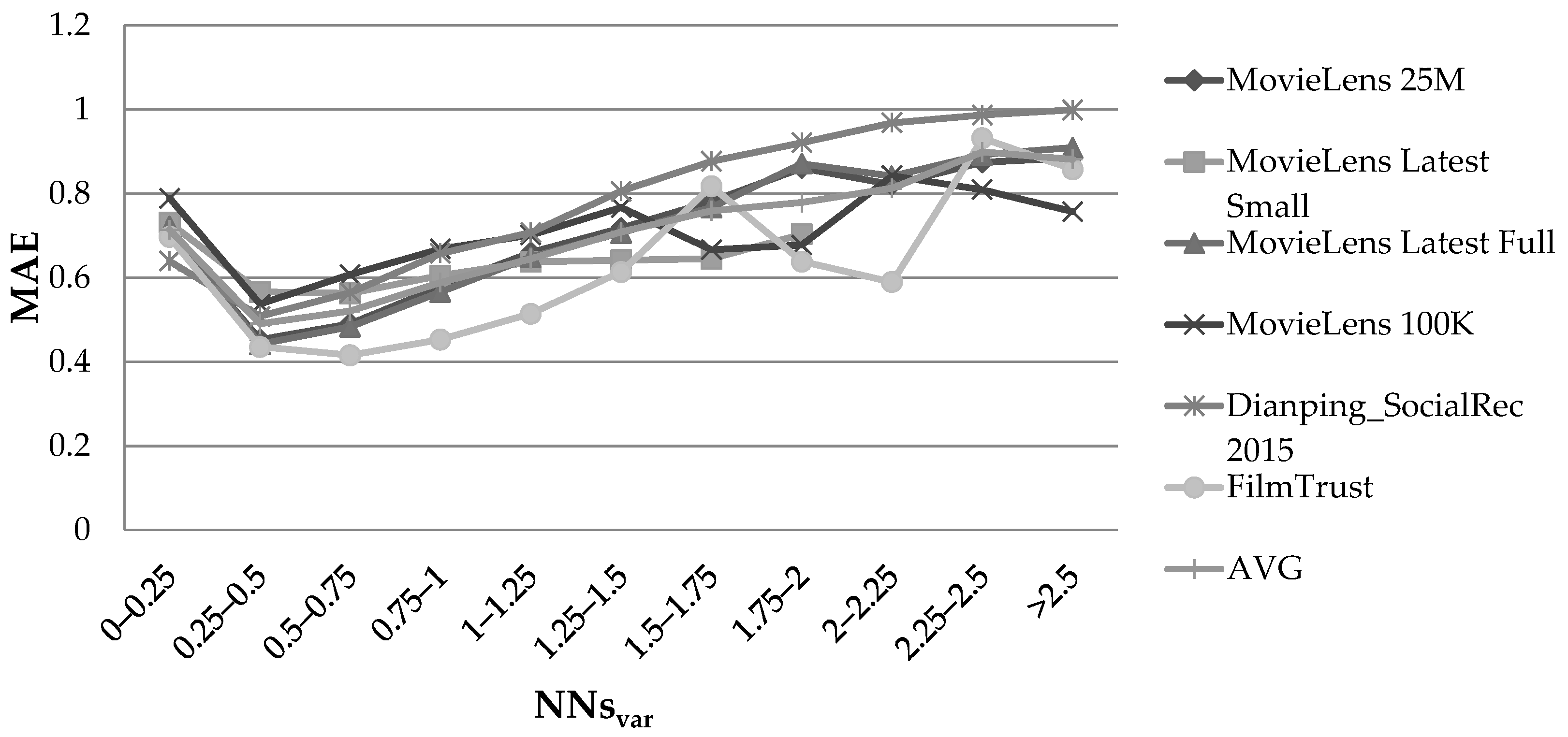
- The variance of the NNs’ ratings given to the item for which the prediction is computed (NNsvar): for this feature, we examined values from 0.0 to 2.5, and an extra case of >2.5 with the increment step set to 0.25.
- The mean average error (MAE) metric, which handles all errors uniformly;
- The root-mean-squared error (RMSE) metric, which boosts the significance of large deviations between the real user rating and the rating prediction produced by the CF system.
3.1. The NNs’ Percentage Taking Part in the Rating Prediction
3.2. Uavg Feature
3.3. Iavg Feature
3.4. UN Feature
3.5. IN Feature
3.6. NNsvar Feature
4. Discussion of the Results
- The percentage of the active user’s NNs taking part in the rating prediction was ≥15%: when taking into account ≥ 15% of a user’s NNs, the CF rating prediction was considered more sound, due to the fact that, as in real life, a recommendation based on many opinions bears a high success probability;
- The active user’s mean rating value was close to the limits of the rating range: it is much easier for a rating prediction system to predict the next rating of a user who almost always enters either excellent or bad ratings.
- The predicted item’s mean rating value was close to the limits of the rating range: it is much easier for a rating prediction system to predict the next rating for an item that is practically considered either widely acceptable or unacceptable.
- The variance of the user’s NNs’ ratings to the predicted item was relatively low (in the 0.25–0.75 range): it is easier for a rating prediction system to predict a rating for a user whose close people share similar opinions (either good or bad) for an item.
5. Conclusions and Future Work
Author Contributions
Funding
Institutional Review Board Statement
Informed Consent Statement
Data Availability Statement
Conflicts of Interest
References
- Lara-Cabrera, R.; González-Prieto, Á.; Ortega, F. Deep Matrix Factorization Approach for Collaborative Filtering Recommender Systems. Appl. Sci. 2020, 10, 4926. [Google Scholar] [CrossRef]
- Cui, Z.; Xu, X.; Xue, F.; Cai, X.; Cao, Y.; Zhang, W.; Chen, J. Personalized Recommendation System Based on Collaborative Filtering for IoT Scenarios. IEEE Trans. Serv. Comput. 2020, 13, 685–695. [Google Scholar] [CrossRef]
- Balabanović, M.; Shoham, Y. Fab: Content-Based, Collaborative Recommendation. Commun. ACM 1997, 40, 66–72. [Google Scholar] [CrossRef]
- Cechinel, C.; Sicilia, M.-Á.; Sánchez-Alonso, S.; García-Barriocanal, E. Evaluating Collaborative Filtering Recommendations inside Large Learning Object Repositories. Inf. Process. Manag. 2013, 49, 34–50. [Google Scholar] [CrossRef]
- Herlocker, J.L.; Konstan, J.A.; Terveen, L.G.; Riedl, J.T. Evaluating Collaborative Filtering Recommender Systems. ACM Trans. Inf. Syst. 2004, 22, 5–53. [Google Scholar] [CrossRef]
- Park, Y.; Park, S.; Jung, W.; Lee, S. Reversed CF: A Fast Collaborative Filtering Algorithm Using a k-Nearest Neighbor Graph. Expert Syst. Appl. 2015, 42, 4022–4028. [Google Scholar] [CrossRef]
- Sinha, B.B.; Dhanalakshmi, R. A Recommender System Based on a New Similarity Metric and Upgraded Crow Search Algorithm. IFS 2020, 39, 3167–3182. [Google Scholar] [CrossRef]
- Mazurowski, M.A. Estimating Confidence of Individual Rating Predictions in Collaborative Filtering Recommender Systems. Expert Syst. Appl. 2013, 40, 3847–3857. [Google Scholar] [CrossRef]
- Ning, H.; Dhelim, S.; Aung, N. PersoNet: Friend Recommendation System Based on Big-Five Personality Traits and Hybrid Filtering. IEEE Trans. Comput. Soc. Syst. 2019, 6, 394–402. [Google Scholar] [CrossRef]
- Hassan, T. Trust and Trustworthiness in Social Recommender Systems. In Proceedings of the Companion Proceedings of The 2019 World Wide Web Conference, San Francisco, CA, USA, 13–17 May 2019; pp. 529–532. [Google Scholar]
- He, R.; McAuley, J. Ups and Downs: Modeling the Visual Evolution of Fashion Trends with One-Class Collaborative Filtering. In Proceedings of the 25th International Conference on World Wide Web, International World Wide Web Conferences Steering Committee, Montréal, QC, Canada, 11 April 2016; pp. 507–517. [Google Scholar]
- Harper, F.M.; Konstan, J.A. The MovieLens Datasets: History and Context. ACM Trans. Interact. Intell. Syst. 2016, 5, 1–19. [Google Scholar] [CrossRef]
- Liu, H.; Hu, Z.; Mian, A.; Tian, H.; Zhu, X. A New User Similarity Model to Improve the Accuracy of Collaborative Filtering. Knowl.-Based Syst. 2014, 56, 156–166. [Google Scholar] [CrossRef]
- Zhang, P.; Zhang, Z.; Tian, T.; Wang, Y. Collaborative Filtering Recommendation Algorithm Integrating Time Windows and Rating Predictions. Appl. Intell. 2019, 49, 3146–3157. [Google Scholar] [CrossRef]
- Koren, Y.; Rendle, S.; Bell, R. Advances in Collaborative Filtering. In Recommender Systems Handbook; Ricci, F., Rokach, L., Shapira, B., Eds.; Springer: New York, NY, USA, 2022; pp. 91–142. ISBN 978-1-07-162196-7. [Google Scholar]
- Koren, Y. Factor in the Neighbors: Scalable and Accurate Collaborative Filtering. ACM Trans. Knowl. Discov. Data 2010, 4, 1–24. [Google Scholar] [CrossRef]
- Adamopoulos, P.; Tuzhilin, A. On Over-Specialization and Concentration Bias of Recommendations: Probabilistic Neighborhood Selection in Collaborative Filtering Systems. In Proceedings of the 8th ACM Conference on Recommender systems—RecSys ’14, Silicon Valley, CA, USA, 6–10 October 2014; pp. 153–160. [Google Scholar]
- Margaris, D.; Spiliotopoulos, D.; Vassilakis, C. Social Relations versus near Neighbours: Reliable Recommenders in Limited Information Social Network Collaborative Filtering for Online Advertising. In Proceedings of the 2019 IEEE/ACM International Conference on Advances in Social Networks Analysis and Mining, Vancouver British, BC, Canada, 27–30 August 2019; pp. 1160–1167. [Google Scholar]
- Verstrepen, K.; Goethals, B. Unifying Nearest Neighbors Collaborative Filtering. In Proceedings of the 8th ACM Conference on Recommender systems—RecSys ’14, Silicon Valley, CA, USA, 6–10 October 2014; pp. 177–184. [Google Scholar]
- Margaris, D.; Vassilakis, C.; Spiliotopoulos, D. On Producing Accurate Rating Predictions in Sparse Collaborative Filtering Datasets. Information 2022, 13, 302. [Google Scholar] [CrossRef]
- Yang, B.; Lei, Y.; Liu, J.; Li, W. Social Collaborative Filtering by Trust. IEEE Trans. Pattern Anal. Mach. Intell. 2017, 39, 1633–1647. [Google Scholar] [CrossRef]
- Yang, X.; Liang, C.; Zhao, M.; Wang, H.; Ding, H.; Liu, Y.; Li, Y.; Zhang, J. Collaborative Filtering-Based Recommendation of Online Social Voting. IEEE Trans. Comput. Soc. Syst. 2017, 4, 1–13. [Google Scholar] [CrossRef]
- Hu, G.-N.; Dai, X.-Y.; Qiu, F.-Y.; Xia, R.; Li, T.; Huang, S.-J.; Chen, J.-J. Collaborative Filtering with Topic and Social Latent Factors Incorporating Implicit Feedback. ACM Trans. Knowl. Discov. Data 2018, 12, 1–30. [Google Scholar] [CrossRef]
- Pereira, N.; Varma, S.L. Financial Planning Recommendation System Using Content-Based Collaborative and Demographic Filtering. In Smart Innovations in Communication and Computational Sciences; Panigrahi, B.K., Trivedi, M.C., Mishra, K.K., Tiwari, S., Singh, P.K., Eds.; Advances in Intelligent Systems and Computing; Springer: Singapore, 2019; Volume 669, pp. 141–151. ISBN 978-981-10-8967-1. [Google Scholar]
- Ghasemi, N.; Momtazi, S. Neural Text Similarity of User Reviews for Improving Collaborative Filtering Recommender Systems. Electron. Commer. Res. Appl. 2021, 45, 101019. [Google Scholar] [CrossRef]
- Zhou, Y.; Liu, L.; Zhang, Q.; Lee, K.; Palanisamy, B. Enhancing Collaborative Filtering with Multi-Label Classification. In Computational Data and Social Networks; Tagarelli, A., Tong, H., Eds.; Lecture Notes in Computer Science; Springer International Publishing: Cham, Switzerland, 2019; Volume 11917, pp. 323–338. ISBN 978-3-030-34979-0. [Google Scholar]
- Wang, X.; He, X.; Wang, M.; Feng, F.; Chua, T.-S. Neural Graph Collaborative Filtering. In Proceedings of the 42nd International ACM SIGIR Conference on Research and Development in Information Retrieval, Paris, France, 21–25 July 2019; pp. 165–174. [Google Scholar]
- Yu, X.; Peng, Q.; Xu, L.; Jiang, F.; Du, J.; Gong, D. A Selective Ensemble Learning Based Two-Sided Cross-Domain Collaborative Filtering Algorithm. Inf. Process. Manag. 2021, 58, 102691. [Google Scholar] [CrossRef]
- Ajaegbu, C. An Optimized Item-Based Collaborative Filtering Algorithm. J. Ambient. Intell. Human Comput. 2021, 12, 10629–10636. [Google Scholar] [CrossRef]
- Margaris, D.; Spiliotopoulos, D.; Vassilakis, C. Augmenting Black Sheep Neighbour Importance for Enhancing Rating Prediction Accuracy in Collaborative Filtering. Appl. Sci. 2021, 11, 8369. [Google Scholar] [CrossRef]
- Zarzour, H.; Al-Sharif, Z.; Al-Ayyoub, M.; Jararweh, Y. A New Collaborative Filtering Recommendation Algorithm Based on Dimensionality Reduction and Clustering Techniques. In Proceedings of the 2018 9th International Conference on Information and Communication Systems (ICICS), Irbid, Jordan, 3–5 April 2018; pp. 102–106. [Google Scholar]
- Faculty of Electrical & Computer Engineering, University of Kashan, Kashan, Isfahan, Iran; Neysiani, B.S.; Soltani, N.; Mofidi, R.; Nadimi-Shahraki, M.H. Improve Performance of Association Rule-Based Collaborative Filtering Recommendation Systems Using Genetic Algorithm. IJITCS 2019, 11, 48–55. [Google Scholar] [CrossRef]
- Chen, J.; Zhao, C.; Uliji; Chen, L. Collaborative Filtering Recommendation Algorithm Based on User Correlation and Evolutionary Clustering. Complex Intell. Syst. 2020, 6, 147–156. [Google Scholar] [CrossRef]
- Chen, V.X.; Tang, T.Y. Incorporating Singular Value Decomposition in User-Based Collaborative Filtering Technique for a Movie Recommendation System: A Comparative Study. In Proceedings of the 2019 the International Conference on Pattern Recognition and Artificial Intelligence—PRAI ’19, Wenzhou, China, 26–28 August 2019; pp. 12–15. [Google Scholar]
- Wu, C.-S.M.; Garg, D.; Bhandary, U. Movie Recommendation System Using Collaborative Filtering. In Proceedings of the 2018 IEEE 9th International Conference on Software Engineering and Service Science (ICSESS), Beijing, China, 23–25 November 2018; pp. 11–15. [Google Scholar]
- Alam, M.T.; Ubaid, S.; Shakil; Sohail, S.S.; Nadeem, M.; Hussain, S.; Siddiqui, J. Comparative Analysis of Machine Learning Based Filtering Techniques Using MovieLens Dataset. Procedia Comput. Sci. 2021, 194, 210–217. [Google Scholar] [CrossRef]
- Liu, G. An Ecommerce Recommendation Algorithm Based on Link Prediction. Alex. Eng. J. 2022, 61, 905–910. [Google Scholar] [CrossRef]
- Luo, S.; Yang, Y.; Zhang, K.; Sun, P.; Wu, L.; Hong, R. Self-Supervised Cross Domain Social Recommendation. In Proceedings of the 8th International Conference on Computing and Artificial Intelligence, Tianjin, China, 18–21 March 2022; pp. 286–292. [Google Scholar]
- Guo, G.; Zhang, J.; Thalmann, D.; Yorke-Smith, N. ETAF: An Extended Trust Antecedents Framework for Trust Prediction. In Proceedings of the 2014 IEEE/ACM International Conference on Advances in Social Networks Analysis and Mining (ASONAM 2014), Beijing, China, 17–20 August 2014; pp. 540–547. [Google Scholar]
- Li, H.; Liu, Y.; Mamoulis, N.; Rosenblum, D.S. Translation-Based Sequential Recommendation for Complex Users on Sparse Data. IEEE Trans. Knowl. Data Eng. 2020, 32, 1639–1651. [Google Scholar] [CrossRef]
- Li, H.; Wu, D.; Mamoulis, N. A Revisit to Social Network-Based Recommender Systems. In Proceedings of the 37th International ACM SIGIR Conference on Research & Development in Information Retrieval, Gold Coast, QLD, Australia, 6–11 July 2014; pp. 1239–1242. [Google Scholar]
- Daqing, H.; Wu, D. Toward a Robust Data Fusion for Document Retrieval. In Proceedings of the 2008 International Conference on Natural Language Processing and Knowledge Engineerin, Beijing, China, 19–22 October 2008; pp. 1–8. [Google Scholar]
- Wang, K.; Chen, Z.; Wang, Y.S.; Yang, Z.N. Feature Fusion Recommendation Algorithm Based on Collaborative Filtering. In Proceedings of the 2019 International Conference on Machine Learning, Big Data and Business Intelligence (MLBDBI), Taiyuan, China, 8–10 November 2019; pp. 176–180. [Google Scholar]
- Margaris, D.; Vassilakis, C. Improving Collaborative Filtering’s Rating Prediction Quality by Considering Shifts in Rating Practices. In Proceedings of the 2017 IEEE 19th Conference on Business Informatics (CBI), Thessaloniki, Greece, 24–27 July 2017; pp. 158–166. [Google Scholar]
- Manochandar, S.; Punniyamoorthy, M. A New User Similarity Measure in a New Prediction Model for Collaborative Filtering. Appl. Intell. 2021, 51, 586–615. [Google Scholar] [CrossRef]
- Candillier, L.; Meyer, F.; Boullé, M. Comparing State-of-the-Art Collaborative Filtering Systems. Machine Learning and Data Mining in Pattern RecognitionPerner, P., Ed.; Lecture Notes in Computer ScienceSpringer: Berlin, Heidelberg, 2007; Volume 4571, pp. 548–562. ISBN 978-3-540-73498-7. [Google Scholar]
- Candillier, L.; Meyer, F.; Fessant, F. Designing Specific Weighted Similarity Measures to Improve Collaborative Filtering Systems. In Advances in Data Mining. Medical Applications, E-Commerce, Marketing, and Theoretical Aspects; Perner, P., Ed.; Lecture Notes in Computer Science; Springer: Berlin, Heidelberg, 2008; Volume 5077, pp. 242–255. ISBN 978-3-540-70717-2. [Google Scholar]
- Kai, Y.; Schwaighofer, A.; Tresp, V.; Xiaowei, X.; Kriegel, H. Probabilistic Memory-Based Collaborative Filtering. IEEE Trans. Knowl. Data Eng. 2004, 16, 56–69. [Google Scholar] [CrossRef]
- Wang, J.; Lin, K.; Li, J. A Collaborative Filtering Recommendation Algorithm Based on User Clustering and Slope One Scheme. In Proceedings of the 2013 8th International Conference on Computer Science & Education, Colombo, Sri Lanka, 26–28 April 2013; pp. 1473–1476. [Google Scholar]
- Pal, B.; Jenamani, M. Trust Inference Using Implicit Influence and Projected User Network for Item Recommendation. J. Intell. Inf. Syst. 2019, 52, 425–450. [Google Scholar] [CrossRef]
- Yazdanfar, N.; Thomo, A. LINK RECOMMENDER: Collaborative-Filtering for Recommending URLs to Twitter Users. Procedia Comput. Sci. 2013, 19, 412–419. [Google Scholar] [CrossRef][Green Version]
- Ronen, R.; Yom-Tov, E.; Lavee, G. Recommendations Meet Web Browsing: Enhancing Collaborative Filtering Using Internet Browsing Logs. In Proceedings of the 2016 IEEE 32nd International Conference on Data Engineering (ICDE), Helsinki, Finland, 16–20 May 2016; pp. 1230–1238. [Google Scholar]
- Molinaro, A.M.; Simon, R.; Pfeiffer, R.M. Prediction Error Estimation: A Comparison of Resampling Methods. Bioinformatics 2005, 21, 3301–3307. [Google Scholar] [CrossRef] [PubMed]
- Konstan, J.A.; Miller, B.N.; Maltz, D.; Herlocker, J.L.; Gordon, L.R.; Riedl, J. GroupLens: Applying Collaborative Filtering to Usenet News. Commun. ACM 1997, 40, 77–87. [Google Scholar] [CrossRef]
- Goldberg, D.; Nichols, D.; Oki, B.M.; Terry, D. Using Collaborative Filtering to Weave an Information Tapestry. Commun. ACM 1992, 35, 61–70. [Google Scholar] [CrossRef]
- Li, J.; Wang, Y.; McAuley, J. Time Interval Aware Self-Attention for Sequential Recommendation. In Proceedings of the 13th International Conference on Web Search and Data Mining, Houston TX, USA, 3–7 February 2020; pp. 322–330. [Google Scholar]
- Margaris, D.; Spiliotopoulos, D.; Vassilakis, C.; Vasilopoulos, D. Improving Collaborative Filtering’s Rating Prediction Accuracy by Introducing the Experiencing Period Criterion. Neural Comput. Applic. 2020. [Google Scholar] [CrossRef]



| Term/Notation | Definition |
|---|---|
| Near neighbour (NN) | An NN of user u is another user v who shares similar likings with u |
| PCC | Pearson correlation coefficient |
| CS | Cosine similarity |
| MAE | Mean absolute error |
| RMSE | Root mean square error |
| Uavg | The average rating value of the user for whom the prediction is formulated |
| Iavg | The average rating value for the item for which the prediction is formulated |
| UN | The number of ratings entered by the user for whom the prediction is formulated |
| IN | The number of ratings that have been entered for the item for which the prediction is formulated |
| NNsvar | The variance of the NNs’ ratings given to the item for which the prediction is formulated |
| Dataset # | Dataset Name | Density | #Users | #Items | #Ratings |
|---|---|---|---|---|---|
| 1 | MovieLens 25 M “recommended for new research” | 0.24% | 162 K | 62 K | 25 M |
| 2 | MovieLens Latest Small “recommended for education and development” | 1.85% | 600 | 9 K | 100 K |
| 3 | MovieLens Latest Full “recommended for education and development” | 0.17% | 280 K | 58 K | 27 M |
| 4 | MovieLens 100 K | 5.88% | 1 K | 1.7 K | 100 K |
| 5 | Dianping_SocialRec 2015 | 0.13% | 148 K | 11 K | 2.1 M |
| 6 | FilmTrust | 1.14% | 1.5 K | 2 K | 35.5 K |
Publisher’s Note: MDPI stays neutral with regard to jurisdictional claims in published maps and institutional affiliations. |
© 2022 by the authors. Licensee MDPI, Basel, Switzerland. This article is an open access article distributed under the terms and conditions of the Creative Commons Attribution (CC BY) license (https://creativecommons.org/licenses/by/4.0/).
Share and Cite
Spiliotopoulos, D.; Margaris, D.; Vassilakis, C. On Exploiting Rating Prediction Accuracy Features in Dense Collaborative Filtering Datasets. Information 2022, 13, 428. https://doi.org/10.3390/info13090428
Spiliotopoulos D, Margaris D, Vassilakis C. On Exploiting Rating Prediction Accuracy Features in Dense Collaborative Filtering Datasets. Information. 2022; 13(9):428. https://doi.org/10.3390/info13090428
Chicago/Turabian StyleSpiliotopoulos, Dimitris, Dionisis Margaris, and Costas Vassilakis. 2022. "On Exploiting Rating Prediction Accuracy Features in Dense Collaborative Filtering Datasets" Information 13, no. 9: 428. https://doi.org/10.3390/info13090428
APA StyleSpiliotopoulos, D., Margaris, D., & Vassilakis, C. (2022). On Exploiting Rating Prediction Accuracy Features in Dense Collaborative Filtering Datasets. Information, 13(9), 428. https://doi.org/10.3390/info13090428