
Image Watermarking Approach Using a Hybrid Domain Based on Performance Parameter Analysis




Abstract
1. Introduction
2. Literature Review
Comparison of Existing Methods
3. Proposed Methodology
| Algorithm 1: Embedding Algorithm |
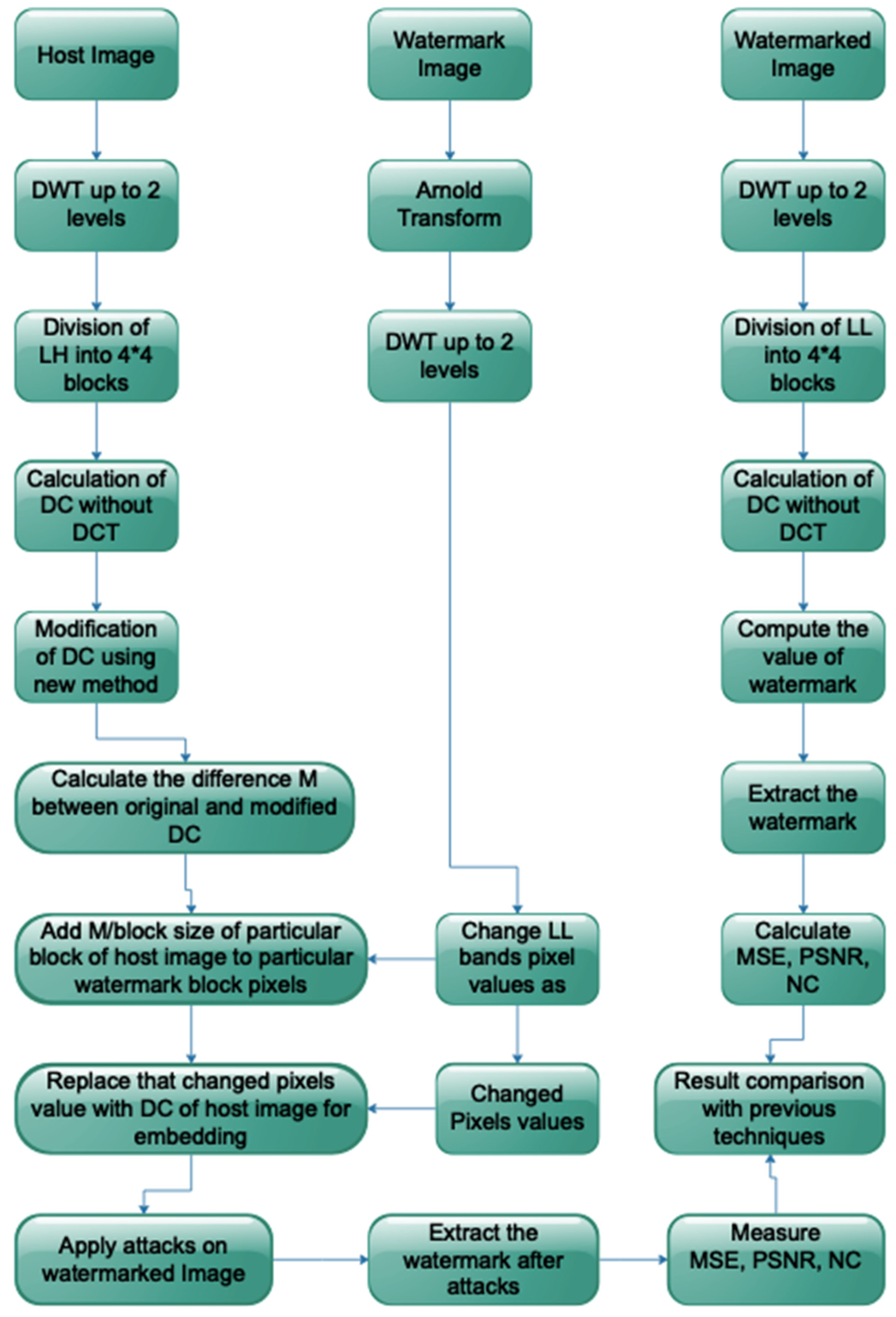
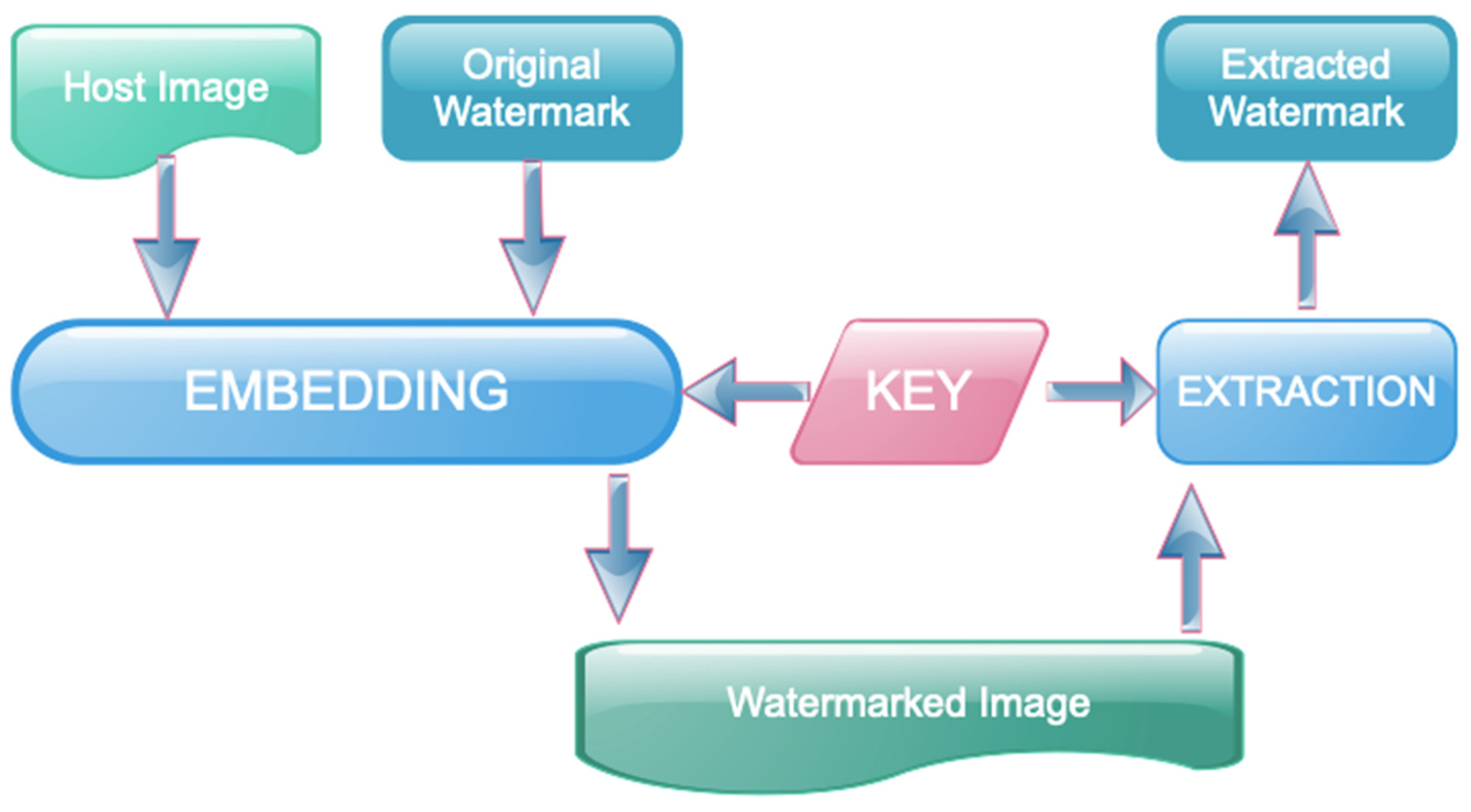
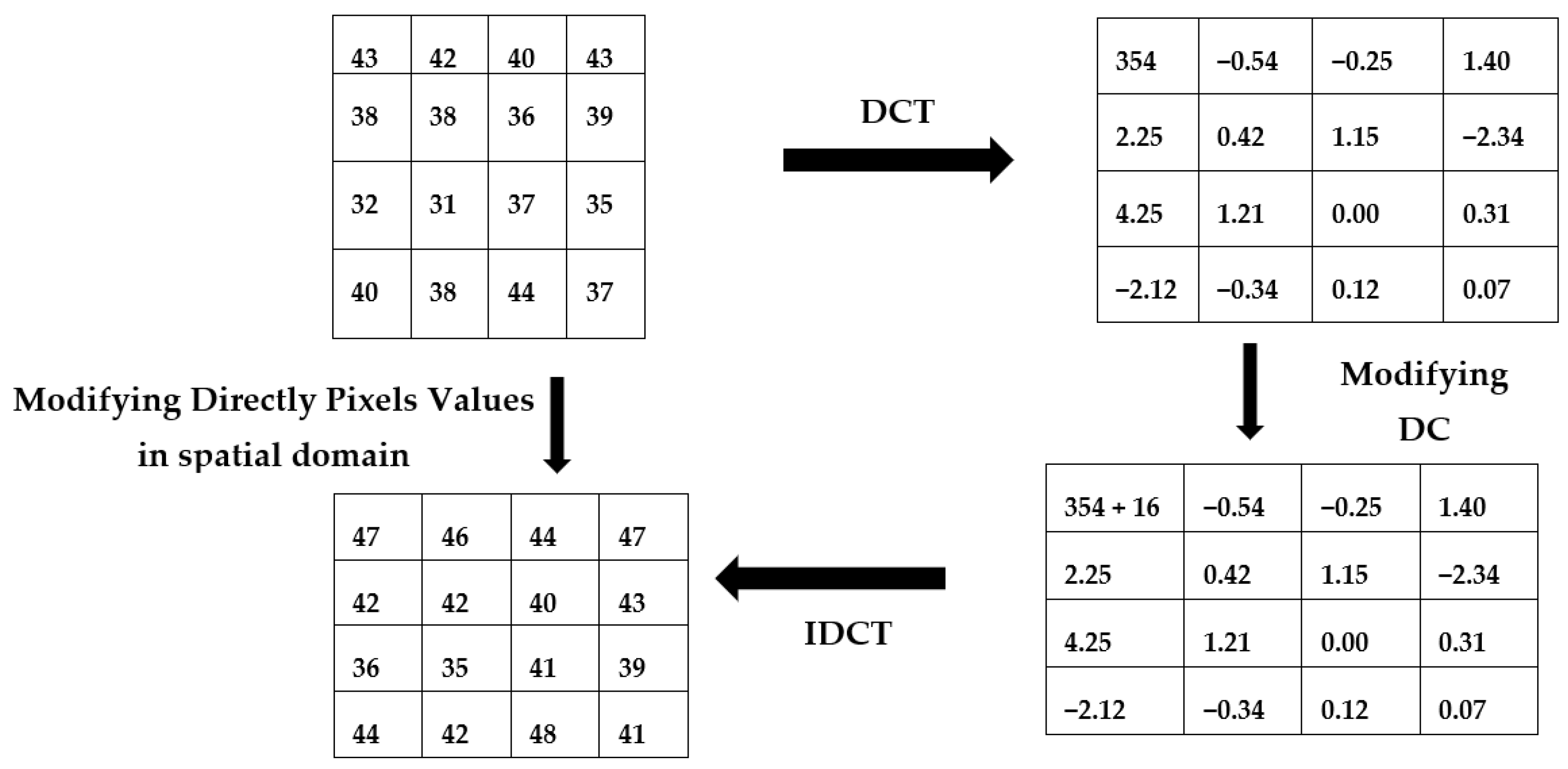
| Step 1—Apply Arnold Transform on the watermarked image. Step 2—Apply DWT up to two levels on the host image and take the LH band. Step 3—Apply DWT up to two levels on the watermark image and take the LL band of the watermark image to embed into the LH band. Step 4—Divide the LH band into 4 × 4 bands. Step 5—Find the DC coefficient c (0,0) of each block by summing up the pixels values of a particular block. Step 6—According to the watermark information, find the magnitudes as: If w = 0 T1 = −0.5∆, T2 = 1.5∆ If w = 1 T1 = 0.5∆, T2 = 1.5∆ where ∆ = block size = 4 Step 7—Find the quantization step as C1 and C2 using T1 and T2 as: C1 = αk∆ + T1 C2 = αk∆ + T2 where α = constant value Step 8—Modify the DC coefficient c’s of each block for embedding in the DC coefficient as follows: c’ (0,0) = C2 if abs c(0,0) − c2 < abs c(0,0) − c1 =C1 else Step 9—Find difference M as: M = c’i, j (0, 0) − ci, j (0, 0) Step 10—Add M/4 to each pixel block in the watermark and then replace the particular block’s DC’s value with these values for embedding. Step 11—Repeat steps 5–10 until all blocks are processed and DC‘s are modified and embedded. |
| Algorithm 2: Extraction Algorithm |
| Step 1—Apply DWT up to two levels on the watermarked image. Step 2—Find the DC coefficient c (0, 0) of each block by summing up the pixels values of a particular block. Step 3—Using quantization steps ∆, compute w’ (i, j): w’ (i, j) = mod (ceil((c(0,0))/∆),α) Step 4—Extract the watermark by applying an Inverse Arnold Transform. |
4. Experimental Results
4.1. Embedding and Extraction of 512 × 512-Host Image and 64 × 64 Watermark
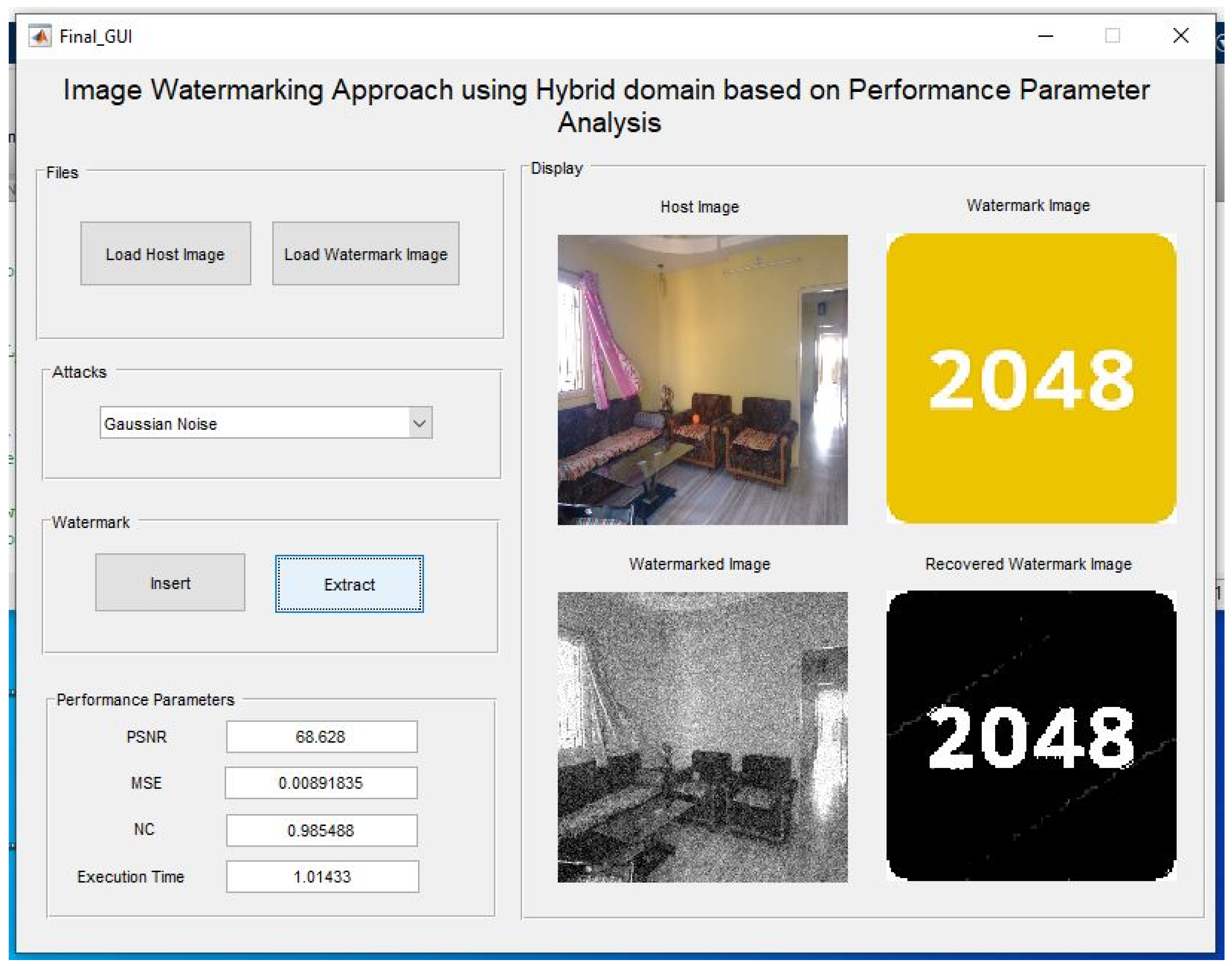
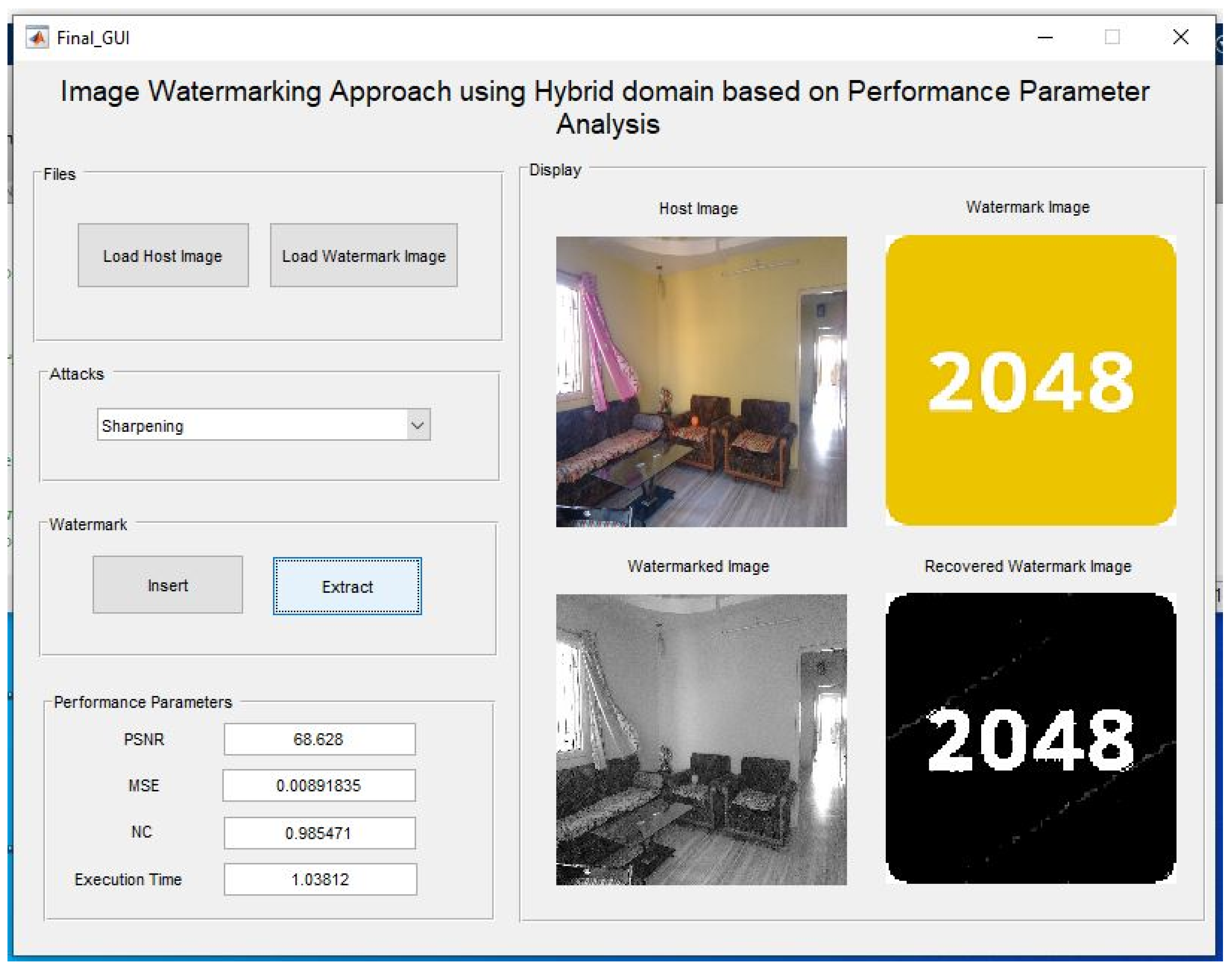
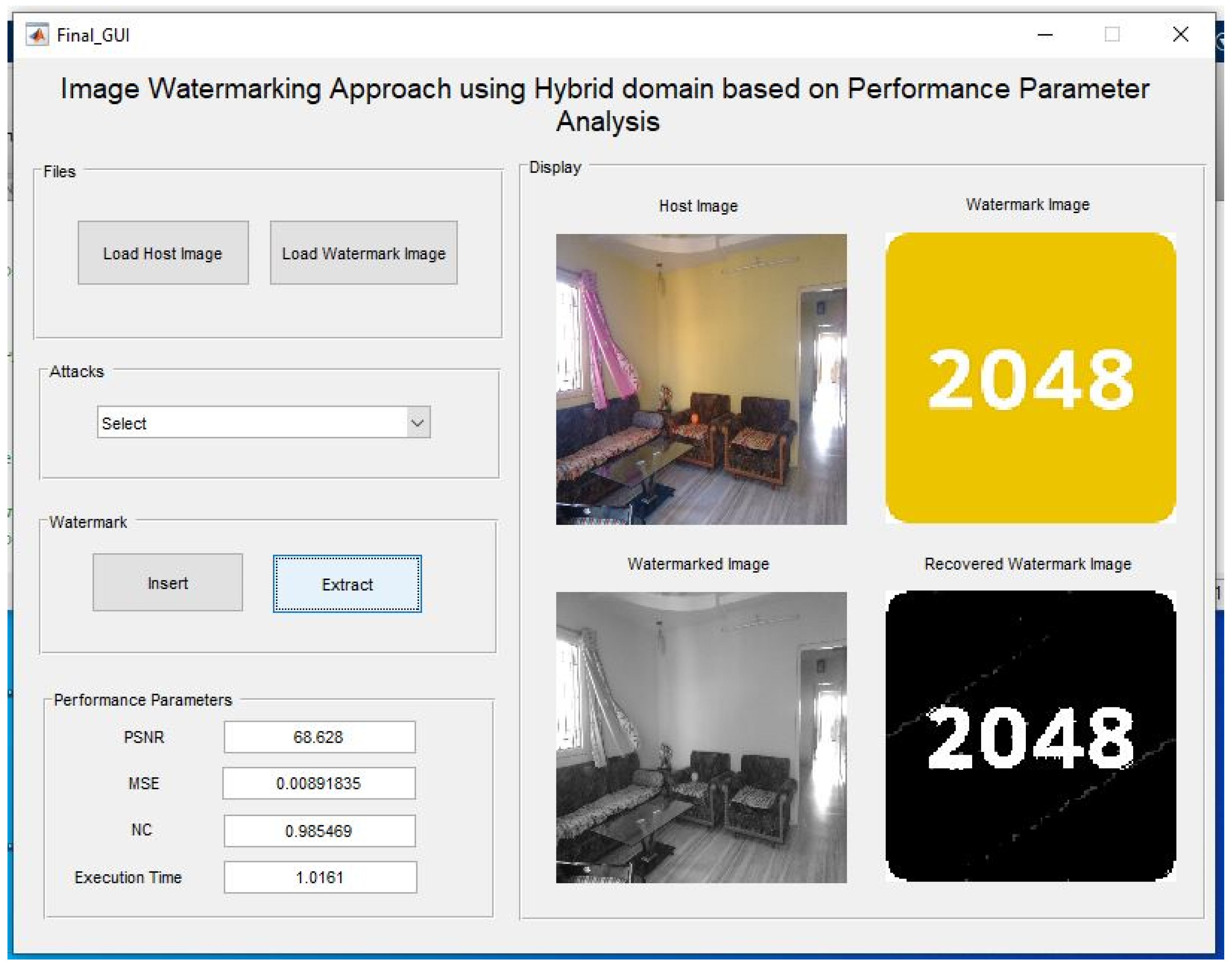
4.2. Embedding and Extraction for a Real-Time Host Image Size of 1200 × 1200
5. Results Analysis
6. Conclusions and Future Enhancement
Author Contributions
Funding
Data Availability Statement
Conflicts of Interest
Abbreviations
| DCT | Discrete Cosine Transform |
| IDCT | Inverse Discrete Cosine Transform |
| DWT | Discrete Wavelet Transform |
| RDWT | Redundant Discrete Wavelet Transform |
| PSNR | Peak Signal to Noise Ratio |
| MSE | Mean Square Error |
| NC | Normalized Correlation |
| DC Component | Direct Current (Average of Pixel Values) |
| CDMA | Code Division Multiple Access |
| RGB | Red–Green–Blue |
| LSB | Least Significant Bit |
| SVD | Singular Value Decomposition |
| LL Band | Approximate image of the input image (Low-Frequency Sub band) |
| LH | Horizontal features of Original Image |
| HL | Vertical features of Original Image |
| HH | Diagonal features of Original Image |
References
- Mane, G.V.; Chiddarwar, G.G. Review Paper on Video Watermarking Techniques. Int. J. Sci. Res. Publ. 2013, 3, 1–5. [Google Scholar]
- Chen, T.P.C.; Chen, T. Progressive image watermarking. In Proceedings of the 2000 IEEE International Conference on Multimedia and Expo, New York, NY, USA, 30 July–2 August 2000; IEEE: Piscataway, NJ, USA, 2000; Volume 2, pp. 1025–1028. [Google Scholar]
- Lee, J.C. Analysis of attacks on common watermarking techniques. IEEE Electr. Comput. Eng. 2017, 1, 1–7. [Google Scholar]
- Khalili, M.; Asatryan, D. Color spaces effects on improved discrete wavelet transform-based digital image watermarking using Arnold transform map. IET Signal Process. 2013, 7, 177–187. [Google Scholar] [CrossRef]
- Kumar, N.; Kalpana, V. Novel Reversible Steganography Method using Dynamic Key Generation for Medical Images. Indian J. Sci. Technol. 2015, 8, 61–74. [Google Scholar] [CrossRef][Green Version]
- Islam, S.M.; Debnath, R.; Hossain, S.A. DWT Based Digital Watermarking Technique and its Robustness on Image Rotation, Scaling, JPEG compression, Cropping and Multiple Watermarking. In Proceedings of the 2007 International Conference on Information and Communication Technology, Dhaka, Bangladesh, 7–9 March 2007; IEEE: Piscataway, NJ, USA, 2007; pp. 7–9. [Google Scholar]
- Liu, X. Fractional krawtchouk transforms with an application to image watermarking. IEEE Trans. Signal Process. 2017, 65, 1894–1908. [Google Scholar] [CrossRef]
- Srivastava, R.; Srivastava, P. A multimodal-based approach for face and unique mark based combination for confirmation of human. Int. J. Bus. Anal. 2019, 6, 16–28. [Google Scholar] [CrossRef]
- Agarwal, H.; Sen, D.; Raman, B.; Kankanhalli, M. Visible watermarking based on importance and just noticeable distortion of image regions. Multimed. Tools Appl. 2016, 75, 7605–7629. [Google Scholar] [CrossRef]
- Lin, S.D.; Chen, C.F. A Robust DCT-Based Watermarking for Copyright Protection. IEEE Trans. Consum. Electron. 2000, 8, 415–421. [Google Scholar] [CrossRef]
- Singh, A.K.; Sharma, N.; Dave, M.; Mohan, A. A novel technique for digital image watermarking in spatial domain. In Proceedings of the 2nd IEEE International Conference on Parallel, Distributed and Grid Computing, Solan, India, 30 April 2012. [Google Scholar]
- Wang, S. A novel DIBR 3D image watermarking algorithm resist to geometrical attacks. Chin. J. Electron. 2017, 26, 1184–1193. [Google Scholar] [CrossRef]
- Srivastava, R. Score-Level Multimodal Biometric Authentication of Humans Using Retina, Fingerprint, and Finger vein. IJAEC 2020, 11, 1–16. [Google Scholar]
- Versaci, M.; Morabito, F.C.; Angiulli, G. Adaptive Image Contrast Enhancement by Computing Distances into a 4-Dimensional Fuzzy Unit Hypercube. IEEE Access 2017, 5, 26922–26931. [Google Scholar] [CrossRef]
- Simi, V.R.; Edla, D.R.; Joseph, J.; Kuppili, V. Parameter-free fuzzy histogram equalization with illumination preserving characteristics dedicated for contrast enhancement of magnetic resonance images. Appl. Soft Comput. 2020, 93, 106364. [Google Scholar] [CrossRef]
- Asikuzzaman, M.; Alam, M.; Lambert, A.; Pickering, M. Imperceptible and Robust Blind Video Watermarking using Chrominance Embedding: A Set of Approaches in the DT CWT Domain. IEEE Trans. Inf. Forensics Secur. 2014, 9, 1502–1517. [Google Scholar] [CrossRef]
- Budiman, G.; Novamizanti, L.; Iwut, I. Genetics algorithm optimization of DWT-DCT based image Watermarking. J. Phys. 2017, 795, 012–039. [Google Scholar] [CrossRef]
- Khan, A.; Siddiqa, A.; Munib, S.; Malik, S.A. A recent survey of reversible watermarking techniques. Inf. Sci. 2014, 279, 251–272. [Google Scholar] [CrossRef]
- Qingtang, S. Robust color image watermarking technique in the spatial domain. Soft Comput. 2018, 22, 91–106. [Google Scholar] [CrossRef]
- Surbhi, A.M.; Rajesh, K. A Survey on Image Watermarking Techniques. Int. J. Sci. Emerg. Technol. Latest Trends (IJSETT) 2014, 1, 22–26. [Google Scholar]
- Jia, S.L. A novel blind color images watermarking based on SVD. Elsevier Int. J. Light Electron Opt. 2014, 125, 2868–2874. [Google Scholar] [CrossRef]
- Anjum, S.R.; Verma, P. Performance evaluation of DWT based image watermarking using error correcting codes. Int. J. Advanc. Comput. Res. 2012, 2, 151–156. [Google Scholar]
- Devi, B.P.; Singh, K.M.; Roy, S. Dual Image Watermarking Scheme based on Singular Value Decomposition and Visual Cryptography in Discrete Wavelet Transform. Int. J. Comput. Appl. 2012, 50, 6–13. [Google Scholar]
- Ramalingam, M. A Steganography Approach over Video Images to Improve Security. Indian J. Sci. Technol. 2015, 8, 79–86. [Google Scholar] [CrossRef][Green Version]
- Chopra, D.; Gupta, P.; Sanjay, G.; Gupta, A. LSB Based Digital Watermarking Technique. Int. J. Appl. 2014, 3, 2319–4847. [Google Scholar]
- Shen, X.F.; Ma, X.H. A Watermarking Algorithm for Digital Image Based on DCT and SVD. In Proceedings of the Congress on Image and Signal Processing, Sanya, China, 27–30 May 2008. [Google Scholar]
- Cerkezi, L.; Çetinel, G. RDWT and SVD based secure digital image watermarking using ACM. In Proceedings of the 24th Signal Processing and Communication Application Conference (SIU), Zonguldak, Turkey, 16–19 May 2016. [Google Scholar]
- Chang, C.C.; Tsai, P.; Lin, C.C. SVD-based digital image watermarking scheme. Pattern Recognit. Lett. 2005, 26, 1577–1586. [Google Scholar] [CrossRef]
- Arora, S.M. A DWT-SVD based Robust Digital Watermarking for Digital Images. Procedia Comput. Sci. 2018, 132, 1441–1448. [Google Scholar]
- Joseph, A.; Anusudha, K. Robust watermarking based on DWT SVD. Int. J. Signal Image Process. 2013, 1, 147–164. [Google Scholar]
- Rahman, M. A dwt, dct and svd based watermarking technique to protect the image piracy. Int. J. Manag. Public Sect. Inform. Commun. Techn. (IJMPICT) 2013, 4, 1–12. [Google Scholar] [CrossRef]











| No | Methods | Input Image Size | Water Mark Image Size | Attacks | PSNR | NC | MSE |
|---|---|---|---|---|---|---|---|
| 1 | LSB [25] based method | 512 × 512 | 256 × 256 | Speckle, Gaussian noise, Salt & Pepper noise | 193.72 | 0.59 | 190.94 |
| 2 | DWT-DCT based method [17] | 512 × 512 | 32 × 32 | Without attack | 36.52 | 1 | 14.49 |
| AWG noise | 30.21 | 1 | 61.9 | ||||
| 3 | COX [22] method | 512 × 512 | 32 × 32 | AWG noise | 27.19 | Near to 1 | 24.27 |
| 4 | CDMA [20] based watermarking DWT in different color space | 512 × 512, Leena | 15 × 64 | Without attack | 67 | 1 | - |
| Salt & Pepper, Gaussian noise JPEG | 67 DB | 0.99 | |||||
| 5 | Combined method [26] | 512 × 512 | 64 × 64 | Low pass & high pass filtering, Rotation, Shearing, noise, JPEG-2000 | - | 1 except in case of scaling & rotation | 0% |
| 6 | RDWT + SVD [27] | 512 × 512 | 512 × 512 | Noise, filtering, scaling, translation | - | +1, 0, −1 | - |
| 7 | SVD [28] | Two 24 bit color images, 512 × 512 | 32 × 32 | Without attacks | - | Near to 1 | 131.01 |
| Filtering, Noise, Rotation, Compression | Near to 1 | 151.87 | |||||
| 8 | DWT [29] | 512 × 512 | 128 × 128 | JPEG, Noise, Rotation, Re watermark, Cropping | 171.09 | Min-0.70 | - |
| Max-0.99 | |||||||
| 9 | SVD [30] + | 512 × 512 | 64 × 64 | Noise, filtering, scaling, translation, Blurring | 64.57 | 0.96 (averaged) | - |
| 10 | DCT + DWT + SVD [31] | 512 × 512 | 128 × 128 | JPEG, Noise, Rotation, Re-watermarking, Cropping | 45.77 | 0.9983 | - |
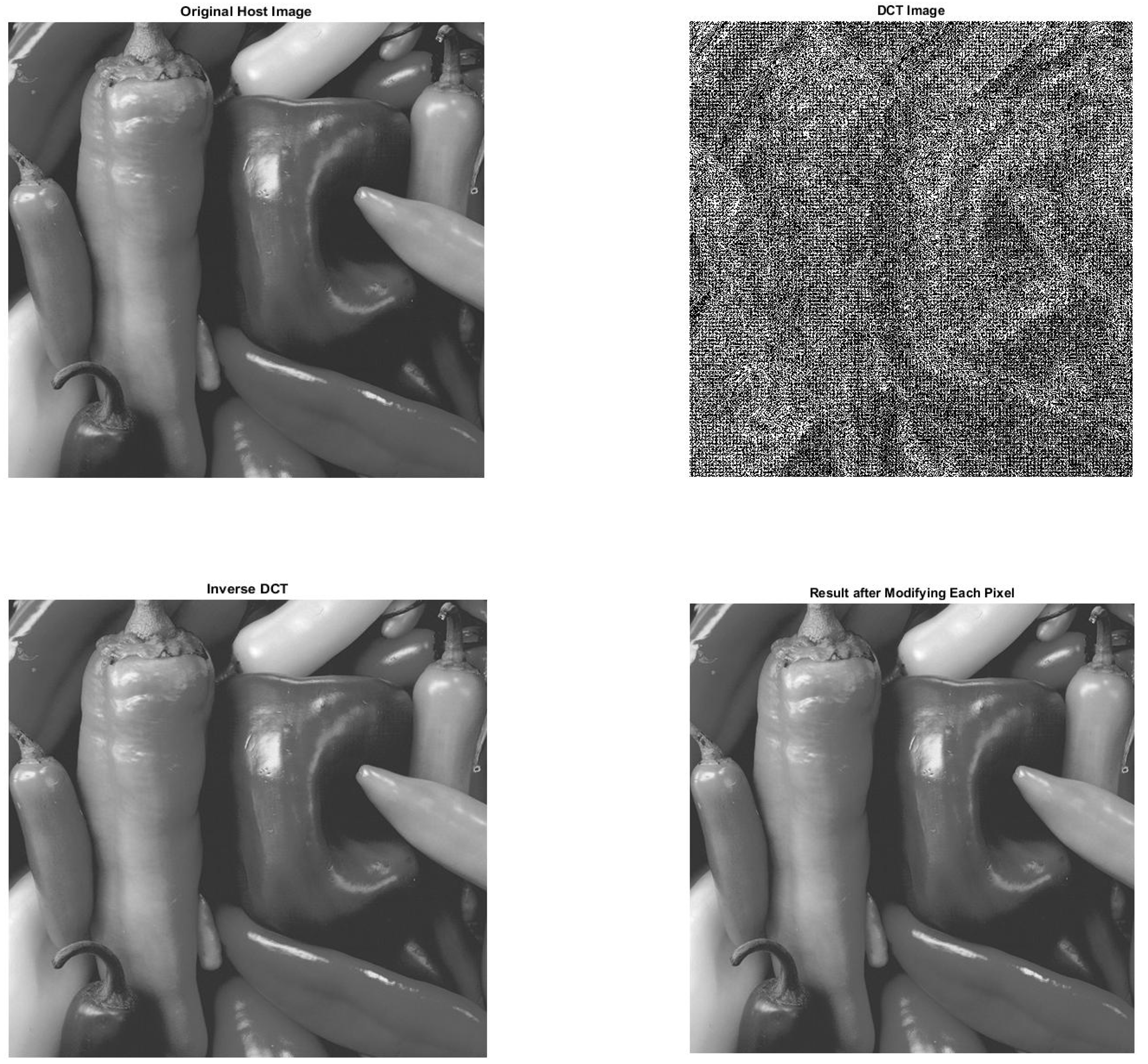
| Block Image{1,1}, 4 × 4 Double | ||||
|---|---|---|---|---|
| Pixel | 1 | 2 | 3 | 4 |
| 1 | 49 | 49 | 47 | 51 |
| 2 | 47 | 50 | 52 | 52 |
| 3 | 50 | 49 | 51 | 53 |
| 4 | 49 | 54 | 51 | 47 |
| Resulted Image1, 512 × 512 uInt8 | ||||
|---|---|---|---|---|
| Pixel | 1 | 2 | 3 | 4 |
| 1 | 53 | 53 | 51 | 55 |
| 2 | 51 | 50 | 52 | 52 |
| 3 | 54 | 49 | 51 | 53 |
| 4 | 53 | 54 | 51 | 47 |
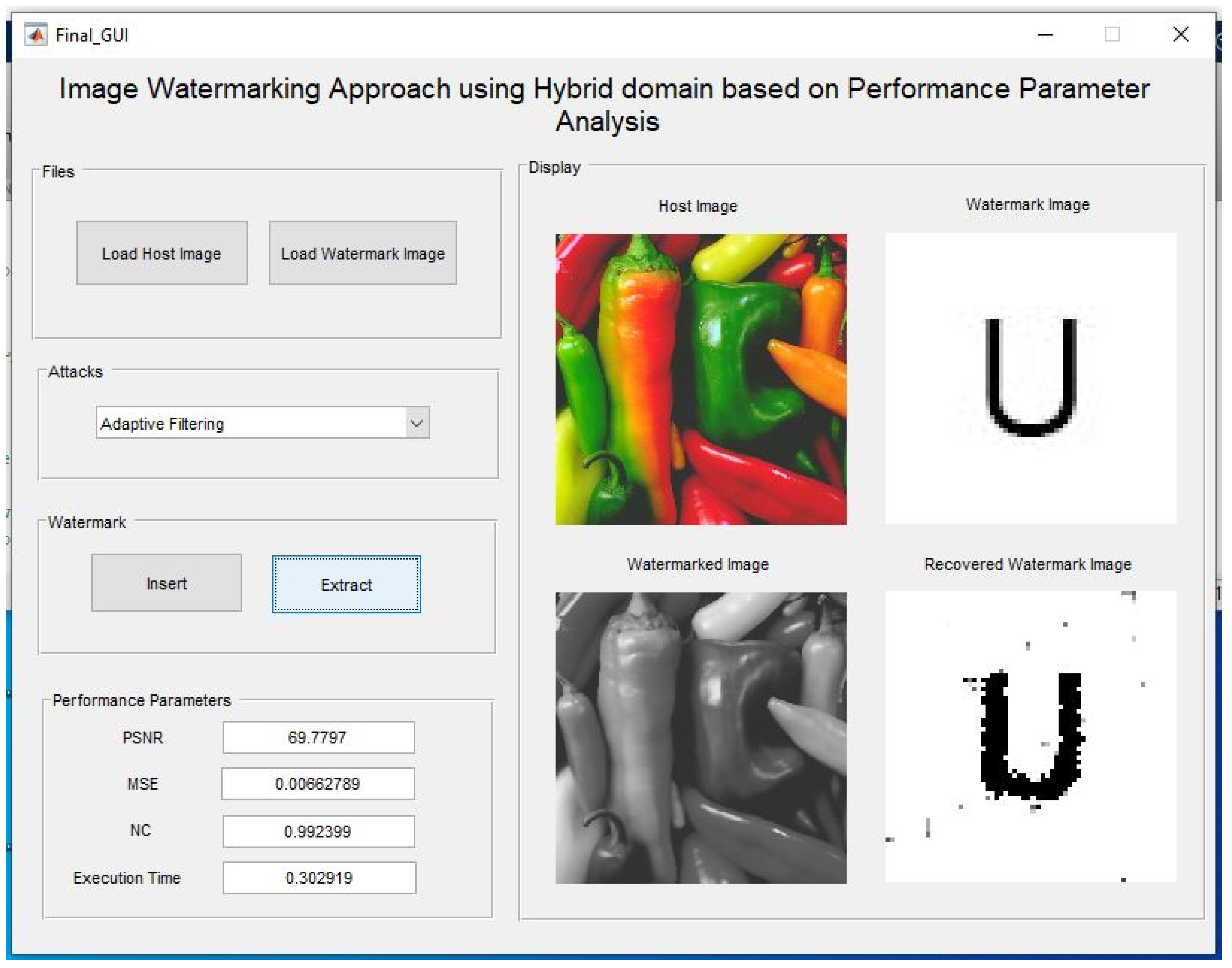
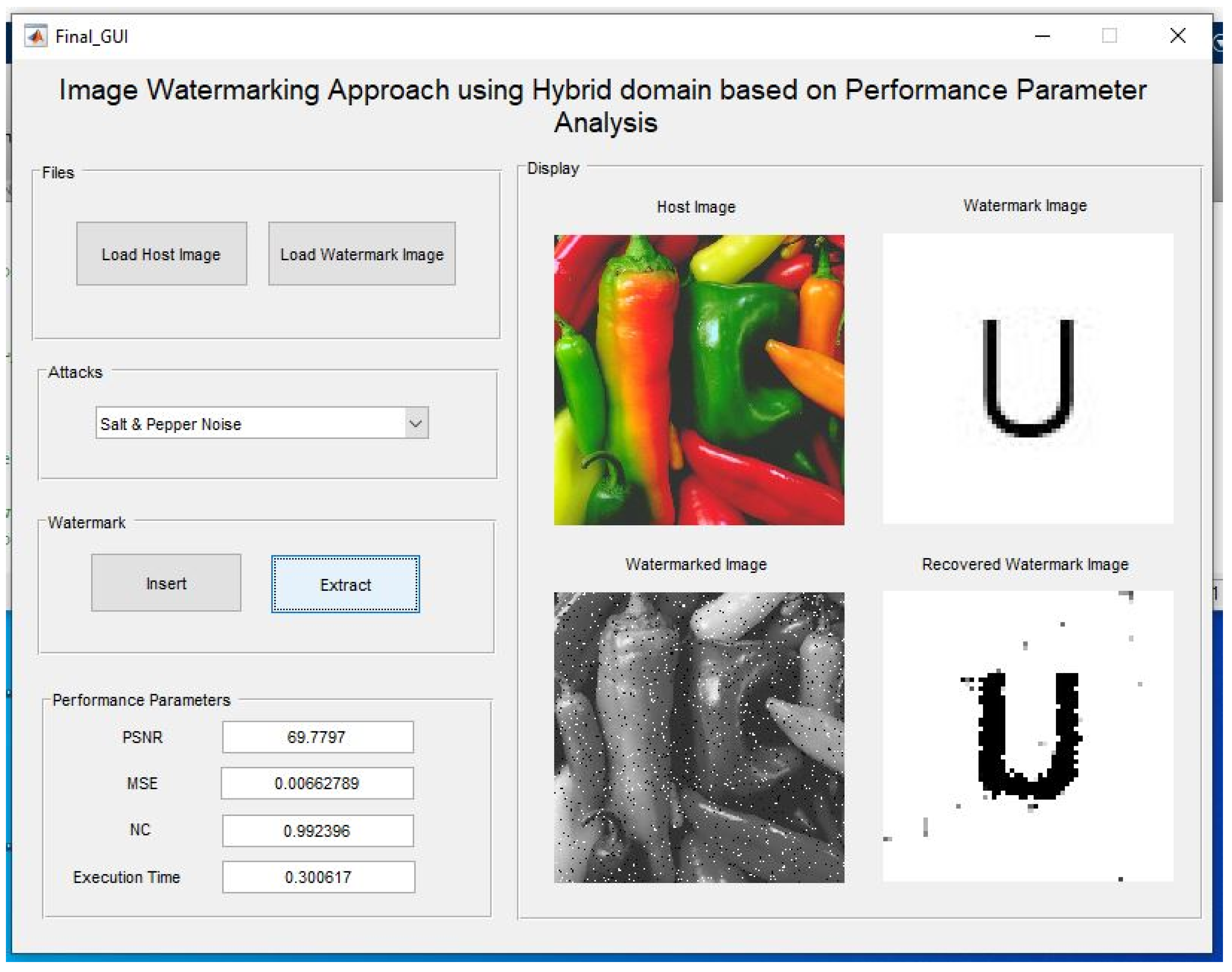
| Original Watermark | Extracted Watermark | |||
|---|---|---|---|---|
| Scaling | Cropping | Adaptive filtering | Salt & Pepper noise | |
 |  |  |  |  |
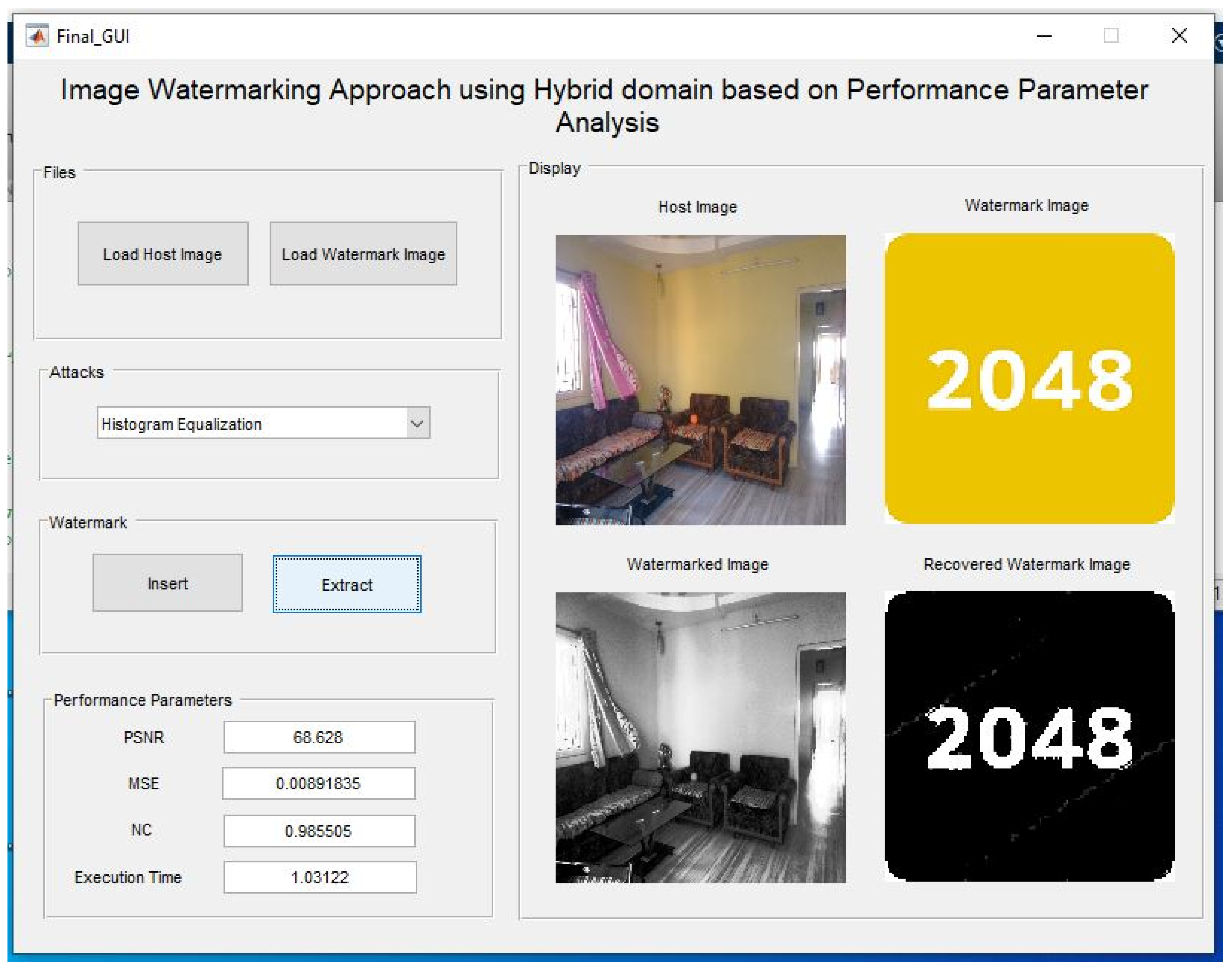
| Original Watermark | Extracted Watermark | ||
|---|---|---|---|
| Histogram Equalization | Gaussian noise | Sharpening | |
 | 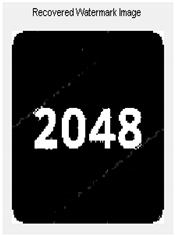 |  |  |
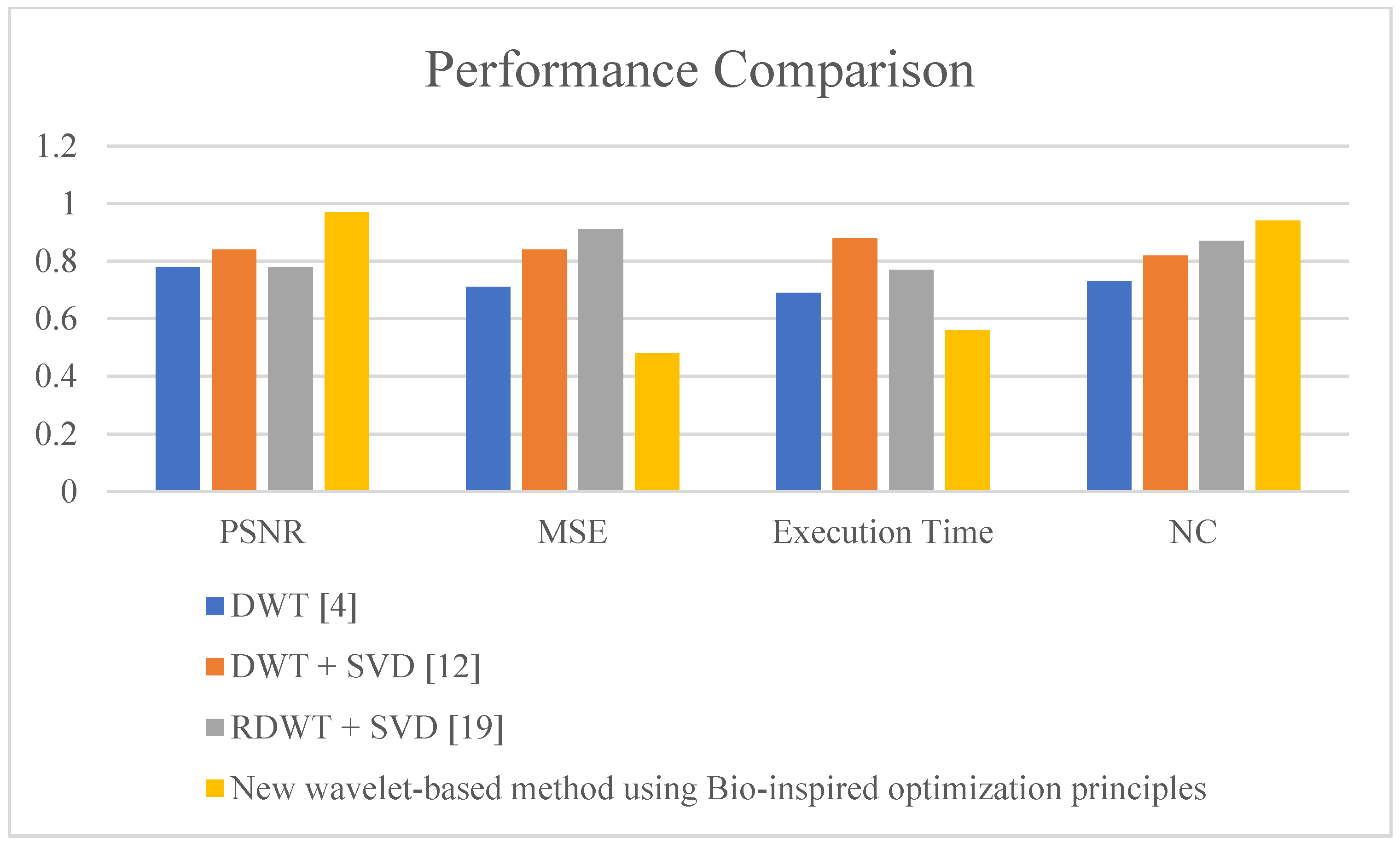
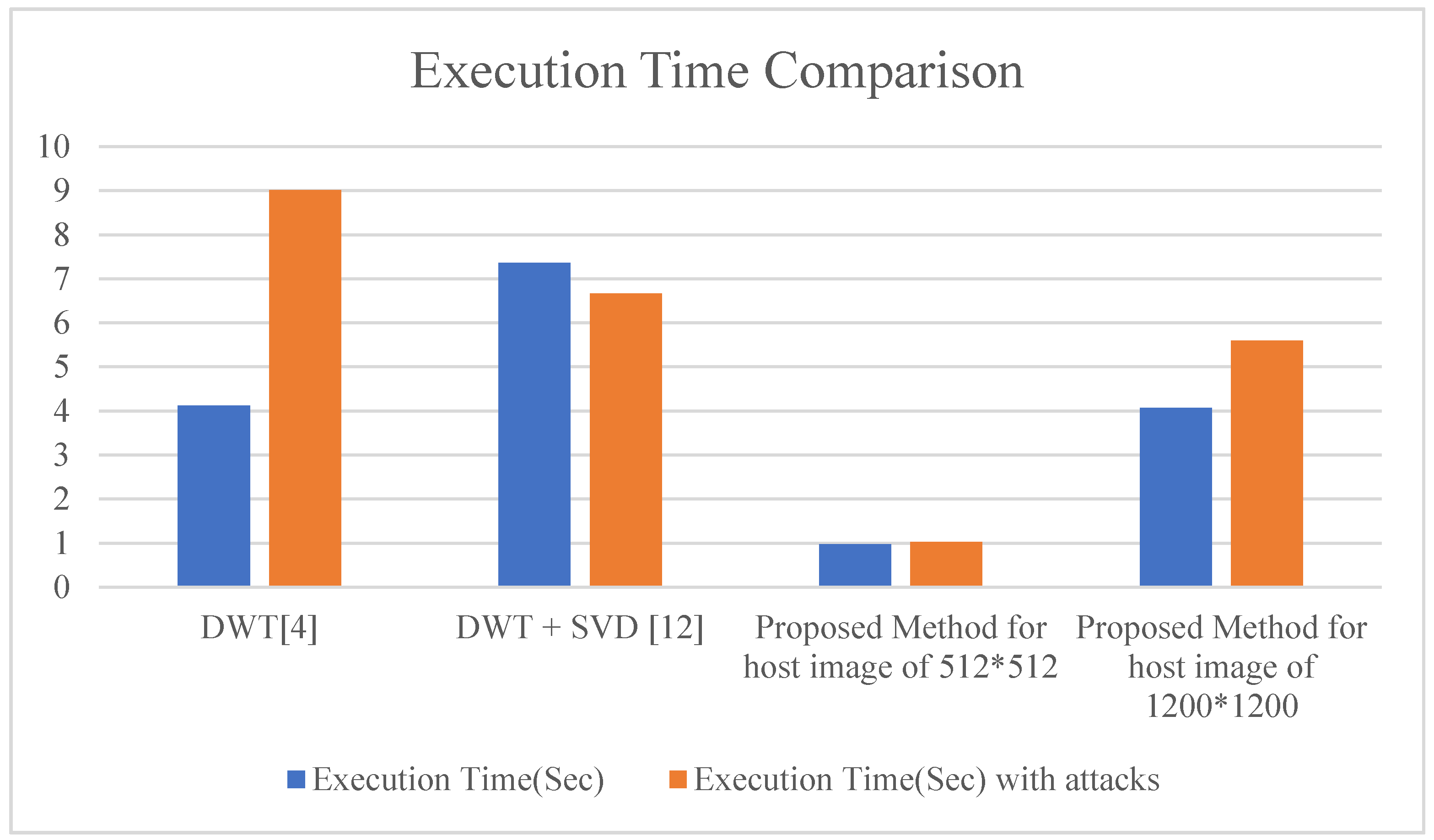
| Methods | Execution Time (Sec) | Execution Time (Sec) with Attacks |
|---|---|---|
| DWT [29] | 4.12 | 9.01 |
| DWT + SVD [30] | 7.36 | 6.67 |
| Proposed method for host image of 512 × 512 | 0.97 | 1.03 |
| Proposed method for host image of 1200 × 1200 | 4.07 | 5.6 |
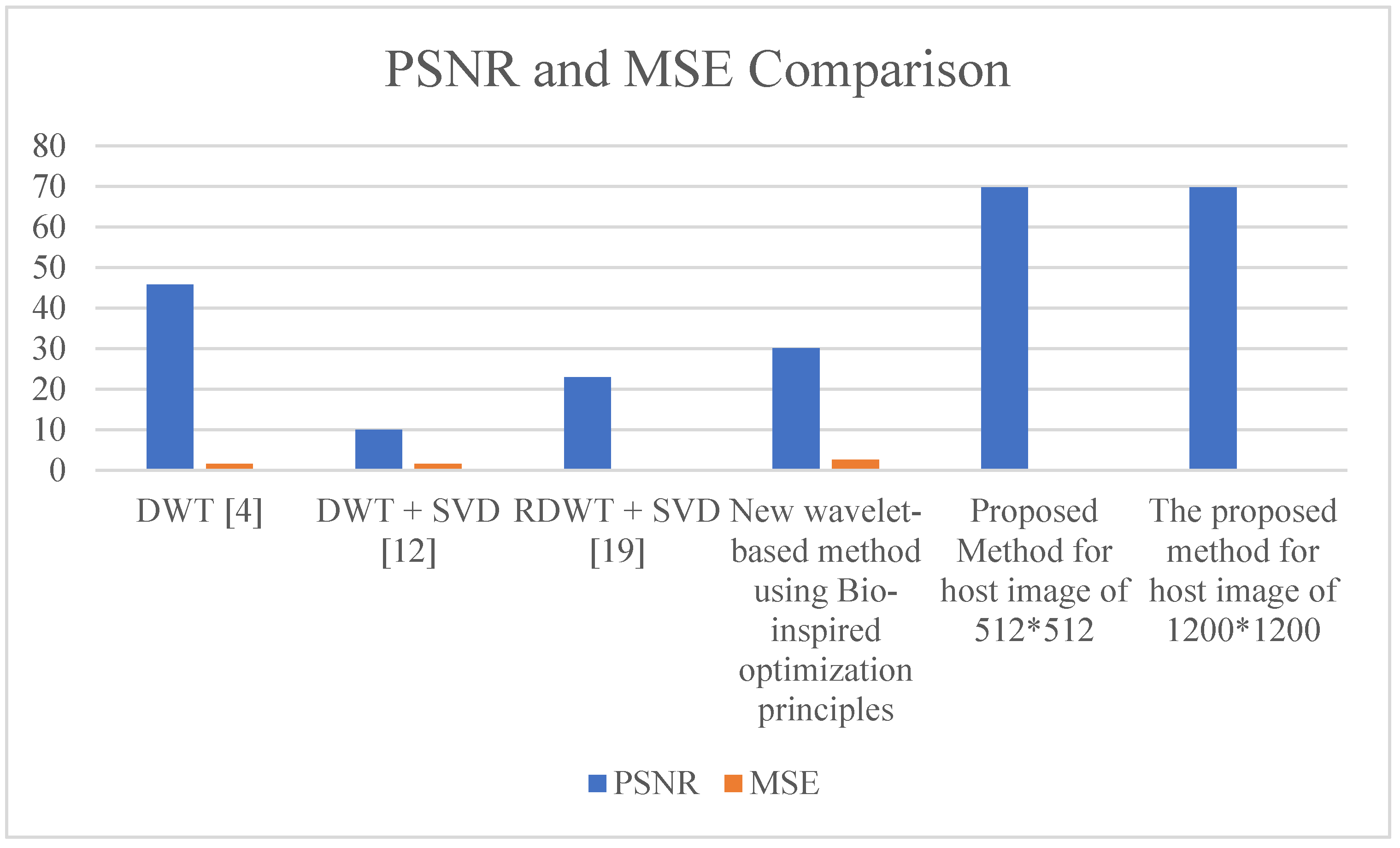
| Methods | PSNR | MSE |
|---|---|---|
| DWT [29] | 45.81 | 1.65 |
| DWT + SVD [30] | 10.05 | 1.62 |
| RDWT + SVD [27] | 23.006 | - |
| New wavelet-based method using bio-inspired optimization principles | 30.12 | 2.66 |
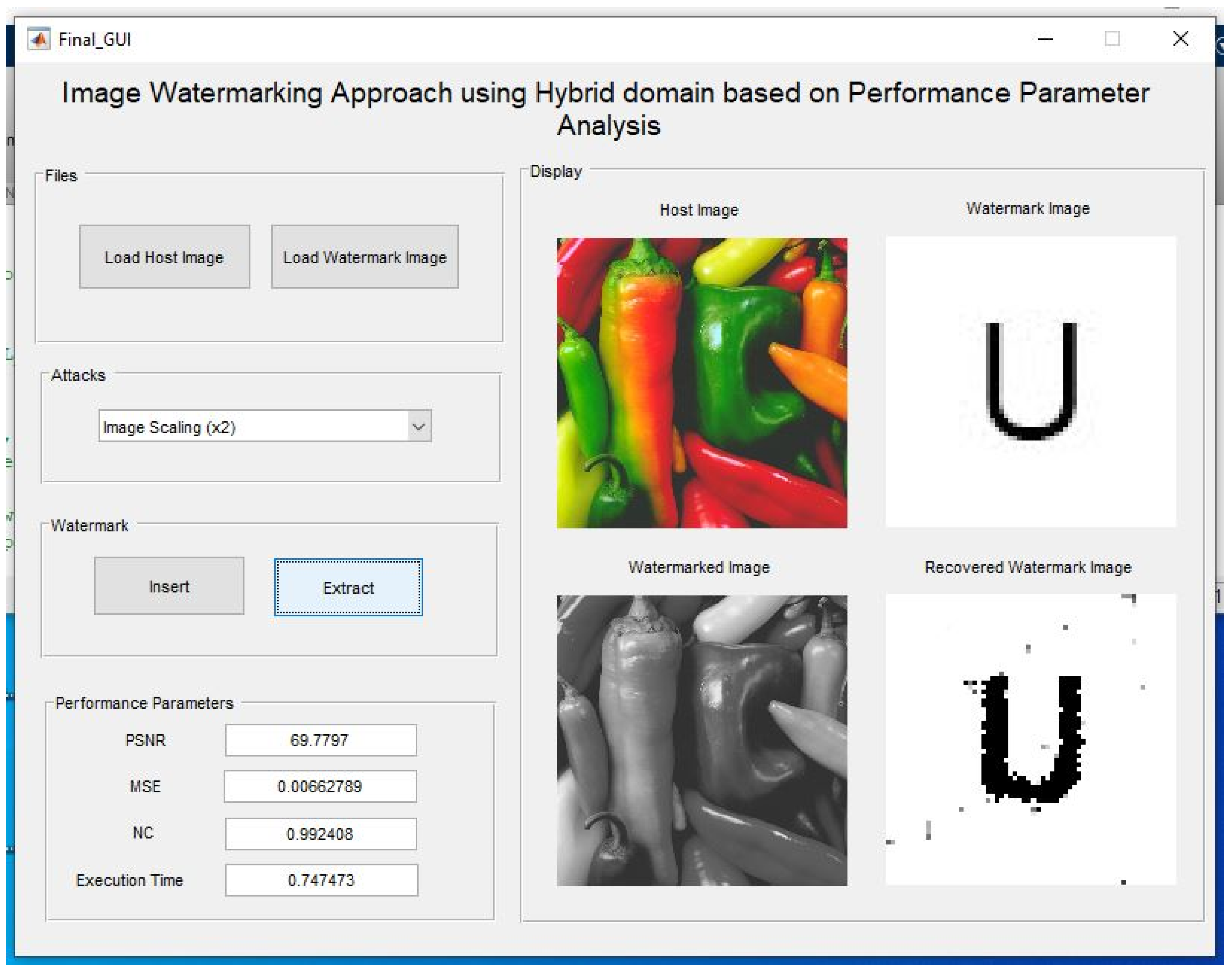
| Proposed method for host image of 512 × 512 | 69.77 | 0.0066 |
| Proposed method for host image of 1200 × 1200 | 69.77 | 0.0089 |
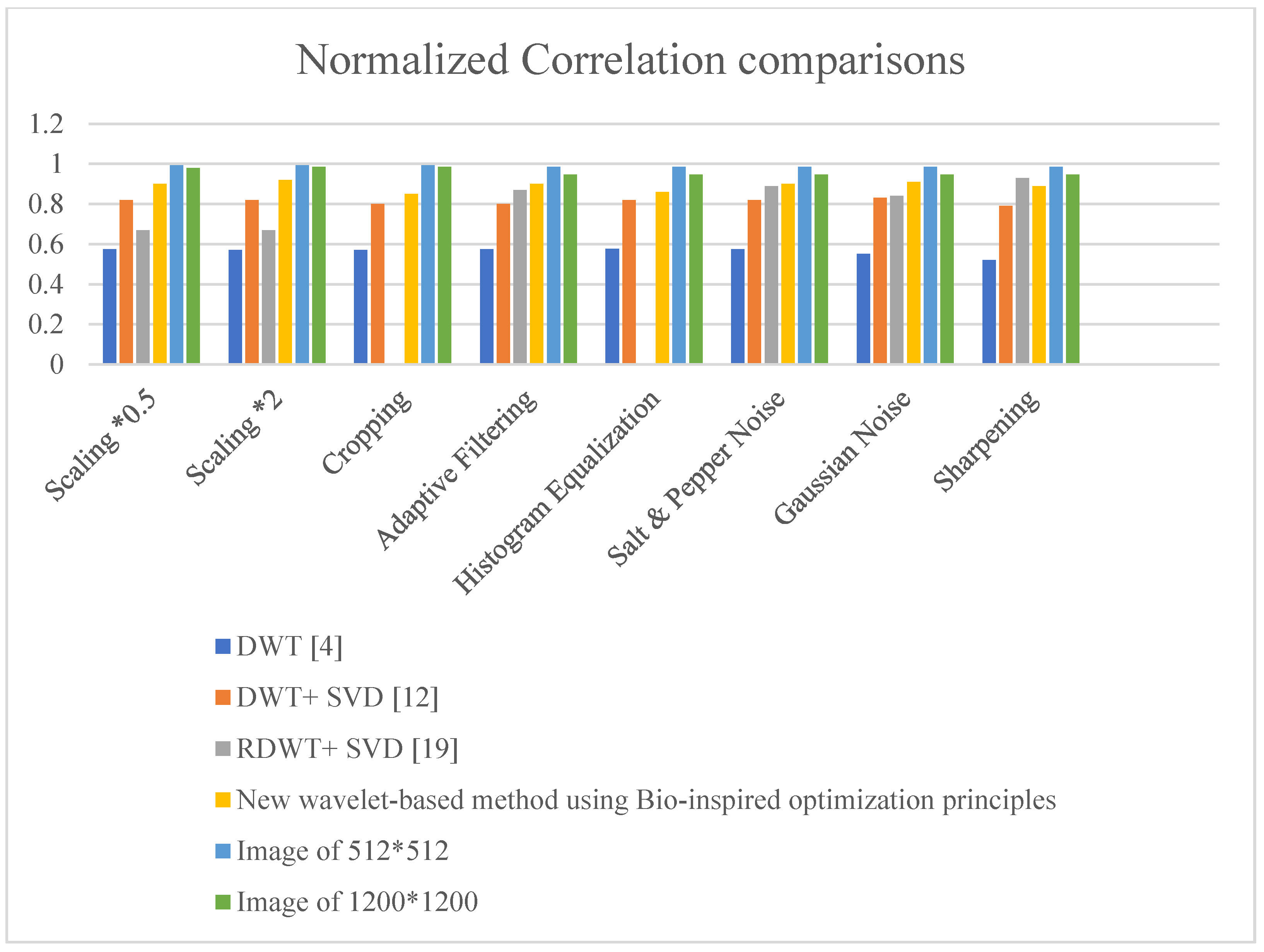
| Attacks | DWT [29] | DWT + SVD [30] | RDWT + SVD [27] | New Wavelet-Based Method Using Bio-Inspired Optimization Principles | Image of 512 × 512 | Image of 1200 × 1200 |
|---|---|---|---|---|---|---|
| Scaling × 0.5 | 0.575 | 0.82 | 0.67 | 0.90 | 0.992403 | 0.98 |
| Scaling × 2 | 0.57 | 0.8203 | 0.67 | 0.92 | 0.992408 | 0.985442 |
| Cropping | 0.571 | 0.801 | - | 0.85 | 0.992394 | 0.985464 |
| Adaptive Filtering | 0.5755 | 0.8012 | 0.87 | 0.90 | 0.985452 | 0.946562 |
| Histogram Equalization | 0.5765 | 0.8201 | - | 0.86 | 0.985503 | 0.946555 |
| Salt and Pepper Noise | 0.5757 | 0.82 | 0.89 | 0.90 | 0.985473 | 0.946542 |
| Gaussian Noise | 0.5512 | 0.831 | 0.84 | 0.91 | 0.985419 | 0.946542 |
| Sharpening | 0.52 | 0.791 | 0.93 | 0.89 | 0.985473 | 0.946563 |
Publisher’s Note: MDPI stays neutral with regard to jurisdictional claims in published maps and institutional affiliations. |
© 2021 by the authors. Licensee MDPI, Basel, Switzerland. This article is an open access article distributed under the terms and conditions of the Creative Commons Attribution (CC BY) license (https://creativecommons.org/licenses/by/4.0/).
Share and Cite
Srivastava, R.; Tomar, R.; Gupta, M.; Yadav, A.K.; Park, J. Image Watermarking Approach Using a Hybrid Domain Based on Performance Parameter Analysis. Information 2021, 12, 310. https://doi.org/10.3390/info12080310
Srivastava R, Tomar R, Gupta M, Yadav AK, Park J. Image Watermarking Approach Using a Hybrid Domain Based on Performance Parameter Analysis. Information. 2021; 12(8):310. https://doi.org/10.3390/info12080310
Chicago/Turabian StyleSrivastava, Rohit, Ravi Tomar, Maanak Gupta, Anuj Kumar Yadav, and Jaehong Park. 2021. "Image Watermarking Approach Using a Hybrid Domain Based on Performance Parameter Analysis" Information 12, no. 8: 310. https://doi.org/10.3390/info12080310
APA StyleSrivastava, R., Tomar, R., Gupta, M., Yadav, A. K., & Park, J. (2021). Image Watermarking Approach Using a Hybrid Domain Based on Performance Parameter Analysis. Information, 12(8), 310. https://doi.org/10.3390/info12080310