Energy-Efficient Collaborative Scheduling of Dual-Trolley Quay Cranes and Automated Guided Vehicles in Automated Container Terminals

Abstract
1. Introduction
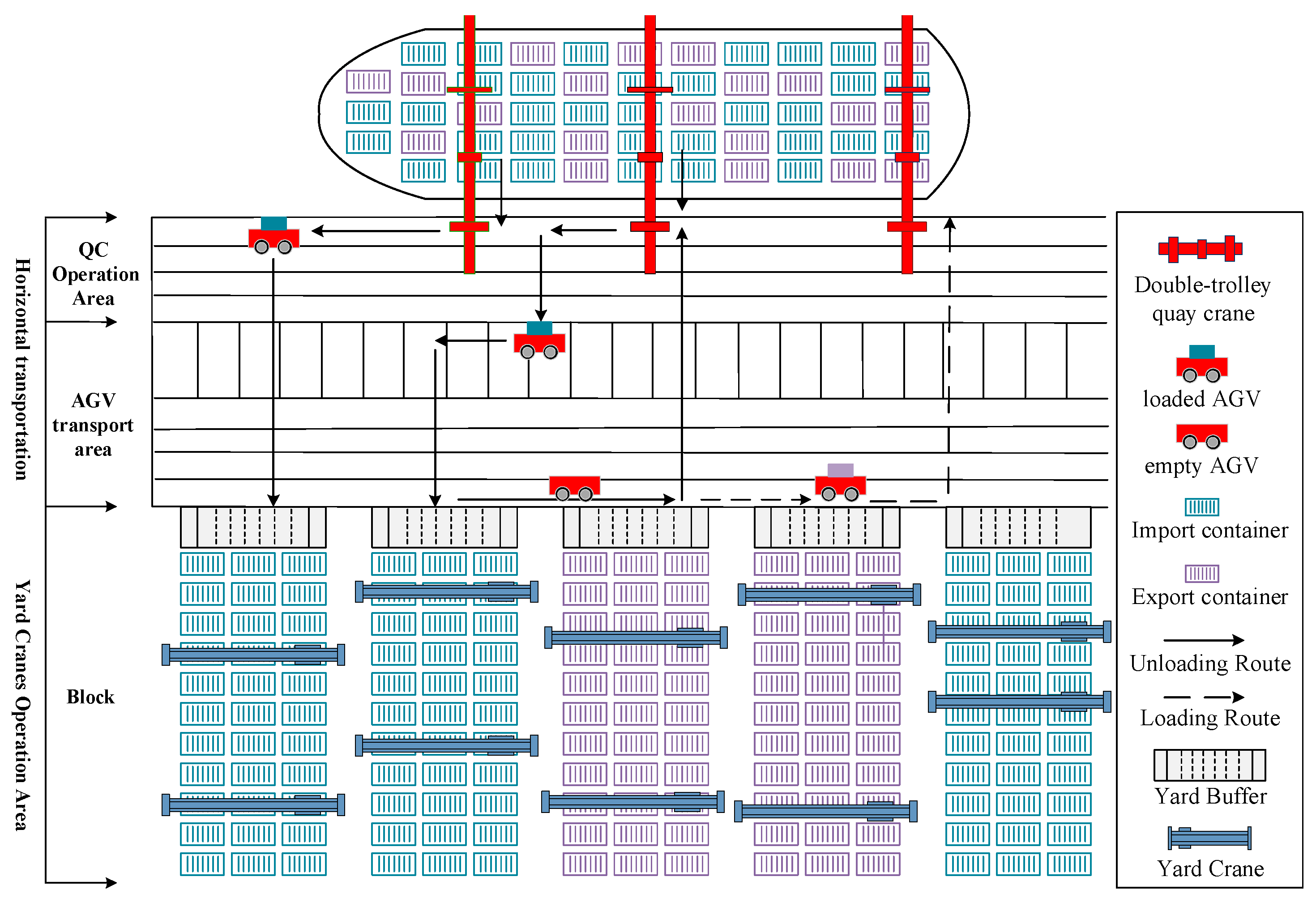
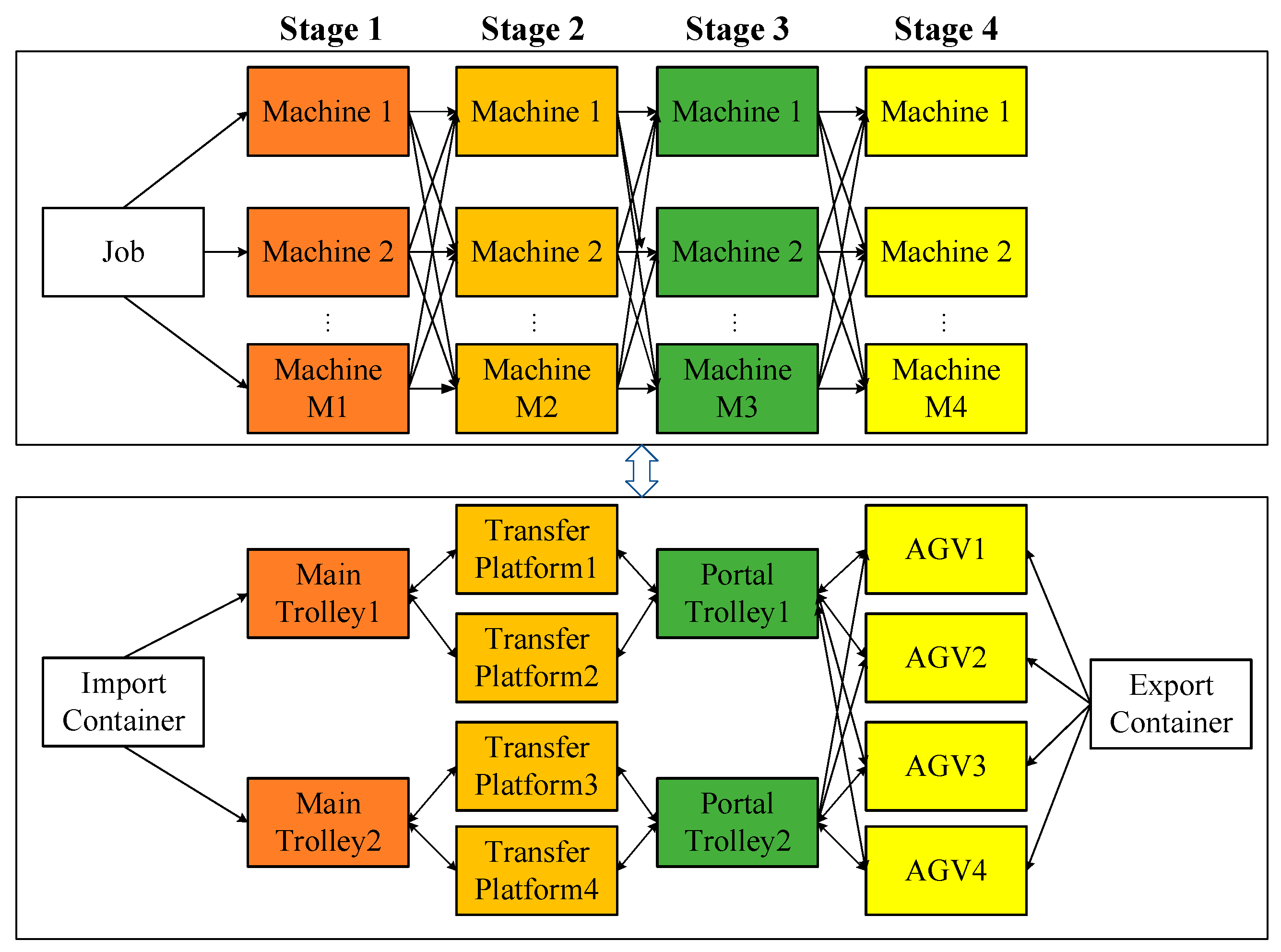
- We analyze the energy consumption of equipment in three operational states: loaded, waiting, and empty. The objective is to minimize total energy consumption while considering actual operational constraints, including mixed loading and unloading bidirectional flows, the limited buffers of DTQCs, machine eligibility constraints, container precedence constraints, and issues related to blocking and deadlocks. By adopting a hybrid flow shop scheduling framework, we map the collaborative scheduling problem of DTQCs and AGVs into a blocking hybrid flow shop scheduling problem with bidirectional flows and limited buffers (BHFSSP-BFLB) and develop a corresponding MIP model.
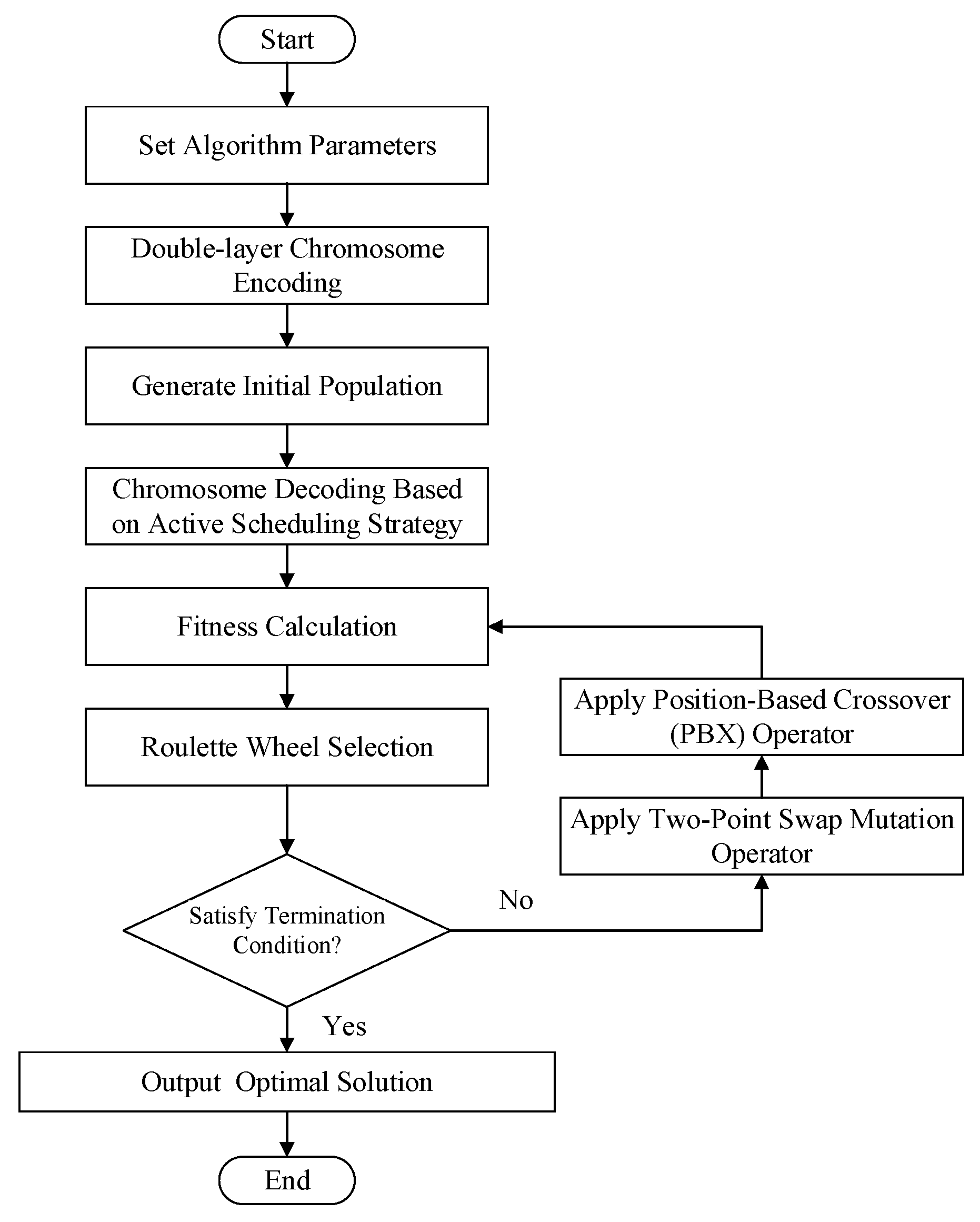
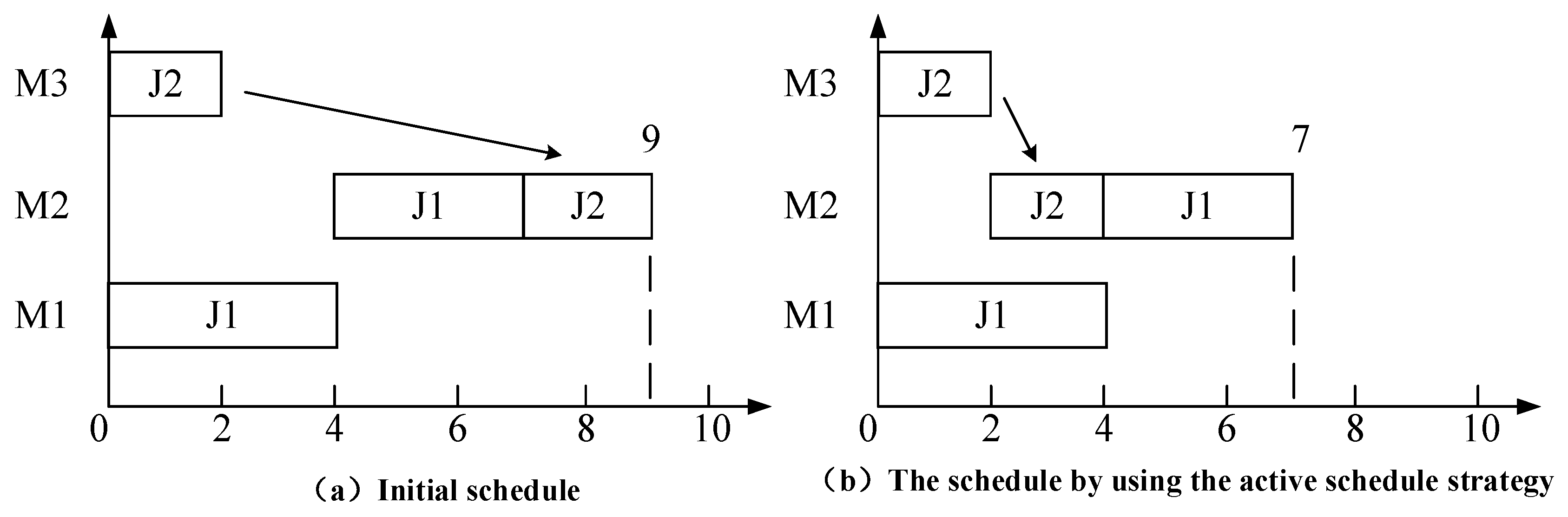
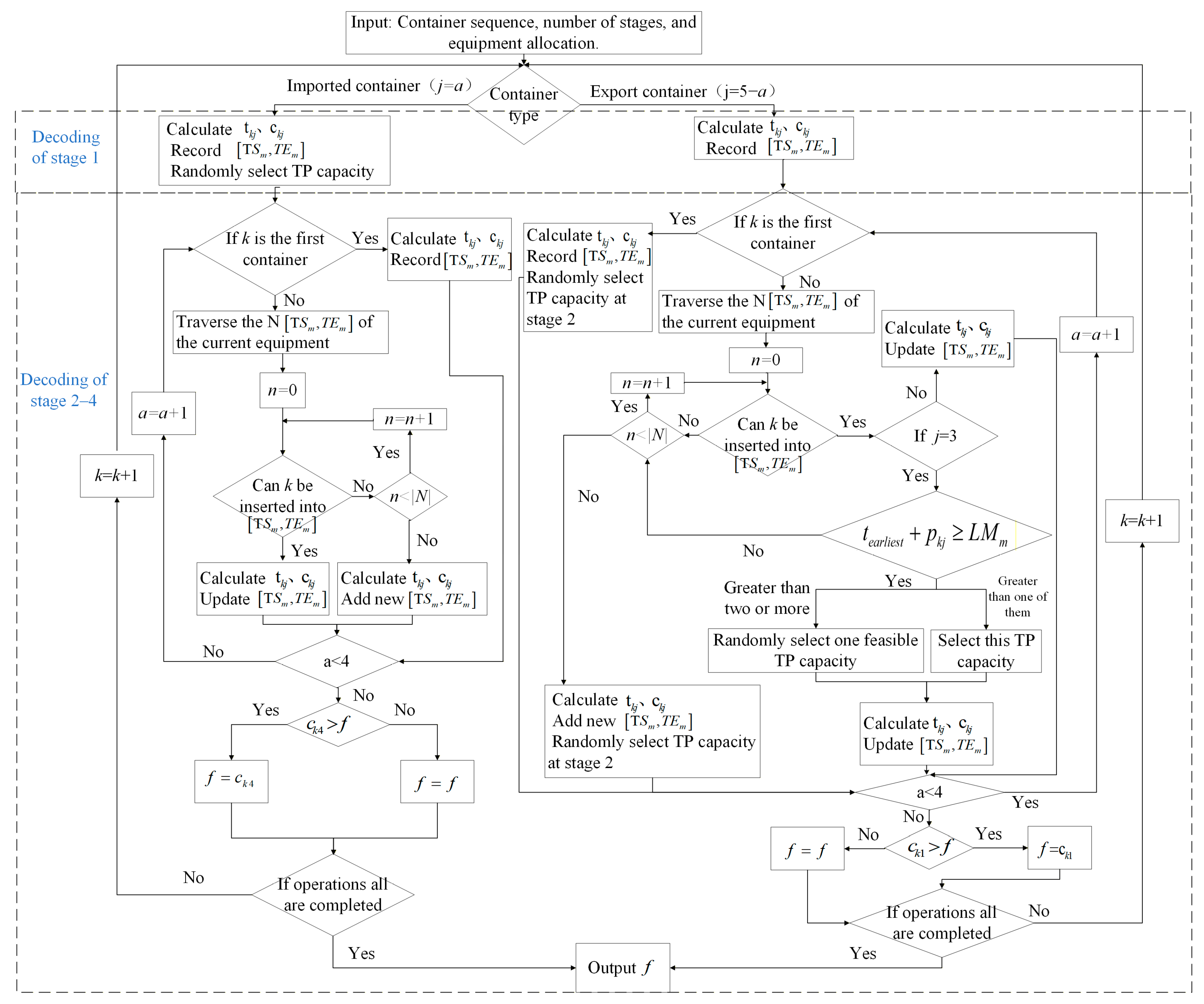
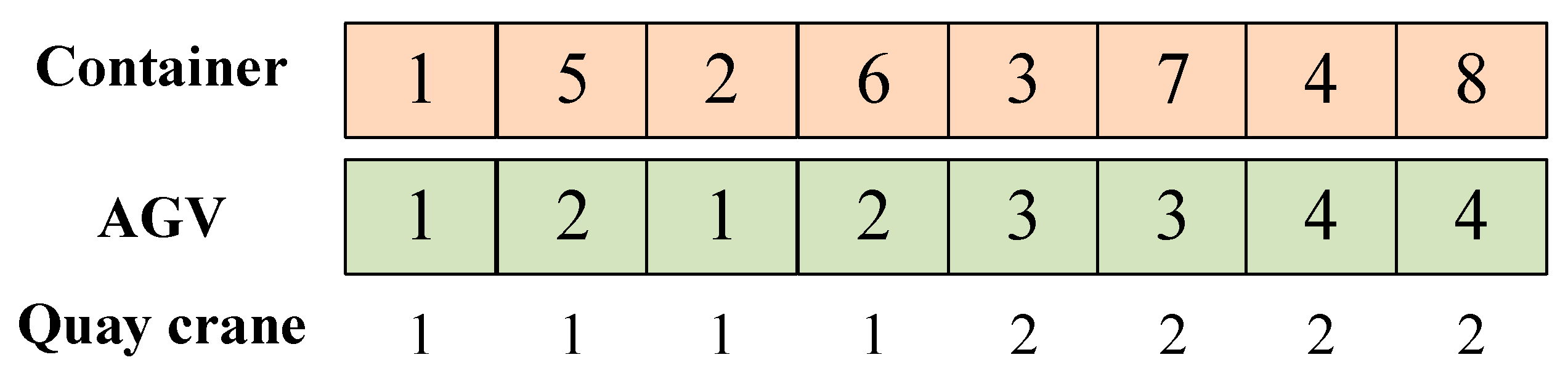
- We propose an IGA that can effectively solve the BHFSSP-BFLB model. A two-layer encoding method incorporating container precedence constraints is designed to ensure compliance with the prioritized processing sequence of containers in ACTs while effectively mitigating system deadlocks. During decoding, an active scheduling strategy based on the insertion of machine idle time is introduced to minimize the makespan.
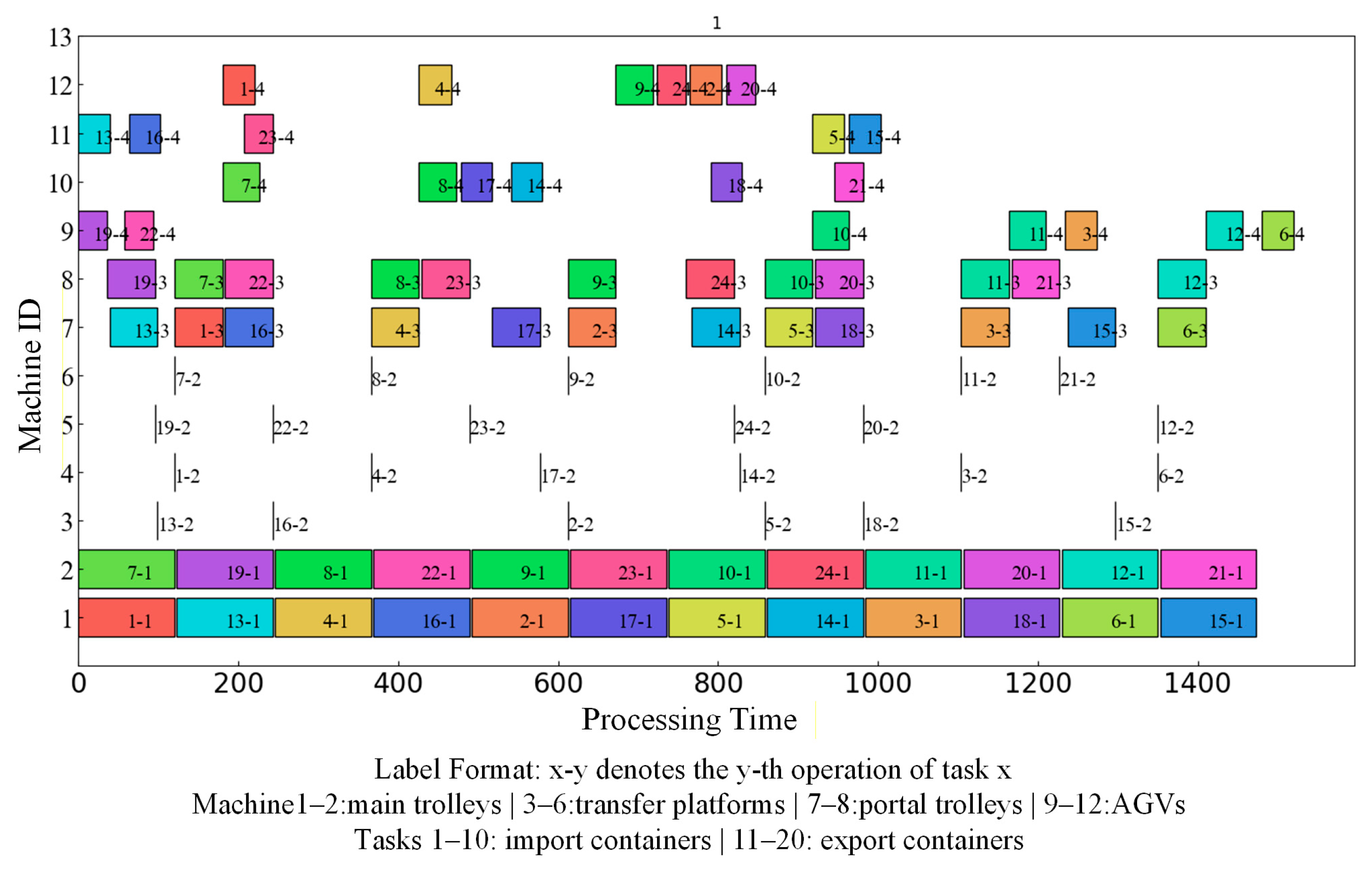
- The effectiveness of the proposed BHFSSP-BFLB model and the IGA in solving this collaborative scheduling problem is validated through numerical experiments. The results demonstrate that the scheduling solutions generated by the active scheduling strategy can significantly reduce total energy consumption while simultaneously decreasing the makespan. Moreover, the numerical experiments reveal the interaction between makespan and energy consumption optimization, providing a useful theoretical basis and decision-making reference for energy-efficient scheduling in ACTs.
2. Literature Review
2.1. Collaborative Scheduling in Automated Container Terminals
2.2. The ACT Scheduling Considering Energy Consumption
2.3. Research Gap
3. Problem Description and Mathematical Modeling
3.1. Problem Description
3.2. Mathematical Modeling
3.2.1. Assumptions and Notations
- All containers and their handling types are known, regardless of new arrivals.
- All AGVs can be shared by all DTQCs.
- There is no mutual interference between DTQCs.
- The release and extraction time of containers at the AGV or transfer platform are known.
- The storage locations of the containers on the ship and in the container yard are known.
- Once a handling operation has started, it must not be interrupted.
- Each capacity location on the transfer platform is modeled as a single piece of equipment.
- The yard buffer is set to infinite capacity, and there is no waiting time for AGVs to hand over containers.
- The operation of the transfer platform does not involve significant energy consumption and is only used as a temporary storage point for containers.
3.2.2. Mathematical Model
4. Solution Method
4.1. Dual-Layer Chromosome Encoding Based on Task Allocation
4.2. Chromosome Decoding Based on Active Scheduling Strategy
4.3. Population Initialization and Fitness Function
4.4. Genetic Manipulation
5. Numerical Experiments
5.1. Experimental Setting
5.2. Analysis of Experimental Results
5.2.1. Results of Small- and Large-Scale Numerical Experiments
5.2.2. Effectiveness of the Active Scheduling Strategy
5.2.3. Analysis of the Correlation Between Energy Consumption and
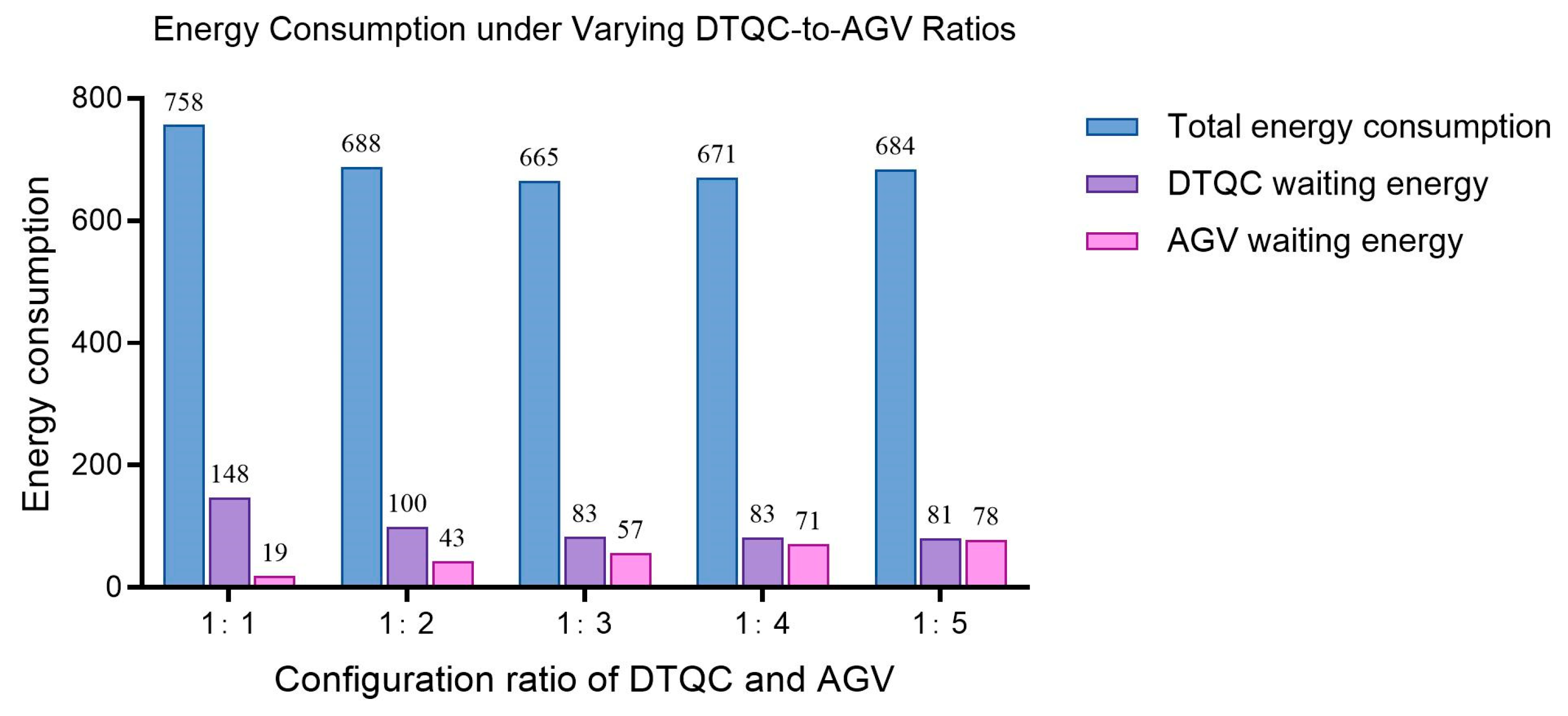
5.2.4. Analysis of the Configuration Ratio Between DTQCs and AGVs
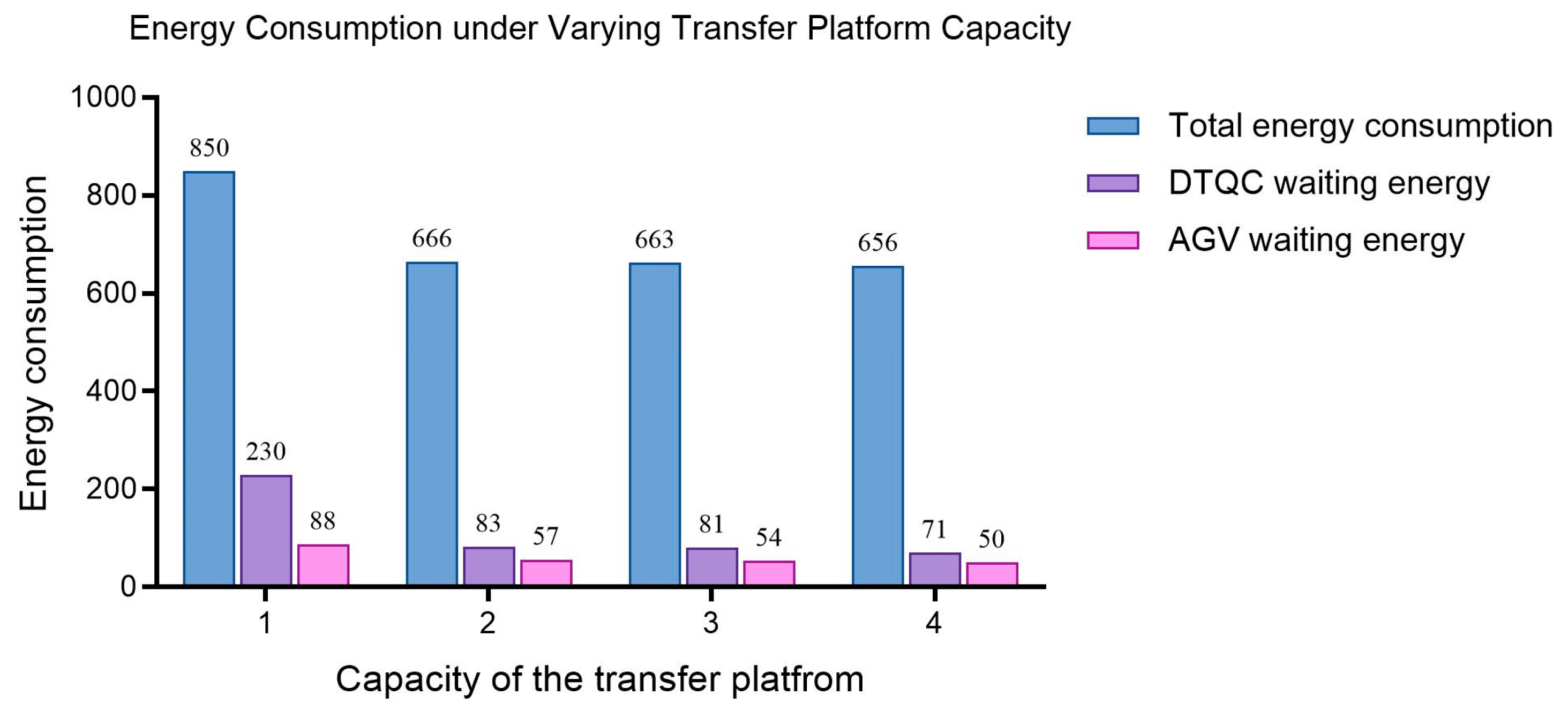
5.2.5. Analysis Transfer Platform Capacity
6. Conclusions
Author Contributions
Funding
Data Availability Statement
Conflicts of Interest
References
- Statista Research Department. Container Shipping—Statistics and Facts. Available online: https://www.statista.com/topics/1367/container-shipping (accessed on 10 January 2024).
- Hsu, H.P.; Wang, C.N.; Nguyen, T.T.T.; Dang, T.T.; Pan, Y.J. Hybridizing WOA with PSO for Coordinating Material Handling Equipment in an Automated Container Terminal Considering Energy Consumption. Adv. Eng. Inform. 2024, 60, 102410. [Google Scholar] [CrossRef]
- Lombardi, S.; DiIlio, G.; Tribioli, L.; Jannelli, E. Optimal Design of an Adaptive Energy Management Strategy for a Fuel Cell Tractor Operating in Ports. Appl. Energy 2023, 352, 121917. [Google Scholar] [CrossRef]
- Tang, D.; Tang, H.; Yuan, C.; Dong, M.; Diaz-Londono, C.; Agundis-Tinajero, G.D. Economic and Resilience-Oriented Operation of Coupled Hydrogen–Electricity Energy Systems at Ports. Appl. Energy 2025, 390, 125825. [Google Scholar] [CrossRef]
- Zhang, X.; Zeng, Q.; Sheu, J.B. Modeling the Productivity and Stability of a Terminal Operation System with Quay Crane Double Cycling. Transp. Res. Part E Logist. Transp. Rev. 2019, 122, 181–197. [Google Scholar] [CrossRef]
- Yue, L.; Fan, H.; Ma, M. Optimizing Configuration and Scheduling of Double 40 ft Dual-Trolley Quay Cranes and AGVs for Improving Container Terminal Services. J. Clean. Prod. 2021, 292, 126019. [Google Scholar] [CrossRef]
- Zhuang, Z.; Zhang, Z.; Teng, H.; Qin, W.; Fang, H. Optimization for Integrated Scheduling of Intelligent Handling Equipment with Bidirectional Flows and Limited Buffers at Automated Container Terminals. Comput. Oper. Res. 2022, 145, 105863. [Google Scholar] [CrossRef]
- Xing, Z.; Liu, H.; Wang, T.; Chew, E.P.; Lee, L.H.; Tan, K.C. Integrated Automated Guided Vehicle Dispatching and Equipment Scheduling with Speed Optimization. Transp. Res. Part E Logist. Transp. Rev. 2023, 169, 102993. [Google Scholar] [CrossRef]
- Fontes, D.B.M.M.; Homayouni, S.M. A Bi-Objective Multi-Population Biased Random Key Genetic Algorithm for Joint Scheduling Quay Cranes and Speed Adjustable Vehicles in Container Terminals. Flex. Serv. Manuf. J. 2023, 35, 241–268. [Google Scholar] [CrossRef]
- Jonker, T.; Duinkerken, M.B.; Yorke-Smith, N.; de Waal, A.; Negenborn, R.R. Coordinated Optimization of Equipment Operations in a Container Terminal. Flex. Serv. Manuf. J. 2021, 33, 281–311. [Google Scholar] [CrossRef]
- Sun, B.; Zhai, G.; Li, S.; Pei, B. Multi-Resource Collaborative Scheduling Problem of Automated Terminal Considering the AGV Charging Effect Under COVID-19. Ocean Coast. Manag. 2023, 232, 106422. [Google Scholar] [CrossRef] [PubMed]
- Zhang, Y.; Tang, K.; Xu, Y.; Xu, S. Integrated Scheduling of Handling Operations in Container Terminal Considering Energy Saving. Comput. Integr. Manuf. Syst. 2024, 30, 2608–2620. [Google Scholar] [CrossRef]
- Vis, I.F.A.; de Koster, R. Transshipment of Containers at a Container Terminal: An Overview. Eur. J. Oper. Res. 2003, 147, 1–16. [Google Scholar] [CrossRef]
- Stahlbock, R.; Voß, S. Operations Research at Container Terminals: A Literature Update. OR Spectr. 2008, 30, 1–52. [Google Scholar] [CrossRef]
- Msakni, M.K.; Diabat, A.; Rabadi, G.; Al-Salem, M.; Kotachi, M. Exact Methods for the Quay Crane Scheduling Problem When Tasks Are Modeled at the Single Container Level. Comput. Oper. Res. 2018, 99, 218–233. [Google Scholar] [CrossRef]
- Wei, M.; He, J.; Tan, C.; Yue, J.; Yu, H. Quay Crane Scheduling with Time Windows Constraints for Automated Container Port. Ocean Coast. Manag. 2023, 231, 106401. [Google Scholar] [CrossRef]
- Abou Kasm, O.; Diabat, A. The Quay Crane Scheduling Problem with Non-Crossing and Safety Clearance Constraints: An Exact Solution Approach. Comput. Oper. Res. 2019, 107, 189–199. [Google Scholar] [CrossRef]
- Chang, D.; Fang, T.; Fan, Y. Dynamic Rolling Strategy for Multi-Vessel Quay Crane Scheduling. Adv. Eng. Inform. 2017, 34, 60–69. [Google Scholar] [CrossRef]
- Cao, Y.; Yang, A.; Liu, Y.; Zeng, Q.; Chen, Q. AGV Dispatching and Bidirectional Conflict-Free Routing Problem in Automated Container Terminal. Comput. Ind. Eng. 2023, 184, 109611. [Google Scholar] [CrossRef]
- Hu, H.; Yang, X.; Xiao, S.; Wang, F. Anti-Conflict AGV Path Planning in Automated Container Terminals Based on Multi-Agent Reinforcement Learning. Int. J. Prod. Res. 2023, 61, 65–80. [Google Scholar] [CrossRef]
- Zhong, M.; Yang, Y.; Dessouky, Y.; Postolache, O. Multi-AGV Scheduling for Conflict-Free Path Planning in Automated Container Terminals. Comput. Ind. Eng. 2020, 142, 106371. [Google Scholar] [CrossRef]
- Liang, C.J.; Shen, Z.; Zhang, Y. Quay Crane and AGV Joint Scheduling with Grouping Work Surface under Interference Constraints. Comput. Eng. Appl. 2020, 56, 254–261. [Google Scholar] [CrossRef]
- Hop, D.C.; Van Hop, N.; Anh, T.T.M. Adaptive Particle Swarm Optimization for Integrated Quay Crane and Yard Truck Scheduling Problem. Comput. Ind. Eng. 2021, 153, 107075. [Google Scholar] [CrossRef]
- Duan, J.; Li, L.; Zhang, Q.; Qin, J.; Zhou, Y. Integrated Scheduling of Automatic Guided Vehicles and Automatic Stacking Cranes in Automated Container Terminals Considering Landside Buffer Zone. Transp. Res. Rec. 2023, 2677, 502–528. [Google Scholar] [CrossRef]
- Qin, T.; Du, Y.; Chen, J.; Sha, M. Combining Mixed Integer Programming and Constraint Programming to Solve the Integrated Scheduling Problem of Container Handling Operations of a Single Vessel. Eur. J. Oper. Res. 2020, 285, 884–901. [Google Scholar] [CrossRef]
- Qin, Q.; Liang, C. Optimization of Equipment Coordination Scheduling Considering Buffer Space in Automated Container Terminal. Comput. Eng. Appl. 2020, 56, 262–270. [Google Scholar] [CrossRef]
- Tan, C.; Yan, W.; Yue, J. Quay Crane Scheduling in Automated Container Terminal for the Trade-Off between Operation Efficiency and Energy Consumption. Adv. Eng. Inform. 2021, 48, 101285. [Google Scholar] [CrossRef]
- Li, H.; Li, X. A Branch-and-Bound Algorithm for the Bi-Objective Quay Crane Scheduling Problem Based on Efficiency and Energy. Mathematics 2022, 10, 4705. [Google Scholar] [CrossRef]
- Yang, X.; Hu, H.; Jin, J. Battery-Powered Automated Guided Vehicles Scheduling Problem in Automated Container Terminals for Minimizing Energy Consumption. Ocean Coast. Manag. 2023, 246, 106873. [Google Scholar] [CrossRef]
- Xiao, S.; Huang, J.; Hu, H.; Gu, Y. Automatic Guided Vehicle Scheduling in Automated Container Terminals Based on a Hybrid Mode of Battery Swapping and Charging. J. Mar. Sci. Eng. 2024, 12, 305. [Google Scholar] [CrossRef]
- Zhao, Q.; Ji, S.; Guo, D.; Du, X.; Wang, H. Research on Cooperative Scheduling of Automated Quayside Cranes and Automatic Guided Vehicles in Automated Container Terminal. Math. Probl. Eng. 2019, 2019, 6574582. [Google Scholar] [CrossRef]
- Yue, L.; Fan, H.; Zhai, C. Joint Configuration and Scheduling Optimization of a Dual-Trolley Quay Crane and Automatic Guided Vehicles with Consideration of Vessel Stability. Sustainability 2019, 12, 24. [Google Scholar] [CrossRef]
- Fan, H.; Guo, Z.; Yue, L.; Ma, M. Joint Configuration and Scheduling Optimization of Dual-Trolley Quay Crane and AGV for Container Terminal Considering Energy Saving. Acta Autom. Sin. 2021, 47, 2412–2426. [Google Scholar] [CrossRef]
- Luo, Y.; Liang, X.; Zhang, Y.; Tang, K.; Li, W. Energy-Aware Integrated Scheduling for Quay Crane and IGV in Automated Container Terminal. J. Mar. Sci. Eng. 2024, 12, 376. [Google Scholar] [CrossRef]
- Niu, Y.; Yu, F.; Yao, H.; Yang, Y. Multi-Equipment Coordinated Scheduling Strategy of U-Shaped Automated Container Terminal Considering Energy Consumption. Comput. Ind. Eng. 2022, 174, 108804. [Google Scholar] [CrossRef]
- Xu, B.; Jie, D.; Li, J.; Yang, Y. Green Integrated Scheduling of U-Shaped Automated Terminals under Uncertainty. Comput. Integr. Manuf. Syst. 2022, 28, 4057–4068. [Google Scholar] [CrossRef]
- Bish, E.K. A Multiple-Crane-Constrained Scheduling Problem in a Container Terminal. Eur. J. Oper. Res. 2003, 144, 83–107. [Google Scholar] [CrossRef]
- Gao, L.; Zhang, G.H.; Wang, X.J. Intelligent Algorithms for Scheduling in Flexible Job Shops and Their Applications; Huazhong University of Science and Technology Press: Wuhan, China, 2012. [Google Scholar]





| Literature | Equipment | Objective | Operational Characteristic | Solution Method | ||||||
|---|---|---|---|---|---|---|---|---|---|---|
| QC | DTQC | AGV | YC | Energy | Efficiency | MLUBF * | Limited Buffer | Blocking/Deadlock | ||
| Yue et al. [6] | √ | √ | √ | √ | EA + IGA | |||||
| Zhuang et al. [7] | √ | √ | √ | √ | √ | √ | √ | ALNS | ||
| Xing et al. [8] | √ | √ | √ | √ | √ | √ | Three-phase | |||
| Fontes et al. [9] | √ | √ | √ | √ | mp-BRKGA | |||||
| Jonker et al. [10] | √ | √ | √ | √ | √ | √ | TSA | |||
| Sun et al. [11] | √ | √ | √ | √ | √ | √ | SA-GA | |||
| Qin et al. [25] | √ | √ | √ | √ | √ | MIP + CP | ||||
| Luo et al. [34] | √ | √ | √ | DMSSA | ||||||
| Bish et al. [37] | √ | √ | √ | √ | √ | TLS | ||||
| This paper | √ | √ | √ | √ | √ | √ | √ | IGA | ||
| Notations | Description |
|---|---|
| Parameters: | |
| Index of container job | |
| Index of initial virtual job | |
| Index of final virtual job | |
| Index of stage | |
| Index of equipment | |
| Set of import container job | |
| Set of export container job | |
| Set of container job, | |
| Set of initial virtual job | |
| Set of final virtual job | |
| A sufficiently large positive real number | |
| Processing time of job at stage | |
| Equipment set of job at stage | |
| Set of equipment available at stage j determined by equipment | |
| Adjustment time of switching from job to job at stage | |
| Set of container job pairs with priority constraints, when , job must precede job | |
| Unit-loaded energy consumption of equipment at each stage, = 1,3,4, respectively, corresponds to the main trolley, portal trolley and AGV | |
| Unit empty energy consumption of equipment at each stage, = 1,3,4, respectively, corresponds to the main trolley, portal trolley and AGV | |
| Unit waiting energy consumption of equipment at each stage, = 1,3,4, respectively, corresponds to the main trolley, portal trolley and AGV | |
| Decision variable | |
| Binary variable that equals one if job is processed by equipment at stage and zero otherwise | |
| Binary variable that equals one if job is processed before job at stage , and zero otherwise | |
| Binary variable that equals one if job is processed immediately before job by equipment at stage , and zero otherwise | |
| Waiting time before processing job by equipment at stage | |
| Start time of job processing at stage | |
| Release time after processing of job at stage |
| Parameter | Description | |
|---|---|---|
| loaded energy consumption of main trolley | 91.24 | |
| loaded energy consumption of portal trolley | 91.24 | |
| loaded energy consumption of AGV | 21 | |
| empty energy consumption of main trolley | 70.18 | |
| empty energy consumption of portal trolley | 70.18 | |
| empty energy consumption of AGV | 14 | |
| waiting energy consumption of main trolley | 49.6 | |
| waiting energy consumption of portal trolley | 49.6 | |
| waiting energy consumption of AGV | 9 |
| Algorithm Parameters | ||||||
|---|---|---|---|---|---|---|
| OBJ | T (s) | OBJ | T (s) | OBJ | T (s) | |
| 49.66 | 47.65 | 49.82 | 46.02 | 48.79 | 46.64 | |
| 48.72 | 48.05 | 47.65 | 45.79 | 48.45 | 47.28 | |
| 46.53 | 48.32 | 45.98 | 43.56 | 46.28 | 45.12 | |
| ID | Containers | DTQCs/AGVs/Blocks | CPLEX | IGA | GAP1 * | |||
|---|---|---|---|---|---|---|---|---|
| Treal (s) | OBJ1 | TIGA (s) | OBJ2 | AVG | ||||
| S1 | 8 | 2/4/2 | 19.70 | 45.44 | 43.05 | 45.97 | 46.36 | 1.17% |
| S2 | 8 | 2/6/2 | 18.34 | 45.44 | 42.99 | 46.03 | 46.38 | 1.30% |
| S3 | 12 | 2/4/2 | 7200 | 69.22 | 65.62 | 70.80 | 71.57 | 2.28% |
| S4 | 12 | 2/6/2 | 7200 | 69.82 | 65.45 | 70.95 | 71.87 | 1.62% |
| S5 | 16 | 2/4/2 | 7200 | 92.99 | 90.53 | 95.54 | 98.01 | 2.74% |
| S6 | 16 | 2/6/2 | 7200 | 93.53 | 90.38 | 96.23 | 97.92 | 2.89% |
| S7 | 20 | 2/4/2 | -- | -- | 111.38 | 120.75 | 124.78 | -- |
| S8 | 20 | 2/6/2 | -- | -- | 120.74 | 121.28 | 124.11 | -- |
| S9 | 24 | 2/4/2 | -- | -- | 148.11 | 146.19 | 152.10 | -- |
| S10 | 24 | 2/6/2 | -- | -- | 147.64 | 147.71 | 152.47 | -- |
| AVG | 2.00% | |||||||
| ID | Containers | DTQCs/AGVs/Blocks | PSO | SA | IGA | GAP | ||||
|---|---|---|---|---|---|---|---|---|---|---|
| TPSO (s) | OBJPSO | TSA (s) | OBJSA | TIGA (s) | OBJIGA | GAP2 *1 | GAP3 *2 | |||
| L1 | 40 | 4/12/4 | 150.89 | 248.75 | 231.86 | 260.47 | 242.06 | 245.86 | 1.2% | 5.9% |
| L2 | 40 | 4/14/4 | 147.64 | 246.78 | 226.38 | 259.89 | 242.92 | 244.59 | 0.9% | 6.3% |
| L3 | 60 | 5/14/4 | 246.31 | 409.85 | 345.26 | 411.36 | 396.75 | 380.7 | 7.7% | 8.1% |
| L4 | 60 | 5/16/4 | 240.18 | 415.62 | 338.27 | 410.28 | 392.57 | 381.11 | 9.1% | 7.7% |
| L5 | 80 | 6/16/4 | 559.24 | 529.65 | 498.65 | 569.45 | 543.08 | 526.43 | 0.6% | 8.2% |
| L6 | 80 | 6/18/4 | 540.34 | 530.98 | 504.37 | 565.74 | 536.3 | 527.1 | 0.7% | 7.3% |
| L7 | 100 | 7/18/4 | 594.36 | 697.34 | 654.39 | 716.91 | 660.53 | 680.81 | 2.4% | 5.3% |
| L8 | 100 | 7/20/4 | 599.48 | 696.41 | 672.87 | 712.39 | 691.56 | 677.27 | 2.8% | 5.2% |
| L9 | 120 | 8/20/4 | 874.26 | 872.66 | 890.71 | 905.26 | 840.54 | 850.86 | 2.6% | 6.4% |
| L10 | 120 | 8/22/4 | 865.34 | 874.28 | 864.49 | 907.48 | 850.69 | 851.46 | 2.7% | 6.6% |
| AVG | 481.804 | 522.7 | 539.7 | 3.1% | 6.7% | |||||
| ID | GA | IGA | GAP4 * |
|---|---|---|---|
| S1 | 729 | 489 | 32.92% |
| S3 | 1095 | 735 | 32.88% |
| S5 | 1467 | 981 | 33.13% |
| S7 | 1876 | 1278 | 31.88% |
| S9 | 2207 | 1524 | 30.95% |
| AVG | 1474.8 | 1001.4 | 32.35% |
| ID | Mean | Maximum | Minimum |
|---|---|---|---|
| S1 | 0.91 | 0.94 | 0.88 |
| S3 | 0.92 | 0.94 | 0.87 |
| S5 | 0.92 | 0.94 | 0.89 |
| S7 | 0.91 | 0.94 | 0.88 |
| S9 | 0.92 | 0.93 | 0.90 |
| AVG | 0.92 | 0.94 | 0.89 |
| ID | GAP5 * | ||
|---|---|---|---|
| S1 | 489 | 489 | 0.00% |
| S2 | 489 | 489 | 0.00% |
| S3 | 735 | 735 | 0.00% |
| S4 | 735 | 735 | 0.00% |
| S5 | 981 | 981 | 0.00% |
| S6 | 1032 | 981 | 5.20% |
| S7 | 1278 | 1227 | 4.16% |
| S8 | 1227 | 1227 | 0.00% |
| S9 | 1524 | 1473 | 3.46% |
| S10 | 1473 | 1473 | 0.00% |
| L1 | 1227 | 1227 | 0.00% |
| L2 | 1227 | 1227 | 0.00% |
| L3 | 1694 | 1667 | 1.62% |
| L4 | 1667 | 1667 | 0.00% |
| L5 | 1913 | 1913 | 0.00% |
| L6 | 1918 | 1913 | 0.26% |
| L7 | 2343 | 2172 | 7.87% |
| L8 | 2176 | 2151 | 1.16% |
| L9 | 2497 | 2365 | 5.59% |
| L10 | 2378 | 2362 | 0.68% |
| AVG | 1.50% |
Disclaimer/Publisher’s Note: The statements, opinions and data contained in all publications are solely those of the individual author(s) and contributor(s) and not of MDPI and/or the editor(s). MDPI and/or the editor(s) disclaim responsibility for any injury to people or property resulting from any ideas, methods, instructions or products referred to in the content. |
© 2026 by the authors. Licensee MDPI, Basel, Switzerland. This article is an open access article distributed under the terms and conditions of the Creative Commons Attribution (CC BY) license.
Share and Cite
Xiao, S.; Deng, S.; Yu, S.; Zheng, P.; Wu, Z. Energy-Efficient Collaborative Scheduling of Dual-Trolley Quay Cranes and Automated Guided Vehicles in Automated Container Terminals. J. Mar. Sci. Eng. 2026, 14, 280. https://doi.org/10.3390/jmse14030280
Xiao S, Deng S, Yu S, Zheng P, Wu Z. Energy-Efficient Collaborative Scheduling of Dual-Trolley Quay Cranes and Automated Guided Vehicles in Automated Container Terminals. Journal of Marine Science and Engineering. 2026; 14(3):280. https://doi.org/10.3390/jmse14030280
Chicago/Turabian StyleXiao, Shichang, Shuaishuai Deng, Shaohua Yu, Peng Zheng, and Zigao Wu. 2026. "Energy-Efficient Collaborative Scheduling of Dual-Trolley Quay Cranes and Automated Guided Vehicles in Automated Container Terminals" Journal of Marine Science and Engineering 14, no. 3: 280. https://doi.org/10.3390/jmse14030280
APA StyleXiao, S., Deng, S., Yu, S., Zheng, P., & Wu, Z. (2026). Energy-Efficient Collaborative Scheduling of Dual-Trolley Quay Cranes and Automated Guided Vehicles in Automated Container Terminals. Journal of Marine Science and Engineering, 14(3), 280. https://doi.org/10.3390/jmse14030280