1. Introduction
In recent years, unmanned surface vessels (USVs) have emerged as pivotal platforms for a wide array of maritime missions, including hydrographic surveying, environmental monitoring, search and rescue, and port security [
1,
2]. The foundation of USV autonomous capability resides in reliable global path planning, which is tasked with computing a collision-free, optimal, and kinematically feasible trajectory from a designated start to a goal within complex and unstructured aquatic environments [
3]. In contrast to ground robots, USVs operate in expansive, dynamic maritime domains characterized by poor structural definition, where navigational hazards such as islands, stationary or moving vessels, buoys, and other obstructions are commonly encountered [
4]. Consequently, the development of robust and adaptive path-planning algorithms is of critical importance to ensure the operational safety, efficiency, and overall mission success of USVs.
Sampling-based algorithms stand out for their ability to handle high-dimensional, continuous spaces, offering advantages over search-based and bio-inspired methods in terms of efficiency and convergence [
5,
6]. Their properties of probabilistic completeness and asymptotic optimality ensure robust theoretical performance.
The rapidly exploring random tree (RRT) algorithm [
7] incrementally builds a tree toward random samples, offering simplicity and fast feasibility but often resulting in jagged, suboptimal paths, especially in narrow environments. Improved variants include RRT*, which rewires the tree for better path quality [
8,
9]; Bi-RRT*, which uses bidirectional growth for faster convergence [
10]; and GB-RRT*, which employs gradient-biased sampling for improved performance in constrained spaces [
11]. Hybrid approaches, such as APF-RRT*, combines sampling with artificial potential fields, enhancing obstacle avoidance and path smoothness [
4,
11,
12]. Building on this, the Bidirectional Artificial Potential Field Rapidly exploring Random Tree (Bi-APF-RRT*) combines bidirectional trees with APF guidance, improving success rates and path smoothness in complex environments [
13,
14].
Despite significant advances in path planning algorithms, unmanned surface vehicles (USVs) still face considerable challenges when performing high-stakes, time-critical missions [
15,
16,
17,
18]. In such scenarios, planning algorithms must simultaneously ensure both rapid path generation and high navigation quality within a limited time frame, yet traditional methods often struggle to balance these two demands effectively. Many existing strategies rely on fixed step sizes and localized optimization mechanisms, which frequently lead to reduced adaptability in complex, large-scale, or cluttered maritime environments due to issues such as convergence to local optima and inconsistent exploration behavior [
19,
20]. For instance, in narrow channels or vessel-dense areas, these methods are prone to path oscillations or even planning failure, significantly compromising the reliability and safety of USVs in real-world operations.
To address these issues, we propose a novel self-adaptive bidirectional APF-RRT* (SA-Bi-APF-RRT*) algorithm, featuring
- 1.
A hierarchical sampling mechanism driven by failure feedback, which improves search efficiency and optimizes narrow channel processing through variable stride and variable mode sampling;
- 2.
Defining local obstacle density and adaptively adjusting APF parameters through a local obstacle density function;
- 3.
A path back-connection mechanism that incorporates an angle penalty and an obstacle minimum distance penalty, which selects the optimal back-connected path from the explored nodes;
- 4.
Segmented greedy pruning and Bézier curve smoothing, which jointly optimizes for path length and smoothness without compromising safety.
Extensive experiments demonstrate that SA-Bi-APF-RRT* outperforms traditional methods (RRT*, GB-RRT*, Bi-RRT*, APF-RRT*, Bi-APF-RRT*) in success rate, solution time, path quality, and adaptability, making it ideal for real-time, mission-critical applications.
The remainder of this paper is organized as follows:
Section 2 provides a formal definition of the problem and outlines the objectives of the study.
Section 3 introduces the proposed SA-Bi-APF-RRT* algorithm, detailing its structure, key innovations, and operational mechanisms.
Section 4 describes the experimental setup, including the simulation environment, and presents a comprehensive comparison of the experimental results to evaluate the performance of the proposed method against existing approaches.
Section 5 analyzes the results, discusses the limitations of the current work, and proposes potential directions for future research. Finally,
Section 6 concludes the study by summarizing the key findings, highlighting contributions, and offering suggestions for further exploration.
2. Problem Definition
This study proposes to solve three problems. In this study, we define X as the state space. Xobs is the obstacle area, and Xfree is the free area. The robot can generate paths and move freely in Xfree. xstart is the starting point, and xgoal is the target point.
2.1. Kinematically Feasible Planning
Feasible path planning is a set of solutions that can be used for a path planning problem (X, xstart, xgoal) that make collision-free paths, where = xstart, = xgoal. If no solution is found, a failure message is returned.
2.2. Optimal Path Planning
Optimal path planning is used to find one of the sets of all feasible path solutions for a path planning problem (X, xstart, xgoal) such that = min{∶∈ feasible path}, where is the length of the path . If no solution is found, a failure message is returned.
2.3. Constrained-Iteration Optimal Path Planning
Constrained-iteration optimal path planning is used to find one of the sets of all feasible path solutions under a limited number of iterations for a path planning problem (
X,
xstart,
xgoal,
Epoch) such that
= min{
∶
∈ feasible path}, where
is the length of the path
and the maximum number of iterations less than the
Epoch. If no solution is found, a failure message is returned [
21].
3. Materials and Methods
This section outlines the key details of the SA-Bi-APF-RRT* algorithm.
Compared with other sampling-based path planning algorithms, the SA-Bi-APF-RRT* algorithm demonstrates faster path generation, requires fewer iterations, maintains a larger safety margin, and produces shorter average path lengths. The pseudocode of the SA-Bi-APF-RRT* algorithm is presented in Algorithm 1.
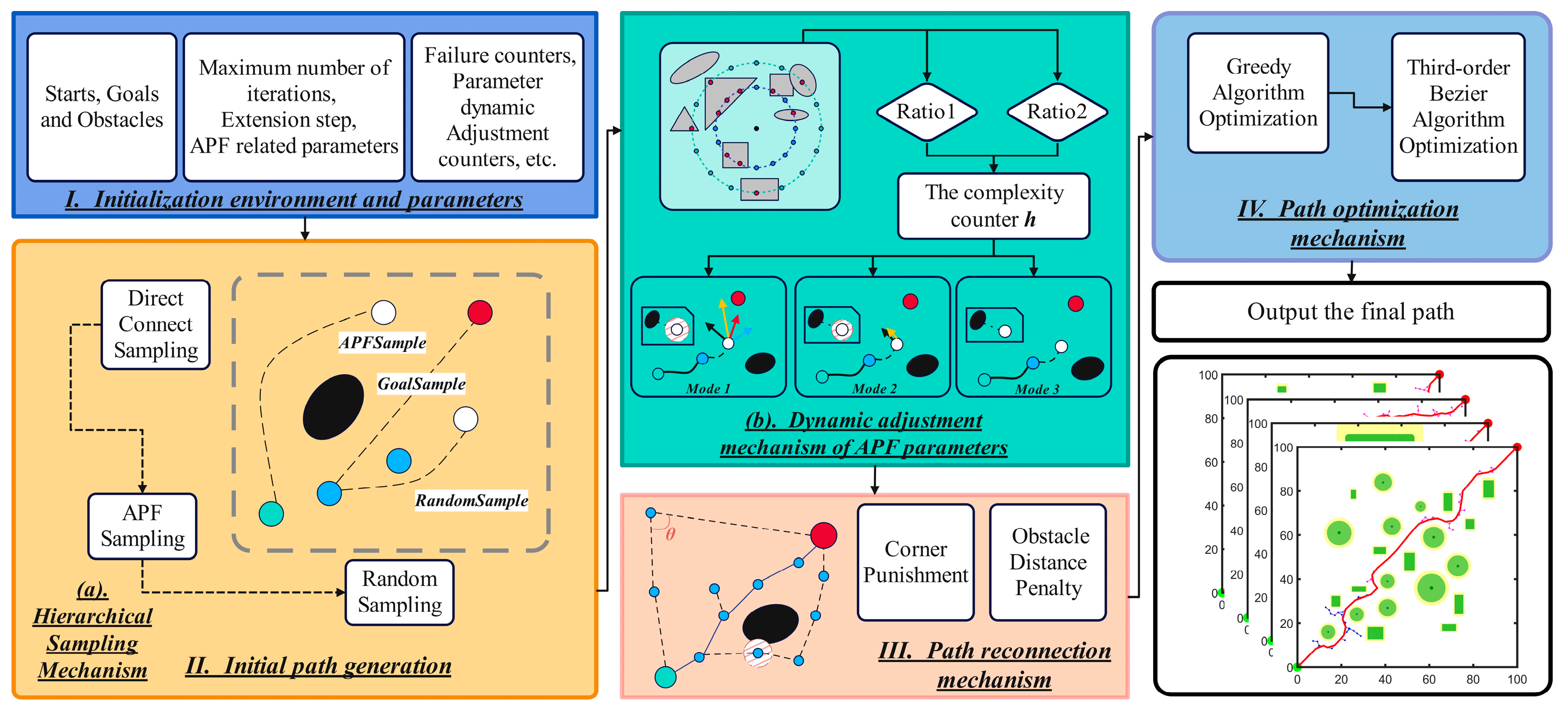
The algorithm presented in this paper improves the RRT* algorithm from three aspects. First, a new sampling method is designed. By designing a hierarchical sampling method, the initial path can be generated efficiently and quickly. Second, by defining the local obstacle distribution, the relevant parameters of the APF algorithm are dynamically adjusted, thus enhancing the obstacle avoidance ability and environmental adaptability, especially for large obstacles and narrow passages. Finally, the path is optimized by combining the greedy algorithm and Bézier curves, reducing the number of redundant nodes and improving the path quality. The general flow of the algorithm is shown in
Figure 1.
| Algorithm 1. SA-Bi-APF-RRT* (xstart, xgoal, Xobs, Epoch) |
 |
3.1. Design of the Hierarchical Sampling Mechanism
In traditional RRT* or its improved algorithms, the sampling strategy, such as uniform random sampling or guided sampling, is often fixed. This step may lead to frequent expansion failures and decreased search efficiency when dealing with areas with dense obstacles or path bottlenecks. To enhance the algorithm’s adaptability and expansion success rate, this study introduces a failure-aware driven hierarchical sampling mechanism, which dynamically adjusts the sampling method to guide the tree structure to explore the space more reasonably.
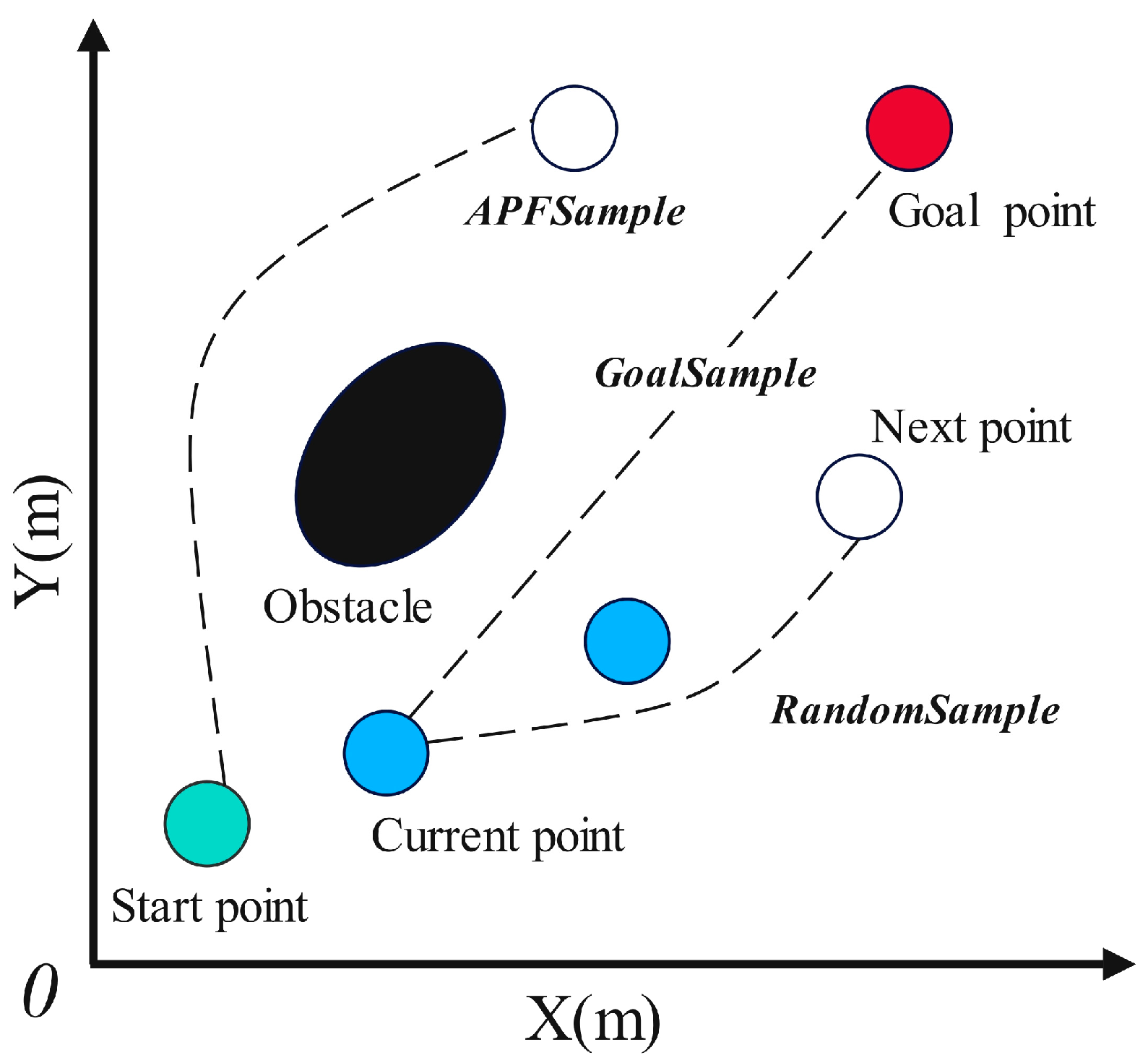
This mechanism consists of two core parts, the failure rate adjustment function and the hierarchical sampling function, as shown in Equations (1) and Algorithm 2, respectively. Among them, the input quantity
p of the sampling function Sample(
p) is as follows:
When the cumulative value of failed expansion,
ftotal, exceeds the set threshold,
, and the algorithm reduces the sampling probability of the target point and switches among three sampling methods, including target sampling, random sampling, and APF guided sampling. In the sampling function Sample(
p), if
p = 1, then target point sampling is adopted to accelerate convergence; if
p = 0, then random sampling is fully used to maintain exploration; and in the intermediate state of 0 <
p < 1, APFSample is called to achieve guided sampling and balance exploration and guidance. This mechanism effectively enhances the adaptability of the algorithm, enabling it to adjust the sampling behavior automatically when encountering expansion bottlenecks or dense obstacle areas, thereby improving the efficiency and robustness of path generation. It should be noted that the sampling parameter
p is a continuous variable within the range [0, 1], enabling a smooth balance between goal-directed sampling and exploration, rather than a strict binary switch.
| Algorithm 2. Sample(p) |
 |
Among them, GoalSample is the target direct connection sampling function, APFSample is the SPF sampling function, and RandomSample is the random sampling function. A schematic of the node expansion is shown in
Figure 2.
3.2. Dynamic Adjustment Mechanism of APF Parameters
To address the issue where the traditional APF method is prone to local minima in areas with dense obstacles, this study designs a dynamic adjustment mechanism of APF based on local obstacle estimation and parameter switching, which realizes the adaptive update of attraction, repulsion intensity, and safety distance and enhances the guidance and feasibility of path expansion.
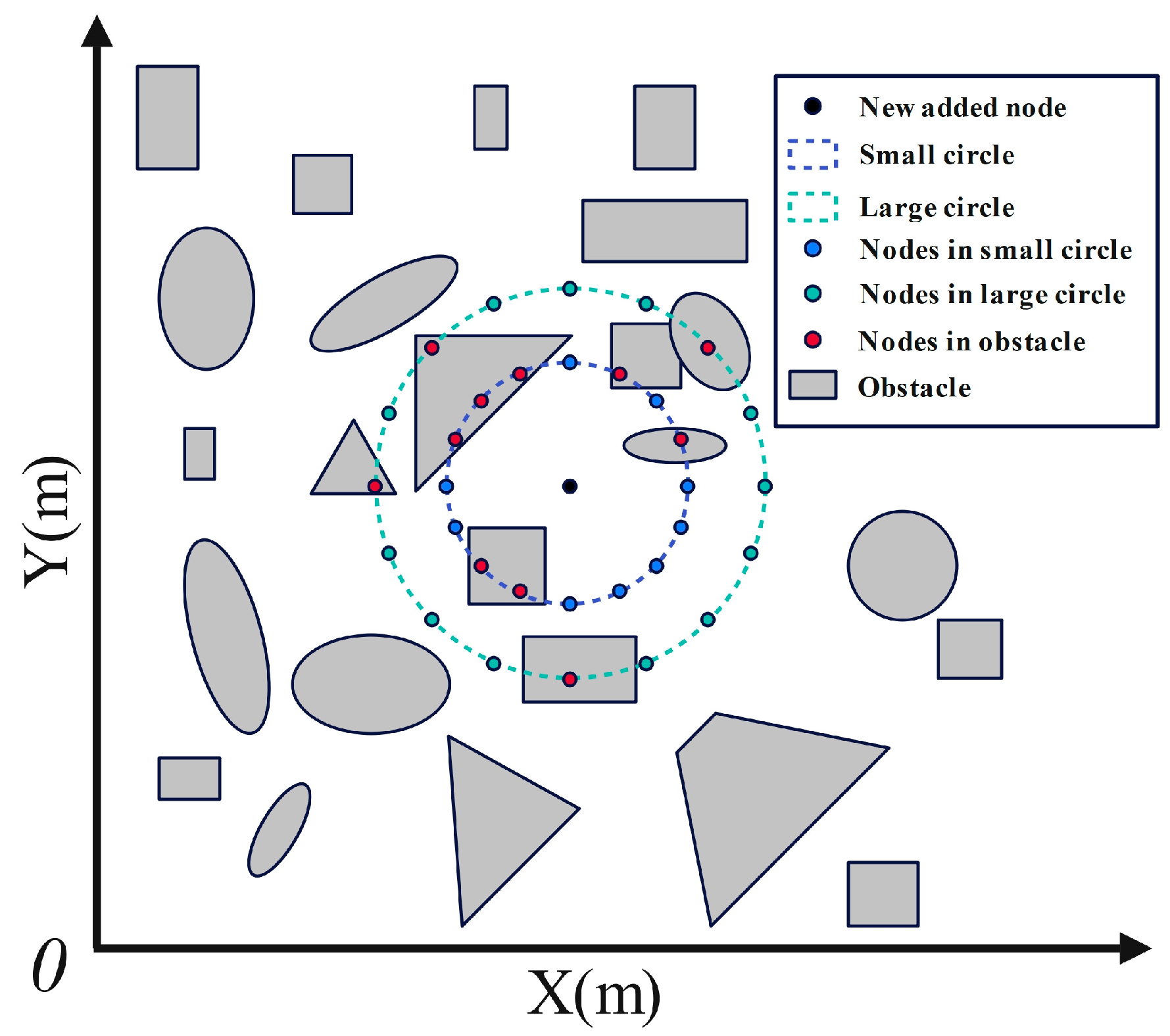
By constructing two concentric circles with xnew as the center (one with a smaller radius and the other with a larger one), N detection points are uniformly generated on the circumference. The proportions of the points that fall into the obstacle set Xobs are, respectively, recorded as Ratio1 and Ratio2. These two proportions can roughly reflect the density characteristics of the local obstacle distribution, where Ratio1 indicates the degree of congestion at a close distance, and Ratio2 reflects the passability at a slightly farther distance. Moreover, Ratio1 and Ratio2 are calculated as shown in Equations (2) and (3). As shown in
Figure 3, samples are taken separately on two circles, where the blue points are the sampling points on the small circle, the green points are the sampling points on the large circle, and the red points are the sampling points that fall into obstacles.
where
i and
j are the serial numbers of the sampling points on the two circles, and Ω represents the obstacle area.
The APF parameters are adaptively adjusted based on local obstacle density rather than being fixed a priori, which alleviates the dependence on specific parameter tuning.
If the output Ratio1 and Ratio2 satisfy the condition of Ratio2 > 0.1 and Ratio1 < 0.01, that is, when the peripheral density is high (Ratio2 > 0.1) and the nearby area is sparse (Ratio1 < 0.01), then the algorithm has entered a “channel opening” or a narrow entrance area. At this point, the adaptive potential adjustment function is called, and its pseudocode is shown in Algorithm 3, where case1, case2, and case3 denote the values of APF parameters for different cases.
| Algorithm 3. Adaptive Potential Adjustment (h, param_set) |
 |
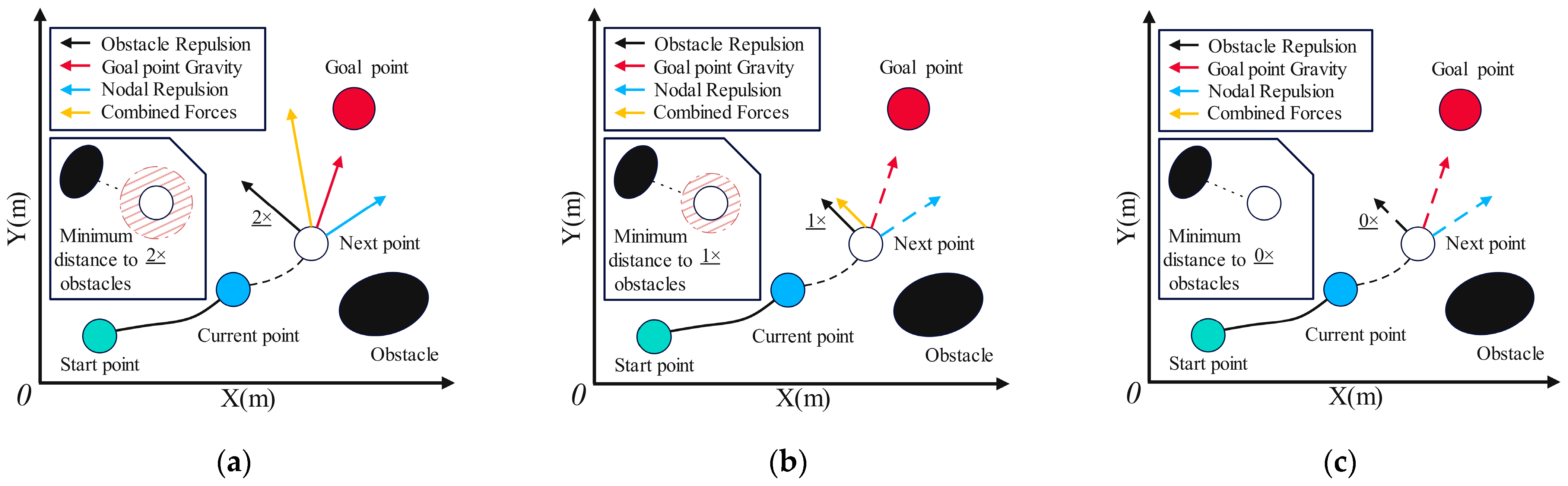
The adaptive potential adjustment function constructs a multiscale neighborhood detection structure centered on the newly generated node, statistically analyzes the distribution density of obstacles, and then accumulates the complexity counter h. When h is small, the current environment is considered relatively open, and the strong attraction and repulsion potential field parameters are retained to guide the tree to expand efficiently toward the target direction. When h accumulates to a medium level, the surrounding obstacles are dense or the path is locally restricted. At this time, the attraction potential field is turned off, and only a certain safety redundancy is retained. If h exceeds the high threshold, then the APF is completely turned off, and the path is guided to switch to a random exploration mode to avoid getting stuck in local extremums. Through the above dynamic parameter adjustment strategy, the algorithm’s ability to escape from narrow passages and complex obstacle areas and the success rate of global planning are effectively improved. The three APF potential field patterns are shown in
Figure 4.
3.3. Path Reconnection Mechanism
The proposed path planning framework employs a local reconnection mechanism to optimize the RRT structure. When a new node is added, the algorithm “rewires” the tree by updating the parent node of the new node within a predefined radius, minimizing the overall path cost while ensuring collision-free paths. The rewiring process examines all existing nodes within the radius and performs collision checks along the connecting lines to ensure feasibility.
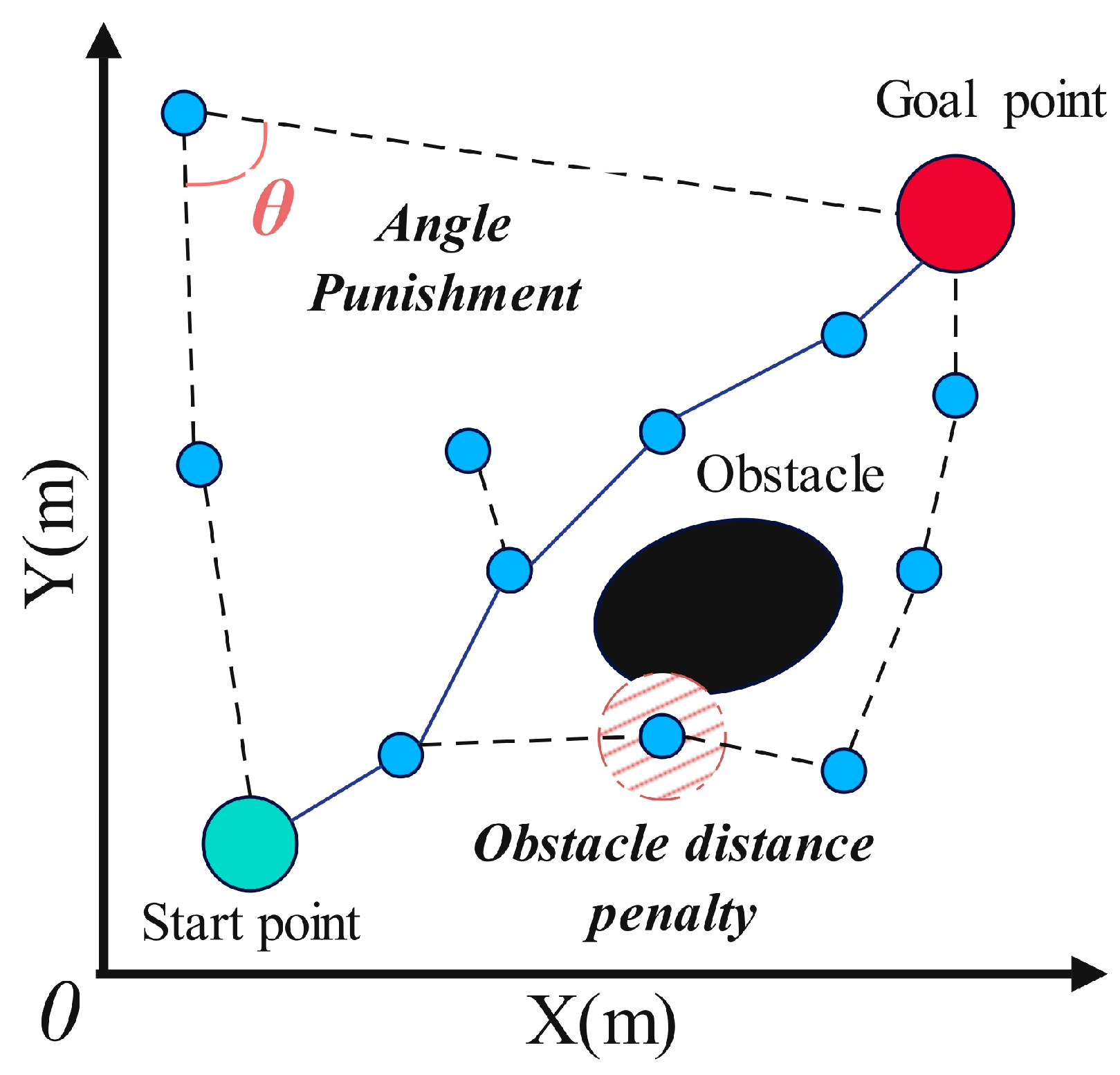
In contrast to the traditional RRT* algorithm’s path back-connection mechanism, the enhanced cost function combines the path length with sharp turn penalties (angle penalties) and proximity to obstacle penalties (obstacle distance penalties) to provide guidance for selecting a parent node. As the path approaches an obstacle, the obstacle penalty increases exponentially, thus encouraging the selection of a safer path, as shown in Equation (4).
where
denotes the accumulated cost from the root to node, ‖·‖ is the Euclidean distance,
is the angle penalty, and
represents the shortest distance from the connecting segment to obstacles. The parameters
and
serve as weighting factors balancing smoothness and safety considerations. If the candidate node has a lower cost, the parent node of the new node is updated accordingly. This dynamic rewiring improves path quality by locally optimizing connections, reducing detours, and increasing gaps close to obstacles.
Figure 5 illustrates this mechanism, showing reconnections based on spatial proximity, angular constraints, and obstacle distance penalties to form efficient and safe paths from the origin to the destination.
3.4. Path Optimization Mechanism
To enhance the smoothness and feasibility of the path, this study introduces a two-stage path optimization strategy based on the original path. First, a greedy simplification algorithm is applied to preliminarily compress the sequence of path nodes [
22,
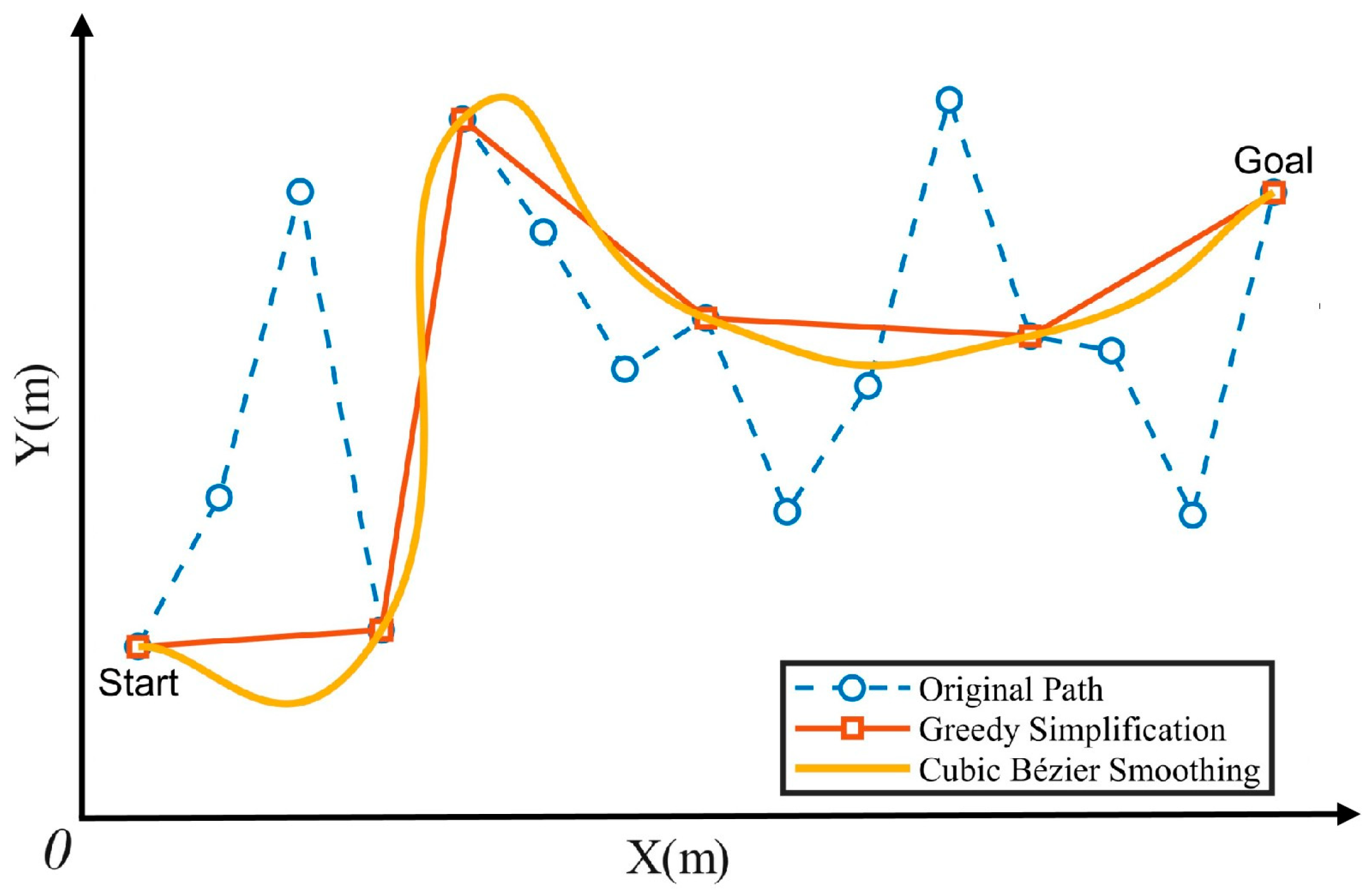
23]. In this stage, starting from the path’s beginning, each subsequent node is attempted to be connected in turn. Under the condition of no collision and the line segment length not exceeding the set threshold, the farthest feasible node is selected as the next path point, effectively eliminating redundant nodes and compressing the path structure. Second, on the basis of the simplified path, cubic Bezier curves are introduced for smoothing [
24]. Specifically, a virtual control point is introduced at the beginning and the end of the path, generated symmetrically from adjacent points to avoid the curvature discontinuity problem caused by boundary mutations; then, for each pair of adjacent path points, four Bezier control points are constructed in combination with their preceding and following points, and the final smooth path is obtained by uniform sampling on each curve, as shown in
Figure 6. This method not only retains the feasibility of the path but also remarkably improves the overall continuity and smoothness, providing a good reference trajectory for path tracking and control.
3.5. Computational Complexity Analysis
To further clarify the computational characteristics of the proposed SA-Bi-APF-RRT* algorithm, this subsection analyzes its computational complexity and compares it with that of conventional RRT*-based planners.
In a standard RRT* algorithm, the dominant computational cost per iteration arises from three main operations: nearest-neighbor search, collision checking, and local rewiring. Assuming a total of N sampled nodes, the nearest-neighbor search and rewiring operations typically require O(log N) time when efficient spatial data structures (e.g., k-d trees) are employed, while collision checking depends on the geometric complexity of the environment and is commonly treated as O(1) per query. Consequently, the overall computational complexity of RRT* is approximately O(N log N).
The proposed SA-Bi-APF-RRT* algorithm retains the same fundamental tree expansion and rewiring framework as RRT* and Bi-RRT* and therefore preserves the same asymptotic computational complexity of O(N log N). The additional mechanisms introduced in this work mainly affect the constant factors rather than the asymptotic order.
Specifically, the hierarchical sampling mechanism introduces a failure-aware sampling strategy selection, which involves only simple threshold comparisons and probability switching operations, incurring negligible additional computational cost per iteration. The local obstacle density estimation for adaptive APF parameter adjustment is performed by sampling a fixed number of detection points on two concentric circles centered at the newly generated node. Since the number of sampling points is constant, this process has O(1) complexity per iteration.
The enhanced path reconnection strategy incorporates angle penalties and obstacle distance penalties into the cost evaluation. These additional cost terms are computed locally during the rewiring stage and do not increase the number of candidate nodes considered, thus maintaining the original rewiring complexity. Finally, the greedy pruning and Bézier curve smoothing procedures are executed only once after a feasible path is found, and their computational cost is linear with respect to the number of path nodes, which is typically much smaller than the total number of sampled nodes (N).
Overall, the proposed SA-Bi-APF-RRT* algorithm achieves significant improvements in path quality, robustness, and convergence efficiency without increasing the asymptotic computational complexity compared with traditional RRT*-based methods. The experimental results further confirm that the additional computational overhead introduced by the adaptive mechanisms is effectively compensated by the reduced number of iterations and sampled nodes required to obtain high-quality paths.
4. Results
In this section, we compare the proposed SA-Bi-APF-RRT* algorithm with RRT*, GB-RRT*, Bi-RRT*, APF-RRT*, and Bi-APF-RRT*. The simulations were run on the I5-13600KF CPU with 16 GB of memory. The simulation platform was MATLAB R2024A.
4.1. Experimental Pretreatment
4.1.1. Environmental Setup
As shown in
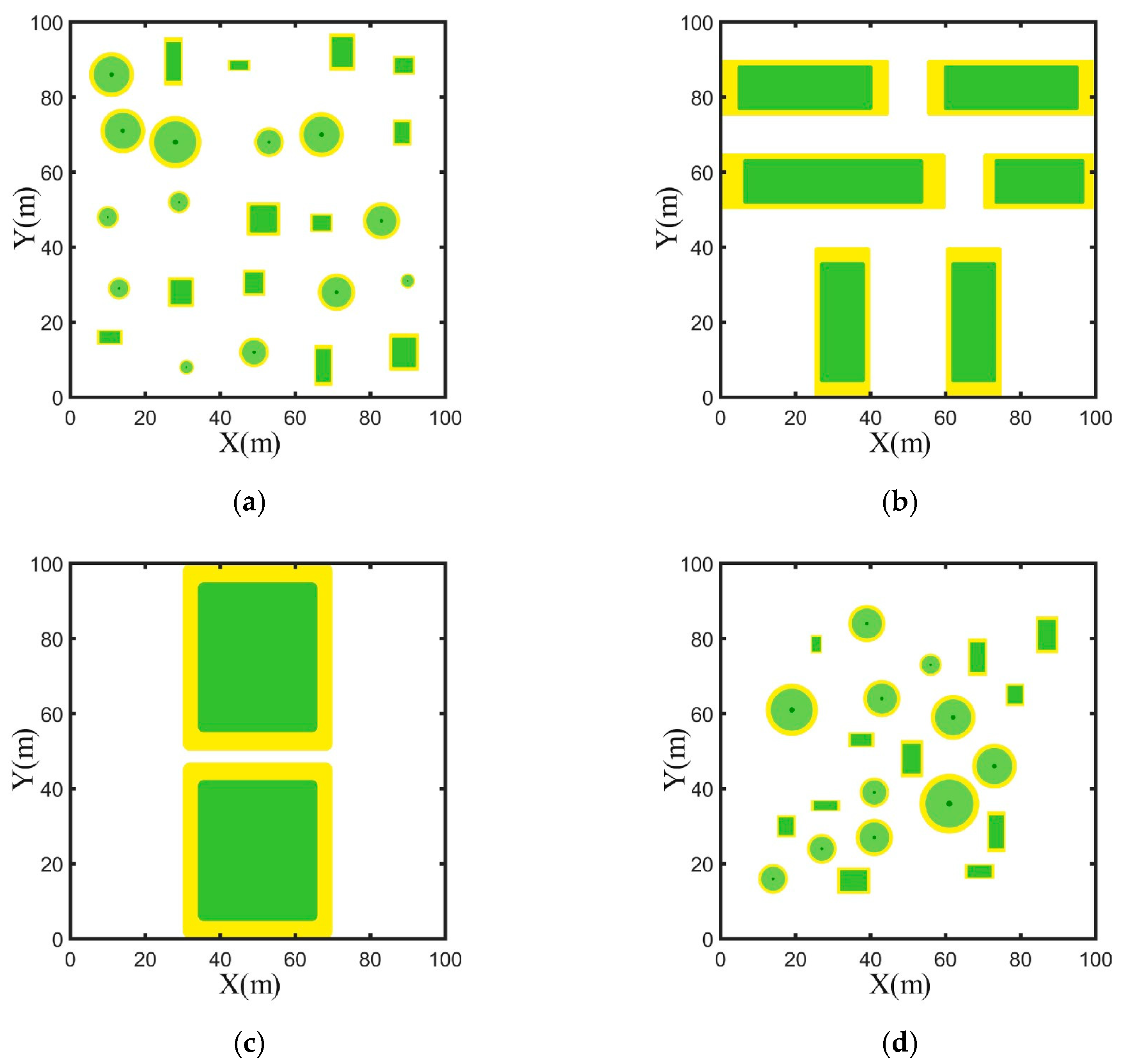
Figure 7, we select a continuous mapping of size 100 m × 100 m as the configuration space. In this space, the green areas represent obstacles. For the circular obstacles, the centers of the obstacles are filled with dark green to show the location of the center more clearly. The light green area on the outermost layer of the obstacles is the expansion zone of the obstacles, ensuring that the algorithm can avoid potential collision risks in advance when planning paths, thereby enhancing safety and robustness.
We designed four different environments as the configuration space.
Figure 7a represents the most basic environment, composed of uniformly distributed obstacles.
Figure 7b consists of several rectangular obstacles of different sizes, with regularly arranged rectangular obstacles forming multiple channel-like regions, suitable for testing the channel selection and shortest path calculation effects of the path planning algorithm. The obstacles in
Figure 7c are two large rectangular ones, which, together, form a narrow and long channel.
Figure 7d is composed of unevenly distributed obstacles, with the obstacles concentrated in the middle part of the configuration space.
4.1.2. Algorithm Parameter Settings
In the simulation experiment, the fixed step size of the RRT*, GB-RRT*, Bi-RRT*, APF-RRT*, Bi-APF-RRT*, and SA-Bi-APF-RRT* algorithms was 2. The target direct connection probability of the GB-RRT* and SA-Bi-APF-RRT* algorithms was set to 30%. The attraction coefficient and repulsion coefficient of the APF-RRT* and Bi-APF-RRT* algorithms were set to 0.5 and 20, respectively. Given that the attraction coefficient and repulsion coefficient of the SA-Bi-APF-RRT* algorithm would change during the operation, the initial values were both set to 1.
4.1.3. Optimal Path Scenario
In this section, xstart is represented by a green dot and xgoal by a red dot. The newly generated nodes during the planning process and the connections between nodes are, respectively, indicated by dark blue and light purple. The optimal path is represented by a red line segment. Meanwhile, the safety distance for the path planning algorithm is set to 2 m to ensure that the robot can maintain a certain safety distance from obstacles during operation.
We set the number of iterations to 2000 and defined the following metrics to measure the quality of the optimal paths generated by different algorithms:
Time (s): Generation time of the path;
Path_Length (m): Length of the generated path;
Total_Nodes (n): Number of nodes contained in the path;
Avg_Distance (m): Safety distance of the generated path;
Successful rate (%): Success rate of path generation at 2000 iterations.
4.2. Simulation Analysis
4.2.1. Environment A
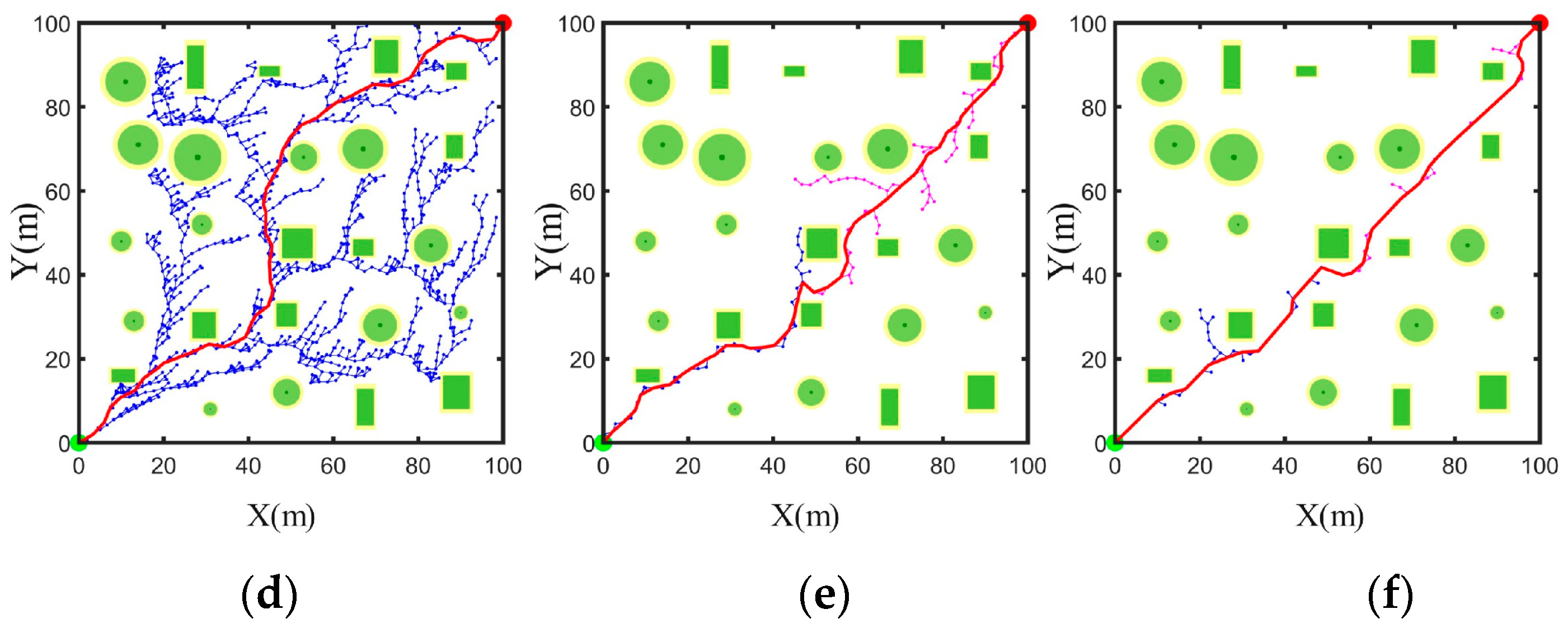
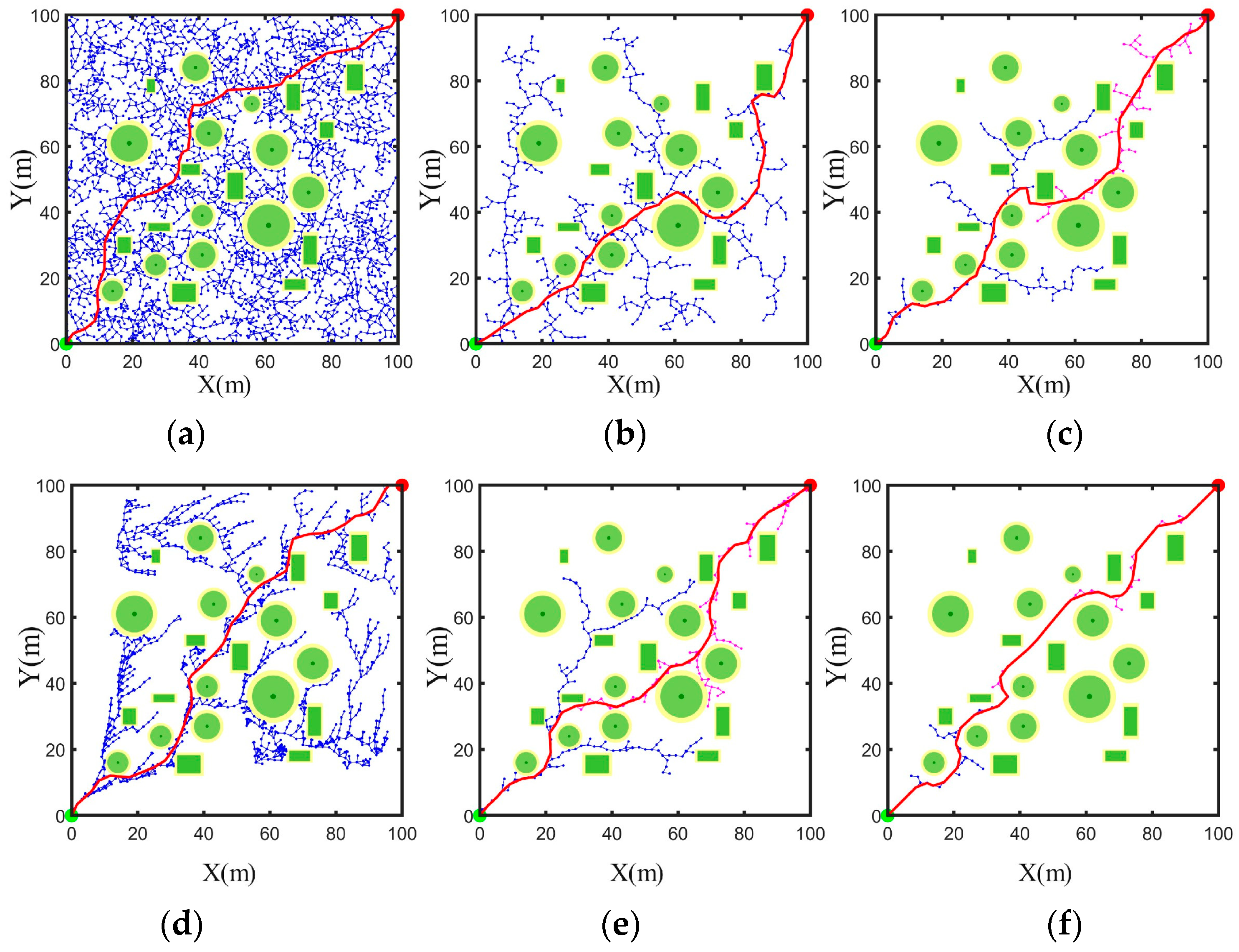
The paths generated by the six algorithms in environment A are shown in
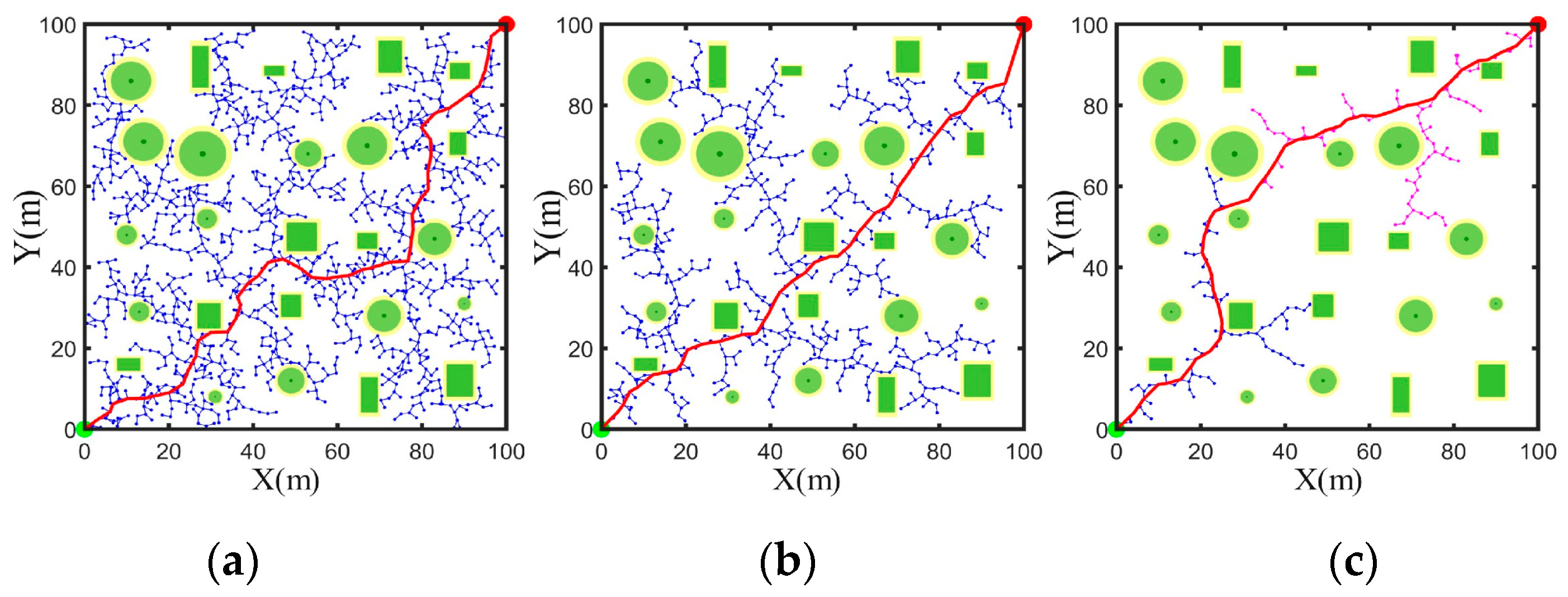
Figure 8.
Figure 8a shows the optimal path generated by the RRT* algorithm. Given the limited performance of the RRT* algorithm, its success rate in generating paths in environment A is the lowest.
Figure 8f shows the path generated by the SA-Bi-APF-RRT* algorithm, with a success rate of 100%. Among the six algorithms, it takes the shortest time, has the fewest average nodes in the generated paths, and has the largest safety distance. Compared with the Bi-APF-RRT* algorithm, its safety distance has increased by approximately 49%, and the average path length is approximately 1.94% shorter.
4.2.2. Environment B
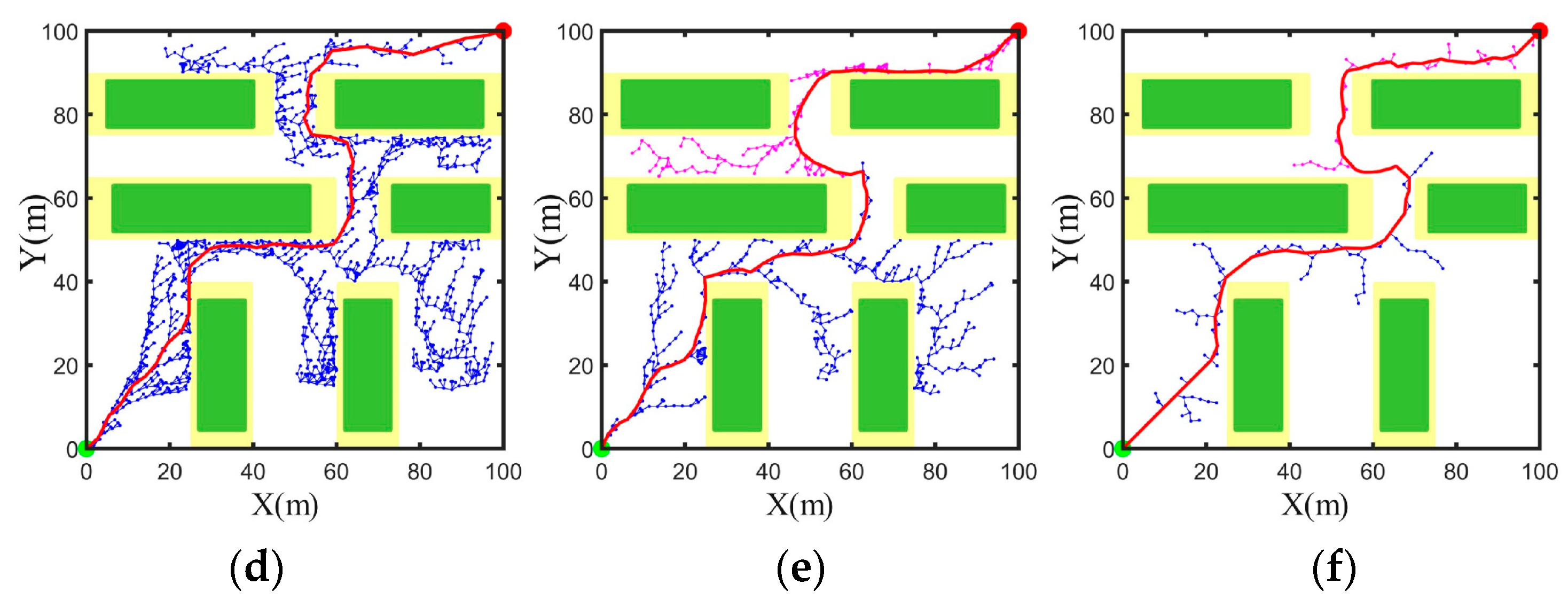
The path exploration performance near a wide obstacle in Environment B was evaluated.
Figure 9 shows the paths generated by six algorithms, while
Table A1 summarizes path generation time, lengths, node counts, safety distances, and success rates.
GB-RRT* (
Figure 9a,b) uses a guiding factor to focus sampling toward the target, producing a more directed and compact tree with fewer nodes, though the path remains moderately smooth with some bends.
APF-RRT* (
Figure 9d) leverages artificial potential fields to guide sampling away from obstacles, resulting in smoother paths, but may get trapped in local optima and generates clustered samples in complex areas.
Bi-APF-RRT* (
Figure 9e) often explores the area near obstacle boundaries, which may compromise safety in real applications.
The proposed SA-Bi-APF-RRT* (
Figure 9f) yields the smoothest path, the shortest average path length, the fewest nodes, and is the only algorithm achieving a 100% success rate in Environment B.
As in Environment A, SA-Bi-APF-RRT* outperforms other algorithms in path quality, requiring only 10.6% of the nodes used by RRT* and just 35.1% of the computation time compared to Bi-APF-RRT*.
4.2.3. Environment C
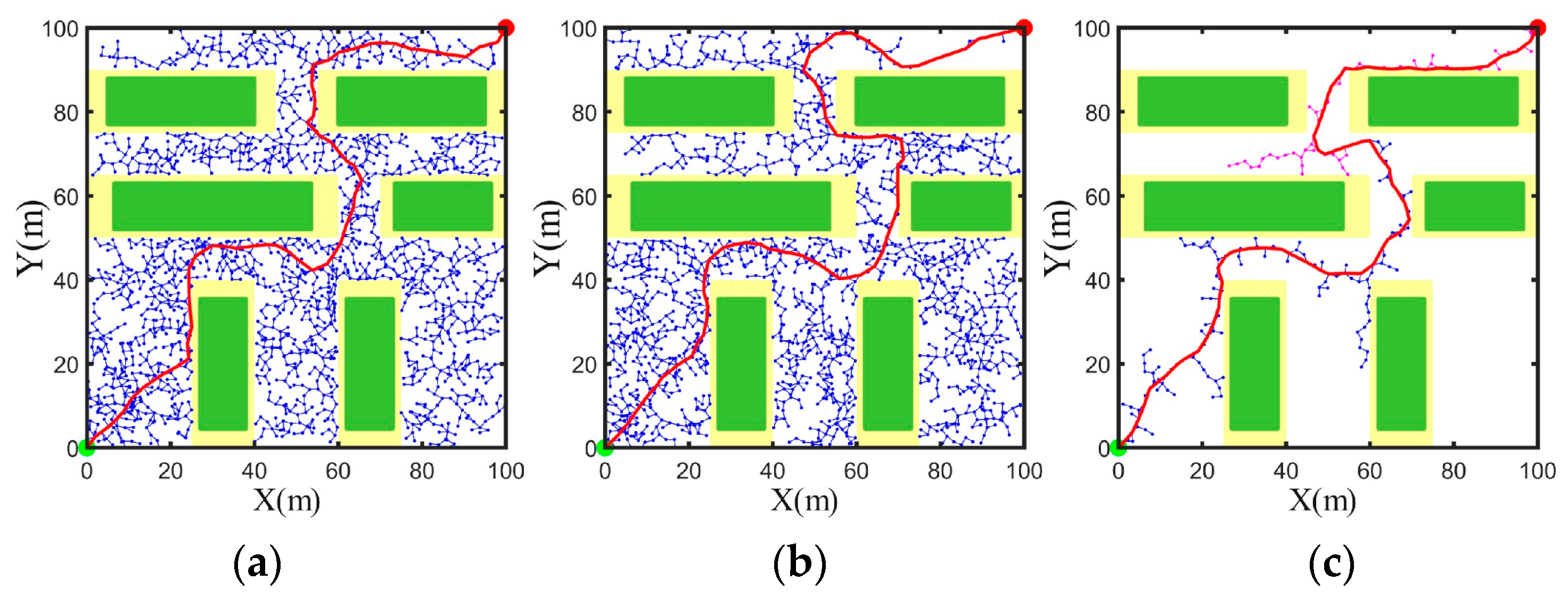
Environment C examined the path exploration capabilities of different algorithms when passing through narrow and long channels. The paths generated by the six algorithms in Environment C are shown in
Figure 10.
Figure 10f shows the optimal path generated by the SA-Bi-APF-RRT* algorithm. As shown in the figure, the SA-Bi-APF-RRT* algorithm has the strongest directional exploration ability and the best path quality. Especially at the edge of obstacles, the path is the smoothest and can avoid local minima. As shown in
Table A1, the safety distance of the path generated by the SA-Bi-APF-RRT* algorithm is 96.1%, 104%, 85.4%, 96.1%, and 82.1% higher than that of the RRT*, GB-RRT*, Bi-RRT*, APF-RRT*, and Bi-APF-RRT* algorithms, respectively.
In addition, in the narrow and long channel environment, only the SA-Bi-APF-RRT* algorithm achieved a success rate of 100%. During the path exploration process in the channel, only the path generated by the SA-Bi-APF-RRT* algorithm is the smoothest, which helps the robot maintain a stable operation in the channel and keep a relatively fixed distance from obstacles when performing tasks.
4.2.4. Environment D
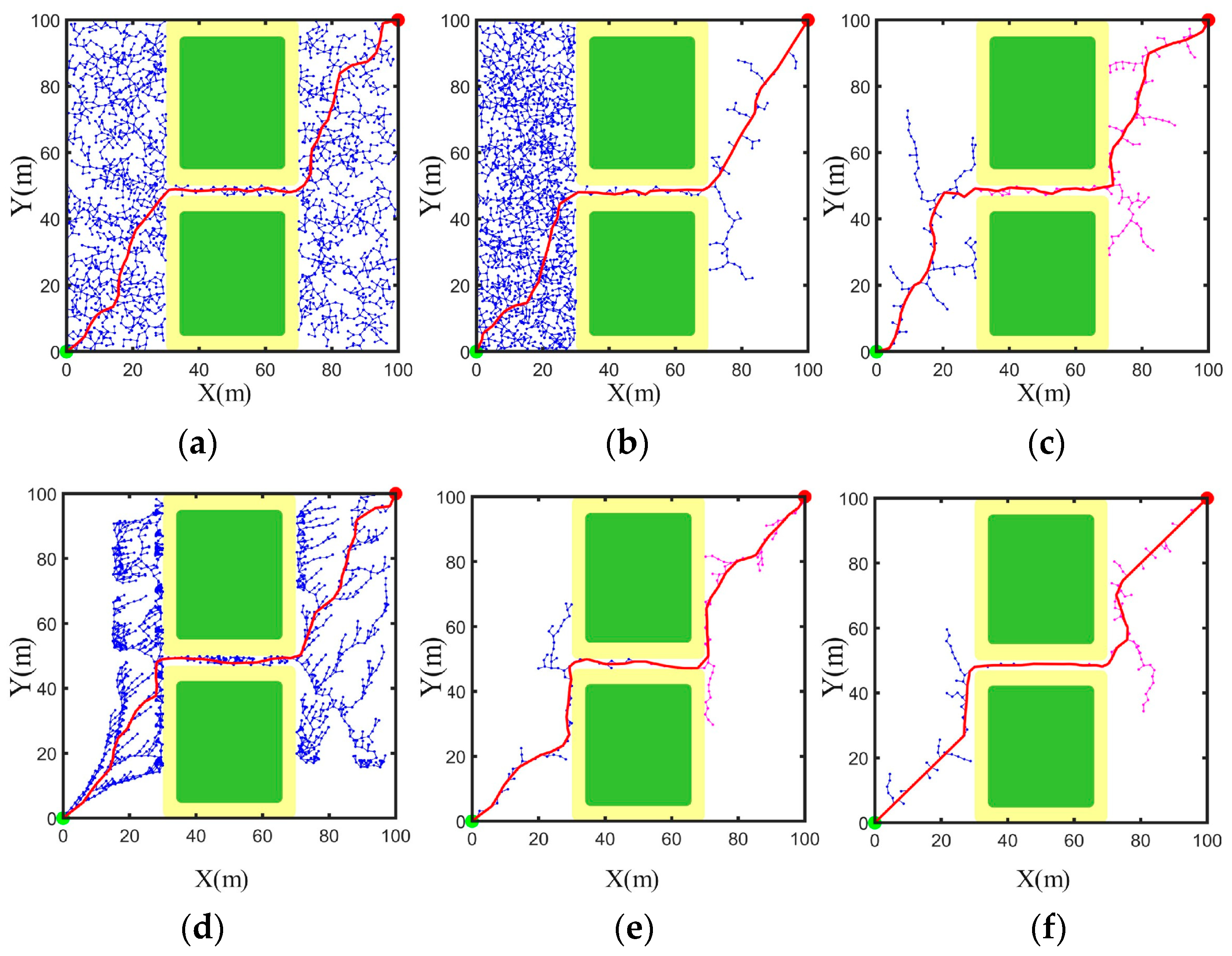
Environment D represents a situation where the overall layout of obstacles is sparse but locally dense. The paths generated by the six algorithms in environment B are shown in
Figure 11. As shown in
Figure 11a, the RRT* algorithm lacks guidance when exploring paths and performs poorly. The APF-RRT* algorithm in
Figure 11d is affected by local extremums when exploring paths and tends to “oscillate” or get stuck in dead ends in dense obstacle areas. Although the algorithms in
Figure 11b,c,e have considerably reduced sampling points, the generated paths are somewhat distorted in some sections. The SA-Bi-APF-RRT* algorithm in
Figure 11f has the shortest path and the best smoothness and can actively avoid crowded obstacle areas and quickly traverse complex regions. This characteristic is mainly due to the dynamic adjustment mechanism of the APF parameters in the SA-Bi-APF-RRT* algorithm. The length of the generated path is 6.6% shorter than that of the RRT* algorithm and 4.6% shorter than that of the Bi-APF-RRT* algorithm.
The SA-Bi-APF-RRT* algorithm synergistically integrates bidirectional tree expansion, artificial potential field (APF) guidance, reconnection optimization, and dynamic parameter adjustment, thereby substantially improving both the efficiency and quality of path planning across all evaluation metrics. Specifically, bidirectional expansion accelerates connectivity between the start and goal, markedly reducing planning time in complex environments. APF guidance enhances path safety by increasing the average distance from obstacles. Reconnection optimization, through the incorporation of corner and obstacle distance penalties, reduces sharp turns, minimizes node redundancy, and yields smoother trajectories. Dynamic parameter adjustment further ensures algorithmic adaptability and consistently high success rates in diverse environments.
Collectively, these innovations enable the proposed algorithm to achieve superior performance relative to traditional methods, as reflected in improved efficiency, path smoothness, safety, reduced planning time, fewer nodes, greater safety distances, and higher success rates.
Nevertheless, the SA-Bi-APF-RRT* algorithm can exhibit increased computational demand in large-scale or obstacle-dense environments, potentially resulting in prolonged runtimes. Furthermore, its real-time efficacy may be constrained by frequent obstacle variations in dynamic or high-dimensional (3D) scenarios, and the global optimization capability remains an area for future improvement.
5. Discussion
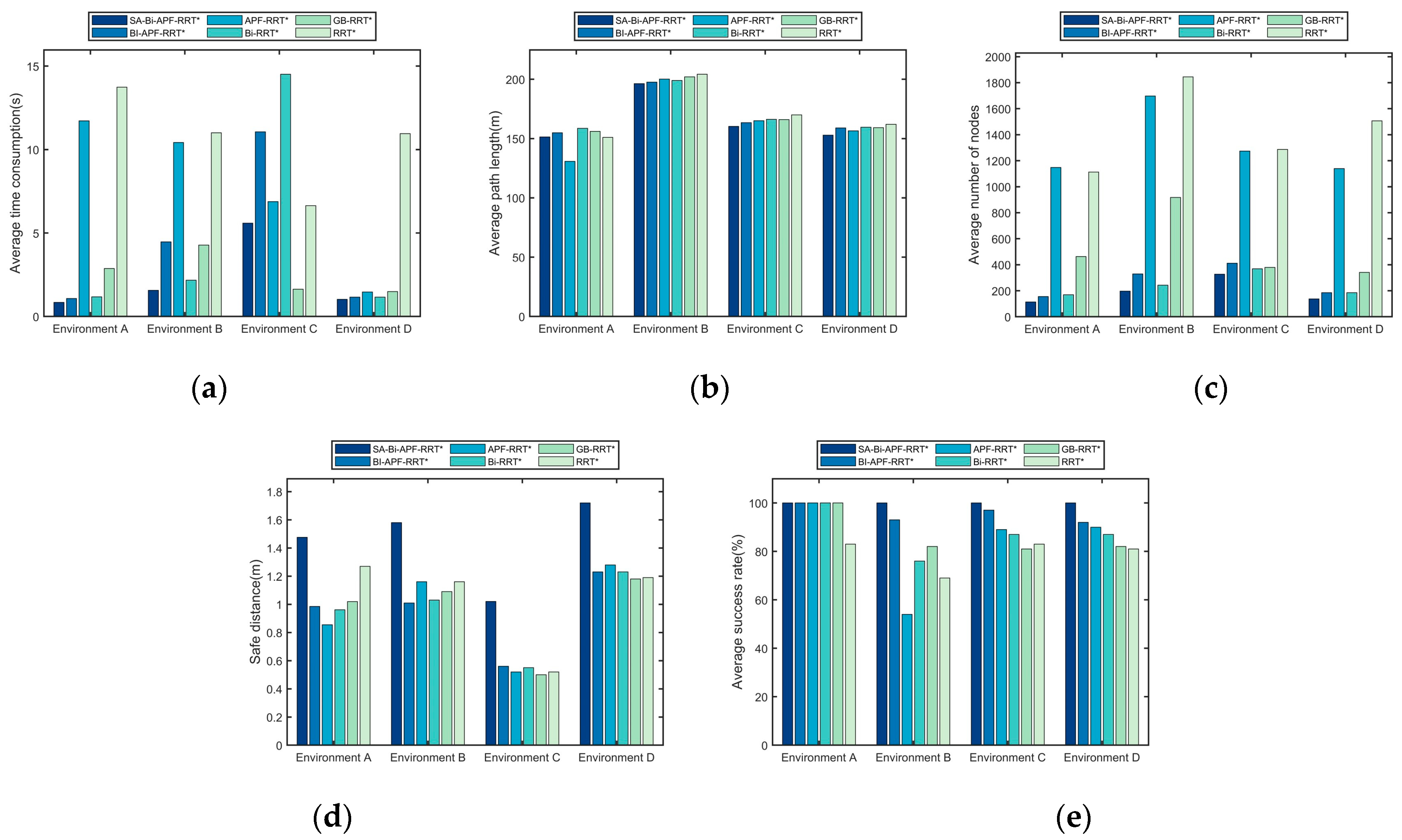
Figure 12 shows the path generation time, path length, total number of nodes, average safety distance, and path generation success rate of six algorithms in four environments. Combining
Figure 8,
Figure 9,
Figure 10, and
Figure 11 reveals that the RRT* algorithm performs the worst overall in the four environments, especially in environments B and C, where the total number of nodes is as high as 1844 and 1287, respectively, with long path generation time and the lowest average success rate. This performance indicates that the RRT* algorithm has limited search efficiency and convergence ability in complex obstacle environments. By contrast, the GB-RRT* algorithm has slightly optimized path length, but the improvement in the number of nodes and success rate is still not remarkable, suggesting that its heuristic mechanism has certain limitations.
Compared with these, the Bi-RRT* and APF-RRT* algorithms have achieved more balanced performance in multiple environments. The Bi-RRT* algorithm has remarkably improved search efficiency because of its bidirectional search strategy, with success rates of 76% and 87% in environments B and C, respectively. The APF-RRT* algorithm, after introducing the APF, has enhanced guidance, making the path closer to the target area, with a reduction in the number of nodes and time cost, but it has some path oscillation issues and a slightly inferior safety distance performance. The Bi-APF-RRT* algorithm further integrates bidirectional search and potential field guidance on the basis of the aforementioned algorithms, achieving relatively stable overall performance. In environments A and C, its path length is shorter, and the average success rate remains above 87%, demonstrating good environmental adaptability. Notably, the SA-Bi-APF-RRT* algorithm exhibits the best performance in all four environments. Among all the indicators, it has the shortest average path length, the lowest planning time, and a success rate of 100% in all environments. Additionally, the average safety distance of the paths generated by this algorithm is generally larger, especially in environments A and C, indicating its advantages in obstacle avoidance and path smoothness, and better meeting the requirements of autonomous mobile robots for path stability and safety.
5.1. Number of Iterations and Path Quality
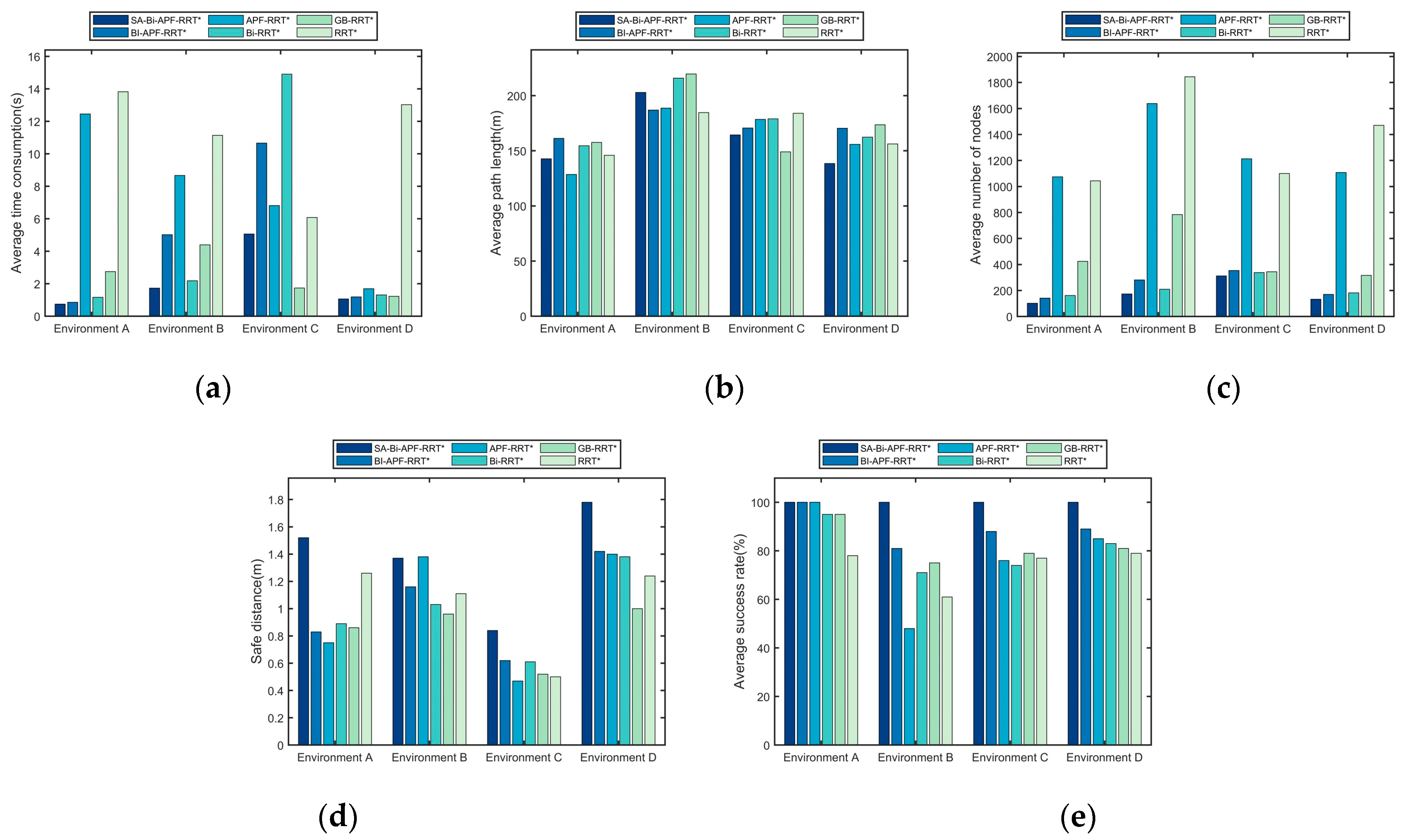
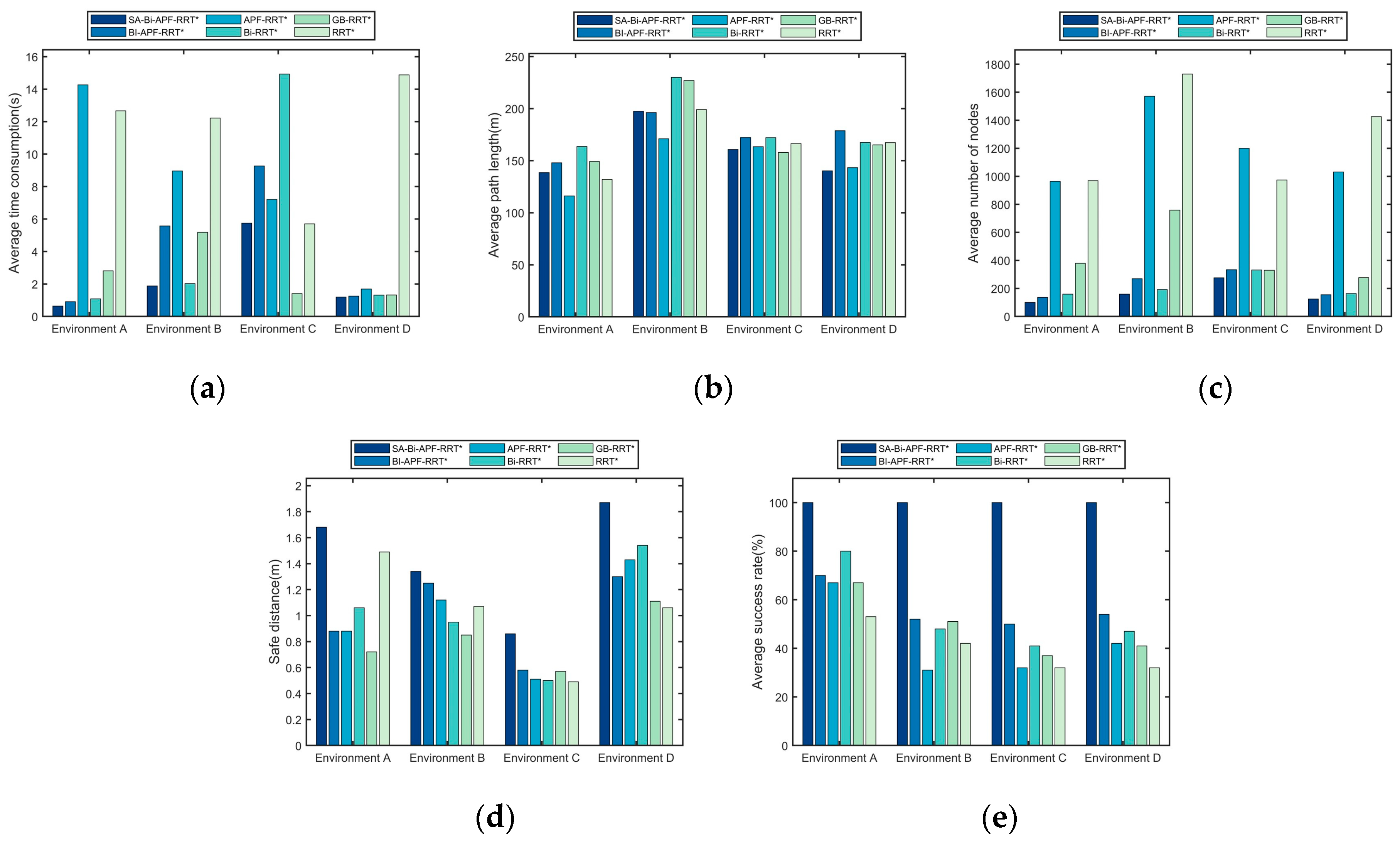
In the previous section, we examined the optimal path-finding performance of different algorithms under 2000 iterations. In this section, the maximum number of iterations is set to 1500, 1000, and 500, respectively, and the experiments are repeated for the six algorithms across the four environments mentioned above. This experiment aims to evaluate the algorithms performance under conditions of limited iteration counts. The same evaluation metrics—average time consumption, average path length, average number of nodes, safe distance, and average success rate—are employed to assess algorithm performance.
5.2. Analysis of Path Quality Under Different Iteration Counts
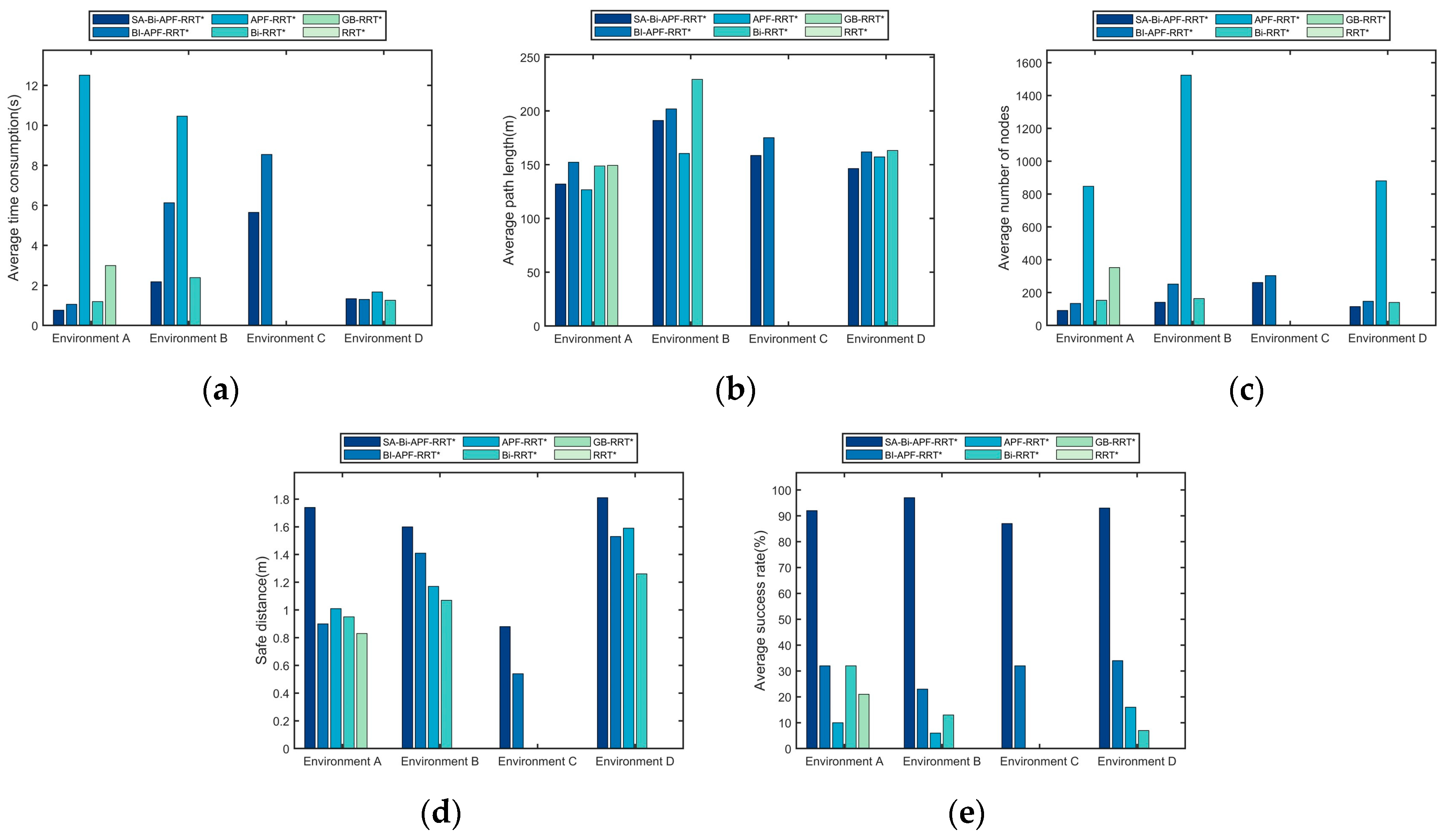
From the perspective of average success rate, the performance of the traditional RRT* algorithm drops considerably as the number of iterations decreases. In 500 iterations, its success rate in environments A, B, C, and D is all 0, which seriously affects the task completion ability. By contrast, Bi-RRT* and APF-RRT* can still maintain a success rate of over 30% in 1000 iterations, while the SA-Bi-APF-RRT* algorithm maintains a success rate of over 90% in all environments with 1500 iterations or less, demonstrating the best environmental adaptability and robustness.
As shown in
Figure 12b and
Figure 13b, the path length of the algorithm fluctuates slightly with the decrease in the number of iterations, but SA-Bi-APF-RRT* still maintains a relatively short path under different iterations, indicating that its path guidance mechanism is effective. For example, in 1500 iterations, the path length of SA-Bi-APF-RRT* in environment C is only 164.41 m, which is shorter than that of Bi-RRT* (175.87 m) and GB-RRT* (192.16 m).
Bi-APF-RRT* also performs well in terms of path quality in 1000 and 500 iterations, achieving shorter path lengths in multiple environments while maintaining a good safety distance, indicating that its bidirectional search and potential field guidance mechanism can better handle planning tasks with low iterations.
Figure 13c,
Figure 14c and
Figure 15c show the trend of node number changes. The number of nodes in RRT* and APF-RRT* is always larger, and the growth rate slows down as the number of iterations decreases. By contrast, SA-Bi-APF-RRT* and Bi-RRT* can complete effective path planning with fewer nodes, indicating higher search efficiency. Especially in 1000 iterations, SA-Bi-APF-RRT* generates only 99.2 nodes to generate a path in environment A successfully, while RRT* generates as many as 969 node in
Figure 15d, under the condition of reduced iterations, SA-Bi-APF-RRT* and Bi-APF-RRT* maintain a relatively high average safety distance, indicating that their paths are further away from obstacles and more practically executable. By contrast, the safety distances of traditional RRT* and GB-RRT* are generally low, and their paths are even close to the edge of obstacles, posing considerable risks. Detailed data are provided in
Table A2,
Table A3 and
Table A4.
5.3. Analysis and Discussion
As the number of iterations decreases, the performance differences among path planning algorithms gradually become apparent. Traditional methods such as RRT* and GB-RRT*, constrained by sampling efficiency, show a considerable decline in success rate and path quality. Bi-RRT* and APF-RRT* demonstrate a certain degree of adaptability. However, Bi-APF-RRT* and SA-Bi-APF-RRT*, relying on bidirectional expansion and potential field guidance mechanisms, maintain stability and superior performance in various environments and under different iterations. Among them, SA-Bi-APF-RRT* has the best overall performance and is a more practically valuable solution in complex dynamic environments.
Under tests with different iteration counts (1500, 1000, 500) and in multiple complex environments, SA-Bi-APF-RRT* exhibits the most comprehensive optimal performance in terms of success rate, path quality, sampling efficiency, safety, and real-time performance.
6. Conclusions
This study proposes an SA-Bi-APF-RRT* algorithm. By establishing a hierarchical new node expansion mechanism, the expansion mode of new nodes is dynamically adjusted. Then, a bidirectional APF guidance strategy, which enhances the obstacle avoidance capability, is introduced. On this basis, the algorithm incorporates an obstacle range density evaluation module, enabling the APF parameters to be autonomously adjusted in accordance with the distribution density of surrounding obstacles. Additionally, the algorithm combines piecewise greedy pruning and Bézier curve fitting techniques, achieving dual optimization of path length and smoothness while ensuring path safety. Compared with other algorithms, the success rate remains consistently above 90%, remarkably higher than RRT*; the path length is generally reduced by approximately 20% to 30%; the number of sampling nodes is reduced by more than 50%, remarkably improving search efficiency; the average path distance is greater than 1 m, demonstrating good obstacle avoidance performance; and the planning time is relatively short, meeting real-time requirements. The above results fully verify the strong adaptability and efficiency of the SA-Bi-APF-RRT* algorithm in low-iteration and high-obstacle environments, making it an optimized solution more suitable for USVs path planning tasks.
Despite the promising performance of the proposed SA-Bi-APF-RRT* algorithm, several limitations remain. The current study focuses on global path planning in static environments, and dynamic obstacles as well as environmental disturbances such as currents and waves are not explicitly considered. In practical USV applications, these factors, together with inevitable perception errors and uncertainties caused by sensing limitations and environmental disturbances, may affect navigation safety and tracking accuracy. Future work will therefore investigate the integration of the proposed algorithm with real-time perception, local replanning, and control strategies to address dynamic environments. In addition, uncertainty-aware planning approaches and robust sensor fusion techniques will be explored to mitigate the impact of imperfect obstacle information. Further optimization will also be considered to improve computational efficiency in large-scale or highly cluttered scenarios, and extending the framework to incorporate vessel dynamics and three-dimensional environments represents another important research direction.
Author Contributions
Conceptualization, S.L. and M.X.; methodology, D.L., K.C. and M.X.; writing—original draft preparation, T.L.; writing—review and editing, M.X., D.L. and K.C.; software, Y.L.; formal analysis, D.L., J.X., T.L. and Y.L.; resources, H.Z., J.X. and M.X.; validation, J.X. and H.Z.; project administration, J.X. and H.Z.; supervision, M.X.; funding acquisition, M.X. All authors have read and agreed to the published version of the manuscript.
Funding
This research was funded by the Integrated Pilot Program for Agricultural Machinery R&D, Manufacturing, Promotion, and Application in Jiangsu Province (Project JSYTH03 & JSYTH12), the Jiangsu Province Modern Agricultural Machinery Equipment and Technology Promotion Project (NJ2024-11), the Key Research and Development Program of Jiangsu Province (BE2022385), and the Nanjing Digital Agriculture Science and Technology Achievement Integrated Innovation and Demonstration Project (NJ2024-07).
Data Availability Statement
The data presented in this study are available upon request from the corresponding author.
Acknowledgments
This study received technical support from the College of Engineering in Nanjing Agriculture University, including the licensed software of MATLAB.
Conflicts of Interest
The authors declare no conflicts of interest.
Appendix A
Table A1.
Simulation date in maximum number of iterations of 2000.
Table A1.
Simulation date in maximum number of iterations of 2000.
| Environment | Algorithm | Time
(s) | Path_Length
(m) | Total_Nodes
(n) | Avg_Distance
(m) | Successful Rate
(%) |
|---|
| Environment A | RRT* | 13.74 | 151.36 | 1113.76 | 1.27 | 83 |
| GB-RRT* | 2.87 | 156.14 | 462.95 | 1.01 | 100 |
| Bi-RRT* | 1.18 | 158.87 | 168.36 | 0.96 | 100 |
| APF-RRT* | 11.72 | 130.98 | 1147.64 | 0.85 | 100 |
| Bi-APF-RRT* | 1.07 | 154.18 | 155.61 | 0.98 | 100 |
| SA-Bi-APF-RRT* | 0.84 | 151.36 | 113.27 | 1.47 | 100 |
| Environment B | RRT* | 11 | 204.36 | 1844.38 | 1.16 | 69 |
| GB-RRT* | 4.28 | 202.71 | 917.52 | 1.09 | 82 |
| Bi-RRT* | 2.17 | 200.37 | 242.29 | 1.03 | 76 |
| APF-RRT* | 10.42 | 199.85 | 1698.36 | 1.16 | 54 |
| Bi-APF-RRT* | 4.47 | 197.27 | 329.73 | 1.01 | 93 |
| SA-Bi-APF-RRT* | 1.57 | 196.58 | 197.21 | 1.58 | 100 |
| Environment C | RRT* | 6.64 | 169.26 | 1287.24 | 0.52 | 83 |
| GB-RRT* | 1.63 | 165.14 | 379.51 | 0.5 | 81 |
| Bi-RRT* | 14.51 | 166.17 | 369.89 | 0.55 | 87 |
| APF-RRT* | 6.88 | 166.28 | 1274.03 | 0.52 | 89 |
| Bi-APF-RRT* | 11.06 | 163.49 | 411.05 | 0.56 | 97 |
| SA-Bi-APF-RRT* | 5.59 | 160.73 | 327.72 | 1.02 | 100 |
| Environment D | RRT* | 10.95 | 162.83 | 1506.75 | 1.19 | 81 |
| GB-RRT* | 1.49 | 159.64 | 341.42 | 1.18 | 82 |
| Bi-RRT* | 1.16 | 159.54 | 185.52 | 1.23 | 87 |
| APF-RRT* | 1.47 | 156.37 | 1139.53 | 1.28 | 90 |
| Bi-APF-RRT* | 1.16 | 159.85 | 185.81 | 1.23 | 92 |
| SA-Bi-APF-RRT* | 1.03 | 152.46 | 136.16 | 1.72 | 100 |
Table A2.
Simulation date in maximum number of iterations of 1500.
Table A2.
Simulation date in maximum number of iterations of 1500.
| Environment | Algorithm | Time
(s) | Path_Length
(m) | Total_Nodes
(n) | Avg_Distance
(m) | Successful Rate
(%) |
|---|
| Environment A | RRT* | 13.82 | 145.92 | 1043.69 | 1.26 | 78 |
| GB-RRT* | 2.75 | 157.62 | 424.35 | 0.86 | 95 |
| Bi-RRT* | 1.17 | 154.57 | 161.42 | 0.89 | 100 |
| APF-RRT* | 12.46 | 128.48 | 1074.66 | 0.75 | 95 |
| Bi-APF-RRT* | 0.86 | 161.21 | 141.4 | 0.83 | 100 |
| SA-Bi-APF-RRT* | 0.75 | 142.77 | 102.04 | 1.52 | 100 |
| Environment B | RRT* | 11.14 | 184.61 | 1843.93 | 1.11 | 61 |
| GB-RRT* | 4.4 | 219.63 | 784.56 | 0.96 | 75 |
| Bi-RRT* | 2.18 | 215.87 | 209.57 | 1.03 | 71 |
| APF-RRT* | 8.67 | 188.64 | 1637.85 | 1.38 | 48 |
| Bi-APF-RRT* | 5.02 | 186.9 | 280.82 | 1.16 | 81 |
| SA-Bi-APF-RRT* | 1.73 | 202.9 | 173.61 | 1.37 | 100 |
| Environment C | RRT* | 6.08 | 183.97 | 1099.85 | 0.5 | 77 |
| GB-RRT* | 1.74 | 149.07 | 344.77 | 0.52 | 79 |
| Bi-RRT* | 14.91 | 178.96 | 338.09 | 0.61 | 74 |
| APF-RRT* | 6.82 | 178.49 | 1213.41 | 0.47 | 76 |
| Bi-APF-RRT* | 10.66 | 170.72 | 354.32 | 0.62 | 88 |
| SA-Bi-APF-RRT* | 5.06 | 164.41 | 311.92 | 0.84 | 100 |
| Environment D | RRT* | 13.03 | 156.26 | 1471.03 | 1.24 | 79 |
| GB-RRT* | 1.23 | 173.58 | 316.66 | 1 | 81 |
| Bi-RRT* | 1.31 | 162.38 | 182.06 | 1.38 | 83 |
| APF-RRT* | 1.7 | 155.82 | 1107.69 | 1.4 | 85 |
| Bi-APF-RRT* | 1.19 | 170.4 | 170.11 | 1.42 | 89 |
| SA-Bi-APF-RRT* | 1.06 | 138.49 | 133.21 | 1.78 | 100 |
Table A3.
Simulation date in maximum number of iterations of 1000.
Table A3.
Simulation date in maximum number of iterations of 1000.
| Environment | Algorithm | Time
(s) | Path_Length
(m) | Total_Nodes
(n) | Avg_Distance
(m) | Successful Rate
(%) |
|---|
| Environment A | RRT* | 12.66 | 132 | 969.15 | 1.49 | 53 |
| GB-RRT* | 2.81 | 149.15 | 378.86 | 0.72 | 67 |
| Bi-RRT* | 1.08 | 163.56 | 158.86 | 1.06 | 80 |
| APF-RRT* | 14.26 | 116.15 | 964.35 | 0.88 | 67 |
| Bi-APF-RRT* | 0.91 | 147.99 | 135.86 | 0.88 | 70 |
| SA-Bi-APF-RRT* | 0.64 | 138.46 | 99.2 | 1.68 | 100 |
| Environment B | RRT* | 12.22 | 199.11 | 1729.94 | 1.07 | 42 |
| GB-RRT* | 5.18 | 226.92 | 758.61 | 0.85 | 51 |
| Bi-RRT* | 2.02 | 230 | 191.71 | 0.95 | 48 |
| APF-RRT* | 8.96 | 171.04 | 1571.53 | 1.12 | 31 |
| Bi-APF-RRT* | 5.57 | 196.23 | 269.04 | 1.25 | 52 |
| SA-Bi-APF-RRT* | 1.88 | 197.48 | 158.79 | 1.34 | 100 |
| Environment C | RRT* | 5.7 | 166.37 | 973.92 | 0.49 | 32 |
| GB-RRT* | 1.41 | 157.78 | 329.8 | 0.57 | 37 |
| Bi-RRT* | 14.93 | 172.07 | 331.17 | 0.5 | 41 |
| APF-RRT* | 7.21 | 163.48 | 1200.2 | 0.51 | 32 |
| Bi-APF-RRT* | 9.27 | 172.26 | 333.14 | 0.58 | 50 |
| SA-Bi-APF-RRT* | 5.74 | 160.75 | 276.41 | 0.86 | 100 |
| Environment D | RRT* | 14.88 | 167.29 | 1425.36 | 1.06 | 32 |
| GB-RRT* | 1.32 | 165.13 | 276.65 | 1.11 | 41 |
| Bi-RRT* | 1.31 | 167.38 | 162.58 | 1.54 | 47 |
| APF-RRT* | 1.69 | 143.35 | 1031.28 | 1.43 | 42 |
| Bi-APF-RRT* | 1.25 | 178.72 | 155.22 | 1.3 | 54 |
| SA-Bi-APF-RRT* | 1.19 | 140.29 | 124.62 | 1.87 | 100 |
Table A4.
Simulation date in maximum number of iterations of 500.
Table A4.
Simulation date in maximum number of iterations of 500.
| Environment | Algorithm | Time (s) | Path_Length
(m) | Total_Nodes
(n) | Avg_Distance
(m) | Successful Rate
(%) |
|---|
| Environment A | RRT* | - | - | - | - | - |
| GB-RRT* | 2.99 | 149.35 | 351.95 | 0.83 | 21 |
| Bi-RRT* | 1.19 | 148.81 | 153.25 | 0.95 | 32 |
| APF-RRT* | 12.51 | 126.69 | 847.03 | 1.01 | 10 |
| Bi-APF-RRT* | 1.06 | 152.37 | 134.1 | 0.9 | 32 |
| SA-Bi-APF-RRT* | 0.76 | 132.02 | 91.48 | 1.74 | 92 |
| Environment B | RRT* | - | - | - | - | - |
| GB-RRT* | - | - | - | - | - |
| Bi-RRT* | 2.39 | 229.45 | 163.65 | 1.07 | 13 |
| APF-RRT* | 10.46 | 160.43 | 1523.86 | 1.17 | 6 |
| Bi-APF-RRT* | 6.13 | 201.94 | 252.17 | 1.41 | 23 |
| SA-Bi-APF-RRT* | 2.18 | 191.08 | 141.12 | 1.6 | 97 |
| Environment C | RRT* | - | - | - | - | - |
| GB-RRT* | - | - | - | - | - |
| Bi-RRT* | - | - | - | - | - |
| APF-RRT* | - | - | - | - | - |
| Bi-APF-RRT* | 8.55 | 175.15 | 303.38 | 0.54 | 32 |
| SA-Bi-APF-RRT* | 5.65 | 158.54 | 261.43 | 0.88 | 91 |
| Environment D | RRT* | - | - | - | - | - |
| GB-RRT* | - | - | - | - | - |
| Bi-RRT* | 1.26 | 163.3 | 139.7 | 1.26 | 7 |
| APF-RRT* | 1.67 | 157.2 | 880.14 | 1.59 | 16 |
| Bi-APF-RRT* | 1.3 | 161.98 | 147.44 | 1.53 | 34 |
| SA-Bi-APF-RRT* | 1.34 | 146.41 | 114.54 | 1.81 | 93 |
References
- Lv, Z.; Wang, X.; Wang, G.; Xing, X.; Lv, C.; Yu, F. Unmanned Surface Vessels in Marine Surveillance and Management: Advances in Communication, Navigation, Control, and Data-Driven Research. J. Mar. Sci. Eng. 2025, 13, 969. [Google Scholar] [CrossRef] [Scilit]
- Xu, H.; Moreira, L.; Xiang, X.; Guedes Soares, C. Maritime Autonomous Surface Ships. J. Mar. Sci. Eng. 2024, 12, 957. [Google Scholar] [CrossRef] [Scilit] [PubMed]
- Shang, X.; Zhang, G.; Lyu, H.; Tan, G. Research on Intelligent Navigation Technology: Intelligent Guidance and Path-Following Control of USVs. J. Mar. Sci. Eng. 2024, 12, 1548. [Google Scholar] [CrossRef] [Scilit]
- Huang, Y.; Li, W.; Ning, J.; Li, Z. Formation Control for UAV-USVs Heterogeneous System with Collision Avoidance Performance. Mar. Sci. Eng. 2023, 11, 2332. [Google Scholar] [CrossRef] [Scilit]
- Sang, H.; You, Y.; Sun, X.; Zhou, Y.; Liu, F. The hybrid path planning algorithm based on improved A* and artificial potential field for unmanned surface vehicle formations. Ocean Eng. 2021, 223, 108709. [Google Scholar] [CrossRef] [Scilit]
- AbuJabal, N.; Baziyad, M.; Fareh, R.; Brahmi, B.; Rabie, T.; Bettayeb, M. A Comprehensive Study of Recent Path-Planning Techniques in Dynamic Environments for Autonomous Robots. Sensors 2024, 24, 8089. [Google Scholar] [CrossRef] [Scilit] [PubMed]
- LaValle, S.M.; Kuffner, J.J. Rapidly-exploring Random Trees: Progress and prospects. In Algorithmic and Computational Robotics: New Directions; Donald, B.R., Lynch, K.M., Rus, D., Eds.; A K Peters, Ltd.: Wellesley, MA, USA, 2001; pp. 293–308. [Google Scholar]
- Li, Y.; Wei, W.; Gao, Y.; Wang, D.; Fan, Z. PQ-RRT*: An improved path planning algorithm for mobile robots. Expert Syst. Appl. 2020, 152, 113425. [Google Scholar] [CrossRef] [Scilit]
- Li, B.; Chen, B. An Adaptive Rapidly-Exploring Random Tree. IEEE-CAA J. Autom. Sin. 2022, 9, 283–294. [Google Scholar] [CrossRef] [Scilit]
- Klemm, S.; Oberlander, J.; Hermann, A.; Roennau, A.; Schamm, T.; Zollner, J.M.; Dillmann, R. RRT*-Connect: Faster, asymptotically optimal motion planning. In Proceedings of the 2015 IEEE International Conference on Robotics and Biomimetics (ROBIO), Zhuhai, China, 6–9 December 2015; pp. 1670–1677. [Google Scholar] [CrossRef] [Scilit]
- Chao, N.; Liu, Y.; Xia, H.; Ayodeji, A.; Bai, L. Grid-based RRT* for minimum dose walking path-planning in complex radioactive environments. Ann. Nucl. Energy 2018, 115, 73–82. [Google Scholar] [CrossRef] [Scilit]
- Ma, B.; Wei, C.; Huang, Q.; Hu, J. APF-RRT*: An Efficient Sampling-Based Path Planning Method with the Guidance of Artificial Potential Field. In Proceedings of the 2023 9th International Conference on Mechatronics and Robotics Engineering, Shenzhen, China, 10–12 February 2023; pp. 207–213. [Google Scholar] [CrossRef] [Scilit]
- Dai, J.; Zhang, Y.; Deng, H. Novel Potential Guided Bidirectional RRT* With Direct Connection Strategy for Path Planning of Redundant Robot Manipulators in Joint Space. IEEE Trans. Ind. Electron. 2024, 71, 2737–2747. [Google Scholar] [CrossRef] [Scilit]
- Sheng, Z.; Song, T.; Song, J.; Liu, Y.; Ren, P. Bidirectional rapidly exploring random tree path planning algorithm based on adaptive strategies and artificial potential fields. Eng. Appl. Artif. Intell. 2025, 148, 110393. [Google Scholar] [CrossRef] [Scilit]
- Kang, Y.; Yang, Z.; Zeng, R.; Wu, Q. Smooth-RRT*: Asymptotically Optimal Motion Planning for Mobile Robots under Kinodynamic Constraints. In Proceedings of the 2021 IEEE International Conference on Robotics and Automation (ICRA), Xi’an, China, 30 May–5 June 2021; pp. 8402–8408. [Google Scholar] [CrossRef] [Scilit]
- Sun, S.; Liu, Z.; Yin, H.; Ang, M.H. FISS: A Trajectory Planning Framework Using Fast Iterative Search and Sampling Strategy for Autonomous Driving. IEEE Robot. Autom. Lett. 2022, 7, 9985–9992. [Google Scholar] [CrossRef] [Scilit]
- Su, Y.; Yu, R.; Tang, W.; Li, T. Fault-Tolerant Trajectory Tracking Control for a Differential-Driven Unmanned Surface Vehicle with Propeller Faults. J. Mar. Sci. Eng. 2025, 13, 1592. [Google Scholar] [CrossRef] [Scilit]
- Kurunathan, H.; Huang, H.; Li, K.; Ni, W.; Hossain, E. Machine Learning-Aided Operations and Communications of Unmanned Aerial Vehicles: A Contemporary Survey. IEEE Commun. Surv. Tutor. 2024, 26, 496–533. [Google Scholar] [CrossRef] [Scilit]
- An, B.; Kim, J.; Park, F.C. An Adaptive Stepsize RRT Planning Algorithm for Open-Chain Robots. IEEE Robot. Autom. Lett. 2018, 3, 312–319. [Google Scholar] [CrossRef] [Scilit]
- Jiang, L.; Liu, S.; Cui, Y.; Jiang, H. Path Planning for Robotic Manipulator in Complex Multi-Obstacle Environment Based on Improved_RRT. IEEE/ASME Trans. Mechatron. 2022, 27, 4774–4785. [Google Scholar] [CrossRef] [Scilit]
- Wang, H.; Lai, H.; Du, H.; Gao, G. IBPF-RRT*: An improved path planning algorithm with Ultra-low number of iterations and stabilized optimal path quality. J. King Saud Univ.—Comput. Inf. Sci. 2024, 36, 102146. [Google Scholar] [CrossRef] [Scilit]
- He, X.; Pan, Q.-K.; Gao, L.; Wang, L.; Suganthan, P.N. A Greedy Cooperative Co-Evolutionary Algorithm With Problem-Specific Knowledge for Multiobjective Flowshop Group Scheduling Problems. IEEE Trans. Evol. Comput. 2023, 27, 430–444. [Google Scholar] [CrossRef] [Scilit]
- Xiao, Y.; Cui, H.; Hussien, A.G.; Hashim, F.A. MSAO: A multi-strategy boosted snow ablation optimizer for global optimization and real-world engineering applications. Adv. Eng. Inform. 2024, 61, 102464. [Google Scholar] [CrossRef] [Scilit]
- Ye, L.; Wu, F.; Zou, X.; Li, J. Path planning for mobile robots in unstructured orchard environments: An improved kinematically constrained bi-directional RRT approach. Comput. Electron. Agric. 2023, 215, 108453. [Google Scholar] [CrossRef] [Scilit]
Figure 1.
Algorithm flowchart.
Figure 1.
Algorithm flowchart.
Figure 2.
Schematic of node expansion.
Figure 2.
Schematic of node expansion.
Figure 3.
Schematic of environment perception.
Figure 3.
Schematic of environment perception.
Figure 4.
Schematic of APF mode; (a) Mode1; (b) Mode2; (c) Mode3. (Solid line arrows represent existing force fields, while dashed line arrows represent weakened or non-existent force fields).
Figure 4.
Schematic of APF mode; (a) Mode1; (b) Mode2; (c) Mode3. (Solid line arrows represent existing force fields, while dashed line arrows represent weakened or non-existent force fields).
Figure 5.
Reconnection mechanism.
Figure 5.
Reconnection mechanism.
Figure 6.
Optimized path illustration.
Figure 6.
Optimized path illustration.
Figure 7.
Schematic of environments; (a) Environment A; (b) Environment B; (c) Environment C; (d) Environment D. (The green parts in the figure represent the obstacles in the housing exhibition, and the yellow parts represent the expansion zones of the obstacles).
Figure 7.
Schematic of environments; (a) Environment A; (b) Environment B; (c) Environment C; (d) Environment D. (The green parts in the figure represent the obstacles in the housing exhibition, and the yellow parts represent the expansion zones of the obstacles).
Figure 8.
Simulation in environment A; (a) RRT*; (b) GB-RRT*; (c) Bi-RRT*; (d) APF-RRT*; (e) Bi-APF-RRT*; (f) SA-Bi-APF-RRT*. (In the figure, the blue lines and pink lines represent the exploration paths of the starting and ending expansion trees respectively, while the red line is the final path of the algorithm).
Figure 8.
Simulation in environment A; (a) RRT*; (b) GB-RRT*; (c) Bi-RRT*; (d) APF-RRT*; (e) Bi-APF-RRT*; (f) SA-Bi-APF-RRT*. (In the figure, the blue lines and pink lines represent the exploration paths of the starting and ending expansion trees respectively, while the red line is the final path of the algorithm).
Figure 9.
Simulation in environment B; (a) RRT*; (b) GB-RRT*; (c) Bi-RRT*; (d) APF-RRT*; (e) Bi-APF-RRT*; (f) SA-Bi-APF-RRT*. (In the figure, the blue lines and pink lines represent the exploration paths of the starting and ending expansion trees respectively, while the red line is the final path of the algorithm).
Figure 9.
Simulation in environment B; (a) RRT*; (b) GB-RRT*; (c) Bi-RRT*; (d) APF-RRT*; (e) Bi-APF-RRT*; (f) SA-Bi-APF-RRT*. (In the figure, the blue lines and pink lines represent the exploration paths of the starting and ending expansion trees respectively, while the red line is the final path of the algorithm).
Figure 10.
Simulation in environment C; (a) RRT*; (b) GB-RRT*; (c) Bi-RRT*; (d) APF-RRT*; (e) Bi-APF-RRT*; (f) SA-Bi-APF-RRT*. (In the figure, the blue lines and pink lines represent the exploration paths of the starting and ending expansion trees respectively, while the red line is the final path of the algorithm).
Figure 10.
Simulation in environment C; (a) RRT*; (b) GB-RRT*; (c) Bi-RRT*; (d) APF-RRT*; (e) Bi-APF-RRT*; (f) SA-Bi-APF-RRT*. (In the figure, the blue lines and pink lines represent the exploration paths of the starting and ending expansion trees respectively, while the red line is the final path of the algorithm).
Figure 11.
Simulation in environment D; (a) RRT*; (b) GB-RRT*; (c) Bi-RRT*; (d) APF-RRT*; (e) Bi-APF-RRT*; (f) SA-Bi-APF-RRT*. (In the figure, the blue lines and pink lines represent the exploration paths of the starting and ending expansion trees respectively, while the red line is the final path of the algorithm).
Figure 11.
Simulation in environment D; (a) RRT*; (b) GB-RRT*; (c) Bi-RRT*; (d) APF-RRT*; (e) Bi-APF-RRT*; (f) SA-Bi-APF-RRT*. (In the figure, the blue lines and pink lines represent the exploration paths of the starting and ending expansion trees respectively, while the red line is the final path of the algorithm).
Figure 12.
Simulation results at 2000 iterations; (a) Averagetime consumption; (b) Average path length; (c) Average number of nodes; (d) Safe distance; (e) Average success rate.
Figure 12.
Simulation results at 2000 iterations; (a) Averagetime consumption; (b) Average path length; (c) Average number of nodes; (d) Safe distance; (e) Average success rate.
Figure 13.
Simulation results at 1500 iterations; (a)Averagetime consumption; (b) Average path length; (c) Average number of nodes; (d) Safe distance; (e) Average success rate.
Figure 13.
Simulation results at 1500 iterations; (a)Averagetime consumption; (b) Average path length; (c) Average number of nodes; (d) Safe distance; (e) Average success rate.
Figure 14.
Simulation results at 1000 iterations; (a)Averagetime consumption; (b) Average path length; (c) Average number of nodes; (d) Safe distance; (e) Average success rate.
Figure 14.
Simulation results at 1000 iterations; (a)Averagetime consumption; (b) Average path length; (c) Average number of nodes; (d) Safe distance; (e) Average success rate.
Figure 15.
Simulation results at 500 iterations; (a)Averagetime consumption; (b) Average path length; (c) Average number of nodes; (d) Safe distance; (e) Average success rate.
Figure 15.
Simulation results at 500 iterations; (a)Averagetime consumption; (b) Average path length; (c) Average number of nodes; (d) Safe distance; (e) Average success rate.
| Disclaimer/Publisher’s Note: The statements, opinions and data contained in all publications are solely those of the individual author(s) and contributor(s) and not of MDPI and/or the editor(s). MDPI and/or the editor(s) disclaim responsibility for any injury to people or property resulting from any ideas, methods, instructions or products referred to in the content. |





 ,
,